Peacekeeping: SA punching below its weight

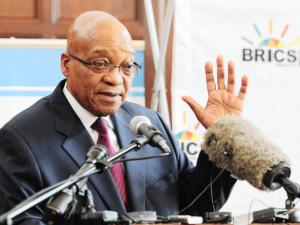
President Jacob Zuma, left

President Jacob Zuma, in a 2009 speech honoring the peacekeeping efforts of the South African National Defense Force (SANDF), proclaimed that “[South Africa] cannot survive in isolation, as its economic development and security is linked to the continent’s stability.” Zuma has since sought to set a higher standard for continental leadership by expanding and extending deployments of peacekeepers, and bolstering the development of the African Union’s African Standby Force (ASF), set to become operational in 2015.

• South Africa, one Africa’s more successful democracies and its largest economy, has mostly resisted Western pressure to intervene in other nations’ conflicts

• President Zuma has shown some enthusiasm for foreign engagement, but has been stymied by the poor condition of South Africa’s undersized and under-resourced military, with limited capability to project force in peacekeeping operations

• Declining domestic confidence in government has further complicated matters, as have strategic missteps, such as the Central African Republic mission that resulted in the deaths of South African soldiers.

Zuma’s activism in the peacekeeping arena has been constrained by longstanding political imperatives to demonstrate solidarity with Africa’s problematic cadre of revolutionary leaders (regardless of their human rights records) and to distinguish South African diplomatic and military objectives from Western, and even African Union, priorities. Unilateral military action in the Central African Republic (CAR), continued support for Robert Mugabe in Zimbabwe, and rhetorical support for “African-led” solutions suggests that adhering to UN and Western priorities may not be part of Zuma’s plan. Zuma’s remarks during President Obama’s June visit to South Africa celebrated growing African ownership of peace and security efforts, and had a defiant undertone: “Solutions that are African-led will be able to yield results.”

South Africa ranks eighth among African troop contributing countries (TCCs), behind less-democratic governments like Uganda, Rwanda, and Ethiopia—and even behind the tiny nation of Burundi, which only recently emerged from civil war and a GDP one-hundredth the size of South Africa’s. At the heart of South Africa’s underwhelming peacekeeping record is Pretoria’s reluctance to spend more money on the military. A 1999 arms deal, which provided South Africa with a superfluous supply of conventional weaponry, was financially ruinous and has depleted the budget for troop maintenance and essential peacekeeping equipment. As a result, the 62,000 strong SANDF, cobbled together from warring factions at the end of Apartheid, still lacks cohesion and increasingly suffers from a want of discipline and necessary skills. This has diminished deployment capability on complex civilian protection assignments. And since South Africa faces no immediate military threats, Pretoria has little incentive to divert funds from social priorities to improve force readiness.

South Africa has used its economic heft to entrench itself in international institutions: Pretoria has covered about 15 percent of the AU budget in recent years; it contributes more to the UN than any African nation; and so far this year has footed 20 percent of the budget for the Southern Africa Development Community (SADC). In the private sector, South Africa remains the largest developing country investor in Africa according to the UN Conference on Trade and Development’s world investment report. South Africa has deftly leveraged these contributions to political advantage, winning a non-permanent seat on the UN Security Council and turning the BRICs into “BRICS” (at first, the ubiquitous tagline referred only to Brazil, Russia, India, and China).

Zuma has managed to increase South Africa’s peacekeeping contributions on the margins, but only where obvious national interest are in play–such as South Africa’s bid for a permanent UN Security Council seat or its mining interests in war torn Central Africa, where the majority of its peacekeepers are deployed. Otherwise the contributions have been modest: Zuma has committed 1,345 troops (about a third of the total) to the new Force Intervention Brigade (FIB) operating in the Democratic Republic of Congo’s Kivu provinces and maintained the 850 South African troops supporting the AU/UN Hybrid Operation in Darfur (UNAMID).  And even so, Zuma has been obliged to create political cover by casting the interventions as acts of ”Ubuntu,” South Africa’s guiding philosophy of human kindness.

And Zuma’s rhetoric has not insulated him from public scorn, most notably in the wake of the March 25 disaster in the CAR, which the press described as South Africa’s “Black Hawk Down” moment.

But Zuma has assertively expanded South Africa’s military presence wherever the risk of political backlash is low. South Africans are ambivalent about launching their soldiers into sovereign African nations, but they favor the creation of African-led institutions. Hence, Zuma has been able to offer instrumental support to the nascent ASF, a 30,000-man army intended for rapid reaction to African crises. Zuma also proposed the creation of an interim force, prior to ASF’s ready date in 2015—the African Capacity for Immediate Response to Crises—which was announced this May, despite the deaths of 13 South African soldiers in CAR.

South Africa has supported peacekeeping endeavors when the mission accords with national interests and public opinion. These instances have admittedly been fewer than Washington and other donor nations would like. And regardless of Zuma’s own policy preferences, growing domestic unrest, a slowing economy, and backlash from the CAR affair could limit South Africa’s forays abroad still further. Public opinion matters in South Africa, and a year after the Marikana mining massacre—one of the worst incidents of police violence since the Apartheid era—distrust and frustration with government is at a post-Apartheid high. In consequence, toleration for military adventurism is likely to hit an all-time low.

• Zuma will seek opportunities to support peacekeeping through regional bodies but will avoid politically risky, unilateral engagements. Robust involvement in the creation of the ASF will garner regional and international plaudits. But key deficits in transport capacity and the quality of South African troops will limit the effectiveness of deployments.

• The conduct of South African peacekeepers during the dangerous operations being conducted in the Democratic Republic of Congo could alter domestic and international perceptions of South Africa’s peacekeeping capabilities. But given the ever-deteriorating situation in the DRC, and the inherent dangers of the offensive operation mandate, the likelihood of incidents that may damage South Africa’s reputation is high.

• To fill a peacekeeping quota on par with its economic heft, South Africa would have to make enormous and politically unpalatable investments in its military. Impressive economic growth would be needed to justify such expenditures—and to rectify the declining public trust in leadership.  Given the uncertainties of the global economy and the pressing need for increased social spending in South Africa, don’t expect Pretoria to pursue a broader stewardship role in Africa. – TSG IntelBrief

The real size of US military operations in Africa

africomThe Pentagon’s Africa Command will tell you there’s one military base on the entire continent. Don’t believe them.

They’re involved in Algeria and Angola, Benin and Botswana, Burkina Faso and Burundi, Cameroon and the Cape Verde Islands. And that’s just the ABCs of the situation. Skip to the end of the alphabet and the story remains the same: Senegal and the Seychelles, Togo and Tunisia, Uganda and Zambia. From north to south, east to west, the Horn of Africa to the Sahel, the heart of the continent to the islands off its coasts, the US military is at work. Base construction, security cooperation engagements, training exercises, advisory deployments, special operations missions, and a growing logistics network, all undeniable evidence of expansion—except at US Africa Command.

To hear AFRICOM tell it, US military involvement on the continent ranges from the miniscule to the microscopic. The command is adamant that it has only a single “military base” in all of Africa: Camp Lemonnier in Djibouti. The head of the command insists that the US military maintains a “small footprint” on the continent. AFRICOM’s chief spokesman has consistently minimized the scope of its operations and the number of facilities it maintains or shares with host nations, asserting that only “a small presence of personnel who conduct short-duration engagements” are operating from “several locations” on the continent at any given time.

With the war in Iraq over and the conflict in Afghanistan winding down, the US military is deploying its forces far beyond declared combat zones. In recent years, for example, Washington has very publicly proclaimed a “pivot to Asia,” a “rebalancing” of its military resources eastward, without actually carrying out wholesale policy changes. Elsewhere, however, from the Middle East to South America, the Pentagon is increasingly engaged in shadowy operations whose details emerge piecemeal and are rarely examined in a comprehensive way. Nowhere is this truer than in Africa. To the media and the American people, officials insist the US military is engaged in small-scale, innocuous operations there. Out of public earshot, officers running America’s secret wars say: “Africa is the battlefield of tomorrow, today.”

The proof is in the details—a seemingly ceaseless string of projects, operations, and engagements. Each mission, as AFRICOM insists, may be relatively limited and each footprint might be “small” on its own, but taken as a whole, US military operations are sweeping and expansive. Evidence of an American pivot to Africa is almost everywhere on the continent. Few, however, have paid much notice.

If the proverbial picture is worth a thousand words, then what’s a map worth? Take, for instance, the one created by TomDispatch that documents US military outposts, construction, security cooperation, and deployments in Africa. It looks like a field of mushrooms after a monsoon. US Africa Command recognizes 54 countries on the continent, but refuses to say in which ones (or even in how many) it now conducts operations. An investigation by TomDispatch has found recent US military involvement with no fewer than 49 African nations.

Despite what AFRICOM officials say, a careful reading of internal briefings, contracts, and other official documents, as well as open source information, including the command’s own press releases and news items, reveals that military operations in Africa are already vast and will be expanding for the foreseeable future.

A Base by Any Other Name…

What does the US military footprint in Africa look like? Colonel Tom Davis, AFRICOM’s Director of Public Affairs, is unequivocal: “Other than our base at Camp Lemonnier in Djibouti, we do not have military bases in Africa, nor do we have plans to establish any.” He admits only that the US has “temporary facilities elsewhere…that support much smaller numbers of personnel, usually for a specific activity.”

AFRICOM’s chief of media engagement Benjamin Benson echoes this, telling me that it’s almost impossible to offer a list of forward operating bases. “Places that [US forces] might be, the range of possible locations can get really big, but can provide a really skewed image of where we are…versus other places where we have ongoing operations. So, in terms of providing a number, I’d be at a loss of how to quantify this.”

The US maintains 10 marine gas and oil bunker locations in eight African nations, according to the Defense Logistics Agency. AFRICOM’s Benjamin Benson refuses to name the countries, but recent military contracting documents list key fuel bunker locations in Douala, Cameroon; Mindelo, Cape Verde; Abidjan, Cote D’Ivoire; Port Gentil, Gabon; Sekondi, Ghana; Mombasa, Kenya; Port Luis, Mauritius; Walvis Bay, Namibia; Lagos, Nigeria; Port Victoria, Seychelles; Durban, South Africa; and Dar Es Salaam, Tanzania.

The US also continues to maintain a long-time Naval Medical Research Unit, known as NAMRU-3, in Cairo, Egypt. Another little-noticed medical investigation component, the US Army Research Unit-Kenya, operates from facilities in Kisumu and Kericho. – Mother Jones

Zuma warns Africans against regime change

regimechangePresident Jacob Zuma says ideas to replace Africa’s democratically elected governments from outside the continent must be rejected.

The people of Africa must reject any idea from outside the continent, which would lead to regime change in an African state, President Jacob Zuma said on Saturday.

“Through the AU [African Union], the peoples of Africa must reject any idea from outside the continent, which seeks to foster an agenda of regime change,” Zuma said at the University of Fort Hare’s East London campus.

In a speech prepared for delivery at the university’s Organisation of African Unity (OAU) 50th anniversary lecture, the president said the replacement of democratically elected governments on the continent must be rejected.

“We must do everything we can to prevent Africa from being cheaply auctioned as a result of the ineptitude and lack of united action and resolve on the part of some of its leaders in safeguarding its vital territorial and sovereign interests,” Zuma said.

The mandate of the OAU had been to deliver African unity, freedom, independence, economic emancipation and development.

The achievement of these objectives still continued today under the banner of the AU.

The AU replaced the OAU on July 9 2002. The OAU was founded on May 25 1963.

Zuma said Africa was no longer a place devoid of hope as was believed in the past, with it now being one of the world’s prime regions of economic growth.

“Africa is one of the fastest growing regions in the world. It is no longer characterised as hopeless, but rather as a continent of hope and opportunity,” he said.

The economic emancipation of the continent, as envisaged by the OAU and AU, could be best attained through economic integration, he added. This would enable Africa to grow its markets, allow for more diversification, and encourage the optimisation of resources.

Integration would help lower transport costs, and ensure people, goods and services were able to move effectively and efficiently across the continent, according to Zuma.

For integration to be achieved, providing the needed infrastructure was key, he said.

“Roads, bridges, rail lines, pipelines, power plants, ICT connectivity, cables, ports, and water-ways are the underpinning arteries of growth,” Zuma said.

Africa’s people, including those who lived outside its borders, also had to recognise that they needed to contribute to its development, he said.

“Beyond this, Africa cannot develop if the continent is not peaceful, and there cannot be peace without development as the two are indivisibly intertwined,” Zuma said.

“The peace and security efforts that the African Union is championing in the continent are important and should be supported by every member state.”

Zuma said Africans should continue to think globally, beyond the confines of the continent.

“We want to be part of the UN Security Council. We want to see an urgent transformation of global economic institutions such as the World Bank and the International Monetary Fund,” he said. – Sapa

ANC launches online radio station

ubuntuThe government on Thursday launched an online, 24-hour radio station that aims to showcase its foreign policy and shore up its position as a continental economic and political powerhouse.

Ubuntu Radio, operated by the department of international relations and co-operation, will “change how Africa is covered”, said spokesperson Clayson Monyela.

“South Africa has a good story to tell and we have done extremely well over the past 20 years. Our foreign policy has evolved but that story is not being told,” he added.

Pushing for a permanent African seat on the United Nations Security Council (UNSC), South Africa is the only African member of the G20 and part of the Brics grouping, alongside Brazil, Russia, India and China.

Stimulate public debate

Monyela said the station aimed to stimulate public debate, with phone-in programmes and talk shows.

“We are not going to talk at our audience, but we are going to have discussions and conversations because people need to know what informs decisions on certain matters,” he said.

“Ubuntu” is used to describe African-style humanity.

South Africa has an estimated 14m internet users, roughly 39% of the adult population. – AFP

‘African’ is not Bantu

roodt_dan_wiki

by Dan Roodt

[followbutton username=’danroodt’ count=’true’ lang=’en’ theme=’light’]

Like Dan Roodt’s Facebook page

Sam Ditshego’s response entitled Ancient ‘Af-rui-ka’, Business Day 7 October, to my previous piece merely serves to confirm what I am saying: that neither the word nor the concept “African” is of Bantu origin.

Linguists differ on this, but three Mediterranean nations first used it: the Egyptians, the Carthaginians and the Romans. Via Latin, it spread all over Europe and eventually came to be used in sub-Saharan Africa too.

Frederik van Zyl Slabbert, a failed liberal politician, wrote a little book in Afrikaans in which he too played upon the ambiguity of the terms Afrikaner/African.

If there is any documentary evidence of other inhabitants of SA calling themselves “Africans” before 1707, I challenge Mr Ditshego to produce it.

Afrikaners are not “Europeans of Dutch extraction” either. Many of our people also came from Germany, France and Scotland.

Our relationship towards the Netherlands is complex, despite speaking mutually intelligible languages. In the recent past, Dutch Calvinists collected funds for terrorist bombings against Afrikaners in their very churches. They have a monarchy and we are republicans.

Most whites today would reject the notion that “white supremacy is a global power system”. According to Ditshego,

I have no truck with affirmative action and BEE and don’t give a hoot where they originated. Who affirms whom here? In the US, where African-Americans are a minority, they need to be affirmed and in South Africa, where Africans are in the majority, they still need to be affirmed. This confirms that white supremacy is a global power system.

In the US, the term used by George Bush — “New World Order” — has become popular for describing the global power system. It represents a kind of global, multicultural police state practising drone killings by remote control that is mostly inimical to white interests.

Unfortunately, South African Bantu have been defined by others, mostly by Marxist historians and anthropologists, but further back by missionaries who had documented and standardised their languages.

This process is still going on, with Prof Jonathan Jansen of the University of the Free State recently suggesting that the Bantu languages should be abandoned in favour of English.

Political correctness relies on stereotypes and shallow thinking, which is why Mr Ditshego cavalierly dismisses all German and French anthropologists from the first half of the 20th century as “racist”.

The German-born father of cultural relativism and a cult hero of the left, Franz Boas, lived and wrote precisely at that time. Claude Lévi-Strauss, too, was born in 1908 and did much to undermine any sense of European cultural superiority.

In a certain sense, there is no place for the rooted African in South Africa.

The European capitalist and the nomadic Bantu herdsman are united in viewing our land as simply a resource to be temporarily exploited until moving on.

That is the great tragedy of the Afrikaner people, in having developed a sentimental attachment to a land and a continent where the New World Order sees simply a province of the globalised US, exporting its own ethnic categories and concepts, such as “affirmative action” and “diversity”.

Also published as a letter in Business Day. on October 10, 2013

[followbutton username=’danroodt’ count=’true’ lang=’en’ theme=’light’]

Like Dan Roodt’s Facebook page

Kenya to host first yuan clearing house in Africa

Kenya wants to host a clearing house for China’s yuan currency – a bold African first that would deepen the continent’s ties with Beijing, already a big investor from The Cape to Cairo.

Such a venture would not eclipse the dollar in Africa anytime soon, however, because the yuan is tightly managed and traders are wedded to the greenback’s flexibility.

Africans can already get quotes for their currencies against the yuan . A clearing house would cut the need for dollar settlements, speed things up and reduce costs.

yuanBut the real prize for Kenya, or any other African host, would be the symbolism of being the continent’s business gateway with Asia’s economic emperor, even if business starts modestly.

Such an exchange would also be the first outside Asia.

Its prospect is a measure of China’s challenge to Africa’s traditional partners in Europe and the United States and reflects the increasing attractions of a continent with some of the world’s fastest growing economies.

“Even if the benefits to business have probably been slightly overblown by diplomats on both sides, I don’t think you can understate the symbolic aspect,” said Shilan Khan, Africa economist at London-based Capital Economics.

China’s ties with Africa have expanded fast.

In 2012, the total volume of China-Africa trade reached $198.49 billion, a rise of 19 percent over the previous year, Chinese government figures show. China accounted for 18.1 percent of Africa’s total trade volume in 2012, up from 3.8 percent in 2000.

“The proposal is basically to consider Kenya favourably given that the financial market is deep here,” Kenyan Finance Minister Henry Rotich told Reuters in August, citing rivals such as Nigeria, which already holds some reserves in yuan.

South Africa had a financial centre that dwarfs Kenya’s and has been mooted as a potential host, though officials there have not said they are pursuing such a plan.

“We are sort of competing and at the end of the day, the Chinese government is the one to decide where this clearing house will be,” Rotich said, making his pitch for east Africa’s biggest economy which aims to become a financial hub.

Early signals look good for Kenya.

“We are very positive about this clearing house and I think it is very important for Kenya to set up a financial hub here and to process the Chinese currency renminbi,” China’s ambassador to Kenya, Liu Guangyuan, told Reuters on the sidelines of a conference in Nairobi on Wednesday.

The value of potential business through such a clearing house was still a subject of discussion, he said.

Kenya’s daily turnover of foreign exchange is $330 million to $370 million, sometimes rising to $500 million.

Highlighting Nairobi’s enthusiasm for a clearing house based in Kenya’s central bank, President Uhuru Kenyatta made his bid for Beijing’s backing during a visit to China in August.

Business between Kenya and China is growing, even if Europe is still a bigger trade partner. Kenya’s Equity Bank, for example, has opened a branch in Nairobi for Chinese business executives, complete with Chinese tellers serving them.

“Everyone is trying to clinch a deal to directly clear and settle yuan transaction with the People’s Bank of China,” said an official at a Chinese state think-tank that often advises Beijing on policy, speaking about Africa’s clearing house plans.

In the meantime government officials in Niger have reportedly found evidence of bloated costs in oil deals with China National Petroleum Corporation (CNPC), leading the government to seek renegotiations on sections of
its contracts with CNPC. In Chad, CNPC operations have been suspended due to alleged “gross environmental negligence”, reports The New York Times.
Gabon, in another controversial move, will also be reclaiming Sinopec assets in 2015, because of breaches of contract, according to Macau- Daily Times

In August Chad’s oil minister Djerassem Le Bemadjiel told state radio that the Chadian government had “found flagrant violations of environmental standards by […] CNPC.

Not only do they not have facilities to clean spilled crude, there were also intentional spillages in order
reduce costs”, reported Reuters.

African entrepreneurs seek their Chinese dream

africa-phone-sellerFrom a windowless room in a dilapidated Hong Kong high-rise, Ali Diallo sells Chinese electronics to retailers across Africa. The modest surroundings belie the multi-million dollar business the West African trader has built in the five years since he moved to the city.

The 39-year-old from Guinea is part of a growing number of African entrepreneurs thriving in southern China, as trade between the world’s second-largest economy and fastest-growing continent soars.

Sitting in a small room cluttered with cardboard boxes destined for Nigeria, Diallo welcomes the latest delivery of Chinese-made mobile phones to his office in Chungking Mansions — a bustling labyrinth better known for budget hotels and no-frills restaurants.

The building is also the go-to place in Hong Kong for African buyers in search of cheap electronics, with phones selling from around $8 each.

“In China there are opportunities for people who can start from scratch and build up their own business. Obviously not in one day but through hard work and networking you can do it,” says the trader, whose company sees an annual turnover of $11 million a year through the sale of phones and tablets alone.

Trade between China and Africa hit new highs of nearly $200 billion last year, according to official Chinese data, driven by Chinese industry’s appetite for African raw materials.

The African traders in southern China are the flipside of this deepening relationship. Entrepreneurs like Diallo have made Chungking Mansions one of the most important passageways for Chinese gadgets air-freighted to Africa.

According to Gordon Mathews, professor of anthropology at the Chinese University of Hong Kong, up to a fifth of all mobiles in Africa have passed through the building’s corridors in recent years.

But while this 17-storey hive is the storefront, the engines behind this trade lie in the industrial heartland of neighbouring Guangdong province in southern China.

This mecca for low-cost manufacturing has drawn entrepreneurs from across Africa, creating one of the largest black communities in Asia.

In the provincial capital Guangzhou, at least 20,000 Africans live in the city, research from local Sun Yat-sen University shows.

Though their number is a fraction of the million Chinese now living in Africa, these migrants are playing a pivotal role in their new home.

“Traders bring with them vast skills and capital, supporting large amounts of Chinese manufacturers… If all the African traders were to vanish it would have an enormous effect on the south China economy and business people realise this rather strongly,” says Mathews.

Many traders work in and around a downtown neighbourhood dubbed “Little Africa”, or more insensitively “Chocolate City” by the local media. Along its winding central alley, a restaurant serves Tilapia with fufu — a staple Congolese meal of fried fish and cassava — as well as traditional Chinese fried rice and steamed fish.

A few kilometres away at Canaan Export Clothes Trading Centre, a vast complex where Igbo is spoken as often as the local Cantonese language, Lamine Ibrahim loads thousands of jeans into bags destined for Africa.

He is one of several hundred Africans who has forged a deeper connection to the city by marrying a local Chinese woman — a relationship founded on love but also economic prudence.

“For (communication) with the Chinese people… she can do. I buy my car, she is there, I open my own factory, she is there. So if I have no wife it’s not easy,” says the Muslim trader from Guinea in broken English.

Five months ago Ibrahim and his wife Choi Zoung-mai — renamed Maryam Barry after converting to Islam — opened their first factory hiring 43 Chinese workers. With this latest investment they hope to secure a bright future for their four-year-old son who speaks fluent Mandarin as well as French, English and Fula.

While there are several success stories, not all African entrepreneurs make it in China — for some rising costs and intense competition make it difficult to stay afloat. But this migrant community, which began forming in Guangzhou in the 1990s, has built a network of groups to support each other’s ambitions.

This is vividly apparent in the handful of African Pentecostal churches that have sprung up across the city. Tucked away on the ninth floor of a building behind Guangzhou railway station, 150 worshippers crowd into Royal Victory Church.

“Our prayer is that you will prosper,” the pastor preaches to cries of agreement from a mostly male congregation drawn from Nigeria, Cameroon and Ghana.

The African entrepreneurs who are flourishing in Guangzhou are succeeding where many foreigners fail. Not only are they navigating the notorious Chinese bureaucracy but at times overt racism in a country where prejudices can run high.

This can range from mild snubs from taxi drivers who refuse to pick up black customers to more serious accusations of traders being unfairly targeted by police when they conduct raids for illegal immigrants.

Even so others report good relations with the Chinese. “Many traders feel much more comfortable working in China than they do in Europe,” says Roberto Castillo, a Lingnan University researcher in Guangzhou.

Ojukwu Emma, president of the local Nigerian community, says the main problem for Africans trading in China are the increasing clampdowns on visas. He says it is getting harder for African residents in the city to renew visas, or for those travelling back and forth to gain re-entry.

“You cannot allow foreigners to come in and not give the foreigner confidence to stay. Once you are out to the world, you must be open,” says the businessman who has lived in the city for 16 years.

But for now booming Sino-African trade continues to draw new waves of African entrepreneurs, drawn to the shores of Guangzhou in search of the Chinese dream. – AFP

Sierra Leone deputy minister charged with rape

rape7Sierra Leone’s Deputy Education Minister Mamoud Tarawali has been charged with raping a university student, police said.

“He is facing counts of rape, wounding, wounding with intent and assault. He has been denied bail and is currently in Pademba road prison,” the inspector general of police Francis Munu said on Tuesday.

Tarawali was sacked last week after he was accused of rape.

He was in court on Monday to hear the charges read out and denied the accusations, police said.

Police said a complaint was filed by a 24-year-old student at the University of Sierra Leone in Freetown who said she was raped by Tarawali in a private residence.

Sierra Leone is recovering from years of war, during which sexual violence committed by fighters against women and girls was widespread. – Reuters

Africa will cease to be a rural continent

krotte
Anywhere in Africa…

According to the UN Population Division, sub-Saharan Africa’s annual urban growth rate is 3.6%, almost double the world average. About 40% of Africa’s more than 1 billion people live in cities and towns, many having migrated from rural areas to escape poverty, drought or conflict. About 200 million people live in slums.

“Africa is urbanizing faster than any other continent, so much so that by 2030, it will cease to be a rural continent,” said Anna Tibaijuka, executive director of UN-Habitat, the UN agency for human settlements. “Despite this, few African leaders are taking the issue seriously.” African governments have done little to manage rapid urbanization and don’t formally recognize slums.

Slums are not provided with public services, like electricity, sewerage systems, waste management, roads, housing and access to health care or education. And more than a quarter of Africa’s slum dwellers don’t have access to safe drinking water, according to the UN Environment Programme. A whopping 175 million people don’t have what’s considered reasonable sanitation.

That’s not going to change soon because Africa’s annual spending  on infrastructure is 45 billion dollars, African Development Bank statistics showed, while almost twice that amount is needed to address the biggest problems.

Sub-Saharan Africa’s largest city, Lagos, Nigeria, is a prime example of poor planning. The city of 11 million people, two-thirds of whom are slum dwellers, is infamous for its overcrowding, potholed streets, traffic jams, frequent power cuts and poor sanitation. “Lagos has fewer infrastructures than any of the other largest cities in the world,” Lagos Town Planning and Urbanization Commissioner Francisco Abosede told the UN news service IRIN.

As the population of Lagos grows by 8% every year, the slums and their associated problems are growing with it, fuelling crime and increasing social tensions.

The situation is not much different in Africa’s largest slum, Kibera, on the outskirts of the Kenyan capital, Nairobi. The city’s slums have become “an urban time bomb,” said James Njuguna, project officer at the Irish non-profit organization Concern International in Nairobi.

Kibera’s estimated 2 million people are a huge underclass with serious consequences for Nairobi’s security and social fabric, Njuguna warned. Frustrated young people often join violent criminal gangs. “The standard of living in the slums is constantly deteriorating,” Njuguna said. “We see rising school dropout rates, poverty, malnutrition and crime. There are no social services. “Unless governments make major political changes, cities like Nairobi might explode with social unrest.”

That’s also true of South Africa. A quarter of South Africans are unemployed, and huge numbers of jobless have been migrating to Johannesburg and Cape Town, the country’s two major cities.

“Government has been struggling to cope with the huge influx of people, to solve infrastructure problems and provide services,” said Thuthukani Ndebele, a researcher at the South African Institute of Race Relations in Johannesburg. “People feel abandoned.” For a South African slum dweller, hope turns first into frustration and then into anger. They believe they have rights.

BRICS makes its presence felt

bricsTotal trade within the BRICS (Brazil, Russia, India, China, and South Africa) grouping amounted to $6.1 billion last year, President Jacob Zuma said on Tuesday.

“This represents 16.8 percent of global trade,” he told delegates at the BRICS business council meeting in Johannesburg.

“The presence and influence of the BRICS grouping continues to be felt.”

Zuma said the strength of BRICS was amplified by the fact that these countries accounted for 43 percent of the world’s population.

“Indeed, we are all gathered here because we see value in the BRICS partnership in many respects.”

In 2012, South Africa’s total trade with BRICS countries stood at R294bn, up from R264bn in 2011.

Total trade with Brazil grew from R18bn in 2011 to R20bn in 2012, and with Russia from R3bn in 2011 to R5bn in 2012.

Zuma said total trade with India, South Africa’s sixth largest trading partner, grew substantially from R53bn to R67bn.

Trade with China grew from R188bn in 2011 to R201bn in 2012.

“All these impressive statistics… should provide you with the determination and confidence to deliver on the imperatives…” he told delegates.

Trade and Industry Minister Rob Davies said the council meeting was intended to deepen the partnerships to enhance co-operation and development on the African continent.

BRICS council South African chairman Patrice Motsepe said it was crucial that the commitment to increase trade and investment was seen, and “quantifiable”.

“There’s a new sense of urgency,” Motsepe said.

He emphasised “value-added trade” and common objectives being sought.

“BRICS is not about excluding other countries,” said Motsepe.

“We want to see investments quantify… It is important to build on the BRICS partnership.” – Sapa

Whites not welcome!

colored_no_whites-jim_crow_metal

by Albert Brenner

It has been 19 years now since the ex-European South Africans voluntarily handed over power to the black majority, and still there is no end in sight to the moral criminalization of all things white.  

And there will never be!

The revisionist feel-good perception has been created that the “evil” whites stole the innocence of the cherubic blacks who were living in eternal beatitude in a pre-colonial Eden called Afro-Atlantis. Asking Beelzebub’s brood (the Afrikaner) to commit collective suicide would be counter-productive because who will be at hand to accept blame when things go awry in Mandelatopia.

The only viable solution for restoring purity to paradise would be for the white devils to build a huge Noah’s Ark, and leave the country for good. And just before they embark for heaven-knows-where, they should all kneel down and pray for forgiveness for all the times they’ve raped South Africa and, to wipe the slate completely clean, take their satanic legacy with them – like, inter alia, building up a superb infrastructure, a world-class health-care system, exceptional retail and banking sectors, and – their ultimate sin – foisting a Written Language and the Wheel on angelic Southern Africa.

To be fair, apartheid was morally warped, but didn’t the Americans, Australians and Kiwis take it one step further in history – by all but wiping out the indigenous peoples who stood in their way!?

How many Native American Indians, Aborigines and Maoris really control their own destinies in these three so-called paragons of civilization? Mind you, how many Africans in Africa can claim they live on Cloud Nine?

To drop the political correctness for one day: Africa is a bloody mess, and no civilized human being can live here anymore! How much bla bla (blame it on slavery, colonialism and apartheid) is still pending before people like Desmond Tutu finally realize that sucking on the worn-out tit of Western penance will not guarantee Africa’s survival anymore – as has been the case since the post-colonial 70s!?

And (ab)using Mandela’s legacy as a moral soap to cleanse their hands of all stains of corruption, rape, murder and mayhem will never suffice as an acceptable excuse for the 500 000 (mostly black) South Africans who have been slaughtered since the supposed champions of 21-century morality came into power in 1994.

The holier-than-thou West should take heed: the fate of the whites in South Africa will be the ultimate fate of the rest of the West – be it in 50 or 500 years.

And that will be the time when all whites will have to prostrate themselves and ask for absolution from all their sins throughout the ages… even Socrates, Einstein, Shakespeare, Gutenberg, Da Vinci and Mozart!

First published in The Conservative Voice in January 2003.

Read more columns by Albert Brenner.

Former SA ambassador examines the land question

Paulo MndlovuJustice Piitso says the question of the ownership of the economy is the nerve centre of the struggles of the people

A revolution will remain incomplete without the resolution of the fundamental question of land ownership.

Next week the people of Zimbabwe will have an opportunity to exercise their democratic right to elect the government of their choice when they will be going to the polls.

This will be the most historic elections paving way for the end of the power sharing unity government between the ZANU -PF under President Robert Mugabe and the MDC under Prime Minister Morgan Tsvangirai.

This complex transitional arrangement is unfolding under the auspices of the watchful eye of the international community. The recent past elections were marred by allegations of state sponsored violence and intimidation of voters that made it difficult for a conducive environment of a free and fair elections.

It will therefore be in the best interest of the people of Zimbabwe that the forthcoming elections take place within the enabling framework of a free and fair environment. The people of Zimbabwe, Southern African region, the continent and the world need peace and stability.

The elections are taking place against the background of protracted forms of struggles between the government of Zimbabwe and the former colonial power Britain, over the historic land ownership question.

The political tensions escalated when the government under the leadership of ZANU-PF, embarked on a programme of seizure of land from the hands of the few white into the hands of the vast majority of the black people of Zimbabwe.

The state led radical programme for seizure of land from the white Zimbabwean community, sparked a fierce reaction that prompted the international community to impose sanctions against the government under the leadership of President Mugabe.

The imposition of the economic sanctions by the international community was a confirmation that colonial societies are ordered by imperialism. The reason why we say the Zimbabwean revolution fiddled with the nervous system of the forces of imperialism and colonialism.

It is from this context that revolutionaries openly debate on the important question of the complexities of the post colonial transitional periods, and how they affect the struggles of our people in the former colonies and semi colonies.

Equally we need to appreciate this as a metamorphosis of how the post colonial contradictions manifest themselves in the arena of the struggles of our people, against imperialism and neo colonial domination.

In the year 1980 Zimbabwe was declared an independent state after decades of protracted forms of struggles for national liberation against British colonial domination and the racist South African apartheid regime.

The declaration of the independence of the former colonial state of Rhodesia, was a historic breakthrough in the struggles of our people for the liberation of the Southern African region.

The declaration of the independence of the former colonial state of Rhodesia was a product of a negotiated transitional political arrangement. The transitional negotiations culminated into the former colonial master Britain and the liberation movement of Zimbabwe signing the historic Lancaster Agreement.

At the heart of the watershed agreement was the unwavering commitment by the British colonial government to assist in ensuring equitable transfer of land back to the overwhelming majority of the people of Zimbabwe. It was agreed that the process should be completed within the first decade of the transitional period.

Historical records prove that the British colonial government rescinded by not expediting the process of the transfer of land as agreed at the Lancaster house. This is the fundamental problem that has aggravated the present socio economic crisis.

The Zimbabwean land ownership question is a living testimony of how complex post colonial transitional period can be in the context of the history of the struggles of our people in the former colonies and semi colonies. It also relates to the nature and the character of the struggles, between the oppressor and the oppressed nations, post colonial transitional period.

At the core of these struggles is the fundamental question of how do we involve the oppressed people in the former colonies and semi colonies into the mainstreams of our economy. The primary issue remains to be how do we resolve the fundamental question of the ownership of the economy.

The scientific historical realities have proven that the question of the ownership of the economy is the nerve centre of the struggles of our people. The basic reason why it has become the most contentious issue after every war of the independence of our people.

The pertinent question is how do we understand the interrelationship between the primary and secondary contradictions. The mistakes we must avoid is to elevate secondary contradictions at the expense of primary contradictions.

Imperialism is trying to confuse our people by elevating the superficial issues of human rights at the expense of the fundamental question of the ownership patterns of the economy.

We must therefore refuse the attempts by imperialism to reduce the role of the people in the former colonies and semi colonies into being praise singers of national anthems and hoisting of National flags.

The most fundamental question is how do we take forward the common struggles of our people to create a new world social order. Our immediate task is to implore our collective responsibility to resolve the contradictions of poverty, disease and underdevelopment inflicting the poor people of the world.

We therefore have to ask ourselves the most important question as to what are the lessons and experiences we have learned out of the contradictions of the Zimbabwean post colonial transition.

We have to ask ourselves the most important question as what is the role and influence of the phenomenon of imperialism and colonialism during the transitional period of the post colonial nation states.

The essence of any revolutionary phase is about generations of mankind making sacrifices. The people of Zimbabwe have made sacrifices during the struggles for liberation against British colonial rule, and they are still making sacrifices today as they continue with the struggles for the socio economic transformation of their country.

The struggles of the people of Zimbabwe are still consistence with the values, culture and traditions of the progressive movement of the world. Its posture is still anti colonial in form and content.

The only task confronting the collective leadership of the ZANU-PF is how to polish their understanding of the scientific revolutionary concept of the role of an individual in the making of history.

The collective leadership of the ZANU-PF will go into the annals of history, having been the first generations of the people of the former colonies and semi colonies to have fiddled with the nervous system of the forces of imperialism and colonialism.

Phatse Justice Piitso is the former Ambassador to the republic of Cuba and the former provincial secretary of the SACP.

Rising Africa, the hopeful continent

africacontinentIn May 2000, the respected international weekly magazine The Economist published a provocative lead article describing Africa as “the hopeless continent”.

To illustrate the hopelessness, the magazine picked several of Africa’s cities as case studies. Among those cities was Freetown, the capital of Sierra Leone, which, according to the magazine, symbolised Africa’s “failure and despair”.

Sierra Leone itself was described as being “of no great importance” because the country’s only relevance to the world was the sympathy needed for its people.

This beleaguered country, it was said, was nevertheless “a symbol of Africa”.

The article elicited condemnation from various quarters, including African government leaders, the academia and analysts. The magazine was reinforcing age-old negative perceptions of Africa, it was said.

The magazine would later atone for its pessimism – albeit 10 years later.

The cover page for the December 2011 edition labelled Africa “The Hopeful Continent”. And they had statistics to back it up.

Over the past decade, it was noted, “six of the world’s 10 fastest-growing countries were African”. In eight of the past 10 years, the magazine said “Africa had grown faster than East Asia, including Japan”.

It was as if there were two Africas: the one described in the May 2000 issue and the other as described in the December 2011 edition. And The Economist is not alone in having had to retract (although tacitly) its own coverage of developments in Africa.

Before South Africa’s successful hosting of the 2010 World Cup, the London-based Guardian newspaper carried an article in which one of their reporters warned potential tourists against visiting South Africa for the spectacle.

In “Why going to South Africa for the World Cup terrifies me”, Guardian journalist Louise Taylor claimed that South Africa was “more dangerous than Iraq and Afghanistan”.

Taylor added: “Deep down, there must be some VIPs pacing Fifa’s corridors of power who harbour nagging regrets that Egypt or Morocco did not pip South Africa and win the vote.”

Interestingly, Taylor had not visited the country before. Her article was based entirely on anecdotes and desktop information. The stereotypical view of Africa as a “dark continent” persists, despite evidence pointing to a continent on the rise.

Africa’s economy is growing at a rapid rate despite the global economic downturn that is adversely affecting some of the continent’s major trading partners, especially those in the euro zone.

The continent is also increasingly adhering to principles of good governance, which include regular democratic elections, adherence to the rule of law and the creation of a climate conducive for trade and investment.

Once a continent known for coups d’état, Africa now holds more elections than ever. In the 1960s and 1970s, according to a recent study, African countries held a total of 10 elections a decade.

This is on a continent of 54 countries.

Latest stats indicate that Africa now holds 41 elections every five years.

Of concern remains the ability of African countries to trade among themselves. Current trade among African countries stands at a paltry 10 percent, excluding trade in oil. Simply put, Africa trades with everyone except itself.

The overwhelming majority of African countries are single-commodity economies, exporting raw materials at a fraction of their value to markets in Asia, North America and Europe.

Together with other countries, South Africa has expressed its belief that integration and intra-trade at the level of regional economic communities will pave the way for greater continental economic integration. A lot of progress has been made regarding the establishment of a Tripartite Free Trade Agreement (T-FTA) between the Southern African Development Community (SADC), the Common Market for Eastern and Southern Africa (Comesa) and the East African Community (EAC). The T-FTA will combine the markets of 26 countries with a population of nearly 600 million people and a combined gross domestic product of $1 trillion (R9.8 trillion).

In summary, this key initiative will provide market scale that could launch a sizeable part of the continent onto a new industrialisation trajectory. The T-FTA will also form part of an Africa-wide FTA, which will create a market of $2.6 trillion.

Delivering the Department of Trade and Industry’s Budget Vote in Parliament recently, Minister Rob Davies said negotiations were proceeding, but that efforts in this regard had to be complemented by the promotion both of infrastructure development and co-operation to transform productive sectors and industrialise Africa.

The minister said investors had not been put off by challenges, but recognised Africa as the next growth frontier and the key strategic importance of South Africa as the most industrialised African country.

The 2013 Africa Competitiveness Survey by Ernst and Young says: “Africa’s rise over the past decade has been very real. While sceptics still abound, and there are people who still seek to debate the point, the evidence of the continent’s clear progress over the past decade is irrefutable.

“Over this period, a critical mass of African economies have grown at high and sustained rates; so much so that, despite the impact of the ongoing global economic situation, the size of the African economy has more than tripled since 2000.

“The outlook also appears positive, with many parts of the region forecast to continue experiencing relatively high growth rates and a number of African economies predicted to remain among the fastest growing in the world for the foreseeable future.

“At the same time, though, individual countries and the region as a whole still need to address significant challenges in order to sustain this progress, and to emulate the kind of developmental path we have seen in places like South East Asia over the past 30 to 40 years. We are of the view that Foreign Direct Investment (FDI) will play a key role in this process as both a source of capital, but, more importantly, as a catalyst for job creation, skills development, technology transfer, and ultimately, the longer-term diversification and transformation of key African economies.”

The growth in the African economy has increased the potential for FDI projects into Africa, as well as creating positive growth for investors in Africa. With South Africa being the single largest investor (2012 FDI projects) in Africa, there is ongoing confidence and interest among African countries regarding its potential growth and future.

The highest levels of growth have been found to originate in sub-Saharan Africa, with the lowest in north Africa. This stagnation in the north is mainly caused by the political instability within the region which has discouraged potential investors and caused certain levels of divestment.

The boom in the southern region is mainly due to the large levels of investment by South Africa in countries in the SADC region.

The role of South Africa as a strong investor has increased over the past decade as it is placed fifth on the list of top 20 countries that source FDI projects in Africa.

This makes it the largest African source of FDI projects with a compounded growth of 57 percent, in South African-originated projects into Africa, since 2007.

The pessimistic view of Africa as a dark, hopeless continent is being challenged by concrete stories of economic development and a general improvement in the standard of living of Africa’s people. – by Clayson Monyela. Monyela is the deputy director-general: public diplomacy in the Department of International Relations and Co-operation.

Malawi faces hunger

malawihungerNearly 10 percent of Malawi’s 13 million people face hunger due of low yields of the main staple maize, prolonged dry spells and flooding, a report said.

“The total number of people who will not be able to meet their annual food requirement during the 2013/14 consumption period is 1,461,940, representing 9.5 percent of national total population,” the Malawi Vulnerability Assessment Committee said.

The grouping of several government departments, the United Nations, embassies and humanitarian agencies said those affected will need assistance for a period of between two to five months.

The shortages will affect poor households in 21 districts of the southern African country.

Food shortage in this impoverished southern African country is often caused by drought and economic difficulties as wellas backward farming practices.

One in two Malawians lives on less than a dollar a day.

Malawi had a good food security record in recent years after late president Bingu wa Mutharika implemented a subsidy programme giving poor villagers access to fertilisers and inputs. – Sapa