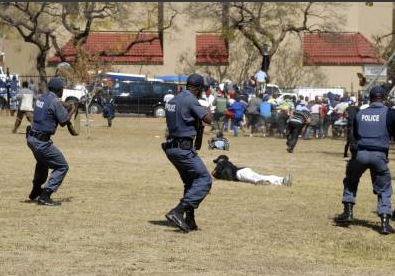
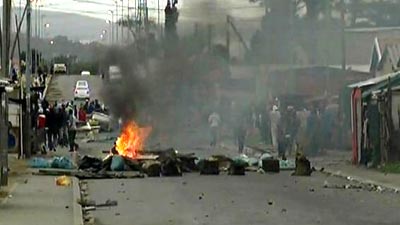
The ANC retained control of two of the three wards in the Tlokwe (Potchefstroom) by-elections in the North West on Wednesday.
The party’s candidate Oupa Mogoshane lost Ward 26 with 900 votes to independent candidate Batiki “Stone” Mahlabe’s 1425 votes, according to the IEC’s results report.
The United Christian Democratic Party candidate Moeketsi Phakedi received 10 votes.
A total of 5677 people were registered to vote in the ward of which only 2374 cast their ballot. There were 39 spoilt votes.
Mahlabe, who was a former African National Congress councillor in the area for 12 years, registered as an independent candidate after he was expelled along with 13 others from the party in July for participating in a motion of no confidence against Tlokwe mayor Maphetle Maphetle.
Maphetle was replaced by Democratic Alliance councillor Annette Combrink.
However, the ANC’s national disciplinary committee overturned the expulsions but Mahlabe decided not to return to the party.
In the 2011 local government elections, the African National Congress won Ward 26 with 3403 of the 3580 valid votes cast, which gave them an overwhelming majority of 95.06 percent of the votes.
The ANC won the by-elections in Ward six and 18 on Wednesday.
In Ward 18 the ANC faced off with another former party member and provincial chief whip David Kham, who registered as an independent candidate.
Kham, like Mahlabe, was one of the 14 councillors expelled from the party.
ANC candidate Thapelo Skozana won with 884 to Kham’s 520 votes.
The Azanian People’s Organisation’s Matladi Mofokeng received 11 votes and the UCDP’s Molebatsi Lehloo 10 votes.
A total of 3251 people were registered to vote in Ward 18 but only 1452 votes were cast and 27 of those were spoilt.
In 2011, the ANC won the ward with 1859 of the 2009 votes cast which resulted in a 94.37 percent victory.
In Ward six the ANC’s Japhta Monaisa won 882 of the 1386 valid votes cast. The Democratic Alliance’s Johann Coetzee came in second with 493 votes.
Azapo’s Lesego Malepe received six votes and UCDP’S Mawela Dinko received five votes.
A total of 4254 people were registered to vote in Ward six but only 1408 came to the polls. There were 22 spoilt votes.
In 2011, the ANC received 1352 (64.26 percent) of the 2104 valid votes and the DA received 720 (34.22 percent) of the votes. – Sapa
Former President says country continues to present an anomalous picture to the world
SPEECH BY FORMER PRESIDENT FW DE KLERK FOXHILLS RESORT, ENGLAND, September 13 2013
SOUTH AFRICA: PAST, PRESENT AND FUTURE
I should like to talk about South Africa: our past, our present and our future -‐ about
where we have come from since the 1980s;
where we now find ourselves; and
where we are going.
It is especially appropriate to do so now -‐ because I can recall no time since 1994 when so many South Africans have been so despondent.
We should remember 1994 -‐ not only because it was the birth of our new society -‐ but because it provides an important reminder that we South Africans have the ability to solve even the most intractable problems.
It is easy to forget now how desperate our situation was in the mid-1980s:
Our efforts to reform apartheid -‐ including the scrapping of more than 100 apartheid laws and the introductions of the tricameral parliament had simply redoubled demands for “one-‐man, one vote”;
We were beset with internal unrest and increasingly violent protests;
Scenes of chaos and insurrection in our streets dominated TV screens throughout the world;
After the Rubicon speech the rand had plummeted through the floor;
Unsure of the government’s ability to control the situation, international banks had pulled the plug on us by refusing to roll over our short-‐term debt;
Demands for comprehensive economic sanctions were reaching crescendo pitch;
Our armed forces were confronting increasing attacks on our borders and the borders of Namibia -‐ attacks that were supported by 50 000 Cuban troops.
There were no signs of light on the dark and stormy horizon.
And yet -‐ by 1990 -‐ we had clawed our way back from the precipice.
The victory of our forces at the battle of the Lomba River in September 1987 had finally convinced the Soviets, the Cubans and the Angolans that there was no prospect of a military victory.
The following year we began negotiations on the withdrawal of Cuban forces from Angola and the parallel implementation of the UN independence process in Namibia;
Also by 1987 the ANC had accepted that there would not be a revolutionary outcome in South Africa and that the only path to the future lay through negotiations;
The successful independence process in Namibia in 1989 showed that it was possible to negotiate successful outcomes with enemies;
Finally, the collapse of the Soviet Union -‐ symbolized by the fall of the Berlin Wall in November, 1989 -‐ signaled the arrival of an entirely new global paradigm.
By the beginning of 1990 these events had opened a historic window of opportunity for a peaceful and negotiated settlement. We did not hesitate. We jumped through -‐ and after almost four years of roller-‐coaster negotiations we were able to reach a national accord on our future.
It was our proudest moment.
Our 1993 and 1996 constitutions were the outcome of the genuine give and take process inherent in all negotiations. The final agreement was at least as close to original negotiating positions of the non-‐ANC parties as it was to that of the ANC.
It contains all the basic rights that we need to maintain a free and prosperous society.
It articulates the values of human dignity, equality, fundamental rights and non-‐ discrimination on which the new South Africa has been established.
It acknowledges the supremacy of the Constitution and the rule of law.
It makes provision for all the institutions and mechanisms that are necessary for multiparty democracy based on accountability, openness and responsiveness.
It has served us well for the past 19 years. Which brings me to the present.
It is important to remember the many, many successes that we have achieved since 1994 -‐ many of them as a result of government action:
We have experienced 19 years of economic growth -‐ interrupted only briefly by the global economic crisis of 2008.
The regulation of our security exchanges and our reporting standards are the best in the world;
Our banks are the second soundest in the world and our corporate boards are the second most efficacious. Our financial services and protection of minority shareholders are third best in the world and our ability to finance local equity is the fourth best internationally.
We are one of the primary gateways to Africa -‐ and are now the fifth largest investor in the continent.
We have also made significant social progress:
The percentage of the population living in absolute poverty has declined to less than 20% -‐ largely because of social grants.
More than three million housing units have been built -‐ enough to house almost a quarter of the population -‐ with another million units in the pipeline;
More than three quarters of the population now have access to electricity, drinkable water and sanitation
We have experienced moments -‐ like the 2010 Soccer World Cup -‐ when we have lived up to Archbishop Tutu’s characterization of us as the Rainbow Nation of God;
We have seen the rapid growth of new and self-‐confident black middle class. Whites now comprise less than 40% of the top decile of income earners.
At the same time we are beset by serious problems. One can hardly disagree with the diagnosis of the National Planning Commission regarding the nature of these challenges. They include:
High unemployment -‐ closer to 40% than the official figure of 25,6%;
Poor education -‐ especially for black South Africans -‐ who fare badly in comparative tests with children from the poorest African countries;
Poor public service delivery -‐ which has led to virtually daily protests throughout the country;
rising levels of corruption; and
the fact that South Africa is still a divided society.
Another growing problem is the increasingly destructive role that is being played by our militant trade unions. It is one of the main causes of unemployment and of our failure to attract the foreign investment that we need for sustained economic growth:
South Africa has the worst labour relations in the world. According to the World Economic Forum’s Global Competitiveness Report it is the worst of 144 countries assessed in terms of co-‐operation in labour-‐employer relations;
COSATU has continuously raised labour costs without commensurate productivity increases -‐ which has inevitably resulted in job losses. South Africa’s flexibility of wage determination is the fourth worst in the world.
Our labour legislation is amongst the most onerous anywhere. South Africa’s hiring and firing practices are the second worst in the world.
COSATU’s campaign to abolish labour brokers would lead to the loss of more than half a million jobs.
COSATU has steadfastly opposed proposals to open labour markets to the unemployed.
It is destroying jobs by alienating foreign and domestic investors through its confrontational stance and open support for nationalisation.
On top of all this came the Marikana massacre of 16 August last year; the subsequent wave of violent and uncontrolled wildcat strikes and hopelessly unrealistic wage demands. All this has been compounded by the precipitate fall of the rand against the US dollar.
So South Africa continues to present an anomalous picture to the world:
on the one hand a picture of failing governance; out of control trade unions; rising corruption and daily service delivery protests -‐ and
on the other hand, a picture of economic dynamism, enormous opportunities and a counter-‐intuitive sense of optimism -‐ particularly in bustling Johannesburg.
But what of the future?
Predicting the future is one of the most risky of all endeavours -‐ since we live in such rapidly changing times. Nevertheless one can identify some of the salient factors that will undoubtedly influence the course of events:
Whatever happens in South Africa will take place within the framework of macro-‐ developments on the global stage -‐ just as they have always done in the past;
Secondly, current developments within the ANC’s ruling alliance will play a key role. The question is whether the leadership will be able to hold together an alliance which now encompasses the whole spectrum
from Stalinism to social democracy;
from exclusive black nationalism to inclusive non-‐racialism;
from genuine commitment to sound governance to pervasive crony capitalism and entrenched kleptocracy?
Will the ANC be able to continue to plaster over these increasing obvious cracks -‐ or will it split?
Thirdly, will it be possible to moderate the behavior of our rampant and wildly irresponsible trade unions?
Fourthly, will the government break away from its race-‐based ideology and accept the idea that the skills of all South Africans must be used to enable the country to address its problems and achieve its potential?
Finally, a critical factor will be our ability to maintain the excellent Constitution that we South Africans negotiated between 1990 and 1996 and the institutions that it mandates including
free and impartial courts;
an independent National Prosecuting Authority; and
government that is accountable, transparent and responsive.
So, these are the factors that will play significant roles in determining our future:
What will happen on the global stage?
What will happen within the ANC Alliance?
Will we be able to control the trade unions?
Will we be able to liberate ourselves from race-‐based ideologies? And,
Will we be able to uphold our Constitution and achieve the vision that it articulates?
Personally, I remain an optimist -‐ and believe that we shall be able to surmount the challenges that confront us now -‐ just as we were able to overcome the much greater problems that we faced 25 years ago.
Issued by the FW de Klerk Foundation, September 16 2013
The police must stop the violence between South Africans and Somalians living in Port Elizabeth, the ANC in the Eastern Cape said on Monday.
“Any type of violence, including looting of shops owned by Somali nationals is illegal, wrong and has no place in South Africa,” African National Congress provincial secretary Oscar Mabuyane said in a statement.
“The SA Police Service members are the first and last line of defence for our communities, and we call on them to use the law and public order policing techniques to stop this wave of violence.”
Eastern Cape police said seven men had been arrested at the weekend for looting and burning Somali-owned shops in Port Elizabeth.
At least 10 shops in KwaZakhele and New Brighton were attacked.
Brigadier Miranda Mills said two shops were looted and burnt in Ntintili street, and a car parked outside was set alight.
Several other shops were targeted on Sunday following the arrest of a Somali man accused of shooting dead a man outside a shop on Saturday evening.
Police had since moved some foreigners out of the area.
Mabuyane said the ANC in the province was calling on residents in the Nelson Mandela Bay Metro to refrain from taking the law into their own hands.
“Somali nationals must also stop using violence to resolve challenges they face but must put their trust in the police to deal with any challenge.
“Violence will not help us deal with any situation but will make matters worse for our people,” he said. – Sapa
The ANC have released a statement condeming what appears to be an attempt to burn down its headquarters, Chief Albert Luthuli House this evening around 18:00.
The party says a suspicious fire broke out at the reception of the building next to the main entrance. The fire burned a reception coach and damaged glass.
ANC spokesperson Jackson Mthembu said senior ANC members were meeting on the 11th floor when they were alerted to the fire.
Mthembu said in a live interview with eNCA that a bottle of what “smells like chemicals” exploded in the foyer.
The attempt was foiled by the intervention by building security personnel who used fire extinguishers to put down flames that were almost reaching the ceiling of the reception area.
The ANC says they view this in serious light and say it appears as an act of attempting to destabilise the party through acts arson and sabotage. The party however, would not elaborate on who they felt was behind the suspected arson.
Mthembu says CCTV footage is being monitored and the police have taken over the parameters of Luthuli House with a view to investigate the source the fire and to ensure that there is no other pending threat to the building and people in the building.
Dog unit and ballistics experts are on the scene and officers will inspect the entire building.
About 80 protesters were arrested on Monday for their involvement in a violent protest outside the Germiston Civic Centre where Ekurhuleni Mayor Mondli Gungubele refused to address them.
The protesting group, which was made up of Umkhonto we Sizwe military veterans and the Azanian People’s Organisation members, forced its way into the building, damaging doors, windows and equipment.
Warning of scenes similar to the Marikana tragedy, the group said it would not back down until government addressed its demands.
These included the fulfilment of promises it claimed the ANC made 11 years ago, including government subsidies for their contribution to the struggle and to be integrated into the police and military.
The protesters said they had letters from government to prove their claims.
The remaining 70 protestors who had not been arrested said they would not stop until they too were taken into custody.
The group added that it would not be voting nor campaigning for the ANC ahead of the 2014 general election. – EWN
Mr. Hein Boonzaaier, one of the accused in the so-called “Bloemfontein 4 terrorism case” has just walked free from the Bloemfontein Magistrate’s Court, with the state withdrawing all charges against him. After eight months of investigations, the state could not find evidence of wrongdoing against the blogger and activist.
Over the last few years Mr. Boonzaaier had visited the United States twice, also attending an American Renaissance conference in Charlotte, North Carolina. According to him, he was seen to be guilty “by association” in having sought support for the Afrikaner cause among US conservatives.
On 16 December 2012, the Day of the Vow for Afrikaners, Mr. Boonzaaier was out in his garden walking his beloved dog, an indigenous Boerboel bitch. He lives in Centurion, a suburb of Pretoria.
“It was exactly a quarter to eight in the morning,” he said. “The next moment there appeared 30 heavily armed policemen in full-body armour and with automatic weapons trained on me. I had no idea what was going on and did not know whether it was some kind of joke or whether I should run away.”
In an open letter published Monday in Afrikaans elsewhere on the PRAAG site, he explained how both his dog and his wife were threatened too, with the sub-machine guns being waved about. The heavily armed police had two warrants: one to search his house and another to arrest him for high treason.
He had to spend two months in prison before he was let out on bail. The state opposed his bail application, as well as those of the three other accused, Johan Prinsloo, Mark Trollip and Martin Keevy.
According to his legal team, “he should never have been arrested”. Boonzaaier stated: “I think it purely revolved around an attempt to discredit me, a goal in which the state and the media have amply succeeded.”
Trial by media
Boonzaaier photographed in Mississippi, proudly wearing a new acquisition
Mr. Boonzaaier’s day job is that of financial consultant. Both South Africa’s powerful Naspers media group and the left-wing Mail & Guardian newspaper castigated him with a “trial by media” during which he was vilified as a “right-wing extremist”, “coup plotter” and so on.
According to Boonzaaier there was an attempt to fabricate evidence against him by distorting statements he had made in the USA so that “it would sound as if he had said exactly the opposite of what he had said in reality”.
Before his arrest, Boonzaaier was involved in the formation of a new political party, the Federal Freedom Party, aiming to contest elections in 2014 in South Africa. He was elected as president of the new party. “My attempt to participate in democratic politics was, however, answered with a ham-fisted, wrongful arrest,” he said.
Boonzaaier is of the opinion that the order to arrest him came from within the ruling ANC. “The most bizarre thing was that the National Prosecuting Authority, which is an independent body in terms of the South African constitution, did not want to release me, despite there being no proper charge or evidence against me. Only when the minister agreed to it, was I finally released. South Africa is becoming more and more like Zimbabwe where the criminal justice system is controlled by politicians within the ruling party.”
“I think it was all part of a plan to discredit our political party, apart from it being directed against me personally. I got the impression that the government did not want me to take part in politics,” Boonzaaier said.
The case against his three fellow accused is continuing. Mr. Martin Keevy was previously declared “psychologically unfit to stand trial“, something which the state prosecutor is disputing. So Keevy has now been referred back to the Bloemfontein psychiatric institution which examined him in the first place for a second observation period of 30 days.
‘Sushi King’ and porn entrepreneur Kenny Kunene has resigned from his senior position in Julius Malema’s Economic Freedom Fighters (EFF) movement.
According to the Star, Kunene told the newspaper he was resigning as head of campaigns, mobilisation and special projects with immediate effect and would no longer hold a leadership position in the party.
Among other complaints, Kunene criticised Zuma’s friendship with the Gupta family.
“The Gupta issue alone should be the last straw for many South Africans,” Kunene wrote in the letter, published in the Star.
When asked if he still intended to Vote for the EFF, Kunene reportedly said that his vote was secret, but that he is still committed to economic freedom.
“I will remain an economic freedom fighter for ordinary people,” IOL reported him as saying.
The EFF recently made headlines when Julius Malema and fellow party members visited the magistrate’s court in Fochville, wearing their distinctive red berets, to show support for residents who had been arrested after violent protests.
The movement has filed papers with the IEC to formally register as a political party.
Malema, whose tax affairs have recently been audited, claimed earlier this month that Kunene and other EFF members had also received notices from Sars that they were under investigation. – eNCA
The African National Congress has broken the affirmative action deal it reached with the National Party in 1994, apartheid era foreign minister Pik Botha reportedly said.
According to a Fin24 report Botha said that Affirmative Action in its current guise was not what the two parties agreed upon.
The former minister said that the intention during the negotiations was to rectify the injustices of the apartheid era. Botha though said that had the ANC insisted on including the current Employment Equity Act in the Constitution at the time, then having a new constitutional dispensation would have been impossible.
“Discrimination against white young people, who had nothing to do with apartheid, was definitely not part of the agreement between the NP and the ANC. Neither, generally, was discrimination against whites, coloureds or Indians,” Botha was quoted as saying by Fin24.
“The boomerang effect of the Employment Equity Act is that masses of black people are still untrained and unemployed and that the country’s economic progress is severely hampered by a shortage of skills. This affects millions more blacks than whites,” Botha added.
Botha opined that fundamental talks between leaders of all races was needed to “agree on the road ahead”. – iAfrica.com
The ANC’s regional secretary in eThekwini (Durban) has been accused of assaulting a member of the party’s youth league, the Sunday Tribune reported.
According to the report, Bheki Ntshangase was alleged to have struck Menzi Ngcobo, a local ANC Youth League member, at a party meeting in Durban’s Umlazi township recently.
Ntshangase was reportedly incensed that the gates to the hall where the meeting was being held had been locked.
Police spokesman Captain Thulani Zwane told the newspaper that a charge of assault had been lodged at the Umlazi police station.
Ntshangase denied the allegations, the newspaper reported. – Sapa
African cleansing ceremony at the site of the Marikana killings
The first anniversary of the shooting at Lonmin’s Marikana mine, near Rustenburg in the North West, will be marked during a commemorative rally on Friday.
On August 10 last year, Lonmin rockdrillers embarked on an unprotected strike for a monthly salary of R12,500.
More workers joined the strike and the protesters gathered at a hill near Nkaneng informal settlement carrying weapons, such as pangas, spears, knobkerries, and iron rods.
On August 16 last year, police trying to disperse and disarm them opened fire on the mineworkers, killing 34 of them.
Ten people, including two policemen and two security guards, were killed in strike-related violence the preceding week.
Several violent deaths in the area following the Lonmin strike have been blamed on rivalry between the Association of Mineworkers and Construction Union (Amcu) and the National Union of Mineworkers (NUM).
The Congress of SA Trade Unions, to which NUM is affiliated, said that there had been “overwhelming concern” in the wake of the Marikana shooting that such killings should never again happen in democratic South Africa.
“Tragically however, one year later, we cannot say that there have been no further deaths,” spokesman Patrick Craven said in a statement on Thursday.
Social problems, poverty and lack of transformation still affected the lives of mining communities.
A framework agreement for a sustainable mining industry, signed by government, employers and most unions, needed to be fulfilled in order to prevent a repetition of the Marikana tragedy, Craven said.
He said the union federation was “bitterly disappointed” at the procedural arguments stalling the work of the Farlam Commission.
President Jacob Zuma appointed the commission to probe circumstances around the August 16 shooting.
On Friday, the Constitutional Court is expected to rule whether the State should pay the legal costs for the miners arrested and injured at Marikana.
In June Dali Mpofu, for the miners, told the commission that due to financial constraints his team could be forced to withdraw from the inquiry.
He previously brought an urgent court application in the High Court in Pretoria several weeks ago seeking funding, but this was dismissed.
The commission has been postponed several times while solutions to the funding problems were sought.
Amnesty International’s Africa spokesman Noel Kututwa said on Thursday that the organisation was concerned that the Farlam Commission was in crisis.
“The long-term consequences for the respect and protection of human rights in South Africa will be severe should the South African authorities fail in taking all necessary steps to achieve accountability for what happened in Marikana on 16 August 2012.”
The SA Communist Party called for the speedy conclusion of the Farlam Commission’s work.
“The SACP hopes that the commission will also attend to the broader systemic, underlying issues around the mining areas and the mining industry.”
The SA Human Rights Commission (SAHRC) said it was concerned about continuing violence and killings in the Marikana area.
“The SAHRC recognises the urgent need for an understanding of all of the causes and reasons for these deaths, and what can be done to improve the material conditions of the people of Marikana, and hold those responsible accountable.”
Agang SA leader Mamphela Ramphele said: “As we honour all those who died at Marikana, we must encourage a spirit of reconciliation backed by practical steps so that all concerned parties can work together to finally bring peace to Marikana”.
The CCMA said its offices would observe a minute of silence at noon on Friday as a mark of respect for those killed at Marikana.
The CCMA committed itself to working tirelessly in efforts to prevent a repetition of the events of August 16 last year. It also acknowledged the work of its members in relation to the Marikana labour disputes.
Council for the Advancement of the SA Constitution chairman Sipho Pityana said police needed to heed lessons learnt from the Marikana shooting.
“The continued brutality of the police, and their inadequacies in policing protests, shows how urgent it is that reforms are introduced to protect the human rights of everyone who lives in South Africa.”
National police commissioner Riah Phiyega called for peace at Friday’s commemorative events.
“We wish to appeal to everyone who will be in attendance to conduct themselves appropriately and to co-operate with the event organisers, marshals and the police,” she said on Thursday.
“Most importantly, we plead with them to not carry dangerous weapons including knives, knobkerries, firearms or any other dangerous weapons.”
NUM and the African National Congress in the North West signalled on Thursday that they would not be attending the commemorations.
NUM spokesman Lesiba Seshoka said the decision was based on the fact that the events were organised by the Marikana Support Group, rather than deputy president Kgalema Motlanthe’s office.
NUM initially welcomed Amcu’s invitation to its president Senzeni Zokwana to attend the commemoration. Zokwana had been asked to share the stage with Amcu president Joseph Mathunjwa in an attempt to ease tensions in the platinum belt.
Lonmin signed an agreement with Amcu this week, recognising it as the company’s majority trade union. The agreement set a threshold of a 30 percent membership for any trade union to be recognised by the company.
Membership of the NUM, which used to be the majority union, has dropped to 20 percent of Lonmin’s workforce.
ANC provincial spokesman Kenny Morolong said: “The commemoration is organised by an illegitimate team called ‘Marikana support group’ — a group which the ANC does not recognise”.
The ANC would only participate in a commemoration organised by government, as agreed with families, Lonmin Platinum and labour unions, he said. – Sapa
Trade union federation Cosatu has condemned the appointment of a former Democratic Alliance leader to the Gauteng planning commission.
This was “the most reactionary and backward decision ever made in the history of the Gauteng government”, Cosatu Gauteng chairman Phutas Tseki said on Wednesday.
He said the appointment of Timothy Nast — the former mayor of Midvaal — was made without consulting the Congress of SA Trade Unions.
Nast ingratiated himself with the ANC by attacking Afrikaner symbols and schools in Midvaal before he resigned amid allegations of fraud and misconduct. His efforts seem not to have convinced some in the Tripartite Alliance.
“We call upon the Gauteng government, and the premier in particular, to reverse this appointment.”
The premier should urgently convene a meeting of the alliance in Gauteng to discuss this matter, Tseki said.
Nast was appointed chief director of infrastructure planning in the commission on August 1.
The premier defended her decision on Wednesday, saying: “Mr Nast was appointed on the basis of his vast and valuable experience in building a strong public service; a factor that suits the demands and the focus on infrastructure planning in the province.” – Sapa/praag
KwaZulu-Natal Human Settlements MEC Ravi Pillay says he is confident that there will be no further service delivery protests and disruptions in KwaDukuza on the north coast.
Earlier this week residents barricaded the R102 with rocks and burning tyres and disrupted schooling.
One of the issues the residents raised was that of a lack of housing delivery. Pillay yesterday held a meeting with the community.
He says residents wanted reassurance that the housing project was on track. Pillay says, “The project is on track in the planning stages and I gave them a detailed report in the lay out plans that have been done.”
Pillay adds that they agreed to re configure the project steering committee to get better representation from the communities, to ensure that there is more effective communication with them.
He says he is confident that normality will resume. – SABC
The bail applications of three men accused of killing an ANC branch leader are expected to resume in the Durban Magistrate’s Court on Tuesday.
Bongukwanda Excellent Gasa, Sipho Innocent Sikhakhane, and Skhulu Phiwayinkosi Gasa were meant to apply for bail on August 2, but their attorney, Laurens de Klerk, asked for a postponement. This was because the State was not satisfied with their residential addresses.
“We were given addresses in the Nkandla area, but those addresses are not appropriate for the State. We still need to verify addresses the defence will give to us,” prosecutor Blackie Swart said at the time.
De Klerk proposed an address for a safe house which could be easily monitored and was near a police station, should the men be granted bail.
The three, who were arrested on July 2, are accused of killing Sithembiso Ngidi, an executive member of the African National Congress Ward 75, Jacobs area branch. Ngidi was shot dead on June 23 after taking part in a door-to-door election campaign in Lamontville, south of Durban. – Sapa
This website uses cookies to improve your experience. We'll assume you're ok with this, but you can opt-out if you wish. Cookie settingsACCEPT
Privacy & Cookies Policy
Privacy Overview
This website uses cookies to improve your experience while you navigate through the website. Out of these cookies, the cookies that are categorized as necessary are stored on your browser as they are essential for the working of basic functionalities of the website. We also use third-party cookies that help us analyze and understand how you use this website. These cookies will be stored in your browser only with your consent. You also have the option to opt-out of these cookies. But opting out of some of these cookies may have an effect on your browsing experience.
Necessary cookies are absolutely essential for the website to function properly. This category only includes cookies that ensures basic functionalities and security features of the website. These cookies do not store any personal information.
Any cookies that may not be particularly necessary for the website to function and is used specifically to collect user personal data via analytics, ads, other embedded contents are termed as non-necessary cookies. It is mandatory to procure user consent prior to running these cookies on your website.


 The ANC retained control of two of the three wards in the Tlokwe (Potchefstroom) by-elections in the North West on Wednesday.