Marine Le Pen to face prosecution for comparing Muslims to Nazis

Marine Le Pen
Marine Le Pen

Marine Le Pen faces prosecution for comparing Muslim immigration to the Nazi occupation of France after the European Parliament’s legal committee recommended that the nationalist leader be stripped of her immunity.

The full parliament is now expected to formally lift her protection from prosecution as an MEP after a vote on the recommendation on July 3, clearing the way for her to face race hate charges in a French court.

Sajjad Karim, a British Tory MEP on the parliament’s legal affairs committee, voted in favour Ms Le Pen losing her parliamentary immunity.

“There is a red line between freedom of speech and inciting racial hatred,” he said. “I, along with many other MEPs, today voted to drop Ms Le Pen’s immunity and I am confident that the majority of the European Parliament will follow our lead in July.”

French prosecutors asked the EU assembly last November to lift the French National Front leader’s immunity as a lawmaker so she could be prosecuted for remarks likening Islamic prayers to the Nazi occupation.

Ms Le Pen faces charges for comments she made in a speech to National Front supporters in December 2010 when she denounced the holding of Muslim prayers in the streets of France in areas where there are no mosques.

“For those who like to talk about World War II, to talk about occupation, we could talk about, for once, the occupation of our territory. There are no armoured vehicles, no soldiers, but it is an occupation all the same and it weighs on people,” she said.

She follows in the footsteps of her father Jean Marie, founder of the French National Front, who was stripped of his legal protection as an MEP to face German Holocaust denials charges in 1998, he had previously been convicted of similar charge in France. – Daily Telegraph

Italy’s first black minister receives death threats

Cecile Kyenge
Cecile Kyenge

Italy’s first black Cabinet minister is facing Internet death threats before a visit to a region known for its anti-immigrant political base.

But Cecile Kyenge says she’s not afraid and challenged Italians to respond to such intimidation themselves to prove that Italy isn’t racist.

Kyenge, a Congolese-born doctor who has lived in Italy since 1983, has been the target of racist diatribes ever since she was named integration minister in April. She has been called “Congolese monkey,” and a member of a “bonga bonga government.”

Last week, a local politician from the xenophobic Northern League party was expelled from the party after she suggested on Facebook: “Why doesn’t someone rape her (Kyenge), so she can understand what victims of atrocious crimes feel?” The official, Dolores Valandro, was implying that immigrants were responsible for violent crime in Italy.

Kyenge on Wednesday acknowledged “racist episodes,” but declined to brand the country as a whole racist. She has offered a muted response to the attacks against her, saying it’s more for Italy as a nation to respond.

“These actions are directed against all of us, not just me,” Kyenge told reporters. “Surely it hasn’t left me indifferent. But I think the response that the country gives is important.”

Unlike France, Germany or Britain, where second and third generations of immigrants have settled, albeit uneasily, Italy is a relative newcomer to the phenomenon, with the first waves of immigrants coming to Italy’s shores only in the 1980s. The country’s race problem was then largely seen at soccer stadiums, where even today black stars like Mario Balotelli are routinely subjected to racists taunts.

But Kyenge’s emergence onto the political stage has brought the issue to the fore, spurred on in part by her call for Italy to change its citizenship law to allow children born in Italy of legal immigrants to obtain citizenship more easily.

Currently, such children can only apply once they turn 18, and can be denied citizenship for a host of bureaucratic mistakes or omissions. Kyenge says changing the law is a key part of changing Italians’ very concept of citizenship, to take into account the country’s changing demographics.

Foreigners made up about 2 percent of Italy’s population in 1990; currently the figure stands at 7.5 percent.

“It’s a new citizenship that comes about by the meeting of different cultures,” she said.

Her call, however, has been met with stiff resistance by the anti-immigrant Northern League, which isn’t taking part in a parliamentary committee drafting the new citizenship law. Kyenge’s spokesman, Cosimo Torlo, said it’s unclear at what age citizenship could be obtained under the proposed legislation – at age 3, 5 or 10 – but that “Whatever it is, it will be better than the current law.”

The threats against Kyenge are real. She arrived at the Foreign Press Association with a phalanx of bodyguards, two of whom flanked the dais where Kyenge spoke, talking into their shirt cuffs and sending signals to two other colleagues at the back of the room.

Asked about the unusually high security detail, Kyenge noted that all ministers have bodyguards. “But it’s clear that for me, because of the threats I have received, there’s a greater attention on protection.”

This weekend, Kyenge will give the opening address to a multicultural festival in the northern region of Veneto, the political home base of the Northern League. Far-right groups are planning a protest. Isabella Zuliani, vice mayor of the town hosting the event, told newspaper Il Gazzettino that police have already been informed about a new round of Internet death threats directed at Kyenge, including one that exhorted simply: “Kill her.”

“Racist episodes exist, but you can’t say that a country is racist because there are certain episodes in the territory,” Kyenge said.

That said, Kyenge appeared more ready to acknowledge such “racist episodes” than in her first meeting with the media, soon after she was nominated. Then, she said Italy’s problem wasn’t so much racism as ignorance of “the other.”

After two months of taunts directed against her, Kyenge said, “Maybe what is missing in Italy is a culture of immigration: We have to try to know, understand the ‘other,’ and that diversity is a richness.

“As soon as we understand that, we can evaluate whether Italy is racist,” she added. – AP

New adoption trend: Bongani speaks Finnish and has an iPad

For some Finnish women, adoption is the new pregnancy

The adoption of South African children by Finnish couples is steadily growing, South Africa’s ambassador to Finland Sello Moloto said on Friday.

In 2011, Finland’s statistics showed that most children adopted from abroad were born in South Africa, he said in Helsinki.

“It’s great. They are given a new life in Finland,” said Moloto.

“And you know, these adopted children are living much better here [in Finland] than some middle class families in South Africa, even better than my kids. They have guitars and ipads and lots of other things…”

Most of the adopted South African children in Finland had been abandoned.

In the past five years around 400 South African children were adopted in Finland, most of them aged between two and four.

“These kids, when you see them, they are already speaking Finnish,” said Moloto.

Many women in Finland chose not to have children as they concentrated on careers.

“Many of them decide not to have kids, as they don’t think they have the time for conceiving… but the main thing is the choice,” he said.

Finnish couples preferred South African children to those from other African states.

“I don’t know what are their reasons but South African laws are much tighter.

“They believe that if they pass through all the processes and screening, the child would not be reclaimed at a later stage.”

He said Finnish people also trusted the South African legal system more than other African countries.

The adopted children generally kept their South African-born names, like Bongani, Thando, and Bheko.

The children could at any time visit their homeland, as many of them retained dual citizenship for Finland and South Africa.

Moloto recently visited a couple who had adopted two South African boys.

The wife was a doctor and the husband a businessman.

“Everything in their home is South African. There are South African flags, emblems, music, food….” said Moloto.

They even celebrated South African holidays so that the boys would not forget their heritage and where they came from.

“I went there on the occasion of Freedom Day and they were having a braai. I was quite surprised.”

They also celebrated Mandela Day.

The boys were born to different mothers and were now brothers.

Finland worked mostly with the Johannesburg Welfare Society, but also other adoption agencies.

Women not wanting their babies were urged to take them to the society or other adoption agencies instead of abandoning them in public places.

“It’s better to leave the kid at the society… than dropping them on the sidewalk,” said Moloto.

According to Statistics Finland, adoptions in 2012 of children born abroad numbered 208.

“The largest groups in the adoptions from abroad to Finland were children born in China and South Africa,” it said on its website.

“In 2011, the largest groups in adoptions from abroad were children born in South Africa.” -Sapa

Councillor calls for black Italian minister ‘to be raped’

Councillor Dolores Valandro

A councillor belonging to Italy’s anti-immigrant Northern League party called Thursday for the country’s first black minister to be raped, sparking an outcry and her expulsion from the party.

“Won’t someone rape her, just to make her understand what victims of this terrible crime feel? For shame!” Dolores Valandro, a councillor in Padua in Northern Italy, wrote on Facebook alongside a photograph of African-Italian Immigration Minister Cecile Kyenge.

Valandro was apparently reacting to an article on a website called “all immigrant crimes” which detailed an alleged attempt by a Somali in Genoa to rape two Romanian girls, Italian media reports said.

Kyenge said “everyone should feel offended” by the comments, and said she had long battled against violent language and behaviour.

Her reaction was supported by Prime Minister Enrico Letta, who said: “Cecile Kyenge is right, each one of us should feel offended, I feel offended.”

“The words do not deserve any comment, just disdain. Cecile deserves solidarity from me, the government and the country,” he said.

Valandro later apologised, saying: “It was a something I said in a moment of anger. When I’m angry I vent that way.”

Kyenge, an eye doctor and Italian citizen originally from Democratic Republic of Congo (DRC), has been subjected to a barrage of racist attacks since being appointed minister in February.

She has drawn heated criticism from the League over plans to push for legislation that would allow children born in Italy to immigrant parents to get automatic citizenship instead of waiting until 18 to apply. – AFP

Unusual delay in Supreme Court’s decision on Abigail Fisher and race-based admissions

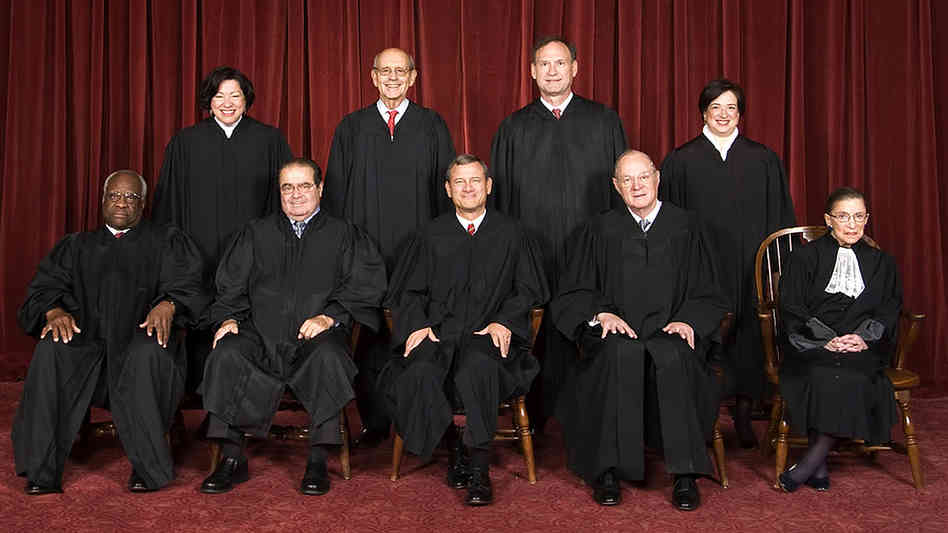
Justices of the Supreme Court

Eight months after attorneys for Abigail Fisher argued in front of the Supreme Court that the University of Texas’ affirmative action admissions policy discriminates against white students, the justices still have not handed down their decision in the potentially paradigm-shifting case.

The unusual delay has many court-watchers stumped, though as with everything Supreme Court-related, all explanations for the wait are, at best, educated guesswork.

Lyle Denniston, who has covered the Supreme Court for more than 50 years and now works for the legal website SCOTUSblog, said he couldn’t remember another case that had been argued in the fall yet still undecided by mid-June.

“I have absolutely no idea what is holding it up,” Denniston said.

One reason why the delay is so surprising: During oral arguments in October, it seemed fairly clear that the four conservative justices would band together with swing vote Justice Anthony Kennedy in striking down the use of race as a factor in undergraduate admissions. Kennedy has voted against affirmative action policies in the past and showed no willingness during questioning to reconsider his past position.

Additionally, the four liberal-leaning justices are short Elena Kagan, who had to recuse herself in this case due to her work on it while a part of the Obama administration. That seemed to clear the way for an easy 5-3 decision in favor of Fisher.

“It’s really surprising that it’s taken this long for the court to issue an opinion,” said Adam Winkler, a constitutional law professor at UCLA School of Law. “It’s almost unheard of for the court to take the entire term to decide what really is a straightforward case.”

Winkler said he believes the court will rule broadly against the University of Texas in a way that will outlaw affirmative action programs nationwide. He thinks that instead of ruling narrowly against this particular school, the court will overturn its own 2003 Grutter v. Bollinger decision that said affirmative action is allowable as long as it’s not a quota system as a way to ensure schools have a diverse student body. In that decision, the court ruled that eventually, in 25 years, the use of race would again becoming legally suspect, but that until then it’s needed to correct societal discrimination.

Winkler guesses the decision is taking so long because the liberal justices are writing lengthy dissents to the conservative judges’ sweeping decision.

“The dissenting justices are very upset about something,” Winkler predicted. “A narrow ruling only striking down Texas’ policy without significantly reshaping the law of affirmative action should be an easy opinion to write and shouldn’t inspire unusually long dissents.”

Long-time court reporter Linda Greenhouse, however, wrote in The New York Times that it’s possible Kennedy’s decision is considered “frustratingly narrow” by his conservative colleagues, since the court has already agreed to hear another affirmative action case in the fall. That suggests they may want another crack at the issue next year.

Another theory floating around legal circles is that the court may be waiting to release the Fisher case at the same time as it hands down Shelby County v. Holder, another landmark case this term (heard in February) that has the potential to significantly diminish the reach of the Voting Rights Act. Alabama sued the federal government, arguing that Southern and other states covered under the act are unfairly monitored by the federal government for discrimination in voting.

One theory is that the court will release the decisions together to make a broader statement about race in society today and how far government institutions may consider race as a way to correct past institutionalized discrimination. The justices could strike down the use of race in admissions as unconstitutional while upholding the Voting Rights Act, as a way to split the issue down the middle and avoid charges of overreach.

But other court watchers said it’s routine for the court to save its most controversial opinions for the last minute, and that it’s impossible to know why the supremes are dawdling.

“This means nothing,” Geoffrey Stone, the former dean of the University of Chicago Law School, said. “The court generally holds its most important decision for the end of the term. We can’t read anything at all into the fact that it hasn’t handed down Fisher yet.”

“I think the more likely explanation is simply that dealing with tough issues requires a lot of thought and care,” said Gail Heriot, a law professor at the University of San Diego. – Yahoo News

Namibian PM wants to close down ‘racist outposts’ after interracial brawl

Dr. Hage Geingob, prime minister of Namibia (ex-South West Africa)

Windhoek — The days are numbered for Buffalo’s bar in Gobabis, the latest flashpoint in an alleged racist attack, warned Prime Minister Dr Hage Geingob.

He said “undesirable establishments like Buffalo’s bar and similar places which are scattered all over the country,” should be closed down for being racist outposts. Geingob made the remarks on Tuesday in the National Assembly when he launched a strong denunciation of the alleged act of racism in which Levi Katire was allegedly assaulted by Nico Kotze and Frederick ‘Boeta’ du Plessis who now face charges of assault and racial discrimination.

“The heinous actions of a group of racist criminals in the town of Gobabis took the entire nation back to a dark past from which we have all so dearly wanted to emerge. It seems there are some people living within our borders who are intent on continuing the sinister legacy of racial discrimination and brutal violence of the past,” said the Prime Minister who joined the growing chorus of voices condemning the barbaric attack.

Geingob went on to say the two suspects are amongst a large number of “so-called Namibian citizens” who look upon the country’s policy of national reconciliation as a “policy of weakness”. The policy of national reconciliation was adopted to heal a nation, which was emerging from a dark history of racial discrimination, and to mitigate acts of revenge following the attainment of independence, Geingob said.

He condemned in the strongest terms the attack on Katire and promised that no stone would be left unturned until “we uproot and expose each and every one of these racist elements, who participated in this act of barbarism.” According to Geingob there are people who still think they can establish “pseudo republics and homelands” on the territory of an independent Namibia that courageously fought and triumphed over a discriminatory system.

He said it is high time that the government awakens racially intolerant individuals from “their absurd dreams and remind them that the apartheid republic is now nothing but a relic of psychosis”. He further warned that Namibia is a free and sovereign state and any individual who cannot comprehend that after 23 years should do him or herself a favour to “pack and go”.

“If you cannot pack yourself fast enough we will assist you. Make no mistake. The days are numbered for undesirable establishments like Buffalo’s bar and similar places which are scattered all over the country.”

He said so-called private establishments should be outlawed in public areas and implored the Attorney-General to find ways of closing down such places and to conduct a thorough investigation into the Gobabis incident.

“We need to identify the nationality of these perpetrators and if they are not Namibians, they should be shipped off immediately. I am aware that there is a criminal investigation which is ongoing, but we must ensure that a place such as Buffalo’s bar is permanently shut down,” he urged the Attorney-General.

The two men were denied bail on Friday in the Gobabis Magistrate’s Court and their quest to secure bail resumed on Wednesday and continues today. – New Era

White guilt, Coloured faith

by Dan Roodt

What was that T-shirt that got SAB Miller so hot under the collar? “Black labour, white guilt.” Now, even that sounds politically correct, but still the world’s second biggest beer company felt strongly enough to sue the T-shirt maker right up to the Constitutional Court.

Hence my title, by way of response to someone I encountered by chance on Twitter today, Sarah Britten, and who had offered us the latest sigh of white guilt in a blog entitled, Why white South Africans should learn the grammar of blackness. It is a case of white guilt, Coloured bad faith, for she is responding to Eusebius McKaiser, the self-styled metro man who vacillates between blackness and whiteness like a chameleon on a swaying branch. McKaiser is so confident of playing whites and blacks off against one another that he could go and work for the CIA or MI6. They could use him to promote factionalism among Arabs in the Middle East.

Sarah Britten, a wayward white gal who at one time managed to emigrate to Sydney but came right back to this cesspool of human misdemeanours, confesses to us:

:”The pervasive ignorance of the grammar of blackness is analogous to the monolingualism of English-speaking white South Africans, who expect everyone else to make an effort for them, but can’t do the same. I know this, because I am one of them, and I am trying to change. So yes, I practice my twerking. I get involved in conversations about towning with Khaya Dlanga.”

I beg to differ here. According to statistics, about fifty percent of English-speaking South Africans know enough Afrikaans to pass for bilingual, the highest percentage of any English-speaking population in the world. English white identity is a fascinating topic in itself, but I want to save that for some other occasion.

Roland Barthes or someone once said that he did not care about any other language besides his own, and one has to respect monolingualism too. The issue here, as ever, is not language but race. Eusebius McKaiser, that narcissistic Coloured who mistakes himself for “Black”, first employed the term “grammar of whiteness” in the Independent papers in The unbearable whiteness of being. I could discourse at length on the pretentiousness of that title, with its allusions to Milan Kundera and whatnot, but attention spans on the internet being what they are, I would rather skip that and get straight to the point.

I think I speak on behalf of all whites when I say we are just totally sick of all the race-baiting going on in South Africa. And all over the world, for that matter. I cannot remember the number of times some idiot on a radio station asked me a question like: “Would you let your daughter marry a black man?” and such drivel, meant to embarrass whitey on the spot. In fact, in this case McKaiser has sufficiently embarrassed Dr. Britten to offer us her sincere undertaking to “correct her racist ways”. As she states:

“In a way, to use the expression used by Eusebius, I am dabbling in the grammar of blackness. This is not about being patronising, or adopting blackface, or trying to be something I’m not (I’m decidedly white and middle class). I’m just … interested. Because here’s the thing: at the most basic level, paying attention to others — and paying attention to what they are interested in — is a way of saying that they matter.”

What is this "vock"?

The problem is, there are just too few whites and too many blacks to practise this form of courtesy in any meaningful way. And blacks would never reciprocate. I remember someone telling me about a black employee at the Cape Archives – inevitably an affirmative-action appointment as she knew nothing about history, archiving or anything else. The one thing about the Cape archives is that it is almost dedicated to the Dutch East Indian Company, or the Vereenigde Oostindische Compagnie, abbreviated V.O.C. The archive is filled with documents, maps, drawings and whatever from the early part of seventeenth and eighteenth-century Cape history. Just about everywhere you look, you can see the letters V-O-C inscribed somewhere. After about a year on the job, the black “archivist” if you could honour her with such a title, asked one morning with a slight air of irritation: “What is this VOC?” pronouncing it “vock”. What is this “vock”. You bet.

None of the black celebrities strutting about on television in their flashy outfits or tweeting away every day has ever, to my knowledge, taken even a remote interest in the indigenous white culture of this country. I am not saying they must act like Afrikaner novelist and historian Karel Schoeman and spend years in the archives, in order to write dozens of books afterwards, including his latest 2 500-page magnum opus about the first fifty years at the Cape. For blacks, and more importantly, their white liberal ventriloquists who constantly feed their racial resentment, everything that happened before 1994 is simply “apartheid history” and therefore not worth knowing. Apart from the bits where blacks can claim victimhood, of course. Or rather, blacks are being prodded into moral outrage against some whites by other whites.

Admittedly, there is a kind of incongruous, fantastic quality to black life that is sometimes interesting, but then mostly in an ironic way. For example, the other day I chanced upon a Nigerian song called “Pop champagne”, celebrating the champagne culture of Lagos. Apparently, Nigerians living in shacks would spend the equivalent of 5000 rand or $500 on a bottle of Louis Roederer Cristal or Dom Pérignon. Once one starts digging into the black world, I am sure you could find lots of titillating detail like that to marvel at, but ultimately it is not very edifying to the white mind to know all of this, let alone contemplate any form of deeper meaning there.

I have the opposite feeling to Dr. Britten. It is not that blacks do not matter to us. South African whites are the kindest, most humane people on earth. But our lives have become overly cluttered with factors over which we exert no control but over which blacks hold sway, such as the litany of social and political failures that one reads about in the media. So we are under no obligation to pay blacks any more attention than they are already getting.

I much prefer delving into Karel Schoeman’s five tomes on early Cape history. Having also written extensively on Cape slavery, he has unabashedly dedicated his present series to “the white colonists”. Good for him.

Regarding Eusebius McKaiser, I hardly think that he has mastered the “grammar of whiteness”, if by that we understand European culture. My 17-year old daughter probably knows more about art history than he does and rereads Nabokov novels, as well as Afrikaans poetry. The problem with blacks and Coloureds in this country is that they have bought into a superficial kind of colonial expat culture which they imagine to represent “the white world” or “the grammar of whiteness”. They think it is a matter of speaking the right high-school English slang or driving the right brand of car. In a sense blacks have liberated all whites from hankering after expensive German cars as we now see them as the accoutrements of corruption and senseless ostentation, a bit like drinking champagne in a Lagos shack.

The Afrikaans Coloureds who are now organising themselves into the Bruinbelange-inisiatief or BBI deserve more sympathy, in reaffirming their identity, especially in the face of African discrimination against them.

But McKaiser’s brand of pseudo-intellectual race-baiting is very much passé. I wish all whites, including Sarah Britten, could see through his verbiage on blackness. He is no more black than you or me, but has made provoking white guilt his special vocation.

No white cadets for South African Airways

Solidarity intends campaigning against SA Airways after not a single white man was selected for its cadet programme, the trade union said on Tuesday.

“In August last year, the SAA lifted the ban on applications from white males for its cadet programme after Solidarity launched a major public protest campaign against the SAA,” deputy general secretary Dirk Hermann said.

“It is clear that the lifting of the ban was merely a smoke-screen for continued racial discrimination by the airline.”

The union said SAA announced on Monday that 40 candidates had been admitted to its cadet programme. They would undergo 14 months of theoretical and practical training to enable them to obtain their Airline Transport Pilot Licences.

This would be followed by about three years of internship. The group consisted of 10 black men, four black women, nine coloured men, one coloured woman, seven Indian men, two Indian women and seven white women, it said.

“SAA’s exclusion of white male candidates constitutes subsidised racism… .The taxpayer is forced to pay for the government’s obsession to apply national racial demographics at all levels, everywhere in South Africa,” said Hermann.

Solidarity called on white men who applied for the cadet programme, but were unsuccessful, to contact it so it could investigate taking legal action on their behalf, said Hermann.

SAA said in a statement that the final 40 candidates fell under the category of previously disadvantaged individuals as defined in the Employment Equity Act.

“It is important to note this in the context of the current reality and measures that need to be taken,” spokesman Tlali Tlali said.

“The cadet programme is the airline’s effort to transform not only its own but also the country’s flight deck community, which is nowhere close to reflecting the country’s demographics,” he said.

He said SAA’s transformation strategy was informed by the broad-based black economic empowerment aviation sector charter.

“In the case of this particular programme, when assessing all applications, SAA is obliged to give preference to previously disadvantaged groups,” said Tlali. – Sapa

Judge Edith Jones in the firing line for race and crime remarks

Judge Edith Jones

Civil rights groups filed a complaint this week against a federal judge in Houston after she allegedly said during a lecture that some minorities are prone to violence.

Judge Edith Jones, who serves on the 5th U.S. Circuit Court of Appeals and was a Bush-era Supreme Court frontrunner, allegedly made the comment while speaking on the death penalty to The Federalist Society at the University of Pennsylvania in February.

The Federalist Society describes itself on its website as “a group of conservatives and libertarians interested in the current state of legal order.”

In her remarks, Jones also is alleged to have said race plays no role in the administration of the death penalty, but certain ethnic groups commit certain types of crimes more often than others.

Civil rights groups, including the J.L. Turner Legal Association, say Jones’ comments reveal a strong ethnic bias. They are pushing for an investigation that could lead to her removal from the bench.

The J.L. Turner Legal Association is an African-American bar association in Dallas. Its president, Mandy Price, told CNN that some attendees were shocked at what they heard and later complained.

“The reaction in the room when she made these remarks was one of shock, surprise, and offense,” according to one account that the legal association collected from some of the attendees.

The Federalist Society itself, however, called the allegations “frivolous accusations.”

ACLU: Blacks busted for marijuana at much higher rates than whites

According to the some of the accounts in the complaint, the judge said, “Racial groups like African- Americans and Hispanics are predisposed to crime.”

They are “‘prone to commit acts of violence,” she said, according to the complaint.

When challenges to her comments arose, she allegedly countered them by saying that “blacks and Hispanics” outnumber “Anglos” on death row.

Price says such comments reveal strong predispositions sitting judges should not harbor.

“We expect that they’re going to be fair, impartial, not that they have predetermined their case,” she said.

A representative from the court, which is headquartered in New Orleans, declined to comment to CNN, and said Jones also is “not making any comment regarding the matter.”

Jones was on President George W. Bush’s short list for the U.S. Supreme Court in 2005, though legal observers remarked at the time that her reputation has a staunch conservative — firmly upholding the death penalty and vocally critical of the Roe v. Wade decision, among other issues — hurt her odds.

“The decision for which Judge Jones is really best known is her opinion saying, ‘While I’m a lower court judge, I will apply Roe v. Wade, but I think it was wrongly decided and should be overruled,'” Supreme Court expert Tom Goldstein told CNN. “That really typifies her role as a lower court judge but signals what she would do if she became a Supreme Court justice.” – CNN.COM

Malema does not mind ‘monkey business’

Julius Malema in Pietersburg

Expelled ANC Youth League leader Julius Malema is “OK” with a picture of him under one of a monkey in a Bloemfontein school classroom, the Sowetan newspaper reported on Thursday.

“They can do that with me, displaying me next to the monkeys, it’s OK,” Malema told the newspaper.

“Nothing shocks me. Our people are subjected to harsh realities of racism everyday. As for me, once you display a racist attitude, I don’t waste time, I deal with it right away because I know that that is how they are brought up.”

The SA Human Rights Commission (SAHRC) said on Monday it would investigate allegations of racism at a Free State school.

“There were complaints that some of those kids [in the school] have been called kaffirs,” said spokesman Isaac Mangena.

The old South African flag and a picture of Malema alongside that of a monkey were also reportedly put up on a classroom wall.

The Sowetan reported that wording written on the monkey picture said primitive brains only allowed monkeys to make strange expressions when they wanted to speak.

The SAHRC said it conducted an on-site inspection of the Wilgehof Primary School in Bloemfontein, after a white pupil’s parent laid a complaint.

The SA Democratic Teachers’ Union (Sadtu) said on Wednesday racism was rife in Free State schools and called for an investigation into racism at schools in the province. – Sapa

Italian soccer fans sentenced for ‘racism’

AC Milan's Kevin-Prince Boateng

Six fans of lower-division club Pro Patria have been issued jail sentences from 40 days to two months for inciting racial hatred during a January friendly against AC Milan.

After repeated racist chants directed at him during the match, Milan and Ghana midfielder Kevin-Prince Boateng kicked the ball in anger at a section of the crowd, took off his shirt and walked off the pitch with the rest of the Rossoneri.

Milan players Urby Emanuelson, Sulley Muntari and M’Baye Niang were also targeted by the chants.

Prosecutors had requested four- to six-month sentences.

The ANSA news agency reports that one fan received a 40-day sentence after collaborating with authorities, while the other five fans received two-month sentences.

The fans were also fined a total of ?10,000 ($13,000), plus trial expenses. – AFP

Designer John Galliano ‘didn’t mean’ anti-Jewish remarks

John Galliano receiving his Legion d'Honneur from former French president Nicolas Sarkozy

Iconic British designer John Galliano, sacked by Dior in 2011 for making drunken racist tirades, says he is “grateful” for his fall from grace because it forced him to confront his drug and alcohol demons.

In what was billed as the designer’s first sober interview since the career-shattering scandal that saw him ousted from the French fashion powerhouse, Galliano told Vanity Fair he had been in denial about his substance abuse for years.

“It sounds a bit bizarre, but I am so grateful for what did happen,” Galliano told the magazine in an interview published Tuesday on its website.

“I have learned so much about myself. I have re-discovered that little boy who had the hunger to create, which I think I had lost. I am alive.”

The 52-year-old was hit with suspended fines totaling 6,000 euros ($8,400) after being found guilty of making anti-Semitic insults in public — an offense under French law — following separate incidents in 2010 and 2011.

Galliano underwent treatment at an Arizona rehabilitation center in the wake of the scandal, which broke after the emergence of a video capturing his anti-Jewish rant towards fellow patrons in a Parisian bar.

“When I saw it, I threw up,” Galliano said of the damning video evidence. “The feeling was like I was about to take a step out onto the street and a bus or truck whooshed past me and the blood was drained from my legs.”

“I was paralyzed from the fear.”

Galliano told Vanity Fair he remained baffled by the nature of his remarks, insisting he “didn’t mean” what he said.

“It’s the worst thing I have said in my life, but I didn’t mean it … I have been trying to find out why that anger was directed at this race,” he said.

“I now realize I was so … angry and so discontent with myself that I just said the most spiteful thing I could.”

Galliano meanwhile painted a picture of a life that had spiraled out of control shortly before the scandal, believing he would have ended up “in a mental asylum or six feet under” if he hadn’t changed his lifestyle.

“I never drank in order to be creative, or to do the research,” he said. “I didn’t need alcohol for any of that. At first alcohol was like a crutch outside of Dior. Then I would use it to crash after the collections.”

“I’d take a couple of days to get over it, like everyone. But with more collections, the crash happened more often, and then I was a slave to it.”

“Then the pills kicked in because I couldn’t sleep. Then the other pills kicked in because I couldn’t stop shaking. I would also have these huge bottles of liquor that people got for me. Towards the end, it was whatever I could get my hands on.”

“Vodka, or vodka-and-tonic. Wine, in the belief it would help me sleep. Wrong. I did manage to stop the voices. I had all these voices in my head, asking so many questions, but I never for one second would admit I was an alcoholic. I thought I could control it.”

Galliano, who spent nearly 15 years at Dior, is widely considered to be one of the most brilliant fashion minds of his generation.

However, his rehabilitation following the racism scandal has been difficult. Last month, New York’s Parsons School of Design canceled a workshop he had been set to give at the prestigious fashion college. – AFP

‘Racism’ at Free State school to be investigated

Racist flag?

Racism is rife at schools across the Free State and requires an investigation, the SA Democratic Teachers’ Union (Sadtu) said on Wednesday.

“We call on the department of education to investigate acts of racism beyond the issue of Wilgehof Primary School, as these practices are still rife in most of the schools in the province,” Sadtu Free State said in a statement.

The SA Human Rights Commission (SAHRC) said on Tuesday it would investigate allegations of racism at the school, in Bloemfontein. It said there were complaints that some of the children at the school had been called kaffirs.

The old South African flag had reportedly been put up on a classroom wall, as had a picture of expelled ANC Youth League president Julius Malema alongside that of a monkey.

The SAHRC conducted an on-site inspection of the school after a white pupil’s parent laid a complaint.

Sadtu said it had previously complained to the department about alleged racism at the school.

“We have on numerous occasions called for the full investigation of allegations of racism at this school, but the department has always opted for defensive tactics claiming that the concerns and complaints raised by our members are baseless and unfounded,” it said.

Sadtu said the alleged racism undermined the dignity of black people.

“The conduct at this school is not just undermining the principles of a democratic non-racial South Africa, but is a clear disregard of the dignity of the black people when they are associated with baboons,” it said. – Sapa

‘Racism’, a religious concept?

by Dan Roodt

Since the ANC takeover in South Africa, this country has become race-obsessed. Not only do we have a huge number of laws that favour blacks over whites, but not a day goes by without someone being publicly accused of “racism”.

Whereas blasphemy, or denigrating Christians generally, is considered freedom of speech, merely stating a fact about black people can often lead to public denunciations, charges of “hate speech” or worse. In South Africa, as in Britain and some other countries, there exists a “Human Rights Commission” whose sole purpose, it seems, is to sniff out “racism” in its various forms, almost like the Spanish Inquisition used to enquire into heresy in the fifteenth century.

I was recently publicly accused here in South Africa of “allowing hate speech” on my Facebook wall. To some extent the motivation was revenge as I had complained about a radio announcer’s swearing at one of my Facebook “friends”, a very civil lady from Cape Town. Within a day or two, he saw fit to retaliate by gathering a whole series of “expert comments” about the “hate speech” proliferating on my Facebook wall, as well as those of some other Afrikaner activists. I could not quite understand what it was all about, but apparently referring to black perpetrators of South Africa’s notorious farm murders as “barbarians” was a clear instance of “racism” and “hate speech”.

Please note that I did not call any black murderers “barbarians”, but some of my 7 000 Facebook friends and followers did. My sin, according to the radio station RSG, was “not removing it timeously”. My retort was that I could hardly police the utterances of the public or act as a self-appointed censor for all those people who are unhappy about the extreme levels of crime and violence in South Africa.

What I also find surprising about the logic of “hate speech”, is that the underlying cause of discontent, i.e. bloody murders and torture, seems to be morally superior to ethnic comments made in reaction to such crimes.

Since this incident about a week ago, various people, on Twitter and elsewhere, have threatened me with prosecution by the so-called Human Rights Commission for “hate speech” which I did not even utter myself but simply “tolerated”. So I suppose if you organise a public meeting in a rented hall somewhere and someone arrives to utter the word “kaffir” or “nigger”, you could be held liable.

That is why I am starting to think that “racism” is a religious concept. The extreme sensitivity that anti-racists have towards certain words or even innuendo is very much akin to intolerance of blasphemy. In Europe I know bananas have been banned in some soccer stadiums for being a form of symbolic insult to black players who have occasionally been offered such fruit on the pitch. I honestly love bananas, eat at least one every day for breakfast and would never decline the curved yellow gift of the tropics. The notion that one could be insulted or defamed by a banana is so absurd that, again, the symbolism must relate to the arcane rules of a religious cult.

Although it is more or less acceptable to criticise Muslims, specifically “Islamists”, in the West, year after year it gets more difficult to voice almost any form of censure regarding black behaviour. The amazing thing is that we now have the exact opposite of what pertained in the nineteenth century when blacks were seen to occupy the lowest rung of human and civilisational evolution. It is as if blacks have ascended to Mount Olympus itself and it is incumbent upon us to respect, nay, revere them.

In American popular culture, such as Hollywood movies, blacks are often presented as the saviours of planet earth or of America. They infuse the white world with their special, divine essence. At the very least, no white protagonist could peform his heroic duties without black assistance. While white characters tend to be fallible, human, blacks are often cast in the roles of morally umblemished near-saints or sages “keeping whites on the right track”.

Often I have been in the presence of Europeans, especially liberal Britons, who tend to be cold and dismissive of their fellow whites, but who display the most unctuous and exaggerated civility towards blacks. It is as if a black, any black, is the most interesting creature imaginable, a prophet as it were, whose very thoughts and gestures need to be attentively followed, savoured, to the exclusion of everybode else.

When it comes to black politicians like Martin Luther King or Nelson Mandela, we are treading on hallowed ground indeed. For a minister of religion, King led a debauched life and told many lies, yet his reputation as one of America’s greatest leaders and sages is unquestionable.

Although he started out as a petty terrorist, Mandela has now been anointed by the world media as nothing short of a saint, if not the reincarnation of Jesus Christ. Almost every world leader has at some point paid tribute to Mandela, with Bill Clinton in the forefront, during and after his presidency. The fact that he probably never wrote any of his speeches himself, including the oft-quoted one delivered from the dock during the so-called Rivonia trial, is simply glossed over.

One of the people who made him famous, the British journalist Anthony Sampson, had the following to say about Mandela in his autobiography, The Anatomist (2008):

“I would love to recollect that I recognised Mandela from the start as a true leader of his people, destined to change the course of history. But in truth at that time (in the 1950s – DR) I sadly underestimated him: he seemed to me too flashy and vain, with his immaculate suits and his wide smile, and he kept aloof from most white observers; I found his rhetoric too formal and stilted, full of anti-colonialist clichés.”

Questioning Mandela’s greatness will probably in itself be considered heresy, or punishable “hate speech”. Yet one cannot help but wonder at the global adoration of someone who spent half his life in prison for a half-baked plan to place bombs in public places and who would ultimately insist on not being conditionally released, but “on his own terms”.

New York Times columnists regularly accuse the Republican Party of “racism” and I suppose the only way in which the GOP could refute them would be by fielding a candidate of colour themselves. The importance of “not being racist” has assumed such proportions that it dwarfs any other political issue, including global financial problems or the wars in the Middle East.

The day is probably not far off when for white voters to vote for a white candidate would be deemed “racist” too. Certainly in South Africa, despite the increasing evidence that black government is anything but utopia, any attempt to escape from it is seen as challenging the laws of the universe. No matter how corrupt and incompetent our local black leaders and officials turn out to be, submitting to them is seen as a moral imperative.

The small community of Afrikaners living together in Kleinfontein, thereby attempting to escape the crime and financial profligacy of nearby Pretoria with its ANC municipality, was recently accused of “racism”, with both CNN and the BBC rushing in to expose their almost criminal deviancy from the multicultural norm.

Probably the most successful political system ever devised was that of Ancient Egypt which lasted several thousand years. However, the key to pharaonic dominance was not to be found in its politics, but in its strictly ordered religious system. The pharaoh was an absolute ruler, but also a god. Not submitting to him must have been unthinkable, a mere mortal rebelling against divine authority.

The vicissitudes of modern democracy being what they are, it is hard to conceive of such an absolute monarch or permanent dynasty today. But what if anti-racism had to succeed in elevating Africans to a special place on earth, as “natural rulers” over the rest of mankind? The ruling elites of Africa are today the closest thing we have to an aristocracy, given the social distance between them and ordinary people, as well as the kind of obeisance they demand, from their impoverished countrymen, but especially from whites. In South Africa, even our liberal media marvel at the glittering ostentation and partying insouciance of our black political gods, using terms like “conspicuous consumption”.

The relative ease with which a fairly unknown politician from the South Side of Chicago such as Obama managed to obtain two presidential terms in America, also shows that the cult of negritude or whatever one needs to call this new secular religion is dominant in the world’s only superpower too.

The irony, of course, is that self-confessed atheists and agnostics in the West are the most ardent adherents to the cult of the black race, adulating King, Mandela, Obama and others who will no doubt soon follow in their footsteps.

Freud thought that Moses might have been an Egyptian. If we are to believe Afrocentrists, the ancient Egyptians could have been black, another highly dubious theory.

But if Moses were black, it would certainily explain why the Judaeo-Christian world so often craves a pharaonic – in the sense of larger-than-life – black king to come and save it.