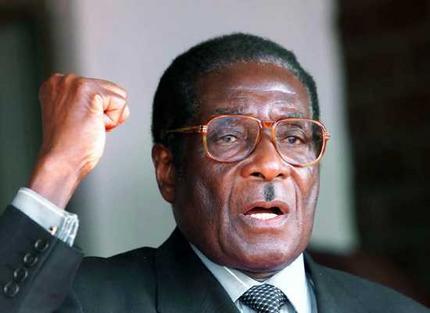
Roy Bennett refutes Max du Preez’s praise of Zimbabwean land grab

Cultural-Marxist journalist Max du Preez

Writing on his Facebook page, Zimbabwean opposition politician Roy Bennett has refuted Max du Preez’s recent defence of Robert Mugabe’s so-called “land reform programme” whereby white-owned land was confiscated, plunging the country into economic chaos.

According to Bennett:

“There is a new fashion developing among some white journalists and academics: they have joined with Zanu-PF in presenting ‘land reform’ as a success. It began with English academic, Ian Scoones, and it’s now being repeated by others – the latest version being a book entitled ‘Zimbabwe takes back its land’.
“These people are reacting to what they say is the simplistic picture of ‘land reform’ as a disaster. But their revisionist line strikes me as being more than a little simplistic itself. These studies focus on very small samples and then make sweeping generalisations that cast Zanu-PF and ‘land reform’ in a positive light. In turn, journalists pick up on these generalisations and simplify them yet again, coming out with sound bites that are grossly and blatantly inaccurate.
“Knowingly or unknowingly, these people have become victims of Zanu-PF propaganda. The well-known South African journalist, Max du Preez, is one. A couple of days ago he wrote in We can learn from Zim’s flourishing farms that ‘agricultural production is presently on levels comparable with the time before the [land reforms] started.’ Even the Zimbabwe government’s own statistics show this to be an absurd statement.
“Tobacco production, the greatest ‘success’ story since the land invasions, currently stands at around 145 million kilograms, between 50 and 100 million kilograms short of the figures from 1995-2000. (Ironically, it is also true that after a dismal few years during which Gono and others claimed to be trying to stimulate production, the rebound in tobacco has occurred via the involvement of crooked Western companies that are providing inputs to peasant farmers and to many white farm managers who are working on behalf of chiefs.)
“In the twenty years from 1980, there were three years of national food deficit coinciding with drought in the early 1980s and early 1990s. Since 2000, there have been 13 consecutive years of food deficit and the United Nations has recently appealed for more than $100 million dollars to feed 1.7 million Zimbabweans in 2013. Zimbabweans are again dependent for survival on the generosity of the international community, including the so-called ‘regime change’ neo-imperialist power, Britain.”
Max du Preez writes in his latest column that “Zimbabwe’s radical land redistribution has worked and agricultural production is on levels comparable to the time before the process started.”
Echoing the anti-white, anti-Afrikaner ideology being churned out by the radical NGO, PLAAS in Cape Town, Max du Preez states that “the two lessons from Zimbabwe” are:
“The first is that most new black farmers can actually farm successfully and commercially if given enough time and help. There are far too many South Africans who believe the opposite.

“The second is that an ambitious land redistribution programme can play a large role in alleviating poverty and providing employment and dignity to large numbers of marginalised people.”

The cultural-Marxist journalist and renegade Afrikaner therefore calls for a radical Zimbabwe-style land grab in South Africa, stating:

“We urgently need to throw old, conventional thinking overboard and tackle our problem with more vigour.”

Dutch show courage in Zim

Zanu-PF thugs threaten white mother

Dutch farmers want Zimbabwe to pay them compensation. White farmers were forced off their land during from 2000 to 2002 when the land grabbing started in all earnest.

Radio Netherlands reported on Wednesday that the farmers took their case to the International Centre for the Settlement of Investment Disputes (ICSID), a Washington-based court which operates under the aegis of the World Bank.

Earlier this year, Zimbabwe finance minister Tendai Biti promised payment but has not held his promise, despite a letter from the Dutch foreign minister in August asking him to honour his word.

The ICSID already ruled in favour of the Dutch in 2009 and ordered Zimbabwe to pay up €8.8m in compensation, to be increased by 10% for each year since the illegal anti-white “reforms”.

According to the report, the group is now entitled to a sum of more than €23m and the Dutch government has been pressuring Zimbabwe over the past two years to fulfil its international obligations. A special envoy has been appointed to negotiate with Zimbabwean officials.

“We wanted to take action earlier, but decided to wait for Biti’s proposal,” the group’s chairperson Lion Benjamins was quoted as saying. “But now we’re sick of waiting, so we have decided to take steps to show Zimbabwe we’re serious.”

The group lobbying European parliamentarians in an attempt to ensure the EU refuses to lift its sanctions on Zimbabwe until the compensation is paid. They are also lobbying the British government to release frozen assets of the Robert Mugabe regime in order to foot the land grab bill.

Opposition rejects Mugabe’s election timetable

Robert Mugabe

Zimbabwe’s main opposition the Movement for Democratic Change (MDC) on Thursday said President Robert Mugabe’s planned timetable for a constitutional referendum and elections was not realistic.

In a High Court filing seen on Thursday, Mugabe proposed a referendum for the first week of November and presidential and legislative polls for March next year.

“The dates being proposed are clearly not feasible,” MDC spokesman Douglas Mwonzora told AFP.

“The date for the election, especially, is unilateral, unrealistic and has no scientific or legal basis.”

Mugabe’s ruling ZANU-PF party has objected to many aspects of the long-delayed draft constitution that was only finished in July and would rein in presidential powers.

Mwonzora added his party was more concerned about conditions under which the vote takes place rather than the date. “For us to meet those dates, ZANU-PF has to change drastically.”

“We want elections to be held in conditions which allow the secrecy of the vote and the security of both the vote and the voter,” said Mwonzora.

Opposition MDC party members were on the receiving end of the violence that characterised the 2008 elections. – AFP

Toilet-flushing symphony in Zimbabwe

Probable Zimbabwean toilet

City authorities in Zimbabwe’s second largest city of Bulawayo, are appealing to home owners to flush their toilets at a specific time, in order to unblock sewers after days of severe water rationing. The ‘big flush’ time has been set for 7:30 pm.

The Bulawayo City Council has asked its 1.5 million residents to flush their toilets simultaneously when water supplies are restored. City officials say ‘‘synchronized flushing’’ is needed to clear waste that would have accumulated in sanitary facilities – which will have been affected by days of water outages.
The hope is that if everyone flushes together there is less chance of sewer blockages and pipe bursts, officials claimed.

Simela Dube, the city’s director of engineering, said: “We need to flush our toilets at the same time to push all the waste that will be just under the surface, as residents would be using little water to flush toilets during water shedding hours.”

Bulawayo’s two main dams, supplying water to the city, have been drying up due to severe droughts in the southwestern part of Zimbabwe.

After expelling whites, Zimbabwe’s formerly first-world infrastructure has been crumbling. Agricultural production has also plummeted, leading to a shortage of foreign exchange and funds necessary for maintaining essential services.

Zimbabwean Anglican bishop calls for ‘war against the white man’

Dr. Nolbert Kunonga

The Church of England Newspaper reports that the former Bishop of Harare, Dr. Nolbert Kunonga, has urged Zimbabwe strongman Robert Mugabe to expel the few remaining white farmers from their lands, telling a gathering of ZANU (PF) supporters that “Whites like other aliens should not be allowed to own land and other properties in the country as they are strangers.”

In an account of his sermon printed in The Zimbabwean, Dr. Kunonga said that he too had been engaged in a campaign of expropriating white-owned properties. “I took 3800 church properties in the region since their title deeds were in my name. There was no way the properties could remain under charge of the church controlled by whites and their black puppets. Bishops such as Julius Makoni, Chad Gandiwa and others are MDC-T and furthered western interests,” he said.

The controversial bishop, who was excommunicated by the Church of the Province of Central Africa after he quit the church to form his own Anglican Church of Zimbabwe, has waged a violent campaign of repression with the support of the security services against Anglicans who are loyal to the Bishop of Harare.

In 2011 the Archbishops of Canterbury, Central Africa, Southern Africa and Tanzania, along with local Anglican bishops, met with President Mugabe asking him to reassert the rule of law in Zimbabwe, and protect persecuted Anglicans from the depredations of Dr. Kunonga. The former bishop has been banned from travel to the U.S., the E.U. and the U.K. due to his complicity with the crimes of the Mugabe regime.

A long time supporter of the Zimbabwean president, Dr. Kunonga has campaigned against the opposition MDC party and its leader Morgan Tsvangirai.  He told the gathering at the Dimbe Primary School near Marondera in Mashonaland East that MDC-T and “its western puppet, Morgan Tsvangirai, are agents of doom fighting to reverse the land reform programme and hand back land to the former colonial white masters.”

[ad 1]

“Tsvangirai is a white man masked in black skin. He is like the Biblical Pharaoh who enjoyed the suffering and economic deprivation of his own people. On the other hand, Mugabe is the Biblical Daniel sent to suffer for the cause of his people,” said Dr. Kunonga.

The former bishop added that those who drive out white farmers, MDC supporters and foreigners from their lands “will enter the kingdom of God.”

“As Christians; we must gear ourselves for a bloody war against white interests,” he said.

Robert Mugabe opens Chinese military college in Zimbabwe

Robert Mugabe

President Robert Mugabe’s ZANU-PF party has strengthened the militarisation of Zimbabwe ahead of next year’s general election with the opening of a National Military College.

Observers pointed out that Mugabe’s latest move sends a strong signal that the military complex will dictate the outcome at the ballot box. The long-serving Zimbabwean president is expected to triumph for the third time over rival Morgan Tsvangirai of the Movement for Democratic Change, after beating him in 2002 and 2008.
Last weekend Mugabe officially opened the college, built by China at a cost of $98 million. It is being described as a “think tank” on security issues. He said it will aslo be used as a bulwark against Western countries, preventing their “regime change” agenda.

The college will exclusively train personnel with a rank of colonel or captain or above, as well as equivalent high ranks in state security, the police and prisons.

In terms of the loan agreement, the loan by China will be paid off over 13 years by means of diamonds to be extracted by Chinese companies from the Marange diamond fields.

Anjin, the Chinese diamond company in Marange, was involved in an argument earlier this year with the Minister of Finance, Tendai Biti, because the Chinese had failed to pay “a single cent” in taxes.

The construction of the college indicates the sustained militarisation of Zimbabwean society, but also the domination of Chinese interests in the country.

If Africa is more like Singapore, why are we getting so many refugees?

by Dan Roodt

Living in South Africa, one gets used to being called a moron by every visiting foreigner, especially ones of the liberal to left-wing persuasion. After all, they seem to reason, we do not know anything about our own history. We do not understand our own country or our own continent. Nor do we have any grasp of Africa or African culture, despite many of our people speaking African languages and compiling dictionaries in those languages.

The same goes for what is called the mass media. The bigger and more influential they are, the more you will find the view that the average Afrikaner or white commentator in this country is a barely literate buffoon. Many a time I have come across the phrase about this country: “Apartheid destroyed South Africa.”

If you had flown in an aeroplane over South Africa in 1994, shortly after Nelson Mandela became president, you would have seen just how “destroyed” South Africa was. We had more roads and railways than Great Britain. Having a far bigger surface area also helps, I suppose. At one time we were one of the few countries exporting more food than we imported, notwithstanding being a semi-arid country.

The criteria for measuring progress in Africa seem to differ from other places. Economic growth, income per capita,  life expectancy, quality of life, infant mortality, the level of education, all those ordinary measures of a country’s success or progress are suspended in favour of focussing on, well, some racial element.

The racial element could be the mystique of Africa, its smiling, simple people happily singing to some merry tune like the coffee plantation workers on Karen Blixen’s farm  in the Hollywood movie “Out of Africa”. Or it could be the successful eradication of Western influence, the confiscation of land owned by white farmers, the imposition of racial job quotas to prevent whites from working in South Africa, and so on.

Organising a successful pogrom against whites in Africa is always cause for celebration. Whichever dictator or strongman is involved in such an operation, may be assured of vast amounts of Scandinavian aid money before, during and after the operation.

A few weeks ago, the correspondent for the New York Times in Johannesburg, Lydia Polgreen, wrote a more or less glowing account of the Zimbabwean tobacco industry. Since nationalising the farms of white farmers and replacing them with “small-scale” black farmers, the country has taken a great leap forward, it appears.

Enthused Polgreen: “The success of these small-scale farmers has led some experts to reassess the legacy of Zimbabwe’s forced land redistribution, even as they condemn its violence and destruction.” Read the whole article: In Zimbabwe Land Takeover, a Golden Lining.

One week after the publication of this article, the UN’s World Food Programme announced that Zimbabwe was in dire need of food aid for 1,6 million people. This is the result of Zimbabwean “land reform” and “restoring the dignity of the African who no longer toils for a white boss”. Of course, up to half the Zimbabwean population has already fled to South Africa in search of food and jobs where they continue to toil for white bosses in restaurants, on farms and as cleaners and gardeners in suburban houses.

Zimbabweans have voted for Robert Mugabe for years. He has rewarded them with the kind of policies that they preferred: crypto-Marxism, confiscation of white assets, robber capitalism, cronyism, a small elite lording it over an impoverished majority enduring increasing hardship, environmental degradation, collapse of infrastructure, hyperinflation and economic crisis.

However, in South Africa these Zimbabwean voters who have democratically chosen to saunter down the road to national disaster, are considered “refugees”. Not only that, but according to a recent article on The Daily Maverick website, South Africa is the country in the world receiving the most refugees. Last year we took in a whopping 219 368 of them. By contrast, the USA only got 40 000 refugees. In many West-European countries, refugees are considered a major problem when about 20 000 announce themselves at the border posts in any given year. Yet we are supposed to endure the flow of hundreds of thousands of refugees across our borders, together with many more illegal aliens, as part of our fate.

But the biggest paradox of all is the following: Why would any African want to leave his democratic, prosperous, economically booming home country for the not so bright lights of Johannesburg, Pretoria, Durban or Cape Town? After all, according to the world’s mass media, we are “the destroyed country”, the least successful on the African continent.

Perhaps the New York Times correspondent in Johannesburg, Lydia Polgreen, could solve that conundrum. This is all the more remarkable in the light of recent pronouncements by American academics that the image of poor sub-Saharan Africans holding out a begging bowl for help or Bono to organise an aid concert is very passé. Malthus was wrong. Unbridled population growth is the road to riches and Africa’s “youth bulge” represents a “demographic dividend”.

This may sound like satire or sarcasm, but it is not. On the CNN website, I came across a piece asking the rhetorical question: Is Africa the new Asia? Written by Professor Richard Aidoo from the Department of Politics and Geography, Coastal Carolina University, the article asserts that Ghana has had a 13,5% growth rate recently, portending an “African miracle”. On the demographic issue, Professor Aidoo writes:

“Africa has another potential advantage – a youthful population with a hunger for change. Many of the uprisings in support of democracy across the continent have been championed by disaffected young people bitten by the technology bug and anxious for opportunities. For these young and driven Africans, change isn’t a distant hope, but something achievable. The memories of colonial exploitation are receding further into the rearview mirror as young Africans look forward.”

Aidoo cites the British Economist in support of his views. Howard W. French, a New York-based African expert who teaches at Columbia University Graduate School of Journalism and is a former senior writer and foreign correspondent for the New York Times, concurs that the continent is already way up the economic scale. He writes in The Atlantic:

“Africa, with a population expected to roughly double by mid-century, has become recognized as the world’s fastest growing continent. But the less-told story is of Africa’s economic rise. In the last decade Africa’s overall growth rates have quietly approached those of Asia, and according to projections by the IMF, on average Africa will have the world’s fastest growing economy of any continent over the next five years.

Seven of the world’s 10 fastest-growing economies are African. The continent is famously resource rich, which has surely helped, but some recent studies suggest that the biggest drivers are far less customary for Africa, and far more encouraging for its future: wholesale and retail commerce, transportation, telecommunications, and manufacturing.”

After 18 years of ANC rule, South Africa’s formerly first-world infrastructure is crumbling. Raw sewage is flowing into our rivers. The roads are full of holes. Our previously superb health care system is in a shambles with patients left to die in state hospitals. Despite record spending, the education department cannot deliver school books to some of its schools. South Africa has two million mostly white and corporate taxpayers who supply a welfare state for 50 million people. We are definitely not an Asian tiger economy, but by traditional measures SA is still the biggest economy on the continent.

But those are traditional measures. Clearly, people in the know and pundits associated with The New York Times, have decided otherwise.

If someone could just explain to me why so many Africans are still flocking to this country which suffered so much damage in the past and has still “not quite recovered from apartheid”, I would be really glad. After all, why would you leave one of the fastest growing economies in the world seething with bright young technology entrepreneurs, to settle in our country still blighted by white, Western influence?

Zimbabwe wants to borrow billions of rand from South Africa

When Zimbabwe nationalised land and evicted whites from the country, hyperinflation ensued. Now it wants to borrow from its neighbour where white taxpayers fund the state.

Zimbabwe will seek funds from southern Africa to help finance its budget as the country battles effects of a nearly decade-long downturn, Finance Minister Tendai Biti said Thursday.

“I am appealing to our colleagues in the SADC (Southern African Development Community) countries,” Biti said in an address on the state of the economy.

“I have secured an appointment two weeks from today, with South African Finance Minister Pravin Gordhan where we are going to ask for budgetary support to the tune of $100 million.

“Another thing we are doing is appealing to our friends in SADC. We are also in discussions with the Angolans for a $50-million credit facility.”

Zimbabwe’s powerhouse neighbour South Africa, the continent’s largest economy, will also be asked to make good on a line of credit promised in 2009 to the tune of 500 million rand ($60.4-million, 47.8-million euros), he said.

Biti said although the economy was stable since the hyperinflation-crippled local dollar was dropped in favour of foreign currencies, money was short in both the government and the private sector.

“I regret to announce that the economy still remains depressed with funding challenges for both private and public sectors, irrespective of the prevailing stable macroeconomic environment and some output improvements in sectors such as mining,” said Biti who in July cut the year’s growth forecast from to 5.6 percent from 9.4 percent.

He blamed low economic performance on lack of money to fund productive projects, low foreign investment, high unemployment, a high debt overhang and uncertainty and delays over the constitution-making process.

Zimbabwe’s economy has shown signs of recovery since veteran President Robert Mugabe and long-time rival Prime Minister Morgan Tsvangirai formed a unity government after 2008 poll chaos.

Biti said revenue collections were still falling short with $257.4 million collected in July against a $271.2 million target and $269.2 million in August against a target of $280.7 million.

The gold-mining sector was on course to attain the annual target of 15,000 kilogrammes, while inflation was on the slide due to the depreciation of the South African rand against the dollar.

He said payments for imports rose by 30 percent from the same period last year to reach $5.1 billion. – Sapa

New York Times and UN at loggerheads over state of Zimbabwean agriculture

Rural Zimbabweans in need of UN food relief after Mugabe's 'successful land reform' Photo: WFP

Whereas the New York Times sang the praises of Zimbabwean “land reform” only a few weeks ago, the UN food agency has just said that hunger was worsening in Zimbabwe after erratic rains, shortages of seeds and fertiliser and “poor agricultural practices” in the troubled economy.

This, the UN said, had led to a reduction in fields planted with the main staple foods. The World Food Programme said cereal harvests in the current season were down by an estimated one-third compared with last year. It said about 1.1million rural people would need food aid up to December, rising to 1.6million in the traditionally “lean months” to March.

The agency’s latest bulletin yesterday said $119-million was needed for upcoming food assistance. It said food shortfalls were becoming especially critical in arid southern Zimbabwe where Matabeles live. The Zimbabwean leader has previously been accused of genocide in Matabeleland where 20 000 people were killed in the early 1990s, with a large proportion of the inhabitants fleeing to South Africa.

Irregular rains, poor agricultural practices and ongoing economic challenges have pushed Zimbabwe into an increasingly critical food security situation, the United Nations food relief agency warned.

Lydia Polgreen of The New York Times Photo: Twitter

However, the New York Times’s correspondent in Johannesburg, Lydia Pogreen, differs from the WFP assessment and sees a “golden lining” amid any dark clouds over Zimbabwean agriculture. On 20 July 2012 the New York-based liberal paper wrote:

“The success of these small-scale farmers has led some experts to reassess the legacy of Zimbabwe’s forced land redistribution, even as they condemn its violence and destruction. “

The paper also stressed that the illegal confiscation of white-owned land does not necessarily lead to greater farming productivity but creates greater equality. It quoted a Zimbabwean pro-Mugabe researcher as saying: “But does it share wealth more equitably? Does it give people a sense of dignity and ownership? Those things have value, too.”

According to the World Food Programme (WFP), the past several weeks have provided signs of growing distress across the African country with high food prices, empty silos and granaries, and a reduced cereal harvest, aggravating the country’s food security outlook.

“Late and erratic rains, poor agricultural practices, constrained access to inputs, and a reduction in planted area have all contributed to reducing the national cereal harvest by 33 per cent this year,” WFP said in a news release on its Zimbabwe Vulnerability Assessment (ZimVAC). It further noted that a lack of diversified livelihoods and the rising cost of living were combining to create a perfect storm of income and food insecurity.

WFP, in fact, pointed out that according to the ZimVAC, over 1.6 million Zimbabweans will be in need of food assistance during the peak hunger period spanning January to March 2013.

ZimVAC is an annual study conducted by the Government of Zimbabwe in collaboration with UN agencies and non-governmental organisations in order to estimate national food insecurity levels.

In response to the deteriorating food situation, the UN agency announced it was scaling up operations in conjunction with the Government and other stakeholders to provide a combination of food distribution and cash transfers to those in need.

The WFP further noted that it would require approximately $119 million to complete its operations in Zimbabwe until the end of March 2013, though it said that almost three-quarters of the funding has not yet been accounted for.

Three reasons South Africa will fail

by Claudia Meades

Ex British Prime Minister Margaret Thatcher once said anybody who thought the ANC could govern country was living in cloud-cuckoo-land. Could anybody, at the time she said it, have imagined that nobody would deliver a more vivid demonstration of her claim, than the ANC itself.

In fact, delivering an account of the ANC’s failures, in as little as seventeen years, will likely take as many years – for not a day passes that South Africans are not bombarded with reams of inanities, clearly depicting the state-of-disaster South Africa has become, under the ANC’s governance.

Indeed, I herewith challenge anybody to name anything-, even if it is just one item of success that can be directly contributed to the ANC government – for if you can actually find something, you will be presented with thousands of failures in return. Where else, in the known universe, would such an entity remain in government..? Oops, I forgot.., Zimbabwe…

In passing: let me remind you, the ANC had little to do with the 2010 Soccer World Cup – it was managed from Europe; Sepp Blatter (a Swiss national) simply seized South Africa for a month. The Gautrain was conceived and designed in Europe. The SKA is simply foreign technology in a remote place and so on.

Sport in South Africa survives, not because of the ANC, but despite the ANC. Since 1994, South Africa has only performed in a sustainable manner, in water-sports, golf and rugby.

The ANC stuck its middle-finger down the throat of South African Soccer and demanded the 2010 SWC present an almost exclusively non-white team – the result was the greatest embarrassment in the history of the sport: i.e. the host being eliminated in the first round. In a bender of divine justice, similar to Jesse Owen’s achievements at the 1936 Summer Olympics in Berlin, was delivered the clearest signal conceivable to the fascism of South Africa’s current black-nationalist regime – this time, a crushing defeat at the “hands” of a near lily-white team…

Kindly do not quote, as a ‘post ‘94 ANC achievement’, anything to do with SARS and/or tax. The ANC does NOT generate tax money – it consumes it, seemingly in a glutinous destructive rage.

While there are places elsewhere in Africa nearing double percentage-point growth-rates, the South African economy is staggering along at less than 2% growth – a figure vehemently disputed by some, saying that in real terms, the South African economy is currently shrinking; e.g. all the signs point at it, citing time-on-time unemployment figures and -other key economic determinants.

The post-Polokwane-‘07 regime has managed to chase away 70% of the Foreign Direct Investment in less than two-and-a-half years (the effects now catching up with the economy). The crippling effects of near insane increases in energy costs – while the country is tiptoeing on the edge of the abyss of rolling black-outs (likely a struggling economy’s death knell), Escom is partying up a (lightning)-storm and giving its executives record salaries and increases.

In summary – the ANC’s modus operandi is simple: take from the white minority and pay the black majority to keep them in power. I am not the first one to raise this actuality, great minds like Moeletsi Mbeki, have done it before. While the aforementioned mores is justified by a near demonic entitlement – viz, as Adolf Hitler presented a “biblical promise” of a thousand-year rule, the ANC delivered the same psychotic delusions, with their “we will rule till Jesus comes” lunacy – a folly that has crippled South Africa at every level of functionality, yet in a rage of overwhelming delusion the ANC continues to celebrate “victory” (even presenting a fictional “battle” that never even happened).

A delusional rage that is slurped up by the largely illiterate- and/or unemployed masses who firmly believe it is their birthright to “take from white people” – spurred on by their spear-dangling DIC-tator, who earlier this year pledged to [verbatim quote] “aggressively” [unquote] remove white South African’s share of the economy, a share that is current less than 20% (of the economy). But as history will attest, the parasitic rage of the communist-vampire will not stop, until its host is sucked bone dry – that is before the monster turns on itself…

As one of the most obese governments on earth, the relevant ANC officials live in a TAX-(funded) HEAVEN, consisting of high-speed convoys-of-destruction featuring Europe’s finest vehicles, private airliners flying in fuel-gulping dual formations to convey a single person to the other side of the earth, seven-course-meals on demand, even an entire private town to be built in honour of the functionally Illiterate Spear-of-the-Nation and his King-Solomon-like bevy of “traditional” wives (one can only image, in horrid trepidation, what the gate-pillars will resemble) and so on.

All of this, while the vast majority of the people who keep the ANC in government, live on less than what one of them splurge out on a suit (often while on a tax-sponsored frenzy in 5th Avenue New York; also known as the land of the “evil imperialist”) – paid for by tax-payers who largely do not even vote for them. A situation so desperate, the USA (in turn) has to rush over to the country (e.g. led by Hillary Clinton’s current visit), to rescue South Africa’s education system and to deliver the critical commonsense (currently lacking) to create real jobs in South Africa, while “The Spear” is frolicking around exotic islands.

Kindly note: the USA has a GDP/capita that is nearly five times (5 x) greater than that of South Africa. Yet the despotic nationalist (ANC) regime, keeps ululating to the whims of the little yellow-and-red flagged critters (i.e. China) – with a GDP/capita that is (more than) 30% LESS than even that of South Africa. Frightening is it not..?

Very few people in South Africa understand the fundamental concept of “TAX”. Tax is not simply an unconditional payment. The only “unconditional” payments are THEFT.

Tax money is handed to a government in good faith – by-and-large, if not exclusively, to deliver collective services that cannot-, or cannot efficiently be achieved by individual entities.

A simple example is street light – one person cannot put up street lights, as everybody uses the street, so money is placed in a ‘pool’ and it is used for collective services. Anything else is THEFT – tax money belongs to the PUBLIC, notably the de facto tax-paying public (e.g. NOT those “tax-payers” who work for the state, the government, municipalities, state-owned-, or semi-state-owned companies, BEE-companies surviving on state-tenders, etc – they simply regurgitate tax-money). The tax-regime conceptually functions/exists in exactly the same manner as that of the body-corporate of a sectional title community/building.

The inconvenient reality is: should the tax-paying community of a country decide to stop paying tax, there is fundamentally nothing the government can do – largely as the ‘government’ needs the very same income to acquire its wherewithal. I.o.w. basically a self-perpetuating incongruity.

Governments will naturally NEVER admit this absolute vulnerability and will use a plethora of methods to intimidate-, indoctrinate (etc) people to continue to pay tax. Imagine a government jailing all its tax-payers – it can NEVER happen.

The South African case must be a tax-base that is one of the most unique in the world. I do not have the exact figures, but South Africa must be the only place on earth, where MORE THAN 80% of the bona fide tax-paying public (refer to the exclusions in brackets in the relevant paragraph above) do not vote for the ruling party. While the vast majority, who vote for the ruling party, contribute little (if not essentially nothing) to the tax-income of the country – viz. one relevant figure I do have: around 70% of the people who vote for the ANC are unemployed.

Shall I remind you that the most prolific country that the world has ever seen – the USA (a place that is younger than South Africa and one that has travelled further than any known being), was built on the ethos – ‘NO TAXATION WITHOUT REPRESENTATION’.

The ANC has left in its wake a plethora of ventures that could only be messed-up by the absolute hopeless – e.g. Telkom (how do you mess up an unmitigated monopoly that is near unconditionally guaranteed? Telkom is now such a desperate mess it wants to withdraw from the stock exchange), SAA (once the greatest airline in the world), Universities (once amongst the most revered academic institutions in the world – now manage little more than ILLITERATE GRADUATES, just ask the Law Society of South Africa), Hospitals (epic institutions that saw some the world’s greatest medical achievements – e.g. the first heart-transplant in history, now little more than macabre medieval slaughterhouses, crawling with Cuban hand-me-downs), etcetera, etcetera, etcetera…

THIS IS THE FIRST REASON SOUTH AFRICA WILL FAIL – the ANC takes money from hard-working people and have nothing to show for it.

It is however the latest governmental inanity, of grand proportions, that now warrants ‘special’ mention.

The South African Local Government Association (Salga) is an idiosyncratic oddity that is probably unique to South Africa. Few hard-working South Africans who make a bona fide contribution to the country’s economy have ever heard of this peculiar public entity. An entity created under Section 21 of the Companies Act (1973) – it is the Minister of Cooperative Governance and Traditional Affairs’s [GOVSA] “Court Jester” and was formed in terms of the Organised Local Government Act 52 of 1997.

Salga represents local government on numerous intergovernmental forums such as the President’s Coordinating Council, Minister and MEC’s forum, the Budget Forum, the National Council of Provinces and the Financial and Fiscal Commission. However, nobody really understands why Salga is necessary or what its value-adding mandate is – this however has not stopped its tax-leeching existence (either directly from a national government grant or indirectly from e.g. membership fees). It appears to be, in some ways, the ANC government’s own union – as bizarre as it sounds (not that peculiarities has ever stopped the ANC regime).

It is worth noting here that the Department of GOVSA is comfortably one of the greatest disasters in an already disastrous ANC government. It presides over rampant non-compliance, corruption of endemic proportions, collapsing- to non-existent infrastructure (including structures that collapsed almost upon completion, by virtue of entities like SGL Engineering, On-Point Engineers and such – distinguished by a certain “director” who took twenty-one years to fail Woodwork), absenteeism so vast it is impossible to quantify, incompetence beyond even the worst nightmare – often openly admitted with flagrant “so what” entitlement, fiscal losses of epic proportions, etc, etc, etc.

E.g. GOVSA (in March 2011) regarded 8 out of 32 unqualified audits as “…an improvement…” – i.e. one quarter – where else in the world would a three-quarters failure-rate be regarded as good enough..? Except naturally a place starting with “Z”…

GOVSA’s rampant disconnection from reality is eagerly led by another one of the ANC regime’s big spender – Richard Baloyi. He who spent R360 000 on car rentals, on 21 occasions, for “unavoidable” reasons – obviously a good enough reason, certainly at more than R17000 a shot. Following his impeccable example, his deputy Ayanda Dlodlo did the same on 18 occasions, at a cost of R205 000 – at more than R11000 a shot, she made sure she did not threaten her bosses score per ‘shot’…

Another (rare in this case) oddity in the ANC is auditor-general Terence Nombembe. Recently Nombembe delivered a report to parliament that estimated 70% of municipal officials were not qualified to perform their duties.

At this point, it worth pointing at Act no 12 of 2004 – The Prevention and Combating of Corrupt Actions – believe it or not, assented to, by a president of an ANC government, in April 2004 (not on the 1st, smart-****).

In CHAPTER 2 – named “OFFENCES IN RESPECT OF CORRUPT ACTIVITIES”, Part 2: “Offences in respect of corrupt activities relating to specific persons”, under the heading “Offences in respect of corrupt activities relating to public officers”, it states,
[verbatim – from line no 50] – “4. (1) Any – (a) public officer, who directly or indirectly, accepts or agrees or offers to accept any gratification from any other person, whether for the benefit of himself or herself or for the benefit of ANOTHER PERSON…”

Then,
“…in order to act, personally or by influencing another person so to act, in a manner…
(ii) that amounts to
(aa) the abuse of a position of authority;
(bb) a breach of trust; or
(cc) the violation of … a set of rules;
(iii) designed to achieve an unjustified result…
is guilty of the offence of corrupt activities relating to public officers.
(2) … “to act” in subsection (1) Includes –
(b) performing or not adequately performing any official functions…”

Not only is 70% incompetence an overwhelmingly unbelievable figure – in any ‘book’, anywhere on earth (bar perhaps Z…) – appointing- and/or allowing such a person to continue- and/or aiding- and/or assisting such a person, is by definition a corrupt activity (i.o.w. corruption).
Act no 12, 2004, gives the prosecuting authority the power to imprison somebody for life (take note Woodwork students – start practicing your ‘Boeremag’ anthems, you could be sharing a close proximity with some unlikely friends – till Jesus comes…).

Following Terence Nombembe revelation, the cabinet instructed COVSA’s Minister (Richard Baloyi) to ensure municipalities employ suitably qualified financial officers – a somewhat impotent response to what is potentially a very serious matter, nevertheless..,

Into the fray steps Salga’s CEO Xolile George, to quickly expose cabinet’s ‘response’ for what it really is – viz ineffectual lip-service.

Nobody (that matters) really knows who Xolile George is, but he quickly poured ice cold water (midst country-wide snowfalls for the first time in recorded history) on the instruction from cabinet, by saying that the inefficient workers were contractual obligations for the municipalities and cannot be let go. He then proceeded to say: “…Our appetite is not to fire people but to capacitate them…”

STAGGERING..!

I trust Xolile George can grasp that he is potentially an accessory to corruption. But I guess he does not grasp this verity and nor do the ANC. In fact the entire ANC regime is not only impervious to the extent- and de facto meaning of corruption, it is wholly oblivious. The examples are overwhelming – I have merely elaborated on one ‘interesting’ example.

THE SECOND REASON SOUTH AFRICA WILL FAIL under the ANC – it has “incapacitated” itself to address incompetence, corruption and alike.

The thrid reason is courtesy of one the greatest literary minds of our time – Ilana Mercer (a citizen of the USA, notably so, as the ANC’s destruction of South Africa is increasingly being recognised on the global stage).

As a classical liberal writer she has written one of the greatest- and probably most complete dissertations on post-Apartheid South Africa – in many ways, of Apartheid South Africa. Her book “Into the Cannibal’s Pot: Lessons For America From Post-Apartheid South Africa.” is a script that is a minimum requirement for ANYBODY who values a future in South Africa (and for that matter the USA) – notably for their children- and theirs. Read it – I urge you.

She has written a number of essays on South Africa (particularly post-1994 South Africa), but for the purposes here, I will refer to her article titled “Clueless in South Africa with Mrs. Obama”

It touches on the ANC’s obligatory sophism – viz “BLAME WHITES FOR EVERYTHING”, from sun-spots to old-age homes…

Ilana cites Jim Peron, a US expat, as she notes,  “…idealism drove him to decamp to post-apartheid South Africa…”. Peron says: “Every time something goes wrong (and that happens constantly), the same litany of excuses is recited. ‘We inherited this problem from the corrupt apartheid regime.’…”

She follows by stating “…There’s one pesky problem with this particular blame-game: South Africa’s flourishing criminal class consists mainly of youngsters who’ve come of age and blossomed under black rule…”

Then she states another inconvenient verity: “…minority-ruled South Africa, with all its problems, offered Africans more than any other country on the Dark Continent…”.

As such she further notes another uncomfortable fact “…While black Africa and East Europe circled the drain due to communism, South Africa was experiencing an economic explosion, courtesy of the National Party’s relatively conservative economics. An oasis in the African desert, South Africa’s… …economy grew at an annual rate of six percent during the 1960s…”.

Presenting more substance not fitting well into the ANC’s “sheep-suit” that blames everything on WHITE APARTHEID, Ilana notes:
“…In his submission to the Truth and Reconciliation Commission, F. W. de Klerk, who received a Nobel Peace prize for surrendering South Africa to the ANC, corrected the record.

Apartheid was not only about white privilege but also about development and redistribution of income from whites to blacks. The economy had grown by an average of 3.5 percent per year under apartheid, the black school population grew by 250 percent in the first twenty-five years of apartheid, and the black share of total personal income had nearly doubled from twenty percent in the mid-1970s to thirty seven percent in 1995, while that of whites declined from seventy one to forty nine percent.” As bad as the Bantu Education system was, it vastly improved black literacy.

Twelve years into the Nationalist government’s rule, the rate of literacy among the Bantu of South Africa was already higher than that of any other state in Africa, or that of India…”

It is worth noting that the gains in the literacy of black South Africans during almost five decades of apartheid, has been all but eradicated by the ANC regime, in as little as one-and-a-half decades.

Then she gives a brief overview of the vast improvements in health-care and life-expectancy of black South Africans under apartheid. A day will come when history will show that the apartheid government took better care of black people than the regime elected under (so-called) “democracy”.
She concludes by saying “…By staving off crime and communism, the apartheid regime, a vast repressive apparatus though it was, saved black South Africans from an even worse moral and material fate…”

THIS IS THE THIRD REASON SOUTH WILL FAIL under the ANC regime – viz the convenient proxy apartheid offers for reality…

Zimbabwe central banker cautions on yet more affirmative action

Zimbabwe’s central bank chief warned Friday the country’s fragile economy could grind to a halt if the government rushes its planned seizure of majority stakes in foreign-owned banks.

“The implementation of indigenisation and economic empowerment regulations in the banking sector should be done in a manner that preserves confidence since any adverse developments in the banking sector could grind economic activity to a screeching halt,” Gideon Gono said.

He was speaking to business executives at the annual congress of the Confederation of Zimbabwe Industries in the eastern resort town of Nyanga.

Zimbabwe passed in 2007 a law that forces all foreign-owned companies to hand over a majority stake of 51 percent to locals.

The law has forced mining firms, including the country’s biggest platinum mine Zimplats, a subsidiary of South Africa’s Impala Platinum, to submit schedules on how they will surrender a majority share.

“We are gratified to note that some aspects of the indigenisation and economic empowerment regulations are receiving attention with a view to harmonize and fine-tune pertinent issues,” Gono said.

Indigenisation Minister Saviour Kasukuwere, in a government notice made public earlier this month, gave foreign banks and other companies one year to cede a 51 percent stake to locals, as required under current laws.

Mugabe’s partner in a coalition government, Prime Minister Morgan Tsvangirai dismissed the ultimatum on the banks as illegal and a threat to the ailing economy’s recovery prospects.

Britain’s Standard Chartered Bank and Barclays Bank are among the major foreign banks with operations in this former British colony.  – AFP

Starvation looms in Zimbabwe

The New York Times recently carried an article stating that Zimbabwe’s “land reform”, confiscating the land of white farmers, was a “success”. Now this report from the United Nations World Food Programme shows the true picture: a country where one in five people receives food hand-outs.

Famine has raised its head in Zimbabwe again, as the numbers of people depending on aid to avoid starvation soared by 60 percent from last year to 1.6 million, according to the United Nations World Food Programme (WFP).

The agency said that one in five of the country’s rural people were in need of famine relief. Grain production in the last year was 1 million tonnes, the worst since 2009, which at 800,000 tonnes was the worst year on record.

Zimbabwe had a reputation as “Africa’s breadbasket” until 2000 when President Robert Mugabe launched his violent seizures of white-owned farms, forcing 1,500 white farmers of their land and displacing a million farm workers and their families.

The International Monetary Fund and the World Bank have said that year marked the beginning of the collapse of one of Africa’s most successful economies.

The latest figures were released after a lengthy study by UN agencies, the Zimbabwe government and non-governmental organisations involved in agriculture.

Already, the report said, rural residents of the country were feeling the effects of the food shortages, a pattern marked by empty domestic granaries and farmers selling their cattle to raise money to buy food.

The report blamed erratic rainfall, low supplies of seed and fertilizer, and bad farming practices.

At the height of the last rainy season, farmers unions slammed a supply arrangement set-up by government officials. Political figures in Mugabe’s ZANU(PF) party snapped up cheap fertilizer and seed and sold large quantities of it at inflated prices while peasant farmers waited helplessly.

During the current winter wheat season, promises of cheap supplies from the government also came to nothing, resulting in the lowest wheat crop forecast yet of 5,000 tonnes.

The WFP said it would rely on “regionally procured cereals” to make up the country’s current shortfall.

Commentators have pointed out that the biggest regional producer is Zambia, where scores of white farmers moved and became large-scale producers again after being driven off their land in Zimbabwe in the last decade. – Sapa-DPA

Zim’s ‘black empowerment minister’ to take platinum mine

by Gillian Gotora

AP – Zimbabwe’s black empowerment minister said Wednesday he will proceed with a takeover of the country’s biggest platinum mine if the South African owners don’t comply with orders to hand over more stakes in the company to blacks.

Minister Saviour Kasukuwere said there is “no compromise” over the eventual handover of 51 percent of the company’s stock as is required by “indigenization” laws.

Last year, Zimplats became the first foreign-owned company to cede 10 percent of its holdings to a local community trust. Zimbabwe has ordered the company to hand over another 30 percent by mid-March. South African-based Implats owns 87 percent of existing shares in Zimplats.

Zimbabwe and South Africa are the world’s largest suppliers of platinum, a corrosion-resistant metal with a wide range of industrial uses that is priced higher than gold.

Kasukuwere told the Associated Press Wednesday that a proposed visit by Implats’ chief executive to discuss the matter would not change the government’s decision.

He said he has no plans to meet with Implats chief David Brown.

“I don’t need to meet them over anything. Why are they coming to see me? I’m not a zoo,” Kasukuwere told The AP. “I have nothing to discuss. They must respect the laws of this country,”

Parliament last year passed a law that calls for all foreign-controlled businesses to take on black partners as majority stockholders.

The former opposition party of Prime Minister Morgan Tsvangirai has voiced concerns that the prospect of hasty takeovers scares off much-needed investment. The party has called for accountability and careful implementation of the “indigenization” program that risks collapsing some viable businesses and mines.

President Robert Mugabe’s party – which is in a shaky three-year coalition with Tsvangirai – says China can provide new technical expertise in mining and manufacturing.

Foreign cash inflows have dwindled in recent months amid uncertainty over the security of possible investments.

This month, banks, including major international banks, have reported growing shortages of cash for day-to-day transactions in Zimbabwe. Executives say the liquidity crisis has been fueled by businesses that cannot repay bank loans because not enough money is coming in to service the loans.

Industrial production has remained stagnant after years of economic meltdown with many factories desperate for cash to replace aging equipment and machinery.

Last year, Kasukuwere announced that he had canceled the Zimplats mining license but backed down after Zimbabwe’s mining minister ruled the cancellation void.

Kasukuwere, 42, seen as a younger militant in the top ranks of Mugabe’s party – which is dominated by veteran politicians aged in their 70s and led by Mugabe, 88- is tasked with securing Zimbabwe’s resources for black control.

Critics of new business takeovers point to a possible repetition of land seizures since 2000 that have seen many of the best former white-owned farms allocated to politicians and Mugabe party loyalists who have left them to lie idle.

Mugabe turns 88, still going strong

by Jan Raath, DPA

Zimbabwe’s President Robert Mugabe is expected to be presented with a very large cake on his 88th birthday Tuesday, ahead of elaborate and costly official events to mark the occasion in the impoverished nation.

The aging and reportedly ill Mugabe, who has been at the helm of since independence in 1980, has insisted repeatedly in recent weeks that he will continue to run Zimbabwe for the foreseeable future.

As it does every year, the media is likely to capture Mugabe as he marks the occasion, posing with the birthday cake presented by family and staff.

In the days that follow, the festivities that have been organized by his special “21st of February Movement”, are to kick off.

Some 5,000 members of Mugabe’s Zanu-PF party and their families are expected to attend the main party, which is to be followed by the finals of a special football tournament – the 1-million-dollar Bob ’88 Super Cup.

There will also be a Miss February 21 beauty pageant.

Mugabe is believed to be recovering from prostate cancer, and last year flew repeatedly to Singapore, for what observers said were “rejuvenation treatments.”

At key public events last year, including party conferences, Mugabe was seen falling asleep and generally appeared to be weakening.

However, since his most recent return from the Far East last month, Mugabe has embarked on a strong public relations campaign.

The president has held a wave of interviews and public speeches and, at a football event, was photographed puffing into a “vuvuzela,” the plastic horn made famous at the 2010 football World Cup in South Africa.

His reinvigorated appearance has been accompanied by a firm stance on his future political role in the southern African nation.

“All the people support that I stand,” Mugabe said about the next election. “There is no one (else) who can stand at the moment,” he told state media in an interview at the weekend.

While Zanu-PF says it wants to hold elections this year, the rival Movement for Democratic Change (MDC) and civil society groups say they want constitutional reforms to be concluded first.

The MDC is part of the coalition government in place since 2008, when Zanu-PF was forced by its regional neighbours to share power, following elections that were marked by violence and allegations of fraud.

Observers say Zanu-PF wants its veteran leader on the ticket for the next election, in part, as no one else in the party has been groomed to take over the job.

Officials in neighbouring South Africa – which is in charge of monitoring the fragile and often violated coalition deal – have already publicly expressed concern about a messy succession in Zimbabwe, should Mugabe die while in power.