A councillor belonging to Italy’s anti-immigrant Northern League party called Thursday for the country’s first black minister to be raped, sparking an outcry and her expulsion from the party.
“Won’t someone rape her, just to make her understand what victims of this terrible crime feel? For shame!” Dolores Valandro, a councillor in Padua in Northern Italy, wrote on Facebook alongside a photograph of African-Italian Immigration Minister Cecile Kyenge.
Valandro was apparently reacting to an article on a website called “all immigrant crimes” which detailed an alleged attempt by a Somali in Genoa to rape two Romanian girls, Italian media reports said.
Kyenge said “everyone should feel offended” by the comments, and said she had long battled against violent language and behaviour.
Her reaction was supported by Prime Minister Enrico Letta, who said: “Cecile Kyenge is right, each one of us should feel offended, I feel offended.”
“The words do not deserve any comment, just disdain. Cecile deserves solidarity from me, the government and the country,” he said.
Valandro later apologised, saying: “It was a something I said in a moment of anger. When I’m angry I vent that way.”
Kyenge, an eye doctor and Italian citizen originally from Democratic Republic of Congo (DRC), has been subjected to a barrage of racist attacks since being appointed minister in February.
She has drawn heated criticism from the League over plans to push for legislation that would allow children born in Italy to immigrant parents to get automatic citizenship instead of waiting until 18 to apply. – AFP
ANC Youth League protest a few days ago, telling DA leader Helen Zille to go back to her country, Germany
The African National Congress (ANC) in the Western Cape has threatened to bring Cape Town to a standstill in what it refers to as a bid to get the ear of Premier Helen Zille so the Democratic Alliance (DA) can deliver “better services” to poor people in the province.
In what could be seen as a drive by the provincial ANC to pile pressure on the DA ahead of the 2014 national elections, the party on Thursday led hundreds of protesters in a march to the provincial legislature and demanded that Ms Zille collect their memorandum of grievances.
Among other things, the protesters demanded better sanitation, housing and “more comfort”. They said the controversial portable flush toilets that were being rolled out in some Cape Town townships showed that the DA did not care about black people.
It was the second day in a row that the ANC had protested outside the provincial legislature against the DA, although Wednesday’s protest by ANC members of the legislature against “DA power abuse” was minor in comparison to Thursday’s march.
Addressing the crowd outside the legislature on Thursday, ANC provincial secretary Songezo Mjongile said Ms Zille’s “refusal” to come out and collect the memorandum showed that she was “scared of the people”. DA provincial leader and cultural affairs and sport MEC Ivan Meyer was sent out to collect the memorandum but Mr Mjongile said the document would only be handed to Ms Zille.
“The next time (when we come to hand over the document), we will bring Cape Town to a standstill … we will bring a crowd of 10,000,” he said.
ANC provincial leader Marius Fransman said that communities “can march all they want but Zille will never listen”.
“She does not even accept our memorandums … the only way is by voting,” he said. “We have to vote for transformation in this province … come 2014, Zille will be a refugee.”
While the Cabinet on Thursday condemned the dumping of human waste in Cape Town by protesters opposing portable flush toilets, Mr Fransman said the protests had actually raised “real issues” around service delivery in the Western Cape.
Earlier in the day during a press conference, ANC Youth League national task team co-ordinator Magasela Mzobe said the Western Cape government had failed to ensure “the very rudimentary levels of sanitation for the people (in township areas such as) Philippi and Kosovo”.
“This speaks to the DA’s total disregard of the dignity of the poor and black majority in the province,” he said. “Poor people in the Western Cape remain of a lesser status and not entitled to the very basic rights to sanitation that today accrue to those in the leafy suburbs of Rondebosch, Camps Bay and many others.”
Ms Zille’s spokesman, Zak Mbhele, said on Thursday that the premier had not been available to collect the memorandum and that is why Mr Meyer was sent to receive it on her behalf. He also said the ANC had nothing “of substance or truth to say”.
“While it’s clear that the ANC has good grassroots machinery to mobilise lots of people for marches and demonstrations, it’s also the case that it has nothing of substance or truth to say,” Mr Mbhele said.
“It’s all a great spectacle and lots of rhetoric but there is no basis for the accusations they make against the Western Cape government. Undoubtedly there is more to come in the run-up to the 2014 elections.” – BDLive
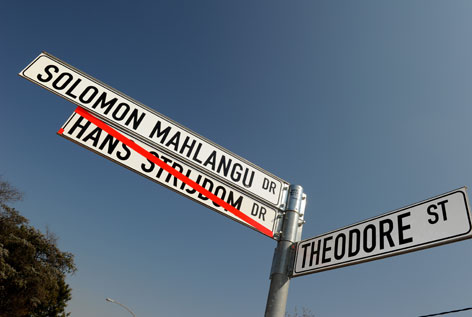
Street name showing a deleted SA prime minister, Hans Strijdom, replaced with a convicted ANC terrorist, Solomon Mahlangu
It was in the interests of justice for finality to be reached in the Tshwane street name saga, a High Court in Pretoria judge said on Thursday.
Judge Bill Prinsloo dismissed the Tshwane Municipality’s application for leave to appeal an interim order, granted in April, interdicting the city from removing old street names and ordering it to re-install old signs which have already been removed.
The order was granted after an urgent application by civil rights group AfriForum pending the outcome of its application to set aside Tshwane’s 2012 resolution to change the “offensive” names of 25 streets.
Prinsloo ruled that his findings on the urgency of the application and the interim interdict he granted were not appealable.
He said the interim order did not amount to a final or definitive finding regarding the rights of any of the parties, and did not interfere with the executive function of the municipality.
There was no chance that another court would come to a different conclusion, he said.
Referring to an Opposition to Urban Tolling Alliance (Outa) case in which the National Treasury successfully appealed against an interim order stopping e-tolling, Prinsloo said the present case was a far cry from the perceived financial consequences in the Outa case.
“In my view, the interim relief does not have an immediate and substantial effect, including serious, immediate and ongoing harm.
“It only perpetuated the status quo involving the retention of the old names under the new names.
“The names have probably been in use for more than a century, are widely known, quite harmless and [their retention is] sure to avoid confusion,” he said.
Prinsloo said the balance of convenience favoured AfriForum, which sought to protect cultural rights, and which stood to be prejudiced if the status quo was not maintained. There was no harm or prejudice whatsoever for the municipality.
He said the R2.6 million it would cost to restore the old names was because of the city’s own conduct. It had had no justifiable reason to remove them at a time when a review application was pending.
The order also did not interfere with executive function, because the new names, which were installed in March 2011, had remained where they were pending the review application.
Prinsloo said an appeal against the interim order could take longer to finalise than the review application, and could delay it for a long time, rendering the proceedings moot.
Such a state of affairs could not be tolerated and was not in the interest of justice, he said.
AfriForum’s Kallie Kriel welcomed the ruling, but said it was not the end of its struggle for the city to recognise the rights of cultural groups.
Tshwane still had a few days left before the court’s deadline to restore the road signs, but if it failed to do so AfriForum would consider appropriate steps, he said.
He hoped the review would be heard before the end of the year or early next year. – Sapa
BANKSERVAFRICA’s Economic Transaction Index (Beti) showed encouraging signs of the economy clawing back in May after three quarters of stagnation, the electronic payment transaction company said on Thursday.
While the Beti figures for May were not as strong as those for April, they still revealed growth of 2.9% year on year.
BankservAfrica’s regulated products CEO Brad Gillis said the negative sentiment in the South African economy “may not be completely justified”.
Although the actual index number for the May Beti was a little down from April, it was the second highest on record.
“This confirms that economic activity may have turned the corner after about three quarters of stagnation,” he said.
Between April and May, the Beti decreased 0.2%.
Economists.co.za chief economist Mike Schussler said April was the strongest month in a long time, as the shift in public holidays had made it a stronger-than-normal month.
“On the other hand, the May Beti seems more subdued, but it is clear that April was an exceptionally strong month, which, together with February transaction data, indicated a return to stronger growth in the economy,” he said.
However, the May Beti did not confirm that South Africa was very likely to have higher economic growth in the second quarter of 2013, than the first quarter.
“We saw no major strikes in May, and that has definitely played a role in relatively strong figures. The economy is still on its feet, but the pace is closer to a stroll than that of a 100m race”, Mr Schussler said.
He expected growth of about three percent in the second quarter of 2013.
“The South African economy has climbed back from stagnation levels that many still think the economy is in. Stagnation was last year’s battle … we are convinced that economic activity is picking up”, Mr Schussler said.
The actual number of economic transactions in the May Beti was 81.7-million, which was 3.5% higher than during May 2012.
The actual total monetary value of the transactions that the Beti reflects was more than R634.2bn just for May 2013.
The total value of transactions in May 2013 was therefore up 11.8% in nominal terms over May 2012. – Sapa
The GOP (Republican Party) deserves to die if it backs immigration reform, allowing more Latinos to become citizens, right wing pundit Ann Coulter says in a new column, If the GOP is stupid, it deserves to die.
The article is the latest in a series since President Barack Obama’s November reelection in which Coulter paints Hispanics as lazy, poor and government-dependent, concluding that they could never vote for conservatives and immigration reform would destroy both the Republican Party and the country as a whole.
“Democrats terrify Hispanics into thinking they’ll be lynched if they vote for Republicans, and then turn around and taunt Republicans for not winning a majority of the Hispanic vote,” Coulter wrote in the column, published Wednesday.
Coulter went on to claim that Latinos don’t favor a path to citizenship.
“Hispanic voters are a small portion of the electorate,” the column says. “They don’t want amnesty, and they’re hopeless Democrats. So Republicans have decided the path to victory is to flood the country with lots more of them!”
Coulter reinforced the views presented in her column during an appearance on Fox News’ “Hannity” Wednesday evening that ran under the banner “Legalizing Illegals.”
“This bill has nothing in terms of enforcement,” Coulter said. “If you’re serious about enforcement, just say ‘we’re enforcing E-Verify.’”
In fact, the comprehensive immigration reform proposal under debate in the Senate pours $6.5 billion into border security and mandates the expansion of E-Verify.
During a disagreement over whether Coulter was directly responding to a question about the path to citizenship, she and the host called one another “liberal.”
“You’re not answering my question,” Hannity said, as Coulter continued speaking. “You’re like a liberal.”
“No, nothing… you, you… on the contrary, you are like a liberal,” Coulter stammered back as Hannity sniggered.
She said if “amnesty” happens, “America is over” and “the only thing left for people like you and me to do, Sean, is to punish the people who destroyed America.” – Huffington Post
An agreement has been reached on the repatriation of Libyan funds and assets from South Africa, the Treasury said on Thursday.
“The Minister of Finance, Pravin Gordhan, has agreed with the Libyan government that the repatriation from South Africa of Libyan funds and assets will be handled in terms of United Nations (UN) protocols,” it said in a statement.
The agreement was reached at a meeting between Gordhan and a Libyan government delegation on June 4. The Libyan delegation was led by Usama al Abid, the Minister in the Office of the Libyan prime minister.
“The decision was informed by the fact that the government of Libya established a single body in 2012 to co-ordinate the repatriation of assets to Libya,” Treasury said.
This body co-operated with the committee formed in terms of the UN Security Council Resolution 1970 (2011) and the panel of experts which co-ordinated repatriation to Libya of assets frozen in various countries.
In particular, the panel identified and monitored hidden assets of the Libya Investment Authority, the Libya Africa Investment Portfolio and the Libya Africa Investment Company, as well as the assets of individuals listed under the relevant UN Security Council resolutions. – Sapa
Sergio Garcia received a warm welcome from US Open spectators on Thursday despite his recent racist remark toward Tiger Woods, but US star Phil Mickelson was the clear fan favorite.
Philadelphia sports fans have a reputation for toughness across the United States, notoriously having booed Santa Claus at an American football game, and their reaction to the Spaniard after his “fried chicken” remark was uncertain.
But when Garcia was introduced to start his opening round at Merion in the 113th US Open, there was only one lone, loud, clear boo to be heard amid polite applause from hundreds of spectators.
Garcia arrived at the 11th tee, used as a starting spot due to course logistics at the 6,996-yard layout, alongside 2009 British Open winner Stewart Cink, both men greeted warmly ahead of a 7:44 a.m. start.
Ireland’s Padraig Harrington received a louder ovation upon his arrival and Garcia quietly made some final practice swings, two policemen behind nearby pine trees to the right of the tee a noticable sign of extra security.
After the trio teed off and began walking down the first fairway, the fans yelled some words of encouragement to Garica, “Go Sergio” and “Go get ’em Sergio.”
The 11th tee area, which features a large rock with the plaque honoring Bobby Jones for his 1930 US Amateur victory that completed a sweep of that year’s US and British Opens and Amateurs, also saw the crowd produce yells of “Kooch” for Matt Kuchar and “Oooost” for South Africa’s Louis Oosthuizen.
A simmering dispute between Woods and Garcia took a cruder tone last month before the BMW PGA Championship when Garcia attempted a joke about what he might serve Woods should they have dinner together.
“We will have him round every night. We will serve fried chicken,” Garcia said.
The reference to fried chicken, seen as an insult to African-Americans, sparked a racism furore much the same way that Fuzzy Zoeller had in 1997 when he suggested Woods serve fried chicken at a Masters champions dinner.
Garcia has apologized publically for the mistake and left an apologetic note for Woods in the locker at the US Open after exchanging a brief handshake on the practice range Monday at Merion.
World number one Woods had tweeted in response to the “fried chicken” remarks: “The comment that was made wasn’t silly. It was wrong, hurtful and clearly inappropriate … it’s long past time to move on and talk about golf.”
Woods, scheduled to begin his quest for a record-tying fourth US Open title and 15th major crown in the afternoon, said again on Tuesday that it was time to move on and put the comment in the past.
Hundreds were waiting in line for the grandstand at the 11th tee to open at 7 in the morning for the first group were wondering if Mickelson, a five-time US Open runner-up, would arrive on time.
Mickelson flew home Monday to Southern California to attend his daughter Amanda’s eighth-grade graduation ceremony and caught an overnight flight across the nation back to Merion in time to make it to the tee for his 7:11 start.
“Your week Phil” and “You made it” were among the yells of encouragement for the black-clad US left-hander who turns 43 on Sunday under overcast skies. – AFP
Recent acts of racism in the country should be strongly condemned, Minister in the Presidency Collins Chabane said on Thursday.
In a statement following Wednesday’s fortnightly Cabinet meeting, Chabane said this should especially be stamped out in school classrooms.
“There is no room for racism in our country and democracy, let alone in our schools, where the values of our Constitution ought to be promoted and defended.”
He called on South Africans to work with government to deal with racism.
“Cabinet commends the department of basic education for its quick action in dealing with racism in schools and encourages all parents, pupils, and teachers to report racism and abuse at schools.”
In a Grade Seven classroom at the Wilgehof Primary School, in Bloemfontein, the old South African flag was reportedly on display, along with a picture of expelled ANCYL leader Julius Malema alongside that of a monkey.
The history and life orientation teacher allegedly responsible for the display and for making racist remarks, as well as the principal, have been suspended.
One of the white parents at the school had also laid a complaint with the SA Human Rights Commission (SAHRC) — who had already been to the school for an on-site inspection.
While investigating, the SAHRC learnt that some pupils had been called derogatory names. – Sapa
Eight months after attorneys for Abigail Fisher argued in front of the Supreme Court that the University of Texas’ affirmative action admissions policy discriminates against white students, the justices still have not handed down their decision in the potentially paradigm-shifting case.
The unusual delay has many court-watchers stumped, though as with everything Supreme Court-related, all explanations for the wait are, at best, educated guesswork.
Lyle Denniston, who has covered the Supreme Court for more than 50 years and now works for the legal website SCOTUSblog, said he couldn’t remember another case that had been argued in the fall yet still undecided by mid-June.
“I have absolutely no idea what is holding it up,” Denniston said.
One reason why the delay is so surprising: During oral arguments in October, it seemed fairly clear that the four conservative justices would band together with swing vote Justice Anthony Kennedy in striking down the use of race as a factor in undergraduate admissions. Kennedy has voted against affirmative action policies in the past and showed no willingness during questioning to reconsider his past position.
Additionally, the four liberal-leaning justices are short Elena Kagan, who had to recuse herself in this case due to her work on it while a part of the Obama administration. That seemed to clear the way for an easy 5-3 decision in favor of Fisher.
“It’s really surprising that it’s taken this long for the court to issue an opinion,” said Adam Winkler, a constitutional law professor at UCLA School of Law. “It’s almost unheard of for the court to take the entire term to decide what really is a straightforward case.”
Winkler said he believes the court will rule broadly against the University of Texas in a way that will outlaw affirmative action programs nationwide. He thinks that instead of ruling narrowly against this particular school, the court will overturn its own 2003 Grutter v. Bollinger decision that said affirmative action is allowable as long as it’s not a quota system as a way to ensure schools have a diverse student body. In that decision, the court ruled that eventually, in 25 years, the use of race would again becoming legally suspect, but that until then it’s needed to correct societal discrimination.
Winkler guesses the decision is taking so long because the liberal justices are writing lengthy dissents to the conservative judges’ sweeping decision.
“The dissenting justices are very upset about something,” Winkler predicted. “A narrow ruling only striking down Texas’ policy without significantly reshaping the law of affirmative action should be an easy opinion to write and shouldn’t inspire unusually long dissents.”
Long-time court reporter Linda Greenhouse, however, wrote in The New York Times that it’s possible Kennedy’s decision is considered “frustratingly narrow” by his conservative colleagues, since the court has already agreed to hear another affirmative action case in the fall. That suggests they may want another crack at the issue next year.
Another theory floating around legal circles is that the court may be waiting to release the Fisher case at the same time as it hands down Shelby County v. Holder, another landmark case this term (heard in February) that has the potential to significantly diminish the reach of the Voting Rights Act. Alabama sued the federal government, arguing that Southern and other states covered under the act are unfairly monitored by the federal government for discrimination in voting.
One theory is that the court will release the decisions together to make a broader statement about race in society today and how far government institutions may consider race as a way to correct past institutionalized discrimination. The justices could strike down the use of race in admissions as unconstitutional while upholding the Voting Rights Act, as a way to split the issue down the middle and avoid charges of overreach.
But other court watchers said it’s routine for the court to save its most controversial opinions for the last minute, and that it’s impossible to know why the supremes are dawdling.
“This means nothing,” Geoffrey Stone, the former dean of the University of Chicago Law School, said. “The court generally holds its most important decision for the end of the term. We can’t read anything at all into the fact that it hasn’t handed down Fisher yet.”
“I think the more likely explanation is simply that dealing with tough issues requires a lot of thought and care,” said Gail Heriot, a law professor at the University of San Diego. – Yahoo News
Dr. Hage Geingob, prime minister of Namibia (ex-South West Africa)
Windhoek — The days are numbered for Buffalo’s bar in Gobabis, the latest flashpoint in an alleged racist attack, warned Prime Minister Dr Hage Geingob.
He said “undesirable establishments like Buffalo’s bar and similar places which are scattered all over the country,” should be closed down for being racist outposts. Geingob made the remarks on Tuesday in the National Assembly when he launched a strong denunciation of the alleged act of racism in which Levi Katire was allegedly assaulted by Nico Kotze and Frederick ‘Boeta’ du Plessis who now face charges of assault and racial discrimination.
“The heinous actions of a group of racist criminals in the town of Gobabis took the entire nation back to a dark past from which we have all so dearly wanted to emerge. It seems there are some people living within our borders who are intent on continuing the sinister legacy of racial discrimination and brutal violence of the past,” said the Prime Minister who joined the growing chorus of voices condemning the barbaric attack.
Geingob went on to say the two suspects are amongst a large number of “so-called Namibian citizens” who look upon the country’s policy of national reconciliation as a “policy of weakness”. The policy of national reconciliation was adopted to heal a nation, which was emerging from a dark history of racial discrimination, and to mitigate acts of revenge following the attainment of independence, Geingob said.
He condemned in the strongest terms the attack on Katire and promised that no stone would be left unturned until “we uproot and expose each and every one of these racist elements, who participated in this act of barbarism.” According to Geingob there are people who still think they can establish “pseudo republics and homelands” on the territory of an independent Namibia that courageously fought and triumphed over a discriminatory system.
He said it is high time that the government awakens racially intolerant individuals from “their absurd dreams and remind them that the apartheid republic is now nothing but a relic of psychosis”. He further warned that Namibia is a free and sovereign state and any individual who cannot comprehend that after 23 years should do him or herself a favour to “pack and go”.
“If you cannot pack yourself fast enough we will assist you. Make no mistake. The days are numbered for undesirable establishments like Buffalo’s bar and similar places which are scattered all over the country.”
He said so-called private establishments should be outlawed in public areas and implored the Attorney-General to find ways of closing down such places and to conduct a thorough investigation into the Gobabis incident.
“We need to identify the nationality of these perpetrators and if they are not Namibians, they should be shipped off immediately. I am aware that there is a criminal investigation which is ongoing, but we must ensure that a place such as Buffalo’s bar is permanently shut down,” he urged the Attorney-General.
The two men were denied bail on Friday in the Gobabis Magistrate’s Court and their quest to secure bail resumed on Wednesday and continues today. – New Era
President Jacob Zuma denied on Thursday being responsible for the sharp decline in the value of the rand.
Responding to the Presidency Budget Vote debate, Zuma roasted opposition parties for linking his news briefing more than two weeks ago on the state of the economy to the depreciation of the rand, hours after he spoke.
“The fact is that markets were very volatile on the day of the media briefing on the economy,” Zuma said.
“Traders responded to news from the United States on quantitative easing, a form of very lax monetary policy in the United States. This led to the strengthening of the dollar,” said Zuma.
The rand plummeting was as a result of a stronger dollar and lower commodity prices.
Zuma conceded that labour unrest and the weak GDP would have added to the situation.
“There had been an expectation that growth would be between one and two percent. When the 0.9 percent growth figures were released, there was a sell-off of the rand,” he said.
Zuma warned opposition parties to steer clear of statements which could make matters worse.
Instead, parties should “put the country first” and work with the government to help build confidence in the economy.
The president said concerns in the mining sector, which has been hard hit by labour unrest, were being dealt with.
Deputy President Kgalema Motlanthe would meet players in the sector on Friday to discuss disputes in an attempt to bring an end to the instability.
While there appeared to be some recovery in the mining sector this year, following a tumultuous 2012, it was far from out of the woods.
“It is for this reason that we place a high premium on restoring stability in the mining sector.”
Zuma asked opposition parties to support the government’s efforts to broker a peace deal between unions in the sector.
“The bottom line is that we should exercise caution when dealing with such matters, and avoid uninformed or loose talk that may exacerbate the situation.”
The US dollar was beaten by major currencies in a week that saw extreme volatility, especially around the yen. Rate decisions in Japan and NZ, and US Federal Budget Balance, Retail Sales and inflation figures are the top events this week. Will this kind of market action continue? Here is an outlook on the main market-movers awaiting us.
The US economy gained 175K jobs in May, exceeding Analysts’ Forecast of a 167,000 job addition , following a series of weak readings.
Furthermore, this was the third straight month that payrolls increased less than 200,000, indicating the US job market is not strong enough to be turning the corner, especially in light of the government’s austerity measures, weighing in the economy.
This enabled only a partial recovery of the US dollar after a major crash, following the mediocre US data and the ECB decision: Draghi practically put the negative deposit rate on the backburner.
Standing out from the crowd were the New Zealand and Australian dollars. The Aussie dollar is getting close to critical support. – SAPA
A man was arrested at London’s Westminster Abbey on Thursday for defacing a portrait of Queen Elizabeth II commissioned to mark her 60 years on the throne.
“In an incident at lunchtime today, a visitor to the abbey sprayed paint on the Ralph Heimans portrait of the queen, presently on display in the Chapter House,” a spokeswoman for the abbey said.
“Until work can be done to remedy the damage it will — very regrettably — not be possible to have the painting on public view.”
Scotland Yard said officers had been called to the abbey at about 12.30 pm (1130 GMT), where security guards had detained a 41-year-old man for defacing a painting.
“He was arrested by police on suspicion of criminal damage and taken to a central London police station where he is in custody,” it said in a statement.
The oil painting by Heimans, a Sydney-born artist based in London, is titled “The Coronation Theatre” and was commissioned for the queen’s diamond jubilee last year.
Measuring nine feet by 11 feet (about 2.7 metres by 3.4 metres), it depicts the monarch in the state dress she wore to her coronation in 1953 and taking an imagined moment of solitary reflection in the sacrarium of Westminster Abbey.
The painting was first shown at the National Portrait Gallery of Australia, and now forms part of the permanent collection of the abbey in London.
It was put on public display on May 23 as part of a special exhibition marking 60 years since the coronation, and was due to stay up until September 27. – AFP
One thousand police officials have been arrested for crime in the past three years, Gauteng police commissioner Mzwandile Petros said on Thursday.
The arrests were made between September 2010 and April this year, he said at a New Age breakfast on government’s drug clean-up campaign.
With a police station comprising about 300 officials, this meant three stations had in effect been closed down.
Petros said this would not deter police management from its drive to clean up the service.
“It takes two years to train a police official. Even if we are left with 10, or one police official, that is how far we are going to take the campaign,” he said. – Sapa
One of the biggest liberal myths in South Africa is that whites own 87% of the land. If you consider that 70% of the country consists of the Karoo desert, there is only 30% with any rainfall to speak of. Blacks have always owned at least half of that in the form of tribal lands where mostly subsistence farming is practised with land being administered according to the whims of the chief. You have his permission to plant or let your cattle graze, but it could be revoked anytime.
The government also owns huge tracts of land. Instead of developing that land, as well as the tribal lands, the government wants to punish white farmers for being successful! As many analysts and economists have pointed out, they are actually using taxpayers’ funds to take land out of production and turn it into subsistence land as in the tribal areas. That is why our agricultural production has been declining, with food prices going up all the time.
The worst is: South African blacks are just not interested in agriculture. Most of them would prefer to have a city job, earn a big salary and spend it on branded consumer goods. But government sees the large number of white-owned farms as a political and strategic problem. It prevents them from pushing whites around at will and even expelling them if need be, as in Zimbabwe.
Another burning issue around land reform is that we have some foreign academics, real “tenured radicals” who have got posts at our universities – heaven knows how – and are now pushing a radical socialist agenda when it comes to land ownership. One such person is Dr. Ruth Hall of a group called PLAAS (Institute for Poverty, Land and Agrarian Studies).
More than 4 000 white farmers and their family members have been killed, with many tortured to death in dehumanising, atrocious ways. They are made to drink boiling water, burned with hot irons or simply hacked to pieces with their corpses displayed afterwards in ways that remind one of Satanic rituals.
Personally, I think the vicious attacks on Afrikaner farmers stem from three things: recent history, African culture and radical left-wing ideology.
During the ANC’s terror campaign in the 1980s, they not only placed bombs in diners and supermarkets, but they also buried limpet mines on farm roads, blowing up white families, as well as black farm workers. So this culture of terrorist violence has taken root and still continues by other means.
A game farm in South Africa
The second factor is not politically correct to mention, but it needs to be said that in traditional African culture there is a fascination with the power of horror and violence. A few hundred people are still murdered every year for body parts to be used in so-called muti or “medicine”. So mix terrorism with horror and you are on your way to unstoppable violence.
The third ingredient is left-wing ideology or what Americans call “liberalism” which amounts to the same thing. There is a whole industry in South Africa, but mostly funded from abroad by Scandinavian governments and American liberal foundations, which advocates radical land reform and Soviet-style collectivist agriculture in our country. To them private property means next to nothing and they indirectly encourage some of these Einsatzgruppen to just go out and kill white farmers indiscriminately. They are dreaming of a brave new world without family-owned or privately-held farms and the murders suit them.
Land reform and the propaganda around it are fuelling ethnic conflict in South Africa which few outsiders are prepared to acknowledge, except the organisation Genocide Watch which looks at it more analytically in terms of other identity conflicts world-wide.
There definitely is a risk of full-scale genocide in South Africa, although for the moment the organisation for that is largely lacking. At present it is more of a random process, driven by the three factors mentioned above.
It is also important to understand that whites and blacks do not naturally hate each other. The current conflict is being driven by outsiders – Europeans, Americans and perhaps even Mugabe who has accused Mandela of being “soft on whites” – who will gain through a collapse of South African agriculture. They will be able to buy land, machinery and other agricultural assets on the cheap and so extend the neo-colonial hold that they have on our country already.
This website uses cookies to improve your experience. We'll assume you're ok with this, but you can opt-out if you wish. Cookie settingsACCEPT
Privacy & Cookies Policy
Privacy Overview
This website uses cookies to improve your experience while you navigate through the website. Out of these cookies, the cookies that are categorized as necessary are stored on your browser as they are essential for the working of basic functionalities of the website. We also use third-party cookies that help us analyze and understand how you use this website. These cookies will be stored in your browser only with your consent. You also have the option to opt-out of these cookies. But opting out of some of these cookies may have an effect on your browsing experience.
Necessary cookies are absolutely essential for the website to function properly. This category only includes cookies that ensures basic functionalities and security features of the website. These cookies do not store any personal information.
Any cookies that may not be particularly necessary for the website to function and is used specifically to collect user personal data via analytics, ads, other embedded contents are termed as non-necessary cookies. It is mandatory to procure user consent prior to running these cookies on your website.