Women plan sex strike in Togo

Lome, Togo – Women in the civil rights group “Let’s Save Togo” said they will have a week long sex strike to demand the resignation of President Faure Gnassingbé.

The plan to withhold sex from their husbands for a week will start Monday, said Isabelle Ameganvi , leader of the group’s women’s wing.

Ameganvi, a lawyer, told the AP that her group is following the example of Liberia’s women who used a sex strike in 2003 to campaign for peace.

The women’s protest is part of a campaign by a coalition against  Gnassingbé. The opposition group National Alliance for Change held a peaceful demonstration against the president on Saturday. Gnassingbé has been in power since 2005, following the death of his  father Gnassingbé Eyadema who ruled the West African country for 38  years. -AP

How the 1960s’ Riots Hurt African-Americans

Detroit race riot in 1967

South Africa is currently going through a period of intense social unrest, characterised by so-called “service-delivery protests”. It is estimated that last year 5% of the country’s black population participated in some form of protest action or rioting. The long-term effects could be considerable, as may be learned from this American study of the aftermath of black rioting in the USA during the 1960’s.

How the 1960s’ Riots Hurt African-Americans

by David R. Francis, National Bureau of Economic Research, Cambridge, Massachusetts

“The riots had economically significant negative effects on blacks’ income and employment. Further, those effects may have been larger in the long run – from 1960 to 1980 – than in the short run – from 1960 to 1970.”

“The riots significantly depressed the median value of black-owned property between 1960 and 1970, with little or no rebound in the 1970s.”

Any American of a certain age remembers the race-related riots that tore through U. S. numerous cities in the 1960s. Between 1964 and 1971, civil disturbances (as many as 700, by one count) resulted in large numbers of injuries, deaths, and arrests, as well as considerable property damage, concentrated in predominantly black areas.

Although the United States has experienced race-related civil disturbances throughout its history, the 1960s events were unprecedented in their frequency and scope. Law enforcement authorities took extraordinary measures to end the riots, sometimes including the mobilization of National Guard units. The most deadly riots were in Detroit (1967), Los Angeles (1965), and Newark (1967). Measuring riot severity by also including arrests, injuries, and arson adds Washington (1968) to that list. Particularly following the death of Martin Luther King in April 1968, the riots signaled the end of the carefully orchestrated, non-violent demonstrations of the early Civil Rights Movement.

Social scientists have studied the causes of the riots for a long time. Now two NBER papers by William Collins and Robert Margo instead examine the economic impact of the riots on African Americans and on the cities where they took place. In the first paper, The Labor Market Effects of the 1960s Riots (NBER Working Paper No. 10243), they find that the riots had economically significant negative effects on blacks’ income and employment. Further, those effects may have been larger in the long run – from 1960 to 1980 – than in the short run – from 1960 to 1970.

Until 1975, the racial gap in average earnings among full-time male workers in the United States narrowed. There were periods of sharp convergence, as in the 1940s, alternating with periods of relative stasis, as in the 1950s and early 1960s. After 1970, racial convergence in earnings slowed markedly, in part because many low-wage black males were no longer engaged in full-time work, the authors note. The proportion of blacks living in high-poverty urban neighborhoods increased as well, and residential segregation led to increasingly poor socioeconomic outcomes among young blacks. In this context, Collins and Margo attempt to detect whether the riots contributed to a downward economic spiral that hurt employment opportunities, incomes, and property values.

Although they characterize their baseline estimates as “tentative,” Collins and Margo find a relative decline in median black family income of approximately 9 percent in cities that experienced severe riots relative to those that did not, controlling for several other relevant city characteristics. There is also some evidence of an adverse effect on adult male employment rates, particularly in the 1970s. Between 1960 and 1980, severe riot cities had relative declines in male employment rates of 4 to 7 percentage points. Individual-level data for the 1970s suggests that this decline was especially large for men under the age of 30.

In the second paper, The Economic Aftermath of the 1960s Riots: Evidence from Property Values (NBER Working Paper No. 10493), Margo and Collins investigate the influence of riots on central city residential property values, especially black-owned properties. They find that the riots significantly depressed the median value of black-owned property between 1960 and 1970, with little or no rebound in the 1970s. The baseline estimates for severe-riot cities relative to small-or-no-riot cities range from approximately 14 to 20 percent for black-owned properties, and from 6 to 10 percent for all central-city residential properties. Household-level data for the 1970s indicate that the racial gap in property values widened substantially in riot-afflicted cities relative to others.

The exact mechanisms through which the riots affected economic activity over a long period of time are difficult to identify, but a large number of potentially reinforcing channels exist. Property risk might seem higher in central city neighborhoods than before the riots, causing insurance premiums to rise; taxes for income redistribution or more police and fire protection might increase, and municipal bonds may be more difficult to place; retail outlets might close; businesses and employment opportunities might relocate; middle and higher income households might move away; burned out buildings might be an eyesore; and so on. These damaging aspects of riots, the authors find, apparently outweighed outside assistance directed toward the riot areas in the wake of the disturbances.

Racism threatens Australia’s ‘brand’

The Sydney Morning Herald reports that Australia’s race discrimination commissioner says the nation’s ‘‘brand’’ has at times been maligned by outbreaks of of racism and there is a poor understanding of the problem in the wider community.

Helen Szoke has also identified a ‘‘cultural glass ceiling’’ that hinders certain minority groups from rising up in workplaces as among the subtler issues that must be tackled.

In advance of today releasing a national anti-racism strategy, Dr Szoke said: ‘‘We understand sex discrimination much better than we understand racism — and we know far we have got  to go with sex discrimination — so that gives you an indication of how far we have to go with racism.’’

Dr Szoke said racism in Australia existed in multiple forms. ‘‘People who actually don’t experience racism think it’s something like riots or violence whereas often racism occurs in quiet places and quiet ways.’’In a paper outlining the public awareness plan to be rolled out over three years, the Australian Human Rights Commission notes indigenous people are among the most vulnerable to racism.

The commission said the experience of people from culturally diverse backgrounds tended  to vary, ‘‘being shaped in large part by their particular histories of migration and settlement’’.

New arrivals, especially those distinguished by dress and skin colour, were more likely to encounter prejudice than ‘‘settled’’ migrants.

In an interview, Dr Szoke cited the episode involving attacks on Indian students in Victoria as particularly harming Australia’s ‘‘brand’’.

She said Victoria Police, which recently raised the alarm about youth from Sudanese and Somali backgrounds, also needed  to exercise caution in how  it engaged with such a complex matter.

‘‘As soon as you name a particular racial group and associate them with crime it has two immediate effects,’’ Dr Szoke said.

‘‘The first is that it builds a perception in the eyes of the community that all people from that racial group are criminals and the second is it actually subjects members of those community who may have a public profile to vitriol and race hate.

‘‘That’s exactly what happened in the past week. I’ve seen some of the emails that have been sent to the African community leaders with some horrific and threatening (messages).’’

Dr Szoke  acknowledged sometimes law enforcement agencies needed to name a particular racial group, but a cautious and sensitive approach was required so as to avoid stigmatising a whole ethnic community.

She rejected the notion that a repeat of the Cronulla race riot situation was on horizon.

Dr Szoke also said she believed that the asylum seeker debate had a racial element to it, ‘‘because at its heart, racism is a fear of difference’’.

Read more: http://www.smh.com.au/national/racist-outbreaks-threat-to-australias-brand-20120823-24p0g.html#ixzz24cx0ztQC

2 killed, 8 wounded in shoot-out outside Empire State Building

Two people were killed and at least eight were wounded in a shooting outside the landmark Empire State Building in New York City on Friday, a New York police source said.

One of the dead was the shooter, the source said, adding there was no apparent link to terrorism.

A white tarp covered what was believed to be a body in front of the entrance to the office building but police declined to confirm if it was the shooter.

“I heard the gunshots,” said Dahlia Anister, 33, who works at an office near the 102-story Empire State Building. “It was like pop, pop, pop. It was definitely in a bunch.”

The shooting started shortly after 9 a.m. on the busy sidewalk on Fifth Avenue outside the Midtown Manhattan building.

It came at the height of the tourist season outside one of New York City’s most popular attractions, startling tourists and commuters. Police cordoned off the area around the building, one of the most recognizable in the world.

The Empire State Building is two blocks from Pennsylvania Station and a few blocks from Grand Central Terminal, two of New York City’s main transportation hubs.

“People started running, saying somebody has a gun, so I just ran the other way. I was scared,” said Adrianne Lapar, 27, who works in the Empire State Building.

The United States has had two other mass shooting cases this summer. On July 20, James Holmes, 24, is accused of opening fire at a midnight screening of the Batman film “The Dark Knight Rises” in Aurora, Colorado, killing 12 people and wounding 58.

On August 5, a gunman killed six people and critically wounded three at a Sikh temple outside Milwaukee before police shot him dead in an attack authorities treated as an act of domestic terrorism.

The Empire State Building was the world’s tallest building for 40 years from its completion in 1931 until construction of the World Trade Center. Following the September 11, 2001, attacks, it was again the tallest building in the city, though was recently surpassed by a new tower under construction at the World Trade Center. – Reuters

US-style ‘minority procurement’ or BEE is ill-suited to South Africa

by Dan Roodt

Deputy President Motlanthe’s call for black business to become more “cost-competitive” in tendering for state business is another noble-sounding ideal denied by reality.

South Africa is so committed to race preference that there is no turning back. It is inscribed in the Constitution and in the minds of almost everyone. BEE, which nowadays gets referred to as Black Elite Enrichment, is a political principle and not an economic one.

The mythology of “apartheid” being a Nazi-like system which “killed millions of people” (this was stated to me by a Wits academic) and withheld education from black people has created the “debt” which must be discharged through hand-outs to the black elite, masquerading as “business”.

Big Business in South Africa has always meddled in politics and has taken a kind of decadent pleasure in kow-towing to a radical government. Some sucker will always pay for BEE and affirmative action, whether it will be pension funds, the middle-class taxpayer or the poor simply getting poorer. We have been infected with American ideas dreamt up to pamper a smaller number of blacks in an economy forty times bigger than ours.

US-style “minority procurement” or BEE is as ill-suited to us as Pik Botha’s anecdote of a snow plough sold to a former homeland government for its airport. “Every airport must have a snow plough” was the sales pitch. Just like every black man must have a business and enjoy some form of preference to soothe his pride and dignity.

South Africa is already a failure as its education and health systems crumble and the numbers queuing up to be “empowered” from the state’s coffers swell. But this is all part of the master plan; a sovereign state at the southern tip of Africa did not suit the major powers.

Many abroad will applaud South Africa’s eventual descent into Zimbabwean bankruptcy and squalor, with gleeful Schadenfreude. It is our fate, which was decided in 1994 and even before.

South Africa is a weak state, if not a failed one. The previous Afrikaner state had some strategic value as it could exert some influence over the sea routes and bother its adversaries. This weak or failed state has about as much strategic importance as Swaziland or Lesotho.

No-one could care less about whether Zuma or Malema governs us, or whether the state pays R7 or R27 for a bottle of water.

White elderly couple’s throats slit

Johannesburg – Gauteng police have arrested two suspects in connection with the murder of an elderly couple from Kempton Park, east of Johannesburg, this week, according to a report on Friday.

Marie Sim, 68, and her husband Leon Sim, 71, who ran Anneliens Guest House in Creswell Park, were both found with their throats slit, Beeld reported.

According to the couple’s eldest son John Sim, his parents had had a long-standing dispute about money and the loan of a generator with a tenant who lived on the property.

“Wednesday was D-Day. My dad would have demanded both the money and the generator, otherwise he planned to lay a charge of theft with the police,” he told Beeld.

The bodies were discovered on Thursday by the couple’s domestic worker, Thembi Radebe.

Leon Sim’s body was found in the garden, while Marie Sims was found in her home. The suspects had tried to burn her corpse by pouring swimming pool chemicals over it and setting it alight.

Reacting to a tip-off from the public, police managed to arrest a male and a female suspect within a few hours. – Sapa

Terror of the gay dwarfish African incubus

by Dan Roodt

To most people outside South Africa in developed countries, our life here must seem bizarre. After all, nowhere in Europe or the United States would you drive your children to school and see that the country’s largest newspaper, the Daily Sun, has got “Terror of the gay Tokoloshe” as its frontpage story for the day.

Probably you do not even know what a Tokoloshe is. Ever since I was a child I was intrigued to see that most black people in South Africa, especially women, place their beds on bricks. Apparently if one’s bed is high enough, the Tokoloshe cannot reach you while you are sleeping. So from my earliest years as I became aware of the peculiar differences between blacks and whites, I was brought under the impression that the Tokoloshe played an important role in the lives of blacks.

More black people in South Africa use so-called “traditional medicine” than the Western kind. The government has even institutionalised witchdoctors which are now called “traditional healers” or simply “healers”. At one point I read somewhere that one might also claim from health insurance for visiting a healer who will give you a concoction called “muti” that might contain all kinds of bizarre ingredients. In the northern parts of the country, there is even traffic in human body parts for making “strong muti”.

Being Africans of a slightly different kind, we Afrikaners jocularly refer to the more regular Eurocentric medicine that we take as “muti” too, especially to children. “Come on, drink your muti,” one would tell one’s son or daughter, referring to cough mixture or a tablet made by some branded pharmaceutical company.

Sometimes we Afrikaners call our children “Tokolos” as a term of endearment. Otherwise, we often joke about the Tokoloshe, saying things like: “The Tokoloshe is going to catch you.” But of course, unlike black Africans, we lack any real belief in his existence. To us he is merely a mythological creature like Zeus or Spiderman.

Wikipedia has a few lines on the Tokoloshe, but it mostly omits his sexual proclivities. From what I remember, the Tokoloshe especially preys on single women as they are more likely to be amenable to his advances, especially in dreams. It is also through one’s dreams that the ancestors communicate to the living. Normally, witchdoctors or sangomas or nyangas as they are also called, are “called” by an ancestor to their profession.

I once heard a story of an African investment banker in Johannesburg being called to become a witchdoctor. He went missing for six weeks and arrived back at the bank with an animal bladder on his head. Afterwards there was some discussion as to whether he could discuss corporate finance with clients while wearing the bladder, which he was not allowed to take off.

The Daily Sun’s story has a charm of its own and is in a way politically correct. No doubt it will speak to people for whom gay rights are a burning issue as even the little African incubus may be gay, it seems. Considering that there is currently a whole hullabaloo in the United States about the Republican senatorial candidate’s petite phrase about “legitimate rape”, “the terror of the gay tokoloshe” brings a whole new dimension to discussions of rape.

According to the Daily Sun’s report, Mr. Isaac Malope (51) has already spent R200 000 (about $25 000) on muti to defend himself against a gay Tokoloshe who comes to rape him every night while he is asleep next to his wife Constance Mazibuko (43).

Isaac Malope told the Daily Sun’s reporter, Alex Nkosi: “Every night he comes between me and my wife and rapes me over and over. When he leaves, I no longer have energy for my wife and even if I try to get an erection, nothing happens.

The only time when I manage to get an erection is if I fast for seven days and ask God for it. But it only lasts for a day and then it is back to hell. I have been to many different sangomas but they have failed to solve the problem.”

Mr. Malope has even travelled from South Africa to Nigeria to consult a well-known prophet there, to no avail.

The couple are now asking the Daily Sun’s readers for help, giving the following number in Pretoria to dial: 012 424 6251.

Amcu calls for independent commission of enquiry as mineworkers were ambushed at Marikana

The Association for Mineworkers and Construction Union (Amcu) has called for an independent commission of inquiry into the killing of 34 striking mine workers at Lonmin’s Marikana platinum mine, in Rustenburg.

“As much as the president of South Africa has called for a commission of inquiry, we are not different to that, but what we are calling for is an independent and outside body that could deal with the root cause of this matter,” Amcu secretary Jeff Mphahlele said on Wednesday.

He was speaking at a public meeting at the University of Johannesburg (UJ).

“We do not trust the terms of reference [of the inquiry ordered by Zuma]… Where are they coming from, but [from] the very same people who killed our people?”

On Thursday, police shot dead 34 people and wounded 78 others while trying to disperse a group of striking workers gathered on a hill near the mine.

Zuma has since appointed an inter-ministerial commission of inquiry into the shooting.

It would be led by Minister in the Presidency Collins Chabane. Its members are: North West premier Thandi Modise and the ministers of mineral resources Susan Shabangu, police Nathi Mthethwa, social development Bathabile Dlamini, co-operative governance Richard Baloyi, labour Mildred Oliphant, defence and military veterans Nosiviwe Mapisa-Nqakula, health Aaron Motsoaledi, state security Siyabonga Cwele, and home affairs Nkosazana Dlamini-Zuma.

Referring to Zuma, Mphahlele asked: “How can you be player and referee at the same time?”

Mphahlele said police officers shot not only at miners who were apparently attacking them, but also shot miners in the back, as they ran away from bullets. Their bodies were found close to a nearby informal settlement.

“They [miners] were being chased from behind and those [police] who were in front had hidden behind the nyalas,” he said.

UJ’s social change research chair Peter Alexander claimed the killings in Marikana were a deliberate, “pre-meditated massacre”.

He said the public had only seen video footage from cameras placed in front of the crowd.

Aside from mine workers shot for apparently attacking the police, more bodies were found a distance away from the police barrier.

“You haven’t heard about this and have heard what the government wants us to hear,” he said.

“They want us to hear stories about people coming down from the mountain with their spears about to attack police.”

He said mine workers had been attacked with rubber bullets and teargas from behind and that as they ran away, they ran towards the police, where they were killed.

Alexander said he based this on his interviews with striking mine workers after the shooting. – SAPA

Norway has to decide on Breivik’s sanity

As the trial of Anders Behring Breivik comes to an end, Norway is just starting to shape its future as a nation no longer isolated by its great wealth from a troubled outside world.

Survivors of Breivik’s massacre are waiting for Friday when an Oslo court passes judgment on the anti-Muslim gunman, hoping to return to something like the lives they led before he slaughtered 77 people last year.

Norwegian society, however, must still balance its liberal and conservative traditions exposed by Breivik’s 10-week trial as it decides how to deal with security and intelligence surveillance, gun controls and rising immigration.

“We are no longer so naive to believe that Norway is the best country in the world,” said Mette Yvonne Larsen, one of the three lawyers in court representing victims of Breivik’s attack on July 22, 2011. “It has made us understand we are a part of international society. We cannot solve problems by ourselves.”

For survivors such as Khamshajiny Gunaratnam, the most pressing need is to hear the verdict after a trial that went into every detail of Breivik’s bomb attack in Oslo that killed eight, and his shooting dead on Utoeya island of 69 people, mostly teenagers.

“After Aug 24, we can be done with it,” Gunaratnam told Reuters.

With what witnesses described as a “joyous battle cry”, Breivik arrived at the island youth camp of the ruling Labour Party dressed as a policeman. He regarded his victims, the youngest of whom was 14, as brainwashed “cultural Marxists” whose support for Muslim immigration threatened Norwegian ethnic purity.

Gunaratnam, aged 24, escaped the massacre by jumping into icy lake waters and swimming for her life. She survived because Breivik was busy shooting her friends in the head at point blank range, presuming she would drown.

SANE OR INSANE?

The verdict itself is not about Breivik’s guilt but whether, as prosecutors say, he is insane.

If Breivik is declared sane, his maximum sentence is 21 years, although this can be extended if he is seen as a danger to society. If declared insane, he faces indefinite mental care under lock and key.

The 33-year-old well-to-do son of a former diplomat is jailed in a three-room cell. He has a computer in one room, a treadmill to keep fit in another, access to TV and newspapers and is allowed a daily stroll in the fresh air outside.

Whatever the verdict, Breivik will probably spend the rest of his life in similar conditions, underscoring what some Norwegians regard as an excessive civility in the face of the cold-blooded killings.

Lawyers for the survivors say some do not care about the verdict while others would prefer Breivik be declared sane, meaning he takes responsibility for his actions.

Breivik himself wants to be ruled sane and his attack considered a political statement rather than an act of lunacy. He has said an insanity verdict would be “a fate worse than death” and that he would appeal it, prolonging the survivors’ ordeal.

A COUNTRY APART

Beyond the survivors’ personal feelings, the country of five million people faces difficult decisions following its worst massacre since World War Two.

Norway’s huge oil wealth has long set it apart from other nations. It has prospered outside the European Union, and its economy is expected to grow more than three percent this year while many European neighbors are stuck in recession.

Likewise, its strong political and legal systems mean it has avoided the corruption that afflicts many other oil producers.

With more than $600 billion in reserves from its oil fund, pristine forests and a welfare system that is the envy of the world, Norway has often looked haughtily at the rest of Europe.

However, some Norwegians now believe their country must draw on the experience of other nations to debate issues such as immigration as the oil wealth attracts large numbers of foreign workers.

These are being discussed more openly after the killings by Breivik, who believed the government’s immigration policies were adulterating Norwegian blood and leading to war with Muslims.

“We know now that Norway can be a source of terrorism … it has led us to just start talking about what kind of society we want,” said Geir Lippestad, Breivik’s lawyer. “What to do about right-wing fundamentalists, access to internet sites by extreme groups. We have just started the discussion.”

“Norway is more aware of racism now, of the issues of multiculturalism. Hopefully, we can start a process that Norway can open up more for the rest of the world,” he told Reuters.

NORWAY TRIES TO STAY THE SAME

On the face of it little has changed since the killings. The foreign ministry has new road blocks on its nearby street and a security check has been set up at the prime minister’s office. But government ministers still walk around without bodyguards and you can drive right up to the parliament building.

After the massacre, Prime Minister Jens Stoltenberg stressed that Norway would make no gut reactions that would infringe on its tradition of open democracy.

When prosecution lawyers shook hands with Breivik at the start of the trial, this civility sent a deliberate message that he would not force changes on the Norwegian way of life.

In some ways they succeeded. Opinion polls show more Norwegians accept multiculturalism – policies designed to accommodate differing communities – as the immigrants flock in.

Norway’s population grew 1.3 percent last year, one of the fastest rates in Europe, and net immigration accounted for 71 percent of that growth. While immigrants arrived from all round the world, 70 percent of them came from Europe.

“People are more aware of the danger of anti-Muslim rhetoric. We are more aware that some ideas can become very dangerous,” said Larsen.

But Norwegians’ civility is being tested already. A 500-page official report last week into the attacks found a host of mishaps and mistakes by police and intelligence services allowed Breivik to carry on the attacks unimpeded.

Norway’s police chief resigned after the report and the intelligence service are pressing for more surveillance powers.

Stoltenberg, who drew widespead praise for his measured and dignified leadership after the attack, is now under pressure to resign following the report. The conservative opposition has gone on the offensive before parliamentary elections next year.

The report also touched on a subject at the heart of Norway – wide gun ownership in a country where hunting is a national pastime, a legacy of Cold War defense preparations and Norway’s strong rural culture.

But the commission’s proposal to ban semi-automatic weapons – the kind that Breivik bought easily – may founder on opposition from many of Norway’s conservative voters for whom gun ownership, like in the United States, is a right.

Some critics of the government say Norway is also unprepared for its role in the outside world, saying its presence in the NATO-led force in Afghanistan, for example, could make it a target for further attacks.

All these debates need to be settled after the Breivik verdict. “Perhaps it was necessary to have a year of mourning,” Brent Aadal, political scientist at the Institute for Social Research. “Now we have to move forward and respond to real challenges.” – Reuters

Did South African police kill at Marikana to help black billionaire Ramaphosa’s finances?

The scene at Marikana, north west of Johannesburg, last week

Over the past few days PRAAG obtained new information about the Marikana massacre that is currently still making frontpage news in South Africa. It appears as if the miners of the Association of Mineworkers and Construction Union (AMCU) were deliberately murdered by the police as part of a campaign to get rid of the bothersome union.

AMCU was busy replacing the NUM (National Union of Mineworkers) as the majority union at the mine. The NUM is affiliated with COSATU, which is a member of the ANC regime’s so-called “tripartite alliance”. Before the shooting started, police ordered the media to leave the area.

Lauren Clifford-Holmes, the multimedia editor for the Johannesburg Mail & Guardian, was prevented last Thursday night from speaking to injured mineworkers. However, she stumbled upon two workers at Lonmin who confirmed that strife between the two trade unions was responsible for the problems, as NUM representatives were not re-elected by dissatisfied miners.
Cyril Ramaphosa

Black businessman and high-ranking ANC politician, Cyril Ramaphosa, apparently owns a contract to supply labour to the Lonmin mine at Marikana via his company Shanduka. “Ramaphosa and the NUM is practising a form of slave labour at the mine,” a source said at Marikana. “He is supplying labour at about R12 000 ($1500) per worker per month, but only pay his workers R4000 ($500) per month, thereby pocketing the difference. As a former NUM chief, he is able to control the union leaders and sees to it that he maintains this grotesque form of exploitation.”

However, NUM’s rival, AMCU, demands that the R12 000 received by Shanduka as labour broker in terms of the contract, should be paid directly to workers. Particularly the rock drillers, who perform the most difficult and dangerous work, felt that they were entitled to this wage, given that this was the tariff already received by Cyril Ramaphosa’s company for work at the mine.

An ex-policeman that PRAAG spoke to, but who prefers to remain anonymous, said that judging from the photographs he had seen, the workers were not attacking the police, but were fleeing from an area where a second police contingent was throwing tear gas at them. “One could see how some of them were trying to protect their eyes and faces. They thought they were fleeing to a safe place, where the heavily armed policemen mowed them down with automatic weapons, however,” said the ex-policeman.

The motive for the mass murder at the Lonmin mine at Marikana was apparently the protection of Shanduka’s lucrative service contract for supplying labour to the mine. Shanduka has already annouced that it will donate R2 million for the funeral of the 34 workers.

The workers are mostly from Lesotho, an independent country, and areas in the Eastern Cape. It would therefore be difficult for them to defend their rights and lives against the ANC-controlled state, cooperating closely with the British-controlled mining company. Until now, the only questions abut the massacre have come from black politicians and activists from outside governing ANC circles.

A group known as the September National Imbizi did a local investitagion and talked to an eyewitness alleging that the mineworkers were “drawn into an ambush” and that they were first bombarded with a “blue substance”, after which they were shot dead during the confusion. Many were executed while trying to hide among rocks and under bushes. On the websit of September National Imbizo, the eyewitness is referred to as “our friend”:

“…our friend shows us how several people were shot while they were hiding between the rocks and under bushes. We see for ourselves splatters of blood that indicate the determination to dig workers out of their hiding holes and shoot them dead. All sorts of items of clothing and shoes, soiled with blood lie all around the scene.”

The website also claims:

“What is clear from what we are told is that this was an ambush. The video material in mainstream media showing workers charging at the police was in fact workers running away from bullets being hurled from behind. Why would workers, armed with knobkierries [African-style clubs – ed.] charge at armed police? The workers were completely surrounded and what we’ve been seeing in the media is only half the story. There was clearly a mission: shoot to kill, thus the deployment of the army.”

Other strange incidents took place.

The media were kept away from the scene for hours so that it would be difficult to reconstruct the exact events. A contact of The Star newspaper was shot dead during the massacre. The police also forced a photographer from the Johannesburg Mail & Guardian to delete his photographs. Why were the police so scared that particular evidence regarding the shooting would leak out?

A video shown in the Netherlands, contained a Vodafone ambulance on the scene. The same vido was later shown in South Africa on News24.com, but without the ambulance, indicating that the video must have been edited.
Beforehand SAPA reported the following statement by the leader of the AMCU:
“We are not safe. Our phones have been tapped,” the Association of Mineworkers and Construction Union president Joseph Mathenjwa told a crowd in the Wonderkop informal settlement at Lonmin.
“We have been democratically colonised – workers work under very harsh conditions.”
After the massacre Mathenjwa demanded a really independent investigation, but the ANC simply appointed one of its own ministers, Collins Chabane, to lead the commission of enquiry. Under the previous, so-called “apartheid government” judges were always appointed to commissions of enquiry.
What Mathenjwa is probably referring to when he talks of “democratic colonisation”, is that workers are paid R4000 per month while Cyril Ramphosa is receiving three times as much per worker.

A Johannesburg businessman PRAAG spoke to and who is also in the services sector, confirmed that the ANC’s cadres have virtually instituted a system of “slave labour” in the country. The former officers of their militia, Umkhonto we Sizwe, is currently providing labour to the mines by recruting foreigners. Few, if any, mines still employ workers directly.

“Everything which the ANC described as apartheid, including the system of migrant labour, now applies, except in a far worse degree,” said the businessman. “The ANC’s cadres control everything. They have dug themselves into all sectors of the economy. They do not rule, they are in business. The state is for them just another business, with resources that they may use to enrich themselves. That is what BEE stands for, Black Elite Enrichment.”

Among those state resources controlled by the ANC, is the police force. Was it used to punish the AMCU and “make an example” of the rival union? In the run-up to the 1994 elections the ANC committed necklace murders against so-called “sell-outs”. Where tens of millions of rand are at issue in the provision of labour to a mine, one may therefore expect that an organisation as ruthless as the ANC will use all means at its disposal to eliminate a rival.

During the shooting a journalist from The Star, Poloko Tau, tweeted from the scene:  “Auto guns creacking [sic] and cocked like 100 at a time, scary … warzone down here, 1st shot fired … journalist running, diving and hiding amid shots, water canon spewing water at the strikers … my contact has just been shot dead …”

After the Marikana massacre, some people simply “disappeared”. SAPA reported the following:

“Around 100 women arrived at the Ga-Rankuwa Magistrate’s Court outside Pretoria today where more than 250 protesters were expected to appear for public violence.

One woman, Nombulelo Jali, 37, wept hysterically. She said police did not know what happened to her husband Themba Khalo Jali, 40, who she says was arrested on Thursday.

‘I have come all the way from Harding in KwaZulu-Natal but we can’t find him. We have frantically searched everywhere and we can’t locate him. Police took him,’ said Jali.”

Julius Malema alleges that many of the striking workers are currently detained “irregularly in a private prison”. His friend and ex-colleague from the ANC Youth League, Floyd Shivambu, also said that many of the workers were shot in the back, which would indicate that they were running away from the police when they were shot.

This could not be verified, as a security blanket has been pulled over the area and journalists are not allowed at the mine hospital.

The narrow links between the British-controlled mining houses and the ANC may be traced back many decades. The first contact between the Afrikaner establishment and the exiled ANC was arranged by the mining company Consolidated Goldfields in England during the eighties. On that occasion Thabo Mbeki and Willie Esterhuyse met each other. Their relationship later played a crucial role in the capitulation of the Afrikaner government as Esterhuyse had persuaded several cabinet ministers that the ANC could be “trusted”.

The mining houses also played a leading role in portraying the ANC as the new government for South Africa and probably entered into private agreements with the so-called “liberation movement”.

Yesterday the chairman of Lonmin, Roger Phillimore, blamed “apartheid” for the poor conditions in which his mineworkers have to live, knowing that Shanduka and Lonmin are pocketing the greater share of the mine’s income for themselves.

Riah Phiyega

Julius Malema held Jacob Zuma and Cyril Ramaphosa responsible for the mass murder: “They presided over the massacre of our people… Not even the apartheid government killed as many.”

It is unclear whether the police’s actions will be investigated internally, as the executive director of South Africa’s Independent Police Investigative Directorate, Mr. Francois Beukman, has recently resigned “to pursue other interests”. He is leaving the service at the end of the month. His contract would only have expired in August 2014. At any rate, the new national police commissioner, Riah Phiyega, does not consider the shooting of 34 people “to be a massacre”.

Black business should stop charging double prices to government, says Deputy President Mantashe

Black business should deliver affordable, quality products and services if it wants government contracts, ANC secretary general Gwede Mantashe said on Tuesday.

“As we support black business, black business must bring a commitment of delivery, cost-competitive and quality of items that are procured,” he told analysts and business people in Soweto.

He asked why a government-built school cost a minimum of R20 million to construct, while a private sector-funded school only cost around R5m to R10m.

“Something is wrong with this system of creating layers and layers of business because the primary objective of building a school is made secondary… to creating business beneficiaries.”

He was addressing analysts as part of the African National Congress’s programme to speak to various sectors in South Africa.

Mantashe said the primary outcome of the ANC lekgotla in July was that the government needed to drop the system of tenders.

It needed to move away from giving business to black companies, and then afterwards arguing about quality and cost.

“Don’t undermine this question of people delivering bridges that get eroded with the first rainfall. It can’t continue. It just can’t continue. It is wrong. It is wrong.”

Mantashe suggested that black businesses look to SizweNtsalubaGobodo, South Africa’s largest black auditing firm, as an example of how to succeed.

The company started small, but now handled the entire audit account of parastatal Transnet because of the quality of its work, Mantashe said.

He said the ANC would meet the Black Business Council (BBC) to discuss the strengths and failures of black economic empowerment (BEE) and the role of state procurement in transformation of the economy.

A representative from the BBC had complained that the government’s procurement policy had gone wrong.

Various delegates raised questions about the effectiveness of BEE policies.

Mantashe responded that he had a problem with the idea of BEE.

“I have a serious grievance with BEE… focusing on shareholding with beneficiaries not being operational.”

He said if the beneficiaries of BEE deals were not part of operations, they were not gaining a deeper understanding of the business in order to grow.

“Operational exposure, to me, is more powerful than just ownership…”

Mantashe drew parallels with when the Afrikaners were in power from 1948 to 1994.

“Afrikaner capital, after 40 years in power,… they couldn’t produce a single CEO of mining, not one.”

All CEOs of mining companies up until 1994 were white and English.

“We should not wait for 40 years to produce genuine black CEOs who can run companies.”

He commended Xstrata’s South African CEO Sipho Nkosi for not being a “window-shopping CEO”.

“Sipho Nkosi is not a big shareholder, but he is very operational… he knows mining. To me, that is how we are going to transform the economy.”

When questioned about factions within the ANC, Mantashe said they had been around for years.

“I wish we can have an organisation that has no factions.”

He spoke of a Pan-Africanist faction splitting from the ANC amid “violent polemics” in 1959.

“It was then, it is today, it will be in future,” Mantashe said.

However, he said: “When there are confrontations in an organisation, we always exaggerate them as always a division about to see a split. I think that is a flawed analysis when there are politicians.”

He said the contradictions helped move the party forward.

“The fact that people have different views… actually it sharpens you.”

South African President Zuma could cost taxpayer R500m ($60m) over 5 years

President Jacob Zuma could cost the South African taxpayer more than R500 million over five years, according to analysis based on the ministerial handbook.

“At the very least, President Zuma will cost the South African taxpayer R517.7m over five years — an average of R103.5m per year,” said Gareth van Onselen in a blog published on www.inside-politics.org.

Van Onselen, the Democratic Alliance’s director of political analysis and development, writes the blog in his personal capacity.

He used the ministerial handbook as a guide to calculate the figure.

“It was a very difficult exercise, but using the ministerial handbook as a guide and by being very conservative, I have generated a total figure.”

The total amount included Zuma’s annual salary of R12.3m over five years, medical aid of R6.5m and pension payout of R2.8m.

The cost for Zuma’s spouses was estimated to be R77.59m.

“According to the presidency, the budget for the Presidential Spousal Support Unit was R15,517,500 for the 2009/10 financial year.

The amount allocated to the Spousal Support Unit had increased from R4.5 million in 2004/05 to R8 million in 2007/8, to R15.5 million in 2009/10, under Zuma.

“Significantly, the only way you can get information on the Spousal Unit is through parliamentary questions.

“There is no longer a standalone line item for it in the presidency’s annual report (there used to be) and no dedicated programme of action for it in the presidency’s strategic plan.

“It is money spent with no identifiable outcome attached to it. And for the last two years, its full costs are unknown,” Van Onselen said.

Zuma’s private vehicles were estimated to cost R3.7m over five years, while flights for the VIP Squadron were calculated at R234.2m over the same time period.

The president’s overseas allowance was estimated to be R127,000 for five years. Van Onselen was not able to work out the allowance for the president’s wives.

Zuma’s official residence could cost about R26m for five years, and the taxpayer could fork out about R6.4m for his private residences.

VIP protection was calculated to be R60m for five years.

Van Onselen said he calculated the figures based on Zuma taking office in May 2009 and his term ending in April 2014.

The presidency had not responded to a request for comment by 4pm on Monday. – SAPA

Barclays, ABSA combine banks for ‘One Africa strategy’

Banking institutions Barclays and its subsidiary Absa are discussing combining to operate as one bank in Africa.

“This is expected to involve the combination of Barclays interests in Botswana, Ghana, Kenya, Tanzania, Uganda, Zambia and the Indian Ocean with Absa, with Barclays Bank PLC remaining as the majority shareholder of the combined African operation,” the two said in a joint statement on Tuesday.

“The listings of Barclays subsidiaries in Kenya, on the Nairobi Securities Exchange, and in Botswana, on the Botswana Stock Exchange, would be maintained.”

Only Barclays holdings in these listed subsidiaries would be included in the proposed combination.

The proposal would be subject to the approval of the boards of Barclays and Absa, and Absa shareholders and regulatory approvals.

“There can be no certainty that these discussions will lead to a combination,” the two banks said.

“The proposed combination would not be expected to be completed until 2013.”

The proposal, whether or not successful, could have an effect on the price of Absa’s shares.

Maria Ramos, CEO of Absa Group and Barclays Africa said: “This proposed combination… is the next logical step in delivering our ‘One Africa’ strategy, which Barclays PLC announced last year.”

“We have already consolidated the regional offices for Absa Africa and Barclays Africa, as well as introduced a global product strategy for banking across the continent.”

Ramos said she was excited by the opportunities for growth in Africa. – SAPA

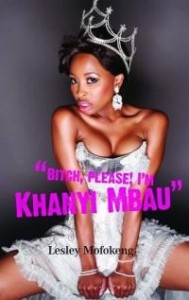
Plastic Princess: Open Letter to Khanyi Mbau on the Publication of Her Memoirs

By Lin Sampson for the Sunday Times:

Let me be straight: two months ago I had never heard of you. But I like wild girls, girls who wallow in the swill of society, girls who make mistakes and are as headstrong as a South Easter.

Girls who leave bullet-holes of bad behaviour.

Your biography is about to be published. Written by Lesley Mofokeng, it strains to make you sound vulnerable, talented and misunderstood.

Marilyn Monroe?

Lesley Mofokeng deserves the Pulitzer Prize for fiction. He certainly can write and he wove a well wrought web of fantasy, including some hard truths.

We made a date for an interview to publicise your book. It was agreed that the Sunday Times would fly you down to Cape Town for the day. Economy class. You enthused: “We can lunch at Grand Beach.”

After that, everything went into a mush of misunderstanding. You could be called Miss Communication. Phone calls, e-mails, SMSs floated in the ether. I was so dying to meet you.

Now recalling our conversation, I hear the fatal words: economy class.

That splintered your ego, didn’t it Khanyi?

And you dreaming of being Queen of England and all.

“I never stopped believing I was a somebody. I thought I was going to marry into royalty. In my dreams I could see myself being the first black member of the British monarchy. Prince William was going to be mine and we’d give Queen Elizabeth brown great-grandchildren.”

Okay, our interview was never going to be easy. I am an ancient woman who reads books, an apostrophe activist who knows Byron’s “Childe Harold’s Pilgrimage” by heart.

You are a self-styled socialite with a very big mouth and a brain like a blown egg. Despite educational opportunities your peers would have given their eyeteeth for, you had to repeat Grade 7. On your first movie break, in 10 takes, you could not memorise the words, “It’s right”.

You are a girl who knows nothing of the beauty of a rhyming couplet, or the dream of a perfect equation; the excitement of investigating the F minor key or reading The Great Gatsby for the first time.

A girl whose hero is a man called Jimmy Choo, a name that doesn’t resonate with struggle cognoscenti.

Mofokeng talks about your “work ethic”. “They [black women her age],” he writes, “respect her willpower and her success.”

Pardon?

You lost your job in Muvhango by taking off on a trip to the Middle East in the middle of filming.

You had a child whom your mother looks after. You married an old, rich man and fed the tabloids with your public fights. Your nude photographs were put on the web in a mean gesture by a married man you had a very public and sordid affair with. You had physical fights in public in which you lost your wig.

Actually Khanyi, I love rich and grand people who have their newspapers ironed, wash their sheets in Jo Malone and run a string of polo ponies.

But the trouble with you, Khanyi, is that you never really knew what really rich and really grand was because you lived in the world of second-hand Hollywood soaps. You thought a Lamborghini was über-chic when everyone knows that only drug dealers and tenderpreneurs with a police record would be seen in one.

You married a man who thought it was stylish to have a Versace belt in different colours to match his leather jackets and rubbed snail mucus at R600 a tub onto his face. Did you really think this was smart? How did you get it so wrong? Your bags are too glittery, your shoes too high, your fights too porny. Your utterances too inane.

You thought the apogee of good food was a food-chain takeout when the rest of the world was tilting into confit de canard. Your favourite was blue cheese and croissants, which you said you would happily eat in front of the poor. I mean, Khanyi, you’ve simply got to do better. Not even the dirt-poor want to tuck into such a passé repast.

When it comes to smart things, you are as dated as a spittoon.

If you’re going to be a role model, charging people R35000 just for the pleasure of sitting next to you, you need to up your game.

Private things stay private. A line like “Mandla loved anal sex. I remember breaking nails clutching the headboard in pain.” Not smart.

You need to ratchet up, girlie. You said you were extravagant on purpose so you could make your husband broke. “I did my calculations. I bought things and sent the bill to Mandla.” Shame, if you had known about real class you could have sent him into a credit-card coma in a nanosecond.

I mean Versace? Who he?

There’s no doubt your swag needs serious attention. It’s time to stop looking like a footballer’s wife and take up residence in Richistan. Forget about even trying to work – well, that at least won’t be hard – and Melrose Arch, puhleez, you need Place Vendôme at least and a villa in Tuscany, all outfitted with climate-appropriate wardrobes.

Jimmy Choo is made for lap dancers; get handmade Italian Franc Maestri. As for food-chain takeaways as the apogee of culinary fare, phone Fortnum’s in London and have your food couriered overnight like all the inhabitants of Richistan.

And that car – a sunshine-yellow Lambo – should be donated to the Fast and the Furious.

Do you remember that story about your rant and scream when someone, thinking you were a waitress, asked you to get him a glass of water. “I carried on ranting until he knew I was someone.”

You see, Khanyi, someone with class would never have done that. Humbleness is the most desirous trait of the rich and famous, which is why they send their children to expensive schools where they have to take cold baths and get whipped.

You said: “I am like Paris Hilton. I am famous for being famous.”

Nah, baby, Paris Hilton is rich, you are a poor girl from a township with a beautiful face like a slightly flawed walnut, a girl who can be found any day of the week fisticuffing a human wallet, an aspirational nudist who lives off rich men and wears outfits as flimsy as the sun in Scotland, a catastrophist with a carbonated hairdo.

Your speech has a formless loquacity and nobody is going to fall about because of the forked lightning of your wit.

I know you have suffered endless narcissistic injuries having your naked body all over the internet, but finally the value of your life isn’t worth spit because as all the really rich and famous know – the Motsepes, the Oppenheimers, the Gettys – the characteristics most valued among the R&F are courage and good manners.

You say in the book you’ve changed. I hope you have, because I think you are a brave girl who likes to state the truth, who tells it as it is, and you have suffered for that, but you really need to overcome the old unreliable, doesn’t-pitch persona.

And you know, Khanyi, you could be so great, all it would take is a little real care about other people and their feelings.

Perhaps there is just one little word you need to learn: no. If you had said at the beginning that you couldn’t come to Cape Town, it all would have been a lot easier.

Yours sincerely,

Lin Sampson