US definitely wants war in Ukraine

It’s about to get much worse

Dr. Paul Craig Roberts talks to Greg Hunter’s USAWatchdog.com

Former Assistant Treasury Secretary Dr. Paul Craig Roberts thinks the Neoconservatives in the U.S. government want war in Ukraine. Dr. Roberts says, “They definitely want war, of course. They’ve wanted it ever since Reagan was President. The Neocons were always saying we have to attack the Soviet Union, and Reagan said we are not going to win anything, we are going to end it. The Neocons got to where they really disliked Reagan because he wouldn’t take advantage of Soviet weakness to attack them. So, they are war minded. They produce documents that say nuclear war is winnable. So, they are basically crazy people; and, yet, they have determined the course of foreign policy since the Clinton Administration. Under George Bush, they controlled the show; and today, under Obama, the Neoconservatives control it.”

Some say the U.S. wants war so they have something to blame the fall of the U.S. economy. Not so, says Dr. Roberts, “They (Neocons) have been very clear about their ideology of American hegemony over the world. It’s like Adolf Hitler all over again. You know, the Germans are the chosen people and have the right to override others. Neoconservatives don’t use the Nazi language. Instead, we’re (Neocons) said to be the ‘exceptional’ people, the ‘indispensable country.’ They use these adjectives to elevate the United States above law, its own law and international law. So, it’s alright if we commit war crimes with naked aggression. It’s alright if we torture. It’s alright if we kidnap people in foreign countries and take them to other foreign countries. This is all just part of America achieving hegemony. Notice the way we achieve it is not by argument or reason or persuasion or anything like that. It’s by force.”

Roberts goes on to say, “So, why is Ukraine important? Well, there is the Black Sea naval base that Russia has there. They have a lease on it until 2042. You have Eastern Ukraine, which is former Soviet military industrial complex . . . for Washington, they say, look we can really bring a serious strategic threat to Russia here. We can devalue their nuclear deterrent by putting anti-nuclear bases in Ukraine on their border. So, when we put pressure on them, they have to think much harder when they stand up to us because we will have the upper hand. . . . So, that’s the real reason for what they are doing. There are other economic reasons. They want to get their hands on Ukraine. They want to loot it.”

On the economy, and if we are headed for another crash, Dr. Roberts says, “I think what we are headed for is continuous sinking. How fast it would be? I don’t know. Everyone’s running out of savings. People have been living off their savings for 5 years. For example, the elderly don’t get any interest income. So, what people are doing is spending down their capital to maintain their lives. As this capital is spent down, there is nothing left to spend. So, consumer spending and retail spending just gradually fall and fall. I don’t think there is going to be a sudden collapse, but there could be a sudden collapse because of all the money the Fed is pumping into the system. This is inconsistent with the dollar’s value and the dollar being the reserve currency.”

On gold, Dr. Roberts says, “To protect the dollar from Quantitative Easing (QE), the Fed is selling naked shorts in the gold market to keep the gold price from rising so rapidly that it exposes the worthlessness of the dollar. . . . The physical stock of gold in the West to meet delivery demand is diminishing rapidly. So, one day the Chinese will buy 100 tons of gold, and we won’t be able to make delivery. That would crash the system. It would just pop. So, there are things that could crash it suddenly. Regardless . . . the economy is going to gradually sink because there are no jobs, or no good jobs. . . So, there is not a recovery. The U.S. is a busted state. It’s completely busted.”

On the Federal Reserve money printing to prop up the economy, Dr. Roberts, who has a PhD in economics, contends, “I think they realize all the money printing does undermine the dollar, and if they lose the dollar, the game is over. So, they have to protect the dollar.” But what happens if the economy falls hard? Will they crank back up QE? Roberts says, “Suppose the economy does move down fairly fast, then all the pressure will be on them to support the economy. Given the stupidity of the media and stupidity of economists and the stupidity of Congress, supporting the economy will mean more QE. If it gets really bad, you could see the Fed cave in and start printing more money . . . at some point, it’s going to cost them the dollar.”

A bright future with barraco barner

 Gemma Worrall,
Gemma Worrall, working hard

Given the tendency to handsomely reward the less educationally advantaged, Gemma Worrall may have a bright future ahead of her.

If you haven’t heard of her, she’s the British 20-year-old beauty salon receptionist from Blackpool who became an overnight Twitter sensation last week with her ludicrously misspelled and misinformed observation on the Ukrainian crisis.

If you really did miss it – and sadly for Gemma’s IQ score not many did – it went thus: ‘If barraco barner is our president why is he getting involved with Russia, scary.’

She’s had more than her comeuppance for the public display of ignorance, with 7,000 re-tweets of her observation, making news as far away as Australia.

But I have a feeling it will be Gemma – and all the other beautiful girls like her – who will have the last laugh.

Thery probably have a far brighter future than young women who model themselves on intelligent people. Think Kardashians or any American music star for that matter.

Think about it. Gemma’s had numerous interview requests and been wooed with promises of thousands of pounds for prime-time TV appearances.

With those 14 ditzy words, Gemma achieved what millions of well-informed girls – who could find Ukraine on a map in an instant – have failed to do. And that’s to be recognised and rewarded.

Times have changed and the value system seems to have gone into reverse. The only ones who hit the headlines and make the money are those who work hard… at being in the gym or at the tanning salon.

It’s not brains that line your pockets or attract admiration today.

Source: Daily Mail

Ukraine: The coup to install billionaires

oligarchs-ukraineBy Dmitri Menin.

It has long been known that revolutions are carried out by romantics, and their fruits harvested by cynics. But Ukraine has now put them all to shame with the unbelievable speed with which it has rushed from romanticism to cynicism. The final few dazed revolutionaries are still wandering across Maidan Square shouting «Down with thieves and oligarchs!» and «Long live the government of national confidence», while at the same time it is these same oligarchs who are confidently taking up the more substantial government posts, such as multimillionaire Arsen Avakov, for example, who has been appointed Minister of Internal Affairs, as well as getting entire regions to feed on, such as billionaires Ihor Kolomoyskyi in Dnepropetrovsk and Sergey Taruta in Donetsk. The other appointees may have fewer millions at the moment, but they will soon catch up. New changes are also afoot. The New York Times reports that the nomination of Vadim Novinsky, the owner of Smart Holding Company whose net worth is estimated to be USD 1.9 billion, for the post of Kiev’s representative to Crimea is on the cards.

There is a rumour that the author of this ‘forced’ staffing strategy is former prisoner Yulia Tymoshenko, who went to see the people on Maidan Square in a wheelchair, but who was able to stand and walk about in the American Embassy. It turns out that is the place where one can breathe the salubrious air of freedom. It is assumed that the oligarchs, who represent the country’s business elite, will be able to exert a controlling influence over workers in eastern Ukraine. Yuriy Lutsenko, an ally of the magically-cured maiden Yulia Tymoshenko, has said that the reason oligarch’s are being appointed is so that big business can be as involved as possible in protecting the country’s territorial integrity, which will not just make use of public resources, but all available private resources as well. Only now, something tells us that this plan is far from spontaneous and that this is exactly the reason why the turmoil and undertaking took place to begin with. And as far as which citizens are primarily going to be saved by these private and public resources, there is absolutely no doubt at all – the most worthy, which is to say the oligarchs themselves. In essence, the era of the complete triumph of the oligarchy in Ukraine has arrived. Masks are being thrown off even more quickly than any kind of decency allows. There is a terrible hurry before the people befuddled by the incense of the burning tyres finally see the light. By then, however, it may very well be too late.

Simon Jenkins, a journalist for The Guardian, writes: «Romantics sometimes refer to the «wisdom of crowds», but they ignore the capacity of totalitarians to manipulate the masses to their will. They forget the hysteria and cruelty of which programmed crowds are capable. Any upheaval can offer the hope of better times. But history is always a sceptic».

Despair is discernible in the words of one of those who took part in the events in Ukraine: «In any case, good intentions like these without any constructive suggestions to take and create a people’s council, popular control or a people’s government are going to be faced with the fact that foreigners are once again going to end up in these public offices.

«Because the trend of Ukrainian desperation lies in the fact that the vermin we for some reason keep electing to govern us do not come from outer space. They live among us! Which is why any recombination of elements that make up the current system of power, which is represented by a political circle of particularly active, deceitful and cynical vermin, is going to come to nothing».

Another disillusioned revolutionary believes that «Maidan is probably waiting for the next grandiose ‘flop’ – something like what happened in 2005. There is no ‘elite’ in Ukraine that would be able to replace the corrupt domestic bedlam. The ‘Donetsk clan’ has been moved aside, and the ‘liubi druzi’ (the ‘dear friends’ of Viktor Yushchenko) are returning. What’s more, they are clearly hungry for revenge and in the mood for it. These are the same ‘liubi druzi’ that successfully ‘carved’ and ‘sawed’ under Tymoshenko in the previous attempt. Except that while they came to power in 2005 under the slogan ‘the Orange Revolution’, now they are chomping at the bit under the rhetoric of Maidan. Tymoshenko was released after all the human fatalities, and she and Turchynov were immediately hoisted to the top of the power pyramid. What is that about? Why such an unprecedented honour? Who exactly are these Elders of Zion? Whilst averting their eyes, some deputies say that such figures exist. All the rest are a closely guarded secret».

But they are not being kept secret any more. Let us look at two of them now.

The new head of the Dnipropetrovsk Regional State Administration is Israeli citizen Ihor Kolomoyskyi, a well-known Ukrainian businessman and head of the European Jewish Council. He is ranked the second richest person in Ukraine (2013) with a net worth of USD 3.645 billion. He is a member of various supervisory boards, the co-owner of PrivatBank, the Neftekhimik-Prykarpattya oil refinery, and the oil and gas extracting company Ukrnafta, the vice-president of the Football Federation of Ukraine, and, according to a number of political analysts, one of the most influential people in Ukraine. It was Kolomoyskyi who was always the financial sponsor of the ‘Yulia Tymoshenko’ political project. He lives in Switzerland. The fact that his PrivatBank was one of the first major lending institutions in the country to stop issuing money to the people because of the ‘Maidan troubles’ is evidence of how much of his own money Kolomoyskyi is willing to share with the people of Ukraine. In reality, he needs additional money himself to rectify affairs in his business empire. Much to the joy of Kiev’s new rulers, he has already registered his presence through his offensive remarks towards Russian president Vladimir Putin. Evidently there will be no point waiting for money, only insults.

Sergey Taruta has been appointed the governor of Donetsk region and is co-owner of the Industrial Union of Donbas Corporation, as well as president of FC Metalurh Donetsk. In February 2008, his net worth was USD 2.65 billion and Taruta ranked 8th in the Top-130 Richest Ukrainians. After the global financial crisis, however, his net worth fell dramatically to approximately USD 750 million. He is urgently in need of fresh infusions to restore his former greatness and save his assets. Governing a region as affluent as Donetsk will give him a good chance to do this, where he will be busy collecting objects of ‘high antiquity’. For this reason, he has spent a long time getting closer to former Ukrainian president Viktor Yushchenko.

Looking at these men, and knowing that it is these men who are standing behind the regime’s main figures, you start to wonder why Turchynov and Yatsenyuk are referring to themselves as a «kamikaze government» quite so insistently, and giving themselves a political life of 3-4 months. Why had it been necessary to rush to power quite so fiercely? Acting President Alexander Turchynov says that the provisional government is doomed because it will have to implement unpopular decisions. «Not those promised by the populists, but those that are needed to save Ukraine from default and restore the faith of creditors and investors. It will be criticised and vilified, but it must fulfil its duties and burn for the sake of Ukraine». Once again there is the question of whether it is for the sake of Ukraine or for the sake of its most worthy sons like Kolomoyskyi, Taruta and others. Yatsenyuk has already announced the unconditional acceptance of all IMF conditions, which will have a serious impact on the further deterioration of life for the Ukrainian people. But then on the other hand, fresh money will be received to save big business, which will then move along the already familiar route to offshore accounts and precious safety deposit boxes that will be hidden much more securely than those of the simpleton Yanukovych. It seems that the ‘kamikaze’ of Turchynov and Yatsenyuk is not going to involve anything except cutting out coupons to transfer power to the oligarchs.

And as far as Maidan’s «Circle of National Trust» is concerned, do they really believe in this fairytale about the fat cats being saviours of the homeland? After until, until fairly recently its leaders had been saying that Ukraine’s new government of national confidence would be closed to anyone on the list of the 100 richest people in Ukraine. Well what are they keeping quiet for?

They, for example, announced that they were going to convene a national popular assembly on Maidan Square on 2 March to listen to a report on the first results of the new government’s work. «And let Turchynov, Yatsenyuk, Tyahnybok, Klitschko and Avakov just try not to come!» it said in a statement on their social network site. People did actually gather on the square. But what did they talk about? About deflecting the threat of Russian ‘aggression’, both invented and over-exaggerated, seemingly so that no kind of report could be given. In truth, nobody has stuttered anything at all about the results of the new government’s work. And maybe nobody is going to ask, either. So what did the young people from the «Heavenly Hundred» and Berkut actually die for?

National sovereignty inconsistent with US dollar system

pcrFrom the moment that Washington launched its orchestrated coup in Kiev, Washington has been accusing Russia of “intervening in Ukraine.” This propaganda ploy succeeded. The Western presstitute media reported (nonexistent) Russian intervention to the exclusion of coverage of Washington’s obvious intervention.

Having falsely accused Russia of invading Crimea, the Obama regime now demands that Russia interfere in Crimea and prevent the referendum set for next Sunday. Unless Russia uses force to prevent the people of Crimea from exercising their right of self-determination, John Kerry declared that the Obama regime will not discuss the Ukrainian situation with Russia.

So, Kerry has given Russia the green light to send in troops to prevent Crimean self-determination.

The presstitute Western media has not noticed that out of one corner of his mouth Kerry denounces Russia for intervening and out of the other corner of his mouth Kerry demands that Russia intervene in behalf of Washington’s interest and suppress Crimean self-determination.

What is the point of such an absurd demand on Russia?

The Obama regime claims that the Crimean vote is not legal, because all of Ukraine is not voting on Crimea’s future. When Washington stole Kosovo from Serbia, Washington did not allow Serbia to vote on Kosovo secession. In the upcoming Scottish vote on whether to secede from the UK, only the Scottish are voting, not the British population. But these normal processes established in international law cannot be permitted to Crimeans, because the vote will not support Washington’s agenda.

Clearly, an Obama regime this shameless has no shame.

The neoconservative warmongers who control the Obama regime are boasting that unless Russia prevents Crimean self-determination, Washington will use sanctions to “badly damage the Russian economy.”

Sanctions are likely to backfire. Sanctions would damage economies of Washington’s NATO puppet states, making them think again about providing cover for Washington’s aggressive words and deeds. It is Europe that will pay for Washington’s aggressive actions.

Sanctions are likely to speed up the implementation of the BRICS negotiations to leave the dollar system and settle their international accounts in their own currencies. All countries with financial and economic links to the West can be intimidated, punished, and destabilized by Washington. National sovereignty is inconsistent with being part of the US dollar system.

From Washington’s standpoint, the importance of sanctions is not any economic effects.

The importance is the propaganda advantage of portraying Russia as an offending party who is punished by Washington. Not only does this propaganda put Russia in the wrong, it also portrays Russia as subservient to Washington.

The Crimean government is actually elected, whereas the Washington-installed government in Kiev is not. Here is a report on Global Research about the “democrats” who comprise the unelected government in Kiev:

During the Clinton, George W. Bush, and Obama regimes, Washington has established that whatever serves Washington’s agenda is legal. Laws inconsistent with Washington’s agenda are simply not applicable. They are dead letter laws. Therefore, it comes as no surprise that in violation of US law that prohibits giving financial assistance to governments whose leaders come to power via coup or other illegal means, Washington is offering its stooges in Kiev $1 billion to help the coup government get up and running.

Paul Craig Roberts was Assistant Secretary of the Treasury for Economic Policy and associate editor of the Wall Street Journal. He was columnist for Business Week, Scripps Howard News Service, and Creators Syndicate. He has had many university appointments. His internet columns have attracted a worldwide following. His latest books are, The Failure of Laissez Faire Capitalism and How America Was Lost. 

Drill, Baby Drill!

drillbabyAmerica is poised to displace Saudi Arabia as the world’s top oil producer with fracking. With that could come a hobbling of Opec and unforeseen shifts in US foreign policy.

So rapid has been the change in its energy fortunes that even some experts, as well as policy-makers in Washington, are struggling to keep up. Nor are we just talking oil. So much natural gas is being released by the shale also that for now outlandish quantities of it are simply being burned off into the atmosphere.

Even predicting future oil output isn’t the precise science you’d expect. “We keep raising our forecasts, and we keep underestimating production,” Lejla Alic, an analyst with the International Energy Agency noted recently. Last year US production reached 7.4 million barrels a day, an increase over 2012 of 15.3 per cent. A jump that large hasn’t been seen since 1951. This year the US should produce 8.3 million barrels a day.

Take another indicator – the volumes of crude being moved by trains, often a mile long, from the shale fields to refineries and terminals. In all of 2008, train companies moved 9,500 wagons of the black stuff. Last year, 400,000 of them rumbled across America.

How long America’s shale boom will last is hard to forecast also. In Texas, which on its own is set to increase production to 4 million barrels a day this year, the drilling peak still hasn’t been reached, but it’s the politicians around the world who set the price and make the markets. Increasingly, the decisions that matter will rest with the US, as it adjusts to its new status as a glut producer.

“The United States is now poised to become an energy superpower,” write By Robert D. Blackwill and Meghan O’Sullivan, in the current issue of Foreign Affairs magazine.

The consequences are likely to be far-reaching, notably affording Washington a chance it hasn’t had since the energy crisis of the early 1970s to reassess its relationships with those countries, often ruled by unappetising despotic governments – Saudi Arabia included – on which America has had to depend for so long to feed its fossil fuel needs.

“Since 1971, when US oil production peaked, energy has been construed as a strategic liability for the country, with its ever-growing thirst for reasonably priced fossil fuels sometimes necessitating incongruous alliances and complex obligations abroad,” they write. “That logic has been upended, and the newly unlocked energy is set to boost the US economy and grant Washington newfound leverage around the world.”

Among the determinations Washington must make is whether to overturn a federal law, also dating back to the early ‘70s, that forbids US companies from exporting crude in all but a few circumstances. Full energy independence may still be many years away, but proponents of ending the ban argue it would not only further boost the US economy – fracking added 0.3 per cent to GDP growth last year – but also help America mitigate or even end Opec’s market influence and lessen Russia’s leverage also.

The Russia equation has, thanks to the Crimea crisis, raced to the fore, though it is more about gas from fracking than oil. America will see captured output touch 70 billion cubic feet a day in 2014, reaching over 100 billion cubic feet per day by 2040. In the past days, Bills have been tabled in both houses of Congress demanding that the federal government speed up the granting of licences to companies to export natural gas across the Atlantic precisely to reduce the dependency of Western Europe and Ukraine on Russian supplies.

Among those wading in is House Speaker John Boehner. “The US Department of Energy’s excruciatingly slow approval process amounts to a de facto ban on American natural gas exports that Vladimir Putin has happily exploited to finance his geopolitical goals,” he said in a statement last week.

Building the infrastructure to export quantities needed to alter the energy politics of Europe will take several years. Nor will changes in America’s foreign policy stance because of its newfound oil fortunes become obvious overnight.

Indeed, some experts warn against over-stating the likely effects. “The US has a lot of interest in what’s going on around the world, in the Middle East and elsewhere, regardless of whether it is independent or self-sufficient in fuels,” Adam Sieminski, the administrator of the Energy Information Administration in Washington told the Financial Post. “Those political and economic interests will remain whether we become an exporter or not.”

As vivid as the gas flares in the Texas sky at night, however, is America’s new-found love affair with fracking. Environmentalists warn loudly of water contamination disasters and some home owners speak of being rattled by man-made earthquakes, but there is no giving it up now. It’s a whole different world to 2008, when US oil production was at a historical low and Sarah Palin was drawing liberal ire declaring that “Drill, Baby Drill!” was the answer to all of America’s problems. Suddenly she seems to have been right.

Source: The Independent

China now controls crucial section of SA’s English media

André Kriel
The coloured André Kriel replaced white socialist Terry Bell

Paul Trewhela says there are disturbing implications of the Sekunjalo consortium’s takeover of the Independent newspaper group. A Communist state has never had such enormous influence over a crucial section of English-language news media anywhere in the world, warns Trewhela, himself a former party member.

The Communist Party of China – the ruling party of a totalitarian state in the second biggest economic power in the world – has taken a 20 percent stake in the second biggest press corporation in South Africa.

According to a statement of the Competition Commission on 16 August last year, a first acquiring firm is Sekunjalo Independent Media (Pty) Ltd, a private firm incorporated in South Africa. A second acquiring firm, Newco, is “a newly formed entity to be incorporated in the Republic of Mauritius.” The announcement continues: “In the Shareholders Agreement entered between China International Television Corporation (“CITVC”) and China Africa Development fund (“CADF”), it is indicated that Newco shall be called Interacom Investment Holdings Limited.”

What the Competition Commission did not state – apparently this was of no concern to it – is that CITVC and CADF are wholly owned instruments of the Chinese state, which in turn is wholly controlled by a single political organisation, the Communist Party. No political parties are permitted in China, except the Communist Party, which exercises a one-party dictatorship over the media.

Sanctioned in October last year, the Chinese state carried through this deal in conjunction with the ANC government, which has taken 25 percent state ownership of the same company via the Public Investment Corporation. In the hands of an openly ANC-sympathetic company, Sekunjalo, this has facilitated ANC/Chinese state entry into most of the main morning newspapers published in English in the country.

The press corporation is now 45 percent owned by these two governments. The former Argus Company, was previously owned by the Anglo American Corporation, which it sold to the Independent News and Media Group, led by Sir Tony O’Reilly, in 1994. Cash-strapped, and having asset-stripped its South African acquisition, INM sold it to the consortium led by Sekunjalo, a Black Economic Empowerment company, last August.

With its 55 percent shareholding of the former O’Reilly press network in South Africa, Sekunjalo now controls 14 newspapers including the nationally circulated Sunday Independent; The Star and Pretoria News in Gauteng; the Cape Times, Cape Argus, Daily Voice and Weekend Argus in Cape Town; The Mercury, Post, Isolezwe, Daily News, Sunday Tribune and Independent on Saturday in Durban; as well as the Diamond Fields Advertiser in Kimberley.

The group’s titles are reported to account for 28 percent of the total advertising spend in paid newspapers in South Africa, 22 percent of all newspapers sold in the country, and 63 percent of the English language market. This makes it a powerful presence in the most widely-read language medium of print journalism in the country.

Never before has a Communist state been in such a position of influence over the press in South Africa. The English media has strictly always been in the hands of British colonial interests. While Mandela is seen as an icon in Britain and the US, they have both been strangely mum on Mandela’s Communist leanings.

The whole affair was masked in South Africa and internationally by a global wave of attention to the decline, death, and funeral of Nelson Mandela, as the pre-eminent icon of 21st century secular, global religious veneration, despite acknowledgement by the South African Communist Party on the day after his death that in the two years before he was arrested in August 1962 he had in fact been a member of SACP central committee.

No suggestion of this awkward fact was permitted to disturb the premiere of the film Mandela: Long Walk to Freedom in London – announced from the podium at the close of the film, on the evening of his death – or his commemoration last week in Westminster Abbey, both events attended by royalty.

The same awkward fact was missed also in no less than five biographies of Mandela written since his release from prison in 1990, most notably by the British author and journalist Anthony Sampson in his “authorised” biography of 1999, though established conclusively in general histories published in South Africa in the three years preceding Mandela’s death by British historian Stephen Ellis and Russian professor Irina Filatova, on the basis of interviews and research in the archives in South Africa, Moscow and Berlin.

Apart from a few perfunctory reports, and with no analysis, the immense implications of the transfer of the most important sector in English-language newspapers in South Africa to a company heavily backed by the Communist and ANC governments has received no attention in South Africa itself, and next to nothing elsewhere, apart from a well-grounded report in the Toronto Globe and Mail by Geoffrey York, writing from Nairobi on 12 October last year, headed “Why China is making a big play to control Africa’s media.”

Immediately following Mandela’s death, a purge of editorial staff in South Africa’s morning newspapers got under way, with shocking speed. Ms Alide Dasnois, exemplary editor of the venerable Cape Times – the first daily paper in southern Africa, founded in Cape Town in 1872 by Frederick York St Leger and modelled on The Times in London – was “relieved of her post” (as delicately phrased by her very experienced deputy, Tony Weaver, in a pained and appalled response) on the morning after Mandela died.

Recalling the massive effort of Cape Times staff on the night before she was sacked, Weaver described the newspaper’s memorial “Madiba wraparound” – affectionately using Mandela’s clan name – as “the best newspaper I have ever worked on.” It was voted by Time Magazine one of the 14 best front pages in the world. “History called, the Cape Times answered,” Weaver concluded. “Alide Dasnois was the editor. It was our last Madiba moment.”

Not so for Dr Iqbal Survé, the chairman of Sekunjalo, now front man for China’s news interests in the most developed economy in Africa, and media front man also for the regime of South Africa’s president Jacob Zuma:

“It is my considered view, and that of the senior executive team”, declared Dr Survé (in his previous career, Nelson Mandela’s medical doctor), in an attempt to justify his sacking of Dasnois, “that the failure of the Cape Times to lead with such a momentous event was an affront to the dignity of Madiba and a disservice to our readers”.

Well, no. More to the point, is Dr Survé’s announcement that his China-and-ANC-backed media empire will in future report more “positive aspects” of the country.

A month after the sacking of Dasnois, Terry Bell – a former political detainee under the apartheid regime, former exile and veteran Business Report columnist in the Independent group titles – was abruptly told that his “Inside Labour” column had been placed on “indefinite hold” while a “recalibration process” is underway.

Three weeks earlier, in his column, Bell had queried an extraordinary instruction which had been received by the Cape Times. According to Bell, this instruction had come from one Andre Kriel, general secretary of the clothing and textile workers’ union, Sactwu. Kriel, wrote Bell, claimed to have spoken to Iqbal Survé, who had agreed that Kriel should “facilitate” the matter of relations between the Cape Times and its new owners. (SACTWU has a share in the consortium.)

Bell reported that Kriel had also “launched attacks on the Cape Times, claiming that this newspaper ‘has not ever carried one positive story about the great struggles that workers have waged’.” Kriel clearly saw his role, continued Bell, “as one campaigning against ‘neo-liberalism’, something he apparently sees as epitomised by the Cape Times.”

In addition to being a council member of the South Africa-US Business Forum, Survé is also chairman of the South Africa-Saudi Arabia Business Council. Sekunjalo lists his senior executive team as: Khalid Abdulla (chief executive officer), Salim Young (lead independent non-executive director), Vukile Mehana (independent non-executive director) and Aziza Begum Amod (non-executive director). Related people are listed as: Mohamed Yusaf Kajee (executive director for Sekunjalo Investments) and Ferhad Khan.

With such powerful joint state financial influence over the Independent group, this is potentially one of the most dangerous attacks on press freedom in South Africa since the founding of the Cape Times as the first daily newspaper in the country in 1872, and a breach of the spirit of the Constitution.

US threatens war ‘if treaty obligations triggered’

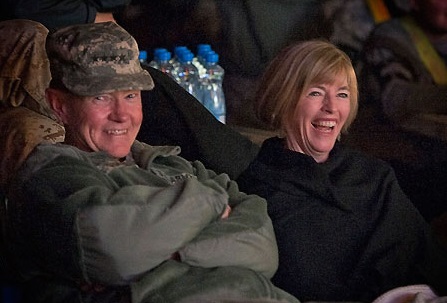
The Dempseys enjoying war

The US has escalated hostilities in Europe further, citing the Chairman of the Joint Chiefs of Staff, General Martin Dempsey, who said the US Army is ready to back up Ukraine and its allies in Europe with military action.

According to the Web site of the Atlantic Council, Dempsey said that “he’s sending a clear message to Ukraine and members of NATO that the US military will respond militarily if necessary.”

“We do have treaty obligations with our NATO allies. And I have assured them that if that treaty obligation is triggered [in Europe], we would respond,” Dempsey said.

According to the General, an independent Crimea creates risk for all the countries of Europe and NATO allies.

“If Russia is allowed to do this, which is to say move into a sovereign country under the guise of protecting ethnic Russians in Ukraine, it exposes Eastern Europe to some significant risk, because there are ethnic enclaves all over Eastern Europe and the Balkans.”

Obama’s war fever, his patent disregard for the sovereignty of nations, his expansion of the Afghanistan war, his illicit use of drones and continued operation of Guantanamo – all deemed “war crimes” of the Bush administration – are now hailed by Democrats and Hawks alike as “democracy”.

As conservative pundit Ann Coulter laments: “I’m sorry, but who cares about military spending as long as Obama is president? At the rate he’s going, Obama might use our military to attack England.”

In response, Russia’s Defense Ministry has given permission for a surveillance flight by Ukraine over Russian territory near the border between the countries. Kiev had claimed Moscow was building up its military presence there.

“The Ukrainians have asked for an unscheduled observation flight over our territory,” Deputy Defense Minister Anatoly Antonov told reporters in Moscow.

Russia and Ukraine are entitled to surveillance flights over each other’s territories following the Open Skies treaty signed in 1992, but Antonov said that Kiev had never asked for one before.

“We have decided to allow such a flight. We hope that our neighbors are assured that there is no military activity that threatens them on the border.”

Antonov vehemently denied a statement Tuesday by Igor Tenyukh, defense minister for the Kiev coup-appointed government, that Russia had amassed more than 220,000 troops, 1,800 tanks and over 400 helicopters in regions adjacent to eastern Ukraine.

“Ukrainian military officials know full well that the entire [Russian] Southern and Western Military Districts put together don’t have that much equipment. The only way you could arrive at that number of soldiers would be if you counted their families,” Antonov said.

“I would dissuade Mr Tenyukh from adding fuel to the fire of the crisis, which is what he appears to be doing. He openly outlined the reasons for this himself, when he asked the Ukrainian parliament to issue him with more funding,” continued the Russian official.

Antonov added that continuing mass training exercises in eastern Ukraine, which Kiev began this week, could plunge Ukraine into even deeper turmoil.

“Staging exercises in an area that is gripped by mass protests against the new regime which came to power as a result of a coup is a risky endeavor, which could further destabilize the political situation in Ukraine,” Antonov insisted.

Oleksandr Turchynov’s, Ukraine’s acting president, said earlier his country could not use its army alone to stop Crimea’s independence, thereby enhancing the possibility of US intervention.

Ukrainian putschists can’t send army to Crimea

Willy Wimmer
Willy Wimmer

Ukraine’s acting president said the country could not use its army alone to stop Crimea from seceding, the latest sign that Crimean independence may be imminent.

Oleksandr Turchynov’s comments came after the Crimean parliament voted for independence ahead of a Sunday referendum on joining Russia, while Washington and Moscow engaged in one of the fiercest clashes since the Cold War.

The interim leader of Ukraine’s putschists said intervening in the Black Sea peninsula, where Crimeans have seized de facto control, would leave Ukraine exposed on its eastern border, close to Russia.

“We cannot launch a military operation in Crimea, as we would expose the eastern border and Ukraine would not be protected,” Turchynov told AFP.

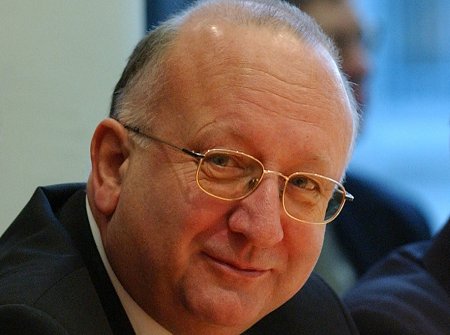
Willy Wimmer, former vice president of the Organization for Security and Co-operation in Europe (OSCE) and state secretary at the German Defense Ministry, said the Black Sea territory might end up under US domination.

The veteran German politician warned more than a decade ago that NATO’s bombing of Yugoslavia was actually part of a US expansion plan.

Until the mid-90s however, all major powers agreed in international law, and in cooperation. But in the middle of the 90s, the US changed tack. They clearly no longer feel bound by international law.

The war in Yugoslavia was only the beginning, and since then, Afghanistan, Iraq, Syria, Libya, have shown that the US would rather rely on military power.

Wimmer said the current government in the Ukraine is not legitimate. “I think it was a putsch, a coup d’état, what happened in Kiev. And what we heard in the news before, the OSCE and other international bodies are doing what they can to create a legal framework for a government which is not legal at all.”

Wimmer said the US puppets in Ukraine are co-operating with Nazi groups, a punishable offence in Germany and other European countries. Many ban all elements associated with Nazism, including Nazi symbols. The coup in Ukraine have left many Europeans fearful of what the US might plan next.

At a political rally in Bavaria this week the main speaker addressed the audience with an appeal not to forget the friendship with the Russian people.

SA mobile data traffic to explode

mobile2Mobile data traffic in South Africa is expected to have a compound annual growth of 53% in the next five years, according to a report.

According to a forecast, it will reach an annual run rate of two exabytes (one quintillion bytes) by 2018.

This is one of the Cisco Visual Networking Index Global Mobile Data Traffic Forecast for 2013 to 2018, said ITWeb.

The report also states that 60% of mobile connections in South Africa will be “smart” connections by 2018, up from 20% in 2013. Cisco also notes that by 2018, 33% of mobile traffic will be offloaded onto WiFi or small cell network.

Craig Zeeman, director of transformation and service provider at Cisco SA said to ITWeb: “South African mobile data traffic will continue its truly remarkable growth, increasing nearly eight-fold over the next five years and growing twice as fast as fixed IP traffic in South Africa.”

Food will be heavily impacted by an increase in mobile data. More than 240 tons of food spoils each year during transit and storage alone.

If organisations used mobile data to keep better track of trucks and the temperature of storage facilities, they would save enough food to feed 40 million people.

In developed countries:

  • mHealth could save $400 billion in healthcare costs in OECD countries
  • Connected cars could save one in nine lives through emergency calling services
  • mEducation can reduce student drop-outs by eight per cent or 1.8 million children
  • Smart metering can cut carbon emissions by 27 million tonnes – the equivalent of planting 1.2 billion trees

Remember Chernobyl?

chernobyl09The 1986 Ukrainian nuclear disaster of Chernobyl was in nuclear weapons-equivalent terms a very large-sized nuclear device, probably releasing 130 kilograms of very highly enriched uranium and plutonium, as well as other long-lived deadly nuclides.

In very approximate terms this was equivalent to about 15 times the radiological inventory of the 1945 Hirsoshima A-bomb. Economic damage to date from the Chernobyl disaster which requires a 2827 square kilometer total exclusion zone, is variously estimated at $350 – $500 billion, with at least 30 000 fatalities to date across Europe.

Despite the Ukraine having known, proven and published natural gas reserves able to cover about 185 years of national gas consumption, for conventional gas reserves, and about 600 years when probable unconventional gas reserves are included, the country was designated by the Soviet Union as needing intensive development of nuclear power. From the late 1960s, nuclear power was developed on a massive basis.

As of 2009, according to the World Nuclear Association, total electricity production was about 50% nuclear and this nuclear supply amounted to about 87 billion kWh. Only 20% of Ukraine’s power supply was gas-based, with 4 billion kWh net exported. Ukraine’s hydropower resources, which have been treated like gas as “poor cousins”, but are large, contributed about 9.3% of electricity generation in 2009, according to the WNA.

All of Ukraine’s remaining 15 civil-type reactors still in service are Russian VVER types, two being 440 MW models, and the other 13 larger 1000 MW units. All of these reactors are potentially “dual use”, due to their original format – exactly like US Westinghouse industry standard 900 MW reactors – derived from Soviet nuclear submarine and nuclear ship reactor models, the design requirements of which demand very high power densities without consideration of plutonium production during their service lifetimes, or the reprocessing of “reactor core pollutants”. Being semi-military design, spunoff plutonium was regarded as a bonus rather than handicap.

The original Soviet design lifetime for VVER reactors was 30 years. The more-dangerous or “naked reactor” Soviet design format, called RBMK, as used at Chernobyl, have since 1997 all been closed down in the Ukraine, but not fully decommissioned.

As many as 15 new reactors of around 1000 MW capacity each with much higher safety standards were “proposed and part funded” in a 2006 Ukrainian energy plan, but none of these reactors were ever completed, although some are in part-completed condition. Significantly, reactor development strategies published by Ukraine’s Energoatom, the state semi-private atomic energy corporation, envisage the possible replacement of unfinished PWR-type reactors by Canadian CANDU heavy water reactors – the type utilized by both Pakistan and India to “brew” sufficient weapons grade plutonium to clandestinely produce their atomic weapons. Reasons for possibly using CANDU reactors notably included the ability of these reactors to operate on the low-clarke or low quality of uranium ore reserves in Ukraine.

Since independence from the USSR in 1991 attempts were made to “close the nuclear fuel cycle”, that is to fund, build and operate nuclear fuel reprocessing facilities and long-term nuclear waste disposal facilities, rather than continue simply storing used fuel rods and nuclear wastes on site – as at Fukushima. This failed civil-sector attempt to reduce the very large residual nuclear pollution resulting from the Chernobyl disaster (1986) and accumulated “temporary measures” for used fuel rod and waste disposal, has been joined by explicitly military-nuclear attempts at reducing the quantities of weapons-capable nuclear material in Ukraine.

In 2013, a four-year Ukraine-NATO project started with the aim of cleaning up radioactive waste at 9 military facilities in the country, with a 25 million euro budget.

Collected and regrouped wastes were scheduled to be buried in the Chernobyl total exclusion zone. Since 2011, very high-level military nuclear wastes originating in Ukraine are scheduled to be “repatriated” to Russia, for burial in Russia’s central dry storage facility. This program which was never funded is now evidently on hold, since late February 2014

A new facility for treatment solid radioactive waste is under construction at the site of Zaporozhe nuclear power plant, to be commissioned in 2015. It will be fitted with a state-of-the-art nuclear waste incinerator of Danish design but this program has suffered from lack of political commitment inside the country, and lack of funding from EU sources. The completion date is only “indicative” and the program is also now on hold.

The Nuclear Threat Initiative (NTI), and its linked World Institute for Nuclear Security (WINS) has tracked the heavily-funded but semi-secret US-Russian Cooperative Threat Reduction project started in 1991 and aimed at repatriating thousands of nuclear warheads and military-nuclear materials, both short-range and long-range, that the USSR had spread between Russia, Belarus, Ukraine and Kazakhstan. While Belarus and Kazakhstan agreed in short order to give up their nuclear weapons, Ukraine initially refused.

In 1992, however, the Ukrainian government recognized it lacked both the resources and the technical know-how to maintain its status as a nuclear-armed nation, and its “inherited” nuclear weapons were literally two-edged swords. It then engaged to repatriate its entire stock – but also demanded financial compensation terms that Russia refused. As cited in interview with Associated Press, former Ukrainian president Leonid Kravchuk said that Russia “….threatened us with all kinds of economic sanctions, they wanted to get this issue over with fast”.

The financial haggling with Ukraine has continued although it is denied or qualified as unimportant by both sides, and by US observers. The haggling led to Russian general Alexander Lebed, in 1997, stating that Ukraine’s military was unable to account for dozens of “compact” or small-sized short-range nuclear devices.

The general gave differing figures regarding the count of lost or stolen weapons, but the Kremlin dismissed his allegations. Leading US politicians cited by NTI claim that the simple absence of “no nuclear detonations by terrorists or organized crime” is the proof that Lebed was being too pessimistic and the program has worked.

Ukraine is therefore a deadly storehouse of dangerous reactors, including the crippled Chernobyl reactor which as yet, to date, does not have a final entombment sarcophage.

Nuclear wastes, in Ukraine, are widely dispersed and poorly accounted for. The country could or might have a certain number of operational or repairable smaller-sized nuclear warheads, the radioactive materials of which also makes them prime assets for the production of “dirty bombs”, that is non-explosive nuclear waste-dispersing weapons.

This is serious business, so Washington’s diplomatic suicide-run to derail nuclear cooperation with Russia through START should raise alarms for anyone genuinely concerned about moving the globe towards a peaceful future.

Source: 21stcenturywire.com

Libya now primary source of illegal arms trade

libyarmsLibya has been named as the primary source of the illegal weapons trade that is fueling conflicts in at least 14 countries around the world, a final report from the UN’s independent panel on Libya’s sanctions announced.

In a briefing to the United Nations Security Council (UNSC) on Monday, the Libya sanctions committee chair, Rwandan Ambassador Eugene Gasana, noted that the post-Gaddafi government is struggling to secure the country in which a number of armed tribal militias denounce Tripoli’s authority.

“The panel noted that the control of non-state armed actors over the majority of stockpiles in Libya as well as ineffective border control systems remained primary obstacles to countering proliferation and that Libya had become a primary source of illicit weapons, including MANPADs [portable air defense systems],” Gasana told the Council, as quoted by Reuters.

Unable to secure its borders, Libya has let weapons fall into the hands of radical elements on several continents, Gasana said.

“Transfers to 14 countries reflected a highly diversified range of trafficking dynamics; and that trafficking from Libya was fueling conflict and insecurity – including terrorism – on several continents,” he said.

As of now, three ports in the country are under full control of rebel groups. A special force has been ordered by the country’s parliament to be sent next week to “liberate” all rebel-held ports, which is crucial to sustaining Libya’s oil-rich export economy that has been struggling to survive after the NATO invasion and regime change.

The UN arms embargo was enacted on Libya at the start of the unrest which eventually ousted former leader Muammar Gaddafi. Last year, non-lethal equipment was allowed to enter Libya when the UNSC eased its sanctions as the UN cautioned Tripoli against the spread of weapons to nearby states.

The UNSC insisted that Libyan authorities improve their monitoring record of arms supplied, sold, or transferred to the government with the approval of the UN sanctions committee. The panel found a number of violations of the arms embargo, such as “non-notified” transfers of arms to government security forces and transfers of weapons to the private market, Gasana said.

Gasana also pointed out that UN experts discovered that some countries need better legislative capacity to induce sanctions and implement asset freezes of the UNSC-generated list of individuals.“One instance resulted in the dissipation of almost $2 million in funds that should have been frozen,” Gasana said.

Meanwhile, Libya’s UN envoy noted that exporting parties should bear responsibility when supplying Libyan authorities with arms.

“Any request for approval for exporting weapons to Libya that is not done via the Libyan mission at the UN or with the knowledge of this mission would be considered a request from a party that does not belong to the Libyan government,” Ambassador Ibrahim Dabbashi told the Security Council.

“The exporting party shall bear the responsibility for that before the Security Council,” he added.

In the meantime, the head of the UN Support Mission in Libya (UNSMIL) warned the 15-member body that Libya faces increased violence.

“Libya faces the risk of embarking on a new trajectory of unprecedented violence,” as security and political divisions deteriorate, Tarek Mitri told the UNSC.

Mitri pointed to the surge of attacks in Sabha, located in the south of the country, which resulted in over 100 civilian deaths – including children – and the displacement of hundreds of families as well as shortages of food, fuel, and medical supplies. In the east, targeted assassinations, bombings, and kidnappings around Benghazi have reached “intolerable” levels.

“Intense efforts to resolve differences and negotiate an agreement on the management of the transitional period, including the future of the General National Congress and the Government, have not succeeded in bringing an end to the divisions that have paralyzed the political process,” noted Mitri.

An “alarming” rise in attacks on journalists has also been witnessed in recent months, Mitri told the Council, with TV stations in Tripoli and Benghazi vandalized and a number of journalists abducted.

Source: RT

Immigrants drown after Spain fires rubber bullets

spainimmigrantsThe European Commission wants Spain to account for the drowning of 14 migrants who recently failed to swim to Ceuta, a Spanish enclave in North Africa. Spain earlier admitted that rubber bullets were fired at them, but claimed no one was injured.

“The commission will be requesting explanations from the Spanish authorities on these events,” EU Home Affairs spokesperson Michele Cercone said, adding that the commission has a right to act if there’s evidence that a member state has violated EU laws.

On Thursday, Spanish Interior Minister Jorge Fernandez Diaz admitted that local border police, in an effort to turn back around 200 migrants who tried to cross the frontier between Morocco and Spain’s Ceuta on February 6, had indeed fired rubber bullets at them.

While some tried to cross on land, at least fourteen migrants drowned in the Mediterranean trying to swim around a man-made breakwater that separates Moroccan and Spanish waters. Spanish police say they are still searching for more victims.

According to the Spanish Interior Minister, the rubber bullets were fired at a distance of 25 meters to deter people from entering Spain while they were in the water. Diaz told a parliamentary commission that the shots were never intended to hit the migrants, whose behavior he described as aggressive. Spanish police posted online video footage of migrants throwing stones at the border fence. The footage didn’t show what had happened when some of them tried to swim around to Spanish land, however. Ceuta, on the north coast of Africa across the Strait of Gibraltar on the Mediterranean Sea, has a population of about 83,000.

According to the online newspaper EUObserver, 23 people managed to make it to Ceuta’s El Tarajal beach, but were immediately turned over to Moroccan authorities. Under European asylum and migration law, anyone who steps foot on member states’ territory is eligible to have their asylum request reviewed before being deported. Although Spanish Interior Minister admitted a group of migrants made it to the beach, Diaz said the group did not enter Spanish territory, since they allegedly never made it past the line of waiting border guards.

Meanwhile, the EU Commissioner for Home Affairs Cecilia Malmstrom said she was “very concerned about Spanish police using rubber bullets to deter migrants.”

“I expect clarifications from the authorities,” Cecilia Malmstrom wrote on her Twitter account.

Spain’s interior minister has admitted police should not have fired rubber bullets at migrants trying to reach Ceuta last month.

Jorge Fernandez Diaz said that rubber bullets were unlikely to deter migrants from the country’s North African enclave.

At least 15 migrants drowned on February 6 as hundreds tried to swim to Ceuta from Morocco.

Man’s tongue goes missing in mortuary

sangoma1Mpumalanga police will on Tuesday be conducting an autopsy on a body of a man whose tongue was allegedly cut out while he was kept at a privately-run mortuary at KaMsogwaba near Nelspruit.

According to police, when the family went to fetch the body for burial, they realised that his tongue had been cut out.

Mpumalanga police spokesperson, Leonard Hlathi, says an investigation is underway to verify the allegations by the family.

“Postmortem is going to be conducted where we are going to check on the body again to see for ourselves and to confirm the allegation by the family,” says Hlathi.

The family says it is not yet clear when would be the next date for the burial.

They have called on the police to ensure that those responsible face the full might of the law.

Sasol to challenge Shell on Karoo shale gas

karooSouth African petrochemicals group Sasol Ltd is keen to invest in a domestic shale industry once it gets off the ground, its chief executive said, in a potential challenge to oil major Royal Dutch Shell.

South Africa’s cabinet proposed new regulations to govern exploration for shale gas late last year after it lifted a 2012 moratorium on the activity in the central Karoo region.

Fracking in the region might tap what is believed to be some of the world’s biggest reserves of the energy source and the government wants to develop an industry that it sees as a potential game-changer in Africa’s largest economy.

“I am very excited because of the technologies we can bring to the table. We’ve got shale gas upstream experience in British Columbia,” Sasol Chief Executive David Constable said on Monday.

“We want to get involved and participate and monetize that gas in country with gas to liquid, gas to power, gas to chemicals,” he said after the group posted a 26 percent rise in half-year earnings.

Shell has applied for an exploration licence and once all of the new regulations are in place it is expected to be near the front of the line.

Constable said Sasol wanted to take part. “We are really interested in what is going in the Shell block and would love to farm in or take a piece of it. Shell is issuing profit warnings and pulling back capex right now,” he said.

Shell said in January that it planned to cut capital spending to $37 billion this year from $46 billion in 2013, following a profit warning.

Shell was not immediately available to comment on Monday.

Constable said the government should take Shell’s strategy into account.

South Africa’s Public Investment Corporation (PIC), which is Sasol’s biggest shareholder with a 13 percent stake in the company and manages 1.4 trillion rand ($130.3 billion) in civil servant retirement funds, has also said it wants a big slice of the shale pie.

Fracking involves pumping pressurised water, chemicals and sand underground to release gas trapped in shale formations and the prospect of it occurring in the semi-arid and sparsely-populated Karoo region, known for its big skies and scenery, has raised concerns anong conservationists.

Constable said Sasol’s experience in British Columbia would enable the company to carry out the process “in an environmentally friendly fashion.”

Source: Reuters