At least 14 dead in Egyptian car bomb explosion

Scene of the explosion at Mansoura, north of Cairo

At least 14 people are believed to have died in a large explosion that destroyed a police headquarters in a Nile Delta city north of Cairo early Tuesday morning, according to the state news agency and a security official. Some 200 people were injured in the blast.

The Egyptian government accused the Muslim Brotherhood of orchestrating the attack. Cabinet spokesman Sherief Shawki said Prime Minister Hazem el-Beblawi had officially declared the group a terrorist organisation.

The Muslim Brotherhood, however, condemned the attack in an emailed statement from the group’s London press office released hours after the explosion.

“The Muslim Brotherhood condemns in the strongest possible terms the attack on the police headquarters in Mansoura (region),” the statement said.

“The Muslim Brotherhood considers this act as a direct attack on the unity of the Egyptian people and demands an enquiry forthwith so that the perpetrators of this crime may be brought to justice.”

Among the injured from the blast at Daqahliya security headquarters in the Nile Delta province of Mansour, was the police chief of the province General Sami al-Meih.

Most of those killed were policemen inside the security headquarters. Many bodies are still believed to be buried under the debris and the death toll is expected to rise, the official said.

An initial investigation indicated that the explosion was the result of a car bomb.

The attack came a day after an Al-Qaida-inspired group called on police and army to desert or face death at the hands of its fighters.

Ansar Beit al-Maqdis, or the Champions of Jerusalem, said it considers Egyptian troops to be infidels because they answer to the secular-leaning, military-backed government.

The group and others based in the Sinai have been blamed for a surge of attacks against security forces since the July coup that toppled the country’s Islamist president, Mohammed Morsi. In response, Egypt’s armed forces launched a military offensive against militants in the Northern Sinai province in August.

Speaking at a public forum on Monday, military spokesman Ahmed Mohammed Ali said so far the operations have resulted in the killing of 184 militants and the arrest of 803 others. He said about 25 percent of those killed and arrested are foreign fighters, but didn’t provide further details.

Ansar Beit al-Maqdis is believed to have ties with Palestinian militants in the Gaza Strip, and officials have said other foreign militants have found refuge in Sinai during the ongoing turmoil. – AP, Reuters, dpa

Pussy Riot saga ends happily

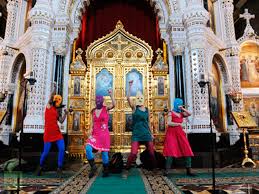
Pussy Riot inside the church in Moscow

A member of punk rock band Pussy Riot, Nadezhda Tolokonnikova, who was kept at the Krasnoyarsk prison hospital, was set free, her husband Pyotr Verzilov tweeted.

Tolokonnikova, like another member of the group, Maria Alyokhina, who was also released on December 23rd, was pardoned in connection with the 20th anniversary of the Russian Constitution. The State Duma decided to release those convicted of hooliganism.

Pyotr Verzilov wrote on his Twitter that Tolokonnikova intended to facilitate the dismissal of the Chief of the Federal Penitentiary Service in the Republic of Mordovia, General Simchenkov. Tolokonnikova served a part of her sentenced at Correctional Colony No. 14 in Mordovia, where she went on a hunger strike, claiming that the administration of the colony threatened to kill her. She claimed that her human rights were violated and complained of intolerable conditions for prisoners. Tolokonnikova described her claims in an open letter.

Maria Alyokhina, Ekaterina Samutsevich and Nadezhda Tolokonnikova were detained in March 2012. On August 17, 2012, the activists were sentenced to two years in prison for their “punk prayer” at the Cathedral of Christ the Savior. The women were convicted of hooliganism motivated by religious hatred. The activists said they did not intend to offend believers, but wanted to draw people’s attention to close ties between the state and the church. On October 10, 2012, Ekaterina Samutsevich’s sentenced was changed to conditional one. – pravda.ru

Father who raped 11-year old daughter sentenced to 39 years

Child-Rape-A 44-year-old father from the Richards Bay area has been convicted and sentenced to a total of 39 years imprisonment by the Richards Bay Regional Court on 20 December 2013, after he was found guilty of raping his 11-year-old daughter in the area.

The KwaZulu-Natal Provincial Commissioner, Lieutenant General Mmamonnye Ngobeni welcomed the conviction and sentence of this father. “The ruthless and barbaric attack of children by criminals even if they are fathers will not be tolerated in our society. The sentence is preceded by intensive and diligent investigation by capable officers from Empangeni FCS Unit. Our endeavours to effectively investigate reported crimes instills hope in victims of crime and sends out a clear message to criminals that we will trace, arrest and successfully prosecute them,” concluded Lieutenant General Ngobeni.

From 1999 to 2001, the victim who was 11-year-old at that time, was at home with her father when the father sexually assaulted her and eventually raped her in separate incidents. She was also assaulted and threatened to be killed during 2001. In August 2001 a case of rape was opened at Richards Bay police station and through investigation the accused was immediately arrested and charged with rape.

I is not known why the case took 12 years to wind its way through the courts.

Limpopo police arrest 82 rapists, warn women

rape3The Limpopo Family Violence, Child Protection and Sexual Offences Units in Limpopo has arrested 82 alleged rapists and an additional 42 wanted rape suspects during the sixteen days of activism, according to a police statement.

A further 11 suspects were also detained for child neglect with the youngest victim being a 6 months old baby. The unit also conducted 54 crime awareness campaigns throughout the length and breadth of the province.

Limpopo Provincial Commissioner Lieutenant General Fannie Masemola has commended these successes and expressed his gratitude to the FCS unit members who continue to uproot rapists in the province.

“These successes are a clear indication that the SAPS is unswerving to make Limpopo a safer place for our women and children. I have instructed that all FCS units and all investigating officers dealing with rape cases to be unsympathetic when dealing with rapists”.

“We cannot have a situation where women live in fear of being raped. I am warning all potential rapists out there or those who are even contemplating it that the SAPS will ensure that the maximum sentence is imposed,” said Masemola.

Meanwhile as the year is drawing to a close and celebrations intensifying to usher in the new year, females especially are sensitised to be vigilant to avoid being victims of rape. The following hints should always be adhered to.

  • Avoid walking alone at secluded places.
  • Don’t accept drinks from strangers as they might be laced with drugs.
  • Avoid frequenting liquor outlets.
  • Parents are sensitised not to allow minor children (girls) to frequent liquor outlets.
  • Avoid hitchhiking
  • Children should avoid gifts from strangers.
  • Elderly women should not be left alone.

South Africa is considered to be the “rape capital of the world”. Whereas estimates vary, more than a million women are raped every year.

Apartheid South Africa: Reality vs. libertarian fantasy

mercer_ilanaby Ilana Mercer

[followbutton username=’IlanaMercer’ count=’true’ lang=’en’ theme=’light’]

Like Ilana Mercer’s Facebook page

One needn’t propagate lies about the state-enforced segregation that was Apartheid in order to condemn it.

Yet in defiance of fact, one prominent libertarian economist has gone so far as to assert that apartheid was “a version of Castroite socialism.”

How can one credibly say that about a country that in its heyday had a gold-backed currency, enjoyed the confidence of investors the world over, sported low to no government debt and similar rates of inflation, the most opulent and spectacular shopping malls, the freest, finest medicine I’ve experience in life on three continents, near-unfettered legal access to handguns (for whites) and relatively secure property rights for the same minority? You can’t. Not if you wish to retain intellectual credibility.

Racial segregation, inequality under the law, injustice: yes, yes, and yes. But “Castroite socialism”?

Not quite as embarrassing, another wag asserted the following: “Apartheid was a system of government control and regulation to artificially keep South African blacks from competing against whites in the marketplace.”

This is only partly true. The problem with half-truths is that the conclusions that flow from their premises will likewise be deficient.

Dogma without data

Distorting the facts about Apartheid’s raison d’être does nothing to promote the truth.

“Hermann Giliomee – whose grand historical synthesis and primary source exegesis (“The Afrikaners: Biography of a People”) is referenced extensively in “Into the Cannibal’s Pot: Lessons For America From Post-Apartheid South Africa” – has concluded that Afrikaner anxieties were overwhelmingly existential, rather than racial. Leading thinkers at Stellenbosch University devised a system for the National Party to ensure “the security of the Afrikaners as a dominant minority.” (More about Apartheid as “A Strategy for Survival,” in “Into the Cannibal’s Pot,” pp. 67-70.)

As noted in the same book:

Anybody who lived … among Afrikaners during the apartheid era can testify that crime and communism were foremost on their minds. To rationalize the cruel, Kafkaesque laws of Apartheid, Afrikaners spoke of the Swart Gevaar (which meant the “Black Threat”), and of the Rooi Gevaar (the “Red Threat”). My Afrikaner neighbor would regularly admonish me for my incipient liberalism: “You want black rule so badly, look around you at the rest of Africa! Anglos like you simply don’t understand what’s at stake.” (P. 70)

The sweeping non sequitur that follows from the partial truth aforementioned has it that “black poverty” and misery stemmed solely from Apartheid’s “suppression of free market forces.” This is economic reductionism, typical of the impoverished analysis of South Africa, offered so authoritatively by libertarian economists stateside.

Apartheid is a necessary explanatory variable in the “black poverty” equation, but never a sufficient one.

As expounded in “Into the Cannibal’s Pot,” “the maze of racial laws that formed the edifice of Apartheid” had been dismantled by the offending National Party almost a decade before the transition to democracy; by 1986, the party had already brought down Apartheid’s pillars, the “pernicious influx control laws,” for example.

In all, South Africa has now been racially desegregated for almost 28 years.

Documented in the same book are these immutable facts: “Twelve years into the Nationalist government’s rule, the rate of literacy among the Bantu of South Africa was already higher than that of any other state in Africa, or that of India. From the 8.6 million recorded in the 1946 census, the black population rose to 17.4 million in 1974 and 28.3 million by 1991. [In-migration from the north was just about non-existent.] From the 1940s to the 1990s, life expectancy for blacks soared from thirty-eight to sixty-one years!” (P. 178.)

“Since the dawn of democracy in 1994, life expectancy has plummeted by nine years. Crime has reached crippling levels … and is certainly much higher than in the Old South Africa. … unemployment had jumped from 19 percent in 1994 (before ‘freedom’) to 31 percent in 2003 (after ‘freedom’), steadily rising until, in 2005, it stood at 38.8 percent. The trend is consistent and persistent.” (P. 178)

These stubborn facts collapse the politically pleasing but reductive theory, promulgated by libertarian know-nothings, that holds Apartheid to be the sole cause of black South Africa’s dysfunction, economic and other.

As the pesky facts attest, black dysfunction in racially desegregated South Africa is way worse than it was during state-enforced segregation. In fact, it now resembles that of the rest of Africa.

Apartheid was reprehensible. But dogma denuded of data does nothing to bolster this uncontested, incontrovertible position.

Lite libertarianism vs. the right kind

Herein lies the difference between the paleolibertarian analysis and what this column has termed the lite libertarian one, philosopher Hans-Hermann Hoppe being the finest example of the former. The rest fall into the latter, lite category.

A crucial difference between lite libertarians and the right kind is that to the former, the idea of liberty is propositional – a deracinated principle, unmoored from the realities of history, hierarchy, biology, tradition, culture, values.

Conversely, the paleolibertarian grasps that ordered liberty has a civilizational dimension, stripped of which the libertarian non-aggression axiom, by which we all must live, cannot endure. “The pursuit of the … paleolibertarian ideal,” explained Catholic philosopher Jack Kerwick, Ph.D., “is the pursuit of an ideal of liberty brought down from the clouds to the nit and the grit of the history and culture from which it emerged.”

Into the Cannibal's Pot

‘The color of money’

Indeed, the truth about the Old South Africa is far more nuanced. As this writer tried mightily to explain during an RT broadcast (embedded), “The color of money” did speak loud and clear to enlightened self-interest in Apartheid South Africa.

“‘The market is color-blind,’ said Milton Friedman. ‘No one who goes to the market to buy bread knows or cares whether the wheat was grown by a Jew, Catholic, Protestant, Muslim or atheist; by whites or blacks.’ As Thomas Sowell put it so well, ‘prejudice is free, but discrimination has costs.’ Added South African academic, Steven Farron: ‘[P]eople demand that their governments restrict the economic and occupational success of specific ethnic or racial groups. However, when the same people act as individuals or business owners, they actively resist and/or circumvent these restrictions.’” (P. 127)

All people do this. Apartheid South Africa was no different.

During Apartheid, white industrialists – miners especially – “put continual pressure on the South African government to allow them to use more black labor.” Afrikaner farmers also chose overwhelmingly to ignore racial job quotas, despite their own racist predilections, and also despite high unemployment among rural Afrikaners. Well before the official dismantling of Apartheid laws (carried out, as mentioned, by the white minority government), the agricultural sector, skilled and managerial jobs included, came to be dominated by blacks. As was the semi-skilled labor market – clothing, furniture, millinery, sheet metal, construction, mining, baking. Clearly, whites, acting as individuals, chose to subordinate ethnic advancement to optimize their livelihood. (P. 126)

Those half-truths again

“Free market economists (the only kind worth consulting) have long since insisted that the rational, self-interest of individuals in private enterprise is always not to discriminate. Arguably, however, the good economists, while certainly not wholesale liars as are their Keynesian counterparts, are still offering up a half-truth. Rational self-interest does indeed propel people, however prejudiced, to set aside bias and put their scarce resources to the best use. But to state simply that ‘discrimination is bad for business’ is to present an incomplete picture of reality. This solecism stems from the taint the word ‘discriminate’ has acquired. The market, by which we mean the trillions of capitalist acts between consenting adults, is discriminating as in discerning – it is biased toward productivity. Hiring people on the basis of criteria other than productivity hurts the proprietor’s pocket.” (P. 127)

Thus, we can be fairly certain that, absent racist affirmative-action laws, the market would reflect a bias toward productivity. In other words, what the good economists are loath to let on is that a free market is a market in which groups and individuals are differently represented. Parity in prosperity and performance between differently able individuals and groups can be achieved only by playing socialist leveler.” (P. 128.)

Freedom vs. egalitarianism

Contra the economic reductionism of the lite libertarian, free-market capitalism is a necessary but insufficient condition to sustain freedom in a country of South Africa’s complexion.

The truth absent from the phantasmagorical formulations critiqued is this: Economic freedom does not necessarily reduce so-called wealth inequality. Inegalitarainism is a feature of a free economy. If history is anything to go by, certain minorities will achieve prosperity from poverty, no matter how gravely the state and society impede them. Jews did it in Europe. Levantines and Indians in Africa and the Middle East. Chinese in southeast Asia and everywhere else they go. Europeans in South Africa.

Moreover, “While all people want safety and sustenance for themselves, not everyone is prepared to allow those whom they dislike and envy to peacefully pursue the same.” (P. 4) Free-market capitalism is not enough to safeguard ordered liberty in racially riven societies like South Africa, where the majority will always covet the possessions of immensely wealthier minorities and associate these riches with racial privilege.

Ultimately, the rights to life, liberty and private property will forever be imperiled in a country whose constitution has a clause devoted to “Limitation of Rights,” and where redistributive “justice” is a constitutional article of faith. (P. 101)

This, paleolibertarians (all three of us) know too well.

In “The Cannibal” chapter entitled “Saving South Africans S.O.S.,” secession is explored as one solution, it being a species of the private-law society delineated by Hans-Hermann Hoppe. Hoppe, of course, has never been afraid to speak to the “unequal civilizing potential” (in James Burnham’s coinage) of different people and peoples.

Against dog-ate-my-homework argumentation

For the sins of man, hard leftists blame society, and the lite libertarian saddles the state.

In its social determinism, the lite libertarian’s “the-state-made-me-do-it” argumentation apes that of the left’s “society-made-me-do-it” argumentation. Both philosophical factions implicate forces outside the individual for individual and aggregate group dysfunction.

In the New South Africa, the left’s “argument” has been taken to a new level of abstraction: “The legacy of Apartheid” is said to explain the unparalleled depravity of Nelson Mandela’s dominant-party mobocracy.

While the state is a worthier culprit than society, both are analytical equals in as much as they absolve the individual of responsibility for his actions. For the philosophy of freedom is predicated on individual responsibility.

“Societies are only as good as the individuals of whom they are comprised; individuals only as good as their actions.” (P. 4) If the sanctity of life is the highest value in a civilized society – then Mandela’s South Africa is uncivilized in every way possible.

The unvarnished truth about democratic South Africa is that it is “now preponderantly overrun by elements, both within and without government, which make a safe and thriving civil society impossible to sustain.” (P. 4)

Although absolutely essential, free-market capitalism is insufficient to the task of tackling this tide of sinecured criminals.

[followbutton username=’IlanaMercer’ count=’true’ lang=’en’ theme=’light’]

Like Ilana Mercer’s Facebook page

Black security guards caught committing robbery at factory

adtThe South African Police Service National Investigation Unit under the direction of Lieutenant General Vinesh Moonoo foiled an organised business robbery at a warehouse in City Deep, Johannesburg on Monday morning.

The detectives received information that a company called Mpisi Import and Export in City Deep was going to be robbed with the assistance of the company security guards as well an ADT security guard.

The accused initially went to premises where the CCTV cameras were being monitored and they allegedly destroyed the recording equipment and they then proceeded in trucks to the actual warehouse.

With the assistance of the Johannesburg K9 Unit, our officers initially stopped an ADT security vehicle as it emerged from the Mpisi warehouse. Several bails of clothing (jeans) were found in the security guard’s vehicle. The guard was arrested and his cellular phone was seized.

The team then proceeded to the warehouse and found no security guards at the gate, instead, they were caught with their hands in the proverbial cookie jar. They were in the back of a truck which had bales of clothes, the same as those found in the ADT vehicle.

One of the security guards was supposed to have been guarding a completely different premises but he had not been on this site at all.

The three suspects arrested have been identified as:-

  • Sipho Nhlanhla Lulane (ADT Security Guard)
  • Sipho Sfiso Ngubane (Mpisi Security Guard)
  • Phuti Abdnico Manoko (Mpisi Security Guard)

All three suspects have appeared in court 17 at the Johannesburg court yesterday and have each been granted R5000 bail. – SA Police Service

Mandela: myths vs. facts

landman_christoby Christo Landman

The ceremonies and media propaganda around the death of Nelson Mandela, cost millions of rands.  Those rands were to a large extent paid by taxpayers of whom the large majority are white.  By means of social grants, they also have to financially support 17 million people, the vast majority of whom are black.

The propaganda wave surrounding the life and death of the then President Mandela is a blend of myth and fact. Khehla Shubane of the Centre for Policy Studies verbalized the Mandela mythology on CNN, which hasnow  become the official Mandela mythology.

But Shimon Peres, a former Prime Minister of Israel, once said of the Israeli and Palestinian disputes: “Personally, I have very little patience for history. I believe that to imagine is more important than to remember.”  Myths are figments of the imagination, but to remember is the recollection of facts.

Imagination is the fertile ground in which myths flourish. Imagine what Mandela was thinking as he looked through the bars of his prison window overlooking Table Mountain.  The myth developed that he had had a Damascene experience and converted from a man who planned violence as the only way to achieve his political objectives, to a man who rejects all forms of violence and instead embraces reconciliation, forgiveness, tolerance and accommodating interpersonal and group differences.

Imagination became perception, which grew into mythical proportions to be finally presented as historical fact.  It is true that he was a skillful politician and a worthy opponent, who never allowed side issues to influence the core issues on the table. It was a fact that during his five-year tenure as the country’s first black president, he achieved more for peace and harmony in a deeply divided South Africa than Mbeki and Zuma, who succeeded him during the fifteen years thereafter. The success of his policy of accommodating differences between cultural groups during his reign supported the growing myth of the saintly Madiba.

But the historical facts that emerged since his retirement do not support the notion of Mandela’s fundamental sense of righteousness and moral values. During the fifteen years since his retirement he never ever pronounced his displeasure at the way the ANC had converted from a liberation movement to a plundering national mafia.  Did he condone what his successors were doing?  Did he condone their immoral return to outdated tribal customs in the face of the need for a unified South Africa, where one race group is not superior to another? Or did he merely lack the courage to defend his moral convictions such as Archbishop Tutu so often does?

That failure on his part drew a line through the Mandela myth and has exposed him as a shrewd political strategist and not the moralist he is made out to be. The world conveniently has conveniently forgotten about the last fifteen years of Mandela’s life on earth before catapulting him as a saint into future mythology.

It is therefore fitting to review the actual historical facts of South Africa in order to gain a perspective to evaluate the pre- and post-Mandela era.

It seems that mythmaking is a fact of life in the history of countries and peoples.  South Africa is no exception.

  • Among Afrikaners the myth is accepted as fact that the Dutch came to RSA with the godly purpose to Christianize blacks. In fact, they came to the Cape of Good Hope to open a trade mission between Europe and India.
  • On the other hand, blacks believe sincerely that they were indigenous to RSA and that their land was stolen by whites. The fact is that the black tribes originated in the central parts of Africa and moved to the south in three great streams. In Southern Africa different language groups occupied different geographical areas. This is still so! The constitution of SA 1996 lists the following black language communities:  Sepedi, Sesotho, Setswana, siSwazi, Tshivenga, Xitsonga, isiNdebele, isiXhoas and isiZulu. In the 1993/4 financial year the government spent R650 mill on 4 554 tribal leaders, which included 18 kings and queens.

The further fact is that the Dutch occupied land at the Cape which was deemed to be “no-man’s-land”. Here and there nomadic Khoi and San tribes were found but what was absent was a government over an identifiable territory with fixed borders and with its own administration.

Another severe problem is that the original history of the black peoples of Southern Africa is not a written one, but a verbal one — so that mythmaking is obviously at the order of the day. The history of the whites is a written one, of which the facts are verifiable. Some of these facts include the following:

  • Dutch temporary occupation was a business transaction and when the Free Burger farmers emerged and moved to the interior, the occupation of the Cape in international law obtained a permanent character.
  •  The numbers of the Dutch were strengthened by the French Huguenots and by some Germans and later, after the first and second British occupation of the Cape, by some English and Scots.
  • White civilization over a period of 2 700 years grew through the following phases: organized agriculture, education, mining, technological innovations, industrialization and an electronic revolution. Differently said: through a pre-modern society to modernism and rationalism to post-modernism!
  • On the other hand, when the first contacts of the whites with blacks other than the Khoi and San “first peoples” took place in 1675, their agricultural tradition was not organized at all and land ownership was the collective property of the tribal king … as is still the case in many of the tribal communities today.
  •  As a matter of fact, the land ownership at Qunu, where Nelson Mandela is buried, is owned by the Tembu King who is the trustee of land ownership. This is the case in many a Southern African country, such as Zimbabwe, Mozambique, Swaziland and others. In RSA there are strong forces at work to abolish private ownership of land.

Ideologically speaking, the divide between white and black is just as strong. British colonialism made a huge impact on Afrikaners and the black peoples. In the case of the Afrikaners British colonialism tried to impose the British way of life on them. Those Afrikaners and black elite groups who adopted the English life-style were in a limited way integrated. Hence, the British influence in RSA actually laid the foundation for a class system; which system is now, after the demise of a policy of ethnic diversity, dominant.

The Afrikaners, on the other hand, advocated the Republican system of government.  British liberalism based on the advancement of individual rights, as manifested in Chapter 2 of the Constitution of SA 1996, had a great impact on Afrikaner political thinking. As a matter of fact, a dominant group of Afrikaners now vote for the Democratic Alliance, which Alliance adopts liberal democracy as the only viable alternative to ANC collectivism and the workings of social democracy.

Black political thinking in the leadership of the so-called liberation movements was heavily influenced and supported by the philosophy of Marxism and Soviet Communism whose ideological thinking was closer to the collectivism of the traditional social organization of the various black ethnic groups.

The political development of SA since 1652 developed in various phases:

  • Since 1652 the Dutch forefathers of the Afrikaners established themselves in the Cape as a permanent settlement.
  • This was followed by two occupations by the United Kingdom, which led to the advancement of the Voortrekkers to the interior.
  • It was during their move to the interior that the Vootrekkers encountered the AmaXhosa.
  • The British introduced segregation of the races to supplement the segregation of a social class system.
  • The Voortrekkers established themselves in two main Republics: of the Transvaal and the Orange Free State.
  • The gold rush to the Witwatersrand in the Transvaal Republic inspired British colonialism to occupy the Transvaal Republic as well as of the Orange Free State.
  •  The British were defeated in the First War of Liberation.
  • During the second War of Liberation, British colonialism became famous for its concentration camp policy whereby 27 000 Afrikaner women and children (one third of all children in the Boer Republics) died of starvation and diseases.

In 1910 the Union of SA came into being which resulted in the amalgamation of four provinces and a large number of traditional tribal authorities. However, Lesotho, Swaziland and Botswana, although politically part of British SA and geographically part of Southern Africa, were given the option to remain outside the Union, which they did. In so doing they created three ethnic sovereign states.  The other language communities found themselves in subordinate positions as part of the Union. In 1913 their territorial bases were acknowledged by law.

The underdeveloped status of the tribal authorities and the gold rush led to an unprecedented influx of blacks to the four (European-style) provinces. To such an extent that the European-style governments in the provinces introduced extraordinary measures to protect Western standards in policies which became known as “petty apartheid”.

In 1948, when the Afrikaners took over the power of government, they tried to unscramble the egg, made by British colonialism and imperialism.  “Petty apartheid” then became only the object of a broader policy of territorially based nation states. In 1960 SA became a Republic outside the British Commonwealth.  The so-called TBVC states (Transkei, Botswana, Venda and Ciskei) opted for independence, but lacked recognition by the international community. The role of the Marxist-inspired liberation movements, such as the African National Congress, as a tool of communist expansionism in the cold war, cannot be emphasized enough.

Eventually apartheid and Zionism were declared racist ideologies by the UN. The propaganda onslaught against the policy of separate but equal development became notorious. In the meantime SA was plagued by terrorist acts, such as the Rivonia case, in which outcome Nelson Mandela and others were given life sentences. The fact remains that the then government of SA was never defeated by acts of violence. In his later years the Mandela groups could have been released much earlier, if only they were prepared to renounce violence.

In the end both the ruling National Party of SA and the liberation groups had to negotiate a peaceful settlement. The settlement comprised the following:

  • 34 constitutional principles for state formation, of which principle 12 read that collective self-determination be acknowledged.
  • An interim Constitution of 1993.
  • A final Constitution of 1996.

The 1993 Constitution provided for the Afrikaners a Volkstaat Council to investigate forms or models of self-determination. It also included a non-diminution clause for the protection of the Afrikaans language.

The 1996 Constitution included the following clauses to enhance the right of self-determination of (language) communities:

  • Internal autonomy for organs of civil society [s.31(1)(b)].
  • Constitutional councils for the protection and promotion of the collective rights of (language, religious, cultural and other) communities (s.185)
  • Territorial self-determination for blacks on their collectively owned tribal lands (s.211 and 212)
  • Territorial self-determination for communities other than communities based on customary law (s.235)
  • A (constitutional) Commission for the Promotion and the Protection of the Rights of Language, Religious, Cultural and other Communities (s.185)

In other words, to a large extent, the ANC is party to a constitution which recognizes many of the principles now post facto discredited as apartheid measures. However, the constitution says one thing, but in practice the ANC-government governs SA as if a negotiated settlement never occurred.

Economically speaking, the development of the so-called homelands is still stunted, due to the non-cooperation of the tribes with the economic system of border industries and industries in the tribal lands on an agency basis.  It is also a best-kept secret that white South Africans simply had no rights within the tribal lands, but a lot of propaganda is being made regarding “petty apartheid” measures in the then four provinces.

In conclusion: because of the resistance of the liberation movements to adopting the policies of separate but equal development, the tribal lands are still underdeveloped and their people pre-modern in their outlook. What we see in SA after the failure of so-called apartheid is new colonialism of a special kind: namely the imposition of African collectivism on inter alia the white population with their European heritage. It is an invasion of masses of Africans, and the creation of innumerable so-called informal settlements in conditions of poverty around the cities. It is estimated that about 8 million illegal immigrants from other African countries invaded the liberated South African society. At the same time what we observe is a class of super-rich Blacks with their limos and then 17 million Blacks on social welfare. The real catastrophe facing SA is when the declining economy of the country becomes incapable of paying social grants; a condition which will start a fire that will burn down SA as well as all the myths on which the present de facto government is based.

The Mandela myth would then have failed to liberate the country, as it ignored the hard realities of a developing state with the need for an economy based on sound principles of modernity, competitiveness and hard work.

Dr. Christo Landman is a former South African diplomat and currently active in Afrikaner cultural organisations. His columns in Afrikaans may be read here.

French lawmaker walks 6000 km, finds ‘unashamed racism’ everywhere

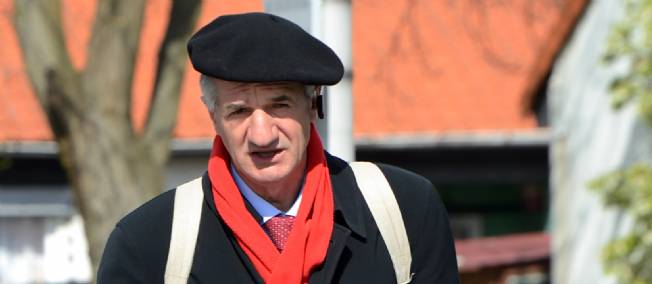
Jean Lassalle, photographed during his walk

A French lawmaker who spent eight months walking a 6,000km “Tour de France” takes his last symbolic steps in Paris on Sunday. He returns to the capital to report on a country that has “little hope for the future”.

“Everywhere I went I witnessed a crisis in the standard of living, a loss of identity and the loss of a sense of a common destiny,” Jean Lassalle, National Assembly member for the Pyrénées-Atlantiques region in southwest France, told Europe 1 radio.

“People would tell me: ‘look at the state you have left our country in’,” he added. “There is no more industry, farming is in crisis, just one in ten children of farmers grudgingly says they want to carry on in agriculture.

“The countryside has lost its perspective, and it isn’t any better in the cities. We all know the state of France’s suburbs, even those that have been rebuilt.”

Lassalle, 58, set out in April and walked an almost uninterrupted route clockwise around France, flying only from Marseille in the south to northern Corsica, and again from Bordeaux in the southwest to Nantes in the northwest.

He said he “needed to get a feeling” for the country, and wrote on his personal blog that he was impressed by peoples’ willingness to speak frankly with him.

“Once they knew what I was doing, I felt a strong sense that they were expressing themselves as a civic duty, choosing their words carefully,” he wrote. “There was a solemnity and a dignity about it, despite everything they had to say.”

Confusion and racism

And what he found was a France confused about its position in a shrinking world, an uncertainty as to the long-term effects of globalisation and a distrust for politicians who, people told him, “do not listen to us at all”.

“We live in a world that is changing out of all recognition,” he told Europe 1. “We [the government] have failed to find ways of explaining to the citizens of this country exactly what this change means.”

Worryingly, he also encountered “latent racism” almost everywhere, “even in the smallest villages”.

“This is racism that seems totally unashamed,” he told Le Monde on Friday. “It is a wholescale rejection of ‘the other’ and often expressed with excessive aggression.”

Lassalle told Le Monde that he was particularly worried about a return of “anti-Semitic rhetoric” that was particularly “linked to wealth”.

On Saturday, Lassalle will walk his final steps, from Place de la Concorde over the River Seine to the National Assembly building in central Paris.

Hundreds of people he met on his walk are expected to accompany him, and to enter the assembly to start a two-day debate on France’s future.

“I will then prepare a parliamentary report on what I learned on my walk, which I will submit to the president at the end of February,” he wrote in his blog. “Meeting people around the country was a deliberate act as an elected member of France’s parliament, as a resistant [to changes that have eclipsed the lives of ordinary people], and a bid to raise awareness of the issues faced by our citizens.

“Things cannot stay the way they are now.” – France24.com

Brazil buys Gripen fighters instead of French planes

A Gripen fighter
A Gripen fighter

Swedish aerospace maker Saab beat competition from France’s Dassault and US aviation giant Boeing to win a $5 billion contract to equip the Brazilian air force with 36 new fighter jets (pictured), the Brazilian defence minister announced Wednesday.

“After analyzing all the facts, President Dilma Rousseff directed me to inform that the winner of the contract for the acquisition of the 36 fighter jets for the Brazilian Air Force is the Swedish Gripen NG,” Defense Minister Celso Amorim told a press conference.

The announcement came after more than 10 years of discussions and repeated delays due to budgetary constraints.

The Gripen is said to be cheaper than either Dassault’s Rafale or Boeing’s F/A-18. It is a state-of-the-art multi-role fighter jet capable of performing an extensive range of air-to-air, air-to-surface and reconnaissance missions. It is in use in the air forces of Britain, South Africa, the Czech Republic, Thailand and Hungary.

Brazil insisted on technology transfers so that the planes can be assembled locally and give a boost to the domestic defence industry.

President Rousseff had postponed a decision on the FX-2 replacement contract in early 2011 for budgetary reasons but Brazilian air force chiefs insisted they needed the new fighter aircraft to maintain an adequate air defence. The air force is to retire its 12 Mirage jets in late December.

Brazil bought the refurbished Mirage 2000 C/Bs from France in 2005 for $80 million to fly for five years. -france24.com

Police arrest four robbers in KZN

saps2Dundee police and Glencoe K9 members arrested four suspects for business robbery in the Dundee CBD and recovered firearms, stolen cash as well as the getaway vehicle in Newcastle. On 17 December 2013 at 09:15 employees of a retail clothing store were allegedly accosted at gunpoint by four armed unknown men who demanded cash and robbed them of an undisclosed amount of cash at gunpoint. The suspects fled in their getaway vehicle which was parked outside the store. No shots were fired and no person was injured during the robbery.

After an initial investigation police proceeded to Newcastle where they arrested four suspects between the ages of 30 and 48 and recovered some of the money that was allegedly stolen. Three firearms, two 9mm pistols and a revolver were seized and the motor vehicle that was allegedly used during the commission of crime was also seized. All four suspects will be charged for business robbery, possession of unlicensed firearms and ammunition as well as possession of suspected stolen property. They will appear in Dundee Magistrates Court soon. The firearms will be sent to ballistics to ascertain whether they were used in the commission of any other crime in the country.

KwaZulu-Natal Police Commissioner, Lieutenant General Mmamonnye Ngobeni commended the members for arresting theses criminals and for the seizure of illegal firearms. “We are committed to eradicating criminal activities in the province of KwaZulu-Natal and confident that the impact of these arrests will result in the reduction of the serious and violent crimes during the festive season,” she said. – SA Police media release

Swedish Klarna buys rival Sofort

Sebastian Siernatkowski, 31

Klarna is taking a big step towards becoming the leading European payments provider and rival to US groups such as PayPal, Visa and MasterCard as the Swedish start-up pays more than €150m to acquire a German rival.

Klarna, which allows customers to buy goods online and pay for them later by invoice, is taking over Munich-based Sofort, paying more than half in cash thanks to support from the Swedish company’s existing shareholders, such as Sequoia Capital and General Atlantic.

Together the two groups – which will continue to offer their separate online payments services – will have 25m users and 10 per cent of the north European market, processing $10bn each year.
“It is no longer crazy to say we have a shot at becoming the independent payments provider in Europe,” Sebastian Siemiatkowski, Klarna’s chief executive and co-founder, told the Financial Times.

The Sofort deal opens up new European markets for Klarna including the UK, Italy, France, Spain and Poland. Mr Siemiatkowski said there were no immediate plans to launch in the US but added that idea was “exciting”, while some of Klarna’s venture capital backers are keen on the idea of it taking on PayPal head to head.

“Sofort is high-test additive that puts even more pep in Klarna’s engine and will help the company accelerate its business in Germany,” said Sir Michael Moritz, a partner at Sequoia Capital.

Klarna was launched in 2004 by a trio of students and has grown rapidly to now account for a quarter of all online payments in Sweden. It uses a complex system to analyse customers’ behaviour in an attempt to detect fraud with late-night or multiple purchases, for instance, viewed as more suspicious than those made in the afternoon or for single items.

The Swedish group claims it can increase sales for online stores by 15-25 per cent, as fewer shoppers abandon purchases through frustration at the payment process. Klarna assumes the credit risk from the merchant in return for a fee and collects payment from the customer.

It has become one of the success stories of European technology and particularly Stockholm start-ups, valued at close to $1bn in its last fundraising two years ago.

Klarna is buying Sofort from its majority owner, Reimann Investors, the family office of the Reimann family that derives its wealth from consumer goods group Reckitt Benckiser and perfume manufacturer Coty.
PayPal, owned by auction site eBay, has 137m active accounts and processed $145bn in payments last year, with just under half of its revenues coming from the US.

The Klarna deal comes amid reports that Amazon, the US online retailer, is to buy GoPago, another payments start-up. – Financial Times

‘East Germany and the ANC shared a special bond’ – Deutsche Welle

Christine Müller
Christine Müller

East Germany and the African National Congress shared a special bond: not only the government, but also the public in the communist state supported the anti-apartheid movement in South Africa.

Heavily armed police forces pushing along black children and teenagers, beating them with clubs, shooting with live ammunition. The disturbing images of the Soweto Uprising shocked the world in June of 1976.

Some 15,000 students in the South African township protested against a new rule that said they’d only be able to take exams in Afrikaans, the language of most white South Africans. They accused the apartheid regime of massively limiting their access to education.

Authorities said 575 people died in the dispute, but the protesters themselves said the number of victims was much higher. Years of unrest followed and led to international protest.

Soweto as catalyst

For Christine Müller from Leipzig, then in communist East Germany, the Soweto uprising was a “defining moment.” She still remembers the effect the pictures had on her. “This rage enveloped me, because I felt so helpless,” Müller told DW. “I thought that we needed to do something immediately.”
Christine Müller

Christine Müller says seeing the pictures from Soweto made her feel ‘helpless’
She researched the topic and looked for fellow supporters. For decades, she worked in church groups that advocated solidarity with the anti-apartheid movement. Today, Müller is the head of the “One World” working group at the Protestant Church of Saxony. For Müller, her involvement is an expression of her Christian faith.
“‘Apartheid’ means exclusion,” she said. “And that’s not just about the victims of racism in South Africa, but more generally about the excluded, who don’t get a piece of the pie when it comes to wealth and power.”

Involuntary union of church and state

East German stamp exalting African wars of liberation

In East Germany, the Protestant church was a main source of political opposition. But the authoritarian government was also involved in the fight against apartheid. That made for an unusual alliance.
The communist leadership in East Berlin described its support for liberation movements as anti-imperialistic solidarity. But East Germany also had pragmatic goals at heart: the government wanted to raise its country’s profile on the world stage. Until the 1970s, it lacked diplomatic ties to western nations because democratic West Germany regarded itself as the only legitimate successor state to the wartime regime. West Germany’s Hallstein Doctrine of 1955 considered it an “unfriendly act” when other countries established diplomatic relations with the East.

Together with the US and Britain, West Germany was among the countries with the strongest ties to the apartheid regime in Pretoria. The West German Protestant church (EKD) was largely mute on the issue. Support for the African National Congress (ANC) and its imprisoned member Nelson Mandela tended to come from leftist groups. That led to angry disputes within the church.

In contrast, the East German government generally regarded any independent social movements as a threat. That didn’t make the anti-apartheid efforts of grassroots groups, or of the East German government, any less worthy, historian Ilona Schleicher said. In the face of the situation in Soweto and other examples of brutal violence against blacks, political persuasion and worldview weren’t of any importance, she said: “Every human being, no matter whether they oppose their state or not, reacts the same to those pictures if they’re really human: with compassion, solidarity and the desire to help.”

Fighting for democracy under communism

But the lack of democracy in East Germany cast a shadow over its anti-apartheid stance, Schleicher said: “They were fighting for something they didn’t have in their own country.” She experienced the anti-apartheid movement as the wife of an East German diplomat in southern Africa. That influenced her stance. “As a working-class child, I grew up with the promises of socialism,” Schleicher told DW. “For me, everything in East Germany looked right. The realization that many things were not in fact right in our country only came to me much later, and also because of the experiences we had abroad.”

On the ground in South Africa, she saw that the liberation fighters didn’t care about who helped them or what their motivation was. “What counted was the actual support.” The ANC profited from East German support in various ways. Instructors and teachers worked in ANC training centers in Tanzania and universities in East Germany accepted black South African students. To make this possible, the official Solidarity Committee collected donations in the population.

When the ANC began using violence against its oppressors in the 1960s, East Germany continued to support it. The Solidarity Committee sent paramilitary equipment including camouflage fabric, binoculars and rubber boats. And instructors trained more than 1,000 resistance fighters in Africa, but also in a secret military camp in the East German village of Teterow.

Apartheid support in West Germany

At the same time in West Germany, companies like Daimler-Benz, Siemens and Deutsche Bank invested in South Africa, and thus provided a form of support to the apartheid regime and its violations of human rights – knowing that they had the West German government on their side.

ANC supporters in the East did experience a crisis of conscience, Müller said: “That was the problem for many of my fellow Christians who said ‘We can’t support our government’s anti-imperialistic politics.'” That’s why she was even happier when the apartheid laws were abandoned in 1990, the year East Germany itself ceased to exist, and in 1994, when Nelson Mandela was elected as the first black president. Müller said that was a nice affirmation for her efforts, even though things are far from perfect in South Africa. – Deutsche Welle

Wouter Basson found guilty of ‘unethical conduct’ by HPCSA

Wouter Basson
Dr. Wouter Basson

Dr Wouter Basson, who headed the previous Defence Force’s chemical warfare section, was found guilt of unprofessional conduct by the Health Professions Council of SA (HPCSA) today.

“In the light of all the circumstances, the breaches amount to unprofessional conduct… the respondent is guilty of unprofessional conduct,” HPCSA professional conduct committee chairman Prof Jannie Hugo said in Pretoria.

The ruling by the council comes after protracted attempts to prosecute Basson for his role in South Africa’s chemical warfare defense initiatives. Basson has maintained throughout that the previous government had developed a defensive capability in the face of chemical weapons being used by the Soviet Union, East German, Cuba and other Warsaw Pact nations during the Angolan war.

However, Prof. Jannie Hugo said that Basson “had contravened international protocals and conventions. The respondent confused ethics of a doctor with that of a soldier while discharging his duties. A doctor cannot rely on military orders to escape the consequences of his duties.”

In a protracted criminal court case which went on appeal to the Constitutional Court and cost the government R50 million, Basson was found not guilty of any offense.

Basson practises as a cardiologist in Cape Town where he is lauded by his patients. Depending on what sanctions the HPCSA is going to apply against him, he could lose the right to practise as a doctor. The body’s decision will be made known in 20 and 21 February 2014.

Letter from Zimbabwe: Generations yet to be born

Cathy Buckle

by Cathy Buckle

Christmas has arrived with a bombshell to Zimbabwe this year. A seven page photocopied form has flooded what’s left of privately owned, legally operating businesses. It’s called the ‘Notification of Extent of Indigenisation and Indigenisation Implementation Plan.’ All ‘foreign’ owned businesses have been instructed to outline their plans to hand over 51% of their companies to ‘indigenous’ Zimbabweans.

At first glance you assume that ‘foreign’ refers to non Zimbabweans but that assumption isn’t the case. According to the Form, an ‘indigenous’ Zimbabwean is defined as “any person who, before the 18th April 1980 was disadvantaged by unfair discrimination on the grounds of his or her race, and any descendant of such person and includes any company, association, syndicate or partnership of which indigenous Zimbabweans form the majority of the members or hold the controlling interest.”

This phrase, and those that follow, leave you with more questions than answers, no matter how many times you read them. It seems that by including the word ‘descendants’, the term ‘indigenous’ also refers to generations yet to be born, conceived or even dreamed of. Then there’s the question about just exactly who is indigenous. If you are a Zimbabwean born Indian, or mixed race or white Zimbabwean, can you be called indigenous? If you are a black Zimbabwean whose parents, grandparents or great grandparents were not born in Zimbabwe – are you indigenous? If your skin is not black but you have a Zimbabwean ID card, a residence permit or a work permit can you be called indigenous? If you were born after 1980, regardless of your skin colour , are you therefore not regarded as indigenous? Or have we all been condemned because of the colour of our skins, regardless of our beliefs, values and actions both before and after 1980?

The most worrying question of all is: Are non-black Zimbabweans, born and resident here, working, employing and paying taxes, to be punished for eternity for something that other non-black people did?

All companies have been told they must submit the Indigenisation Form by the 1st of January 2014. A list of over 50 categories of businesses are itemized on the Form and with each line your heart sinks. All the things that everyone has been doing to survive since farms were seized and the economy went into freefall, are on the indigenisation schedule.

The Indigenisation Form stipulates that every business must ‘cede a controlling interest of not less than 51%’ of its shareholdings to ‘indigenous’ Zimbabweans with effect from the 1st of March 2010 or within five years from the commencement of business. According to the Permanent Secretary for Indigenisation, non compliance with the Indigenisation law will lead to arrest. Lawyers say they are waiting for people to come forward and challenge the legislation but they aren’t offering pro bono services and for companies struggling to stay open, lawyer’s fees aren’t in the budget, nor is the ability to swallow the outrage that you must give away a 51% controlling interest of your company because of the colour of your skin.

While this ugly plan is unfolding in Zimbabwe, we tried to follow the events in South Africa but it wasn’t easy. ZBC gave almost no coverage to the death of Nelson Mandela or the week of international memorials and tributes. ZBC TV waited until the day after the Johannesburg memorial service and then screened just a few minutes of the service, not providing the audio of any of the speeches of world leaders. They didn’t give Zimbabweans the chance to hear US President Obama say words that we so wish were also true for Zimbabwe. President Obama said that because Nelson Mandela was not only a leader of a movement but also a skilled politician, South Africa now had a Constitution that was: “true to his vision of laws that protect minority as well as majority rights, and the precious freedoms of every South African.”

This is my last letter of 2013 and I wish all Zimbabweans, and people who follow our trials and turmoil, a happy, peaceful and safe Christmas. Thank you for reading this letter and supporting my books for so long, without you I wouldn’t have had to courage to keep going. Until next time, love Cathy.

Read Cathy Buckle’s blog where she posts regular letters from Zimbabwe.