Faith in Obama drops sharply in South Africa, Russia, Germany due to US spying, Ukraine crisis

Only 52% of South Africans believe that the USA take the protection of personal freedoms seriously. Overt the past year, the percentage of South Africans who still believe in the American president Barack Obama has dropped by 18 percentage points.

Citizens of other BRICS countries, such as Russians and Brazilians have also become suspicious of US motives, following upon revelations of the National Security Agency’s global spy program, together with civil strife in Ukraine. In Germany, faith in the USA has slumped by a whopping 23 percentage points.

Thanks to a series of global scandals, the United States in general, and its commander-in-chief in particular, have suffered a drop in favorability among the majority of countries polled by Pew Research.

“In 22 of 36 countries surveyed in both 2013 and 2014, people are significantly less likely to believe the US government respects the personal freedoms of its citizens,” the report said.
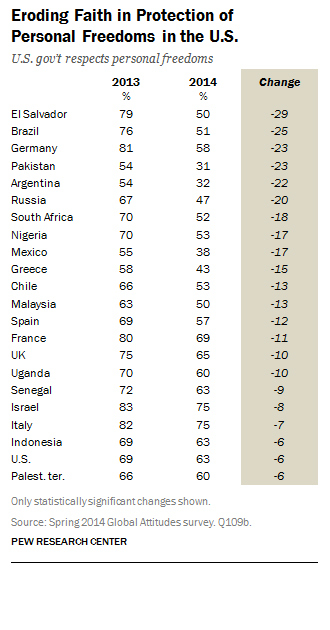
pew_table1
Spring 2014 Global Attitudes Survey, Pew Research

Among privacy-loving Germans – many of whom have even refused to allow the Google Maps car to film their homes – Obama’s reputation nosedived when it was revealed that the NSA was collecting communication metadata not only on average Germans, but also on Chancellor Angela Merkel, whose personal mobile phone had been hacked by US intelligence.

Germans’ confidence in Obama sunk to 71 percent, 17 points down from 2013.

Tensions between NATO’s two biggest members escalated this month German authorities arrested a Defense Ministry official suspected of passing secrets to the US. This shocking incident came just one week after the arrest of a German intelligence officer who worked as a double agent for the Americans.

German authorities took the unprecedented step of ordering the expulsion of the Berlin CIA station chief.

“Revelations that Washington systematically reads both Americans’ and some foreigners’ emails and listens in on their telephone conversations appears to have significantly damaged Obama’s approval in only one European Union country: Germany,” Pew reported.

Brazilians’ confidence in the first black American leader dropped from 69 percent in 2013 to 52 percent presently.

Brazilian President Dilma Rousseff, who was also the victim of NSA snooping on her personal communications, expressed her anger at those revelations by canceling an official visit to Washington in October.

Finally, Russia, which is watching neighboring Ukraine teeter on the edge of full-blown civil war, sees an American hand provoking the situation behind the scenes, especially after former Ukrainian President Viktor Yanukovich decided against signing as association agreement with the European Union in favor of stronger ties with Moscow.

The decision by sparked a violent showdown in the capital Kiev, which has led to nationwide civil strife that continues today.

“Russian faith in Obama, already quite low in 2013, is down 14 points (to 15 percent), a likely casualty of the Ukraine confrontation,” Pew said.

Meanwhile, America’s once invincible reputation for protecting individual liberties has suffered a major reality check following damning revelations about the extent of NSA surveillance from whistleblower Edward Snowden, presently living in Russia, where he has been granted asylum.

Belief that the US government respects personal freedoms plummeted 25 points in Brazil to 50 percent over the last year; 23 points in Germany to 58 percent; 20 points to 40 percent in Russia; and 11 points to 69 percent in France. Meanwhile, even the United Kingdom, a trusted ally, appears to have experienced a chilling effect by America’s recent naughtiness, dropping 10 points to 65 percent.

US drone strikes have also struck a negative chord among allies and enemies alike, including in NATO member states like Britain, France and Spain. In 37 of 44 surveyed countries, half or more of the public expressed disapproval of drone attacks.

Russia to reopen Cuban intel base

Moscow and Havana have reportedly reached an agreement on reopening the SIGINT facility in Lourdes, Cuba – once Russia’s largest foreign base of this kind – which was shut down in 2001 due to financial problems and under US pressure.

When operational, the facility was manned by thousands of military and intelligence personnel, whose task was to intercept signals coming from and to the US territory and to provide communication for the Russian vessels in the western hemisphere.

Russia considered reopening the Lourdes base since 2004 and has sealed a deal with Cuba last week during the visit of the Russian President Vladimir Putin to the island nation, reports Kommersant business daily citing multiple sources.

“I can say one thing: at last!” one of the sources commented on the news to the paper, adding that the significance of the move is hard to overestimate.

The facility in Lourdes, a suburb of Havana located just 250km from continental USA, was opened in 1967. At the peak of the cold war it was the largest signal intelligence center Moscow operated in a foreign nation, with 3,000 personnel manning it.

From the base Russia could intercept communications in most part of the US including the classified exchanges between space facilities in Florida and American spacecraft. Raoul Castro, then-Defense Minister of Cuba, bragged in 1993 that Russia received 75 percent of signal intelligence on America through Lourdes, with was probably an overstatement, but not by a large amount.

Following the collapse of the Soviet Union the base was downscaled, but continued operation. After Russia was hit the 1998 economic crisis, it found it difficult to maintain many of its old assets, including the Lourdes facility. In Soviet times Cuba hosted it rent-free, but starting 1992 Moscow had to pay Havana hundreds of millions dollars each year in addition to operational costs to keep the facility open.

An additional blow came in July 2000, when the US House passed the Russian-American Trust and Cooperation Act, a bill that would ban Washington from rescheduling or forgiving any Russian debt to the US, unless the facility in Lourdes is shut down.

Moscow did so in 2001 and also closed its military base in Vietnam’s Cam Ranh, with both moves reported as major steps to address Americans’ concerns. But, in the words of a military source cited by Kommersant, the US “did not appreciate our gesture of goodwill.”

Source: RT

Seeding the net with false info

The British spy agency GCHQ has developed covert tools to seed the internet with false information, including the ability to manipulate the results of online polls, artificially inflate pageview counts on web sites, “amplif[y]” sanctioned messages on YouTube, and censor video content judged to be “extremist.” The capabilities, detailed in documents provided by NSA whistleblower Edward Snowden, even include an old standby for pre-adolescent prank callers everywhere: A way to connect two unsuspecting phone users together in a call.

The tools were created by GCHQ’s Joint Threat Research Intelligence Group (JTRIG), and constitute some of the most startling methods of propaganda and internet deception contained within the Snowden archive. Previously disclosed documents have detailed JTRIG’s use of “fake victim blog posts,” “false flag operations,” “honey traps” and psychological manipulation to target online activists, monitor visitors to WikiLeaks, and spy on YouTube and Facebook users.

But as the U.K. Parliament today debates a fast-tracked bill to provide the government with greater surveillance powers, one which Prime Minister David Cameron has justified as an “emergency” to “help keep us safe,” a newly released top-secret GCHQ document called “JTRIG Tools and Techniques” provides a comprehensive, birds-eye view of just how underhanded and invasive this unit’s operations are. The document—available in full here—is designed to notify other GCHQ units of JTRIG’s “weaponised capability” when it comes to the dark internet arts, and serves as a sort of hacker’s buffet for wreaking online havoc.

Source: First Look

Singapore to destroy gay-themed books

A children’s book inspired by a real-life story of two male penguins raising a baby chick in New York’s zoo has been deemed inappropriate by state-run Singapore libraries, and the conservative city-state’s information minister said he supports the decision to destroy all copies alongside two other titles.

The National Library Board, which runs 26 public libraries in Singapore, pulled from the shelves and said it would “pulp” the copies of three titles, citing complaints their content goes against Singapore’s family values.

The books are “And Tango Makes Three,” about a male-male penguin couple in the Central Park Zoo; “The White Swan Express: A Story About Adoption,” which involves a lesbian couple; and “Who’s In My Family: All About Our Families.”

“The prevailing norms, which the overwhelming majority of Singaporeans accept, support teaching children about conventional families, but not about alternative, non-traditional families, which is what the books in question are about,” Minister of Communications and Information Yaacob Ibrahim said Friday.

He added: “Societies are never static, and will change over time. But NLB’s approach is to reflect existing social norms, and not to challenge or seek to change them.”

Ebola moves to Freetown

The worst outbreak of Ebola moved to Sierra Leone’s capital of Freetown.

Sidie Yahya Tunis, director of Information, Communication and Technology at the Ministry of Health and Sanitation, said: “The Ebola disease usually spreads to other places when suspected or confirmed cases in one community move to another, they abandon treatment centers to stay with relatives or they seek treatment outside the Ebola centers.”

There have been 99 Ebola deaths in Sierra Leone out of 315 laboratory-confirmed cases, the ministry said in an e-mailed statement today. The ministry said yesterday that 92 people had died out of 305 cases. Cases of the hemorrhagic fever have killed more than 540 people in Guinea, Sierra Leone and Liberia in an outbreak that according to the World Health Organization may last another three to four months.

The toll is greater than the 280 people killed in 1976, when the virus was first identified near the Ebola River in what is now the Democratic Republic of Congo.

The rapid spread of the virus is largely due to people moving across African borders as well as cultural practices that are contrary to public health guidelines, such as people touching the body of a deceased relative before the funeral.

Thousands flee northern Gaza as Israel launches ground offensive

Thousands of residents fled northern Gaza on Sunday at the urging of the Israeli military as its ground troops briefly crossed the border on a mission to destroy a launching site.

The tumult came as the death toll from Israel’s six-day Operation Protective Edge offensive rose to more than 160, with more than 1,000 injured, the Palestinian Health Ministry said.

“Civilians are requested to evacuate their residences immediately for their own safety,” the Israeli leaflets dropped by air warned. They listed specific areas that would “prove to be most dangerous.”

Israeli airstrikes hit more than 200 homes and buildings across Gaza on Sunday. Despite calls from the United Nations and world leaders, there were no signs the two sides will agree to a cease-fire soon.

“We don’t know when the operation will end,” Israeli Prime Minister Benjamin Netanyahu told a Cabinet meeting Sunday. “It might take a long time.”

Lt. Col. Peter Lerner, spokesman for the Israeli Defense Forces, said the military has hit 1,300 targets since the offensive began July 7. He said Gaza militants have launched 904 rockets at Israel. Of these, 160 were intercepted by Israel’s “Iron Dome” anti-rocket system, Lerner said.

Nasr Kafarna, 43, a farmer in northern Gaza who lives near the border, says he has been on edge for the past week. After Israeli troops crossed into Gaza early Sunday, he fears for the worst.

“I worry this is all-out war now,” he said. “We haven’t recovered from the last one – we aren’t ready for another one.”

The death toll in the first week of this offensive has topped the estimated 133 killed in the last outbreak of hostilities in 2012. That Israeli operation, also to stop rockets being lobbed over the border, lasted eight days. The current conflict follows the murders of three Israeli teenagers in the West Bank and the killing of a Palestinian teenager last month in what is being called a revenge death.

Residents say tensions are high in the densely populated, 140-square-mile strip of land squeezed between Israel and the Mediterranean Sea.

“Every time after you hear the sound of a missile hitting sometime, you look up the names of the dead with extreme fear, not knowing whose name you are going to find,” said Sabab Farahat, 22, of Gaza City. “Our hearts ache even for the names of the people we do not know.”

“I want to go back to my normal life, go to my university and the market and meet my friends,” Farahat added. “I really miss normal life.”

On Saturday, Israeli airstrikes hit two mosques – Israel’s government said Hamas hides arms in those places of worship.

Iyad Mortaga, 34, of Nuseirat refugee camp in central Gaza, says she is just in a state of disbelief over what is happening and the deaths from the operation.

“I really don’t know how all this came to pass,” she said, adding she had attended afternoon prayer at the Dar Al Salam Mosque before it was hit.

“My neighbor – we learned of his death two hours after the bombing,” she said. “Now I can’t go to pray in the mosque and I am afraid to go to any mosques.”

In Israel, Ministry of Foreign Affairs spokesman Yigal Palmor told USA TODAY, “Israel isn’t interested in a temporary cease-fire. … We’re not looking for a Band-Aid solution but a long-term plan that will neutralize and take off the table completely all possible threats of rocket fire from Gaza.”

Gershon Baskin, the Israeli who negotiated the 2011 prisoner swap for Gilad Shalit, the Israeli soldier Hamas kidnapped in 2006, said he maintains open channels with many in the Palestinian leadership and both sides remain far apart. He said Israel’s military is concerned about Hamas’ arsenal of anti-tank rockets.

“The Hamas have tunnels and bunkers all throughout the north and center of Gaza, and they are planning to emerge out of nowhere and hit the Israelis with the hopes of being able to grab some soldiers and hold them hostage,” Baskin said.

He said a senior official in the Palestinian Authority involved in attempts to get Hamas to agree to a cease-fire told him that Hamas won’t stop until after Israel launches a ground invasion. “They want to hurt Israel badly, something they have so far failed to do” with their rockets,” Baskin said. – USA Today

Cry for me, Argentina

Riot police fired tear gas and rubber bullets late Sunday to restrain a group of vandals who disturbed a peaceful rally celebrating Argentina’s gutsy performance in a 1-0 loss to Germany in the World Cup finals.

Parents with small children could be seen fleeing in fear after police, who initially remained on the sidelines as jubilant fans poured into downtown Buenos Aires, began chasing down the vandals on motorcycles. The youths, many of them with their faces covered and drinking heavily, responded by hurling rocks, destroying store fronts and even breaking into a theater.

Police said 20 officers were injured and at least 60 people were arrested. The vandals tore down street lights and ripped up the stone from some streets to throw at officers.

The chaotic situation marred what was an otherwise spontaneous show of support for Argentina’s national team after its best World Cup run in 24 years.

Amid the outpouring of gratitude, there was a hint of frustration that Messi, the four-time world player of the year, didn’t turn in a stronger performance.

“Messi still isn’t Maradona,” said 31-year-old Eduardo Rodriguez, referring to Diego Maradona, who lifted the championship trophy for Argentina in 1986 and led the ‘albiceleste’ to its last World Cup final, also against Germany, in 1990. “But this here is a party. We’re all proud of our warriors.”

Despite the pride over their team’s performance, many Argentines couldn’t hide the pain.

In Rio de Janeiro, more than 70,000 Argentina fans cheered on their team, many having traveled upward of 40 hours by car.

Source: AP

Nicaragua to build rival to Panama Canal

A Nicaraguan committee approved a proposed route on Monday for a $40 billion shipping channel across the Central American country that would compete with the Panama Canal.

The committee of government officials, businessmen and academics approved a 172 mile (278 km) route from the mouth of the Brito river on the Pacific side to the Punto Gorda river on the Caribbean that was proposed by executives from the HK Nicaragua Canal Development Investment Co Ltd (HKND Group).

The Hong Kong-based HKND group, which is leading the project, is headed by Chinese lawyer Wang Jing, who also heads Chinese company Xinwei Telecom Enterprise Group.

The proposed canal would pass through Lake Nicaragua, Central America’s largest lake, and will be between 230 meters and 520 meters (755 feet to 1,706 feet) wide and 27.6 meters (90 feet) deep, said HKND engineer Dong Yunsong.

The proposed route still faces environmental and social impact studies that could recommend some changes to the plan, but those studies should be finished later this year to allow work to begin by December, said committee member Telemaco Talavera.

Opponents of the plan are concerned about the canal’s effect on Lake Nicaragua, an important fresh water source for the country, as well as the impact on poor communities.

The plan is to finish the canal in 2019 and begin operations in 2020, Talavera said.

The proposed channel would be more than three times longer than the 48-mile (77-km) Panama Canal, completed in 1914.

Source: Reuters

British newspapers try to salvage melting pot after Brazilian defeat

There was a marked difference between the Brazilian and British coverage on the Brazilian soccer defeat of 1-7 against Germany.

The Brazilian sport daily Lance called the crushing loss of Brazil against Germany “The Biggest Shame in History.” “The Maracanazo becomes nothing and literally a thing of the past,” the newspaper said on its website.

Newspapers and TV commentators called the defeat the “Mineirazo,” an allusion to the Mineirao Stadium in Belo Horizonte and Brazil’s traumatic Word Cup defeat at home in 1950 known as the “Maracanazo.”

Brazil’s President Dilma Rousseff added to the gloom.
“Like every Brazilian, I am very, very sad about this defeat. I am immensely sorry for all of us. Fans and our players,” she wrote on Twitter.

Brazil’s national media dubbed the team’s record loss – equal to a 6-0 defeat by Uruguay in 1920 – the “Shame of Shames”.

Spanish sports paper Marca wrote: “The Germans … can lay claim that Tuesday night’s beat-down of Brazil is the most dominating performance in World Cup history. Adding to the indignity of it all, the crowd shouted ‘Ole!’ with each completed German pass to complete the darkest hour in the history of Brazilian football.”

The British nevertheless still tried very hard to sell their multicultural melting pot ideology to the losers by pretending to be heartbroken over their loss.

In the Daily Mirror, Martin Lipton, himself a wreck, “feared” for a football nation.

“In shame. In humiliation. In tears of utter shock, disbelief, disrepair, records rewritten for all the wrong reasons.

“The hearts of a nation of 200 million people were not just broken here in the Estadio Mineirao last night.

They were smashed into a billion tiny pieces. Irreparably.”

Other British commentators had similar pronouncements to make. “It was simply too much. Too brutal, Too excruciating. Too painful to watch,” cried Martin Samuel in the Daily Mail.

“Six minutes of football that would live in the memory — Brazil 0 Germany 1, to Brazil 0 Germany 5. In six minutes. Six minutes. It needed repeating, digesting. There has never been a World Cup semi-final like this.”

Brazil invested $11 billion to host this tournament.

Central banks’ investment in yuan puts currency near reserve status

Investment by dozens of central banks comes despite currency not being fully convertible

At least 40 central banks have invested in the yuan and several others are preparing to do so, putting the mainland currency on the path to reserve status even before full convertibility, Standard Chartered said.

Twenty-three countries have publicly declared their holdings in yuan, in either the onshore or offshore markets, yet the real number of participating central banks could be far more than that, said Jukka Pihlman, Standard Chartered’s Singapore-based global head of central banks and sovereign wealth funds.

Pihlman, who formerly worked at the International Monetary Fund advising central banks on asset-management issues, said at least 17 central banks had invested in yuan assets without declaring they had done so.

The US dollar is still the world’s most widely held reserve currency, accounting for nearly 61 per cent of global allocated reserves at the end of last year, according to IMF data. The ratio has been on a declining trend since 2001, when 71 per cent of the world’s reserves were denominated in US dollars.

The IMF does not disclose the percentage of reserves held in yuan, but the emerging market countries’ share of reserves in “other currencies” has increased by almost 400 per cent since 2003, while that of developed nations grew 200 per cent, according to IMF data.

Pihlman said “a great number of central banks are in the process of adding [yuan] to their portfolios”.

“The [yuan] has effectively already become a de facto reserve currency because so many central banks have already invested in it,” he said. “The [yuan] may become a de facto reserve currency before it is fully convertible.”

The central banks more likely to add yuan holdings in the future were the ones with “strong trade linkages to China” and those which had relatively large levels of reserves which could consider diversifying more for return-related reasons, he said.

“The [yuan’s] convertibility may be already there for central banks in a way that has got them comfortable to start investing in the currency,” Pihlman said.

The rising popularity of the yuan among central bankers is probably mainly due to Beijing’s extremely favourable treatment of them as it has sought to encourage investment in the yuan.

For example, central banks enjoy preferential treatment in the qualified foreign institutional investor category, both on the size of the quota and the length of the lock-up period. The quotas to the interbank bond markets given to central banks are not publicly known, but some of those announced by investing central banks are up to 10 times larger than others in the programme and, most importantly, free of any capital controls.

“Central banks and sovereign funds have special treatment,” Pihlman said. “They have the ability to invest in a way that any other investor does not. When it comes to convertibility, there is nothing kind of formally out there, but the feed back from central banks is that it is fully convertible.”

Among the 23 central banks known to have yuan holdings, 11 are from Asian markets with close trade links with mainland China: Australia, Hong Kong, Indonesia, Japan, South Korea, Macau, Malaysia, Nepal, Pakistan, Singapore and Thailand, according to public records from either central banks’ own statements or central bankers’ interviews with the press.

The rest are five from Europe – Austria, Belarus, Norway, France and Lithuania – and seven from South America or Africa – Bolivia, Chile, Ghana, Kenya, Nigeria, South Africa and Tanzania.

Source: South China Morning Post


Mugabe wants to give few remaining whites the boot too

PRESIDENT Robert Mugabe on Wednesday ratcheted up pressure against few hundred white remaining farmers saying they too must go adding whites would no longer be allowed to own land in Zimbabwe.

In an address filled with anti-western rhetoric at the launch of the A1 Model Settlement Tenure Permit in the Zanu PF heartland of Mashonaland West, Mugabe said Zimbabwe was no country for whites as far as the land was concerned.

“There are white farmers who are still on the land and have the protection of some cabinet ministers and politicians as well as traditional leaders,” he said.

“That should never happen and we will deal with ministers but as for our chiefs we do not want to harass you.

“Chief Charumbira (Fortune and president of chief’s council), you need to help us on this one because we respect you and your members. We do not want trouble.”

He added: “I have been given a list of 35 white farmers in Mashonaland West alone and in just a few districts that have been audited. We say no to whites owning our land and they should go.

“They can own companies and apartments in our towns and cities but not the soil. It is ours and that message should ring loud and clear in Britain and the United States.”

The new tenure system will confirm land ownership and, according to Mugabe, the government will create modalities within the financial services sector to allow farmers to access funding.

In typical anti-western rhetoric Mugabe took a dig at former British Premier Tony Blair.

“We had an agreement with the Margaret Thatcher government and when Tony Blair came he reneged on that agreement. I pleaded with him to review his decision but he was a boy from the street with no experience so he stuck to his guns,” said the veteran leader.

“I was not amused and told him to keep his England and we would keep our Zimbabwe. We will not pay for our land and we will not ask our people to pay for it because they never paid for it in the first place.

“They were selling to each other amongst themselves and we will not recognise any of that nonsense. They were living like kings and queens on our land and we chucked them out. Now we want all of it.”

Mugabe’s latest pronouncements are likely to send jitters across the agricultural sector and the remaining white commercial farmers some who have argued that they never benefitted from colonialism. – New Zimbabwe

BRICS reach consensus on creating joint development bank

The five BRICS countries have reached a broad consensus on their $100 billion development bank though some differences remain, the Chinese Vice Foreign Minister Li Baodong said on Monday ahead of a summit in Brazil next week to be attended by President Xi Jinping.

The new bank will symbolize the growing influence of emerging economies in the global financial architecture long dominated by the United States and Europe through the International Monetary Fund and the World Bank.

Leaders of Brazil, Russia, India, China and South Africa are expected to sign a treaty to launch the bank officially when they meet at a BRICS summit in the northern Brazilian city of Fortaleza on July 15.

A senior Brazilian government official said in May the five BRICS nations were likely to agree to fund the bank equally, giving them the same rights, Reuters reports.

The new development bank would help cover growing demand for project financing that has not been entirely met by global multilaterals, which, for years, have been heavily criticized for meddling in the domestic policies of sovereign borrowers.

The BRICS also need to decide if the bank will be based in New Delhi, Shanghai, Johannesburg or Moscow. Brazil will not offer headquarters because of upcoming presidential elections that could delay negotiations, the Brazilian official said.

Argentina has been invited to join the sixth BRICS Summit, due to take place in July in the Brazilian city of Fortaleza. The country will join the bloc of major emerging economies, made up of Brazil, Russia, India, China, and South Africa, which jointly account for as much as nearly quarter of the world’s economy.

Russia voiced the news following the recent meeting held between the country’s Foreign Minister Sergei Lavrov and his Argentine counterpart Héctor Timerman, which resulted in signing a joint declaration on the non-proliferation of arms in outer space.

Argentina’s Timerman stressed the “strategic association” between both countries “is based on a common vision about the essence of international relations, values and objectives of common well-being that both nations are building.”

The officials have discussed both the global and regional policies, “assuming that international conflicts have a sustainable solution” if political leaders work toward “the strengthening of a solid multilateral system based in cooperation and mutual collaboration and the non-intervention in states’ domestic affairs through economic, political or military means.”

Timerman, notably, “stressed Argentina’s position against double-standard” messages, referring to Western powers denouncing the referendum recently held in Crimea while the same parties supported the 2012 voting in the Malvinas Islands as their inhabitants reaffirmed their decision to stay British.

Sergei Lavrov said Russian leader Vladimir Putin will likely meet with President Cristina Fernández de Kirchner and other Latin American heads of state during Putin’s upcoming visit to the region.

Source: VoR

Aussie woman gets arrested for calling Asian a ‘gook’ on Sydney train

Police say a woman’s apology for a tirade of racist abuse towards Sydney train passengers is not enough, and she may face prosecution.

The woman was arrested on Thursday night and was being questioned at a central coast police station.

A video posted on YouTube emerged on Thursday morning showing a middle-aged woman abusing a man and a woman whom she calls “Asian” on a train heading north on the Newcastle and Central Coast line.

In the video she identifies herself as Sue Wilkins.

“He can’t even get a regular girlfriend, he’s got to get a gook,” Wilkins says to the man.

When the woman tries to defend herself, Wilkins makes fun of her accent before saying: “What’s wrong with Hong Kong? Why did you come to Australia?”

Wilkins told Ninemsn that she regretted the verbal attack and she was embarrassed by her behaviour.

“It’s not nice what I did to that lady,” Wilkins told Ninemsn.

“It wasn’t nice to say that to her because it’s not nice when people say that to me … call me white trash and fatso. I know how it hurts and I shouldn’t be saying it to other people.”

But NSW police assistant commissioner Max Mitchell told reporters on Thursday afternoon that police still wanted to speak with Wilkins and she should come forward.

“From a policing perspective we will thoroughly investigate this matter and the person responsible will be prosecuted,” he said.

Police had spoken to Wilkins when she got off the train at Strathfield after the incident at about 4pm on Wednesday afternoon, but at the time were not aware of the full details.

He said he did not know why police had spoken to her, but they ultimately let her continue her journey.

“Police patrolling from the local area command said they were there for another matter and were unaware of the full circumstances of this matter,” he said.

He said police had not spoken to Wilkins since.

In the video, Wilkins appears to be on the phone to police when she gives her name, apparently reporting the children who refused to give up their seat for her.

Mitchell said she could be charged with offensive behaviour, which carries a $500 fine.

“But also magistrates have the opportunity of taking into consideration the racially motivated context of this matter,” he said, which means the offence could carry a harsher penalty.

He urged witnesses to the incident to come forward.

The chief executive of Sydney Trains, Howard Collins, said after 36 years of running London’s train system, he had never seen “such [racist] behaviour like I’ve seen here”. – The Guardian (extract)

Hiding Ebola patients a misdeed warns president

Liberia’s president warned Monday that anyone caught hiding suspected Ebola patients will be prosecuted.

Ellen Johnson Sirleaf’s comments on Monday dispelled rumors in Liberia that the outbreak isn’t real.

Her warning came just days after Sierra Leone issued a similar warning, saying some patients had discharged themselves from the hospital and had gone into hiding.

Sirleaf expressed concern that some patients had been kept in homes and churches instead of receiving medical attention.

“Let this warning go out: Anyone found or reported to be holding suspected Ebola cases in homes or prayer houses can be prosecuted under the law of Liberia,” Sirleaf said.

Kenema, on the frontline of Sierra Leone’s fight against Ebola, is located in the diamond-rich east. It is the West African nation’s third largest city.

Health workers have encountered resistance throughout the region ever since Ebola cases were first confirmed in March, and some have even been attacked.

At the Moala checkpoint on the road to Liberia, masked health workers take the temperature of all travelers to monitor for anyone who might be carrying a fever.

But many still put faith in traditional methods.

At the same Moala checkpoint, police and soldiers tied herbal rope bracelets around travellers’ wrists, telling them a local traditional healer had been told in a dream that doing so could ward off Ebola.

The outbreak of the disease in West Africa is already the deadliest on record, with 635 cases and 367 fatalities, according to the latest World Health Organization numbers. A majority of the deaths — 280 — have been in Guinea where cases were first reported.

In an update released Monday, Liberia’s health ministry said the country had recorded 49 deaths as a result of Ebola, 26 of which were confirmed by laboratory tests.

There is no cure for the deadly disease which has an incubation period of two to 21 days and starts with fever and fatigue before descending into headaches, vomiting, violent diarrhea and then multiple organ failure and massive internal bleeding.

The deadly Ebola virus could solve France’s immigration problems “in three months”, Jean-Marie Le Pen, founder and honorary president of France’s far-Right Front National, has said.

Medical charity Medecins Sans Frontieres (MSF) says Ebola is “out of control”, located in at least 60 places across Guinea, Liberia and Sierra Leone.