The number of elderly people caught shoplifting in Japan’s capital city has outstripped that of teenagers for the first time since records began, a report said Monday.
A quarter of the people arrested on suspicion of the crime in Tokyo last year were at least 65 years old, figures showed, amid warnings of increasing isolation in the age group.
“Even though the total number of arrests for shoplifting has been declining, the ratio of elderly people are on the rise,” a Tokyo Metropolitan Police spokesman said.
“Our survey shows that elderly shoplifters tend to be lonely, having no one to talk to, and having no hobby to enjoy,” he said.
Statistics showed 3,321 people aged 65 or older were arrested for shoplifting, accounting for 24.5 percent of the total, while those aged 19 or younger made up 23.6 percent, with 3,195 individual arrests. Both figures are slightly down in absolute terms from 2011, the spokesman said.
It was the first time since comparable data had been collected that the elderly made up a higher proportion of suspected thieves, the Mainichi Shimbun newspaper reported.
Around a quarter of Japan’s 128 million population is aged 65 or older, and the country has a far-below replacement birthrate of an average 1.39 children for every woman.
There are regular reports of bodies lying unfound for weeks or even months after a single, elderly person has died alone. Commentators say the phenomenon is a result of the fraying of familial ties as Japan has modernised.
A government survey last week found 3.5 million elderly women and 1.4 million elderly men live alone. – AFP
Following the most recent shift ‘away’ from a USD-centric world (with the China-Australia direct currency convertibility), it seems the possibility of China’s Yuan as the next global reserve currency is getting closer. The Brits, Germans, and now the Swiss (who just signed a free-trade-agreement with China) are all actively vying to become Europe’s Yuan trading hub as it seems the long line of developments to internationalize the currency over the past two years. As Bundesbank board member Joachim Nagel noted in a speech entitled “Reniminbi as a potential reserve currency” this week, “the Chinese currency is well on its way to becoming one of the future global reserve currencies.” He noted that, although the USD is still the most commonly-used currency for settling trade with China; from virtually zero in 2010, the Yuan is used to settle over 12% of trading transactions now – and is likley to increase further.
Remember, nothing lasts forever:
This latest development in global currency relations should come as no surprise to those who have followed our series on China’s slow but certain internationalization of its currency over the past two years. To wit: “World’s Second (China) And Third Largest (Japan) Economies To Bypass Dollar, Engage In Direct Currency Trade“, “China, Russia Drop Dollar In Bilateral Trade“, “China And Iran To Bypass Dollar, Plan Oil Barter System“, “India and Japan sign new $15bn currency swap agreement“, “Iran, Russia Replace Dollar With Rial, Ruble in Trade, Fars Says“, “India Joins Asian Dollar Exclusion Zone, Will Transact With Iran In Rupees“, “The USD Trap Is Closing: Dollar Exclusion Zone Crosses The Pacific As Brazil Signs China Currency Swap“, and “Thanks, World Reserve Currency, But No Thanks: Australia And China To Enable Direct Currency Convertibility.”
Via Deutsche Bundebank (Dr. Joachim Nagel),
Renminbi as a potential reserve currency
According to Bundesbank Executive Board member Joachim Nagel, the Chinese currency is well on its way to becoming one of the future global reserve currencies. This potential stems from the renminbi’s increasing convertibility, he said at a conference of the Chamber of Industry and Commerce in Frankfurt.
He emphasised that although the US dollar is currently the most commonly used currency for settling trade with China, the significance of the renminbi has increased greatly over the last few years. He underlined this by referring to figures published by SWIFT, which indicate that the percentage of trading transactions settled in renminbi jumped from virtually zero to around 12% between 2010 and 2012 – and is likely to increase further. In view of this, he pointed out that the renminbi has already achieved the status of a trading currency.
Drawing parallels to the Deutsche Mark
Mr Nagel compared China’s growing importance with the German economic miracle of the 1950s and drew parallels between the renminbi’s current growth and the development of the Deutsche Mark. Thanks to the recovery of the German economy, the country accumulated a large volume of foreign exchange reserves and the Deutsche Mark acquired the status of a global investment and reserve currency, he explained. He anticipates that “the renminbi is certain to have similar long-term prospects if market access is liberalised further”. Mr Nagel backed up his comments by citing a survey of reserve managers carried out by RBS. The survey revealed that 14% of reserve managers have already invested in renminbi, with 37% of respondents considering investing in the currency in the next five to ten years.
Mr Nagel sees the renminbi as currently transitioning from a being trading currency to an investment currency. While both inward and outward direct investment is now possible, portfolio investments will continue to be regulated, he remarked, adding that improvements are expected in this area. “The internationalisation process of the Chinese currency is taking place more gradually than was the case with the Deutsche Mark, which, at times, was subject to radical upheaval”, he added. Mr Nagel recalled, in this context, the collapse of the Bretton Woods system of fixed exchange rates and the crisis in the European Monetary System at the beginning of the 1990s.
Renminbi financial centre in Frankfurt
Mr Nagel noted that “given China’s growing economic importance, the internationalisation of the renminbi seems long overdue”. He explained the Chinese government’s decision to employ offshore trading centres, which would allow China to establish its currency internationally, while protecting its domestic financial system. Hong Kong, where around 80% of all renminbi trade is settled, is by far the most important trading centre for the currency, with London and Singapore each accounting for 4% of renminbi trade since mid-2012. He added that the expansion of the market has led to the growing significance of other financial centres for renminbi.
Mr Nagel welcomed Frankfurt’s endeavour to position itself as a trading hub for the Chinese currency, calling it a step in the right direction, towards the free movement of capital. “The high level of interaction between China’s and Germany’s real economies highlights the necessity for a more active renminbi trade”, Mr Nagel remarked, “perhaps even using Germany as a hub” – Zero Hedge
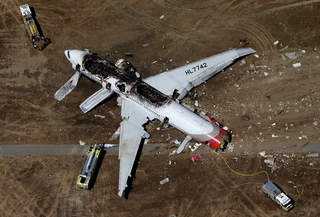
A navigation system that helps pilots make safe descents was turned off at San Francisco airport on Saturday when a South Korean airliner crashed and burned after undershooting the runway, officials said.
The system, called Glide Path, is meant to help planes land in bad weather. It was clear and sunny, with light winds, when Asiana Flight 214 from Seoul, South Korea crashed just before noon, killing two passengers and injuring more than 100.
Aircraft safety experts said Glide Path was far from essential for routine landings, and it was not unusual for airports to take such landing systems off line for maintenance or other reasons.
But pilots have grown to rely on the decades-old technology, which is designed specifically to prevent runway misses, so investigators are likely to look closely at the issue.
“The pilots would have had to rely solely on visual cues to fly the proper glide path to the runway, and not have had available to them the electronic information that they typically have even in good weather at most major airports,” said Captain Chesley “Sully” Sullenberger, the former US Airways pilot who gained fame with a successful crash landing on the Hudson River in 2009.
“What that means is that then the automatic warnings that would occur in the cockpit when you deviate below the desired electronic path wouldn’t have been available either. So we don’t know yet if that’s a factor in this particular situation, but that’s certainly something they’ll be looking at,” he told the local CBS News affiliate.
Glide Path is a computerized system based at an airport that calculates a plane’s path of descent and sends it to pilots in real time.
San Francisco International has turned off the system for nearly the entire summer on the runway where the Asiana flight crashed, according to a notice from the airport on the Federal Aviation Administration’s Web site. It showed the system out of service June 1-August 22 on runway 28 Left.
Kevin Hiatt, chief executive of the Flight Safety Foundation and a former Delta pilot, said it was common for airports to take instrument landing systems offline for maintenance on clear days. Pilots use several other instruments and visual cues to land in clear conditions, Hiatt said.
Former Inspector General of the U.S. Department of Transportation Mary Schiavo said pilots had become increasingly dependent on instruments for flying. But she added that modern planes had plenty of systems for landing safely, down to a pilot watching the lights on the runway. – Reuters
Teresa Heinz Kerry, a leading philanthropist and wife of US Secretary of State John F. Kerry, was in critical but stable condition Sunday after being flown to Massachusetts General Hospital from Nantucket, where she had been rushed to the hospital for an undisclosed ailment, according to aides to the secretary.
Heinz Kerry, 74, was stricken while at the family’s vacation home, according to State Department spokesman Glen Johnson.
“Late Sunday afternoon, Mrs. Teresa Heinz Kerry was taken by ambulance to Nantucket Cottage Hospital, accompanied by her husband,” Johnson said in a prepared statement. “Once doctors had stabilized her condition, she was transferred to Massachusetts General Hospital in Boston, again accompanied by the Secretary.”
Johnson did not provide further details of her condition, saying “the family is grateful for the outpouring of support it has received and aware of the interest in her condition, but they ask for privacy at this time.”
Shortly after 5:30 p.m., Noah Brown, public information officer for Nantucket Cottage Hospital, confirmed in a brief phone interview that Heinz Kerry had arrived at the hospital that afternoon.
“She was brought in, in critical but stable condition, and that is currently how . . . . her condition still remains,” Brown said. “At this point, we are determining the next phase of her care, be that either in our facility on the island, or on the mainland.”
Heinz Kerry has overcome serious health problems in recent years. She was diagnosed with breast cancer in September 2009 and underwent surgery and radiation treatments. She has publicly encouraged other women to get regular mammograms to help enable early detection of the disease.
The Kerry family’s holiday weekend on Nantucket was designed as a much-needed respite for the nation’s top diplomat following a frenetic pace of foreign travel, but it garnered unwanted headlines before Heinz Kerry’s hospitalization. On Friday, a State Department spokeswoman was forced to retract an earlier denial that Kerry had been on his yacht, Isabel, during the military coup in Egypt Wednesday. – The Boston Globe
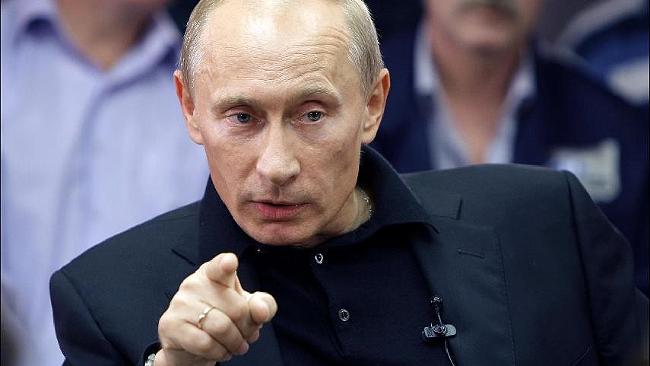
Russia’s President Vladimir Putin has said that Egypt risks slipping into civil war following the military overthrow of president Mohamed Morsi.
Dozens of people have been killed and more than 1 000 wounded in clashes between Morsi’s supporters, opponents and the military since the president’s exit.
“Syria is already in the grips of the civil war … and Egypt is moving in the same direction,” Putin told Russian state news agency RIA Novosti on Sunday during a visit to Kazakhstan’s capital Astana.
Meanwhile, Egypt’s transition has stumbled after the choice of Mohamed ElBaradei as interim prime minister was thrown into doubt by Islamist objections.
ElBaradei’s nomination had been confirmed by several sources and state media on Saturday, but just before midnight a presidential spokesperson told reporters that the prime minister had not in fact been chosen.
The abrupt U-turn came amid opposition to the appointment by the Nour Party, Egypt’s second Islamist force after Morsi’s Muslim Brotherhood movement, highlighting the challenge the military faces in finding consensus among liberals and conservatives on who should run the country.
Clashes between tens of thousands of pro- and anti-Morsi protesters swept the Arab world’s most populous nation on Friday and at least 35 people were killed and more than 1 000 wounded.
The violence, which saw rival factions fighting street battles in central Cairo and many others cities and towns, underlined the pressing need for a swift political solution seen as inclusive to all.
“We extend our hand to everyone, everyone is a part of this nation,” the spokesperson told reporters. “The Muslim Brotherhood has plenty of opportunities to run for all elections including the coming presidential elections or the ones to follow.”
Minutes after he spoke, state media reported that the public prosecutor ordered that four top Brotherhood leaders held this week be detained for a further 15 days on accusations that they incited violence against protesters.
The four included Saad el-Katatni, head of the group’s political wing, and Khairat El-Shater, its political strategist.
The Brotherhood has said it wants nothing to do with the military’s plans for a new interim government. It believes Morsi should be reinstated, and has pledged to keep protesting until he is.
The Nour Party, however, had agreed to the army-backed transition plan leading to new elections. Its withdrawal from the process would strip that plan of vital Islamist support.
And following the Nour rejection, the interim administration headed by Adli Mansour delayed naming the new prime minister.
On Sunday, people were still reeling from one of the bloodiest days in over two years of tumultuous upheaval since autocrat Hosni Mubarak, who ruled for 30 years, was toppled in a popular uprising that was part of the 2011 “Arab Spring”.
The Brotherhood called for another day of protest on Sunday.
Huge protests were staged on June 30 to pressure Morsi into resigning amid growing anger at economic stagnation and the perception among many that the Brotherhood was seeking to take control of every part of the state – a charge it fiercely denies.
Millions took to the streets to cheer his ouster on Wednesday, but for many Islamists it was a bitter reversal that raised fears of a return to the suppression they endured for decades under autocratic rulers.
The military said it had not carried out a coup, but merely enforced the will of the people. – Reuters
Former president Thabo Mbeki’s nephew died in Sweden last year under what now appears to have been suspicious circumstances.
Swedish police are facing accusations of brutality leading to his death. They have also been accused of attempting a cover-up.
Sunday World can reveal that Magnus Moerane (41), the son of Mbeki’s cousin Sophia Moerane, suffered fractures to his skull after being apprehended by the police in Stockholm in October.
It has emerged that Magnus was declared dead on arrival at a Stockholm hospital. But the police told Moerane that Magnus had been admitted to the intensive care unit of the hospital and could not be saved.
It took the intervention of the South African embassy in Sweden for Moerane to get full disclosure about her son’s death and access to the autopsy reports.
“The mission wrote a diplomatic note to the Swedish Foreign Ministry in which it was indicated that Moerane was not satisfied with the initial information provided, and that the embassy requested the authorities to provide a full disclosure around the circumstances of the death of Magnus Moerane.
“The Swedish authorities gave full co-operation to the SA embassy and provided the results of their investigations, including a second autopsy, to the embassy,” said Department of International Relations and Co-operation spokesman Clayson Monyela. He said the embassy could not interfere in the legal processes of a sovereign state.
Moerane believes her son was the victim of a racist assault by the police, similar to the shooting of a 69-year-old man of Portuguese origin in Stockholm last month, sparking riots.
A 73-year-old retired nurse, Moerane said she had known that her worst nightmare would soon become a reality when the police refused to show her the file on her son.
She reported Magnus missing a day after not hearing from him and after going to his flat.
Moerane last saw her son on October 30. He was dead the next day.
“The police told me to get an attorney because there was a problem,” she said.
Moerane’s ordeal worsened when she was told that she did not qualify for legal aid because she did not have home insurance.
She said her persistence in demanding answers from the police eventually led to them breaking the news of Magnus’s death to her and her youngest son, Vuyo (35).
“A man came into the room and said that, according to the report, the police had apprehended Magnus. They were forced to give him a bear-hug (tackle) to restrain him because he was big and tall.
“They said Magnus broke loose and fell on the concrete, which fractured his skull,” said Moerane.
Moerane phoned Mbeki a few weeks ago to tell him of the death of her son and the circumstances.
“I said: ‘Motswala (cousin), it’s bad.’ He went quiet and said: ‘I’m shocked,'” Moerane said.
Mbeki’s office was unavailable for comment at the time of publication.
Magnus was the eldest son of Mbeki’s cousin Moerane – the fifth child of Mbeki’s late uncle, Michael Moerane.
Michael Moerane was the elder brother of Mbeki’s mother, Epainette. He was a renowned music teacher and classical music composer.
The police said that after the 41-year-old fell he was put into a police car, then suffered seizures followed by heart failure .
The autopsy report said Magnus died from “the breaking of of the skull base and wounds in the brain tissues.
The report further said: “The injuries to the head have a look that can be the result of an unidentified blunt object.”
Swedish police commissioner Marianne Oman, who dealt with the case, was unavailable for comment.
Moerane said a three-paragraph letter from deputy chief district attorney Kay Engfeldt proved her theory that a cover-up was being attempted.
In the letter, Engfeldt said she had found “no reason for investigation” of Magnus’s death.
Engfeldt wrote: “Known facts: A man has died in connection with a police intervention. It gives no suggestion that a crime has been committed by someone from the police.”
Engfeldt’s decision came after a final autopsy report stated that Magnus died from “acute poisoning by Sertraline”.
Sertraline is an antidepressant used to treat depression, and obsessive-compulsive disorder, panic disorder and anxiety disorders.
But Moerane refuses to accept this version of events.
She believes her son was the victim of racial profiling – condoned by the Swedish government to rid its borders of illegal immigrants.
“Police brutality and racial profiling are common here,”Moerane said.
She added: “I am saddened that I had to bury my son in a country that didn’t want him. We might as well have remained in South Africa and have him die a noble death because he was fighting apartheid.”
Magnus worked at Arrow Nordic Components AB from 1998 to 2001.
He was diagnosed with Asperger syndrome, an autism spectrum disorder that results in difficulty with social interactions.
The Swedish embassy in Pretoria said it had not received any information from the Swedish Ministry of Justice concerning the Sunday World’s inquiry into the ambiguities surrounding the death of Magnus Moerane.- Sunday World
Hundreds of thousands of protestors flood Cairo’s Tahrir Square while a man waves an Egyptian flag from a rooftop last night
Sixteen Islamist activists were shot dead early on Monday during a protest outside a key Cairo army headquarters calling for ousted president Mohamed Morsi to be reinstated, his Muslim Brotherhood said.
“Sixteen people were killed and 100 others injured, many of them in serious condition,” the group’s spokesman Ahmed Aref told AFP.
Police barricades prevented journalists from accessing the area around the elite Republican Guards base.
Demonstrators told AFP that troops and police had fired tear gas canisters and bullets into the air to disperse the protesters.
“They wanted to disperse the protesters,” who were determined to stage an indefinite sit-in, the protester said.
Another protester, Mahmud al-Shilli confirmed that security forces fired into the air, adding that a group of men in civilian clothing had attacked the protesters.
“The Republican Guard fired tear gas but the thugs came from the side. We were the target,” Shilli told AFP.
Earlier, demonstrators told AFP by telephone that troops and police had fired tear gas canisters and live rounds in a bid to disperse them.
“I saw with my own eyes the people who they shot at,” one protester said, adding that several people had been injured.
On Friday at the same spot, four Islamists were shot dead by soldiers.
Supporters of Morsi’s Muslim Brotherhood have mobilised in large numbers in different parts of Cairo in recent days, vowing to defend Morsi, who was ousted by the military on Wednesday after mass protests calling for him to be removed from power.
Morsi was Egypt’s first freely elected president but lasted just a year in power. – AFP
A Rwandan man who came to Canada in 2001 as a refugee after the 1994 genocide in Rwanda has been acquitted on charges that he participated in the very genocide that he fled.
Jacques Mungwarere was acquitted Friday on one count of genocide by murder and on one count of crimes against humanity by murder.
He was arrested in 2009 in Windsor, Ontario, and accused of participating in a massacre of Tutsis in the region of Kibuye.
He claimed the accusations against him were fabricated. His lawyer argued that Mungwarere was fingered as a potential murderer after he agreed to testify for the defense at the trial of another Rwandan in the United States.
Ontario Superior Court Judge Michel Charbonneau ruled Friday that the defense raised a reasonable doubt. – AP
Police outside Sheremetyevo international airport in Moscow
Hopes have risen that Edward Snowden may finally be able to leave Moscow, where he has been stranded in an airport for 14 days, after three Latin American countries offered the fugitive US intelligence leaker asylum.
Bolivia on Saturday became the third country to offer refuge to the former US National Security Agency (NSA) contractor, with President Evo Morales saying he was willing to take Snowden in “if he asks”.
The offer came not long after Venezuela’s leftist President Nicolas Maduro said he would grant the 30-year-old “humanitarian asylum” and Nicaraguan President Daniel Ortega said his country could offer a safe haven.
The flurry of offers arrived after a series of rejections from many of the 21 countries to which Snowden had applied to last week for refuge.
The WikiLeaks anti-secrecy website that has been supporting Snowden’s cause said he had recently applied to six additional countries that it refused to name.
But it was far from clear how exactly Snowden — hidden out of sight of reporters for the past two weeks — could reach another nation from the transit zone of Russia’s sprawling Sheremetyevo international airport.
He has been stripped of his passport by the US authorities and a refugee pass initially believed to have been offered to him by Ecuador has since been declared invalid.
“He has no passport and asylum can only be granted to a specific individual. I have grave doubts that this is now possible,” senior ruling party lawmaker Alexander Romanovich told Moscow Echo radio.
Sheremetyevo only handles commercial flights and Snowden cannot travel past passport control to another airport used by foreign dignitaries.
Even if he got on a commercial flight, the plane carrying him could be grounded — the fate suffered by the jet carrying Morales after several EU states denied it overflight rights over suspicions Snowden was onboard.
Analysts meanwhile said Moscow may be increasingly concerned about getting sucked into a diplomatic spat with Washington that it had never planned for and which it would rather avoid.
— Leftist Latin American leaders offer asylum —
Morales declared however that Bolivia has “no fear” of the United States and its European allies, and that he would be willing “to give asylum to the American, if he asks”.
The offer was echoed by Maduro, who visited Moscow at the start of the week for a gas summit during which he strongly hinted that Venezuela –long a diplomatic irritant for the United States — could welcome the opportunity to help Snowden out.
But he made his intentions absolutely clear in an address at an independence day event in Caracas.
“As head of state of the Bolivarian republic of Venezuela, I have decided to offer humanitarian asylum to the young Snowden … to protect this young man from the persecution launched by the most powerful empire in the world,” said Maduro said.
Nicaragua’s Daniel Ortega voiced a slightly more toned down message only minutes earlier.
“We are open, respectful of the right to asylum, and it is clear that if circumstances permit it, we would receive Snowden with pleasure and give him asylum here in Nicaragua,” Ortega said at a public event.
So far, only Nicaragua, of the three that have offered asylum, said it had received his formal request; that could mean a petition there is further along in the pipeline than elsewhere.
Ecuador had been seen as the American’s best hope when he arrived in Moscow from Hong Kong on June 23 after leaking secrets about the extent of the US data surveillance programme to the press.
But the leftist government in Quito has yet to consider his application.
— ‘Russia is not happy he is here’ —
Russian President Vladimir Putin has refused to extradite Snowden to the United States while still stressing that he would like to see him gone as soon as possible.
Analysts interpret the mixed message as a sign that Moscow feel like they are being drawn into a fracas with Washington at a time when it would rather avoid additional difficulties to the two sides’ strained ties.
“Russia is not happy that he is here. If it wanted to offer him asylum, this would have been done right away,” said Carnegie Moscow Centre analyst Maria Lipman.
She noted that Putin himself was a former KGB spy who cares deeply about the safety of state secrets.
Alexander Konovalov of the Institute of Strategic Assessments agreed that “there is nothing for us to gain from Snowden”.
Putin has denied ever questioning Snowden about the details of the US spy network and has even suggested that doing so was not worth the effort.
“Snowden’s asylum in Venezuela would be the best option,” said parliament’s foreign affairs committee chairman Alexei Pushkov.
“This country is in a sharp conflict with the United States,” Pushkov tweeted. “It will not get any worse.” – AFP
Militants in Egypt’s Sinai bombed a gas pipeline to Jordan on Sunday, witnesses said, amid a surge in attacks on police and soldiers after Islamist president Mohamed Morsi’s ouster.
Witnesses told AFP the blast took place near the the north Sinai town of El-Arish.
After an uprising overthrew president Hosni Mubarak in early 2011, militants in Sinai repeatedly bombed the pipeline, which also supplied Israel.
But such attacks had not been reported for almost a year. – AFP
Medical officials say at least 12 people have been killed in clashes between supporters and opponents of the ousted president in the Mediterranean coastal city of Alexandria, bringing nationwide toll to 30.
Emergency services official Amr Salama says the 12 died when hundreds of Islamists descended on a rally by opponents of ousted President Mohammed Morsi in the city, opening fire with guns.
He says clashes erupted, and police joined on the side of the Morsi opponents.
Salama says he saw one man die when he went to the roof of a building, raised an Egyptian flag and shouted insults against Morsi. Morsi backers went to the roof and stabbed him and threw him off the building.
The state news agency MENA also confirmed 12 dead in the city. – AP
The head of Egypt’s Muslim Brotherhood Friday vowed that the group’s followers would hold open-ended protests to press for the reinstatement of ousted Islamist president Mohammed Morsi, as violence mounted in the country.
“All the measures taken (by the army) are invalid,” Mohammed Badie said at a massive Cairo rally. “The millions supporting Morsi will stay in the squares until the president of Egypt is reinstated.”
Badie, who is the spiritual leader of the Brotherhood to which Morsi belongs, denied media reports he had been arrested.
His influential deputy, Khayrat al-Shater, was arrested Friday in Cairo on charges of inciting violence against opponents, the official Middle East News Agency reported.
The army ousted Morsi on Wednesday following unprecedented protests by millions of Egyptians who demanded his resignation and early presidential elections. Several leading Islamists have since been detained.
The former president’s backers staged huge protests across Egypt, demanding his reinstatement.
“The situation is very clear. The democratic process in Egypt has been assassinated by a coup d’etat against the first democratically elected president,” Omar Ibrahim, a school teacher attending the pro-Morsi rally in the Cairo area of Nasr City, told dpa.
“But I can assure you that the Egyptian people will defend their revolution.”
Violence on Friday in the wake of Morsi’s overthrow left 17 people dead and 315 injured in Cairo and other areas, state television reported, citing the Health Ministry. There were no details on how and where the casualties occurred.
The broadcaster reported clashes between Morsi’s opponents and backers in Alexandria, Egypt’s second most populous city, the Nile Delta provinces of Damietta and Beheira, and the coastal city of Suez.
One person was reported killed and 66 injured in fighting between the two sides near the Nile-side TV building in Cairo near Tahrir Square, where Morsi’s opponents continued to celebrate his removal.
The army positioned tanks and armoured vehicles outside the building apparently to prevent potential attacks.
There were clashes in al-Arish, a city in the Sinai Peninsula near Israel. A police car was torched in the violence.
State television said the army had foiled an attempt by Morsi’s supporters to storm the city hall of the Suez Canal city of Ismailia. No casualties were reported.
Egypt’s top Muslim cleric, Ahmed al-Tayyeb, appealed for calm.
“I call on all Egyptians to avoid bloodshed. I entreat to God to put an end to this ugly sedition,” al-Tayyeb, head of the prestigious Sunni al-Azhar institution, said in a televised statement.
Earlier Friday, gunmen attacked army and police checkpoints in Sinai, killing one soldier and injuring three others, a security official said.
The attacks prompted Egyptian authorities to indefinitely close the Rafah border crossing with the Palestinian Gaza Strip. Troops deployed in Suez and South Sinai provinces were put on maximum alert following the assaults.
Interim President Adli Mansour, sworn in Thursday, has dissolved the Islamist-dominated Shura Council, which served as a temporary legislature.
Mansour appointed Refaat Shehata, outgoing intelligence service chief, as presidential advisor on security and named Mohamed Farid as new intelligence chief.
The African Union Peace and Security Council suspended Egypt on Friday from the 54-nation bloc, citing an unconstitutional power grab in the North African nation.
Cairo said it “deeply regretted” the bloc’s decision.
“We deeply regret this decision, which has been taken on the basis of unrealistic information,” Foreign Ministry spokesman Badr Abdel-Atti said.
Morsi became Egypt’s first democratically elected president last year after winning the polls with a narrow margin.
The opposition accused him of being keen on tightening the Muslim Brotherhood’s hold on power and becoming a dictator. – dpa
US Senator Ron Paul says US foreign policy doesn’t pass the laugh test.
A military coup in Egypt yesterday resulted in the removal and imprisonment of the elected president, Mohamed Morsi, a closure of media outlets sympathetic to him, the house arrest of his advisors, and the suspension of the constitution. The military that overthrew Morsi is the main recipient of the $1.3 billion yearly US aid package to Egypt. You could say that the US “owns” the Egyptian military that just overthrew its democratically-elected leader.
The hypocrisy of the US administration on these events in Egypt is stunning. As the New York Times reported today:
President Obama urged the military to move quickly to return Egypt to a democratically elected government, saying, ‘We are deeply concerned by the decision of the Egyptian Armed Forces to remove President Morsi and suspend the Egyptian Constitution.’ The president notably did not refer to the military’s takeover as a coup — a phrase that would have implications for the $1.3 billion a year in American military aid to Egypt.
Well, Egypt had a democratically-elected government, but it was overthrown by the US-funded Egyptian military!
Let’s review US policy toward Egypt to see the foolish hypocrisy of the government’s interventionism: First the US props up the unelected Hosni Mubarak for decades, spending tens of billions of dollars to keep him in power. Then the US provides assistance to those who in 2011 successfully overthrew Mubarak. Then the US demands an election. The Egyptians held an election that was deemed free and fair and shortly afterward the US-funded military overthrows the elected president. Then the US government warns the military that it needs to restore democracy – the very democracy that was destroyed by military coup! All the while the US government will not allow itself to utter the word “coup” when discussing what happened in Egypt yesterday because it would mean they might have to stop sending all those billions of dollars to Egypt.
All this they do with a straight face. We are not supposed to notice the insanity of their foreign policy. – prisonplanet.com
Israel’s peaceful relationship with its neighbors in Egypt comes at a high price: the deal obliges the US to provide massive amounts of unconditional military aid to Egypt.
And that’s where things get dicey. A military coup normally obliges the US to suspend military aid, which is why the US is avoiding calling this coup a “coup” in so many words, hoping to gloss over that fact.
But Egypt is a big deal, and a coup there is a little hard for the US to just write off as no big deal, which has Israeli officials fretting the prospect that the US might eventually be obliged to revoke aid to the new junta and “violating” the Egypt-Israel treaty in doing so.
Not that this means a serious risk of war, as both nations have been be getting billions from the US for decades and are both armed to the teeth. The US money buys Israel a lot of influence however, like the right under the treaty to dictate Egypt’s military policy in Sinai.
Israel is also expressing concern that jihadists will use the “power vacuum” to carry out attacks along the border, though Egypt has heavily deployed its military along the Gaza frontier, so this also seems unlikely.
In the end, the first impact the coup may have for Israel is weakening Hamas and strengthening Fatah, as Hamas had close ideological ties with President Morsi and was even in the process of ditching its long-standing alliance with Syria and Iran in favor of Egypt.
The Syrian government, which has long sought to portray its repression of the revolt against its rule as a crusade against Islamists, is relishing the Brotherhood’s humiliation in Egypt. Assad, in comments to be published in the state-run newspaper al-Thawra on Thursday, declared that “what is happening in Egypt is the fall of so-called political Islam.”
The president urged the country’s military to “return full authority” to “a democratically elected” government.
“Will the Brotherhood see the reality of events — and they rarely see any reality other than the visions in their own minds — and step down under the pressure of tens of millions of Egyptians? Or will the country be pushed into a civil war?” asked the announcer who read Wednesday afternoon’s news broadcast on state television, ahead of the daily digest of army victories against “terrorists” opposing the government.
Meanwhile, in rebel-held portions of Syria, people are starting to chafe at the behavior of the Islamist groups.
The execution on the streets last month of a 14-year-old boy for making a blasphemous comment and a rule issued this week by the city’s self-appointed Sharia court banning women from wearing makeup have stirred anger in the northern city of Aleppo. Citizens in the northeastern city of Raqqah have staged small-scale demonstrations against the Islamists who hold sway there.Some in Raqqah have watched with eager interest as the unrest unfolds in Cairo, said a resident who spoke via Skype on the condition that he not be identified because of the sensitivity of the subject. “The time will come when people realize that these groups don’t represent Islam, and they will kick them out,” he said.
Further afield, the recent mass demonstrations in Turkey, hailed as a model for emerging Arab democracies, were sparked by plans to chop down trees in a central Istanbul park but quickly grew into a wider expression of unease with Prime Minister Recep Tayyip Erdogan’s authoritarian style and his policies of Islamicization.
In Tunisia, the ruling Ennahda party, a Brotherhood affiliate, has held the middle ground between the radical Salafis who have threatened to use force to impose Islamic law and secularist activists, in another reflection of the splits opening up across the region that could shape a new round of turmoil.
“There is a fundamental divide in the Arab world over big issues such as the role of religion in government . . . and the identity of the state,” Hamid said. “It is a real, fundamental divide, and there is a lot at stake.” antiwar.com
This website uses cookies to improve your experience. We'll assume you're ok with this, but you can opt-out if you wish. Cookie settingsACCEPT
Privacy & Cookies Policy
Privacy Overview
This website uses cookies to improve your experience while you navigate through the website. Out of these cookies, the cookies that are categorized as necessary are stored on your browser as they are essential for the working of basic functionalities of the website. We also use third-party cookies that help us analyze and understand how you use this website. These cookies will be stored in your browser only with your consent. You also have the option to opt-out of these cookies. But opting out of some of these cookies may have an effect on your browsing experience.
Necessary cookies are absolutely essential for the website to function properly. This category only includes cookies that ensures basic functionalities and security features of the website. These cookies do not store any personal information.
Any cookies that may not be particularly necessary for the website to function and is used specifically to collect user personal data via analytics, ads, other embedded contents are termed as non-necessary cookies. It is mandatory to procure user consent prior to running these cookies on your website.


 The number of elderly people caught shoplifting in Japan’s capital city has outstripped that of teenagers for the first time since records began, a report said Monday.