Jordanians support ISIS

In a recent survey conducted by AlJazeera.net, the website for the Al Jazeera Arabic television channel, respondents overwhelmingly support the Islamic State, with 81% voting “YES” on whether they approved of ISIS’s conquests in the region.

The poll, which asked in Arabic, “Do you support the organizing victories of the Islamic State in Iraq and Syria (ISIS)?” has generated over 38,000 responses thus far, with only 19% of respondents voting “NO” to supporting ISIS.

ISIS pose a direct threat to the “entire civilised world”, the Queen of Jordan has declared, as she urged Muslims around the world to rise up against the group.

She urged people to ignore the “clash of civilizations”. Queen Rania said the war against ISIS must happen with the support of Britain and other allies in the Western world.

She spoke to leftist journalists earlier and said that ISIS threatened the One World ideology because it was “medieval”. She said all “modern” people should unite against the scourge.

Even as Jordan launched intense airstrikes against the Islamic State to avenge the extremist group for burning to death a captured Jordanian fighter pilot, the militants enjoy large support in the kingdom.

Africa Day fizzles out

There was no celebrations to mark Africa Day in Kenya, but the country’s President Uhuru Kenyatta is urging the continent to work together to fight extremism.

Africa has 54 countries, but only six; Ghana, Mali, Namibia, Zambia, Lesotho and Zimbabwe observe the day with a public holiday. Celebrations in these countries began early.

Africa Day is celebrated annually within the African continent to mark the formation of the Organisation of African Unity (OAU) on 25 May 1963 and the African Union in 2002.

Nobel peace prize winner and Egyptian scholar Mohamed ElBaradei said on Africa Day it is generally good to celebrate, but not in Africa right now.

ElBaradei told journalists in Pretoria today that there were still too many problems in Africa, and even the world, and reflection was needed instead.

“It is good to celebrate, but it is also good to say we have a lot of problems on our hands. I don’t think it will suffice to celebrate now. I think it is time for reflection and to say we have a lot of problems on our hands. We owe our people a lot in terms of governance, and governance continues to be a major issue in Africa,” he said.

He said countries had to ask themselves if military intervention was the only way or whether there was another way to address the issues.

Elbaradei used to head the International Nuclear Atomic Agency.

Flickr tags blacks as ‘apes’

Flickr is facing a user revolt after a new auto-tagging system labelled images of black people with tags such as “ape” and “animal” as well as tagging pictures of concentration camps with “sport” or “jungle gym”.

The system, which was introduced in early May, uses what Flickr describes as “advanced image recognition technology” to automatically categorise photos into a number of broad groups.

For instance, a picture of a newspaper cartoon can be automatically given the tags “drawing”, “sketch”, “cartoon”, “text”, and “writing”, in addition to whatever else the uploader decides to add to the photo. Other tags the system can automatically append include “outdoors” and “blackandwhite” – referring to the picture’s setting and image type.

But the system appears to be misfiring frequently, and often in offensive ways. A portrait taken by Corey Deshon of a black man named William has been auto- tagged with “blackandwhite” and “monochrome” – but also with the words “animal” and “ape”.

The system itself doesn’t appear to be applying race as a factor, since at least one other photo, of a white woman, was also given the “animal” and “ape” tags.

Elsewhere, photos of Dachau concentration camp have been auto-tagged with the “jungle gym”, “sport” and “trellis” tags, while an instantly recognisable photo of the entrance to Auschwitz was given the “sport” tag.

A Flickr spokesperson said: “We are aware of issues with inaccurate auto-tags on Flickr and are working on a fix. While we are very proud of this advanced image-recognition technology, we’re the first to admit there will be mistakes and we are constantly working to improve the experience. If you delete an incorrect tag, our algorithm learns from that mistake and will perform better in the future. The tagging process is completely automated – no human will ever view your photos to tag them”.

The company is already reacting in a piecemeal manner to the mistags, removing the “sport” tag from many concentration camp photos, and apparently removing “ape” from the auto-tagging software’s lexicon entirely (neither of the photos which were tagged “ape” are tagged as such any more, though both still have the “animal” tag).

Source: The Guardian

ISIS takes over UNESCO landmark

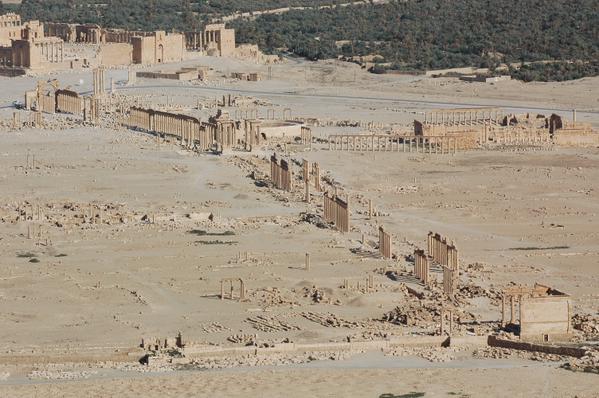
Islamic State militants have entered Syria’s historic city of Palmyra, a UNESCO landmark, after gaining full control over the city, a monitoring group said Thursday. The extremists now control more than 50 percent of Syrian territory, it adds.

The Syrian Observatory for Human Rights told AFP that overnight IS seized most of the city, including an army intelligence outpost, a military airport and a prison.

“IS fighters are in all parts of Tadmur [Arabic name for Palmyra], including near the archaeological site,” Observatory head Rami Abdel Rahman said.

The militants confirmed on Twitter that they gained full control over the ancient city, Reuters reported.

The remains of Palmyra, once one of the world’s key cultural hubs, stand in the middle of the desolate Tadmorean Desert in Syria.

The monitoring group says that this is the first time the jihadists have taken a large population center directly from Syrian pro-government forces. The group is already controlling wide areas in Syria’s north and east.

Many fear that after falling into jihadists’ hands, Palmyra would suffer a fate of the ancient Assyrian city of Nimrud, Iraq, which they devastated earlier this year.

Syrian state TV said pro-government fighters had withdrawn from the city.

On Wednesday hundreds of statues were moved from the city to locations safe from IS militants, Syria’s Director of Antiquities Maamoun Abdulkarim told Reuters.

“Hundreds and hundreds of statues we were worried would be smashed and sold are all now in safe places,” Abdulkarim said. “The fear is for the museum and the large monuments that cannot be moved,” Abdulkarim added. “This is the entire world’s battle.”

Texas bloodbath may be start of all-out gang war

Predictably, experts see the hand of the Hells Angels behind Sunday’s Waco bloodbath. They say the Angels have been encouraging the Cossacks to challenge the Bandidos’ control of Texas. On Sunday, the Cossacks were helped by another gang, the Scimitars.

US experts fear that this may well be the beginning of an all-out war between highly organized crime syndicates – with the potential of going global.

The massacre in Waco had all the signs of a proxy war. It basically pitted the Bandidos against the Cossacks. But the latter group is supported by the Hells Angels, a biker gang with branches in Europe, Canada and Australia, and the archenemy of the Bandidos.

The real war will likely be fought between these two organizations. Control of Texas might be the immediate spoils, but the world might see other battlegrounds, as well.

The shootout in Waco was just the latest clash in a long history of rivalry. The Bandidos are generally considered the world’s second-largest biker gang, behind the popularly better known Hells Angels, with as many as 2500 members in 13 countries, according to the US authorities.

The Hells Angels were founded in 1948 in California and entertain more than 400 chapters in 50 countries, according to the organization’s own count.

Other gangs are the Outlaws, the Pagans, the Warlocks and the Mongols.

The Bandidos began in 1966 in Texas, almost 20 years after the Hells Angels, but the two gangs soon became bitter rivals. Named in honor of the Mexican bandits who refused to live by anyone’s rules but their own, the Bandidos began recruiting their first members out of biker bars in various Texan cities.

The Mongols have a big Lebanese Muslim contingent in Germany and the Middle East, too.

Looking at mugshots from Texas, some may think that these are “white” bikers and some of the Mongols are. Some even display the double lightning bolt tattoos, Nazi insignia based on runes.

But there is a tremendous amount of anti-white racism present. Although Hispanics do not frown upon white Norman Spanish, they avidly support racial mixing.

These mixed-race gangs fight against the white power gangs in the US and in Europe. Naked hatred based on “cultural differences”, actually racial differences, are pretty big deals for these gangs.

By the time the carnage was over, bodies were scattered across the tarmac in what one witness described as a war zone. Nine bikers were dead and 18 wounded, some critically. Police surrounded the rest and arrested 170, who face organised-crime charges.

There were claims on Monday night that one gang was ambushed by the other to settle a turf war over who becomes the king of the roads in Texas.

As local police braced themselves on Tuesday for more bloodshed, anti-white sentiments were gaining with policemen calling white gangs “domestic terrorists”.

In a memo dated May 1, the Texas Department of Public Safety (DPS) cautioned authorities about increasing violence between the Bandidos and the Cossacks, Dallas TV station WFAA reported.

The DPS Joint Information Center bulletin said the tension could stem from Cossacks refusing to pay Bandidos dues for operating in Texas and for wearing a patch on their vest that claimed Texas as their turf without the Bandidos’ approval.

Israel gives up on bus apartheid

The Israeli government has had to suspend a recently passed law that would have prevented Palestinians from travelling on the same buses as Israelis.

The apartheid-style segregation law was introduced by Israel’s Defence Minister Moshe Yaalon on Wednesday but provoked outrage from Israeli opposition.

The segregation programme was however short-lived and within hours of being launched, Israeli Prime Minister Benjamin Netanyahu said it was “unacceptable” and suspended it with immediate effect. The programme would have run a three-month trial.

If implemented, the programme would have stopped Palestinians who commute to Israel for work from using public transport available to Israelis living in West Bank settlements.

Source: eNCA

Unprecedented security at Zim Pakistan clash

Thousands of police and paramilitaries have been deployed and helicopters will be buzzing over Lahore’s Gaddafi Stadium, which has been turned into a fortress for Friday’s Twenty20 cricket game against lowly Zimbabwe.

Authorities have mounted an unprecedented operation to guard insurgency-hit Pakistan’s first home international in six years.

The fixture is Pakistan’s first on home soil since 2009, when militants launched a gun attack on Sri Lanka’s team bus in Lahore, killing eight police and civilians and leaving seven players wounded.

Roads around the stadium will be closed and shops and restaurants have been shuttered for the duration of the series, consisting of two Twenty20s and three ODIs, all in Lahore.

Jammers are in use to cut out radio signals, hampering wifi at the stadium, and fans will have to go through metal detectors at three security checkpoints, raising the prospect of hours of queuing.

Zimbabwe have been under tight wraps since their arrival early on Tuesday, when they were whisked from the airport to their hotel watched by thousands of security personnel.

They are far from the usual arrangements for a cricket match, and Zimbabwe captain Elton Chigumbura said it was a new experience for him and his team.

Pakistan captain Shahid Afridi hoped the first ball on Friday will refocus attention on cricket as he attempts to lift his team after a poor World Cup and series in Bangladesh.

Despite the tight security and the late confirmation of the series, following a massacre in an attack on a bus in Karachi, organisers say the 27,000-capacity venue is a sell-out for Friday’s game.

Source: AFP

Uhuru calls for open borders

Kenyan President Uhuru Kenyatta has urged African governments to open their borders.

Speaking at the Pan African Parliament in Midrand, Kenyatta told members of the house that the continent’s potential could be realised only if African governments worked together and made it easier to trade with each other.

“There cannot be a good reason why it is easier for us to trade with Asia, Europe and the Americas rather than our own fellow Africans.

“Africa must significantly open her markets to African products to promote this ideal. That process can only be achieved if we start by opening up our borders to each other,” Kenyatta said.

He called for governments to significantly reduce the cost of inter-Africa trade and to forge partnerships which would take the continent into a new industrial development.

Partnerships in East Africa only began in July 2000 with Kenya, Tanzania, Rwanda, Uganda and Burundi. This community undertook to establish a customs union, common market, monitoring union and a political federation. The customs union is already in place and the common market goal is gradually being achieved.

SADC is much older.

“Despite our individually small economies, the integration has placed the entire region on a trajectory of growth that will fundamentally transform Africa,” Kenyatta said.

Kenyatta also announced that Kenya would be the second country after Mali to sign a protocol that will see the Pan African Parliament becoming a legislative body.

Nigerian restaurant serves human flesh

A Nigerian restaurant has reportedly been shut down for cooking human flesh and serving it to customers.

The police were tipped off by locals who suspected something horrific was taking place inside the kitchen.

They raided the hotel restaurant to discover human heads which were still dripping with blood in plastic bags.

A local priest who ate at the restaurant – in the south-eastern province of Anambra – was alarmed at the price of meals there, let alone where the meat came from, BBC Swahili reported.

He was presented with a bill of 700 Naira – around £2.20 – when the daily wage for tens of millions of Nigerians is approximately 60p.

The priest said: ‘The attendant noticed my reaction and told me it was the small piece of meat I had eaten that made the bill scale that high.

‘I did not know I had been served with human meat, and that it was that expensive.’The police also found a terrifying arsenal of weapons which included grenades when they raided the restaurant. Ten people were arrested in connection to the crimes.

One resident said: ‘I am not surprised at the shocking revelation… Every time I went to the market, I observed strange activities going on in the hotel.

‘People who were never cleanly dressed and who looked a bit strange made their way in and out of the hotel, making me very suspicious of their activities.’

Source: Daily Mail

ISIS takes provincial capital of Iraq

Iraqi forces have retreated from a compound they used as a command center in Ramadi, losing control of Aden’s provincial capital to Islamic State militants, despite substantial US airstrike support helping Iraqi troops and loyal militia hold the city.

“Ramadi has fallen,”said Muhannad Haimour, a spokesman for the governor of Anbar province. “The city was completely taken. … The military is fleeing.”The spokesman added that at least 500 people were killed in the jihadist offensive.

The militants claimed their full control of the city after squashing last major pocket of resistance from tribal and government forces.

“God has enabled the soldiers of the caliphate to cleanse all of Ramadi… after storming the 8th brigade. They (now) control it along with a battalion of tanks and missile launchers and in addition to the Anbar operations command,” the Islamic State (IS, formerly ISIS) statement said. The group also said it had seized tanks and killed dozens Iraqi security forces.

The final ISIS offensive that drove out government forces and tribal militias began early Sunday. Militants focused their attack on police officers defending the Malaab district in southern Ramadi by simultaneous bombings. Another three suicide bombers stormed the gate of the military headquarters to take control of the Anbar Operation Command.

Jihadis “pushed into the Ramadi military command headquarters after a fierce fight. The whole city is under their control,” Ahmed al-Dulaimi, a tribal leader told Bloomberg via phone.

Local security officials told AP that the militants already carried out mass killings of Iraqi security forces and civilians. Sunni tribal leader, Naeem al-Gauoud, said that bodies litter the streets in Ramadi, while others are thrown in the river.

The Pentagon refused to immediately admit Ramadi had fallen, with Defense Department spokeswoman Maureen Schumann saying it was “too early to make definitive statements about the situation on the ground.” She said the United States was “continuing to monitor reports of tough fighting in Ramadi and the situation remains fluid and contested.”

The Islamic State indeed has military advantage in Ramadi, the Pentagon confirmed, warning that the city falling into the hands of jihadists would be a great propaganda boost for them. But in the worst case, official said according to Reuters, the US-led coalition would support Iraqi army in taking the city back “later.”

Thousands march against US military presence in Japan

Thousands have been marching in Okinawa and across Japan in protest against the planned relocation of a US military base in Okinawa. The protesters criticized the Japanese government, who appear to be turning a deaf ear to the locals.

The protests began on Friday with about 1,200 people in Okinawa, as the island marked the 43rd anniversary of its reversion to Japanese sovereignty, and continued into Sunday gathering thousands of people.

“Even after our reversion, the problems of the bases remain unchanged,” Okinawa Governor Takeshi Onaga said at the protest, adding reversion of sovereignty had failed to bring Okinawans what they wanted.

“We’ve long suffered from the bases, and I’m angered by the outrageousness of both the US and Japanese governments in insisting a new base be built in Henoko,” Fujiko Matsuda, who heads a local citizens’ group, told the Japan Times.

“It is wrong to proceed with the Henoko relocation without listening to the voices of the Okinawans,” said another Okinawa resident, Atsuko Ikeda. “If we don’t prevent it, there is no future for Japan as a democratic nation.”

On Saturday, protestors marched around the US Futenma airbase in Ginowan city in Okinawa. About 2,600 people across Japan from Hokkaido to Nagasaki also took to the streets to voice their disapproval.

The activists shouted slogans, such as: “Oppose enhanced Japan-US defense ties”, “Bring back an Okinawa without US bases”, “The United States has to respect Okinawa people’s will”.

In the northeastern town of Henoko, hundreds of protesters scuffled with police outside new ‘Camp Schwab’. Several demonstrators were detained following the clashes.

On Sunday, about 35,000 people turned out to protest in the prefecture.

“No matter how long it might take, we will never give up our fight until the government gives it up,” said Keiichi Takara, director of the Confederation of Trade Unions Okinawa. “Through the rally, we will reaffirm our resolved commitment.”

According to mayor of Nago, Susumu Inamine, who opposes US military bases in Okinawa, “the government is thrusting their responsibility on us.”

“The government says we are to blame that the issue has stalled for 19 years and they tell us to find an alternative place (for the base). That’s outrageous,” he shouted into the crowd of protesters.

Marine biologist Katherine Musik said the rally “is absolutely tremendous.”

“Tens of thousands of voices, right now, shouting together, ‘NO’, in perfect harmony! ‘NO’ to the US military presence, how powerful! Let’s all shout, ‘Yes’ to the blue corals, red sea fans, orange clownfish, ‘Yes’ to the endangered dugongs in the sea, the endangered birds in the forest!”

There is a long history of incidents and alleged crimes committed by US soldiers in Okinawa. The current wave of anti-base sentiment on the island was sparked by a 1995 case, when three US marines were reported to have kidnapped and brutally raped a 12-year-old schoolgirl.

There were also less-publicized sex crime cases involving underage victims reported in 2001 and 2005, the fatal running over of a female high school student by a drunken US marine in 1998, and other crimes.

Israel tells Africans to leave or face prison

Israel is telling black Africans they must leave now or face an indefinite stay in prison.

Israeli authorities are sending letters to the first of 45,000 Eritrean and Sudanese refugees, informing them they have 30 days to accept Israel’s offer of $3,500 in cash and a one-way ticket home or to an unnamed third country in Africa, or face incarceration at Saharonim prison.

Israeli leaders have proclaimed that their tough approach — building a fence along its border, denying work permits for illegal migrants, forcing them into a detention center in the desert — may ultimately save lives by dissuading migrants from attempting a perilous journey. Critics of the Israeli policy counter that a country built by refugees should be more accepting of those fleeing war, poverty and oppression.

But these days, even liberal Europe is considering a more muscular approach. The European Union began a push Monday for U.N. authorization to deploy military force in the Mediterranean to stop migrant smuggling ships.

The new measures to press the Africans to leave Israel comes at a time of heightened fears among the refugees, who were stunned last month by a widely circulated video allegedly showing three Eritreans who left Israel killed by Islamic State militants in Libya. Friends and relatives said they had traveled there in a bid to reach Europe.

“We saw the video, but we thought maybe it wasn’t true, maybe it was just a hoax,” said Aman Beyene, an Eritrean asylum seeker who has spent 14 months at an Israeli detention center.

“Then we spoke to an Eritrean boy who had witnessed the killings, and we knew it was true,” Beyene said.

The 38-year-old Eritrean accountant sat at a picnic table in the dirt parking lot of the Holot detention facility, a compound of single-story cement-block dormitories housing 2,000 Africans, surrounded by a fence spooled with razor wire in the Negev desert.

Beyene spoke slowly as he recalled watching the video showing a man thought to be his friend Tesfay Kidane, 29, dressed in an orange jumpsuit beheaded on a beach in Libya by Muslim extremists. He said Kidane felt despondent being cooped at the Holot facility, so he accepted the Israelis’ offer to be flown to a third country — likely Uganda or Rwanda — and from there made his way to Libya, where he was kidnapped by the Islamic State.

Though the detainees at Holot are free to leave the compound during the day, the nearest city is an hour’s bus ride away and the men are forbidden to work. If they fail to return by nightfall, they are sent to a prison across the street.

Interviews with Eritreans and Sudanese at Holot suggest that many are still dreaming of reaching Europe through the chaos of Libya — despite knowing that more than 1,800 Africans have drowned in the Mediterranean Sea this year and others have been taken captive by the Islamic State.

“Being beheaded by ISIS or sinking on a boat is scary,” said Mutasim Ali, 28, who arrived in Israel in 2009 from the Darfur region in Sudan and has spent the past year detained in the detention center. “But you can’t really stay here, wasting your life, doing nothing.”

He pointed to the men like him who spend their days milling about in circles, staring at their mobile phones, waiting for the next meal.

Before Israel began cracking down on African migrants a few years ago, the Africans were highly visible in bustling cities, working in kitchens and doing menial labor. There are still neighborhoods in south Tel Aviv filled with Africans. Many Israelis complained they were being “invaded.”

Source: Washington Post

Code Blue: End UN immunity

Former First Lady of South Africa and Mozambique has added her voice to a growing campaign to block staff in UN peacekeeping missions from hiding behind immunity when accused of crimes and sexual abuse.

Graça Machel has added her voice to a campaign called Code Blue that calls on the UN Secretary General to immediately waver diplomatic immunity for all mission staff when complaints of sexual exploitation arise.

The campaign launched in New York, is also calling on UN member states to appoint an independent Commission of Inquiry to examine every facet of sexual abuse in peacekeeping operations.

Machel produced a UN report in 1996 on the Impact of Armed Conflict on Children and recommended that all gender-based violence during conflicts be prosecuted as a war crime.

19 years later, she believes little has changed within the UN system.

“These are women and children who have been brutalized by war and these are people who [are] eager … who represents the so called international community – the support, to say it’s ok now, we are going to start anew. We are going to have peace and pain is not going to be part of our life again and exactly the same people who infringe,” says Machel.

“How does it happen that the more we have sophisticated, international laws instruments, like conventions and protocols, we have also institutions which are expected to enforce those international laws, and people who within institutions are responsible to transform principles, to make them alive, it’s exactly those people, who turn against women and children,” she adds.

Code Blue has called for an amendment to the 1948 convention on immunity for UN civilian personnel to exclude cases of sexual abuse and exploitation.

Preliminary findings by the campaign have found that the vast majority of alleged abuse is by non-military personnel and a smaller percentage by the blue helmets themselves.

Co-director of organisation AIDS-Free World, that is spearheading the campaign, Paula Donovan says, “The problem with peacekeeping sexual exploitation and abuse and the application of immunity to UN staff and people who report ultimately to the SG is that it’s a gross misapplication of the 1946 convention. That convention was never intended to cover crimes, it certainly wasn’t intended to cover sexual crimes and it wasn’t intended to provide an obstacle to justice.”

The UN says it has a zero tolerance policy against sexual abuse but waiving immunity remains the prerogative of the Secretary General.

Donovan’s campaign is calling for an independent investigation.

“An independent, truly independent, commissioned by member states not by anyone in the Secretariat, must be commissioned to look at every single aspect of immunity, sexual exploitation, and abuse and the way it’s dealt with by the UN system,” she adds.

Co-director of Aids Free World, Stephen Lewis also blasted the UN’s handling of a leaked internal report that revealed French troops sexually abused children in the Central African Republic, even though the French were not under UN mandate.

“It’s now a year since those children were interviewed in the Central African Republic and they knew as early as May in 2014 that terrible things were being done. And frankly we believe that the UN should have jumped all over France from that day to this. Never giving them a moment when we as a United Nations weren’t asking what are you doing, have you charged people, have you taken them to trial, have you put them in jail, what are you doing about this abuse?” asks Lewis.

The UN has come under scrutiny in recent weeks for initially suspending the official who leaked the report to French authorities and then reinstating him.

France is now investigating the claims against its troops.

Vatican recognizes Palestine

Israel says it is “disappointed” that the Vatican has recognized the state of Palestine in a new treaty.

In a statement, the Israeli Foreign Ministry says the move doesn’t help the peace process and “distances the Palestinian leadership from returning to direct and bilateral negotiations.”

It says it will study the treaty agreement and will “consider its steps accordingly.”

The Vatican officially recognized the state of Palestine in a new treaty finalized Wednesday concerning the Catholic Church’s activities in the region.