‘Negro’ erased from Swedish children’s literature series

The word “negro” will be erased from the new Swedish editions of the book series about Pippi Longstocking by Astrid Lindgren, Swedish media report. Karin Nyman, Lindgren’s daughter, has given her consent after having pondered the idea for several years.

This year Astrid Lindgren’s Pippi Longstocking series will celebrate its 70th anniversary and the new Swedish editions due to be published in spring will be slightly different; all notions of the notorious “negro” will be effaced. In the original texts the main character, Pippi, is described as “negro princess” whereas her father is referred to as a “negro king”. From now on Pippi’s father, seafarer Ephraim Longstocking, will be described as the “king of the South Seas”.

“We are replacing a word that is harmful for children,” said Karin Nyman, Lindgren’s daughter and the person who came up with the name for Pippi, in an interview to Dagens Nyheter. “I grew up in another world, when there were only white people in Sweden, and it was long, long before any other people. In the last years I <…> have thought that the ‘n-word’, it is just a word that belongs to history, so it might as well stay? But I have changed my mind because it is a word that is being used today. It is harmful, and therefore we just cannot keep it in the books about Pippi.”

In September 2014, a Swedish TV-channel presented a new edition of the popular Pippi TV-series from 1969, erasing what they called “racist expressions”. They not only changed the description of Pippi’s father, but also deleted the scene where Pippi expressed her notion on what Chinese people look like.

Source: Sputnik News

The real Angela Merkel

The amazing career of a communist propagandist in the former German Democratic Republic

Angela Merkel was born in Hamburg in 1954 (Federal Republic of Germany). Shortly after her birth, her family made the unusual choice of moving to the East. Her father, a pastor in the Lutheran church, then founded a seminary in the German Democratic Republic and became director of a home for handicapped persons. He refrained from making any public criticism of the regime and enjoyed a privileged social status, having two cars and making frequent trips to the West.

Angela Merkel was a brilliant student, graduating as a doctor of physics. She married a physician, Ulrich Merkel, whom she soon divorced. She then moved in with Professor Joachim Sauer, divorced like herself but already the father of two children. Angela Merkel obtained a research post in quantum physics at the Academy of Sciences.

At the same time, she became politically involved in the Freie Deutsche Jugend (Free German Youth), the state organisation for young people. She rose within the organisation to the post of Secretary of the Agitprop department, becoming one of the main experts in political communication in the communist dictatorship. For professional and political reasons, she often travelled within the Soviet bloc, above all to Moscow, particularly since she spoke Russian fluently.

Although for many years hoped and prepared for, the fall of the Berlin Wall in November 1989 nevertheless took all governments by surprise. The CIA attempted to take over by recruiting senior individuals under the old system who were willing to serve the USA like they had previously served the USSR.

One month later, Merkel changed sides from one day to the next and joined the Demokratischer Aufbruch (Democratic Revival), a new movement inspired by the West German Christian Democrat party. She immediately took over the same functions that she had held before, except that the position was now, in West German terminology, “Press spokesperson”.

However, it soon became known that the president of Demokratischer Aufbruch, Wolfgang Schnur, had been a collaborator of the Stasi, the political police under the communist dictatorship. Merkel herself informed the press of this painful news, obliging Schnur to resign and enabling herself to be appointed in his stead as president of the movement.

Following the last parliamentary elections in the GDR, she joined the government of Lothar de Maizière, becoming the latter’s spokesperson, although Demokratischer Aufbruch only picked up 0.9% of the votes. During this period of transition, she was actively involved in the “2+4” negotiations that ended Berlin’s quadripartite status and the allied occupation, as well as in the negotiations aimed at reunifying Germany. In order, as she said, to avoid a mass exodus from the East to the West, she argued strongly in favour of getting the GDR to join the market economy and the Deutschmark zone.

Her partner, Joachim Sauer, was recruited by the US company Biosym Technology, spending a year at San Diego (California) at the laboratory of this Pentagon contractor. He then joined Accelrys, another San Diego company carrying out contracts for the Pentagon. For her part, Angela Merkel was perfecting her English, which she soon spoke fluently.

Once the GDR had been reunified with the Federal Republic and the Demokratischer Aufbruch had become part of the Christian Democratic Union (CDU), Angela Merkel was elected member of the Bundestag, the German federal parliament, and joined Helmut Kohl’s government. Although strict in matters of morals, he selected this young childless divorcee from the East living with a partner as Minister for Family, Youth and Women.

Within 14 months, the communist Agitprop leader of the DDR youth movement had become a Christian Democrat minister of Youth in the Federal Republic. Incidentally, she achieved very little in her first period as minister.

Continuing her career within the CDU, Angela Merkel launched an unsuccessful bid to get herself elected president of the Brandenburg regional party. However, Lothar de Maizière, who had become deputy president of the national party, was convicted of having distant relationships with the East German political police and was obliged to resign, to be replaced by Merkel.

In 1994, Klaus Töpfer, the Minister of the Environment, the Protection of Nature and Nuclear Security, was appointed director of the UN environment programme, following a series of clashes with the German Chamber of Industry and Commerce, which accused him of underestimating economic reality. Helmut Kohl then ended the crisis by appointing his protégée Merkel as Töpfer’s replacement. Immediately after assuming office, Merkel sacked all the senior officials of her ministry who had remained loyal to her predecessor. It was during this period that she formed a friendship with her French counterpart at the time, Dominique Voynet.

In 1998, Chancellor Kohl informed the USA of his opposition to an international intervention in Kosovo, while the Social Democrats under Gerhard Schröder and the Greens under Joschka Fischer compared Slobodan Milosevic to Adolf Hitler and were calling for a humanitarian war.

The pro-US press then thundered against the Chancellor, accusing him of the economic difficulties that the country was suffering from as a result of reunification. In the September 1998 elections, the Christian Democrats were swept out of power by a wave of red and green, Schröder becoming Chancellor and appointing Fischer his Foreign Minister.

However, Helmut Kohl and his closest associates had apparently accepted money from obscure sources for the CDU, but refused to reveal the names of the donors, arguing that they had given their word. Angela Merkel then published a courageous article in the Foreign Frankfurter Allgemeine Zeitung in which she distanced herself from her mentor. In this way, she forced him to withdraw from the party, with Wolfgang Schäuble, CDU party president, resigning shortly afterwards. Thus, in the name of public morality she grabbed the presidency of the party.

From then on, Angela Merkel was publicly supported by two press groups. Firstly, she was able to count on the support of Friede Springer, who had inherited the Axel Springer group (180 newspapers and magazines, including Bild and Die Welt). The group’s journalists are required to sign an editorial agreement laying down that they must work towards developing transatlantic links and defending the state of Israel.

Angela Merkel can also rely on her friend Liz Mohn, director of the Bertelsmann group, the number 1 in the European media world (RTL group, Prisma group, Random House group, etc.). Ms. Mohn is also vice-president of the Bertelsmann Foundation, an intellectual pillar of Europe-American relationships.

Angela Merkel relies on the advice of Jeffrey Gedmin, specially dispatched to Berlin to assist her by the Bush clan. This lobbyist first worked at the American Enterprise Institute (AEI) under Richard Perle and Mrs. Dick Cheney. He enthusiastically encouraged the creation of a Euro with Dollar parity exchange rate. Within the AEI, he led the New Atlantic Initiative (NAI), which brought together all the America-friendly generals and politicians in Europe. He was then involved in the Project for a New American Century (PNAC) and wrote the chapter on Europe in the neocon programme. He argued that the European Union should remain under NATO authority and that this would only be possible by “discouraging European calls for emancipation.” Finally he became the administrator of the Council of the Community of Democracies (CCD), which argues in favour of a two-speed UN, and became director of the Aspen Institute in Berlin. Subsequently he turned down the offer from his friend John Bolton of the post of deputy US ambassador to the UN so as to be able to devote himself exclusively to Angela Merkel.

In 2003, the State Department entrusted Jeffrey Gedmin and Craig Kennedy with a huge programme of “public diplomacy”, in other words propaganda, including the clandestine funding of journalist and opinion formers in Western Europe.

In 2003, Chancellor Gerhard Schröder opposed the Anglo-American intervention in Iraq. Angela Merkel then published a courageous article in the Washington Post in which she rejected the Chirac-Schröder doctrine of European independence, affirmed her gratitude and friendship for “America” and supported the war.

In May 2004, she established a new situation by pushing through the election as President of the Federal Republic of the banker Horst Köhler, main author of the Maastricht Treaty and creator of the Euro, later president of the European Bank for Reconstruction and Development (EBRD) and director of the IMF. She then began a “patriotic” campaign against radical Islamism.

Throughout the 2005 electoral campaign she criticised the increase in unemployment figures and the Social Democrats inability to deal with it, gaining for the CDU a lead of 21 percentage points in public opinion polls. It was then that her mysterious adviser, Jeffrey Gedmin, published an open letter to her in Die Welt. After criticising the German economic model, he wrote: “Before advancing the country, you need to defeat intellectually those nostalgic individuals who are dragging their feet. If Sarkozy succeeds Chirac, France might experience an upswing. It would be regrettable if Germany continued to decline.” In reply to this invitation, Merkel finally revealed her solutions. She promoted one of her advisers, the former Constitutional Court judge Paul Kirchhof, and entrusted him with the Initiative Neue Soziale Marktwirtschaft (Initiative for the New Social Market Economy). She announced the abolition of graduated income tax, proposing that the rate should be the same for those who only just have what is necessary and those who live in luxury. The outgoing Chancellor, Gerhard Schröder, severely criticised this proposal in a televised debate. The CDU’s lead was decimated, and in the actual election, the CDU polled 35% of the votes and the SPD 34%, the remainder being spread amongst a number of small parties. The Germans didn’t want Schröder any longer, but nor did they want Merkel. Following long and laborious negotiations, a Grand Coalition was agreed, with Merkel, although Chancellor, obliged to surrender half of the minister posts to her opponents.

She pushed through the participation of a German contingent in the multinational force under US command in Afghanistan. Then, when Israel intervened in Lebanon, she successfully achieved the involvement of the German navy in the FINUL, arguing that “if Germany’s raison d’être is to guarantee Israel’s right to exist, we cannot say, now that this existence is threatened, that we will do nothing.”

As of 1 January 2007, Angela Merkel is the president of the European Union. She has never made any secret of her intention to force France and the Netherlands to accept the equivalent of the Constitutional Treaty project that they both rejected in referendums, nor of her intention to relaunch the proposed merger of the North American Free Trade Area and the European Free Trade Area, thereby creating a “great transatlantic market” to use the words once pronounced by Sir Leon Brittan.

Source: Voltairenet

Italian town renames piazza ‘Martyrs of Odessa’

The renaming of a piazza in a small Italian town has caused a diplomatic incident.

The square in Ceriano Laghetto, in the northern province of Lombardy, is now called “Martyrs of Odessa” in memory of people killed during the recent upheaval in the Ukrainian city. It is named for pro-Russian separatists who died during clashes with Ukrainian government supporters in May 2014, Mayor Dante Cattaneo, of the right-wing Northern League party, tells Il Fatto Quotdiano.

More than 30 people were killed in a fire after barricading themselves into a government-run building in the city to escape the mayhem.

The renaming of the piazza – which is used as a car park – has angered Ukraine’s ambassador in Rome, Yevhen Perelygin.

In a letter to the region’s prefect, he asks for the decision to be revoked, saying the events of May 2014 “are still unclear”.

He also suggested in an interview that the decision was “manipulated by political forces who support the Russian initiative” in Ukraine, something the mayor refutes.

Mr Cattaneo appears to be defiant, despite a request from the regional authority to undo the change, and says Italy shouldn’t be allowing foreign interference in decision making. “Piazza for the Martyrs of Odessa is there and will remain,” he tweeted.

“In Ceriano there’s a democratically elected local authority. It is not Ukraine.”

Source: BBC

Sleep-deprived Merkel at centre of Ukraine peace deal

When she arrived at the Brussels summit on Thursday, German chancellor Angela Merkel’s face bore the signs of the sleepless nights she has endured in the past week in a prodigious quest for a settlement of the Ukraine crisis.

But despite the deep rings around her eyes, there was no rest in sight for Europe’s most powerful leader. Just hours after the all-night Ukraine negotiations in Minsk, she was preparing for talks with her 27 fellow EU leaders — not least the radical new Greek prime minister Alexis Tsipras, with whom Germany is clashing over the country’s bailout.

“I have a certain camel-like quality,” Ms Merkel, 60, once said, explaining her capacity to keep going when others would have collapsed with tiredness. She has needed every ounce of it this week covering about 20,000 kilometres on an itinerary of Berlin-Kiev-Berlin-Moscow-Munich-Berlin-Washington-Ottawa-Berlin-Minsk-Brussels.

For all the effort, the ceasefire deal struck on Thursday morning is little different from a previous one reached in Minsk last September but never implemented.

Upon arrival in Brussels, Ms Merkel was more sober than triumphant, saying: “This is a glimmer of hope. Deeds must now follow words.”

It is her political style to tackle difficult problems step by step. With the Ukraine crisis, the first aim has long been to stop the fighting — and then hope that a ceasefire can create a little breathing space.

German officials concede that full implementation of the latest Minsk agreement might be a long shot — but believe even a “frozen conflict” in which the two sides did nothing more than stop fighting, would be worth the huge diplomatic effort.

The latest initiative sprang from a letter Mr Putin sent a month ago to Ukrainian president Petro Poroshenko offering peace talks. With the support of French president François Hollande, Ms Merkel decided it was worth engaging the Russian leader, especially with the fighting intensifying around the strategic town of Debaltseve and growing calls in the US for the west to arm Kiev.

The US was not invited to the peace talks. Thus Merkel’s shuttle diplomacy finally brought the Minsk meeting — and buckets of praise at home for the dogged chancellor.

“Merkel: the world chancellor” ran a headline in Bild, the tabloid.

Even Gregor Gysi, leader of the far-left Linke party and who has fought Ms Merkel for years, allowed himself to say: “If the chancellor succeeds, I will find the words to praise her.”

Host Belarusian president Aleksandr Lukashenko did not sleep much either and later joked that his task was “to provide supplies.” He later told the media that the leaders had the finest Russian and Belarusian “eggs, cheeses and dairy products, as well as buckets of coffee,” which helped them stay up “without so much as a nap,” pointing out that no one touched a single drop of alcohol, unlike the journalists.

Source: FT

Famous author Houellebecq says Muslims are dangerously underrepresented

The Union of French Muslim Democrats (UDMF) has said it hopes to field candidates in eight cities in French elections next month, a modest objective for a young party with big ambitions.

The UDMF this week filed applications to run two candidates in the Parisian suburb of Bobigny as part of local elections in March, French media reported on Thursday. The relatively new political party said it planned to do the same in seven other ballot races, including in Marseille, Lyon and Nice.

Famed French author Michel Houellebecq’s latest novel “Submission,” which envisions France ruled by a Muslim party in 2022, sparked a media storm when it hit bookshelves this year.

The Charlie Hebdo massacre, incredibly, took place on the same day as the novel’s release in France. Speaking to France Inter radio about his best-selling novel, Houellebecq admitted that Muslims were dangerously unrepresented in mainstream politics.

The controversial writer Houellebecq had been found not guilty of inciting racism in 2002 by calling Islam “the stupidest religion”.

A panel of three judges acquitted Houellebecq of the charges of provoking racial hatred in remarks made in an interview with the literary magazine Lire.

The charges had been brought by France’s Human Rights League, the Mecca-based World Islamic League and the mosques of Paris and Lyon in a trial reminiscent of Britain’s Salman Rushdie affair.

The case also pitted leftwingers against Christians at a time of rising public concern about Islam in France, home to Europe’s largest Muslim community.

Najib Azergui, who founded the UDMF in 2012, told the daily Le Parisian that his group wanted to give a voice to the country’s sizeable Muslim community, which struggles to find itself represented in the country’s mainstream parties.

Hocine Hebbali, 32, became the party’s first – and so far only – member elected to public office, winning a seat as a city councilor in Bobigny last year.

The UDMF says it supports using Islamic banking practices to decrease France’s bloated public debt and says the country should invest in the halal food industry as a way to create jobs.

The party wants to repeal France’s 11-year-old ban on headscarves in schools and backs Turkey’s bid to join the European Union, according to the group’s website.

Ukraine agrees on ceasefire

An agreement has been brokered in Minsk to stop hostilities in Ukraine from Sunday. The deal was reached after marathon talks between the leaders of France, Germany, Russia and Ukraine, and signed by the Ukrainian rebels.

“I believe we agreed on a big deal. We agreed to a ceasefire starting at 00:00 on February 15,” Russian President Vladimir Putin told the media after the talks were finished.

“The main thing achieved is that from Saturday into Sunday there should be declared – without any conditions at all – a general ceasefire,” Ukrainian President Petro Poroshenko told journalists in a separate statement.

A compromise decision was taken over the disengagement line, which was the biggest stumbling block in the negotiation. According to the document, Kiev’s troops would pull back heavy weapons from the current frontline. The rebels would pull back from the line as it existed in September, when the previous ceasefire agreement was signed.

The security zone separating the warring parties must be at least 50km wide for artillery over 100mm caliber, 70km for regular multiple rocket launchers and 100km for heavier weapons with a longer range, such as Tochka-U ballistic missiles, the document states.

The weapons pullout must start on Sunday and be completed in no longer than 14 days. The OSCE is charged with implementing the ceasefire on the ground and will use its drone fleet and monitors to verify that both parties are sticking to the deal.

All German universities are free to international students

All German universities are now free to Americans and all other international students. The last German state to charge tuition at its universities struck down the fees this week.

Why are they offering such a generous plan?

In explaining why Germany made this move, Dorothee Stapelfeldt, a Hamburg senator, called tuition fees “unjust” and added that “they discourage young people who do not have a traditional academic family background from taking up study. It is a core task of politics to ensure that young women and men can study with a high quality standard free of charge in Germany.”

The perks don’t end at free tuition:

Even before Germany abolished college tuition for all students, the price was a steal. Typically semester fees were around $630. What’s more, German students receive many perks including discounts for food, clothing and events, as well as inexpensive or even free transportation.

Considering the average student loan debt in the U.S. is $29,400, a lot of U.S. high school students would do well to start learning German.

Source: Daily Kos

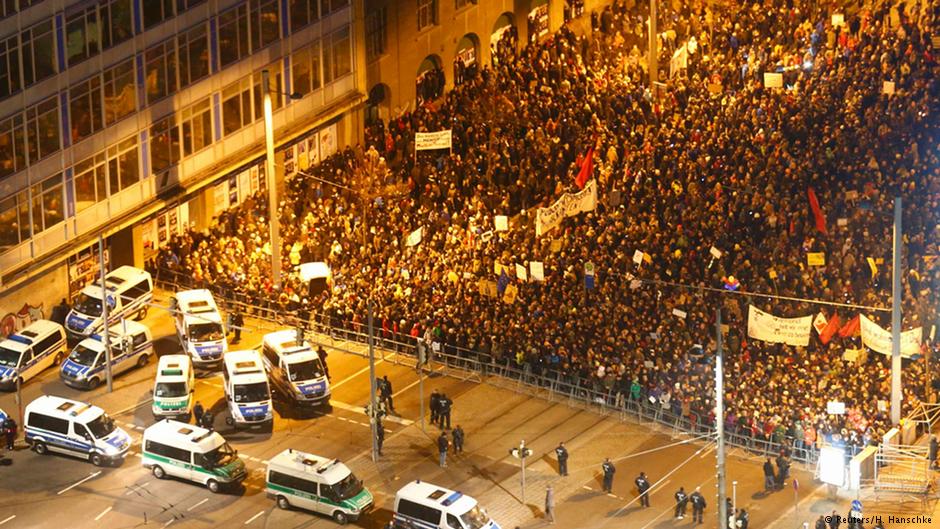
Another PEGIDA protest banned in Germany

Supporters of the PEGIDA (Patriotic Europeans Against the Islamization of Europe) movement in Germany’s eastern city of Leipzig, where the movement is called LEGIDA, had once again planned to take to the streets on Monday.

But the city called off the protest, saying police do not have enough officers to provide security and prevent violence.

Not enough police officers? The demonstrators think that reason was given as a false pretense to prohibit them from exercising a basic right. The ban amounts to “surrender by the constitutional democracy”, says Rainer Wendt, head of the German Police Union.

Demonstrators at a previous PEGIDA rally

It’s a fact that the anti-Islamization movement has for weeks embarrassed quite a few politicians in Saxony state. They have been forced to explain why it would seem that the Saxon cities of Leipzig and Dresden are hotbeds of xenophobic radicals. They would like to be rid of the bothersome protesters. A ban looked like an option, and referring to a lack of police officers could block the freedom of assembly for weeks because the authorities have the right to ban protests if the police can’t guarantee safety during a demonstration.

Unfounded conspiracy theories

On closer inspection, conspiracy theories and suspicions that a basic German right is being eroded turn out to be untenable.

“I absolutely don’t see the erosion of the freedom of assembly,” says Daniel Schily of the “More Democracy!” group.

An assembly ban is “an exception,” says former constitutional judge Hans-Jürgen Papier, adding that it must always be well-founded, and can’t be exercised arbitrarily.
NSA-Untersuchungsausschuss Hans-Jürgen Papier

While in fact, thousands of jobs have been cut in Germany’s police forces in the wake of reforms, Saxony’s police have so far managed to pull in reinforcements from other states when needed. This Monday was different, however: so many rallies were registered in Saxony and other German states that instead of the requested 31 groups of 100 police officers, only eight groups would have been available.

2,000 police officers are not enough

According to the police risk assessment, Leipzig Mayor Burkhard Jung pointed out that 800 police officers would not have been enough to safeguard the rally. More than 2,000 officers were deployed at the last PEGIDA protest in the city and even that wasn’t enough to prevent clashes between PEGIDA supporters and opponents, Jung argued. Banning the demonstration was thus by no means an arbitrary act, he said.

Every demonstration application must be processed by local authorities. Permits are not administered based on the political orientation of the demonstration, but on whether or not it poses any threat to the constitution. Under freedom of opinion and freedom of assembly laws, the constitution guarantees the right to state opinions publicly, no matter how outlandish they may seem.

Observers thus fear that the developments among the parties in Saxony and the new demonstration ban may prompt people to challenge this in a court of law. Any German citizen is able to legally challenge an assembly ban. In such claims in the past, many administrative courts have in the end allowed the demonstrations to take place – most recently in the autumn of 2014, when Hannover’s administration court ended up approving a hooligan demonstration, despite it having been banned by the local assembly authorities. As long as the right to file suits is upheld, experts on constitutional law see no danger to Germany’s freedom of assembly.

The increased number of banned demonstrations in Saxony has become a special concern for the state that does not apply to other states. “In Saxony, it seems the police, the interior ministry and the politicians are fighting for their own interests,” Daniel Schily believes. Chancellor Angela Merkel has already stepped in, saying in January that she wanted to protect the freedom of assembly. If need be, she said, more federal police should be made available so that demonstrations could take place. – Deutsche Welle

China slams US weapons to Ukraine

China is against Washington’s plans to provide Ukraine with weapons, the country’s Foreign Ministry spokesperson Hua Chunying said on Monday.

“China calls for the political settlement of the crisis in Ukraine as this meets the interests of all the sides. People in eastern Ukraine now are more in need of peace rather than weapons,” the diplomat stressed, commenting on the US plans.

Beijing welcomes and supports the active mediation efforts, which have been recently taken by the parties to ease tensions in eastern Ukraine and resolve the crisis by political means, she said.

China urges all the sides to refrain from any actions that could lead to an increase in confrontation or affect the negotiation process, the Chinese Foreign Ministry’s spokesperson said.

“China will continue playing a constructive role in the political settlement of the crisis in Ukraine,” the diplomat said.

Last Sunday, the New York Times newspaper reported that the Unites States considered supplying arms to Ukrainian forces.

Source: Itar-TASS

NATO fractures on Ukraine

NATO Secretary General Jens Stoltenberg has announced that each member of the alliance must make an independent decision on the supply of weapons to the Kiev government, which continues to fight independence supporters in southeastern Ukraine, the DPA news agency reports.

Speaking at the Conference of the Social and Democratic Party in Berlin on Sunday, Stoltenberg also said that he supports the reconciliation efforts of the Normandy Quartet, which includes Russia, Germany, France and Ukraine.

Normandy format talks have not led to any significant breakthroughs in Ukraine peace efforts. Kiev forces that launched a military operation against independence supporters in the Donetsk and Luhansk regions last spring, continue to clash with local militia, which leads to heavy civilian casualties.

Meanwhile, the US Congress has recently called for the provision of lethal assistance to Kiev-led forces.
Ukrainian President Petro Poroshenko asked US Congress for lethal weapon supplies during his September visit to the United States, however, Washington did not grant his request.

Speaking at the Munich Security Conference on Saturday, German Chancellor Angela Merkel ruled out any possibility of weapon supplies to Ukraine, stating that this would not help solve the crisis. Other European states, including Finland, France and Italy have also rejected the idea.

Source: Sputnik News

Russia to set up military bases in an EU state

Cyprus has offered Russia to have air and navy bases on its territory.

Cypriot president Nicos Anastasiades announced that the country is ready to host Russian aviation and naval bases. The official agreement on military cooperation between the two nations is expected be signed on February 25, 2015, according to Lenta.ru.

“There is an old [defense] agreement, which should be renewed as is. At the same time, some additional services will be provided in the same way as we do with other countries, such as, for example, with France and Germany,” Nicos Anastasiades said. “Cyprus and Russia have traditionally had good relations, and this is not subject to change.”

Cyprus’ announcement comes after Russia expressed interest in having a military base in Cyprus in late January, according to the Global Post and Greek Reporter.

Notably, Cyprus is one of the 28-member states in the EU, which have been imposing sanctions on Russia over the past year in response to the actions in Ukraine.

And just like Greece has recently caused a stir by complicating the process of extending sanctions on Russia, Cyprus, too, just voiced some opposition to the additional sanctions on Russia, adding that many EU members share that opinion.

“We want to avoid further deterioration of relations between Russia and the European Union,” the Cypriot president reportedly said.

Source: Business Insider

Ukraine: War drums beat louder

As the German Chancellor, Angela Merkel, prepared to brief Barack Obama in Washington on Monday about the state of peace negotiations in Ukraine, the Atlanticists were preparing for war.

The Estonian President, Toomas Hendrik Ilves, compared Western inaction against Russia with the appeasement of Adolf Hilter in 1938, when Nazi Germany was alllowed to seize parts of the former Czechoslovakia.

“We know from history that appeasement will never satisfy those that are being appeased,” he said. “Munich ’38 I think should be a lesson to all of us even today.”

British Foreign Secretary Philip Hammond accused Mr Putin of “acting like some mid-20th century tyrant”, while the French Foreign Minister, Jean-Yves Le Drian, said he would “fear the worst” if peace talks this week failed.

The US wants to send weapons to Ukraine, but Germany and France oppose arming Kiev’s forces, saying this could lead to an escalation of the conflict.

Lord Ashdown, the former UK Liberal Democrat leader, urged the West to use “military diplomacy” however, to hide their intent.

“The right reaction to the Russian arming of the Ukrainian rebels is to make it clear we are prepared to do the same for the Ukrainian government,” he writes. “Start small, slow and unaggressively – with communications and intelligence equipment for example.”

Carl Bildt, former Swedish foreign minister, said war “between Russia and the West” was now conceivable.

Ukrainian military transport aircraft have, for the past year since the putschists overthrew the government of President Viktor Yanukovych in Kiev, been flying around the world, including the United States, collecting everything from weapons and military helicopters to armored vehicles and ammunition for Ukraine’s army and neo-Nazi militia units.

The respected German daily, the Süddeutsche Zeitung featured a Russian military expert Yevgeny Buchinsky warning that if Kiev receives hard military aid, “Russia will have to intervene, and then, bluntly speaking, take Kiev. Then NATO would be in a difficult situation. Then you would have to start World War III, which no one wants.”

The Atlanticist representative in Kiev, president Poroshencko, meanwhile has promised Ukrainians US military aid: “I don’t have any doubt that the US and other partners will provide help with lethal weapons.”

EU bureaucrats have admitted – off the record – that even sanctions are ridiculous, sanctioning in fact the EU for least 15% of exports to Russia. The British have whipped up the pro-sanction lobby into a frenzy about “Russian aggression”, hoping to gain from their efforts later.

Russian president Putin, Ukrainian President Petro Poroshenko, German Chancellor Angela Merkel and French President François Hollande are all due to take part in the Minsk peace summit. Russian Foreign Minister Sergey Lavrov said Russia expected “important decisions” to be made at the meeting.

Germany’s Frankfurter Allgemeine Sonntagszeitung newspaper reported today that German intelligence estimated up to 50,000 soldiers and civilians had been killed during the conflict, nearly 10 times higher than Kiev’s estimate. “The official figures are clearly too low and not credible,” a source said.

Insiders say Merkel and Hollande came to Moscow but with the purpose of having what diplomats call “a full and frank discussion” in private with Putin in the Kremlin, where they can be confident the Americans are not spying on them.

Poroshenko’s officials are insisting that the question of federalisation was not discussed during a meeting with Hollande and Merkel.

Hollande has however now come out publicly to support “autonomy” for the eastern regions, making a discussion of federalisation a virtual certainty.

Russian student Alexander Mercouris says the reason Hollande is there and appears to be taking the lead is to provide Merkel with cover.

The one thing Merkel cannot afford politically is the appearance of a Moscow-Berlin stitch-up that the hardliners in Washington, Kiev, London, Warsaw and the Baltic States will claim is a new Molotov-Ribbentrop Pact to divide Europe into German and Russian spheres of influence. Whether we like it or not in Germany the shadow of Hitler still hangs heavy and exposes Berlin to endless moral blackmail.

Shell sails off with vessel named after Nazi

Royal Dutch Shell’s decision to plough ahead with plans to host a ship named after a Nazi in UK waters has provoked outrage among Jewish communities and Holocaust memorial groups.

The vessel is named after Pieter Schelte Heerema, a Nazi who was a member of the Waffen-SS during WWII.

Having failed in its efforts to get the vessel’s owner to change the name of the ship, Shell is set to launch the boat in UK waters in coming weeks.

The move forms part of the energy giant’s broader agenda of decommissioning an oilfield off the coast of Scotland.

As part of this process, Shell has tendered plans to the British government to use the “Peter Schelte” vessel to remove the Brent Delta oil platform from the East Shetland basin.

The oil rig, which consists of a 23,500 ton steel framework, will then be dispatched for scrapping.

The “Peter Schelte” ship is currently docked in Rotterdam, where its construction is almost complete. Edward Heerema, the son of Pieter Schelte Heerema, named it in memory of his father.

The vessel’s planned presence in British waters has sparked anger among Jewish groups throughout Europe.

Vivian Wineman, chief of the Board of Deputies of British Jews, said he will challenge Shell’s plan to introduce the ship to North Sea waters.

“We call on Shell and the government to insist the ship is renamed,” he told the Financial Times.

“The ship-owner should be sensitive to the citizens of Britain and the Netherlands, both Jewish and non-Jewish, who will be deeply hurt.”

“There is never a good time to name a ship after a dead Nazi, but coming just as we commemorate the 70th anniversary of the liberation of Auschwitz, and considering the majority of Dutch Jews were killed in the Holocaust, this is very unfortunate timing.”

Shell said it had backed a campaign, spearheaded by the Dutch, to have the name of the ship altered. Its owner, the chief of Swiss-based energy firm Allseas, however, refused the demand.

“Shell believes that the name of the vessel is inappropriate. We have raised our concerns with Allseas and asked them to consider changing the name,” the firm told the FT.

“However, the name of the vessel is a matter for Allseas alone, and one for Allseas to justify,” it added.

The issue has reportedly been considered by Shell’s top management. But the crane ship is the only one in the world capable of lifting the energy firm’s mammoth Brent oil platform.

The Brent oil field, at the center of the controversy, has yielded 2 billion barrels of oil and almost 6 trillion cubic feet of gas since production began in 1976.

Esther Voet, chief of the Dutch Centre for Information and Documentation on Israel (Cidi), which fronted the ship’s renaming campaign, denounced Shell for deciding to use the vessel.

“This is a bloodstain on the name of Royal Dutch Shell,” she told the FT.

The British government told the newspaper the issue of the ship’s name was “a matter for Allseas and Shell to resolve.”

Pieter Schelte Heerema lived in Venezuela prior to the war, and made his way back join the Nazis after Germany invaded the Netherlands.

After his conviction, a judge found that he had severed ties with the Nazis and worked for the Resistance. Although Heerema’s testimony has been discredited by some, the judge believed his testimony and halved his sentence.

The former Nazi soldier later founded a successful oil services firm in the Netherlands called Heerema.

Britain to lead spearhead NATO force in Eastern Europe

Britain will play a lead role in a “high readiness” NATO force that will be established in Eastern Europe, Defence Secretary Michael Fallon said Thursday.

Britain would send up to 1,000 troops and four RAF Typhoon jets for “air policing” in the region, BBC reported cited Fallon as saying.

The multinational force is the biggest reinforcement of NATO’s collective defence since the end of the Cold War.

It comes as French and German leaders headed to the Ukrainian capital Kiev to try to negotiate an end to escalating fighting in the east of the country.

Fallon said NATO’s credibility in the face of the security challenges depended on “everyone playing their part” to implement decisions taken to bolster its forces at a summit of member states in Wales last year.

“Strong words must be backed up with firm action,” he said.

NATO defence ministers have gathered in Brussels to discuss the details of the “Very High Readiness Joint Task Force” (VJTF), which will form NATO’s first response in the face of aggression.

It is expected to be made up of about 5,000 troops from NATO countries, with its lead units able to deploy at two days’ notice.

Britain will be the force’s lead nation in 2017 and then on rotation thereafter, Fallon said.

Fallon said Britain would contribute manpower to two regional headquarters in Poland and Romania, and to force integration units in Poland, Romania and Bulgaria.

Britain would also send four RAF Typhoon jets to support NATO’s Baltic air policing mission in 2015, he confirmed.

The Typhoons will operate alongside Norwegian aircraft between May and August 2015, with the aim of securing NATO’s airspace over Latvia, Estonia and Lithuania, which do not have their own air defence fighters.

They will operate at NATO’s request from Amari Airbase in Estonia, he said.

Fighting in eastern Ukraine began last April, when separatists seized government buildings after Ukraine’s southern Crimea peninsula acceded to Russia.

More than 5,000 people have been killed in the conflict.

NATO Secretary-General, Jens Stoltenberg has said that Russia continues to violate international law as fighting continues in Ukraine.

Source: daijiworld.com