German Chancellor injured in skiing accident

Angela Merkel
Angela Merkel

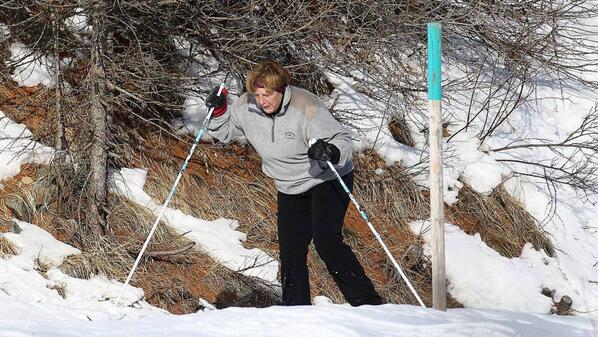
German Chancellor Angela Merkel has injured her pelvis on a cross-country skiing trip during her Christmas vacation, her spokesman Steffen Seibert said. She will be mostly bedbound for three weeks and will not visit Warsaw on Wednesday as planned.

The injury will also prevent Merkel from receiving Luxembourg’s new prime minister, Xavier Bettel, on Thursday.

Merkel fell and now has a crack in her pelvis, Seibert said. She has also suffered a serious contusion.

“The chancellor is of course able to work and is in full communication,” said Seibert. He added that Merkel’s accident occurred “at low speed” but he declined to give further details.

The chancellor was staying at the skiing resort of St. Moritz in Switzerland with her husband, Joachim Sauer. The resort is a traditional Christmas vacationing spot for their family.

Merkel is the second prominent public figure to suffer a serious skiing injury these Christmas holidays. Last week former Formula 1 world champion Michael Schumacher had an accident in the French Alps, and remains in a coma due to a head trauma. – RT

Mayor of Paris, minister call for ban on French comedian Dieudonne

dieudonne
Poster of Dieudonne’s Le Mur at the entrance of the theatre

The mayor of Paris is also calling for comedian Dieudonne M’bala M’bala, known for his anti-Jewish humour, to be banned from performing in public.

France’s interior minister, Manuel Valls, voiced his displeasure first in wanting Dieudonne, as he is known, banned from the stage.

The well-known comedian, started out years ago with a Jewish partner in sketches that mocked racism.

But in 1997, he fell out with Elie Semoun over money owed to him.

He has now joined the political right and alienated some fans with anti-Jewish comments. Dieudonne maintains that most people find joking about blacks in order, but not humour about Jews.

His latest joke about gas chambers has irked Paris mayor Bertrand Delanoe, who likened Dieudonne to a criminal who “defends crimes against humanity”.

“We must ban the performances” he said, echoing recent comments made by interior minister Valls. Valls himself has been accused of discrimination after he said in September that Roma did not want to integrate.

Dieudonne has already been fined a couple of times for defamation, insults, hate speech and racial discrimination, and over his salute, called the “quenelle”.

The “quenelle” has been used by several personalities since, including footballer Nicolas Anelka, who recently used it to celebrate a goal.

But the 47-year-old comedian says the Holocaust gets too much attention to the exclusion of other crimes.

Valls, meanwhile, has said he wants to ban performances by Dieudonne on his nationwide tour this month, after the comedian joked about Jewish radio presenter Patrick Cohen.

“When I hear Patrick Cohen speak, I tell myself, you know, the gas chambers… A shame,” joked Dieudonne.

Despite the criticism, the comedian has scores of die-hard fans who feel he is unjustly being hounded by the media and politicians.

Dieudonne’s official page has 466,000 likes.

He won fans by exposing a well-known Jewish author’s denials of ethnic focus as flimsy and insincere.

The French-born son of a Cameroonian father and a white mother, Dieudonne M’Bala M’Bala shot to fame in the 1990s in a double-act with his childhood friend Semoun.

He stood for EU-wide elections in 2009 on an anti-Zionist platform, describing Holocaust commemorations as “memorial pornography”.

But his shows at a small theatre in Paris that he manages attract packed audiences.

At his show on Thursday, the comedian joked about “kippa city” and “the banking slave master” to general hilarity.

US court rules against liability of German companies for apartheid

daimlerA district court in the US has ruled German companies could not be held responsible for the atrocities committed by the former apartheid regime in South Africa. The decision came after years of legal disputes.

German carmaker Daimler and defense group Rheinmetall could not be linked to any atrocities committed by the apartheid government in South Africa , a judge ruled in the US.

New York District Court Judge Shira Scheindlin made it clear the two German companies could not be sued for compensation under a US law known as the Alien Tort Statute. This allows non-US citizens to bring cases before a court in the United States if they see a violation of international law.

Predominantly South African plaintiffs, victims of racial segregation and violence in the country, maintained that Daimler, Rheinmetall and other firms had supported the apartheid regime through their close business ties with the South African government in the 1970s and 1980s, including the sale of cars and munitions.

Questions remain

A spokesman for the two German companies hailed the ruling, welcoming the legal clarity that had finally been established after years of fierce recriminations.

“We hope that this decision will finally bring to an end more than ten years of legal dispute,” Daimler said in a statement.

But the US judge did not immediately dismiss similar claims made against US companies Ford Motor and IBM, who were not immediately available for comment. – Deutsche Welle

Thatcher did not mention Mandela in official discussions with PW Botha

PW Botha and Margaret Thatcher

Margaret Thatcher made no mention of Nelson Mandela during the only formal talks she held with South Africa’s leader PW Botha, documents released recently reveal.

The papers blow apart recent Tory boasts that she helped end apartheid – and her own claim that she had pressed for his release at the summit.

Instead Thatcher relegated the issue to a short, private chat with Botha before the June 1984 talks officially got under way. No notes were taken so there is no evidence of what was discussed.

The then PM had been urged by the British Foreign Office to raise Mandela’s imprisonment officially during the four-hour minuted formal discussions.

But Thatcher, who objected to sanctions against Botha’s regime and had branded Mandela a terrorist, failed to do so.

Thatcher’s own account says Mandela’s incarceration was “noted” during a private audience on “sensitive issues”.

But her adviser John Coles stated: “No note-takers were present. Mr Botha said he could not interfere with the South African judicial process.” – extract from The Mirror

Pussy Riot saga ends happily

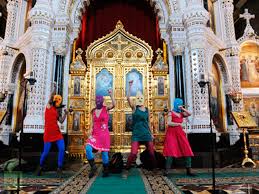
Pussy Riot inside the church in Moscow

A member of punk rock band Pussy Riot, Nadezhda Tolokonnikova, who was kept at the Krasnoyarsk prison hospital, was set free, her husband Pyotr Verzilov tweeted.

Tolokonnikova, like another member of the group, Maria Alyokhina, who was also released on December 23rd, was pardoned in connection with the 20th anniversary of the Russian Constitution. The State Duma decided to release those convicted of hooliganism.

Pyotr Verzilov wrote on his Twitter that Tolokonnikova intended to facilitate the dismissal of the Chief of the Federal Penitentiary Service in the Republic of Mordovia, General Simchenkov. Tolokonnikova served a part of her sentenced at Correctional Colony No. 14 in Mordovia, where she went on a hunger strike, claiming that the administration of the colony threatened to kill her. She claimed that her human rights were violated and complained of intolerable conditions for prisoners. Tolokonnikova described her claims in an open letter.

Maria Alyokhina, Ekaterina Samutsevich and Nadezhda Tolokonnikova were detained in March 2012. On August 17, 2012, the activists were sentenced to two years in prison for their “punk prayer” at the Cathedral of Christ the Savior. The women were convicted of hooliganism motivated by religious hatred. The activists said they did not intend to offend believers, but wanted to draw people’s attention to close ties between the state and the church. On October 10, 2012, Ekaterina Samutsevich’s sentenced was changed to conditional one. – pravda.ru

French lawmaker walks 6000 km, finds ‘unashamed racism’ everywhere

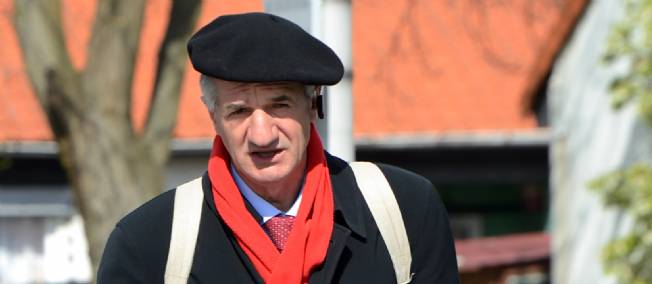
Jean Lassalle, photographed during his walk

A French lawmaker who spent eight months walking a 6,000km “Tour de France” takes his last symbolic steps in Paris on Sunday. He returns to the capital to report on a country that has “little hope for the future”.

“Everywhere I went I witnessed a crisis in the standard of living, a loss of identity and the loss of a sense of a common destiny,” Jean Lassalle, National Assembly member for the Pyrénées-Atlantiques region in southwest France, told Europe 1 radio.

“People would tell me: ‘look at the state you have left our country in’,” he added. “There is no more industry, farming is in crisis, just one in ten children of farmers grudgingly says they want to carry on in agriculture.

“The countryside has lost its perspective, and it isn’t any better in the cities. We all know the state of France’s suburbs, even those that have been rebuilt.”

Lassalle, 58, set out in April and walked an almost uninterrupted route clockwise around France, flying only from Marseille in the south to northern Corsica, and again from Bordeaux in the southwest to Nantes in the northwest.

He said he “needed to get a feeling” for the country, and wrote on his personal blog that he was impressed by peoples’ willingness to speak frankly with him.

“Once they knew what I was doing, I felt a strong sense that they were expressing themselves as a civic duty, choosing their words carefully,” he wrote. “There was a solemnity and a dignity about it, despite everything they had to say.”

Confusion and racism

And what he found was a France confused about its position in a shrinking world, an uncertainty as to the long-term effects of globalisation and a distrust for politicians who, people told him, “do not listen to us at all”.

“We live in a world that is changing out of all recognition,” he told Europe 1. “We [the government] have failed to find ways of explaining to the citizens of this country exactly what this change means.”

Worryingly, he also encountered “latent racism” almost everywhere, “even in the smallest villages”.

“This is racism that seems totally unashamed,” he told Le Monde on Friday. “It is a wholescale rejection of ‘the other’ and often expressed with excessive aggression.”

Lassalle told Le Monde that he was particularly worried about a return of “anti-Semitic rhetoric” that was particularly “linked to wealth”.

On Saturday, Lassalle will walk his final steps, from Place de la Concorde over the River Seine to the National Assembly building in central Paris.

Hundreds of people he met on his walk are expected to accompany him, and to enter the assembly to start a two-day debate on France’s future.

“I will then prepare a parliamentary report on what I learned on my walk, which I will submit to the president at the end of February,” he wrote in his blog. “Meeting people around the country was a deliberate act as an elected member of France’s parliament, as a resistant [to changes that have eclipsed the lives of ordinary people], and a bid to raise awareness of the issues faced by our citizens.

“Things cannot stay the way they are now.” – France24.com

Swiss clocks tick past deadline to disclose hidden assets

swissclockSome 300 Swiss banks had until the end of Monday to determine whether to give the United States records of Americans hiding assets there as Washington threatens institutions with legal action for assisting those avoiding US taxes.

The US and Switzerland have been at odds in recent years, with Washington alleging that Swiss banks have helped US citizens hide billions of dollars in assets from authorities.

Pursuant to a deal between the nations, Swiss banks can avoid US prosecution by volunteering account information on American clients, along with paying a fine.

The penalty equals between 20 and 50 percent of the value of the undeclared accounts, based on when they were conceived. If a bank opened an undeclared account before 2009 – when the Swiss banking giant UBS was fined US$780 million by the US for tax evasion – it would face a lower penalty.

Notoriously secretive Swiss banks that do not disclose account information will face stiffer penalties and prosecution in the US if Washington finds they have hidden Americans’ assets.

Egon Vorfeld, managing partner at the Forum Finance Group SA, suggested smaller banking entities will feel the brunt of the high fines even though they are less likely to hide US citizen assets.

“Most of the larger banks are already cooperating, and it’s fairly clear which direction they are going,” Vorfeld told RT in an interview. “They have run the numbers and know exactly what they are doing. Perhaps some of the smaller banks could be affected because the fines – the worst of them – could be very onerous on them.”

Negotiator of the deal Swiss Finance Minister Eveline Widmer-Schlumpf has encouraged banks to comply, but experts are split on whether bending to Washington and offering disclosure is a good idea.

“If the United States is threatening all the Swiss banks that it will block their access to the US market and to conducting operations in dollars, let it say so clearly, and let Switzerland take the country before…the World Trade Organization for abusing its dominant position,” wrote business lawyer Douglas Hornung in a recent opinion piece in the Le Temps daily.

“But please, don’t give in to inexcusable blackmail and let us remain the proud masters of our destiny, and of our past. We have a choice,” he added.

Vorfeld told RT the issue of why the US feels it should be able to tell Swiss banks what to do comes down to its large footprint in global banking operations.

“The US has an awful lot of clout and is able to throw its weight around, and feels justified to do so. But clearly a lot of other people feel there is injustice in this supposed justice system, that a lot of the smaller banks will be possibly victims,” Vorfeld said, suggesting those smaller institutions are also more likely to possibly evade the US demand. RT

Brit locked up for telling Nelson Mandela joke

Neil Phillips, right

Neil Phillips was taken to a police station after posting jokes about Nelson Mandela’s death.

“There was no hatred. What happened to freedom of speech?”

Neil Phillips said he was fingerprinted, DNA-swabbed and had his computers seized.

The 44-year-old was held after posting: “My PC takes so long to shut down I’ve decided to call it Nelson Mandela.”

Another read: “Free Mandela – switch the power off.”

But police swooped after a councillor complained over the gags about the former South African leader, who passed away on Thursday, aged 95.

Mr Phillips who insisted he meant no harm, said: “It was an awful experience. I was fingerprinted, they took DNA and my computer.

“It was a couple of jokes, Bernard Manning type,” he added. “There was no hatred. What happened to freedom of speech? I think they over-reacted massively.”

Mr Phillips, who runs Crumbs sandwich shop in Rugeley, Staffordshire, was arrested after complaints by Cllr Tim Jones about the one-liners, aired when the anti-apartheid hero was critically ill.

A spokesman for Staffordshire Police confirmed the arrest and added: “When he answered bail on September 30, he was informed that there would be no further action based on CPS decision of there being insufficient evidence to support a prosecution.”

Yesterday, millions flocked to churches, parks and hills to pay their respects to Mr Mandela, including ex-wife Winnie. – dailystar.co.uk

David Cameron won’t be hanging Mandela

Conservative-FutureBritish Prime Minister David Cameron on Thursday said “a great light had gone out” following Nelson Mandela’s death, revealing that flags would be flown at half-mast at his Downing Street Office.

“A great light has gone out in the world,” said a statement released by Cameron.

“Nelson Mandela was a towering figure in our time; a legend in life and now in death — a true global hero.

“Across the country he loved they will be mourning a man who was the embodiment of grace,” he added.

“Meeting him was one of the great honours of my life. My heart goes out to his family – and to all in South Africa and around the world whose lives were changed through his courage.

“I’ve asked for the flag at No.10 to be flown at half mast.”

In a newly updated edition of Cameron: The Rise of the New Conservative, by James Hanning, the deputy editor of The Independent on Sunday, and Francis Elliott, the deputy political editor of The Times, it is revealed that the 23-year-old future leader went on a “fact-finding mission” that took place 20 years ago while the Thatcher government was opposed to sanctions against South Africa at the time.

The trip was organised and funded by Strategy Network International (SNI), created in 1985 specifically to lobby against the imposition of sanctions on South Africa.

Cameron remembered the visit: “It was all terribly relaxed, just a little treat, a perk of the job. The Botha regime was attempting to make itself look less horrible, but I don’t regard it as having been of the faintest political consequence.”

In 2006, shortly after becoming Tory leader, Mr Cameron tried to make amends for his party’s record on South Africa by visiting Nelson Mandela, by then President, at the same time as suggesting the party’s policy from the 1980s was from another era that he did not belong to. He said at the time: “The mistakes my party made in the past with respect to relations with the African National Congress and sanctions on South Africa make it all the more important to listen now.

“The fact that there is so much to celebrate in the new South Africa is not in spite of Mandela and the ANC; it is because of them – and we Conservatives should say so clearly today.”

But what was not known, and which sheds new light on the 2006 meeting, was that British civil servants and advisers were told not to go on such trips, the book reveals.

Many in the Conservative Party used to wear ‘Hang Nelson Mandela’ badges at university. Their leader at the time Margaret Thatcher described Mandela as a terrorist.

South African, French, African foreign ministers to meet today

Paris-0792International Relations and Cooperation Minister Maite Nkoana-Mashabane arrived in Paris, France, yesterday morning, 04 December 2013, where she is leading a South African Government delegation to the France-Africa Summit taking place from 06-07 December 2013.

The summit will be preceded on 05 December 2013 by a meeting of Ministers of Foreign Affairs.

It is expected that the summit will focus on three identified themes; namely (i) Peace and Security, (ii) Economic Partnership and Development and (iii) the Environment.

It is further expected that the summit will examine policies for preventing conflicts, trafficking and piracy, how to deter the formation of armed movements and terrorist groups, and the strengthening of African security mechanisms.

South Africa’s participation at the summit will be informed by its foreign policy, which champions, amongst other things, peace, security and development as well as the African Agenda.

The South African Government delegation to the summit includes Defence Minister Nosiviwe Mapisa-Nqakula and senior officials. – DIRCO press release

Water UK admits fracking compromises water supply

Two industry groups signed a Memorandum of Understanding stating that their members will minimize the impact of onshore oil and gas development in the UK on the country’s water resources.The memorandum accompanies a report released by Water UK. The report concludes that ”where water is in short supply there may not be enough available from public water supplies or the environment to meet the requirements for hydraulic fracturing.”While the aim of the mutual agreement was to give the public greater confidence and reassurance that everything will be done to minimize the effects on water resources and the environment during fracking, some organizations are speaking out against agreement.

“Water is a key concern for people in areas where drilling is proposed, particularly among farmers, who’re worried for their livestock,” said Greenpeace energy spokesperson Anna Jones. ”A voluntary agreement between Water UK and its major new client is unlikely to alleviate these concerns.

Under the memorandum, members of Water UK and UK Onshore Operators Group pledge to work together to identify and resolve risks around water or wastewater including:

Baseline monitoring requirements to assess impacts of onshore oil and gas development on the quality and quantity of local water resources.

Plans relating to site water management, especially water reuse, to improve understanding of local impacts.

Onshore oil and gas company development plans, including scenarios for expansion of exploration and development within a local area and what this means for short and long-term demand for water at specific locations.

The expected volumes and chemical and biological composition of waste water as well as preferred disposal routes.

“This agreement acknowledges that fracking will impact and affect the UK’s water resources and environment,” Jones said. But she also warns, “you will never regulate away the risks of fracking.”

frackingThe UK is not the only nation feeling a strain on water resources from the fracking boom. In the U.S. record temperatures this summer led to water shortages and drought in states like Texas and Colorado.

According to an AP analysis, the vast majority of counties in these states have fracking operations. In October, a report was released showing that the volumes of water used for fracking in the Marcellus Shale states of West Virginia and Pennsylvania are putting a major strain on freshwater reserves.

“The desperate search for shale gas and oil mustn’t be allowed to cause water shortages for critical public purposes,” said Tony Bosworth, a campaigner.

“Fracking is not the solution to our energy problems—it won’t lead to cheaper energy bills,” Bosworth said. “The government should pull the plug on its dash for dirty shale gas and develop Britain’s plentiful renewable power potential.” – wakingtimes.com

Dutch military intelligence operatives deploy in Africa

dutch-intelligence-maliThe Dutch military is planning to deploy a team of dozens of military intelligence operatives in Africa in the coming weeks, part of a U.N. peacekeeping mission charged with stabilizing the terror-afflicted northern part of Mali and preventing the resurgence of Islamist militants that only year ago held sway over much of the country, according to the Dutch military.

The Dutch contribution — which will also include a team of special-forces troops and four Apache attack helicopters — marks a rare return by a European power to a U.N. peacekeeping mission in Africa, where debacles from Somalia to Rwanda triggered a retreat in the late 1990s. But what is perhaps even more striking is that the U.N.’s top brass are privately acknowledging that the U.N.’s blue helmets will be engaging in the business of spying.

Since the birth of U.N. peacekeeping in Egypt’s Sinai intelligence has been a dirty word in U.N. quarters, feeding suspicion among poor countries that Western spooks were secretly using the United Nations as a cover to spy on them, and giving fright to right wing Americans who fretted that U.N. storm troopers in black helicopters might swoop down to occupy the American prairie. In 1960, then U.N. Secretary General Dag Hammarskjold declined to establish a U.N. intelligence agency on the grounds that the U.N. “must have clean hands.” In a sign of the enduring anxiety over big power espionage, Brazil and Germany this week pressed through a U.N. General Assembly resolution aimed at constraining massive data collection and digital eavesdropping, a move aimed at constraining the National Security Agency and other foreign intelligence outfits.

But in the U.N.’s far flung peacekeeping missions intelligence is no longer a dirty word. Herve Ladsous, the U.N.’s French chief of the U.N. peacekeeping department, will visit the Democratic Republic of Congo early next month to launch the flight of two U.N. surveillance drones — the U.N. prefers to call them Unmanned Aerial Vehicles — to keep track of potential threats from armed militias. If all goes well, these flying cameras could be introduced into peacekeeping missions in Mali, and possibly Ivory Coast and South Sudan.

The Dutch unit in Mali will operate electronic eavesdropping – or signals intelligence – operations targeting Islamic militants. But it will also engage in gathering human intelligence – low tech spying involving the cultivation of paid informants. “I would say this is precedent setting,” Walter Dorn, a Canadian professor of Defense Studies at the Royal Military College of Canada (RMCC), who has written extensively on U.N. intelligence gathering, told Foreign Policy. “The United Nations has been hesitant to use the word intelligence and engage in intelligence activities. But the necessity of being informed in situations where you have the fog of war, or the fog of peacekeeping, means that you have to have an accurate and timely information gathering and analysis units.”

The actual threat to U.N. peacekeepers is by no means greater today than it has been in the past. So far this year, 82 U.N. blue helmets died serving in U.N. missions, fewer than half of the 173 fatalities suffered in 2010, and only a fraction of the 252 who died in 1993, when the U.N. was running high risk missions in Bosnia and Somalia. But the U.N.’s key powers, Britain, China, France, Russia and the United States, agree on the need to confront the rising threat to U.N. personnel by Islamic extremists.

The Islamist militant group, Al Shabab, has been targeting U.N. personnel in Mogadishu, Somalia, mounting a bold terror attack against the U.N.’s humanitarian compound in June that left eight people employed by the U.N. dead.( In that case, a U.N. intelligence unit actually received a tip that the attack would occur, but it was still unable to stop it.)

For instance, in Mali, where the U.N. is facing a challenge by Islamist insurgents, suicide bombers last month attacked a U.N. peacekeeping unit in the town of Tessalit, Mali, killing two Chadian blue helmets and a civilian.

The Malian crisis began in the beginning of 2012 when a coalition of Tuareg separatists and foreign Islamist extremists linked to Al Qaeda, reinforced by arms from the fallen former Libyan leader Moammar Ghadafi’s arsenals, seized control of key cities in northern Mali. Malian army officers, citing the governments’ failure to adequately equip its troops in the battle against the insurgents, staged a military coup that sent the country into a state of chaos.

Fearing an Islamist offensive against the capital of Bamako, the French government launched a military offensive in January that routed the militants out of northern Mali. The French then helped organize a coalition of African countries that helped Mali drive the insurgents into retreat in the north. In July, the African troops were integrated into a new U.N. peacekeeping mission – the U.N. Multidimensional Integrated Stablization Mission in Mali(MINUSMA). The mission – which is headed by a Dutch politician, Bert Koenders- is serving along-side a separate French force of some 3,000 troops.

Earlier this month, the Dutch Defense Minister Jeanine Hennis-Plasschaert announced that some 380 Dutch military personnel would serve in the U.N. mission, aiding an increasingly well-armed mission – which includes a combat-ready Chinese guard force – to restore security and stability in northern Mali. They will be headquartered in Bamako and Gao, where their primary job will be gathering, processing and analyzing intelligence. “In addition to special forces, we will deploy our sensor capability, unmanned systems and 4 Apache attack helicopters,” she said. “We will be the eyes and ears of the U.N., enabling them to operate more effectively.

Jean Marie Guehenno, a French national who headed the U.N. peacekeeping department from 2000 to 2008, said that the move to formally integrate intelligence gathering activities into U.N. peacekeeping missions reflects a growing recognition of the dangers facing blue helmets, particularly from an array of terrorist organizations and non-state armed militias.

“Traditionally, [U.N.] member states have been a bit reluctant to permit intelligence gathering activities because of concerns over the potential violation of a country’s sovereignty,” Guehenno said, noting that revelations of NSA spying has in some way reinforced those concerns. “Spying makes people nervous.”

“On the other hand, there is a mounting sense that the safety and protection of troops benefits a lot from effective intelligence,” he said. “It’s harder for the members’ states to say it’s horrible to collect intelligence if you have human lives lost. So, I think the U.N. is in a stronger position to say you put us in a dangerous environment we need to cope with it and the only way to cope is to have some kind of intelligence. I’m convinced there were a few situations where peacekeepers died and their lives might have been saved with better situational awareness intelligence.”

Despite the political constraints, U.N. commanders, including those serving in Hammarskjold’s day, have long recognized the importance of tactical intelligence gathering in complex missions, erecting make-shift intelligence units to spy on potential enemies. In early 1961 in the Congo, the U.N. set up its first serious intelligence unit — known as Military Information Branch – the word intelligence was “banned from the U.N. lexicon,” to oversee aerial surveillance, radio intercepts, and of informants, Dorn wrote in a history of the Congo operation. The practice was largely suspended in the ensuing Cold War decades, only to resurface after the Cold War ended, giving way to a major surge in U.N. peacekeeping operations.

Since the turn of the century, U.N. personnel in places like Sierra Leone and Somalia largely relied on foreign government spooks to supply them with tactical intelligence on enemy intentions. But more recently the U.N. has begun to formalize intelligence collection in missions in Haiti and the Democratic Republic of the Congo, where units with names like the Joint Mission Analysis Centers and Joint Operations Centers – collect information the old fashion way: through the cultivation of spies. In Port au Prince, U.N. blue helmets paid Haitian informants to expose the hideaways of famously unpopular gang leaders’ in the deepest slums. Even their lovers could be relied upon to reveal the location of where they were sleeping for arrest. Informants were sometimes dressed in U.N. uniforms but with their faces covered to avoid detection.

“The U.N. was able to tap into the wide-ranging disaffection with the gangs in order to procure plenty of actionable information,” Dorn wrote in a study of the U.N. mission in Haiti.”Intelligence-led operations helped the United Nations to take the initiative, to control the “battle-space’ and minimize the risks to both its own personnel and innocent bystanders. The mission was successful in overcoming gang rule of entire districts, but not without initial opposition from within the emission, from Haitian officials and, of course, from the gangs themselves.”

Patrick Cammaert, a retired Dutch general who served as the U.N. Secretary General’s chief military advisor from 2002 to 2005, said it was a “un uphill battle” to convince the U.N. political leadership, and member states, to collect intelligence. In 2003, Cammaert urged the U.N. peacekeeping department to contract a private company to conduct aerial surveillance for a newly established mission in Liberia. Two years later, when he was reassigned as the U.N.’s eastern division commander in eastern Congo, Cammaert finally succeeded in securing funding, around $5 million, in the mission’s budget to conduct aerial surveillance missions to track the movement of militias and human rights violators, including Bosco Ntganda and Laurent Nkunda. It never happened. “All the documents were cleared, but the proposal was firmly killed in DPKO[The U.N. Department of Peacekeeping Operations] because people didn’t like it,”he said.

The constraints forced him to improvise, cultivating a team of informants. “You had to be creative; I sometimes had to pay informants from my own daily subsistence allowance because we didn’t have funds for that,” he said. “I managed to get a number of people trust worthy people — don’t ask I how I found them – but I’d put them on a Moped and tell them to drive somewhere and come back and tell me what you saw.”

Cammaert said the recent change in attitude reflected a growing recognition that U.N. peacekeepers “are dealing with a threat that is asymmetric, much more sophisticated, and much more dangerous, not only to local population but to peacekeepers was well.” As a result, he said, “the word intelligence is not such a dirty word anymore.” – Foreign Policy

Complaint against Zimbabwean officials for crimes against humanity

Ben Freeth, right, and farmworkers
Ben Freeth, right, and farm workers

Rights activist, Ben Freeth, have laid a complaint of crimes against humanity against several high ranking Zimbabwean officials.

The action stems from alleged human rights abuses by the Zimbabwean government against farm workers, commercial farmers and the opposition. They want the police to investigate the claims and eventually have the perpetrators prosecuted for crimes against mankind.

Enough evidence exists for police to start investigations. Some 33 affidavits of Zimbabwean farmers and ordinary citizens have been collected to support their claims.

Zimbabwean Human Rights Activist Ben Freeth says: “The attack has gotten worse, almost all those farmers and farm workers have been left without anything at all.”

AfriForum Legal Representative Willie Spies says: “It is important to bring the actual perpetrators to justice. Our legal system do allow for that. SA is party to the statute of Rome. In terms of our international legal obligation, SA is obliged to investigate complains that have been laid by victims.”

The Zimbabwean embassy declined to comment on the matter. Unisa International Law Professor, Gus Waschefort says, “The decision by the Zimbabwean embassy not to comment is driven by a political dimension. The crimes were committed by individuals, not the state.”

The action was prompted by the Supreme Court of Appeal that ordered the NPA to investigate crimes against humanity and human rights abuses according to the Rome Statute.

France provides maps of Africa’s real borders

africamapsFrance has provided maps from its archives on African borders to the African Union.

France was one of the top colonisers of Africa and was involved in creating borders of most of the countries.

The AU’s Director for Peace and Security, Wane El-Ghassim, says knowing this kind of information will help curb some of the conflicts we still see today.

He says when borders are not clearly defined there is a huge risk of tensions resulting in conflict.

El-Ghassim says borders were defined by treaties signed by colonisers as a result these countries have a lot of information on Africa.

This is why the AU is trying to generate as much information as possible from the colonisers.

Africa has 80 000km of borders, but only 30% are precisely demarcated and this has been a source of disagreements among many countries in the continent.

Meanwhile, Analyst and Senior lecturer at Wits University, Koffi Kouakou, says Africa should not be relying on outsiders to give them information. He says it is important for Africans to have their own information.