China implements significant policy shift

China has understood Washington’s geopolitical game.

The year 2015 might thus be one of the most decisive and interesting in modern history with China implementing a policy decision that will transform the world over the next decade.

On November 29, 2014, a little-noted but highly significant meeting took place in Beijing. Xi Jinping, Chinese President and Chairman of the Central Military Commission, delivered what was called “An Important Address”.

The official Foreign Ministry statement on the meeting confirms it was indeed “important.” The powerful central leadership has announced an official a strategic global shift in Chinese foreign policy.

China has defined Russia, as well as the BRICS economies, including Africa, as the future and has ceased calling itself a developing country.

In his address to the meeting, President Xi highlighted a sub-category of developing countries beyond the Great Powers, namely: “Major Developing Powers (kuoda fazhanzhong de guojia). China will “expand cooperation and closely integrate our country’s development” with the designated Major Developing Powers, Xi declared.

According to Chinese intellectuals, these are countries who “support reform of the international order”.

It includes Russia, Brazil, South Africa, India, Indonesia, and Mexico, that is, China’s BRICS partners, as well as Indonesia and Mexico.

China believes in an Asian “community of shared destiny” too, implying closer economic and diplomatic ties with South Korea, Japan, India, Indonesia, even Vietnam and the Philippines.

China has furthermore declared a freeze in China-UK diplomatic relations following a meeting by the Cameron government with the Dalai Lama.

China recently signed not one, but several gigantic energy deals with Russian state companies Gazprom and Rozneft, allowing Russia to offset the growing threat to her west European energy exports, a life-and-death issue for the Russian economy.

Russia will deliver 40% of China’s natural gas and explore new areas of cooperation between Russian Armed Forces and the Chinese PLA.


The geopolitics of South Africa’s puppet scandals

To say that popular singer Steve Hofmeyr and author Dan Roodt are targeted by the South African media monopoly, is putting it mildly. They are hounded and smeared daily by paid employees on social media.

With senior staff now openly revolting against Media24, most journalists are searching for new horizons in a job market reeling from the internet.

The only other paying jobs that are not in newsprint are websites flush with Soros money. It thus pays to be a basher of anything sane and conservative.

So sharing deep thoughts with local neo-cons whose articles, full of wishful thinking, are just as short-lived as the latest “racist scandal” editors dream up in an effort to cover up the inevitable decline.

The current malaise is linked to BRICS of which South Africa is a member. Neo-cons tell their stooges in the media giant that America and China will reshape the world order, but only last week China picked Russia and officially recognized the Crimean referendum.

Media24’s official Russia-basher Leopold Scholtz, reporting from the EU, was again refuted by developments in Germany just days ago. He keeps pretending not to notice the earth moving beneath his feet.

So the Steve-and-Dan smear campaign has gained momentum in order not to tackle the large elephant in the room.

A pock-faced jester was even hauled out to spout libel and vile insults, taunting the two Afrikaners in the latest desperate attempt to incite racial animosity or whatever it is that will not dig the printed news hole deeper.

As readers also found out last week, Merkel’s Brisbane speech may actually bring in a major shift in German politics. Afrikaners adore Germans, even though they hate Nazis. A shift from a long phase of Merkel’s undisputed leadership to one where she gets increasingly challenged by furious industrialists, is afoot.

Scholtz – his father was historian to the architect of Apartheid Verwoerd, ironically – has become accustomed to framing Afrikaners as Nazis in tendentious articles, a distinctly anti-German and Atlanticist pastime. But failing to find actual evidence, he has had to invent it with the help of a devious editor from one dwindling sheet called Beeld.

A recent Der Spiegel cover on the G20 read “Summit of Failure: How the EU lost Russia over Ukraine”, making Scholtz’s task all the more difficult to paint Afrikaners as Nazis and rant on about Russian aggression.

Signed, in an unprecedented move, by Spiegel Staff as a whole – hence indicating an overall editorial stance – the leading article refused to blame Putin for the Ukraine crisis. It instead blamed Merkel, Scholtz’s darling.

Just as Merkel’s political opponents smell victory, Germany’s leading weekly equates Merkel’s faults to Putin’s. But the turn-around will not be smooth for Media24, a blind neo-con sycophant.

And just a week earlier, ARD had given 30 minutes of airtime to Putin, who was finally able put forward his views in full before a major Western audience. ARD’s editorial decision was also unprecedented.

Meanwhile senior German politicians endorsed the Russian annexation of Crimea.

The Anglo-American media retaliated at full tilt, screeching with indignation: “Why Angela Merkel is saying farewell to Ostpolitik”.

Had they been interested in journalism, and reporting instead of Russia-bashing and race-baiting, they would have asked some pertinent questions about South Africa, BRICS and Europe.

Scholtz, who fancies himself as an honorary re-educated German, is strangely mum, pointing to the fact that there is no editiorial independance from neo-con manipulation in South Africa.

From the English press in the country Atlantic subservience is a given and a constant, but Afrikaners thrive on anti-colonialism and independence.

The big cheeses in Media24 would rather like to forget that fact and concentrate on ad hominem tags.

How more subservient to the US, and deaf to their own readers and businesses, can a media monopoly become? Especially when Afrikaner farmers are killed by the thousands and white crosses dot the countryside marking their torture and demise.

The resentment that Media24’s stubborn Atlanticism and anglophilia arouses among ordinary Afrikaners is thus an old story from our concentration camp past from Aliwal North to Bethulie, Balmoral and the long list of wanton destruction, rape and war crimes by Englishmen.

The news is that even senior politicians and business leaders are now getting tired of Atlanticism, and this may eventually lead to Media24’s downfall.

In their eagerness to bad mouth Steve and Dan, factual errors are overlooked, and outright lies told. Ordinary Afrikaners inundated the media with complaints, calling their reports inadequate, one-sided and biased. But this has strengthened Media24’s resolve to find a “racist” scapegoat or two and save their Atlanticist neo-colonial project.

They also attack the increasingly economically fragile Afrikaners and accuse them of militaristic nationalism.

In their deluded, scapegoating mood, nobody in the crumbling edifice wants to address the real issues. That alone may go down as a major shift in geopolitics.

EFF attack with brics, machetes, pangas

Chaos erupted on Sunday afternoon during the Economic Freedom Fighters’ Northern Cape conference, as members armed with bricks, machetes and pangas tore into each other, trashing the venue and leaving a trail of blood.

The conference, which saw EFF members from across the province gather at the Savoy Hotel in Kimberley to elect the provincial leadership, spiralled out of control after an apparent jostling for the leadership position between the party’s incumbent provincial leader, Aubrey Baartman, and a delegate at the conference, Ronald Februarie.

On Saturday a charge of assault was laid with the police following an apparent incident between Baartman and Februarie. On Sunday the police confirmed that a case had been opened and they were investigating it, but referred all queries to the party itself.

Chaos, however, erupted at around 3pm on Sunday afternoon as a group of around 50 people stormed the Savoy Hotel in the CBD. Other EFF members fled the hotel, running into the Old De Beers Road.

One person, wearing a camouflage uniform and armed with a stun gun, was trying to “shoot” as many people as possible as they fled in all directions.

The fleeing members then armed themselves with machetes, pangas, bricks and even beer bottles and returned to the hotel premises.

The front doors of the hotel were forced open and bricks flew between the two EFF factions, with members running backwards and forwards, trying to hide behind vehicles parked in the road.

The front windscreen of a bus, which was used to ferry members to the conference, was also smashed.

At one stage, Februarie himself came running out of the building with blood pouring from his mouth and down his arm. He too ducked for cover behind cars in the road.

Inside the venue there was even more chaos, with delegates running up and down the stairs and through the passages.

Tables and chairs were smashed, as well as interior doors. Blood was smeared on the carpets and on the tiles in the passages. Both doors to the conference centre were broken and the one entrance was barricaded closed with around 10 to 15 chairs which had been stacked on top of each other.

EFF members hurled insults, slating delegates as traitors and accused each other of supporting fraudulent members.

Around 10 minutes after the chaos erupted, several police vehicles as well as security guards arrived and managed to restore order.

A journalist was forced to take cover and call to the police for assistance after delegates attempted to forcefully take his camera to prevent him from taking photographs inside the venue. The police eventually took his camera to diffuse the situation.

Baartman told journalists after the incident that the instigators behind the violence that erupted needed to be disciplined and warned that they would face disciplinary action.

“One of the heads of security was injured after a brick was thrown at him and he might even lose his eyesight,” said Baartman.

He accused a faction of hiring gangsters from Galeshewe to disrupt the proceedings.

“The entire disruption was orchestrated as all delegates were searched,” Baartman said. “There was strict security and no weapons were allowed inside the premises.”

He added that he only learnt during the course of the conference that Februarie had his sights set on the leadership position.

“Ronald comes from Gauteng and doesn’t know the people here in the province. I will not be held hostage and will continue to defend the organisation. This group are agents working for the ANC,” said Baartman.

He said the fighting broke out when a faction of members realised that they did not have enough support to oust him as provincial leader and replace him with Februarie.

Meanwhile, EFF co-ordinator, Mabatho Mokause, who herself was hit on the head with a chair, accused Baartman of being corrupt and bribing delegates with R10 000 to vote for him.

“Security guards were sent from the national office for the conference. They were supposed to have searched all the delegates but they only searched the supporters of Februarie, forcing them to strip all the way down to their underwear,” said Mokause.

She called for Baartman to be removed as the provincial leader. “The national leadership must intervene now. This conference cannot go on – none of the votes cast here are valid.”

Mokause also accused Baartman of having several cases against him.

“We cannot have a leader who has so many cases against him. We are trying to teach our youngsters about politics. We cannot have a leadership that is corrupt. Baartman must go!”

Source: Diamond Fields Advertiser

Sanctions run counter to G20, international law, WTO, GATT

The sanctions that some G20 countries have taken against Russia run counter to the principles of G20, the Russian president, Vladimir Putin, reminded partners at the organisation’s summit currently held in Brisbane, Australia.

More importantly, Putin said, sanctions run counter to international law.

Such punitive measures may only be introduced through the United Nations and its Security Council, he said.

Moreover, they violate WTO principles as well as the General Agreement on Tariffs and Trade, the GATT.

Ironically the United States itself created the latter at a certain point, but it is currently crudely violating its principles.

Regrettably, Putin said, today’s world exists within a very narrow horizon of planning, in particular, in the sphere of politics and security.

“Everybody lives from election to election. This is a very narrow planning horizon. It leaves no opportunities for taking a broader perspective, for looking into a more distant future. That’s bad. But I hope that we shall discuss this,” he added.

At the just-ended APEC summit, discussions were held on international problems, sanctions and on bilateral problems with most participants in attendance.

President Putin reminded his audience tha the GDP of the BRICS countries calculated at the purchasing power parity is greater than that of the G7. The GDP of BRICS is $37.4 trillion, while that of the G7 is $34.5 trillion.

BRICS to meet at G20

During his visit to Australia for the G20, Vladimir Putin is scheduled to hold a separate meeting with the leaders of BRICS (Brazil, Russia, India, China, and South Africa), as well as a number of working contacts with other counterparts, including French President Francois Hollande and British Prime Minister David Cameron.

The Group of Twenty, or G20, is a leading international forum specializing in global economy and finances. It consists of the world’s largest advanced and emerging economies, which represent some two-thirds of the world’s population, 85% of global gross domestic product and more than 75% of global trade.

The G20 members are Argentina, Australia, Brazil, Canada, China, France, Germany, India, Indonesia, Italy, Japan, the Republic of Korea, Mexico, Russia, Saudi Arabia, South Africa, Turkey, the United Kingdom, the United States and the European Union.

Last year, Russia was the G20 chair. In early 2014, it delegated the chair’s powers to Australia.

Brisbane, situated on the eastern coast of Australia, is the capital of the state of Queensland. A city with a population of over 2 million people is the third populous city in Australia.

Putin will arrive in Brisbane from the Russian Far Eastern city of Vladivostok, where he held a meeting on shipbuilding the day before.

Prior to that, he visited Beijing, which hosted the Asia-Pacific Economic Cooperation (APEC) summit.

Russia, Brazil, SA discuss possible joint military products

Russia, Brazil and South Africa are considering a possibility of joint development of military purpose products, deputy director of the Russian Federal Service for Military-Technical Cooperation Anatoly Punchuk said on Monday.

He is leader of the Russian delegation at Euronaval 2014 (International Naval Defence and Maritime Exhibition and Conference) ItarTASS reported.

“In terms of BRICS [Brazil, Russia, India, China and South Africa] a series of major projects with India is being implemented now. South Africa shows more interest in cooperation with Russia in the joint development and production of military weaponry,” Punchuk said.

Earlier, Russia’s state corporation, Rosoboronexport, director-general Anatoly Isaikin told TASS that Russia, Brazil and South Africa were planning to hold talks within BRICS before the yearend.

According to earlier reports, Russia is planning to sign a contract on the Pantsir air defense missile and artillery systems before the end of the year. Russia proposes Brazil to improve technological cooperation on supplies of the Pantsir-S1 air defence and artillery systems, Punchuk said.

After the demonstration tests for the Brazilian delegation in September “active talks are continuing”, he said.

Brazil’s president wins re-election

Brazil’s President Dilma Rousseff narrowly won re-election on Sunday after convincing voters of her party’s strong record of reducing poverty over the last 12 years.

Rousseff won 51.6 percent of votes in a runoff against centrist opposition leader Aecio Neves, who won 48.4 percent support.

The campaign was one of the most dramatic in Brazil since direct elections were restored in 1989. One candidate was killed in a plane crash in August, and his replacement then soared into the lead in opinion polls, only to fade in the final days before the first round of voting October 5.

The vote split Latin America’s biggest country almost evenly in two along lines of both social class and geography. Neves prevailed in Brazil’s richer south, southeast and centre-west, while Rousseff took the Amazon north and impoverished north-east.

Voting was peaceful.

The result means another four years in power for the Workers’ Party, which since 2003 has virtually transformed Brazil – lifting 40 million from poverty, reducing unemployment to record lows and making big inroads against hunger in what remains one of the world’s most unequal countries.

With 200 million people and a gross domestic product of $2-trillion, Brazil is Latin America’s largest economy and its most populous country.

Rousseff owed her victory to overwhelming support from the roughly 40 percent of Brazilians who live in households earning less than $700 a month.

They have benefited from the Workers’ Party’s rollout of a programme that pays a small monthly stipend to one in four Brazilian families, as well as federal housing programs, government-sponsored vocational schools and an expansion of credit to the working class.

Rousseff, 66, is unlikely to enjoy much, if any, of a honeymoon when her second term starts on New Year’s Day.

Marco Aurelio Garcia, a top Rousseff adviser on foreign affairs, sounded a defiant note shortly after the results were published. Asked what the government’s message to financial markets was, he replied: “Take tranquillisers.”

During the runoff, senior leaders from both parties compared their rivals to Nazis.

Rousseff, who was jailed and tortured in the early 1970s for opposing that era’s military dictatorship, is the country’s first woman president. The daughter of a Bulgarian aristocrat who emigrated to Brazil during World War 2, she was a relatively obscure government technocrat until her predecessor Luiz Inacio Lula da Silva hand-picked her as his successor.

Many in the Workers’ Party are already thinking ahead to the next election in 2018, when Lula, who governed from 2003 to 2010, has said he may run again. Brazil’s constitution doesn’t allow presidents to seek a third consecutive term.

Rousseff repeatedly thanked Lula for his support on Sunday night, and gave him a big hug onstage.

Neves’ PSDB, meanwhile, faces an uncertain future after falling short in three straight presidential contests due in part to its image as the party of Brazil’s wealthy minority.


Emerging markets eye renminbi as alternative to dollar

With some effort, it is possible to discern the outline of a future “renminbi zone” emerging as a rival to the “dollar zone” that has dominated the world’s financial system since the end of the second world war.

Though still indistinct, the contours of this new currency contingency are nowhere clearer than among the Brics countries (Brazil, Russia, India, China and South Africa), following a decision to create a Brics bank in July.

The bank’s two key entities – a New Development Bank (NDB) and a Contingent Reserve Arrangement (CRA) – are designed to form a developing world alternative to the two institutional bulwarks of the “dollar zone”, the World Bank and International Monetary Fund (IMF).

The Brics bank has not disclosed which currencies it intends to use to disburse development funding (through the NDB) and support against short-term liquidity pressures (through the CRA), but given China’s status as the world’s second-largest economy the renminbi is expected to dominate, officials and analysts say.

“It will represent a spectacular own goal if the Brics bank ends up having its assets denominated in US dollars,” says Jan Dehn, head of research at Ashmore, an emerging markets investment manager.

So a vision of a future “renminbi zone” starts to take shape: funding in renminbi is to be disbursed from a Shanghai-based multilateral organisation to emerging economy recipients to finance infrastructure projects and assist governments when liquidity crises strike.

If this future materialises, it will mean a rebalancing in global governance powers towards China and away from the “Washington consensus”. In a sense, the west has only itself to blame. The bank – which will have initial capital of $50bn and maximum allowable capital of $100bn – was formed in response to the west’s reluctance to devolve influence to emerging powers.

The IMF, for instance, allocates just 10.3 per cent of its voting rights to Brics countries despite the fact that they have more than doubled their share of global GDP to 21 per cent in 2013 from less than 10 per cent in 2000. European countries, by contrast, control voting rights of 27.5 per cent for just 18 per cent of the world’s output. To add to the imbalance, the IMF presidency is reserved for a European while that of the World Bank routinely goes to an American.

From another perspective, the Brics bank may evolve to challenge the conditionality – or cash for results – that the IMF and World Bank have sought to inculcate around the world.

With an estimated $8tn needed to finance infrastructure development plans in the Asia-Pacific region between 2010 and 2020, according to an Asian Development Bank estimate, the Brics bank will have ample opportunity to make its presence felt.

The creation of another organisation, the China-led Asian Infrastructure Investment Bank (AIIB), is set further to underline Beijing’s attempt to boost its financial soft power within the developing world.

But while the banks represent key conduits for the projection of Chinese financial power, more immediate determinants of the renminbi’s place in the world hinge on the attractiveness – or otherwise – of the Chinese currency as a unit for trade, a store of value and for portfolio investments.

In all of these categories, the renminbi remains a minnow compared with the US dollar. More than 50 central banks around the world have said they intend to invest part of their foreign currency reserves in the renminbi, according to Jukka Pihlman, global head of central banks and sovereign wealth funds at Standard Chartered. Uptake is strongest among Brics countries and in parts of Asia, Africa and Latin America that have fast-growing trade and investment links with China.

“While the renminbi is unlikely to challenge the US dollar’s dominance as a global reserve currency in the immediate future, the international monetary system is rapidly becoming ‘multipolar’, with the renminbi gaining prominence as a reserve and transaction currency,” Mr Pihlman says.

Under IMF rules, the renminbi cannot be officially included in central banks’ reported totals of reserves because it is not “freely usable”. However, some central banks have started report their offshore and onshore renminbi investments as official reserves anyway, Mr Pihlman says, indicating a further unravelling of IMF influence.

Nevertheless, if the IMF were to include the renminbi as a Special Drawing Rights reserve asset – which is up for review next year – it would act as a significant propellant for renminbi internationalisation, Mr Pihlman says.

The bigger opportunity for the renminbi, though, lies with potential changes in portfolio investment flows, says Ashmore’s Mr Dehn. An inflationary surge in the US dollar zone, which might follow the current recovery in US demand, could lead to a sharp increase in the relative attractiveness in renminbi assets (so long as inflation does not hit China too), Mr Dehn argues.

“So the gradual internationalisation of the renminbi may be followed by the potential for a greater surge, as people try to protect themselves from inflation in developed markets,” says Mr Dehn.

“I’ll eat my hat if the renminbi isn’t the strongest currency on the planet over the next 10 years,” he adds.

Source: FT

Rigged gold price distorts perception of economic reality

The Federal Reserve and its bullion bank agents (JP Morgan, Scotia, and HSBC) have been using naked short-selling to drive down the price of gold since September 2011. The latest containment effort began in mid-July of this year, after gold had moved higher in price from the beginning of June and was threatening to take out key technical levels, which would have triggered a flood of buying from hedge funds.

The Fed and its agents rig the gold price in the New York Comex futures (paper gold) market. The bullion banks have the ability to print an unlimited supply of gold contracts which are sold in large volumes at times when Comex activity is light.

Generally, on the other side of the trade the buyers of contracts are large hedge funds and other speculators, who use the contracts to speculate on the direction of the gold price. The hedge funds and speculators have no interest in acquiring physical gold and settle their bets in cash, which makes it possible for the bullion banks to sell claims to gold that they cannot back with physical metal. Contracts sold without underlying gold to back them are called “uncovered contracts” or “naked shorts.” It is illegal to engage in naked shorting in the stock and bond markets, but it is permitted in the gold futures market.

The fact that the price of gold is determined in a futures market in which paper claims to gold are traded merely to speculate on price means that the Fed and its bank agents can suppress the price of gold even though demand for physical gold is rising. If there were strict requirements that gold shorts could not be naked and had to be backed by the seller’s possession of physical gold represented by the futures contract, the Federal Reserve and its agents would be unable to control the price of gold, and the gold price would be much higher than it is now.

Gold price manipulation is used when demand for delivery of gold bullion begins to put upward pressure on the price of gold and hedge funds speculate on the rising price of gold by purchasing large quantities of Comex futures contracts (paper gold). This speculation accelerates the upward move in the price of gold. The TF Metals Report provides a good description of this illegal manipulation of the gold market:

“Over a period of 10 weeks to begin the year, the Comex bullion banks were able to limit the rally to only 15% by supplying the “market” with 95,000 brand new naked short contracts. That’s 9.5MM ounces of make-believe paper gold or about 295 metric tonnes.

“Over a period of just 5 weeks in June and July, the Comex bullion banks were able to limit the rally to only 7% by supplying the “market” with 79,000 brand new naked short contracts. That’s 7.9MM ounces of make-believe paper gold or about 246 metric tonnes.” http://www.tfmetalsreport.com/comment/429940

In previous columns, we have documented the heavy short-selling into light trading periods.
See for example: http://www.paulcraigroberts.org/2014/07/16/insider-trading-financial-terrorism-comex/.

The bullion banks do not have nearly enough gold in their possession to make deliveries to the buyers if the buyers decide to stand for delivery per the terms of the paper gold contract. The reason this scheme works is because the majority of the buyers of the contracts are speculators, not gold purchasers, and never demand delivery of the gold. Instead, they settle the contracts in cash. They are looking for short-term trading profits, not for a gold hedge against currency inflation. If a majority of the longs (the purchasers of the contracts) required delivery of the gold, the regulators would not tolerate the extent to which gold is shorted with uncovered contracts.

In our opinion, the manipulation is illegal, because it is insider trading. The bullion banks that short the gold market are clearing members of the Comex/NYMEX/CME. In that role, the bullion banks have access to the computer system used to clear and settle trades, which means that the bullion banks have access to all the trading positions, including those of the hedge funds. When the hedge funds are in the deepest, the bullion banks dump naked shorts on the Comex, driving down the futures price, which triggers selling from stop-loss orders and margin calls that drive the price down further. Then the bullion banks buy the contracts at a lower price than they sold and pocket the difference, simultaneously serving the Fed by protecting the dollar from the Fed’s loose monetary policy by lowering the gold price and preventing the concern that a rising gold price would bring to the dollar.

Since mid-July, nearly every night in the US the price of gold remains steady or drifts higher. This is when the eastern hemisphere markets are open and the market players are busy buying physical gold for which delivery is mandatory. But as regular as clockwork, following the close of the Asian markets, the London and New York paper gold markets open, and the price of gold is immediately taken lower as paper gold contracts flood into the market setting a negative tone for the day’s trading.

Gold serves as a warning for aware people that financial and economic trouble are brewing. For instance, from the period of time just before the tech bubble collapsed (January 2000) until just before the collapse of Bear Stearns triggered the Great Financial Crisis (March 2008), gold rose in value from $250 to $1020 per ounce, or just over 400%. Moreover, in the period since the Great Financial Collapse, gold has risen 61% despite claims that the financial system was repaired. It was up as much as 225% (September 2011) before the Fed began the systematic take-down and containment of gold in order to protect the dollar from the massive creation of new dollars required by Quantitative Easing.

The US economy and financial system are in worse condition than the Fed and Treasury claim and the financial media reports. Both public and private debt burdens are high. Corporations are borrowing from banks in order to buy back their own stocks. This leaves corporations with new debt but without income streams from new investments with which to service the debt. Retail stores are in trouble, including dollar store chains. The housing market is showing signs of renewed downturn. The September 16 release of the 2013 Income and Poverty report shows that real median household income has declined to the level in 1994 two decades ago and is actually lower than in the late 1960s and early 1970s. The combination of high debt and decline in real income means that there is no engine to drive the economy.

In the 21st century, US debt and money creation has not been matched by an increase in real goods and services. The implication of this mismatch is inflation. Without the price-rigging by the bullion banks, gold and silver would be reflecting these inflation expectations.

The dollar is also in trouble because its role as world reserve currency is threatened by the abuse of this role in order to gain financial hegemony over others and to punish with sanctions those countries that do not comply with the goals of US foreign policy. The Wolfowitz Doctrine, which is the basis of US foreign policy, says that it is imperative for Washington to prevent the rise of other countries, such as Russia and China, that can limit the exercise of US power.

Sanctions and the threat of sanctions encourage other countries to leave the dollar payments system and to abandon the petrodollar. The BRICS (Brazil, Russia, India, China, South Africa) have formed to do precisely that. Russia and China have arranged a massive long-term energy deal that avoids use of the US dollar. Both countries are settling their trade accounts with each other in their own currencies, and this practice is spreading. China is considering a gold-backed yuan, which would make the Chinese currency highly desirable as a reserve asset. It is possible that the Fed’s attack on gold is also aimed at making Chinese and Russian gold accumulation less supportive of their currencies. A currency linked to a falling gold price is not the same as a currency linked to a rising gold price.

It is unclear whether the new Chinese gold exchange in Shanghai will displace the London and New York futures markets. Naked short-selling is not permitted in the Chinese gold exchange. The world could end up with two gold futures markets: one based on assessments of reality, and the other based on gambling and price-rigging.

The future will also determine whether the role of reserve currency has been overtaken by time. The US dollar took that role in the aftermath of World War II, a time when the US had the only industrial economy that had not been destroyed in the war. A stable means of settling international accounts was needed. Today there are many economies that have tradable currencies, and accounts can be settled between countries in their own currencies. There is no longer a need for a single reserve currency. As this realization spreads, pressure on the dollar’s value will intensify.

For a period the Federal Reserve can support the dollar’s exchange value by pressuring Japan and the European Central Bank to print their currencies with which to support the dollar with purchases in the foreign exchange market. Other countries, such as Switzerland, will print their own currencies so as not to endanger their exports by a rise in the dollar price of their exports. But eventually the large US trade deficits produced by offshoring the production of goods and services sold into US markets and the collapse of the middle class and tax base caused by jobs offshoring will destroy the value of the US dollar.

When that day arrives, US living standards, already endangered, will plummet. American power will have been destroyed by corporate greed and the Fed’s policy of sacrificing the US economy in order to save four or five mega-banks, whose former executives control the Fed, the US Treasury, and the federal financial regulatory agencies.

Dr. Paul Craig Roberts was Assistant Secretary of the Treasury for Economic Policy and associate editor of the Wall Street Journal. He was columnist for Business Week, Scripps Howard News Service, and Creators Syndicate. He has had many university appointments. His internet columns have attracted a worldwide following. Roberts’ latest books are The Failure of Laissez Faire Capitalism and Economic Dissolution of the West and How America Was Lost.

Dave Kranzler also contributed to this article.

The Zionist-Anglo-Saxon caliphate vs BRICS

By Peter Koenig

Ever since the BRICS (Brazil, Russia, India, China and South Africa) expressed their unison through the formation of a joint Development Bank – Durban, South Africa on 27 March 2013 – the Zionist-Anglo-Saxon caliphate attempted to divide them. The BRICS constitute some 45% of the world population and close to 30% of global GDP. The BRICS idea is to issue a joint alternative currency, fully detached from the US dollar and its greed economy.

In the meantime a number of other countries would like to join the BRICS, including Argentina, Venezuela, Iran, Mongolia, Malaysia and others, which would result in about one third of the world’s economic output and half of the global inhabitants.

This gives the BRICS a profile of strength surpassing that of the United States and Europe together. China alone is not only already the world’s largest economy, China is also dominating the Asian market of some 4.2 billion people, 60% of the world populations and a combined GDP of about US$ 20 trillion, equivalent to about US$ 25 trillion, when comparing purchasing power with the dollar based US economy of about US$ 17 trillion. Asia registered an average growth rate of almost 8% over the past few years, compared to that of the western world, hovering around 1%.

There is no need for the BRICS to fear US interference – divide to rein – if they are able to solidify their union with solidarity – political and monetary solidarity, as well as common trade policies – and if they have the political will to decouple their economies from the dollar – which is key for the BRICS success.

Sir Obama – here also called the western caliphate – has multiple self-assumed capacities. He creates new caliphates at his service, like the ISIS, the Islamic State of Iraq and the Levant (Syria); then he bombs them making the world believe they are enemies, condones their beheading of western journalists and clandestinely funds their Middle East crusade for energy and world dominance, a crusade the ISIS are carrying out for the supreme caliphate in the White House.

Washington’s caliphate also has a small army of ‘martyr nations’ fighting (and suffering) for him, like the 28 members of the European Union, led (sic) by a like-minded group of Washington-submissive neoliberal Zionist- Christian puppets. They do what Washington says. Most of them are also pro-forma members of the White House caliphate-driven worldwide war machine, called NATO, and ape the war cries of (the) Fogh (of war) Rasmussen, who is Obama’s master puppet in Europe.

Of course, the caliphate is always ready with sanctions for those who don’t behave, especially sanctions which backfire on others. The latest sanctions on Russia follow a series of billion dollar propaganda of lies and outright falsehoods, demonizing Vladimir Putin and Russia. Interestingly the ‘sanctions’ imposed on Russia by Washington’s supreme warrior – and submissively carried out by his European minions, have been retaliated by Russia by blocking most of agro-trading with Europe, leaving European farmers with rotting vegetables and fruit – billion dollar losses, estimated at a multiple of the ‘sanctions’ costs to Russia.

Neoliberals are short-sighted. They are overwhelmed by greed, instant gratification, and a dream of Full Spectrum Dominance, meaning controlling the world’s resources, money and people. But their caliphate empire is doomed, since lies and deceptions work some of the time with some of the people, but not all the time with all of the people. In fact, the tide is shifting – which is the silver lining of the dark cloud shed by the monstrous, murderous western war machine. The larger of the European minions, Germany and France, and some of the newer ones, Poland, Hungary the Czech Republic, to name but a few, become doubting and hesitating on the way of sanctions. They start feeling the hurt.

The Zionist Anglo-Saxon caliphate needs conflicts and wars in order to survive. Its economy is based on producing weapons and on destruction. World peace would make it collapse.

To attain their objective, the western caliphate is using a thousands-of-year-old wisdom – dividing to rein. By a multi-billion dollar driven worldwide propaganda and lie campaign, Obama and his European bootlickers first confuse the people of nations and continents, distort their common sense, then they drive a wedge between them, between allies, neighbors, common cultures, families – turning friends into foes.

Remember, the dollar is fiat money, not worth the paper it’s printed on. It is produced at will and is called Quantitative Easing (QE), a conveniently confusing euphemism for creating debt held as monetary reserves by nations’ treasuries around the globe.

The same happens with funding of the eternal war machine. Printing money at will has become a pastime justifying wars, mass killings for conquering the world’s resources and people. It will last as long as the rest of the world permits it. It’s already a fading phenomenon. Ten to fifteen years ago close to 90% of the world’s reserves were denominated in US dollars. Today that figure has shrunk to about 60%.

Dividing to rein is precisely what the western caliphate intends to do with the BRICS. Starting with Brazil, Washington attempts through an ugly smear campaign to slander Brazil’s leader, Dilma Rousseff and to defame Brazil’s economy. The former is accused of corruption and nepotism and Brazil’s economy is admonished for runaway private debt that supposedly stands at 80% of GDP. However, the smear-campaigners do not explain that thanks to the increase in private debt Brazil’s GDP has grown by 30% in the last decade. They don’t explain either that Brazil’s foreign debt to GDP ratio stands at less than 57%, compared with that of the US of almost 101.5% and of Germany’s, 82%.

In short, Brazil is doing well. But the presstitute media propaganda masters have managed to lower President Rousseff’s popularity to the point where her re-election in the forthcoming ballot is questionable. Precisely what the Washington caliphate wants.

Imagine an economy-based real contest between the western caliphate and the BRICS. With a GDP of about 30% of the world’s economic output, covering almost 50% of the globe’s population, the BRICS have an average debt to GDP ratio of less than 45 % (2014 estimates) – Brazil (56.8%), Russia (13.4%) India (67.7%), China (22.4%), South Africa (46.1%) – compared to that of the US (101.5%) and of the Eurozone (92.6%).

It is clear that the BRICS have nothing to fear from the western caliphate – and its possible slew of sanctions. However – and this is key – the western Zionist-Anglo-Saxon empire controls the current western monetary system. The FED, Wall Street, the European Central Bank (ECB) and the IMF, an extension of the US Treasury and the FED, as well as the Bank for International Settlements (BIS), the central bank of central banks, the privately owned chief manipulator of gold and currencies – hold the western economies hostage. They finance the US/NATO war machine. The western Zionist-Anglo-Saxon controlled financial system has the same objective of Full Spectrum Dominance, as does the supreme caliphate and assassin-in-chief, Obama, who currently serves the western arms manufacturing and banking oligarchy.

It is therefore high time that the BRICS proceed to reality with their intended alternative currency, completely detached from the dollar and the Wall Street clearing system. The economic viability of such an alternative system stands about 2 to 3 times higher than that of the UD dollar.

An interim measure to stop the western bulldozer may be necessary. Russia and China and a number of other countries have already agreed to trade in their respective currencies and, in particular, to trade hydrocarbons in non-dollar denominated moneys, a measure that will considerably lower demand for the dollar, hence, further lower the dollars viability as a reserve currency. Russia and China are poised to issue a common currency, a basket of currencies that may be joined by other countries willing to detach themselves from the fangs of the western abusive monetary caliphate.

On 3 and 4 September, NATO, the military arm of the western caliphate met in Wales, UK – to discuss its raison d’être. By NATO’s own admission, this was the most important meeting since the collapse of the Soviet Union, attended by 60 heads of state, including the 28 NATO members. As expected the focus of the meeting was to demonize Russia, a key member of the BRICS, with lies and slanders that know hardly any competition in the world of deception. The final briefing report is so full of nonsense and unproven accusations – similar to those continuously aped by Fogh Rasmussen – that Russia doesn’t even need to counter them. The NATO declarations drown in their own lies and deceptions.

It is clear, after 65 years of existence and chaotic disasters all over the world, NATO needs a new identity, a new Cold War, or, better even, a new direct war with Russia – for ‘the security’ of Europe. Therefore, the caliphate Obama, in hopefully one of his last unabashed moves, is requesting that Europe ups its ante – that the European members contribute at least 2% of their GDP to NATO – and let the military industrial complex move more weapons into the European NATO bases. In other words, making Europe more vulnerable to Russian defense attacks, putting the peoples of Europe once again in the firing line. The European leaders (sic) seem to be oblivious to such dangers.

However, there is hope. As said by Pepe Escobar, “The real deal this September is not NATO. It’s the SCO’s summit. Expect the proverbial tectonic shifts of geopolitical plaques in the upcoming meeting of the Shanghai Cooperation Organization – a shift as far-reaching as when the Ottoman Empire failed at the gates of Vienna in 1683. On the initiative of Russia and China, at the SCO summit, India, Pakistan, Iran and Mongolia will be invited to become permanent members.”

The SCO summit could be the first step towards a new world order – not the notorious “One World Order” proclaimed by the empire of the Zionist-Anglo-Saxon caliphate – but a new direction of the world, away from an usurious, abusive financial and monetary system, away from Washington’s objective of Full Spectrum Dominance – towards a new world of sovereign states.

Peter Koenig is an economist and former World Bank staff. He worked extensively around the world in the fields of environment and water resources. He writes regularly for Global Research, ICH, the Voice of Russia, now Ria Novosti, and other internet sites. He is the author of Implosion – An Economic Thriller about War, Environmental Destruction and Corporate Greed – fiction based on facts and on 30 years of World Bank experience around the globe.

New BRICS bank to challenge IMF

A new development bank launched by emerging economies will help all nations in distress to return to health, South African President Jacob Zuma said Monday.

The so-called Brics – Brazil, China, India, Russia and South Africa – announced last month that they were setting up a development bank and emergency reserve fund. This was seen as a major challenge to the Washington-based International Monetary Fund and World Bank, which some emerging powers see as biased towards Western policy positions.

Zuma, visiting Washington for a US-Africa summit, argued that the IMF has few success stories to show despite the often austere regimens it imposes on troubled economies in return for emergency loans.

For now, only the Brics nations will be able to draw from the $50-billion in the New Development Bank and $100-billion in the Contingent Reserve Arrangement. The IMF, set up with the World Bank during the Bretton Woods conference in 1944, has faced criticism for imposing onerous conditions and for not giving wider representation to developing nations on its controlling committees.

The Brics bank plan came after an agreement to give China and other emerging powers more voting power in the IMF got bogged down in the US Senate due to opposition by conservative Republicans.

Source: Sapa

Faith in Obama drops sharply in South Africa, Russia, Germany due to US spying, Ukraine crisis

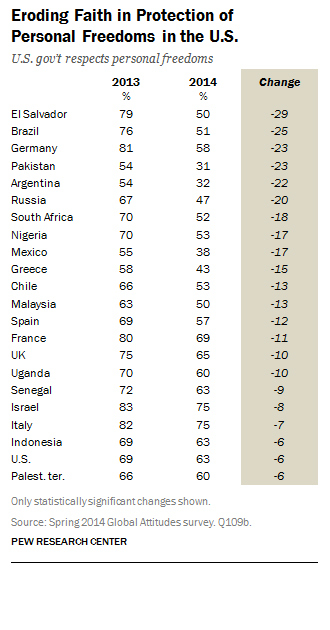
Only 52% of South Africans believe that the USA take the protection of personal freedoms seriously. Overt the past year, the percentage of South Africans who still believe in the American president Barack Obama has dropped by 18 percentage points.

Citizens of other BRICS countries, such as Russians and Brazilians have also become suspicious of US motives, following upon revelations of the National Security Agency’s global spy program, together with civil strife in Ukraine. In Germany, faith in the USA has slumped by a whopping 23 percentage points.

Thanks to a series of global scandals, the United States in general, and its commander-in-chief in particular, have suffered a drop in favorability among the majority of countries polled by Pew Research.

“In 22 of 36 countries surveyed in both 2013 and 2014, people are significantly less likely to believe the US government respects the personal freedoms of its citizens,” the report said.

pew_table1
Spring 2014 Global Attitudes Survey, Pew Research

Among privacy-loving Germans – many of whom have even refused to allow the Google Maps car to film their homes – Obama’s reputation nosedived when it was revealed that the NSA was collecting communication metadata not only on average Germans, but also on Chancellor Angela Merkel, whose personal mobile phone had been hacked by US intelligence.

Germans’ confidence in Obama sunk to 71 percent, 17 points down from 2013.

Tensions between NATO’s two biggest members escalated this month German authorities arrested a Defense Ministry official suspected of passing secrets to the US. This shocking incident came just one week after the arrest of a German intelligence officer who worked as a double agent for the Americans.

German authorities took the unprecedented step of ordering the expulsion of the Berlin CIA station chief.

“Revelations that Washington systematically reads both Americans’ and some foreigners’ emails and listens in on their telephone conversations appears to have significantly damaged Obama’s approval in only one European Union country: Germany,” Pew reported.

Brazilians’ confidence in the first black American leader dropped from 69 percent in 2013 to 52 percent presently.

Brazilian President Dilma Rousseff, who was also the victim of NSA snooping on her personal communications, expressed her anger at those revelations by canceling an official visit to Washington in October.

Finally, Russia, which is watching neighboring Ukraine teeter on the edge of full-blown civil war, sees an American hand provoking the situation behind the scenes, especially after former Ukrainian President Viktor Yanukovich decided against signing as association agreement with the European Union in favor of stronger ties with Moscow.

The decision by sparked a violent showdown in the capital Kiev, which has led to nationwide civil strife that continues today.

“Russian faith in Obama, already quite low in 2013, is down 14 points (to 15 percent), a likely casualty of the Ukraine confrontation,” Pew said.

Meanwhile, America’s once invincible reputation for protecting individual liberties has suffered a major reality check following damning revelations about the extent of NSA surveillance from whistleblower Edward Snowden, presently living in Russia, where he has been granted asylum.

Belief that the US government respects personal freedoms plummeted 25 points in Brazil to 50 percent over the last year; 23 points in Germany to 58 percent; 20 points to 40 percent in Russia; and 11 points to 69 percent in France. Meanwhile, even the United Kingdom, a trusted ally, appears to have experienced a chilling effect by America’s recent naughtiness, dropping 10 points to 65 percent.

US drone strikes have also struck a negative chord among allies and enemies alike, including in NATO member states like Britain, France and Spain. In 37 of 44 surveyed countries, half or more of the public expressed disapproval of drone attacks.

BRICS reach consensus on creating joint development bank

The five BRICS countries have reached a broad consensus on their $100 billion development bank though some differences remain, the Chinese Vice Foreign Minister Li Baodong said on Monday ahead of a summit in Brazil next week to be attended by President Xi Jinping.

The new bank will symbolize the growing influence of emerging economies in the global financial architecture long dominated by the United States and Europe through the International Monetary Fund and the World Bank.

Leaders of Brazil, Russia, India, China and South Africa are expected to sign a treaty to launch the bank officially when they meet at a BRICS summit in the northern Brazilian city of Fortaleza on July 15.

A senior Brazilian government official said in May the five BRICS nations were likely to agree to fund the bank equally, giving them the same rights, Reuters reports.

The new development bank would help cover growing demand for project financing that has not been entirely met by global multilaterals, which, for years, have been heavily criticized for meddling in the domestic policies of sovereign borrowers.

The BRICS also need to decide if the bank will be based in New Delhi, Shanghai, Johannesburg or Moscow. Brazil will not offer headquarters because of upcoming presidential elections that could delay negotiations, the Brazilian official said.

Argentina has been invited to join the sixth BRICS Summit, due to take place in July in the Brazilian city of Fortaleza. The country will join the bloc of major emerging economies, made up of Brazil, Russia, India, China, and South Africa, which jointly account for as much as nearly quarter of the world’s economy.

Russia voiced the news following the recent meeting held between the country’s Foreign Minister Sergei Lavrov and his Argentine counterpart Héctor Timerman, which resulted in signing a joint declaration on the non-proliferation of arms in outer space.

Argentina’s Timerman stressed the “strategic association” between both countries “is based on a common vision about the essence of international relations, values and objectives of common well-being that both nations are building.”

The officials have discussed both the global and regional policies, “assuming that international conflicts have a sustainable solution” if political leaders work toward “the strengthening of a solid multilateral system based in cooperation and mutual collaboration and the non-intervention in states’ domestic affairs through economic, political or military means.”

Timerman, notably, “stressed Argentina’s position against double-standard” messages, referring to Western powers denouncing the referendum recently held in Crimea while the same parties supported the 2012 voting in the Malvinas Islands as their inhabitants reaffirmed their decision to stay British.

Sergei Lavrov said Russian leader Vladimir Putin will likely meet with President Cristina Fernández de Kirchner and other Latin American heads of state during Putin’s upcoming visit to the region.

Source: VoR

BRICS morphing into anti-dollar alliance

Before the crucial visit to Beijing next week, the governor of the Russian Central Bank, Elvira Nabiullina met Vladimir Putin to report on the progress of the upcoming ruble-yuan swap deal with the People’s Bank of China and the Kremlin used the meeting to let the world know about the technical details of its international anti-dollar alliance.

On June 10th, Sergey Glaziev, Putin’s economy advisor published an article outlining the need to establish an international alliance of countries willing to get rid of the dollar in international trade and refrain from using dollars in their currency reserves. The ultimate goal would be to break the Washington’s money printing machine that is feeding its military-industrial complex and giving the US ample possibilities to spread chaos across the globe, fueling the civil wars in Libya, Iraq, Syria and Ukraine. Glaziev’s critics believe that such an alliance would be difficult to establish and that creating a non-dollar-based global financial system would be extremely challenging from a technical point of view. However, in her discussion with Vladimir Putin, the head of the Russian central bank unveiled an elegant technical solution for this problem and left a clear hint regarding the members of the anti-dollar alliance that is being created by the efforts of Moscow and Beijing:

“We’ve done a lot of work on the ruble-yuan swap deal in order to facilitate trade financing. I have a meeting next week in Beijing,” she said casually and then dropped the bomb: “We are discussing with China and our BRICS parters the establishment of a system of multilateral swaps that will allow to transfer resources to one or another country, if needed. A part of the currency reserves can be directed to [the new system].” (source of the quote: Prime news agency)

It seems that the Kremlin chose the all-in-one approach for establishing its anti-dollar alliance. Currency swaps between the BRICS central banks will facilitate trade financing while completely bypassing the dollar. At the same time, the new system will also act as a de facto replacement of the IMF, because it will allow the members of the alliance to direct resources to finance the weaker countries. As an important bonus, derived from this “quasi-IMF” system, the BRICS will use a part (most likely the “dollar part”) of their currency reserves to support it, thus drastically reducing the amount of dollar-based instruments bought by some of the biggest foreign creditors of the US.
Skeptics will surely claim that a BRICS-based anti-dollar alliance will not manage to deprive the dollar of its global reserve currency status. Instead of arguing against this line of thought, it is easier to point out that Washington is doing its best to enlarge the ranks of the enemies of the dollar. Asked by Russia 24 channel to comment on Nabiullina’s statements, Andrei Kostin, the president of the state-owned VTB bank and one of the staunchest supporters of anti-dollar policies, offered an interesting perspective on the situation in Europe:

“I think the work on ruble-yuan swap line will finalized in the nearest future and the way for ruble-yuan settlement will be open. Moreover, we are not the only ones with such initiatives. We know about the statements made by Mr. Noyer, chairman of the Bank of France. As a retaliation for what Americans have done to BNP Paribas, he opined that the trade with China must be done in yuan or euro.”

If the current trend continues, soon the dollar will be abandoned by most of the significant global economies and it will be kicked out of the global trade finance. Washington’s bullying will make even former American allies chose the anti-dollar alliance instead of the existing dollar-based monetary system. The point of no return for the dollar may be much closer than it is generally thought. In fact, the greenback may have already past its point of no return on its way to irrelevance.

Source: VoR