Apartheid is alive and well in Australia

John Pilger
John Pilger

In the late 1960s, I was given an usual assignment by the London Daily Mirror’s editor in chief, Hugh Cudlipp. I was to return to my homeland, Australia, and “discover what lies behind the sunny face”. The Mirror had been an indefatigable campaigner against apartheid in South Africa, where I had reported from behind the “sunny face”. As an Australian, I had been welcomed into this bastion of white supremacy. “We admire you Aussies,” people would say. “You know how to deal with your blacks.”

I was offended, of course, but I also knew that only the Indian Ocean separated the racial attitudes of the two colonial nations. What I was not aware of was how the similarity caused such suffering among the original people of my own country. Growing up, my school books had made clear, to quote one historian: “We are civilised, and they are not”. I remember how a few talented Aboriginal Rugby League players were allowed their glory as long as they never mentioned their people. Eddie Gilbert, the great Aboriginal cricketer, the man who bowled Don Bradman for a duck, was to be prevented from playing again. That was not untypical.

In 1969, I flew to Alice Springs in the red heart of Australia and met Charlie Perkins. At a time when Aboriginal people were not even counted in the census — unlike the sheep — Charlie was only the second Aborigine to get a university degree. He had made good use of this distinction by leading “freedom rides” into racially segregated towns in the outback of New South Wales. He got the idea from the freedom riders who went into the Deep South of the United States.

We hired an old Ford, picked up Charlie’s mother Hetti, an elder of the Aranda people, and headed for what Charlie described as ”hell”. This was Jay Creek, a “native reserve”, where hundreds of Aboriginal people were corralled in conditions I had seen in Africa and India. One outside tap trickled brown; there was no sanitation; the food, or “rations”, was starch and sugar. The children had stick-thin legs and the distended bellies of malnutrition.

What struck me was the number of grieving mothers and grandmothers – bereft at the theft of children by the police and “welfare” authorities who, for years, had taken away those infants with lighter skin. The policy was “assimilation”. Today, this has changed only in name and rationale.

The boys would end up working on white-run farms, the girls as servants in middle-class homes. This was undeclared slave labour. They were known as the Stolen Generation. Hetti Perkins told me that when Charlie was an infant she had kept him tied to her back, and would hide whenever she heard the hoofs of the police horses. “They didn’t get him,” she said, with pride.

In 2008, Prime Minister Kevin Rudd apologised for this crime against humanity. Older Aboriginal people were grateful; they believed that Australia’s first people — the most enduring human presence on earth — might finally receive the justice and recognition they had been denied for 220 years.

What few of them heard was the postscript to Rudd’s apology. “I want to be blunt about this,” he said. “There will be no compensation.” That 100,000 people deeply wronged and scarred by vicious racism – the product of a form of the eugenics movement with its links to fascism — would be given no opportunity to materially restore their lives was shocking, though not surprising. Most governments in Canberra, conservative or Labor, have insinuated that the First Australians are to blame for their suffering and poverty.

When the Labor government in the 1980s promised “full restitution” and land rights, the powerful mining lobby went on the attack, spending millions campaigning on the theme that “the blacks” would “take over your beaches and barbies”. The government capitulated, even though the lie was farcical; Aboriginal people comprise barely three per cent of the Australian population.

Today, Aboriginal children are again being stolen from their families. The bureaucratic words are “removed” for “child protection”. By July 2012, there were 13,299 Aboriginal children in institutions or handed over to white families. Today, the theft of these children is now higher than at any time during the last century. I have interviewed numerous specialists in child care who regard this as a second stolen generation. “Many of the kids never see their mothers and communities again,” Olga Havnen, the author of a report for the Northern Territory government, told me. “In the Northern Territory, $80 million was spent on surveillance and removing kids, and less than $500,000 on supporting these impoverished families. Families are often given no warning and have no idea where their children are being taken. The reason given is neglect — which means poverty. This is destroying Aboriginal culture and is racist. If apartheid South Africa had done this, there would have been an uproar.”

In the town of Wilcannia, New South Wales, the life expectancy of Aborigines is 37 – lower than the Central African Republic, perhaps the poorest country on earth, currently racked by civil war. Wilcannia’s other distinction is that the Cuban government runs a literacy programme there, teaching young Aboriginal children to read and write. This is what the Cubans are famous for – in the world’s poorest countries. Australia is one of the world’s richest countries.

I filmed similar conditions 28 years ago when I made my first film about indigenous Australia, The Secret Country. Vince Forrester, an Aboriginal elder I interviewed then, appears in my new film, Utopia. He guided me through a house in Mutitjulu where 32 people lived, mostly children, many of them suffering from otitis media, an infectious, entirely preventable disease that impairs hearing and speech. “Seventy per cent of the children in this house are partially deaf,” he said. Turning straight to my camera, he said, “Australians, this is what we call an abuse of human rights.”

The majority of Australians are rarely confronted with their nation’s dirtiest secret. In 2009, the respected United Nations Special Rapporteur, Professor James Anaya, witnessed similar conditions and described government “intervention” policies as racist. The then Minister for Indigenous Health, Tony Abbott, told him to “get a life” and stop listening to “the victim brigade”. Abbott is now the prime minister of Australia.

In Western Australia, minerals are being dug up from Aboriginal land and shipped to China for a profit of a billion dollars a week. In this, the richest, “booming” state, the prisons bulge with stricken Aboriginal people, including juveniles whose mothers stand at the prison gates, pleading for their release. The incarceration of black Australians here is eight times that of black South Africans during the last decade of apartheid.

When Nelson Mandela was buried this week, his struggle against apartheid was duly celebrated in Australia, though the irony was missing. Apartheid was defeated largely by a global campaign from which the South African regime never recovered. Similar opprobrium has seldom found its mark in Australia, principally because the Aboriginal population is so small and Australian governments have been successful in dividing and co-opting a disparate leadership with gestures and vacuous promises. That may well be changing. A resistance is growing, yet again, in the Aboriginal heartland, especially among the young. Unlike the US, Canada and New Zealand, which have made treaties with their first people, Australia has offered gestures often wrapped in the law. However, in the 21st century the outside world is starting to pay attention. The specter of Mandela’s South Africa is a warning.

This article first appeared in the London Daily Mirror.

‘East Germany and the ANC shared a special bond’ – Deutsche Welle

Christine Müller
Christine Müller

East Germany and the African National Congress shared a special bond: not only the government, but also the public in the communist state supported the anti-apartheid movement in South Africa.

Heavily armed police forces pushing along black children and teenagers, beating them with clubs, shooting with live ammunition. The disturbing images of the Soweto Uprising shocked the world in June of 1976.

Some 15,000 students in the South African township protested against a new rule that said they’d only be able to take exams in Afrikaans, the language of most white South Africans. They accused the apartheid regime of massively limiting their access to education.

Authorities said 575 people died in the dispute, but the protesters themselves said the number of victims was much higher. Years of unrest followed and led to international protest.

Soweto as catalyst

For Christine Müller from Leipzig, then in communist East Germany, the Soweto uprising was a “defining moment.” She still remembers the effect the pictures had on her. “This rage enveloped me, because I felt so helpless,” Müller told DW. “I thought that we needed to do something immediately.”
Christine Müller

Christine Müller says seeing the pictures from Soweto made her feel ‘helpless’
She researched the topic and looked for fellow supporters. For decades, she worked in church groups that advocated solidarity with the anti-apartheid movement. Today, Müller is the head of the “One World” working group at the Protestant Church of Saxony. For Müller, her involvement is an expression of her Christian faith.
“‘Apartheid’ means exclusion,” she said. “And that’s not just about the victims of racism in South Africa, but more generally about the excluded, who don’t get a piece of the pie when it comes to wealth and power.”

Involuntary union of church and state

East German stamp exalting African wars of liberation

In East Germany, the Protestant church was a main source of political opposition. But the authoritarian government was also involved in the fight against apartheid. That made for an unusual alliance.
The communist leadership in East Berlin described its support for liberation movements as anti-imperialistic solidarity. But East Germany also had pragmatic goals at heart: the government wanted to raise its country’s profile on the world stage. Until the 1970s, it lacked diplomatic ties to western nations because democratic West Germany regarded itself as the only legitimate successor state to the wartime regime. West Germany’s Hallstein Doctrine of 1955 considered it an “unfriendly act” when other countries established diplomatic relations with the East.

Together with the US and Britain, West Germany was among the countries with the strongest ties to the apartheid regime in Pretoria. The West German Protestant church (EKD) was largely mute on the issue. Support for the African National Congress (ANC) and its imprisoned member Nelson Mandela tended to come from leftist groups. That led to angry disputes within the church.

In contrast, the East German government generally regarded any independent social movements as a threat. That didn’t make the anti-apartheid efforts of grassroots groups, or of the East German government, any less worthy, historian Ilona Schleicher said. In the face of the situation in Soweto and other examples of brutal violence against blacks, political persuasion and worldview weren’t of any importance, she said: “Every human being, no matter whether they oppose their state or not, reacts the same to those pictures if they’re really human: with compassion, solidarity and the desire to help.”

Fighting for democracy under communism

But the lack of democracy in East Germany cast a shadow over its anti-apartheid stance, Schleicher said: “They were fighting for something they didn’t have in their own country.” She experienced the anti-apartheid movement as the wife of an East German diplomat in southern Africa. That influenced her stance. “As a working-class child, I grew up with the promises of socialism,” Schleicher told DW. “For me, everything in East Germany looked right. The realization that many things were not in fact right in our country only came to me much later, and also because of the experiences we had abroad.”

On the ground in South Africa, she saw that the liberation fighters didn’t care about who helped them or what their motivation was. “What counted was the actual support.” The ANC profited from East German support in various ways. Instructors and teachers worked in ANC training centers in Tanzania and universities in East Germany accepted black South African students. To make this possible, the official Solidarity Committee collected donations in the population.

When the ANC began using violence against its oppressors in the 1960s, East Germany continued to support it. The Solidarity Committee sent paramilitary equipment including camouflage fabric, binoculars and rubber boats. And instructors trained more than 1,000 resistance fighters in Africa, but also in a secret military camp in the East German village of Teterow.

Apartheid support in West Germany

At the same time in West Germany, companies like Daimler-Benz, Siemens and Deutsche Bank invested in South Africa, and thus provided a form of support to the apartheid regime and its violations of human rights – knowing that they had the West German government on their side.

ANC supporters in the East did experience a crisis of conscience, Müller said: “That was the problem for many of my fellow Christians who said ‘We can’t support our government’s anti-imperialistic politics.'” That’s why she was even happier when the apartheid laws were abandoned in 1990, the year East Germany itself ceased to exist, and in 1994, when Nelson Mandela was elected as the first black president. Müller said that was a nice affirmation for her efforts, even though things are far from perfect in South Africa. – Deutsche Welle

Majority of white South Africans disagree ‘black poverty due to apartheid’

Buried in a recent report from the Institute for Justice and Reconciliation, is an indication that the media and educational inisitutions have largely failed in brainwashing white South Africans about the country’s past. A majority of whites (54,3%) disagree with the statement that “many black South Africans are poor today as a result of apartheid’s legacy”. A significant proportion of whites (37,7%) disagree that “apartheid was a crime against humanity”.

reconciliation_table23

Table 23 summarises youth and adult agreement (across historically defined race groups) with three historical truths about the nature and  legacy of apartheid.

‘Concerning’


According to Kim Wale, author of the 2013 SA Reconciliation Barometer Survey, “It is positive to note that across these three questions South Africans report high agreement with historical truths, but it is concerning to note that white South Africans are much less  likely to agree with the rest of South Africa. Youth are slightly more likely than adults to agree with historical truths by 3–4%. In terms of  the statement that apartheid was a crime against humanity, 76.4% of  South Africans agree, but only 52.8% of white South Africans agree  compared to 70.4% coloured, 77.1% Indian/Asian and 80.9% black South Africans who agree with this statement. In terms of the  statement that the apartheid government wrongly oppressed the  majority of South Africans, about half of white South Africans agree with this statement and almost 40% disagree compared to 72.1% of South Africans who agree and 23.7% who disagree with it.

Black poverty in South Africa

She went on to say: “When South Africans are asked whether they agree that many black South Africans are still poor today because of the lasting effects of apartheid, almost 70% agree that the poverty of the present is linked to the injustice of the past. However, less than half as many white South Africans agree (33.4%) with this statement. White youth are 5.6% more likely than white adults to agree with this statement which provides some hope that the younger generation of white South Africans may recognise the effects of the past on the poverty of the present. This is important as if South Africans do not agree on the connection between economic exclusion and our historical legacy, they are not likely to agree with the need to address that legacy.”

White resistance to affirmative action in South Africa is growing, especially amid widespread reports of government corruption and the ostentatious lifestyle of the country’s politically connected black elite. – praag.org and IJR report

Oprah Winfrey is delusional about racism, white and black

Gregory Kane
Gregory Kane

by Gregory Kane

Ah, the tenets of Libthink, one of which is that anyone opposed to the policies of one President Obama is, by definition, a racist.

A second is that only whites can be racist. Another is that no black person, anywhere, at any time and under any circumstances, can be a racist.

And now, courtesy of none other than Oprah Winfrey, those white racists need to die for America to enter racial Shangri La.

Oprah’s on a tour. She was recently in Great Britain to promote her movie “Lee Daniels’ The Butler.”

A correspondent for the BBC asked her if she felt that racism was the reason some Americans opposed Obama and his policies. Oprah, the one person responsible, more than any other, for Obama being president, of course said yes.

But she said much more than that. Specifically, she said this when asked if the problem of racism in America had been solved:

“Of course the problem [of racism] is not solved. … As long as there are people who still— there’s a whole generation — I say this, you know, I said this, you know, for apartheid, South Africa, I said this for my own, you know, for my own community in the South — there are still generations of people, older people, who were born and bred and marinated in it, in that prejudice and racism, and they just have to die.”

In one quick, thoughtless breath, Oprah added another tenet to Libthink: Not only are all racists white, but they also need to “just die,” every last one of them.

Once all those old, white racists “who were born and bred and marinated in it” have died, then America will be forever purged of racism.

Make that “white racism,” and remember, according to Libthink doctrine, that’s the only racism worth mentioning.

The racism that blacks might hold for non-blacks, that Latinos might hold for non-Latinos and that Asians might hold for non-Asians won’t go away of course, no matter how much adherents of Libthink doctrine might wish it were so.

There will continue to be the attacks that black thugs make against white victims, some of which (if not all) have to be at least partially motivated by race.

That black vs. Latino racist conflict won’t end after all those old white folks “bred and marinated in racism” die.

Said conflict has been going on for years. You might have seen an episode about it on Oprah’s show when it was on the air.

What’s that? You never heard about what happened to Cheryl Green on Oprah’s show? Well, there might be a reason for that.

Oprah, her brain steeped in Libthink as it is, probably didn’t figure this tale of Latino-on-black violence was worth doing a show about.

Green was only 14 years old when a Latino gang member fatally shot her in the Harbor Gateway area of Los Angeles on Dec. 15, 2006.

Four years later, Jonathan Fajardo was found guilty of Green’s murder. He was also found guilty of a hate crime, which means Green’s murder was racially motivated.

This wasn’t a murder carried out by some old, “bred and marinated”-in-racism white person Oprah holds in such disdain. At the time of Green’s murder, Fajardo, a Latino man, was only 18 years old.

So Oprah’s notion that racism is the exclusive worldview of the old and the white appears to be utter nonsense.

In the early 1990s, a Korean-American named Joel Lee was fatally shot on the streets of Baltimore.

Witnesses identified a distinctly not old and distinctly not white African American male as the shooter. At his trial, witnesses also told of the utter hatred he had for Asians.

A predominantly black jury acquitted him. In spite of Oprah’s delusions, racism won’t end once all those old, “bred and marinated in racism” whites die.

Gregory Kane, a Washington Examiner columnist, is a Pulitzer Prize-nominated news and opinion journalist who has covered people and politics from Baltimore to the Sudan.

First published in the Washington Examiner.

Criticism of police a security threat

MK soldiers parading under images of Mandela and Mbeki

Attacking the police’s crime intelligence division threatens the country’s security, the Umkhonto we Sizwe Military Veterans’ Association said on Monday.

“The various allegations levelled at the leadership of crime intelligence division… and the clear turf battles seeming to be raging… is a threat to the security, peace and stability of our country,” MKMVA chairman Kebby Maphatsoe told reporters in Johannesburg.

He said generals and colonels who served in the apartheid-era security intelligence had retired at the dawn of democracy and established private intelligence institutions.

“These are trained people…. Those generals are paraded as experts on crime fighting and have the audacity to regularly bash the SA Police Service, especially its crime intelligence division.”

He said civil society had been against the establishment of a crime intelligence unit, and was intent on discrediting the police.

He singled out former crime intelligence head Richard Mdluli as an example of this.

“Civil society has been against him returning to perform his duty as a policeman. It is dangerous. We will wake up one morning to an uprising and question why did it go about without being detected.” – Sapa

Coloured ANC leader wants to honour assassin Tsafendas

Christian Martins, MPL for the Eastern Cape

A request has been made to declare the graves of Hendrik Verwoerd and his assassin Dimitri Tsafendas national heritage sites.

The request came from ANC Eastern Cape MPL Christian Martins in a letter to the National Heritage Council of SA, released to the media on Monday.

Martins argues in the letter that South Africa’s history would be incomplete without Verwoerd, referred to as the “architect of apartheid”.

Verwoerd served as South Africa’s prime minister from September 2, 1958 to September 6, 1966, when he was stabbed by Tsafendas in the then House of Assembly in Parliament.

“Dimitri Tsafendas and Hendrik Verwoerd arguably changed the course of post-war South African history more than any other, when Tsafendas stabbed to death the ‘architect of apartheid’,” said Martins.

Martins said that while Tsafendas was declared unfit to stand trial due to insanity, research showed Tsafendas knew what he was doing and planned the assassination well in advance.

“And further research clearly shows that this act of Tsafendas was politically motivated, aggravated by the heinous racial prejudices that Verwoerd exploited to try to entrench white rule on the subcontinent.”

It was Martin’s opinion that rather than forgetting these important role-players in the country’s history, homage should be bestowed upon Tsafendas, a hero and martyr for the cause of the South African people.

“The assassination of Verwoerd was our exodus from the policies, laws and by-laws articulated and crafted by Verwoerd,” he said.

“Verwoerd inculcated in South Africans a belief that those who opposed apartheid or criticised it either misunderstood the policy or were dangerous communists.”

This led to violence which drove black leaders into exile and quenched internal opposition, giving birth to a form of leadership within many mass movements that saw South Africa transformed to democracy.

“Shared opposition and shared passion for apartheid shaped South Africa and for that we have to honour and remember the oppressed and the oppressor, the villain and the hero,” said Martins.

Martins was punished by the Eastern Cape legislature’s ethics committee in September for referring to the Democratic Alliance as peacocks in October last year.

He was penalised one months salary and suspended from participating in the activities of the legislature for 30 days from October 1. – Sapa

Red October an eye opener to me as Briton

The Red October protest on 10 October 2013

by Claire Smith

I went on my first protest march yesterday – another item checked on the ‘things everyone should do before they die’ list. I attended the Red October march. According to the media reports on the march I must have turned into a right wing, fascist, Nazi, apartheid supporting crazy since I moved here. That’s not true. I was brought up in London, one of the most diverse cities on the face of the planet and I marvel at the fantastic range of cultures that this earth plays host to. Anyone who knows me knows that I don’t give a flying monkeys whether you are white, black or green with sky blue polka dots – AND THAT HAS NOT CHANGED.

I also don’t recognise the caricature of the protest that was presented by the media – maybe I’m mistaken and I turned up at a different protest….

I have to say, I was hesitant at turning up yesterday. I was worried that this event would be hijacked by racist groups looking for a publicity opportunity. I was worried that the message of Red October would be kidnapped.

I was pleasantly surprised by what I experienced; the protesters in Pretoria were respectful but wanted to get their point heard. I, personally, heard no bigoted racism, no derogatory name calling or incitement to violence. I saw people who were sick and tired of the fear that crime causes in this country – people who were saying enough is enough. I identified with the Red October cause after reading the content of the letter sent to the Presidency setting out the reasons for the protest:

  1.  Urgent attention to the lack of security on South African farms and the lack of attention to farm murders in general
  2.  Urgent attention to the continuing violence against women
  3.  Urgent attention to police action regarding murder and crimes committed against the people of South Africa by foreigners streaming across our borders
  4.  Urgent attention to the lack of quality education for all our children, respecting their culture, language, religion and heritage
  5. Urgent attention to the lack of service delivery, the preservation of our natural water resources and the lack of control over the theft of electricity
  6. Urgent attention to the legal processes and lack of justice with regard to the detaining of prisoners without proper due course
  7. Urgent attention to expedient trials and harsher sentences of criminals found guilty of violent crime, i.e. murder and rape

Nothing racist in that lot – no calls for return to apartheid, no we’re better than you, no bigoted name calling, no incitement to violence, no mention that this should be limited to white people in any way, shape or form!

But when the protest was reported in the media it was characterised as a bunch of Afrikaners demanding special treatment over anyone else, making outlandish, untrue statements and generally being a bit racist. It was an eye opening experience of selective reporting and has taught me the lesson that the ‘news’ is actually about 99% opinion and spin and the remaining space left to fact is filled by cherry-picked information to back up the preconceptions of the person and/or agency presenting the story.

So, let’s answer the criticisms leveled at Red October.

In 2009 white people represented 1.8% of murder victims, but make up 8% of the population.

By this statement E news is trying to indicate that white people, especially Afrikaners, are not victimized and are, in fact, nice and safe and complaining about nothing. Anyone fearing ‘white genocide’ is clearly a delusional fantasist.

Up until this point, any figures quoted by groups worried about the degree of violence focused on white populations were discredited as the South African Police Service does not routinely collect data on the ethnicity of victims and perpetrators of murder. Obviously that doesn’t make nice convincing TV news, so E has gone through the archives until they found a 4 year old statistic gathering dust in a corner. Want to disprove groups who spend an awful lot of effort trying to document murder rates through the devotion of their time to collating anecdotal reporting? Then where is your carefully researched analysis of murder over the past 19 years? Where is your statistical analysis of last year’s crime statistics that were released last month? Where is your evidence of the reliability of your single snapshot statistic from 2009?

So, let’s leave statistics aside – as Benjamin Disraeli reportedly said: “There are three kinds of lies: lies, damned lies, and statistics.”

What is verifiable is the horrific brutality and savagery of farm murders in South Africa; if you have a strong stomach, Google it. Torture, rape, murder and mutilation are a legitimate and reasonable part of robbery or a wage dispute? I didn’t think so.

This march is ridiculous as it only focusses on crime against white people

I refer you back to the motivation for the protest above. This was against all crime, all murder, all rape, all violent attacks. No one in this country should have to live in fear. Yes, the focus shifted towards white victims of brutal farm attacks, but these were the people who could be bothered to get off their backsides and make a stand.

If all those who criticised the march on that basis stood up and arranged a protest against the complete lack of control that the ANC government has over crime in this country, then we’d attend that one too. But you haven’t, so we can’t.

The additional demand to scrap racial quotas such as Affirmative Action, Black Economic Empowerment, etc, etc, proves that Red October is a front for racists who wish to return to apartheid.

It has escaped reporting, but organisers and speakers took great pains to point out that this is by no means a call to return to apartheid and that the system was fundamentally wrong.

All forms of discrimination are fundamentally wrong. None of them are positive. The ANC, however, insist on applying racial quotas and conditions on all areas of commerce and employment. How will it ever be fair that someone has to hand over large percentages of the business that they have worked hard to establish and make successful, just due to their skin colour?

The motivation for this protest also highlights the issue of education, asking for quality education for ALL children in this country. The ANC has had 19 years to focus on education, ensuring that every person can compete for jobs based on their abilities and qualifications rather than the melanin content of their skin. They have failed spectacularly – the government can’t even get textbooks into schools for the start of the school year! In order to cover for their incompetence and lack of motivation in this area, they impose employment quotas to give a thin veneer of success.

In the face of a difficult and hostile job market, many white families have had to rely on their entrepreneurial abilities to make a living. If you can’t get a job, you have to work for yourself in order to survive. The new focus of the government has now been to attack white ownership of business, to demand that anyone who has worked hard to establish a successful, profitable company now hands over a percentage of what they built up to black ownership.

There is one group determined to keep race a flashpoint in South Africa and that is the ANC. The ANC are just as obsessed with race as apartheid was, possibly more so.

As the title of this piece indicated, this experience has been a real eye opener. Caricatures mindlessly spouted by the media are being used unfairly to silence people’s concerns. I guess there are none so blind as those that refuse to see, and deaf as those that refuse to hear.

From a Brit living in South Africa – Claire Smith

‘Blaming apartheid, race does not wash anymore’

Matthews Phosa
Mathews Phosa

It is time for government to shape the country’s future decisively and stop blaming the past, former ANC treasurer-general Mathews Phosa said on Tuesday.

“We are… a government, and placing the blame on the past, apartheid, race, and other external factors does not wash anymore. It is time for solutions of which we are the architects and it is time to shape our future decisively,” Phosa said in a speech prepared for delivery at the Ahmed Kathrada Foundation conference in Johannesburg.

“Let us begin by making sure that every rand of public money that is spent makes a tangible impact on development and upliftment of our people.”

Corruption and non-service delivery were serious concerns.

“If we fail to address the income gap and alleviate poverty, we will have other consequences. Ours will be a perpetually volatile society, open to flare-ups from time to time, and growing disenchantment among the voters with those they have voted into power.”

Phosa said many in the ruling African National Congress had faced charges of corruption and had brought the party into disrepute in “a devastating and shocking fashion.”

“It has never been ANC policy for anyone to steal public money. Anyone doing that satisfies his or her own greed at the expense of the nation, and to the lasting detriment of a party that commanded the respect of the entire globe.”

The corruption scourge would lead to the decline of the ANC and ultimately render its history “meaningless”.

“If we want to avoid being consigned to the dustbin of history, we must be demonstrably more decisive, more transparent and totally unforgiving in how we deal with those who steal public money, or abuse positions of trust,” said Phosa. – Sapa

Let us be!

Eugene Marais
Eugène Marais

by Albert Brenner

[followbutton username=’albertbrenner1′ count=’true’ lang=’en’ theme=’light’]

I have been asked many times to write a column about Afrikaner identity. It`s a task I have always dreaded, for it will need to also involve examining questions like: can an atheist be an Afrikaner? Similarly, can an English-speaking white South African be an Afrikaner? Can Afrikaner political parties not supporting self-determination still be called “Afrikaner”? Or even: can non-whites be Afrikaners? Any honest elucidation of (the) Afrikaner identity must also include the less savoury aspects of said people. But then; nobody is perfect. That said, here goes…

Afrikaner identity, like all others, is comprised of three distinct, yet intimately intertwined aspects: the individual, the collective and the nation.

The individual sustains the collective which, in turn, sustains the nation… and vice versa. Meaning that it is the primary responsibility of the individual to contribute to the collective in such a way that his/her collective – in this case, the Afrikaner collective – takes precedence over all other collectives. The collective is comprised of various sub-collectives. For example, (the individual) Naas Botha – the famous ex-Springbok rugby player – has recently stated that he is in favour of race-quotas in rugby. This means that he, as an individual, does not support the Afrikaner sub-collective (Afrikaner rugby players, in this case), ergo, he is not sustaining the collective. Hence, he is a “South African”, not an Afrikaner. This obviously also applies to individuals like Dr Piet Croucamp, Fransie Cronje, Tim du Plessis, Anton van Niekerk, etc.

Moving to the collective/s; aforesaid has the primary responsibility to sustain the interests of the individual, be it as welfare organisation, church, academic institution, etc. For example, Stellenbosch University (as a collective) supports discrimination against Afrikaner students. This means it is not Afrikaner anymore… it is “South African”.

Moving to the nation; if a sub-collective is primarily involved in politics (e.g. the Freedom Front political party) its main responsibility is to strive for nationhood. The aforesaid can only be sustained if it dominates physical territory. It is possible to be a people (i.e. a collective) without physical territory. But one only has to look at the history of the Jewish People – arguably the most successful in terms of survival – in order to realise that dominance over a physical territory is the only sure-fire guarantee of/for progressive survival. This means that the (traditionally Afrikaner) Freedom Front party is not Afrikaner anymore, because it has forsaken its primary responsibility… self-determination in/on a physical territory dominated by Afrikaners.

To the tricky questions; e.g. can an atheist be an Afrikaner? Yes, but only if s/he sustains the “default” of the collective which, in the case of the Afrikaner (identity), is Christian. Meaning that as long as atheists put the well-being of the Christian Afrikaner collective above their individual well-being as atheists, they can be 100% Afrikaners. Ditto for English-speaking white South Africans – or any other white person, for that matter – in terms of language. Afrikaans is, and therefore must stay, the default. The same could be said for non-whites wanting to be Afrikaners. But this, in itself, would be self-contradictory and, ultimately, irrational. For in order to sustain the Afrikaner default identity (which is white, in terms of race), non-whites would have to forsake any and all attempts at demographic dominance.

The above-explained dynamics are also being played out in traditional Western countries with, hitherto, distinct identities. Just think about the American identity when, in 2060, white English-speaking (and mostly Christian) “Americans” will be demographically swamped by Spanish-speaking Hispanics. In short; (the) American identity will no longer be “American”.

To the specifics of (the) Afrikaner identity; we are the most inherently pharmaconian people on the planet. I derived the adjective pharmaconian from the Greek root pharmacon… meaning to heal or to kill. Afrikaners like to fight and to heal. We make the best soldiers and the best doctors. We, as a people, are absolutely unique in this regard! In terms of the former, there is no need to blow our own trumpet – others do it for us, with aplomb…

The Americans fight for a free world. The English mostly for honor glory and medals. The French and Canadians decide too late that they have to participate. The Italians are too scared to fight. The Russians have no choice. The Germans for the Fatherland. The Boers? Those sons of bitches fight for the hell of it! – American General George “Guts and Glory” Patton

Give me 20 divisions American soldiers and I will beach Europe. Give me 15 consisting of Englishmen, and I will advance to the borders of Berlin. Give me two divisions of those marvellous fighting Boers and I will remove Germany from the face of the earth. – Field Marshall Bernard L. Montgomery (Commander Allied forces WWII)

It is therefore no wonder that we love rugby so much. It has become a substitute for our warrior-like psyche. An opium, unfortunately.

In terms of our passion for healing, we can only look at incredible doctors like Christiaan Barnard, or the fact that we had one of the very few defence forces in the world with a separate medical services arm. This pharmaconian essence of the Afrikaner also has its drawbacks. In terms of liking to fight; we tend toward bullying behaviour, especially because of our big physical size – inherited from the Dutch. This bad characteristic has always necessitated a very strong (mostly patriarchal) hierarchy… to keep the boys in line, so to speak.

The above characteristic was, in my opinion, the main reason why nearly the whole Afrikaner society collapsed after 1994, for when our leaders jumped ship, all the power structures collapsed like a house of cards. The main bullies then turned on their own people, selling them out like flies at the TRC, and in nearly every Afrikaner sphere imaginable. This thuggish behaviour is (now) exemplified by people like Piet Croucamp, Max du Preez, Pik Botha, Anton Van Niekerk, Pierre de Vos, etc.

Our passion for healing was, in my opinion, also the main motor behind the majority Yes vote in the referendum in 1992. Many Afrikaners thought that being “nice” (like e.g. the Swedes) was the only way out of all the fighting. I.e. many Afrikaners wanted to “heal” the bad relationship they had with blacks. The only problem is that this innate propensity to heal is not suited for African conditions… for here the Rule of the Jungle is still very much prevalent. And hell, what do the Swedes know about Africa in any case?!

Be that as it may; we share identity characteristics with other people that are also unique. We, like the Bushman, are in awe of Nature. No wonder the Afrikaners and the Bushmen get along so well, especially during the Angolan War. We established nature reserves long before it became cool to like the natural environment. Unlike our European peers, our art and literature is mainly devoted to the admiration of nature in connection with existential deliberations, e.g. Eugène N. Marais`s Die siel van die mier. (Eng title: The soul of the ant.)

We, as a people, prefer to spend every free minute in nature, be it camping, hunting, or visiting game/nature reserves. This also has its drawbacks. You`d hardly see an Afrikaner family going to a museum or art gallery on the weekend. This has, unfortunately, seen us lag behind our European peers.in terms of sustained “intellectuality”. But then, we live in the most beautiful country in the world… and we have been forced to fight for our continued survival as a unique people ever since we landed here 350 years ago.

Last, but definitely not least; if it were up to me, I’d change the word history to herstory when it comes to summarising the history of the Afrikaner, for the Afrikaner woman is the most unique woman on the planet. They know exactly what they want, and will go through hell and high water to get it… even if it means whipping their men all the way there.

In conclusion: I think that, given our absolutely unique pharmaconian character, the identity of the Afrikaner can best be summed up in the (moral) imperative of the German philosopher Martin Heidegger; sein lassen.

This idea/l, letting be, is a battle-cry to consciously demand and strive for an independent Lebensraum for yourself, as a unique people… as well as for all other things unique, be it other people, races, cultures, beliefs, or nature herself. Even during Apartheid, warped as it was, the Afrikaner promoted the independence of the various unique black peoples of South Africa. It is certainly not the Afrikaner’s fault that the latter did not stay true to their own identities… something they now yearn for with all their (identity-less) soul.

A discussion about the difference between the Boer and the Afrikaner is conspicuous by its absence in this column. In my opinion, the Boer is just a much hardier version of the Afrikaner – true grit… best summed up by Sir Arthur Conan Doyle.

Take a community of Dutchman of the type of those who defended themselves for fifty years against all the power of Spain at a time when Spain was the greatest power in the world.Intermix with them a strain of those inflexible French Huguenots, who gave up their name and left their country forever at the time of the revocation of the Edict of Nantes. The product must obviously be one of the most rugged, virile, unconquerable races ever seen upon the face of the earth. Take these formidable people and train them for seven generations in constant warfare against savage men and ferocious beasts, in circumstances in which no weakling could survive; place them so that they acquire skill with weapons and in horsemanship, give them a country which is immanently suited to the tactics of the huntsman, the marksman and the rider. Then, finally, put a fine temper upon their military qualities by a dour fatalistic Old Testament religion and an ardent and consuming patriotism.Combine all these qualities and all these impulses in one individual and you have the modern Boer.

That said; the very survival of the Afrikaner is now at stake. At the heart of this war is the battle for his identity. It is now up to the Afrikaner to decide his own fate… for letting others be definitely does not imply forsaking your own right to be!

[followbutton username=’albertbrenner1′ count=’true’ lang=’en’ theme=’light’]

Beware the Black Borg!

Borg Art  Pic

by Albert Brenner

[followbutton username=’albertbrenner1′ count=’true’ lang=’en’ theme=’light’]

The greatest bogeyman ever conjured up in order to keep rebellious white South Africans in line, comes in the form of an amorphous, same-thinking, same-feeling, black entity. This all-dominant Jungian (archetypal) mass of collective agency was reinvigorated by the half-wit CEO of the South African Institute of Race Relations (SAIRR), Fransie Cronjé, in a Rapport (read Naspers Pravda) column last weekend.

According to Fransie, whites in Mandelatopia must stop rebelling against their de facto enslavement forthwith, lest blacks destroy them utterly in a “second revolution”. In short – in line with the finest Stockholm Syndrome diagnosis – Fransie is screaming; “Keep quiet, otherwise they will kill us!”.

Now the thing is just whether the little bald pseudo-intellectual shyster is actually dim-witted or just plain ignorant. For he neither knows or represents white South Africans, nor does he know or represent black South Africans. Yet he presumes to do both, in public!

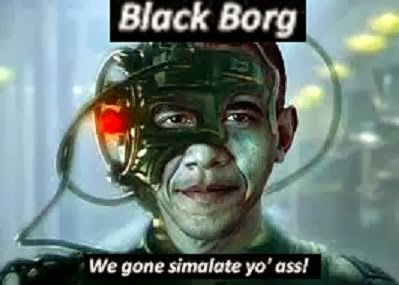
The simple fact is that this amorphous collective black entity that he so dreads, simply does not exist. It is simply another bogeyman created by the MSM and Hollywood – an entity akin to the Borg in the science-fiction series Star Trek. The former fictional being – written in the singular because they all share the same consciousness, and conscience – is famous for their (dreaded) command; “This is the Borg. We`ll assimilate you now. Resistance is futile”!

All fiction, all guano… in the real world. Never in recorded history has there been absolute hegemony among Africans – and, especially not in South Africa. The various black groupings – mostly tribal, in nature – were at each others throat before Apartheid, during Apartheid, and even now… after Apartheid.

To even think that all blacks share the exact same thoughts, feelings, moral sentiments, et cetera, – just because they share the same skin colour – is not only incredibly naive, it is also downright patronising and racist. In short; there is no absolute hegemony among the other races; so why should blacks be different in this regard?!

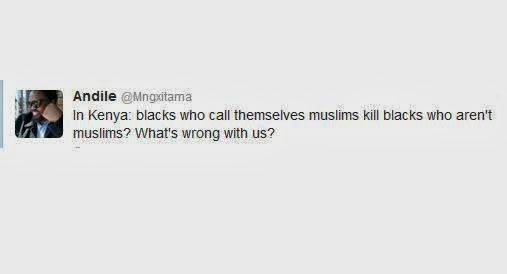
It therefore beggars belief when even (self-appointed) black intellectuals, like the awfully trite Hegel-emulating “Bikoist”, Andile Mngxitama, throw tantrums when blacks – wherever they may find themselves in space and time – do not act as “one” (see picture below).

andilem

Be that as it may; the “Black Borg” myth is only topped by its inverse, the myth of the Noble Savage. The latter, a neo-Romantic Rousseauian-regurgitating MSM/Hollywood creation, sees all blacks as inherently cherubic beings who only want the best for humanity, the universe… and the environment, of course. All little Mandela`s in heart, soul and suffering… all “one” in their eternal victimhood at the hands of the White Devil.

It is, frankly, beyond belief that even blacks themselves ascribe to this sickening denigration of their very being. I mean honestly, how can they acquiesce to a perception that only allows them collective agency, and not individual agency? But then, hey; they have been baby-sat for so long by bleeding-heart White Guilt-driven liberals that they, blacks, have left it up to others, like little lentil Fransie, to speak on their behalf.

Whatever the moral weather on that one; it is a fact that blacks have never, and will never, act as “one”. And the threat by the SAIRR vegetable, Fransie, that disillusioned (`”bitter”) whites will cause the Black Borg to suddenly appear from the Delta-quadrant wormhole just because they, the whites, are justifiably recalcitrant, is equally preposterous. Nothing, in the context of Mandelatopia, illustrates this more succinctly than the transition period to black rule in the early 90s.

During this time, the blacks did not rise up as “one” to take revenge on their Tutu-myth Holocaust oppressors, the whites. On the contrary; once the blacks realised that FW (fuck-wit) De Klerk was just going to hand over the whole caboodle, they went straight for each other’s throats…to get at the loot first.

Near-civil war circumstances prevailed as the Zulus of Buthulezi’s IFP fought the (mostly Xhosa) ANC of Mandela. More than 16 000 blacks died during that period. Hardly any whites were harmed, except for the cowardly APLA attacks on the St George’s Pub and the Roseview Church.

In her brilliant bookThe People’s War, Anthea Jeffery painstakingly researched the true facts behind the so-called “liberation struggle”. Her findings illustrate, beyond any doubt, how blacks used fellow blacks as a mere means to an end. It is an indisputable fact that the vast majority of blacks in South Africa were coerced, by threat of physical violence, to partake in Joe Slovo’s callous revolution.

  • `”the ANC had little compunction about attacking black civilians, including its own supporters, for the formula for people’s war draws no distinction between combatants and others and regards all civilians (irrespective of their political affiliation) as expendable in conflict;
  • the ANC had a motive to unleash violence, for it wanted to create enough mayhem and unrest either to spark an insurrection or to weaken its opponents to the point where it could triumph in negotiations;
  • the ANC had the means to unleash violence, for the peace process allowed it to bring back into South Africa some 13 000 armed and trained combatants whom it then refused to disarm or disband; and
  • the ANC was the only organisation to draw benefit from the 15 000 political killings that took place in the early 1990s (after all major apartheid laws had been repealed), for it used these to;
  1. stigmatise De Klerk and the IFP,
  2. stampede negotiators into giving it what Joe Slovo called ‘a famous victory’ in negotiations, and
  3. put great pressure on the first all-race election, while making it unthinkable for anyone to demand a re-run of the deeply flawed April 1994 poll in which it was accorded (no accurate count being possible) some 63% of the vote.” (source)

The above-quoted just illustrates, once more, that Fransie is as dumb as mud… especially given the fact that Dr Jeffery is his chief researcher at the SAIRR!

Hell, one does not even need to read a single book to understand that blacks are not “one”. Just look at the dismal moral state of all post-colonial sub-Saharan countries. The chief “liberator” and his inner circle have always enriched themselves shamelessly, at the expense of their own people.

In Mandelatopia, Mandela, like his cronies Sexwale, Zuma, Ramaphosa, et cetera, are drowning in money, while the vast majority of their fellow blacks are suffering under extreme poverty. It suffices to say that they, the former, couldn’t`t give a continental damn. There is no “oneness”, no ubuntu, no Noble Savage and no Black Borg. Period!

That a “second revolution” will take place in Mandelatopia is a fact. But it will not be because whites are standing up for their rights. It will be because blacks will revolt against their own leaders because of the broken promises of the past 20 years of typically-African mis-governing. That whites will bear the brunt of the coming (inevitable) revolution is obvious, because they (still) have those things that the black leaders promised their black sheeple, but failed to deliver… as always.

It is thus abundantly clear that the motive behind Fransie`s reinvigoration of the Black Borg myth is everything but noble, in the sense of heroically”saving” the enslaved backsides of whites in Mandelatopia.

For you see, for Fransie – as one of the main Afrikaner H-G men in Mandelatopia – it is all about keeping his ill-earned privileges and prestige. Had the playing-field with his white peers been level, half-wits like Fransie, Piet Croucamp, JP Landman, Tim du Plessis, Pierre de Vos, etc. would never have reached the level they have attained now.

But then; Fransie`s DNA is coward-based. His survival instincts and skills were honed in his dad’s nutsack… where he used to cower in the most remote corner because he was the lesser of 60 million. Now he is still cowering, in front of 60 million blacks. But that is his saving grace, his claim to fame. For unlike the one million whites who were forced to emigrate in order to seek employment, Fransie is in league with the new Master of South Africa. He is a made-man!

So the next time Fransie screams at you, as a white South African, to shut the fcuk up and continue paying unquestioningly for the `”sins of your forefathers”, just think of the picture below.

frans

Five factors that will shape SA’s future: FW de Klerk

FW de Klerk
FW de Klerk

Former President says country continues to present an anomalous picture to the world

SPEECH BY FORMER PRESIDENT FW DE KLERK FOXHILLS RESORT, ENGLAND, September 13 2013

SOUTH AFRICA: PAST, PRESENT AND FUTURE

I should like to talk about South Africa: our past, our present and our future -­‐ about

  • where we have come from since the 1980s;
  • where we now find ourselves; and
  • where we are going.

It is especially appropriate to do so now -­‐  because I can recall no time since 1994 when so many South Africans have been so despondent.

We should remember 1994 -­‐ not only because it was the birth  of  our  new  society -­‐  but because it provides an important reminder  that  we  South  Africans  have  the  ability  to  solve even  the  most  intractable  problems.

It is easy to forget now how desperate our situation was in the mid-­1980s:

  • Our efforts to reform apartheid -­‐ including the scrapping of more than 100 apartheid laws and the introductions of the tricameral parliament had simply redoubled demands for “one-­‐man, one vote”;
  • We were beset with internal unrest and increasingly violent protests;
  • Scenes of chaos and  insurrection  in our streets dominated  TV  screens throughout the world;
  • After the Rubicon speech the rand had plummeted through the floor;
  • Unsure  of  the  government’s  ability  to  control  the  situation,  international  banks  had pulled the plug on us by refusing to roll over our short-­‐term debt;
  • Demands for comprehensive economic sanctions were reaching crescendo pitch;
  • Our armed forces were confronting increasing attacks on our borders and the borders of Namibia -­‐ attacks that were supported by 50 000 Cuban troops.

There were no signs of light on the dark and stormy horizon.

And yet -­‐  by 1990 -­‐  we had clawed our way back from the precipice.

The victory of our forces at the battle of the Lomba River in September 1987 had finally convinced the  Soviets, the Cubans  and the Angolans that there  was no  prospect of a military victory.

  • The  following  year  we  began  negotiations  on  the  withdrawal  of  Cuban  forces  from Angola and the parallel implementation of the UN independence process in Namibia;
  • Also by 1987 the ANC had accepted that there would not be a revolutionary outcome in South Africa and that the only path to the future lay through negotiations;
  • The successful independence process in Namibia in 1989 showed that it was possible to negotiate successful outcomes with enemies;
  • Finally,  the  collapse  of  the  Soviet  Union -­‐   symbolized  by  the  fall  of  the  Berlin  Wall  in November, 1989 -­‐  signaled the arrival of an entirely new global paradigm.

By the beginning of 1990 these events had opened a historic window of opportunity for a peaceful and negotiated settlement. We did not hesitate. We jumped through -­‐ and after almost four years of roller-­‐coaster negotiations we were able to reach a national accord on our future.

It was our proudest moment.

Our 1993 and 1996 constitutions were the outcome of the genuine give and take process inherent in all negotiations. The final agreement was at least as close to original negotiating positions of the non-­‐ANC parties as it was to that of the ANC.

It contains all the basic rights that we need to maintain a free and prosperous society.

It  articulates  the  values  of  human  dignity,  equality,  fundamental  rights  and  non-­‐ discrimination on which the new South Africa has been established.

It acknowledges the supremacy of the Constitution and the rule of law.

It  makes  provision  for  all  the  institutions  and  mechanisms  that  are  necessary  for multiparty democracy based on accountability, openness and responsiveness.

It has served us well for the past 19 years. Which brings me to the present.

It is important to remember the many, many successes that we have achieved since 1994 -­‐ many of them as a result of government action:

  • We have experienced 19 years of economic growth -­‐  interrupted only briefly by the global  economic  crisis  of  2008.
  • The regulation of our security exchanges and our reporting standards are the best in the world;
  • Our banks are the second soundest in the world and our corporate boards are the second most efficacious. Our financial services and protection of minority shareholders are third best in the world and our ability to finance local equity is the fourth best internationally.
  • We are one of the primary gateways to Africa -­‐  and are now the fifth largest investor in the   continent.

We have also made significant social progress:

  • The  percentage  of  the  population  living  in  absolute  poverty  has  declined  to  less  than 20% -­‐  largely because of social grants.
  • More than three million housing units have been built -­‐  enough to house almost a quarter of the population -­‐  with another million units in the pipeline;
  • More than three quarters of the population now have access to electricity, drinkable water and sanitation
  • We have experienced moments -­‐  like the 2010 Soccer World Cup -­‐  when we have lived up  to  Archbishop  Tutu’s  characterization  of us  as  the  Rainbow  Nation  of  God;
  • We have seen the rapid growth of new and self-­‐confident black middle class. Whites now comprise less than 40% of the top decile of income earners.

At the same time we are beset by serious problems. One can hardly disagree with  the diagnosis of the National Planning Commission regarding  the  nature  of  these  challenges. They include:

  • High unemployment -­‐  closer to 40% than the official figure of 25,6%;
  • Poor education -­‐  especially for black South Africans -­‐  who fare badly in comparative tests with  children  from  the  poorest  African  countries;
  • Poor public service delivery -­‐  which has led to virtually daily protests throughout the country;
  • rising levels of corruption; and
  • the fact that South Africa is still a divided society.

Another growing problem is the increasingly destructive role that is being played  by  our militant trade unions. It is one of the main causes of unemployment and of our failure to attract the foreign investment that we need for sustained economic growth:

  • South Africa has the worst labour relations in the world. According to the World Economic Forum’s Global Competitiveness Report it is the worst of 144 countries assessed in terms of co-­‐operation in labour-­‐employer relations;
  • COSATU has continuously raised labour costs without  commensurate  productivity increases -­‐ which has inevitably resulted in job losses. South Africa’s flexibility of wage determination is the fourth worst in the world.
  • Our labour legislation is amongst the most onerous anywhere. South Africa’s hiring and firing practices are the second worst in the world.
  • COSATU’s campaign to abolish labour brokers would lead to the loss of more than half a million jobs.
  • COSATU has steadfastly opposed proposals to open labour markets to the unemployed.
  • It   is   destroying   jobs   by   alienating   foreign   and   domestic   investors   through   its confrontational stance and open support for nationalisation.
  • On top of all this came the Marikana massacre of 16 August last year; the subsequent wave of violent and uncontrolled wildcat strikes and hopelessly unrealistic wage demands. All this has been compounded by the precipitate fall of the rand against the US dollar.

So South Africa continues to present an anomalous picture to the world:

  • on  the  one  hand  a  picture  of  failing  governance;  out  of  control  trade  unions;  rising corruption and daily service delivery protests -­‐ and
  • on  the   other  hand,  a  picture   of  economic   dynamism,  enormous  opportunities  and  a counter-­‐intuitive sense of optimism -­‐  particularly in bustling Johannesburg.

But what of the future?

Predicting the future is one of the most risky of all endeavours -­‐ since we live in such rapidly changing times. Nevertheless one can identify some of the  salient  factors  that  will undoubtedly influence the course of events:

  • Whatever happens in South Africa will take place within the framework of macro-­‐ developments on the global stage -­‐ just as they have always done in the past;
  • Secondly, current developments within the ANC’s ruling alliance will play a key role. The question is whether the leadership will be able to hold together an alliance which now encompasses the whole spectrum
    • from Stalinism to social democracy;
    • from exclusive black nationalism to inclusive non-­‐racialism;
    • from  genuine  commitment  to  sound  governance  to  pervasive  crony  capitalism and entrenched kleptocracy?
  • Will the ANC be able to continue to plaster over these increasing obvious cracks   -­‐  or will it  split?
  • Thirdly, will it be possible to moderate the behavior of our rampant and wildly irresponsible trade unions?
  • Fourthly, will the government break away from its race-­‐based ideology and accept the idea that the skills of all South Africans must be used to enable the country to address its problems and achieve its potential?
  • Finally, a critical factor will be our ability to maintain the excellent Constitution that we South Africans negotiated between 1990 and 1996 and the institutions that it mandates including
  • free and impartial courts;
  • an independent National Prosecuting Authority; and
  • government that is accountable, transparent and responsive.

So, these are the factors that will play significant roles in determining our future:

  • What will happen on the global stage?
  • What will happen within the ANC Alliance?
  • Will we be able to control the trade unions?
  • Will we be able to liberate ourselves from race-­‐based ideologies? And,
  • Will we be able to uphold our Constitution and achieve the vision that it articulates?

Personally,  I  remain  an  optimist -­‐  and  believe  that  we  shall  be  able  to  surmount  the challenges that confront us now -­‐ just as we were able to overcome the  much  greater problems that we  faced  25  years ago.

Issued by the FW de Klerk Foundation, September 16 2013

Master and slave

mandeladeklerk

by Albert Brenner

It is always so amusing to witness the blatant hypocrisy on display when (the) Slave becomes Master. The Enlightenment philosopher Friedrich Hegel`s masterful little piece, the Master-Slave dialectic, has been the fons et origo of all the various discourses by the Other to claim/gain power.

From Simone de Beauvoir`s First Wave Feminism, Frantz Fanon’s Black Consciousness Movement to the modern Gay and Lesbian Movement, all call on Hegel. It was even the inspiration behind Francis Fukuyama’s rather dull neo-liberal utopianism in his international best-seller The End of History and the Last Man. It is rather trite, but it needs elucidation… especially if one wants to understand the pseudo-intellectual madness underpinning Mandelatopia.

According to Hegel, the Slave first becomes just like the (hated) Master s/he has overthrown. I.e. the former institutes the exact same regime that supported the latter. In subsequent stages, the consciousness of these two antagonists are suppose to fuse – bringing about a “higher plane of Reality” through the synthesis of the thesis (i.e. The Master) and the antithesis (i.e. The Slave).

It suffices to say that this synthesis has never happened. Hegel was a typical German idealist… always dreaming of Utopia. Yet, his dialectic, in itself, exists – and is evident in many spheres of reality, e.g. Anthony Giddens’s Third Way (socialism), as a synthesis between capitalism and communism. As to Hegel’s overt utopianism; Sir Karl Popper dealt it the death-blow with his fantastic book The Poverty of Historicism.

Be that as it may; we can clearly see that the new Master of South Africa, the ANC/SACP/COSATU alliance, has instituted the exact same discriminatory regime as the old NP Apartheid government. Affirmative action, Black Economic Empowerment, race quotas in sport teams, race quotas at universities, et cetera, are the hallmarks of the new Master’s claim to the moral high ground. Like Master, like Slave.

In order to legitimise his/her overt discriminatory regime – the exact same overt discriminatory regime the (hitherto Slave) fought against – s/he must couch it in terms and concepts that deny his/her blatant inherent hypocrisy.

Sigmund Freud sees the above need as a form of guilt assuagement; in terms of the Oedipus recriminations experienced by the Brother Clan once they have killed the Great Patriarch (nudge nudge, Groot Krokodil PW Botha). I mean seriously, one ought to feel guilty, especially as an academic, when one (morally) justifies a regime that is exactly the same as the one that was overthrown… in the name of freeing the oppressed from the oppressor!

The above guilt assuagement in Mandelatopia comes in three forms. Firstly; “re-dressing the wrongs of the past”. The silliness of such an endeavour is obvious. How can one, for example, accurately weigh what needs to be “re-dressed” when the scales were not even to start off with. Blacks in South Africa do have a “default burden”, to borrow a term from artist and activist Steve Hofmeyer. It is a fact that they were pretty much pre-Neolithic in culture till recently. Add to this a (black) population that doubles in size every 30 years then it is physically impossible to “re-dress” anything, even in a remotely fair and just manner.

The second form of guilt assuagement is “healing the wounds of the past”. This nonsense even outshines Scientology… for one can only heal something that was healed in the first place. Never in the history of South Africa has there ever been a “healed” body (politic). The Boers fought the Brits, the Brits fought the Zulus, the Zulus the Shangaans, the Brits the Zulus, et cetera, et cetera. Meaning that endeavouring to “heal” something that was not “whole/healed” in the first place is physically impossible and intellectually dishonest, to say the least.

The third form of guilt assuagement is (the) propagation of, and adherence to, “Whiteness Studies” theory. This has become the intellectual instrument of choice of anti-Afrikaner Afrikaner academics like Piet Croucamp, Anton van Niekerk, Christi van der Westhuizen, Amanda Gouws, et cetera.

It suffices to say that this pseudo-intellectual guano is just a feel-good academic disguise for stripping the (heterosexual) Pale Male of his power… as called for by the father of this nonsense, Noel Ignatiev. His call to “abolish the white race” is nothing but a call for the Master (the heterosexual Pale Male) to be killed by the Slave (the Other), globally.

Okay, enough theory; let us examine how Hegel and Freud’s theories work in practice. Enter the half-wit, Dr Piet Croucamp. Peester Piet (henceforth, PP) first rose to prominence when he threw his lot in with the (hitherto) Slave during a speech by Mandela at the University of Stellenbosch in 1991. According to an article (see picture, click to enlarge) in the Vrye Weekblad of Max du Preez (a useful idiot of George Soros), PP had brawled with some “right-wing” students because they were being “intolerant”.

piet1_vryeweekbl

Find below a translation of the most important parts of this article, titled “I cannot tolerate intolerance”:
  1. “But I get seriously pissed off when people are intolerant…when people don`t want to listen and just pay attention to their own boring rhetoric.”
  2. “I do not have specific political views and beliefs. It is just that I cannot tolerate intolerance. Here it concerns the nice old classic Socratic idea of (an) open-ended debate.”
  3. “I would have hit lefties as well if they had screamed down speakers and displayed such intolerance. It is, at the end of the day, (the) participation that counts – whether somebody is a fascist, a racist or a liberal, is irrelevant.”

Now, what tolerance, in terms of his much-professed “open-ended Socratic style of debate”, did PP display towards Dr Louise Mabille when she published her article, Die vreemde veraad van feministe teenoor die Weste, on Praag? What “participation” did he allow her… given the fact that he said even “racists” must be allowed to “say their say” without hindrance? Why did he not hit himself, seeing that he had said he would hit “lefties” as well if they displayed such intolerance?

The answer to all these questions can be summed up in one sentence. PP is the Master now… and the Master, by his/her very nature, is always intolerant! Like, for example, the previous regime’s use of state coercion to silence Steve Biko, so PP used the power of state instruments (in this case, the UP senate and SAHRC) to silence Dr Mabille… even before she had the opportunity to “say her say”!

That PP, is too dumb to understand that he has become that hated Master he so loathed as (champion of the) Slave way back then, must be due to the fact that he did his doctorate in minbus-taxi berths, or something equally academically frivolous.

piet 2And not only is PP intellectually under-endowed, he is also a lying sack of guano. He lied in public when he said that Dr Mabille wrote that blacks had a genetic “inclination” to commit baby rape. She said no such thing! She said it was a cultural phenomenon among black ethnic groups. This is an empirical fact confirmed by leading medical professionals, top ANC leaders, black social workers, et cetera.

Now why didn’t PP lodge a complaint against the above-mentioned persons and institutions as well? And why hasn’t the SAHRC laid “hate speech” charges against all the above-mentioned international news agencies and their reporters? Well, they, like PP, are all (still) part and parcel of the same thuggish being, the Master.

But one day, soon, some Slave, like my recalcitrant self, will rise up and hit Master PP full in the face, for it is foreordained by Hegel’s Master-Slave dialectic. How exciting, how boring…

PS. Hey Peester Piet, jammer, Meester Piet… wat het van jou Simsonhare geword?!

We are all Amy Biehl now

Grooming more dupes
Grooming more dupes

The white American exchange student, Amy Elizabeth Biehl, died just over 20 years ago on August 25, 1993. The circumstances of her death read like a chronicle foretold to the current racial animosity in South Africa where singing struggle songs like “Kill a Boer” and attacking white farms continue unabated.

The graduate from Stanford University and anti-Apartheid activist was murdered by black Cape Town residents while a black mob shouted racial slurs. The four men convicted of her murder were released as part of the Truth and Reconciliation process.

Biehl was a student at the University of the Western Cape in Cape Town as a scholar in the Fulbright Program.

As she drove a friend home to the black township of Guguletu, outside Cape Town, on August 25, 1993, a black mob pulled her from the car and stabbed and stoned her to death. She probably tried to remind them how much she hated white Afrikaners while she was dying.

The attack on the car driven by Amy Biehl was one of many incidents of general lawlessness in NY1, blamed on the “lack of opportunity as a result of Apartheid” as was fashionable then. These days the reigning anarchy in NY1 is attributed to lacking “service delivery”. Any explanation which ignores a racial motive will do.

To sane South Africans Biehl’s death was simply the result of ignoring the racial divide. Had she gone into NY1 last week, she probably would have met with the same fate. But blinding ideology comes at a price, everywhere in Africa, also in places where no one has ever heard of Apartheid.

Bands of toyi-toying black youths threw stones at delivery vehicles and cars driven by whites. One delivery vehicle was toppled over and set alight and only the arrival of the police prevented more damage. A quick scrutiny of any South African newspaper today would inform the reader of the lasting legacy that Mandela’s release had on black urban violence.

Black urban youths, born well after Apartheid, do not suffer from Mandela’s oft cited “terrible past”. They suffer instead from a terrible example set by the likes of Biehl: Proof that killing whites are rewarded, hate crimes are lauded.

Amy Biehl’s possessions in her car were stolen. According to Rex van Schalkwyk, in his 1998 book One Miracle is Not Enough: “Supporters of the three men accused of murdering [her] … burst out laughing in the public gallery of the Supreme Court today when a witness told how the battered woman groaned in pain.” (pp. 188–89.)

Four people were convicted of killing her. In 1998, all were pardoned by South Africa’s Truth and Reconciliation Commission, a travesty to hide the ANC’s past crimes and future intentions.The usual suspects, Britain and the US, gave their firm support to the shameless whitewash.

Amy Biehl’s killing was pardoned at the TRC when the four stated that their actions had been “politically motivated.”. Biehl’s family supported the release of the killers,and her father shook the murderers’ hands, smiling.

“Among those we remember today is young Amy Biehl. She made our aspirations her own and lost her life in the turmoil of our transition, as the new South Africa struggled to be born in the dying moments of apartheid. Through her, our peoples have also shared the pain of confronting a terrible past, as we take the path towards the reconciliation and healing of our nation.”

There was no “terrible past” however. There was only bad faith in depicting a system designed to protect minorities. The smiling handshake would sadly be a prescient gesture of our terrible future, the one that the Biehls enabled by their bought forgiveness.

In 1994, Biehl’s parents, Linda and Peter, founded the Amy Biehl Foundation Trust “to develop and empower youth in the townships, in order to discourage further violence.” The money must have eased the pain of losing a child to such a useless cause.

Two of the men who had been convicted of her murder also received money from the foundation. In 1999, Biehl’s parents were honored with the Aline and Norman Felton Humanitarian Award.

In his speech accepting the Congressional Gold Medal on 23 September 1998, Nelson Mandela said:
“Among those we remember today is young Amy Biehl. She made our aspirations her own and lost her life in the turmoil of our transition, as the new South Africa struggled to be born in the dying moments of apartheid. Through her, our peoples have also shared the pain of confronting a terrible past, as we take the path towards the reconciliation and healing of our nation.”

There was never a path towards reconciliation, never any healing. Mandela simply rubberstamped racial hate crimes.

On August 25, 2010, on the 17th anniversary of Biehl’s death, a bronze plaque mounted on a stone was unveiled by the U.S. Ambassador, Donald Gips, and Biehl’s mother, Linda Biehl, at the Cape Town site where she was killed. It was yet another effort by the US to displace the blame, but this time with little enthusiam.

The faces of laughing black killers had been visited on too many by 2010.

Apartheid wasn’t conceived in a vacuum

Apartheid homelands
Apartheid homelands

Expose entrenched racism as it manifests in contemporary South Africa but don’t assume your authority to equate (“all but small dissident groups of alternative”) Afrikaners with white supremacy. It was the British that united all of South Africa as the political entity we know today, just over 100 years ago, after they showed zero white solidarity towards the Afrikaners and just before they passed the Natives Land Act of 1913. It only needed a name when the NP came to power: Apartheid wasn’t conceived in a vacuum.

Furthermore, dressing the experience of whiteness in a costume of irrational racial hatred that sprang from thin air might impress your Elizabethan audiences in the enchanted forest (for whom Englishness may have been the only conceivable “default”) but it will do nothing towards our understanding of how things came to be the way they are, which is crucial for reconciliation in this country and all over the world.

Playing the brutish white off against the helpless black conjures up images of a 19th-century representation of “Bongo bongo land” and your call on “us whites” to unite in our collective white guilt is just outright supremacist. Welcome to the African renaissance. It isn’t up to “us whites” anymore. – Guest on Mail & Guardian