German TV channel ZDF airs fake news

A citizen’s media group has lodged a complaint against German television channel ZDF for airing a photograph of Russian tanks in eastern Ukraine, which in reality were Russian tanks on patrol in South Ossetia in 2008.

Just days after a US politician presented on the Senate floor falsified images of Russian tanks purported to be taken in eastern Ukraine, one of Germany’s largest broadcasters appears guilty of the very same error.

The German media watchdog group, known as the Permanent Open Committee of Media Monitoring, has issued a complaint against federal channel Zweiten Deutschen Fernsehens (ZDF) over false reporting on the situation in eastern Ukraine, Deutsche Wirtschafts Nachrichten has reported.

The complaint involves a photograph that purports to show Russian military presence in eastern Ukraine, a claim that Moscow has denied on numerous occasions.

The news segment aired by ZDF featured a photo with the caption “Russian armored vehicles moved through Isvarino in the Lugansk region, February 12, 2015,” citing “Ukrainian army spokesman Andrei Lysenko.” However, there is one glaring problem with the photograph in question: it shows Russian tanks in South Ossetia, not Ukraine.

The real Angela Merkel

The amazing career of a communist propagandist in the former German Democratic Republic

Angela Merkel was born in Hamburg in 1954 (Federal Republic of Germany). Shortly after her birth, her family made the unusual choice of moving to the East. Her father, a pastor in the Lutheran church, then founded a seminary in the German Democratic Republic and became director of a home for handicapped persons. He refrained from making any public criticism of the regime and enjoyed a privileged social status, having two cars and making frequent trips to the West.

Angela Merkel was a brilliant student, graduating as a doctor of physics. She married a physician, Ulrich Merkel, whom she soon divorced. She then moved in with Professor Joachim Sauer, divorced like herself but already the father of two children. Angela Merkel obtained a research post in quantum physics at the Academy of Sciences.

At the same time, she became politically involved in the Freie Deutsche Jugend (Free German Youth), the state organisation for young people. She rose within the organisation to the post of Secretary of the Agitprop department, becoming one of the main experts in political communication in the communist dictatorship. For professional and political reasons, she often travelled within the Soviet bloc, above all to Moscow, particularly since she spoke Russian fluently.

Although for many years hoped and prepared for, the fall of the Berlin Wall in November 1989 nevertheless took all governments by surprise. The CIA attempted to take over by recruiting senior individuals under the old system who were willing to serve the USA like they had previously served the USSR.

One month later, Merkel changed sides from one day to the next and joined the Demokratischer Aufbruch (Democratic Revival), a new movement inspired by the West German Christian Democrat party. She immediately took over the same functions that she had held before, except that the position was now, in West German terminology, “Press spokesperson”.

However, it soon became known that the president of Demokratischer Aufbruch, Wolfgang Schnur, had been a collaborator of the Stasi, the political police under the communist dictatorship. Merkel herself informed the press of this painful news, obliging Schnur to resign and enabling herself to be appointed in his stead as president of the movement.

Following the last parliamentary elections in the GDR, she joined the government of Lothar de Maizière, becoming the latter’s spokesperson, although Demokratischer Aufbruch only picked up 0.9% of the votes. During this period of transition, she was actively involved in the “2+4” negotiations that ended Berlin’s quadripartite status and the allied occupation, as well as in the negotiations aimed at reunifying Germany. In order, as she said, to avoid a mass exodus from the East to the West, she argued strongly in favour of getting the GDR to join the market economy and the Deutschmark zone.

Her partner, Joachim Sauer, was recruited by the US company Biosym Technology, spending a year at San Diego (California) at the laboratory of this Pentagon contractor. He then joined Accelrys, another San Diego company carrying out contracts for the Pentagon. For her part, Angela Merkel was perfecting her English, which she soon spoke fluently.

Once the GDR had been reunified with the Federal Republic and the Demokratischer Aufbruch had become part of the Christian Democratic Union (CDU), Angela Merkel was elected member of the Bundestag, the German federal parliament, and joined Helmut Kohl’s government. Although strict in matters of morals, he selected this young childless divorcee from the East living with a partner as Minister for Family, Youth and Women.

Within 14 months, the communist Agitprop leader of the DDR youth movement had become a Christian Democrat minister of Youth in the Federal Republic. Incidentally, she achieved very little in her first period as minister.

Continuing her career within the CDU, Angela Merkel launched an unsuccessful bid to get herself elected president of the Brandenburg regional party. However, Lothar de Maizière, who had become deputy president of the national party, was convicted of having distant relationships with the East German political police and was obliged to resign, to be replaced by Merkel.

In 1994, Klaus Töpfer, the Minister of the Environment, the Protection of Nature and Nuclear Security, was appointed director of the UN environment programme, following a series of clashes with the German Chamber of Industry and Commerce, which accused him of underestimating economic reality. Helmut Kohl then ended the crisis by appointing his protégée Merkel as Töpfer’s replacement. Immediately after assuming office, Merkel sacked all the senior officials of her ministry who had remained loyal to her predecessor. It was during this period that she formed a friendship with her French counterpart at the time, Dominique Voynet.

In 1998, Chancellor Kohl informed the USA of his opposition to an international intervention in Kosovo, while the Social Democrats under Gerhard Schröder and the Greens under Joschka Fischer compared Slobodan Milosevic to Adolf Hitler and were calling for a humanitarian war.

The pro-US press then thundered against the Chancellor, accusing him of the economic difficulties that the country was suffering from as a result of reunification. In the September 1998 elections, the Christian Democrats were swept out of power by a wave of red and green, Schröder becoming Chancellor and appointing Fischer his Foreign Minister.

However, Helmut Kohl and his closest associates had apparently accepted money from obscure sources for the CDU, but refused to reveal the names of the donors, arguing that they had given their word. Angela Merkel then published a courageous article in the Foreign Frankfurter Allgemeine Zeitung in which she distanced herself from her mentor. In this way, she forced him to withdraw from the party, with Wolfgang Schäuble, CDU party president, resigning shortly afterwards. Thus, in the name of public morality she grabbed the presidency of the party.

From then on, Angela Merkel was publicly supported by two press groups. Firstly, she was able to count on the support of Friede Springer, who had inherited the Axel Springer group (180 newspapers and magazines, including Bild and Die Welt). The group’s journalists are required to sign an editorial agreement laying down that they must work towards developing transatlantic links and defending the state of Israel.

Angela Merkel can also rely on her friend Liz Mohn, director of the Bertelsmann group, the number 1 in the European media world (RTL group, Prisma group, Random House group, etc.). Ms. Mohn is also vice-president of the Bertelsmann Foundation, an intellectual pillar of Europe-American relationships.

Angela Merkel relies on the advice of Jeffrey Gedmin, specially dispatched to Berlin to assist her by the Bush clan. This lobbyist first worked at the American Enterprise Institute (AEI) under Richard Perle and Mrs. Dick Cheney. He enthusiastically encouraged the creation of a Euro with Dollar parity exchange rate. Within the AEI, he led the New Atlantic Initiative (NAI), which brought together all the America-friendly generals and politicians in Europe. He was then involved in the Project for a New American Century (PNAC) and wrote the chapter on Europe in the neocon programme. He argued that the European Union should remain under NATO authority and that this would only be possible by “discouraging European calls for emancipation.” Finally he became the administrator of the Council of the Community of Democracies (CCD), which argues in favour of a two-speed UN, and became director of the Aspen Institute in Berlin. Subsequently he turned down the offer from his friend John Bolton of the post of deputy US ambassador to the UN so as to be able to devote himself exclusively to Angela Merkel.

In 2003, the State Department entrusted Jeffrey Gedmin and Craig Kennedy with a huge programme of “public diplomacy”, in other words propaganda, including the clandestine funding of journalist and opinion formers in Western Europe.

In 2003, Chancellor Gerhard Schröder opposed the Anglo-American intervention in Iraq. Angela Merkel then published a courageous article in the Washington Post in which she rejected the Chirac-Schröder doctrine of European independence, affirmed her gratitude and friendship for “America” and supported the war.

In May 2004, she established a new situation by pushing through the election as President of the Federal Republic of the banker Horst Köhler, main author of the Maastricht Treaty and creator of the Euro, later president of the European Bank for Reconstruction and Development (EBRD) and director of the IMF. She then began a “patriotic” campaign against radical Islamism.

Throughout the 2005 electoral campaign she criticised the increase in unemployment figures and the Social Democrats inability to deal with it, gaining for the CDU a lead of 21 percentage points in public opinion polls. It was then that her mysterious adviser, Jeffrey Gedmin, published an open letter to her in Die Welt. After criticising the German economic model, he wrote: “Before advancing the country, you need to defeat intellectually those nostalgic individuals who are dragging their feet. If Sarkozy succeeds Chirac, France might experience an upswing. It would be regrettable if Germany continued to decline.” In reply to this invitation, Merkel finally revealed her solutions. She promoted one of her advisers, the former Constitutional Court judge Paul Kirchhof, and entrusted him with the Initiative Neue Soziale Marktwirtschaft (Initiative for the New Social Market Economy). She announced the abolition of graduated income tax, proposing that the rate should be the same for those who only just have what is necessary and those who live in luxury. The outgoing Chancellor, Gerhard Schröder, severely criticised this proposal in a televised debate. The CDU’s lead was decimated, and in the actual election, the CDU polled 35% of the votes and the SPD 34%, the remainder being spread amongst a number of small parties. The Germans didn’t want Schröder any longer, but nor did they want Merkel. Following long and laborious negotiations, a Grand Coalition was agreed, with Merkel, although Chancellor, obliged to surrender half of the minister posts to her opponents.

She pushed through the participation of a German contingent in the multinational force under US command in Afghanistan. Then, when Israel intervened in Lebanon, she successfully achieved the involvement of the German navy in the FINUL, arguing that “if Germany’s raison d’être is to guarantee Israel’s right to exist, we cannot say, now that this existence is threatened, that we will do nothing.”

As of 1 January 2007, Angela Merkel is the president of the European Union. She has never made any secret of her intention to force France and the Netherlands to accept the equivalent of the Constitutional Treaty project that they both rejected in referendums, nor of her intention to relaunch the proposed merger of the North American Free Trade Area and the European Free Trade Area, thereby creating a “great transatlantic market” to use the words once pronounced by Sir Leon Brittan.

Source: Voltairenet

Sleep-deprived Merkel at centre of Ukraine peace deal

When she arrived at the Brussels summit on Thursday, German chancellor Angela Merkel’s face bore the signs of the sleepless nights she has endured in the past week in a prodigious quest for a settlement of the Ukraine crisis.

But despite the deep rings around her eyes, there was no rest in sight for Europe’s most powerful leader. Just hours after the all-night Ukraine negotiations in Minsk, she was preparing for talks with her 27 fellow EU leaders — not least the radical new Greek prime minister Alexis Tsipras, with whom Germany is clashing over the country’s bailout.

“I have a certain camel-like quality,” Ms Merkel, 60, once said, explaining her capacity to keep going when others would have collapsed with tiredness. She has needed every ounce of it this week covering about 20,000 kilometres on an itinerary of Berlin-Kiev-Berlin-Moscow-Munich-Berlin-Washington-Ottawa-Berlin-Minsk-Brussels.

For all the effort, the ceasefire deal struck on Thursday morning is little different from a previous one reached in Minsk last September but never implemented.

Upon arrival in Brussels, Ms Merkel was more sober than triumphant, saying: “This is a glimmer of hope. Deeds must now follow words.”

It is her political style to tackle difficult problems step by step. With the Ukraine crisis, the first aim has long been to stop the fighting — and then hope that a ceasefire can create a little breathing space.

German officials concede that full implementation of the latest Minsk agreement might be a long shot — but believe even a “frozen conflict” in which the two sides did nothing more than stop fighting, would be worth the huge diplomatic effort.

The latest initiative sprang from a letter Mr Putin sent a month ago to Ukrainian president Petro Poroshenko offering peace talks. With the support of French president François Hollande, Ms Merkel decided it was worth engaging the Russian leader, especially with the fighting intensifying around the strategic town of Debaltseve and growing calls in the US for the west to arm Kiev.

The US was not invited to the peace talks. Thus Merkel’s shuttle diplomacy finally brought the Minsk meeting — and buckets of praise at home for the dogged chancellor.

“Merkel: the world chancellor” ran a headline in Bild, the tabloid.

Even Gregor Gysi, leader of the far-left Linke party and who has fought Ms Merkel for years, allowed himself to say: “If the chancellor succeeds, I will find the words to praise her.”

Host Belarusian president Aleksandr Lukashenko did not sleep much either and later joked that his task was “to provide supplies.” He later told the media that the leaders had the finest Russian and Belarusian “eggs, cheeses and dairy products, as well as buckets of coffee,” which helped them stay up “without so much as a nap,” pointing out that no one touched a single drop of alcohol, unlike the journalists.

Source: FT

Ukraine agrees on ceasefire

An agreement has been brokered in Minsk to stop hostilities in Ukraine from Sunday. The deal was reached after marathon talks between the leaders of France, Germany, Russia and Ukraine, and signed by the Ukrainian rebels.

“I believe we agreed on a big deal. We agreed to a ceasefire starting at 00:00 on February 15,” Russian President Vladimir Putin told the media after the talks were finished.

“The main thing achieved is that from Saturday into Sunday there should be declared – without any conditions at all – a general ceasefire,” Ukrainian President Petro Poroshenko told journalists in a separate statement.

A compromise decision was taken over the disengagement line, which was the biggest stumbling block in the negotiation. According to the document, Kiev’s troops would pull back heavy weapons from the current frontline. The rebels would pull back from the line as it existed in September, when the previous ceasefire agreement was signed.

The security zone separating the warring parties must be at least 50km wide for artillery over 100mm caliber, 70km for regular multiple rocket launchers and 100km for heavier weapons with a longer range, such as Tochka-U ballistic missiles, the document states.

The weapons pullout must start on Sunday and be completed in no longer than 14 days. The OSCE is charged with implementing the ceasefire on the ground and will use its drone fleet and monitors to verify that both parties are sticking to the deal.

All German universities are free to international students

All German universities are now free to Americans and all other international students. The last German state to charge tuition at its universities struck down the fees this week.

Why are they offering such a generous plan?

In explaining why Germany made this move, Dorothee Stapelfeldt, a Hamburg senator, called tuition fees “unjust” and added that “they discourage young people who do not have a traditional academic family background from taking up study. It is a core task of politics to ensure that young women and men can study with a high quality standard free of charge in Germany.”

The perks don’t end at free tuition:

Even before Germany abolished college tuition for all students, the price was a steal. Typically semester fees were around $630. What’s more, German students receive many perks including discounts for food, clothing and events, as well as inexpensive or even free transportation.

Considering the average student loan debt in the U.S. is $29,400, a lot of U.S. high school students would do well to start learning German.

Source: Daily Kos

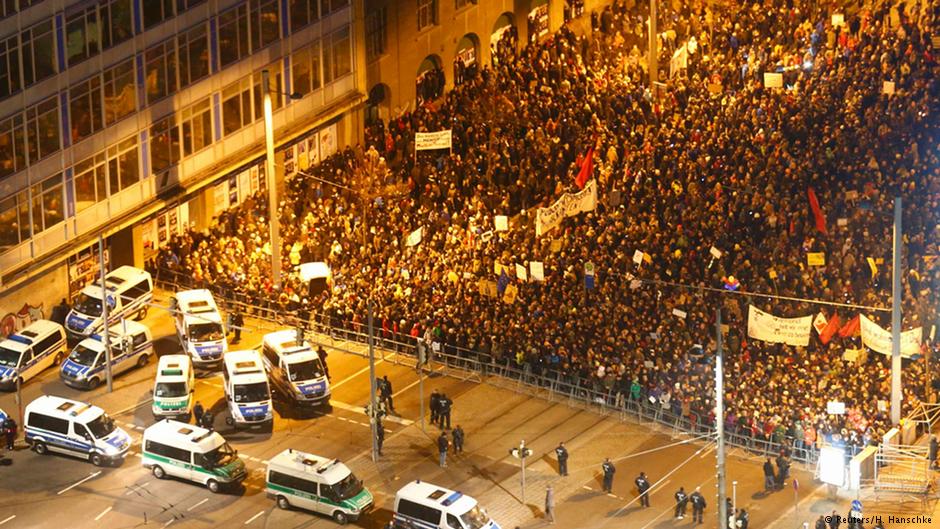
Another PEGIDA protest banned in Germany

Supporters of the PEGIDA (Patriotic Europeans Against the Islamization of Europe) movement in Germany’s eastern city of Leipzig, where the movement is called LEGIDA, had once again planned to take to the streets on Monday.

But the city called off the protest, saying police do not have enough officers to provide security and prevent violence.

Not enough police officers? The demonstrators think that reason was given as a false pretense to prohibit them from exercising a basic right. The ban amounts to “surrender by the constitutional democracy”, says Rainer Wendt, head of the German Police Union.

Demonstrators at a previous PEGIDA rally

It’s a fact that the anti-Islamization movement has for weeks embarrassed quite a few politicians in Saxony state. They have been forced to explain why it would seem that the Saxon cities of Leipzig and Dresden are hotbeds of xenophobic radicals. They would like to be rid of the bothersome protesters. A ban looked like an option, and referring to a lack of police officers could block the freedom of assembly for weeks because the authorities have the right to ban protests if the police can’t guarantee safety during a demonstration.

Unfounded conspiracy theories

On closer inspection, conspiracy theories and suspicions that a basic German right is being eroded turn out to be untenable.

“I absolutely don’t see the erosion of the freedom of assembly,” says Daniel Schily of the “More Democracy!” group.

An assembly ban is “an exception,” says former constitutional judge Hans-Jürgen Papier, adding that it must always be well-founded, and can’t be exercised arbitrarily.
NSA-Untersuchungsausschuss Hans-Jürgen Papier

While in fact, thousands of jobs have been cut in Germany’s police forces in the wake of reforms, Saxony’s police have so far managed to pull in reinforcements from other states when needed. This Monday was different, however: so many rallies were registered in Saxony and other German states that instead of the requested 31 groups of 100 police officers, only eight groups would have been available.

2,000 police officers are not enough

According to the police risk assessment, Leipzig Mayor Burkhard Jung pointed out that 800 police officers would not have been enough to safeguard the rally. More than 2,000 officers were deployed at the last PEGIDA protest in the city and even that wasn’t enough to prevent clashes between PEGIDA supporters and opponents, Jung argued. Banning the demonstration was thus by no means an arbitrary act, he said.

Every demonstration application must be processed by local authorities. Permits are not administered based on the political orientation of the demonstration, but on whether or not it poses any threat to the constitution. Under freedom of opinion and freedom of assembly laws, the constitution guarantees the right to state opinions publicly, no matter how outlandish they may seem.

Observers thus fear that the developments among the parties in Saxony and the new demonstration ban may prompt people to challenge this in a court of law. Any German citizen is able to legally challenge an assembly ban. In such claims in the past, many administrative courts have in the end allowed the demonstrations to take place – most recently in the autumn of 2014, when Hannover’s administration court ended up approving a hooligan demonstration, despite it having been banned by the local assembly authorities. As long as the right to file suits is upheld, experts on constitutional law see no danger to Germany’s freedom of assembly.

The increased number of banned demonstrations in Saxony has become a special concern for the state that does not apply to other states. “In Saxony, it seems the police, the interior ministry and the politicians are fighting for their own interests,” Daniel Schily believes. Chancellor Angela Merkel has already stepped in, saying in January that she wanted to protect the freedom of assembly. If need be, she said, more federal police should be made available so that demonstrations could take place. – Deutsche Welle

China slams US weapons to Ukraine

China is against Washington’s plans to provide Ukraine with weapons, the country’s Foreign Ministry spokesperson Hua Chunying said on Monday.

“China calls for the political settlement of the crisis in Ukraine as this meets the interests of all the sides. People in eastern Ukraine now are more in need of peace rather than weapons,” the diplomat stressed, commenting on the US plans.

Beijing welcomes and supports the active mediation efforts, which have been recently taken by the parties to ease tensions in eastern Ukraine and resolve the crisis by political means, she said.

China urges all the sides to refrain from any actions that could lead to an increase in confrontation or affect the negotiation process, the Chinese Foreign Ministry’s spokesperson said.

“China will continue playing a constructive role in the political settlement of the crisis in Ukraine,” the diplomat said.

Last Sunday, the New York Times newspaper reported that the Unites States considered supplying arms to Ukrainian forces.

Source: Itar-TASS

NATO fractures on Ukraine

NATO Secretary General Jens Stoltenberg has announced that each member of the alliance must make an independent decision on the supply of weapons to the Kiev government, which continues to fight independence supporters in southeastern Ukraine, the DPA news agency reports.

Speaking at the Conference of the Social and Democratic Party in Berlin on Sunday, Stoltenberg also said that he supports the reconciliation efforts of the Normandy Quartet, which includes Russia, Germany, France and Ukraine.

Normandy format talks have not led to any significant breakthroughs in Ukraine peace efforts. Kiev forces that launched a military operation against independence supporters in the Donetsk and Luhansk regions last spring, continue to clash with local militia, which leads to heavy civilian casualties.

Meanwhile, the US Congress has recently called for the provision of lethal assistance to Kiev-led forces.
Ukrainian President Petro Poroshenko asked US Congress for lethal weapon supplies during his September visit to the United States, however, Washington did not grant his request.

Speaking at the Munich Security Conference on Saturday, German Chancellor Angela Merkel ruled out any possibility of weapon supplies to Ukraine, stating that this would not help solve the crisis. Other European states, including Finland, France and Italy have also rejected the idea.

Source: Sputnik News

Will Russia remonetize in gold?

The “perfect-storm” of geopolitical instability, diplomatic isolation, severe currency depreciation, and economic decline now confronting Russia has profoundly damaged Moscow’s international standing, and possibly for the long-term.

Yet, it is precisely such conditions that may push the country’s leadership into taking the radical step that will secure its world-player status once and for all: the adoption of a gold-exchange standard.

Though a far-fetched idea at first glance, many factors suggest that remonetization in gold may be a logical next step for Moscow.

First, for years Moscow has been expressing its unwillingness to remain at the monetary mercy of the US and its NATO allies and this view has been most vehemently expressed by President Putin’s long-time economic advisor, Sergei Glazyev.

Russia is prepared to play strategic hardball with the West on the issue: the governor of Russia’s central bank took the unusual step last November of presenting to the international media details of the bank’s zealous gold-buying spree.

The announcement, in sharp contrast to that institution’s more taciturn traditions, underscores Moscow’s outspoken dismay with dollar hegemony; its timing suggests coordination with the top rungs of government to present gold as a possible currency-war weapon.

Second, despite international pressure, Russia has been very wary of the sell-off policies that led the UK, France, Spain, and Italy to unload gold over the past decade during unsuccessful attempts to prop up their respective ailing economies — in particular, of then-Prime Minister Gordon Brown’s sell-off of 400 metric tons of the country’s reserves at stunningly low prices.

Moscow’s surprise decision upon the onset of the ruble’s swift decline in early December 2014 to not tap into the country’s gold reserves, now the world’s sixth largest, highlights the ambitiousness of Russia’s stance on the gold issue. By the end of December, Russia added another 20.73 tons, according to the IMF in late January, capping a nine-month buying spree.

Third, while the Russian economy is structurally weak, enough of the country’s monetary fundamentals are sound, such that the timing of a move to gold, geopolitically and domestically, may be ideal. Russia is not a debtor nation. At this writing in January, Russia’s debt to GDP ratio is low and most of its external debt is private.

Physical gold accounts for 10 percent of Russia’s foreign currency reserves. The budget deficit, as of a November 2014 projection, is likely to be around $10 billion, much less than 1 percent of GDP. The poverty rate fell from 35 percent in 2001 to 10 percent in 2010, while the middle class was projected in 2013 to reach 86 percent of the population by 2020.

Collapsing oil prices serve only to intensify the monetary attractiveness of gold. Given that oil exports, along with the rest of the energy sector, account for 45 percent of GDP, the depreciation of the ruble will continue; newly unstable fiscal conditions have devastated banks, and higher inflation looms, expected to reach 10 percent by the end of 2015. As Russia remains (for the foreseeable future) mainly a resource-based economy, only a move to gold, arguably, can make the currency stronger, even if it does limit Russia’s available currency.

In buying as much gold as it has, the country is, in part, ensuring that it will have enough money in circulation in the event of such fundamental transformation. In terms of re-establishing post-oil shock international prestige, a move to gold will allow the country to be seen as a more reliable and trustworthy trading partner.

The repercussions of Russia on a gold-exchange standard would be immense. Above all, it would mean the first major schism in the world’s monetary order. China would quite likely follow suit. It could mean the threat of a severe inflation in the United States should rafts of unwanted dollars make their way back across the Atlantic — the Fed’s ultimate nightmare. Above all, the country will avoid the extreme debt leverages which would not have happened had Western capitals remained on gold.

“A gold standard would be politically appealing, transforming the ruble to a formidable currency and reducing outflows significantly,” writes Dr. Enrico Colombatto, economics professor at the University of Turin, Italy.

He notes that the only major drawback would be that the imposed discipline of a gold standard would deprive authorities of discretionary political power. The other threat would be that of a new generation of Russian central bankers becoming too heavily influenced by the monetary mindset of the European Central Bank (ECB) and the Fed.

As Alisdair MacLeod, a two-decade veteran of off-shore banking consulting based in the UK, recently wrote, Russia (and China) will “hold all the aces” by moving away from any possible currency wars of the future into the physical gold market. In his article, he adds that there is currently a low appetite for physical gold in Western capital markets and longer-term foreign holders of rubles would be unlikely to exchange them for gold, preferring to sell them for other fiat currencies.

Mr. Macleod cites John Butler, CIO at Atom Capital in London, who sees great potential in a gold-exchange standard for Russia. With the establishment of a sound gold-exchange rate, he argues, the Central Bank of Russia would no longer be confined to buying and selling gold to maintain the rate of exchange. The bank could freely manage the liquidity of the ruble and be able to issue coupon-bearing bonds to the Russian public, allowing it a yield linked to gold rates. As the ruble stabilizes, the rate of the cost of living would drop; savings would grow, spurred on by long term stability and lower taxes.

Foreign exchange also would be favorable, Mr. Butler maintains. Owing to the Ukraine crises and commodities crises, rubles have been dumped for dollar/euro currencies. Upon the announcement of a gold-exchange, demand for the ruble would increase. London and New York markets would in turn be countered by provisions restricting gold-to-ruble exchanges of imports and exports.

The geopolitics of gold also figure into Russia’s increasingly close relations with China, a country that also has made clear its preference for gold over the dollar. (Russia recently edged out China as the world’s top buyer of the metal.) In the aftermath of the $400 billion, 30-year deal signed between Russian gas giant Gazprom and the China National Petroleum Company in November 2014, China turned its focus to the internationalization of its own gold market. On January 15, 2015, the Shanghai Gold Exchange, the largest physical gold exchange worldwide, and the World Gold Council, concluded a strategic cooperation deal to expand the Chinese gold market through the new Shanghai Free Trade Zone.

This is not the first time the gold standard has been seen as the ultimate cure for Russia’s economic problems. In September 1998, the noted economist Jude Wanninski predicted in a far-sighted essay for The Wall Street Journal that only a gold ruble would get the the country out of its then-debt crises. It was upon taking office about two years later, in May 2000, that President Putin embarked upon the country’s massive gold-buying campaign. At the time, it took twenty-eight barrels of crude just to buy an ounce of gold. The gold-backed ruble policy of those years was adopted to successfully pay down the country’s external debt.

As a pro-gold stance is, essentially, anti-dollar, speculation about how the US would react raises the question of whether an all-out currency war would follow. The West would have to keep Russia regionally and militarily marginalized, not to mention kept within the confines of the Fed, the ECB, and the Bank of England (BOE).

Nor is that prospect too far-fetched. As Dutch author Willem Middelkoop has written in his 2014 book The Big Reset: War on Gold and the Financial Endgame,

A system reset is imminent. Even before 2020 the world’s financial system will need to find a different anchor. … In a desperate attempt to maintain this dollar system, the United States waged a secret war on gold since the 1960s. China and Russia have pierced through the American smokescreen around gold and the dollar and are no longer willing to continue lending to the United States. Both countries have been accumulating enormous amounts of gold, positioning themselves for the next phase of the global financial system.

Source: Von Mises Institute

Ukraine: War drums beat louder

As the German Chancellor, Angela Merkel, prepared to brief Barack Obama in Washington on Monday about the state of peace negotiations in Ukraine, the Atlanticists were preparing for war.

The Estonian President, Toomas Hendrik Ilves, compared Western inaction against Russia with the appeasement of Adolf Hilter in 1938, when Nazi Germany was alllowed to seize parts of the former Czechoslovakia.

“We know from history that appeasement will never satisfy those that are being appeased,” he said. “Munich ’38 I think should be a lesson to all of us even today.”

British Foreign Secretary Philip Hammond accused Mr Putin of “acting like some mid-20th century tyrant”, while the French Foreign Minister, Jean-Yves Le Drian, said he would “fear the worst” if peace talks this week failed.

The US wants to send weapons to Ukraine, but Germany and France oppose arming Kiev’s forces, saying this could lead to an escalation of the conflict.

Lord Ashdown, the former UK Liberal Democrat leader, urged the West to use “military diplomacy” however, to hide their intent.

“The right reaction to the Russian arming of the Ukrainian rebels is to make it clear we are prepared to do the same for the Ukrainian government,” he writes. “Start small, slow and unaggressively – with communications and intelligence equipment for example.”

Carl Bildt, former Swedish foreign minister, said war “between Russia and the West” was now conceivable.

Ukrainian military transport aircraft have, for the past year since the putschists overthrew the government of President Viktor Yanukovych in Kiev, been flying around the world, including the United States, collecting everything from weapons and military helicopters to armored vehicles and ammunition for Ukraine’s army and neo-Nazi militia units.

The respected German daily, the Süddeutsche Zeitung featured a Russian military expert Yevgeny Buchinsky warning that if Kiev receives hard military aid, “Russia will have to intervene, and then, bluntly speaking, take Kiev. Then NATO would be in a difficult situation. Then you would have to start World War III, which no one wants.”

The Atlanticist representative in Kiev, president Poroshencko, meanwhile has promised Ukrainians US military aid: “I don’t have any doubt that the US and other partners will provide help with lethal weapons.”

EU bureaucrats have admitted – off the record – that even sanctions are ridiculous, sanctioning in fact the EU for least 15% of exports to Russia. The British have whipped up the pro-sanction lobby into a frenzy about “Russian aggression”, hoping to gain from their efforts later.

Russian president Putin, Ukrainian President Petro Poroshenko, German Chancellor Angela Merkel and French President François Hollande are all due to take part in the Minsk peace summit. Russian Foreign Minister Sergey Lavrov said Russia expected “important decisions” to be made at the meeting.

Germany’s Frankfurter Allgemeine Sonntagszeitung newspaper reported today that German intelligence estimated up to 50,000 soldiers and civilians had been killed during the conflict, nearly 10 times higher than Kiev’s estimate. “The official figures are clearly too low and not credible,” a source said.

Insiders say Merkel and Hollande came to Moscow but with the purpose of having what diplomats call “a full and frank discussion” in private with Putin in the Kremlin, where they can be confident the Americans are not spying on them.

Poroshenko’s officials are insisting that the question of federalisation was not discussed during a meeting with Hollande and Merkel.

Hollande has however now come out publicly to support “autonomy” for the eastern regions, making a discussion of federalisation a virtual certainty.

Russian student Alexander Mercouris says the reason Hollande is there and appears to be taking the lead is to provide Merkel with cover.

The one thing Merkel cannot afford politically is the appearance of a Moscow-Berlin stitch-up that the hardliners in Washington, Kiev, London, Warsaw and the Baltic States will claim is a new Molotov-Ribbentrop Pact to divide Europe into German and Russian spheres of influence. Whether we like it or not in Germany the shadow of Hitler still hangs heavy and exposes Berlin to endless moral blackmail.

British threaten to halt intel to Germany

British intelligence chiefs have threatened to halt their sharing of information with their German counterparts if Germany goes ahead with a parliamentary inquiry into British and US spying, according German media reports.

The British are worried that German politicians could expose classified information including details of code breaking and other technology, including a European surveillance program, which was launched last year, said a report in German weekly magazine, Focus.

Head of Germany’s federal intelligence agency, the Bundesnachrichtendienst (BND) Gerhard Schindler, is reportedly taking the British threat seriously.

Schindler told the parliamentary inquiry on the issue on Wednesday evening that he was experiencing “unusually tense relations with British partner agencies.”

The UK provides crucial eavesdropping powers, which is shared with the German agencies.

“Without the information from British signals intelligence we would be blind,” an unnamed senior German intelligence official told Focus.

Hollande says Ukraine should not join NATO

French President François Hollande and the German chancellor Angela Merkel are set to visit Moscow on Friday after a trip to Kiev, in order to find a peaceful solution to the escalating violence in Ukraine.

“Together with Angela Merkel we have decided to take a new initiative,” Hollande told a news conference. “We will make a new proposal to solve the conflict which will be based on Ukraine’s territorial integrity.”

The two European leaders decided Wednesday night on the trip and did not consult American officials about it, AP reports citing a senior French official.

Hollande also added that he did not think it would be a good idea for Ukraine to join NATO.

He called on the international community on Thursday to fulfil its “duty” to take action against Islamist extremists in Africa, saying that France could not go it alone, France24 reported.

“There is a message that I want to send to the international community and to the biggest countries,” he told a bi-annual presidential press conference on Thursday. “Do your job. Don’t give lessons – act. Do your duty. No one else will do it in your place.”

“France cannot settle all the world’s conflicts,” he said.

The African Union has backed plans for a regional five-nation force of 7,500 troops to defeat the deadly rise of Boko Haram in northeast Nigeria, and Chad has deployed its army to join the fight against the jihadists.

France is supporting the operations by carrying out reconnaissance flights over border areas of Chad and Cameroon to provide the two nations with intelligence, defence officials in Paris have said.

“We must help the Africans much more to act against terrorism,” Hollande said. “If we don’t do it, countries will be destabilised once again.”

France deployed troops to the Sahel region of Africa to fight against militant extremists after helping oust the Islamist forces that had seized much of northern Mali in 2013. The country is also taking part in US-led operations against the Islamic State group in Iraq and Syria.

The United Nations Security Council last month called for a multinational military effort to tackle Boko Haram, expressing concern that its incursions were undermining peace and stability in Central and West Africa.

Hitler photo delivers blow to Pegida

In Pegida’s first ever press conference in Dresden on Monday, Lutz Bachmann insisted that the group was not racist, and distanced themselves from footage during a lively television debate showing Pegida demonstrators delivering racist remarks.

Bachmann has been most keen to stress his Muslim credentials, showing photographs on his Facebook site of his Turkish best man.

Meanwhile a Catholic priest who took part in a demonstration organised by the Pegida-offshoot group Dügida in the western city of Duisburg in Germany on Monday has been banned from preaching by his religious elders, after he compared the movement to the Crusades.

The head of the German anti-Islamisation has stepped down after a picture of him jokingly posing as Adolf Hitler was unearthed. Bachmann, 41, is a butcher’s son from Dresden.

Bachmann’s Facebook page, was accompanied by the line: “He’s Back,” after Timur Vermes’ best-selling 2012 satirical novel of the same name about Hitler.

The Dresden Morgenpost somehow got hold of a private Facebook conversation between Bachmann and one of his Facebook contacts, in which he described immigrants as “cattle”, “scumbags” and “trash”. The comments were posted on 19 September.

Pegida spokeswoman Kathrin Oertel, told Spiegel Online Bachmann’s resignation was the “only possibilty for the movement”.

A spokesman for Bernd Lucke, the head of the political party Alternative für Deutschland, an anti-euro party which has publicly expressed an allegiance with the aims of Pegida, said that with his “sad utterings and disgusting jokes”, Bachmann had “embarrassed the people of Pegida who have been compelled by honest concerns to take to the streets”.

Responding to the picture, Bachmann told Wednesday’s Bild: “I took the photo at the hairdresser’s, for the publication of the audiobook of the satire He’s Back … you need to be able to joke about yourself now and then”. Asked about the derogatory comments he allegedly made about immigrants, Bachmann replied: “We don’t comment about private matters.”

Bachmann, who has multiple convictions for burglary, assault and drug possession, was said by German intelligence services to be a target for Islamist terrorists who said on social media sites they intended to kill him.

German PEGIDA cancels rally over death threats

German PEGIDA movement, which stands against ‘the Islamization of the West’ has canceled next week’s rally in the city of Dresden after threats were issued against one of its top organizers.

The Patriotic Europeans against the Islamization of the West (PEGIDA) movement has been holding protests every Monday in the eastern German city of Dresden since October.

The rallies, which initially gathered no more than 500 people, hit a record attendance of 25,000 last week.

PEGIDA announced on its Facebook page that the rally planned for January 19 has been called off after the police said “there is a specific threat against a member of the organization team.”

According to DPA news agency, the threats were filed by Islamic radicals against the movement’s co-leader, Lutz Bachmann.

The German police were informed of the threats against Bachman by foreign secret services, the agency added.

A spokesman for the Dresden police said that they had placed a “general ban” on all public gatherings on Monday, Reuters reported.

“The police in Dresden have received information of a concrete threat against the weekly PEGIDA rally,” a statement by Dresden police said. “Assassins have been called up to mingle among the PEGIDA protestors and murder one of the individuals leading the rally.”

Instead of taking to the streets, PEGIDA called on all Europeans who oppose “religious bigotry any kind” to hang the national flag of their country out of their windows and light a candle on Monday.

PEGIDA is currently the most supported anti-immigration movement in Germany as rallies by similar organizations in other cities have so far been unable to draw anywhere near as much people.

The Dresden group was criticized by many German politicians, with Chancellor Angela Merkel calling PEGIDA “racists full of hatred.”