China warns West against escalation in Crimea

shi
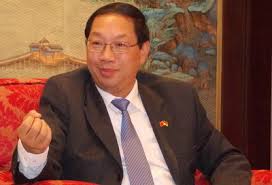
Ambassador Shi Mingde

China’s top envoy to Germany has warned the West against punishing Russia with sanctions for its intervention in Ukraine, saying such measures could lead to a dangerous chain reaction that would be difficult to control.

In an interview with Reuters days before the European Union is threatening to impose its first sanctions on Russia since the Cold War, ambassador Shi Mingde issued the strongest warning against such measures by any top Chinese official to date.

“We don’t see any point in sanctions,” Shi said. “Sanctions could lead to retaliatory action, and that would trigger a spiral with unforeseeable consequences. We don’t want this.”

The interview was conducted on Wednesday, the same day that the EU agreed a framework for sanctions that would slap travel bans and asset freezes on people and companies accused by Brussels of violating the territorial integrity of Ukraine.

German Chancellor Angela Merkel, has taken the side of the putschists supported by the United States, and warned that unless Russia accepts the idea of a “contact group” to resolve the crisis diplomatically, Russia risked “massive” political and economic damage if it did not change course in the coming days.

Source: Reuters

The Failure Of German Leadership – Merkel Whores For Washington

pcr

Washington, enabled by its compliant but stupid NATO puppets, is pushing the Ukrainian situation closer to war.

German Chancellor Merkel has failed her country, Europe, and world peace. Germany is the strength of the EU and NATO. Had Merkel said “No” to sanctions on Russia, that would have been the end of the crisis that Washington is brewing, a crisis unlikely to be ended short of war.

But Merkel has signed away the sovereignty of the German nation and assigned the fate of Germany to a province in the American Empire. Thus has Merkel and the weak German leadership consigned the world to war. Already blamed for World War 1 and World War 2, now Germany will be blamed for World War 3.

Washington’s mismanaged Ukrainian coup has cost Washington Crimea, which Washington wanted most of all in order to deprive Russia of its warm water naval base on the Black Sea. In addition, the mismanaged overthrow of an elected government in Ukraine is threatening to also lose the Russian cities of eastern Ukraine. Like Crimea, eastern Ukraine consists of former Russian areas that Khrushchev stuck into Ukraine in the 1950s.

In what is clearly a fruitless and pointless effort to get Crimea back, Washington is demanding that Russia interfere in Crimea and prevent Crimea from seceding from Ukraine. If the Russian government refuses to follow Washington’s orders, Washington has announced that it will inflict “damaging sanctions” on Russia. Initially, EU countries expressed an unwillingness to go along with Washington, but with bribes and threats, Washington has conquered Merkel and has its European puppets lined up following orders.

Washington understands that economic sanctions are a far less threat to Russia than the loss of its Black Sea naval base. Washington also understands that Putin cannot possibly abandon the millions of Russians in eastern and southern Ukraine to the mercy of the anti-Russian and unelected government imposed by Washington in Kiev. As Washington knows that its threat of sanctions is empty, why did Washington make it?

The answer is in order to drive the crisis to war. Washington’s neoconservative nazis have been agitating for war with Russia for a long time. They want to remove one of the three remaining restraints (Russia, China, Iran) on Washington’s world hegemony. Washington wants to break up the BRICS (Brazil, Russia, India, China, South Africa) before these countries form a separate currency bloc and avoid the use of the US dollar.

Russia will respond in kind to Washington’s sanctions. European peoples and Western banks and corporations will suffer losses. It would be at least two or three years before Washington has in place means of delivering US natural gas achieved by fracking and contamination of US water supplies to Europe to take the place of Russia’s cutoff of energy to Europe.

The Western presstitute media will dramatize the Russian response to sanctions and demonize Russia, while ignoring who started the fight, thereby helping Washington prepare Americans for war. As neither side can afford to lose the war, nuclear weapons will be used. There will be no winners.

All of this is perfectly clear, just as was the obvious conclusion of the march of events leading up to World War 1. Now, like then, the people who see the outcome are powerless to stop it. Delusion rules. Arrogance and hubris overflow. Statements and actions become ever more reckless, and then there is hell to pay.

Americans and Europeans, if they had any awareness at all, would be in the streets violently protesting the coming war toward which the insane criminals in Washington are driving the world.

Instead, the German chancellor, the French president, the British prime minister and the Western presstitute media continue to lie: It was legitimate for the West to steal Kosovo from Serbia and to steal the Ukrainian government, but it is not legitimate for the Russian population of Crimea to exercise self-determination and return to Russia. Washington and its EU puppets even have the audacity to declare falsely, after overthrowing an elected government in Ukraine and installing an unelected one, that Crimean self-determination violates the Ukrainian constitution, which no longer exists because Washington destroyed it.

The criminally insane government in Washington has pushed the Russian bear into a corner. The bear is not going to surrender.

Paul Craig Roberts was Assistant Secretary of the Treasury for Economic Policy and associate editor of the Wall Street Journal. He was columnist for Business Week, Scripps Howard News Service, and Creators Syndicate. He has had many university appointments. His internet columns have attracted a worldwide following. His latest books are, The Failure of Laissez Faire Capitalism and How America Was Lost. 

US threatens war ‘if treaty obligations triggered’

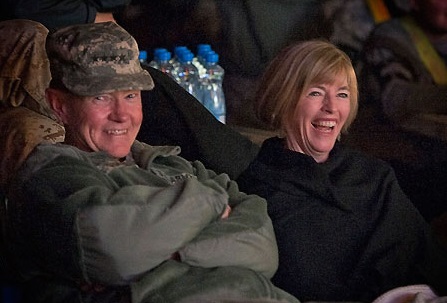
The Dempseys enjoying war

The US has escalated hostilities in Europe further, citing the Chairman of the Joint Chiefs of Staff, General Martin Dempsey, who said the US Army is ready to back up Ukraine and its allies in Europe with military action.

According to the Web site of the Atlantic Council, Dempsey said that “he’s sending a clear message to Ukraine and members of NATO that the US military will respond militarily if necessary.”

“We do have treaty obligations with our NATO allies. And I have assured them that if that treaty obligation is triggered [in Europe], we would respond,” Dempsey said.

According to the General, an independent Crimea creates risk for all the countries of Europe and NATO allies.

“If Russia is allowed to do this, which is to say move into a sovereign country under the guise of protecting ethnic Russians in Ukraine, it exposes Eastern Europe to some significant risk, because there are ethnic enclaves all over Eastern Europe and the Balkans.”

Obama’s war fever, his patent disregard for the sovereignty of nations, his expansion of the Afghanistan war, his illicit use of drones and continued operation of Guantanamo – all deemed “war crimes” of the Bush administration – are now hailed by Democrats and Hawks alike as “democracy”.

As conservative pundit Ann Coulter laments: “I’m sorry, but who cares about military spending as long as Obama is president? At the rate he’s going, Obama might use our military to attack England.”

In response, Russia’s Defense Ministry has given permission for a surveillance flight by Ukraine over Russian territory near the border between the countries. Kiev had claimed Moscow was building up its military presence there.

“The Ukrainians have asked for an unscheduled observation flight over our territory,” Deputy Defense Minister Anatoly Antonov told reporters in Moscow.

Russia and Ukraine are entitled to surveillance flights over each other’s territories following the Open Skies treaty signed in 1992, but Antonov said that Kiev had never asked for one before.

“We have decided to allow such a flight. We hope that our neighbors are assured that there is no military activity that threatens them on the border.”

Antonov vehemently denied a statement Tuesday by Igor Tenyukh, defense minister for the Kiev coup-appointed government, that Russia had amassed more than 220,000 troops, 1,800 tanks and over 400 helicopters in regions adjacent to eastern Ukraine.

“Ukrainian military officials know full well that the entire [Russian] Southern and Western Military Districts put together don’t have that much equipment. The only way you could arrive at that number of soldiers would be if you counted their families,” Antonov said.

“I would dissuade Mr Tenyukh from adding fuel to the fire of the crisis, which is what he appears to be doing. He openly outlined the reasons for this himself, when he asked the Ukrainian parliament to issue him with more funding,” continued the Russian official.

Antonov added that continuing mass training exercises in eastern Ukraine, which Kiev began this week, could plunge Ukraine into even deeper turmoil.

“Staging exercises in an area that is gripped by mass protests against the new regime which came to power as a result of a coup is a risky endeavor, which could further destabilize the political situation in Ukraine,” Antonov insisted.

Oleksandr Turchynov’s, Ukraine’s acting president, said earlier his country could not use its army alone to stop Crimea’s independence, thereby enhancing the possibility of US intervention.

Propaganda rules the news: Russia never invaded Ukraine

pcrGerald Celente calls the Western media “presstitutes,” an ingenuous term that I often use. Presstitutes sell themselves to Washington for access and government sources and to keep their jobs. Ever since the corrupt Clinton regime permitted the concentration of the US media, there has been no journalistic independence in the United States except for some Internet sites.

Glenn Greenwald points out the independence that RT, a Russian media organization, permits Abby Martin who denounced Russia’s alleged invasion of Ukraine, compared to the fates of Phil Donahue (MSNBC) and Peter Arnett (NBC), both of whom were fired for expressing opposition to the Bush regime’s illegal attack on Iraq. The fact that Donahue had NBC’s highest rated program did not give him journalistic independence. Anyone who speaks the truth in the American print or TV media or on NPR is immediately fired.

Russia’s RT seems actually to believe and observe the values that Americans profess but do not honor.

I agree with Greenwald. Greenwald is entirely admirable. He has intelligence, integrity, and courage. He is one of the brave to whom my just published book, How America Was Lost, is dedicated. As for RT’s Abby Martin, I admire her and have been a guest on her program a number of times.

My criticism of Greenwald and Martin has nothing to do with their integrity or their character. I doubt the claims that Abby Martin grandstanded on “Russia’s invasion of Ukraine” in order to boost her chances of moving into the more lucrative “mainstream media.” My point is quite different. Even Abby Martin and Greenwald, both of whom bring us much light, cannot fully escape Western propaganda.

For example, Martin’s denunciation of Russia for “invading” Ukraine is based on Western propaganda that Russia sent 16,000 troops to occupy Crimea. The fact of the matter is that those 16,000 Russian troops have been in Crimea since the 1990s. Under the Russian-Ukrainian agreement, Russia has the right to base 25,000 troops in Crimea.

Apparently, neither Abby Martin nor Glenn Greenwald, two intelligent and aware people, knew this fact. Washington’s propaganda is so pervasive that two of our best reporters were victimized by it.

As I have written several times in my columns, Washington organized the coup in Ukraine in order to promote its world hegemony by capturing Ukraine for NATO and putting US missile bases on Russia’s border in order to degrade Russia’s nuclear deterrent and force Russia to accept Washington’s hegemony.

Russia has done nothing but respond in a very low-key way to a major strategic threat orchestrated by Washington.

It is not only Martin and Greenwald who have fallen under Washington’s propaganda. They are joined by Patrick J. Buchanan. Pat’s column calling on readers to “resist the war party on Crimea” opens with Washington’s propagandistic claim: “With Vladimir Putin’s dispatch of Russian Troops into Crimea”.

No such dispatch has occurred. Putin has been granted authority by the Russian Duma to send troops to Ukraine, but Putin has stated publicly that sending troops would be a last resort to protect Crimean Russians from invasions by the ultra-nationalist neo-nazis who stole Washington’s coup and established themselves as the power in Kiev and western Ukraine.

So, here we have three of the smartest and most independent journalists of our time, and all three are under the impression created by Western propaganda that Russia has invaded Ukraine.

It appears that the power of Washington’s propaganda is so great that not even the best and most independent journalists can escape its influence.

What chance does truth have when Abby Martin gets kudos from Glenn Greenwald for denouncing Russia for an alleged “invasion” that has not taken place, and when independent Pat Buchanan opens his column dissenting from the blame-Russia-crowd by accepting that an invasion has taken place?

The entire story that the presstitutes have told about the Ukraine is a propaganda production. The presstitutes told us that the deposed president, Viktor Yanukovych, ordered snipers to shoot protesters. On the basis of these false reports, Washington’s stooges, who comprise the existing non-government in Kiev, have issued arrest orders for Yanukovych and intend for him to be tried in an international court. In an intercepted telephone call between EU foreign affairs minister Catherine Ashton and Estonian foreign affairs minister Urmas Paet who had just returned from Kiev, Paet reports: “There is now stronger and stronger understanding that behind the snipers, it was not Yanukovych, but it was somebody from the new coalition.” Paet goes on to report that “all the evidence shows that the people who were killed by snipers from both sides, among policemen and then people from the streets, that they were the same snipers killing people from both sides . . . and it’s really disturbing that now the new coalition, that they don’t want to investigate what exactly happened.” Ashton, absorbed with EU plans to guide reforms in Ukraine and to prepare the way for the IMF to gain control over economic policy, was not particularly pleased to hear Paet’s report that the killings were an orchestrated provocation.

What has happened in Ukraine is that Washington plotted against and overthrew an elected legitimate government and then lost control to neo-nazis who are threatening the large Russian population in southern and eastern Ukraine, provinces that formerly were part of Russia. These threatened Russians have appealed for Russia’s help, and just like the Russians in South Ossetia, they will receive Russia’s help.

The Obama regime and its presstitutes will continue to lie about everything.

Paul Craig Roberts was Assistant Secretary of the Treasury for Economic Policy and associate editor of the Wall Street Journal. He was columnist for Business Week, Scripps Howard News Service, and Creators Syndicate. He has had many university appointments. His internet columns have attracted a worldwide following. His latest books are, The Failure of Laissez Faire Capitalism and How America Was Lost. 

Ukraine fever sweeps the Balkans

balkansAs the world watches the Ukrainians in their effort to defend themselves from Russia and become a fully European nation, close attention to the situation in Kiev and the crisis in Crimea is notable in the Balkan Muslim countries—Kosovo, Albania, Bosnia-Herzegovina—and in two with significant Muslim minorities, Montenegro and Macedonia.

In the Balkans, the threat of Serbian aggression has receded, but in a parallel with Ukraine, Russian influence is perceived behind intrigues from Belgrade. The events in Ukraine are seen in a context of the struggle against corruption and the phenomenon of the post-Communist “mafia state.”

In the first week of February, a wave of protest began in the Bosnian city of Tuzla, which is known for its tradition of multiethnic harmony among Bosnian Muslims, Croats, and Serbs. An old industrial redoubt now plagued with unemployment ranging between 40 and 60 percent, Tuzla boiled over quickly, as reported by BBC News, with attacks on official buildings.

Solidarity demonstrations spread to other Bosnian cities with economic problems, including Mostar in Herzegovina, which is divided between Muslims and Croats and has an aluminum industry, Zenica in central Bosnia, where a steel complex has been owned by ArcelorMittal since 1998, and then to Sarajevo, the capital. There, on February 7, demonstrators set fire to government buildings and fought police.

Local and foreign media, international observers, and politicians assigned blame for the Bosnian upheaval in all directions. Resentment of the excessively convoluted bureaucracy foisted by the 1995 Dayton Accords on Bosnia, which is partitioned between a so-called “Republic of Serbs” and the “Federation of Bosnia-Herzegovina,” grouping Muslims and Croats, is one issue. “Federation Bosnia” comprises 10 cantons, each with its own autonomous political and educational authorities, plus a special zone at Brcko in the northern part of the territory, all reporting—barely—to the supposed central government in Sarajevo. It has more varieties of statist delirium above and below the cantonal level: legislatures, ministries, municipalities, in a seemingly endless and redundant supply.

Economic opportunities mostly involve political malfeasance, financed by the European Union through the Office of the High Representative (OHR), the real government, with American support. The current high representative is an Austrian of Slovene background, Valentin Inzko. Bosnia-Herzegovina is therefore a place of profound despair, afflicted by brain drain. Its traditional Central European system of education, which produces well-trained graduates, sees them leave for other countries as soon as they can. A serious upheaval in Bosnia was, to anybody watching the country, obviously on the way—a matter of when, rather than why.

Also at the end of the first week of February, Kosovo saw turmoil as Ibrahim Gashi, rector of the University of Pristina, in the capital of that Balkan republic, was forced to resign after he was exposed as a falsifier of his academic work. Clashes between police and students left 29 officers hurt and 30 students arrested. Gashi’s departure from the university was followed by that of several of his colleagues.

In Podgorica, the capital of Montenegro, on February 18, hundreds of people gathered, throwing rocks at state offices, and injuring nine policemen. The Montenegrins called for “revolution.” Unemployed workers in Macedonia assembled in front of government buildings in that country’s capital, Skopje, on February 18. The next day, in Albania, after an informal strike by minivan drivers, in a country lacking a reliable public transportation system, a full one-day transport shutdown took place, with a rally in Tirana, the capital.The idiom of social rebellion is common in Balkan culture, which has undergone numerous such movements over the centuries, and where communism in the former Yugoslavia, under the charismatic dictator Joseph Broz Tito (1892-1980) kept memories of it alive in a civic myth that imposed much less conformity and silence than in other Communist lands. Lately, public acclaim for a “Balkan spring” gave way rapidly to visions of a “Bosnian-Ukrainian model.”

But in Bosnia-Herzegovina and Albania, entrenched elites quickly sought to profit from social conflict. The Bosnian politician Fahrudin Radoncic, leader of a party titled the Union for a Better Future, which holds four out of 28 seats in the weird, ineffectual House of Representatives crafted for the Muslim-Croat Federation, has been accused of organizing the assault on the government buildings in Sarajevo in an attempted coup d’etat. Radoncic, once a respected dissident, is now seen as a patron of shady deals with Serbian extremists—likewise an old motif in the Balkans. Dnevni Avaz (Daily Voice), a down-market tabloid owned by Radoncic, last week featured a column headed “Ukraine Is All of Us”—rhetoric viewed as cynical by many Bosnians.

Similarly, former Albanian prime minister Sali Berisha, an ex-Communist and leader of his country’s entrenched Democratic party, stirred the striking minivan drivers against the Socialist (i.e., neo-Communist) administration of Edi Rama, who took power last year.

As in Ukraine, allegations that discredited leaders are manipulating mass protests in Bosnia-Herzegovina and Albania to regain influence are widespread. But in the Balkan lands, they are more convincing than they appear to be in Kiev. On February 28, Zeljko Komsic, an ex-Communist and politically independent member of the three-person presidency of Bosnia-Herzegovina, declared “I am not with fascists, chauvinists, thieves, or racketeers.” Epitomizing the complexity of post-Dayton Bosnian governance, Komsic is the Croat representative in the presidency, which comprises a Bosnian Muslim, a Serbian, and a Croatian.

A legal complaint brought at the European Court of Human Rights in Strasbourg by Dervo Sejdic, a Bosnian Roma (Gypsy) representative, and Jakob Finci, president of the Bosnian Jewish Community, alleged discrimination in that, under Dayton, members of minorities are excluded from the Bosnian presidency. The Court found for the plaintiffs in the case, Sejdic and Finci v. Bosnia and Hercegovina, but a reform of the ethno-political structure has yet to be adopted.

Since the cathartic arson at government facilities in Sarajevo, protests have continued but with much-diminished participation, typically bringing together a few hundred elderly folk aggrieved mainly by the loss of pensions. Observing one such gathering on Saturday, March 1, which was Bosnian Independence Day, I noticed the prominent display of a portrait of Tito. Nostalgia for communism is an important motive for elderly Bosnians to take to the streets.

Leaflets for the March 1 assembly, taped up throughout Sarajevo, demanded “social justice for all.” Bosnia’s Muslim religious leadership, under moderate direction since the replacement of the Wahhabi-line chief cleric Mustafa Ceric by Husein Kavazovic last year, supports the call for social justice. But the Islamic approach to Bosnian problems is conservative.

At Friday prayers in Sarajevo’s exquisite and intimate 16th-century Cobanija mosque, the day before the March 1 protest, the elderly preacher, known as a khatib and different from the imam, who leads the service, pronounced blessings and immediately commenced an eloquent denunciation of violent demonstrations. With his voice repeatedly breaking, he said to stay away from barricades such as were seen in the recent uproar. He referred to violence as “Satan’s path” and called on the assembled Bosnian Muslims to be thankful for the existence of a state with a territory and constitution which they should protect and obey. He said he was a pensioner himself and that his wife had not worked for years. But he repeated, “do not go to the barricades. Do not be tempted to Satan’s path. Remember that we have a state, territory, political structures and freedom. Do not waste them or abuse them.”

Meanwhile, those who remain indignant about corruption, rulership from afar, joblessness, lack of pensions, and the other misfortunes of Dayton besetting Bosnians have been meeting in “plenums” for democratic debate and proposal of solutions.

Thus, its Balkan disarray notwithstanding, Bosnia may find a secure way to European standards of entrepreneurship, accountability, and popular sovereignty. In a land where rebellion seems deeply embedded in the culture, hope is not exhausted.

Source: www.weeklystandard.com

Nato and Russia in talks over Ukraine

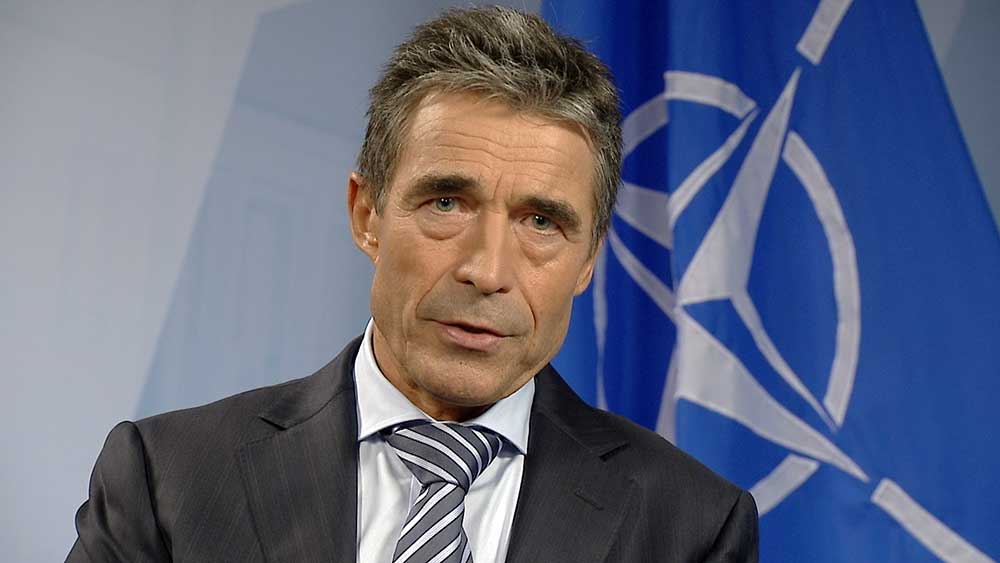
Anders Fogh Rasmussen

The NATO alliance and Russia have agreed to discuss the latest developments in Ukraine at a special meeting on Wednesday.

The alliance announced that an extraordinary NATO-Russia council will convene at the suggestion of alliance secretary-general Anders Fogh Rasmussen. Russia agreed to the meeting on Tuesday, when NATO ambassadors were further discussing the crisis among themselves.

Rasmussen has said Russia’s military intervention in Ukraine is in violation of the U.N. charter and threatens peace and security in Europe. Russian President Vladimir Putin said Tuesday that Moscow reserves the right to use its military to protect Russians there but voiced hope it won’t need to do so.

Russia took over the Crimean peninsula on Saturday, placing its troops around the region’s military bases and border posts.

Swedish special forces deployed in Africa

sof
Swedish operator chasing camel milk

Sweden’s SOF (or Special Operations Forces) are reported to have deployed to Chad, the Central Africa Republic, and the Congo in recent years.

Swedish operators may have also conducted other classified covert operations, including domestically in their home nation, which have gone unreported thus far. SOG (Swedish Operation Group) is reported to have a small number of women in the unit, or attached to it, who work in intelligence roles.

Partnered with indigenous forces, SOG has conducted dozens, if not hundreds, of raids in Afghanistan.

SOG also appears to be a part of Admiral McRaven’s “Global SOF framework,” now called the ISCC under SOCOM. This is a new and unique organization that represents a positive step forward for US and Allied SOF.

“Sweden has two full-time officers in the NATO special forces team in Belgium and another tied to the new U.S. special forces management’s international staff, which opened in October in Florida. The latter is confirmed by Defence Minister Karin Enstrom (M) , who visited headquarters last summer…The U.S. is building a global network of special units that can work together. When the international headquarters opened in October last year included ten countries , Sweden and Australia are the only ones who are not members of NATO.” (Dn.se)

What the future holds for Sweden’s SOG, and for the new Global SOF network, is something that we will be keeping an eye on.

Source: sofrep.com

‘Left’ and ‘Right’ bamboozling you on Benghazi

mercer_ilanaby Ilana Mercer

[followbutton username=’IlanaMercer’ count=’true’ lang=’en’ theme=’light’]

Like Ilana Mercer’s Facebook page

“Us against al-Qaida”: This has been—still is—the narrowly conceived narrative among neoconservatives. As the politically provincial neoconservative foreign-policy paradigm has it, those were the forces that played out in the Benghazi affair, in which the American mission was left undefended, resulting in the slaughter of Ambassador Christopher Stevens and three other Americans (who, given the pecking order in the Empire, generally go unnamed).

Hillary Clinton, the woman who cracked the whip at Foggy Bottom at the time, had clearly resolved to run the U.S. embassy in Benghazi, Libya, as one would an open community center. This was meant to signal that her war on Libya had been a success, when in fact Hillary’s adventure there had as much “host-nation support” as George Bush’s faith-based forays into Iraq and Afghanistan.

Indeed, “a central figure in the attack,” reports David D. Kirkpatrick of the New York Times, “was an eccentric, malcontent militia leader, Ahmed Abu Khattala.” Once persecuted and imprisoned by Gadhafi, Abu Khattala is a Libyan Islamist from the el-Leithi region, who considers “the United States not far behind Col. Gadhafi on his list of infidel enemies.”

Understandably, Fox-News neocons have been fuming over “A Deadly Mix in Benghazi,” Kirkpatrick’s exposé in the Times. In their focused blindness, Republicans believe religiously that, to quote Kirkpatrick, “Mr. Stevens died in a carefully planned assault by al-Qaida to mark the anniversary of its strike on the United States 11 years before.” Accordingly, the Obama administration has been “covering up evidence of al-Qaida’s role to avoid undermining the president’s claim that the group has been decimated, in part because of the raid that killed Osama bin Laden.”

Uncovered by The Times’ investigation, however, was a very different reality in Benghazi—”murkier than either of those story lines suggests. Benghazi,” contends Kirkpatrick, “was not infiltrated by Al Qaeda, but nonetheless contained grave local threats to American interests. The attack does not appear to have been meticulously planned, but neither was it spontaneous or without warning signs.”

In particular are neoconservatives fulminating over the findings that “turned up no evidence that al-Qaida or other international terrorist groups had any role in the assault,” and that “the attack was led, instead, by fighters who had benefited directly from NATO’s extensive air power and logistics support during the uprising against Col. Gadhafi.”

How can that be? Easily: The history of Libya is festooned with similar ransacking and burning of consulates by angry local mobs. Alas, in the ignorance it cultivates about the past, America is Cicero’s perpetual child. By the definition of the great Roman statesman, “Not to know what happened before one was born is to be always a child.”

Into the Cannibal's Pot

Based on the annals of U.S. intervention in the region, it is fair to say that, to the extent the American-made video lampooning Islam triggered the hatred harbored by the invaded Libyans for the invading Americans—to that extent it is true that the YouTube clip, more so than the mythical al Qaida, was a catalyst for the attack on our embassy in Benghazi.

Still, the NYT has hardly been unsparingly honest. Rather, the Gray Eminence is as dishonest and politically provincial as the opposing faction.

Discounted in the Kirkpatrick essay is that al Qaida has devolved into many decentralized operations that mirror the aspirations of the indigenous population to be free of meddling Westerners—unless of course said militia and tribesmen (the Ansar al-Shariah, for example) can get us to bankroll their Baksheesh economy.

Predictably, the double-crossing neoconservative and neoliberal entities cross-pollinate each other.

So wrong was the Times on Iraq that the reporter who piped lies straight from the Bush White House to her Times readers was recruited to Fox News: She is Judith “Chalabi” Miller. (Ahmed Chalabi was the Iraqi exile who agitated for American intervention in Iraq. In the ramp-up to war, Chalabi fed Ms. Miller, the New York Times’ birdbrain now perched at Fox News, with the pro-invasion “intelligence” she then presented to the public.)

The facts in the Benghazi affair have likewise been unwoven and retied into two contradictory narratives to suit the respective sides.

Think of lab rats racing through a maze, as you watch the sub-intelligent, dual-panel “dialogue” conducted on the teli. Hosts Stephanie Cutter (left-wing, social-democratic rat) and S. E. Cupp (right-wing, social-democratic rat): Each rat runs with a designated, neatly bifurcated (Republican or Democratic) political orthodoxy. Each is a “maze-bright” rat, and not the possessor and giver of any truth.

“Left” and “right” are bamboozling you on Benghazi.

The new Silk Route

arabicChina’s likely sale of sophisticated missiles to Turkey over the objections of its NATO allies might have angered Washington and other capitals, but it should not have been a surprise.

Even as the U.S. has spent billions of dollars and lost hundreds of lives in Iraq and Afghanistan, Beijing has been quietly upping its presence in the Middle East.

Militarily, the U.S. – which maintains a permanent aircraft carrier presence near the Gulf as well as dozens of other warships and major bases in Turkey, Qatar and the United Arab Emirates – is by far the dominant regional power.

China has tended to follow Russia’s lead on the Middle East, sometimes appearing sidelined on issues such as Syria.

Beijing’s economic, political and diplomatic clout, however, is growing fast. China’s Ministry of Commerce said last month China-Arab nation trade now reaches $222 billion a year, 12 times its 2002 level. That would outstrip U.S.-Mideast trade, valued at $193 billion in 2011.

Militarily too, China’s footprint is rising. As well as maintaining a three-ship antipiracy task force in the Indian Ocean and occasionally sending ships to the Mediterranean, Beijing has deployed UN peacekeepers to Lebanon.

Turkey’s choice of a $3.4 billion deal to acquire the Chinese FD-2000 missile defence system rather than rival U.S. or European systems may be a sign of things to come.

“It is a wake-up call,” said Christina Lin, a former U.S. official and now fellow at the School for Advanced International Studies who last year briefed the Pentagon’s Joint Chiefs on the issue. “China is looking to get a lot more involved in the Middle East and is being increasingly accepted there.”

China’s interests in the region, she said, ranged from energy and investment to countering the spread of jihadist militancy, a major worry for Beijing in its Muslim provinces.

The firm that makes the missile system, China Precision Machinery Import and Export Corp (CPMIEC) is under US sanctions for violations of the Iran, North Korea and Syria Nonproliferation Act. While Turkish officials said the deal was not yet officially finalised, it was likely to go through.

U.S. and other NATO officials complain it may not be compatible with other NATO systems and may increase the risk of cyber attack or other interference across the alliance. The Chinese Foreign Ministry said Western states were overeacting to what was essentially simply a commercial decision.

Mixing commerce and geopolitics, experts say, is at the heart of Beijing’s approach. Chinese officials have become regular visitors to most Mideast states while a range of regional leaders including Turkey’s Tayyip Erdogan, Israel’s Benjamin Netanyahu, Palestinian leader Mahmoud Abbas and Jordan’s King Abdullah have all visited China.

The aftermath of the “Arab Spring” and Washington’s abandonment of longtime proxies such as Egypt’s Hosni Mubarak, some analysts say, has left some governments keen to find alternative allies. Even longtime U.S. partners feel the draw.

“I personally have close friendly relations with various Chinese leaders, current and former,” Jordan’s Abdullah told Chinese media last month. “We are interested in building on this relationship… because China plays a vital role in promoting world peace and stability and has an influential role in regional issues.”

Beijing has long been a major supplier of small arms to the region – the Stockholm International Peace Research Institute this month reported 2006-10 sales to Egypt, Jordan, Lebanon and Qatar. Still, the Turkish deal is seen as a major breakthrough for its advanced weapon sales.

China’s soaring energy needs are seen as a major motivator, coming just as the U.S. gets closer to energy independence and budget constraints and public reluctance hit its military presence.

The International Energy Agency expects China’s Mideast oil imports to grow from 2.9 million barrels per day in 2011 to 6.7 million in 2035, a projected 54 percent of total Chinese oil imports.

Already, Chinese national oil companies are amongst the biggest players in Iraq and Iran and Beijing is both Saudi Arabia’s largest trading partner and the biggest single purchaser of Iran’s crude.

That purchasing power has effectively allowed China and other Asian powers to determine how successful U.S. and European sanctions on Iran over its nuclear program can be.

In the long run, some analysts suggest Beijing’s oil needs could actually bring it closer to the West, particularly on Iran. The Stockholm International Peace Research Institute says Chinese defence sales to Tehran have already notably fallen.

“If Washington (were to) substantially reduce its military presence in the region, oil security concerns might compel Beijing to play a larger role in defusing the primary threat to the free flow of oil – the closure of the Strait of Hormuz,” former CIA energy analyst Erica Downs told a congressional probe into Chinese trade practices earlier this year.

“NEW SILK ROUTE”

China’s regional ambitions, however, go well beyond defence deals and oil. While some 75 percent of U.S.-Mideast trade remains energy-related, China has deliberately diversified and says more than half its regional trade is now non-energy.

Last month, China hosted a five-day China-Arab States Expo in Its north-west Ningxia Hui Autonomous region.

“Though the trade growth is fast, there is still room for improvement,” Zhu Weilie, director for the Centre for China-Arab States Co-Operation Forum Studies told Xinhua. “The two sides should enhance mutual trust to improve communications in political, economic and cultural fields.”

Infrastructure projects have been a major focus. Port operator Cosco owns part of Egypt’s Port Said container terminal. Rail ventures include Medina to Mecca in Saudi Arabia, Mediterranean to Red Sea in Israel and Ankara to Istanbul in Turkey.

In the longer term, there is also talk of linking Turkey and Central Asia to China by rail, providing Chinese goods access to Europe through what some analysts call “a new Silk Route”.

Ultimately, Chinese investment may prompt the kind of backlash already seen in Africa. Its attempts to befriend everybody may also prove unsustainable – its stance on Syria has already irritated some Gulf states and prompted an angry protest at its embassy in Libya.

For now, however, it remains broadly welcomed. In July, a Pew Centre survey showed China viewed more positively than the U.S. in every Mideast state except Israel.

“If you talk to diplomats in the Gulf, they are very impressed,” former U.S. official Lin said. “Chinese ambassadors in the region tend to speak very good, classical Arabic while the Americans still expect everyone to talk in English.” – Reuters

The two missiles that ended a confrontation in Syria

TridentA well informed diplomatic source told a Lebanese newspaper that “the US war on Syria had started and ended the moment those two ballistic missiles were fired, leaving inconsistent information, as Israel denied and Russia confirmed, until an Israeli statement was issued indicating they were fired in the context of an Israeli-US joint drill and fell in the sea, and that they were not related to the Syrian crisis.”

The source further told the Lebanese daily As-Safir that “the US forces fired these two rockets from a NATO base in Spain, and were instantly detected by the Russian radars and confronted by the Russian defense systems, so one of them exploded in the airspace and the second one diverted towards the sea.”

In this context, the source pointed out that “the statement issued by the Russian Defense Ministry, which stated the detection of two ballistic missiles fired towards the Middle East, intended to neglect two points: the first was the location from which the two rockets were fired, and the second was their downing. Why? Because the moment the full military operation was launched, Head of the Russian Intelligence Service contacted the US intelligence and informed it that “hitting Damascus means hitting Moscow, and we have removed the term “downed the two missiles” from the statement to preserve the bilateral relations and to avoid escalation. Therefore, you must immediately reconsider your policies, approaches and intentions on the Syrian crisis, as you must be certain that you cannot eliminate our presence in the Mediterranean.”

“This unannounced direct confrontation between Moscow and Washington increased the Obama Administration’s confusion and certainty that the Russian side was ready to move until the end with the Syrian cause, and that the US did not have a way out of its impasse except through a Russian initiative which would save America’s face…” he added.

From this point, the diplomatic source clarified that “in order to avoid further US confusion, and after Israel denied knowing anything about the rocket firing in its first statement, which is the truth, Washington demanded Tel Aviv to adopt the rocket firing to save its face in front of the International Community, especially since these two rockets were the beginning of the US aggression on Syria and the announcement of the beginning of military operations, after which US President Barack Obama was supposed to go to the G20 Summit in Russia to negotiate the destiny of Syrian President Bashr Al-Assad. However, he went to find a way out of the impasse he’s in.”

The source further indicated that “after the US-Russia rocket confrontation, Moscow intended to increase its number of military experts in Russia, and added to its military units and destroyers to enhance its military presence in the Mediterranean. It also set a time for announcing about its initiative on stopping the aggression on Syria after the G20 Summit, after drawing a side scene on the sidelines of the summit which was followed by two successive visits for Iranian Foreign Minister, Hussein Amir Abdul Lahyan, and Syrian Foreign Minister, Walid Al-Moallem, in which a way out was agreed on with the Russian side, and it included a Syrian announcement on approving the Russian initiative regarding putting Syrian chemical weapons under international supervision and preparing Syria for joining the non-proliferation treaty.

Finally, the source pointed out that “One of the first results of the US-Russian military confrontation was the British House of Commons’ rejection to participate in a war on Syria. This was followed by European stances, most significantly, the German stance announced by Chancellor Angela Merkel.” – almanar.com

Assad winning hearts and minds, NATO data shows

President  Assad
President Assad

After two years of civil war, support for the regime of Syrian President Bashar Assad was said to have sharply increased.

NATO has been studying data that told of a sharp rise in support for Assad. The data, compiled by Western-sponsored activists and organizations, showed that a majority of Syrians were alarmed by the Al Qaida takeover of the Sunni revolt and preferred to return to Assad, Middle East Newsline reported.

“The people are sick of the war and hate the jihadists more than Assad,” a Western source familiar with the data said. “Assad is winning the war mostly because the people are cooperating with him against the rebels.”

The data, relayed to NATO over the last month, asserted that 70 percent of Syrians support the Assad regime. Another 20 percent were deemed neutral and the remaining 10 percent expressed support for the rebels.

The sources said no formal polling was taken in Syria, racked by two years of civil war in which 90,000 people were reported killed. They said the data came from a range of activists and independent organizations that were working in Syria, particularly in relief efforts.

The data was relayed to NATO as the Western alliance has been divided over whether to intervene in Syria. Britain and France were said to have been preparing to send weapons to the rebels while the United States was focusing on protecting Syria’s southern neighbor Jordan.

A report to NATO said Syrians have undergone a change of heart over the last six months. The change was seen most in the majority Sunni community, which was long thought to have supported the revolt.

“The Sunnis have no love for Assad, but the great majority of the community is withdrawing from the revolt,” the source said. “What is left is the foreign fighters who are sponsored by Qatar and Saudi Arabia. They are
seen by the Sunnis as far worse than Assad.” – worldtribune.com

Who will US really arm in Syria?

alnusraThe US decision to arm the Syrian rebels fighting government troops has sparked feuds among various rebel factions dominated by radical Islamist fighters. As internal schisms among the rebels deepen, fighters from the Al-Qaeda-linked Al-Nusra Front have reportedly assassinated a large number of officers of the Free Syrian Army.

The Al-Qaeda-linked Al-Nusra Front is now said to be targeting Free Syrian Army (FSA), but these two share a common goal – to oust Syrian President Bashar Assad.

The rebel ranks met in Istanbul recently, where they could make no type of agreement between themselves. By all accounts this power struggle has been going on for months.

The decision by President Obama and the NATO powers that they will give weapons to the Free Syrian Army probably mean some of those arms will be used to attack Kurds in the northern part of Syria.

Reports say that many FSA fighters are leaving more modern brigades for hard-line groups.

In neighboring Iraq and Lebanon, the Al-Nusra Front has become the lead faction in the opposition. The so-called ‘moderate rebels’ has no clout against the hundreds or thousands, millions or billions – we don’t know – coming from Qatar and Saudi Arabia, the American allies in the Persian Gulf.

The Free Syrian army seems to have deposed some of the initial leaders, but rather like the pre-Iraq-War time, we don’t really know. It isn’t stopping the Americans. They seem to know exactly who the Free Syrian Army is, and they have 2,000 marines over the Jordanian border putting in Patriot missiles and getting ready for war. They were flying F-16s over the past 48 hours.

France does not seem to know who the FSA is either, as Paris is saying “no more arms, no more weapons, until we find out who the personnel really are in this rebel movement.”

The US should be bombing Syria not with weapons, but with airlifts of medicine and urgent medical care for all of these millions of refugees.

Syria already had a refugee crisis in the fallout of the Iraq war, and it has its own one now. have reportedly assassinated a large number of officers of the Free Syrian Army. – RT

African migrants ‘left to die’ sue Nato states

boatpeopleSurvivors of a dinghy tragedy that left 63 migrants dead have accused the Nato member states of failing to come to the aid of people in danger.

The harrowing case known as the boat “left-to-die” was first revealed by the Guardian in 2011 and raised serious questions about the role of Nato naval vessels and military aircraft after a tiny dinghy crammed with 72 migrants from sub-Saharan Africa ran out of fuel and drifted for two weeks along one of the busiest shipping lanes in the world. The passengers died one by one, despite numerous distress calls, while Nato allies engaged in the operation against Muammar Gaddafi were in the waters nearby but did not help.

An initial legal complaint was shelved by the Paris prosecutor’s office last year after the French military claimed it had no responsibility.

Last year, an investigation by the Council of Europe, the continent’s human rights watchdog, found that a catalogue of institutional and legal failures led to the avoidable deaths of the migrants. It called on Nato and its member states to launch separate inquiries into why so many military units – including a Spanish frigate under Nato command that was sailing in the immediate vicinity of the boat – failed to respond to the migrants’ desperate pleas for help.

The new Paris legal complaint – with the International Federation of Human Rights Leagues and three other rights groups as civil parties – is designed to force a judicial inquiry by a French investigating judge. Another complaint is to be lodged in Belgium and official demands for information have been made in Canada and the UK.

Human rights groups denounced the lack of information from defence ministries whose forces were present.

Father Mussie Zerai, an Eritrean priest in Rome, one of the last people to communicate with the migrant boat before its satellite phone battery ran out, warned against the omertà, or code of silence, among Nato states.

Survivor’s account
Launching the legal case, Abu Kurke , a survivor, described what happened after the dinghy left Libya on March 27 2011 before washing up in Libya two weeks later with only 11 people alive, two of whom died shortly after.

Abu Kurke (25) had fled his native region of Oromia in Ethiopia as a result of political violence, trekking across the Sahara to reach the north African coast. He and a friend paid for their passage on the dinghy but boarded without food or water after the Libyan military intercepted them and took their bags. Abu Kurke found the boat “very small, very dangerous”. He considered swimming back but his friend warned that Libyan forces might open fire.

He now lives in the Netherlands with his wife and child, and needs ear surgery after injuries from sun exposure. “I have constant nightmares,” he said. “To see 63 people die is something that you can’t easily forget.”

Gonzalo Boye, the lawyer heading the Spanish case, said that naval ships on a military operation that did not assist civilians in danger was equivalent to a “war crime”. – Guardian News and Media 2013

Biting the hand that feeds you…

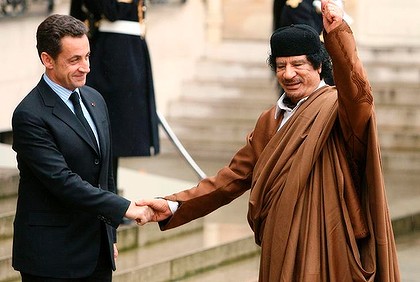
Sarko meets his funder

Evidence has been promised to a French court that could prove former President Nicolas Sarkozy accepted more than €50 million in campaign donations from ousted Libyan leader Muammar Gaddafi.

­Information pointing to the existence of such documents was revealed late last year by Franco-Lebanese businessman Ziad Takieddine. He’s currently facing corruption charges and is under investigation over allegations of his involvement in a money laundering operation between France and the Middle East, in which he is believed to have been involved for 20 years.

“I can provide you with details of the financing of Nicolas Sarkozy’s campaign,” Le Parisien quoted Takieddine as saying. He told the judge the sums involved would exceed €50 million, as Sarkozy’s 2006-7 campaign was “abundantly” financed by Tripoli. The payments continued after Sarkozy’s victory, Takieddine added.

Takieddine’s testimony repeats allegations made by Gaddafi’s son Saif al-Islam and French investigative website Mediapart. Sarkozy has denounced the claims as “grotesque.”

He also claimed to be in possession of “evidence that three French companies in Libya have received contracts for fictitious services” to the tune of “more than €100 million.”

At a December 19 hearing, Takieddine said a number of meetings to organize the payments had taken place in 2006 and 2007 between Claude Gueant, Sarkozy’s chief of staff, and Gaddafi’s private secretary, Bashir Saleh. He said records of these meetings were in the possession of former Libyan Prime Minister Al Baghdadi Mahmoudhi, who is living in exile in France.

Takieddine was apprehended while attempting to take cash out of Libya on a private flight in March 2011, during the NATO-led anti-Gaddafi campaign.

His trial centers on claims that a series of bombings in 2002 in Karachi, Pakistan, were carried out in revenge for the non-payment of bribes agreed during the 1994 sale of a French submarine. The tragedy killed 14 people, including 11 French naval engineers. Takieddine is charged with acting as an intermediary in the deal.

It is alleged that some of the cash involved was transferred back to former Prime Minister Edouard Balladur’s 1995 presidential election campaign. The activities also implicate Nicolas Sarkozy, who was Balladur’s campaign spokesman and budget minister.

If found to be true, the allegations could severely embarrass the former French president, as he together with UK Prime Minister David Cameron played a leading role in instigating the NATO airstrikes that helped topple Gaddafi in October 2011.