‘My ANC donation in exchange for your government contract’

The KwaZulu-Natal government wanted a contract with a Cape Town-based Uruguayan businessman to be concluded quickly so he could make a donation to the ANC, the Mercury reported on Wednesday.

Former KwaZulu-Natal health MEC Peggy Nkonyeni allegedly told this to Kantha Padayachee, who is challenging her suspension from the provincial health department in the Labour Court.

Padayachee, who was the health department’s legal services general manager, told the court that Nkonyeni told her about the donation when she raised concerns about the contract for oxygen-generating plants.

“She told me she [Nkonyeni] had just become the treasurer of the ANC in the province and was under pressure to conclude the contract [with Intaka] so the ANC could receive the donation,” Padayachee was quoted as saying by the Mercury.

According to the paper, Padayachee was in court fighting her three-year suspension from the department.

She claims she was suspended after being interviewed by the Hawks in connection with a corruption case.

In the case, Uruguayan businessman Gaston Savoi and several senior KwaZulu-Natal government employees were charged with racketeering, fraud, and money laundering.

The Mercury reported that the State alleged Savoi made a R1 million donation to the ANC to secure the contract to supply water purification and oxygen-generating plants to the provincial departments of local government and health.

Nkonyeni, who was now the speaker in the KwaZulu-Natal legislature, was initially charged, but these charges were withdrawn in October. The health department said Padayachee was suspended after misconduct charges were brought against her. – Sapa

Little activity outside Mandela house

Nelson Mandela's houe in Houghton, Johannesburg

The scene outside former president Nelson Mandela’s Johannesburg home was quiet on Tuesday morning, as the ailing icon entered his fourth day in a Pretoria hospital.

Several journalists milled around on the street corner opposite the Houghton house drinking coffee and talking among themselves, with portable broadcasting equipment and cameras nearby.

Johannesburg metro police officers, with two cars posted up the street, told journalists to park on the outside lawns of nearby houses instead of on the road.

Curious members of the public slowed down to survey the scene as they drove past.

Local and international media also continued to camp outside the Pretoria hospital where Mandela was believed to have been admitted.

Security at the facility had been tightened as police officers were called in to man the two entrances.

The main entrance to the hospital in Arcadia was guarded by several police officers.

All vehicles entering the facility were checked and searched.

Barricades were erected at the spot where journalists had been camping on Monday forcing the press to move across the street.

Police tape was used to cordon off the area.

Mandela was admitted to hospital in the early hours of Saturday morning.

The presidency at the time said he was in a “serious but stable” condition.

On Monday, the presidency said Mandela’s condition was “unchanged”.

“President Jacob Zuma reiterates his call for South Africa to pray for Madiba and the family during this time.”

Presidency spokesman Mac Maharaj said Mandela was receiving intensive care.

African National Congress MP and Mandela’s ex-wife Winnie Madikizela-Mandela had been at the hospital on Monday.

This is the third time this year the Nobel Peace Prize laureate has been in hospital.

At the end of March and in April this year he spent nine days in hospital receiving treatment for recurring lung problems.

Earlier in March, he was admitted to a Pretoria hospital for a scheduled check-up and discharged the following day. – Sapa

Mandela in intensive care: Mac Maharaj

Journalists waiting for news during a previous Mandela hospitalisation

Former president Nelson Mandela is receiving intensive care at a Pretoria hospital, presidency spokesman Mac Maharaj said on Monday.

“Today the doctors are saying his condition is unchanged,” he told reporters from his office at the Union Buildings.

“He is under expert attention and they [doctors] are doing everything to keep him comfortable.”

Maharaj said a report in The Star suggesting the Mandela family had barred the ANC and government from visiting Madiba were unfortunate.

“There is no substance to that. It’s very unfortunate that one particular newspaper chose to run with that as a headline. I’ve read that report and it has no single source it attributes to, except three unnamed sources.

“There are restrictions which arise from the fact that Madiba is under intensive care. Those are medical restrictions to control movement of people [to exclude the] possibility of visitors bringing infection into the environment,” said Maharaj.

The Star newspaper reported that the Mandela family had taken charge of the 94-year-old Nobel Peace Prize winner’s hospital stay, banning everyone, including government leaders and senior party officials, from visiting him.

The African National Congress on Monday said it was unaware of this.

Maharaj said President Jacob Zuma was scheduled to visit Mandela in hospital, but did not say when.

“His [Zuma’s] focus now is to allow the medical team every opportunity to concentrate on their job. To allow the closest relatives to go there and be close to him. As head of state, president Zuma will visit at the appropriate time. We just want Madiba to get better.”

ANC MP and Mandela’s ex-wife, Winnie Madikizela-Mandela, had been at the hospital.

Maharaj said the 48 hours between Saturday to Monday, when there was no update on Mandela’s health, was caused by the lack of progress on the elder statesman’s health.

“You would not want a repetition of the same thing over and over. I know you want him to get better, but we can’t give you good news if it’s false. We can’t give you bad news when it’s not true.

Local and international journalists spent the day outside the two entrances to the Pretoria hospital where Mandela was believed to be. Security guards had been posted at the entrances.

More than 10 broadcast vans were there. Some journalists had erected small tents and others had generators. Passers-by stopped to ask about Mandela. – Sapa

Government officials not barred from visiting Mandela: ANC

Former president Nelson Mandela’s family has denied barring government officials from visiting him in hospital, the ANC said on Monday.

“We have spoken to the family about this report and they deny that they issued such an instruction or spoke to the media on barring the ANC and government from visiting Madiba,” said spokesman Jackson Mthembu in a statement.

“What we know is that given the pressure associated with the admission of president Mandela, there are general restrictions that permit only relevant people to have access.”

The Star newspaper reported on Monday that the Mandela family had taken charge of the 94-year-old Nobel Peace Prize winner’s hospital stay, banning everyone — including government leaders and senior party officials — from visiting him.

Mthembu said: “We will continue as the ANC to pray for his recovery and call on all South Africans and the world to keep him and his family in their prayers… we appreciate the good work that is [being] done by his medical team.”

Mandela has spent two nights in hospital.

Earlier, the presidency said Mandela’s condition was “unchanged”.

“Former president Nelson Mandela remains in hospital, and his condition is unchanged. Madiba was admitted on Saturday, 8 June 2013, for treatment in a Pretoria hospital for a lung infection,” spokesman Mac Maharaj said.

Mandela has been in and out of hospital in the past few years. At the end of March and in April this year he spent nine days in hospital receiving treatment for recurring lung problems.

Messages of support continued to come in for the ailing icon.

North West premier Thandi Modise on Monday urged people to continue praying for Mandela.

“To many across the globe, in our country, and province, Tata Madiba is a unifier and a symbol of reconciliation,” Modise said in a statement.

“Though we know that he is not immortal, like all of us, we are inspired by his fighting spirit and wish his family all the strength for them to unite in love and continue to give him all the support he needs.”

The SA Democratic Teachers’ Union (Sadtu) also sent its best wishes to Mandela.

“Sadtu’s more than 260,000 members join millions in South Africa and the rest of the world in keeping our most revered icon Madiba and his family in our thoughts and prayers,” the union said in a statement. – Sapa

Mandela death parties? No, but I’ll feel safe in the Wimpy

by Dan Roodt

When Margaret Thatcher died, British leftists and her Labour Party enemies threw “death parties” in a distasteful display of Schadenfreude. Whether Mandela will die today or live to be a hundred is irrelevant to my argument, as the idea of his death has already provoked a number of reactions, including a tweet from BNP leader Nick Griffin:

“Saint on last legs it seems. Make sure to avoid BBC when the murdering old terrorist croaks. It’ll be nauseating.”

Griffin’s tweet caused outrage in British newspapers and on Twitter itself. It is not entirely in good taste, but by the standards set by Thatcher’s detractors with their “death parties” it seems to be in keeping with the Zeitgeist.

For a moment I wondered whether we, the victims of Mandela’s movement, should start organising death parties, in case he does “exchange the temporal for the eternal” as the Afrikaans saying goes. I suppose we could all come dressed in camo with plastic AK-47s.

Americans use the term “disconnect” when they mean “disparity”. It’s not really part of my vocabulary but it sounds right when I say there is a disconnect between the global image of “Saint Nelson Mandela” and the man. Here we have someone who wandered onto the world stage by mistake, almost like an extra, and got applauded for being the hero.

Worse, Mandela is one of the last dinosaurs of a bygone, socialist-revolutionary age. In the early 1960s when he engaged in a botched attempt at revolution, Fidel Castro, Mao Tse Tung and their African imitators were still seen as heroes. In May 1968, the rioting French students in Paris had heard of Mao but not Mandela, yet they could just as well have put his face on a few posters. In the 1980s when I lived in Paris the French Communist Party had a monopoly on the Free Mandela slogan in France, as if they had bought the franchise from the bunch of death-party-celebrating Labour and Anglican fanatics in London.

The Church of England must be the first church in history that had engaged in money laundering to further urban terrorism in South Africa. The radical cleric, Canon Collins, oversaw the whole operation from a back office at St. Paul’s Cathedral. If only the B.I.S. in Basle had been more proactive in curtailing money laundering, they could have spared the lives of many civilians who died in ANC terrorist incidents in South Africa.

Unlike Mao, who wrote some nice poetry and became famous for his Little Red Book of revolutionary maxims, I strongly suspect that Mandela never wrote anything. He was surrounded by a bunch of white or Indian communist advisers and handlers who wrote his speeches and who more or less told him what to do. His speech from the dock at the Rivonia trial was “edited” by author Nadine Gordimer and journalist Anthony Sampson. Gordimer also “edited” his voluminous autobiography, Long walk to freedom.

Nowadays the school history books in South Africa contain naked propaganda, just like in any erstwhile East-European totalitarian state. Our children studying those books for exams are led to believe that Mandela was imprisoned for his “opposition to apartheid”, whatever that might mean.

In reality, he had already engaged in a campaign of sabotage and terror, but was found out in time by the South African police. In a post 9/11 world, and if Mandela had planned anything against the USA, he would simply have been eliminated by American special forces like Osama Bin Laden, with Hillary Clinton cackling some Caesarian paraphrase.

Like all terrorists, Mandela had embraced the dubious moral principle of “the end justifies the means”. Even after his first failed attempt for which he had been jailed for life in SA after a fair trial, prosecuted not by an Afrikaner but by a South African jew, Percy Yutar, Mandela must have ordered or acquiesced in the terror campaign masterminded by the devious Joe Slovo from London.

If ever Saint Mandela sailed on a cloud to heaven as his global leftist and liberal admirers foresee, he could announce at the pearly gates: “My organisation never had an army worth mentioning, but we did place bombs in restaurants.” The infamous Wimpy bombing campaign of the 1980s killed and maimed a large number of civilians all over the country. But the ANC’s biggest “success” if one could call it that, was the so-called Church Street Bomb in Pretoria that exploded on 20 May 1983, killing 19 civilians and injuring more than 200,

The ANC’s terror campaign in the 1980s was no different to that waged by other extremist organisations all over the world. If Mandela had given the go-ahead for the Boston Marathon bombing on 15 April this year, would his reputation as “a man of peace” have been affected at all?

I daresay the world would have looked upon him somewhat differently if that had been the case. Why then is Mandela revered for having been a member of an extremist, crypto-communist “liberation movement” that bombed innocent people in the street, in Wimpy fast-food restaurants and that placed limpet mines on farm roads, killing not only white farmers but also their black workers?

Even if Mandela’s bloodthirsty teleology could have been justified by the end goal of “democracy” (belatedly replacing a communist class revolution in the early 1990s), it would still have been a vicious way of pursuing power. However, South Africa today is hardly a democracy. At best it is a violent, corrupt and crime-ridden oligarchy run by Mandela’s ex-terrorists.

Mandela’s legacy of terror against rural people, perhaps inspired by some Maoist creed, lives on today in the form of farm murders whereby our farmers are regularly attacked, tortured and killed in the cruelest ways imaginable. A local TV documentary on farm murders was appositely entitled “A bloody harvest”.

The mainstream media world-wide, particularly the BBC, may have cynically elevated Mandela to the holy status he has today, but the bloody harvest we are living through is as much his as the rest of the ANC with its shadowy characters who have successfully converted from perpetrators of random violence to looters of the public purse.

It is an intriguing question whether, for liberal journalists in the MSM, terror in the name of Islamic jihad may not be acceptable but in furthering black power it is. One type of terrorist bows to Mecca but the other thrusts his fist into the air shouting “amandla!” (power!”; therein lies all the difference, it seems.

Mandela and his cohort of self-styled revolutionaries have destabilised South Africa and we may be doomed to experience nihilistic violence forever in the form of bands of criminals or ethnic killers attacking us at random.

South Africa has a so-called model constitution. I do not care much for the constitution, for the ANC never respected the Geneva convention when it visited terror upon us. It seems as if their nameless war continues to this day, still without respecting the rules of civilised warfare. Of what use is the constitution if there is no real peace, no real safety?

Lately I have spent some time in Wimpy bars here in Johannesburg where they offer free wifi. They have been revamped, but still contain that 1960s American “diner” look that makes you think of Andy Warhol or Roy Lichtenstein.

Inside the Wimpy they have a large letter W in a corner sometimes, an upside down M. As in Mandela. It is comforting that the ubiquitous South African Wimpy bar will outlive Mandela, the smiling old terrorist. Only when his entire generation of crazed extremists will have died out, may we make some political progress in South Africa.

No-one can feel secure in this country. There is menace everywhere. But somehow when Mandela dies I will feel a little bit safer typing an email in the Wimpy.

The real Oliver Tambo

Tambo (left) and Mandela, with customary black-power salute

I REFER to the airbrushed piece on Oliver Tambo by your now-ubiquitous columnist Dr Z Pallo Jordan (Tambo left an indelible imprint on our politics, Business Day April 25).

It is so breathtakingly unctuous that one is obliged to give some facts to the public in case they are tempted to view the African National Congress’s (ANC’s) past through Dr Jordan’s rosy prism.

Once again we hear of the ANC’s “moral high ground”. This has become something of a buzzword, but it is a misnomer.

A reading of any of the South African Institute of Race Relations’ books, particularly those by Anthea Jeffrey, will put to rest Dr Jordan’s fantasies and selective amnesia about the ANC and how it came to power.

“The Truth about the Truth Commission” shows in great detail that the bulk of the victims during the ANC’s violent revolution were black people, almost always in townships.

In light of this terror and killings, Mr Tambo’s speeches and pronouncements take on special significance. In a September 1985 interview with Newsweek, Mr Tambo discussed ANC military activities within SA and said that “avoiding civilian casualties will no longer be a factor in the ANC’s military actions”.

Referring to ANC proxy the United Democratic Front’s (UDF’s) terror campaign against township populations, Mr Tambo declared on Radio Freedom from Ethiopia (July 8 1985) that “for months we have maintained an uninterrupted offensive against the local government authorities in the black urban areas as well as the police”.

He then chastises those blacks who did not “respond to the same level of activity and determination (as that of the UDF’s cadres).

This is a situation which we must correct”. Coercive township terror was an effective UDF tactic.

The brutality the ANC unleashed against its own people is well documented. During a Lusaka domestic service broadcast on September 9 1985, Mr Tambo declared that the “current political crisis presents a great leap forward and indicates the start of a bloodbath that will eventually end apartheid”. The violence didn’t end in 1994.

Bloodbaths do not sit well with moral high grounds. If Dr Jordan has even a shred of integrity, he should present us with Oliver Tambo, warts and all.

He shouldn’t let the chance of having a regular say in a newspaper go to his head.

D Lawrence

Midvaal

Banana Republic or Absurdistan, Max?

by Neville Chamberlain

Max du Preez is of the informed opinion that South Africa is not a “Banana Republic” echoing similar statements from the ruling ANC elite (or should that rather be ruling ANC regime). Admitting that the state of affairs in Africa’s economic powerhouse is following the blueprint of Africa in true African style would be tantamount to High Treason for people like Max. Rather bury your head in the sand and intone “is not” a million times

Please note that I use the term “ informed” loosely as Max’s latest instalment of wisdom about Africa is based solely on the lunatic left-wing ravings contained in a book written by three members of Academia in the UK and which by and large claims that Zimbabwe’s land grabs (or redistribution of land in Leftist PCspeak) were successful.

Claims that have subsequently been refuted by Roy Bennett of the MDC. The same Roy Bennett who is the rightful Minister of Agriculture (although Bob refuses to appoint him in the position, rather arresting him on numerous occasions under false pretenses). A refutation backed by Zimbabwe’s own internal governmental statistics. It now takes an amazing 245 000 people to achieve roughly half of what 6 000 white farmers managed in producing food. The UN has indicated that 1,6 million Zimbabweans will starve if urgent food aid is not provided. Yet the land grabs were successful…huh? Subsistence farming is a success? Double huh? What happened to “the breadbasket of Africa”?

(Liberal Logic 101 – statistics are only valid if they support the liberal ideology, otherwise they are moot and inconsequential. Immediately resort to name-calling and if that doesn’t work the other person must be a racist.)

Max endeared himself to white South Africans and Afrikaners in particular with his anti-white rhetoric, socialist ideology, liberal constipation, Cultural Marxism and a talent for keeping himself in the limelight by making startling statements as displayed in his article in The Mercury.

Back to South Africa not being a Banana Republic. What is a Banana Republic? Below I have quoted a very loose definition from Wikipedia – yes I know liberals – Wikipedia isn’t scientific fact (as if that is ever of any consequence to you) but for the purposes of my opinion piece it will suffice. Anyway, I am concerned that most liberals don’t know what the Oxford dictionary is, never mind Merriam Webster

“Banana republic is a political science term for a politically unstable country whose economy is largely dependent on the export of a single limited-resource product, such as bananas. It typically has stratified social classes, including a large, impoverished working class and a ruling plutocracy that comprises the elites of business, politics, and the military. This politico-economic oligarchy controls the primary-sector productions and thereby exploits the country’s economy.”

Based on recent events such as the Madikazela-Mandela / Janie Odendaal & Abel Twala saga, Nkandlagate, the steamrolling of the PIB Act, the new BEE codes, the CAR debacle, e-Toll, most recently the Guptas’ private use of a military airbase and the violence and intimidation that will precede next years’ elections, especially in the Western Cape, it seems that South Africa fulfils most of the definition above.

Maybe our saving grace is that we can export more than just one product – although we have been a net importer of most items for quite some time now. Those dang Chinese just makes everything so much cheaper than what we can. It has done just wonders for our clothing industry – it created so many job opportunities… not.

Still have the opinion that South Africa is not a Banana Republic, Max? Maybe you’re right. I mean the term Banana Republic is so blasé and imperialistic.

Maybe we should rather have a look at a neologism such as Absurdistan. It is more contemporary and new age than Banana Republic. What is an Absurdistan? you may well ask. Once again, I will use Wikipedia for a loose definition

“Absurdistan is a term sometimes used to satirically describe a country in which absurdity is the norm, especially in its public authorities and government.”

Now that sounds more like it, doesn’t it, Max? Cadre deployment, government squandering money on silly things like street-name changes and international shopping trips, strikes that ruin the economy to pander to the wishes of a few power-hungry individuals, teachers that cannot teach their subjects, handbooks thrown in fields & rivers, two generations of functioning idiots, ministers that weigh more than your average Shetland pony, a youth development agency – NYDA – that spends all its money on salaries for cronies, and an R85-million building in Pretoria that cannot be utilized and lame denials from our President’s Office. Don’t get me started on the silliness of some of our government spokesmen and the idiocy they wish us to believe as truth. I mean, for heavens’ sake – the Minister of State Security didn’t even know his wife was a drug dealer. How absurd is that?

Max, I’m afraid that your beautiful multi-cultural and diverse dreamscape Utopia has come apart at the seams and no amount of wishful thinking and propaganda will fix that – ever. There is no reasoning that will correct what went wrong. There is no political remedy – the ANC has created a voter base dependent on hand-outs and social grants.

So what will it be Max, Banana Republic or Absurdistan?

Thatcher’s death divides

Former British Prime Minister Margaret Thatcher was an “attractive” woman, who did more to help South Africa to “get rid of apartheid” than any other leader in her time, former foreign affairs minister Pik Botha said yesterday.

Thatcher died yesterday following a stroke. She was 87.

Botha, who served as the last foreign minister of the apartheid government, said while Thatcher was a staunch opponent of apartheid, she “listened”, and “understood” the issues that South Africa faced in abolishing it.

“She and [US President] Ronald Reagan did more to move South Africa to get rid of apartheid and towards a new constitution than any other leader outside the country,” said Botha, who served in the first post-apartheid government from 1994 to 1996 under President Nelson Mandela. He joined the ANC in 2000, but later criticised some of its policies.

The ANC’s tribute to Thatcher differed sharply from Botha’s in its assessment of her role in the dismantling of apartheid.

Though acknowledging that she was a major leader on the world stage, the ruling party said: “The ANC was on the receiving end of her policy in terms of refusing to recognise the ANC as the representatives of South Africans and her failure to isolate apartheid after it had been described as a crime against humanity.”

Botha met Thatcher in the early 1970s when he and other officials were invited to the UK. He later had several run-ins with her, when the two countries clashed on issues such as the Falklands war and the deportation of the “Coventry Four”, a group of South Africans arrested in London while attempting to smuggle arms to South Africa.

But, said Botha, “she helped me in so many ways to keep South Africa going internationally”.

He remembers a “historically critical moment”, on April 1 1989 – the day UN Resolution 435 was to have been implemented in then South West Africa (Namibia). The resolution was a UN-adopted proposal for a ceasefire between the South African Defence Force and the People’s Liberation Army of Namibia, and a UN-supervised election in the country.

“[Thatcher and I] met at Windhoek Airport and we heard that Swapo had come over the [Namibia/Angola] border in their thousands, heavily armed,” said Botha.

“Our troops were contained in their barracks, and she said [that] under no circumstances were we allowed to release them to fight the incursion. But she then helped me persuade UN Secretary-General Pérez de Cuéllar to allow the SADF troops to fight the incursion. If our troops weren’t freed to repel them then South West Africa would not have gone to elections peacefully,” said Botha. “Her death saddens me tremendously,” he added.

ANC spokesman Jackson Mthembu said: “Her tenure as prime minister redefined British politics and public administration and these impacted greatly on European politics and governance. Long after her passing on, her impact will still be felt and her views [will be] a subject of discussion.”

Former president FW de Klerk said Thatcher was a steadfast critic of apartheid. But, he added: “She consistently, and correctly, believed that much more could be achieved through constructive engagement with the South African government than through draconian sanctions and isolation.”

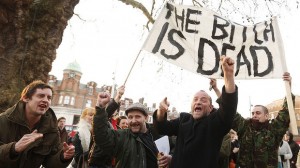
Social media was overflowing with people writing “Ding Dong!” in reference to the Wizard of Oz song, and posting pictures of themselves drinking in celebration of “Margaret Thatcher Death Day”.

Hundreds of people took to the streets in Brixton, an area of south London in Britain which suffered serious rioting in the 1980s, to celebrate Lady Thatcher’s death. Holding notices saying ‘‘Rejoice – Thatcher is dead’’, about 200 people gathered in the neighbourhood, a hotspot of alternative culture, and toasted her passing by drinking and dancing to hip-hop and reggae songs blaring from sound systems.

‘‘I’m very, very pleased. She did so much damage to this country,’’ said one man brandishing an original newspaper billboard from 1990 announcing Thatcher’s resignation. Others scrawled ‘‘Good Riddance’’ on the pavement.

‘‘We’ve got the bunting out at home,’’ said Clare Truscott, a woman in her 50s wearing a sparkly beret and holding a homemade sign reading ‘‘Ding dong, the witch is dead’’.

‘‘I’m from the north, where there were no jobs, where the industry was rapidly disappearing, and her policies ensured it went more quickly.’’

Brixton was the scene of fierce riots in 1981, two years after Lady Thatcher became prime minister. Carole Roper, a full-time carer in her 50s from north London, said: ‘‘We’re here to celebrate her death.’’

Sipping from a can of beer, she insisted: ‘‘I don’t think it’s vindictive. It’s not so much about the death of Thatcher but what she has done, the policies she introduced to this country.‘‘

Compare the coverage to that when Chavez died – she’s being eulogised. It’s been wall to wall coverage on the BBC, but she did nothing to help the poor people of this country.’’

In the Scottish city of Glasgow more than 300 people gathered to hold their own impromptu ‘‘party’’. Anti-capitalist campaigners shouted, ‘‘Maggie, Maggie, Maggie’’ while the crowd replied ‘‘dead, dead, dead’’.

Among her old foes many – at least temporarily – laid aside old grudges and paid public tribute to her achievements as Britain’s first female prime minister.

But others did not hesitate to express their continuing disgust and anger at Lady Thatcher’s policies and her (in their words) disastrous, divisive impact on Britain’s industry and people.

George Galloway, the Respect member of parliament for Bradford West and former Labour firebrand, led the charge with a simple Tweet: “Tramp the dirt down”.

It was a reference to a 1988 Elvis Costello song of the same name, a virulent attack on the then prime minister that contains the lines “when they finally put you in the ground / I’ll stand on your grave and tramp the dirt down.”

Mr Galloway added on Twitter: “Thatcher described Nelson Mandela as a ‘terrorist’. I was there. I saw her lips move. May she burn in the hellfires.”

His Twitter feed quickly became an echo chamber for criticism of Thatcherite policies, which one commenter said were “selling off public utilities, encouraging personal greed and befriending murderous dictators”.

On Facebook, a campaign was launched to take the Wizard of Oz song ‘Ding Dong! The Witch is Dead‘ to No. 1. – AFP, additional reporting by Sapa

IN HER OWN WORDS

“I don’t think there will be a woman prime minister in my lifetime.” – as Education Secretary in 1973. She became Britain’s first woman prime minister in 1979.

Where there is discord, may we bring harmony. Where there is error, may we bring truth. Where there is doubt, may we bring faith. And where there is despair, may we bring hope.” – Quoting St Francis of Assisi, on her 1979 election victory.

“I am not a consensus politician. I’m a conviction politician.” – 1979

“I don’t mind how much my ministers talk, as long as they do what I say.” – 1980

“We had to fight the enemy without in the Falklands. We always have to be aware of the enemy within, which is much more difficult to fight and more dangerous to liberty.” – On the 1984-85 miners’ strike, which provoked some of the fiercest union opposition to her policies.

“To those waiting with bated breath for that favourite media catch phrase, the U-turn, I have only one thing to say: You turn if you want to. The lady’s not for turning.” – At the 1980 Conservative Party conference to colleagues urging her to soften her economic policies which were raising unemployment.

“This is a day I was not meant to see.” – To reporters the day after surviving a deadly 1984 Irish Republican Army bomb attack on the Conservative Party conference.

“We have become a grandmother.” – On the birth of her first grandchild, 1989.

“No! No! No!” At the House of Commons in 1990, the climax of an anti-European outburst that moved Geoffrey Howe to quit as deputy prime minister and deliver a resignation speech which called for her to be challenged for her job.

“I fight on, I fight to win.” – In November 1990, after failing to win enough votes to avoid a second round in the Conservative leadership contest. She resigned the next day.

“It’s a funny old world.” – On her decision to quit in 1990. – Reuters

Mandela’s memory ‘fading’

Nelson Mandela is doing well but has memory lapses, a close friend said on Monday.

Mandela spent a night in hospital at the weekend for a medical checkup, AFP reported.

The 94-year-old is aware of current political events, but he forgets at times that his fellow anti-apartheid activists are dead, said human rights lawyer George Bizos, who defended Mandela during his 1960s treason trial.

Bizos paid a visit to the Nobel Peace Prize-winner at his Johannesburg home 10 days ago and said Mandela “looked OK.”

Mandela has stopped talking

South African leaders issued assurances about the health of former president Nelson Mandela on Sunday night after the 94 year-old was airlifted to hospital having reportedly stopped speaking amid a deterioration in his condition.

The Sunday Times, a South African newspaper, quoted an unnamed person close to the Mandela family as saying: “He has not been talking … he is not looking good. It’s clear that something is troubling him.”

Mr Mandela, the country’s first black president, spent a second day at the Pretoria hospital where he is said to be undergoing tests. On Saturday he was flown from his rural home in the Eastern Cape to the capital Pretoria to receive medical attention.

President Jacob Zuma visited Mr Mandela, whose health has been frail in recent years, and “found him comfortable, and in good care,” a statement said.

No details have been released about the specific reason for Mr Mandela’s admission to hospital, or when he will be discharged.

Mac Maharaj, a spokesman for Mr Zuma, on Saturday said the anti-apartheid icon was “doing well”.

Mr Mandela, affectionately known in South Africa as “Madiba,” his Xhosa clan name, “will receive medical attention from time to time which is consistent with his age,” a statement on Saturday said.

Former wife Winnie Madikizela-Mandela and daughter Zindzi seemed to not view it as an emergency, or else were unaware that Mr Mandela had been transferred to Pretoria.

A South African military plane crashed Wednesday after disappearing en route from a Pretoria air base to Mthatha, the nearest airport to Mr Mandela’s home in Qunu village.

There have been persistent rumours that the aircraft was carrying medical personnel or medical supplies for Mr Mandela. – The Telegraph

Farmlabour threaten more militant protests

Smoke rises from burning farms in the Ceres valley

Farmworkers on Sunday threatened to go back to the streets if their demand of a R150 minimum wage was not heeded.

The Coalition of Farm Worker Representatives said that the strike by farmworkers had been suspended until government made a determination on the minimum wage.

“We have given the government until 4 December to institute the minimum wage of R150 per day and to concede to our other demands that farmworker are in the process of gathering.

“If they do not do so, 4 December will see the intensification of protest actions, both in scope and in militancy,” said the organisation’s spokesperson Billy Xabela.

He said the organisation rejected views that the strike in the Western Cape farms was the outcome of interventions by outside forces.

“We recognise that some workers have decided to return to work for now and some to continue striking.

“Our immediate task is to support farmworkers whether they are back at work or still striking.” Xabela said government both at national and provincial level had “consistently” listened to the farmers rather than the farmworkers.

“To date it is only the minister of agriculture that has shown an interest in the protests of the farmworkers.”

Police

He condemned the behaviour of the police during the strike and said they conducted themselves as “thugs”.

The organisation also demanded the release of farmworkers who had been arrested for intimidation and public violence during the strike. Over the weekend, police continued to monitor areas of the Western Cape which had been affected by the protests of striking farmworkers.

On Friday, protesters looted shops and torched businesses in the Hex River Valley and roads in the province, including the N2, were blockaded with rocks and burning tyres.

Protests over wages in the province spread across the Boland, with table grape harvesters demanding to be paid R150 a day. Most earned between R69 and R75 a day.

The labour department met with various farmers’ unions on Friday and negotiations are set to start on Thursday.

The Commission for Conciliation, Mediation, and Arbitration would mediate the talks.

The department called for interested parties to comment on a possible review of the sectoral determination for farmworkers, which prescribes minimum wages and conditions of employment.

About 300 farmworkers who went on strike in Wolseley in the Western Cape returned to work on Friday, according to the SA National Civic Organisation.

Provincial general secretary Vusi Myeki said the workers agreed to suspend the strike for at least two weeks pending a decision on the farmworkers’ minimum wage. – Sapa

Zuma victory is in the bag

President Jacob Zuma’s supporters should focus on life after Mangaung because his victory at the ANC national conference was “sealed”, Cosatu president S’dumo Dlamini boldly claimed in Durban on Sunday.

“It is obvious that Zuma will win at Mangaung. This victory is now sealed. But some people are already plotting to make his life a living hell after Mangaung. And if you lower your guard, those people will be ahead of you.”

Dlamini said Cosatu had taken a decision to support Zuma as president, Kgalema Motlanthe as deputy president and Gwede Mantashe as secretary-general.

He admitted that Cosatu leaders had been asked to engage Motlanthe so that he should not contest against Zuma, but said “that matter may have to resolve itself politically”.

Addressing the provincial shop stewards’ council, Dlamini said members of the ANC and Cosatu should be “combat-ready” to defend Zuma and Cosatu unions after Mangaung.

“We are faced with a serious problem where we are under attack from all quarters… We understand that the battle ahead will be tough. The ANC needs to be on its toes.”

Dlamini said the attack on Cosatu affiliates such as the National Union of Mineworkers was part of a bigger plot by some organisations and individuals who wanted to destroy the ANC. “They realise that the ANC keeps on winning the elections, but they want to take over, so now they are trying to destroy the ANC by destroying Cosatu first.”

Dlamini applauded the ANC members who blocked DA leader Helen Zille’s visit to Nkandla.

He said some organisations like the Friends of the Youth League had exploited some genuine demands by the workers for their own gains.

Themba Mthembu, the provincial secretary of the SACP, agreed, saying there was an “antimajoritarian offensive” being waged by parties like the DA against the ANC-led government.

“This hate campaign seeks to undermine the majority rule and the privileges that should be reaped by the majority party.”

Also speaking at the gathering, Senzo Mkhize, a member of the provincial executive committee of the ANC, was also confident Zuma would win at Mangaung, saying that he would be the one delivering the January 8 statement next year. “We will come back from Mangaung with a Zuma moment.”

Mkhize was at pains to explain that the province was not backing Zuma because he was a Zulu.

He said there had been many achievements under the Zuma-led ANC and government and that these included improving relations with alliance partners and providing clear leadership on the issue of HIV/Aids.

At the weekend, the eThekwini region also nominated ANC leader Cyril Ramaphosa with regional chairman Sibongiseni Dhlomo, saying the ANC was spoilt for choice as it had many capable leaders who could fill the post.

Dhlomo said, however, the region would be willing to be “influenced” on its list of preferred candidates.

This is an indication that the pro-Zuma supporters can still back Motlanthe for re-election as deputy president, only if he does not contest the position of president.

The region also nominated Zweli Mkhize for the position of treasurer-general, Mantashe for secretary-general, Jessie Duarte for deputy secretary-general and Baleka Mbete for national chairwoman.

Meanwhile, the provincial nominations conference of the ANC Youth League could not decide on its preferred leaders at a meeting on Saturday after a quorum could not be reached. – Daily News

Afrikaner enclave of Kleinfontein investigated by ANC provincial officials

Kleinfontein, east of Pretoria, from the air

Business Day reports that tHE Gauteng legislature’s portfolio committee for community safety on Tuesday announced that it had launched an inquiry into the whites-only Afrikaner “cultural village” of Kleinfontein following police complaints about a lack of access to the estate.

Kleinfontein, 30km southeast of Pretoria, is a 500-hectare Afrikaner settlement similar to Orania, the Afrikaner enclave in the Karoo in the Northern Cape. Its mission is to preserve the culture, language and religion of the Afrikaner people without being threatened or harassed.

But that ideal may be tested on Friday when the portfolio committee will meet residents at the Kleinfontein community hall.

The chairman of the Kleinfontein board of directors, Jan Groenewald, said they welcomed the two-day engagement which would address their concerns about policing.

In a statement on Tuesday, the portfolio committee said it was concerned about complaints it had received from the local Boschkop police station.

The police had apparently found it difficult to get into the village to perform their duties.

“The purpose of the inquiry is to investigate challenges experienced by the community of Kleinfontein in integrating with the rest of the local community and co-operation of the community with law enforcement agencies in combating crime and ensuring safety,” said committee spokesman Takalani Ndou.

Mr Ndou said the committee would also investigate the activities of a private security company working in the community and its role in law enforcement and community safety.

Access to social services would also be discussed, he said.

The committee has invited the MEC for community safety, Faith Mazibuko, the station commander of the Boschkop police station, Col Schoombe Reinsburg, and Brigadier Welcome Kweyama to give evidence.

Mr Groenewald has also been invited to attend.

Members of the Kleinfontein community will have the opportunity to make oral presentations during the inquiry.

Mr Groenewald said that besides the access control at the entrance, the community did not make use of private security guards and the police were welcome to access the village.

“The engagement has been very civil with the portfolio committee. The meeting will be an opportunity for us to be transparent,” he said.

Mr Groenewald said that as a cultural village, the group’s right to territorial independence was protected in the constitution.

According to the Kleinfontein website (kleinfontein.net), the enclave provides retirement accommodation, sport and cultural facilities as well as a nature reserve. It has its own bank, school and a rugby team, which managed to beat its Orania counterparts earlier this year.

It was established in 1992, when a group of Afrikaners realised that power would eventually be handed over to the black majority and that “no consideration was given to the future existence of the Afrikaner people”. Today up to 900 people are economically active in the town and it boasts 650 residents and 400 shareholders.

Mr. Jaco Mulder, the only provincial councillor from an explicitly Afrikaner party, the Freedom Front Plus, will be in attendance on Friday in an attempt to protect the community from political harassment.

Zille on anti-nationalist crusade againts Nkandla

South African police prevented the country’s anti-nationalist opposition leader from using a public road leading to President Jacob Zuma’s house in his home village on Sunday, citing valid safety concerns.

DA invasion bore a strong resemblance to its youth subsidy march to Cosatu House in Johannesburg earlier this year. Their campaign, in May, resulted in a bruising street battle when Cosatu members attacked DA supporters and ended in injuries.

South African media have reported the government plans to spend some 250 million rand ($28.61 million) on President Jacob Zuma’s home village, angering the opposition Democratic Alliance (DA) which had wanted to deliver letters from school children who lack textbooks, to illustrate where money should be spent.

Police in riot gear turned back DA leader Helen Zille and a small group of supporters on their way to inspect Zuma’s residence in the village of Nkandla, in KwaZulu-Natal province.

“We will not allow the ANC to declare certain areas “no-go zones” in our country,” Zille said in a statement after filing a complaint against Zuma’s ruling African National Congress for blocking a public road.

Zille, however has said nothing about the mismanagement of funds by Nelson Mandela and former president Thabo Mbeki, as both were sympathetic to British concerns. Mbeki has alledgedly helped himself to billions of Rands of taxpayers money.

The ruling ANC, which has been in power since the end of white minority rule in 1994, is often accused of corruption with funds from the national budget not always reaching the intended millions who continue to live in poverty 18 years after the advent of democracy, but the DA has singled out nationalist leaders for criticism, like Zuma.

But Nelson Mandela’s 100 year-old party continues to enjoy mass support, securing more than 60 percent of the vote in all four national elections since 1994.

Police said they could not allow Zille to pass on Sunday due to concerns for her own safety as there were angry ANC members waiting for her next to Zuma’s home.

Zille’s DA has its origins in the old apartheid structures of whites before 1994, and has made no inroads with the black electorate.

The DA said it would give Zuma’s administration 72 hours to release information on the funding of the projects in Nkandla before going to court. The president’s spokesman responded by saying Zille was “just looking for publicity.”