Free Clive! The adulterous Limpho Hani exploiting her ‘pain’

The adulterous Limpho Hani, exploiting her 'pain'
The adulterous Limpho Hani, exploiting her ‘pain’

Clive Derby-Lewis, one of the men convicted of killing SACP secretary general Chris Hani, should be freed, the Front Nasionaal (FN) said on Saturday.

Derby-Lewis is South Africa’s most famous remaining political prisoner, said the group’s deputy leader Dan Roodt in Pretoria, where a march was being held by the convicted killer’s supporters.

In demanding his release, the Afrikaner FN emphasized that it did not mean this as a political statement.

“That might seem like a paradox. Clive is, after all, a consummate politician, a statesman and a leading figure of the conservative movement in South Africa,” said Roodt.

The FN believed freeing Derby-Lewis was the right thing to do.

They demanded his release in the name of “justice, in the name of God or Christian charity and in the name of civilised values”.

“For such an appeal to reason and reasonableness, they will call us right-wing. Or fascists. Or boorish Boers. But we reject all labels and slogans,” Roodt said.

Hani was shot dead in the driveway of his home on April 10 1993.

Derby-Lewis, who was sentenced to 25 years behind bars, has already served more than 20 years of his sentence.

The 78-year-old man, who has been diagnosed with cancer, has twice been denied medical parole.

The SA Communist Party in the Western Cape were due to hold Chris Hani memorial lectures on Saturday.

“…Twenty-one years ago, comrade Chris was assassinated by ignorant cowards outside his residence in Boksburg,” provincial spokesman Masonwabe Sokoyi said in a statement.

He did not comment on millions of “ignorant cowards”, Germans and Eastern Europeans who welcomed the end of communism.

“In the month of April all SACP structures commemorate and pay homage to a virtuous and humble leader of the working class.”

Both the “virtuous leader” Hani and his wife Limpho were having extra-marital affairs when Hani was shot, however.

The SACP supported virulent action against the adulterous comrade Zwelizima Vavi, head of Cosatu.

The 50-year-old Vavi has been fighting to keep his job over the past few months after a probe into whether he is still ­suitable to lead.

This is not the first time the married father of six – from both his current and previous marriages – has been accused of sexual misconduct.

In 2006, then Cosatu president Willie Madisha compiled a dossier in which he ­accused Vavi of sexually harassing a married female Cosatu employee. The charges did not stand then.

Around the same time, Vavi was also accused of using the federation’s ­credit card to bankroll an extra-marital affair, using it to splurge on his and his mistress’ foreign trips without the federation’s knowledge.

City Press reported on how her distraught former husband Bheki Ngema tried in vain to get Madisha to institute disciplinary proceedings against Vavi, and to force Vavi to fork out R700 000 “as compensation so my children would not suffer much”.

Vavi, who lives in Sandton, is thus not a paragon of virtue on matters ­sexual, and his 14-year career in the federation could come to an end.

The extramarital affair could force him out as Vavi is also swimming against the political tide.

Cosatu’s general secretary is also not the first local politician to be embroiled in a sex or rape scandal.

Here are some others:

» Jacob Zuma

In December 2005, Zuma was charged with the rape of an HIV-positive family friend in what was to become one of the country’s major sex scandals in recent history. He was acquitted in May 2006.

» John Steenhuisen

The DA’s KwaZulu-Natal leader was forced to resign in 2010 after an affair with the party’s provincial spin doctor Terry Kass-Beaumont became public.

» Narend Singh

News of the 2006 sex scandal followed the emergence of a DVD of a tryst between Singh and Roseanne Narandas, wife of jeweller Bob Narandas.

By then, the DVD had been sold around Durban for weeks.

Singh resigned his post as Kwazulu-Natal MEC for arts, culture and tourism, but remained a member of the provincial legislature for the IFP.

» Fikile Mbalula

In 2011, the sports minister had an affair with model Joyce Molamu, whom he paid R10 000 to have an abortion. They had sex twice, said Mbalula, who publicly apologised.

» Malusi Gigaba

The public enterprises minister was sued for R1.7 million in 2011 by a friend, Luka Sandhlane, for having an affair with his wife and ruining their marriage. Gigaba apologised to Sandhlane, who reconciled with his wife.

» Albert Mncwango

The former IFP national organiser had his rape conviction and 10-year sentence overturned by the Pietermaritzburg High Court in 2005. Mncwango – who spent 19 days in jail before successfully appealing – said the rape charge was trumped-up to destabilise the IFP’s elections campaign at the time.

» Mbulelo Goniwe

Goniwe was axed as ANC chief whip and MP in 2006 after being found guilty of sexual harassment. He asked ANC parliamentary administrative assistant Nomawele Njongo to have sex with him after she helped serve dinner to guests at his home.

» Jonas White

The Cederberg mayor was kicked out of the ANC last month for allegedly sending an image of his genitals “embellished with a strawberry and cream” to his deputy, Lorna Scheepers. He is also facing a criminal investigation for alleged sexual harassment.

But Chris Hani strangely has not been knocked off his perch.

It is alleged that Hani still enjoys the protection of advocate Gerrie Nel, the Oscar trial star, and advocate George Bizos.
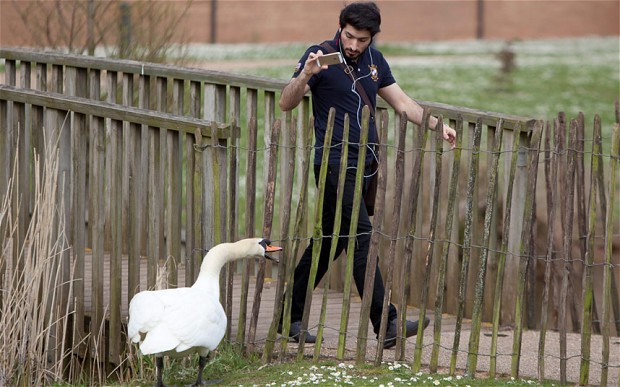
White wing swan attacks students of colour

whiteswanWarwick University has erected a fence around a campus lake to stop a spate of swan attacks on students.

A 4ft tall bird, which boasts an 8ft wingspan, has been accused of behaved aggressively towards foreign students as they cross over a footbridge near its nesting place at the university’s Gibbet Hill campus in Coventry, West Midlands.

The footbridge is used by hundreds of students everyday as a route between accommodation and university buildings. Undergraduates revealed that the swan only appeared to target students from ethnic minorities.

One 24-year-old student from India said: “These swans are very annoying, and the students feel as though they’re being bullied.

“I’m from India, and they attack me especially, they focus straight on me.

“We’ve been warned that the swans will be a bit feisty at this time of year, but they go for me all year round.
“I think they don’t like too many Indians in England – maybe the swans here are a little bit racist.”

Italian student Albertina Crocetti, 24, who is studying Physics with Business Studies, said: “It’s bizarre, she doesn’t seem to like foreigners and attacks them to defend her nest.

Source: The Telegraph

SA’s killing fields

South Africa still has one of the highest murder rates in the world with 31 murders per 100000 people in 2012 – five times the global average of 6.2 per 100000, according to the UN Office on Drugs and Crime’s latest report, released yesterday. 

murdersCrime statistics released by Minister of Police Nathi Mthethwa in September showed that murder increased by 650 cases, to 16259, a 4.2% increase from 2012.

An AFP report this week puts South Africa’s murder rate at 31.3 per 100000 people, a 2.8% increase from 2012.

Nevertheless, the UN report hailed South Africa’s “encouraging trend” in halving the murder rate from 64.5 per 100 000 in 1995 to 31 in 2012.

But Institute for Security Studies senior researcher Gareth Newham says this country could reduce the murder rate to 2.1 per 100 000.

“Reduction of the murder rate relies on the police, but what we need is a plan that involves more social workers, education and role-modelling because most people [in this country] are killed by people known to them,” Newham said.

The UN reported that over half of all murder victims were under 30, with children under 15 accounting for just over 8% of all murder victims, at 36 000.

The UN report notes that though most men globally are killed by someone they did not know, almost half of the female victims were killed by someone close to them.

About 80% of murder victims and 95% of perpetrators were men, with 15% of all murders stemming from domestic violence (63 600).

Almost 70% of all domestic violence fatalities in South Africa are women (43 600).

“Home can be the most dangerous place for a woman,” said Jean-Luc Lemahieu, the UN’s director for policy analysis and public affairs

The UN names Honduras as the world’s most murderous country, with 90.4 murders per 100000. The US overtook Africa as the region with the most murders because of a surge in drugs-funded organised crime.

The report ignored the scourge of farm murders on whites, much higher still than the current murder rate.

Source: Timeslive

SACP wants amnesty denied to Derby-Lewis

Derby-Lewis and Walus

At the past weekend the SACP in Gauteng marched to the Kgosi Mampuru correctional facility, handing over a memorandum to the Department of Correctional Services with demands including that any parole application by Hani’s killers, Clive Derby-Lewis and Janusz Walus be denied. They were both given life sentences, and have served 20 years. Mr Derby-Lewis was denied parole in 2011 and again last year. He was stabbed twice in prison in recent months.

The main reason the SACP opposes their amnesty application is their refusal to divulge the “full circumstances of the killing”.

“They have not disclosed the fuller wider conspiracy and there clearly was one,” says SACP deputy secretary-general Jeremy Cronin, who represented the party when the pair applied for amnesty. Another factor is the continued endorsement of their “toxic” views publicly. Mr Cronin referred to a letter in a national newspaper this week that described Derby-Lewis in glowing terms. The author said “if he (Derby-Lewis) did what he did to prevent communism, then he did very well”.

“This was a letter indicating support for the assassination, basically,” Mr Cronin says.

“Considering whether he should be released or not, that’s another factor, there are people out there who praise them … they are not just lone lunatics who did something very stupid. There are forces who have not been uncovered, who are still lurking in our society; and secondly, there are people who are brazenly supporting what they did, and the newspaper letting that be published.”

He says more should be done to uncover the truth behind the killing of Hani. The SACP does not simply want amnesty denied to them, but it also wants the “networks” to which they belonged uncovered.

Mr Cronin, too, is cautious about treading into the terrain of “what Chris Hani would say” about South Africa today. But he does feel Hani would have been proud that the ANC has remained in power. Hani was the chief of staff of Umkhonto weSizwe and an ANC national executive committee member.

Mr Cronin says the complications inside the alliance would not have surprised Hani, but the factional battle in the Congress of South African Trade Unions would have been a cause for concern.

“Sometimes the stories we tell of a heroic past are a little one-sided. Hani would have been the first to (acknowledge) there were many, many challenges — and (that there) always are in real struggle. He knew real-life organisations have their complexities and complications, and it’s important to build those organisations, to respect their unity, but at the same time be principled.” Hani would have been a “huge asset” and would not have criticised from the “outside”.

Former intelligence minister and SACP leader Ronnie Kasrils has been in the firing line for his criticism of the ANC after he said he found it difficult to urge people to vote for the party today.

Mr Kasrils agrees more has to be done to uncover all the facts behind Hani’s death. He recalls Hani’s outstanding achievements and unblemished record, in a country plagued by challenges such as maladministration, cronyism and corruption. Quoting a biography of Hani, he says Hani believed that if the ANC did not deliver, the people should not hesitate “to march against them”.

There are many lessons to draw from Hani’s teachings. “I mean, none of us would have believed and imagined we would see police shoot people during protests … Marikana, Andries Tatane and the list goes on … so this is something we need to consider if we learn lessons from what Chris had to say.”

Young Communist League secretary Buti Manamela says Hani believed socialism was about “simple things” such as education, health, shelter and food security. He told Hani’s memorial service on Thursday the SACP had ensured these issues remained on the ANC’s agenda.

Source: Natasha Marrian, Business Day

Pondo chief’s letter to Russia

Pondo Chief
Pondo Chief Umqikela

A chief of the Pondo people wrote to Russian Emperor in November 1886. The chief asks Alexander III to protect his people from British occupation. The letter is addressed «To the Czar St Petersburg, Russia, Esihlonyane Pondoland, 10 Nov. 1886». It goes as follows, «Sir, I again write, to you, I wish to explain our present position As a Nation. We are independent Nation subject to no other power up to the present Self Independent. The Pondo Nation now asks to be protected by you. The English Government wants to take away our Country». The letter provides the details of the matter and adds, «P.S. do not listen the English Govt. what might they say. They might say perhaps the Pondo country belongs to them. They might say this to delude you as you are no aware of the facts, that it is false. The boundary of the Pondo Country Commences from Umtata river Mouth and up along the Umtata river and through Gungululu to Shawbury Mission Station, and go down to Ngxaroli and through Ishungwana and to the Umzimvubu River and Run along the Stream to the junction of the Imvenyane stream and along the Intsuzwa Mountain and to Celintcungu Mountains to Nolangeni Mountains through Engele Mountains. Another thing they have armed their subjects to come and fight us. As we have no friend to assist us we don’t want to be under the protection of the English Govt. We shall await your valuable assistance. The English Govt. is treating us most shamefully. The population of the Pondo Nation is about 200 000. Our country is very rich in Copper, Gold, Coal, etc. and all kinds of Minerals. It is for this reason they want to take away our Country forcibly against our Consent. Should you kindly agree to protect us? We would allow you to open all Mines in the Country. I have the honor to be Sir Your most obedient Servant Umhlangaso JS Faku for Paramount Chief Umqikela Chief Councilor and Prime Minister».

Goodbye US dollar, nothing lasts forever

reservecurrencyNothing lasts forever – especially reserve currencies – no matter how much one hopes that the status-quo remains so, in the end the exuberant previlege is extorted just one too many times. Headline after headlines shows nations declaring ‘interest’ or direct discussions in diversifying away from the US dollar… and as SCMP reports, Standard Chartered notes that at least 40 central banks have invested in the Yuan and several more are preparing to do so.

The trend is occurring across both emerging markets and developed nation central banks diversifiying into ‘other currencies’ and “a great number of central banks are in the process of adding yuan to their portfolios.” Perhaps most ominously, for king dollar, is the former-IMF manager’s warning that “The Yuan may become a de facto reserve currency before it is fully convertible.”

As The South China Morning Post reports, Jukka Pihlman, Standard Chartered’s Singapore-based global head of central banks and sovereign wealth funds (who formerly worked at the International Monetary Fund advising central banks on asset-management issues), notes that:

At least 40 central banks have invested in the yuan and several others are preparing to do so, putting the mainland currency on the path to reserve status even before full convertibility

The US dollar is still the world’s most widely held reserve currency, accounting for nearly 33 per cent of global foreign exchange holdings at the end of last year, according to IMF data. That ratio has been declining since 2000, when 55 per cent of the world’s reserves were denominated in US dollars.

The IMF does not disclose the percentage of reserves held in yuan, but the emerging market countries’ share of reserves in “other currencies” has increased by almost 400 per cent since 2003, while that of developed nations grew 200 per cent, according to IMF data.

As SCMP goes on to note, the rising popularity of the yuan among central bankers is probably mainly due to Beijing’s extremely favourable treatment of them as it has sought to encourage investment in the yuan.

For example, central banks enjoy preferential treatment in the qualified foreign institutional investor category, both on the size of the quota and the length of the lock-up period. The QFII quotas given to central banks are not publicly known, but some of those announced by investing central banks are up to 10 times larger than others in the programme and, most importantly, free of any capital controls.

“Central banks and sovereign funds have special treatment,” Pihlman said. “They have the ability to invest in a way that any other investor does not have. When it comes to convertibility, there is nothing formally out there, but it is fully convertible.”

As Pihlman explains, things are accelerating…

Pihlman said “a great number of central banks are in the process of adding [yuan] to their portfolios”.

“The [yuan] has effectively already become a de facto reserve currency because so many central banks have already invested in it,” he said. “The [yuan] may become a de facto reserve currency before it is fully convertible.”

The central banks more likely to add yuan holdings in the future were the ones with “strong trade linkages to China” and those which had relatively large levels of reserves which could consider diversifying more for return-related reasons, he said.

“The [yuan’s] convertibility may be already there for central banks in a way that has got them comfortable to start investing in the currency,” Pihlman said.

We leave it to a former World Bank chief economist, Justin Yifu Lin, to sum it all up…

“the dominance of the greenback is the root cause of global financial and economic crises,”

It appears the world is beginning to listen.

Source: Zero Hedge

Anglican Church supports war crimes… again

tonyiraqNot only is Middle East “Peace Envoy”, Catholic convert and Butcher of Baghdad, Tony Blair gunning for another overthrow and mass destruction in Syria, he has recruited the son of an Archbishop to help him.

Not any old Archbishop either. Blair’s latest recruit is son of Justin Welby, the Archbishop of Canterbury, Primate of All England, who heads both the Church of England and the eighty million member Anglican Communion worldwide.

Blair has given Peter Welby “a key role” in his mega-funded Faith Foundation as “a researcher for a new website … that will analyse the role of religion in conflicts around the world.” Perhaps enjoining, as George W. Bush put it, a “Crusade” against majority Muslim countries might be an angle worth pursuing.

Twenty three year old Welby is clearly a faithful Blairite, having already hawkishly warned of President Putin’s “annexation” of the Crimea and that the British Government: “would be wise to consider reversing some defence cuts …” As a “researcher” he clearly has a bit to learn, since the Crimean referendum with a 83.1% turn out and near 97% vote to cede to Russia had clearly passed him by.

He will surely fit well in his new post since the above exhibits a splendidly Blair-type mindset and abandonment scrutiny of facts – like weapons of mass destruction that can be unleashed “in forty five minutes.”

However, it is with Syria that he follows Blair’s line to the letter. The “Peace Envoy” embraces wars of aggression as a fish takes to proverbial water – courageously always traveling with an army of armed protection officers funded by the un-consulted British tax payer.

Blair’s determination to do for Syria what he did for Iraq is a litany, but here are a random four: Legality ditched again, he declared of President Assad: “He’s got to go …” (CBS 19th April 2012.)

“We’ve got to look very carefully to what more we can do to ratchet up the pressure on Assad … “ (BBC “Today” Programme, 17th September 2012.)

There would be: “ ‘catastrophic consequences’ if the West fails to arm Syrian rebels to defeat the regime of President Bashar al-Assad.” (Daily Telegraph 19th June 2013.) Blair either missed, or is cheering on, the unspeakable atrocities being committed by the (Western paid) foreign insurgents and terrorist groups.

As this was being written he popped up on the BBC’s “Today” Programme again, loftily attempting to justify the catastrophes of Afghanistan and Iraq in his “I’d do it all again” mode and saying of Syria that the strong opposition of the British people (he didn’t mention the “No” vote in Parliament) did not “invalidate” the need for action. As Stop the War put it: “We should invade Syria whether the British public want it or not.”

The cynic might ponder on whether, for a man for whom precious human lives lost in orders of magnitude are clearly very cheap indeed, there is an element of pay-back involved.

At the beginning of November 2001, three weeks after the invasion of Afghanistan, Blair went to visit President Assad: “the first ever visit to Damascus by a British leader, to enlist support for the bombing campaign. Instead he was subjected to a recital of … Western failures in the Middle East.”

Rather than gather support for the bombing, he “was forced to listen as the Syrian President heaped criticism on the killing of Afghan civilians.”

“We cannot accept what we see on television, the killing of innocent civilians, hundreds now dying every day”, Assad told Blair, adding that: “We are always against war” – and moreover, the West also placed little value on Arab lives.

Whatever Blair’s motives, Peter Welby is firmly on side. On 31st March he wrote, in an article for the Faith Foundation’s website: “Last week I went to a presentation by Emile Hokayem hosted by the International Institute for Strategic Studies in London.” In a “fascinating” talk: “Hokayem argued that engagement must be with [jihadist] rebels more favourable to Western interests …”

In a ramble about the complexities of terrorist groups in Iraq and their travels between Iraq and Syria, there is no mention that they were never there before in secular Iraq and Syria and, as mentioned previously, literally came in with Bush and Blair’s tanks, in their illegal invasion, which also left all borders wide open for all comers.

Hokayem, writes Welby unquestioningly, thought Assad’s victory “improbable”, but his money is basically on the thugs and: “peace is unlikely until one group is sufficiently dominant to take the others with it.”

No mention of countless beheadings, including children, and of the numerous, unspeakable medieval atrocities meted out by these demonic, illegal immigrants.

In fact, even the Washington Post is of the view that President Assad’s tide is turning and that: “He is in a stronger position than ever before to quell the rebellion” and indeed, to win a third term in the upcoming elections.

One man is incandescent about the appointment of Peter Welby and has written to his father in no uncertain terms.

Nicholas Wood is author of “War Crime or Just War? The Case Against Blair”, a meticulous legal compilation of just that. Wood, is also Secretary of the Blair War Crimes Foundation. He writes:

The Archbishop of Canterbury.
Canterbury Cathedral

Dear Sir,

I enclose my book on Blair, and also a letter to the Prime Minister on his criminality. Though quite why I bother to pay the postage I don’t know.

I cannot comprehend that you are someone who is supposed to think every day of moral values but not realise that Blair is a very dangerous psychopath, who, as well as causing untold devastation and misery in Iraq, wishes to extend that violence into Syria and Iran.

If you read page 570 of his autobiography you might possibly see what I mean.

Referring to Blair’s advisory position to various heads of State, including Uzbekistan, of which former Ambassador Craig Murray blew the whistle on mind numbing torture, he states:

Your son will be benefiting, indirectly, of course, from money obtained from despots who boil their victims. This, under the guise of piety.

I was brought up as a child, a long time ago, to think of Thomas A Becket as a Saint, who resisted the power of a military state, and paid the price with his life. I cannot see you doing that.

I also was brought up to worship the medieval beauty of Canterbury, it’s stones and it’s stained glass. If stones could weep, they would be weeping now.

Yours faithfully, Nicholas Wood, MA.

Page 570 of Blair’s autobiography to which Wood refers contains a phrase which should surely grab the attention of any psychiatrist:

I had a vision for Britain. All the way I had believed I could and would persuade the country it was the right choice, the modern way, bigger than Iraq, bigger than the American Alliance, bigger than any one thing; a complete vision of where we should be in the early twenty first century; about how we finally overcome the greatness of our history to discover the full potential of our future.

“Bigger than Iraq”? The nearing two million deaths since 2003? The five million orphans, million widows. five million displaced? On to Syria, Iran?

Nicholas Wood says in succinct understatement:

I suggest that such a vision should be restrained before it is emulated and allowed free rein.

Felicity Arbuthnot is a journalist with special knowledge of Iraq. Author, with Nikki van der Gaag, of Baghdad in the Great City series for World Almanac books, she has also been Senior Researcher for two Award winning documentaries on Iraq

Fears of racial violence after white man shoots black teenager

Bloemhof protest
Bloemhof protest

The violent protests that started in Bloemhof and spread to Christiana has claimed its first casualty: a Grade 9 pupil who was shot and killed when protesters in Christiana marched to the municipal offices on Wednesday.

The angry residents said that the 17-year-old boy had been shot and killed by a white tavern owner who allegedly shot at them when they were marching to the Lekwa-Teemane Municipality.

“We were marching from Geluksoord then we went over the N12 and then onto the road leading to town and as we were about to enter the town, the white man and his friends came out of the tavern wielding their guns and approached us,” the residents said.

They said that as the white men approached them, “we got frightened and started turning back”.

“As we ran, one of the men shot at us like he was shooting animals at a game farm. We ran until we crossed over the N12 onto the side of the township. This is why we started to barricade the highway with rocks,” the protesters added.

They said that shortly after they barricaded the highway, the police arrived “and they started shooting at us too”.

The residents vowed to avenge the death of the 17-year-old.

“We are going to pay revenge for the killing of one of our own,” they said.

“That white man must be arrested or else we will set that tavern of his alight or kill him,” they said.

They said that the killing of the pupil was going to divide the town along racial lines.

“Racial tensions in this town are serious already and this latest incident is like pouring petrol onto the fire,” the protesters added.

Efforts to speak to the man who allegedly killed the boy were futile as he was arrested by the police.

The man’s wife, said that it was not true that her husband had killed the boy.

“My husband was given an advice by the local chief of traffic, who told him to shoot in the air if the protesters came into town. So he did exactly that. He did not shoot at the people. He only shot in the air. The person who died could have been trampled on during a stampede that occurred when the marchers were running away,” she said.

She added that “for almost an hour my husband held those people off from accessing the town”.

“What would have happened had he not done so? Police arrived a bit late. Some of those marchers wanted to come to the tavern to harass the people who are working here because some of them are foreign nationals,” she added.

Police officers on the scene refused to speak to the DFA on the killing of the boy.

The spokesman for the North West police, Brigadier Thulani Ngubane, confirmed that one person was shot and killed in Christiana during the protest.

“The police found the man already dead and it is believed that he was shot dead during the time when people went into the town and started looting shops belonging to foreign shop owners,” Ngubane added.

He said that although no one had been arrested in connection with the killing, “the police have taken some people in for questioning”.

The teenager’s mother, Tshidi Mokonono, said that although she had not yet identified her son’s body she was certain that it was him.

“The people that were with him at the protest confirmed this to me. It pains me a lot to lose a child like this,” the emotional woman said.

Battling to hold back tears, Mokonono said that it was “sad that I will never see his dream of wanting to be a teacher come true”.

“I would like to see the man who did this to my child arrested and sentenced to jail for a long time,” she added.

On Thursday, North West premier Thandi Modise appealed for calm following the shooting.

“We are saddened that the life of a person so young was cut short under such unfortunate circumstances and wish to convey our condolences to the family that lost their loved one,” she said.

“Everything has to be done to normalise the situation, prevent destruction of private and private properties and loss of lives.”

The protesting residents said they were marching to the offices of their municipality to show solidarity with their peers who were protesting in Bloemhof.

“Christiana is part of the same Lekwa-Teemane Municipality. So we were marching to the municipal offices to demand that the mayor and the councillors be removed from their positions.”

Late on Wednesday, the house belonging to a councillor, Tebogo Mokgosi, in the adjacent Utlwanang township was reported to have been burned down.

Modise was expected to lead a provincial executive council (Exco) intervention task team to talk to protesters in Boitumelong in Bloemhof on Thursday at 3pm.

She was also expected to meet with residents of Bodibe in Itsoseng near Lichtenburg on Friday.

Source: Diamond Fields Advertiser and Sapa

Life sentence for another South African rape

rape3Nongoma Regional Court convicted and sentenced Mcabangeleni Gumbi,25,of Ophalule area, to life sentence in prison for rape on Monday, 7 April 2014. On Thursday, 08 August 2013, at about 03:00 , the accused went to the victim’s room at Ophalule area, Nongoma and demanded cash from her. Unfortunately the victim did not have any cash with her. The accused then raped the victim. The accused fell asleep after raping her and she managed to escape, and reported the matter to the police. A case of rape was opened at Nongoma police station for further investigation. Through investigation with the help of the community, the accused was arrested and charged for rape.

The KwaZulu-Natal provincial commissioner, Lieutenant General Mmamonnye Ngobeni commended the work done by Nongoma detectives for their outstanding work that led to the arrest and conviction of the accused. She also commended the local community members for assisting the local police to arrest the culprit. She further encouraged the victims of rape not to be afraid of reporting such crimes even if they are being intimidated by the culprits. – SA Police Media Service

American military contractors arrive in Ukraine

greystoneA resident of Donetsk has posted a photo of soldiers on a social networking service site. The soldiers, outside a local military enlistment office, were armed with sub-machineguns and light-weight machineguns and spoke English. They wore the uniform that was obviously not Ukrainian.

The coordinator of the Self-Defence of Donbass united organization of the activists of Donetsk told reporters earlier that a plane with 200 foreign mercenaries had landed at Donetsk airport. According to him, the legionnaires speak neither Russian, nor Ukrainian.

Meanwhile, the Russian Foreign Ministry said on April 7th that Kiev is amassing Interior Ministry troops and Ukraine’s National Guards, as well as fighters of the ‘Right Sector’ illegal armed group, in the southeast of Ukraine, including in Donetsk. The Russian Foreign Ministry points out that it is especially concerned over the fact that taking part in the forthcoming operation are some 150 US experts from the Greystone private military organization, dressed in the uniform of the Sokol (Falcon) police task force.

The White House has refuted the report, insisting in its Tuesday’s statement with reference to a Greystone official that US mercenaries are not involved in suppressing unrest in the south-east of Ukraine, Interfax reports.

The Foreign Ministers of Russia, Ukraine, the US and the EU are due to meet for talks on Ukraine next week, according to the press service of the EU High Representative for Foreign Affairs and Security Policy, Catherine Ashton.

Peace initiatives do in no way prevent the US from beefing up its military presence off Ukraine’s coast. Another US naval ship, USS Donald Cook, has entered the Black Sea, according to Rossiya-24 TV channel.

According to The Daily Telegraph British newspaper, the objective of the ship, armed with an air defence system and Tomahawk cruise missiles is to show support for Kiev. Another US naval ship has been in the area since March this year.

Russia is not conducting any unusual or unplanned military activities on its territory in the area of the Ukrainian border, the Russian Foreign Ministry said.

“The US and Ukraine have no reasons for concerns. Russia has said many times that it is not conducting any unusual or unplanned activities significant in terms of military issues on its territory in the area of the Ukrainian border,” the Russian Foreign Ministry said in a commentary posted on its website.

“The daily activities by the Russian troops on its national territory do not threaten the security of the US and other OSCE countries. The attempts to accuse Russia of beefing up its armed forces are groundless,” the ministry said.

Washington employs thousands private military contractors (PMCs). They’re mercenaries. They’re hired guns.

Peter Dale Scott once said they’re “authorized to commit violence in the the name of their employers.” They’re “predatory bandits.”

They’re “uncontrollable subordinates…representing…power (in) remote places.”

They operate extrajudicially. They’re unrestricted by US, international, or local governments’ laws. They’re free from civil or criminal accountability.

Under Article 47 of the 1977 Protocol I to the Geneva Conventions:

“A mercenary is any person who:

(a) is specially recruited locally or abroad in order to fight in an armed conflict;

(b) does, in fact, take a direct part in the hostilities:

(c) is motivated to take part in the hostilities essentially by the desire for private gain and, in fact, is promised, by or on behalf of a Party to the conflict, material compensation substantially in excess of that promised or paid to combatants of similar ranks and functions in the armed forces of the Party;

(d) is neither a national of a Party to the conflict nor a resident of territory controlled by a Party to the conflict;

(e) is not a member of the armed forces of a Party to the conflict; and

(f) has not been sent by a State which is not a Party to the conflict on official duty as a member of its armed forces.”

Washington substitutes them for Pentagon forces however. At multiples more in cost. Using them gives US authorities cover for whatever crimes they commit. Doing so avoids accountability.

They’re an integral part of America’s imperial agenda. Apparently they’re operating in Ukraine. Perhaps hundreds will increase to thousands.

Maybe in other Ukrainian cities. Maybe covertly in Crimea. If not now, maybe later. Expect East/West tensions to escalate. Expect the risk for open conflict to increase.

Source: Voice of Russia/ The Sleuth Journal

Media invited to Free Clive Derby-Lewis protest on 12 April

freecliveThe organisers of the Free Clive Derby-Lewis protest invite the media to attend their event at 09h00 on Saturday 12 April at Church Square in the centre of Pretoria.

Apart from celebrity activist Steve Hofmeyr, a number of political parties and Afrikaans cultural organisations are going to participate in the protest.

Mr. Derby-Lewis, a former Conservative Party MP and mayor of Edenvale on the East Rand, has recently been diagnosed with lung cancer and is currently hospitalised. He has already been held 21 years as a political prisoner and survived two recent attacks by inmates at the Pretoria Central prison. On several occasions, he has also been denied medical treatment.

Dr. Dan Roodt, spokesman of the Front National, a political party contesting the current elections in South Africa, made the following comment on Derby-Lewis: “Last year I visited him in prison, prior to the attacks that injured him. He is a kind, articulate, elderly gentleman who does not deserve to be in prison! Together with Janus Walusz, he was denied amnesty by the Truth and Reconciliation Commission for the politically motivated killing of Chris Hani, a communist terrorist, in 1993. However, the TRC granted amnesty to almost all other perpetrators who cited even the remotest political motivation for their deeds, including the APLA mass murderers who had attacked a congregation of the St. James Church during a service, killing eleven people and wounding 58 others on 25 July 1993.”

“Clive Derby-Lewis has been a model prisoner and has qualified for parole since 2008,” he continued. “But until now his release has not been authorised for what many suspect are political reasons. Clive is entitled to justice like everyone else, including the crazed leftist killers with their war crimes on innocent civilians in South Africa and who have all been amnestied by the TRC, to a man.”

The political party Front National has been running an online petition urging his immediate liberation on humanitarian grounds on its website. The petition will be handed to the department of correctional services on Saturday.

Blade says Nkandla is white people’s lies

Blade telling Nkwinti to take white farms, not mines

Higher Education Minister Blade Nzimande and member of the SACP has described what is being written about President Jacob Zuma and his Nkandla residence as “white people’s lies”.

He has been the General Secretary of the South African Communist Party since 1998.

Nzimande was speaking at an event to honour President Zuma held at the University of Zululand, at KwaDlangezwa.

Nzimande has heaped praise on President Zuma, saying it is appropriate to honour him for his contribution to peace in KwaZulu-Natal and education in the country.

He’s dismissed as “lies perpetuated by white people” reports about Nkandla and Zuma.

In 2007 Malawian businessman Charles Modise claimed he made a R500,000 donation to the South African Communist Party in 2002.

He claimed he gave the money, packed in black plastic bags, to Willy Madisha, who in turn swore he transported the money in the boot of his car to SACP general secretary Nzimande. However, Nzimande denied ever receiving the money, also calling the allegations “lies perpetuated by white people”.

Despite being a Communist, Mzimande is against the nationalisation of mines, strangely stating that it is not “inherently progressive” as it depended on which class interests were being advanced.

Nzimande supports the accelerated transfer of white-owned land to blacks however and warned earlier that South Africa would become like Zimbabwe if whites continue to own land.

Nzimande said the people needed to know why banks were still financing farmers using the “same [free market] methods used during apartheid”.

“One of the biggest obstacles facing land reform is the willing buyer-willing seller principal,” he said.

He said with that principle, it was those who already owned the land—and not the landless—who benefited.

Ericsson bribes officials to secure deals

handshakeSwedish mobile telecoms equipment maker Ericsson paid 116 million Swedish crowns ($18 million) to a commercial agent, money which was then used to bribe Greek officials to secure a deal for Ericsson in 1999, Swedish radio reported on Wednesday.

In an interview, former Ericsson employee Liss-Olof Nenzell told Swedish radio that “politicians, generals and high-ranking state officials” had received the Ericsson money.

Ericsson said in a statement that it had paid money to a commercial agent, but did not know what became of it.

The Swedish company used to employ local commercial agents in many countries in a bid to increase sales.

“We have zero tolerance for bribes and corruption. At the time, we used agents, but we don’t anymore because it is a system that lacks transparency,” it said in an emailed statement.

“We know that a payment was made to an agent, but we don’t know what happened with the money after that. We really hope that the money wasn’t used for bribes, but we don’t know for sure.”

The Greek order was for the Ericsson airborne surveillance system Erieye and was worth 4.9 billion Swedish crowns ($759 million). Ericsson has subsequently sold its defense business to Swedish group Saab.

Alf Johansson, chief public prosecutor at the National Anti-Corruption unit of the Swedish Prosecution Authority, said he was looking into the matter and had asked Greek investigators for information.

He added, however, that he was only interested in potential crimes committed after July 1, 2004, as crimes before that date would have passed the statute of limitations, meaning they could not be prosecuted.

Antonis Kantas, deputy armaments chief at the Greek Defense Ministry between 1997 and 2002, has admitted to taking $16 million in bribes relating to arms deals with foreign companies and mentioned Ericsson in connection with bribes in his court testimony.

Source: Reuters

Ericsson fires victim of violent black crime for K-word

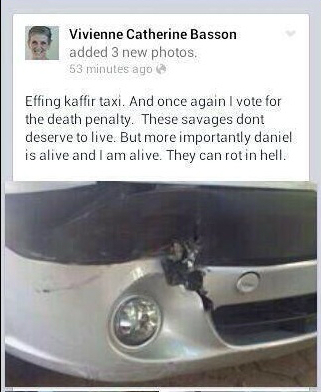
bassonTelecommunications firm Ericsson has fired a worker who used the word “kaffir” in a tweet.

The tweet from the account of Vivienne Basson used the word while expressing frustration over a taxi accident.

The Tweet went on to say, “These savages don’t deserve to live. They can rot in hell.”

Ericsson South Africa M.D Magnus Mchunguzi says Basson who was a sub-contractor, has breached their business ethics.

Social Networks may seem to many as lawless, but World Wide Worx Technology expert, Arthur Goldstuck says people may be prosecuted for hate speech posted online.

He also says the law on social networks applies as it would in other public spaces.

Social network leaves a pure trail of evidence as numerous people can copy it and save it for the whole world to see.

Goldstuck says once you put something up online, it can never be entirely deleted.

Basson explained on twitter what led to her offensive speech before apologising.

ericsson