‘Exiles in our own fatherland’ – Kleinfontein residents

Show of force: municipal posse driving into Kleinfontein

There are no signs that say “Whites Only.”

There are, though, men in military fatigues who log the license plates of vehicles approved to enter Kleinfontein, a rural enclave that is home to about 1,000 Afrikaner whites. And there is a bust of Hendrik Verwoerd, the former South African leader who spearheaded white racist rule.

This exercise in separate, self-sufficient living near the South African capital, Pretoria, is more than just a throwback to the apartheid era that ended with the country’s first all-race elections in 1994. In recent days, Kleinfontein and its campaign to be formally recognized as a township have become a touchstone for fresh debate about law, freedom and the kind of “rainbow nation” that South Africa is trying to be.

Kleinfontein, which is all private property, requires its residents to be Afrikaners, descendants of settlers who arrived from Europe centuries ago and speak Dutch-based Afrikaans, the idiom of South Africa’s former overseers. That brings accusations of racism in a nation whose population of over 50 million is mostly black, but the community skirts race references in its manifesto. Descendants of British settlers, for example, would not be welcome to live here.

The community is not organized “on the basis of race,” said Jan Groenewald, chairman of the board of directors of Kleinfontein, which means “Little Fountain” in Afrikaans. Instead, he said, the goal is to preserve a cultural bedrock that stretches back to the lore of the hardy Voortrekker settlers.

The dig-in mindset at the austere settlement echoes that of its ancestors, who drew ox wagons into a defensive circle, a tactic that helped them defeat a much bigger Zulu force at the Dec. 16, 1838 Battle of Blood River. The date has near-mystical import for staunch Afrikaners, though the vast majority of whites accepted South Africa’s new, multi-racial order in 1994 as part of a negotiated settlement.

“We are here to stay,” read Afrikaans-language signs outside modest brick-and-tile homes linked by dirt roads in Kleinfontein.

Residents don’t pay taxes on municipal services because they don’t receive them. They draw water from a spring and are building a sewage system. There is a cafe, a primary school and a care center for the elderly. Zebra, antelope and wildebeest roam in one part of the fenced, 721-hectare (1,780-acre) property. Residents buy many of their goods from outside the fence.

“If I was a racist, we wouldn’t speak to a black. We wouldn’t do business with them,” said Annatjie Oncke, a 49-year-old house cleaner living in a caravan park. She and other poor residents do the kind of menial labor reserved for blacks in the era when whites were in charge. Kleinfontein also has engineers and other skilled workers, as well as retirees.

In the past, small bands of Afrikaners have sought to establish enclaves elsewhere in South Africa, notably in the Northern Cape community of Orania, founded in 1990. Nelson Mandela, South Africa’s first black president, traveled to Orania in 1995 and had coffee there with Verwoerd’s widow in a show of racial reconciliation. Verwoerd was assassinated in 1966.

Kleinfontein has been around almost as long as Orania, but is now under scrutiny in part because it wants local authorities to recognize it as an entity with the right to run its own affairs. The Times, a South African newspaper, reported that provincial lawmakers were informed last year that black police officers were barred from entering the enclave.

Last week, members of the Democratic Alliance, a political party, protested outside Kleinfontein.

“By creating a ‘whites-only’ area, this community is saying that it has no respect for people who are different from them. It is saying that it fears people who are different,” said Mbali Ntuli, the party’s youth leader.

On Wednesday, Kgosientso Ramokgopa, the mayor of Pretoria and surrounding areas, visited Kleinfontein as part of an inquiry into its alleged failure to comply with municipal planning laws. Delegations of the two sides met in a hall with a corrugated iron roof, a church bell mounted outside in a scaffold.

Ramokgopa noted the right of every citizen to “reside in any part of the country,” while Groenewald, Kleinfontein’s chairman, spoke of the right to “self-determination.”

The mood was diplomatic, and jovial at times. Ramokgopa joked about “koeksusters,” a fried, sugary snack favored by his Afrikaner hosts. Groenewald referred to Mandela’s leadership, but also hinted at his resolve with a mention of Koos de la Rey, a general in the 1899-1902 Anglo-Boer war who did not want conflict but fought hard when it began.

South Africa’s national flag does not fly in Kleinfontein, though some residents were seen recently with the “Vierkleur” (“Four-color”), the flag of the Transvaal republic, which in the 19th century formed part of what is now South Africa. A community member handed out a declaration that complained of betrayal and persecution of the “Boer-Afrikaner nation,” and described South African democracy as a sham.

“We find ourselves exiles in our own fatherland,” the statement said. “We experience this new dispensation not as a democracy, but as the dictatorship of an alien majority.”

For some observers, any uproar over Kleinfontein masks bigger challenges about racial integration in South Africa, where average income levels of whites still outstrip those of blacks. Unemployment is high and residents of some districts have protested violently against the government’s failure to provide basic services, a fact that Kleinfontein’s leaders did not let slip in their discussions with Pretoria officials.

Author Eusebius McKaiser said the country is still wrestling with the legacy of “apartheid geography,” in which some districts originally designed for different races still remain largely segregated.

“We need to stop gloating about the anger we feel towards people like those who live in Kleinfontein,” McKaiser wrote in The Star newspaper. “They are honest and crude about their revulsion of people who are different to themselves. We are not fundamentally different to Kleinfontein’s people. We are just less honest, more subtle.”

Ramokgopa, the mayor, toured Kleinfontein in a convoy of vehicles that kicked up dust and had residents peering at the commotion from their windows. He said the “inherent contradictions” at play over Kleinfontein would emerge elsewhere.

“The nature of the conflict in South Africa is defined by race and that’s something that we need attend to,” he said. “The next generation will still be grappling with this question.” – Sapa/AP

South Africa needs federalism

There are two recent events clearly demonstrating that the South African constitution does not work to govern a highly complex, multiethnic and even multinational society.

The first is the recent hullabaloo over the Afrikaner community of Kleinfontein, east of Pretoria, and the second is the consistent hostility towards Afrikaans-only schools displayed by the Gauteng education department.

What threat do the thousand Christian Afrikaners living peacefully in Kleinfontein pose to the City of Tshwane, which has a land area the size of Luxembourg and millions of inhabitants?

Kleinfontein is no different to any other gated community in the country, except that it is not built in a pseudo-Tuscan style, does not sport some nonsensical Mediterranean name and signs are not posted in English.

It resembles the German concept of a Sprachinsel, or ” language island”, meant to conserve the beleaguered Afrikaans language.

The people of Kleinfontein do not aspire to exoticism; they have simply dared to be themselves. They live together in a self-sufficient community, like thousands of other communities in rural parts of South Africa.

In fact, the president lives in just such a Zulu community at Nkandla, enjoying his own language and culture. Why is it acceptable to be Zulu or pseudo-Italian, but not Afrikaans?

While the ruling party, the African National Congress, wants dialogue with Kleinfontein, the English, assimilationist Democratic Alliance has displayed great hostility to the community in its own affirmation of democratic centralism.

Even the former Soviet Union did not practic e the same level of statist interference in education as the Gauteng education department under MEC Barbara Creecy does, bullying a school such as Fochville Hoërskool into accepting English children who are deliberately bussed in.

Fochville is the only Afrikaans high school in a vast area and Anglicising it by fiat constitutes a form of ethnic belligerence that boggles the mind.

The department’s ill-disguised language chauvinism is camouflaged by predictable accusations of racism levelled at the school, which already has happy black pupils enjoying quality education in Afrikaans.

We desperately need a federal or confederal system to end the abuse of power characterising this Leninist “democracy” at all levels.

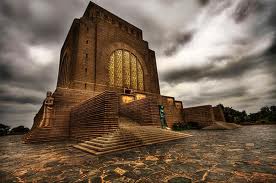
Voortrekker Monument gets gold award from China – 50% of all Chinese tourists go there

The Voortrekker Monument

The Voortrekker Monument won a prestigious gold award for overall performance at the China Outbound Travel and Tourism Market, the Pretoria municipality said on Wednesday.

Strategic Executive Director, Nomasonto Ndlovu said in a statement the City of Pretoria were concluding its exhibition at Indaba 2013.

“What a fantastic way to end our participation at Indaba 2013. This is such good news and will give our tourism industry a tremendous boost.”

According to the statement Sonja Lombard, Managing Director of the Voortrekker Monument, said the main reason for winning the award was the 45% increase in Chinese visitors to this landmark.

“More significant is that 50% of all Chinese visiting South Africa visited the Voortrekker Monument,” Lombard was quoted as saying.

Ndlovu said in keeping with government’s decision to promote South Africa as a heritage and cultural hotspot, the City of Pretoria exhibited its wide array of attractions at Indaba 2013.

“The Voortrekker Monument, which receives more than 200 000 visitors per year, was built to commemorate the centenary of the Great Trek. It received its new status as a Grade 1 National Heritage Site last year.”

The building was designed to commemorate the bravery and persistence of the Afrikaner pioneers who left the British-controlled Cape Colony during the Great Trek between 1835 and 1854 in search of freedom further north.

“The monument also serves as an ideal venue for classical music and choral performances. The Hall of Heroes can accommodate up to 600 people, and its fantastic acoustics enhance the music coming from its digital Allen organ,”  Ndlovu said.

She added that this is the ninth consecutive year that the city has showcased Pretoria’s tourism offerings at Indaba.

Blade runner killing and the media blackout

by Ilana Mercer

After decades of indifference from America’s infotainment industry, imagine my surprise to hear TV anchors like Megyn Kelly of Fox News allude to the killing fields of South Africa.

South Africa should be in the news every day. It isn’t. Scant few among the West’s Yellow Press care to chronicle the country’s favorite blood sport: murder. The Afrikaners, in particular – arguably that country’s founding people – are being killed off at genocidal rates with nary a murmur from the media – although the same crowd is on the scene to report on Nelson Mandela’s every wheelchair-bound move.

According to Genocide Watch, South Africa under the African National Congress is now at stage 5 of the 8 stages of genocide. However, were it not for a little-known, heroic Internet journalist (cited in “Into the Cannibal’s Pot: Lessons for America from Post-Apartheid South Africa”), few would know who the victims of this racial onslaught are and how they die.

Soon jurist Alan Dershowitz was chiming in about “how dangerous” life in South Africa was. Dershowitz even denigrated the country’s judiciary as “a very politically correct judiciary,” “filled with people from the ANC and supporters of the ANC”; most certainly “not one of the finer judiciaries in the world.”

A subject that had been submerged since 1994 – the ramshackle state of post-apartheid South Africa – was suddenly being raised, if in veiled terms.

The reason for the heightened awareness among the criminally comatose is Blade Runner Oscar Pistorius’ run-in with the law. The Olympian amputee killed his girlfriend, model Reeva Steenkamp, in what he contends was a case of mistaken identity. This being South Africa, the crime scene in suburban Pretoria is rumored to have been contaminated by the new and notorious South African Police Services. And the prosecutor has overreached, charging Pistorius, who has no priors, with premeditated murder.

The high-profile murder is PC and TV perfect for a left-liberal media, in South Africa and beyond, that wish to peddle the myth of “colorless” crime in South Africa. It is no such thing. In the aggregate, violence in the Rainbow Nation – more appropriately called the “Rambo Nation” – is unidirectional: black on black and black on white. Violence against women generally flows in the same direction. Considering, moreover, that the country now has one of the world’s highest murder rates and lowest conviction rates, a South Africa thug can safely pursue his vocation without fearing the consequences.

South African authorities, universities and think tanks no longer provide information about victimization patterns by race of victim and offender. Nevertheless, in the research for my book, I uncovered data according to which, at 76.6 percent of the population, blacks committed 76.4 percent of “intimate femicides” (defined as “the killing of a female person by an intimate partner”). And they committed 68.3 percent of “non-intimate femicides”: “the killing of a woman by someone other than an intimate partner.”

Whites have proven woefully inadequate to the task of filling their pro-rata crime quotas (page 38). At less than 9 percent of the population and dwindling, the corresponding numbers for white South Africans were 3.9 and 2.6 percent, respectively.

Order lIana Mercer’s brilliant polemical work, “Into the Cannibal’s Pot: Lessons for America from Post-Apartheid South Africa”

With respect to incarceration rates, whites “underperformed” again. According to the South African Department of Correctional Services, 113,773 criminals had been sentenced as of June 2008, of whom only 2,190 were white. Whites make up only 1.9 percent of the number of sentenced criminals.

Weighing in with 90,013 sentenced individuals – approximately 79.1 percent of the total number of criminals sentenced – blacks more than filled their per-population crime allotment.

This high-profile celebrity case involves a class of people – wealthy white South Africans – whose role in the country’s violent crime is statistically insignificant. Trust a hypocritical media to turn a statistical outlier, an anomaly, into a perfect foil for the continued blackout on the color of crime in South Africa.

The incontinent gushing over Pistorius has given way to condemnation. Paranoid about security is how the athlete’s “obligingly stupid” journo friends are now labeling him. They had only ever jetted in from low-crime or no-crime countries for an interview.

More at home among the international glitterati, Oscar Leonard Carl Pistorius is no Afrikaner “everyman,” says activist Dan Roodt, who is such a man. Even so – and for all his privilege – Pistorius knows the rapacity and invincibility of the criminal class in his country. Like every other Afrikaner, he knew in his gut what infiltrating gangs would do to a legless Boer. He had seen the mangled images.

Perhaps Pistorius will speak up.

Deconstructing David Smith on Oscar Pistorius

The British Guardian is a notoriously anti-South African and more particularly anti-Afrikaans newspaper. As a purveyor of quasi-leftwing propaganda it is probably only rivalled by the former Soviet rag Pravda (‘The Truth’) which nowadays no longer enthuses about the class struggle and violent revolution. Unlike The Guardian.

The Oscar Pistorius incident is a kind of fait divers that would have gone unnoticed were he not a Paralympian athlete. However, for The Guardian’s Africa correspondent, David Smith, the murder is pregnant with meaning, revealing “deep-rooted attitudes to women, race and guns”. (See Oscar Pistorius: South Africa prepares for its own OJ-style trial of the century.)

A murder between two white people, which is ostensibly some kind of crime passionel, therefore has a deeper social meaning which the brainy Brecht-quoting Brit will reveal to us. Unfortunately for David Smith, his sensationalistic article, half-reportage, half-oped piece – but full-blooded propaganda – does not live up to its pop-psychological pretensions.

Smith, like his namesake in the Johannesburg Star, Janet Smith, who equally specialises in stereotypes about South Africa and Afrikaners, is confident that his British readers share those same idée reçues, reinforced by years of one-sided caricatures sent out from South Africa. Asserting racism in the Pistorius case, is like invoking a mediaeval theory of witches, referring to succubi that we know “exist out there somewhere”.

The notion that there is any similarity between the case of O.J. Simpson and Pistorius is equally spurious. In Simpson’s case there was a clear racial element, which eventually played itself out in the differential white and black perceptions of Simpson’s guilt. Simpson, a black man, had been accused of murdering his white wife. There is more of a resemblance to the recent allegations of abuse suffered by Mrs. Judy Sexwale at the hands of her cabinet minister husband than to the Pistorius case.

Yet probably accusations of black husbands beating up their white wives is not news to David Smith and The Guardian. It does not fit their edenic view of Africans as the innocent victims of white racism.

Smith and The Guardian, as far as I know, have never reported on farm murders or the many high-profile cases of white children, some even babies or toddlers, killed in cold blood by young black males in South Africa. Willemien Potgieter, Danielle Esterhuizen and Alyssa Botha come to mind. News from South Africa is carefully filtered to incite international animus against local whites, Afrikaners especially.

Obviously, David Smith and other foreign correspondents are acting in bad faith. Their writing flies in the face of journalistic ethics, credibility or even basic decency. In more than one sense, they are “framing” us, portraying us as ruthless killers and “racists” while we are the real victims of the sadistic violence raging in South Africa.

I would go even further and suggest that the British Left, that motley collection of Anglican radical clerics, cultural Marxists and whatever “militant tendency” remains in the Labour Party, are not happy with the slow pace of the killing in South Africa. The sadism, although vicious and bloodcurdling as when elderly ladies are tortured with hot irons, made to drink boiling water, gang-raped or hacked to pieces, does not happen on a scale large enough to satisfy the heirs of Kitchener or Roberts’s genocidal instincts.

David Smith, for example, laments the fact that there are “160 000 inmates who endure incarceration in Africa’s most overcrowded prison system”. We know that only 8% of murder cases ever result in a conviction in this country. The inefficiencies of our “transformed” criminal justice system, as well as corruption, see to that. Recently we learned that one third of all “South African” men had raped a woman on some occasion. Now, if all the murderers, the rapists and the robbers could have been apprehended and punished, there would no doubt have been a million “inmates enduring incarceration” in South Africa, almost elevating us to American levels of imprisonment.

However, even the fact that 8% of our murderers are in jail is too much too bear for British sadists who believe that these admirably passionate animals, the murderers and rapists, should be allowed to roam free within the paradise of cruelty that is South Africa.

Since the early nineteenth century, Britain has followed a remarkably consistent policy of ethnocide and even genocide towards the indigenous whites and Afrikaners of this country. I get the sense in David Smith’s ramblings about gun culture and white racism, that the process of decay and dissolution is not taking place fast enough. The hundreds of thousands of our people who are fleeing to Australia, New Zealand and other countries as a result of the violence, to be assimilated there into the Anglo-Saxon population, are not sufficient to ensure our immediate and sudden demise. More horror, more sadism is needed.

Hence Smith and all the others who are inciting black hatred against us, hoping for some sort of “final solution”. Smith’s message is clear: every Afrikaner male is, like Oscar Pistorius, a woman killer, a “gun freak” who needs to be eliminated in some or other way. Gated communities and other ways of protecting oneself from the paradise of cruelty brought about by British political intervention in South Africa, “arguably inflame the divide between the haves and the have-nots”, as Smith puts it. His platitudes tumble like clothes in a tumble dryer, but we must not miss the underlying logic that protecting oneself from violence is morally wrong. Within a sadistic universe the victim, once chosen by the master, has no right to resist being abused or slaughtered.

When the British camp commandant barks, we should all accept our fate unreservedly. Britain is an island state with an immense capacity for ethnocentrism, whether directed against Afrikaners, Russians, the French or the Germans. I recently re-read Kurt Vonnegut’s cult novel from the late sixties, Slaughterhouse Five, set against the backdrop of the Dresden bombing. British contempt for the Other inspired not only the Boer concentration camps and the Dresden bombing, but also the series of colonial killings in Africa and India. More recently, British soldiers in Irak have been accused of committing atrocities against the civilian population there. Terms used by these paragons of antiracism for Iraqis include: “stinking Arabs”, “yip-yaps”, towel-heads”, “flip-flops”, and “crusties.” (See The British Military in Iraq : A Legacy of War Crimes and Atrocities.)

To Britain and its journalists, South Africa is just a zoo or game park where they may gawk at the next “kill”, naturally siding with the predators, those magnificent creatures.

Not all South African blacks are amenable to the antiwhite hate being broadcast from London by the likes of David Smith and his local emulators. A decade or two ago Muff Anderson of the Johannesburg Sunday Times smuggled AK-47s from London in the boot of her car, dishing them out to any young warlord feeling like a bout of killing. She was widely lauded for this. Gun-smuggling is an interesting sideline to journalism as one creates the news one writes about.

On the other hand, the affable Zulu, President Jacob Zuma, has said some sympathetic things about Afrikaners and acknowledged our right to exist in South Africa. He is certainly for a return to law and order, even while South Africa is being destabilised by barely disguised ethnic and racial propaganda from Britain and those local media who still fawn at the feet of the colonial power.

The only South African politician currently finding favour in British eyes, is Mrs. Helen Zille, leader of the DA and the daughter of German immigrants who is trying her best to pass for English. On the subject of South Africa’s rape epidemic, when the Rape Crisis Centre in Cape Town appealed to Zille for funding, she callously replied: “Get in line – there are thousands of NGOs desperate for funding, all equally needy.” A few weeks later she was in front of the cameras protesting against the gang-rape and murder of the coloured girl of 15, Anene Booysen. Even if Zille’s accent is not quite pukka yet, at least she has mastered British hypocrisy.

Frankly, Oscar Pistorius holds little interest for me. Let him have his soap opera in court. However, we should refuse to let him be portrayed as some kind of archetypal white male or Afrikaner “everyman”, which he is not. I have never even heard him speak Afrikaans in public. Apart from his surname, you could really mistake him for an Englishman. Or a journalist. They have a taste for guns too, especially AK-47s. Just ask Muff Anderson.

Mulder regrets passing away of Louis Luyt

Louis LuytThe passing away of Dr. Louis Luyt is a huge loss to South Africa. As a businessman, rugby administrator, Afrikaner leader and politician he consistently made contributions to the country.

Dr. Luyt played a huge role in South African rugby during the most important transfer period following 1994. He especially never received the necessary recognition for his important contribution to the huge success of the Rugby World Cup in 1995.

“In talks between the FF Plus and Dr. Luyt’ s Federal Alliance party in 2007, I experienced him as an honest person who was genuinely concerned about South Africa’s future. The talks resulted in a successful amalgamation of the two parties. Where there are often conflicts following such a joining of parties and leaders, we worked well together in the interest of the bigger issue of South Africa’s future, Dr. Pieter Mulder, FF Plus leader, said.

As a witness of Dr. Luyt’s strong leadership qualities, is his commercial history where he worked himself up from nothing into one of South Africa’s biggest businessmen.

I would like to, on behalf of myself and the Freedom Front Plus, express my sympathy with the family of Dr. Louis Luyt with his passing away.

Afrikaner musical celebrates 1950s America

The fantasy world of “Pretville,” a Grease-style film musical in the Afrikaans language, celebrates 1950s Americana, the thrill of first love and foot-tapping classics that evoke innocence and discovery.

Scene from Pretville

HARTBEESPOORT, South Africa (AP) — Do you remember your first kiss? If you have a few years under your belt, maybe you stole it in the back of the movie theater, the projector whirring in the darkness. Or rather, back of the “bioscope,” a word for the cinema in South Africa in the old days.

The fantasy world of “Pretville,” a Grease-style film musical in the Afrikaans language, celebrates 1950s Americana, the thrill of first love and foot-tapping classics that evoke innocence and discovery.

It is also an affirmation of an Afrikaner identity that spent years in the doghouse after 1994 elections and the end of apartheid, the system of white minority rule imposed by Afrikaner nationalists in 1948. And while most of the actors are white, two who are not play authority figures, lampooning the now-discarded racial order.

The musical, its creators stress, is joyful escapism, not a whitewashing of South Africa’s tortured history of race relations. As co-producer Paul Kruger noted, “pret” means “fun” in Afrikaans. The movie indulges in rock ‘n’ roll, vintage cars, greasers in sneakers, pin curl hairstyles and swing dresses, lots of pastel pink and blue, and double thick strawberry milkshakes with extra cream.

“I think we’ve been excluded in that whole journey during the ’50s in South Africa,” Kruger said. He added with understatement: “We were busy with too many other things, too many other politics kept us busy.”

The plot is about a farm boy and a town slicker who vie for a beauty’s affection, with assorted side-sagas and a generous sprinkling of flamboyant characters: an aging crooner called Eddie Elektriek who courts an old flame, a candy storeowner with an eye for the guys, a hairdresser-cum-mayor with a goatee and a pompadour, a stutterer in horn-rimmed glasses and a pregnancy that fuels fevered gossip.

The feel-good film borrows from Buddy Holly, Jerry Lee Lewis and West Side Story. But it’s a whole lotta shakin’ with an Afrikaner stamp. For example, the song “Is Jy Myne” (Are You Mine) is loosely based on “My Boy Lollipop,” and “Skud, Skop en Hop” (Shake, Rattle and Roll) echoes “Great Balls of Fire.”

“It’s taking something old, putting something new,” composer Machiel Roets said of pairing Afrikaans with vintage vibes. “Voila! A new recipe.”

Afrikaans, the Dutch-based language of the descendants of European settlers, is spoken as a first language by 13.5 percent of South Africa’s 51 million people, according to the 2011 census. Pretville has a strong fan base and English subtitles but it isn’t a cross-over hit. The movie’s promoters say it’s part of a larger revival in the last few years of music and movies in Afrikaans, a language once tarred by its association with apartheid.

The film set, which resembles small-town Main Street, is a popular tourist attraction for Afrikaans-speaking crowds that ogle the Hammerstein radio, Nash Metropolitan car, Handy Hannah hair dryer and other props, many bought on eBay and shipped from the United States.

Annelie Engelbrecht, who was celebrating her 49th birthday there, and her husband, Pierre, traveled 700 kilometers (435 miles) from their home near South Africa’s Kruger game reserve to soak up the movie’s aura. The set lies near a mountain range west of the capital, Pretoria. A sign at the entrance announces the production house: “Hartiwood Studios,” a play on the nearby town of Hartbeespoort, and Hollywood.

“We used to go to the films and kiss at the back of the movies. It was really like that in the olden days,” Engelbrecht said. She thought the racial mixing in the movie was “tongue in cheek” because it was unthinkable under apartheid in the 1950s.

“Blacks and whites wouldn’t have danced together, I can promise you that,” Engelbrecht said. “That is just the new South Africa.”

Actor Terence Bridgett, the campy mayor who sashays around a hair salon, is of mixed heritage. His two assistants, Dyna and Dot, are “The Supremes” of Pretville. Entertainer Emo Adams, who has a Malay background and released an album titled “Tall, Dark & Afrikaans,” plays the police chief, breaking up a fight between the love-struck suitors and tossing them in jail.

In a classic send-up, Adams delivers “Elvis the Pelvis” dance moves in the olive-green uniform of the 1950s South African police. Security forces at that time harshly enforced a growing body of law that enshrined a system of white domination and racial segregation. Blacks lacked political rights, the right to move freely, the right to live where they wanted. They couldn’t, of course, visit “bioscopes” for whites.

In 1976, the South African government tried to force the teaching of Afrikaans on schools in black townships, triggering massive protests and a bloody crackdown that ultimately invigorated opposition to white rule.

After apartheid, Afrikaans became one of 11 official languages in the multi-ethnic country. R.W. Johnson, author of “South Africa’s Brave New World,” wrote that many Afrikaners felt so guilty about the past that they were reluctant to assert their culture, “in much the same way that after 1945 many Germans became uncomfortable with any assertion of German national identity.”

Lizelle de Klerk, a Pretville actor, remembers shunning her cultural background and helping craft plays in university about “how we hate being Afrikaans,” but now she believes Afrikaners can proudly tell their own stories, whether they are about race or not.

De Klerk dreams of performing on London’s West End, but also wants to contribute to South African expression in the years ahead. She is reading a book about the 1990s Truth and Reconciliation Commission, which opened a nation’s story-telling floodgates by hearing testimony about apartheid-era cruelty.

“South Africa finally had a new narrative that they could draw from to make stories, because finally you had black peoples’ stories, colored peoples’ stories. You heard offenders’ stories. You heard ‘people that were victims’ stories,” de Klerk said. “So it’s a whole new dynamic. But I think we’re moving, slowly moving, forward. And it’s great.” – AP

Watch the YouTube-trailer here.

Afrikaner enclave of Kleinfontein investigated by ANC provincial officials

Kleinfontein, east of Pretoria, from the air

Business Day reports that tHE Gauteng legislature’s portfolio committee for community safety on Tuesday announced that it had launched an inquiry into the whites-only Afrikaner “cultural village” of Kleinfontein following police complaints about a lack of access to the estate.

Kleinfontein, 30km southeast of Pretoria, is a 500-hectare Afrikaner settlement similar to Orania, the Afrikaner enclave in the Karoo in the Northern Cape. Its mission is to preserve the culture, language and religion of the Afrikaner people without being threatened or harassed.

But that ideal may be tested on Friday when the portfolio committee will meet residents at the Kleinfontein community hall.

The chairman of the Kleinfontein board of directors, Jan Groenewald, said they welcomed the two-day engagement which would address their concerns about policing.

In a statement on Tuesday, the portfolio committee said it was concerned about complaints it had received from the local Boschkop police station.

The police had apparently found it difficult to get into the village to perform their duties.

“The purpose of the inquiry is to investigate challenges experienced by the community of Kleinfontein in integrating with the rest of the local community and co-operation of the community with law enforcement agencies in combating crime and ensuring safety,” said committee spokesman Takalani Ndou.

Mr Ndou said the committee would also investigate the activities of a private security company working in the community and its role in law enforcement and community safety.

Access to social services would also be discussed, he said.

The committee has invited the MEC for community safety, Faith Mazibuko, the station commander of the Boschkop police station, Col Schoombe Reinsburg, and Brigadier Welcome Kweyama to give evidence.

Mr Groenewald has also been invited to attend.

Members of the Kleinfontein community will have the opportunity to make oral presentations during the inquiry.

Mr Groenewald said that besides the access control at the entrance, the community did not make use of private security guards and the police were welcome to access the village.

“The engagement has been very civil with the portfolio committee. The meeting will be an opportunity for us to be transparent,” he said.

Mr Groenewald said that as a cultural village, the group’s right to territorial independence was protected in the constitution.

According to the Kleinfontein website (kleinfontein.net), the enclave provides retirement accommodation, sport and cultural facilities as well as a nature reserve. It has its own bank, school and a rugby team, which managed to beat its Orania counterparts earlier this year.

It was established in 1992, when a group of Afrikaners realised that power would eventually be handed over to the black majority and that “no consideration was given to the future existence of the Afrikaner people”. Today up to 900 people are economically active in the town and it boasts 650 residents and 400 shareholders.

Mr. Jaco Mulder, the only provincial councillor from an explicitly Afrikaner party, the Freedom Front Plus, will be in attendance on Friday in an attempt to protect the community from political harassment.

Verwoerd pumped millions into black education

by H.S. Brink

Firstly, blaming HF Verwoerd for the textbook mess is nonsensical at best and for your newspaper to portray Verwoerd as the “architect of apartheid” is a false representation.

Those who perpetuate this lie may well be referred to a book by David Walsh called The Roots of Segregation – Native Policy in Natal (1845-1910), published in 1971.

The foreword says: “(Lord) Shepstone’s policy was the precursor of the later policy of segregation, which in turn has been called apartheid, separate development and separate freedoms.”

Walsh in his conclusion writes: “It is a myth that apartheid is the exclusive product of Afrikaner nationalism: it’s antecedents are to be found in Natal.”

When the National Party came to power in 1948 it inherited a disorderly schooling system for blacks that was run mainly by Anglican and Catholic churches.

The 1951 Eiselen report on black education revealed shocking facts. Admission to school was subject to baptism. Parental participation was non-existent. Most black children had never been to school. Illiteracy was rife.

No indigenous language was tolerated and  English was the sole medium of instruction for education.

Part of subsidised teachers’ salaries landed in church coffers. Some priests and nuns got a pittance.

In Taung, as was the practice elsewhere, the community built the church which doubled up as one massive classroom for 500 scholars.

In and around Mafeking 25 000 scholars had 56 classrooms between them.

Verwoerd changed all this with an orderly system, pumping millions of pounds into black education, plus the £2 million representing the total tax contribution by blacks.

Additionally, a special levy was placed on urban property taxes to build schools and alleviate the backlog in black education, and so on and so forth.

Yet President Jacob Zuma, who believed in liberation before education, accuses Verwoerd of putting black people “back for centuries”.

One cannot but wonder who put the rest of Africa back for centuries?

As for the pretext of Afrikaans being the cause of the 1976 school uprising, think again.

The two schools that were in the forefront of the Soweto riots did not receive tutoring in Afrikaans in any subject.

Also, an  advisory board’s polling of all black schools’ governing bodies revealed that 64% approved of Afrikaans and English as mediums of education.

Zuma’s promotion of the “second revolution”, where scholars such as Hector Pieterson will undoubtedly be used again as pawns in a communist game, will indeed put South Africa back for centuries.

Afrikaner singer Steve Hofmeyr marches against violent crime

Steve Hofmeyr with crosses
Singer Steve Hofmeyr with white crosses on his cheek

Local celebrities and members of the public marched to the Union Buildings in Pretoria on Tuesday to protest against violent crime.

The march which was organised by Afrikaans singers Bobby and Karlien van Jaarsveld and Steve Hofmeyr as well as other celebrities was aimed at calling on government to take action against violent crime in the country.

“This is our long walk to freedom…it’s our little war. Crime is high in this country and I mean I have children and want to make sure they are safe and that’s what this is about,” said Bobby Van Jaarsveld.

He said the march was against all crime and not specifically farm attacks.

He said the killing of a five-month-old baby showed how bad things were.

Margrietha de Goede, 66, and the five-month-old baby were found strangled in her home on May 23. De Goede’s body was found under a carpet in an outside room. The baby was found under a bed in the main house.

The march was led by Hofmeyr who had painted white crosses on his face.

He marched behind a big banner which read “Ons sal nie stil bly nie 1/8We won’t keep quiet 3/8.”

Other posters carried by the marchers read “Moeg vir bloed 1/8Tired of blood 3/8” and “this country needs leadership”.

Most of the marchers were dressed in black as they made their way to the Union Buildings to hand over a memorandum to the presidency.

Afriforum supported the march and also called on its members to join the protest. – Sapa

Xhosa-speaking magistrate refuses Afrikaner woman bail, citing racial issues

A Pretoria magistrate has said black people are having to pay more bail than whites, and are effectively receiving harsher punishments than whites who have committed the same offences.

Magistrate Ndileka Ndamase made the statement in the Hatfield district court on Monday, during the bail application of Carol Smith, Beeld newspaper reported.

She wrote on the charge sheet that blacks who stole items worth under R1000 were granted bail of between R1000 and R2000.

“[On] the other hand, white people who commit serious offences are released with a warning, or on bail of under R1000,” Ndamase wrote.

Smith, who is accused of cashing a fraudulent cheque of R30,000 at an Absa branch, was effectively denied bail.

Smith’s lawyer, Mariette Jansen van Vuuren, told Beeld the State had not opposed bail, and that the docket had not been brought to court.

“The magistrate had a problem with the confirmation of my client’s address, but her [Smith’s] husband gave a statement and rendered proof of residence,” Jansen van Vuuren said.

Ndamase insisted on the submission of police confirmation of Smith’s proof of residence, and effectively refused bail on these grounds.

“My client is being disadvantaged because Ndamase is prejudiced against her,” Jansen van Vuuren said.

According to Beeld, the Law Commission is currently engaged in a disciplinary hearing against Ndamase, because of firstly, her alleged refusal to carry out judicial orders and secondly, her alleged refusal to accept authority.

Beeld reported Ndamase and Jansen van Vuuren earlier had an altercation in the same court, due to Ndamase addressing the court in isiXhosa, instead of English.

– Sapa

A letter from South Africa

Afrikaans monument

Partial view of the Afrikaans language monument at Paarl, Western Cape


Dear PRAAG member/supporter abroad,

Thank you very much for your support so far for the cause of saving South Africa’s white and Afrikaner people from extinction. I must apologise for not having communicated with you regularly in the past, but we have been, as always, busy with our increasingly bitter struggle here.

We have also revamped this, our English-language website. Apart from publishing South African news, together with our own media releases and newsletters, we shall also be carrying global news stories of interest on that site. Please visit it regularly as we shall be updating it on a daily basis.

Our Afrikaans-language site for South Africa is also being renewed and has become a major South African news portal in its own right. We publish approximately 20 stories and columns per day and also have a very lively comments section.

Increasingly, the mainstream media in South Africa and globally are suppressing the bad news coming out of this country. For example, our president Jacob Zuma sang a song in public during the ANC’s centenary celebrations on 8 January 2012 in Bloemfontein in which he called for the shooting of Boers and whites. It included the phrases: “They are cowards, they will run, the cabinet will shoot them.” Although broadcast live on television to the whole country, it took some time for people to realise that he was actually calling for the mass killing of whites and farmers, as the song was sung in Zulu.

However, none of the mainstream media made much of this, which actually constituted an international crime due to South Africa being a signatory to various international conventions that prohibit any form of incitement to genocide or violence against another ethnic or racial group.

Many crimes committed against whites are not reflected in police statistics. I personally interviewed a gallery owner in Pretoria who was held up at gunpoint by three blacks in her home who continuously threatened to kill and rape her. She was badly assaulted and had to be hospitalised afterwards. However, when she reported the crime to the local police station, the black officers on duty refused to accept it as she had mentioned the fact that her attackers had used the words: “We are going to kill you, you white bitch.” Due to the racial nature of the attack, the police refused to accept her affidavit.

We are currently setting up support groups all over the country that will collect information which we could then publish on our website. One of our technicians is busy training people in video technology to make it possible to gather evidence and also post videos on YouTube on the ongoing violence in South Africa, as well as efforts to counter it. We have some retired policemen and detectives who are prepared to investigate crimes without remuneration, but we have to pay their transport costs.

No-one knows how many whites have been killed by blacks in South Africa since 1994 when the ANC took over. It could be 30 000, or 50 000, or even as high as 100 000. Such statistics are a closely guarded secret. However, together with another organisation, we lodged an official request last month with the South African Police Service for crime statistics broken down by race or population group. We are anxiously awaiting the results. If not forthcoming, we will be forced to seek a court order to obtain them.

A high-ranking member of the Dutch Freedom Party (PVV), Martin Bosma, recently visited South Africa. According to him, “Afrikaners are the canary in the coal mine for the whole of the Western world. You will be the first Western nation to die out since the start of the European Renaissance.”

The attack on us is multifaceted: racial violence, anti-white legislation and discrimination, as well as efforts to undermine our educational system, our culture, language and our very identity. At the beginning of this year, a high school in Fochville, a town west of Johannesburg, was targeted with a group of black children bused in by the provincial government. This was the last remaining public school of quality in that whole area, with parents driving their children 100 kilometres per day there and back. The provincial education department is being run by a white communist who is adamant that all schools “must be the same” whether they are majority-white or majority-black. According to talk in the education department, the officials want to capitalise on “white flight” by driving all white children out of public or state schools, forcing them into private and home schooling which many cannot afford.

In 2003 when it was announced that the name of our capital, Pretoria, would be changed to the African name of “Tshwane”, PRAAG was the first organisation to protest that act of cultural vandalism. We organised a protest march right into the heart of the black inner city, with myself walking side by side with the very popular Afrikaner singer Steve Hofmeyr. Since then we have not given up the fight and many court cases and petitions later, it was announced last week that the name of the city would not be changed after all. However, it was announced at the same time that twenty-seven street names would be changed from those of the city’s founders to black and communist names. Even “Church Street” would not be spared as it is apparently offensive. One of the streets would be named after terrorist Solomon Mahlangu who had killed some white civilians in the late 1970’s.

As the South African crisis deepens, more and more people are waking up to the fact that the current system is unjust, corrupt and violent. Those who can afford it, are emigrating. But many cannot leave, either for financial reasons or because the other Western countries would not accept them. On the other hand: why should we leave and simply abandon our country and all our assets to a corrupt African government appointed over us by the United States, Britain, Sweden and other Western powers?

We must claim at least part of South Africa for ourselves! To this end, we are building our current network of activists, not only in this country, but all over the world.

We are very much encouraged by the groundswell of conservative support for us in the United States, the Low Countries, Australia, Northern Italy and many other countries. Protests and demonstrations are being planned in several major Western cities this year and we welcome those.

I want to invite you to join us in this struggle, which currently affects us, the canary in the coal mine, the most. But ultimately it engages us all, because multiculturalism is just communism or extreme egalitarianism in disguise. The Cold War may be over, but the assault upon our Western and Christian values have never been greater.

Let us hope that the movement which we are building to save our beleagured nation on the southern tip of Africa will not only benefit us, but will mobilise thousands more all over Europe and North America to stave off the kind of nightmare which we are already living through, every day.

I shall soon be sending you information on our Pro-Afrikaans support groups or simply “buzz groups” which we are currently forming. They offer an exciting way of meeting like-minded people and participating in the movement to save this nation.

Soon, on 6 April 2012, it will be 360 years since three Dutch ships first threw anchor in Cape Town’s Table Bay. Of course, that founding moment is today derided as “the coming of the hated white colonialist”.

But we who love our culture and civilisation know otherwise.

Regards,

Dan Roodt
Director, PRAAG (Pro-Afrikaner Action Group)

South Africa’s DA wants Franz Jooste’s ‘hate camp’ closed

Franz Jooste
Franz Jooste

A motion to shut down Afrikaner survivalist group Kommandokorps’s “hate camp” was adopted by the Mpumalanga provincial legislature, the province said on Wednesday.

The Democratic Alliance’s motion was adopted on Tuesday, provincial spokesman Lebona Mosia said.

“We support it [the motion] and agree that this thing must be shut down,” he said.

DA provincial leader Anthony Benadie said the motion was “a decisive victory in the fight against racism”.

“Mpumalanga provincial police commissioner, Lt-Gen Thulani Ntombela [has been] requested to use every legal means available to him to shut down the camp, pending a full investigation into what is happening there,” Benadie said in a statement.

“The house condemns racism of all kinds, both in this house and elsewhere in our province. The continued existence of this camp must be regarded as an affront to our democratic order, and it must be stopped now.”

The Mail & Guardian reported on Friday that the Kommandokorps’s instructors taught boys as young as 13 that there was a race war in the country and that South Africa’s black population was the enemy.

Following an infantry-style curriculum, the youths were lectured by camp leader Franz Jooste, 57, on racial differences, which included a claim that black people had a smaller cerebral cortex than whites and could not take the initiative or govern effectively.

He was quoted as saying that aside from the aborigines in Australia, the African black was the “most under-developed, barbaric member of the human race”.

On Monday, Jooste denied the reports.

“No utterances of hate speech are ever made. Cadets are taught to love their own language, culture, traditions, religions and race. That is in the Constitution,” he said in a statement.

Benadie said the training took place on a farm outside Carolina in Mpumalanga.

“It is not a permanent camp or militant base, and the owners of the farm hold no connection to the Kommandokorps,” he said.

“While the DA motion is now a resolution of the legislature and must be implemented, the DA has already traced and interacted directly with the owners of the farm, and appealed to them not to allow further Kommandokorps training or activities to take place at their facilities.” – Sapa

South Africa, a bigger version of Zimbabwe

The multicultural dream that the US and Britain foresaw in South Africa is simply not going to happen. In fact, it is not even being realised in their own countries, backed up by huge globalised economies.

If things continue like now, South Africa will become a bigger version of Zimbabwe. Most whites will leave, the infrastructure will collapse and a few expats will keep the mines going. Probably incoming Chinese and Indians will acquire some remaining assets on the cheap and still squeeze the last few rands out of what used to be the greatest republic ever on the African continent.

However, every dark cloud has a silver lining, as they say. The way I see it, we are in this mess as a result of outside intervention, Soviet for sure, but to a far greater extent from Britain and the US. If it were not for Father Trevor Huddleston, Anthony Sampson, the American Black Caucus, Ted Kennedy and a few others, this country by now would have been a world power. We had the technology, the know-how and the drive to create something extraordinary in Southern Africa, but we had leaders that went from mediocre to bad to treasonous. De Klerk had no right to turn the army over to the ANC and abolish Afrikaner sovereignty for which our women and children had died in the camps and for which the women of the Great Trek had been prepared to “walk barefoot over the Drakensberg”.

Therefore the economic crisis in the Anglo-Saxon countries is to our benefit. It lessens the chances of further and even more catastrophic intervention in SA. Many Afrikaners fear Britain and America more than they fear the ANC, because ultimately the Anglo-Saxon powers might intervene to prop up an ANC government if ever conditions had to become so intolerable that an Afrikaner revolt or rebellion would be a matter of survival.

The other positive aspect is the revolution in technology and communications. We may not have a volkstaat or own republic yet, but we have the internet. While American ideas such as affirmative action and the moral superiority of blacks led to our downfall a short while ago, Facebook, Google and YouTube are rearming us. Even if we lose our last schools and churches, as well as the remaining suburbs or farming areas that are recognisably Afrikaans, we will still be able to associate on Facebook and Twitter, on Skype and so on.

The Afrikaner identity has been a subject of much debate. Often academics and journalists have been hostile to us, claiming that we simply “do not exist” or otherwise have been legislated out of the way by the ANC government. I am vaguely contemplating a short book on Afrikaner history in English for our potential friends in America and elsewhere that are curious about us. The title I am toying with is: “The orphans of the West”. We were more or less abandoned by the West even though we fought on the Allied side in two world wars and in Korea.

Like every orphan, we will have to reconcile ourselves with the reality of that abandonment and forge a new future for ourselves on some part of South African soil.

Some of the idiots who devised the current system have said: “South Africa’s identity is our constitution.” As if a flawed document like that could ever represent an identity. Frenchman Jean Raspail, author of the dystopian novel on immigration, The Camp of the Saints, coined a very useful simile. He spoke of the newcomers inhabiting a Western shell like the hermit crab. The ANC and its hangers-on, including the white Left in this country, are but hermit crabs enjoying their new home, made in our government buildings – but which they did not create.

There is a very interesting – and moving – short story by Hennie Aucamp called “Die uitsettingsbevel” – The eviction order. In it he also refers to language, of being at home in one’s own language. We have been served our eviction order, that we are no longer welcome here, but ultimately we carry that home with us in the form of our language, culture and tradition.

Many people claim that the Afrikaans tradition is almost dead, like a plant starved of water and nutrients. However, our identity is not defined by one document such as the SA constitution, but by many. It is the narrative of especially the twentieth century, culminating in the 1960s where Afrikaners for a brief few years had a sense of a “republic found again”. In French it sounds even better, slightly Proustian, as “la république retrouvée”. It was an almost utopian time before the calumny, the hypocritical boycotts, the posturing and barely disguised local ethnic hatred of Afrikaners started. Communism, the classless society or liberalism never mobilised any black South Africans, but the phrase “kill a Boer” sung by Mandela, Malema and others sure did.

Possibly there no longer exists an Afrikaner nation, given the intense social engineering of the last decade or two. I am not so pessimistic, however. And then an Afrikaner archive is still extant. That archive represents the sum total of 350 years of Herculean effort and pioneering struggle, of tragic deaths at the hand of black tribes or British soldiers, as well as our enormous literary, legal, theological, philosophical and musical output of the twentieth century.

It is inevitable that that archive, unless the ANC manages to destroy it beforehand, which is a distinct possibility, will be digitized and will ultimately end up on the internet: searchable, overwhelming and alive. When that happens, the Afrikaner nation will be reborn and the phoenix will rise from the ashes as it did after the murder of Retief and his men in early 1838, or after 1902 when Kitchener and Roberts had burnt the Transvaal and the Free State to the ground (including the churches). Even the anglicised children of the diaspora Afrikaners will be affected by it. At first they will read about their forebears in English, but perhaps the generation after them will be curious enough to start relearning Afrikaans, like the Jews relearned Hebrew, which will only be a mouse click away.

Defeat is a terrible thing and, like the American Southerners, we have been defeated twice, firstly militarily by Britain and secondly by that alliance of post-war leftism and black nationalism that cast us as villains and racists, the morally and physically expendable members of humanity about whom no one sheds any tears. Orphans.

On the other hand, the defeated have a way of reasserting themselves. Germany and Japan lost the Second World War, but prospered economically. Today Germany controls the pursestrings of Europe.

And make no mistake: South Africa is still us. The hermit crab never really belongs in his shell, and knows it.

One day the kingdom will be ours again, or at least part of it. The ANC and the rest of our ruling circus are just as strong as their backers. Yesterday it was the Soviet Union, Sweden, British Labour and the Anglican Church. Today it might be China, India and the Arab world. Tomorrow it might be Obama or Hillary Clinton’s America, with political correctness gone haywire.

My wife always maintains that we Afrikaners can go back to the land tomorrow. My grandmother lived alone on a farm in the Rustenburg district, completely self-sufficient. She never had black servants or workers and she only bought sugar and powdered milk from the shop. The rest she grew or reared with her bare hands, without electricity.

So we have this vast country all around us that will sustain us, no matter what. Social and economic collapse in South Africa poses no threat to us. It would only be a matter of concern for the UN, for the Anglo-American empire, for the EU, possibly China and India. To us such a collapse would represent one vast opportunity, like the country we found here when we had dragged our oxwagons over the Drakensberg: a wide and temperate realm, empty of people except for a few emaciated tribes here and there, no tropical diseases and teeming with wildlife.

However, the hermit crab people ensconced in our buildings, our barracks, our police stations and consuming our taxes do not have the inner strength to maintain their supposed hegemony. They depend on outside support and even the threat of exterior force to cow us into submission, to keep us subjugated by affirmative action, racial quotas and other measures. Their incessant propaganda broadcast night after night on the public television has an Orwellian air, that of mind control exercised by a paranoid ruling clique.

As someone said: “Nowhere else in the world has a majority ever sought refuge in an arsenal of legislation to protect itself from the competitive threat of a minority.” We are so few, and yet they are so afraid of us.