White people fear becoming U.S. minority

Farrakhan holds up his book called 'The Secret Relationship Between Blacks and Jews'

Nation of Islam leader Louis Farrakhan says white people are promoting birth control for black women because they fear becoming a minority in the United States.

Farrakhan spoke Saturday at Fountain Street Church in Grand Rapids, invited by the Grand Rapids Community College Black Student Union.

He says white Americans will lose their majority by 2050 and says they’ve introduced birth control to black women “because they don’t want no more black babies.”

MLive.com reports Farrakhan says he opposes same-sex relationships. He says he isn’t “homophobic” and isn’t “afraid of people who choose a lifestyle that’s different” but rather is afraid for them.

The Chicago-based Farrakhan says women’s role is to stay home and raise children with strong moral values.

He also says he isn’t anti-Semitic. – www.freep.com

Stunning drop in US GDP

The U.S. economy posted a stunning drop of 0.1 percent in the fourth quarter, defying expectations for slow growth and possibly providing incentive for more Federal Reserve stimulus.

The economy shrank from October through December for the first time since the recession ended, hurt by the biggest cut in defense spending in 40 years, fewer exports and sluggish growth in company stockpiles.

The Commerce Department said Wednesday that the economy contracted at an annual rate of 0.1 percent in the fourth quarter. That’s a sharp slowdown from the 3.1 percent growth rate in the July-September quarter.

The surprise contraction could raise fears about the economy’s ability to handle tax increases that took effect in January and looming spending cuts.

Still, the weakness may be because of one-time factors. Government spending cuts and slower inventory growth subtracted a total of 2.6 percentage points from growth.

And those volatile categories offset faster growth in consumer spending, business investment and housing — the economy’s core drivers of growth.

Another positive aspect of the report: For all of 2012, the economy expanded 2.2 percent, better than 2011’s growth of 1.8 percent.

The economy may stay weak at the start of the year because Americans are coming to grips with an increase in Social Security taxes that has left them with less take-home pay.

Subpar growth has held back hiring. The economy has created about 150,000 jobs a month, on average, for the past two years. That’s barely enough to reduce the unemployment rate, which has been 7.8 percent for the past two months.

Economists forecast that unemployment stayed at the still-high rate again this month. The government releases the January jobs report Friday.

The slower growth in stockpiles comes after a big jump in the third quarter. Companies frequently cut back on inventories if they anticipate a slowdown in sales. Slower inventory growth means factories likely produced less.

Heavy equipment maker Caterpillar, Inc. said this week that it reduced its inventories by $2 billion in the fourth quarter as global sales declined from a year earlier.

The biggest question going forward is how consumers react to the expiration of a Social Security tax cut. Congress and the White House allowed the temporary tax cut to expire in January, but reached a deal to keep income taxes from rising on most Americans.

The tax increase will lower take home pay this year by about 2 percent. That means a household earning $50,000 a year will have about $1,000 less to spend. A household with two high-paid workers will have up to $4,500 less.

Already, a key measure of consumer confidence plummeted this month after Americans noticed the reduction in their paychecks, the Conference Board reported Tuesday.

Economists expected the first reading on gross domestic product to show growth of 1 percent, down from the third quarter’s reading of 3.1 percent. – AP

Uncle Tom’s Cabin, with white slaves

When was the last time you saw Uncle Tom’s Cabin in a theater? The answer is probably never. As far as I can tell, a theatrical version of Harriet Beecher Stowe’s controversial novel hasn’t been performed in the Philadelphia area for many decades, and that also appears to be true for the rest of the country, with the exception of a couple of attempts in New York City over the years. But one Philadelphia theater company says that it’s time to bring the story back to the stage, but with a twist.

EgoPo Classic Theater, a company that describes itself as “edgy, innovative, and inspiring,” is set to debut Uncle Tom in May at Delancey Place’s Plays & Players Theater. Auditions begin this weekend. The show will mark the end of EgoPo’s vaudeville-themed season, which started with their excellent all-female Assassination of Jesse James and continues in March with The Life (and Death) of Harry Houdini.

Uncle Tom was quickly transformed into a theatrical work after the novel’s 1852 publication. And although the book was immensely popular (its sales in the 1800s were only surpassed by those of the Bible), the various theatrical versions were even more so.

Because copyright laws were not what they are today, the scripts strayed freely from the original text, and the show eventually became a centerpiece of minstrel performances, complete with blackface and the most exaggerated racial stereotypes possible. Plus, the book itself wound up on some “banned book” lists, and the NAACP objected to its language and characterizations. No wonder the progressive theater world sought to distance itself in later years.

For the May production, EgoPo artistic director Lane Savadove and Glenn Odom, a literary studies professor at Rowan University, are creating a new script. “We’re doing a realistic, naturalistic version that will be incredibly respectful of the novel,” promises Savadove. “We’re not writing anything. We’re using the book word-for-word, cutting it just so that it works in a theatrical format. I really want the novel to speak for itself on the stage. This is not going to be some post-modern version of Uncle Tom’s Cabin.”

I asked him why it was important to do Uncle Tom now, why he wants to pick it up after all these years.

“The play got tagged as racist not because of the book but because of the minstrel shows,” he explains. “The book was written as an anti-racist piece, and in the last 10 years, the top African American scholars like Henry Louis Gates and Cornel West have gone back to reclaim it as an important part of racial history. And so, we wanted to go back now that it’s seen in this new light and create a new theater version.”

One person who is not convinced that this is necessarily a good idea is Philadelphia actor James Ijames, who teaches the most prominent version of the Uncle Tom scripts in his “Race on the Stage” course at Temple University.

“The citing of Henry Louis Gates and Cornel West to somehow say, ‘See, the black guy said it’s OK!’ is problematic,” says Ijames. “Citing the elder statesmen is akin to the ‘some of my best friends are black’ argument. That notion and rebuttal and defense doesn’t have anything to do with anything.”

Further complicating the matter is Savadove’s decision to swap races in the casting process. In other words, white actors will play slaves while black actors will play their owners.

I talked to one white actor who plans to audition for the show, even though his concerns are “numerous.” The actor, who asked to remain anonymous, points out that many of the stereotypes commonly associated with black culture can be traced back to Uncle Tom, from the “Aunt Jemima” figure to the hyper-educated, very proper black man.

“Those stereotypes were built off of white characterizations of blacks,” he says. “I don’t know how having white actors playing black characters introduces anything new to this story. I sincerely hope that there is an artistic objective beyond being edgy for the sake of being edgy.”

But his biggest and “admittedly selfish” concern is the dialect and language that he’ll be expected to use.

“I have a hard time listening to myself delivering the language,” he notes. “It sounds like a blatantly racist caricature.” He says that he can’t even read his lines in public.

Savadove tries to explain his unusual casting decision: “Even though, by all accounts, the dialogue is incredibly historically accurate, it’s a loaded subject to have a black man speak in a Southern slave dialect. And so we’re switching the races. And we’re painting a picture of an America where it happens to be that the whites became enslaved and the blacks became the slave owners. We’re pointing out the randomness with which the blacks became enslaved and the whites became empowered.”

When I asked Savadove if staging the play was the subject of much debate within EgoPo, he told me it wasn’t. “We are clear in what we are doing,” he says. “And we articulated it clearly to our board.”

In light of Savadove’s justification for the racial switch and his comments regarding “randomness,” Ijames wondered about the racial makeup of that board, as did Ardmore-based playwright Quinn Eli, whose newest play will debut at Plays & Players in April alongside works by Suzan-Lori Parks and other African American playwrights.

And so I asked Savadove point blank if there were any black people on his board. He refused to answer directly. Then he pointed to EgoPo’s 2012 production of A Dybbuk, perhaps the most important play in Jewish history and one with its own controversies surrounding mysticism and Kabbalah. “You didn’t call me then and ask me if any of my board members were Jewish,” he said. No, I didn’t. But, then, A Dybbuk is no Uncle Tom’s Cabin.

In any event, both Eli and Ijames say that they intend to go see EgoPo’s Uncle Tom. And so do I.

“I’ll find it difficult to absorb the image of whites in place of blacks as slaves,” says Eli. ”And I question how effective it will be for white members of the audience who won’t have to take the horror of what happened to those who it actually happened to. It presupposes that a lot of our notions about race have changed more dramatically than I think they have. But that doesn’t mean it won’t make for interesting theater.” – The Philly Post

Shale gas boom visible from space

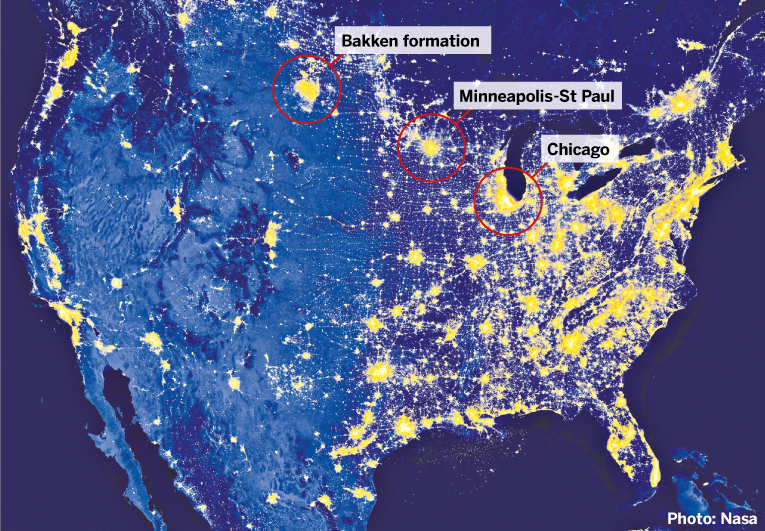
Oil companies at the heart of the US shale oil boom are burning off enough gas to power all the homes in Chicago and Washington combined in a practice causing growing concern about the waste of resources and damage to the environment.

The volume of unwanted gas being flared off in North Dakota, the state leading the shale revolution transforming the outlook for US energy, rose about 50 per cent last year. The surge at the state’s Bakken formation is being replicated in other shale regions with the Texas state regulator issuing 1,963 permits to flare in 2012, more than six times the number of 306 in 2010.

The rapid increase has made the US one of the world’s worst countries for gas flaring. The volume of gas flared in the US has tripled in just five years, according to World Bank estimates and is now fifth highest in the world, behind Russia, Nigeria, Iran and Iraq.

The flaring is a result, in large part, of the low price of natural gas in North America, which can make it uneconomic to build pipelines and tanks to handle the gas released by oil production. Flaring is often the safest way to dispose of it.

The lights of the flares burning in the Bakken and Texas’ Eagle Ford shale fields can clearly be seen in night-time satellite photography.

Flaring has been attracting attention from investors and environmental campaigners because of the waste of gas and its consequences for greenhouse gas emissions, local air pollution and disturbance to nearby communities.

Flaring in North Dakota increases by about 20 per cent the greenhouse gas emissions resulting from the state’s oil production, refining and transport, compared with the US average, according to Financial Times analysis of official data.

Investors managing a total of $500bn last year wrote to oil companies including ExxonMobil, Chevron, Statoiland US independents urging them to do more to cut their flaring. They warned that “excessive flaring, because of its impact on air quality and climate change, poses significant risks for the companies involved.”

Since then, flaring in the US and concerns over it have only increased.

The North Dakota legislature is considering a bill to encourage flaring reduction through tax breaks. The state is also pushing producers to use gas to power drilling rigs.

After child abuse, Americans have elder abuse

MASON, Ohio (AP) — She raises her hands to her snow-white hair in a gesture of frustrated bewilderment, then slowly lowers them to cover eyes filling with tears. The woman, in her 70s, is trying to explain how she wound up in a shelter that could well be where she spends the rest of her life.

While the woman was living with a close family member, officials at the Shalom Center say, her money was being drained away by people overcharging for her grocery shopping, while her body and spirit were sapped by physical neglect and emotional torment. She says she was usually ordered to “go to bed,” where she lay in a dark room, upset, unable to sleep.

“She just yelled at me all the time. Screamed at me, cussed me out,” the woman says of a family member. “I don’t know what happened. She just got tired of me, I guess.”

The Shalom Center offers shelter, along with medical, psychological and legal help, to elderly abuse victims in this northern Cincinnati suburb. It is among a handful in the country that provide sanctuary from such treatment, a problem experts say is growing along with the age of the nation’s population.

The number of Americans 65 and over is projected to nearly double by 2030 because of the 74 million baby boomers born in 1946-64, and the number of people 85 and over is increasing at an even faster rate. The number of seniors being abused, exploited or neglected every year is often estimated at about 2 million, judging by available statistics and surveys, but experts say the number could be much higher. Some research indicates that 1 in 10 seniors have suffered some form of abuse at least once.

“That’s a big number,” said Sharon Merriman-Nai, project director of the Clearinghouse on Abuse and Neglect of the Elderly, based at the University of Delaware. “It’s a huge issue, and it’s just going to get bigger.”

Recognition of and mechanisms for dealing with elder abuse are many years behind strides that have been made in child abuse awareness and protection, experts say.

Getting comprehensive numbers of the abused is complicated, experts say, because the vast majority of cases go unreported out of embarrassment, fear of being cut off from family — most abuse is at the hands of relatives — or confusion about what has happened.

Abuse sometimes comes to light only by chance. County-level adult protective services caseworkers can get anonymous tips. In one recent Ohio case, a hair stylist noticed her elderly client was wincing in pain and got her to acknowledge she had been hit in the ribs by a relative. Another Shalom Center patient was referred by sheriff’s detectives who said his son beat him.

“Are these older people going to be allowed to live their lives the way they deserve to?” said Carol Silver Elliott, CEO of the Cedar Village retirement community, of which the Shalom Center is a part. “We really are not addressing it as a society the way we should.”

The Obama administration has said it has increased its focus on protecting American seniors by establishing a national resource center and a consumer protection office, among other steps. But needs are growing at a time when government spending on social services is being cut on many levels or not keeping up with demand.

In Ohio, slowly recovering from the recession, budgets have been slashed in such areas as staffs that investigate elderly abuse cases.

Staff at the Job and Family Services agency in Hamilton County in Cincinnati is about half the size it was in 2009, spokesman Brian Gregg said. Even as national statistics indicate elder abuse is increasing, the number of elder abuse cases the agency can probe is lower, down from 574 cases in 2009 to 477 last year, he said.

There are no longer enough adult protective services investigators to routinely check on older adults unless there is a specific report of abuse or neglect.

“We do the best we can down here,” Gregg said, noting that the agency has a hotline to take anonymous reports and that it is seeing more financial scams targeting elderly people.

The price for not getting ahead of the problem and preventing abuse of people who would otherwise be healthy and financially stable will be high, warned Joy Solomon, a former Manhattan assistant prosecutor who helped pioneer elder abuse shelters with the Weinberg Center for Elder Abuse Prevention, which opened in 2005 at the Hebrew Home community in New York City.

“My argument always is, if all you do is come in when the crisis has occurred, it is much more costly than preventative care,” said Solomon, director of the shelter, which takes in about 15 people a year. “We’re going to have to pay for it anyway.”

She and others in the field say the first steps are to raise public awareness and train police, lawyers, criminal justice officials and others to recognize and respond to signs of abuse.

Prosecutors often have been reluctant to purse elder abuse cases, which can be complex because of medical and financial complications, the witness’ ability to testify or reluctance to testify against relatives, according to research for the National Institute of Justice.

In suburban Los Angeles, Orange County started an Elder Abuse Forensic Center nearly 10 years ago; it helps police, geriatrics specialists, lawyers and social services workers coordinate efforts to identify, investigate and prosecute abuse cases.

New York City started its Elder Abuse Center to 2009 to bring a multi-organization approach to the problem, saying nearly 100,000 older people are abused in their homes in the city alone. While he was Ohio’s attorney general, Richard Cordray, now director of the federal Consumer Financial Protection Bureau, initiated in 2009 the state Elder Abuse Commission, something current Attorney General Mike DeWine has continued.

The commission has focused on training and education and hopes to launch a public awareness campaign this year, said Ursel McElroy, the longtime adult protection services investigator who leads it. The commission also has been pushing for legislation to improve legal protection and abuse prevention, expand training, and improve statistical data.

In New York, part of the Weinberg Center’s mission is to help other communities replicate it. It has assisted shelter startups in upstate New York, Connecticut, Rhode Island and Minnesota along with the Shalom Center in Ohio.

The center marked its anniversary in January. While more than 40 people have been referred to the nonprofit, faith-based center, only three have gone through with admittance, signs of the reluctance of people who fear losing family relationships — even if they are bad — or the feeling of being at home.

Set up as a “virtual shelter” because victims are integrated into the full Cedar Village retirement community, it is meant to provide 60- to 90-day emergency stays while caseworkers provide help and seek out the best alternative, such as with a different caregiver or relative.

In the case of the woman who complained of abuse in a relative’s home, a call to adult protective services by someone familiar with her led to an investigation and her referral to the shelter.

She has little money, health problems and few alternatives, and after a while, she asked if she could stay at Cedar Village permanently. Caseworkers and officials at the nonprofit, faith-based home agreed that was the best place for her.

The center asked that her identity be protected for this story because the close relatives who allegedly abused her don’t know where she is.

She paints, plays in a residents’ bell choir, plays bingo with others regularly, and has her own room and TV to watch favorites such as “Ellen” and reruns of “I Love Lucy.”

The healthy diet the center keeps her on means she misses some of her favorite foods — beans and corn bread, fried pork chops. But she loves the tuna salad, the group activities and having a life with people who care about her.

“I’ve got quite a few friends,” she says. “They’re just nice people here. I have somebody to talk to, and I appreciate it.”

Inauguration Poster Likens Obama to Jesus

Street vendors and souvenir stores across Washington, D.C. are selling posters depicting President Obama as Jesus Christ — and one national news publication called him the “Second Coming.”

The poster, which does not have the official endorsement of the White House, features an image of the president in prayer with the headline, “Prophecy Fulfilled.”

“Barak is of Hebrew origin and its meaning is ‘flash of lightning,” the poster notes, referencing a passage in in the Old Testament book of Judges.

Hussein, they allege, is a Biblical word meaning “good and handsome.”

“So you see, Barak was destined to be a good and handsome man that would rise like a flash of lightning to win victory in a battle against overwhelming odds,” the poster read.

This week’s cover of Newsweek depicts President Obama as the “Second Coming” – a biblical reference to the return of Christ.

It’s not the first time that Obama has been deified by his supporters.

Actor Jamie Foxx called President Obama “our Lord and Savior” during a recent television appearance.

“It’s like church over here,” Foxx told the audience. “First of all, give an honor to God and our Lord and Savior Barack Obama.”

“Barack Obama,” he shouted as the audience cheered.

Florida A&M professor Barbara Thompson published a book titled “The Gospel According to Apostle Barack.” The book likens Obama to Jesus Christ and Martin Luther King, Jr.

“I learned that Jesus walked the earth to create a more civilized society, Martin (Luther King) walked the earth to create a more justified society, but, Apostle Barack, the name he was called in my dreams, would walk the earth to create a more equalized society, for the middle class and working poor,” she wrote in an excerpt published by The Daily Caller. “Apostle Barack, the next young leader with a new cause, had been taken to the mountaintop and allowed to see over the other side.”

A controversial painting of President Obama, posed as Jesus Christ on the cross, was part of an art exhibit at Bunker Hill Community College in Boston. – Todd Starnes


‘Hign Noon’ rallies across the US

Pro-gun activists held “high noon” rallies across the United States on Saturday to defend the right to own firearms that they say is being threatened by President Barack Obama’s gun-control proposals.

The U.S. debate over gun control erupted 20 first-graders and six adults at an elementary school in Newtown, Connecticut, were killed with an assault rifle.

“We are law-abiding citizens, business owners, military, and we are not going to be responsible for other people’s criminal actions,” former Marine Damon Locke said to applause at a Florida rally he had helped organize.

Some in the crowd of about 1,000 in Brooksville, about an hour north of Tampa, hoisted signs that said: “Stop the Gun Grabbers” and “Gun control isn’t about guns, it’s about control.”

Obama and gun-control advocates have begun a push to reinstitute a U.S. assault weapons ban following the Connecticut massacre. A number of other states have taken up gun legislation, and New York, with among the strictest gun control laws in the country, broadened its assault weapons ban on Tuesday.

Obama has also called for a ban on high-capacity magazines and more stringent background checks for gun purchasers.

In Connecticut, a rally for gun rights drew about 1,000 people at the state Capitol, where lawmakers have reacted to the Newtown shooting with proposals to tighten gun-control rules, including limiting access to assault weapons and high-capacity magazines.

That did not sit well with gun owner Jessie Buchanan, who attended the rally in Hartford.

“They could take away the 10-round magazine today and tomorrow it would be the five-round and the next day it would be the whole thing,” Buchanan said.

In Denver, the mood was defiant as about 500 people, including families with children, gathered in unseasonably warm weather outside the state Capitol.

“I have earned the right to have my guns,” said Don Dobyns, an Air Force veteran and former police officer from Colorado Springs, who was among the rally organizers.

Sporting a shirt that read, “Girls with guns,” 31-year-old Jennifer Burk said, “My parents didn’t raise a victim and the government shouldn’t try and make me one.”

Gun-control advocates say U.S. civilians have no justifiable need for assault weapons or high-capacity magazines, and they say more background checks will help keep guns out of the hands of criminals.

The reaction has been fierce from gun supporters such as the National Rifle Association, who point to a right to bear arms that is enshrined in the Second Amendment to the U.S. Constitution and which they do not want to see watered down.

On Sunday, gun-control advocates plan to hold a National Gun Prevention Sabbath, where they say 150 houses of worship will call on the faithful to advocate for an “actionable plan to prevent gun violence.”

People who have lost loved ones to gun violence will display their photographs, organizers said. – Reuters


Obama Cabinet: Too white

Clarence Thomas 'is white'

MSNBC host and commentator Melissa Harris Perry surprisingly defended the lack of diversity in President Obama’s second term cabinet in an appearance on the network this morning. Harris Perry says just because someone is of one gender and not the other or has a certain skin color doesn’t mean they are representative of that specific group. Harris Perry cites Supreme Court Justice Clarence Thomas as an example, who she says doesn’t represent “the vast majority” of African-Americans.

MSNBC host and commentator Melissa Harris Perry says we should “be careful” when it comes to calling out the hypocrisy of President Obama for having a not so diverse cabinet. Perry says we don’t want to “assume that any given physical body carries with it a set of political ideas.”

Harris Perry names Supreme Court Justice Clarence Thomas as an example. Harris Perry says just because he is black it “does not mean Justice Thomas is representing necessarily the positions, the issues, even the Constitutional interpretation that is shared by the vast majority of civil rights organizations, by the vast majority of African-Americans.”

America’s White Male Problem

Frank Schaeffer

The American political process is being hijacked by a reckless, whining dangerous gang of psychologically damaged white men who are far-right ideologues. I used to be one of them. It’s time to tell the truth about our white male problem.

Not everyone who disagrees with the president is a racist. Not even most people who do are. But the continuous attempt by the white far-right in Congress to shut down the government rather than work with our black president has a lot to do with racism. And lurching from manufactured crisis to crisis isn’t about politics; it’s about pathology. It doesn’t make sense politically to take the blame for risking America’s future — and the Republicans know they will take the blame — so how can we conclude other than something else is going on here?

I’m not talking about the white young male mass murderers we’re afflicted with carrying assault rifles courtesy of the NRA. I’m talking about the white far-right males who hijacked the 112th Congress and are set to destroy the 113th. They have metaphorically done to our country what the killer in Newtown literally did to 20 children, and for the same apparent reason: alienation from the mainstream and retreat to a paranoid delusional fantasy land of — literal — mental impairment.

This has less to do with politics and more to do with the fear and mental illness that grips a willfully ignorant minority of white males. But the mainstream media is talking about everything but the underlying racial, cultural and mental health issues afflicting the white male minority of far-right congressmen holding us all hostage. And the extreme insanity of the right-wing rhetoric over the last four years, from “birther” to Obama-is-a-Muslim etc., conclusively points to something other than politics.

The manufactured crisis we face are not about economics. These self-inflicted wounds are about a few people’s fear of being marginalized.

It’s not considered polite to mention race anymore. But I’m going to mention it anyway. We have a white problem.

I’m a 60-year-old white male father and grandfather. My son served in the Marines. I own a gun. I have handwritten notes from George Bush Sr, Jr, Ronald Reagan and Gerald Ford both to me and to my late father expressing gratitude for our contributions to the “fight” for traditional values and the Republican “cause.” Been there, done that!

I spent my youth not only as part of the Republican Party but helping to organize the culture wars that have come near to destroying our country. I have worked with the very kind of people who are now the hard-core Republican right. But I have changed my views. I may not be one of them any longer, but I bring an insider’s knowledge to the table.

Overlay a map of the states with the safe gerrymandered congressional districts that sent us the Tea Party Republicans hijacking our country and you’ll find it’s the same map by and large of the former slave states.

The anxiety of losing white long-held power at the expense of minority and marginalized constituencies like women and gays has metastasized into outright hatred of everything and anything President Obama would suggest. Racism has combined with fear.

The fear is of a world in which white (mostly) evangelical Republicans lose power… forever. The country has moved on, but the safe Republican gerrymandered districts have not. These folks are literally living in a fool’s paradise whose time has come and gone.

The white Republican hijackers of our Congress talk about smaller federal government and out-of-control federal spending, states’ rights and the Defense of Marriage Act. These are the defenders of 30-round magazines and personal arsenals, Kevlar-piercing cop-killing bullets, access to unlimited numbers of semiautomatic weapons and lethal handguns carried in public — all in the name of the Second Amendment.

The mainstream media doesn’t have the courage to say it, but the Second Amendment “defense” is nothing to do with today’s loud defense of “gun rights.” The truth of the matter is that there is a subculture of frightened white Republicans who see their own government as a threat. They’ve embraced ignorance and a fact-free life that denies evolution, gay-rights, the demographic changes in America, and above all, the fact that their fellow countrymen have rescinded our entire history of racist bigotry and voted for a black man for president. They just can’t accept this.

The common thread that runs through the Republicans’ “issues” of the day has little to do with those issues per se. What it’s really about is the fear of a future in which traditional white male power structures dissolve.

The true crux of the friction with the White House and the Democrats and indeed with most Americans — including most women living in the South and many Southern men as well — lies in the racial history of Reconstruction, Jim Crow and slavery.

The lies about our federal government — that somehow they are in league with the United Nations, to the point where we can’t even sign an international declaration on the rights of the handicapped! – have nothing to do with the stated objectives. This is like a family argument where an uncle shows up at the dinner table and argues with everyone not because he actually disagrees but because he’s feeling alienated from the family.

Simple palpable hatred drives these people to willful ignorance. The white males insisting on carrying guns (in a country where violent crime is way down!) are scared, not of muggers, but of the fact that their imaginary reality is coming unstuck.

They’re too smart to believe that Fox News spin on reality is reality. Most of these folks are too smart to believe in their evangelical theology either. I’ll bet at heart many are atheists or at least doubters, well aware of the hypocrisies and inanities of evangelical Christianity. But they put on an act of upholding what they believe are the traditional standards we need to live by, which really boils down to little more than white resentment.

These Republicans are from safely gerrymandered districts so they have little to lose and something to gain by “holding the line” against public opinion and the president, even if it continually pushes the country to the brink.

The fact is that many flag-waving American Republican males these days are horribly unpatriotic. Not since the 1960s and the far-left of the Weather Underground have we seen people who hate America so deeply. Some of the Republican “patriots” hate this country so much they joinsecessionist movements and interpret their “right to bear arms” as a right to build personal arsenals against that day when the federal government comes to “take away our freedoms.”

House Republicans like to say that Americans voted for a divided government. They say that “gridlock” is what becomes it. But that’s not true. The Democrats won 50.6% of the votes for president, to 47.8% for the Republicans; 53.6% of the votes for the Senate, to 42.9% for the Republicans.

A state of panic exists because Republican members of Congress demand a state of paralysis. They want to freeze the world as it is because the new world doesn’t have room for white male bigots who base their lives on Bronze Age mythology and white, privileged, Jeffersonian-style institutional racism. Their real ideology has nothing to do with gun rights, fighting against abortion or reducing the size of the federal deficit, but has everything to do with their own personal psychological turmoil.

These people are literally ill with fear. And their world is turning lopsided. There is a black man in the White House and he’s winning, and worst of all he’s self-evidently smarter than they are. He’s not even angry!

It is time for the mainstream media to stop playing the Republican extremists’ game. Let’s talk about racism and white Southern males who can’t get with the program. Let’s talk about what’s really going on with gun rights, which has nothing to do with hunting or home protection or even the Second Amendment, but has everything to do with the delusional paranoia of people who really believe the world is out to get them because it’s changing.

Let’s talk about the fact that there never was a fiscal cliff, just a dysfunctional Congress hijacked by the white males who turned the Tea Party into their cry of anguish.

The real problem we face is racism, bigotry and willful ignorance in the face of our changing demographics, spiritual beliefs and the challenge that postmodern thought poses to people stuck in Bronze Age thinking. These haters are a minority in the South, but they have  — through gerrymandering — given the whole South a black eye. The millions of tolerant Southern white men, women and all the rest of us wherever we’re from need to rise up and condemn this charade.

The real problem we face is not economics or gun ownership or what happens to Planned Parenthood, but how we can reintegrate a few hurting marginalized white males in Congress and their most ardent delusional supporters into a better future while stopping them from using self-created political stalemate to burn down the house we all share.

Frank Schaeffer is the author of Crazy for God: How I Grew Up as One of the Elect, Helped Found the Religious Right, and Lived to Take All (or Almost All) of It Back

Detroit, an education wasteland

Detroit Public Schools (DPS) also need metal detectors

In the public schools in Detroit, Mich., according to the U.S. Department of Education, only 7 percent of the eighth graders are grade-level proficient or better in reading.

Detroit public-school eighth graders do even worse in math than they do in reading, according to the Department of Education. While only 7 percent scored highly enough on the department’s National Assessment of Educational Progress test in 2011 to be rated “proficient” or better in reading, only 4 percent scored highly enough to be rated “proficient” or better in math.

Statewide in Michigan, only 32 percent of public-school eighth graders scored grade-level proficient or better in reading, and only 31 percent scored grade-level proficient or better in math.

68 percent of Michigan public-school eighth graders are not proficient in reading and 69 percent are not proficient in math.

Over the past decade, Michigan’s public school have shown no improvement at all in teaching children how to read. In 2002 just as in 2011, according to the U.S. Department of Education, only 32 percent of Michigan public-school eighth graders scored proficient or better in reading. – CNSNews

Economic warfare provoked Pearl Harbor

Robert Higgs

Many people are misled by formalities. They assume, for example, that the United States went to war against Germany and Japan only after its declarations of war against these nations in December 1941. In truth, the United States had been at war for a long time before making these declarations. Its war making took a variety of forms. For example, the U.S. navy conducted “shoot [Germans] on sight” convoys – convoys that might include British ships — in the North Atlantic along the greater part the shipping route from the United States to Great Britain, even though German U-boats had orders to refrain (and did refrain) from initiating attacks on U.S. shipping. The United States and Great Britain entered into arrangements to pool intelligence, combine weapons development, test military equipment jointly, and undertake other forms of war-related cooperation. The U.S. military actively cooperated with the British military in combat operations against the Germans, for example, by alerting the British navy of aerial or marine sightings of German submarines, which the British then attacked. The U.S. government undertook in countless ways to provide military and other supplies and assistance to the British, the French, and the Soviets, who were fighting the Germans. The U.S. government also provided military and other supplies and assistance, including warplanes and pilots, to the Chinese, who were at war with Japan.[1] The U.S. military actively engaged in planning with the British, the British Commonwealth countries, and the Dutch East Indies for future combined combat operations against Japan. Most important, the U.S. government engaged in a series of increasingly stringent economic warfare measures that pushed the Japanese into a predicament that U.S. authorities well understood would probably provoke them to attack U.S. territories and forces in the Pacific region in a quest to secure essential raw materials that the Americans, British, and Dutch (government in exile) had embargoed. [2]

Roosevelt had already led the United States into war with Germany in the spring of 1941—into a shooting war on a small scale. From then on, he gradually increased U.S. military participation. Japan’s attack on December 7 enabled him to increase it further and to obtain a war declaration. Pearl Harbor is more fully accounted for as the end of a long chain of events, with the U.S. contribution reflecting a strategy formulated after France fell. . . . In the eyes of Roosevelt and his advisers, the measures taken early in 1941 justified a German declaration of war on the United States—a declaration that did not come, to their disappointment. . . . Roosevelt told his ambassador to France, William Bullitt, that U.S. entry into war against Germany was certain but must wait for an “incident,” which he was “confident that the Germans would give us.” . . . Establishing a record in which the enemy fired the first shot was a theme that ran through Roosevelt’s tactics. . . . He seems [eventually] to have concluded—correctly as it turned out—that Japan would be easier to provoke into a major attack on the Unites States than Germany would be. [3]

The claim that Japan attacked the United States without provocation was . . . typical rhetoric. It worked because the public did not know that the administration had expected Japan to respond with war to anti-Japanese measures it had taken in July 1941. . . . Expecting to lose a war with the United States—and lose it disastrously—Japan’s leaders had tried with growing desperation to negotiate. On this point, most historians have long agreed. Meanwhile, evidence has come out that Roosevelt and Hull persistently refused to negotiate. . . . Japan . . . offered compromises and concessions, which the United States countered with increasing demands. . . . It was after learning of Japan’s decision to go to war with the United States if the talks “break down” that Roosevelt decided to break them off. . . . According to Attorney General Francis Biddle, Roosevelt said he hoped for an “incident” in the Pacific to bring the United States into the European war.[4]

These facts and numerous others that point in the same direction are for the most part anything but new; many of them have been available to the public since the 1940s. As early as 1953, anyone might have read a collection of heavily documented essays on various aspects of U.S. foreign policy in the late 1930s and early 1940s, edited by Harry Elmer Barnes, that showed the numerous ways in which the U.S. government bore responsibility for the country’s eventual engagement in World War II—showed, in short, that the Roosevelt administration wanted to get the country into the war and worked craftily along various avenues to ensure that, sooner or later, it would get in, preferably in a way that would unite public opinion behind the war by making the United States appear to have been the victim of an aggressor’s unprovoked attack.[5] As Secretary of War Henry Stimson testified after the war, “we needed the Japanese to commit the first overt act.” [6]

At present, however, seventy years after these events, probably not one American in 1,000—nay, not one in 10,000—has an inkling of any of this history. So effective has been the pro-Roosevelt, pro-American, pro-World War II faction that in this country it has utterly dominated teaching and popular writing about U.S. engagement in the “Good War.”

In the late nineteenth century, Japan’s economy began to grow and to industrialize rapidly. Because Japan has few natural resources, many of its burgeoning industries had to rely on imported raw materials, such as coal, iron ore or steel scrap, tin, copper, bauxite, rubber, and petroleum. Without access to such imports, many of which came from the United States or from European colonies in Southeast Asia, Japan’s industrial economy would have ground to a halt. By engaging in international trade, however, the Japanese had built a moderately advanced industrial economy by 1941.

At the same time, they also built a military-industrial complex to support an increasingly powerful army and navy. These armed forces allowed Japan to project its power into various places in the Pacific and East Asia, including Korea and northern China, much as the United States used its growing industrial might to equip armed forces that projected U.S. power into the Caribbean, Latin America, and even as far away as the Philippine Islands.

When Franklin D. Roosevelt became president in 1933, the U.S. government fell under the control of a man who disliked the Japanese and harbored a romantic affection for the Chinese because, some writers have speculated, Roosevelt’s ancestors had made money in the China trade. [7] Roosevelt also disliked the Germans in general and Adolf Hitler in particular, and he tended to favor the British in his personal relations and in world affairs. He did not pay much attention to foreign policy, however, until his New Deal began to peter out in 1937. Thereafter he relied heavily on foreign policy to fulfill his political ambitions, including his desire for reelection to an unprecedented third term.

When Germany began to rearm and to seek Lebensraum aggressively in the late 1930s, the Roosevelt administration cooperated closely with the British and the French in measures to oppose German expansion. After World War II commenced in 1939, this U.S. assistance grew ever greater and included such measures as the so-called destroyer deal and the deceptively named Lend-Lease program. In anticipation of U.S. entry into the war, British and U.S. military staffs secretly formulated plans for joint operations. U.S. forces sought to create a war-justifying incident by cooperating with the British navy in attacks on German U-boats in the northern Atlantic, but Hitler refused to take the bait, thus denying Roosevelt the pretext he craved for making the United States a full-fledged, declared belligerent—a belligerence that the great majority of Americans opposed.

In June 1940, Henry L. Stimson, who had been secretary of war under William Howard Taft and secretary of state under Herbert Hoover, became secretary of war again. Stimson was a lion of the Anglophile, northeastern upper crust and no friend of the Japanese. In support of the so-called Open Door Policy for China, Stimson favored the use of economic sanctions to obstruct Japan’s advance in Asia. Treasury Secretary Henry Morgenthau and Interior Secretary Harold Ickes vigorously endorsed this policy. Roosevelt hoped that such sanctions would goad the Japanese into making a rash mistake by launching a war against the United States, which would bring in Germany because Japan and Germany were allied.

The Roosevelt administration, while curtly dismissing Japanese diplomatic overtures to harmonize relations, accordingly imposed a series of increasingly stringent economic sanctions on Japan. In 1939, the United States terminated the 1911 commercial treaty with Japan. “On July 2, 1940, Roosevelt signed the Export Control Act, authorizing the President to license or prohibit the export of essential defense materials.” Under this authority, “[o]n July 31, exports of aviation motor fuels and lubricants and No. 1 heavy melting iron and steel scrap were restricted.” Next, in a move aimed at Japan, Roosevelt slapped an embargo, effective October 16, “on all exports of scrap iron and steel to destinations other than Britain and the nations of the Western Hemisphere.” Finally, on July 26, 1941, Roosevelt “froze Japanese assets in the United States, thus bringing commercial relations between the nations to an effective end. One week later Roosevelt embargoed the export of such grades of oil as still were in commercial flow to Japan.” [8] The British and the Dutch followed suit, embargoing exports to Japan from their colonies in Southeast Asia.

Roosevelt and his subordinates knew they were putting Japan in an untenable position and that the Japanese government might well try to escape the stranglehold by going to war. Having broken the Japanese diplomatic code, the American leaders knew, among many other things, what Foreign Minister Teijiro Toyoda had communicated to Ambassador Kichisaburo Nomura on July 31: “Commercial and economic relations between Japan and third countries, led by England and the United States, are gradually becoming so horribly strained that we cannot endure it much longer. Consequently, our Empire, to save its very life, must take measures to secure the raw materials of the South Seas.”[9]

Because American cryptographers had also broken the Japanese naval code, the leaders in Washington also knew that Japan’s “measures” would include an attack on Pearl Harbor.[10] Yet they withheld this critical information from the commanders in Hawaii, who might have headed off the attack or prepared themselves to defend against it. That Roosevelt and his chieftains did not ring the tocsin makes perfect sense: after all, the impending attack constituted precisely what they had been seeking for a long time. As Stimson confided to his diary after a meeting of the War Cabinet on November 25, “The question was how we should maneuver them [the Japanese] into firing the first shot without allowing too much danger to ourselves.” After the attack, Stimson confessed that “my first feeling was of relief . . . that a crisis had come in a way which would unite all our people.”[11]

Robert Higgs is senior fellow in political economy for the Independent Institute and editor of The Independent Review. He is the 2007 recipient of the Gary G. Schlarbaum Prize for Lifetime Achievement in the Cause of Liberty. Send him mail.

Notes

[1] See “Flying Tigers,” Wikipedia. Available at: http://en.wikipedia.org/wiki/Flying_Tigers .

[2] Robert Higgs, “How U.S. Economic Warfare Provoked Japan’s Attack on Pearl Harbor,” The Freeman 56 (May 2006): 36-37.

[3] George Victor, The Pearl Harbor Myth: Rethinking the Unthinkable (Dulles, Va.: Potomac Books, 2007), pp. 179-80, 184, 185, emphasis added.

[4] Ibid ., pp. 15, 202, 240.

[5] See Perpetual War for Perpetual Peace: A Critical Examination of the Foreign Policy of Franklin Delano Roosevelt and Its Aftermath, edited by Harry Elmer Barnes (Caldwell, Id.: Caxton Printers, 1953).

[6] Stimson as quoted in Victor, Pearl Harbor Myth, p. 105.

[7] Harry Elmer Barnes, “Summary and Conclusions,” in Perpetual War for Perpetual Peace: A Critical Examination of the Foreign Policy of Franklin Delano Roosevelt and Its Aftermath, edited by Harry Elmer Barnes (Caldwell, Idaho: Caxton Printers, 1953), 682-83.

[8] All quotations in this paragraph are from George Morgenstern, “The Actual Road to Pearl Harbor,” in Barnes, ed., Perpetual War for Perpetual Peace, 322-23, 327-28.

[9] Quoted in Morgenstern, “The Actual Road to Pearl Harbor,” 329.

[10] Robert B. Stinnett, Day of Deceit: The Truth About FDR and Pearl Harbor (New York: Free Press, 2000).

[11] Quoted in Morgenstern, “The Actual Road to Pearl Harbor,” 343, 384.

This talk by Robert Higgs was the Arthur M. Krolman Lecture at the 30th Anniversary Supporters Summit of the Ludwig von Mises Institute, Callaway Gardens, Georgia, on October 26, 2012. Originally posted at the Ludwig von Mises Inistitute

Russia, China wrestle US on Internet governance, freedom

A Russia-led proposal calling for sweeping new governmental powers to regulate cyberspace could enable countries to block some Web locations and wrest control of allotting Internet addresses from a U.S.-based body.

The proposal, co-signed by Russia, China, Saudi Arabia, Algeria, Sudan and the United Arab Emirates, added to fears in some Western countries of a stalemate midway through a 12-day conference in Dubai to rewrite a longstanding treaty on international communications.

Russia and its supporters, which include many African and Arab states, seek to formally extend the remit of the International Telecommunication Union (ITU) to govern many aspects of the Internet.

The United States, Europe and other allies including Australia and Japan insist the treaty should continue to apply only to traditional telecommunications such as international wireline and wireless calls.

Countries can opt out of parts of the revised treaty when it emerges or refuse to sign it altogether.

“If we have no agreement it will create political tension around the Internet,” said Markus Kummer, vice president for public policy at industry think tank The Internet Society.

A leaked draft of the Russia-led proposals would give countries “equal rights to manage the Internet including in regard to the allotment, assignment and reclamation of Internet numbering.”

This could allow governments to render websites within their borders inaccessible, even via proxy servers or other countries. It also could allow for multinational pacts in which countries could terminate access to websites at each others’ request.

Such moves would undermine ICANN, a self-governing nonprofit organization under contract to the U.S. Department of Commerce, which is ultimately responsible for making sure that people trying to reach a given website actually get there.

“Much of the Internet was developed from U.S. research funding, and the U.S. has kept a residual role, so many other governments say it’s not right that one government ‘controls’ the Internet,” said Kummer.

“The irony is the U.S. has a very laid-back role and protects the Internet from political interference, but the fact it’s the U.S. makes it highly political.”

Beyond web locations and addresses, the Russia-led coalition document says ITU member states should be able to control other elements of the Internet’s infrastructure within their borders, as Russia has sought for months.

The revision would give nations the explicit right to “implement policy” on net governance and “regulate the national Internet segment,” the draft says.

“If you throw in addressing and naming, that puts the entire ecosystem in play, which is what the U.S. and E.U. said they would never agree to,” said a Western participant.

“You’re almost guaranteeing lock-up in certain areas that might prevent the other areas from easily going forward,” he said.

Another clause states any country should have the right to know the route of telecom traffic “where technically feasible,” which differs from an earlier submission and appears to acknowledge tracing Internet traffic is impractical.

“Internet networks don’t follow national borders and a lot of governments are not happy with that notion, that they don’t have control over their territory,” said Kummer. “Some governments feel threatened, which they see as undermining their national sovereignty.”

The ITU usually agrees decisions by consensus, but the intransigence of both sides means it could come down to a vote, which may leave the United States and its allies in the minority.

“The U.S. is not considering walking out of the conference and is still participating as normal,” a U.S. spokesman said in an emailed statement, denying an earlier report that the United States could quit the summit, which ends on Friday. – Reuters

First day of legal pot ends in shoot-out

States where cannabis is decriminalized

Two suspected robbers believed to be targeting an alleged home-based marijuana growing operation were killed in a shootout on the first day of legal marijuana in Washington state, authorities said.

The 35-year-old homeowner told detectives he shot the masked intruders Thursday after they broke into his home near Puyallup, Pierce County Sheriff spokesman Ed Troyer said, according Komonews.com. Troyer told the news outlet that the masked men most likely sought to grab the pot and maybe cash.

The Associated Press reported the secluded, luxury home had a security system, a private driveway and that the homeowner had motorcycles, boats and nice cars.

The homeowner and his 9-year-old son were not hurt. The homeowner, whose name was not released, was detained, at least pertaining to an illegal growing operation, Troyer told the wire service. He has since been released.

The marijuana at the home was of large quantity, much more than one would need for medicinal use, Troyer said.

The shooting occurred on the first day of legal marijuana in the state. The law, which voters approved in November, allows those 21 and older to possess an ounce or less of pot.

Backers of the initiative hope the law puts an end to the black market marijuana industry, such as the alleged growing operation where the shooting took place.

At the moment, it is still illegal to buy, sell or grow marijuana. The state’s liquor control board is now tasked with drafting a framework for licensing growers, handlers and retailers. – LA Times

France backs Palestinians

Hillary kisses French foreign minister Fabius

France has announced it will vote in favor of recognition of Palestine as a non-member observer state at the UN General Assembly later this week.

­The French Foreign Minister Laurent Fabius told parliament that France “will respond ‘yes’” when the issue is put on a vote at the UN General Assembly.

France, a permanent UN Security Council member, is the first European country to speak in favor of elevating Palestinian status from an observer to a nonmember observer state.

The United States, which opposes the Palestinian bid for statehood, publicly disagreed with France’s move. State Department spokeswoman Victoria Nuland said Paris’s decision would not change the US assessment of the Palestinian action as a “mistake.”

“With regard to France and any other countries, we obviously disagree with our oldest ally on this issue,” she told reporters. “They know that we disagree with them. But it’s their sovereign decision.”

The Austrian foreign ministry also said Tuesday it would back the Palestinian bid and claimed that more than half of the European Union’s 27 member states would vote for the proposal, AFP reported.

Meanwhile, the UK says it is ready to support the PA in their current bid to become a non-member observer state if the Palestinians comply with three conditions, The Telegraph reports.

British Foreign Secretary William Hague allegedly requested Palestinian President Mahmoud Abbas, pledge not to join the International Criminal Court after its UN status is upgraded, not to apply for full membership at the UN and to resume peace negotiations with Israel without any preconditions.

At the moment the PA refuses to negotiate with Israel until it halts the expansion of Jewish settlements in the occupied West Bank and East Jerusalem territories.

On Thursday, the Palestinians will officially ask the assembly to upgrade their status.  Earlier the Palestinian Authority said it expected the assembly to vote two-thirds in favor of granting the PA non-member status, seeing the move as an important step toward a two-state solution with Israel.

Israel strongly opposes the bid. Previously Tel Aviv said it objects to any wording the PA would bring for a vote at the assembly.

But as Israeli authorities were unable to block the bid they have changed their stance and now are trying to soften the wording, Haaretz reported on Tuesday citing a senior Israeli official.

The article states Tel Aviv and Washington are working together to change the document.

Last year, Washington used its veto power to block a Palestinian bid for statehood at the UN Security Council. A similar move is unlikely in this case as there are no vetoes in the General Assembly. – RT