Afrikaner musical celebrates 1950s America

The fantasy world of “Pretville,” a Grease-style film musical in the Afrikaans language, celebrates 1950s Americana, the thrill of first love and foot-tapping classics that evoke innocence and discovery.

Scene from Pretville

HARTBEESPOORT, South Africa (AP) — Do you remember your first kiss? If you have a few years under your belt, maybe you stole it in the back of the movie theater, the projector whirring in the darkness. Or rather, back of the “bioscope,” a word for the cinema in South Africa in the old days.

The fantasy world of “Pretville,” a Grease-style film musical in the Afrikaans language, celebrates 1950s Americana, the thrill of first love and foot-tapping classics that evoke innocence and discovery.

It is also an affirmation of an Afrikaner identity that spent years in the doghouse after 1994 elections and the end of apartheid, the system of white minority rule imposed by Afrikaner nationalists in 1948. And while most of the actors are white, two who are not play authority figures, lampooning the now-discarded racial order.

The musical, its creators stress, is joyful escapism, not a whitewashing of South Africa’s tortured history of race relations. As co-producer Paul Kruger noted, “pret” means “fun” in Afrikaans. The movie indulges in rock ‘n’ roll, vintage cars, greasers in sneakers, pin curl hairstyles and swing dresses, lots of pastel pink and blue, and double thick strawberry milkshakes with extra cream.

“I think we’ve been excluded in that whole journey during the ’50s in South Africa,” Kruger said. He added with understatement: “We were busy with too many other things, too many other politics kept us busy.”

The plot is about a farm boy and a town slicker who vie for a beauty’s affection, with assorted side-sagas and a generous sprinkling of flamboyant characters: an aging crooner called Eddie Elektriek who courts an old flame, a candy storeowner with an eye for the guys, a hairdresser-cum-mayor with a goatee and a pompadour, a stutterer in horn-rimmed glasses and a pregnancy that fuels fevered gossip.

The feel-good film borrows from Buddy Holly, Jerry Lee Lewis and West Side Story. But it’s a whole lotta shakin’ with an Afrikaner stamp. For example, the song “Is Jy Myne” (Are You Mine) is loosely based on “My Boy Lollipop,” and “Skud, Skop en Hop” (Shake, Rattle and Roll) echoes “Great Balls of Fire.”

“It’s taking something old, putting something new,” composer Machiel Roets said of pairing Afrikaans with vintage vibes. “Voila! A new recipe.”

Afrikaans, the Dutch-based language of the descendants of European settlers, is spoken as a first language by 13.5 percent of South Africa’s 51 million people, according to the 2011 census. Pretville has a strong fan base and English subtitles but it isn’t a cross-over hit. The movie’s promoters say it’s part of a larger revival in the last few years of music and movies in Afrikaans, a language once tarred by its association with apartheid.

The film set, which resembles small-town Main Street, is a popular tourist attraction for Afrikaans-speaking crowds that ogle the Hammerstein radio, Nash Metropolitan car, Handy Hannah hair dryer and other props, many bought on eBay and shipped from the United States.

Annelie Engelbrecht, who was celebrating her 49th birthday there, and her husband, Pierre, traveled 700 kilometers (435 miles) from their home near South Africa’s Kruger game reserve to soak up the movie’s aura. The set lies near a mountain range west of the capital, Pretoria. A sign at the entrance announces the production house: “Hartiwood Studios,” a play on the nearby town of Hartbeespoort, and Hollywood.

“We used to go to the films and kiss at the back of the movies. It was really like that in the olden days,” Engelbrecht said. She thought the racial mixing in the movie was “tongue in cheek” because it was unthinkable under apartheid in the 1950s.

“Blacks and whites wouldn’t have danced together, I can promise you that,” Engelbrecht said. “That is just the new South Africa.”

Actor Terence Bridgett, the campy mayor who sashays around a hair salon, is of mixed heritage. His two assistants, Dyna and Dot, are “The Supremes” of Pretville. Entertainer Emo Adams, who has a Malay background and released an album titled “Tall, Dark & Afrikaans,” plays the police chief, breaking up a fight between the love-struck suitors and tossing them in jail.

In a classic send-up, Adams delivers “Elvis the Pelvis” dance moves in the olive-green uniform of the 1950s South African police. Security forces at that time harshly enforced a growing body of law that enshrined a system of white domination and racial segregation. Blacks lacked political rights, the right to move freely, the right to live where they wanted. They couldn’t, of course, visit “bioscopes” for whites.

In 1976, the South African government tried to force the teaching of Afrikaans on schools in black townships, triggering massive protests and a bloody crackdown that ultimately invigorated opposition to white rule.

After apartheid, Afrikaans became one of 11 official languages in the multi-ethnic country. R.W. Johnson, author of “South Africa’s Brave New World,” wrote that many Afrikaners felt so guilty about the past that they were reluctant to assert their culture, “in much the same way that after 1945 many Germans became uncomfortable with any assertion of German national identity.”

Lizelle de Klerk, a Pretville actor, remembers shunning her cultural background and helping craft plays in university about “how we hate being Afrikaans,” but now she believes Afrikaners can proudly tell their own stories, whether they are about race or not.

De Klerk dreams of performing on London’s West End, but also wants to contribute to South African expression in the years ahead. She is reading a book about the 1990s Truth and Reconciliation Commission, which opened a nation’s story-telling floodgates by hearing testimony about apartheid-era cruelty.

“South Africa finally had a new narrative that they could draw from to make stories, because finally you had black peoples’ stories, colored peoples’ stories. You heard offenders’ stories. You heard ‘people that were victims’ stories,” de Klerk said. “So it’s a whole new dynamic. But I think we’re moving, slowly moving, forward. And it’s great.” – AP

Watch the YouTube-trailer here.

Obama Cabinet: Too white

Clarence Thomas 'is white'

MSNBC host and commentator Melissa Harris Perry surprisingly defended the lack of diversity in President Obama’s second term cabinet in an appearance on the network this morning. Harris Perry says just because someone is of one gender and not the other or has a certain skin color doesn’t mean they are representative of that specific group. Harris Perry cites Supreme Court Justice Clarence Thomas as an example, who she says doesn’t represent “the vast majority” of African-Americans.

MSNBC host and commentator Melissa Harris Perry says we should “be careful” when it comes to calling out the hypocrisy of President Obama for having a not so diverse cabinet. Perry says we don’t want to “assume that any given physical body carries with it a set of political ideas.”

Harris Perry names Supreme Court Justice Clarence Thomas as an example. Harris Perry says just because he is black it “does not mean Justice Thomas is representing necessarily the positions, the issues, even the Constitutional interpretation that is shared by the vast majority of civil rights organizations, by the vast majority of African-Americans.”

Oxfam’s misguided messiah complex

Feeling good

The British charity Oxfam recently released an updated version of the Book of Lamentations. Something about how “the relentless focus on ongoing problems at the expense of a more nuanced portrait of [Africa], is obscuring the progress that is being made towards a more secure and prosperous future.”

That’s chief executive Barbara Stocking, as quoted by the BBC. Apparently the charity’s been doing some polling recently (in the UK), and coming up with interesting results. In one poll half of the respondents confessed that Africa conjured for them images of hunger, famine and poverty. In another poll, almost half of the 2,000 respondents thought Africa’s biggest challenge was hunger. Three out of four were suffering from ‘Africa-fatigue’ – that debilitating condition that afflicts well-meaning foreign philanthropists exposed to an endless stream of images of suffering and torment originating from the dark continent.

A distressed Oxfam has since gone ahead to launch its latest Africa campaign, in a desperate bid to shift the world’s attention from African Hunger, to African-Hunger-Backdropped-By-Stunning-African-Landscapes.

That’s, in a nutshell, the story. It left me a tad puzzled. A w-t-f puzzlement. As in: is Oxfam for real? Let’s even forget, for a moment, that Oxfam has probably done far more than any other organisation in propagating these images. Let’s focus on something else that struck me about the story: the way blame is being placed squarely on the shoulders of the Images.

Oxfam appears to be saying: Put All The Blame On The Images. Not the people hanging on stubbornly to those images in the face of alternative evidence. Am I alone in thinking Oxfam’s lamentations suggest a British public that is at the mercy of what they are fed. Helpless Brits who somehow cannot – despite all their efforts – rise beyond the bombardment of pity-evoking images of Africa,

One might as well rephrase Dame Stocking as follows: “Oh poor helpless people of Britain, all they’re being fed is harrowing, unhelpful images of Africa. We need to stop that. We need to feed them something different. We need to change their diet.”

In whose interest?

The whole set-up suggests that Britain is now guilty of the sort of intellectual laziness once associated (almost solely) with America (er, sorry). Clearly the surveys say far more about the British mind than they do about the African condition. Now we know, courtesy of Oxfam, that all along we’ve been depending on a bunch of wallet-opening puppets to deliver us from ourselves.

Now the puppets are growing weary, the strings fraying, the wallet-opening mechanisms aging. Now we have to refurbish the puppets, oil the creaking joints with a new, more positive type of ‘communication’. Landscapes, not Hunger!

A mindset that elevates what the British public thinks of Africa, over and above contemporary reality, and that suggests it is in Africa’s interest for that thinking to change, is not only faulty but dangerous as well.

To put it less mildly, who – apart from Oxfam, obviously – really cares, in 2013, what the British public thinks about a continent from which they fled in varying stages of undress? What’s that proverb about crying more than the bereaved? In the 21st century are people still allowed to be zombies gobbling up everything they’re fed by a collaboration of powerful media and NGOs?

I seriously doubt that it is in Africa’s interest for Brits to change their perception of Africa. Instead I think it is totally in Britain’s interests to change its perceptions of Africa. That problem, is Britain’s, and no one else’s. If the Brits insists on seeing Africa primarily through the lens of philanthropic intervention, good for them.

Let them stay thinking that way; let Oxfam, with its its Africa-emblazoned super-hero capes, stay convincing itself that it has a duty to alter global perceptions of Africa, while the Russians and Chinese – and diaspora Africans, who must have once assumed they’d left the continent for good – boldly head out to the continent to engage in potentially more useful ways.

Alternative images

Granted that those starving-children-and-dying-mothers images form a sizable part of African exports to the west. There may be little we can do about that, as long as we have a west obsessed with delivering Africa from itself. But what about the the tens of thousands of kwashiorkor-free, English-speaking, pocket-money-receiving African students who flock to the UK annually, to study (with a good number actually returning, to continue with the lives they left behind in Lagos and Nairobi and Accra and Freetown and Johannesburg etc).

How the British public fails to permit these alternative images to displace some of the “old stereotypes” (quoting Dame Stocking) should alarm many right-thinking people, and perhaps inspire an industry of academic theses on national delusions and epidemics of ostrich-in-sand-syndromes. If those flesh-and-blood representations of contemporary Africa somehow don’t succeed in serving as a useful counterbalance to the stereotypes, then nothing will.

“We want to make sure people have a really better balanced picture of what’s happening in Africa. Of course we have to show what the reality is in the situations in those countries. But we also need to show the other places where things are actually changing, where things are different,” Dame Stocking says.

I wish her and Oxfam the very best. Must be awful to have to take on that job of saving people from self-inflicted ignorance. In an age in which Google, Twitter and the news media lie at most fingertips, delivering, alongside stories of African suffering, narratives of determined recovery from tragedy and technology-driven change and emboldened youth and rising political awareness and growing intolerance for tyranny – is there still room for getting way with blaming with fixating on photos of begging bowls and the oxfamished children attached to them?

Stories also abound of the startling stupidities and failures of aid projects whose origins lie in a mentality belonging to a world that appears to have vanished. Misguided messiahs and their T-shirt donation and Shoe donation schemes, money-grabbing consultants, corrupt practices, high-profile-nil-value baby adoptions, etc etc.

It’s important that the Oxfams of this world do not allow themselves to get overly caught up in the myth of their impact. In the larger scheme of things, perhaps they’ve been over-estimating their messianic abilities. Consider this: In his posthumously published collection of essays pan-Africanist Tajudeen Abdul-Raheem says, of Nigeria’s 2006 debt relief deal: “What kind of success is debt relief that sees Nigeria paying back over three billion dollars to Britain alone, a figure more than the total aid budget of Britain in the same year?”

You could of course argue that that is oil-rich Nigeria, and choose instead to focus on the Rwandas and Malawis, where close to half the national budgets are donor-funded. And I could remind you of what the late Malawian president did with chunks of his country’s money. Or the mystery of the vanishing dollars in the Ugandan prime minister’s office.

I’m also somewhat surprised we’re still having this ‘African aid’ argument at the beginning of 2013, after the eloquent arguments of books like Dead Aid and The Fastest Billion. And after the Economist already publicly regretted its silliness.

Tolu Ogunlesi is black, lives in Lagos, Nigeria, where he works as Features Editor for NEXT, a daily newspaper. In 2009 he was awarded the Arts and Culture prize in the annual CNN Multichoice African Journalism Awards, as well as shortlisted for the inaugural PEN/Studzinski literary prize. He’s not part of Oxfam’s target market. Very few black poets press on the “donate now” button on the Oxfam website.

America’s White Male Problem

Frank Schaeffer

The American political process is being hijacked by a reckless, whining dangerous gang of psychologically damaged white men who are far-right ideologues. I used to be one of them. It’s time to tell the truth about our white male problem.

Not everyone who disagrees with the president is a racist. Not even most people who do are. But the continuous attempt by the white far-right in Congress to shut down the government rather than work with our black president has a lot to do with racism. And lurching from manufactured crisis to crisis isn’t about politics; it’s about pathology. It doesn’t make sense politically to take the blame for risking America’s future — and the Republicans know they will take the blame — so how can we conclude other than something else is going on here?

I’m not talking about the white young male mass murderers we’re afflicted with carrying assault rifles courtesy of the NRA. I’m talking about the white far-right males who hijacked the 112th Congress and are set to destroy the 113th. They have metaphorically done to our country what the killer in Newtown literally did to 20 children, and for the same apparent reason: alienation from the mainstream and retreat to a paranoid delusional fantasy land of — literal — mental impairment.

This has less to do with politics and more to do with the fear and mental illness that grips a willfully ignorant minority of white males. But the mainstream media is talking about everything but the underlying racial, cultural and mental health issues afflicting the white male minority of far-right congressmen holding us all hostage. And the extreme insanity of the right-wing rhetoric over the last four years, from “birther” to Obama-is-a-Muslim etc., conclusively points to something other than politics.

The manufactured crisis we face are not about economics. These self-inflicted wounds are about a few people’s fear of being marginalized.

It’s not considered polite to mention race anymore. But I’m going to mention it anyway. We have a white problem.

I’m a 60-year-old white male father and grandfather. My son served in the Marines. I own a gun. I have handwritten notes from George Bush Sr, Jr, Ronald Reagan and Gerald Ford both to me and to my late father expressing gratitude for our contributions to the “fight” for traditional values and the Republican “cause.” Been there, done that!

I spent my youth not only as part of the Republican Party but helping to organize the culture wars that have come near to destroying our country. I have worked with the very kind of people who are now the hard-core Republican right. But I have changed my views. I may not be one of them any longer, but I bring an insider’s knowledge to the table.

Overlay a map of the states with the safe gerrymandered congressional districts that sent us the Tea Party Republicans hijacking our country and you’ll find it’s the same map by and large of the former slave states.

The anxiety of losing white long-held power at the expense of minority and marginalized constituencies like women and gays has metastasized into outright hatred of everything and anything President Obama would suggest. Racism has combined with fear.

The fear is of a world in which white (mostly) evangelical Republicans lose power… forever. The country has moved on, but the safe Republican gerrymandered districts have not. These folks are literally living in a fool’s paradise whose time has come and gone.

The white Republican hijackers of our Congress talk about smaller federal government and out-of-control federal spending, states’ rights and the Defense of Marriage Act. These are the defenders of 30-round magazines and personal arsenals, Kevlar-piercing cop-killing bullets, access to unlimited numbers of semiautomatic weapons and lethal handguns carried in public — all in the name of the Second Amendment.

The mainstream media doesn’t have the courage to say it, but the Second Amendment “defense” is nothing to do with today’s loud defense of “gun rights.” The truth of the matter is that there is a subculture of frightened white Republicans who see their own government as a threat. They’ve embraced ignorance and a fact-free life that denies evolution, gay-rights, the demographic changes in America, and above all, the fact that their fellow countrymen have rescinded our entire history of racist bigotry and voted for a black man for president. They just can’t accept this.

The common thread that runs through the Republicans’ “issues” of the day has little to do with those issues per se. What it’s really about is the fear of a future in which traditional white male power structures dissolve.

The true crux of the friction with the White House and the Democrats and indeed with most Americans — including most women living in the South and many Southern men as well — lies in the racial history of Reconstruction, Jim Crow and slavery.

The lies about our federal government — that somehow they are in league with the United Nations, to the point where we can’t even sign an international declaration on the rights of the handicapped! – have nothing to do with the stated objectives. This is like a family argument where an uncle shows up at the dinner table and argues with everyone not because he actually disagrees but because he’s feeling alienated from the family.

Simple palpable hatred drives these people to willful ignorance. The white males insisting on carrying guns (in a country where violent crime is way down!) are scared, not of muggers, but of the fact that their imaginary reality is coming unstuck.

They’re too smart to believe that Fox News spin on reality is reality. Most of these folks are too smart to believe in their evangelical theology either. I’ll bet at heart many are atheists or at least doubters, well aware of the hypocrisies and inanities of evangelical Christianity. But they put on an act of upholding what they believe are the traditional standards we need to live by, which really boils down to little more than white resentment.

These Republicans are from safely gerrymandered districts so they have little to lose and something to gain by “holding the line” against public opinion and the president, even if it continually pushes the country to the brink.

The fact is that many flag-waving American Republican males these days are horribly unpatriotic. Not since the 1960s and the far-left of the Weather Underground have we seen people who hate America so deeply. Some of the Republican “patriots” hate this country so much they joinsecessionist movements and interpret their “right to bear arms” as a right to build personal arsenals against that day when the federal government comes to “take away our freedoms.”

House Republicans like to say that Americans voted for a divided government. They say that “gridlock” is what becomes it. But that’s not true. The Democrats won 50.6% of the votes for president, to 47.8% for the Republicans; 53.6% of the votes for the Senate, to 42.9% for the Republicans.

A state of panic exists because Republican members of Congress demand a state of paralysis. They want to freeze the world as it is because the new world doesn’t have room for white male bigots who base their lives on Bronze Age mythology and white, privileged, Jeffersonian-style institutional racism. Their real ideology has nothing to do with gun rights, fighting against abortion or reducing the size of the federal deficit, but has everything to do with their own personal psychological turmoil.

These people are literally ill with fear. And their world is turning lopsided. There is a black man in the White House and he’s winning, and worst of all he’s self-evidently smarter than they are. He’s not even angry!

It is time for the mainstream media to stop playing the Republican extremists’ game. Let’s talk about racism and white Southern males who can’t get with the program. Let’s talk about what’s really going on with gun rights, which has nothing to do with hunting or home protection or even the Second Amendment, but has everything to do with the delusional paranoia of people who really believe the world is out to get them because it’s changing.

Let’s talk about the fact that there never was a fiscal cliff, just a dysfunctional Congress hijacked by the white males who turned the Tea Party into their cry of anguish.

The real problem we face is racism, bigotry and willful ignorance in the face of our changing demographics, spiritual beliefs and the challenge that postmodern thought poses to people stuck in Bronze Age thinking. These haters are a minority in the South, but they have  — through gerrymandering — given the whole South a black eye. The millions of tolerant Southern white men, women and all the rest of us wherever we’re from need to rise up and condemn this charade.

The real problem we face is not economics or gun ownership or what happens to Planned Parenthood, but how we can reintegrate a few hurting marginalized white males in Congress and their most ardent delusional supporters into a better future while stopping them from using self-created political stalemate to burn down the house we all share.

Frank Schaeffer is the author of Crazy for God: How I Grew Up as One of the Elect, Helped Found the Religious Right, and Lived to Take All (or Almost All) of It Back

‘Dog eating newborn’s head’

A dog seen eating a newborn baby’s head led to the arrest of a woman on a charge of concealing a birth, Eastern Cape police said on Monday.

Residents of Ngcingwana village, near Dutywa, saw the dog eating the decomposing head on Sunday evening, Captain Jackson Manatha said.

They called the police, who found a 21-year-old black woman in the area who had recently given birth. Her baby died and was buried in a shallow grave in the garden of her home. It could not be established if the baby was born alive.

The woman would appear before the Dutywa Magistrate’s Court on Tuesday on a charge of concealment of birth.- SAPA

Technology is the Opiate of the Masses

Everywhere I look outside my home I see people busy on their high tech devices, while driving, while walking, while shopping, while in groups of friends, while in restaurants, while waiting in doctor offices and hospitals, while sitting in toilets – everywhere. While connected electronically, they are inattentive to and disconnected in physical reality.

People have been steadily manipulated to become technology addicted. Technology is the opiate of the masses.

This results in technology servitude. I am referring to a loss of personal freedom and independence because of uncontrolled consumption of many kinds of devices that eat up time and money. Most people do not use independent, critical thinking to question whether their quality of life is actually improved by the incessant use of technology products that are marketed more aggressively than just about anything else.

I for one have worked successfully to greatly limit my use of technological innovations, to keep myself as unconnected as possible and to maximize my privacy and independence. I do not have a smart phone; I do not participate in social networking; I do not have any Apple product, nothing like an IPod, IPad and similar devices. I have never used Twitter or anything similar, or sent a text message. I do use the Internet judiciously on an old laptop. Email is good and more than enough for me. I very rarely use an old cell phone.

So what have I gained? Time, privacy and no obsession to constantly be in touch, connected, available, informed about others. Call me old fashioned, but I feel a lot more in control of my life than most people that I see conspicuously using their many modern devices. They have lost freedom and do not seem to care about that. When I take my daily long walks I have no device turned on, no desire to communicate, nor to listen to music; I want to be in the moment, only sensing the world around me, unfiltered and uninterrupted by any technology.

I am not hooked by advancing technology, not tethered to constantly improved devices, not curious about the next generation of highly priced but really unnecessary products, not logged on and online all the time. I have no apps or games.

Those who think interactions with people through technology devices are the real thing have lost their sanity. Technology limits and distorts human, social interactions. Worse yet, people have lost ability and talent for actually conversing to people face to face, responding to nonverbal nuances, or through intimate writing with more than just a few words.

Consider these findings: “Researchers from the University of Glasgow found that half of the study participants reported checking their email once an hour, while some individuals check up to 30 to 40 times an hour. An AOL study revealed that 59 percent of PDA users check every single time an email arrives and 83 percent check email every day on vacation.”

A 2010 survey found that 61 percent of Americans (even higher among young people) say they are addicted to the Internet. Another survey reported that “addicted” was the word most commonly used by people to describe their relationship to technology. One study found that people had a harder time resisting the allure of social media than they did for sex, sleep, cigarettes, and alcohol.

A recent study by the Pew Research Center’s Internet and American Life Project found that 44 percent of cellphone owners had slept with their phone next to their bed. Worse, 67 percent had experienced “phantom rings,” checking their phone even when it was not ringing or vibrating. A little good news: the proportion of cellphone owners who said they “could live without it” increased to 37 percent from 29 percent in 2006.

The main goal of technology companies is to get you to spend more money and time on their products, not to actually improve your quality of life. They have successfully created a cultural disease that has gone viral. Consumers willingly surrender their freedom, money and time in pursuit of what exactly? To keep pace with their peers? To appear modern and sophisticated? To not miss out on the latest information? To stay plugged in? I do not get it.

I see people as trapped in a pathological relationship with time-sucking technology, where they serve technology more than technology serves them. I call this technology servitude. Richard Fernandez, an executive coach at Google acknowledged that “we can be swept away by our technologies.” Welcome to virtual living. To break the grand digital delusion people must consider how lives long ago could be terrific without all the technology regalia pushed today.

What is a healthy use of technology devices? That is the crucial question. Who is really in charge of my life? That is what people need to ask themselves if they are to have any chance of breaking up delusions about their use of technology. When they can live happily without using so much technology for a day or a week, then they can regain control and personal freedom and become the master of technology. Discover what there is to enjoy in life that is free of technology. Mae West is famous for proclaiming the wisdom that “too much of a good thing is wonderful.” Time to discover that it does not work for technology.

As to globalization of technology servitude: Is this worldwide progress what is best for humanity? Is downloaded global dehumanization being sucked up? Time for global digital dieting.

Joel S. Hirschhorn blogs at www.delusionaldemocracy.com

Receive a free e-book by Pascal Bruckner by signing up for the Papyyrus ebook newsletter

Papyyrus.com is an exciting new e-book library offering 12 000 recent ebooks in four languages to its members. By signing up for the Papyyrus newsletter, we are offering you this interesting and topical e-book in PDF format by French “new philosopher” Pascal Bruckner.

Fascism, communism, genocide, slavery, racism, imperialism–the West has no shortage of reasons for guilt. And, indeed, since the Holocaust and the end of World War II, Europeans in particular have been consumed by remorse. But Pascal Bruckner argues that guilt has now gone too far. It has become a pathology, and even an obstacle to fighting today’s atrocities. Bruckner, one of France’s leading writers and public intellectuals, argues that obsessive guilt has obscured important realities. The West has no monopoly on evil, and has destroyed monsters as well as created them–leading in the abolition of slavery, renouncing colonialism, building peaceful and prosperous communities, and establishing rules and institutions that are models for the world. The West should be proud–and ready to defend itself and its values. In this, Europeans should learn from Americans, who still have sufficient self-esteem to act decisively in a world of chaos and violence. Lamenting the vice of anti-Americanism that grips so many European intellectuals, Bruckner urges a renewed transatlantic alliance, and advises Americans not to let recent foreign-policy misadventures sap their own confidence. This is a searing, provocative, and psychologically penetrating account of the crude thought and bad politics that arise from excessive bad conscience.

Pascal Bruckner is the award-winning author of many books of fiction and nonfiction, including the novel Bitter Moon, which was made into a film by Roman Polanski. Bruckner’s nonfiction books include Perpetual Euphoria and The Paradox of Love (both Princeton).

The Tyranny of Guilt: An Essay on Western Masochism

by Pascal Bruckner

Originally published in French by Grasset & Fasquelle

English translation published by Princeton University Press

As soon as you press the send buttion, the page will show a download link with the title of the book. Simply click on it to start downloading.

Enjoy the read!

If you have any problems, contact us at info[at]praag.org.

[email-download download_id=”1″ contact_form_id=”3598″].

We need a new story

Every culture has a Story of the People to give meaning to the world. Part conscious and part unconscious, it consists of a matrix of agreements, narratives, and symbols that tell us why we are here, where we are headed, what is important, and even what is real. I think we are entering a new phase in the dissolution of our Story of the People, and therefore, with some lag time, of the edifice of civilization built on top of it.

Sometimes I feel intense nostalgia for the cultural mythology of my youth, a world in which there was nothing wrong with soda pop, in which the Superbowl was important, in which the world’s greatest democracy was bringing democracy to the world, in which science was going to make life better and better. Life made sense. If you worked hard you could get good grades, get into a good college, go to grad school or follow some other professional path, and you would be happy. With a few unfortunate exceptions, you would be successful if you obeyed the rules of our society: if you followed the latest medical advice, kept informed by reading the New York Times, and stayed away from Bad Things like drugs. Sure there were problems, but the scientists and experts were working hard to fix them. Soon a new medical advance, a new law, a new educational technique, would propel the onward improvement of life. My childhood perceptions were part of this Story of the People, in which humanity was destined to create a perfect world through science, reason, and technology, to conquer nature, transcend our animal origins, and engineer a rational society.

From my vantage point, the basic premises of this story seemed unquestionable. After all, it seemed to be working in my world. Looking back, I realize that this was a bubble world built atop massive human suffering and environmental degradation, but at the time one could live within that bubble without need of much self-deception. The story that surrounded us was robust. It easily kept anomalous data points on the margins.

Since my childhood in the 1970s, that story has eroded at an accelerating rate. More and more people in the West no longer believe that civilization is fundamentally on the right track. Even those who don’t yet question its basic premises in any explicit way seem to have grown weary of it. A layer of cynicism, a hipster self-awareness has muted our earnestness. What was once so real, say a plank in a party platform, today is seen through several levels of “meta” filters to parse it in terms of image and message. We are like children who have grown out of a story that once enthralled us, aware now that it is only a story.

At the same time, a series of new data points has disrupted the story from the outside. The harnessing of fossil fuels, the miracle of chemicals to transform agriculture, the methods of social engineering and political science to create a more rational and just society – each has fallen far short of its promise, and brought unanticipated consequences that threaten civilization. We just cannot believe anymore that the scientists have everything well in hand. Nor can we believe that the onward march of reason will bring on social utopia.

Today we cannot ignore the intensifying degradation of the biosphere, the malaise of the economic system, the decline in health, or the persistence and indeed growth of global poverty and inequality. We once thought economists would fix poverty, political scientists would fix social injustice, chemists and biologists would fix environmental problems, the power of reason would prevail and we would adopt sane policies. I remember looking at maps of rain forest decline in National Geographic in the early 1980s and feeling both alarm and relief – relief because at least the scientists and everyone who reads National Geographic is aware of the problem now, so something surely will be done.

Nothing was done. Rainforest decline accelerated, along with nearly every other environmental threat that we knew about in 1980. Our Story of the People trundled forward under the momentum of centuries, but with each passing decade the hollowing-out of its core, that started perhaps with the industrial-scale slaughter of World War One, extended further. When I was a child, our system of ideology and mass media still protected that story, but in the last thirty years the incursions of reality have punctured its protective shell and have ruptured its essential infrastructure. We no longer believe our storytellers, our elites. We don’t believe the politicians, we don’t believe the doctors, we don’t believe the professors, we don’t believe the bankers, we don’t believe the technologists. All of them imply that everything is under control, and we know that it is not. We have lost the vision of the future we once had; most people have no vision of the future at all. This is new for our society. Fifty or a hundred years ago, most people agreed on the general outlines of the future. We thought we knew where society was going. Even the Marxists and the capitalists agreed on its basic outlines: a paradise of mechanized leisure and scientifically engineered social harmony, with spirituality either abolished entirely or relegated to a materially inconsequential corner of life that happened mostly on Sundays. Of course there were dissenters from this vision, but this was the general consensus.

When a story nears its end it goes through death throes, an exaggerated semblance of life. So today we see domination, conquest, violence, and separation take on absurd extremes that hold a mirror up to what was once hidden and diffuse. The year 2012 ended with just such a potent story-disrupting event: the Sandy Hook massacre. Even realizing that far more, equally innocent, children have been killed in the last few years by, say, U.S. drone strikes, it really got under my skin. No one was immune. I think that is because its utter senselessness penetrated every defense mechanism we have to maintain the fiction that the world is basically OK. Unlike 9/11 or Oklahoma City, and certainly unlike the horrors that go on around the world, there was no convenient narrative to divert the raw pain of what happened. We cannot help but map those murdered innocents onto the young faces we know, and the anguish of their parents onto ourselves. At the base of our Story of the People is separation, of humanity from nature, of me from you, of each from all, and this event united everyone, of whatever culture, nationality, or political persuasion. For a moment, we all felt the exact same thing. For at least a moment, I am sure, most people were in touch with the simplicity of what is important; I am sure many people had that fleeting feeling, “It doesn’t have to be that difficult, if only we could remember what is so obvious now, that love is all there is.” We humans have made such a mess of things, forgetting love. It is the same realization we have when a loved one is going through the dying process, and we think, “Ah, how precious this person is – why couldn’t I see that? Why couldn’t I appreciate all those moments we had together? All the arguments and grudges seem so tiny now.”

Following that moment, of course, people hurried to make sense of the event, subsuming it within a narrative about gun control, mental health, or the security of school buildings. Maybe I am imagining things, but I don’t think anyone really believes deep down that these responses touch the heart of the matter. Gun culture, we know, is a symptom of something deeper, and the violence that finds expression through guns would, even in their absence, come out in some other way. Mental illness too is a problem so vast that it is essentially unsolvable in our current system; it too comes from a deeper source. As for school security, a Chinese saying describes all the measures proposed: they stop the gentleman but not the villain.

No one would say that Sandy Hook was more horrible than the Holocaust, the Stalinist purges, or the imperialistic wars of the 20th century and 21st, but it was less comprehensible. Try as we might, we cannot fit it into our Story of the World. It is the anomalous data point that unravels the entire narrative – the world no longer makes sense. We struggle to explain what it means, but no explanation suffices. We may go on pretending that normal is still normal, but this is one of a series of “end time” events that is dismantling our culture’s mythology.

The evident futility of the responses that we are capable of imagining also points to this deep ideological breakdown. The responses are all about more control. Yet control, as we may or may not realize, is a key thread of the old story of humanity rising above nature, imposing technology and reason on the wild world and the uncivilized human. All around us, we see our efforts at control backfiring: wars to fight terrorism breed terrorism, herbicides breed superweeds, antibiotics breed superbugs, psychiatric medications lead to explosive outbursts of violence.

Looking back on the community schools a couple generations past, where children and parents could walk in and out of any door, can we say that the inexorable trend toward fortress schools in a fortress state is something anyone would have chosen? The world was supposed to be getting better. We were supposed to be becoming wealthier, more enlightened. Society was supposed to be advancing. Here I am in America, the most “advanced” nation on Earth, yet even as our financial wealth has doubled and doubled again in fifty years, we have lost wealth of a more basic form; for example, the social capital of feeling safe, feeling at home where we live. Is more security the best we can aspire to? What about a society where safety does not equal security? What about a world where no human being wields an assault rifle? What about a world where we mostly know the faces and stories of the people around us? What about a world where we know that our daily activities contribute to the healing of the biosphere and the well-being of other people? We need a Story of the People that includes all of those things – and that doesn’t feel like a fantasy.

Various visionary thinkers have offered versions of such a story, but none of them has yet become a true Story of the People, a widely accepted set of agreements and narratives that gives meaning to the world and coordinates human activity towards its fulfillment. We are not quite ready for such a story yet, because the old one, though in tatters, still has large swaths of its fabric intact. And even when these unravel, we still must traverse the space between stories, a kind of nakedness. In the turbulent times ahead our familiar ways of acting, thinking, and being will no longer make sense. We won’t know what is happening, what it all means, and, sometimes, even what is real. Some people have entered that time already.

I wish I could tell you that I am ready for a new Story of the People, but even though I am among its many weavers, I cannot yet fully inhabit the new vestments. In other words, describing the world that could be, something inside me doubts, rejects, and underneath the doubt is a hurting thing. The breakdown of the old story is kind of a healing process, that uncovers the old wounds hidden under its fabric and exposes them to the healing light of awareness. I am sure many people reading this have gone through such a time, when the cloaking illusions fell away: all the old justifications, rationalizations, all the old stories. Events like Sandy Hook help to initiate the very same process on a collective level. So also the superstorms, the economic crisis, political meltdowns… in one way or another, the obsolescence of our old mythos is laid bare.

We do not have a new story yet. Each of us is aware of some of its threads, for example in most of the things we call alternative, holistic, or ecological today. Here and there we see patterns, designs, emerging parts of the fabric. But the new mythos has not yet emerged. We will abide for a time in the space between stories. Those of you who have been through it on a personal level know that it is a very precious – some might say sacred – time. Then we are in touch with the real. Each disaster lays bare the real underneath our stories. The terror of a child, the grief of a mother, the honesty of not knowing why. In such moments we discover our humanity. We come to each other’s aid, human to human. We take care of each other. That’s what keeps happening every time there is a calamity, before the beliefs, the ideologies, the politics take over again. Events like Sandy Hook, for at least a moment, cut through all that down to the basic human being. In such times, we learn who we really are.

How can we prepare? We cannot prepare. But we are being prepared.

Charles Eisenstein is an essayist and author of the books Sacred Economics and The Ascent of Humanity. He is a contributor to Shareable, where this article first appeared.

Biting the hand that feeds you…

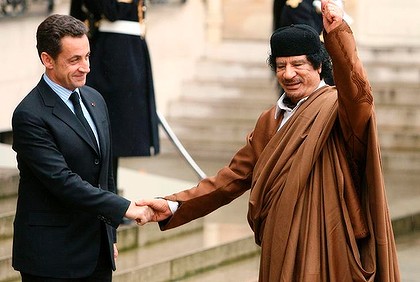
Sarko meets his funder

Evidence has been promised to a French court that could prove former President Nicolas Sarkozy accepted more than €50 million in campaign donations from ousted Libyan leader Muammar Gaddafi.

­Information pointing to the existence of such documents was revealed late last year by Franco-Lebanese businessman Ziad Takieddine. He’s currently facing corruption charges and is under investigation over allegations of his involvement in a money laundering operation between France and the Middle East, in which he is believed to have been involved for 20 years.

“I can provide you with details of the financing of Nicolas Sarkozy’s campaign,” Le Parisien quoted Takieddine as saying. He told the judge the sums involved would exceed €50 million, as Sarkozy’s 2006-7 campaign was “abundantly” financed by Tripoli. The payments continued after Sarkozy’s victory, Takieddine added.

Takieddine’s testimony repeats allegations made by Gaddafi’s son Saif al-Islam and French investigative website Mediapart. Sarkozy has denounced the claims as “grotesque.”

He also claimed to be in possession of “evidence that three French companies in Libya have received contracts for fictitious services” to the tune of “more than €100 million.”

At a December 19 hearing, Takieddine said a number of meetings to organize the payments had taken place in 2006 and 2007 between Claude Gueant, Sarkozy’s chief of staff, and Gaddafi’s private secretary, Bashir Saleh. He said records of these meetings were in the possession of former Libyan Prime Minister Al Baghdadi Mahmoudhi, who is living in exile in France.

Takieddine was apprehended while attempting to take cash out of Libya on a private flight in March 2011, during the NATO-led anti-Gaddafi campaign.

His trial centers on claims that a series of bombings in 2002 in Karachi, Pakistan, were carried out in revenge for the non-payment of bribes agreed during the 1994 sale of a French submarine. The tragedy killed 14 people, including 11 French naval engineers. Takieddine is charged with acting as an intermediary in the deal.

It is alleged that some of the cash involved was transferred back to former Prime Minister Edouard Balladur’s 1995 presidential election campaign. The activities also implicate Nicolas Sarkozy, who was Balladur’s campaign spokesman and budget minister.

If found to be true, the allegations could severely embarrass the former French president, as he together with UK Prime Minister David Cameron played a leading role in instigating the NATO airstrikes that helped topple Gaddafi in October 2011.

Gerard Depardieu is granted Russian citizenship by Putin decree

Gerard DepardieuPresident Vladimir Putin has signed a decree granting Russian citizenship to French film star and tax exile Gerard Depardieu, who is renouncing his French citizenship to search for an easier tax climate outside of his native country.

­The Academy Award-nominated Depardieu is a regular in Moscow. The actor made headlines across the world when he announced in late December that “Putin has already sent me a passport!” The statement was a joke, but it soon became reality.

The day after the announcement, Putin told a press conference that the French bon vivant was a welcome guest in Russia: “If Gerard Depardieu really wants to have Russian residence permit or a Russian passport, we can consider the issue resolved positively.”

Putin also said that he has long had “kind, friendly, personal relations” with the leading light of French cinema.

On the morning of January 3, the Kremlin released a statement announcing that “Vladimir Putin has signed a decree granting Russian citizenship to France’s Gerard Depardieu.”

The 64-year-old actor said he was renouncing his French citizenship over the “insulting” accusations of tax evasion he faced after announcing plans to move to Belgium. “I don’t ask for approval, but I could at least be respected!” Depardieu wrote in an open letter to Prime Minister Jean-Marc Ayrault.

“All those who have left France have not been insulted as I have been,” Depardieu said, referring to French Prime Minster Jean Marc Ayrault’s comment that the actor was “pathetic”for deciding to leave his native country.

Last week, Depardieu confirmed he would stay in Belgium despite the fact that a French court struck down the proposed 75 percent income tax rate for the country’s wealthiest. The French government agreed to axe the notorious measure after it “failed to recognize equality before public burdens.”

Depardieu earlier mentioned three countries ready to offer him residence: Belgium, where he recently bought a house; Montenegro, where he has friends and some businesses; and Russia, which has a flat 13 percent income tax rate and could become a tax haven for the actor. – RT

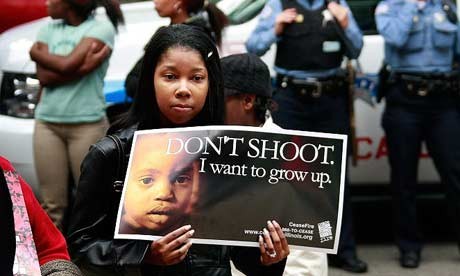
Setting a new record: Chicago’s murder rate

With still a few days to go until the new year, 40-year-old Nathaniel T. Jackson became the five-hundredth person killed in Chicago, Illinois since the start of 2012.

In 2011, the city saw only 435 homicides.

Superintendent Garry McCarthy confirmed to the Chicago Tribune late Thursday night that the passing of Mr. Jackson marked murder number 500 for the Windy City, and that no suspect had been identified by the police at that point. On Friday afternoon, though, the department issued a statement to the press reclassifying a death earlier in the week as being still under investigation. With that update, the slaying of Jackson makes him one murder shy of the 500 mark, but with a homicide rate of more than one per day, that milestone is expected to be met before 2012 comes to a close.

Discussing the grim news on Friday, Chicago Mayor Rahm Emanuel said it was “an unfortunate and tragic milestone, which not only marks a needless loss of life but serves as a reminder of the damage that illegal guns and conflicts between gangs cause in our neighborhoods.”

Emanuel, a former Obama administration staffer known like the president for his staunch pro-gun control stance, condemned the National Rifle Association earlier this month after the NRA’s vice president asked for armed guards in every school across America.

“That is not the right answer for our society, our schools and most importantly our children,” Emanuel said.

Even as adamantly opposed to guns on the streets as Emanuel is, however, the mayor has a seemingly impossible task of turning around a surge in violent crimes as murders have skyrocketed under his administration. According to the police statistics provided to the Tribune, “homicides were up 17 percent over last year in Chicago, and shootings had increased by 11 percent.”

All the way back in June, Roseanna Ander of the University of Chicago Crime Lab warned The Daily that Chicago was already on the path to having a particularly bloody year.

“Violence has always been most pronounced on summer weekends in Chicago,” Ander said, adding, “One likely factor is the warmer-than-usual weather and the early spring. Over 80 percent of shootings occur outdoors and in public places.”

Ander’s prediction proved right, and as the summer months progressed matters were only made worse. In late August, 19 people were shot in a single evening in Chicago. It may have been a big number at the time, but was only a few shots beyond what the city saw months earlier.

“Over the Memorial Day weekend, in a 72-hour period, we had 12 people killed and another 45 people shot.” WBEZ Chicago Public Radio host Robert Wildeboer told National Public Radio during a July 10 interview.

“Thirteen people were shot in one 90-minute stretch, and so that’s really focusing public attention on this issue right now,” Wildeboer added. “You know, just last night, eight people were shot in the city of Chicago. But some of the numbers were just so shocking, A, that murder’s up 40 percent over last year. B, there have been a number of really violent weekends in Chicago where the numbers are just so striking, everybody’s just, like, what in the world?”

The last time Chicago saw this many deaths in a single year was 2008, when 512 people were killed. Meanwhile in New York, Police Commissioner Raymond Kelly says the murder rate in the Big Apple is down nearly 19 percent in 2012.

“I’m thankful for the fact that this year there will be the lowest number of murders that we’ve had since we started to record them in 50 years, even though the population is as high as it’s ever been,” Kelly tells reporters this week.

60 dead in Ivory Coast during New Year’s Eve stampede

The Ivory Coast on Wednesday began three days of national mourning after a stampede among crowds gathered for celebratory New Year’s Eve fireworks in Abidjan left at least 60 dead and dozens injured.

An AFP journalist saw many injured children, while images broadcast by RTI television showed bodies stretched lifeless on the ground outside the city’s main stadium.

Piles of abandoned shoes and clothing could also be seen at the stadium, where soldiers and police were deployed, along with UN peacekeepers.

“This is a real tragedy on this New Year’s Day,” President Alassane Ouattara said at the scene.

“We are all in shock,” he added, announcing that three days of national mourning would be held starting Wednesday.

The government said 60 people had died, with an average age of 18. Earlier, the head of military rescue workers, Lieutenant Colonel Issa Sako, told journalists that 61 had died.

“Forty-nine wounded were evacuated” by rescue workers, Sako said, adding that other injured victims had gone to hospital on their own. Another rescue official said at least 200 people had been wounded in all.

Sako said the flow of people at the stadium had caused a “very large crush” and that “in the crush, people were walked over and suffocated by the crowd”.

Officials said around 50,000 people had gathered for the fireworks.

Witnesses said the stampede had broken out after the fireworks ended, though the cause remains unclear. It erupted near the stadium’s main entrance, where security had set up tree trunks as crowd control barriers.

According to a police source, the crush occurred when two streams of spectators going in opposite directions crossed paths.

A security source added that rescue services “took some time to arrive”.

Interior Minister said the “exact circumstances” of the tragedy are “under investigation by the security services”.

Visibly shaken children were among the roughly 40 wounded taken to a hospital in the wealthy neighbourhood of Cocody, in the north of the economic capital.

A mother named Zeinab who had taken two of her children to the stadium found one of them in the hospital, a small boy who lay on a bed in a groggy state.

Zeinab said she “hurt all over” and showed a journalist the scratches on her body.

“I don’t know what happened but I found myself lying on the ground with people stepping on me, pulling my hair or tearing my clothes,” she said.

She said she had been knocked unconscious and that a young man had pulled her from the crowd.

The New Year’s fireworks, the city’s second in two years, had been touted as a symbol of national renewal under Ouattara after a violent post-election crisis that tore the country apart from December 2010 to April 2011, killing some 3,000 people.

The unrest began after Ouattara’s long-time rival and former iron-fisted ruler Laurent Gbagbo refused to step down.

He was later arrested by forces loyal to Ouattara, with UN and French military backing, and transferred to the International Criminal Court in The Hague, where he is accused of crimes against humanity.

Though the troubled west African nation — the world’s top cocoa producer — is still recovering from the political and military crisis, Ouattara had struck a note of optimism in a New Year’s message on Monday evening.

He said the former French colony had “possibilities like seldom before” ahead of it, promising it would soon reap the rewards of economic growth and development. – AFP

French immigrant youths burn 1200 cars for fun

Muslim youths burning cars in France

A New Year’s Eve tradition for some in France of torching empty, parked cars has continued.

Interior Minister Manuel Valls said Tuesday that 1,193 vehicles were burned overnight around the country, where the stunt began in the 1990s.

There was no way to compare this figure to recent ones because the conservative government of former President Nicolas Sarkozy stopped making the numbers public while he was in office. But the rate of burned cars was apparently steady. On Dec. 31, 2009, 1,147 vehicles were burned.

For some, the decision of France’s current Socialist government to resume making public figures of New Year’s Eve’s torched cars is unwise.

Bruno Beschizza, a security chief for Sarkozy’s UMP party, said on iTele TV that publishing the numbers motivates youths to commit such crimes. – AP

US and Canada lock up blacks, Indians

Canadian prison

By Matt Moir, The Tyee

Idle No More is forcing many Canadians to be Willfully Blind No More.

Ostensibly, the movement spearheaded by Attawapiskat Chief Theresa Spence is about the protection of First Nations’ treaty rights. At its core, though, might be something more profound, perhaps best described as a demand for all of us in this country to re-think the relationship between Aboriginal and non-Aboriginal Canadians. The relationship is, of course, an uneven one, though it might be far more uneven than most of us in this country care to acknowledge.

Against this backdrop, policy makers and average Canadians alike would be well advised to ring in the New Year by considering the lessons Michelle Alexander highlights in her important book, The New Jim Crow: Mass Incarceration in the Age of Colorblindedness. The context is American, but the lessons may hit closer to home. In the book, Alexander writes the following in regards to African-Americans and the United States’ criminal justice system:

“It is fair to say that we have witnessed an evolution in the United States from a racial caste system based entirely on exploitation (slavery), to one based largely on subordination (Jim Crow), to one defined by marginalization (mass incarceration). While marginalization may sound far preferable to exploitation, it may prove to be even more dangerous. Extreme marginalization, as we have seen throughout world history, poses the risk of extermination.”

It’s a narrative equally provocative and compelling. Alexander argues that Americans’ obsession with ‘law and order’ began as a conservative attempt to breed white opposition to the burgeoning civil rights movement. Politicians on the right labeled civil disobedience a precursor to criminality, and branded supporters of civil rights legislation as promoters of lawlessness. Exploiting the fears of poor and rural whites, Republican politicians invented and propagated the ‘War on Crime’ and, more specifically, the ‘War on Drugs’ as a means to incarcerate, and thus control, the black population.

The scheme was so successful that any politician that questioned the effectiveness or morality behind the supposedly colour-blind ‘War on Drugs’ was accused of being ‘soft on crime’ — the death knell for one seeking public office. In 1992, Bill Clinton recognized that Democrats could peel off right leaning white voters by outflanking the Republicans on issues like crime and welfare reform, and promptly advocated for a number of policies that resulted in the largest increases in federal and state prison inmates of any president in the history of the United States, the overwhelming majority of which were people of colour. The normalization of racial marginalization, according to Alexander, was finally, quietly complete.

The book is more than a lament; it’s a warning. Alexander paints a bleak portrait of a future in which the majority of African Americans — increasingly economically vulnerable in a nation of skyrocketing inequality — being under the control of the criminal justice system is not entirely inconceivable. It’s an ugly commentary on contemporary American society. Canadians should pay attention.

One in five Canadian prisoners are Aboriginal

Troublingly, there are significant parallels between the plight of African Americans in the United States, and the Aboriginal population in Canada.

As American history is steeped in institutional savagery toward African Americans, Canada’s history, too, is pockmarked by the white majority’s mistreatment of Indigenous peoples. Most notable among a litany of gross violations of justice are the permanent occupation of ancestral lands beginning in the 18th century, the noxious attempt to ‘civilize’ Aboriginal people in residential schools in the early 1900s, and the refusal to recognize Aboriginal Canadians as legal ‘persons’ until the middle of the 20th century. And the similarities, unfortunately, are not only historical.

Though Canada doesn’t yet lock up the same percentage of its citizenry as its southern neighbor — the most heavily incarcerated society in the world — measures passed by Prime Minister Harper’s Conservative government have resulted in a steady increase in the number of Canadians behind bars. Canadians of Aboriginal ancestries have borne the brunt of the surge of prisoners.

The proportion of African Americans and Aboriginal Canadians in prison far exceed their representation in the U.S. and Canada, respectively. In the U.S., black Americans account for 12 per cent of the total population, but represent nearly 40 per cent of the prison population. In Canada, Aboriginal peoples make up four per cent of the total population, but 20 per cent of the prison population.

These significant discrepancies are not shrinking. In the U.S., over 40 per cent of new offenders to state and federal prisons are African American. In Canada, more than one in five new admissions to men’s prisons are of Aboriginal descent. Among women offenders, over one in three are Aboriginal. In the U.S., one in three black men can expect to be incarcerated at some point in their lives. In Canada, young Aboriginal men are more likely to go to prison than complete a high school diploma. And once in custody, a significantly larger proportion of African American and Aboriginal Canadian prisoners are recommended for maximum levels of security than white prisoners charged with similar crimes.

Structural discrimination

While it might be unfair to claim that Canadian politicians and the Canadian criminal justice system have joined forces to consciously ensure that our Aboriginal communities remain repressed and disenfranchised, it cannot be denied that Aboriginals across the country suffer from poverty, injustice and lack of opportunity more than other type of Canadian. One in four Aboriginal children live in poverty.

The life expectancy for Indigenous people in Canada is eight to 20 years less than non-Aboriginal Canadians. On First Nations reserves, 60 per cent of children do not graduate high school, and the lack of suitable housing and access to clean water is endemic. To be Aboriginal in Canada today is to be a second-class citizen.

As a new year begins, we should take this opportunity to look closely at the society that we have created, and address the appalling inequalities of our criminal justice system. There is still time to prevent the prison state of our southern neighbors, but only if we hurry.

No Canadian should be idle.