Romney stumbles on Libya

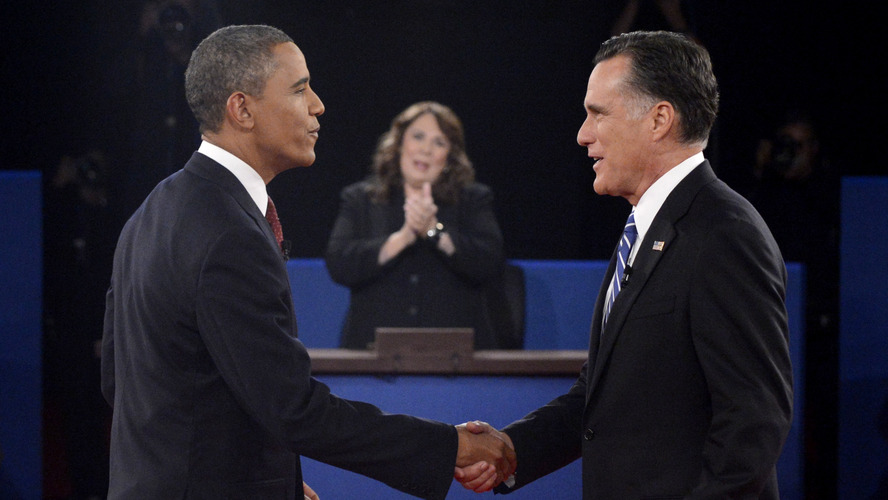
White House challenger Mitt Romney stumbled and missed his mark as he attacked Barack Obama’s handling of last month’s deadly attack on a US mission in Libya.

The Obama camp had been flailing for a month to explain its response to the September 11 assault on the Benghazi consulate, at first blaming it on protesters before concluding it was a pre-planned attack by Islamist militants.

Four Americans, including US ambassador Chris Stevens, died in the attack, and Romney’s campaign has zeroed in on the issue to attack Obama’s broader Middle East policy and his perceived failure to understand looming threats.

It could have proved a weak point for the incumbent in the pair’s second televised debate on Thursday, with Romney returning to his theme that Obama’s policy is “unraveling before our very eyes.”

Obama had slammed Romney for trying to make political capital out of a national security issues and said in his own defense that he had declared the Benghazi assault an “act of terror” the very day after it took place.

Sensing a mistake, Romney went in for the kill.

“I think it’s interesting, the president just said something, which is that on the day after the attack he went into the Rose Garden and said that this was an act of terror,” Romney said.

“That’s what I said,” Obama replied.

“You said in the Rose Garden the day after the attack, it was an act of terror? It was not a spontaneous demonstration, is that what you’re saying?” Romney asked.

“Please proceed governor,” Obama said, relaxing back on his tall chair.

“I want to make sure we get that for the record — because it took the president 14 days before he called the attack in Benghazi an act of terror,” Romney protested.

“Get the transcript,” Obama suggested.

As Romney stood center stage, looking suddenly less sure of himself, CNN journalist and debate moderator Candy Crowley stepped in: “He did in fact, sir.”

“Can you say that a little louder, Candy?” Obama asked with amusement.

“He, he did call it an act of terror,” she stuttered, as Romney looked deflated.

In fact, on September 12, in the Rose Garden, Obama had indeed said in reference to the Benghazi attack: “No acts of terror will ever shake the resolve of this great nation.”

Aside from Romney’s stumble, which was seized upon with glee by Obama’s campaign and broader support base, both candidates landed some tough blows on the Libya issue — without either scoring a knockout.

Obama accused Romney of exploiting the issue and missing a chance to prove that he has the mettle to become US commander-in-chief.

“While we were still dealing with our diplomats being threatened, governor Romney put out a press release,” Obama said, referring to the Republican’s criticisms on the night of the attack.

“Trying to make political points, and that’s not how a commander-in-chief operates. You don’t turn national security into a political issue, certainly not right when it’s happening,” he said during an angry exchange.

Romney hit back, accusing Obama of going on a fundraising tour the day after the September 11 assault on the Benghazi consulate and declaring that his Middle East policy was “unraveling before our very eyes.”

But Obama retorted: “The suggestion that anybody on my team, whether it’s a secretary of state, our UN ambassador, anybody on my team, would play politics or mislead when we’ve lost four of our own, governor, is offensive.

“That’s not what we do. That’s not what I do as president, not what I do as commander-in-chief,” the president declared, fixing Romney with an angry stare before turning on his heel and heading back to his seat. – Sapa/AFP

‘Some girls, they rape so easy’

Roger Rivard

The controversial comments led Republican vice presidential hopeful Paul Ryan, a Wisconsin congressman, to withdraw his endorsement of Roger Rivard just hours before Ryan was set to debate Vice President Joe Biden.

It was the second time Ryan has withdrawn an endorsement from a fellow Republican due to offensive rape comments.

Missouri congressman Todd Akin drew widespread condemnation for declaring in August that a woman’s body can prevent conception in cases of “legitimate rape” as he tried to explain his opposition to abortion even in cases of rape.

Ryan, who also opposes abortion in cases of rape, is expected to be pressed on his pro-life views during the debate.

Rivard, a 60-year-old state representative, first made the statement when discussing the case of a local high school student who had been charged with sexual assault for having sex with an underage girl in the school’s band room.

The Chetek Alert paper quoted him in December as saying that his father had warned him “some girls rape easy” — meaning that some girls could decide later that sex wasn’t consensual.

He doubled down on the comments in an interview with the Milwaukee Journal Sentinel Wednesday, saying that he took his father’s warnings about the dangers of premarital sex seriously.

“He also told me one thing, ‘If you do (have premarital sex), just remember, consensual sex can turn into rape in an awful hurry,'” Rivard told the paper.

“Because all of a sudden a young lady gets pregnant and the parents are madder than a wet hen and she’s not going to say, ‘Oh, yeah, I was part of the program.’ All that she has to say or the parents have to say is it was rape because she’s underage. And (my father) just said, ‘Remember, Roger, if you go down that road, some girls,’ he said, ‘they rape so easy.'”

Rivard went on to say: “What the whole genesis of it was, it was advice to me, telling me, ‘If you’re going to go down that road, you may have consensual sex that night and then the next morning it may be rape.’ So the way he said it was, ‘Just remember, Roger, some girls, they rape so easy. It may be rape the next morning.'”

About three hours after speaking to the paper, Rivard — who is engaged in a tight re-election race — sent a statement to the Sentinel in which he acknowledged that “rape is a horrible act of violence.”

“Sexual assault is a crime that unfortunately is misunderstood and my comments have the potential to be misunderstood as well,” his statement said.

“I have four daughters and three granddaughters and I understand the importance of making sure that awareness of this crime is taken very seriously.”

But activists said his initial statement belies his inability to comprehend the realities of sexual assault and are part of a broader problem of blaming victims.

“Unfortunately, comments like these are all too common, and an indication of ways in which the culture is generally undereducated about what sexual assault is,” Pennie Meyers of the Wisconsin Coalition Against Sexual Assault said in a statement. “Sexual assault remains an underreported and underprosecuted crime.”

Rivard, who is married with six children and ten grandchildren, said in his campaign biography that he learned the “value of a hard day’s work at a young age” while working at his parent’s restaurant in Rice Lake, Wisconsin. Sapa/AFP

Pretoria PEN and the new occult censorship

by Dan Roodt

I belong to a writer’s organisation called Pretoria PEN which has been affiliated for the past six years to PEN International, a world-wide network of authors and journalists. Some of the people who have been presidents of PEN chapters or “centres” as they are called, have been famous writers such as Günter Grass, Václav Havel, Salman Rushdie and others.

However, since October last year I have been embroiled in an increasingly ugly procedural and quasi-political wrangle with a group of Cape authors who have hijacked Pretoria PEN. Yes, I know, lots of people in South Africa get hijacked all the time, usually facing an AK-47-wielding hijacker demanding their motor vehicle. Many also get killed or wounded in the process. Sometimes the hijackers kill their victims just for sport.

So immediately, as is our wont, I can hear a chorus of voices piping in: “Regard yourself as lucky. You are still alive!” That’s normally what people say to a hijack victim who has merely lost his car or pick-up truck. Or to a rape victim. Present-day South Africa is, after all, famous for all the wrong things, being the so-called “rape capital” of the world. We are also way up there with Colombia and a few others in the murder stakes. If only our rugby and cricket teams could maintain the same consistent standards as our murderers, we would have won the last few rugby matches against the All Blacks of New Zealand.

The three Cape authors who hijacked or tried to hijack our literary society are Fanie Olivier, John Miles and Piet Haasbroek. Strictly speaking, Olivier is a poet and not from the Cape either, as he commutes between Poznań and Durban. Poznań, as you probably know, is a Polish city. In one of my favourite short French novels by Jean-Philippe Toussaint, La salle de bain, there are some Polish painters who disturb the main character while he he has taken up residence in the bathroom, reading books and listening to football matches broadcast over the radio.

I was not disturbed by any Polish painter, a rare species in South Africa, but by a Polish email informing me that these three gentlemen were demanding the keys, figuratively speaking, to our little societal Volkswagen. We held meetings, amended our constitution and invited any dissident members to make their voices or their votes heard, to enter into debate and reasonable discussion, to no avail.

After Poznań, the action moved to Stellenbosch where on 7 March 2012 Olivier delivered a speech where he, inter alia, denounced organ music. Now, it may interest you that one of the aftereffects of apartheid or Afrikaner rule in South Africa is that the whole country is littered with organs, especially German ones, being of good quality. Many postgrads in music have written theses about the church organs of small towns. Of course, many of those small towns now bear different names and some of them are awash in sewage as the new town councils are more interested in buying Mercedes-Benzes than in maintaining their water purification systems. Visiting such run-down water purification plants has become a form of tourism among some local activists, one of them being Mr. Jaap Kelder of the National Taxpayers’ Association.

But I digress. The point of Olivier’s denuncation of organ music was that it had some connotation with Christianity. One of the sins committed by Pretoria PEN was that we had actually contracted one of those postgrads, an organist from the University of Pretoria’s music school, to come and give a recital to us after our AGM in January, boycotted by Olivier and his friends. And that was not only a faux pas, but also decidedly politically incorrect. In fact, during Olivier’s rambling little speech in Stellenbosch, the mere mention of the organ elicited howls of ridicule and guffaws of contempt.

Perhaps some background is needed. Fanie Olivier, the poet laureate of a place called Durban-Westville, has spent most of his life teaching literature at segregated universities, situated in the notorious Bantustans or “homelands” of apartheid. His father, a powerful figure and high-ranking member of a secret Afrikaner society known as the Broederbond (the Society of Brothers), was the first principal of the Indians-only University of Durban-Westville, so it is quite understandable that the heir to the throne, young Fanie, was also appointed there where he debuted with the anthology, Gom uit die sipres (Glue from the cypress).

Later he was a professor of Afrikaans at the University of Venda, in the former homeland known as the Republic of Venda. I am unaware that he ever took up Venda citizenship, although he may have learnt the language. For those who know little about South Africa, the Limpopo province, where the majority of Vendas live, in the former Republic of Venda, is where most ritual murders take place. A few hundred people get killed every year, to make medicine from body parts. Children too. Of course, this is never put on our tourist brochures and few people dare to write about it, except some bored court reporters who may happen to stumble upon such a case being heard. Usually, such reports are anodyne, with the race and ethnicity of murderer and victim carefully omitted and published towards the bottom of the inner pages of newspapers where only the very curious ever venture.

The thing about ritual murders is that they entail a belief in the occult. Some hijackers also buy muti, or medicine, from so-called sangomas or witch doctors, before setting out on the day’s business, pistol or assault rifle in hand. But “occult”, for those who know Latin, also has another meaning: “that which is concealed or difficult to detect”. Now, I am not of the school that looks for “influences” in an author’s work, but perhaps Fanie Olivier did to some extent acculturate during his many years at the University of Venda.

He has an uncanny belief in the powers of obfuscation, the ruse, making simple things abstruse, even claiming that our society, Pretoria PEN, “ceased to exist long ago”, as if he were waving Harry Potter’s magic wand or throwing the bones in a dark hut in Venda while declaiming some powerful incantation that will change a man into a croccodile or cause someone to drop dead hundreds of kilometres away.

I know vampires are fashionable too. Or the girl with the dragon tattoo. But the next scene in Fast Fanie’s racy tale (a previous cricket player here had the nickname, “Vinnige Fanie”) shifts to South Korea where, during the annual congress of PEN International, he presents himself as not only the President of Pretoria PEN, having hijacked us by remote control, magically, as it were, by email from Poland, but also its chief name-changer. Now, it so happens that name changes are another touchy topic in South Africa. One day you may be driving down a street, and the next the name may be changed to that of some Party stalwart or some arcane figure from a non-existent past, such as the mythical Chief Tshwane who, legend has it, founded a lost city, more or less in the same place as present-day Pretoria and therefore deserves to be eponymously honoured.

In the book South Africa’s Brave New World, R.W. Johnson ascribes a lot of the current South African obsessions with gambling, palaces and lost cities to the influence of entrepreneur Sol Kerzner who built a series of such casino palaces and follies, replete with artificial waterfalls and lakes, even beaches, in another Bantustan, the Republic of Bophutatswana. Johnson states somewhere that SA has now become “one big Bantustan”. Not far from where I live, there is a Renaissance Tuscan village with a casino and shops inside and artifical stars twinkling on the ceiling. Very African, you might say.

In a Bantustan, by knowing the right people and oiling the right palms, you could become a millionaire, and go off to Las Vegas or the Bahamas and repeat the trick there. Just look at Sol Kerzner. Vinnige Fanie is a man of ambition who knows his way around any Bantustan, especially the Grand Bantustan that Johnson refers to. He is also a lawyer, an advocate at the Durban bar, so able to ensnare hapless authors in his byzantine legalistic strategems.

But let’s stick to our plot and get back to the city of Gyeongju in South Korea. This is also historical, for it must be the first name change in history that was decreed in a completely different country, in the Far East, where dragons and not kitsch concrete elephants usually adorn the palaces. Poor old Pretoria, poor old Kruger whose statue still stands – for the time being at least – on Church Square, Pretoria. There he gets polluted by pigeon droppings and some pieces of his bronze get hacked off, nay hijacked by entrepreneurial individuals,  who sell them to scrap metal dealers. And Church Street was found to be such an offensive name that it was changed to… what? I will have to look it up on Google, one moment…

This is all very confusing. Church Street in Pretoria was so offensively long, being one of the first streets laid out in the city, that its name had to be changed to four other names: Helen Joseph, WF Nkomo, Stanza Bopape and Elias Motswaledi.

The only name that I recognise among those ones, is that of Helen Joseph, who happened to be a communist and not some legendary chief of the city lost in the mists of time, out of Rider Haggard or Edgar Rice Burroughs.

There is such a thing as Cape Communism. Or the Stellenbosch school of Marxism, which is why the university there is sometimes referred to as Stalinbosch. It is also a place where authors get banned if they do not say the right things, like I was banned from appearing on campus in 2005 during the Woordfees festival but finally managed to participate in a panel discussion only because I had armed bodyguards protecting me from being attacked by rabid Red Guards who regarded me as a bad influence on the public. In fact, I have it on good authority that some zealots are pressing for my books to be removed from the library of the University of Stellenbosch for being sexist or racist or both.

One of the people who accused me of “sexism” was André Brink who writes barely disguised autobiographical novels boasting about the number of his female conquests and in his latest novel, Philida, makes liberal use of the ethnic slur, “kaffir”, for which people in South Africa normally get dragged before the Equality Court and fined or even imprisoned. See the logic there? I don’t.

But back to Gyeongju where Pretoria PEN became the latest casualty of the ANC government’s name change policy, no doubt because it was seen as an “offensive” name, as offensive as the capital’s name or Paul Kruger’s name whose statue is being slowly devoured by the clients of scrap metal dealers. According to Fanie Olivier, delivering his rambling speech in Stellenbosch, “Pretoria PEN” was a “random” name. (He used the Afrikaans word “lukraak”, which more or less means random.)

One month after the meeting in Gyeongju, shortly after asking for Fanie Olivier’s address as it seems that this little exercise, plagiarised from the writings of Franz Kafka, will now go to court, I receive a laconic email from PEN International stating the following:

“We are writing to inform you that on 14 September 2012 the PEN International Assembly of Delegates at the 78th PEN Congress in Gyeongju, Korea voted to change the Pretoria PEN Centre’s name to PEN Afrikaans.
Following this decision, Pretoria PEN no longer exists as a Centre of PEN International.”

How curious. So our legally constituted literary society, founded in the real city of Pretoria, not some fictional realm of the imagination or the ANC government’s commissars, may be vaporised without even consulting us. No right of appeal, nothing.

Talking of commissars, is it any coincidence that the South African Minister of Higher Education also happens to be the leader of the Communist Party, that old blade runner, known as Blade Nzimande? Logically, those academics down at the University of Stellenbosch where the new “cloned” but rebranded Pretoria PEN is ostensibly headquartered, have to kow-tow to their minister who has wide powers to appoint and dissolve university councils. So now we understand a bit better how so many intellectual champions of apartheid and the Bible have now converted to another Book and find organ music execrable.

However, if literature is becoming more and more state-controlled in our de facto one-party state (65% of the population and 90% of black people vote for the ANC and its SACP alliance partner), there are also the corporate powers to consider. Often the big corporations and government work closely together, especially when contracts are awarded. It is generally accepted that the “New South Africa” is one of the most corrupt countries in the world. Not for nothing have we coined the term “tenderpreneur” to describe people doing business with the state.

Add to this mix the National Intelligence Agency whose white, Afrikaner members are apparently so desperate to keep their jobs amid rampant affirmative action that they will do anything to ensnare their own people in acts of high treason, conspiracy and sex scandals. Facebook and the commentary sections of South African web pages are apparently rife with NIA trolls who sow dissension, ridicule and slander. Public figures seen to be “dissidents” or “outspoken” are regularly vilified.

Quite a few members of Pretoria PEN, such as myself and singer/writer Steve Hofmeyr, have been subjected to whole campaigns, also in the media. Several people regularly posted a satirical poem that I had written as a 20-year old everywhere he could and also sent it to thousands of people by email, completely disregarding any copyright I may hold over the poem. One such person was apparently an English-speaking member of a far-right group who considered me to be a danger to society for having written such scabrous satirical poetry in my young days.

Is it pure coincidence that while Fanie Olivier is waging his behind-the-scenes email campaign against Pretoria PEN, there should be another group of trolls on Wikipedia publishing half-truths and distortions about me? When I enquire about their identity, I get promptly banned from Wikipedia! The anonymous literary critics on Wikipedia have also ascertained that I suffer from mental retardation, being insufferably stupid, and that all my books put together contain “nothing of any merit”. At least these Wiki-writers, even if faceless, are not ambiguous.

Part of Fanie Olivier and his henchmen’s approach was to “leak information” to friends, journalists at the Cape Town daily Die Burger and other Naspers publications who would then try to stigmatise me and others. Naspers tabloid Sondag went so far as to draw a completely spurious association between me and a supposed adult-dating site, suggesting that I was a pornographer. Naturally I complained to the Press Ombudsman of South Africa, who ordered the newspaper to publish an apology on its front page. The newspaper lodged one appeal after the other, but each time the original decision was upheld. In a final desperate attempt to stall the apology, the newspaper is suing the Press Ombudsman, a historical first in South Africa.

The journalist from Die Burger who had published Fanie Olivier’s “leak” was also ordered by the Ombudsman to publish an apology to me and Pretoria PEN at the beginning of 2012. That was before Naspers got around to the idea that it could bully the Ombud through lengthy court cases.

Only a few months ago, as president of Pretoria PEN, I testified before the Media Commission about press freedom in South Africa and mechanisms for keeping the Naspers group, which has a total monopoly in Afrikaans media, under control without curtailing freedom of the press.

I strongly suspect that the takeover attempt by Fanie Olivier, John Miles and Piet Haasbroek is being financed by some Naspers entity, such as one of their book-publishing concerns down in Cape Town. An unnamed “sponsor” paid for three people to fly to Gyeongju. At the very least, the name of this sponsor should be revealed, for the sake of transparency.

In the meantime, the Naspers propaganda machine is destroying authors’ or performers’ reputations, almost at will. This is the new censorship in South Africa which, in deference to Fanie Olivier and his fellow travellers, I would call “occult censorship”. It is vague, but no less insidious and effective.

In the old days we had the staid Judge Lammie Snyman and his fellow censors who saw it as their prerogative to protect us from communist or terrorist propaganda and obscenity. They were easy to deal with and almost counter-productive. They made heroes out of people like André Brink or Nadine Gordimer whose books were banned for a few short months or slightly longer before they were unbanned on appeal. Today, we are caught between Scylla and Charybdis, the state that wants to control everything according to the East German model, and the Naspers media monopoly that prides itself on being able to make or break anyone’s reputation. If you had deep pockets, you could take them on in the courts, or otherwise through the Ombudsman. As I have found out, even the Ombudsman will only give you a Pyrrhic victory as Naspers sees itself not bound by any adverse decision from the so-called “self-regulatory body”.

When the Naspers Sunday paper Rapport published the infamous interview with another Pretoria PEN member, Annelie Botes, on 21 November 2010 I immediately saw all the hallmarks of another character assassination. Preying on Annelie’s honesty and concern about crime and violence in South Africa, they focussed on one sentence where she spoke of her inner fears as a member of an ethnic and racial minority. The context was completely disregarded and she was immediately calumnied as xenophobic, even racist.

Annelie Botes is probably the most popular literary author in South Africa. Locally, she far outsells André Brink, Nadine Gordimer, J.M. Coetzee or any of the big names in South African literary fiction. She addresses difficult and courageous themes, such as autism, incest and child abuse in her works. The public loves her for it.

However, as a result of the Rapport interview, the K. Sello Duiker award was taken away from her and just yesterday she confessed on Facebook that her latest manuscript had been rejected by her publisher. In this way, another talented and widely-read author is being silenced.

I see on the CV of Annelie Botes that she also has a teaching licentiate in classical music – the piano – and was at one time a church organist. As a result, she will never be acceptable to any PEN Centre down in Cape Town, least of all one that meets on the campus of Stellenbosch University, with Philistine Fanie as its president.

Let’s make the organ our new resistance symbol, I feel! And the pen, of course, which may just be mightier than the hijacker’s AK-47, even in this country where violence and revolution have been romanticized for so long.

I receive quite a bit of fan mail, despite being banned in Stellenbosch. The other day I got a note from a young hacker who offered to hack the ebooks of all my literary enemies and upload them to the Swedish Pirate Bay and similar websites. That way no one would have to buy their books ever again; they and their publishers would make losses. I declined his offer, being something of a victim of piracy or “hacked” and dismembered works myself.

However, I thought to myself afterwards, have things become so desperate that such extreme measures, sabotaging or pirating the books of others, should be considered? Indeed, there is a sense of “living on the edge” in South Africa. We are locked into a struggle for survival, and in some respects our whole world is caving in around us. Whether it is the Marikana mining massacre or just another everyday xenophobic killing of an immigrant from another African country, or a farm murder, we are living in an “age of iron”, to borrow a phrase from J.M. Coetzee. The latter preferred emigration to Australia.

The theme of fear that Annelie Botes broached in her interview is becoming more and more palpable. Another colleague and Pretoria PEN member, Gustav Venter, has just published his novel Die amigdala van Alrina Smal in which a woman goes almost insane with fear after a sexual assault. Will it even be reviewed by the printed press, I wonder? It also deviates from the post-card multicultural paradise that everybody sees in South Africa and for that reason might fall victim to the new occult censorship.

Effectively, Annelie Botes, Steve Hofmeyr, Gustav Venter, Fransi Phillips and all the other innovative and courageous authors depicting our contemporary reality in their works, together with me, have been excluded from PEN International without due process or any right of appeal. The censors of Stellenbosch and the media monopoly have spoken.

Yet we do need to organise ourselves to confront our imminent exclusion from the literary community, in South Africa and abroad. Already Fanie Olivier is making legal threats to us if we continue to exercise that right as we have been doing since 2004. He claims to have the support of the London management of PEN International.

But we have the right to associate with one another, as well as the right to communicate with other authors and NGOs all over the world. Let no one intimidate us into surrendering that right, nor into giving up the fight for free speech in South Africa.

Floyd Shivambu on ANC’s tribal politics

Zulu tradition irks ex-ANCYL leader

A few years ago, the ANC made a huge blunder in electing Jacob Zuma as President of the ANC in December 2007. Ironically, the re-election of President Thabo Mbeki in the same Conference would have been a huge blunder, portraying an incapable ANC that cannot outgrow its individual leaders. This is an unfortunate part of politics where it happens that both sides of political options are disastrous.

Now, Polokwane bred a disaster in Jacob Zuma who despite his literary incapabilities, has very low or non-existent moral standards, and obsessed with enrichment of his family members and household. An expectation was somewhat developed towards Polokwane that the election of Jacob Zuma will lead to discontinuation of rabid presidentialism and the ANC will be taken to the people. It was not to be so judging by the many individually inspired blunders committed by the sitting President both as ANC President and President of the Republic of South Africa.

Election of Jacob Zuma in the 53rd National Conference of the ANC will be the biggest blunder the ANC would have made in its history because it is going to lead to massive electoral support decline of the ANC. Majority of the people will lose confidence on the capacity of the ANC to create conditions for betterment of their lives and govern society effectively. The ANC should never elect Zuma, despite efforts to co-ordinate tribal support in KwaZulu Natal.

Between January and August 2012, the membership of the ANC in KwaZulu Natal grew by more than 100 000, actually more than 36% growth, meaning that KZN delegates will have mandates from unseasoned members on what should be the direction of the ANC. The membership growth had nothing to do with organisational development and growth, but the tribal need to defend a fellow Zulu speaking individual who has failed to provide leadership to the ANC.

What this means is that a tribal regiment has been mobilized as voting fodder to defend and protect President Zuma. Under real circumstances, there can never be a straight thinking individual without tribal prejudices, and without expectation to be defended from corrupt practices, and without legitimate expectation of being recipient of State and government patronage who will support the re-election of President Zuma as President of the ANC, and subsequently as President of South Africa until 2019.

If in their wisdom, ANC members believe and think that the re-election of President Zuma is the right thing to do, then the ANC would have lost its moral compass and total wrong. It will mean that the people of South Africa will be justified to lose confidence in the ANC.

Jacob Zuma is a corrupt leader who encourages corruption of self-enrichment. We can all appreciate that the Courts of law have not yet decided on his impending guilty verdict, and it does not need rocket science to know and notice that any competitive and fair court of law will find him guilty of corruption. The biggest corruption however is that Jacob Zuma will cost the South African government more than R1 billion on his three official residences, many wives who are subsidized by the State, and now recently the expansion of his private residence in Nkandla and the roads leading towards there.

A R1 billion can do a lot in the eradication of informal settlements and bettering of living conditions of many fronts. Zuma is a liability to the ANC, to the country and to the image of Africans the world over. He must be stopped sooner than later and held accountable for his corruption, fraud and money laundering.

The wisdom or lack of it on the President’s side led to first, militarization of the Police, second, destabilization of its leadership through unexplainable release of Police Commissioner Bheki Cele, and appointment of an inexperienced and Security cluster novice police commissioner Riya Phiyega.

The mishandling of the mass wage protests in Marikana in August this year, which led to the massacre was as a result of the directionlessness of the police and lack of experienced leadership. The Police Commissioner is on record of justifying the Marikana massacre claiming that the police were defending themselves, whilst they conspicuously resorted to cold-blooded killing of protestors after failing to arrest all of them for withdrawing their labour from the Mines.

The reason why the Mines protests happened in the first place is a reflection of lack of leadership at the highest level of the State and government. As a territory with mineral resources endowments, the leadership of South Africa have a permanent obligation to ensure that the people of South Africa, not Mine bosses, derive maximum benefits through salaries and decent human settlements from the extraction of Mineral resources.

The Zuma led government does and has never even pretended to care about the well-being of the people and Mineworkers, the government has instead arrested thousands of mineworkers, injured and killed some of them and recurrently assured Mine bosses that they are safe and should not panic. President Zuma went to the extent of deploying the military to intimidate mineworkers and those who associate with them from pursuing a national protest action against Mine bosses. South Africa has degenerated into a Security State due to the insecurities of President Jacob Zuma.

Offered an opportunity to provide political and ideological leadership to the ANC, President Zuma dismally failed and instead gave a pathetic characterization of the ANC struggles as second transition, which in all intents and purposes deviates from the core values and mission of the ANC to achieve Freedom Charter objectives.

Members of the ANC had to re-educate President Zuma in the Policy Conference that our struggle cannot be characterized as second transition because the first transition towards attainment of Freedom Charter objectives has not been fulfilled. In the ANC, inability of a sitting President to provide political and ideological leadership is treacherous. There is not even a single new idea or intervention provided by President Zuma that has taken the country forward, and yet he still want re-election for another 5 years.

Re-election of Jacob Zuma will not only cause massive and irreparable divisions in the ANC, it will isolate a significant number of voters in the 2014 general elections, most of whom will stay away for fear of voting for a white dominated party and some who will guarantee the opposition increased majority and representation in the National Assembly and Provincial Legislations.

This is an absolute fact and ANC structures and members should in a uniting fashion avoid repeating the mistakes made in the 52nd National Conference of electing a leader who is only concerned about his personal and private family’s upliftment, whilst not offering any durable, sound and sustainable solutions to South Africa’s crisis of unemployment, poverty and inequalities. We cannot afford to repeat mistakes.

Floyd Shivambu is an Economic Freedom Fighter.

Poisonous gas accident at Kraft

After the accident at Kraft Foods in Bad Fallingbostel, Germany

About 1,400 people have been evacuated from their homes in Germany, authorities said on Tuesday, after a chemical accident at a factory run by US food giant Kraft caused a cloud of poisonous gas.

The accident, at the small town of Bad Fallingbostel, near Hanover in northern Germany, happened on Monday when employees accidentally poured acid into a tank containing sodium hydroxide solution, causing a chemical reaction.

About 700 firefighters were still trying to cool the container on Tuesday amid rising temperatures and fears of a possible explosion. Technical experts were trying to pump out the acid.

Local authorities have imposed emergency measures, including closing local schools and nurseries as well as parts of a major motorway running nearby. An exclusion zone of 500 metres has been set up.

A spokeswoman for the company said that no one had been injured so far.

“There has at no time been any danger for the population because we decided, along with the authorities, to evacuate as a precautionary measure,” Heike Hauerken told rolling news channel N24.

Production was halted as soon as the accident took place, she added. – Sapa/AFP

Ann Coulter’s Mugged, a review

Ann Coulter and friend

Many in the Dissident Right/ Right Opposition have criticized Ann Coulter as the epitome of the cable news partisanship. However, next to Pat Buchanan, she probably speaks more taboo truths than anyone else with Main Stream Media [MSM] access.

Coulter calls for cuts in legal immigration, ending birthright citizenship, speaks frankly about the Bell Curve, defends groups like the Council of Conservative Citizens (with some qualifications), and even quotes VDARE.com and Peter Brimelow .

So I was excited when I heard of her latest book, Mugged: Racial Demagoguery from the Seventies to Obama.

But, as she began promoting it, the controversy seemed to be limited to her attacking liberals and the Democrats for racism and indifference to blacks.

So I got worried that the book would be more partisan Jonah Goldberg-type “Democrats-are-the-real-racists, Martin Luther King-is-a-conservative” platitudes than an actual, much-needed indictment of racial demagoguery.

Fortunately, however, the vast bulk of Coulter’s book focuses on exposing liberal and black hysteria and lies about race.

Coulter notes several actions that now inspire accusations of racism in the Age of Obama:

“not electing Obama president”
“requesting documents from Attorney General Eric Holder” in Fast and Furious
“references  to Obama playing basketball”
“the word ‘the’”. The last charge, she notes, was inspired by Donald Trump referring to “the blacks.”

Her book’s subtitle is Racial Demagoguery from the Seventies to Obama, and Coulter systematically documents racial demagoguery from the 1970s on. She does a great job telling the true story behind supposed acts of racism such as the justified Rodney King beating, the tragic (but not racist) shooting of Amadou Diallo, and the Willie Horton Ad. She exposes the little-known fact that Jim Jones People’s Temple mass suicide was led by a fanatical left-winger driven by “anti-racism” and Marxism, who also had close ties to the Democratic Party.

Perhaps the best part of Coulter’s book is her discussion of hate crime hoaxes. She devotes an entire chapter, amusingly titled “Hey, whatever happened to that story…” to hate crime hoaxes and how the MSM always accepts the lies, only to deep-six the stories when they prove false. In addition to rehearsing well-known hoaxes such as the Tawana Brawley case, she goes into great detail about lesser-publicized frauds, like the non-existent epidemic of black church burnings during the Clinton years. More importantly, she notes that many of these fake hate crimes stirred up actual hate crimes against whites—which were all ignored by the MSM.

Coulter covers the Duke Lacrosse mess later in the book.  This is one of the few Hate Crime hoaxes that most people still remember, but Coulter brings up facts often ignored (outside of VDARE and a few other sources) that put it in perspective. She reports DOJ crime statistics noting that there has not been a single case of an actual white-on-black gang rape, while thousands of black-on-white rapes (including gang rapes) occur each year. As Coulter barbs:

  If there were a single unequivocal example of a white on black rape in modern times, a lesbian folk singer would have written a song about it and won an Oscar for the accompanying documentary.

There are, however, a few areas where I believe Coulter’s partisanship gets in the way of her otherwise excellent analysis.  Like many Conservatism Inc. publicists, Coulter argues the Democrats are in fact the real racists, and that the Republican Southern Strategy was non-racial.

Coulter has occasionally made some statements suggesting that she is sympathetic to Bell Curve arguments. [See her column Murdering The Bell Curve, June 27, 2002 at 2:50 PM]But she concludes her book by asserting

if all black people woke up tomorrow morning with the cultural predilections of Korean Americans, all sociological disparities—income, crime rates, out of wedlock births—would vanish within ten years.

Coulter’s general point that most of the problems in the black community will only improve through cultural change is no doubt true. But the unfortunate fact of average genetic differences means that most of those disparities will never vanish.

These quibbles aside, Coulter’s Mugged ranks with Jared Taylor’s Paved with Good Intentions and Thomas Sowell’s The Vision of the Anointed  as one of the best indictments of American minority and liberal hypocrisy and hysteria on race. – Alexander Hart, VDARE.com

Don’t laugh please, we’re black(face)!

Blackface not funny

Administrators in the Waverly Central School District have been fielding complaints all weekend after students involved in a Friday pep rally staged a skit critics say was racist and made light of domestic violence.

The issue is getting some national attention after a Waverly High School graduate posted a story on the CNN iReport website early Monday.

Three white students wearing blackface put on the skit, according to the post by 2006 graduate Matt Dishler, with two of the students representing singer Rihanna and her former boyfriend, entertainer Chris Brown, who were involved in a highly publicized domestic violence case in 2009.

A photo posted with the story shows one male restraining another male, with a student portraying Rihanna cowering on the floor. Students and others sitting on the bleachers in the background appear to be smiling and laughing as they watch the skit.

Dishler said he didn’t attend the rally, but heard about it from friends. After confirming the information, he decided to post an opinion piece.

“I can testify there’s not a lot of racial diversity in that school whatsoever. We’re not really exposed to that at that school,” Dishler said. “I felt like something should have been done about this. I don’t believe the kids had any vicious intentions, but the administrators should have said that’s not exactly OK.”

Waverly Superintendent Joseph Yelich said he was not aware that the students were planning to do the skit, but he has received plenty of complaints since then.

“The Waverly School District is committed to creating a positive atmosphere through all activities,” Yelich said. “I’ll be working with building administration, staff and students to develop future activities consistent with that commitment.

“There is a set of concerns that a number of individuals have had, and we want to address those concerns,” Yelich said. “I want to be sure administration and staff and students know what our expectations are.”

Yelich did not indicate what if any specific actions would result from Friday’s pep rally.

A New Hope Center, an Owego-based agency that assists victims of domestic and sexual violence, hate crimes, rape and other abuse, is already working with the Waverly School District on bullying issues, according to Assistant Director Francis J. Bialy.

Bialy wasn’t aware of Friday’s pep rally, but he said, in general, it’s disturbing to try to find humor in grave issues such as domestic violence.

“If it’s intended to be humorous or putting down people, it further perpetuates permission to engage in such behavior,” Bialy said.

“When you look at issues with race, the same thing holds true. If people act in racist ways or support racist behavior, they tell other people it’s OK to act racist.

“I hesitate to judge the intent of something,” Bialy said.

“There’s also a dynamic that well-intentioned actions are done without a full sense of understanding that also end up being damaging as well. I think it should be looked at.”

Dishler said he is still proud of his former high school and didn’t want to be too critical.

“I believe they will take steps to cure it. I just think sometimes things need to be brought to light,” Dishler said.

“(Domestic violence) is nothing to joke about. I wanted people to know this mistake was made and can we please rectify it so it doesn’t happen again.”  – stargazette.com

‘Racist’ comedian suing for libel

A British comedian, Frankie Boyle is suing the Mirror newspaper for libel, over an article which labelled him racist.

He is complaining about a story published on 19 July 2011, saying he was in talks for a new Channel 4 show.

The first sentence read: “RACIST comedian Frankie Boyle could soon be returning to TV despite upsetting thousands of viewers”.

The Mirror said it will defend itself “on the basis of truth and fair comment”.

The trial, which is taking place at the High Court in London, is expected to last a week.

Boyle’s lawyer told the court that the newspaper had also defamed his client, by asserting he had been “forced to quit” the BBC comedy show Mock The Week.

His barrister, David Sherborne, said that to call someone “racist” was “obviously defamatory”.

Mr Sherborne said Boyle’s humour was “deliberately challenging”.

Controversial humour

He said the comic did not object to being criticised but did object to being described as racist.

“Saying ‘vile’ or ‘offensive’, or his material is ‘vile’ or ‘offensive’, is one thing,” Mr Sherborne told the jury.

“He realises that that goes with the territory, so to speak. But accusing him of being a racist is an entirely different matter.”

Mr Sherborne added: “You can call him ‘offensive’, you can call him ‘tasteless’. That’s fine. But he is not racist.”

The Glasgow-born comedian’s humour has often proved controversial with audiences.

Last year, broadcasting watchdog Ofcom upheld more than 500 complaints about his Channel 4 show Tramadol nights, during which he joked about Katie Price’s disabled son, Harvey.

Ofcom ruled that the joke appeared to “target and mock the mental and physical disabilities” of the then eight year-old.

In 2008, the BBC apologised when Boyle made a joke about Palestine on the Radio 4 comedy show Political Animal.

Break from Twitter

A year after that, BBC Two’s Mock The Week was criticised by the BBC Trust over comments Boyle made on the show about swimmer Rebecca Adlington’s appearance.

As yet, The Mirror has not removed the article about Boyle from its website.

A paragraph added to the top of the story reads: “Frankie Boyle is taking legal proceedings against us for the description of him as a ‘racist comedian’. He claims it is untrue and defamatory. We are defending this claim on the basis of truth and fair comment.

“We are also defending his claim that we libelled him by suggesting that ‘he was forced to quit Mock the Week’ in 2009.”

Boyle’s lawyer said any suggestion his client was forced to leave the show was “completely untrue”.

Boyle has taken a temporary respite from Twitter. “I’m afraid I must disappear from Twitter for a while. See you on the other side of this thing.” – BBC

Affirmative action about to be redefined?

The case for racial preferences in awarding places at US universities is no longer  about minorities held back by centuries of discrimination, says Simon Barber.

Rather, it is all about letting educators decide what will be best to prepare the youth for racial diversity. That, at any rate, is how proponents of affirmative action are framing the discussion as the matter is about to be heard by the US Supreme Court.

Solicitor-general Donald Verrilli, the Obama administration’s chief litigator, told the court last week: “The core of our interest is in ensuring that the nation’s universities produce graduates who are going to be effective citizens and effective leaders in an increasingly diverse society and effective competitors in diverse global markets.”

Just over half the Fortune 100 chimed in with an amicus brief. “The only means of obtaining a properly qualified group of employees,” they argued, “is through diversity in institutions of higher education which are allowed to recruit and instruct the best qualified minority candidates and create an environment in which all students can meaningfully expand their horizons.”

The case pits Abigail Fisher against the University of Texas. Ms Fisher, who is white, says her rights under the constitution’s 14th Amendment were violated when she failed to get in. The university says that while it does indeed take race into account in selecting candidates, it does so as part of a “holistic” review fully consistent with the court’s precedents, in particular Justice Sandra Day O’Connor’s opinion in the landmark 2003 case, Grutter v Bollinger. Writing for a slim 5-4 majority Justice O’Connor held that the University of Michigan Law School’s admissions strategy passed muster: it was adopted in “good faith”, did not rely on demographically-based quotas and was “narrowly tailored to a compelling interest in attaining a diverse student body (with a) critical mass” of minority students.

Opponents of affirmative action would like to believe that, with Justice O’Connor’s replacement by the far more conservative Justice Samuel Alito, there is now a critical mass on the court for banning race-based preferences altogether. They hope Ms Fisher will persuade a majority if not to reverse Grutter v Bollinger, then at least, in the words of Justice Sonia Sotomayor (who will not be part of that majority), “gut it”.

There is a school of progressive thought which would not mind seeing Ms Fisher prevail. In a new study for The Century Foundation, Richard Kahlenberg looks at how universities have been handling diversity in the seven states, including California, where racial preferences have already been banned by referenda, state legislatures or gubernatorial executive order. The news is good.

Responses include partnerships with disadvantaged schools, new race-neutral preferences for students from all difficult environments, no more automatic slots for offspring of alumni, and guaranteed places, regardless of test scores, for a fixed percentage of top students from all in-state public schools. Many of these are terrible, de facto segregated and disproportionately starved of resources.

“For people who care about social equality, all these new measures are intrinsically desirable,” Mr Kahlenberg writes. But they do not come naturally to university administrators because they are harder and more expensive to implement.

“While higher education’s vigorous defence of affirmative action on one level represents a sincere desire for greater racial equality, it has another less virtuous side to it, as racial preferences avoid the hard work of addressing deeply rooted inequalities and instead provide what (one critic) has called ‘racial justice on the cheap’ … recruiting fairly privileged students of colour is far less expensive than including low-income and working class kids of all races.”

Research by Derek Bok, a former Harvard president, found that 86% of African Americans at universities with selective admissions standards were either middle or upper class. At Ivy League schools, 41% of black students were not even African American, but immigrants from relatively advantaged backgrounds.

While it is invidious to invoke the voices of revered figures who can no longer speak for themselves in support of one’s favoured positions, it is interesting to conjecture what Dr Martin Luther King might have said of class, as opposed to race-based affirmative action. He did say, in calling for a Bill of Rights for the Disadvantaged in 1967, “it is a simple matter of justice that America, in dealing creatively with the task of raising the Negro from backwardness should also be rescuing a large strata of the forgotten white poor”. Simon Barber, bdaylive.com

The West has failed Christians

Too young to be a victim

In January 1945, my mother, too young even for school, joined millions of other ethnic Germans fleeing westwards from Breslau as the Red Army advanced. My forefathers had lived in this region of Silesia (German since 1242) for at least nine generations that I know of. The forced repatriation – a process that might now be called ethnic cleansing – of my mother’s family and millions of other civilians from groups whose nationality would in future be inextricably linked to their ethnicity, was largely overlooked in the euphoria that swept the world at the end of World War II.

They never returned.

Now we are witnessing another wave of civilian displacement in the Middle East with hundreds of thousands of Christians being forced to flee  as they are banished from their 2,000 year old homelands in today’s remarkable surge in Arabian people power.

Their fate has been largely forgotten as the global media attention has moved on from Egypt and Libya and encamped in Syria to watch the terrible bloodshed in Damascus, Houla, Aleppo and Homs. Innocent people on all sides are enduring awful hardship, death and torture; civil war does not discriminate between young and old, rich or poor. In the ghastly bloodletting we are now seeing, no one seems safe from the prospect of sudden death and destruction of property.

Desperation

Yet for the two million plus Syrian followers of Christ, whose lineage goes back 2000 years to St Paul’s proselytising in the first century AD, these are especially desperate times. Ethnic cleansing is an ugly phrase, but that’s just what is going on right now for Christians in Syria. The unspeakable truth now is that the sizeable Christian communities in war-torn Syria are at greater threat of ethnic cleansing from their ancestral homes than has been the case for generations – often at the hands of the self-styled freedom fighters so feted by the Western press.

These fighters, increasingly rent-a-mob Jihadists with no real stake in the affairs of Damascus, do not see the enclaves of Christians as genial neighbours who they have lived alongside for centuries, as many Syrian rebels do. It is true religious minorities often find their most assured protection under dictatorships. It pays not to rock the status quo.

But to use this as a reason to attack them, destroy ancient churches and hold them to ransom seems a convenient excuse. The Jihadists  simply see them as representing an infidel faith and have turned their attentions on them in a way that was so much rarer for the Syrian-based rebels. Syria’s Christians, who make up less than 10 per cent of the estimated 23 million population, include Greek Orthodox, Syriac Orthodox, Maronite and Melkite Greek Catholic faithful.

Already thousands have left, part of a larger tide of displaced Syrians escaping the conflict in which opposition groups say 27,000 people have died. In the Homs area 80,000 have fled as churches and community centres have been targeted, defaced, and their religious icons stolen. Whilst it is true that some Christians have held prominent positions under Assad  they have also taken leading roles in the political opposition to Assad’s rule, there are other Christians, like George Sabra, who ran for presidency of the opposition Syrian National Council, who have been staunchly anti-Assad.

The Iraqi example

These Christians are now abroad, staying with friends, in gardens or in churches in Lebanon, in Turkey, anywhere out of the firing line. Some have resorted to taking the Government’s side and bearing arms, a move anathema to them throughout history. What my Syrian Christian constituents fear is that once gone, there will be no coming back. A rebel victory and a harder Islamist regime, may very well not want the return of a pluralist society, with Christians living alongside Shiite and Sunni Muslims as they have since biblical times.

Events in Iraq provide us with a timely example. Amidst savage bloodletting between Sunnis and Shiites in the aftermath of the US-led invasion of Iraq in 2003, the story of Iraq’s Christian population is one that is rarely told. But since the invasion it is estimated that half their number has desperately been driven to exile outside the country.

Some 330,000 Iraqi Christians fled in the past decade to Syria alone – and are now fleeing again. Others have found safe haven in Jordan and naturally some have come to these shores, including to my constituency, the Cities of London and Westminster. Under Saddam Hussein, some Christians had risen to the top of politics, most notably Tariq Aziz, Hussein’s Deputy Prime Minister. Yet since the dictator’s fall, violence against the Christian minority, who were often associated with the “crusading invaders”, has included kidnappings, the beheading of a priest, the bombing of ancient churches and forced conversion to Islam.

This is the backdrop to the fate that I fear will within a decade or so befall the long established Christian population in this region.

The West must act now to protect the Christians of Syria, Egypt and Iraq and make sure religious freedoms for Christians are enshrined in the laws of any future new regimes if we wish to avoid a similar scale of civilian displacement. And we must ensure that the banishment from their homelands of Middle Eastern Christians over the years ahead is not a dark derivative of the Middle Eastern uprising. – Mark Field, The Independent

Malema promises bloodshed

Unlucky victim of South African violence

Axed ANC Youth League leader Julius Malema believes bloodshed will help him get South Africa’s land and mineral resources, according to a report on Tuesday.

Malema was in Harare on Saturday to attend a wedding ceremony and address Zanu-PF youth, the Zimbabwe Herald reported.

He said the youths in South Africa were calling for whites to surrender land and minerals resources they hold because “when they came from Europe they did not carry any land into South Africa”.

“What we are asking is for them to surrender our minerals because they did not come with any mineral. We want that land and those minerals for free because they never paid for those minerals.”

Malema said whites committed murder to get land.

“Actually they killed people to get that land and those minerals. We are not going to give them money when we take the land back because it will be like we are thanking them with money for killing our people.

“We will never do that, little did they know that we are not scared of blood. We are scared of defeat. We don’t want to be defeated but seeing blood is not what we are scared of as long as that blood delivers what belongs to us we are prepared to go to that extent.”

Malema told the youth he was in Zimbabwe to gain inspiration and wisdom, so that when he returned home he could “double the spirit of fighting against imperialist forces”.

He said Zimbabwe was an inspiration to Africa, in that it is now wholly independent and has divested itself of external control.

Malema faces a money-laundering charge relating to a R52m tender awarded to On-Point engineers, which he allegedly benefited from. – Sapa

WSJ trashes SA’s black government

The Wall Street Journal has published an article painting a bleak picture of South Africa’s economy, saying labour unrest has caused its economic growth to fall behind other African states.

“The unrest is exposing a stark reality – South Africa is falling behind, even in Africa,” read the Wall Street Journal article, published on its website on Friday.

The article said Rwanda, which had 800 000 people killed in the same year the ANC took power, had managed to achieve annual economic growth near 8% since 2004, more than double South Africa’s 3.7% growth rate during the same period.

It said that when Zambia held its democratic elections in 1991, it scrapped nationalisation, but South Africa “is debating nationalisation and other ways to intervene in the mining sector”.

Countrywide strikes coupled with unemployment and income disparity were posing a grave challenge to the ruling party, read the Wall Street Journal article.

Brazil’s economy had grown around the same pace as South Africa’s but its income disparity had diminished, it added. – Sapa

Better governance will improve Brics growth

The world’s five emerging economic powerhouses will experience significantly slower growth if they delay in implementing key political reforms, according to a report released on Monday by Germany’s Bertelsmann foundation.

The report said the five Brics countries – Brazil, Russia, India, China and South Africa – must focus on creating competent and stable political institutions and improving their education, health and judicial systems in order to achieve sustainable growth.

Brazil, which the report says has halved incidences of extreme poverty and moved 20 million people into the middle class in the last decade, was called “the most promising of the Brics states” because of its institutional reforms and infrastructure improvements.

The “worst-performing” country in the comparative study was Russia, which suffers from “a unilateral economic strategy, patronage and the lack of involvement of civil society.” It said Russia must diversify its economy by overcoming its reliance on natural resources.

The Bertelsmann report, titled “Sustainable Governance in the Brics,” said the results for China were “ambivalent” as the country grapples with problems related to demography, social inequality and pollution. India too is plagued by “enormous regional and social imbalances,” as well as infrastructure shortfalls and widespread corruption, which hinder growth.

The report lauded South Africa for its economic stability, reduction of state debt and strengthening of social welfare policies, but said it held a “middling” position within the Brics, due in large part the poor performance of its education system and labour market. It has the highest level of social inequality in the grouping.

The five countries are home to 42% of the world population and make up some 18% of global gross domestic product (GDP). Goldman Sachs, the investment group that coined the Brics acronym in 2001, forecasts the countries to account for some 40% of global GDP by 2050. – Sapa

Young Africans commit more crime in Australia

Young Somalis celebrate Australia Day

Police have expressed concern over new figures that show Somali and Sudanese-born Victorians are five times more likely to commit crime than the wider community.

While the volume of crime is not significant, police say the trend needs to be stopped.

Assistant Commissioner Stephen Fontana says he is also concerned about the age of the offenders.

“A lot of the offences that we’re concerned about are assaults and street robberies,” he said.

“We’re particularly concerned about the violence on occasions and also the age of the individuals involved.

“The vast majority are under 21 years of age.”

Mr Fontana says police are doing a lot of work with the communities.

He dismissed suggestions, however, that the social unrest experienced during the Cronulla riots could be replicated in Melbourne.

 “If we don’t stop the trend now, in the future we could have concerns.”

But Ross Barnett, the director of the Ethnic Communities Council of Victoria, has dismissed the statistics.

“Police data is notoriously unreliable, so I think we need to take it with a grain of salt,” he said.

“We do need a broader approach.

“I think, as has been pointed out by other people, there is a significant level of disengagement with African youth.”