A group of 108 schoolchildren and 10 teachers from the Hennopspark Primary School in Pretoria were robbed at gunpoint at a lodge in Hazyview on Thursday, said Mpumalanga police.
Colonel Leonard Hlathi said they had been on a school tour when three men armed with a shotgun and two pistols entered their rooms shortly after midnight.
“They said they did not want to harm them, but just wanted their things,” said Hlathi.
The gunmen made off with 14 cellphones, money, an I-pad, laptop and jewellery.
No one was injured in the robbery and no arrests had been made, said Hlathi.
Hennopspark Primary School spokeswoman Anna Alkema said the children involved were Grade seven pupils, who were between the ages of 11 and 13-years-old.
She said they had arrived in Hazyview on Wednesday and were meant to start their tour only on Thursday. Their trip had been cut short and the children were on their way back home.
School principal Jannie Raath said the school was grateful that no one had been harmed.
“We spoke to them and everyone is a little traumatised but they are ok. We have also spoken to the parents,” said Raath. – Sapa
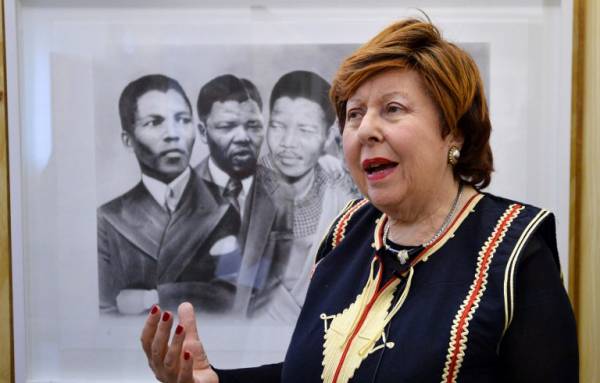
A portrait of Nelson Mandela by British artist Richard Stone and a portrayal of him playing the role of Jesus at the Last Supper are some of the works on display in London’s “We Love Mandela” exhibition.
Some 22 artists, all South African with the exception of Stone, are displaying around 50 works reflecting the “emotions of people”, their feelings and ideas about South Africa’s first black president, exhibition curator Natalie Knight told AFP.
Many of the artists showcased were forced to work underground during the era of apartheid.
Peace icon Mandela featured “at the top” of the list of personalities whom Stone, portraitist of Queen Elizabeth II and former British prime minister Margaret Thatcher, wanted to paint.
“It was the most daunting experience I had ever had” and also “the greatest privilege”, the artist told AFP.
“Here we have quite possibly the most famous man on the planet,” he said.
“My goal was to capture something of the soul of this very great man.”
Natalie Knight in front of a Mandela painting in London Photo: AFP
Stone recalled how Mandela “allowed a little window to be open into his soul” during the six sittings which took place in his Johannesburg office in 2008.
The painting, which features a dignified white-haired Mandela wearing one of his trademark colourful shirts, was sold at auction in 2008 for around 480,000 euros ($650,000) during a London concert celebrating his 90th birthday.
The exhibition gives equal billing to numerous cartoons by South African animator Zapiro, one of which shows Mandela sat in a carriage next to the queen as they travel through the streets of London.
A policeman turns to his colleague and says: “The next bloody tourist who asks who’s the little old lady with Mandela…!”
For Knight, the drawing epitomises “the importance of Mandela in the world.”
Another work explores the power of Mandela’s clenched fist, the symbol of his fight against apartheid, while another imagines Mandela as the central figure at the Last Supper, surrounded by “his” disciples, including Mahatma Gandhi, Martin Luther King and Rosa Parks.
The exhibition was postponed on several occasions due to health concerns over 95-year-old Mandela, who was hospitalised in June and is now receiving intensive care at home.
The exhibition is free to the public and will open on October 16 at the South African embassy in London. It will then travel to Paris, while Berlin and the United States have expressed interest in hosting the works.
I have been asked many times to write a column about Afrikaner identity. It`s a task I have always dreaded, for it will need to also involve examining questions like: can an atheist be an Afrikaner? Similarly, can an English-speaking white South African be an Afrikaner? Can Afrikaner political parties not supporting self-determination still be called “Afrikaner”? Or even: can non-whites be Afrikaners? Any honest elucidation of (the) Afrikaner identity must also include the less savoury aspects of said people. But then; nobody is perfect. That said, here goes…
Afrikaner identity, like all others, is comprised of three distinct, yet intimately intertwined aspects: the individual, the collective and the nation.
The individual sustains the collective which, in turn, sustains the nation… and vice versa. Meaning that it is the primary responsibility of the individual to contribute to the collective in such a way that his/her collective – in this case, the Afrikaner collective – takes precedence over all other collectives. The collective is comprised of various sub-collectives. For example, (the individual) Naas Botha – the famous ex-Springbok rugby player – has recently stated that he is in favour of race-quotas in rugby. This means that he, as an individual, does not support the Afrikaner sub-collective (Afrikaner rugby players, in this case), ergo, he is not sustaining the collective. Hence, he is a “South African”, not an Afrikaner. This obviously also applies to individuals like Dr Piet Croucamp, Fransie Cronje, Tim du Plessis, Anton van Niekerk, etc.
Moving to the collective/s; aforesaid has the primary responsibility to sustain the interests of the individual, be it as welfare organisation, church, academic institution, etc. For example, Stellenbosch University (as a collective) supports discrimination against Afrikaner students. This means it is not Afrikaner anymore… it is “South African”.
Moving to the nation; if a sub-collective is primarily involved in politics (e.g. the Freedom Front political party) its main responsibility is to strive for nationhood. The aforesaid can only be sustained if it dominates physical territory. It is possible to be a people (i.e. a collective) without physical territory. But one only has to look at the history of the Jewish People – arguably the most successful in terms of survival – in order to realise that dominance over a physical territory is the only sure-fire guarantee of/for progressive survival. This means that the (traditionally Afrikaner) Freedom Front party is not Afrikaner anymore, because it has forsaken its primary responsibility… self-determination in/on a physical territory dominated by Afrikaners.
To the tricky questions; e.g. can an atheist be an Afrikaner? Yes, but only if s/he sustains the “default” of the collective which, in the case of the Afrikaner (identity), is Christian. Meaning that as long as atheists put the well-being of the Christian Afrikaner collective above their individual well-being as atheists, they can be 100% Afrikaners. Ditto for English-speaking white South Africans – or any other white person, for that matter – in terms of language. Afrikaans is, and therefore must stay, the default. The same could be said for non-whites wanting to be Afrikaners. But this, in itself, would be self-contradictory and, ultimately, irrational. For in order to sustain the Afrikaner default identity (which is white, in terms of race), non-whites would have to forsake any and all attempts at demographic dominance.
The above-explained dynamics are also being played out in traditional Western countries with, hitherto, distinct identities. Just think about the American identity when, in 2060, white English-speaking (and mostly Christian) “Americans” will be demographically swamped by Spanish-speaking Hispanics. In short; (the) American identity will no longer be “American”.
To the specifics of (the) Afrikaner identity; we are the most inherently pharmaconian people on the planet. I derived the adjective pharmaconian from the Greek root pharmacon… meaning to heal or to kill. Afrikaners like to fight and to heal. We make the best soldiers and the best doctors. We, as a people, are absolutely unique in this regard! In terms of the former, there is no need to blow our own trumpet – others do it for us, with aplomb…
The Americans fight for a free world. The English mostly for honor glory and medals. The French and Canadians decide too late that they have to participate. The Italians are too scared to fight. The Russians have no choice. The Germans for the Fatherland. The Boers? Those sons of bitches fight for the hell of it! – American General George “Guts and Glory” Patton
Give me 20 divisions American soldiers and I will beach Europe. Give me 15 consisting of Englishmen, and I will advance to the borders of Berlin. Give me two divisions of those marvellous fighting Boers and I will remove Germany from the face of the earth. – Field Marshall Bernard L. Montgomery (Commander Allied forces WWII)
It is therefore no wonder that we love rugby so much. It has become a substitute for our warrior-like psyche. An opium, unfortunately.
In terms of our passion for healing, we can only look at incredible doctors like Christiaan Barnard, or the fact that we had one of the very few defence forces in the world with a separate medical services arm. This pharmaconian essence of the Afrikaner also has its drawbacks. In terms of liking to fight; we tend toward bullying behaviour, especially because of our big physical size – inherited from the Dutch. This bad characteristic has always necessitated a very strong (mostly patriarchal) hierarchy… to keep the boys in line, so to speak.
The above characteristic was, in my opinion, the main reason why nearly the whole Afrikaner society collapsed after 1994, for when our leaders jumped ship, all the power structures collapsed like a house of cards. The main bullies then turned on their own people, selling them out like flies at the TRC, and in nearly every Afrikaner sphere imaginable. This thuggish behaviour is (now) exemplified by people like Piet Croucamp, Max du Preez, Pik Botha, Anton Van Niekerk, Pierre de Vos, etc.
Our passion for healing was, in my opinion, also the main motor behind the majority Yes vote in the referendum in 1992. Many Afrikaners thought that being “nice” (like e.g. the Swedes) was the only way out of all the fighting. I.e. many Afrikaners wanted to “heal” the bad relationship they had with blacks. The only problem is that this innate propensity to heal is not suited for African conditions… for here the Rule of the Jungle is still very much prevalent. And hell, what do the Swedes know about Africa in any case?!
Be that as it may; we share identity characteristics with other people that are also unique. We, like the Bushman, are in awe of Nature. No wonder the Afrikaners and the Bushmen get along so well, especially during the Angolan War. We established nature reserves long before it became cool to like the natural environment. Unlike our European peers, our art and literature is mainly devoted to the admiration of nature in connection with existential deliberations, e.g. Eugène N. Marais`s Die siel van die mier. (Eng title: The soul of the ant.)
We, as a people, prefer to spend every free minute in nature, be it camping, hunting, or visiting game/nature reserves. This also has its drawbacks. You`d hardly see an Afrikaner family going to a museum or art gallery on the weekend. This has, unfortunately, seen us lag behind our European peers.in terms of sustained “intellectuality”. But then, we live in the most beautiful country in the world… and we have been forced to fight for our continued survival as a unique people ever since we landed here 350 years ago.
Last, but definitely not least; if it were up to me, I’d change the word history to herstory when it comes to summarising the history of the Afrikaner, for the Afrikaner woman is the most unique woman on the planet. They know exactly what they want, and will go through hell and high water to get it… even if it means whipping their men all the way there.
In conclusion: I think that, given our absolutely unique pharmaconian character, the identity of the Afrikaner can best be summed up in the (moral) imperative of the German philosopher Martin Heidegger; sein lassen.
This idea/l, letting be, is a battle-cry to consciously demand and strive for an independent Lebensraum for yourself, as a unique people… as well as for all other things unique, be it other people, races, cultures, beliefs, or nature herself. Even during Apartheid, warped as it was, the Afrikaner promoted the independence of the various unique black peoples of South Africa. It is certainly not the Afrikaner’s fault that the latter did not stay true to their own identities… something they now yearn for with all their (identity-less) soul.
A discussion about the difference between the Boer and the Afrikaner is conspicuous by its absence in this column. In my opinion, the Boer is just a much hardier version of the Afrikaner – true grit… best summed up by Sir Arthur Conan Doyle.
Take a community of Dutchman of the type of those who defended themselves for fifty years against all the power of Spain at a time when Spain was the greatest power in the world.Intermix with them a strain of those inflexible French Huguenots, who gave up their name and left their country forever at the time of the revocation of the Edict of Nantes. The product must obviously be one of the most rugged, virile, unconquerable races ever seen upon the face of the earth. Take these formidable people and train them for seven generations in constant warfare against savage men and ferocious beasts, in circumstances in which no weakling could survive; place them so that they acquire skill with weapons and in horsemanship, give them a country which is immanently suited to the tactics of the huntsman, the marksman and the rider. Then, finally, put a fine temper upon their military qualities by a dour fatalistic Old Testament religion and an ardent and consuming patriotism.Combine all these qualities and all these impulses in one individual and you have the modern Boer.
That said; the very survival of the Afrikaner is now at stake. At the heart of this war is the battle for his identity. It is now up to the Afrikaner to decide his own fate… for letting others be definitely does not imply forsaking your own rightto be!
Twenty members of the SA Police Service have been suspended in the past two months, the police said on Sunday.
“The actions of the employees were investigated and, based on prima facie evidence, disciplinary action was taken against them,” spokesman Lt-Gen Solomon Makgale said.
The suspended employees include eight police officers and 12 administration officials, said Makgale.
Makgale said that over the past two months 191 members of the police were arrested for their alleged involvement in various crimes such as murder, rape, corruption and fraud.
“An instruction has been issued to make it compulsory for members of the SAPS to regularly declare when they are facing criminal investigations.”
Makgale said that police management was also in the process of verifying the academic qualifications of employees.
“Employees whose academic records differ from what they have declared to SAPS will be dealt with and may be investigated criminally depending on the circumstances,” said Makgale.
Agang SA has welcomed the decision by the police to verify the qualifications of all policemen and women.
“The levels of public trust and confidence in the capabilities of the South African Police Service are so low,” spokesman Thabo Leshilo said in a statement.
Leshilo said Agang SA urged the police leadership to speed up the probe to verify the qualifications, especially those in leadership positions.
Makgale said the police has dismissed 930 of its members over the past 17 months. – Sapa
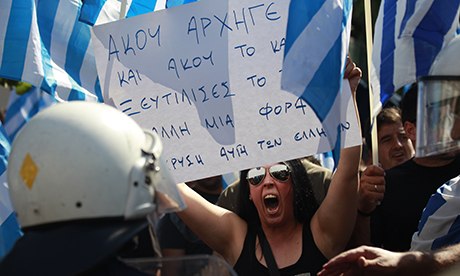
A protestor outside police headquarters in Athens holds a placard stating: ‘Listen chief, listen again, you have ridiculed the system one more time – Golden Dawn of the Greeks’
Golden Dawn, the aggressive Greek right-wing party making headlines in the crisis-hit country after the murder of an anti-fascist musician, has gone from provocation to provocation in its short career in Greece’s parliament.
The party’s 18 lawmakers have been accused of using their parliamentary immunity to intimidate police and evade arrest, meaning that there are only a few cases of solid prosecution against them.
Until the murder of hip hop artist Pavlos Fyssas on Wednesday, police had failed to pursue most other cases of brazen aggression by suspected Golden Dawn members against migrants or political rivals.
– June 7, 2012: Golden Dawn party spokesman Ilias Kasidiaris, a former commando, strikes female Communist MP Liana Kanelli during a heated talk show debate. He escapes arrest by temporarily going into hiding. Parliament later lifts his immunity so Kasidiaris can face trial.
– June 12, 2012: Four Egyptian fishermen are attacked in their sleep in the working-class district of Perama by a gang of black-clad attackers. One victim is hospitalised with serious head injuries.
Six people arrested at the time denied involvement and were released. According to media reports, at least one of the assailants would take part in another beating of Communist party members in Perama a year later.
– September 7, 2012: Golden Dawn lawmakers George Germenis and Panagiotis Iliopoulos lead a black-clad detachment of party members to an open-air fair near Athens, where they proceed to smash the stalls of unlicensed migrant peddlers.
Another GD team headed by lawmaker Costas Barbaroussis carries out a similar operation in the western town of Messolonghi the following day.
Parliament has agreed to lift the immunity of all three MPs so they can be prosecuted.
– January 17, 2013: A Pakistani migrant is fatally stabbed in central Athens by two Greeks, one of them a fireman. Police later find Golden Dawn tracts at the one of the attackers’ homes.
– May 2, 2013: Athens Mayor George Kaminis bans a Golden Dawn food handout exclusively catering to Greeks as racist. Hours later, GD lawmaker George Germenis is detained after apparently trying to punch the mayor, and hitting a 12-year-old girl instead. Germenis’ immunity has again been lifted over the assault and he will be tried.
– September 12, 2013: Communists putting up posters in the working-class district of Perama are attacked by a large group of alleged Golden Dawn members bearing nail-studded clubs. Eight Communists are hospitalised but the attackers escape.
– September 18, 2013: Anti-fascist singer Pavlos Fyssas is fatally stabbed after an apparent ambush by suspected Golden Dawn members. The killer, George Roupakias, is immediately arrested and later confesses to police his Golden Dawn affiliation.
Golden Dawn continues to deny involvement and accuses its critics of slander, but pictures soon appear in the press, showing Roupakias participating in party events, wearing GD insignia. – AFP
Arrested: Nikos Michaloliakos, the leader of Golden Dawn
by Hélène COLLIOPOULOU
Greek police on Saturday swooped on the Golden Dawn party, arresting its leadership and hunting for dozens of members across the country in a crackdown sparked by the murder of a leftist musician.
The arrests came a day after Golden Dawn threatened to pull its lawmakers out of parliament, a move that could spark a political crisis in the recession-hit country.
The party urged its followers to demonstrate against what it called an “illegal decision” on Saturday and by late morning several hundred faithful had gathered in front police headquarters in Athens.
In dawn raids, Greek anti-terror police arrested party leader Nikos Michaloliakos along with party spokesman and MP Ilias Kassidiairis, two other lawmakers and a dozen party members, police said.
The charges against them ranged from belonging to a “criminal organisation” to murder and assault, according to a source in the justice ministry.
The police sweep came after the country’s supreme court, which has been charged with investigating the group, issued arrest warrants for some 30 members.
Golden Dawn has faced a crackdown after a self-confessed neo-Nazi fatally stabbed popular hip-hop musician Pavlos Fyssas, 34, on September 18, a killing that sparked nationwide protests.
The party currently has 18 lawmakers in parliament and prior to the murder was the third most popular political grouping in the country.
“This government is determined not to allow the descendants of the Nazis to poison our social life, to commit crimes, terrorise and undermine the foundations of the country that gave birth to democracy,” Prime Minister Antonis Samaras warned in a televised address a day after the killing.
Golden Dawn leader Michaloliakos has threatened to pull the group’s deputies out of parliament, a move that would prompt by-elections in 15 regions around the country.
“We will exhaust any means within our legal constitutional rights to defend our political honour,” Michaloliakos told reporters late on Thursday.
“If the country enters a cycle of instability, it is those who demonise Golden Dawn who will be responsible, not (us),” he said.
By-elections could hurt Samaras’s coalition government, which has a slim majority of 155 MPs in the 300-seat parliament, and could cast into doubt Greece’s ability to fulfil its obligations to creditors on multi-billion-euro bailouts.
Samaras’s conservative party is neck-and-neck in the polls with the radical leftist Syriza party that opposes Greece’s EU-IMF austerity bailout, and a strong showing by Syriza in by-elections could lead to the government’s fall.
Formerly on the fringe of Greek politics, Golden Dawn’s popularity has skyrocketed as it tapped into widespread anger over unpopular reforms in a country that is currently slogging through its sixth year of recession and where unemployment among the youth stands at a staggering 60 percent.
It went from 19,000 votes a few years ago to over 426,000 in June 2012 elections after pledging to “scour the country” clean of illegal immigrants.
The party, whose leader has denied the Holocaust, has sent black-clad squads to smash market stalls owned by migrants, held torch-lit rallies lambasting political opponents as “traitors” and “thieves”, and organised food donations exclusively for ethnic Greeks.
It has also been blamed for a series of brutal attacks on migrants and political opponents, though it strenuously denies any responsibility and claims to be the victim of slander.
This year, the party has consistently polled at over 10 percent, with its approval ratings even higher in the 18-44 age group, making them the country’s third-strongest political force.
Although the hip-hop artist’s murder has led to a dip in those ratings, analysts warn that the party’s popularity will make any efforts to outlaw it difficult and politically dangerous.
“The constitution makes no provision for the dissolution of a parliamentary group, even it there is proof that it is a criminal organisation,” Dimitris Christopoulos, an associate professor of law at Athens’ Panteion University, told AFP this week. – AFP
A total of 187 police officers were arrested over two months this year for crimes including murder, rape, and robbery, the Sunday Times reported.
Between July 8 and August 26, 39 officers were arrested for murder, 14 for rape, 20 for robbery, and 23 for corruption.
The Sunday Times obtained these figures from a document issued by the police’s human resources department earlier this month.
The arrests made during the two months also included nine officers for possession of drugs, and another nine for drunk driving. Eight were arrested for theft and five for assault. Two were arrested for hijacking.
Meanwhile, the Sunday Independent reported that the Gauteng government paid out almost R100 million in civil claims against the police for 2011 and 2012.
In 2012 the number of claims nearly doubled to 1427, from the 652 lodged in 2011.
The figures were given in a parliamentary reply by Gauteng community safety MEC Faith Mazibuko.
Mazibuko said the increase in claims was due to people’s increased awareness of their constitutional rights and certain law firms specialising in such claims. – Sapa
In a recent article in the Sunday Independent, Gillian Schutte mistakenly blames so-called “white conservative narratives” for the appalling sexual violence that is sweeping South Africa at present. As rape is notoriously underreported, most estimates put the number of such crimes at more than a million per year or approximately three thousand per day.
The macabre forms of dehumanising torture during farm murders provide another clue to the societal breakdown that is occurring in our country. Even calling it “our country” might be a malapropism in that Afrikaners like myself are no longer considered full citizens in an Afro-Saxon state that is slouching towards some incarnation of Mugabe’s Zimbabwe or, better still, Charles Taylor’s Liberia. This week, Taylor’s conviction as a war criminal was confirmed by an international court, the first head of state to be jailed for such crimes committed in Sierra Leone while he was in office.
South Africa has become a sadists’ apocalypse. No amount of “reframing”, circumlocution or leftist pseudo-intellectualism can disguise it any longer. Nor can the seemingly desperate massaging of the crime statistics. In the age of social media, people communicate their horror and despair at being captives in this, our “paradise of cruelty”. Policing our language as in the cowardly attack upon Louise Mabille is a poor substitute for the lack of policing elsewhere.
As the twentieth century has shown, utopias are always dangerous, be they fascist or communist. Every utopia has turned into its mirror image, a dystopia replete with genocide. South Africa’s pursuit of a racial biopolitics known as “transformation”, as well as extreme forms of cultural relativism, have unleashed hitherto unknown social consequences. In the domain of sexual violence at least, the country has earned the dubious title of “rape capital of the world” and it regularly tops international murder tables too.
Understanding the causes of this immense violence, unknown in peacetime, represents a rare analytical challenge. None of the usual explanations actually fit. The same people denouncing “colonialism” are the most accomplished colonialists in their slavish subordination to US or British racial discourse and political correctness.
However, neither Britain nor America has absorbed any significant African cultural influence so it is of no use applying the sociology of New York or London to an outbreak of sadistic violence in Limpopo province. It is risible to see ostensibly educated people constantly blaming either “apartheid” or “poverty” for the horrors and cruelties afflicting this society.
The retreat of Afrikaner power in South Africa has been coterminous with the resurgence of African belief systems, including witchcraft and ritual murders. In the early nineties South Africa experienced hundreds of killings associated with witchcraft and occult beliefs, leading to the Commission of Inquiry into Witchcraft Violence and Ritual Murders. We still do not understand the role that occult beliefs played during the revolution, especially in establishing hegemonic black politics and racial nationalism. The necklace, that symbol of revolution, is pregnant with ethnographic and cultural meaning. There is also evidence that young “comrades” intimidated traditional healers to extract money from clients and that the accusation of being a witch was used to eliminate political opponents.
Mrs. Winnie Madikizala-Mandela, that international heroine and former wife of Nelson Mandela, subscribed to the Maoist doctrine – ‘kill one, scare a thousand’ – that support is gained through terror and horror. She notoriously stated in 1986:
…with our boxes of matches and our necklaces we shall liberate this country.
A necklace killing whereby a tyre is placed around the victim’s neck, filled with petrol and then set alight
Child and even baby rape is another ghastly phenomenon indicating that South Africa has navigated to a new, alien moral code. Stating that white men sometimes do it in some other country too, hardly mitigates the particular horror that it has assumed here.
The British Guardian ran an article on 12 March 2009 entitled, “Raped and killed for being a lesbian: South Africa ignores ‘corrective’ attacks“. The Guardian’s website contains an accompanying video interview with lesbian rape victims, as well as young black men who are outspoken in their support of “corrective rape”. One of them says:
Me, I have no time to rape them, but if there are some of the other guys who want to teach them the way, they must rape them, they must rock them.
But perhaps white conservatives are a bigger problem: they might go to church or caution their children against drugs and sexual promiscuity, which would undermine the libertine morals that so many have advocated for so long in South Africa. In Hillbrow, as recounted to me by a former policeman, young white female drug addicts are employed as prostitutes by Nigerian gangsters. When they are no longer useful to their pimps, they simply get injected with heroine and pushed off highrise buildings in what gets officially recorded by the police as “suicides”. In South Africa, the crime reality show is so much better than the fiction.
The country’s academics are all but ignoring the scourge of rape, including infant rape, judging from the paucity of published articles in the field. To some extent they have acculturated to the witch-hunting culture in persecuting dissidents in their own ranks. Otherwise they engage in repetitive denunciations of “patriarchy” as if there were still a father left somewhere that has not been killed.
South Africa’s “transformed” universities have been turned into the “armed brothels” Erik von Kuehnelt-Leddihn spoke about when he said:
Rousseau is the grandfather of the concentration camps and also of those armed brothels that we continue to call universities. We have with us on one hand the Old Left, a finished product of L’éducation sentimentale, with its bent for social engineering and its tendency to identify its own plans and policies with the volonté générale; on the other the New Left which has taken up the slogan Retournons à la nature! exemplified in the rabble of unwashed, unkempt, debauched, unbridled ignoble savages who look to the Third World of the underdeveloped for inspiration. Its heroes are Chairman Mao with his Little Red Book, Ché Guevara, Ho Chi Minh, Holden Roberto, the Harlem criminals and the pistol-packing priests.*
That is why leftist university intellectuals find any form of criticism of traditional African culture to be inherently “racist” and eschew references to practices such as ukuthwala(the kidnapping and forced marriage of young maidens). Recent legislation has placed about 18 million black South Africans under so-called customary law in which such practices are legal.
Everybody in South Africa, whether white or black, fears a witch-hunt in some or other form. Especially the kind of witch-hunt whereby you are called a “racist”, lose your tenured university job and spend the rest of your life in ignominy. Therefore white academics are completely silent on ukuthwalaor the so-called “virgin cleansing myth” if the professors do not actually deny in writing that such phenomena exist!
Here and there information filters through the iron curtain of political correctness. The only academic article worth reading on the “virgin cleansing myth” is that by Suzanne Leclerc-Madlala which appeared in The African Journal of AIDS Research in 2002 under the title, “On The Virgin Cleansing Myth: Gendered Bodies, AIDS and Ethnomedicine“. It provides a fascinating glimpse into the psycho-sexual paradigm in which, as she puts it, “virgin cleansing is believed to have both a therapeutic and a prophylactic effect” (against HIV-AIDS). Raping a child or a disabled person is therefore seen as a form of AIDS prevention or cure.
But even the virgin cleansing myth obliquely alluded to by Dr. Mabille in her critique of insipid Western feminism does not go far enough in explaining South Africa’s journey upriver into the heart of darkness. We really lack the concepts to understand the enormity of what we are faced with.
Much of what passes for analysis of sex and culture in South Africa consists of rehashed hippie or New Left thinking from 1960s America. Get liberated, man, is more or less the gist of it. Call it Marcuse on Durban Poison. Repression or any form of “holding back” is invariably seen as “bad”. But sometimes repression might be desirable, even imperative. Freud was old-fashioned enough to advocate a balance between the pleasure principle and the reality principle.
The old Afrikaner government, while encouraging African ethnic identities, saw fit to suppress witchcraft and ritual murder by making it a criminal offence. Prior to becoming the first president of a united South African republic, Charles Robberts Swart introduced the Suppression of Witchcraft Act 3 of 1957. To the principled cultural relativist, the act – which is still on the statute books – is an affront and he would probably agree with the Marquis de Sade that “morality is just geography misapplied”, meaning that a crime in one culture is a harmless pastime in another.
One could even argue that the very structure of the South African political system is tending towards sado-masochism. Last Sunday the new CEO of the liberal Institute of Race Relations, Dr Frans Cronjé, argued in Rapport that whites should assume a far more submissive role in South Africa, lest they expose themselves to some form of collective revenge during a Second Revolution. According to Cronjé, such a revolution will be
…a violent, racist and destructive transition from a reconciling democratic state to a hostile, black nationalist state… After the Second Revolution, white South Africans will lose their homes, their jobs and their businesses.
Apart from exhortations to submissiveness, white guilt and even “vows of silence” à la Samantha Vice of Rhodes University, South Africa’s academic sycophants contribute little to our grasp of contemporary violence. In this respect, French literature is more instructive. Sade’s amoral theory of nature, of course. But also his notion of the sovereignty of sexual instincts that should not be tamed by any man-made law or religious scruple.
The Marquis de Sade had a disciple in the surrealist author Georges Bataille who espoused a theory of “transgression”. He took an interest in violence, punishment and eroticism. Bataille also collected photographs of Chinese executions which included horrific torture.
South Africa’s army of sadists regularly commit acts that shock a weaker Eurocentric sensibility. At the same time they are creating a world without limits, revelling in a new-found innocence that to them must represent the perfect freedom, the sovereignty of Sade’s libertine who pursues excess in celebration of pristine nature, a nature that punishes the weak and rewards the strong. To impose one’s will on a woman is also a gift of nature to all men. As Sade writes in Philosophy in the Bedroom:
If then it becomes incontestable that we have received from Nature the right indiscriminately to express our wishes to all women, it likewise becomes incontestable that we have the right to compel their submission, not exclusively, for I should then be contradicting myself, but temporarily. It cannot be denied that we have the right to decree laws that compel woman to yield to the flames of him who would have her; violence itself being one of that right’s effects, we can employ it lawfully. Indeed! has Nature not proven that we have that right, by bestowing upon us the strength to bend women to our will?**
Human rights or even a puritanical code such as feminism is not incompatible with sadism. As Bataille would argue, morality is needed for transgression to take place.
Sylvia Plath wrote in her poem “Daddy” that “Every woman adores a Fascist”. She was wrong. Every woman adores a sadist. Especially if she happens to be a feminist.
* Erik van Kuehnelt-Leddihn. “The Western Dilemma: Calvin or Rousseau?” in Modern Age, Winter 1971, p. 55.
** The Marquis de Sade. The complete Justine, Philosophy in the Bedroom and other writings, transl. RIchard Seaver and Austryn Wainhouse. New York: Grove Press, 1965, p. 319.
Victims of the bloody regime of Liberian warlord Charles Taylor spoke of their relief after his 50-year jail term for war crimes and crimes against humanity in Sierra Leone was upheld by an international court on Thursday.
The final verdict handed down by the UN-backed Special Court for Sierra Leone (SCSL) draws a line under a seven-year trial of the 65-year-old former Liberian president, sentenced in May last year for “some of the most heinous crimes in human history”.
“As a government, we believe that justice has been done and impunity is over,” Sierra Leone government spokesman Abdulai Bayraytay told AFP.
“The message for sitting heads of state not only in Africa but beyond is that when you are in power you must exercise it judiciously, have respect for the rule of law and human rights and uphold the dignity of others.”
Around 100 people, including human rights activists and survivors of the Sierra Leone civil war, watched a live broadcast of the ruling in the capital Freetown.
For Sullay Turay, who lost a hand and a foot to Taylor-backed rebels, the outcome “showed that no matter what you do, justice will finally catch up with you and this is what has happened in Taylor’s case.”
The former warlord, who was jailed initially for 50 years for arming rebels during Sierra Leone’s brutal 1990s civil war, is likely to spend the rest of his life behind bars, possibly in a British jail.
He sparked a 13-year civil war in his own country when he led a rebellion in 1989 to oust President Samuel Doe which deteriorated into one of Africa’s bloodiest conflicts.
His National Patriotic Front of Liberia (NPFL) earned a reputation for extreme violence, conscripting child soldiers and terrorising citizens of certain ethnic groups.
After taking Monrovia, Taylor was elected president in 1997, but violence again erupted in 1999 when another rebellion started and he lost control of much of the country, fleeing in 2003 to Nigeria.
The conflicts resulted in 270,000 deaths, with many civilians displaced and several thousand becoming victims of atrocities, according to the United Nations.
As Liberia’s president from 1997 to 2003, Taylor supported Revolutionary United Front rebels in neighbouring Sierra Leone by supplying them with guns and ammunition as they waged a campaign of terror during a civil war that claimed 120,000 lives between 1991 and 2002.
He was finally arrested and transferred to The Hague in 2006, where he was convicted in 2012 of aiding and abetting the rebels during the conflict, known for its mutilations, drugged child soldiers and sex slaves, trial judges found.
“Full justice has now been done and the victims should move on with their lives. The violations they suffered have been addressed through the judicial process,” said Ibrahim Tommy, chairman of the Centre for Accountability and the Rule of Law campaign group.
“The government now should work to strengthen the justice system and work for the socio-economic prosperity of the victims.”
Some victims of the conflict remain bitter and voiced frustration that Taylor had not received the 80-year sentence requested by the prosecution.
“Let Taylor rot in jail. I only wish he would have served his sentence in an African prison to suffer the more,” said Freetown taxi driver Andrew Lebbie.
But there was also a note of reconciliation among the crowd gathered for the ruling in Freetown.
“Forgiveness is all I would ask for. The court should have tempered justice with mercy,” said vicar Sam Fergusson.
But Taylor has never been charged for his role in Liberia’s bloody history, only that in neighbouring Sierra Leone. – AFP
The KwaZulu-Natal police spokesman who resigned amid allegations that he had a fake matric certificate has denied his qualification is invalid, The Star reported on Friday.
“It is not true that my certificate is fake,” Colonel Vincent Mdunge was quoted as saying.
“I am currently consulting my legal team and will take this to court.”
He said it would have been impossible for him to serve in the police for 27 years with an invalid certificate.
On Thursday, Colonel Jay Naicker said the allegations against Mdunge surfaced when the criminal and academic records of SA Police Service employees were checked. Mdunge subsequently resigned.
Mdunge told The Star’s sister newspaper Isolezwe he did not quit because of the pending criminal investigation against him. He claimed it was a coincidence that he resigned at the same time that the allegations surfaced.
On Friday, Naicker told Sapa he did not know of Mdunge’s intentions to take the matter to court.
“It’s his decision and he doesn’t have to notify us of it,” said Naicker. – Sapa
An Mpumalanga man was jailed for 20 years on Wednesday for raping two teenagers on their way to school.
Angel Phokane, 29, from Clau Clau Trust near Mbombela, was sentenced in the Nelspruit Regional Court, a Sapa correspondent reported.
He was arrested in February last year on four charges — armed robbery, attempted murder, and two rapes. He pleaded guilty to all the charges and told the court he was influenced by a substance he had been taking. He did not identify the substance.
In his confession statement, Phokane told the court that on February 6, 2012, he attacked two young girls at Silingane Trust while they were on their way to school.
“After I assaulted one of the girls and stabbed her in the back of her neck with a knife. I demanded their two cellphones and they gave them to me,” Phokane said in his statement.
“I then forced the other girl, who was in school uniform into the veld, where I had oral sex with her. I then… raped her. The other girl escaped while I was busy raping her.”
On February 22 he again went to his spot at Silingane Trust to wait for other girls.
“When the other 15-year-old, who was in school uniform, approached, I threatened her with a knife and forced her to follow me into the veld. I forced her to lie on the ground and raped her,” he said.
“I left the girl at the scene and walked away. I know what I did was wrong and is punishable by law.”
Passing sentence, magistrate Willie Wilkens said: “The court is satisfied that you did not try to deceive us with lies.”
Wilkens sentenced Phokane to 10 years for armed robbery, 10 years for attempted murder, and 20 years for each of the two rapes. The sentences would run concurrently, meaning he would only spend 20 years in prison.
“Your name will be placed in the register for sexual offenders and you are not fit to work with children or possess a firearm,” Wilkens said.
“When you get employment after your release from prison, you should disclose to your new employers about these offences. If you fail, a fine for R140,000 will be imposed on you by the court.” – Sapa
According to an analysis of the latest crime stats by the Istitute for Security Studies, the murder rate in Cape Town is almost twice as high as that of Johannesburg.
Lizette Lancaster, a researcher at the Institute, writes: “Between April 2011 and March 2012, police recorded more murders in Cape Town than in Johannesburg and Pretoria combined. This means that, taking population into account, Cape Town residents are 1,8 times more likely to be murdered than Johannesburg residents. Yet this information is potentially misleading because the likelihood of being a crime victim depends in large part on race, gender, age, economic profile and where in a city a person lives.”
For example, almost two-thirds of the Cape Town murders took place in just ten of the 60 police station precincts in the city, according to an analysis of crime hotspots by the Institute for Security Studies (ISS). For years, the Coloured area of Mitchells Plain has experienced the highest violence and property crime rates in the country.
Black areas in Cape Town show ‘abnormally high murder rates’
Although surpassed by Coloured (mixed-race) areas regarding general violent crime, black townships in Cape Town showed the highest murder rates. According to Lizette Lancaster, “Nyanga, Khayelitsha, Gugulethu and Harare remain the most murderous in the peninsula, according to an analysis that takes population size into account. These areas have experienced abnormally high murder rates for more than a decade.”
Similarly, a countrywide analysis of police precinct statistics suggests that income levels matter. Residents in low-income areas are far more likely to be murdered than their middle- and high-income counterparts. Half of South Africa’s murders occurred in only 13% of police precincts (or in 143 out of 1 127).
The focus tends to fall on South Africa’s national murder rate, which is almost five times higher than the global average of 6,9 murders per 100 000 people. However, about 13% of police precincts in South Africa had lower murder rates than this, including affluent areas such as Brooklyn (Pretoria), Garsfontein (Pretoria), Camps Bay, Claremont, Rondebosch (Cape Town), Edenvale and Linden (Gauteng). Over 10% of South African policing precincts – more than 115 stations – experienced no murders, while three in four murders occurred in just a quarter of the country’s police precincts. Suburbs like Sandton, Parkview (Johannesburg), Durban North, Table View and Woodstock (Cape Town) had a murder rate of just under 10 per 100 000 people.
Although murder is often used as the main indicator to support arguments that South Africa is a violent country, it makes up only 2,5% of all violent crime. While there were 16 259 murders in 2012/13, over 600 000 other violent crimes were also reported to the police, including attempted murder, rape, robbery and assault.
Most murder victims are young black men
A vast majority of the murders that take place daily do not make the news. They happen in areas where crime and violence are the norm, and where residents already feel marginalised and forgotten. The majority of murders are neither premeditated nor committed as part of a crime, but occur when an argument leads to physical assault. Research shows that most victims are killed by acquaintances, friends or family members during disputes fuelled by alcohol or drug abuse.
Victimisation surveys, police docket surveys and mortuary surveillance studies reveal that most South African murder victims are young black men. These studies also reveal that most murdered women are killed by their intimate partners, and that men are six times more likely to be killed than women. However, violence affects all South Africans, and the resultant trauma has lasting physical, emotional and often financial consequences.
Former Hard Livings gang leader Rashied Staggie, 57, who is currently on day parole, will be employed as a general cleaner at a Belville office from Thursday, Beeld reported.
Staggie was sentenced in 2003 to 15 years in prison on charges of kidnapping and rape, and in 2004, he received another sentence of 13 years for gun theft.
The sentences ran concurrently, and he was released to serve a term of day parole from Monday 23 September to March 2014.
Pastor Ivan Waldeck, 46, owner of Ukonwaba Investments, said on Wednesday that he had delivered a letter confirming that he had offered Staggie permanent employment, to the department of correctional services.
“He will work as a general cleaner because he has no previous experience. He will commence on September 26. His working hours are from 8am to 4.30pm.” – Sapa
Cartoon from the Sowetan, a black South African newspaper
More than 100 complaints of sexual misconduct were laid against teachers last year, according to the SA Council for Educators (SACE).
In its 2012/13 annual report, tabled at Parliament on Thursday, the council said it received a total of 556 complaints for various “alleged offences or breaches” between April 1 last year and March 30 this year.
Of these, 104 were for “sexual misconduct, including rape”.
The council was established in terms of the SACE Act. According to this legislation, no person is allowed to practise as a teacher in South Africa unless he or she is registered with the council.
Other categories of offences listed in the annual report, including the number of such complaints laid against teachers, are:
— Verbal abuse, victimisation, harassment and defamation: 83;
— Fraud, theft and financial mismanagement: 65;
— Racism: two;
— Corporal punishment and assault: 182;
— Unprofessional conduct, alcohol abuse, absenteeism and insubordination: 115;
— Negligence: nil; and,
— Murder: two.
The council said 319 of the total 556 cases were “finalised in forms other than disciplinary hearings”.
A total of 57 disciplinary cases were finalised over the 12-month period.
According to the report, 27 teachers were struck off the council’s roll of educators indefinitely.
Yet another was struck off, but may re-apply after a certain period, and a further 28 were struck off, but the striking off was suspended for a certain period.
On the number of appeals received from those struck off, eight were from those struck off the roll indefinitely for sexual offences.
Of the eight, five were finalised and the appeals dismissed. The other three appeals had been postponed.
On dealing with abuse of pupils by teachers, the council said one of the biggest problems was the general lack of co-operation by the parents of the abused children.
Parents had refused council officials access to the abused children.
“In some case, the abusers would end up being referred to ‘as sons-in-law’,” the report states.
This practice had negatively affected the council’s operations.
“[E]ach year we have a lot of sexual abuse cases that are being carried over into the next financial year because they could not be closed.”
It said the battle against the abuse of pupils would not be won “until such time that parents take the responsibility to protect their children and to support the SACE cause.” – Sapa
This website uses cookies to improve your experience. We'll assume you're ok with this, but you can opt-out if you wish. Cookie settingsACCEPT
Privacy & Cookies Policy
Privacy Overview
This website uses cookies to improve your experience while you navigate through the website. Out of these cookies, the cookies that are categorized as necessary are stored on your browser as they are essential for the working of basic functionalities of the website. We also use third-party cookies that help us analyze and understand how you use this website. These cookies will be stored in your browser only with your consent. You also have the option to opt-out of these cookies. But opting out of some of these cookies may have an effect on your browsing experience.
Necessary cookies are absolutely essential for the website to function properly. This category only includes cookies that ensures basic functionalities and security features of the website. These cookies do not store any personal information.
Any cookies that may not be particularly necessary for the website to function and is used specifically to collect user personal data via analytics, ads, other embedded contents are termed as non-necessary cookies. It is mandatory to procure user consent prior to running these cookies on your website.