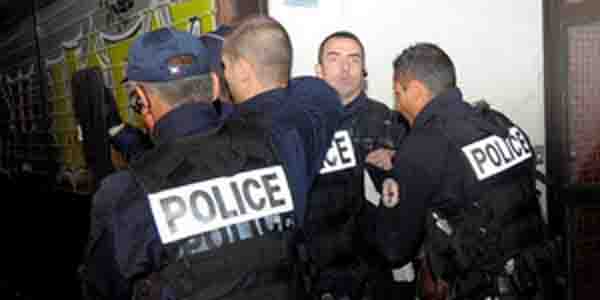
A group of skinheads attacked a French far-left activist in the heart of Paris’ shopping district, leaving the young man brain-dead in the hospital Thursday, officials said, in an attack that raised fears of increased far-right violence.
Political tensions are high in France after months of protests against legalizing gay marriage that sometimes ended with troublemakers from the extreme right clashing with police.
Interior Minister Manuel Valls said a fight broke out Wednesday evening between two groups of young people in a pedestrian street just steps away from the famous Printemps department store. At one point, the 19-year-old leftist was beaten by several skinheads, according to Valls, a widely respected, center-leaning member of President Francois Hollande’s Socialist government.
No suspects have been arrested, and Valls told reporters at the scene of the attack – a crowded street with cafes and chain stores – that finding them is the top priority.
It was unclear how the fight developed and how many people were involved.
Politicians from left and right lashed out at the violence, as did Valls, who focused his anger at the skinheads.
“There is no place for small neo-Nazi groups whose enemy is the nation,” he said. “A group of the extreme right is at the heart of this assassination. There is a discourse of hate and a climate that favors this discourse. We need to pay attention to this because they threaten our values.”
The Party of the Left said Meric, one of its activists, was declared brain dead. The party, one of several small political movements on France’s vocal and active far left, called for demonstrations in Paris on Wednesday against violence by groups on the extreme right.
The victim, Clement Meric, is a student at Sciences Po, one of France’s most prestigious universities, according to the school. – AP
France’s culture minister has branded online retailer Amazon a “destroyer” of bookshops in the latest confrontation between the Socialist government in Paris and America’s giants of the digital economy.
“Today, everyone has had enough of Amazon, which, by dumping, slashes prices to get a foothold in markets only to raise them once they have established a virtual monopoly,” Culture Minister Aurelie Filippetti said.
“It is destructive for bookshops,” the minister told a conference of booksellers Monday in the southwestern city of Bordeaux.
Filippetti said that she would be examining measures that could curb Amazon’s growth in France by restricting the American giant’s ability to combine offers of free deliveries with discounts of up to five percent on cover prices, which is the maximum allowed in France under existing legislation designed to protect small booksellers.
The attack on Amazon is the latest in a series of disputes between the French government and American companies including Google, Yahoo! and Apple.
French authorities are already embroiled in a dispute with Amazon over a $252 million tax bill related to the company’s sales in France between 2006 and 2010.
The dispute arose because of Amazon’s practice of reporting European sales through a Luxembourg-based holding company, taking advantage of the tiny Duchy’s relatively low corporation tax rates for earnings outside its borders.
Amazon insists the arrangement, which has been criticised by politicians across Europe, is legal under the European Union’s single market rules.
Industrial Renewal Minister Arnaud Montebourg last month also infuriated Yahoo! by placing a series of conditions on its proposed takeover of French video-sharing site Dailymotion, causing the deal to collapse.
France is meanwhile at loggerheads with Google over privacy issues and over demands that it pass on part of its advertising revenues to newspapers and other content providers that the search engine links to.
The Paris government has also clashed with Apple and other hi-tech manufacturers over proposals to tax smartphones and tablets to fund French-language creative and artistic projects. – AFP
Dominique Venner committed suicide on Tuesday in front of the altar of Notre Dame Cathedral in Paris. The death of the 78-year-old essayist and historian sparked numerous reactions from French nationalists.
Several executives and members of the country’s National Front party took to Twitter to praise Venner. Directly referencing Venner’s last blog post, National Front party leader Marine Le Pen called the writer’s act an “eminently political” gesture destined to “awaken the people of France.”
“All our respect to Dominique Venner whose last gesture, an eminently political one, attempted to awaken the people of France. MLP”
In a blog post published on the same day as his suicide, Venner talked about “new gestures, spectacular and symbolic ones, to rattle lethargies, to shake anaesthetised consciences and awaken the memory of our origins.”
Louis Aliot, vice-president of the National Front and Marine Le Pen’s partner, also paid his respects, calling Venner an “intransigent and courageous defender of our civilisation’s values.”
“My emotional thoughts go out to the tragic disappearance of D.Venner, intransigent and courageous defender of our civilisation’s values.”
Bruno Gollnisch, another figure of the National Front, saw Venner’s suicide as a “protest against the decadence of our society.” Gollnisch argued that Venner “experienced” the approval of the law on gay marriage “as it should have been experienced, as a promotion of decadence and a defacement of marriage.”
Gollnisch added that “it wasn’t his only fight, he also protested against the programmed disappearance of the French people, the progressive substitution with other populations.”
Julien Rochedy, the president of the National Front youth group tweeted:
“It’s with immense sadness that I hear about Dominique Venner’s suicide. He will be reunited with the heroes from the Iliad he loved so much.”
According to some members of the National Front, Venner was considered as a potential candidate to head the party when it was founded in 1972.
Honorary president Jean-Marie Le Pen commented on the suicide to the AFP by comparing it to the death of Pierre Drieu La Rochelle, a writer who collaborated with the Nazis during WWII and who committed suicide in 1945. “An intellectual suicide, which testifies with death,” declared the founder of the National Front.
On Tuesday night, thousands of militants gathered in front of Notre Dame Cathedral, carrying torches and national flags. According to Le HuffPost, an unidentified speaker said: “We ignored the deep causes of his gesture. We are here to pay tribute to his last fight (…) He always defended France, beautiful, strong and proud of itself.”
French troops fought Islamist rebels in Mali while in neighbouring Algeria Al-Qaeda-linked fighters killed two people, took more than 40 foreign hostages and called for an end to France’s “crusade”.
Chad meanwhile announced it would be sending 2,000 soldiers to fight in Mali.
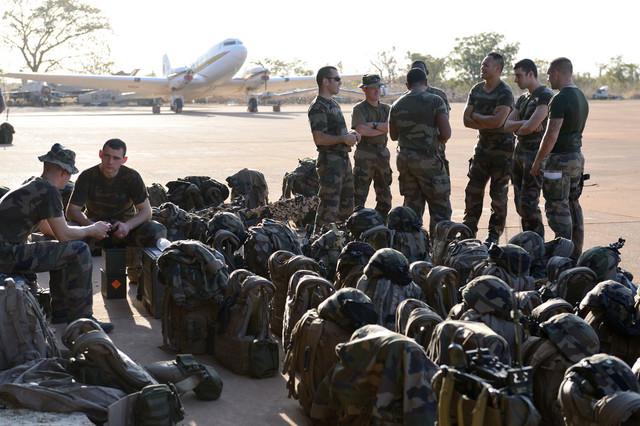
After days of air strikes on Islamist positions in northern Mali, controlled by the rebels since April, French and Malian ground forces battled the insurgents in the central towns of Diabaly and Konna.
But the assault on a gas field over the border in Algeria dramatically raised the stakes.
Islamists said they were holding 41 foreign hostages, including seven Americans, after their attack on the In Amenas gas field in the east of the country.
A group calling itself “Signatories for Blood” claimed the action in a post to the Mauritanian website Alakhbar.
The attack was in reprisal for “the crusade being waged by French forces in Mali” and for Algerian’s cooperation, it said, calling for an end to the operation.
Algerian Interior Minister Dahou Ould Kablia said that one Briton and an Algerian had been killed in the attack, while another six people — a Briton, a Norwegian a Scot and three Algerians — had been wounded.
Other reports said the hostages included Japanese, Malaysian, Norwegian and Filipino nationals. Dublin confirmed the kidnapping of an Irish national while the US State Department said several of its nationals were being held.
The attackers had also demanded the release of 100 Islamists held in Algeria in exchange for their hostages, a worker at the gas field site told AFP.
The attack came less than a week after France launched its air strikes on Islamists in northern Mali on January 11 and just days after Algeria opened its airspace to French fighter jets engaged in the mission.
Jointly operated by British oil giant BP, Norway’s Statoil and state-run Algerian energy firm Sonatrach, the gas field is located 1,300 kilometres (810 miles) southeast of Algiers, close to the Libyan border.
On the ground in central Mali, French troops engaged Islamist fighters in Diabaly, a town seized two days earlier by fighters led by Algerian Abou Zeid, one of the leaders of AQIM.
“The special forces are currently in Diabaly, in close-quarter combat with the Islamists. The Malian army is also in place,” a Malian security source said on condition of anonymity.
There were also clashes near Konna, the central town Islamists seized last week, prompting the French intervention, security sources said.
The French military said it had secured a strategic bridge on the Niger river near the town of Markala, south of Diabaly, blocking a key route to Bamako.
French Defence Minister Jean-Yves Le Drian said the western zone around Diabaly was home to “the toughest, most fanatical and best-organised groups. It’s under way there but it’s difficult”.
— ICC launches Mali war crimes probe —
The International Criminal Court said it had launched a warcrimes probe Wednesday, as rights groups and military sources denounced the Islamists’ use of child soldiers and use of civilians as human shields.
“Different armed groups have caused havoc and human suffering through a range of alleged acts of extreme violence,” chief prosecutor Fatou Bensouda said in a statement.
“I have determined that some of these deeds of brutality and destruction may constitute war crimes.”
Chad announced Wednesday it would send 2,000 soldiers to Mali, a significant boost to the African forces gathering there.
“We intend to send an infantry regiment and two support battalions, which comes to around 2,000 men,” Moussa Faki Mahamat told Radio France Internationale. They would work closely with the Malian army and the multinational West African force taking shape, he added.
Nigeria will command the UN-approved 3,300-strong multinational African intervention force and has promised 900 troops. Niger, Burkina Faso, Togo, Senegal, Guinea and Ghana have also promised troops.
Some 2,000 men will arrive within the next 10 days, according to a report from a meeting of regional army chiefs seen by AFP.
Ivory Coast President and ECOWAS regional bloc chairman Alassane Ouattara called for all European countries to lend support to the operation after a meeting with Chancellor Angela Merkel in Germany.
Germany has already pledged two transport planes and Italy logistical support.
France says it will ultimately send 2,500 troops, pitted against what are thought to be around 1,300 Islamic fighters.
Mali has been effectively split in two since April 2012, when Islamists took advantage of a military coup in Bamako and an offensive launched by Tuareg separatists in the north to seize half the country.
The UN and aid agencies report some 370,000 Malians have been displaced by the fighting. – AFP
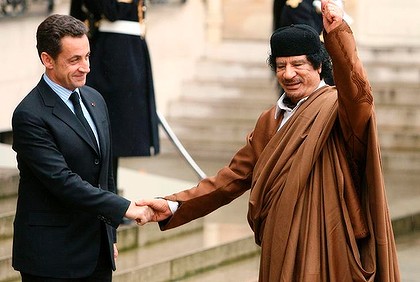
Evidence has been promised to a French court that could prove former President Nicolas Sarkozy accepted more than €50 million in campaign donations from ousted Libyan leader Muammar Gaddafi.
Information pointing to the existence of such documents was revealed late last year by Franco-Lebanese businessman Ziad Takieddine. He’s currently facing corruption charges and is under investigation over allegations of his involvement in a money laundering operation between France and the Middle East, in which he is believed to have been involved for 20 years.
“I can provide you with details of the financing of Nicolas Sarkozy’s campaign,” Le Parisien quoted Takieddine as saying. He told the judge the sums involved would exceed €50 million, as Sarkozy’s 2006-7 campaign was “abundantly” financed by Tripoli. The payments continued after Sarkozy’s victory, Takieddine added.
Takieddine’s testimony repeats allegations made by Gaddafi’s son Saif al-Islam and French investigative website Mediapart. Sarkozy has denounced the claims as “grotesque.”
He also claimed to be in possession of “evidence that three French companies in Libya have received contracts for fictitious services” to the tune of “more than €100 million.”
At a December 19 hearing, Takieddine said a number of meetings to organize the payments had taken place in 2006 and 2007 between Claude Gueant, Sarkozy’s chief of staff, and Gaddafi’s private secretary, Bashir Saleh. He said records of these meetings were in the possession of former Libyan Prime Minister Al Baghdadi Mahmoudhi, who is living in exile in France.
Takieddine was apprehended while attempting to take cash out of Libya on a private flight in March 2011, during the NATO-led anti-Gaddafi campaign.
His trial centers on claims that a series of bombings in 2002 in Karachi, Pakistan, were carried out in revenge for the non-payment of bribes agreed during the 1994 sale of a French submarine. The tragedy killed 14 people, including 11 French naval engineers. Takieddine is charged with acting as an intermediary in the deal.
It is alleged that some of the cash involved was transferred back to former Prime Minister Edouard Balladur’s 1995 presidential election campaign. The activities also implicate Nicolas Sarkozy, who was Balladur’s campaign spokesman and budget minister.
If found to be true, the allegations could severely embarrass the former French president, as he together with UK Prime Minister David Cameron played a leading role in instigating the NATO airstrikes that helped topple Gaddafi in October 2011.
President Vladimir Putin has signed a decree granting Russian citizenship to French film star and tax exile Gerard Depardieu, who is renouncing his French citizenship to search for an easier tax climate outside of his native country.
The Academy Award-nominated Depardieu is a regular in Moscow. The actor made headlines across the world when he announced in late December that “Putin has already sent me a passport!” The statement was a joke, but it soon became reality.
The day after the announcement, Putin told a press conference that the French bon vivant was a welcome guest in Russia: “If Gerard Depardieu really wants to have Russian residence permit or a Russian passport, we can consider the issue resolved positively.”
Putin also said that he has long had “kind, friendly, personal relations” with the leading light of French cinema.
On the morning of January 3, the Kremlin released a statement announcing that “Vladimir Putin has signed a decree granting Russian citizenship to France’s Gerard Depardieu.”
The 64-year-old actor said he was renouncing his French citizenship over the “insulting” accusations of tax evasion he faced after announcing plans to move to Belgium. “I don’t ask for approval, but I could at least be respected!” Depardieu wrote in an open letter to Prime Minister Jean-Marc Ayrault.
“All those who have left France have not been insulted as I have been,” Depardieu said, referring to French Prime Minster Jean Marc Ayrault’s comment that the actor was “pathetic”for deciding to leave his native country.
Last week, Depardieu confirmed he would stay in Belgium despite the fact that a French court struck down the proposed 75 percent income tax rate for the country’s wealthiest. The French government agreed to axe the notorious measure after it “failed to recognize equality before public burdens.”
Depardieu earlier mentioned three countries ready to offer him residence: Belgium, where he recently bought a house; Montenegro, where he has friends and some businesses; and Russia, which has a flat 13 percent income tax rate and could become a tax haven for the actor. – RT
A New Year’s Eve tradition for some in France of torching empty, parked cars has continued.
Interior Minister Manuel Valls said Tuesday that 1,193 vehicles were burned overnight around the country, where the stunt began in the 1990s.
There was no way to compare this figure to recent ones because the conservative government of former President Nicolas Sarkozy stopped making the numbers public while he was in office. But the rate of burned cars was apparently steady. On Dec. 31, 2009, 1,147 vehicles were burned.
For some, the decision of France’s current Socialist government to resume making public figures of New Year’s Eve’s torched cars is unwise.
Bruno Beschizza, a security chief for Sarkozy’s UMP party, said on iTele TV that publishing the numbers motivates youths to commit such crimes. – AP
A black rights group on Monday slammed the latest Miss France competition for producing a “white as snow” winner from a field it claimed was unrepresentative of the country’s ethnic make-up.
Marine Lorphelin, 19, a brunette medical student from Burgundy, was on Saturday crowned Miss France 2013, having edged out Miss Tahiti, Hinarini de Longeaux, in the final round of judging.
Louis-Georges Tin, the president of the CRAN (Representative Council of Black Associations), on Monday lamented the lack of contestants from France’s African and north African communities.
“The failure to represent the contemporary French population in an event such as this is obviously serious,” Tin said in a statement issued jointly with Fred Royer, the creator of Miss Black France.
“It amounts to denying the very existence of French people of African origin.”
Of the 33 finalists in Saturday’s contest, eight were from ethnic minorities with six of those coming from France’s Pacific or Caribbean territories.
“In the antiquated world of Miss France, blacks apparently can only come from overseas departments,” the CRAN statement said.
“As for Frenchwomen of north African heritage, they were ‘represented’ by only one candidate who was quickly eliminated (too Muslim perhaps?).”
France is home to around five million Muslims, most of them of north African origin.
The statement went on to express regret that “Miss France is as white as the end of year snow on the steeples of an eternal France.”
France has announced it will vote in favor of recognition of Palestine as a non-member observer state at the UN General Assembly later this week.
The French Foreign Minister Laurent Fabius told parliament that France “will respond ‘yes’” when the issue is put on a vote at the UN General Assembly.
France, a permanent UN Security Council member, is the first European country to speak in favor of elevating Palestinian status from an observer to a nonmember observer state.
The United States, which opposes the Palestinian bid for statehood, publicly disagreed with France’s move. State Department spokeswoman Victoria Nuland said Paris’s decision would not change the US assessment of the Palestinian action as a “mistake.”
“With regard to France and any other countries, we obviously disagree with our oldest ally on this issue,” she told reporters. “They know that we disagree with them. But it’s their sovereign decision.”
The Austrian foreign ministry also said Tuesday it would back the Palestinian bid and claimed that more than half of the European Union’s 27 member states would vote for the proposal, AFP reported.
Meanwhile, the UK says it is ready to support the PA in their current bid to become a non-member observer state if the Palestinians comply with three conditions, The Telegraph reports.
British Foreign Secretary William Hague allegedly requested Palestinian President Mahmoud Abbas, pledge not to join the International Criminal Court after its UN status is upgraded, not to apply for full membership at the UN and to resume peace negotiations with Israel without any preconditions.
At the moment the PA refuses to negotiate with Israel until it halts the expansion of Jewish settlements in the occupied West Bank and East Jerusalem territories.
On Thursday, the Palestinians will officially ask the assembly to upgrade their status. Earlier the Palestinian Authority said it expected the assembly to vote two-thirds in favor of granting the PA non-member status, seeing the move as an important step toward a two-state solution with Israel.
Israel strongly opposes the bid. Previously Tel Aviv said it objects to any wording the PA would bring for a vote at the assembly.
But as Israeli authorities were unable to block the bid they have changed their stance and now are trying to soften the wording, Haaretz reported on Tuesday citing a senior Israeli official.
The article states Tel Aviv and Washington are working together to change the document.
Last year, Washington used its veto power to block a Palestinian bid for statehood at the UN Security Council. A similar move is unlikely in this case as there are no vetoes in the General Assembly. – RT
The United States used U.S.-Israeli spy software to hack into the French presidential office earlier this year, the French cyberwarfare agency has concluded, according to the newsmagazine l’Express.
The magazine reported late Tuesday that the computers of several close advisers to then-president Nicolas Sarkozy – including Chief of Staff Xavier Musca – were compromised in May by a computer virus that bears the hallmarks of Flame, which was allegedly created by a U.S.-Israeli team to target Iran’s nuclear program. Anonymous French officials pointed the finger at the United States.
“You can be on very good terms with a ‘friendly’ country and still want to guarantee their unwavering support – especially during a transition period,” an official told the magazine. The alleged spying attack took place a few days before the second round of the French presidential elections, which Sarkozy lost to Francois Hollande, a socialist.
Homeland Security Secretary Janet Napolitano reportedly did not deny the allegations when asked point-blank about them.
“We have no greater partner than France, we have no greater ally than France,” Napolitano reportedly answered, at the opening of an interview with l’Express. “We cooperate in many security-related areas. I am here to further reinforce those ties and create new ones.”
In the interview, Napolitano also said that the Flame and Stuxnet viruses had “never been linked to the U.S. government.”
The White House did not return a request for comment from The Hill.
Parts of this article have been translated from the French. Read the original here.
French police on Tuesday arrested 12 suspects over the killing of two students lynched by a mob armed with hammers, baseball bats and knives.
The killings last Friday in the Echirolles suburb of Grenoble sparked outrage in France and prompted President Francois Hollande to travel to the southeastern city late Monday to visit the families of the dead young men.
Hollande was accosted as he visited the poor suburb by a local resident who lambasted security forces for failing to stop the violence she said was plaguing the area.
Interior Minister Manuel Valls also travelled to the city and on Tuesday denounced what he called a “massacre” and vowed that the killers would be tracked down.
Three suspects, who may be of most interest and all have convictions for violent crimes, are still on the run, prosecutor Jean-Yves Coquillat told reporters.
Kevin Noubissi and Sofiane Tadburt, both aged 21, were beaten and stabbed to death by a gang of about a dozen people in a park. Noubissi was stabbed seven to eight times, and Tadburt 30 times, the prosecutor said.
The gang was reportedly seeking vengeance after a minor incident outside a high school involving Noubissi’s younger brother.
Funerals for the two friends were due to take place Wednesday at the local mosque.
On Tuesday evening police said about 10,000 people took part in a memorial march to honour the two young men, who were said by friends and families to be model students.
Participants marched in silence while carrying white balloons and holding up placards showing photos of the victims.
Most of those arrested Tuesday in Grenoble were aged between 18 and 21, and most have criminal records, officials said.
No one has admitted guilt, the prosecutor added.
Two brothers, both in the military, were the first to be arrested in the case, police said, after being brought in for questioning on Monday. One was found near Grenoble, the other in a town about 500 kilometres (300 miles) away.
Their mother was also brought in for questioning Tuesday. – AFP
French magazine is set to increase Muslim ire by printing cartoons of the Prophet Mohammed Wednesday a day after 12 died in an Afghan suicide bombing, the deadliest attack linked to an anti-Islamic film.
A female suicide bomber killed 12 people in Afghanistan on Tuesday in the deadliest single attack attributed to the controversial film which has sparked furious protests across the Muslim world.
The deaths raised to over 30 the toll from incidents linked to the trailer for “Innocence of Muslims,” a film produced by extremist Christians in the United States that depicts the Prophet Mohammed as a thuggish womaniser.
After a week that has seen protests in at least 20 countries, there were fears that the wave of anger in the Islamic world could hit harder in Europe as it emerged that French satirical weekly Charlie Hebdo was planning to publish cartoons caricaturing the Prophet Mohammed in its Wednesday edition.
Charlie Hebdo is no stranger to controversy over its handling of the issues relating to Islam.
Last year it published an edition “guest-edited” by the Prophet Mohammed that it called Sharia Hebdo. The magazine’s offices in Paris were subsequently fire-bombed.
Charlie Hebdo’s latest move was greeted with immediate calls from political and religious leaders to avoid inflaming the situation.
French Prime Minister Jean-Marc Ayrault issued a statement expressing his “disapproval of all excesses”.
The magazine’s editor, originally a cartoonist who uses the name Charb, said the images would “shock those who will want to be shocked”.
Dalil Boubakeur, the senior cleric at Paris’s biggest mosque, appealed for France’s Muslims to remain calm.
President Barack Obama said Tuesday he expected governments in the Muslim world to protect American diplomats, despite their revulsion at a film made on US soil deemed offensive to their faith.
“The message we have to send to the Muslim world is that we expect you to work with us, to keep our people safe,” Obama said during a taping of the “Late Show with David Letterman” on CBS TV.
US Secretary of State Hillary Clinton, meanwhile, said “we are taking aggressive steps to protect” diplomatic missions worldwide.
Among those killed so far have been four US diplomatic staff in Libya, including ambassador Chris Stevens, who died when militants laid siege to the US mission in Benghazi a week ago on September 11 in a four-hour attack.
Clinton said the FBI had launched an investigation inside Libya, and she vowed that “we will not rest until the people who orchestrated this attack are found and punished.”
In Afghanistan, Hezb-i-Islami, the second largest insurgent group after the Taliban, said the suicide bomb attack was to avenge the “insult” of the film.
“The bombing was in retaliation for the insult to our Prophet,” spokesman Zubair Sidiqi told AFP by phone from an undisclosed location.
Security officials said nine foreigners including South Africans were among those killed on a highway leading to Kabul airport when the bomber blew up her station wagon alongside a minivan carrying foreign workers.
Taliban fighters last week stormed a British-run airfield, killing two US Marines and destroying six US fighter jets in another act of vengeance.
In Lebanon, the head of the Shiite Muslim movement Hezbollah, listed in the United States as a terrorist organisation, made a rare public appearance to warn of “very dangerous” repercussions if the entire film is released, rather than the 14-minute trailer that has already sparked outrage.
Al-Qaeda’s franchise in North Africa urged Muslims to storm US embassies and kill American envoys in Muslim countries, monitoring group IntelCenter said.
The film-maker Nakoula Basseley Nakoula, a 55-year-old Egyptian Copt and fraudster who was sentenced to 21 months in prison in the United States in June 2010, has not been seen since Saturday when he was questioned.
The risks now facing those involved in the film’s production were underlined when a Salafist cleric in Egypt called Monday for the deaths of all those involved in its making.
Before dawn on Monday, officers from the Los Angeles County sheriff’s department escorted four members of Nakoula’s family to join him in hiding.
Egypt’s public prosecutor has ordered that seven US-based Egyptian Copts be tried over their role in the film, accusing them of “insulting the Islamic religion, insulting the Prophet and inciting sectarian strife.”
However Interpol in a statement said it was not aware of any request from Egypt for the arrest of people related to the film but stressed that its charter “forbids it from undertaking any matter of a predominantly political, military, religious or racial nature.”
In Pakistan, two protesters died after demonstrating against the film close to the Afghan border and outside the US consulate in Karachi.
Police used tear gas to disperse more than 2,000 protesters trying to reach the US consulate in the city of Peshawar, chanting anti-US slogans and burning the Stars and Stripes flag.
Afghanistan, Bangladesh and Pakistan blocked access to YouTube, following the video-sharing website’s failure to take down the clip of the film. Saudi Arabia and Russia indicated they may follow suit.
In east Jerusalem hundreds of Palestinians clashed with Israeli border police, hurling stones and firebombs at a checkpoint.
Reuters) – The French are bleaker about their country’s future than at any time since 2005, a new poll showed on Saturday, with 68 percent saying they are “rather” or “very” pessimistic, the highest level ever in the initial months of a new presidency.
The poll’s findings jibed with a survey released last weekend which found that Socialist President Francois Hollande’s approval rating had slipped to 54 percent, continuing a steady decline since he took office in May.
The level of pessimism fell just short of an all-time high of 70 percent registered in August 2005, when the poll was created near the end of Jacques Chirac’s government.
Hollande’s government has been reeling from unemployment at a 13-year high and a rash of job cuts in recent weeks at top employers like carmaker Peugeot and retailer Carrefour . The government launched a plan this week to create 150,000 state-sponsored jobs for youth.
Only 34 percent of those surveyed were confident in the government’s ability to battle unemployment, and just 20 percent expect the government to be able to improve their buying power.
“It’s the first time that anxiety is so high at the beginning of a presidential mandate,” said polling firm Ifop, which conducted the survey for Dimanche Ouest France newspaper, in a statement accompanying the findings.
Pessimism stood at just 34 percent at the equivalent point in Chirac’s presidency in 2002 and 50 percent in Nicolas Sarkozy’s in 2007, the firm said.
The government’s efforts to spur consumption have been complicated by its EU deficit-cutting commitments, which mean hitting a 3 percent deficit target next year. That will force it to find some 30 billion euros ($37.8 billion) in deficit cuts next year, half of which it has said would come from spending.
The poll found that the pessimism extended even to 58 percent of Socialist party supporters.
Nearly 60 percent lacked confidence in the government’s ability to strengthen law and order, which has emerged as a concern in the wake of riots last month in the city of Amiens.
Those surveyed were asked: “In thinking about the future, for you and your children, would you say that you are very optimistic, rather optimistic, rather pessimistic or very pessimistic,” along with queries about their confidence in the government’s ability to make progress on various issues.
The poll was based on the views of 1,004 people aged 18 and over, interviewed Aug. 30 and 31.
Former South African president Nelson Mandela’s 94th birthday will be celebrated before the start of the Tour de France’s 16th stage in Pau, organisers said on Tuesday.
France-South Africa Seasons 2012/2013 organisers have joined forces with Mandela’s family and Tour de France race officials to honour the anti-apartheid icon and a large banner reading “Happy Birthday Nelson Mandela” will be held up by local children before Wednesday’s stage.
Laurent Clavel, Commissioner General of France-South Africa Seasons on the French side, said the event will be witnessed by millions of people across the world.
“While thousands line the route in France, millions follow it on TV,” he added.
“It is an honour to be able to salute Nelson Mandela. The event … will generate a lot of interest in South Africa and will contribute to further cementing the relations between France and South Africa.” – AFP
This website uses cookies to improve your experience. We'll assume you're ok with this, but you can opt-out if you wish. Cookie settingsACCEPT
Privacy & Cookies Policy
Privacy Overview
This website uses cookies to improve your experience while you navigate through the website. Out of these cookies, the cookies that are categorized as necessary are stored on your browser as they are essential for the working of basic functionalities of the website. We also use third-party cookies that help us analyze and understand how you use this website. These cookies will be stored in your browser only with your consent. You also have the option to opt-out of these cookies. But opting out of some of these cookies may have an effect on your browsing experience.
Necessary cookies are absolutely essential for the website to function properly. This category only includes cookies that ensures basic functionalities and security features of the website. These cookies do not store any personal information.
Any cookies that may not be particularly necessary for the website to function and is used specifically to collect user personal data via analytics, ads, other embedded contents are termed as non-necessary cookies. It is mandatory to procure user consent prior to running these cookies on your website.