

 Illegal immigration into Europe is being fuelled by airlines that sell budget tickets from North Africa for as little as £120, a senior European border control official has warned.
Migrants buy low-cost, one-way tickets from Morocco and Algeria to Turkey and then slip into Europe via Turkey’s porous land borders with Greece and Bulgaria, according to Gil Arias, the deputy executive director of Frontex.
They are able to take advantage of a recent policy of so-called “visa diplomacy” on the part of Turkey, which has sought to expand its influence in the Middle East by relaxing visa restrictions for citizens from other Muslim nations.
The route is quicker and safer than taking a people-smuggling boat across the Mediterranean. Two such vessels sank earlier this month in the waters between Libya and Lampedusa in Italy, with the loss of more than 500 lives.
“Due to this visa policy by Turkey to the North African nations, people are flying to Istanbul on cheap flights and then on to Greece and more recently, Bulgaria,” said Mr Arias, who previously served as a police inspector and border control official in Spain. “When they get there they discard their travel documents, and will sometimes pretend to be either Palestinians or Syrians in order to try to claim refugee status.”
There is no suggestion that airlines are complicit in illegal immigration, but Mr Arias said Frontex was powerless to stop them carrying such passengers – mainly Moroccan and Algerian passport holders. He said there was no evidence in advance that the passengers were planning to cross into the European Union.
His comments come at a time of growing tensions between European Union nations over how to tackle illegal immigration and who should share the burden. In Greece, public anxiety over the influx has helped in the rise of the Far-Right Golden Dawn party.
Last week, Bulgaria announced that it was planning to spend £2.2?million on a fence to limit the number of Syrian migrants fleeing the country’s civil war.
The 20-mile long fence will go around the mountainous region of Elhovo, one of the most difficult areas to police, after the arrival of 6,800 migrants – 70 per cent of them Syrian – since the start of the year. Bulgaria, which the EU’s poorest member, has demanded extra Brussels aid to deal with the problem. – telegraph.co.uk
Read Full Article
Tag: Greece
Ericsson bribes officials to secure deals

 Swedish mobile telecoms equipment maker Ericsson paid 116 million Swedish crowns ($18 million) to a commercial agent, money which was then used to bribe Greek officials to secure a deal for Ericsson in 1999, Swedish radio reported on Wednesday.
In an interview, former Ericsson employee Liss-Olof Nenzell told Swedish radio that “politicians, generals and high-ranking state officials” had received the Ericsson money.
Ericsson said in a statement that it had paid money to a commercial agent, but did not know what became of it.
The Swedish company used to employ local commercial agents in many countries in a bid to increase sales.
“We have zero tolerance for bribes and corruption. At the time, we used agents, but we don’t anymore because it is a system that lacks transparency,” it said in an emailed statement.
“We know that a payment was made to an agent, but we don’t know what happened with the money after that. We really hope that the money wasn’t used for bribes, but we don’t know for sure.”
The Greek order was for the Ericsson airborne surveillance system Erieye and was worth 4.9 billion Swedish crowns ($759 million). Ericsson has subsequently sold its defense business to Swedish group Saab.
Alf Johansson, chief public prosecutor at the National Anti-Corruption unit of the Swedish Prosecution Authority, said he was looking into the matter and had asked Greek investigators for information.
He added, however, that he was only interested in potential crimes committed after July 1, 2004, as crimes before that date would have passed the statute of limitations, meaning they could not be prosecuted.
Antonis Kantas, deputy armaments chief at the Greek Defense Ministry between 1997 and 2002, has admitted to taking $16 million in bribes relating to arms deals with foreign companies and mentioned Ericsson in connection with bribes in his court testimony.
Source: Reuters
Israelis tried to send arms to Iran via Greece


Israeli arms dealers tried to send spare parts for F-4 Phantom aircraft via Greece to Iran in violation of an arms embargo, according to a secret probe by the US government agency Homeland Security Investigations (HSI) carried out in cooperation with the drugs and weapons unit of Greece’s Financial Crimes Squad (SDOE).
According to the probe, which Kathimerini has had access to, the operation was carried out in two phases – one in December 2012 and the second in April 2013. In both cases, officials traced containers packed with the F-4 parts on Greek territory. The cargo had been sent by courier from the Israeli town of Binyamina-Giv’at Ada and had been destined for Iran, which has a large fleet of F-4 aircraft, via a Greek company registered under the name Tassos Karras SA in Votanikos, near central Athens. SDOE officials established that the firm was a ghost company, while the company’s contact number was found to belong to a British national residing in Thessaloniki who could not be located.
According to HSI memos, the cargo appears to have been sent by arms dealers based in Israel, seeking to supply Iran in contravention of an arms embargo, and using Greece as a transit nation.
Source: Ekathimerini
Swiss turn down Greece’s retroactive tax plan

Swiss Finance Minister Eveline Widmer-Schlumpf turned down the proposal of her Greek counterpart Yiannis Stournaras to impose taxes on Greeks’ bank accounts and transfer the money to Athens.

Currently in the Greek capital, Widmer-Schlumpf told Stournaras that Switzerland does not do such deals any more, focusing instead on automatic information exchange between tax authorities, currently negotiated at international level.
“Models we had earlier considered and discussed to prevent untaxed money in Swiss banks are partly outdated,” Widmer-Schlumpf said.
The total amount of Greek deposits in Swiss banks is not clear, some scenarios speak even of 60 billion euro. It’s not a secret that the debt-ridden country would love to extend a long arm and grab a percentage even if the money has been already taxed.
Defeated by the Taliban, Washington decides to take on Russia,China

 by Paul Craig Roberts
The several days of organized protests in Ukraine are notable for the relative lack of police violence. Unlike in the US, Canada, Thailand, Greece, and Spain, peaceful protesters have not been beaten, tear gassed, water cannoned, and tasered by Ukrainian police. Unlike in Egypt, Palestine, and Bahrain, Ukrainian protesters have not been fired upon with live ammunition. The restraint of the Ukrainian government and police in the face of provocations has been remarkable. Apparently, Ukrainian police have not been militarized by US Homeland Security.
What are the Ukrainian protests about? On the surface, the protests don’t make sense. The Ukrainian government made the correct decision to stay out of the EU. Ukraine’s economic interests lie with Russia, not with the EU. This is completely obvious.
The EU wants Ukraine to join so that Ukraine can be looted, like Latvia, Greece, Spain, Italy, Ireland, and Portugal. The situation is so bad in Greece, for example, that the World Health Organization reports that some Greeks are infecting themselves with HIV in order to receive the 700 euro monthly benefit for the HIV-infected.
The US wants Ukraine to join so it can become a location for more of Washington’s missile bases against Russia.
Why would Ukrainians want to be looted?
Why would Ukrainians want to become targets for Russia’s Iskander Missiles as a host country for Washington’s aggression against Russia?
Why would Ukrainians having gained their sovereignty from Russia want to lose it to the EU?
Obviously, an intelligent, aware, Ukrainian population would not accept these costs of joining the EU.
So, why the protests?
Part of the answer is Ukrainian nationalists’ hatred of Russia. With the Soviet collapse, Ukraine became a country independent of Russia. When empires break up, other interests can seize power. Various secessions occurred producing a collection of small states such as Georgia, Azerbaijan, the former central Asian Soviet Republics, Ukraine, the Baltics, and the pieces into which Czechoslovakia and Yugoslavia were broken by “nationalism.” The governments of these weak states were easy for Washington to purchase. The governments of these powerless states are more responsive to Washington than to their own people. Much of the former Soviet Empire is now part of Washington’s Empire. Georgia, the birthplace of Joseph Stalin, now sends its sons to die for Washington in Afghanistan, just as Georgia did for the Soviet Union,
These former constituent elements of the Russian/Soviet Empire are being incorporated into Washington’s Empire. The gullible nationalists, naifs really, in these American colonies might think that they are free, but they simply have exchanged one master for another.
They are blind to their subservience, because they remember their subservience to Russia/Soviet Union and have not yet realized their subservience to Washington, which they see as a liberator with a checkbook. When these weak and powerless new countries, which have no protector, realize that their fate is not in their own hands, but in Washington’s hands, it will be too late for them.
With the collapse of the Soviet Union, Washington quickly stepped into the place of Russia. The new countries were all broke, as was Russia at the time and, thus, helpless. Washington used NGOs funded by Washington and its EU puppets to create anti-Russian, pro-American, pro-EU movements in the former constituent parts of Soviet Russia. The gullible peoples were so happy to have escaped the Soviet thumb that they did not realize that they now had new masters.
It is a good bet that the Ukrainian protests are a CIA organized event, using the Washington and EU funded NGOs and manipulating the hatred of Ukrainian nationalists for Russia. The protests are directed against Russia. If Ukraine can be realigned and brought into the fold of Washington’s Empire, Russia is further diminished as a world power.
To this effect NATO conducted war games against Russia last month in operation Steadfast Jazz 2013. http://www.strategic-culture.org/news/2013/10/17/nato-steadfast-jazz-exercise-chill-of-cold-war.html Finland, Ukraine, Georgia, and neutral Sweden have offered their military participation in the next iteration of NATO war games close to Russia’s borders despite the fact that they are not NATO members.
The diminishment of Russia as a powerful state is critical to Washington’s agenda for world hegemony. If Russia can be rendered impotent, Washington’s only concern is China.
The Obama regime’s “Pivot to Asia” announced Washington’s plan to surround China with naval and air bases and to interject Washington into every dispute that China has with Asian neighbors. China has responded to Washington’s provocation by expanding its air space, an action that Washington calls destabilizing when in fact it is Washington that is destabilizing the region.
China is unlikely to be intimidated, but could undermine itself if its economic reform opens China’s economy to western manipulation. Once China frees its currency and embraces “free markets,” Washington can manipulate China’s currency and drive China’s currency into volatility that discourages its use as a rival to the dollar. China is disadvantaged by having so many university graduates from US universities, where they have been indoctrinated with Washington’s view of the world. When these American-programmed graduates return to China, some tend to become a fifth column whose influence will ally with Washington’s war on China.
So where does this leave us? Washington will prevail until the US dollar collapses.
Many support mechanisms are in place for the dollar. The Federal Reserve and its dependent bullion banks have driven down the price of gold and silver by short-selling in the paper futures market, allowing bullion to flow into Asia at bargain prices, but removing the pressure of a rising gold price on the exchange value of the US dollar.
Washington has prevailed on Japan and, apparently, the European Central Bank, to print money in order to prevent the rise of the yen and euro to the dollar.
The Trans-Pacific and Trans-Atlantic Partnerships are designed to keep countries in the US dollar payments system, thus supporting the dollar’s value in currency markets.
Eastern European members of the EU that still have their own currencies have been told that they must print their own currencies in order to prevent a rise in their currency’s value relative to the US dollar that would curtail their exports.
The financial world is under Washington’s thumb. And Washington is printing money for the sake of 4 or 5 mega-banks.
That should tell the protestors in Ukraine all they need to know.
Paul Craig Roberts was Assistant Secretary of the Treasury for Economic Policy and associate editor of the Wall Street Journal. He was columnist for Business Week, Scripps Howard News Service, and Creators Syndicate. He has had many university appointments. His internet columns have attracted a worldwide following. His latest book, The Failure of Laissez Faire Capitalism and Economic Dissolution of the West is now available.
Greece to draft ‘hate speech’ laws


The leftist Greek government said on Monday it would soon present a bill targeting “racist hate speech”, part of a crackdown on the Golden Dawn party after an anti-fascist rapper died.
“(The bill) will be submitted to parliament in a matter of days. It has symbolic and moral value,” Deputy Prime Minister Evangelos Venizelos told reporters, adding that it would align Greek legislation with European standards.
Greece’s ruling coalition had been at loggerheads over whether it needed a new anti-racism law to deal with inflammatory talk used by Golden Dawn.
Venizelos’s Socialist PASOK party had pushed for a new law, while the main ruling conservative party of Prime Minister Antonis Samaras had argued that current legislation was enough.
But the murder of rapper Pavlos Fissas on September 17 by a suspected Golden Dawn supporter prompted a crackdown on Greece’s third-most popular party, whose fierce anti-immigrant rhetoric has attracted support amid a severe economic crisis.
Golden Dawn leader Nikolaos Mihaloliakos and four other party lawmakers are due to appear in court this week to respond to charges of forming a criminal organization.
The government is also preparing another law that would suspend Golden Dawn’s state funding on the grounds that its leadership is facing prosecution on felony charges.
“Democracy can’t fund its opponents,” Venizelos said.
Prosecutors are investigating the party for links to about 30 violent attacks, including the killing of the rapper and a Pakistani immigrant.
The party has denied any connection to the rapper’s death and also rejects the neo-Nazi label.
An outright ban of a political party is difficult under Greek law. The government plans instead to undermine Golden Dawn by cutting its money flows and dismantling its leadership.
Controversies around Greece’s Golden Dawn party: a timeline
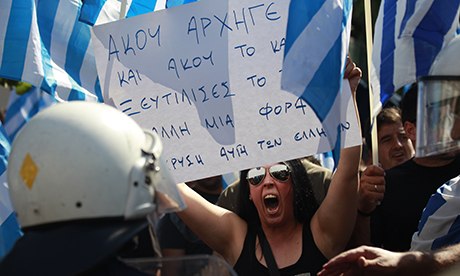
Golden Dawn, the aggressive Greek right-wing party making headlines in the crisis-hit country after the murder of an anti-fascist musician, has gone from provocation to provocation in its short career in Greece’s parliament.
The party’s 18 lawmakers have been accused of using their parliamentary immunity to intimidate police and evade arrest, meaning that there are only a few cases of solid prosecution against them.
Until the murder of hip hop artist Pavlos Fyssas on Wednesday, police had failed to pursue most other cases of brazen aggression by suspected Golden Dawn members against migrants or political rivals.
– June 7, 2012: Golden Dawn party spokesman Ilias Kasidiaris, a former commando, strikes female Communist MP Liana Kanelli during a heated talk show debate. He escapes arrest by temporarily going into hiding. Parliament later lifts his immunity so Kasidiaris can face trial.
– June 12, 2012: Four Egyptian fishermen are attacked in their sleep in the working-class district of Perama by a gang of black-clad attackers. One victim is hospitalised with serious head injuries.
Six people arrested at the time denied involvement and were released. According to media reports, at least one of the assailants would take part in another beating of Communist party members in Perama a year later.
– September 7, 2012: Golden Dawn lawmakers George Germenis and Panagiotis Iliopoulos lead a black-clad detachment of party members to an open-air fair near Athens, where they proceed to smash the stalls of unlicensed migrant peddlers.
Another GD team headed by lawmaker Costas Barbaroussis carries out a similar operation in the western town of Messolonghi the following day.
Parliament has agreed to lift the immunity of all three MPs so they can be prosecuted.
– January 17, 2013: A Pakistani migrant is fatally stabbed in central Athens by two Greeks, one of them a fireman. Police later find Golden Dawn tracts at the one of the attackers’ homes.
– May 2, 2013: Athens Mayor George Kaminis bans a Golden Dawn food handout exclusively catering to Greeks as racist. Hours later, GD lawmaker George Germenis is detained after apparently trying to punch the mayor, and hitting a 12-year-old girl instead. Germenis’ immunity has again been lifted over the assault and he will be tried.
– September 12, 2013: Communists putting up posters in the working-class district of Perama are attacked by a large group of alleged Golden Dawn members bearing nail-studded clubs. Eight Communists are hospitalised but the attackers escape.
– September 18, 2013: Anti-fascist singer Pavlos Fyssas is fatally stabbed after an apparent ambush by suspected Golden Dawn members. The killer, George Roupakias, is immediately arrested and later confesses to police his Golden Dawn affiliation.
Golden Dawn continues to deny involvement and accuses its critics of slander, but pictures soon appear in the press, showing Roupakias participating in party events, wearing GD insignia. – AFP
Greek government arrests Golden Dawn leader and MPs


by Hélène COLLIOPOULOU
Greek police on Saturday swooped on the Golden Dawn party, arresting its leadership and hunting for dozens of members across the country in a crackdown sparked by the murder of a leftist musician.
The arrests came a day after Golden Dawn threatened to pull its lawmakers out of parliament, a move that could spark a political crisis in the recession-hit country.
The party urged its followers to demonstrate against what it called an “illegal decision” on Saturday and by late morning several hundred faithful had gathered in front police headquarters in Athens.
In dawn raids, Greek anti-terror police arrested party leader Nikos Michaloliakos along with party spokesman and MP Ilias Kassidiairis, two other lawmakers and a dozen party members, police said.
The charges against them ranged from belonging to a “criminal organisation” to murder and assault, according to a source in the justice ministry.
The police sweep came after the country’s supreme court, which has been charged with investigating the group, issued arrest warrants for some 30 members.
Golden Dawn has faced a crackdown after a self-confessed neo-Nazi fatally stabbed popular hip-hop musician Pavlos Fyssas, 34, on September 18, a killing that sparked nationwide protests.
The party currently has 18 lawmakers in parliament and prior to the murder was the third most popular political grouping in the country.
“This government is determined not to allow the descendants of the Nazis to poison our social life, to commit crimes, terrorise and undermine the foundations of the country that gave birth to democracy,” Prime Minister Antonis Samaras warned in a televised address a day after the killing.
Golden Dawn leader Michaloliakos has threatened to pull the group’s deputies out of parliament, a move that would prompt by-elections in 15 regions around the country.
“We will exhaust any means within our legal constitutional rights to defend our political honour,” Michaloliakos told reporters late on Thursday.
“If the country enters a cycle of instability, it is those who demonise Golden Dawn who will be responsible, not (us),” he said.
By-elections could hurt Samaras’s coalition government, which has a slim majority of 155 MPs in the 300-seat parliament, and could cast into doubt Greece’s ability to fulfil its obligations to creditors on multi-billion-euro bailouts.
Samaras’s conservative party is neck-and-neck in the polls with the radical leftist Syriza party that opposes Greece’s EU-IMF austerity bailout, and a strong showing by Syriza in by-elections could lead to the government’s fall.
Formerly on the fringe of Greek politics, Golden Dawn’s popularity has skyrocketed as it tapped into widespread anger over unpopular reforms in a country that is currently slogging through its sixth year of recession and where unemployment among the youth stands at a staggering 60 percent.
It went from 19,000 votes a few years ago to over 426,000 in June 2012 elections after pledging to “scour the country” clean of illegal immigrants.
The party, whose leader has denied the Holocaust, has sent black-clad squads to smash market stalls owned by migrants, held torch-lit rallies lambasting political opponents as “traitors” and “thieves”, and organised food donations exclusively for ethnic Greeks.
It has also been blamed for a series of brutal attacks on migrants and political opponents, though it strenuously denies any responsibility and claims to be the victim of slander.
This year, the party has consistently polled at over 10 percent, with its approval ratings even higher in the 18-44 age group, making them the country’s third-strongest political force.
Although the hip-hop artist’s murder has led to a dip in those ratings, analysts warn that the party’s popularity will make any efforts to outlaw it difficult and politically dangerous.
“The constitution makes no provision for the dissolution of a parliamentary group, even it there is proof that it is a criminal organisation,” Dimitris Christopoulos, an associate professor of law at Athens’ Panteion University, told AFP this week. – AFP
Thousands protest against right-wing party in Athens


Thousands of Greeks took to the streets of Athens to protest against far-right extremism on Thursday, a day after police and demonstrators clashed in cities across the country following the murder of an anti-fascist singer.
Around 4,000 people marched in the capital’s western Keratsini district, where Wednesday’s murder occurred, carrying banners that said “stop fascism” and “no pasaran” (“they shall not pass”), an AFP reporter saw.
The protesters, mostly trade union members, shouted slogans including “out with fascists” and “workers do not fear threats”.
Greece has been rocked by unrest since popular hip hop artist Pavlos Fyssas, who wrote music under the nickname Killah P, was stabbed to death early on Wednesday by 45-year-old truck driver George Roupakias, who has allegedly confessed to police and is said to be a supporter of the neo-Nazi Golden Dawn party.
Thousands of Greeks took to the streets in anti-fascist marches in cities across the country on Wednesday. Scuffles broke out in some areas, with police firing tear gas at groups of demonstrators in Athens, the northern city of Thessaloniki and the western city of Patras.
Golden Dawn has denied links with the killer, but pictures have surfaced of Roupakias participating in party activities, and reports said members of his family worked for the organisation.
In a televised address earlier on Thursday, Greek Prime Minister Antonis Samaras vowed to rein in the Golden Dawn party.
“This government is determined not to allow the descendants of the Nazis to poison our social life, to commit crimes, terrorise and undermine the foundations of the country that gave birth to democracy,” he said.
Experts have argued that current legislation would make it difficult to slap an outright ban on Golden Dawn, but government spokesman Simos Kedikoglou said steps will be taken to expose the group’s “criminal” acts and isolate it. – AFP
ADL urges Greece to reconsider appointment of minister
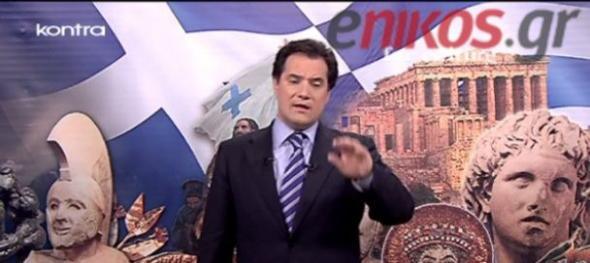
Greece’s Health Minister nationalist Adonis Georgiadis has a history of remarks about Jews and has promoted anti-Semitic book.
The Anti-Defamation League expressed concern on Friday over the appointment of Adonis Georgiadis as Greece’s Health Minister, due to a history of troubling remarks about Jews and his public promotion of an anti-Semitic book.
According to reports, Georgiadis has said in the past that “all major banks belong to the Jews” and that “the Jewish lobby” would determine the fate of Greece’s foreign debt. He has also promoted an anti-Semitic diatribe called “The Jews, the whole truth” written by Konstantinos Plevris, a prominent author and self-proclaimed anti-Semite.
“At a time when anti-Semitic speech and Holocaust denial continue to occur regularly in public and political discourse in Greece and as Golden Dawn’s leaders openly espouse anti-Semitism to stoke hatred and fear while their party is rising in popularity, the elevation of a politician who is also known to have promoted anti-Semitism is troubling,” said Abraham H. Foxman, the ADL’s national director. “Our concern is heightened by the ongoing failure to enact a stringent anti-racism bill despite the government’s public commitment to do so.”… – Haaretz
Racial attacks rise in crisis-hit Greece


Omar Diallo’s head is still swollen after a recent assault on the streets of Athens which left him with several stitches.
Having fled his troubled homeland of Guinea, the 28-year-old is no stranger to violence, but the virulent racism he says he has experienced in crisis-hit Greece has come as a shock.
In the Athens neighbourhood where he lives — an area full of empty, graffiti-covered shops with “for rent” and “for sale” signs on the windows. “There are zones where we no longer have the right to go, or where we can only go in groups.”
He was on his own when he was assaulted. The attack was swift and silent, unaccompanied by racist taunts or demands.
“Four people got hold of me on the street, one of them hit me with some object on the head. I fell down and they hit me. When they finished, they left.”
Omar fled his west African home after a September 2009 stadium massacre during an opposition rally. His father was among the 157 killed, while he was thrown in jail.
After being released he decided to leave his country where he said he feared for his life.
But just a few years after coming to Athens in search of a better future, he found himself lying in the street, blood dripping from his head, until police officers found him and took him to the hospital.
His story is not unique.
“I saw a young Pakistani being beaten right in front of me, by two giants, who ran through the whole bus to get to him and then kicked him violently out on the street. I did not interfere because I was scared,” a mortified retired Frenchman, who has been living in Athens for a year, told AFP.
A watchdog recording racial violence counted 154 victims in 2012, 107 of whom were assaulted in Athens. In at least eight cases, victims or witnesses said they recognised people associated with neo-Nazi party Golden Dawn.
Omar, who used to study international relations in Conakry, feels that racial attacks have surged since conservative Prime Minister Antonis Samaras came to power in June 2012.
That is when Golden Dawn was elected into parliament for the first time, winning 18 seats out of an overall 300.
“They felt politically fortified,” Omar said.
Racist attacks ‘almost every day’
According to the report on racial violence, only 24 of the victims made a formal complaint to the police in 2012.
“In my understanding, they (perpetrators) try not to kill, but to make visible injuries, so as to spread the fear to the communities,” said Doctor Nikitas Kanakis, secretary general of the Greek branch of the non-governmental group Doctors of the World.
Kanakis has long tried to highlight the problem, and victims of racial attacks often turn to him instead of going to a hospital.
He has brought attention to several attacks such as the case of a 14-year-old Afghan boy, whose face was slashed by a broken bottle in an Athens neighbourhood dominated by neo-Nazis.
“Almost every day in various parts of the country, particularly in Athens, racist attacks occur,” said Giorgos Tsabropoulos, head of the UNHCR’s Athens office.
The government’s response to the problem has been ambiguous.
It has condemned Golden Dawn’s attacks as unacceptable, and Public Order Minister Nikos Dendias recently told the BBC that “Golden Dawn… is clearly a neo-Nazi party.”
He said a special police unit had been created to deal with racist crimes and “that the people who act unlawfully should end up in prison.”
But in the same interview he said “creating new legislation won’t help” , despite being under pressure from the Council of Europe to do so.
Dendias said the rise of Golden Dawn and its xenophobic and racist doctrine was linked to a surge in undocumented migrants arriving in Greece, which he said were “are a huge burden to our society.”
Dendias has appealed to the EU for financial aid to deal with the increasing number of migrants.
The premier recently made a big show of his meeting with Greek star basketball player of Nigerian origin Giannis Adetokunbo, who was drafted into the NBA, to counter accusations of racism.
Eva Cosse from Human Rights Watch admits that there has been some progress, notably the appointment of a special prosecutor in Athens, but “there is still a lot of work to do.”
“They need to assure that every migrant and asylum seeker, even undocumented, has the right to access the judicial system,” she told AFP.
Meanwhile, the US Embassy in Greece has warned US citizens travelling to Greece to be wary of “a rise in unprovoked harassment and violent attacks against persons who, because of their complexion, are perceived as foreign migrants.”
“US citizens most at risk are those of African, Asian, Hispanic or Middle Eastern descent in Athens and other major cities,” the statement on the embassy’s website, first posted last November, reads. – SAPA/AFP
Greece hires Goldman Sachs, Rothschild to ‘help economy’

 Who better to help Greece escape financial turmoil than Wall Street mafia head Goldman Sachs and the international banking elite family known as the Rothschilds?
According to an official statement as reported by Reuters, Greece’s bank rescue fund has turned to the banking mafia duo in order to sell off two Greek banks (Proton and Hellenic Postbank) that were all but decimated by the economic turmoil in the nation. And who better to help sell these banks and help Greece to get back to a stable economic than Goldman Sachs, who actually was very helpful in helping to wage financial warfare on the Greek people through hiding Greece’s debt.
But that, of course, is just seasoning on top of the ironic yet horrific dish cooked up by this rescue fund in choosing the very origin of the modern banking mafia through turning to the notorious Rothschild family. From funding mega wars to originally making their massive wealth through outright deception following the Battle of Waterloo, electing any Rothschild to act as a Greek adviser is a choice that goes against the interests of the Greek people.
But then again, that is the way of the international banking cartel.
As we saw with the Cyprus incident, the wealthy bankers and connected corporate moguls pulled their voluminous amounts of cash from their accounts within the nation before the government went in and took finances from the savings of the people in order to pay for the country’s mega bailout. Even Cyprus President Nikos Anastasiadis was found to be on the list of individuals who withdrew their finances before the government-backed theft began.
According to Reuters on the partnership between the Greek bank rescue fund and the corrupt banking tag team Goldman and Rothschild in an article that has received virtually zero attention:
“Greece’s bank rescue fund has hired Rothschild and Goldman Sachs as advisers on the sale of lenders Proton and Hellenic Postbank (TT), which are most likely to be bought by bigger Greek banks, officials told Reuters on Friday.”
Back in April 2012 Zero Hedge – to loud jeers by the “pundits” who were convinced there is no chance in hell of it happening – that Goldman’s take over of the world’s central bank triumvirate: the NY Fed (Bill Dudley), the ECB (Mario Draghi) and the Bank of England, would soon be completed with Mark Carney taking over the world’s oldest central bank located on Threadneedle street.
This process has now been concluded and we have photographic evidence. – Anthony Gucciardi/Zero Hedge
Greek political parties try to solve crisis around state TV closure


Greece’s governing coalition parties are to meet for a second time in three days to try and end a political crisis triggered by the closure of state broadcaster ERT.
Conservative Prime Minister Antonis Samaras will hold talks later Wednesday with coalition partners — the Socialist Pasok and Democratic Left parties — who have opposed his decision to switch of ERT’s signal and fire all its 2,700 employees.
The dispute has raised the threat of a snap general election in crisis-hit Greece, just one year after the last general election. But most analysts have argued that politicians are unlikely to gamble on the country’s vital bailout program given that opinion polls suggest no party would emerge the outright winner.
Shares on the Athens Stock Exchange were broadly unchanged Wednesday, as markets in Europe drifted.
Pasok spokeswoman Fofi Gennimata demanded that the government switch ERT’s signal back on, in compliance with a high court decision this week.
But conservatives insist the public broadcaster will remain off the air until a more efficient state TV and radio network is set up.
“It’s fairly simple. A mistake has been made and it must be corrected,” Gennimata told private Vima FM radio. “It requires bravery to correct a mistake. But that is necessary. It’s not acceptable for an elected government to fail to comply with a high court order.”
Gennimata denied reports that senior members of her party were seeking Samaras’ replacement as prime minister.
Fired ERT employees have continued unauthorized broadcasts since the broadcaster’s June 11 closure, streamed mostly online and on disused analog frequencies, and have even expanded regional TV and radio programming this week.
Journalist and other media unions on Wednesday filed a law suit against Greece’s finance and media ministers, accusing them of violating the high court ruling.
ERT was axed as international pressure is growing on the bailed out country to fire public servants and speed up long-term cost cutting reforms aimed at making the country’s budget and national debt sustainable.
Samaras has described ERT as an organization under excessive union control that could not be reformed without closure. Opponents counter that ERT’s problems stem from decades of political interference in programming and hiring decisions.
Greece’s two largest labor unions are planning to stage a protest rally outside ERT headquarters, a building 10 kilometers (6 miles) north of central Athens that remains occupied by laid off broadcast workers for a ninth day. Protests in other Greek cities and towns are also planned to start at 6:00 p.m. (1500GMT), to coincide with Samaras’ coalition talks. – AP
Greek leaders agree to austerity measures
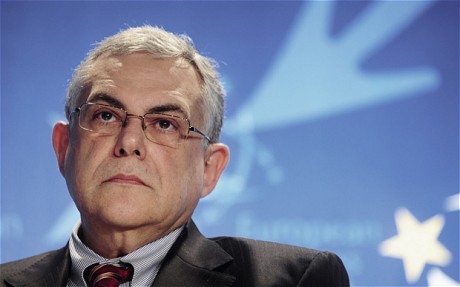

(Reuters) – Greek leaders clinched a long-stalled deal on reforms and austerity measures needed to secure a bailout and avoid a messy default, government sources said, hours before the country’s financial backers were to meet in Brussels on Thursday.
Athens’ partners in the European Union and the International Monetary Fund have been exasperated by a lack of agreement on the sacrifices they demanded in return for a 130 billion euro ($172 billion) bailout, with time running out for Greece before a major March 20 bond redemption.
Finance Minister Evangelos Venizelos set off for Brussels without a complete deal after all-night talks with leaders of the three Greek coalition parties and chief EU and IMF inspectors left one sensitive issue – pension cuts – unresolved.
But following further negotiation on Thursday, two government sources said an overall agreement had been reached.
“A few minutes ago, I got a call from the Prime Minister of Greece saying that an agreement had been reached and has been endorsed by the major parties,” European Central Bank President Mario Draghi told a news conference in Frankfurt in the first official confirmation.
The euro and European stocks strengthened on news of the breakthrough, which raised prospects of averting a chaotic hard default by the euro zone’s most indebted country within weeks, that could send tremors around the global economy.
The risk premium investors charge for holding Italian and Spanish bonds rather than safe-haven German Bunds fell back.
Euro zone officials say the full package must be agreed with Greece and approved by the EU, IMF and European Central Bank by February 15 so legal paperwork can be completed in time to avoid a chaotic default that may threaten the global economic recovery.
“The financial survival of the country in the coming years depends on the new program … It is a time of responsibility for everyone,” Venizelos said.
Greece’s two major labor unions called a 48-hour strike for Friday and Saturday against the reforms that the party chiefs managed to agree on.
“The painful measures that create misery for the youth, the unemployed and pensioners do not leave us much room,” secretary general of the ADEDY union, Ilias Iliopoulos, told Reuters.
“We won’t accept them. There will be a social uprising.”
Venizelos should now be able to present to fellow euro zone finance ministers a fully-fledged new bailout plan, including a commitment for 3.3 billion euros in budget cuts this year, when they meet at 1700 GMT.
Before then, all eyes will be on what the ECB is willing to do to help Greece at its monthly policy meeting.
WRITTEN COMMITMENT SOUGHT
After the overnight talks, a senior government official said the party chiefs had agreed on how to make about 90 percent of the promised savings, leaving a relatively small hole in the calculations.
Asked how the differences over pension cuts had been resolved, another government official told Reuters: “”There will be cuts in other areas of public spending and we will see how we will minimize reductions in pensions.”
International lenders are demanding that the party leaders commit themselves in writing to implement the program of pay and pension cuts, structural and administrative reforms.
The leaders have been loath to accept the lenders’ tough conditions, which are certain to be unpopular with voters. They face parliamentary elections possibly as early as April.
“In these difficult hours we have to look after the ordinary people, the pensioners,” conservative New Democracy leader Antonis Samaras said after the political leaders’ meeting.
“I haven’t got the right to not negotiate hard and I don’t care what other people think about that. We have to make sure that people will suffer less.”
Newspaper editorials criticized the harshness of the austerity measures demanded by Greece’s lenders, but said there was no other option but to give in and agree.
“The memorandum seems, and in fact is, heavy and unbearable for the majority of the Greek people but unfortunately it is the only choice so that the country is not led over the cliff,” financial daily Imerisia said.
Greece has been falling deeper into recession since it was rescued by a first bailout deal in May 2010, and latest unemployment data showed the country’s jobless rate rose to a new record of 20.9 percent in November.
Industrial output fell 11.3 percent in December, in further proof of the deep economic malaise.
ALMOST THERE
Prospects for a bailout deal had brightened when the finance ministers’ chairman Jean-Claude Juncker called the Brussels meeting – which IMF managing director Christine Lagarde will attend – to examine the bailout plan.
On offer from the EU and IMF is a package involving the new rescue funds and a bond swap with private creditors to ease the nation’s large debt burden.
Athens is also urging the ECB to forego profits on its Greek bond holdings in what could raise 12 billion euros or more. The bank’s 23-member Governing Council met on Thursday but Draghi declined to say how the Greek bonds held by the ECB and national central banks would be handled.
For the bailout, Athens must accept conditions requiring big cuts in many Greeks’ living standards. The smallest member of the coalition, the far-right LAOS party, was particularly uncomfortable with the measures.
Panos Beglitis, spokesman for PASOK which is in the coalition along with LAOS and the conservative New Democracy party, said the leaders had agreed to cut the minimum wage by 22 percent as part of efforts to make the economy more competitive. Plans to scrap holiday bonuses paid to private sector workers had been dropped.
Two sources said the government would promise spending cuts and tax rises worth 13 billion euros from 2012 to 2015, almost double the seven billion originally pledged.
Other elements of the deal have been gradually slotting into place, including the bond swap with private creditors to ease Greece’s debt burden by reducing the value of government bonds held by banks and insurers.
Private bondholders are expected to take real losses of about 70 percent on their holdings as part of the swap, under which they receive new, longer-dated Greek bonds to try to reduce Greece’s debt burden by about 100 billion euros.
Talks on the swap have dragged on for weeks, complicated by the position of hedge funds and demands that public creditors also chip in. Officials and bankers say the deal cannot be finalized until the rest of the rescue package is nailed down.
($1 = 0.7545 euros)
(Additional reporting by Renee Maltezou, Lefteris Papadimas and Karolina Tagaris in Athens and Paul Carrel in Frankfurt; Writing by David Stamp and Deepa Babington; editing by Elizabeth Piper)