South Africa’s Democratic Alliance publishes its Broad-Based Black Economic Empowerment programme

A handbook for companies on how to apply affirmative action in South Africa

THE DA’S PLAN FOR BROAD-BASED BLACK ECONOMIC EMPOWERMENT THAT WILL BOOST ECONOMIC GROWTH AND JOB CREATION

During apartheid, racial separation and economic discrimination were the defining characteristics of South Africa. Black South Africans were subject to ruthless asset-stripping and restrictions: labour laws that prevented their advancement, land expropriation, business regulations banning black ownership, Bantu education, and laws that prevented black South Africans from living in metropolitan areas.

The DA looks forward to the time when everyone in South Africa can participate fully in a non-racial economy and society. South Africa must continue on the journey towards achieving justice for all. In order to achieve this, we need to make strategic interventions to counter the effects of apartheid’s asset stripping and restrictions. This can be done by growing our economy and creating more jobs for South Africans. Broad-Based Black Economic Empowerment (B-BBEE) is one of the interventions that will help to achieve this.

The Constitution provides a mandate for B-BBEE, as it supports measures to empower persons or categories of persons disadvantaged by discrimination. The majority of South Africa’s people have a legitimate claim to economic redress. If we not do succeed in providing redress, the process of reconciliation, and how South Africans relate to one another, is put at risk. Within this context, the DA supports the underlying principle of B-BBEE.

We are, however, concerned that the guiding principle of B-BBEE is being undermined by a number of factors that have played out in the public sphere and in the media. These include a ‘get rich quick mentality’ among some B-BBEEE tenderers; the emergence of ‘fronting’; the rise of ‘tenderpreneurs’; a lack of long-term sustainability, and the fact that some B-BBEEE beneficiaries do not feel incentivised to create opportunities for others.

The DA believes that we need to change how we implement B-BBEE by altering the scorecard, not discarding it. There have been some notable successes in B-BBEE, and the DA is today submitting working proposals that draw upon these successes to make it work better. This can be done by sharpening the definitions, streamlining and altering the weightings of the scorecard and introducing measures to address our most pressing challenges: job creation, education and skills development.

We will push for such changes in the Portfolio Committee for Trade and Industry, where three sets of regulatory frameworks will soon come under review: the B-BBEE Amendment Bill, amendments to the Preferential Procurement Policy Framework Act (PPPFA) and the Revised Codes of Good Practice on B-BBEE.

The PPPFA and B-BBEE Act

Amendments to the PPPFA and the B-BBEE Act were published in December last year. The DA is in broad agreement with them. Specifically,

* The DA supports the intention of the legislation to prohibit and punish fronting activity, its clarification of the definition of fronting, and the strict penalties the legislation proposes for those found guilty of fronting. It is important that fronting in respect of all B-BBEE elements is recognised as a criminal offence – and not just the misrepresentation of black ownership.

* The DA welcomes the alignment between the Codes of Good Practice and procurement regulations, and specifically the fact that the empowerment status of firms tendering for government business must be determined on the basis of all B-BBEE elements, rather than on the basis of ownership alone. This will encourage the business community to broaden its focus in terms of empowerment to include alternative empowerment mechanisms.

There are, however, some concerns which will need to be clarified in the committee:

* Section 12(A) of the B-BBEE amendment bill gives the Minister the right to allow organs of state and public entities to determine their own “transformation policies”, which would take precedence over the Codes of Good Practice. We remain concerned about the potential abuse that may arise from this.

* The appointment of the head of the B-BBEE Commission by the Trade & Industry Minister might bring into question the Commission’s impartiality. The DTI will thus have to give additional assurances that the Commission will remain impartial.

* The Commission has the power to investigate allegations of fronting and may delegate its “duties and functions” to the Special Investigating Unit or “any other person or organ of state”. We believe that it is necessary for these powers of delegation to be clarified.

* The Bill requires that all “public companies listed on the Johannesburg Stock Exchange” provide to the Commission (a) “the report on their compliance with B-BBEE” and (b) “any other prescribed information”. Given the already cumbersome regulatory environment in which South African businesses have to operate, we will question the limitations on the powers of the Commission to call for information.

* The B-BBEE Commission will now take responsibility for responding to technical questions. The DA will seek specific information on how the Commission will be capacitated to deal with these queries, so as not to repeat the lack of responsiveness by the DTI in handling queries in the past.

The Codes of Good Practice:

The DA believes that there has been an over-emphasis on the ownership component of the empowerment scorecard. Too few have benefited from the government’s insistence on focusing only on ownership for the past few years. This has been to the detriment of other B-BBEE components that have the potential to expand access to economic opportunities.

The Cabinet has approved the revised B-BBEE Codes of Good Practice to be published for public comment. The DA will use the public consultation around these proposals, as well as their consideration in the Portfolio Committee on Trade and Industry, to advocate for ten principled changes to the code. These are as follows:

1. Recognition for contributions to job creation

We will propose an increased weighting to the socio-economic development component, and call for points to be awarded in recognition of employment creation. Employment is the most sustainable way to lift people from poverty, and it acts as an economic multiplier by increasing people’s purchasing power. Specific recognition must be given for job creation by South African businesses.

2. Encouraging access to employment through the Youth Wage Subsidy

An alternative scorecard should recognise job creation via the DA’s proposed Youth Wage Subsidy programme. As it stands, the scorecard for the skills development element awards points for the percentage of black employees participating in learnership programmes offered through the Sector Education and Training Authorities (SETAs). SETAs are an unwieldy and ineffective tool to bolster skills development, lacking the flexibility to respond to the market.

3. Encouraging participation by black new entrants in ownership transactions

The DA will propose increased recognition for the participation of “black new entrants” in ownership equity programmes. The ownership element currently awards only 2 bonus points for equity deals that benefit individuals who have not previously held ownership in other entities with a total cumulative value of more than R20 000 000. These points can be increased, while reducing the threshold for qualification as a “black new entrant”. This will promote broad-based participation in equity transactions, and help reduce the incentive to “re-empower” those who have already gained access to wealth though B-BBEE.

The DA believes that there should be a cap on the monetary value for individuals and companies participating in B-BBEE deals. This will not prevent black entrepreneurs from accessing investment opportunities. Rather it will determine the extent to which their participation will be deemed to contribute to broad-based empowerment.

4. Allowing local companies to make use of equity equivalent programmes as an alternative to ownership reform

The present Codes allow foreign-owned companies to use specified development programmes as an alternative to equity transfers. Contributions are measured against 25% of the value of the entity’s operations in South Africa. These programmes have the potential to benefit many more people. They provide an alternative to ownership schemes that often tie up capital in B-BBEE, without creating productive participation by black South Africans in the economy. We believe that this option should also be available to local companies.

5. Incentivising both internal and externally focused skills development initiatives.

Cabinet indicated that a decision has been taken to make skills development more outwardly focused. The scorecard currently only recognises contributions to skills development for an entity’s own employees in the skills development component. This excludes South Africa’s large unemployed population from capacity-building initiatives initiated by the business community.

The DA will propose that contributions to skills development opportunities for any South African earning less than R15 000 per month be recognised in the skills development component. Recognition of skills development contributions for non-employees will encourage businesses to invest in equipping South Africans to participate in the formal economy.

6. Increasing the weight of the enterprise development element

We support the proposed merger of the management control and employment equity elements to create an integrated measurement of black participation in strategic decision-making and key management roles. This would allow for additional points to be allocated to both enterprise development and socio-economic development.

To ensure that enterprise development initiatives assist emerging entrepreneurs who add productive value, the Codes must incentivise support to enterprises with black owner-managers, rather than simply firms with black shareholding. Given the potential job-creating power and growth contribution of small businesses, consideration could be given to the recognition of all enterprise development initiatives in support of businesses below a specified turnover threshold – regardless of the racial profile of the small business owners.

7. Recognition for talent management strategies

Employment equity drives will only be sustainable if they are coupled with appropriate strategies to attract, develop and retain talented staff. Recognition for the development of effective talent management strategies should be included in the employment equity element of the scorecard.

8. Recognising support for local industry

Businesses that use local resources should be rewarded for their investment in the South African economy. The DA will support changes to the preferential procurement component that increases recognition for procurement from locally owned businesses, and removes the exclusion benefit for imports. Industries that rely on imports will not be adversely affected as they will continue to be benchmarked against their peers who face the same global supply realities. The aim must be to retain as much capital as possible in the local economy, especially in the rural areas.

9. Easing the regulatory burden on small businesses

Small and medium size enterprises employ 68% of South Africa’s labour force, but carry a very high administrative burden. We welcome the intention to make an upward adjustment in the thresholds for compliance for exempted micro enterprises. We similarly welcome the move to qualify the B-BBEE scorecard and propose that these thresholds are regularly adjusted for inflation.

We are, however, concerned about the proposal that requires Qualifying Small Enterprises (QSEs) to comply with the full B-BBEE scorecard and believe that it is likely to make it much more difficult for small businesses to become compliant with the Codes and reap the potential benefits of a good empowerment status.

10. Reducing the cost of compliance

The cost of compliance to B-BBEE regulations for QSEs can be reduced by introducing B-BBEE audits, once every two years, that produce scorecards which will be valid for 24 months. This would also allow businesses to implement empowerment programmes with slightly longer timeframes.

In sum, the DA’s approach is a unified one: ensuring that the Constitution continues to frame the principles of B-BBEE, and creating the right policy environment for it to succeed. For B-BBEE to succeed, millions of poor and unemployed black South Africans must benefit from it, so that they can lift themselves and their families out of poverty, acquire new skills and ensure that their children are able to gain access to the formal economy.

Black business should stop charging double prices to government, says Deputy President Mantashe

Black business should deliver affordable, quality products and services if it wants government contracts, ANC secretary general Gwede Mantashe said on Tuesday.

“As we support black business, black business must bring a commitment of delivery, cost-competitive and quality of items that are procured,” he told analysts and business people in Soweto.

He asked why a government-built school cost a minimum of R20 million to construct, while a private sector-funded school only cost around R5m to R10m.

“Something is wrong with this system of creating layers and layers of business because the primary objective of building a school is made secondary… to creating business beneficiaries.”

He was addressing analysts as part of the African National Congress’s programme to speak to various sectors in South Africa.

Mantashe said the primary outcome of the ANC lekgotla in July was that the government needed to drop the system of tenders.

It needed to move away from giving business to black companies, and then afterwards arguing about quality and cost.

“Don’t undermine this question of people delivering bridges that get eroded with the first rainfall. It can’t continue. It just can’t continue. It is wrong. It is wrong.”

Mantashe suggested that black businesses look to SizweNtsalubaGobodo, South Africa’s largest black auditing firm, as an example of how to succeed.

The company started small, but now handled the entire audit account of parastatal Transnet because of the quality of its work, Mantashe said.

He said the ANC would meet the Black Business Council (BBC) to discuss the strengths and failures of black economic empowerment (BEE) and the role of state procurement in transformation of the economy.

A representative from the BBC had complained that the government’s procurement policy had gone wrong.

Various delegates raised questions about the effectiveness of BEE policies.

Mantashe responded that he had a problem with the idea of BEE.

“I have a serious grievance with BEE… focusing on shareholding with beneficiaries not being operational.”

He said if the beneficiaries of BEE deals were not part of operations, they were not gaining a deeper understanding of the business in order to grow.

“Operational exposure, to me, is more powerful than just ownership…”

Mantashe drew parallels with when the Afrikaners were in power from 1948 to 1994.

“Afrikaner capital, after 40 years in power,… they couldn’t produce a single CEO of mining, not one.”

All CEOs of mining companies up until 1994 were white and English.

“We should not wait for 40 years to produce genuine black CEOs who can run companies.”

He commended Xstrata’s South African CEO Sipho Nkosi for not being a “window-shopping CEO”.

“Sipho Nkosi is not a big shareholder, but he is very operational… he knows mining. To me, that is how we are going to transform the economy.”

When questioned about factions within the ANC, Mantashe said they had been around for years.

“I wish we can have an organisation that has no factions.”

He spoke of a Pan-Africanist faction splitting from the ANC amid “violent polemics” in 1959.

“It was then, it is today, it will be in future,” Mantashe said.

However, he said: “When there are confrontations in an organisation, we always exaggerate them as always a division about to see a split. I think that is a flawed analysis when there are politicians.”

He said the contradictions helped move the party forward.

“The fact that people have different views… actually it sharpens you.”

South African Airways no longer wants white pilots

Cadet pilot training course applications from white men are no longer being accepted by the SA Airways (SAA), it was reported on Friday.

SAA spokesman Kabelo Ledwaba told Beeld that the cadet programme was being advertised online as an initiative to bring pilot demographics in line with the country’s broader demographics.

“Only 15 percent of SAA’s pilots are currently black, and this includes Indians and coloureds. The rest are white, and 91 percent of them are men.”

Ledwaba said the airline would appoint male, white pilots when there were vacant posts for which applicants of other races could not be found.

Beeld had asked why white applicants were being rejected across the board.

An irate father had called the newspaper to complain that his son, who had a commercial pilot’s licence and met the educational and physical criteria, had been rejected on the grounds of race.

By filling out several dummy applications, Beeld established that the online form had been programmed to reject any white applicants. – Sapa

$54,8m fine for South Africa’s Telkom

Telkom headquarters in Pretoria, as seen from Church Square Photo: Wikipedia

The Competition Tribunal of South Africa has fined Telkom, the one-time monopoly state telephone company, with a $54.8 million fine over unfair competition, according to an Associated Press report this morning.

The tribunal issued the fine Tuesday morning as part of a decade-long look at the company’s practices.

The case began in 2002, with Internet service providers alleging Telkom charged its competitors high prices for using its services, while charging much lower fees to its subsidiaries and its customers.

The South African government still owns part of Telkom SA Ltd., once an entirely state-run company. The company, with operations in other African nations, has had financial troubles in recent years. Subscribers also have increasingly dropped fixed telephone lines, the backbone of Telkom’s business, for mobile phones.

Telkom has also practised a blacks-only employment policy and has lost a significant percentage of its skilled personnel as whites have either been retrenched or resigned of their own accord.

Zimbabwe central banker cautions on yet more affirmative action

Zimbabwe’s central bank chief warned Friday the country’s fragile economy could grind to a halt if the government rushes its planned seizure of majority stakes in foreign-owned banks.

“The implementation of indigenisation and economic empowerment regulations in the banking sector should be done in a manner that preserves confidence since any adverse developments in the banking sector could grind economic activity to a screeching halt,” Gideon Gono said.

He was speaking to business executives at the annual congress of the Confederation of Zimbabwe Industries in the eastern resort town of Nyanga.

Zimbabwe passed in 2007 a law that forces all foreign-owned companies to hand over a majority stake of 51 percent to locals.

The law has forced mining firms, including the country’s biggest platinum mine Zimplats, a subsidiary of South Africa’s Impala Platinum, to submit schedules on how they will surrender a majority share.

“We are gratified to note that some aspects of the indigenisation and economic empowerment regulations are receiving attention with a view to harmonize and fine-tune pertinent issues,” Gono said.

Indigenisation Minister Saviour Kasukuwere, in a government notice made public earlier this month, gave foreign banks and other companies one year to cede a 51 percent stake to locals, as required under current laws.

Mugabe’s partner in a coalition government, Prime Minister Morgan Tsvangirai dismissed the ultimatum on the banks as illegal and a threat to the ailing economy’s recovery prospects.

Britain’s Standard Chartered Bank and Barclays Bank are among the major foreign banks with operations in this former British colony.  – AFP

Why no scholarships for white people?

by Alex Urbina Favela

Why is it that there are no scholarships that specifically target white people?

I mean, there are plenty of scholarships out there that are designed for people of certain ethnicities, such as the Hispanic Scholarship Fund, the Asian and Pacific Islander American Scholarship Fund, and the Thurgood Marshall College Fund, but it is hard (or maybe impossible) to find one that specifically caters to Caucasians. I mention this in order to point out a double standard in our society.

Although it does not directly address scholarships, affirmative action upholds a similar double standard in our country.

The Supreme Court has recently decided to review a case that is tied to affirmative action, and it seems the chances for upholding racial quotas are weaker than ever.

The case in question is Fisher v. the University of Texas. Abigail Fisher has alleged that UT denied her admission due to her race.

Since the last time it ruled in favor of an affirmative action plan in 2003, the Supreme Court has become decisively more conservative.

Justice Samuel Alito has subsequently replaced the moderate Justice Sandra Day O’Connor after her retirement in 2006, marking a shift away from a liberal majority. This leaves the Supreme Court with five conservative justices out of a total of nine.

In addition to that, Supreme Court Justice Elena Kagan, who most likely would have voted for use of race quotas in admissions, has recused herself from the upcoming review due to her involvement in the case as Solicitor General. No, things do not look well for affirmative action at all.

But we must ask ourselves if affirmative action is something we think truly represents the American spirit.

Consider this: what if you were told that you could not receive admission into a university or receive a scholarship because of the color of your skin? It would be devastating and blatantly outrageous, correct? Well, this argument used to only apply to ethnic minorities’ rights to education, but I think the same can now be said of those with a Caucasian background.

Now, don’t get me wrong; I am of Mexican descent and as swarthy as they come. But I just cannot help but call out this obvious hypocrisy in our culture.

We are all so quick to preach equality and fair opportunities for everyone regardless of race, but at the heart of the issue is a general notion to combat the idea of whites getting everything.

Accordingly, we establish that it is okay to grant scholarships and college admission to some and not to others. Is this not racism in and of itself? Is this not what the previous generations tried so hard to eliminate?

It is my opinion that affirmative action should be discontinued. It is nothing more than racial balancing with a catchy title. It purposely gives a select few an advantage while denying that same advantage to others. Racial balancing is racist and we all know it.

However, I will give our racism in this matter some credit: it does increase classroom diversity. Proponents of affirmative action could say that this increase in diversity leads to better classroom discussion and an increase in overall learning.

But I would argue that the link between classroom diversity and classroom learning is not as strong as one would think. It, of course, plays a role in greater multi-cultural understanding but we must not fool ourselves into thinking of classroom diversity as a cure-all solution for learning.

I propose that instead of continuing to discriminate based on race, college admissions should be based solely on merit.

This way, race would not even be taken into consideration and everyone would have an equal chance at gaining admission to the college of their choice. This is only fair.

Whatever the solution is, race needs to be kept out of the acceptance process. Until things like this are dealt with, racism will be hard at work in the U.S. as double standards continue to exist.

South African businesses to pay crippling affirmative-action fines

Businesses could pay an enormous price – up to 10% of their turnover – if they do not strictly observe provisions regarding affirmative action, says a report on the Sake24.com site.

Attempts at Nedlac to reach a compromise about proposed radical amendments to the Employment Equity Act came to naught and the next step is to take them through the parliamentary process. The proposed amendments are said to be so radical that the business sector will have them tested in court if they remain unchanged by the parliamentary process. Should the proposals be accepted not only could considerably larger fines be levied, but they would also make it much easier for government to impose them, notes the report. The 1998 Employment Equity Act prescribes relatively small fines of between R500 000 and a maximum of R900 000. The new fines being proposed follow the model of competition legislation and are linked to companies’ turnover. They range from 2% of a company’s annual turnover to 10% for repeated violations. The report says the proposed fines are largely in line with those outlined at the end of 2011 in the Black Empowerment Bill for companies using fronts to claim that they are empowered. Not only are fines of up to 10% envisioned, but also imprisonment of up to 10 years for those who lie about their company’s empowerment status.
Full Sake24 report

Meanwhile, the controversy over proposed changes to the Act, which it was feared would cause coloured and Indian workers to lose their jobs in some provinces, turned out to be a storm in a teacup, says a Business Day report. The contentious issue of whether employers should use national or regional demographic statistics to calculate the employment equity target for their workforce has not been significantly changed, says the report. Under the present law, employers have a choice to use national or regional demographics to determine their racial targets. There was an uproar last year when an initial draft of the amendments proposed that employers be forced to use national demographics as a measure, which would have meant that the workforce had a disproportionate number of coloureds in the Western Cape and of Indians in KZN. However, the amendment Bill is believed to leave the present regulatory regime much the same, with the exception that the Labour Minister will have the power to produce regulations on the matter. The regulations will allow a company – that is designated as a national company – to use national demographics as its employment equity measure. Companies that are not national will not use national demographics, notes the report.
Full Business Day report

– LegalBrief

Affirmative Action premium: black females receive 36% more than whites

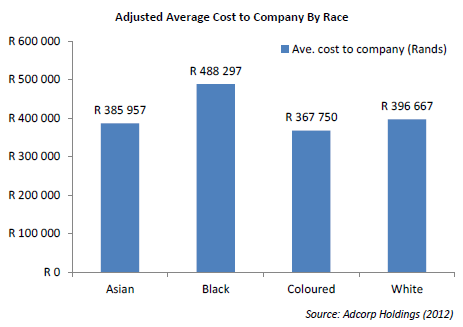
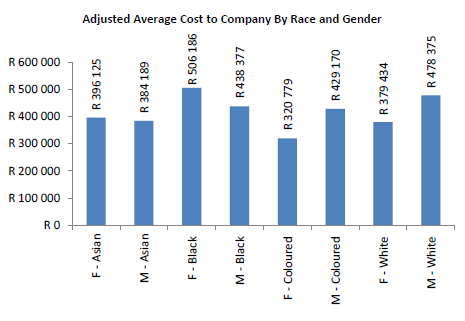
Data from the Adcorp Employment Index suggest that – all else being equal – black females receive 36,4% more than whites in South Africa.

This month, we take a closer look at the wage premium of affirmative action candidates in South Africa. The premium for blacks is now 23.1% – and for black females is now 36.4% – above their white counterparts.

One of the most important labour market indicators in South Africa is the “affirmative action premium” – the wage premium of affirmative action candidates over their non-affirmative action counterparts, holding constant the level of skills, qualifications, experience, on-the-job performance and other pertinent information so as to reflect purely the race-linked pay discrepancies between candidates. Since much of the required information is not recorded or readily available, Adcorp was able to obtain the required information for only 1,604 permanent placements for the 12-month period June 2011 to May 2012, on which the following analysis is based.

As indicated in the figure, Asians and coloureds earn 2.7% and 7.3% less than whites respectively, whereas blacks earn 23.1% more than whites, for equivalent levels of skills, qualifications, experience and on-the-job performance.

Interestingly, when the figures are dissected further by gender, Asian and black females earn 3.1% and 15.5% more than their male counterparts; whereas coloured and white females earn 25.2% and 20.6% less than their male counterparts.

The data is not consistently available over time, so it is impossible to say for the moment whether the affirmative action wage premium – which applies exclusively to blacks, and most notably to black females – has been rising or falling over time. But Adcorp will track and report on these figures in coming editions of the Adcorp Employment Index.

This is an edited extract from the Adcorp Employment Index for June 2012, July 10 2012

Apartheid revisionism needed

About two weeks ago, Hermann Giliomee, the well-known liberal Afrikaner historian, wrote a scandalous piece in the Afrikaans Sunday newspaper, Rapport. The title was, “Apartheid: was it only evil?” (Afrikaans link)

I have since responded with two articles of my own to his, and we are more or less in agreement that there has been a colossal misrepresentation of what the apartheid system of racial segregation in South Africa was. However, at least one academic from the University of Stellenbosch, Anton van Niekerk, has already attacked Giliomee, describing his piece as “immoral” and “unjustifiable”.

But for decades white South Africans have spent an ever-increasing portion of their taxes on black education, health and welfare, something which the rest of the world has characterised as a “crime against humanity”.

The other day I was speaking to a friend and she told me that Afrikaans was such a nice language because one could still express how one felt, whereas “everything in English had to be so politically correct”. At least that is the way it is in South Africa. Probably in the USA and other countries, it is different. Although I have been astounded to see how intolerant American liberals can get about views on race that differ from their own.

To appreciate what a major step Giliomee took in coming out with the view that some alternatives to apartheid would have been worse, one has to live in South Africa where every day we are inundated with propaganda about our “evil past”. I grew up in the 1960’s and 1970’s, rode a bicycle in our crime-free streets, saw happily dancing black mineworkers and generally was completely unaware that anybody in South Africa was desperately unhappy. As opposed to today when acrimonious exchanges fly almost continuously between black, white, coloured and Indian, race relations in those days were cordial and uncomplicated. We each lived in our own compartments and did not feel threatened by others. That too, in juxtaposition with contemporary South Africa where whites constantly worry whether they are going to be attacked en masse, chased into the sea by angry, frustrated blacks or fall victim to the daily criminal incidents such as rape, murder, robbery and theft. Whereas South African whites go out of their way to be civil to blacks, even calling them “sir”, which would have been unheard of in the old South Africa, blacks do not seem to return the compliment. Instead they behave absolutely abominably, whether in the extreme form of violent crime or in the imperious arrogance of their politics.

However, that almost idyllic South African past before we adopted the American model of affirmative action, white guilt and forced integration, is nowadays equated with Nazism. In 1939 large numbers of white South African men volunteered to fight Germany together with Britain and the rest of the Commonwealth, yet at some point we became the Nazis. Even Germans look upon us as Nazis. Not only do the Germans feel morally superior to us, but they would rather sell their sleek Mercedes-Benzes and BMW’s to corrupt black politicians than to us. These days, being impoverished, lower middle-class victims of affirmative action, “black economic empowerment” and all the other race-preference measures, we cannot afford German cars anymore and are driving second-hand Korean cars.

After all, the Germans only gassed a few million Jews. We Afrikaners or white South Africans oppressed blacks, which is far worse. We provided them with separate toilets. The fact that they did not have toilets at all before and somehow did it behind bushes or even in full view (as many still do next to our decaying roads), is besides the point, but next to whites-only toilets, Auschwitz and Dachau pale into insignificance.

Many South African liberals have already told me that denying that “apartheid was a crime against humanity” was tantamount to holocaust denial. In fact, two billionaire Jews, the twin brothers Krok, have given us their version of a South African holocaust museum, the so-called Apartheid Museum. That part of the deal was getting a casino licence from the new black government so they could make even more money, is never mentioned. Suffice it to say that we now have a tourist attraction where people can come and participate in the re-imagining of the South African past as a quasi-Nazi nightmare, replete with our own holocaust museum.

Except six million did not die. At least not in South Africa. It was more a case of: six million were born, grew up and proliferated and out of that population explosion and “youth bulge” all the chaotic urbanisation and familiar riots ensued.

Today there are as many, if not more, black riots in South Africa, than ever before. Yet the BBC, ABC, France 2, Reuters and whoever are not filming it. It seems that for blacks to riot under a black government is considered normal whereas every stone thrown or building set alight “under apartheid” was seen as pregnant with meaning, the expression of an entire political philosophy, a deep yearning for democracy. Just today I read in a report from the SA Institute of Race Relations that the most signifcant shift in the South African voting pattern is not that a lower percentage of people want to vote for this well-nigh useless and incompetent ANC government, but that fewer blacks express the desire to vote at all.

But I digress. The fact is that for Hermann Giliomee to have set off his apartheid revisionism, took a lot of courage. In a private letter, he told me that to his great relief he had severed all ties with universities. No-one wishing to keep his post at a university or even get published in academic circles would dare write a piece with such a heretical title: “Apartheid: was it only evil?”

To most sane people, his is a rhetorical question. One only needs to drive around South Africa and see all the overweight, contented blacks walking around in brand-name clothes, driving cars and chatting away on expensive cellphones to appreciate that, contrary to popular belief, our “evil past” had not affected them in any negative way.

Whenever I hear the litany of complaints by blacks about how they have been “disadvantaged” by apartheid – that is another shibboleth of the new South Africa, the “previously disadvantaged” – I feel like asking them: But what would South Africa have looked like without apartheid? Would our GDP have rivalled America’s? Would you have sent rockets to the moon from Soweto? If, despite affirmative action, only a thousand blacks could so far manage to pass the board examination to become a chartered accountant, how on earth would this economy ever have performed better than it actually has under mostly white management and entrepreneurship?

However, the issue goes further. Again, contradicting received wisdom, apartheid, at least the kind of policy espoused by the successive Afrikaner governments after 1948, was not only about providing separate amenities to black and white, so-called “petty apartheid”. It was also a colossal attempt at kick-starting black development. In today’s money, billions were poured into black education, healthcare, training, agricultural development, social services and so on. That was so-called “grand apartheid”, something which few of the hysterical liberals screaming “boycott South Africa” at the time wanted to talk about.

If we are to be heretics, after Hermann Giliomee’s example, we might as well start talking about grand apartheid  now.

By the way, I firmly believe that what a few of us “dissident Afrikaner intellectuals” are doing at present, questioning the racial orthodoxies of South Africa, is of great significance to us, to this country and perhaps even to the wider world that is grappling with similar problems.  For a long time now, we have been labouring under a type of censorhip. Whenever we dared to question our abject guilt, the Luciferian malevolence of our forebears, we would immediately be silenced, ostracised or vilified, so as to suppress those facts or aspects of our past that do not fit in with the “Nazi model”.

What we are really dealing with, and that was the starting point of my recent piece in Afrikaans, published on www.praag.co.za on Sunday, is yet another confrontation between dogma and reason. To Van Niekerk, Leop0ld Scholtz and many of the Media24 or Naspers commentators, it is about maintaining the apartheid dogma as it was established by the foreigners and by the South African Marxists.

Anton van Niekerk feels that it is “immoral” to question the apartheid dogma by simply referring to the facts of National Party policy between 1948 and 1994. At the very least it represents an argumentum ad populum or appeal to the “accepted wisdom” created in the past by left-wing historians and British newspapers.

Therefore, to be an apartheid rationalist today, requires a great deal of courage! A year or two ago at the offices of the South African Human Rights Commission, when I questioned the assertion by an Indian academic from Wits University that “apartheid had killed millions of people”, I was seen as some sort of lunatic. The Wits professor concerned promptly burst into tears and in general I was deemed a heretic.

The point about apartheid is that just about any lie or misrepresentation of if is acceptable today, simply because so many Afrikaners no longer have the courage to speak the truth about our past. Many of the National Party cabinet members are still alive and would easily be able to rectify the falsifications and half-truths by means of a few statistics and statements to the media, but they are simply too lily-livered for that.

Mr. Flip Buys too, of the mighty Soliforum group, says in almost every one of his radio interviews: “I am fighting for a better future, not a better past.” Buys knows very well on which side his bread is buttered and that the questioning of the apartheid dogma would quickly cost him the support of Media24.

But like George Orwell said: ” He who controls the present, controls the past. He who controls the past, controls the future.”

Actually, it is quite ironic that someone like Hermann Giliomee, who has a reputation as a liberal thinker and who spent some time at the University of Cape Town, should defend the current reputation of mostly conservative Afrikaners from the past. But I think part of Giliomee’s feeling that he has to do it, stems precisely from the classic nineteenth-century liberal idea that “there is more than one truth” or that every issue has at least two sides. Of course, that is also a principle of our Roman-Dutch law in South Africa, that every party to a suit has at least the right to put his case.

After my first response to Giliomee on Sunday a week ago, a reader sent me a clipping from The Citizen newspaper. It was made up of a letter that Jaap Marais wrote sometime in the nineties to the newspaper in which he pointed out a few interesting facts and figures, for the benefit of one W.J. Sachs who wrote that “the apartheid government withheld basic education from the black majority”. Naturally, it has become a generally accepted part of the apartheid dogma that blacks had received no education before the ANC took over in 1994. The fact that members of the ANC government are able to read and write at all, will no doubt soon by declared an official miracle by the Pope.

Among other things, Marais shows how only 20% of black children went to school under the United Party government prior to 1948. However, by 1967 the historian C.J. Scheepers Strydom wrote: “one of the changes with most far-reaching effect is undoubtedly the advancement of Bantu in education. Today 85% of the Republic’s Bantu of school-going age are literate – an increase of 600% since 1925. 32 000 teachers are employed in 8 500 schools with 2 million pupils”.

Jaap Marais adds: “In 1948 there were 8 000 Bantu teachers and 336 437 pupils in 3 310 schools. So it is evident that the so-called ‘apartheid regime’ did more for black education than its predecessor.”

While white taxes today are being spent largely on blacks, this was already the case during South Africa’s previous political system. Jaap Marais shows in his letter that the contribution per individual taxpayer according to race in 1970 was the following:

Whites R126

Indians R10

Coloureds R3

Blacks R0,85

In other words, blacks paid only 1/130th of the taxes paid by whites, but received far more from the state treasury!

Marais points out further that the total contributions of the different race groups in the 1980/81 fiscal year were still the following:

Whites R2 053 million

Indians R43 million

Coloureds R39 million

Blacks R100 million

In fiscal 1982/83 whites continued to pay 92,5% of all personal income tax.

After giving these figures, Marais emphasises the stupendous fact denied by today’s dogmatists, namely that in the same decade from 1973 to 1983 we again saw a tremendous rise in expenditure on black education: from R27 million per annum to R475 million per annum. From 1981 to 1985 the increase was equally rapid and shot up from R225 million per annum to R950 million per annum.

Referring to fiscal 1983/84, Marais says: “The government took from the 1,5 million taxpayers a total of R1 733 million for non-white education, averaging R1 107 per white taxpayer. This is how the former government practised affirmative action.”

In 1971 blacks had received 16 percent of the total education budget, but by 1991 it was already 58%, which indicates to what extent the apartheid dogma that “whites withheld education from blacks” rests on a myth.

But Anton van Niekerk and other dogmatists will respond to this by saying that they are not interested in the numbers and hard reality, but in the “moral” aspects of apartheid and segregation to which they refer as “an assault on human dignity” and “dehumanising”.

Van Niekerk writes in Rapport:

“We can therefore not judge apartheid in terms of a sinical, semi-Machiavellian estimation, merely what would have happened to the economy if there were no apartheid. Apartheid is gnawing at our conscience as whites because we have wounded the basic humanity of our fellow South Africans in its essence.”

The question is: why is apartheid “gnawing at our conscience as whites” when all the leaders and inhabitants of the formerly independent black homelands, as well as the Indians and Coloureds who also enjoyed certain privileges above blacks, may walk around with “clean consciences”?

And one wonders why Anton van Niekerk’s version of white guilt only applies to white South Africans or whether he also subscribes to Susan Sontag’s slogan: “The white race is the cancer of history.” Are all whites guilty? At any rate, most Western countries practised some or other form of colonialism or segregation. Until the seventies some of the southern states of the USA, as well as Britain, still applied forms of apartheid or segregation. Why should we be singled out as the scapegoats of the Western world?

Evidently, Afrikaners and SA whites do not need to take moral lessons from Americans, Britons or former National Party supporters like Anton van Niekerk. Today we have the opposite problem: in South Africa and to a lesser extent in the USA and other countries, there exists a system of reverse discrimination and permanent affirmative action by which we are reduced to permanently second-class citizens. Blacks also commit violence against us on a scale which may, at the very least, be called a violation of our human rights and at worst may be seen as a form of genocide.

In the recent past, the silence on black-on-white violence by the media in the USA has been coming under the magnifying glass. It is a disconcerting tendency that black violence, also in our country, is not being examined with the same “moral” spectacles as those used to stare at the South African past. During the conflict between the ANC and the National Party, newspapers regularly published statistics about deaths in police detention, but these days it is not being done anymore. In his book Trou tot die dood toe, gen. Johan van der Merwe mentions that nowadays approximately 700 deaths in police detention occur per annum, which is far higher than at any time during so-called “apartheid”. When are Prof. Anton van Niekerk and other politically correct academics going to start looking at that?

Those who prefer to make use of “moral criteria” should apply the same criteria to the methods used by the ANC to come to power. That is another issue raised by Van der Merwe: The ANC simply ignored the Geneva Convention and committed terror against civilians, both black and white. How are we supposed to feel guilty about the apartheid past when we are being governed by a group of monsters that exploded the Church Street Bomb on 20 May 1983 and committed over 400 necklace murders. (The method of execution by which a tyre is place around someone’s neck, filled with petrol and set alight, the person literally burnt alive.)

It will also be an interesting exercise to compare the human rights record of “Apartheid South Africa” with those of the group of countries that declared apartheid a “crime against humanity” at the United Nations.

Two years ago I visited Sweden. At times I had to stop myself from feeling morally superior to the Swedes, those supporters of the ANC and the anti-apartheid movement. Because our people have done so much more for blacks than Swedes or Norwegians – with all their development programmes in Africa. We only have to look at the extraordinary affluence of South African blacks, against the abject poverty pertaining elsewhere in Africa.

Where apartheid was wrong in my view, was in the burden and responsibility we took upon ourselves to look after other nations and racial groups, administer them, train them and in general assume responsibility for their well-being. In this way, the economic and political failure of the black homelands also became our failure. To this day, the dogmatists are trying to place the blame for deficient black performance on us.

While paternalism in many Western countries is still fashionable and aid money is being handed out in Africa by the billions, we Afrikaners must never again assume Kipling’s “white man’s burden”. The paradox of apartheid is: We are today damned, not so much because we oppressed blacks, but because we demonstrated compassion for blacks, as well as their education, health and welfare.

At present many people want to continue with this, in the name of so-called “reconciliation between the races”. It would be a grave mistake and would only lead to further misery and recriminations. Currently the black man prefers to stand on his own two feet and certainly does not need our help, assistance or even taxes anymore.

Labour Court orders Denel to employ white woman

The Labour Court ruled in Solidarity’s favour yesterday by ordering Denel Dynamics to permanently appoint a member of the union retroactively as of 10 February 2011 following 24 months of service as a contract worker. Solidarity cautioned companies to stop denying white employees permanent appointments while they are waiting to appoint affirmative action candidates.

Ansie van Niekerk was appointed seven times in continuous fixed-term contracts over the period 9 February 2009 to 28 February 2011. After 24 months’ employment as a contract worker in the position of senior secretary, she applied for permanent positions on three occasions. She was overlooked each time owing to affirmative action. She was not even invited to an interview after her third application, even though she met all of the job requirements. Denel breached its own employment policy in the process, according to Solidarity.

“Denel Dynamics’s conditions of service clearly state that employees appointed on a contractual basis for more than 24 months should, after this period, be appointed permanently,” said Dirk Groenewald, Head of Solidarity’s Labour Court Division. An external candidate, a black woman, has been appointed in the position in the meantime, although the company’s policy states that preference must be given to internal candidates. “Van Niekerk, who met all the requirements for the position, was not appointed purely on the basis of her skin colour.”

Groenewald said that appointing white employees on a contractual basis in order to wait for affirmative action candidates amounts to unfair discrimination and, moreover, the white employees ultimately have to be appointed permanently, as in this case. “Judge André van Niekerk ordered Denel Dynamics to adhere to its conditions of service concerning temporary hourly employees and to appoint Van Niekerk retroactively as a senior secretary, or in a similar position. Denel Dynamics was also ordered to pay the costs of the proceedings.”

This case is one of more than 20 cases that Solidarity has instituted against government departments and parastatals regarding the unfair implementation of affirmative action.

Facts in the Van Niekerk case

Ansie van Niekerk was effectively employed as a senior secretary at Denel Dynamics from 9 February 2009 to 28 February 2011. The position entails rendering support to three electronic engineering departments comprising some 40 engineers and technicians as well as three line managers.

During the period in question, she was appointed in continuous fixed-term contracts seven times: 9 February 2009 to 9 May 2009; 10 May 2009 to 30 August 2009; 1 September 2009 to 31 December 2009; 1 January 2010 to 30 April 2010; 1 May 2010 to 31 August 2010; 1 September 2010 to 31 January 2011; and 1 February 2011 to 28 February 2011.

She received a consistent evaluation score of 4,2 which, according to the performance standard, is equal to “production of better than expected performance, quality and standard”. Although she met the requirements and filled the position for more than two years, she was overlooked for a permanent appointment.

Anti-white measures stepped up in South Africa

Partial view of the Afrikaans language monument at Paarl, Western Cape


Everyone knows the cliché about the frog being heated up slowly in water. Instead of jumping out of the pot, he becomes so used to it that he eventually boils to death. So many people have already used this metaphor for South Africa’s whites that it feels almost like plagiarism just to mention it.

However, last week’s mammoth conference by the ruling ANC in Midrand again gave me the idea that we are all being brainwashed into accepting the unacceptable: that we may lose our farms, property and equal rights simply because we are white.

During his opening speech, the ANC leader Jacob Zuma flew into a rage against “white men” who supposedly “still control the economy”. We reported on the ANC conference on www.praag.org, which led to a few altercations with black South Africans on Twitter.

White men are already self-employed

What blacks do not seem to understand is that white men no longer pose any kind of competition in the job market to them. All the banks and major corporations in South Africa follow the government’s affirmative-action rules to the letter. They are even eager to get rid of their white employees, to the extent that 75% of white men over fifty are already self-employed, eking out a measly living by doing odd jobs on their computers. South Africa is crying out for engineers, but many white engineers are sitting at home selling pet food on the internet or running gasoline stations. If they are still allowed to get gasoline franchises from the oil companies who have also excluded whites from doing that!

I came upon another statistic about white South African men: In 2006, one out of every four, of all ages, was self-employed. In short, while the ANC was ranting against white males at their conference, there were hardly any left in formal employment. Tens of thousands of young white men have already left the country and are working overseas, because no corporation would employ them in South Africa, let alone the government or municipalities where it is almost unheard of for any white person to be offered a job, except as cleaning staff.

Yes, this is the most bizarre effect of South African affirmative action, that well-educated but impoverished whites are now so desperate for an income that they will clean the floors and toilets for black office staff. I spoke to an alderman in the town of Brits, north west of Johannesburg, and she confirmed that the cleaning staff of the municipality was all white, employed as a “special favour” to the local white community. East of Johannesburg, in the horrible, Stalinist “megacity” of Ekurhuleni, a similar arrangement is taking place whereby whites are only employed to do menial labour. This is a way of boosting the self-esteem of the profligate black municipal potentates who regularly make the news because of corruption, unwarranted expenditure on luxury hotels and overseas conferences, and so on.

Taking the fight to the courts

As I am writing this, I am still awaiting the US Supreme Court decision on Fisher v. the University of Texas on affirmative action. Somehow it was not handed down last week, being overshadowed by the news of the Court’s decision on Obamacare. The Fisher decision, although important for the United States, might have a knock-on effect worldwide. South African universities practise the same kind of exclusion of white students on racial grounds, except far more radically. In some faculties, such as veterinarian science at the University of Pretoria, whites are banned altogether. In medicine, they are only allowed a quota of 10% of admissions, regardless of academic merit.

What astounds me, is why we have not had more court challenges of affirmative action and anti-white discrimination generally, in South Africa. The still relatively independent South African courts are often criticised by the ANC, so we should litigate while we still can, following all the US examples of whites who have successfully sued against race preferences.

Should we ‘prepare for war’?

However, many people believe that we are not far from even more violence than we are already experiencing. The Transvaal Agricultural Union recently asked whether farmers should “prepare for war”, given the belligerent rhetoric coming from many ANC politicians. The radical mood of the ANC and especially its militant, communist youth wing, suggests that we could see farm invasions like in Zimbabwe, with whites simply chased off their property within the next year or two, or even earlier. In a widely publicised statement, ANC Youth leader Ronald Lamola said in Durban ten days ago, about taking the land of whites: “We need an act as forceful as war to bring it back to the Africans.”

The ANC closed last week’s “policy conference” with the entire throng singing “bring me my machine gun” in Zulu, led by President Jacob Zuma, as usual.

That FW de Klerk happened to hand the ANC’s militia, Umkhonto we Sizwe, all 500 000 automatic weapons in the country’s arsenal in 1994, was the gravest error of judgement ever and a constant worry to us all.

So amid all this uncertainty and radical talk from the government, we must continue to fight for what is right, organise and defend ourselves.

Spread the message

I want to ask you, our overseas supporters, to please spread the word of our plight. Read the posts on our website and stay informed about the developing conflict in South Africa.
We are trying to keep www.praag.org updated on a daily basis, despite also running a full-scale news website in Afrikaans for our local readers on www.praag.co.za. Remember you can also use Google Translate to read some of those articles.

I recently came across an eBook on the internet about racial violence in America, White Girl Bleed A Lot: The Return Of Race Riots To America by Colin Flaherty.

What amazed me about this book, was the similarity in the violence committed by blacks in the USA and in South Africa, except here it is more extreme, sadistic and informed by African ritual, such as the recent case where a young white female victim’s hands were amputated. Presumably to be used in the concoction of muti, or medicine.

We shall try to alert you about interesting eBooks regularly, which may stimulate the international debate around white and Western survival. As the visiting Dutch politician Martin Bosma of the Freedom Party said, “You Afrikaners are the canary in the coal mine for the whole Western or European world.”

Indeed. Don’t let us die for the sake of proving that multiculturalism does not work. With our increasing poverty and joblessness here, we rely on your PayPal subscriptions and donations to keep our struggle going here.

Please also tell your friends about our fund-raising site, as well as this site www.praag.org where the enfolding drama of South Africa’s slide into racial socialism is being chronicled.

For the solidarity and friendship that you have shown us so far, I thank you from the bottom of my heart. Things may look grim now, but there is hope for our civilisation yet.

Regards,

Dan Roodt

Director, Pro-Afrikaner Action Group (PRAAG)

U.S. Supreme Court to rule on Affirmative Action today

In addition to a ruling on the constitutionality of the Affordable Healthcare law ( Obamacare) law today,  the United States Supreme Court is also set to hand down a ruling on an Affirmative Action case which may impact parents with teens heading to college in the near future.

An Anglo-Saxon white female student who was rejected admission into the University of Texas argued that African American and Hispanic students with inferior credentials were admitted over her using via the school’s Affirmative Action plan.

This case, Fisher v. University of Texas, was a follow up to the last Texas Affirmative Action case the 5th Circuit Court of Appeals decided, known as Hopwood v. Texas.  In that 1996 case, the Court ruled the school system’s Affirmative Action program was not narrowly tailored enough to meet a compelling state interest and then overruled a diversity admission policy at the law school.  It stated the school could not use race as a factor in admission decisions.

To get around that decision and do its part to increase Black and Latino admissions, the University of Texas system opted on a plan to admit the top 10 percent of all high schools. That move caused minority student admissions to jump 21 percent.

However, when the US Supreme Court took up Affirmative Action in 2003 through Grutter v. Bollinger, the majority stated that diversity is an interest that schools can and should promote as long as they meet the strict standard: that its policy was narrowly tailored to meet the compelling interest in diversity promotion.

After that case, Texas expanded its Affirmative Action efforts beyond just the top 10% and started taking into account diversity when making admission decisions. It operated under that program until 2008 when Fisher sued after she was denied admission.

There are up to several dozen factors that each school use to determine who gets admitted and it’s easy for those who get rejected to point to race and use that as a basis for a judicial challenge.  And that’s what happened here.

Fisher claims that the Affirmative Action policy at the University of Texast has become a racial quota system. The dissenting judge in the case below noted that use of a racial animus opens the door to numerical admission based on race alone. But, that was the minority opinion. Fisher managed to push her case up the ladder and was granted a review by the Supreme Court.

What will stand out this round is that the Supreme Court that heard the University of Michigan case, thereby empowering Texas to change its policy back then, is not the current court of 2012 which is dominated by conservatives, 5-4.

It gets even more complicated because Justice Elena Kagan, who was the solicitor general in the case below, has recused herself from the case.

That maneuver stacks the court with even more conservative Justices, increasing the odds that Affirmative Action may be struck down in its entirety or, at the least, in more extreme ways than before. Justices John Roberts, Antonin Scalia, Clarence Thomas and Samuel Alito have taken anti-Affirmative Action stances in prior decisions.  Justices Sonia Sotomayor, Ruth Bader Gingsburg and Stephen Breyer are more liberal and are more likely to uphold the Texas Affirmative Action program.  Hence, this decision will hinge on Justice Anthony Kennedy, who under the current make up of the court has become the “swing” vote, though he’s voted with the conservative wing 63% of the time since 2010.  However, he occasionally sides with the liberal wing, according to the SCOTUS Blog.

It’s worth noting that Kennedy has voted against  Affirmative Action in the past. In 1989, he voted in City of Richmond v. J.A. Croson Co. against federal contractors setting aside 30% of contracts for African Americans.  Also that year, he voted with the majority to allow disgruntled White workers in Martin v. Wilks to challenge Affirmative Action settlements. That same year, he also voted in Wards Cove Packing v. Atonio which challenged numerical underutilization of women or minorities.

Several groups have filed amicus briefs in this potentially landmark case.

Affirmative Action programs will not necessarily be automatically ruled unconstitutional, per se.  But, the court may look to Texas’ Affirmative Action program, invalidate it, and possibly set up a higher bar for other colleges and universities to climb in order to use race in admission.

Such a move could, in effect, invalidate all government Affirmative Action programs nationwide.

Conservative think tanks are watching and hoping this will be the year that Affirmative Action goes by the wayside permanently.  And it’s one more perfect hot button issue for the elections, just in time to see if the first Black president gets re-elected.

Californian ban on affirmative action stays

A federal appeals court on Monday rejected an attempt to revive preferential admissions for minorities at the University of California and reaffirmed the legality of Proposition 209, the state’s voter-approved ban on affirmative action.

The suit – filed by 55 UC applicants and an advocacy group called By Any Means Necessary, and supported by Gov. Jerry Brown – argued that the legal rationale for Prop. 209 had been undermined by developments since the initiative passed in 1996.

One development was a 2003 U.S. Supreme Court ruling allowing universities to consider applicants’ race as a factor in promoting campus diversity. The other was a 50 percent drop in admissions of Latinos, African Americans and American Indians at UC in the first year after Prop. 209 passed.

Minority enrollment has risen somewhat since then under UC policies to admit the top 4 percent from each California high school, and to give less weight to applicants’ scores on standardized tests.

Brown also argued against Prop. 209 in court, saying it created unfair barriers by outlawing preferences for minorities and women, while allowing other groups – military veterans, athletes, children of alumni – to seek preferential admissions.

But in a terse 3-0 ruling, the Ninth U.S. Circuit Court of Appeals in San Francisco said similar arguments had been addressed and rejected in 1997, when another panel of the court upheld Prop. 209.

The 2003 Supreme Court decision allowed race-based affirmative action in some circumstances, but “it did not hold that such programs are constitutionally required,” Judge Barry Silverman said in the appeals court’s decision. He noted that the high court has granted review of a Texas case that could lead to a nationwide ban on preferential treatment of minorities.

California’s Prop. 209 barred state and local agencies from considering race or gender in employment, contracting and education. The lawsuit challenges only the measure’s application at UC, but a ruling striking down any part of Prop. 209 would have made all of it vulnerable.

The measure was defended in court by its sponsors, an organization led by former UC Regent Ward Connerly. Their lawyer, Ralph Kasarda of the Pacific Legal Foundation, said Monday’s ruling was “good news for everyone who values fairness and equal opportunity.”

The plaintiffs’ organization said it would ask the full appeals court for a rehearing.

Communist Party supports punishment of SA whites for ‘fronting’

The SACP has welcomed the Broad Based Black Economic Empowerment (BBBEE) Amendment Bill which would see the assigning of a commissioner to solely investigate incidents of fronting.

“The SACP urges government to move with the necessary speed to finalise provisions in law that allows for fronting to be criminalised,” said spokesman Malesela Maleka on Wednesday.

Fronting is when companies place unqualified black individuals in high positions so the companies seem to be complying with the BEE Act.

The black individuals are made to look as though they own the company or have decision-making powers in the company when they actually do not.

“Such levels of dishonesty are nothing but corruption. Those who are involved in fronting are merely reproducing a parasitic, compradorial and colonial type relation between black sections of the capitalist class and established capital,” said Maleka.

“The SACP calls on government to act decisively and criminalise fronting, to investigate the nature and extent of the practice and to act against those involved.”

On Tuesday Minister of Trade and Industry Rob Davies said the Amendment Bill would put in place strict measures to tackle fronting.

He said a commissioner would be assigned to receive cases of fronting and investigate them.

Davies said ordinary law enforcement officers did not have the capacity to investigate transactions to see where fronting was taking place.

“We welcome government’s decision to appoint a commissioner to deal with this scourge,” said Maleka.

– SAPA