Israel tells Africans to leave or face prison

Israel is telling black Africans they must leave now or face an indefinite stay in prison.

Israeli authorities are sending letters to the first of 45,000 Eritrean and Sudanese refugees, informing them they have 30 days to accept Israel’s offer of $3,500 in cash and a one-way ticket home or to an unnamed third country in Africa, or face incarceration at Saharonim prison.

Israeli leaders have proclaimed that their tough approach — building a fence along its border, denying work permits for illegal migrants, forcing them into a detention center in the desert — may ultimately save lives by dissuading migrants from attempting a perilous journey. Critics of the Israeli policy counter that a country built by refugees should be more accepting of those fleeing war, poverty and oppression.

But these days, even liberal Europe is considering a more muscular approach. The European Union began a push Monday for U.N. authorization to deploy military force in the Mediterranean to stop migrant smuggling ships.

The new measures to press the Africans to leave Israel comes at a time of heightened fears among the refugees, who were stunned last month by a widely circulated video allegedly showing three Eritreans who left Israel killed by Islamic State militants in Libya. Friends and relatives said they had traveled there in a bid to reach Europe.

“We saw the video, but we thought maybe it wasn’t true, maybe it was just a hoax,” said Aman Beyene, an Eritrean asylum seeker who has spent 14 months at an Israeli detention center.

“Then we spoke to an Eritrean boy who had witnessed the killings, and we knew it was true,” Beyene said.

The 38-year-old Eritrean accountant sat at a picnic table in the dirt parking lot of the Holot detention facility, a compound of single-story cement-block dormitories housing 2,000 Africans, surrounded by a fence spooled with razor wire in the Negev desert.

Beyene spoke slowly as he recalled watching the video showing a man thought to be his friend Tesfay Kidane, 29, dressed in an orange jumpsuit beheaded on a beach in Libya by Muslim extremists. He said Kidane felt despondent being cooped at the Holot facility, so he accepted the Israelis’ offer to be flown to a third country — likely Uganda or Rwanda — and from there made his way to Libya, where he was kidnapped by the Islamic State.

Though the detainees at Holot are free to leave the compound during the day, the nearest city is an hour’s bus ride away and the men are forbidden to work. If they fail to return by nightfall, they are sent to a prison across the street.

Interviews with Eritreans and Sudanese at Holot suggest that many are still dreaming of reaching Europe through the chaos of Libya — despite knowing that more than 1,800 Africans have drowned in the Mediterranean Sea this year and others have been taken captive by the Islamic State.

“Being beheaded by ISIS or sinking on a boat is scary,” said Mutasim Ali, 28, who arrived in Israel in 2009 from the Darfur region in Sudan and has spent the past year detained in the detention center. “But you can’t really stay here, wasting your life, doing nothing.”

He pointed to the men like him who spend their days milling about in circles, staring at their mobile phones, waiting for the next meal.

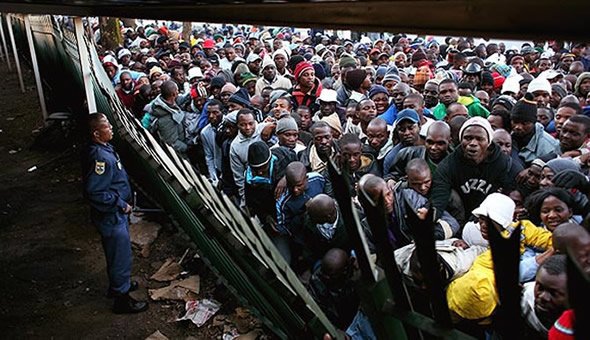
Before Israel began cracking down on African migrants a few years ago, the Africans were highly visible in bustling cities, working in kitchens and doing menial labor. There are still neighborhoods in south Tel Aviv filled with Africans. Many Israelis complained they were being “invaded.”

Source: Washington Post
EU to share burden of massive influx

The European Union’s executive body is to unveil radical new proposals on immigration, imposing migrant quotas on the 28 countries of the union under a distribution “key” system set by Brussels.

The plan, which is supported by Germany and will be fiercely resisted by Britain’s new Conservative government, will be launched by the European commission on Wednesday in response to migrant boats crisis in the Mediterranean.

The bold move by Brussels comes as the EU draws up plans for military attacks in Libya to try to curb the flow of people across the Mediterranean by targeting the trafficking networks. The EU’s top diplomat is to unveil an attempt on Monday to secure a UN mandate for armed action in Libya’s territorial waters.

Britain is drafting the UN security council resolution that would authorise the mission, senior officials in Brussels said. It would come under Italian command, have the participation of about 10 EU countries – including Britain, France, Spain and Italy – and could also drag in Nato, although there are no plans for the initial involvement of the alliance.

While there is broad support within the EU for the military plans, the proposals for sharing the immigration burden are highly controversial and divisive.

The policy document, obtained by the Guardian, demands new and binding rules establishing a quota system of sharing refugees among the member states.

The migration agenda declares: “The EU needs a permanent system for sharing the responsibility for large numbers of refugees and asylum seekers among member states.”

Source: mg.co.za

‘SA clogged by economic migrants’

Only 12% of the more than 75,000 asylum seekers who applied for refugee status in SA last year were successful, a sign that the system was being clogged up by economic migrants without a political claim to stay in the country.

Deputy director-general of home affairs Thulani Mavuso told Parliament’s portfolio committee on home affairs on Tuesday that the department would this year seek to amend the Refugee Act of 1998 to speed up the processing of asylum applications.

Recurring violence against foreigners has placed policy makers under pressure to address the presence of large numbers of migrants competing with locals in low-skill jobs and small-scale business enterprises.

The Refugee Act, which is based on the Geneva Conventions, gives every individual from no matter where an opportunity to present their case for asylum. Large numbers of applicants and cumbersome appeal processes have meant that asylum seekers without a legitimate claim can legally live and work in SA for many years while their applications are adjudicated.

Last year the highest number of those granted refugee status came from Ethiopia, (3,041), Somalia (2,903) and the Democratic Republic of the Congo (2,321).

“(Most) asylum seekers fell outside of the definition of a refugee. These are instances of economic migrants with low-end skills (seeking livelihoods),” said Mr Mavuso.

According to the BBC: “Official data suggests there are about two million foreign nationals in South Africa” but that “some estimates put the number of immigrants at five million”.

Source: Business Day

Man arrested for human trafficking

A man was arrested in Mentz village near Mankweng in Polokwane on Monday for alleged human trafficking, Limpopo police said.

The man, 27, who was not from South Africa, allegedly brought 19 men, all foreign nationals, across the border into South Africa and locked them in a storeroom in Mentz village, spokesperson Lieutenant Colonel Malesela Ledwaba said.

“The police swiftly went to the spaza shop store room, acting on a tip off and managed to find the 19 foreigners, who were locked in,” he said.

“The country of origin of the suspect together with that of the 19 men is still to be confirmed.”

The 27-year-old was expected to appear in the Mankweng Magistrates Court soon.

In April, at least seven people, including three South Africans, were killed in xenophobic violence that occurred in parts of KwaZulu-Natal and Gauteng.

Bob urges migrants not to go to SA

Other African nations should stop their citizens from migrating to South Africa to prevent violence against foreigners, Zimbabwean President Robert Mugabe on Wednesday

A wave of anti-immigrant violence in South Africa has claimed seven lives in Durban and Johannesburg over the past four weeks. The South African government has deployed troops to stop the fighting.

After a summit of the Southern African Development Community (SADC) called to discuss industrialisation in southern Africa, Mugabe told reporters that South African President Jacob Zuma had briefed regional leaders on the violence.

Zuma told the meeting that his government would educate its citizens to be tolerant of foreigners and would keep its security forces on alert to prevent future attacks.

“I was suggesting that we, the neighbours, must do what we can to prevent more people going into South Africa. If we can do it, we can then try to get those in South Africa home,” said Mugabe, the current SADC chairman.

“So people should get back to their own countries. It’s not just one for South Africa to resolve but for us, we the neighbouring countries, to resolve. Our people should not have the instinct of rushing into South Africa.”

An estimated one million Zimbabweans live in South Africa, after fleeing economic crisis and political violence at home over the last 15 years.

Mugabe said his government had brought 800 of its citizens back from Durban, but most of them had indicated they planned to return to South Africa, Zimbabwe’s biggest trading partner.

“The people who are described as influx into South Africa are not pushed by governments,” said Mugabe, who has ruled the former British colony since independence in 1980.

“They are people who voluntarily go to South Africa. They think South Africa is the heaven, our heaven in southern Africa.”

Periodic outbreaks of anti-immigrant violence have been blamed on high unemployment in South Africa. The official jobless rate is around 25 percent although economists say is much higher.

Mugabe concurred, saying the living standards of black South Africans were low and that the migrants “who think there is heaven in South Africa and decide to go to South Africa, they make the situation of the Africans there worse.”

Source: Reuters

Swedish MP wants safer passage for migrants to EU

A Swedish Member of the European Parliament (MEP) has pointed the finger at EU members for their reluctance to resolve the problem of migrants’ safer passage to Europe.

Sweden’s Member of the European Parliament Cecilia Wikström has blamed EU countries for doing little to ensure migrants’ safe passage to Europe, the Swedish news website the Local reported.

According to Wikström, EU member states’ current support on the issue is so scanty that Sweden’s younger generation may liken their actions to “turning a blind eye to the Holocaust”.

Earlier, the MEP, who has repeatedly called for migrants’ “legal and safe routes to Europe”, told the Swedish TV network SVT that the younger generation would compare the EU’s stance on the matter to the policy of appeasement in World War II.

Source: SputnikNews

Some 400 migrants drown in shipwreck off Libya

About 400 migrants died in an attempt to reach Italy from Libya when their boat capsized. This is the latest tragedy in the Mediterranean where the death toll from shipwrecks has surged this year.

The boat, carrying about 550 migrants in total, flipped about 24 hours after leaving the Libyan coast, according to some of the 150
survivors who were rescued and brought to a southern Italian port on Tuesday morning, Save the Children reported.

Before this incident there had already been more than 500 deaths of migrants crossing the Mediterranean from Africa this year, up sharply from 47 in the same period of 2014, says the Geneva-based International Organisation for Migration (IOM).

The survivors of the latest shipwreck were mostly sub-Saharan Africans, but no further details were available, a Save the Children spokesperson tells Reuters. It is not clear exactly when the boat had capsized.

The number of boats carrying migrants aiming to reach the EU from Africa has picked up in recent weeks as fine spring weather makes the passage safer.

In February, more than 300 drowned when attempting the crossing in cold weather and rough seas. Save the Children, the IOM and other humanitarian organisations have called for the European Union to bolster its sea rescue operations before the migrant flows soar as they usually do in the summer months.

On Monday, 2 851 migrants were saved in rescue operations in the Mediterranean, the Italian coast guard said, adding to at least nine who died and 5 629 who were saved over the weekend. Italy, which handled the largest number of migrant arrivals in the EU, has become increasingly alarmed about the breakdown of law and order in Libya, which has greatly exacerbated the task of tackling the migrant flows.

Source: Reuters

Migrants to US on the rise

Fleeing poverty
Fleeing self-induced poverty

The number of boats bringing undocumented migrants from various countries other than Cuba is on the increase, according to American federal authorities, who say smugglers have turned to other nationalities as the smuggling of Cubans has dried up.

One Oct. 16, a boat carrying migrants from Haiti capsized east of Miami Beach. Just two weeks before, on Oct. 3, federal authorities spotted a boat leaving Bimini, in the Bahamas, and traveling west toward U.S. shores without navigation lights.

On Aug. 28, smugglers dumped a group of Haitian migrants near Palm Beach and ordered them to swim ashore. A 14-year-old girl was later found dead on the beach.

And between 2009 and 2010, boats traveling between the Bahamas and South Florida smuggled dozens of Brazilians who first traveled to Europe and then flew to the Bahamas to board the smuggling boats to South Florida.

Federal officials say there’s an increase in migrant boat traffic toward South Florida involving the smuggling of undocumented foreign nationals of various nationalities. The boat traffic appears to have drawn smugglers who once primarily transported Cuban migrants across the Florida Straits and who now are focusing on nationals from other countries because the Cuban migrant smuggling organization have largely been dismantled, the officials said.

“Smugglers look for business anywhere,” said a federal official familiar with the issue.

The dismantling of the Cuban migrant smuggling networks along with improved Coast Guard patrolling and interdiction tactics are credited with a dramatic decrease in the number of Cuban migrants arriving by sea.

As a result, the majority of undocumented Cuban migrants are now arriving through the Mexican border. They come not only by boat from the island to the Yucatán peninsula but also overland from South and Central America.

Homeland Security Investigations (HSI), a unit of U.S. Immigration and Customs Enforcement, is the lead agency investigating boat migrant-smuggling networks.

Over the last two or thee years, investigators have noticed an increase in the number of boats operated by smugglers and transporting undocumented migrants of various nationalities.

The federal official familiar with the issue said that while several smuggling organizations were involved, they seemed to share similar traits. A significant number of them, the official added, operated boats that began voyages toward South Florida in the Bahamas – but carried migrants who came from as far away as Brazil, Ecuador or Colombia. Some of the migrants also started out in Haiti or the Dominican Republic but then made their way to the Bahamas to board smuggling boats for the final leg to South Florida.

In some cases, small boats overloaded with migrants begin their trips in Haiti.

That was the case in the ill-fated voyage of the 25-foot fishing boat that flipped over five miles east of Miami Beach, killing four female Haitian migrants Oct. 16. It carried 15 migrants, some of whom started the voyage in the northwestern Haitian coastal city of Port-de-Paix, according to Louisias Pierre, one of the survivors interviewed recently by the Miami Herald.

An affidavit in Miami federal court from an HSI special agent quoted one of the witnesses in the tragedy as saying that people boarded the boat in the Bahamas,

Pierre told the Miami Herald that the smugglers promised to transfer the migrants to a larger boat in the Bahamas, but that never happened. The boat did stop in the Bahamas, but only to pick up more migrants.

In the Oct. 3 voyage, the 24-foot boat began its trip in Bimini, according to an affidavit from another HSI special agent.

When a Customs and Border Protection vessel intercepted the suspect boat it disobeyed orders to stop.

“The operator of the suspect vessel then proceeded to increase his speed and performed evasive maneuvers, such as aggressively making left and right turns in an S-pattern, in an attempt to avoid interdiction,” the HIS affidavit said. “Due to the failure of the suspect vessel to stop, CBP fired two warning shots forward of the bow.”

The affidavit said the boat finally stopped about 10 miles east of Elliott Key, just south of Key Biscayne.

When CBP officers approached, they saw five men on the boat. One told officers that he was testing the boat, possibly to purchase it. A second man claimed he was brokering the sale. The three other men, they claimed, were migrants they had rescued from a makeshift boat adrift in the sea.

But once everyone was brought ashore, federal agents learned that two of the men were migrant smugglers and the other three were Cuban migrants without visas.

The federal official familiar with the issue said migrants pay a wide range of prices to be smuggled in — from as little as $1,000 or $2,000 per person to cross from the Bahamas to South Florida to as much as $15,000 for a comprehensive travel package from Brazil that includes flights to Europe and the Bahamas and then the boat ride to South Florida.

It’s unclear whether most boats are interdicted or get through to South Florida.

“We don’t catch them all,” the official said. “It’s a cat-and-mouse game.” – Miami Herald

Russian Unity Day: 8 000 Russian nationalists protest against migrants

Russians on the march for Unity Day

Several thousand Russian nationalists rallied Monday in Moscow, venting against the migrants they accuse of pushing up the crime rate and taking their jobs.

The protest took place on the national holiday of Unity Day, established in 2005 to replace commemorations of the Bolshevik Revolution.

Many demonstrators carried Russian imperial flags. One group displayed a banner reading “Young People Against Tolerance.” The protesters in a southern neighborhood of the Russian capital ranged from tough-looking youths to older people.

Animosity is strong among nationalists against migrants both from the former Soviet Central Asian republics and non-Slavs from the largely Muslim Russian Caucasus region.

Monday’s rally came three weeks after rioters targeted a vegetable warehouse where they believed the killer of an ethnic Russian man was working. Police later rounded up more than 1,000 migrants working at the warehouse.

Some demonstrators praised the riot and suggested it was backed by the state.

“People received a signal that if they engage in such pogroms, there will be progress,” said Yevgeny Morgunov, a 36-year-old researcher at the Russian National Academy of Sciences.

He said he didn’t support the radical exclusionary sentiment reflected in the nationalist slogan “Russia for Russians,” but said “if Russians feel good, the other people of Russia will feel it too.”

There were no immediate reports of trouble at the Moscow rally, but the Interfax news agency said police detained 12 participants in a similar rally in the Siberian city of Krasnoyarsk. Nationalist demonstrations were also reported in the cities of Irkutsk and Kazan.

A U.N. report in September said Russia has about 11 million migrants. The state news agency RIA-Novosti, however, cited the Federal Migration Service as saying only about 718,000 of them have residency permits. – AP

More than 600 migrants land in Italy

An earlier boatload of migrants rescued by the Italian Coast Guard

More than 600 migrants from Eritrea, Pakistan, Syria and other countries have landed on Italian shores on three boats, coast guards said Tuesday.

The coast guard rescued 336 people aboard a boat near Porto Empedocle in Sicily and escorted them ashore, where most of them fled from police.

The migrants said they were all from Eritrea.

Dramatic video images shot from a border guard vessel showed the migrants including women and children being helped off a heavily overcrowded boat at night.

A second boat with 233 people aboard was also spotted by a navy vessel and taken to the tiny island of Lampedusa, Italy’s southernmost point and a major arrival point for migrant boats from Libya and Tunisia.

A third boat with 67 people aboard arrived in a small port near Syracuse in southeast Sicily. The migrants said they were all from Pakistan and Syria.

“I want to be a human like everybody. In Syria, everything is destroyed,” one of the migrants told news channel SkyTG24. Another said the journey had “lasted 10 days and we ran out of water”.

Local coast guard official Luca Sanciglio said: “We were told about the impending landing by a fisherman who spotted them. The boat was not stable so we had to ferry them to the shore.”

“We have a duty to rescue everyone 24 hours a day and that includes immigrants,” he said.

“After so many days and nights of suffering, they just want water and someone to welcome them,” he added.

Most of the thousands of economic migrants and refugees who have landed in Italy in recent months have landed in Libya from other parts of Africa.

Some 350 migrants — many of them from Egypt and Syria — arrived on four boats in Sicily on Monday.

Calmer weather conditions and growing unrest in north Africa have led to a surge in migrant arrivals in recent weeks.

Italy’s interior ministry said 24,277 migrants landed in Italy in the 12-month period between August 1, 2012, and August 10, 2013. – AFP

African migrants ‘left to die’ sue Nato states

boatpeopleSurvivors of a dinghy tragedy that left 63 migrants dead have accused the Nato member states of failing to come to the aid of people in danger.

The harrowing case known as the boat “left-to-die” was first revealed by the Guardian in 2011 and raised serious questions about the role of Nato naval vessels and military aircraft after a tiny dinghy crammed with 72 migrants from sub-Saharan Africa ran out of fuel and drifted for two weeks along one of the busiest shipping lanes in the world. The passengers died one by one, despite numerous distress calls, while Nato allies engaged in the operation against Muammar Gaddafi were in the waters nearby but did not help.

An initial legal complaint was shelved by the Paris prosecutor’s office last year after the French military claimed it had no responsibility.

Last year, an investigation by the Council of Europe, the continent’s human rights watchdog, found that a catalogue of institutional and legal failures led to the avoidable deaths of the migrants. It called on Nato and its member states to launch separate inquiries into why so many military units – including a Spanish frigate under Nato command that was sailing in the immediate vicinity of the boat – failed to respond to the migrants’ desperate pleas for help.

The new Paris legal complaint – with the International Federation of Human Rights Leagues and three other rights groups as civil parties – is designed to force a judicial inquiry by a French investigating judge. Another complaint is to be lodged in Belgium and official demands for information have been made in Canada and the UK.

Human rights groups denounced the lack of information from defence ministries whose forces were present.

Father Mussie Zerai, an Eritrean priest in Rome, one of the last people to communicate with the migrant boat before its satellite phone battery ran out, warned against the omertà, or code of silence, among Nato states.

Survivor’s account
Launching the legal case, Abu Kurke , a survivor, described what happened after the dinghy left Libya on March 27 2011 before washing up in Libya two weeks later with only 11 people alive, two of whom died shortly after.

Abu Kurke (25) had fled his native region of Oromia in Ethiopia as a result of political violence, trekking across the Sahara to reach the north African coast. He and a friend paid for their passage on the dinghy but boarded without food or water after the Libyan military intercepted them and took their bags. Abu Kurke found the boat “very small, very dangerous”. He considered swimming back but his friend warned that Libyan forces might open fire.

He now lives in the Netherlands with his wife and child, and needs ear surgery after injuries from sun exposure. “I have constant nightmares,” he said. “To see 63 people die is something that you can’t easily forget.”

Gonzalo Boye, the lawyer heading the Spanish case, said that naval ships on a military operation that did not assist civilians in danger was equivalent to a “war crime”. – Guardian News and Media 2013

900 migrants cross to Italy by sea in one weekend, 7 drown

Clandestine immigrants on their way to Italy in a rubber dinghy

Seven immigrants drowned on Sunday during an attempted crossing to Italy by gripping on to a large tuna fishing cage towed by a trawler, according to witnesses from among the 95 people rescued by the coast guard.

Italy’s coast guard rescued the migrants off the shores of Sicily after reports came in of dozens of people clinging desperately to the tuna cage out at sea.

Survivors later told rescue workers that seven people with them had drowned after they had tried to scramble on board the trawler when the crew cut the line linking the boat with the cage.

Witnesses said the victims had been pushed back into the sea, Italian media said.

Rescuers pulled more than 250 people in several boats to safety on Sunday, as the number of people who landed in Italy over the weekend rose to over 900.

More than 100 men from Eritrea were taken to Lampedusa island off the Sicilian coast on Sunday, along with a further 55 people from a different boat, some of whom had jumped into the water at the sight of the coast guard.

On Saturday, some 690 immigrants were rescued from boats with engine trouble or dinghies that had begun taking on water, including a baby girl born during the crossing from Turkey.

Good weather has raised fears of increased numbers of migrants trying to reach Italy by sea. – AFP

South Africa detaining refugees and migrants ‘unlawfully’

The department of home affairs (DHA) is unlawfully detaining refugees and migrants and forcing costly court actions to fight for their release, Lawyers for Human Rights (LHR) said on Wednesday.

“The detention of refugees and migrants is carried out in an unlawful manner,” said LHR refugee and migrant rights programme head Kaajal Ramjathan-Keogh.

“Despite repeated engagement with [DHA] we’ve encountered a lot of difficulty in releasing people without resorting to the courts,” said Ramjathan-Keogh.

She was speaking at the release in Johannesburg of an LHR report, “Monitoring Detention in South Africa”.

LHR attorney Thandeka Duma said Home Affairs “seemed to have dysfunctional internal systems”.

Home Affairs spokesman Ronnie Mamoepa declined to comment on the report as the department had not yet read it.

“We’ve not had sight of that report to enable us to comment intelligently,” Mamoepa said.

“However, the department remains committed to discharging its mandate within the framework of the law, the Constitution and the framework of international obligations.”

Duma said that under the Refugees Act, asylum seekers were allowed to move freely while their applications were being considered. They were allowed to remain in the country until the entire application process, including appeals, was exhausted.

However, the DHA in many cases was only using the Immigration Act, which allowed for the detainment of undocumented migrant, in contravention of previous court rulings.

“Courts ruled [DHA] will not read the Immigration Act in isolation,” Duma said.

She said DHA maintained that it is following the law.

“However, this claim is totally contradicted by the evidence in this report and elsewhere,” Duma said.

She said attempts to intervene for the release of improperly detained migrants and refugees with the department had been unsuccessful, forcing LHR to seek recourse in the courts.

In the year covered by the report, LHR won 18 of its cases and secured the release of 41 improperly detained people, a win rate of about 95 percent.

LHR was also awarded costs — although less than it believed was owed –and this was a significant cost to the state.

“We are of the view that such costs are a waste of taxpayer money,” Duma said.

“The court should hold home affairs’ officials personally responsible for court orders that are not followed,” Duma said.

She said LHR, along with many other NGOs, had been denied access to immigration facilities such as the Lindela repatriation centre in Krugersdorp and was only able to meet clients outside it.

“We are also concerned by the continued lack of independent monitoring in immigration detention facilities.”

She said the SA Human Rights Commission was the only body allowed in and had not released a report on conditions inside Lindela since 2000.

SAHRC legal consultant Sugne Niemann said the organisation did inspect Lindela earlier this year and made regular visits.

She could not comment on whether the SAHRC would release a report on conditions inside the repatriation facility, referring questions to the SAHRC’s provincial office.

The SAHRC provincial office could not immediately provide comment on their visits to Lindela. – Sapa

Moscow fire kills 13 migrant workers

Twelve people died Tuesday when a night time fire tore through a two-story Moscow market warehouse that was being used by migrant workers from a former Soviet republic as a temporary residence.

“Twelve people died. They were migrant workers. We are trying to confirm which (ex-Soviet) republic they came from,” a Moscow emergencies ministry spokesman told AFP.

Unconfirmed news reports said the migrants came from the impoverished Central Asian nation of Tajikistan. Numerous Moscow markets employ cheap labourers from the region without giving them proper housing conditions or pay.

The blaze erupted early Tuesday at a market on the southern outskirts of the city called Kachalovsky. Officials said it took two hours to put out.

Emergency workers described squalid living conditions in which the workers slept on hard cots that were stacked on top of each other in rows of four without any direct access to the outside.

The workers “lived in a metal annex that was equipped with a space heater”, an unnamed law enforcement official told the Interfax news agency.

“They slept in frighteningly tight conditions, on hard bunk cots that were then stacked on top of each other,” he said.

Another official said the workers probably left the space heater on all night to stay warm during the frigid Moscow spring. Overnight temperatures plunged below freezing and much of central Russia has been hit by snow.

“The fire could have started from the electric space heater. It was probable left on all night because the structure was turned into living quarters,” an unnamed investigator told ITAR-TASS.

Police said they have opened a criminal investigation but have not yet pressed any charges against the market owners.

Russia’s migration service estimates that there are 700,000 Tajiks living officially in the country — a tenth of their home country’s population of just under seven million.

Tajikistan was wrecked by a brutal civil war in the early 1990s and then experienced nearly two decades of ethnic tensions and endemic drugs trafficking that hampered sustainable growth.

Its economy remains in tatters and some analysts estimate that up to half of Tajikistan’s young male population is currently trying to make a living in Moscow and other major Russian cities.

The predominant majority of the migrants who arrive in Moscow do so without acquiring the official city worker permits that the Russian capital has required since Soviet times.

Their employment is therefore never officially reported to the authorities and many end up living in Moscow apartment block basements or makeshift residences.

Seven migrants were killed in January 2009 when a fire swept through an underground Moscow garage they were building and had also used as a temporary living shelter.

Another seven died in May 2011 when a fire engulfed an old abandoned building in central Moscow.

The presence of Central Asian nationals and workers from the predominantly Muslim Caucasus region has also stirred racial tensions in the Russian capital and resulted in repeated deadly attacks.

President-elect Vladimir Putin had vowed to reinforce migration controls while serving as prime minister for the past four years and won a strong following from Russian nationalists while heading the Kremlin in 2000-2008.