If Africa is more like Singapore, why are we getting so many refugees?

by Dan Roodt

Living in South Africa, one gets used to being called a moron by every visiting foreigner, especially ones of the liberal to left-wing persuasion. After all, they seem to reason, we do not know anything about our own history. We do not understand our own country or our own continent. Nor do we have any grasp of Africa or African culture, despite many of our people speaking African languages and compiling dictionaries in those languages.

The same goes for what is called the mass media. The bigger and more influential they are, the more you will find the view that the average Afrikaner or white commentator in this country is a barely literate buffoon. Many a time I have come across the phrase about this country: “Apartheid destroyed South Africa.”

If you had flown in an aeroplane over South Africa in 1994, shortly after Nelson Mandela became president, you would have seen just how “destroyed” South Africa was. We had more roads and railways than Great Britain. Having a far bigger surface area also helps, I suppose. At one time we were one of the few countries exporting more food than we imported, notwithstanding being a semi-arid country.

The criteria for measuring progress in Africa seem to differ from other places. Economic growth, income per capita,  life expectancy, quality of life, infant mortality, the level of education, all those ordinary measures of a country’s success or progress are suspended in favour of focussing on, well, some racial element.

The racial element could be the mystique of Africa, its smiling, simple people happily singing to some merry tune like the coffee plantation workers on Karen Blixen’s farm  in the Hollywood movie “Out of Africa”. Or it could be the successful eradication of Western influence, the confiscation of land owned by white farmers, the imposition of racial job quotas to prevent whites from working in South Africa, and so on.

Organising a successful pogrom against whites in Africa is always cause for celebration. Whichever dictator or strongman is involved in such an operation, may be assured of vast amounts of Scandinavian aid money before, during and after the operation.

A few weeks ago, the correspondent for the New York Times in Johannesburg, Lydia Polgreen, wrote a more or less glowing account of the Zimbabwean tobacco industry. Since nationalising the farms of white farmers and replacing them with “small-scale” black farmers, the country has taken a great leap forward, it appears.

Enthused Polgreen: “The success of these small-scale farmers has led some experts to reassess the legacy of Zimbabwe’s forced land redistribution, even as they condemn its violence and destruction.” Read the whole article: In Zimbabwe Land Takeover, a Golden Lining.

One week after the publication of this article, the UN’s World Food Programme announced that Zimbabwe was in dire need of food aid for 1,6 million people. This is the result of Zimbabwean “land reform” and “restoring the dignity of the African who no longer toils for a white boss”. Of course, up to half the Zimbabwean population has already fled to South Africa in search of food and jobs where they continue to toil for white bosses in restaurants, on farms and as cleaners and gardeners in suburban houses.

Zimbabweans have voted for Robert Mugabe for years. He has rewarded them with the kind of policies that they preferred: crypto-Marxism, confiscation of white assets, robber capitalism, cronyism, a small elite lording it over an impoverished majority enduring increasing hardship, environmental degradation, collapse of infrastructure, hyperinflation and economic crisis.

However, in South Africa these Zimbabwean voters who have democratically chosen to saunter down the road to national disaster, are considered “refugees”. Not only that, but according to a recent article on The Daily Maverick website, South Africa is the country in the world receiving the most refugees. Last year we took in a whopping 219 368 of them. By contrast, the USA only got 40 000 refugees. In many West-European countries, refugees are considered a major problem when about 20 000 announce themselves at the border posts in any given year. Yet we are supposed to endure the flow of hundreds of thousands of refugees across our borders, together with many more illegal aliens, as part of our fate.

But the biggest paradox of all is the following: Why would any African want to leave his democratic, prosperous, economically booming home country for the not so bright lights of Johannesburg, Pretoria, Durban or Cape Town? After all, according to the world’s mass media, we are “the destroyed country”, the least successful on the African continent.

Perhaps the New York Times correspondent in Johannesburg, Lydia Polgreen, could solve that conundrum. This is all the more remarkable in the light of recent pronouncements by American academics that the image of poor sub-Saharan Africans holding out a begging bowl for help or Bono to organise an aid concert is very passé. Malthus was wrong. Unbridled population growth is the road to riches and Africa’s “youth bulge” represents a “demographic dividend”.

This may sound like satire or sarcasm, but it is not. On the CNN website, I came across a piece asking the rhetorical question: Is Africa the new Asia? Written by Professor Richard Aidoo from the Department of Politics and Geography, Coastal Carolina University, the article asserts that Ghana has had a 13,5% growth rate recently, portending an “African miracle”. On the demographic issue, Professor Aidoo writes:

“Africa has another potential advantage – a youthful population with a hunger for change. Many of the uprisings in support of democracy across the continent have been championed by disaffected young people bitten by the technology bug and anxious for opportunities. For these young and driven Africans, change isn’t a distant hope, but something achievable. The memories of colonial exploitation are receding further into the rearview mirror as young Africans look forward.”

Aidoo cites the British Economist in support of his views. Howard W. French, a New York-based African expert who teaches at Columbia University Graduate School of Journalism and is a former senior writer and foreign correspondent for the New York Times, concurs that the continent is already way up the economic scale. He writes in The Atlantic:

“Africa, with a population expected to roughly double by mid-century, has become recognized as the world’s fastest growing continent. But the less-told story is of Africa’s economic rise. In the last decade Africa’s overall growth rates have quietly approached those of Asia, and according to projections by the IMF, on average Africa will have the world’s fastest growing economy of any continent over the next five years.

Seven of the world’s 10 fastest-growing economies are African. The continent is famously resource rich, which has surely helped, but some recent studies suggest that the biggest drivers are far less customary for Africa, and far more encouraging for its future: wholesale and retail commerce, transportation, telecommunications, and manufacturing.”

After 18 years of ANC rule, South Africa’s formerly first-world infrastructure is crumbling. Raw sewage is flowing into our rivers. The roads are full of holes. Our previously superb health care system is in a shambles with patients left to die in state hospitals. Despite record spending, the education department cannot deliver school books to some of its schools. South Africa has two million mostly white and corporate taxpayers who supply a welfare state for 50 million people. We are definitely not an Asian tiger economy, but by traditional measures SA is still the biggest economy on the continent.

But those are traditional measures. Clearly, people in the know and pundits associated with The New York Times, have decided otherwise.

If someone could just explain to me why so many Africans are still flocking to this country which suffered so much damage in the past and has still “not quite recovered from apartheid”, I would be really glad. After all, why would you leave one of the fastest growing economies in the world seething with bright young technology entrepreneurs, to settle in our country still blighted by white, Western influence?

The (white) elephant in the room

By Libratwin

Today I ask a question, because I do not know the answer.

I was born 10 years and 3 months before the end of Apartheid in the province we now call Limpopo. I was born one of twins to loving and caring parents.  I grew up in the midst of a changing landscape, albeit political, and saw a country grasp at the tenuous reins of a new future for all.  Unfortunately, the ANC lost the reins a while ago and the over-fed, under-qualified, over-paid and under-educated horses are running all over the show.

What should have been the start of a better, brighter and stronger South Africa has become the exact opposite. As a country, we live in fear of the dark, we are weaker than ever and even more divided. Apartheid might have visibly and purposely divided the masses, but nowadays, it is a feeling of discord and disharmony that divides us. It might not be as visible but it is much, much more obvious.

I believe I am a good person. Religion aside, I have never purposely hurt another living entity (my twin brother doesn’t count since he had it coming a few times), nor have I been purposely cruel towards someone else.

Crime in SA is a very big and very real problem which we all face on a daily basis. But it does seem that the crimes against whites are extremely brutal and overtly violent. Why was a 13-year old shot, and subsequently died, along with her sister and father for a few cell phones?

Why was a young woman raped, her foot cut off and used to sodomize her and then killed with boiling oil? Why was a man beaten to death with his own garden shovel? Why was a 92-year old woman raped and beaten for a few hundred rand?

This could have happened to anyone but it happened to white people and their attackers were reportedly black.

I know crime happens everywhere and not just to white people. But as I am constantly told, I am the minority, that I am one of the evil white devils, that I am responsible for the plight of every poor, unemployed and homeless person in this country.

Still waiting to hear how the hell I’m responsible for that. Why not blame the homos (I’m pro-gay btw), hippies and hoodlums on us while you’re at it?

The ANC Youth League Facebook page is riddled with hate speech (once you decipher the horrible spelling and grammar) against the whites. Lamola, Malema and their cadres have all said publicly that they will kill whites and have urged others to do so.  We’re told we should be “grateful” we’ve been “allowed” to stay in the land of our birth, we’ve been warned that there will be mass murder when Nelson Mandela dies.

Although the last statement may or may not be true, and with that in mind, is it any wonder that we feel persecuted?

So my question is, why are there so many (note that I used many and not all) people in my home country who want to kill me or are willing to kill me? Well, I have a theory but no answers. I think it is because I am white and I am still being blamed for the past.

Apartheid evil is hype

by Dan Roodt

South Africa is listed in Samuel Huntington’s book as a country prone to a “clash of civilisations”. Hence the acrimonious exchanges that characterise South African discussions of politics and history.

The South African left scored a major propaganda victory some time in the 1980s when reformist National Party policies were vilified as the “apartheid crime against humanity”. The Truth and Reconciliation Commission compared us to the Nazis. Hyperbole reigned supreme.

How many death camps did John Vorster open up and how many mass graves have the BBC shown to the world? The BBC would surely have loved to find even one mass grave as testimony to Afrikaner evil, yet it could only report on rugby player Geo Cronjé’s supposed refusal to share a room with a non-white player a few years ago.

Further investigation of Mr Cronjé’s “crime against humanity” revealed it to be a red herring.

On Wednesday, I reminded listeners of 702 that all history, including apartheid, was open to interpretation. One black SABC journalist responded by saying that I was “revising history and her pain”. However, there is far more pain to come as we witness the shambles our country is turning into. Inevitably, unflattering comparisons are being drawn between the old and the new SA, unflattering to the post-1994 dispensation.

Apartheid revisionism is in the air. Historian Hermann Giliomee recently delivered a hammer blow to the truism that “apartheid withheld education from blacks” by pointing out that “syllabi of schools in the higher standard were the same as those in white schools”.

It is also completely false that Hendrik Verwoerd discouraged the study of science and mathematics in black schools; the main problem was the lack of qualified teachers, as it remains to this day. According to an insider within the Gauteng education department, the maths average among black matriculants is currently a hopeless 20%.

A refined and cultured man like Dr Verwoerd would have been highly shocked by the Limpopo schoolbook affair. No doubt he is “spinning in his grave” as that educational buffoon, Kader Asmal, once put it, but for entirely different reasons. The tragic demise of his educational legacy should fill us all with sadness.

Within an Orwellian climate of hysteria and cries of “racism!” whenever the anti-apartheid myths are exposed, historians and commentators will need great courage to rehabilitate our history to anything resembling the truth.

This piece also appeared as a letter in the Johannesburg Business Day.

PRAAG plans charging Woolworths with apartheid

PRAAG, the Pro-Afrikaans Action Group, has given Woolworths until midnight on 7 September 2012 to stop discrimination against Afrikaners, Afrikaans and the white race (see email underneath), otherwise the action group will lay a charge of apartheid against Woolworths.

Apartheid is a punishable offence in terms of several international conventions and therefore the management of Woolworths could be prosecuted both locally and internationally.

According to Dr. Dan Roodt of PRAAG “we are sick and tired of apartheid which is being applied to us according to the international definition and which is punishable. We are not going to allow Woolworths to get away with their criminal behaviour and violation of our human rights.”

Contact: Dan Roodt dan@praag.org 073 951 1467

———- Forwarded message ———-
From: Dan Roodt <dan@praag.org>
Date: 2012/9/7
Subject: Diskriminasie en apartheid teen Afrikaans, Afrikaners en die blanke ras
To: markvanbuuren@woolworths.co.za
Cc: PressOffice <mediarelations@woolworths.co.za>

Mnr. Mark van Buuren
Werknemersbestuurder
Woolworths
Langmarkstraat 93
Kaapstad

Geagte meneer Van Buuren,

U word hiermee in kennis gestel dat indien u nie teen middernag op 7 September 2012 alle diskriminasie teen Afrikaans, Afrikaners en lede van die blanke ras staak nie, ons nie sal huiwer om die nodige kriminele klagtes teen u maatskappy en sy werknemers sowel plaaslik as internasionaal in te dien nie.

Onder andere maak u u aan apartheid skuldig, wat ‘n internasionale misdaad is.

Ons is ook van plan om die Raad van Europa in kennis te stel dat u rassisties teenoor mense van Europese afkoms optree en sal versoek dat reisbeperkings op alle personeel van Woolworths ingestel word aangesien u u aan menseregteskendings teen Suid-Afrikaanse blankes skuldig maak.

Die uwe,

Dr. Dan Roodt

‘Apartheid made maths difficult for blacks’ and other myths – historian Hermann Giliomee defends Bantu Education

By Hermann Giliomee

Bantu Education: Destructive intervention or part reform?

As the crisis of education in black schools has worsened, or rather become more evident, so the tendency to “Blame Verwoerd” has intensified.

Senzo Mchunu, MEC for Education in Kwazulu-Natal, declared in late July: “One of the points we found was a problem in Maths and Science. It was Verwoerd who made the subjects difficult because he thought blacks would be a threat to him’.[1]

Addressing the Limpopo textbook crisis on Talk Radio 702, President Jacob Zuma said: “What is happening today is what Verwoerd did, where the black majority were historically not given education. We are dealing with a system that had put black people back for centuries.” According to Zuma, Verwoerd created the textbook crisis in Limpopo. [2]

Redi Tlhabi, who interviewed Zuma on Talk Radio 702, expressed outrage over the president’s remark that he did not know who was to blame for the textbook scandal, but agreed with him about Verwoerd. “The president was right in that Verwoerd worked to create a system that was intent on stifling the black child and making sure that she or he did not thrive.” She added: ‘Today, in 2012, I did not expect that the ‘liberation party [the ANC] would want to further Verwoerd’s goals: to keep the black child poor, uneducated and deprived.” [3]

President Zuma’s comments attracted a retort from Mamphela Ramphele, a product of Bantu education and a previous UCT Vice-Chancellor. Speaking at an education conference she commented on the current state of black education: “The monumental failure in South Africa was not Hendrik Verwoerd’s fault but that of the current government”. She continued: “Children under apartheid’s ‘gutter education’ were better educated than children are today.”[4]

Hendrik Verwoerd, National Party Minister of Native Affairs from 1950 to 1958 and Prime Minister from 1958 to his assassination in 1966, remains one of the most complex figures in South African history. In the contemporary debate, he is, however, little more than a demonic figure, denounced and excoriated as the architect of all our misfortunes.

Equally, while his policy of Bantu Education looms large in the popular imagination it is very poorly understood. Despite the significant work that has recently been done by historians in this area, many opinion-formers’ knowledge of this policy does not stretch much beyond a notorious single quote by Verwoerd in a 1953 speech.

Although the Bantustans and Bantu education were inextricably linked, Bantu education could, to a considerable degree, also be considered on its own merits. This article attempts to focus only on some of the aspects of this system, such as funding and the relative value of mother tongue education, and not on the more ideological aspects like the attempt to use the schools to foster distinctive ethnic identities.

Verwoerd’s Bantu education signalled the introduction of mass education in South Africa. After 1994 a new regime has removed all forms of racial privilege, but black public schools remained in a state of crisis. It is important to go back to the founding years of the system to establish to what extent the roots of the crisis could be traced back to these years.

The indictment

The indictment of the education system Hendrik Verwoerd, Minister of Native Affairs, introduced in 1954 consists of several charges. The most important are:

  • He closed down a functioning system of black education that included some good mission schools like Lovedale and Healdtown
  • His policy based on ‘the assumption of an inferior potential of African minds’ was ‘explicitly designed to prepare blacks for a subordinate place in society.’[5]
  • He discouraged the teaching of Mathematics and Science
  • The policy deliberately starved black education of funds

Closing down a functioning system?

Missionary societies dominated the provision of black and coloured education before the accession of the National Party to power in 1948. In 1939 the Minister of Education in the United Party government admitted that two-thirds of black children were without any school experience whatsoever.[6] During the war years the government improved the provision of education to blacks considerably, but by 1950 less than half of black children between the ages of 7 and 16 were attending school, and only 2.6% of black pupils were enrolled in post-primary standards. The average black child spent only four years in school.

Among the mission schools there were a few excellent high schools, but, as a historian commented, the renowned reputation of these schools ‘should not obscure the fact that most mission schools were poor primary schools with large dropout rates’ and that the ‘mission system was breaking down at all levels.’[7] With the demand for education growing rapidly, schools had to take in far more children than they could teach effectively.

The state helped by providing salaries for approved teaching posts, but overall state aid was insufficient in a modernising economy. School buildings were dilapidated and classes overcrowded. Most schools were understaffed and there was a severe shortage of competent teachers.

In the mid-1940s both the United Party government and the Natives Representative Council, the main body for articulating black opinion, sensed that the system of black education was in need of drastic overhaul. The main sticking points lay elsewhere. There was firstly the question of funding.

ZK Matthews, the leading black authority on education and a prominent member of the ANC, demanded the modernisation in terms that, implicitly at least, meant apportioning resources for equal educational opportunities. But whites baulked at the expense. RFA Hoernlé, a leading liberal, observed that while a large number of the white voters do not mind  ‘native education’ as such, it would be suicide in most constituencies for a Member of Parliament ‘to advocate, let alone vote for, the proposal that whites should be taxed in order that natives could be educated.’[8]

Another major point of conflict was over the extent to which traditional black culture had to be made part of the school syllabus. Matthews argued for the ‘preservation of the African heritage and for using the powers of the vernacular languages to effect social rejuvenation.[9] Some ANC leaders, however, rejected any ‘Bantuization of native education’. Blacks had to be educated ‘to live side by side with Europeans’.[10] Developing proficiency in English was generally regarded as much more desirable than using the Bantu languages as media for instruction.

In 1954 the government took over the coloured and black schools that the state partly funded and moved control of black and coloured education from the provinces to central government. As part of his ambitious plan to overhaul black education Verwoerd insisted that black education had to be rooted in the ‘native community’. ‘It is in the interest of the Bantu that he be educated in his own circle. He must not become a black Englishman in order to be used against the Afrikaner.’[11]

To the extent that the policy tried to foster different ethnic identities in the black community it was a dismal failure, but that was not the sole rationale of the policy.[12] In , the decades that followed, however, the issues of promoting the Bantustan policy through the education policy and mother tongue education became hopelessly confused.

Both Werner Eiselen who headed the commission that laid the groundwork for Verwoerd’s policy, and Verwoerd himself, firmly believed in mother tongue education as the best form of education  A Professor of Anthropology before he became a chief inspector of native education in the Transavaal, Eiselen had a great respect for the particularity of blacks and genuine concern for the preservation of Bantu language and culture.[13] To him there was little doubt that blacks would learn better through their own languages.

Verwoerd received his secondary school education in the medium of English in Milton Boys School in Bulawayo before enrolling at the University of Stellenbosch. He became the first student in the country to write his doctoral dissertation in Afrikaans. In 1924 he received his doctoral degree, a year before Afrikaans was proclaimed an official language. Afrikaans quickly developed from a low-status language to one that could be used in all walks of life. Afrikaans-speakers, along with English speakers, now began to experience the benefits of what language expert Neville Alexander called “mother-tongue education from cradle to university.”[14]

Bantu education, as introduced by Verwoerd in 1954, entailed the provision of eight years of mother tongue medium education (MTE). In addition well-trained teachers and competent speakers of English and Afrikaans taught these languages as second languages. In the ninth year of school, students were expected to switch to learning through the two second languages, Afrikaans and English.

The department laid down the principle that it would not use African languages as media of instruction in secondary school until the black community requested it. An education advisory council, which was established in terms of the policy, polled the boards of control of black school all over the country to asses their support for different options: It provided the following result[15]:

1 Afrikaans and English 64%
2 Only Afrikaans 5%
3 Only English 31%
4 Mother tongue 1%

The scant support for mother tongue as medium of instruction in the two highest school standards is an important indication the black population – unlike the Afrikaans one – were not convinced of the merits of mother tongue instruction.

Yet Bantu education was not out of line with what many Western scholars regard the best educational practice. Developed countries teach their children in the mother tongue because they are convinced that such a policy is pedagogically much sounder. They also believe that it improves people’s ability to make a contribution to the economy than those taught in a second or third language. Many developing countries, by contrast, tend to use the colonial language of instruction because they believe, incorrectly as it happens, that it is a short cut to a good education and job opportunities.

In South Africa the results of Bantu education between the mid-1950s and mid-1970s was positive, measured by pass rates. Kathleen Heugh, an acknowledged authority on language use in education, writes: “Between 1955 and 1975, there was a steady improvement in the achievement in literacy and numeracy… Eight years of MTE resourced with terminological development, text-book production, competent teacher education and competent teaching of English, resulted in a school-leaving pass rate of 83.7% for African students in 1976. This is the highest pass rate to date.”[16]

One of the reasons for the disastrous downturn in black education after 1976 is the introduction of a policy that limited mother tongue education to the first three years, which is generally accepted as quite inadequate. Heugh concludes: apartheid’s education policy consisted of two phases. The first part, up to 1976, worked to the educational advantage of black students; the second part, from 1976 on, to their disadvantage, with mother tongue education limited to three or four years.[17]

Based on racist assumptions?

Those who charge Verwoerd with implementing a policy with racist assumptions usually base it on a reading of his speech in parliament in 1953 when he introduced the policy. Here Verwoerd attacked the existing policy, which, in his words, showed the black man ‘the green pastures of the European but still did not allow him to graze there’. By that he meant pupils were provided with skills that employers did not want from black workers.

He criticised the existing policy as uneconomic, because money was spent on education with no clear aim. This frustrated educated blacks, who were unable to find the jobs they wanted. He said: ‘Education should have its roots entirely in the Native areas and in the Native environment and the Native community … The Bantu must be guided to serve his own community in all respects. There is no place for him in the European community above the level of certain forms of labour. Within his own community, however, all doors are open.’

This comment is quoted in virtually every article on the subject. It is often distorted by quoting only the first part – ‘There is no place for him in the European community above certain forms of labour’ – and by omitting the qualifier that Verwoerd added: ‘Within his own community, however, all doors are open.’ [18]

Today the first part of the quote sounds very harsh, but it was not out of line with existing policy. A study states: ‘The overwhelming demand among urban employers was for workers with basic literacy, who could be employed as unskilled labour. In most cases “tribal labour” was preferred.’[19] There was little demand for blacks who had completed the more advanced standards.

The previous United Party government had also seen little need for the training of large numbers of black artisans for employment in the common area. The policy emphasised the training of whites for skilled labour in the so-called “white areas”. Blacks could only expect to do skilled work in the reserves. In terms very similar to those Verwoerd would use later, the secretary of the Department of Native Affairs told the De Villiers Commission on Technical and Vocational Training in 1947 that ‘the unfolding of extensive government development schemes’ in the reserves would produce a large number of skilled posts.[20]

White supremacy was clearly incompatible with a steadily rising, better educated, urbanized black population moving up to strategic levels of the economy. Recognizing this, J.G. Strijdom, Transvaal NP leader, warned D.F Malan in 1946 that it would be impossible to maintain racial discrimination if the quality of education of the subordinate people was steadily improved. ‘Our church ministers,’ he added, ‘were far too eager to compete with other missionary societies in trying to provide the most education to blacks.’ If the state in the future tried to withhold equal rights from educated people it would lead to ‘bloody clashes and revolutions.’[21]

To put it in non-racist terms, by modernizing the provision of education to the subordinates, however incompletely, the apartheid state ran the risk of sowing the seeds of its own destruction. An opinion survey conducted in 1981 showed that black children’s rejection of segregation steadily increased with higher education levels. About half of the children with only 4 years of schooling said whites could keep their own housing areas and schools, against only a third of those in Standards 7 to 9, and only one tenth of those in Std 10 and higher. See Table 1.[22]

Table 1: Black political responses (%) according to level of education – 1981

Whites can have their own… Std 2 or below Std 3-6 Std 7-9 Std 10 and above
Laws against mixed marriages

70

65

45

18

Own housing areas

62

52

32

15

Own schools

53

34

26

13

Farmlands

47

38

29

11

Recreation facilities

41

27

13

9

Transport and Buses

36

26

18

2

Note: Only percentages accepting segregation are given

Source: Hermann Giliomee and Lawrence Schlemmer, From Apartheid to Nation-building, p.119

Read the whole article here.

Blacks worse off now than under apartheid – Julius Malema

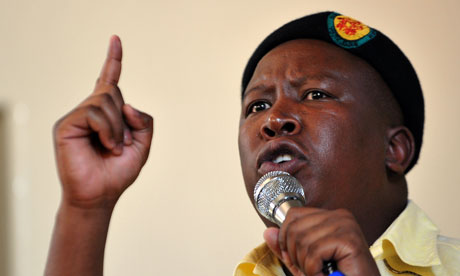
Julius Malema

Black people are worse off than they were during the apartheid years, expelled ANC Youth League leader Julius Malema said on Thursday.

“We are worse [off] than during the times of apartheid. We are being killed by our own people. We are being oppressed by our own government,” he told mineworkers at the Aurora mine in Grootvlei, Springs.

More than 1000 mineworkers from the liquidated Aurora Empowerment Systems and the neighbouring Gold One arrived to hear Malema speak.

He said politicians could not help the workers because they benefited from the mines and had shares in them.

“Every mine has a politician inside. They give them money every month, they call it shares. But it is protection fee to protect whites against the workers.”

He said the fact the Aurora crisis had lasted for four years showed there was no leadership in the country. Aurora Empowerment Systems bought the mines when the previous owner, Pamodzi Gold, went into liquidation. Since then workers have not been paid and the mines have been stripped of assets.

“If there was leadership in this country it can’t take four years. Four years shows that there is not leadership. When they (politicians) arrive to represent you, they give them money and they forget you.”

Malema told the workers they should form a committee to speak to the lawyers and present their complaints to the liquidators of Aurora.

He announced what he labelled the start of a revolution in the mining sector.

“We are going to lead a mining revolution in this country. We are going to each mine. We will run these mines ungovernable until the boers come to the table,” he said.

“We want them to give you a minimum wage of R12,500. These people can afford R12,500. Mining in South Africa amounts to trillions of rands.”

About 5000 people had been left jobless at Aurora. It was currently under liquidation.

The prospective buyers of Aurora mines, Gold One, have allegedly fired over 1500 workers who went on strike demanding a minimum wage of R6500.

The miners claimed management then replaced them with contract workers. – Sapa

US-style ‘minority procurement’ or BEE is ill-suited to South Africa

by Dan Roodt

Deputy President Motlanthe’s call for black business to become more “cost-competitive” in tendering for state business is another noble-sounding ideal denied by reality.

South Africa is so committed to race preference that there is no turning back. It is inscribed in the Constitution and in the minds of almost everyone. BEE, which nowadays gets referred to as Black Elite Enrichment, is a political principle and not an economic one.

The mythology of “apartheid” being a Nazi-like system which “killed millions of people” (this was stated to me by a Wits academic) and withheld education from black people has created the “debt” which must be discharged through hand-outs to the black elite, masquerading as “business”.

Big Business in South Africa has always meddled in politics and has taken a kind of decadent pleasure in kow-towing to a radical government. Some sucker will always pay for BEE and affirmative action, whether it will be pension funds, the middle-class taxpayer or the poor simply getting poorer. We have been infected with American ideas dreamt up to pamper a smaller number of blacks in an economy forty times bigger than ours.

US-style “minority procurement” or BEE is as ill-suited to us as Pik Botha’s anecdote of a snow plough sold to a former homeland government for its airport. “Every airport must have a snow plough” was the sales pitch. Just like every black man must have a business and enjoy some form of preference to soothe his pride and dignity.

South Africa is already a failure as its education and health systems crumble and the numbers queuing up to be “empowered” from the state’s coffers swell. But this is all part of the master plan; a sovereign state at the southern tip of Africa did not suit the major powers.

Many abroad will applaud South Africa’s eventual descent into Zimbabwean bankruptcy and squalor, with gleeful Schadenfreude. It is our fate, which was decided in 1994 and even before.

South Africa is a weak state, if not a failed one. The previous Afrikaner state had some strategic value as it could exert some influence over the sea routes and bother its adversaries. This weak or failed state has about as much strategic importance as Swaziland or Lesotho.

No-one could care less about whether Zuma or Malema governs us, or whether the state pays R7 or R27 for a bottle of water.

South African Communist Party supports boycotts of ‘apartheid Israel’

The SACP commends the cancelation of a trip of various leaders of different sectors to visit Israel. Furthermore we welcome the statements of government as articulated by the Deputy Minister of International Relations, cde Ebrahim Ebrahim.

The SACP has witnessed attempts by the South African Zionist Federation, the South African Jewish Board of Deputies and the Office of the Chief Rabbi to isolate the Deputy Minister as if he is not expressing government policy. These remarks are consistent with government’s intention for instance to classify goods coming from the Israeli Occupied Territories as such. Similarly we recall that the University of Johannesburg has cut ties as well with the University of Ben Gurion. The comments by the Deputy Minister and the cancellation of the visits must be seen as part of a set of actions by progressives around the world to put pressure on apartheid Israel to change its policies regarding Palestine

Attempts to make turn these statements into individual comments smack of opportunism and are part of the divide and rule tactics which we should not accept. Our principled stance against apartheid Israel’s occupation of Palestine remains.

The SACP also wishes to strongly condemn the hypocrisy and double standards of the Israeli government when only a week ago it prevented a Non- Aligned Movement delegation, made up of no less than Ministers coming from different countries, to go to Ramallah in Palestine. Amongst these Ministers was our own Deputy National Chairperson, cde Thulas Nxesi, who was sent there by the South African government. It is time now that all the progressive forces must refuse to be intimidated by apartheid Israel and deepen solidarity actions with the oppressed people of Palestine.

Apartheid Israel has for all intents and purposes failed to adhere to international resolutions on the necessity to free the Palestinian people and their legitimate aspirations for an independent Palestinian state, with East Jerusalem as its capital. The SACP supports the broad framework of boycott and divestment directed against apartheid Israel.

Statement issued by the SACP, August 15 2012

Verwoerd pumped millions into black education

by H.S. Brink

Firstly, blaming HF Verwoerd for the textbook mess is nonsensical at best and for your newspaper to portray Verwoerd as the “architect of apartheid” is a false representation.

Those who perpetuate this lie may well be referred to a book by David Walsh called The Roots of Segregation – Native Policy in Natal (1845-1910), published in 1971.

The foreword says: “(Lord) Shepstone’s policy was the precursor of the later policy of segregation, which in turn has been called apartheid, separate development and separate freedoms.”

Walsh in his conclusion writes: “It is a myth that apartheid is the exclusive product of Afrikaner nationalism: it’s antecedents are to be found in Natal.”

When the National Party came to power in 1948 it inherited a disorderly schooling system for blacks that was run mainly by Anglican and Catholic churches.

The 1951 Eiselen report on black education revealed shocking facts. Admission to school was subject to baptism. Parental participation was non-existent. Most black children had never been to school. Illiteracy was rife.

No indigenous language was tolerated and  English was the sole medium of instruction for education.

Part of subsidised teachers’ salaries landed in church coffers. Some priests and nuns got a pittance.

In Taung, as was the practice elsewhere, the community built the church which doubled up as one massive classroom for 500 scholars.

In and around Mafeking 25 000 scholars had 56 classrooms between them.

Verwoerd changed all this with an orderly system, pumping millions of pounds into black education, plus the £2 million representing the total tax contribution by blacks.

Additionally, a special levy was placed on urban property taxes to build schools and alleviate the backlog in black education, and so on and so forth.

Yet President Jacob Zuma, who believed in liberation before education, accuses Verwoerd of putting black people “back for centuries”.

One cannot but wonder who put the rest of Africa back for centuries?

As for the pretext of Afrikaans being the cause of the 1976 school uprising, think again.

The two schools that were in the forefront of the Soweto riots did not receive tutoring in Afrikaans in any subject.

Also, an  advisory board’s polling of all black schools’ governing bodies revealed that 64% approved of Afrikaans and English as mediums of education.

Zuma’s promotion of the “second revolution”, where scholars such as Hector Pieterson will undoubtedly be used again as pawns in a communist game, will indeed put South Africa back for centuries.

South Africa – STILL Practising Apartheid

by Rolene Marks

During the Apartheid years, South Africa was seen as the world’s number 1 pariah state. Officially excluded from the family of nations, South Africa was subjected to harsh policies of academic, economic, sporting and other boycotts. Many, including poster-child for the BDS movement against Israel, Archbishop Desmond Tutu, have claimed that thanks to international policies of isolation and boycotts, the heinous Apartheid regime was brought to its knees and eventually ended.

Tutu and other proponents of the Boycott Divestment and Sanction campaign rationalize their attempts to isolate Israel by making odious comparisons between the Jewish State and Apartheid South Africa. As someone who grew up in South Africa, bore daily witness to the daily workings of the Apartheid machine and now lives in Israel, this campaign is racist and nefarious to say the least. While Israel is far from perfect and there are instances of individual racism, just as there are in any other country, Israel is FAR from being an Apartheid State. Words like Apartheid have become the stick by which to smack the proverbial horse. Naturally there are those who will deny that these accusations are anti-Semitic by crying Mazel Tov! Gefilte Fish! We love the Jewish people – we just hate Israel. While in some circles it has become decidedly politically incorrect to attack Jews, the Jewish brand or State has been declared open season for battle.

This brings me back to the accusation I have made in the title of this post. The South African Ministry of Trade and Industry have passed a ruling calling for goods imported from the West Bank to have their “made in Israel” labeling removed. “For now, there is no decision but people should know that South Africa recognises Israel inside the 1948 UN borders,” Macdonald Netshitenzhe, the trade ministry’s director for trade policies and legislations, said. “Now coming to the issue of Palestine and Israel, a product from Israel has to be manufactured or produced within the borders of 1948.Under the 1948 boundaries, territories occupied after 1967 such as the Gaza Strip are not included. Therefore for the goods or vegetables which are grown in the area where Israel invaded other Arab countries, South Africa says, you better say these products are grown in Palestine or Occupied Palestinian Territories,” Netshitenzhe added. (courtesy News24.com)

It seems that the country that famously defeated discriminatory policies after the first democratic elections in 1994 has done an about turn and is fast hurtling downhill back towards its racist past. This time, instead of discriminatory laws being passed based on race; South Africa is claiming its “moral high ground” to pass racist laws against the Jewish State. And yes, they are racist. By singling out one country for opprobrium and sanction because its identity is defined along ethnic-nationalist lines, that is APARTHEID. By resorting to ridiculous kangaroo courts such as the Russell Tribunal which placed the State of Israel on trial for “crimes against Apartheid” you are perpetrating anti-Semitism. By ignoring the human rights abuse and transgressions of some of the world’s greatest offenders, one of which is on your border (hello Robert Mugabe) or ignoring the plight of your own citizens and rather choosing to focus on Israel that is Apartheid.

We should not dismiss the actions of the South African government or pooh-pooh them with the excuse that South Africa means little in the grand Western political scheme of things. We need to take heed very carefully. The actions of this government who many see at the benchmark by which we measure racism are proving popular with many other countries, including Denmark who may follow suit.

Many forget who truly stands to lose when boycotting Israeli manufacturers. Apart from hurting importers of Israeli goods, boycotts will lead to the loss of jobs for many Palestinian workers in factories or on farms. While proponents of this action are motivated by ideology the end result can prove to be disastrous for those they intend to help. Peace in my belief will come from the ground up and not by sowing division.

To the South African government whose policies of quiet diplomacy and lack of action have meant that dictators like Robert Mugabe can continue to starve their people, or red-carpet treatment of Jean-Bertrande Aristide of Haiti, Bashir of the Sudan, Assad of Syria or the Foreign Minister of Iran and others makes its own statement, I ask when are you going to start labeling goods from these countries? South Africa, where once you could have played a vital role in the brokering of a lasting peace in the Middle East, you have lost all credibility.

South African Communist Party calls FW de Klerk an ‘apartheid dinosaur’

Iafrica.com reports that SACP general secretary Blade Nzimande lashed out at FW de Klerk on Thursday, branding the former president an “apartheid political dinosaur”.

On Wednesday, De Klerk spoke at a briefing discussing the outcomes of the ANC’s policy conference. De Klerk said the spirit of inclusiveness and reconciliation embodied by former president Nelson Mandela was no longer prevalent in the country.

He warned against the ruling party’s national democratic revolution.

“The NDR as a concept is dangerous. A revolution against who? Who is the enemy?”

De Klerk added that the SACP was one of the driving forces behind what he called radical ANC policies.

Nzimande has since hit back, calling De Klerk “a politician who has long reached his sell-by date”.

“All what De Klerk is saying about the SACP is nothing but an attempt at resuscitating the classical, but failed, apartheid ‘rooi gevaar’ tactic which was used by his now extinct National Party and its criminal apartheid regime not only to persecute communists but as part of the whole armoury to fight against the liberation movement,” Nzimande said.

“De Klerk’s latest anti-communist burst is nothing more than rehashing this nonsense, and in fact exposing that the likes of him no longer have any relevance in today’s South Africa, if they ever did at all. Not so long ago he let the cat out of the bag by clearly stating he still firmly believes that the bantustan policies were the correct ones for South Africa.”

Praag.org previously reported that in his concluding remarks on Wedenesday, “De Klerk urged South Africans to be active and engage the ruling party on its policies, because they would shape the country’s future”.

FW de Klerk attacked for ‘defending the white man’

A black South African columnist has just published the following article in the London Guardian, blaming whites for blacks’ continuing poverty under a black government.

FW de Klerk: defender of the white man

South Africa is trying to move on from apartheid. It’s a shame its former president is not

by Justice Malala

The last undemocratically elected president of South Africa, the Nobel Peace laureate FW de Klerk, has in recent months been holding forth on the state of the nation. It’s a familiar view: that South Africa is becoming yet another post-colonial country destined to fall into maladministration, corruption, famine and finally war because the white man has lost political power.

In his utterances, it seems, the only thing that can save the nation from this preordained state of affairs is continued protection of white minority privileges and rights. All attempts to discuss a South Africa that is not riven by the terrible inequalities wrought by apartheid are seen, by him, as a threat to these privileges.

We heard elements of this narrative again this week. “The Mandela and Mbeki era of reconciliation is over,” de Klerk warned darkly. “White males are quite unjustly blamed for the continuing triple crisis of unemployment, inequality and poverty.”

He did not ask South Africans to come together and find solutions to these problems. Instead, he asked them to “get [on to the] playing field and become politically active”. The message is clear: they must fight and stop the ruling ANC’s talk of speeding up measures to stem unemployment and poverty.

These utterances come in the wake of De Klerk’s interview on CNN in May when he claimed that black people under apartheid “were not disenfranchised, they voted”. In this he was defending the heinous homeland system, under which Africans were “cleaned out” from “white South Africa” and confined to impoverished “black reserves”.

It increasingly seems that De Klerk cannot change from the person an angry Nelson Mandela identified during the democracy negotiations in 1991: “His weakness is to look at matters from the point of view of the National party and the white minority in this country, not from the point of view of the population of South Africa.”

Though De Klerk chooses to appoint himself defender of the country’s white males, they need very little defending. Almost all of the 20 best-paid directors in Johannesburg Stock Exchange-listed companies are white men. This is not to vilify them, but it is a reminder that all of us South Africans need to do something, urgently, about inequality and poverty. After all, just this week the World Bank said South Africa is one of the most unequal countries in the world, with the top 10% of the population accounting for 58% of its income and the bottom half less than 8%. “Circumstances at birth are important drivers of inequality in South Africa,” said the bank’s report.

South Africa faces massive problems of unemployment and poverty. The ruling ANC has spectacularly failed the poor after 18 years in power. Under President Zuma things are getting worse: the challenges of poverty, unemployment and inequality need a new vision and new leaders. But the De Klerk soundtrack, that South Africa is on the verge of collapse because the white man is allegedly under threat, is tiring and depressing. It does nothing to solve these urgent and collective problems.

De Klerk still believes he is the leader of a threatened white minority. He should learn to think of not just the white males whose survival he so energetically claims to defend, but also of the poor and marginalised who every day stand on our street corners and beg for alms.

That is the complex narrative of a country that has defied stereotypes and had three democratically elected presidents in 18 years; which has avoided racial conflagration; which has given more electricity to more people in the shortest space of time than any other in the world. It is not the narrative of a country whose sole obsession is the survival of a white minority’s privileges.

Original article.

Apartheid revisionism needed

About two weeks ago, Hermann Giliomee, the well-known liberal Afrikaner historian, wrote a scandalous piece in the Afrikaans Sunday newspaper, Rapport. The title was, “Apartheid: was it only evil?” (Afrikaans link)

I have since responded with two articles of my own to his, and we are more or less in agreement that there has been a colossal misrepresentation of what the apartheid system of racial segregation in South Africa was. However, at least one academic from the University of Stellenbosch, Anton van Niekerk, has already attacked Giliomee, describing his piece as “immoral” and “unjustifiable”.

But for decades white South Africans have spent an ever-increasing portion of their taxes on black education, health and welfare, something which the rest of the world has characterised as a “crime against humanity”.

The other day I was speaking to a friend and she told me that Afrikaans was such a nice language because one could still express how one felt, whereas “everything in English had to be so politically correct”. At least that is the way it is in South Africa. Probably in the USA and other countries, it is different. Although I have been astounded to see how intolerant American liberals can get about views on race that differ from their own.

To appreciate what a major step Giliomee took in coming out with the view that some alternatives to apartheid would have been worse, one has to live in South Africa where every day we are inundated with propaganda about our “evil past”. I grew up in the 1960’s and 1970’s, rode a bicycle in our crime-free streets, saw happily dancing black mineworkers and generally was completely unaware that anybody in South Africa was desperately unhappy. As opposed to today when acrimonious exchanges fly almost continuously between black, white, coloured and Indian, race relations in those days were cordial and uncomplicated. We each lived in our own compartments and did not feel threatened by others. That too, in juxtaposition with contemporary South Africa where whites constantly worry whether they are going to be attacked en masse, chased into the sea by angry, frustrated blacks or fall victim to the daily criminal incidents such as rape, murder, robbery and theft. Whereas South African whites go out of their way to be civil to blacks, even calling them “sir”, which would have been unheard of in the old South Africa, blacks do not seem to return the compliment. Instead they behave absolutely abominably, whether in the extreme form of violent crime or in the imperious arrogance of their politics.

However, that almost idyllic South African past before we adopted the American model of affirmative action, white guilt and forced integration, is nowadays equated with Nazism. In 1939 large numbers of white South African men volunteered to fight Germany together with Britain and the rest of the Commonwealth, yet at some point we became the Nazis. Even Germans look upon us as Nazis. Not only do the Germans feel morally superior to us, but they would rather sell their sleek Mercedes-Benzes and BMW’s to corrupt black politicians than to us. These days, being impoverished, lower middle-class victims of affirmative action, “black economic empowerment” and all the other race-preference measures, we cannot afford German cars anymore and are driving second-hand Korean cars.

After all, the Germans only gassed a few million Jews. We Afrikaners or white South Africans oppressed blacks, which is far worse. We provided them with separate toilets. The fact that they did not have toilets at all before and somehow did it behind bushes or even in full view (as many still do next to our decaying roads), is besides the point, but next to whites-only toilets, Auschwitz and Dachau pale into insignificance.

Many South African liberals have already told me that denying that “apartheid was a crime against humanity” was tantamount to holocaust denial. In fact, two billionaire Jews, the twin brothers Krok, have given us their version of a South African holocaust museum, the so-called Apartheid Museum. That part of the deal was getting a casino licence from the new black government so they could make even more money, is never mentioned. Suffice it to say that we now have a tourist attraction where people can come and participate in the re-imagining of the South African past as a quasi-Nazi nightmare, replete with our own holocaust museum.

Except six million did not die. At least not in South Africa. It was more a case of: six million were born, grew up and proliferated and out of that population explosion and “youth bulge” all the chaotic urbanisation and familiar riots ensued.

Today there are as many, if not more, black riots in South Africa, than ever before. Yet the BBC, ABC, France 2, Reuters and whoever are not filming it. It seems that for blacks to riot under a black government is considered normal whereas every stone thrown or building set alight “under apartheid” was seen as pregnant with meaning, the expression of an entire political philosophy, a deep yearning for democracy. Just today I read in a report from the SA Institute of Race Relations that the most signifcant shift in the South African voting pattern is not that a lower percentage of people want to vote for this well-nigh useless and incompetent ANC government, but that fewer blacks express the desire to vote at all.

But I digress. The fact is that for Hermann Giliomee to have set off his apartheid revisionism, took a lot of courage. In a private letter, he told me that to his great relief he had severed all ties with universities. No-one wishing to keep his post at a university or even get published in academic circles would dare write a piece with such a heretical title: “Apartheid: was it only evil?”

To most sane people, his is a rhetorical question. One only needs to drive around South Africa and see all the overweight, contented blacks walking around in brand-name clothes, driving cars and chatting away on expensive cellphones to appreciate that, contrary to popular belief, our “evil past” had not affected them in any negative way.

Whenever I hear the litany of complaints by blacks about how they have been “disadvantaged” by apartheid – that is another shibboleth of the new South Africa, the “previously disadvantaged” – I feel like asking them: But what would South Africa have looked like without apartheid? Would our GDP have rivalled America’s? Would you have sent rockets to the moon from Soweto? If, despite affirmative action, only a thousand blacks could so far manage to pass the board examination to become a chartered accountant, how on earth would this economy ever have performed better than it actually has under mostly white management and entrepreneurship?

However, the issue goes further. Again, contradicting received wisdom, apartheid, at least the kind of policy espoused by the successive Afrikaner governments after 1948, was not only about providing separate amenities to black and white, so-called “petty apartheid”. It was also a colossal attempt at kick-starting black development. In today’s money, billions were poured into black education, healthcare, training, agricultural development, social services and so on. That was so-called “grand apartheid”, something which few of the hysterical liberals screaming “boycott South Africa” at the time wanted to talk about.

If we are to be heretics, after Hermann Giliomee’s example, we might as well start talking about grand apartheid  now.

By the way, I firmly believe that what a few of us “dissident Afrikaner intellectuals” are doing at present, questioning the racial orthodoxies of South Africa, is of great significance to us, to this country and perhaps even to the wider world that is grappling with similar problems.  For a long time now, we have been labouring under a type of censorhip. Whenever we dared to question our abject guilt, the Luciferian malevolence of our forebears, we would immediately be silenced, ostracised or vilified, so as to suppress those facts or aspects of our past that do not fit in with the “Nazi model”.

What we are really dealing with, and that was the starting point of my recent piece in Afrikaans, published on www.praag.co.za on Sunday, is yet another confrontation between dogma and reason. To Van Niekerk, Leop0ld Scholtz and many of the Media24 or Naspers commentators, it is about maintaining the apartheid dogma as it was established by the foreigners and by the South African Marxists.

Anton van Niekerk feels that it is “immoral” to question the apartheid dogma by simply referring to the facts of National Party policy between 1948 and 1994. At the very least it represents an argumentum ad populum or appeal to the “accepted wisdom” created in the past by left-wing historians and British newspapers.

Therefore, to be an apartheid rationalist today, requires a great deal of courage! A year or two ago at the offices of the South African Human Rights Commission, when I questioned the assertion by an Indian academic from Wits University that “apartheid had killed millions of people”, I was seen as some sort of lunatic. The Wits professor concerned promptly burst into tears and in general I was deemed a heretic.

The point about apartheid is that just about any lie or misrepresentation of if is acceptable today, simply because so many Afrikaners no longer have the courage to speak the truth about our past. Many of the National Party cabinet members are still alive and would easily be able to rectify the falsifications and half-truths by means of a few statistics and statements to the media, but they are simply too lily-livered for that.

Mr. Flip Buys too, of the mighty Soliforum group, says in almost every one of his radio interviews: “I am fighting for a better future, not a better past.” Buys knows very well on which side his bread is buttered and that the questioning of the apartheid dogma would quickly cost him the support of Media24.

But like George Orwell said: ” He who controls the present, controls the past. He who controls the past, controls the future.”

Actually, it is quite ironic that someone like Hermann Giliomee, who has a reputation as a liberal thinker and who spent some time at the University of Cape Town, should defend the current reputation of mostly conservative Afrikaners from the past. But I think part of Giliomee’s feeling that he has to do it, stems precisely from the classic nineteenth-century liberal idea that “there is more than one truth” or that every issue has at least two sides. Of course, that is also a principle of our Roman-Dutch law in South Africa, that every party to a suit has at least the right to put his case.

After my first response to Giliomee on Sunday a week ago, a reader sent me a clipping from The Citizen newspaper. It was made up of a letter that Jaap Marais wrote sometime in the nineties to the newspaper in which he pointed out a few interesting facts and figures, for the benefit of one W.J. Sachs who wrote that “the apartheid government withheld basic education from the black majority”. Naturally, it has become a generally accepted part of the apartheid dogma that blacks had received no education before the ANC took over in 1994. The fact that members of the ANC government are able to read and write at all, will no doubt soon by declared an official miracle by the Pope.

Among other things, Marais shows how only 20% of black children went to school under the United Party government prior to 1948. However, by 1967 the historian C.J. Scheepers Strydom wrote: “one of the changes with most far-reaching effect is undoubtedly the advancement of Bantu in education. Today 85% of the Republic’s Bantu of school-going age are literate – an increase of 600% since 1925. 32 000 teachers are employed in 8 500 schools with 2 million pupils”.

Jaap Marais adds: “In 1948 there were 8 000 Bantu teachers and 336 437 pupils in 3 310 schools. So it is evident that the so-called ‘apartheid regime’ did more for black education than its predecessor.”

While white taxes today are being spent largely on blacks, this was already the case during South Africa’s previous political system. Jaap Marais shows in his letter that the contribution per individual taxpayer according to race in 1970 was the following:

Whites R126

Indians R10

Coloureds R3

Blacks R0,85

In other words, blacks paid only 1/130th of the taxes paid by whites, but received far more from the state treasury!

Marais points out further that the total contributions of the different race groups in the 1980/81 fiscal year were still the following:

Whites R2 053 million

Indians R43 million

Coloureds R39 million

Blacks R100 million

In fiscal 1982/83 whites continued to pay 92,5% of all personal income tax.

After giving these figures, Marais emphasises the stupendous fact denied by today’s dogmatists, namely that in the same decade from 1973 to 1983 we again saw a tremendous rise in expenditure on black education: from R27 million per annum to R475 million per annum. From 1981 to 1985 the increase was equally rapid and shot up from R225 million per annum to R950 million per annum.

Referring to fiscal 1983/84, Marais says: “The government took from the 1,5 million taxpayers a total of R1 733 million for non-white education, averaging R1 107 per white taxpayer. This is how the former government practised affirmative action.”

In 1971 blacks had received 16 percent of the total education budget, but by 1991 it was already 58%, which indicates to what extent the apartheid dogma that “whites withheld education from blacks” rests on a myth.

But Anton van Niekerk and other dogmatists will respond to this by saying that they are not interested in the numbers and hard reality, but in the “moral” aspects of apartheid and segregation to which they refer as “an assault on human dignity” and “dehumanising”.

Van Niekerk writes in Rapport:

“We can therefore not judge apartheid in terms of a sinical, semi-Machiavellian estimation, merely what would have happened to the economy if there were no apartheid. Apartheid is gnawing at our conscience as whites because we have wounded the basic humanity of our fellow South Africans in its essence.”

The question is: why is apartheid “gnawing at our conscience as whites” when all the leaders and inhabitants of the formerly independent black homelands, as well as the Indians and Coloureds who also enjoyed certain privileges above blacks, may walk around with “clean consciences”?

And one wonders why Anton van Niekerk’s version of white guilt only applies to white South Africans or whether he also subscribes to Susan Sontag’s slogan: “The white race is the cancer of history.” Are all whites guilty? At any rate, most Western countries practised some or other form of colonialism or segregation. Until the seventies some of the southern states of the USA, as well as Britain, still applied forms of apartheid or segregation. Why should we be singled out as the scapegoats of the Western world?

Evidently, Afrikaners and SA whites do not need to take moral lessons from Americans, Britons or former National Party supporters like Anton van Niekerk. Today we have the opposite problem: in South Africa and to a lesser extent in the USA and other countries, there exists a system of reverse discrimination and permanent affirmative action by which we are reduced to permanently second-class citizens. Blacks also commit violence against us on a scale which may, at the very least, be called a violation of our human rights and at worst may be seen as a form of genocide.

In the recent past, the silence on black-on-white violence by the media in the USA has been coming under the magnifying glass. It is a disconcerting tendency that black violence, also in our country, is not being examined with the same “moral” spectacles as those used to stare at the South African past. During the conflict between the ANC and the National Party, newspapers regularly published statistics about deaths in police detention, but these days it is not being done anymore. In his book Trou tot die dood toe, gen. Johan van der Merwe mentions that nowadays approximately 700 deaths in police detention occur per annum, which is far higher than at any time during so-called “apartheid”. When are Prof. Anton van Niekerk and other politically correct academics going to start looking at that?

Those who prefer to make use of “moral criteria” should apply the same criteria to the methods used by the ANC to come to power. That is another issue raised by Van der Merwe: The ANC simply ignored the Geneva Convention and committed terror against civilians, both black and white. How are we supposed to feel guilty about the apartheid past when we are being governed by a group of monsters that exploded the Church Street Bomb on 20 May 1983 and committed over 400 necklace murders. (The method of execution by which a tyre is place around someone’s neck, filled with petrol and set alight, the person literally burnt alive.)

It will also be an interesting exercise to compare the human rights record of “Apartheid South Africa” with those of the group of countries that declared apartheid a “crime against humanity” at the United Nations.

Two years ago I visited Sweden. At times I had to stop myself from feeling morally superior to the Swedes, those supporters of the ANC and the anti-apartheid movement. Because our people have done so much more for blacks than Swedes or Norwegians – with all their development programmes in Africa. We only have to look at the extraordinary affluence of South African blacks, against the abject poverty pertaining elsewhere in Africa.

Where apartheid was wrong in my view, was in the burden and responsibility we took upon ourselves to look after other nations and racial groups, administer them, train them and in general assume responsibility for their well-being. In this way, the economic and political failure of the black homelands also became our failure. To this day, the dogmatists are trying to place the blame for deficient black performance on us.

While paternalism in many Western countries is still fashionable and aid money is being handed out in Africa by the billions, we Afrikaners must never again assume Kipling’s “white man’s burden”. The paradox of apartheid is: We are today damned, not so much because we oppressed blacks, but because we demonstrated compassion for blacks, as well as their education, health and welfare.

At present many people want to continue with this, in the name of so-called “reconciliation between the races”. It would be a grave mistake and would only lead to further misery and recriminations. Currently the black man prefers to stand on his own two feet and certainly does not need our help, assistance or even taxes anymore.

UN ‘Human Rights’ Official Attacks Israeli ‘Apartheid’ Policy

Richard Falk says the peace process is a trick, claims Israel’s treatment of PA Arabs in Judea and Samaria is apartheid.

By Elad Benari, Arutz Sheva
Judea and Samaria

The UN’s rapporteur for PA human rights launched a blistering attack on the international community on Monday.

According to an AFP report, Richard Falk accused the world of “conspiring in Israeli settlement policies”. He also branded the peace process a “trick.”

Falk also took aim at the Middle East Quartet’s peace envoy Tony Blair over his efforts in the region.

Speaking to reporters after addressing the UN Human Rights Council in Geneva, Falk claimed that Palestinian Authority Arabs in the PA-controlled areas of Judea and Samaria were offered no protection in Israeli law and said that their treatment was akin to apartheid.

“I think one has to begin to call the reality by a name,” Falk said, according to AFP. He likened the “discriminatory dualistic legal system” in Judea and Samaria to the former system in South Africa.

In his report to the council, Falk expressed his concern about Israel’s use of administrative detention, the expansion of Jewish communities in the region and violence by local Jewish residents.

“The peace process is a trick rather than a way to find a solution to the problem,” Falk said, adding that envoy Tony Blair “has not much to show for his 86 visits to the Middle East… (it is) an extension of the peace process which I regard as a failure because while time passes the settlement culture continues.”

He added, “The international community is conspiring — maybe unwittingly — in a process that has no way of bringing justice to the people involved in this conflict.”

Falk said that at least 3,500 buildings were under construction in Judea and Samaria in 2011, adding that such building on “Palestinian” land “more or less closes the book on the reality and feasibility” of a two-state solution to the conflict.

“The credibility of the Human Rights Council is very much at stake if there is nothing that is done about the non-cooperation or non-compliance” by Israel with the council’s recommendations, he said.

“The language of censure doesn’t help the Palestinian people if there is no action,” claimed Falk.

He also denounced violence by Jewish residents against Palestinian Authority Arabs, claiming it was “a new feature of the drive to occupy the Palestinian territories.”

“Many people say the Israeli government is an extension of the settlers and I think that is an accurate description,” he said.

Falk has a long record of attacking Israel, including comparing Israelis to Nazis and criticizing Israel for keeping Islamic Jihad terrorist Khader Adnan in custody, even after a video of him pleading for suicide bombers to “carry the next explosive belt” was exposed.

Falk responded by criticizing the Jewish State and condemning the procedure of administrative detention, a procedure that also is used by the United States. He also castigated Israel for lack of compassion for the Islamic Jihad spokesman who launched a hunger strike in order to pressure Israel to release him.

“There was not even the slightest show of respect for the dignity of Mr. Adnan’s long hunger strike or sympathy for the acute suffering that accompanies such a determined foregoing of food for an extended period,” Falk wrote.

He also claimed that “Mr. Adnan’s prior arrests stemmed from militant peaceful demonstrations that landed him in Israeli jails eight times, and induced him to undertake shorter hunger strikes on three previous occasions, one as recently as 2010. From what we can tell, Mr. Adnan is a committed activist who has associated himself with Islamic Jihad, but works on a daily basis as a baker and maintains an admired strong family role.”

Last year, the United States, joined by American Jewish groups, called on the United Nations to sack Falk after he posted an anti-Semitic cartoon on his blog.

When criticized, Falk replaced the cartoon with an apology that claimed he could not detect the anti-Semitic content of the cartoon “until it was pointed out,” although it appeared to equate Jews with animals.