A Nicaraguan committee approved a proposed route on Monday for a $40 billion shipping channel across the Central American country that would compete with the Panama Canal.
The committee of government officials, businessmen and academics approved a 172 mile (278 km) route from the mouth of the Brito river on the Pacific side to the Punto Gorda river on the Caribbean that was proposed by executives from the HK Nicaragua Canal Development Investment Co Ltd (HKND Group).
The Hong Kong-based HKND group, which is leading the project, is headed by Chinese lawyer Wang Jing, who also heads Chinese company Xinwei Telecom Enterprise Group.
The proposed canal would pass through Lake Nicaragua, Central America’s largest lake, and will be between 230 meters and 520 meters (755 feet to 1,706 feet) wide and 27.6 meters (90 feet) deep, said HKND engineer Dong Yunsong.
The proposed route still faces environmental and social impact studies that could recommend some changes to the plan, but those studies should be finished later this year to allow work to begin by December, said committee member Telemaco Talavera.
Opponents of the plan are concerned about the canal’s effect on Lake Nicaragua, an important fresh water source for the country, as well as the impact on poor communities.
The plan is to finish the canal in 2019 and begin operations in 2020, Talavera said.
The proposed channel would be more than three times longer than the 48-mile (77-km) Panama Canal, completed in 1914.
Investment by dozens of central banks comes despite currency not being fully convertible
At least 40 central banks have invested in the yuan and several others are preparing to do so, putting the mainland currency on the path to reserve status even before full convertibility, Standard Chartered said.
Twenty-three countries have publicly declared their holdings in yuan, in either the onshore or offshore markets, yet the real number of participating central banks could be far more than that, said Jukka Pihlman, Standard Chartered’s Singapore-based global head of central banks and sovereign wealth funds.
Pihlman, who formerly worked at the International Monetary Fund advising central banks on asset-management issues, said at least 17 central banks had invested in yuan assets without declaring they had done so.
The US dollar is still the world’s most widely held reserve currency, accounting for nearly 61 per cent of global allocated reserves at the end of last year, according to IMF data. The ratio has been on a declining trend since 2001, when 71 per cent of the world’s reserves were denominated in US dollars.
The IMF does not disclose the percentage of reserves held in yuan, but the emerging market countries’ share of reserves in “other currencies” has increased by almost 400 per cent since 2003, while that of developed nations grew 200 per cent, according to IMF data.
Pihlman said “a great number of central banks are in the process of adding [yuan] to their portfolios”.
“The [yuan] has effectively already become a de facto reserve currency because so many central banks have already invested in it,” he said. “The [yuan] may become a de facto reserve currency before it is fully convertible.”
The central banks more likely to add yuan holdings in the future were the ones with “strong trade linkages to China” and those which had relatively large levels of reserves which could consider diversifying more for return-related reasons, he said.
“The [yuan’s] convertibility may be already there for central banks in a way that has got them comfortable to start investing in the currency,” Pihlman said.
The rising popularity of the yuan among central bankers is probably mainly due to Beijing’s extremely favourable treatment of them as it has sought to encourage investment in the yuan.
For example, central banks enjoy preferential treatment in the qualified foreign institutional investor category, both on the size of the quota and the length of the lock-up period. The quotas to the interbank bond markets given to central banks are not publicly known, but some of those announced by investing central banks are up to 10 times larger than others in the programme and, most importantly, free of any capital controls.
“Central banks and sovereign funds have special treatment,” Pihlman said. “They have the ability to invest in a way that any other investor does not. When it comes to convertibility, there is nothing kind of formally out there, but the feed back from central banks is that it is fully convertible.”
Among the 23 central banks known to have yuan holdings, 11 are from Asian markets with close trade links with mainland China: Australia, Hong Kong, Indonesia, Japan, South Korea, Macau, Malaysia, Nepal, Pakistan, Singapore and Thailand, according to public records from either central banks’ own statements or central bankers’ interviews with the press.
The rest are five from Europe – Austria, Belarus, Norway, France and Lithuania – and seven from South America or Africa – Bolivia, Chile, Ghana, Kenya, Nigeria, South Africa and Tanzania.
The five BRICS countries have reached a broad consensus on their $100 billion development bank though some differences remain, the Chinese Vice Foreign Minister Li Baodong said on Monday ahead of a summit in Brazil next week to be attended by President Xi Jinping.
The new bank will symbolize the growing influence of emerging economies in the global financial architecture long dominated by the United States and Europe through the International Monetary Fund and the World Bank.
Leaders of Brazil, Russia, India, China and South Africa are expected to sign a treaty to launch the bank officially when they meet at a BRICS summit in the northern Brazilian city of Fortaleza on July 15.
A senior Brazilian government official said in May the five BRICS nations were likely to agree to fund the bank equally, giving them the same rights, Reuters reports.
The new development bank would help cover growing demand for project financing that has not been entirely met by global multilaterals, which, for years, have been heavily criticized for meddling in the domestic policies of sovereign borrowers.
The BRICS also need to decide if the bank will be based in New Delhi, Shanghai, Johannesburg or Moscow. Brazil will not offer headquarters because of upcoming presidential elections that could delay negotiations, the Brazilian official said.
Argentina has been invited to join the sixth BRICS Summit, due to take place in July in the Brazilian city of Fortaleza. The country will join the bloc of major emerging economies, made up of Brazil, Russia, India, China, and South Africa, which jointly account for as much as nearly quarter of the world’s economy.
Russia voiced the news following the recent meeting held between the country’s Foreign Minister Sergei Lavrov and his Argentine counterpart Héctor Timerman, which resulted in signing a joint declaration on the non-proliferation of arms in outer space.
Argentina’s Timerman stressed the “strategic association” between both countries “is based on a common vision about the essence of international relations, values and objectives of common well-being that both nations are building.”
The officials have discussed both the global and regional policies, “assuming that international conflicts have a sustainable solution” if political leaders work toward “the strengthening of a solid multilateral system based in cooperation and mutual collaboration and the non-intervention in states’ domestic affairs through economic, political or military means.”
Timerman, notably, “stressed Argentina’s position against double-standard” messages, referring to Western powers denouncing the referendum recently held in Crimea while the same parties supported the 2012 voting in the Malvinas Islands as their inhabitants reaffirmed their decision to stay British.
Sergei Lavrov said Russian leader Vladimir Putin will likely meet with President Cristina Fernández de Kirchner and other Latin American heads of state during Putin’s upcoming visit to the region.
Brazil offers Angola new credit line worth $2-billion
Brazil has offered Angola a new credit line worth $2-billion for use in the sub-Saharan African country’s energy and construction sectors, Angolan Finance Minister Armando Manuel said on Monday.
Several Brazilian companies are involved in energy and construction in Angola, Africa’s No. 2 oil producer, although China is the main foreign partner and buys nearly half of Angola’s oil.
Angolan President Jose Eduardo dos Santos, on a state visit to Brazil, was due to meet Brazilian President Dilma Rousseff later on Monday to discuss moves to strengthen a strategic partnership between the two Portuguese-speaking countries that began in 2010.
Angola is spending billions to rebuild transport, energy and communication networks destroyed by a 27-year civil war that ended in 2002.
This would be the sixth credit line extended by Brazil.
“The new line raises the total to $7.83-billion, which makes it clear that there is a growing link between the two countries,” Manuel said in comments broadcast by Angola state TV network TPA.
China has given an estimated $13.4-billion in so-called ‘oil-for-infrastructure’ loans to Angola. As a result, Chinese construction companies are heavily involved in the reconstruction projects.
Still, Brazil’s Odebrecht, Latin America’s biggest diversified construction conglomerate, which is engaged in the construction and agribusiness sectors, is Angola’s biggest private employer.
The US also has a strategic partnership with Angola, which the two parties are trying to strengthen.
The US-run Export-Import Bank this month financed a deal for Angola to buy $1-billion of railway and energy equipment from General Electric.
The collapse of the monetary system awaits the world in the near future, says financial expert James Rickards. Russia and China’s desire to rid the US dollar of its global reserve currency status is an early sign of the “increasingly inevitable” crisis.
“China has three trillion dollars, but they are buying gold as fast as they can. China worries that the US is going to devalue the dollar through inflation so they want to have a hedge if the dollar goes down, so the gold will go up,” Rickards told RT.
As one of the key events in support of his forecast, Rickards points to the words uttered by Russian President Vladimir Putin at the 18th International Economic Forum in St. Petersburg that took place earlier this month.
“Putin said he envisions a Eurasian economic zone involving Eastern Europe, Central Asia, and Russia. The Russian ruble is nowhere near ready to be a global reserve currency, but it could be a regional reserve currency,” he said, as quoted by ETF Daily News.
Rickards’ book about the demise of the dollar was released in April under quite an apocalyptic name – ‘The Death of Money.’ However, the author is surprised that the events are unfolding much faster than he predicted.
“If anything, the tempo of events is faster than expected. Therefore, some of these catastrophic outcomes may come sooner than I wrote about.”
Last Wednesday, China and Russia signed a historic US$400 billion gas deal which will provide the world’s fastest growing economy with the natural gas it needs to keep pace for the next 30 years. Experts say this could be the catalyst that dethrones the greenback as the world’s reserve currency.
The best-selling author writes that the “linchpin” of the collapse is the approaching failure of the dollar since it is at the foundation of the system. Powerful countries such as Russia, China, Iran, and India do not rely on the US in their national security and would benefit from the US economy being weaker, thus desiring to break free from the dollar standard.
He elaborates that the dual collapse “looks increasingly inevitable.”
“The mistakes have already been made. The instability is already in the system. We’re just waiting for that catalyst that I call the snowflake that starts the avalanche,” he said, as quoted by ETF.
There are three big international factors that are pressuring the dollar right now – Russia, China, and Saudi Arabia.
“Since the 1970s, Saudi Arabia [has been] the leader in what’s called the petrodollar. It basically means that Saudi Arabia and, by extension, OPEC, price oil in dollars, so the world market is in dollars.
“Russia is a major natural resource exporter; they price their exports in dollars as well. But Russia now is engaged in a financial war with the US around the issues in Crimea and Ukraine.”
The threats to the dollar are “ubiquitous,” the author states in his book. The only way the US can pay off its $17 trillion debt is with inflation, which would drive other countries away from the dollar while the accumulation of gold by Russia and China presages the shift to a new reserve asset.
“The next time we will have a liquidity crisis in the world it’s going to be bigger than the ability of central banks to deal with it. The IMF will basically have to bail out the world by printing the SDRs (an international reserve asset created by the IMF in 1969 to supplement its member countries’ official reserves). By that time, you will see the SDR emerge as the new global world currency,” Rickards told RT.
Cooperation of Russia’s and China’s defense ministries is an important factor for security in the region and the whole world, Russian President Vladimir Putin said after talks with China’s President Xi Jinping. “As far as military-technical cooperation contacts and contacts between defense ministries are concerned, such cooperation is a major factor for stability and security in the region and around the world,” Putin said. He noted joint projects in civil aircraft building.
“We have good prospects and good projects for creating a wide-body plane and heavy civilian helicopter,” Putin said.
Cooperation in the automobile industry was developing well, too, he said.
“We are working along all lines and there is progress everywhere,” Putin said.
“We shall be expanding financial infrastructures. Active work is underway to expand mutual settlements in the national currencies. We shall give thought to new instruments in the financial sphere,” he added, TASS reports.
Russia and China intend to raise their trade and business ties to a qualitatively new level as the two countries continue to boost their bilateral trade, Russian President Vladimir Putin said at negotiations with his Chinese counterpart Xi Jinping in Shanghai on Tuesday. According to Putin, he and the Chinese leader discussed bilateral issues and key international topics before they were joined by their countries’ delegations.
“Our countries have accomplished an enormous amount of joint work to reach this new historic landmark – a comprehensive partnership and strategic cooperation. China has gained a firm foothold as our main trade partner,” the Russian president said. Mutual trade between Russia and China grew by 2% to $90 billion in 2013 year-on-year, he said.
“Russian-Chinese cooperation has become a crucial factor of international stability. Our cooperation on the platform of the UN and other international organizations is becoming increasingly important. And we will continue to contribute to the development of regional ties, including within the SCO [Shanghai Cooperation Organization],” the Russian leader said.
Russia and China are resolved to resist the interference in internal affairs of other states urging to give up the language of unilateral sanctions, Russian President Vladimir Putin and Chinese leader Xi Jinping said in a joint statement following their talks in Shanghai. Russia and China also called for giving up funding or encouraging the activity aimed at changing the Constitutional order of other states.
“The parties underscore the necessity to respect the historical heritage of countries, their cultural traditions, the independently chosen social and political system, the system of values and ways of development, and resist the interference in internal affairs of other states, giving up the language of unilateral sanctions, the organization of assistance, funding or encouraging the activity aimed at changing the constitutional order of another state or its involvement in any multi-party association or union,” the document said.
The Russian and Chinese leaders call for “keeping the stability of international relations, peace and security at the regional and global levels, settling crises and disputes, fighting terrorism and cross border crime and resisting the proliferation of weapons of mass destruction.”
The parties agree that countries and peoples are increasingly dependent on each other in the modern world amid the convergence of the economies and cultures of different states, according to the joint statement, TASS reports.
Putin’s two-day visit to China may give momentum to restoring multipolar world
During the visit Putin will also hold separate bilateral meetings with some summit participants, in particular, Mongolian President Tsakhiagiin Elbegdorj, President of Afghanistan Hamid Karzai and Iranian President Hassan Rouhani.
A separate meeting of Putin with UN Secretary-General Ban Ki-moon is also planned. “The sides intend to exchange views on all important international issues, including on the situation in Ukraine,” Russian presidential aide Yuri Ushakov told TASS.
In addition, Putin will talk to the former President of the People’s Republic of China Jiang Zemin, “whom Vladimir Vladimirovich knows very well,” Ushakov added.
The current meeting between the heads of Russia and China is the second this year. They had previously met at the opening of the Sochi Olympics in February. According to Ushakov, the two heads of state plan to discuss important issues of the development of relations in various spheres, including interaction in the international arena. The side will pay major attention, in particular, to the work within the framework of the United Nations, BRICS group (bringing together Brazil, Russia, India, China and South Africa) and a number of regional structures, he said. On the talks’ results, the sides are expected to adopt a statement on a new stage in Russian-Chinese relations of comprehensive partnership and strategic interaction.
A package of documents that is planned to be signed in Shanghai would break a record in terms of the volume. “The package consists of 40 – 43 documents. The package that we have now is perhaps a record-breaking,” Ushakov said. He noted, in particular, that the sides continued the preparation of the contract between Russia’s natural gas monopoly Gazprom and China National Petroleum Corporation (CNPC).
China is Russia’s main trade partner. In 2013, the bilateral trade reached a record high level of 88.8 billion US dollars (1.7-percent increase from the 2012 level). In the first quarter of 2014, the growth of this indicator continued and reached 2.2%.
In the view of Ushakov, if this trend persists, the sides may reach by 2015 the level of 100 billion US dollars, and by 2020 – 200 billion US dollars.
The joint design of a long-haul wide-body aircraft and the production of Mil Mi-26 heavy helicopters in China will be the top priority military-technological cooperation areas discussed during the Chinese visit of Russian President Vladimir Putin, newspaper Kommersant said on Monday.
The newspaper quoted sources in the Russian delegation and said Russia’s United Aircraft Corporation (UAC) had drawn up a sketch project and a feasibility study of the prospective long-haul wide-body jet.
“This project is supposed to be a rival for US and European aircraft, and China is interested in building at least 1,000 jets. If the project is successful we may set up a joint venture at some point to compete full-scale against Airbus and Boeing. We are prepared to buy these aircraft for domestic needs, as well,” a source told Kommersant.
The second project will yield a heavy helicopter for Chinese military and civilian structures. “We offered them to buy Mil Mi-26 helicopters but our partners declined that option. They wished to design a helicopter capable of transporting up to 15 tonnes of cargo, so we suggested a concept of profound modernization of the Mi-26 and expressed readiness to start from scratch and to provide exclusive customization,” the source continued.
Putin said he believes the contract for the supply of gas to China will enable Russia to diversify its pipeline routes and will help China reduce its energy deficit. “We are consistently moving towards the formation of a strategic energy alliance,” Putin said. Simultaneously, “active work is being done to reduce the dependence of bilateral trade on external economic factors.”
Putin has said he is always glad to visit hospitable China. The expansion of ties with China is Russia’s indisputable foreign policy priority, Putin said in an interview for the Chinese media ahead of his visit to China. Bilateral cooperation has reached a higher level of comprehensive strategic partnership, he said.
He pointed out that the bilateral cooperation potential was far from exhausted.
Without as much as a whisper the South African government allowed at least 400.000 Chinese to swamp the country during the past six years. Chinese migrants, mainly from the overpopulated Fujian province in China, have been shipped off to South Africa at an alarming rate. Spreading all over the country, even in the remotest parts, between 6 000 and 12 000 “Chinese shops” sprang up.
New York also began to witness an influx of Fuzhounese Chinese-Americans. Fuzhou is the capitol city of the Fujian province of China, located in the southeast. Fuzhounese immigrants were attracted by promises of opportunity in New York (other destinations of interest were Japan, Australia, and Europe). Many undocumented immigrants came to New York as well, brought to the United States through human smuggling practices that had become widespread in the towns outside Fuzhou.
Today there are over 400.000 Chinese-Americans living in New York.
Emigrants who traveled to New York lived both in Fuzhou itself and in smaller villages outside of Fuzhou. The quantity of Fuzhounese immigrants measure into the tens of thousands. Fuzhounese immigrants in New York now outnumber Cantonese immigrants. Parts of the Lower East Side Chinatown and Sunset Park Chinatown are coming to be described as “Little Fuzhou” to acknowledge the growing Fuzhounese population.
Since the arrival of Fuzhounese people in Manhattan, Chinatown has expanded dramatically. Parts of the Lower East Side that originally belonged to Little Italy were now being assimilated into the ever-growing “Little Fuzhou”
Prof Colin McCarthy, retired from the University of Stellenbosch, first noted the “Chinese colonization” in South Africa. Says Prof McCarthy: “All the evidence indicates that the project to set up such an extensive network of Chinese shops, all following the same pattern and targeting the same market, was well researched, well planned, well organized and well financed”.
The young, unemployed couples from Fujian province settled into the network – pushing up cheap Chinese plastic, products and clothing into a lucrative retail chain far bigger than Pick ‘n Pay, Pep Stores or Edgars. To make matters worse: most of the Chinese shops are not registered and do not pay any taxes in South Africa’ not even import or export duties – in fact, China puts its clothing exports to South Africa to R11,3 billion in 2010; whilst South Africa’s failing statistics put the Chinese clothing imports at only R6,7 billion! It means that in one single year R4,6 billion worth of Chinese clothing entered South Africa illegally.
A South African Revenue Services employee spilled the beans on a small Chinese shop in a rural area where, when raided by SARS, R1,2 million was found under the counter.
Janet Wilhelm of the HSRC observes: “It is amazing how so many people can enter a country seemingly unnoticed!” She quotes the SAPS Aliens Investigation Unit as saying “Many Chinese travel to South Africa via Mbabane, Maputo and Maseru from where they enter South Africa with false identity documents by road”.
Patrick Chong, chairman of the Chinese Association of South Africa, says: “Many would enter on tourist or student visas then simply stay”.
Researches of Noseweek followed the Chen family where one pioneer settled illegally in South Africa, spreading within four years to 172 members of the family scattered across Lesotho trading Chinese products.
The South African ANC government officially proclaimed Chinese as “honorary blacks”, making them exempt from affirmative action, quotas and Black Economic Empowerment.
It is ironic that while populists like Malema and Shivangu walk about claiming “land and minerals for the South African people”, the ANC government has allowed at least 400 000 additional Indians and Pakistanis, at least 400 000 Chinese and at least 10 million illegal’s from Zimbabwe, Nigeria, Mozambique, Angola and now also Zambia into the country.
Very soon, the IMF will cease to be the world’s only organization capable of rendering international financial assistance. The BRICS countries are setting up alternative institutions, including a currency reserve pool and a development bank.
The BRICS countries (Brazil, Russia, India, China and South Africa) have made significant progress in setting up structures that would serve as an alternative to the International Monetary Fund and the World Bank, which are dominated by the U.S. and the EU. A currency reserve pool, as a replacement for the IMF, and a BRICS development bank, as a replacement for the World Bank, will begin operating as soon as in 2015, Russian Ambassador at Large Vadim Lukov has said.
Brazil has already drafted a charter for the BRICS Development Bank, while Russia is drawing up intergovernmental agreements on setting the bank up, he added.
In addition, the BRICS countries have already agreed on the amount of authorized capital for the new institutions: $100 billion each. “Talks are under way on the distribution of the initial capital of $50 billion between the partners and on the location for the headquarters of the bank. Each of the BRICS countries has expressed a considerable interest in having the headquarters on its territory,” Lukov said.
It is expected that contributions to the currency reserve pool will be as follows: China, $41 billion; Brazil, India, and Russia, $18 billion each; and South Africa, $5 billion. The amount of the contributions reflects the size of the countries’ economies.
China on Tuesday condemned Britain for interfering in its domestic affairs, in response to a human rights report, a day after the British government said Beijing had called off human rights talks. Britain listed China as “a country of concern” in its annual human rights report last week, saying it had observed increased curbs on freedom of expression, association and assembly in 2013.
It also cited reports of “the forcible suppression of ethnic unrest in Tibet and Xinjiang.”
China reacted by calling off talks with Britain on Beijing’s human rights record. Chinese and British officials had been due to hold a round of the two-way Human Rights Dialogue in London on Wednesday.
The two countries had agreed to resume the regular meetings during a trip to China by British Prime Minister David Cameron in December.
Chinese Foreign Ministry spokeswoman Hua Chunying accused Britain of issuing the report with “irresponsible remarks made about the Chinese political system, rudely slandering and criticizing China’s human rights situation”.
Britain must immediately stop using human rights as a pretext for interfering in China’s internal politics and judicial sovereignty, Hua told a daily news briefing. “Britain’s path on this issue is not helpful to dialogue and discussion on the subject of human rights, and not good for the stable development of the health of China-UK relations,” Hua added.
Cameron’s visit was aimed at spurring closer trade and business links between Britain and the world’s second biggest economy and at drawing a line under a dispute involving Tibet’s spiritual leader that had led to a diplomatic freeze.
But Britain’s Foreign Office said Beijing had pulled out of the first round of the talks, the resumption of which Cameron had hailed at the time as a significant achievement. “We are disappointed that the Chinese government last week unilaterally postponed the dialogue, which was due to take place on 16 April,” a Foreign Office spokeswoman said in a statement. “It is not for us to say why it was postponed. We are now in discussion to agree new dates,” she said.
A spokeswoman at the Chinese embassy in London said she was unaware the talks had been cancelled.
It is one of the world’s longest railways — an approximately 11,000-kilometre “modern-day silk road” that traverses Russia and Kazakhstan to link a megacity in the heart of China with a key commercial hub in western Germany.
On Saturday, as part of his landmark visit to Germany, Chinese President Xi Jinping is set to visit the last stop on the “Yuxinou” rail line, an industrial feat that promises to revolutionise transport between Europe and Asia.
Duisburg is a steel-making town of around half a million on the confluence of the Rhine and Ruhr rivers that boasts the world’s biggest inland port and is one of Germany’s most important transport and commercial hubs.
Despite the vast distances between them, it takes just 16 days for trains crammed with laptops and electronics to travel to Duisburg from Chongqing, a sprawling metropolitan symbol of rising China with a population of more than 30 million.
Xi is scheduled to welcome a freight train on Saturday afternoon as it completes a journey that has taken it through Central Asia, Russia, Belarus and Poland.
Last week we reported that while the West was busy alienating Russia in every diplomatic way possible, without of course exposing its crushing overreliance on Russian energy exports to keep European industries alive, Russia was just as busy cementing its ties with China, in this case courtesy of Europe’s most important company, Gazprom, which is preparing to announce the completion of a “holy grail” natural gas supply deal to Beijing.
We also noted the following: “And as if pushing Russia into the warm embrace of the world’s most populous nation was not enough, there is also the second most populated country in the world, India.” Today we learn just how prescient this particular comment also was, when Reuters reported that Rosneft, the world’s top listed oil producer by output, may join forces with Indian state-run Oil and Natural Gas Corp to supply oil to India over the long term, the Russian state-controlled company said on Tuesday.
It said both companies, which work together on Russia’s Sakhalin-1 project, may also join forces in Rosneft’s yet-to-be built liquefied natural gas plant in the far east of Russia to the benefit of Indian consumers of LNG.
We just have one question: will payment for crude and LNG be made in Rubles or Rupees? Because it certainly won’t be in dollars.
Rosneft, which is increasing oil flows to Asia to diversify away from Europe, did not provide any additional details but said it had discussed potential cooperation with Reliance Industries and Indian Oil.
It did not have to: it is quite clear what is going on. While the US is bumbling every possible foreign policy move in Ukraine (and how could it not with John Kerry at the helm), and certainly in the middle east, where it is alienating Israel and Saudi just to get closer to Iran, Russia is aggressively cementing the next, biggest (certainly in terms of population and natural resources), and most important New Normal geopolitical Eurasian axis: China – Russia – India.
There is only one country missing – Germany. Because while diplomatically Germany is ideologically as close to the US as can be, its economy is far more reliant on China and Russia, something the two nations realize all too well. The second the German industrialists make it clear they are shifting their allegiance to the Eurasian Axis and away from the Group of 6 (ex Germany) most insolvent countries in the world, that will be the moment the days of the current reserve petrocurrency will be numbered.
In 2013 only four NATO members—the U.S., U.K., Greece and Estonia—spent at least 2% of GDP on defense.
At 1.9%, France last year fell short of the 2% that is supposed to be the technical requirement for membership. Denmark spent 1.4% of its GDP on defense, Germany 1.3%, Italy 1.2%, and Spain 0.9%. This is what a country spends if it thinks its main “security threat” is Russia.
The group of five major emerging national economies known as the BRICS has rejected the Western sanctions against Russia and the “hostile language” being directed at the country over the crisis in Ukraine.
“The escalation of hostile language, sanctions and counter-sanctions, and force does not contribute to a sustainable and peaceful solution, according to international law, including the principles and purposes of the United Nations Charter,” foreign ministers of the BRICS countries – Brazil, Russia, India, China and South Africa – said in a statement issued on Monday.
The group agreed that the challenges that exist within the regions of the BRICS countries must be addressed within the framework of the United Nations.
“BRICS countries agreed that the challenges that exist within the regions of the BRICS countries must be addressed within the fold of the United Nations in a calm and level-headed manner,” the statement added.
The White House said earlier on Monday that US President Barack Obama and the leaders of Britain, Canada, France, Germany, Italy and Japan decided to end Russia’s role in the G8 over the crisis in Ukraine and the status of Crimea.
Meanwhile, the G7 group of top economic powers has snubbed a planned meeting that Russian President Vladimir Putin was due to host in the Black Sea resort city of Sochi in June.
The G7 said they would hold a meeting in Brussels without Russia instead of the wider G8 summit, and threatened tougher sanctions against Russia.
Russia brushed off the Western threat to expel it from the G8 on the same day. The Autonomous Republic of Crimea declared independence from Ukraine on March 17 and formally applied to become part of Russia following a referendum a day earlier, in which nearly 97 percent of the participants voted in favor of the move.
On March 21, Putin signed into law the documents officially making Crimea part of the Russian territory. Putin said the move was carried out based on the international law.
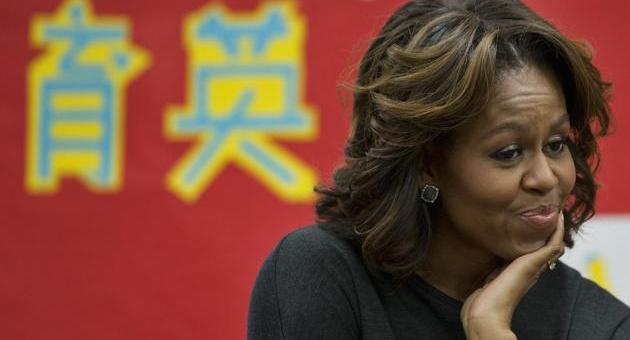
First Lady Michelle Obama will be accompanied by her children and her mother on her trip to China, which begins on Wednesday. But she won’t be accompanied by the press and she will take no questions from the media.
“Michelle Obama’s trip to China starting on Wednesday will be nonpolitical, the White House says, a ‘people-to-people exchange’ emphasizing the importance that both nations place on education. As if to underscore the point, no reporters are traveling with the first lady, and she does not plan to give interviews while there,” reports the New York Times.
The White House is defending the first lady bringing her family along for the ride by saying it’s what the Chinese would want. “Tina Tchen, Mrs. Obama’s chief of staff and a first-generation Chinese-American, said a multigenerational visit would be appreciated by the Chinese, who value tradition,” says the Times.
‘The most powerful message we can deliver [to the Chinese people] is one of the examples of not just the first lady’s life story but of America and our values,’ Deputy National Security Adviser Ben Rhodes told reporters during the Monday call.
‘That alone I think speaks to things like respect for human rights that are interwoven into the DNA of the United States of America.’
American and Chinese leaders have not had especially close personal relationships and there is hope among foreign relations experts that Obama and Peng will form a bond.
Obama’s trip comes as fears about China’s economy mount, the country flexes its muscles in disputed areas of the South China Sea and a missing Malaysian plane carrying Chinese nationals.
“In the US, women enjoy equal rights as men in politics,” said Shen Dingli, a professor of international relations at Fudan University in Shanghai. “But in Chinese traditional culture, we have a saying: ‘a woman without talent is virtuous’.” While female Chinese business leaders are common, he said, women barely appear at the highest levels of the country’s political elite – only two rank among its 25 top officials.
US officials say they want to spread the “power of American values,” and the importance of education. On her second day in Beijing, Obama will give a speech about cultural exchange at the Stanford Center at Peking University, where she’ll meet with Chinese and American students.
About 200,000 Chinese students are studying in the US, more than from any other country. Only 20,000 American students study in China each year. The Obama administration wants to boost that number.
She won’t meet with Chinese president Xi Jinping, but will visit with his wife Peng Liyuan, visit schools and tourist highlights and eat lunch at a Tibetan restaurant.
Source: The Weekly Standard/Washington Post/The Guardian
China’s top envoy to Germany has warned the West against punishing Russia with sanctions for its intervention in Ukraine, saying such measures could lead to a dangerous chain reaction that would be difficult to control.
In an interview with Reuters days before the European Union is threatening to impose its first sanctions on Russia since the Cold War, ambassador Shi Mingde issued the strongest warning against such measures by any top Chinese official to date.
“We don’t see any point in sanctions,” Shi said. “Sanctions could lead to retaliatory action, and that would trigger a spiral with unforeseeable consequences. We don’t want this.”
The interview was conducted on Wednesday, the same day that the EU agreed a framework for sanctions that would slap travel bans and asset freezes on people and companies accused by Brussels of violating the territorial integrity of Ukraine.
German Chancellor Angela Merkel, has taken the side of the putschists supported by the United States, and warned that unless Russia accepts the idea of a “contact group” to resolve the crisis diplomatically, Russia risked “massive” political and economic damage if it did not change course in the coming days.
Source: Reuters
This website uses cookies to improve your experience. We'll assume you're ok with this, but you can opt-out if you wish. Cookie settingsACCEPT
Privacy & Cookies Policy
Privacy Overview
This website uses cookies to improve your experience while you navigate through the website. Out of these cookies, the cookies that are categorized as necessary are stored on your browser as they are essential for the working of basic functionalities of the website. We also use third-party cookies that help us analyze and understand how you use this website. These cookies will be stored in your browser only with your consent. You also have the option to opt-out of these cookies. But opting out of some of these cookies may have an effect on your browsing experience.
Necessary cookies are absolutely essential for the website to function properly. This category only includes cookies that ensures basic functionalities and security features of the website. These cookies do not store any personal information.
Any cookies that may not be particularly necessary for the website to function and is used specifically to collect user personal data via analytics, ads, other embedded contents are termed as non-necessary cookies. It is mandatory to procure user consent prior to running these cookies on your website.