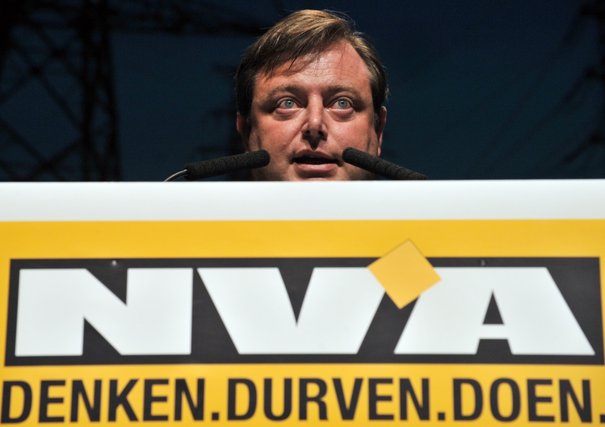
Landslide victory for Flemish nationalists

Bart de Wever

Flemish nationalists made sweeping gains across northern Belgium in local elections on Sunday, a success that will bolster separatists’ hopes for a break-up of the country.

Bart de Wever, leader of the New Flemish Alliance (NVA), is set to become mayor of the northern city of Antwerp, Belgium’s economic heartland, after his party emerged as the largest one ending about 90 years of socialist rule.

Soon after the ballot results emerged, Mr De Wever, who had turned the tough mayoral race into a referendum on Flander’s independence for Belgium, demanded that the country’s prime minister give greater independence to the Dutch-speaking north.

“De Wever sent a strong signal to Brussels and he has put his party on course to send an even clearer one in 2014 … they will try to go for an even bigger win in the federal elections,” said a veteran political analyst for the Gazet Van Antwerpen.

“We want to give Flemish people the government they want at all levels. That is why I call on Elio Di Rupo and the francophone politicians. Take up your responsibility,” said De Wever.

The strong result recorded by the Flemish nationalists is likely to have an impact across Europe, where the sovereign debt crisis, which has seen rich countries bail out poor ones, has revived separatist sentiment throughout the continent.

Flanders, which is the most economically prosperous region of Belgium, has long resented financing the ailing economy of French-speaking Wallonia, and Sunday’s victory will strengthen their demand for self-rule.

Lieven De Winter, a political scientist at Université Catholique de Louvain, said that Mr De Wever’s victory was a clear step forward for separatist who had long been campaigning for secession from the southern part of the country. However, he warned that the process towards accomplishing a break-up would be wrath of problems.

“There is no doubt that tonight De Wever made a small step towards completing his dream of a break-up but there are many obstacles ahead … at the end of the day you need two to tango,” Mr De Winter said.

NVA won about 38 per cent of votes in Antwerp against about 28 per cent secured by the Socialists, according to provisional Flanders government data. Meanwhile, in the rest of the northern region the Flemish nationalists won more than 30 per cent of support.

NVA is expected to seek the support of the Socialists to run Antwerp – in Belgium it is common for opposing parties to form a coalition after elections as no one party enjoys an outright majority throughout the country.

Belgium consists of Dutch-speaking Flanders, francophone Wallonia and Brussels, its bilingual capital. The Socialists have tried to keep Brussels French through Arab immigration. Political powers have already been devolved to regional governments, Flanders, in more populous with about 6m people compared with 3.5m in Wallonia.

NVA’s victory in Antwerp and strong result across the north of Belgium will give good momentum to the separatists in the run-up to the key federal elections in 2014, said analysts. – FT

 

Racial goals for maths and reading

The Florida State Board of Education passed a plan that sets goals for students in math and reading based upon their race.

On Tuesday, the board passed a revised strategic plan that says that by 2018, it wants 90 percent of Asian students, 88 percent of white students, 81 percent of Hispanics and 74 percent of black students to be reading at or above grade level. For math, the goals are 92 percent of Asian kids to be proficient, whites at 86 percent, Hispanics at 80 percent and blacks at 74 percent. It also measures by other groupings, such as poverty and disabilities, reported the Palm Beach Post.

The plan has infuriated many community activists in Palm Beach County and across the state.

“To expect less from one demographic and more from another is just a little off-base,” Juan Lopez, magnet coordinator at John F. Kennedy Middle School in Riviera Beach, told the Palm Beach Post.

JFK Middle has a black student population of about 88 percent.

“Our kids, although they come from different socioeconomic backgrounds, they still have the ability to learn,” Lopez said. “To dumb down the expectations for one group, that seems a little unfair.”

Others in the community agreed with Lopez’s assessment. But the Florida Department of Education said the goals recognize that not every group is starting from the same point and are meant to be ambitious but realistic.

As an example, the percentage of white students scoring at or above grade level (as measured by whether they scored a 3 or higher on the reading FCAT) was 69 percent in 2011-2012, according to the state. For black students, it was 38 percent, and for Hispanics, it was 53 percent.

In addition, State Board of Education Chairwoman Kathleen Shanahan said that setting goals for different subgroups was needed to comply with terms of a waiver that Florida and 32 other states have from some provisions of the federal No Child Left Behind Act. These waivers were used to make the states independent from some federal regulations.

“We have set a very high goal for all students to reach in Florida,” Shanahan said.

But Palm Beach County School Board vice-chairwoman Debra Robinson isn’t buying the rationale.

“I’m somewhere between complete and utter disgust and anger and disappointment with humanity,” Robinson told the Post. She said she has been receiving complaints from upset black and Hispanic parents since the state board took its action this week.

Robinson called the state board’s actions essentially “proclaiming racism” and said she wants Palm Beach County to continue to educate every child with the same expectations, regardless of race. – CBS

Russia the only country speaking of SA atrocities

The cover of Versia, from some years before

by Avigdor Eskin, translated from the Russian by Karlinka Bismark

Russia is the only country that speaks of the atrocities of Africans in South Africa.

Avigdor Eskin stirred the world, with 34 striking miners at a platinum mine in Marikana South Africa were shot and killed by police during a protest. Be clear: this is not about the times of apartheid: the time and place – here and now. As a result, the government first set out to bring to justice the miners themselves and accuse them of provoking bloody riots. However, the world-wide publicity forced President Jacob Zuma to change his mind. All those arrested were released. Miners and mine-owners directly linked to the ruling party, “the African National Congress’, hastened to meet halfway in the demands for higher wages. So the conflict was over.

It will be recalled that the global response to the aforementioned carnage did not include South African Embassy pickets and calls for sanctions, as happened after Sharpeville in 1960. On March 10, 1960 seven thousand black demonstrators surrounded the building where the police station was and tried to take it by storm. The police opened fire, killing 69 blacks.

For the “Sixties” in the world, this event has become iconic and unforgettable. The protests covered almost all the countries of the West. A UN Security Council adopted a resolution at No. 134 condemning the actions of the authorities in South Africa. The Battle at the mine of Marikana did not receive this massive reaction, because the miners were not shot by white police, as it was in Sharpevile, and their black counterparts.

A month ago, the “Voice of Russia” in English, reported on Marikana. It was the first of its kind. And it has been widely rastirazhirovana. As long as 18 years ago, the apartheid regime in South Africa was eliminated and the power was placed in the hands of the “African National Congress”, with the country thrown back to the third world.

In 1994, the average life expectancy of black South Africans reached 64 years, but now it has fallen below 50. The average statistical number of 49 includes data on the white and Asian population of the country, of which the life expectancy is much higher. If we consider the Negro population on its own, its life expectancy is less than 47 years. But South Africa came out on top in the world regarding population infection and AIDS.

Post-apartheid South Africa also firmly holds first place in the world in rape, killing and looting. And it set the world record for the lengthiest trial. In 2002, the South African security forces arrested 23 Afrikaners on suspicion of conspiracy to overthrow the government, as well as in the preparation of acts of sabotage. The trial is known as “Boeremag” – the name of the group, which translated from Afrikaans means “Boer force”. 20 people were behind bars pending a court decision.

The main point of the charges can be called an analogue of the 64th article in the Soviet Criminal Code. The defendantsm repeatedly met and discussed plans for a separate state for the white part of the territory of South Africa. However, only five of them participated in the preparation of real sabotage. This process is similar to the famous court case that went down in history as the “Rivonia trial” – bearing the name of the town near Johannesburg.

On July 11, 1963, 10 leaders of the “African National Congress” were arrested on charges of conspiring to overthrow the government. On their account was by then 221 acts of sabotage. The trial lasted less than two years. The main accused was named Nelson Mandela. The struggle to free Mandela and his associates was conducted all over the world for many years.

Not one human rights organization in the world will stand up for the prisoners from the “Boeremag” and none of the advocates of human rights pay attention to the fact that 20 people were held under severe prison conditions not by a court, but in anticipation of the judgment. The lawyer of two of the defendants Paul Kruger told us, “If you compare the Rivonia trial with the Boeremag then in many ways we are forced to recognize the lawlessness in the second”.

Accused Wilhelm Pretorius has suffered severe torture that affect his health to this day. I’m not talking about the fact of the length of the trial. Nowhere in the world do you hold the accused in jail for more than 10 years in anticipation of the verdict.

Unfortunately, the world is indifferent to what is happening in that country. This is racism. “The world does not want to hear us because we are white, pursued by the black majority. “

A month ago, the court read out the last conviction to all the accused, going all the way over to the prosecutor’s office. But the decision on punishment may take a year, based on the experience of the case. Only one of the accused was suddenly released from prison – the hero of the war on terror in the 80s, Adriaan van Wyk. The judge ruled that, for any turn of events, he did not condemn Van Wyk for a longer period than the one served. After 10 and a half years in a dungeon Adriaan was released.

However, he was not allowed contact with his colleagues on the movement for the rights of the Afrikaner and give interviews to the press. The judge’s decision was explained by Attorney Dan Mostert : “First of all I want to say that my client should not have been kept in jail for a single day. His fault was that he was involved in the discussion of plans for the establishment of an independent Afrikaner state. But I want to draw attention to the fact of his release. A month ago, the ‘Voice of Russia’ in English, reported this, and it has been widely replicated.

“There is no doubt that it influenced the judge’s decision to set Adrian free. Sometimes we do not understand the importance of publicity. There are times when wide publicity under tyranny saves lives. “

Interestingly, in the 60s and 70s, the Soviet Union, with its propaganda apparatus was the locomotive in the struggle for the accession to power of the ANC in South Africa. This initiative was taken up by liberal circles in Europe and the U.S. – from the early 80s -and their governments. This is what the global front for the abolition of the apartheid regime looked like. White South African government has met the international requirements and gradually transferred power to the black majority led by “the African National Congress”. Since then, the international media has been ignoring the facts of flagrant human rights violations in this country, and have not admitted to their error. An exception is the Russian media, which have repeatedly talked about the systematic extermination of white people in this country.

The South African government itself denies the murder of more than fifty thousand of its white citizens, but attributes it to the general wave of crime. But the facts have belied this explanation. In their speeches in English, most of the Negro leaders talk about democracy and equality. However, during the transition to their tribal dialect they openly call for the physical destruction of the Afrikaner.

Every person can now find online records of the famous song “Kill the Boer”, that accompanied the entire struggle against the white regime. After coming to power, it was repeatedly performed publicly by Nobel Peace Prize winner Nelson Mandela, together with with his associates. In January this year, the current South African President Jacob Zuma performed once this call for murder on racial grounds in during the African National Congress’s centenary celebrations.

The well-known human rights activist, Dr. Dan Roodt, head of the organization for the preservation of the Afrikaner culture PRAAG said in an interview with us that after the call of President Zuma to attack the white minority, the number of attacks on white farmers in South Africa as a whole had increased markedly. “When the President himself publicly calls for the extermination of our people, the radical part of Black youth perceives it as a call to action.”

Orignally published in Russian in the newspaper Versia.

Blacks show blind loyalty to Barack

African Americans show blind loyalty to President Barack Obama.

Are black people supporting Obama mainly because he’s black? If race is just one factor in blacks’ support of Obama, does that make them racist? Can blacks’ support for Obama be compared with white voters who may favor his Republican challenger, Mitt Romney, because he’s white?

These questions have long animated conservatives who are frustrated by claims that white people who oppose Obama’s policies are racist. This week, when a black actress who tweeted an endorsement of Romney was subjected to a stream of abuse from other African-Americans, the politics of racial accusation came full circle once again.

Stacey Dash, who also has Mexican heritage, is best known for the 1995 film “Clueless” and the recent cable-TV drama “Single Ladies.” On Twitter, she was called “jigaboo,” “traitor,” “house nigger” and worse after posting, “Vote for Romney. The only choice for your future.”

The theme of the insults: A black woman would have to be stupid, subservient or both to choose a white Republican over the first black president.

Russell Simmons, the hip-hop mogul and Obama backer, called Dash’s experience “racism.” Said Barbara Walters on “The View”: “If she were white, this wouldn’t have happened.”

Twitter users are by no means representative of America, and many black Obama supporters quickly denounced the attacks. But the reason Dash was attacked is simple: She is a black woman supporting a white candidate over a black one.

There is racial bias amongst whites, and there is racial bias amongst blacks. But as far as the press is concerned, it only goes one way, says a white critic.

When people speak out against a symbol of black progress like Obama, African-Americans tend to feel hurt.

“We still have a civil rights (era) mentality, but we’re not living in a civil rights-based world anymore,” says a black man. “We want to say, `You’re black, you need to stand behind black people.'”

He said one reason he voted for Obama in the 2008 primary against Hillary Clinton was because Obama is black: “Yes, I will admit that.”

Is that racism? Not in his mind. “It’s voting for someone who would understand your side of the coin a lot better.”

Such logic runs into trouble when applied to a white person voting for Romney because he understands whiteness better. Ron Christie, a black conservative who worked for former President George W. Bush, finds both sides of that coin unacceptable.

“It’s not the vision that our leaders in the civil rights movement would have envisioned and be proud of in the era of the first African-American president,” Christie said.

Martin Luther King Jr. fought Jim Crow laws, which deprived blacks of political rights after Reconstruction, upheld by Southern Democrats. But black voters switched after Democratic President Lyndon B. Johnson pushed through the 1960s civil rights legislation and Republicans successfully pursued the votes of white people who disliked the civil rights agenda.

Since then, Democrats have persistently wooed black voters with programs and platforms that African-Americans favor, and the party has been rewarded every four years.

Clinton got 83 percent of the black vote in 1992 and 84 percent in 1996; the third-party candidate Ross Perot probably sliced away some of Clinton’s black support. Al Gore got 90 percent in 2000; John Kerry got 88 percent in 2004. Obama captured 95 percent in 2008, and 2 million more black people voted than in the previous election.

Christie says he, too, shares the sense of pride in Obama smashing what for blacks is the ultimate glass ceiling. He understands that black pride springs from a shared history of being treated as less than human, while the history of pride in whiteness has a racist context.

Christie says black men shifted from calling candidate Obama “half-white” and “not one of us” to demanding that Christie stop opposing the first black president.

He sees it in the comments of radio host Tom Joyner, who told his millions of listeners a year ago, “Let’s not even deal with facts right now. Let’s deal with our blackness and pride – and loyalty. . I’m not afraid or ashamed to say that as black people, we should do it because he’s a black man.”

The actor Samuel L. Jackson said much the same thing: “I voted for Barack because he was black,” he told Ebony magazine. “Cuz that’s why other folks vote for other people – because they look like them.”

In 2011, as black unemployment continued to rise, the chairman of the Congressional Black Caucus said that if Clinton was still president, “we probably would be still marching on the White House . (but) nobody wants to do anything that would empower the people who hate the president.”

And just last week, the rapper Snoop Dogg posted a list of voting reasons, written by someone else, on a social media account. No. 1 on his pro-Obama list: He’s black. Snoop’s top reason to not vote for Romney: He’s white.

Black voters feel like white people are attacking their dignity whwn they say negative things about Obama, and they are closing ranks around him.

There should not be this resistance to pride over the first black president, says many blacks. The USA should only elect blacks to that position in the future to eradicate racism. The GOP probably agrees, but would prefer an Uncle Tom. – AP

Verwoerd’s hated legacy

NEWS FLASH FROM 50 YEARS AGO
• Safmarine buys two refrigerated cargo ships of 10 000 tonnes each to transport export fruit to Europe for R2 million.
• South Africa takes the lead with 100 000 bales of cotton spun every year on 230 000 spindles and 3 500 looms, creating 10 000 jobs.
• South Africa is the largest exporter of fish in the southern hemisphere and sixth in the world with exports valued at R40 million.
• Great Britain report that on average 250 applications for emigration to South Africa are received daily, especially from skilled artisans.
• Maree, Minister for Education, establishes the Board for bantu Education, aimed at improving black education to the same level as education for whites.
• 2000 white refugees from Kenya’s uhuru uprising are relocated in Natal where they are helped to produce tea, coffee and sisal.
• Local governments for the coloured community in the Free State established by MEC Haveman.
• SA Railways and Harbours orders 100 new electric locomotives at a cost of R13 million and with the provision that 68% material from South Africa be used in the manufacturing process.
• A hand-spinning and weaving factory for fabrics erected in Umtata, Transkei to create jobs for blacks by the Bantu Investment Corporation.
• The cape Hospitals Department spend R23 million on new hospitals, including the new University of Stellenbosch Teaching Hospital.
• A two-storey hotel for blacks erected in Daveyton, Springs for use by black sportsmen and VIP’s handed over to black entrepreneurs by Benoni Town Council.
• Dr FW Quass says that of the 2060 welfare organisations in the country, 2000 are aimed at the black population.
• The Department of Statistics releases figures of an 18% increase in employment. Monthly income for the year rose to R111,4 million compared to the previous year’s R102 million.
• Some coloured townships, including Haarlem in the Langkloof, exempted from the Group Areas Act and put under own administration.
• Between 1959 and 1962 a total of 91 631 houses for blacks were built at a cost of R38 million in urban areas, while 474 sub-economic units were built for whites at a cost of R1 million.
• South Africa has 300 000 miners employed at gold mines and 250 000 in coal mines. The fatality figures stands at 1,29 per thousand workers.
• Foreign investment grew from R142 million in 1961 to R503,6 million according to Trust Bank.
• The government announces plans to make it possible for 35 000 Xhosas in Western Transvaal to bring out special votes during the Transkei elections.
• Chief Pilane of the Tswana says he foresees the establishment of an independent Tswana state where his people and whites “can live in peace as we have always done”.
• PW Botha, Minister of Housing, announces plans to build 2000 houses in Klerksdorp and 2000 in Port Elizabeth to make provision for new immigrant employees.

A rapper’s charity

A rapper's tears

Wyclef Jean, the Haitian-born hip-hop celebrity, complained when he faced questions about his charity’s financial record and ability to handle what eventually amounted to $16 million in donations.

Portraying himself as persecuted like Jesus and Martin Luther King Jr., Mr. Jean, 40, writes with indignation about insinuations that he had used his charity, Yéle, for personal gain. He says he did not need to — “I have a watch collection worth $500,000”— and that doubters will someday understand “Yéle is Haiti’s greatest asset and ally.”

But on his book tour for “Purpose: An Immigrant’s Story,” Jean neglects to mention two key facts: a continuing New York attorney general’s investigation has already found financial improprieties at Yéle, and the charity effectively went out of business last month, leaving a trail of debts, unfinished projects and broken promises.

“If I had depended on Yéle,” said Diaoly Estimé, whose orphanage features a wall painting of Mr. Jean and his wife, “these kids would all be dead by now.”

Even as Yéle is besieged by angry creditors, an examination of the charity indicates that millions in donations for earthquake victims went to its own offices, salaries, consultants’ fees and travel, to Mr. Jean’s brother-in-law for projects never realized, to materials for temporary houses never built and to accountants dealing with its legal troubles.

On the ground in Haiti, little lasting trace of Yéle’s presence can be discerned. The walled country estate leased for its headquarters, on which the charity lavished $600,000, is deserted. Yéle’s street cleaning crews have been disbanded. The Yéle-branded tents and tarps have mostly disintegrated; one camp leader said they had not seen Yéle, which is based in New York, since Jean was disqualified as a presidential candidate because he lives in Saddle River, N.J., not Haiti.

This summer, the charity foundered.

At the end of August, Derek Q. Johnson, Yéle’s chief executive, announced his resignation to supporters.

His resignation came after Jean declined to accept a settlement proposed by the attorney general covering the charity’s pre-earthquake activities, and he hired Avi Schick, a lawyer who had been a member of Attorney General Eric T. Schneiderman’s transition team.

The settlement would have required Jean and the two other Yéle founders to pay $600,000 in restitution “to remedy the waste of the foundation’s assets.” It also would have required Yéle to pay for a forensic audit of its post-disaster expenses, as it had done for its pre-earthquake finances, and to start “winding down its affairs.”

In 2010, Yéle spent $9 million and half went to travel, to salaries and consultants’ fees and to expenses related to their offices and warehouse. In contrast, another celebrity charity, Sean Penn’s J/P Haitian Relief Organization, spent $13 million with only 10 percent going to those costs.

Though Mr. Penn’s group spent $43,000 on office-related expenses, Yéle spent $1.4 million, including $375,000 for “landscaping” and $37,000 for rent to Mr. Jean’s Manhattan recording studio. Yéle spent $470,440 on its own food and beverages.

Some of Yéle’s programming money went to projects that never came to fruition: temporary homes for which it prepaid $93,000; a medical center to have been housed in geodesic domes for which it paid $146,000; the revitalization of a plaza in the Cité Soleil slum, where supposed improvements that cost $230,000 are nowhere to be seen.

In its relief operation, Yéle operated outside the coordination system set up by other nongovernment groups; it did not want to be burdened by rules and meetings, Mr. Locke said in a 2010 interview.

Other organizations focused on providing concrete services like sanitation or health care.

Yéle chose to work more broadly than deeply. It supplied food, water and supplies to what it said were dozens of tent camps. Julie Schindall, then spokeswoman for Oxfam America, called it a “dump and run strategy.” Mr. Penn told The New York Times in 2010, “My impression is that Yéle is at the service of Wyclef Jean and his reputation.”

Nobel bailout, EU wins

Past winners

The European Union has been announced the winner of the Nobel Peace Prize 2012. Amidst Europe’s as-yet-unsolved crippling economic backdrop, a heated debate emerged over the validity of the prize.

­The unanimous decision was reportedly made by a five-person panel chaired by Council of Europe Secretary-General Thorbjoern Jagland, a strong advocate of the 27-nation block.

The news came 60 years after the creation of the EU’s predecessor organization, the European Coal and Steel Community, which helped rebuild a continent decimated by two World Wars.

“The European Union is in the middle of one of its worst crises, but perhaps it is precisely now the peace and stabilization project deserves a hand from the ‘no’ country Norway?”
Norwegian public broadcaster NRK said.

Norway, the Nobel Peace Prize’s host nation, refused membership in the EU in 1972 and again in 1994.

One past winner introduced indefinite detention and expanded the deadly global drone war. Another was the architect of the deliberate mass killing of civilian populations in Indochina. Ghandi never got one.

With the winner of the 2012 Nobel Prize set to be announced in Oslo, Norway on Friday, the shadow of Barack Obama still looms large. In 2009, the committee awarded the current US president “for his extraordinary efforts to strengthen international diplomacy and cooperation between peoples.” Nominations for the award are due by February 1, meaning Obama had served as America’s executive for less than two weeks when the Norwegian Nobel Committee selected him. Perhaps it was wishful thinking.

Since then, Obama signed the National Defense Authorization Act into law, making it legal to indefinitely detain US citizens. There are also the deadly drone wars in Yemen and Pakistan, the war waged in Libya, the Afghan surge and a secret “kill list” revealed this year by The New York Times, which grants a select few American officials the option to mark perceived national security threats – foreign citizens or otherwise – for assassination. Ironic, yes, but they never could have known.

Even attempts for the committee to play it more conservatively have backfired. Last year, the committee decided to recognize three women for their role in a non-violent struggle for the safety of women and for women’s rights to full participation in peace-building work. The three women included a Yemeni activist, Liberian President Johnson Sirleaf and her fellow citizen and civil society activist Leymah Gbowee.

On Wednesday, Gbowee publically lambasted Sirleaf for failing to fight corruption and nepotism in Liberia.

Liberia’s Truth and Reconciliation Commission even put Sirleaf on a list of 52 people who should be sanctioned for committing war crimes for supporting former Liberian warlord and President Charles Taylor in the late 1980s.

Taylor, who infamously campaigned on the slogan “He killed my ma, he killed my pa, but I will vote for him” during the 1997 general election that followed a war that killed over 200,000 people, fortunately did not win a Nobel Prize.

The post-Obama rehabilitation of the prize might not have gone as smoothly as hoped, but the prize’s history is replete with examples of questionable choices, to say the least.

Chief among them was the 1973 prize awarded to North Vietnamese leader Le Duc Tho and Henry Kissinger. Tho rejected the prize, telling Kissinger that peace had not been restored in South Vietnam. Kissinger for his part accepted the prize “with humility.”

Before, during and after his acceptance of the prize, Kissinger would be implicated in assassination, war crimes and the slaughter of civilians in a large swath of countries: East Timor, Pakistan, Greece, Cyprus, Chile, Argentina, Cambodia, Laos and Vietnam.

This year’s winner was drawn from 231 different nominations, 188 of whom are individuals, while the rest are organizations.

Also on the list was Myanmar’s President Thein Sein, who might be recognized for his role in moderating Myanmar’s notoriously repressive military regime. But even Sein has been implicated in confiscating land from paddy farmers which was later sold to an officer from the effectively paramilitary United Wa State Arm, who then used the land for the production of amphetamines.

This certainly wouldn’t have been the biggest shock in the prize’s hundred-plus years.

Racism worse for whites, study shows

American Freedom Fighters

The study polled roughly 200 white people and 200 black people drawn at random from a national census and asked them to rate racist attitudes against blacks and whites in each decade from 1950 to 2000.

Both groups felt racism against black people was substantial in the 1950s and both groups agreed the situation had markedly improved.

However, white respondents to the survey indicated that racism is now on the rise against white people. Eleven per cent of people responding to the survey even gave anti-white racism a maximum rating of ten points.

The authors said the research showed America has not yet reached a “post-racial” era, despite the election of Barack Obama as the country’s first black president.

Instead, they said there are still “several legal and social controversies” highlighting “reverse racism” against white people, and that the white respondents to the survey felt that racism is now a “zero-sum game” – the less racism that is directed against black Americans has been accompanied by a rise in perceived biases against white Americans.

“Whites believe the pendulum has now swung way beyond equality in the direction of discrimination,” it added.

“It is a pretty surprising finding when you think of the wide range of disparities that still exist in society, most of which show black Americans with worse outcomes than whites in areas such as income, home ownership, health and employment,” said Samuel Somers, an associate professor of psychology at Tufts who co-authored the study.

David E. Berstein, a professor of law at George Mason university, told the New York Times that the US policy of affirmative action, which sees universities and employers overtly favour black candidates over whites, had led many whites to complain about the unfairness of the system.

“It is not terribly surprising that whites subjectively perceive discrimination against members of their own group as an especially significant and growing problem, even though, objectively speaking, bias against blacks is far more pervasive, problematic and ill-intentioned,” he said. – The Telegraph


Black racists at school ‘sickening’

Hindu traditions maintained

A report that pupils were being racially abused at a Boksburg school is disturbing, the Inkatha Freedom Party in Gauteng said on Thursday

“We are sickened by the reported racial discrimination doing the rounds at schools in Gauteng,” provincial leader Bonginkosi Dhlamini said in a statement.

The Star reported on Thursday that several parents of pupils at the Parkdene Primary School in Boksburg claimed the children suffered racial abuse and discrimination.

This was apparently because they wore red strings around their wrists as part of the Hindu faith.

A Grade 3 pupil was reportedly discriminated against by his music teacher, who is the principal’s wife, for wearing red strings on his wrists.

His parents claimed he was called a “coolie” several times in front of his classmates and told to take the string off.

After complaining, the parents were told the pupil had to wear a red jersey to hide the string.

The principal refused to comment, saying the department was dealing with the matter.

Dhlamini said the teacher’s alleged behaviour “demonstrates the dwindling humanistic culture in our society”.

“This unendurable action by the teacher is a regressive sign of racial battles still protruding in our society, and strict measures needs to be taken against those who… blatantly attack innocent children because of their race and religion.”

Education spokesperson Charles Phahlane was not immediately available for comment. – Sapa

‘It always happens to others’

South Africa may not experience tsunamis, hurricanes or devastating earthquakes, but we do experience other life-shattering tragedies such as fires,  HIV/AIDS and…. violent  crime!   “It always happens to others!” people are wont to  say … until  it happens to you! A victim of a hijacking writes about his terrible ordeal.

It happened to me three years ago, on the night of 17 September 2003. I was returning home after presenting a late lecture to engineering students. I was tired. It had been raining. I was looking forward to relaxing at home with my wife and son. I stopped my car outside the gate at home and was opening the gate, when I heard a voice behind me saying: “Get back inside your car”.

I turned slowly to see a black man standing there pointing his gun at me. I looked quickly towards my house but nobody was in sight. I had no option but to obey. With that, two accomplices emerged from the shadows and forced me into the back of the car, one on either side of me.

The gun toting attacker got behind the wheel and we drove away. I had no idea where I was being taken at that time of night. I was swiftly relieved of my belongings – my wallet (with R70.00 cash in it), my gold watch, my cell phone, my wedding band,…all the while I was being sworn at, cursed at. I remained calm, knowing that God had His hand on me.

I told them to drop me on the side of the road telling them they could have my car. In reply I was told they did not want my car, only money! As we drove on they forced me to lie down on the seat so that I could not be seen and put a dirty cap over my face so I could not see where I was being taken. I just prayed: “God confound them.” This happened, as they soon lost their way and had to stop and ask directions; but I was not afforded an opportunity for escape. I did manage to see some lights as we drove along and I recognised the route they were taking. I had no idea what to expect next.

After another ten kilometers or so, they turned into a smaller road and finally down a steep, rough track into a clearing and there I was accosted by the gun-wielding man who demanded to know where my laptop was. I had been doing research for an M.Sc. in Electrical Engineering and had left some discs on the back seat. They were now in disarray as I had been forced to lie down on them during the highjacking journey. While trying to explain that I did not possess one, the man punched me in the face and repeated his demand. He then threw me down onto the ground outside the car and tried to kick me in the face with his boot. I caught his foot and protected my face but he then started shooting, pumping four bullets into my left leg and two into my right thigh. He pulled the trigger once more but the gun just went “click”. As he walked away from the car, I decided to try and escape. I could not use my legs – they were simply not responding – so I decided to roll away. I rolled off the edge of the clearing and down the steep slope for about 30 meters through long weeds and muddy ground full of stones and roots. I decide to lie there with my head down so that blood would stay in my head. There was a street lamp nearby. In the dim light I could see the bullet wounds in my legs and the blood oozing from them. I lay on my back looking up at the stars thinking, “Nobody even knows where I am – Am I going to die like this?” I prayed to God saying I was totally in His hands. It was now up to Him.

After lying there for about ten minutes, I spotted a young African boy walking along a nearby path. I called out to him in Zulu asking him to phone the police, get an ambulance and phone my wife to let her know what had happened to me. He said he would call his mother to help me – it turned out that she was a qualified home nurse! She arrived soon after, equipped with rubber gloves and a first aid kit. She took off my shoes and asked permission to remove my long pants, quite blood-stained by now. There was no time to feel embarrassed so I said, “Go ahead”. She cleaned my wounds and slowed the bleeding. With that an African man appeared and said: “Do not be afraid. I am here to help you.” By now my legs were shaking uncontrollably. He then left and returned with a sleeping bag which he placed over me to keep me warm. He placed his jacket under my head then returned home to phone the local police.

They were reluctant to come and investigate so he became angry and phoned his white boss, whom he knew “would make a plan”. His boss (who did not even know me) threatened the police and demanded that I be attended to. Within fifteen minutes there were four police vehicles at the scene. One of the policemen phoned my wife telling her I had been shot several times and that I would be taken to Crompton Hospital. My wife made two phone calls and by the time I arrived there were thirty family, friends and church members waiting. Even in the state I was in, I was emotionally moved and touched by this overwhelming support.

I was wheeled into Emergency, given an x-ray and, not needing surgery, was taken to a ward where my blood was tested.  My veins had collapsed and they had to take arterial blood to establish my blood type. I needed two and a half pints of replacement blood. I overheard the nurses talking and saying that I probably would not live – then the doctor commenting that I was strong and would pull through. A day later I was well enough to move to a normal ward – one of the many miracles to follow. My left leg was in plaster from top to toe with a small window cut in the plaster to enable the dressing of my wound to be changed regularly. Two days later I was visited by Nickolas Ntanjana (who covered me with the sleeping bag) and his boss, Bruce Dickson, and that is when I heard their side of the story (about the calls to the police).

I was back home and recuperating in the company of my loving and very supportive family. I was off work for the rest of the year. This led to some serious financial losses as I received no compensation from either the Road Accident Fund nor from Workman’s Compensation.

I lost tens of thousands of rands due to not being able to give extra lectures. There is no fund to cover one in the event of a highjacking.  A case of attempted murder was opened by the local police but to date no arrests have been reported. It is sad that criminals and the syndicates supporting them, can just force themselves into your life, violently ruin it and get away with it. Governments who pride themselves on removing the death penalty will have to answer to God as to why they have subjected their law-abiding citizens to the death penalty instead! Not only do you and your immediate family suffer but also the community that you serve – there are vast, rippling (negative) effects. Medical expenses, counselling (by psychologists or psychiatrists), protracted battles with insurance companies or debtors, security measures to be upgraded, etc. I have lost my ability to concentrate for extended periods on technical type work and hence have had to give up my research. I was determined not to become a victim and was elected as chairman of the South African Institute of Electrical Engineers, KwaZulu Natal Branch, last year. Nevertheless my reserves of energy have become limited. I suppose being over the age of fifty also contributes to this.

I would like to emphasise that having been through a traumatic, near death experience, it gives one a new set of values. One of these is the importance of communicating  appreciation and love to those around you. Say it and say it often. Love is the only thing I know that grows as you give it away! Life is really very temporal and fragile. Live it by loving those close to you.

HOW TO AVOID A HIJACK SITUATION

  • 80% of hijackings take place in home driveways. Check your driveway and street before you leave or enter your premises. Be on the look out for suspicious vehicles/persons.
  • Always be cautious and aware of surrounding obstructions and shrubbery that may conceal a hijacker.
  • At road junctions, leave enough space between your car and the one ahead of you to allow you to escape.
  • If a car has driven into the rear of your car, and the impact is fairly light, wave to the driver to follow you to somewhere safe to trade necessary information.
  • When approaching your vehicle, always have your keys ready but not visible. Be aware of your surroundings & if you notice any suspicious behaviour immediately walk away from your car towards a safe area.
  • When approaching a red traffic light at night, slow down so that you only reach it when it turns green.
  • Do not stand by your car if you are waiting for somebody & never sit in your parked vehicle without being aware of your surroundings.
  • Once in the car, lock all your doors & leave your window only partially open. Keep any valuables, briefcase, handbag & cell phone out of sight.
  • If you suspect you are being followed, take a different route home. If you still think you are being followed, drive to the nearest police station. Do not stop your car for any reason as this will give your pursuer the ideal opportunity to hijack your vehicle.
  • Avoid driving through high crime or unfamiliar areas as well as late at night/early hours of the morning when the roads are quiet.
  • Drive in the centre lane away from pedestrians where possible.
  • When you are a victim of a car-hijacking, don’t put up a fight. Do exactly as told by the hijackers. Do not reach for your purse or valuables.
  • Gather as much information as possible without posing a threat.

Romney has a tough road ahead

The American electoral college system means each state is assigned a certain number of electoral votes, dependent on population, and whoever wins a majority of these electoral votes – 270 or more – will be the next president.

For states with a large population, such as California or Texas, therefore have more influence, and tiny ones like Rhode Island or Maine less

It means campaign tactics limit the presidential candidates in states that are swing states. American states tend to lean strongly toward one political ideology at the presidential level.

Massachusetts, for example, is a strongly liberal and Democrat state, while Texas leans toward the Republicans. Democrats will not win Texas in this election cycle, and Republicans stand no chance of winning Massachusetts.

This leaves about eleven swing states that are usually competitive. For this election however, it’s down to eight with Michigan and Pennsylvania leaning towards the Democrats, while Missouri will likely vote Republican.

These eight are Florida (29 electoral college votes), Ohio (18), New Hampshire (4), Virginia (13), North Carolina (15), Colorado (9), Nevada (6) and Iowa (6).

The balance of power in these states gives a decisive advantage to President Barack Obama. With 538 electoral college votes at stake, 270 votes will secure victory, and, according to reasonable projections Obama can pretty much bank on 247 while Republicans have a total of only 191 probable votes.

This means only one thing: If Romney loses Florida he cannot become president, as its 29 votes will put Obama ahead of the 270-victory threshold. It also means Romney can’t afford to lose any combination of votes that add up to anything more than 22.

The problem for Romney is that swing state polls are not kind to him as things stand, although they have narrowed in recent days. The polling average has Obama up in all swing states except North Carolina. And Romney is less than a percentage point ahead in North Carolina.

Incidentally, if Obama does only win 22 of the 100 available electoral votes, both candidates will be tied at 269. If this happens the Constitution points to the House of Representatives to decide who becomes president, and that chamber will likely have a Republican majority.

Two trains set alight

Two Metrorail trains have been set alight in Mabopane, the company said on Friday.

Five coaches carrying passengers caught fire at Kopanong station while in Akasia only one coach was burnt down at 22:00 on Thursday. Both trains were enroute to Mabopane from Koedoespoort , Metrorail spokesperson Lillian Mofokeng said.

Mofokeng said the cause of the fire was unknown. Several other coaches were however vandalised. No injuries had been reported.

She said they were not able to assess the extent of the damage because of the rain, but it seemed severe.

Commuters were advised to organise alternative transport as the services in the Mabopane corridor were shut down until further notice.

“It will be impossible to operate trains in this corridor due to the severe nature of the damage of these trains and the electrical overhead cables…commuters are advised to make their own transport arrangements…,” Gauteng Metrorail manager Tembela Kulu said.

Pretoria stays! Pretoria bly!

Scene of a previous protest organised by the Pretoria stays! group

I hereby support the efforts that PRAAG have made since 2003 to save the name of Pretoria. I am also prepared to add my name to a class action human rights application without any financial obligation to the relevant authorities or courts to enforce the international legal principle that the culture and place names of minority groups may not be changed by the state and that the South African state shall protect the existence and the national or ethnic, cultural, religious and linguistic identity of minorities within its territory.

Hiermee steun ek die pogings van PRAAG sedert 2003 om die naam van Pretoria te red. Ek is ook bereid om my naam te voeg by ‘n klasaksie- menseregte-aansoek sonder enige finansiële verpligting teenoor die toepaslike owerheid of howe om die volkeregtelike beginsel te laat geld dat die kultuur en plekname van minderheidsgroepe nie deur die staat verander mag word nie en dat die Suid-Afrikaanse staat die bestaan en die nasionale, etniese, kulturele, godsdienstige en taalkundige identiteit van minderhede binne sy gebied moet beskerm.

[emailpetition id=”3″]
[signaturelist id=”3″]

WSU speaker wants racial separation

Jared Taylor

More than 200 people visited Towson University to hear Jared Taylor, a self-described “racial realist.”

A prospective White Student Union at Towson University added to its own controversial history when it brought an advocate for white interests to speak Tuesday at the group’s first meeting.

Jared Taylor, editor of the “racial realism” online news site American Renaissance, said he hoped to spread a message about the importance of racial separateness.

“I believe in complete freedom of association, and when given that choice most people prefer the company of people of their own race,” said Taylor, when reached by phone Wednesday. “We’re always being told to celebrate diversity and I think diversity is a source of tension.”

Many people, including a Patch reporter and other media, were denied admission to the Tuesday night event by campus security after the venue, which holds about 200, filled to capacity. Still, about 50 individuals stood outside the doors as Taylor spoke.

Taylor said his presentation centered around his support for the White Student Union and speaking out against diversity. He acknowledged that the audience reception was lukewarm—”some liked it, some didn’t.”

The White Student Union began recruiting members at Towson University a few months ago.This occurred shortly after Youth for Western Civilization, a group headed by current White Student Union President Matthew Heimbach, disbanded following allegations that its members scrawled “white pride” in chalk at locations around campus.

Youth for Western Civilization’s faculty advisor Richard Vatz, who is also a Patch blogger, resigned from his post after the chalk-writing incident, noting in his resignation letter  that he “cannot in good conscience advise a group that attacks people or groups personally or tactlessly or does not recognize their dignity and the value of dignified argument in the marketplace of ideas.”

Heimbach, who did not return calls for comment on this article, previously said both groups were about celebrating white heritage and advocating for white interests, not supremacy.

“It’s a spectacular double standard that only whites are singled out and told they can’t have a race-based organization,” said Taylor, who argued that the group is necessary as demographics change making whites a minority.

Taylor said he presented evidence showing problems raised by diversity, such as data indicating that approximately 100,000 job grievances are related to racial matters. He also pointed to racial riots that occur in prisons. Taylor empathized with whites who felt the need to join gangs in prison because he said there are many black and Hispanic gangs existing outside of prison whose networks extend to jails.

But he did admit there was one benefit to diversity.

“I do enjoy ethnic food,” he said.

Many attendees were not impressed with Taylor’s presentation.

During his speech, Taylor said several people sneaked inside the venue through a fire escape and shouted an obscenity at him. Gay Pinder, a Towson University spokeswoman who was in attendance, said she just heard one person yell at the end of the presentation. She said the individual left through the rear door immediately after making the proclamation.

“It was generally a well-behaved crowd,” Pinder said.

Raymond Winbush, the director of The Institute for Urban Research at Morgan State University, said the presentation was deceptive.

“[Taylor’s] lying,” said Winbush, who is black. “He’s good at manipulating words and says he’s not racist. It’s like the white collar Ku Klux Klan.”

Towson University senior Ignacio Evans, who is also black, thought Taylor was well-spoken but called his speech “absolutely disgusting.”

“He was eloquent, put together, but inherently racist,” Evans said. “He was very anti-diversity and made assertions that people of color are inferior.”

Taylor dismissed the claims of racism as “name-calling.”

“[Calling someone racist is] something someone will say when they don’t have an argument,” he said.

Frankie Knight, a white senior family science student who didn’t know much about the White Student Union, came to the meeting after hearing about it from her professor.

“I thought it was very negative and very offensive,” she said.

Knight and Evans both noted that Taylor said blacks are genetically inferior. He denied making the statement.

“I have said the races are different….there are unquestionable differences,” Taylor said.

And Taylor was not without supporters. Johns Hopkins University engineering professor Dennis Nagle, who is white, said he believes there is truth to Taylor’s teachings.

“He’s got some interesting views on diversity that aren’t popular,” said Nagle, who was not able to get inside the event. “But he’s got evidence and documentation to back it up.”

The White Student Union is not a university-recognized student organization, but the group’s leaders are working to make it approved. Because they don’t yet have that status, the White Student Union had to book the Towson University venue for the presentation as an outside entity. – TowsonPatch