Apartheid evil is hype

by Dan Roodt

South Africa is listed in Samuel Huntington’s book as a country prone to a “clash of civilisations”. Hence the acrimonious exchanges that characterise South African discussions of politics and history.

The South African left scored a major propaganda victory some time in the 1980s when reformist National Party policies were vilified as the “apartheid crime against humanity”. The Truth and Reconciliation Commission compared us to the Nazis. Hyperbole reigned supreme.

How many death camps did John Vorster open up and how many mass graves have the BBC shown to the world? The BBC would surely have loved to find even one mass grave as testimony to Afrikaner evil, yet it could only report on rugby player Geo Cronjé’s supposed refusal to share a room with a non-white player a few years ago.

Further investigation of Mr Cronjé’s “crime against humanity” revealed it to be a red herring.

On Wednesday, I reminded listeners of 702 that all history, including apartheid, was open to interpretation. One black SABC journalist responded by saying that I was “revising history and her pain”. However, there is far more pain to come as we witness the shambles our country is turning into. Inevitably, unflattering comparisons are being drawn between the old and the new SA, unflattering to the post-1994 dispensation.

Apartheid revisionism is in the air. Historian Hermann Giliomee recently delivered a hammer blow to the truism that “apartheid withheld education from blacks” by pointing out that “syllabi of schools in the higher standard were the same as those in white schools”.

It is also completely false that Hendrik Verwoerd discouraged the study of science and mathematics in black schools; the main problem was the lack of qualified teachers, as it remains to this day. According to an insider within the Gauteng education department, the maths average among black matriculants is currently a hopeless 20%.

A refined and cultured man like Dr Verwoerd would have been highly shocked by the Limpopo schoolbook affair. No doubt he is “spinning in his grave” as that educational buffoon, Kader Asmal, once put it, but for entirely different reasons. The tragic demise of his educational legacy should fill us all with sadness.

Within an Orwellian climate of hysteria and cries of “racism!” whenever the anti-apartheid myths are exposed, historians and commentators will need great courage to rehabilitate our history to anything resembling the truth.

This piece also appeared as a letter in the Johannesburg Business Day.

You can’t have your banana and eat it

“In his ‘Wrath of dethroned white males’ (see underneath), Professor Malegapuru Makgoba has dared to offer a biological explanation for the power structure that prevails in the new South Africa. Makgoba is perhaps the leading theoretical Africanist in our country today. I am sorry, therefore, to bother him with Eurocentric logic, but his argument represents a tautology,” writes Dan Roodt.

In his “Wrath of dethroned white males” Professor Malegapuru Makgoba has dared to offer a biological explanation for the power structure that prevails in the new South Africa. According to him, the white male has been “dethroned” and should now learn to adapt to a subservient, even submissive, role within our society.

Until now, Social Darwinism or the model of society as a competition for resources where the fittest will survive and prosper, has often been associated with notions of European superiority. After all, Europeans from a minute area in north-western Europe managed to get on to little sailing boats to colonise and rule the greater part of the Earth for a few hundred years. Britain is said to have conquered 100-million people in the Indian sub-continent with 800 soldiers and 2 000 Indian auxiliaries.

Makgoba’s view of African male dominance therefore represents a novel departure from a previously Eurocentric idea. However, he is not the first South African to take an interest in biological explanations for human behaviour or politics. Two of his predecessors would be Eugene Marais and Jan Smuts.

Marais was keen on the study of primates, especially baboons, and wrote two books about them, The Soul of the Ape and Burgers van die Berge. The great Afrikaner physician, journalist, poet and intellectual stressed the similarity between human and baboon behaviour, including an occurrence where he observed human boys and young baboons playing together, making clay figures and imitating one another.

This extraordinary incident is recounted in Burgers van die Berge. It fits in with Makgoba’s view that imitation and “aping” are normal features of both human and baboon societies. Nowhere would Marais, however, advance the notion that imitation was solely linked to hierarchy and dominance.

Makgoba is perhaps the leading theoretical Africanist in our country today. I am sorry, therefore, to bother him with Eurocentric logic, but his argument represents a tautology. Because black males are in power, he deduces that they are both dominant and “fitter” than white males. However, it could be that they are dominant for reasons other than their fitness.

Not so long ago, Mathatha Tsedu, the then editor of the Sunday Times, caused quite a ripple when he wrote in his column on July 13 2003 that black men sometimes display a lack of prowess. He quoted an anonymous Cabinet member who had told him: “When you come from where we come from and you then have to realise that if you want something done quickly you have to rely on whites, it is really debilitating. You bleed internally, but our very own comrades do not work. There is generally no work ethic.”

Of course, there could be a debate about what attributes an alpha male should have in human society. Should he be intelligent, physically strong or both? Should he be a good manager, highly numerate and literate, disciplined and with a good work ethic? Or are these but the traits of a tame white baboon and are universal criteria for primate success such as aggression, reproductive prowess and dominant behaviour more important?

Makgoba’s assessment leans toward the latter interpretation. However, I do not think that the same conditions of Darwinian survival pertain in the human world as opposed to the animal world. Human beings display altruistic behaviour uncommon in many species so that they would not necessarily subjugate the weaker members of their society as happens in a primate hierarchy.

Take the nuclear project at Pelindaba that existed under the previous government, for example. A handful of white Afrikaner males produced six nuclear bombs, deadly enough to kill millions of people in one fell swoop. In a straight Darwinian contest, they should have used that power to eliminate their black male rivals forever, thereby ensuring their own dominance within Makgoba’s scheme of rivalry between white and black males. Yet not only did they refrain from using the bombs, but they handed over power to the black males and peacefully dismantled their own lethal weapons.

Biologically speaking, such behaviour is absurd. No male baboon would be caught dead playing into the hands of his rival. Yet this is precisely what we have seen in South Africa.

At another level, however, one could argue that a form of social Darwinism is still operative at every level in a capitalist society where individuals and companies are selected for fitness through economic competition. This leads to a further contradiction in Makgoba’s argument, for while exalting black male fitness over white male weakness, he insists on affirmative action and black economic empowerment.

Because of racial-preference measures in our society, Darwinian competition, even at the more civilised economic level — as opposed to brute contests with bared teeth and flailing limbs — is flawed.

Either black males such as Makgoba will have to discard racial preference so that the real Darwinian contest may begin, or they will have to continue invoking sympathy for the poor, downtrodden black male having been disadvantaged by centuries of colonial oppression and racism. In other words, they will have to choose between Darwinism and altruism.

As they would say in the baboon world: you can’t have your banana and eat it.

Originally published in the Mail & Guardian on 1 April 2005

Wrath of dethroned white males

by Malegapuru Makgoba
In the primate family, to which humankind belongs, there are certain heritage features which display “clear dominance relationships among members, and the proclivity to imitate”, hence such terms as “aping and monkey business”. Alienated. Quarrelsome. Spoilers. Certain white males exhibit all the symptoms of the dethroned male baboon.

A critical factor of human development and leadership is “our primate heritage” as defined in the book Leading Minds: An Anatomy of Leadership, by Howard Gardner, Harvard University’s distinguished psychologist and professor of education.

In the primate family, to which humankind belongs, there are certain heritage features which display “clear dominance relationships among members, and the proclivity to imitate”, hence such terms as “aping and monkey business”.

These heritage features are most pronounced in males who compete for control of the social cluster, for protection of offspring and possession of the most desirable females.

Baboons or bonobos, for example, are often headed by a dominant male with pretenders to the throne hanging around. The dominant male ensures that progeny are not only his through reproduction, but also that all members of the colony imitate him. He becomes the “gold standard”. Ultimately the dominant male is dethroned by a younger and fitter male, only to repeat another variation cycle of hierarchy, dominance and imitation.

The dethroned male becomes depressed, quarrelsome and a spoiler of the new order until he gets ostracised from the colony to lead a frustrated, lonely and unhappy life. This is our “primate heritage”.

I use this example because baboons are familiar to most South Africans; they are among our closest primate relatives genetically and a totem for some Africans. African people have been referred to as bobbejaan and at times shot and killed by certain white males who apparently “confuse or mistake” us for baboons.

More importantly, I use this example because humankind is reflective and should do better than our primate relatives; also because the dethroned white male in South Africa is playing the same role as dethroned baboon troop leaders do.

The primate practice teaches us that information is not sufficient to bring about change; that change often only occurs when it is enforced on even such a highly sophisticated species as humankind.

A group of dethroned white males called “Die Boeremag” are recently alleged to have been plotting a coup and even entertaining the exciting thought of assembling all Africans on the N1 and then chasing or marching them to Zimbabwe. In their naïve logic, Zimbabwe belongs to Africans and South Africa belongs to whites.

Another group of white males are languishing in a Zimbabwean jail for masterminding a coup in Equatorial Guinea; a group of white male farmers have emigrated to Nigeria; and some white males are alleged to be causing “instability in the Free State”.

Recently, Justice John Hlophe to his credit raised the issue of racism within the Cape Division of the judiciary as largely ascribed to and associated with white males. Many prominent Africans have complained repeatedly and with increasing frequency over the decade about “alienation and institutionalised racism” within the academic, church, corporate, media, sports and public/government sectors of our country.

As the transformation of our society deepens, like the peeling of an onion, more racist white males are being caught, fingered out and revealed. Surely we must by now recognise and respect that Africans who have been victims of racism over centuries and generations understand better than the perpetrators about what racism is, means and feels.

We must equally accept that 350 years of racist experiences and socialisation cannot be overcome in 10 years of freedom. The request for “reconciliation” and “forgiveness” masquerades as a quest for memory loss. Regrettably, whenever an African raises this issue, the white male response has been “to play the man rather than the ball”.

Racism, a socially constructed phenomenon with no biological basis, is a complex system of symbols and meanings that continues to modify over time as a consequence of both societal structural changes and political struggles. A segment of white males continues to deny the collective body of African experiences and instead wants to monopolise and to dictate the definition and appropriate meaning to racism. If and when they do accept the existence of racism, it is often detached and projected. Lately, many African students at campuses of higher learning are complaining about “racism, alienation and social exclusion”. The main culprits are the younger generation of white males imitating their elders.

Similar symptoms of the dethroned are evident in the caustic, negative terms in which the debate about black economic empowerment is framed; in the ways in which black executives are vilified; and in the way in which employment equity is always viewed through the prism of its impact on the longevity and well-being of the (dethroned) white male.

The dawn of the new dispensation has retired a segment of previously dominant and ambitious white males prematurely. This segment has lost its power, authority and a sense of purpose in society. Whether intended or unintended, conscious or unconscious, a sector of white males have an adaptation problem.

They have become bitter; but this also has become a serious problem for our society and a major obstacle to our democratic transformation. Some members of this group, which is out of kilter with the mindset of liberated African society, have become spoilers — across a wide range of activities. It has become not only ungrateful but also oblivious to Ubuntu. This group does not seem to understand the word “reconciliation”.

All these take place in the midst of a society making every effort to reconcile its horrible past and to transform itself into a just, equitable and non-racial society. The creation of a non-racist society will emerge to a large extent through the conscious confrontation of the current pervasive racism by all.

It is crucial here to indicate that not all white males display this obnoxious, arrogant, racist behaviour we continue to experience 10 years after liberation. In fact, to the contrary, many white males have made great strides, great sacrifices and significant contributions to this evolving equitable, non-racist and non-sexist South Africa we are creating through our Constitution and our African renaissance vision.

But the group of spoiler white males, just like the male baboon or bonobo, was once a dominant force through colonial and apartheid conquests. Over centuries this group defined that which was civilisation as opposed to that which was barbarism. He defined that which was liberal as opposed to that which was autocratic. Even when he excluded women, blacks and the uneducated classes in society, he still called this liberal philosophy.

He defined culture, morality, ethics and the shape and form of wealth distribution according to the way it suited and advantaged him. He created and bequeathed the world an illiberal, unjust, unequal, racist and sexist society. Over centuries and through dominant enforcement he ensured that his mindset or world view was imitated without question by those he presided over. This dominant white male has had an unparalleled and unrivalled opportunity in which to shape the history and future of the world and humankind according to his image.

But as history and nature would have it, unfortunately the white male in his prime was never able to conquer everyone. The great Arab and Chinese histories and cultures continued to challenge the monolithic culture of the white male. The indestructible and experiential cultures of the Africans remained impervious and alive despite centuries of imperial invasion and concerted efforts to obliterate these.

With the demise of the empires and of Western values, even the stiff upper lips of these white males begun to quiver. This white male feels ostracised from society and is leading “a frustrated, lonely and an unhappy life away from the herd”.

We now have a predominantly African government presiding over an African country and a predominantly African society with dominant African values. This African force will follow our primate heritage of cultural social clusters, dominance and imitation, with modifications made by our Constitution, which respects human dignity, diversity and non-sexism. It will also be influenced by the context of the 21st century, globalisation and the greater mosaic of interdependent cultures.

Africans will transform and reconcile this society by ensuring that the fingerprints of their African culture, value and knowledge systems and notions of social order are embedded in and are the blueprints of a future South African society.

Africans will not transform this country through previously dominant foreign rules, values or cultures. No dominant group ever transforms society through subservience and alien values. This would simply be against our primate heritage. When the English were dominant we were anglicised, when the Afrikaners were dominant we were Europeanised, now that Africans are dominant we must Africanise and not apologise for our Africanness.

The white male should instead be excited by the new prospects of imitating Africans. When we say “Mayibuye iAfrika” we mean it and mean business. Democratic governments are representative of the will, values and aspirations of the majority and not the will and aspirations of a whingeing white male minority.

While Ubuntu will continue to influence our drive for reconciliation, let there be no doubt that sooner or later African dominance and the imitation of most that is African shall permeate all spheres of South African society

This message should be loud and clear just as the writing is on the wall for all to whom South Africa belongs. All modern democratic societies celebrate diversity around a common vision, in our case an African vision. It should therefore become common sense that the white male soon learns to speak, write and spell in an African language; that he, like Johnny Clegg, learns to dance and sing like Ladysmith Black Mambazo. He should learn kwaito, dance like Lebo, dress like Madiba, enjoy eating “smiley and walkies” and attend ‘“lekgotla” and socialise at our taverns.

He must soon accept, value and imitate the things that matter dearly to Africans. The sooner this white male gets out of his denial mode, the sooner he will receive treatment and proper African rehabilitation. Surely, our white male group can and should do better than the baboon or the bonobo.

Malegapuru Makgoba is the vice-chancellor of the University of KwaZulu-Natal and writes in his personal capacity

Originally published in the Mail & Guardian on 25 March 2005

Mindless response to massacre in South Africa

by Ilana Mercer

On August 16, 36 striking miners were shot dead by South African Police Service officers at the site of the Lonmin Platinum Mine, at Marikana—northwest of this writer’s birthplace, Johannesburg.Seventy eight of the 3000 rioting strikers were injured.

International response to the massacre at Marikana ran to variations on a theme: “They’re killing their own people”—although not quite so crudely put, as that would imply that the beleaguered white inhabitants of post-apartheid South Africa were not refracted through the Rainbow Nation’s national spectrum.

Nevertheless, as is to be expected of the pack animals that make up the press in the West, the incredulity over “black police firing at black mine workers” was unanimous.

Perhaps the journalistic herd intended to separate state-conducted violence from state-condoned violence. The latter is most certainly a black-on-black and black-on-white franchise. For in reality, most murders of Africans in Africa and, incidentally, of Africans in America, are courtesy of other blacks.

Needless to say, the luminaries of Western café society are not exercised when Nelson Mandela’s party, the African National Congress, inadvertently socks it to honky by denying the holocaust of the nation’s rural whites.

“A labor dispute between the oppressors (whites) and the oppressed (blacks)”: That is the mantra invariably mouthed by media whenever an innocent farmer is slaughtered—a weekly occurrence, on aggregate—in the country considered by cretins such as Anderson Vanderbilt Cooper, “a model of stability since racist white rule ended.”

But when the ANC, in control of the dominant-party state that is South Africa, engages in crowd control against what is deemed simplistically as “its own people,” that makes headlines. To wit, “The violent incidents on August 16were the single most lethal use of force by South African security forces against civilians since the end of the apartheid era.”

Allusions were made to the Sharpeville massacre.

Cut to March of 1960. A small band of panic-stricken policemen of the apartheid era—the media insists on appending the adjective “racist” in mentioning these men—shot dead 69 black demonstrators.

Prior to the 1960 Sharpeville massacre, nine white cops had been murdered in Durban.

Prior to the Marikana massacre, the strikers, all sweetness-and-light, had killed at least 10 individuals. There were police officers battered to death, mine security guards burned alive, and a union shop steward hacked to smithereens.

Let me hazard a guess: Contra their sympathizers in the West, who don’t scare fast enough—the marauding mob at Marikana put the fear of God in the misguided folks who fired upon them. The same law-enforcement officers had first tried to disperse and stop the rioters with tear gas, water cannons, stun grenades and barbed wire.

You’d have had to experience the onrush of a riled-up African crowd to comprehend the terror among these frightened, likely incompetent, cops entrusted with defending mine operators and other staff still at the site. The last would have endured hours, if not days, of menacing chanting, singing, stomping, all amplified through loudspeakers.

Likewise, the besieged police at Sharpeville would have been petrified, as the “unarmed” mob brandishing pangas, spears and sticks, advanced on their isolated outpost and breached the station’s fence, at the eponymous African township.

In both instances, the cops—white and black, then and now, right or wrong—fought to stay alive.

The media mob has already cut some slack to the black cops who were assailed at Marikana by 3000 miners. The frightened, outnumbered fellows at Sharpeville, who confronted 5,000 to 7,000 frenzied protesters: They’ve been condemned for eternity.

Sharpeville’s “villains” had also attempted to control the crowds with tear gas and batons before that fateful shooting.

Why not ask 800,000 Rwandan Tutsis what a tribe armed with indigenous weapons is capable of doing to a despised, helpless “Other”?

Ask the same of some 4000 white South Africans farmers, who once helped feed the continent.

Or, closer to home, let an all-American lass, Amy Elizabeth Biehl, tell you how furious her white skin and good intentions made an “unarmed” crowd, back in Cape Town of 1993.

Silly me. Question those Tutsis—whose blood turned the Kigara River red—all you like, but they will not reply. For they were torn asunder or macheteed by their longtime Hutu neighbors.

Ask the late Ms. Biehl about her ordeal, but she too has been silenced—stabbed and stoned, by an “unarmed” mob with murder on its mind.

As to the 4000 (and counting) Boers—they’re dead and buried too. Interred in the land they had farmed for centuries; culled like springbok on a hunting safari by the same, disarming, inadvertent enemies of peace and prosperity.

In a world awash in floating fiat currency, demand for platinum will remain consistent and predictably high, even as production plummets in one of platinum’s prime producers, South Africa.

That’s guaranteed.

The miners of Marikana told Time magazine that they would not return to work until their wages were doubled (poor productivity be damned). Any scab who stepped in to do “their” jobs would be eliminated. Or so they promised.

Read Ilana’s blog.

Anders Breivik the white Mandela

by Joseph Secrève

It’s been a week since the most notorious modern day mass murderer on Norwegian soil has been sentenced to 21 years, the maximum sentence the Norwegian state could offer. Given the severe nature of Breivik’s crimes – the killing of 77 innocent citizens – there would be little doubt that had the Nordic state recognised the death penalty, he would have been incarcerated in a cell next to the gallows, awaiting his final ordeal. Legal experts and various news makers from all over the world would have concurred that a sentence of death would have been apposite.

Throughout the entire hearing he did not cease from flaunting his extreme ideals in the courtroom, hoisting his fist to his chest and raising it in the air, saluting an ideal not entirely clear to us. He considered himself to be at one with his ideals that were thoroughly elaborated in his 1500 page manifesto, and refused to appeal the sentence after it was passed.

The overwhelming reaction to Breivik is shock, disgust and contempt. Yet underneath, he managed to attract a scant number of admirers, if one were to take a look at certain news excerpts. French author Richard Millet appears to be the first in line to be seduced by his skill to “write marvellously well” and his “questionable ideas [that] do not reduce his literary qualities”. The Italian Euro politician Mario Borghezio landed himself in hot water when he stated forthright that Breivik had some “excellent ideas”.

One could argue that it is human nature to seek what is hidden, to peek behind the mask of public opinion. Noblemen are scrutinised for their frailties and ignominy, while thieves and murderers are subject to sympathy once they open up and reveal a dram of victimhood. In Breivik’s case however, he exudes a certain strength and an unfailing belief in what he did. One could argue that his admirers are in a way attracted to the strength of his conviction, as if some primitive mechanism drives people to seek the strong. Strength after all is protection, and protection is security. Instead of being a hothead or displaying incoherent ramblings, his comportment reveals a calm and collected man, well in control of his thoughts, actions and words. Here we see a perfect alignment between high ideals, actions and the most basic emotions mankind possesses: a condition we call charisma.

We saw this same thing happening earlier.

Fortunately for many South Africans at that time, Nelson Mandela was thwarted from committing a similar yet much larger onslaught in South Africa. After having been found guilty of manufacturing enough explosive material for 210 000 hand grenades, 48 000 anti-personnel mines, 1500 timers, 144 tonnes of ammonium nitrate, 21.6 tonnes of aluminium powder and one tonne of black powder, he was sentenced to life long imprisonment, just barely escaping death row. In a ghastly similarity, legal experts from all over attended the Rivonia trials, stating the death penalty would have been justified. The onslaught he helped facilitate had already started, and the government could not stop all his acts of terrorism, downplayed to sabotage. Various factories government facilities, newspapers and people were targeted and assailed with pipe bombs.

Once he was arrested and placed in the docks, he refused to be sworn in and could therefore not be cross-examined, but his writings were unequivocal in their meaning. In his essay “How to be a good Communist” whom he claimed was written by someone else even though he couldn’t identify that particular person, he supported a campaign of ruthless elimination of all traitors and informers. Neither did he shy away from cutting off the noses of those impimpis who dare cross the line. (Interestingly, in recent google searches of How to be a good Communist, the “eliminate” sentence itself seems to have been eliminated.)

What has remained of all this is clear to see. All through the eighties, Mandela refused to call his people to order, countenancing the savage necklace killings and people’s war in the townships, while “signing off” the Church Street bomb in 1983 that killed 19 and injured 200 people, black and white. Mandela was awarded The Nobel Peace Prize by the selfsame people who locked up Breivik, even though Mandela never swore himself to peace, right up to this day. However, Mandela’s sympathisers and fellow activists also recalled his calm and sober demeanour during his protracted trial, masterfully deluding people into buying his good intentions, not much different to Breivik apparently.

With the help of his connections within the ANC and communist agents across the world, he managed to turn the tidal wave in his favour. He is nowadays considered as one of the world’s most revered men and his actions justified. His country has unfortunately little to show for it except for debasement, extreme poverty, farm murders and self-serving tenderpreneurs. Babyrapes, muti murders and other superstitious practices are all part of daily life. Savagery is considered civil and civil is the new savagery. All the while, politicians and their juiced-in friends are leeching off the state coffers and taxpayers are considered as no more than charity workers for the rich.

Yet, regardless of this, Mandela’s integrity is beyond question, proving how the amazing power of conviction could outlast any factual proof. The Age of Reason has passed and the Age of Sentiment has taken its place, beaming its brave new world into the living room of every spoiled child and misguided adult.

People have a remarkably short-term memory when it comes to politics, as Mandela’s life has taught us. It is plausible to assume that Mandela was not up to an urban lifestyle when he first came to Johannesburg, feeling the pressure of being a nobody while descending from Xhosa aristocracy back home. Did this cognitive dissonance propel him into politics?

Conversely, Breivik hails from a homogeneous nation, and as many foreigners in Norway can attest, the Norwegians are far from worldly in their approach, shamelessly discriminating against those who are not of their own. The well-laid rules and codes that commanded Norwegian life for so long are now challenged by the foreign born and many Norwegians are feeling the same pressure.

Only time will tell where Breivik will end up over 21 years, should he still be alive by then. His firm conviction and the changing demographics of Norway may possibly serve him.

However, between Breivik and Mandela there is a much larger yet hidden battle going on of which they are nothing more but its ramifications. It is the nationalists versus the internationalists. The handlers of the nation state versus the handlers of the world’s richest enterprises. The internationalists seem to be winning, with Mandela acting as their pied piper and the sheeple following in blind obedience. Breivik on the other hand is their bogeyman. Similarly, Hitler’s killing spree of 6 million Jews is seen as a stark warning against any form of nationalist upsurges, while the 100 million victims of communism is all but forgotten and didn’t even make it to the courtroom.

We live in a world where justice itself has become an object of questioning. No longer is it a matter of right and wrong, but which is the lesser of the two evils, since justice also has a nasty habit of following the money.

Perhaps in the end we could only rest ourselves in the words of historian Carroll Quigley when he wrote: “I have objected to a few of [the international Anglophile network’s] policies but in general my chief difference of opinion is that it wishes to remain unknown, and I believe its role in history is significant enough to be known.”

Should their role be known, however, the centuries of injustice they masterminded would spill out for all to see, and Mandela’s true empire builders will scatter like vampires in the sun, seeking that last bit of shadow to cower behind along with their dirty little tricks.

And that may just be the opportunity that Breivik is secretly waiting for.

The failure of South African democracy

Let’s face it: South African democracy has failed. There may still be the trappings of people voting every five years and the annual ritual of parliament being opened, but it has turned out to be just a white elephant.

Every election is a racial census. The average “voter” is answering to a vague ethnic calling of voting ANC in order “to show those goddamn whites”, but has no inkling what the economy, foreign policy or the myriad laws streaming out of parliament are all about. You might as well ask him to vote on the latest theory in astrophysics. He is voting on the colour of the document’s cover, not on the contents thereof.

But the ignorance of the electorate is only the start of the problem. This system of government, the so-called Westminster system, was designed in Britain to suit British people. South Africa is a jumble of languages, races and ethnic groups, a real multiethnic society that has nothing in common with the British isles except that we use British spelling conventions. If anything, we should have had the Swiss cantonal system as Leon Louw and others have suggested, where each district could rule itself and even secede from itself if it no longer found the cantonal policies to its liking.

It is true that the National Party was stupid. But the stupidest thing it ever did was to concede to this insane political system that is destroying our country and leading to massive waste, corruption, genocidal violence, books in rivers or rubbish dumps and a small number of politically connected people living like the mediaeval Pope while the rest of us only scrape by.

Both Aristotle and Plato were skeptical of democracy and considered it even outright dangerous. There are other ways of deciding issues than having a bunch of would-be parasites put their faces on placards and making a cross next to their names, knowing full well that these people are going to steal from the very parliament where they are making laws that we are supposed to obey. I am here referring to the parliamentary travel scandal, of course. But the constant stream of scandals around South Africa’s “leaders” reads like a report from some pirates’ island in the Caribbean, in the days when being a buccaneer was nothing to be frowned upon.

There is no moral principle like “democracy”. An elected leader is no better than a king or an aristocrat or a dictator, unless he behaves better of course. Evidently, South Africa’s elected representatives comport themselves like robbers and the state is their Cave of Ali Baba.

Democracy, at least in theory, should lead to good government. With all the apartheid revisionism going on at the moment, most thinking, honest people are starting to agree that we actually had better government, education and health services when the Afrikaner minority governed South Africa from 1948 to 1994. A Canadian political scientist, Heribert Adam, actually called the thing by its name, an oligarchy. It would have warmed Aristotle’s heart. Or that of Nietzsche, who saw in democracy the most degenerate system ever devised by man.

The old system was an oligarchy and it served us fairly well, a lot better than the current, criminal free-for-all. Of course, in some respects it was slightly feudal and unfair. But no more unfair than the present system, with its “modern”, liberated appearance but dark, primitive underbelly.

The only concept that adequately describes the South African political system is sadism, or taking pleasure in hurting people. It is the rule of people over others who are aware that such rule will cause the others pain. You have to take the punishment and follow ever more complex rules, while they, being sadists, are above the rules.

Our South African rulers are a law unto themselves. Who could disagree with that statement?

Democracy, like any system, is a means to an end. It is not end in itself. To make it more understandable: a political system is like the operating system of your computer. You choose the most functional one that gives you the least problems. If Windows had to crash every second day, then you would change to a Mac or Linux or whatever. Ultimately, you need the system that will run the most smoothly. It must be there in the background and not bother you with constant error messages or sudden freezes, slowness and mood swings.

In the ancient Greek city of Athens democracy existed for less than 200 years before it was done away with under the Macedonians Phillip and Alexander. Even in modern Europe, democracy has not been universal. In Africa, as in South Africa, it remains an experiment and has caused more wars and problems than it has solved.

Apparently one third of all our taxes get lost due to corruption, “tenderpreneurs” and the like. Financially, democracy therefore costs us a third of the annual budget or about R330 billion. This must be the most expensive system we could ever think of, which is destroying the country bit by bit. Even a dictator like Idi Amin or Robert Mugabe would be cheaper as no dictator could possibly embezzle such a large amount every year. In a certain sense, South African democracy means having 5000 dictators raping the country all at once.

Democracy has failed us utterly. Whosoever would deny that, is either stupid or dishonest. Or both.

US-style ‘minority procurement’ or BEE is ill-suited to South Africa

by Dan Roodt

Deputy President Motlanthe’s call for black business to become more “cost-competitive” in tendering for state business is another noble-sounding ideal denied by reality.

South Africa is so committed to race preference that there is no turning back. It is inscribed in the Constitution and in the minds of almost everyone. BEE, which nowadays gets referred to as Black Elite Enrichment, is a political principle and not an economic one.

The mythology of “apartheid” being a Nazi-like system which “killed millions of people” (this was stated to me by a Wits academic) and withheld education from black people has created the “debt” which must be discharged through hand-outs to the black elite, masquerading as “business”.

Big Business in South Africa has always meddled in politics and has taken a kind of decadent pleasure in kow-towing to a radical government. Some sucker will always pay for BEE and affirmative action, whether it will be pension funds, the middle-class taxpayer or the poor simply getting poorer. We have been infected with American ideas dreamt up to pamper a smaller number of blacks in an economy forty times bigger than ours.

US-style “minority procurement” or BEE is as ill-suited to us as Pik Botha’s anecdote of a snow plough sold to a former homeland government for its airport. “Every airport must have a snow plough” was the sales pitch. Just like every black man must have a business and enjoy some form of preference to soothe his pride and dignity.

South Africa is already a failure as its education and health systems crumble and the numbers queuing up to be “empowered” from the state’s coffers swell. But this is all part of the master plan; a sovereign state at the southern tip of Africa did not suit the major powers.

Many abroad will applaud South Africa’s eventual descent into Zimbabwean bankruptcy and squalor, with gleeful Schadenfreude. It is our fate, which was decided in 1994 and even before.

South Africa is a weak state, if not a failed one. The previous Afrikaner state had some strategic value as it could exert some influence over the sea routes and bother its adversaries. This weak or failed state has about as much strategic importance as Swaziland or Lesotho.

No-one could care less about whether Zuma or Malema governs us, or whether the state pays R7 or R27 for a bottle of water.

Are Mrs. Thatcher’s cuckoos coming home to roost?

Mrs. Margaret Thatcher famously stated in the nineteen-eighties that “Anyone who thinks the ANC will form the government of South Africa is living in cloud cuckoo-land.”

For this, she was ridiculed by the British radicals, with Bishop Trevor Huddleston of the Anti-Apartheid Movement in the forefront. Since that time, all the anti-apartheid secrets have been revealed, including the active role played by British radicals, especially within the Anglican Church, in undermining what was then still the sovereign government of South Africa.

Whereas the ANC and SACP also enjoyed Soviet and East German support, the financial and organisational muscle for the South African revolution was provided by Sweden and the Anglican Church. Another radical priest, Canon John Collins of St. Paul’s in London, oversaw a vast network of agents who channelled funds in the name of the Defence and Aid Fund into South Africa for political trials and to support the relatives of imprisoned revolutionaries. Under today’s banking laws, money may no longer be laundered in such a fashion.

On the website of the Canon Collins Trust, a document boasts that one hundred million pounds were distributed in support of attempts to overthrow the much-vilified reformist government of PW Botha. Revolution, and not reform, was what everyone had preached back then.

However, as South Africa pursues its dream of an egalitarian society at all costs, there is a certain revolutionary fatigue setting in, even among the most ardent supporters of the ANC. And the second phase of the revolution, or “second transition” as it has been euphemistically called, still lies ahead of us. During that phase, most white farmers will lose their land and large swathes of private industry, including the mines, may be nationalised. Mayhem and ethnic conflict will probably result.

Increasingly, to paraphrase a line from Joyce’s Ulysses, the New South Africa is a nightmare from which we are trying to awake.

Over the past thirteen days, there have been seventeen victims of farm attacks in South Africa. Not all have died, but the death rate is high. Some were horribly tortured. Another ten people were killed at the Lonmin platinum mine at Marikana amid strife between the mine and two competing trade unions.

The American NGO, Genocide Watch, has already classified South Africa as a category 5 (out of a possible 8) genocide risk, with polarisation between groups taking place. On his recent visit to South Africa, Dr. Gregory Stanton of Genocide Watch stated that the atrocities committed against Afrikaner farmers “were signs of genocide and that there is enough suspicion that it is being organised”.

Stanton also asserted an intrinsic connection between communist ideology and genocide. In this, he is supported by the post-Maoist philosophers of France, the so-called nouveaux philosophes, who broke with Marxism in the nineteen-seventies and also saw the germ of crimes against humanity in the concepts of Marx and Lenin.

In the minds of the ANC “comrades”, transformation is both necessary and inevitable, echoing classical Marxist-Leninism. Ordinary human lives or cultures will not stand in the way of their grand strategy to effect a radical change in South Africa. In almost every public appearance, ANC leaders use the Marxist cliché “moving forward”, indicating the country’s march towards a millenarian goal.

Afrikaner children at high school listen to the iconoclastic band Fokofpolisiekar, voicing their frustrations with violence, affirmative action and social decay in songs such as “Brand Suid-Afrika”. And certainly the impression that South Africa is burning, sometimes literally, is not amiss. If only the BBC, NBC and other major TV networks overseas had been filming all of this as they did during the seventies and eighties, already there would have been an impression that South Africa was experiencing a crisis.

After almost two decades of ANC rule, it appears that Mrs. Thatcher’s cuckoos are coming home to roost. Like ZANU PF in Zimbabwe, the ANC has not been able to make the transition from a crypto-communist liberation movement waving AK-47s to a political party managing Africa’s only industrial state. In its rhetoric and its thinking, it is stuck in a time warp, sometime before Ché Guevara got shot in Bolivia.

The ANC’s British supporters, as well as Sweden, saw fit to launch the ANC in its successful bid for power in South Africa. In fact, on 27 April 2004, the Swedish ambassador in Pretoria stated on Radiosondergrense, but speaking English, that “without the help of Sweden, the ANC would never have ruled South Africa”.

To many outside South Africa, the ANC still represents the party of Nelson Mandela. To them he personifies the romantic hero, a kind of black Ché Guevara who went to prison to liberate the South African masses. However, to the racial and ethnic minorities who suffer under ANC rule, with its accompanying threats of “kill a Boer, kill a farmer”, the movement is a Frankenstein let loose. The modern ANC was made in Britain, but it has grafted itself onto the South African state, blurring the boundaries between itself and the republic.

Through its culture of tenderpreneurs and high-spending officials, it has arguably become one of the richest political parties in the world, unassailable in the polls. In a vast country where electioneering is prohibitively expensive, oppositon parties face a permanent financial and propaganda disadvantage. The SANDF has been transformed, precisely, into nothing more than an ANC militia, an extension of Umkhonto we Sizwe. So even if the ANC is outvoted in 2019 or 2024 or when Jesus returns, as Zuma has stated, it will probably cling onto power, just like ZANU PF or the Angolan MPLA has done.

Of course, that paragon of human rights and democracy, Robert Mugabe, was also enthusiastically backed by British diplomats at Lancaster House and fêted by Fleet Street as a great African leader. The British penchant for radical chic has found a ready outlet in Southern Africa, to devastating effect.

However, like all radical movements, the ANC will overplay its hand. The question is not if but when. The further issue is how much damage it will do to South Africa and how many more massacres of Afrikaner families will take place before a realignment occurs.

Dan Roodt: Britain’s hatred of Afrikaners

Following on the Marikana massacre where 36 black miners were killed yesterday, shot by the ANC’s police service, the usual nauseating comments about apartheid and Afrikaner racism are being made by the BBC and other British media. As if we have any control over the behaviour of mine workers at, in this instance, a British-owned corporation Lonmin. Not to mention the ANC regime’s corrupt and often incompetent police force.

A few years ago, the BBC broke into a hysterical fit when an Afrikaner rugby player, Geo Cronjé, moved to share a hotel room with a friend rather than with another player who happened to be “of colour”. The bearded Cronjé was immediately accused of being an odious “racist”. That prompted me to tweet today: “Wonder whether British Lonmin management will share a hotel room with a black miner? BBC please investigate.”

However, on Facebook I was immediately accused of  “dividing South African whites”. I do believe that South Africa’s increasingly oppressed and marginalised white population, who even get blamed when the mostly black police fire upon some very violent and aggressive miners, should find some common ground. But not at the expense of the truth that Britain has always posed a real threat to us. Once again her media are exploiting a tragic incident to cast us in a bad light.

Historically, all the poison against South Africa and Afrikaners was spread by the BBC, The Observer, The Guardian, as well as of course the local English newspapers who, according to Communst Party leader Bram Fischer, “were doing a splendid job”. The caricature of us as khaki-clad Nazis who were barely literate was broadcast all over the world.

Then the English are always going on about anti-Semitism and Nazi propaganda, but their propaganda has actually played a big role in reducing us to a threatened minority in our own country. If blacks today feel justified in torturing and killing us, it is due to the venom and hate pouring out of London, as well as the pens and minds of London’s local sycophants. No wonder Napoleon spoke of “perfidious Albion”.

The problem is, our people have been so damaged by anglicisation that they see the world through Anglo-Saxon eyes and prefer emigraton to other Commonwealth countries where they try to asimilate, ashamed of themselves, hiding from John Bull’s hate. Many Afrikaners disdain the French, the Germans, the Russians, the “dumb Dutch” (Holland actually has the highest average IQ of any white country) and even the Americans as if they were part of the infernal Empire themselves.

In Afrikaans literature, especially in the Cape, there is a nauseating obession with British literature, as if no books had ever been written in other great European languages. There are some exceptions, such as Jan Rabie who married a Scotswoman in Paris, but refused to speak English to her. To her death she spoke Afrikaans with a kind of Scottish drawl.

The blacks around us are Englishmen gone wrong. Only an Englishman can be so megalomaniac as to think he could completely anglicise an African and make him into something which he is not. The English churces in South Africa, especially the Anglican Church, have been in the forefront of inciting South African blacks against the indigenous whites, bearing a large share of the responsibility for the black-on-white  atrocities currently taking place in South Africa.

Our only hope is that Germany might colonise the European Union to such an extent that Britain becomes finally marginalised. There is a rumour that the US wants to “move the City” to New York and so take away 25% of British GDP. We can only hope.

In a recent edition of Die Afrikaner newspaper there was an article on how the infiltrated SA Foreign Ministry prevented immigrants from the Netherlands from coming to SA in the 1960’s but threw open our doors to Britons, fleeing Harold Wilson’s socialist Britain. The author argues that those British immigrants, many of whom still have dual passports, tilted South African politics in favour of the British view of capitulation to the ANC. Although conservative, their children were often radicalised by the local English universities with their neo-Marxist leanings and so became converts to South Africa’s left-wing, anti-Western revolution.

They also voted overwhelmingly “yes” for black rule in the fateful 1992 referendum.

But the tide is turning against the island of hate, in France, in Germany, Russia, South America and even parts of the USA. Once our story gets out into the world, we will again enjoy the sympathy of the whole world, with people volunteering to come and join us in our struggle for liberation here.

While I was indulging in these thoughts of casting off the British yoke – the ANC is largely a creation of the British Left and the Anglican Church – my wife reminded me of how the English had messed up our indigenous Cape Dutch archicture when they first started buying up such properties in the nineteenth century.

The English have always been ranting against us for having owned slaves during the early Cape period. Of course, they forget that Britain was heavily involved in the transatlantic slave trade. A recent book by Marthinus van Bart shows that they even traded slaves in Cape Town.

Not all Afrikaners at the Cape owned slaves in the seventeenth and eighteenth centuries, however. But the Dutch East India Company’s representatives in the Cape normally did.

My wife comes from a family that owned one of the magnificent Cape Dutch houses, Rhone, which is today a tourist attraction. It had no slave bell, indicating that there were probably no slaves.

However, the English were keen to pass themselves off as “landed gentry” and therefore preferred the official residences of former Company officials, having slave bells, such as Vergelegen.

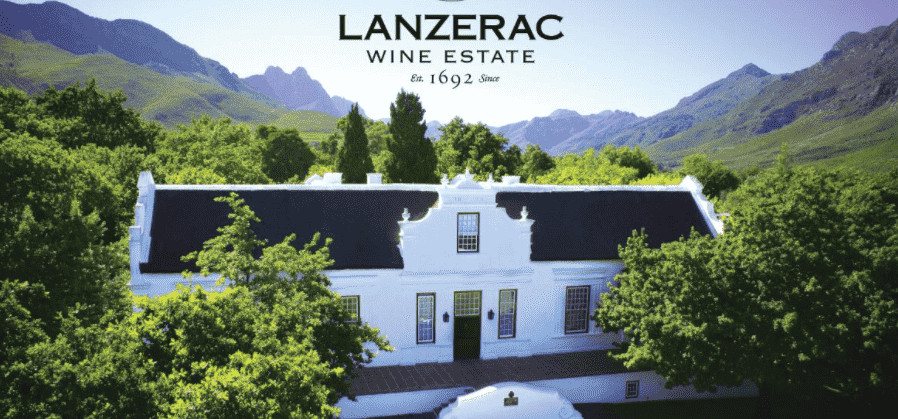
Lacking our sober, Germanic taste, they erected horrible kitsch copies of Cape Dutch houses such as Groote Schuur or destroyed the original architecture as at Lanzerac to add servants quarters. Otherwise, they removed those stately gables.

Today the ANC regime is continuing the proud tradition of name changes, first brought by the British. They invented “classy” French-sounding names like Lanzerac, replacing the poetic Schoongezicht, meaning “fair countenance”.

The Arts and Crafts movement in Britain further added to the aesthetic degeneration of the Cape in the nineteenth century. Since the ANC came to power and with Afrikaner influence on the wane, we have had a similar explosion of ugly, Tuscan-style buildings on the Transvaal Highveld as another British fashion got imported to South Africa.

A black man in an ugly, quasi-Italian house, speaking English and watching soccer on TV; that is about the contempory definition of British civilisation, as can be seen in South Africa.

Paul Ryan, Ayn Rand and Rachel the wretch

by Ilana Mercer

Even-tempered, tall, dark, handsome and heterosexual: If these qualities were still in demand in Tinseltown’s leading men, the Romney-Ryan Republican presidential ticket would be described as the stuff of Hollywood.

As goes Hollywood, so go D.C. and the country. None of the constituents the Republicans are told to appease – if they are to reclaim the White House on the first Tuesday after the first Monday of November 2012 – is partial to upstanding, good-looking, staunchly Christian, white males.

The ladies, the Latinos, the halt and the lame: These identity groups – political constructs of the left’s making – will be galvanized to lambaste the two leading Republicans for being too attractive, too macho, too white, too Christian and too rich.

And for speaking favorably of Ayn Rand. Ostensibly, at least.

Paul Ryan has come under coruscating attack in the progressive press for admitting that Rand’s peerless defense of the morality of laissez-faire capitalism influenced him.

Despised by the left, reviled by many on the right, Ayn Rand would have appreciated the picture-perfect aesthetic of the Republican duo, if not its policies and political philosophy.

According to CNN, Ryan once addressed the Atlas Society, “a group dedicated to promoting Rand’s beliefs.” In that 2005 speech, he said this:

“I grew up reading Ayn Rand and it taught me quite a bit about who I am and what my value systems are and what my beliefs are. It’s inspired me so much that it’s required reading in my office for all my interns and my staff. … the reason I got involved in public service, by and large, if I had to credit one thinker, one person, it would be Ayn Rand. And the fight we are in here, make no mistake about it, is a fight of individualism versus collectivism.”

Ayn Rand, of course, was no fan of “public service,” unless it was in the service of reversing the damage done to the voluntary economy by legislators. The Republicans’ repeal-and-replace statism doesn’t cut it.

Order lIana Mercer’s brilliant polemical work, “Into the Cannibal’s Pot: Lessons for America from Post-Apartheid South Africa”

At MSNBC, Commissar Rachel Maddow ran the Ryan-Rand clip as though she had stumbled upon a crime scene.

Ryan is “not a fiscal conservative,” asserted Maddow, after the screening. Rather, the presumptive Republican vice-presidential nominee was an acolyte of “this person, Ayn Rand,” spat the TV talker.

“This person.” What disdain the left has for Ayn Rand, who was a trailblazing female – a Russian émigré who instantiated in novel form a comprehensive, thoroughly American philosophy of freedom.

For someone who is considered smart, Maddow sure says a lot of deeply stupid things. Her mindless claim is predicated on the assumption that “fiscal conservatism” and the beliefs of Ayn Rand are mutually exclusive.

While Ayn Rand was no social conservative, she was fiscally conservative. In fact, “fiscal conservative” is just how a libertarian anarchist – more radical than Rand – might describe Rand, who advocated not the absence of government but a night-watchmen government.

“Give me Thomas Aquinas, Don’t give me Ayn Rand,” proclaimed Ryan in a subsequent interview with National Review.

Why renounce Rand in this manner?

Mitt Romney’s pick for VP could have calmed down to a blind panic and simply reaffirmed the influence Ayn Rand had on (the better parts of) his political thought.

The quest for mutually exclusive categories, be it by Maddow or by Ryan, falls flat here. Ayn Rand would have renounced Saint Thomas Aquinas for his faith. But she would be wrong to deny that natural-rights philosophers like herself owed a debt of gratitude to Aquinas, the foremost philosopher of natural law. Aquinas deferred to revelation to justify the natural rights of man; Rand to reason. But does a difference in justification change the fact that the natural rights of man remain unalienable in both belief systems?

Unrelenting in maligning Ayn Rand, Maddow ended on a loud moo:

“In Ayn Rand’s novel, she leads her readers to see the wealthiest people as heroes, heroes that must be protected. The rich are heroes and everybody else is a taker. The more the rich have, the better. The better for everyone. That is not fiscal conservatism, either. It is something else.”

Rubbish. Rand scorned those rich whose ill-gotten gains were derived by using the coercive power of the state – Barack Obama, Harry Reid, Nancy Pelosi, George W. Bush, to mention a few. In Rand’s book, these men have not earned an honest crust.

Rand’s celebrated “rich” were the men and women who bring to market the products and services without which life would be miserable, and for which Maddow is a walking ad.

The clothes she is kitted-out in, her coif, the devices she uses to communicate and transmit her sub-intelligent message, the food she buys cheaply to sustain her efforts – these are all produced, facilitated or brought to market by the invisible hand she labors to lop off.

The “rich” were voted into riches by the only democratic vote – the dollar power of the ungrateful masses, who, like Maddow, cannot do without the computers, software, hardware, hand-held devices, air conditioning, airplanes, apparel – on and on – the rich provide.

The left treats “the rich” as a reified, rigid state-of-being. Ayn Rand – and all men and women of reason – understand that “rich” is a work in progress.

Achieved through voluntary cooperation, riches are a reward for work well done. (Which is why this book is well-worth buying.)

Hillary’s next blood-inspired hoedown

If you care about rebels the world over, as Sens. John McCain, Joseph Lieberman and Lindsey Graham think you ought to, consider the fate of one brave rebel. Stacked as they are with The Dictator’s judges, the courts in this rebel’s country want to place him behind bars for shooting a predator on his property. Ursus arctos horribilis is a wild and extremely dangerous carnivore that thrives in the northwestern parts of this dictator’s dominion.

The tribesman is guilty of no more than aggressively repelling from human habitat a creature that had become brazen, making itself at home near the man’s six young children, as they frolicked.

It used to be that the country’s tribesmen instilled fear in encroaching beasts, animal and human. But due to decades of cultural and legal emasculation, under a succession of like-minded dictators, the queered men folk are no longer licensed to protect home and hearth. If they do, they risk losing their liberty.

One man’s freedom fighter is another man’s terrorist. Our rebel’s plight would never be popularized by CNN’s Anderson Cooper or the rest of America’s journalistic priesthood. For he is an American, one among many.

“Jeremy M. Hill, 33, pleaded not guilty in U.S. District Court to killing a grizzly bear with a rifle on his 20-acre property near Porthill, Idaho, at the Canadian border.

At least five of Mr. Hill’s six young kids, ranging in age from 14 years to 10 months, were home when their dad killed a brown bear that had gone after penned pigs the kids had been raising.

I wonder how many Syrian rebels or regulars President Bashar al-Assad has arrested for shooting wild animals that had threatened their families.

If given the choice, this scribe would choose the absolute right to defend life and property over the democratic vote, any day.

Fighters for the family and the farm are never “rebels.” Or so McCain, Lieberman and Graham would impatiently insist. Wresting dominion from the distributive state: now that’s the defining battle of an “authentic” freedom fighter.

Order lIana Mercer’s brilliant polemical work, “Into the Cannibal’s Pot: Lessons for America from Post-Apartheid South Africa”

Speaking of our Syrian soul mates, the Free Syria Army, aka “The Rebels”: By now you’ve viewed their handiwork. Purity of arms is not exactly their military or moral motto. In footage uploaded to the Internet Aug. 2, members of the Free Syria Army were captured committing war crimes. They lined up pro-government militia against a wall in the city of Aleppo and mowed them down.

Where have we seen a similar scene before? Yes, yes, on YouTube. But YouTube is not a place, America; Libya is.

Backed by American drones and French fighter jets above, another bunch of rebels to whom the U.S. took a shine intercepted Col. Moammar Gadhafi as he fled his hometown of Sirte, dragged him from his vehicle and lynched him then and there.

To these rebels’ blood-curdling harangues of “Allahu Akbar,” Hillary Rodham Clinton added her own ululation. “We came, we saw, he died!” cackled the secretary of state in solidarity, when tidings arrived of the actions of her thugs of choice.

America’s three neoconservative amigos, aforementioned, consider the Syrian rebels and the Syrian people one and the same. McCain, Lieberman and Graham advocate providing their side in the Syrian civil war with “weapons, tactical intelligence, communications equipment, financing, medical supplies” and much more.

Political illiteracy being a precondition for political office, these “three blind mice,” naturally, don’t know Shia from Shinola. Grasping Syria’s ethnic and religious mix is clearly beyond the ken of one John McCain.

A new book, “Revolt in Syria: Eye-witness to the Uprising,” might guide the perplexed in peeling back the onion of the Syrian enigma.

“To put it simply,” writes its Times Literary Supplement reviewer, “the Alawite sect, to which Bashar al-Assad belongs, is favored by the regime. The Christians are in a similar position. Therefore, both of these groups support the government. The Sunnis are a marginalized majority, so many turn to political Islam to find a voice. The Kurds are non-Arabs in an ‘Arab Republic.’ Many do not feel Syrian and even support Israel. Damascenes are isolated and care little for anything outside Damascus.”

The analysis in “Revolt in Syria” makes it clear that the divisions between the factions are in flux. “There are Sunnis who ‘would die for the president,’” as are there anti-government Christians.

The recent slaughter perpetrated by her preferred sect has yet to elicit Secretary Clinton’s familiar hee-haws.

Given her history in Libya, Hillary is likely postponing the hoedown for when her proxies eliminate Bashar al-Assad.

The ‘Great Leader’ Mandela

by Karin Roodt

This week South Africa, and seemingly the entire planet, celebrated Nelson Mandela’s birthday.  Around Mandela a personality cult has been built that exceeds that of a Stalin, a Mao, a Kim Jong Il and a Hitler. In a global survey it was found that Mandela was a more famous brand than Coca-Cola.

The Soviet author A.O. Avdienko wrote the following:

“Thank you, Stalin. Thank you because I am joyful. Thank you because I am well. No matter how old I become, I shall never forget how we received Stalin two days ago. centuries will pass, and the generations still to come will regard us as the happiest of mortals, as the most fortunate of men, because we lived in the century of centuries, because we were privileged to see Stalin, our inspired leader. Yes, and we regard ourselves as the happiest of mortals because we are the
contemporaries of a man who never had an equal in world history.

“The men of all ages will call on thy name, which is strong, beautiful, wise and marvelous. Thy name is engraven on every factory, every machine, every place on the earth, and in the hearts of all men.

“Every time I have found myself in his presence I have been subjugated by his strength, his charm, his grandeur. I have experienced a great desire to sing, to cry out, to shout with joy and happiness. And now see me–me!–on the same platform where the Great Stalin stood a year ago. In what country, in what part of the world could such a thing happen.

“I write books. I am an author. All thanks to thee, O great educator, Stalin. I love a young woman with a renewed love and shall perpetuate myself in my children–all thanks to thee, great educator, Stalin. I shall be eternally happy and joyous, all thanks to thee, great educator, Stalin. Everything belongs to thee, chief of our great country. And when the woman I love presents me with a child the first word it shall utter will be : Stalin.”

The consecration of Stalin as a kind of divine human, was supposed to overcome the ethnic and geographic divisions within the Soviet Union. The entire exercise was seen as necessary, as building unity and consensus in those days perhaps posed the biggest challenge to the Soviet government.

The end result was a cult of the “Great Leader”, a deliberate project to focus dedication and loyalty on the omnipotent leader, whose persona had to show the way in creating the ideal socialist man or woman out of the diverse ethnic groups that found themselves within the same territory.

The parallels with South Africa are obvious: a country of eleven official languages, tribes, races and religions grappling with the oft-repeated governmental wish of “nation building”.

Stalin was not the only “Big Leader” in history. Hitler and Mao were two other well-known examples of successful personalities that attained cult status, incarnating immense power. The tentacles and violations that resulted from such power, are also known today, unfortunately.

Political analysts believe that China’s present success is partially due to the dismantling or deconstruction of the Maoist personality cult which led to the Cultural Revolution.

In April 2003 a train in North Korea caught fire, with the fire spreading to nearby buildings. Several people died because they had tried to rescue portraits of their “Great Leader”, Kim Jong Il, from the flames. A few dubious pictures of the puffy dictator were saved while people, not photos, were consumed by the fire.

The familiar soap opera of the “Great Leader” greets every North Korean opening his daily newspaper over breakfast. If he is having breakfast at all, that is. For North Korean communism causes food shortages, like elsewhere.

To those who believe in slavery and the subjugation of people, cults of personality may make perfect sense. To the propagandists creating and maintaining such cults, so much more so. It is sometimes amusing to contemplate their ridiculousness, if it were not so tragic that people’s souls are stripped of all meaning.

In Togo and Turkmenistan there exists a similar devotion to the “Big Leader”. The Western media like to laugh at such grotesque celebrities, but strangely they do not practise introspection when it comes to their own “Great Leader”, Nelson Mandela.

He is presented as without blemish, without sin, the ideal man, the personification of the only political ideal worth aspiring to; he typically displays all the qualities of the “Great Leader”.

World leaders, the most influential among the influential, fell over each other in the Western media this week to confess their devotion to the Xhosa, to sing the praises of his political ideals and purity.

Worrying, to say the least. Never in history has a personality cult led to anything worthwhile. The smiling “Great Leader” has always brought death and destruction, as well as the worst misery and slavery.

Translated from the Afrikaans by Dan Roodt.

Apartheid revisionism needed

About two weeks ago, Hermann Giliomee, the well-known liberal Afrikaner historian, wrote a scandalous piece in the Afrikaans Sunday newspaper, Rapport. The title was, “Apartheid: was it only evil?” (Afrikaans link)

I have since responded with two articles of my own to his, and we are more or less in agreement that there has been a colossal misrepresentation of what the apartheid system of racial segregation in South Africa was. However, at least one academic from the University of Stellenbosch, Anton van Niekerk, has already attacked Giliomee, describing his piece as “immoral” and “unjustifiable”.

But for decades white South Africans have spent an ever-increasing portion of their taxes on black education, health and welfare, something which the rest of the world has characterised as a “crime against humanity”.

The other day I was speaking to a friend and she told me that Afrikaans was such a nice language because one could still express how one felt, whereas “everything in English had to be so politically correct”. At least that is the way it is in South Africa. Probably in the USA and other countries, it is different. Although I have been astounded to see how intolerant American liberals can get about views on race that differ from their own.

To appreciate what a major step Giliomee took in coming out with the view that some alternatives to apartheid would have been worse, one has to live in South Africa where every day we are inundated with propaganda about our “evil past”. I grew up in the 1960’s and 1970’s, rode a bicycle in our crime-free streets, saw happily dancing black mineworkers and generally was completely unaware that anybody in South Africa was desperately unhappy. As opposed to today when acrimonious exchanges fly almost continuously between black, white, coloured and Indian, race relations in those days were cordial and uncomplicated. We each lived in our own compartments and did not feel threatened by others. That too, in juxtaposition with contemporary South Africa where whites constantly worry whether they are going to be attacked en masse, chased into the sea by angry, frustrated blacks or fall victim to the daily criminal incidents such as rape, murder, robbery and theft. Whereas South African whites go out of their way to be civil to blacks, even calling them “sir”, which would have been unheard of in the old South Africa, blacks do not seem to return the compliment. Instead they behave absolutely abominably, whether in the extreme form of violent crime or in the imperious arrogance of their politics.

However, that almost idyllic South African past before we adopted the American model of affirmative action, white guilt and forced integration, is nowadays equated with Nazism. In 1939 large numbers of white South African men volunteered to fight Germany together with Britain and the rest of the Commonwealth, yet at some point we became the Nazis. Even Germans look upon us as Nazis. Not only do the Germans feel morally superior to us, but they would rather sell their sleek Mercedes-Benzes and BMW’s to corrupt black politicians than to us. These days, being impoverished, lower middle-class victims of affirmative action, “black economic empowerment” and all the other race-preference measures, we cannot afford German cars anymore and are driving second-hand Korean cars.

After all, the Germans only gassed a few million Jews. We Afrikaners or white South Africans oppressed blacks, which is far worse. We provided them with separate toilets. The fact that they did not have toilets at all before and somehow did it behind bushes or even in full view (as many still do next to our decaying roads), is besides the point, but next to whites-only toilets, Auschwitz and Dachau pale into insignificance.

Many South African liberals have already told me that denying that “apartheid was a crime against humanity” was tantamount to holocaust denial. In fact, two billionaire Jews, the twin brothers Krok, have given us their version of a South African holocaust museum, the so-called Apartheid Museum. That part of the deal was getting a casino licence from the new black government so they could make even more money, is never mentioned. Suffice it to say that we now have a tourist attraction where people can come and participate in the re-imagining of the South African past as a quasi-Nazi nightmare, replete with our own holocaust museum.

Except six million did not die. At least not in South Africa. It was more a case of: six million were born, grew up and proliferated and out of that population explosion and “youth bulge” all the chaotic urbanisation and familiar riots ensued.

Today there are as many, if not more, black riots in South Africa, than ever before. Yet the BBC, ABC, France 2, Reuters and whoever are not filming it. It seems that for blacks to riot under a black government is considered normal whereas every stone thrown or building set alight “under apartheid” was seen as pregnant with meaning, the expression of an entire political philosophy, a deep yearning for democracy. Just today I read in a report from the SA Institute of Race Relations that the most signifcant shift in the South African voting pattern is not that a lower percentage of people want to vote for this well-nigh useless and incompetent ANC government, but that fewer blacks express the desire to vote at all.

But I digress. The fact is that for Hermann Giliomee to have set off his apartheid revisionism, took a lot of courage. In a private letter, he told me that to his great relief he had severed all ties with universities. No-one wishing to keep his post at a university or even get published in academic circles would dare write a piece with such a heretical title: “Apartheid: was it only evil?”

To most sane people, his is a rhetorical question. One only needs to drive around South Africa and see all the overweight, contented blacks walking around in brand-name clothes, driving cars and chatting away on expensive cellphones to appreciate that, contrary to popular belief, our “evil past” had not affected them in any negative way.

Whenever I hear the litany of complaints by blacks about how they have been “disadvantaged” by apartheid – that is another shibboleth of the new South Africa, the “previously disadvantaged” – I feel like asking them: But what would South Africa have looked like without apartheid? Would our GDP have rivalled America’s? Would you have sent rockets to the moon from Soweto? If, despite affirmative action, only a thousand blacks could so far manage to pass the board examination to become a chartered accountant, how on earth would this economy ever have performed better than it actually has under mostly white management and entrepreneurship?

However, the issue goes further. Again, contradicting received wisdom, apartheid, at least the kind of policy espoused by the successive Afrikaner governments after 1948, was not only about providing separate amenities to black and white, so-called “petty apartheid”. It was also a colossal attempt at kick-starting black development. In today’s money, billions were poured into black education, healthcare, training, agricultural development, social services and so on. That was so-called “grand apartheid”, something which few of the hysterical liberals screaming “boycott South Africa” at the time wanted to talk about.

If we are to be heretics, after Hermann Giliomee’s example, we might as well start talking about grand apartheid  now.

By the way, I firmly believe that what a few of us “dissident Afrikaner intellectuals” are doing at present, questioning the racial orthodoxies of South Africa, is of great significance to us, to this country and perhaps even to the wider world that is grappling with similar problems.  For a long time now, we have been labouring under a type of censorhip. Whenever we dared to question our abject guilt, the Luciferian malevolence of our forebears, we would immediately be silenced, ostracised or vilified, so as to suppress those facts or aspects of our past that do not fit in with the “Nazi model”.

What we are really dealing with, and that was the starting point of my recent piece in Afrikaans, published on www.praag.co.za on Sunday, is yet another confrontation between dogma and reason. To Van Niekerk, Leop0ld Scholtz and many of the Media24 or Naspers commentators, it is about maintaining the apartheid dogma as it was established by the foreigners and by the South African Marxists.

Anton van Niekerk feels that it is “immoral” to question the apartheid dogma by simply referring to the facts of National Party policy between 1948 and 1994. At the very least it represents an argumentum ad populum or appeal to the “accepted wisdom” created in the past by left-wing historians and British newspapers.

Therefore, to be an apartheid rationalist today, requires a great deal of courage! A year or two ago at the offices of the South African Human Rights Commission, when I questioned the assertion by an Indian academic from Wits University that “apartheid had killed millions of people”, I was seen as some sort of lunatic. The Wits professor concerned promptly burst into tears and in general I was deemed a heretic.

The point about apartheid is that just about any lie or misrepresentation of if is acceptable today, simply because so many Afrikaners no longer have the courage to speak the truth about our past. Many of the National Party cabinet members are still alive and would easily be able to rectify the falsifications and half-truths by means of a few statistics and statements to the media, but they are simply too lily-livered for that.

Mr. Flip Buys too, of the mighty Soliforum group, says in almost every one of his radio interviews: “I am fighting for a better future, not a better past.” Buys knows very well on which side his bread is buttered and that the questioning of the apartheid dogma would quickly cost him the support of Media24.

But like George Orwell said: ” He who controls the present, controls the past. He who controls the past, controls the future.”

Actually, it is quite ironic that someone like Hermann Giliomee, who has a reputation as a liberal thinker and who spent some time at the University of Cape Town, should defend the current reputation of mostly conservative Afrikaners from the past. But I think part of Giliomee’s feeling that he has to do it, stems precisely from the classic nineteenth-century liberal idea that “there is more than one truth” or that every issue has at least two sides. Of course, that is also a principle of our Roman-Dutch law in South Africa, that every party to a suit has at least the right to put his case.

After my first response to Giliomee on Sunday a week ago, a reader sent me a clipping from The Citizen newspaper. It was made up of a letter that Jaap Marais wrote sometime in the nineties to the newspaper in which he pointed out a few interesting facts and figures, for the benefit of one W.J. Sachs who wrote that “the apartheid government withheld basic education from the black majority”. Naturally, it has become a generally accepted part of the apartheid dogma that blacks had received no education before the ANC took over in 1994. The fact that members of the ANC government are able to read and write at all, will no doubt soon by declared an official miracle by the Pope.

Among other things, Marais shows how only 20% of black children went to school under the United Party government prior to 1948. However, by 1967 the historian C.J. Scheepers Strydom wrote: “one of the changes with most far-reaching effect is undoubtedly the advancement of Bantu in education. Today 85% of the Republic’s Bantu of school-going age are literate – an increase of 600% since 1925. 32 000 teachers are employed in 8 500 schools with 2 million pupils”.

Jaap Marais adds: “In 1948 there were 8 000 Bantu teachers and 336 437 pupils in 3 310 schools. So it is evident that the so-called ‘apartheid regime’ did more for black education than its predecessor.”

While white taxes today are being spent largely on blacks, this was already the case during South Africa’s previous political system. Jaap Marais shows in his letter that the contribution per individual taxpayer according to race in 1970 was the following:

Whites R126

Indians R10

Coloureds R3

Blacks R0,85

In other words, blacks paid only 1/130th of the taxes paid by whites, but received far more from the state treasury!

Marais points out further that the total contributions of the different race groups in the 1980/81 fiscal year were still the following:

Whites R2 053 million

Indians R43 million

Coloureds R39 million

Blacks R100 million

In fiscal 1982/83 whites continued to pay 92,5% of all personal income tax.

After giving these figures, Marais emphasises the stupendous fact denied by today’s dogmatists, namely that in the same decade from 1973 to 1983 we again saw a tremendous rise in expenditure on black education: from R27 million per annum to R475 million per annum. From 1981 to 1985 the increase was equally rapid and shot up from R225 million per annum to R950 million per annum.

Referring to fiscal 1983/84, Marais says: “The government took from the 1,5 million taxpayers a total of R1 733 million for non-white education, averaging R1 107 per white taxpayer. This is how the former government practised affirmative action.”

In 1971 blacks had received 16 percent of the total education budget, but by 1991 it was already 58%, which indicates to what extent the apartheid dogma that “whites withheld education from blacks” rests on a myth.

But Anton van Niekerk and other dogmatists will respond to this by saying that they are not interested in the numbers and hard reality, but in the “moral” aspects of apartheid and segregation to which they refer as “an assault on human dignity” and “dehumanising”.

Van Niekerk writes in Rapport:

“We can therefore not judge apartheid in terms of a sinical, semi-Machiavellian estimation, merely what would have happened to the economy if there were no apartheid. Apartheid is gnawing at our conscience as whites because we have wounded the basic humanity of our fellow South Africans in its essence.”

The question is: why is apartheid “gnawing at our conscience as whites” when all the leaders and inhabitants of the formerly independent black homelands, as well as the Indians and Coloureds who also enjoyed certain privileges above blacks, may walk around with “clean consciences”?

And one wonders why Anton van Niekerk’s version of white guilt only applies to white South Africans or whether he also subscribes to Susan Sontag’s slogan: “The white race is the cancer of history.” Are all whites guilty? At any rate, most Western countries practised some or other form of colonialism or segregation. Until the seventies some of the southern states of the USA, as well as Britain, still applied forms of apartheid or segregation. Why should we be singled out as the scapegoats of the Western world?

Evidently, Afrikaners and SA whites do not need to take moral lessons from Americans, Britons or former National Party supporters like Anton van Niekerk. Today we have the opposite problem: in South Africa and to a lesser extent in the USA and other countries, there exists a system of reverse discrimination and permanent affirmative action by which we are reduced to permanently second-class citizens. Blacks also commit violence against us on a scale which may, at the very least, be called a violation of our human rights and at worst may be seen as a form of genocide.

In the recent past, the silence on black-on-white violence by the media in the USA has been coming under the magnifying glass. It is a disconcerting tendency that black violence, also in our country, is not being examined with the same “moral” spectacles as those used to stare at the South African past. During the conflict between the ANC and the National Party, newspapers regularly published statistics about deaths in police detention, but these days it is not being done anymore. In his book Trou tot die dood toe, gen. Johan van der Merwe mentions that nowadays approximately 700 deaths in police detention occur per annum, which is far higher than at any time during so-called “apartheid”. When are Prof. Anton van Niekerk and other politically correct academics going to start looking at that?

Those who prefer to make use of “moral criteria” should apply the same criteria to the methods used by the ANC to come to power. That is another issue raised by Van der Merwe: The ANC simply ignored the Geneva Convention and committed terror against civilians, both black and white. How are we supposed to feel guilty about the apartheid past when we are being governed by a group of monsters that exploded the Church Street Bomb on 20 May 1983 and committed over 400 necklace murders. (The method of execution by which a tyre is place around someone’s neck, filled with petrol and set alight, the person literally burnt alive.)

It will also be an interesting exercise to compare the human rights record of “Apartheid South Africa” with those of the group of countries that declared apartheid a “crime against humanity” at the United Nations.

Two years ago I visited Sweden. At times I had to stop myself from feeling morally superior to the Swedes, those supporters of the ANC and the anti-apartheid movement. Because our people have done so much more for blacks than Swedes or Norwegians – with all their development programmes in Africa. We only have to look at the extraordinary affluence of South African blacks, against the abject poverty pertaining elsewhere in Africa.

Where apartheid was wrong in my view, was in the burden and responsibility we took upon ourselves to look after other nations and racial groups, administer them, train them and in general assume responsibility for their well-being. In this way, the economic and political failure of the black homelands also became our failure. To this day, the dogmatists are trying to place the blame for deficient black performance on us.

While paternalism in many Western countries is still fashionable and aid money is being handed out in Africa by the billions, we Afrikaners must never again assume Kipling’s “white man’s burden”. The paradox of apartheid is: We are today damned, not so much because we oppressed blacks, but because we demonstrated compassion for blacks, as well as their education, health and welfare.

At present many people want to continue with this, in the name of so-called “reconciliation between the races”. It would be a grave mistake and would only lead to further misery and recriminations. Currently the black man prefers to stand on his own two feet and certainly does not need our help, assistance or even taxes anymore.

The bullshit vilification of whites in South Africa

By Mike Smith

“Dog bites man” is not news, but “Man bites dog” is.

It also applies to spotting bullshit in the news. Stabbing someone to death is just not a white thing in South Africa. It is a black or coloured move. It is what they do, not we. Now if you hear of a white man who shot someone to death, then you can believe it, because that is what whites do…but stabbing? Nahhh. Who are they trying to fool here?

That is what I thought when I read a few weeks ago about five white men and a woman arrested in Boksburg after a 15 year old black boy was stabbed to death in an open field between a black township called Primrose and the white suburb of Boksburg.

Two boys, one 15 the other 18 walked through the field and the 15 yo was beaten up and stabbed to death…apparently by whites wearing balaclavas. Apparently the black mother of Sibusiso Titimani was alerted by a boy who told her. ‘mama ka Sibusiso! uyashaywa uSibusiso ngamabhunu’ [Sibusiso is being beaten up by the boers],”

Nearby, an innocent white family lived, so the police kicked their doors down at 03h00 in the morning and arrested them. The media splashed it out that 16 guns and 15 swords were found together with camouflage clothing and wait for it…the obligatory “Nazi-badge” that was obviously thrown in by the police.

Apparently, presumably and allegedly, according to the media, they carried out the killing of the 15-year old black boy in revenge for the killing of rightwing leader Eugene Terreblanche.

The story made international headlines. British newspaper’s vilification of white South Africans

Even their names were splashed all over the newspapers. “Susanna Harmse, 50, was arrested on Friday with Wesley Courtney, 27, Christopher Duvenage, 25, Daniel Harmse, 19, Abraham Harmse, 50, and Christopher Harmse.” Source

All Afrikaners then. All rightwing fanatics and murderers… right?

Now at this stage anybody who grew up in South Africa would know exactly what happened here.

The 18-year old friend of Sibusiso beat him up and stabbed him to death in the field and then blamed it on the “white peoples”… but proclaiming the obvious truth would be akin to sacrilege, for these noble savages are little angels who can do no wrong and the whites are the evil devils, yadda yadda bullshit!

The sensationalist black newspaper Sowetan and its 3rd-rate reporters such as Mogomotsi Selebi obviously tried to climb on the mudslinging band wagon and rubbed it in… “Heavy caliber guns, ammunition and rightwing emblems…” were found. Sowetan sensationalist bollocks

The MSM tried their best to turn this into a racial hate crime and blacks demonstrated against the whites outside the court.

Well it subsequently turned out that the police ended up with egg on their mugs seeing that the “heavy caliber guns” were mere pellet guns and the rest of the weapons and ammunition were all legal and registered. Further… all charges were withdrawn because the state found “no connection whatsoever” between these people and the murdered boy. They had solid alibis and none of them could be pointed out in an identity parade.

The judge had the following to say. “Somebody is going to have mud on their face,” said Snyman. “We heard that many firearms were found in your possession, but they were pellet guns. People get so upset, they come outside court toyi-toying, (but in the) meantime these people have not even been pointed out… It’s always much better if you hear all the evidence. There is nothing against the accused as it stands.” ET revenge murder charges withdrawn

The family’s lawyer, Boela van der Merwe, said the wrong message had been sent about his clients to the community of Primrose.

“The whole matter was not properly investigated. As the magistrate said, there will be mud on someone’s face.

“People jumped to the wrong conclusions.”

But you see… this is how propaganda works. Because the articles that were originally posted, were on the front pages all over the world. But then when the people were acquitted, the international media never mentioned it. They have slung the mud and some stuck… they are not going to wash it off now.

They achieved exactly what they wanted to. The vilification and blackening of the White South African, especially the Afrikaners.

The ANC’s second revolution (okay, ‘transition’) against whites

by Dan Roodt

South Africa, like Cuba, is the last outpost of communism. Elsewhere in the world, experiments in collective farming and nationalisation have been abandoned as the grim mistakes of nineteenth-century radicalism, issuing forth from the bearded Karl Marx, scribbling away in the British Library.

However, behind Karl Marx there was a capitalist, Friedrich Engels, who bankrolled him and actually paid him to pour forth his books and pamphlets that would sow discord and resentment for more than a century.

The ANC, like many of the “tenured radicals” at South African universities, loves Karl Marx. The class struggle is their favourite nursery tale. And if you could add that the capitalists are actually white, then it’s no longer Little Red Ridinghood; it’s Little Red Soldiers marching from one conference to the next.

Unlike most journalists and newspaper pundits, I have actually read the ANC’s document on “the second transition”. Not so long ago, the ruling party – maybe we should capitalise “Party” as is communist practice – entertained us on the notion that South Africa was going through a two-stage revolution. Classical marxist theory holds that all of human history advances through a succession of “epochs”, culminating in “the most advanced stage, the classless society, or communism”. That is when people start queuing for bread, potatoes, shoes or waiting ten years to buy a two-stroke-engined car with nineteen-fifties technology.

At one point Cuba was going back to the bicycle. Not that I have anything against bicycles; on the contrary. Quite a few of our BEE moguls and traffic cops taking bribes alongside the roads, bulging out of their blue uniforms, could do with some exercise.

But to go back to stone age economic principles – “sharing” things around the camp fire – is a great leap backwards, if you will pardon the pun. In fact, Mao’s “great leap forward” was another communist cliché floating around the ANC’s Midrand conference yesterday.

According to Marx and Engels, there is first a political revolution, alternately called a “bourgeois revolution”, before the real transformation, the social revolution, begins. In the case of Russia, the “capitalist epoch” lasted only a few months, from February to October 1917, but we need not detain ourselves with such finer details. In ANC parlance, the transition of 1994 when De Klerk fired all his generals and handsupped before the Party’s militia, Umkhonto we Sizwe, was the political or “National Democratic Revolution”.

Until now, the second or social revolution has been chomping at the bit within the Luthuli House stables, ready to propel its bright-eyed, sushi-chomping jockeys into the apocalyptic dawn.

According to Jacob Zuma yesterday, the enemy, the class enemy, to put it more politically correctly, seems to be so-called white males. South African marxists have always confounded race and class. Mbeki, the great black marxist – or should I use the fashionable euphemism, “progressive” – intellectual, used to rave quite frequently about the white ruling class while he was still president. Or maybe Mbeki was just too habitually drunk to realise that putting yourself forward as a victim while you are wearing the crown represents a colossal contradiction.

However, not so long ago I read that 75% of white males over 50 were self-employed. That is only logical as BEE and affirmative action have already swept South African corporate life, not to mention the civil service and municipalities. Most municipalities are now all-black, with whites actually doing the cleaning. Our municipalities must have the most highly educated cleaning staff in the world; apparently some of the people wielding brooms and mops have postgraduate qualifications. But they happen to be white, which is a fatal handicap in the Republic of South Africa.

Younger white males are hanging on in the SME’s where racial headcounts are pursued with lesser fervour. In fact, a survey that I found on the internet yesterday showed that one in four white males of all ages was actually self-employed in 2006. By now the figure must be far higher.

So maybe the ANC, in its racial-marxist zeal, pursuing the Second Coming – wasn’t Mbeki also fond of quoting his favourite Xhosa poet, William Butler Yeats? – is barking up the wrong tree, “full of passionate intensity”.

One of the few people I mostly agree with in South Africa, is liberal historian Hermann Giliomee. I think that is because we both look at the current situation from the vantage point of history. Not… fantasy. He recently told me that he was just glad to have severed all ties with universities. In fact, the universities have become little ANC kindergartens, producing the type of pompous, quasi-marxist “papers” of which the ANC’s latest policy document is but a carbon copy.

We have to acknowledge that race, not class, is what the South African revolution is all about. That is why the white male bogeyman will be brandished, even if most of us white males eke out a measly living doing odd jobs on our computers in SOHOs. For those less familiar with American acronyms, that is “small office home office”. While the BMW-driving, black bourgeoisie are feasting out there, living it up in five-star hotels and bleeding this country dry.

To understand black identity, we have to look at America and a book such as Jared Taylor’s recent White Identity – racial consciousness in the 21st century.

In a nutshell: whites, with the exception of a few so-called “right-wing Afrikaners”, no longer have an identity. Blacks, on the other hand, are completely lacking in any European class consciousness. Their only consciousness is one of race. Not being very culturally assertive and preferring English as their means of communication, their only identity is being black, which may be further enhanced by hating whites.

Ultimately, the second revolution is not about poverty, equality, redressing past wrongs or any of the usual clichés offered by the ANC. It is about the black elite affirming its own identity.

Like Narcissus, they are looking at themselves in the mirror, whispering: “I am black, so black.” All other consequences flow from that existential premise and experience.

When I was a student, some of the campus radicals used to call it “black-being-in-the-world”. It had a kind of Heideggerian ring to it.

South Africa is going to pay a very high price for that singular mode of being.