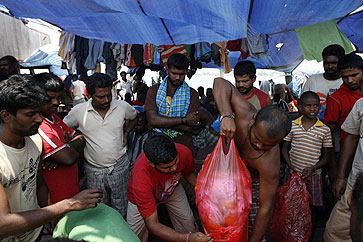
Record 4,200 migrants rescued at sea by Italian coastguard

Up to 4,200 migrants sailing across the Mediterranean Sea were rescued by European ships on Friday, but 17 people died during the journey on unseaworthy boats. The number rescued in 24 hours appears to be one of the highest in recent years.

The 17 bodies were found on three inflatable dinghies, from which over 300 other migrants were rescued alive, the Italian Navy said on Twitter.

Friday’s rescue operations were led by the Italian coastguard, and involved German and Irish naval ships working under the auspices of the EU’s Frontex border agency.

A similar international maritime mission off the coast of Sicily on Thursday resulted in the rescue of over 700 migrants from Libya in six boats.

So far, the busiest days this year have been on April 12 when 3,791 migrants were rescued and the May 2 rescue of 3,690 people.

According British activist John Wight, the drowning of hundreds of refugees in the Mediterranean is “a crime against humanity,” and “the ultimate responsibility lies with Western governments that have proved themselves the enemy of everything good in the world and a friend to everything bad.”

Over 40,400 boat migrants, many of them fleeing poverty and conflict-stricken countries such as Syria and Eritrea, have arrived in Italy since the start of the year, according to the International Organization for Migration (IOM).

New statistics gathered by IOM confirm 2015 appears to be “an even deadlier year than 2014,” when nearly 3,300 migrants perished trying to enter Europe. While last year the number of migrants dying in all Mediterranean crossings from January to April was 96, this year’s toll is an estimated 1,770 so far through to April 30, IOM said.

IOM’s team in Italy has recently reported a persisting trend of growing numbers of women from Africa, particularly Nigerians.

“In the first four months of 2015, we have registered an increase in the number of incoming Nigerian women – three times as many as during the same period last year. There are well-founded concerns that many of them may be victims of trafficking,” Federico Soda, Director of the IOM Coordination Office for the Mediterranean in Rome, stated earlier this month.

By mid-May, some 62,500 people had crossed the Mediterranean, and at least 1,800 have died, the agency added.

“It happens a lot in waves, you could have a few days where nothing happens, then there can be a high number of arrivals at the same time,” Flavio di Giacomo, a spokesman for the IOM in Italy, told AFP.

Speaking in Lisbon on Friday, Tunisia’s Prime Minister Habib Essid said his country will consider the naval campaign the EU plans to curb the migrant problem “almost a military intervention.”

Essid added that it will not help, as “if you stop the boats in this area, they will just move to the other side.”

Cannes: Immigrants 1, Lesbians 0

The debate around the world about what to do with growing waves of desperate migrants will be spurred by a Cannes Film Festival triumph for a movie that looks at the plight of a refugee hero.

“Dheepan”, a French movie about a Sri Lankan former soldier’s struggles in a Paris ghetto in the grip of narco-gangs, didn’t set out to tackle that wider thorny issue.

But the fact that the film’s win comes as refugee boats set off across Asian waters and the Mediterranean — the same sea lapping at glittering Cannes and its super-yachts — inevitably means it will figure in that context.

“It’s important to reflect on the situation,” the movie’s director, Jacques Audiard, admitted to reporters insistently raising the question.

But he stressed, “I started writing the screenplay four or five years ago and the situation wasn’t as critical as it is now”.

Nevertheless, “if it helps the situation, then so much the better”.

The movie won’t begin its release in cinemas for another three months. Its Cannes win will no doubt take it to countries that might otherwise have not seen it.

Some of those countries are ones grappling with the problem of immigrants.

A Hungarian movie taking viewers inside Auschwitz, “Son of Saul”, picked up the runner-up Grand Prize for its narrow but powerful look at the Holocaust.

The best actress award was something of an upset, confounding critics who had thought Australian star Cate Blanchett was untouchable for her turn in an American period lesbian drama, “Carol”.

Instead Blanchett’s co-star, Rooney Mara, and an actress in a French relationship drama called “Mon Roi”, Emmanuelle Bercot, ended up sharing the trophy.

Israel tells Africans to leave or face prison

Israel is telling black Africans they must leave now or face an indefinite stay in prison.

Israeli authorities are sending letters to the first of 45,000 Eritrean and Sudanese refugees, informing them they have 30 days to accept Israel’s offer of $3,500 in cash and a one-way ticket home or to an unnamed third country in Africa, or face incarceration at Saharonim prison.

Israeli leaders have proclaimed that their tough approach — building a fence along its border, denying work permits for illegal migrants, forcing them into a detention center in the desert — may ultimately save lives by dissuading migrants from attempting a perilous journey. Critics of the Israeli policy counter that a country built by refugees should be more accepting of those fleeing war, poverty and oppression.

But these days, even liberal Europe is considering a more muscular approach. The European Union began a push Monday for U.N. authorization to deploy military force in the Mediterranean to stop migrant smuggling ships.

The new measures to press the Africans to leave Israel comes at a time of heightened fears among the refugees, who were stunned last month by a widely circulated video allegedly showing three Eritreans who left Israel killed by Islamic State militants in Libya. Friends and relatives said they had traveled there in a bid to reach Europe.

“We saw the video, but we thought maybe it wasn’t true, maybe it was just a hoax,” said Aman Beyene, an Eritrean asylum seeker who has spent 14 months at an Israeli detention center.

“Then we spoke to an Eritrean boy who had witnessed the killings, and we knew it was true,” Beyene said.

The 38-year-old Eritrean accountant sat at a picnic table in the dirt parking lot of the Holot detention facility, a compound of single-story cement-block dormitories housing 2,000 Africans, surrounded by a fence spooled with razor wire in the Negev desert.

Beyene spoke slowly as he recalled watching the video showing a man thought to be his friend Tesfay Kidane, 29, dressed in an orange jumpsuit beheaded on a beach in Libya by Muslim extremists. He said Kidane felt despondent being cooped at the Holot facility, so he accepted the Israelis’ offer to be flown to a third country — likely Uganda or Rwanda — and from there made his way to Libya, where he was kidnapped by the Islamic State.

Though the detainees at Holot are free to leave the compound during the day, the nearest city is an hour’s bus ride away and the men are forbidden to work. If they fail to return by nightfall, they are sent to a prison across the street.

Interviews with Eritreans and Sudanese at Holot suggest that many are still dreaming of reaching Europe through the chaos of Libya — despite knowing that more than 1,800 Africans have drowned in the Mediterranean Sea this year and others have been taken captive by the Islamic State.

“Being beheaded by ISIS or sinking on a boat is scary,” said Mutasim Ali, 28, who arrived in Israel in 2009 from the Darfur region in Sudan and has spent the past year detained in the detention center. “But you can’t really stay here, wasting your life, doing nothing.”

He pointed to the men like him who spend their days milling about in circles, staring at their mobile phones, waiting for the next meal.

Before Israel began cracking down on African migrants a few years ago, the Africans were highly visible in bustling cities, working in kitchens and doing menial labor. There are still neighborhoods in south Tel Aviv filled with Africans. Many Israelis complained they were being “invaded.”

Source: Washington Post

Biggest political upset in the Netherlands after asylum announcement

The political upset this week does not come from France, where Marine Le Pen came out stronger in local elections, but from the Netherlands.

The largest party, the liberal VVD has announced that it wants to abolish asylum completely for non-Europeans, meaning black Africans.

The VVD wants to convince other European parties in Europe to adopt a new ‘Fortress Europe’ policy.

This is the first time that a European mainstream party is adopting an openly anti-immigration stance. The proposal is that African countries should rather receive asylum seekers.

Ostensibly the party is worried about “drownings” when tens of thousands of Africans perish at sea in the hazardous journey to Europe.

Last year some 3000 drowned and the VVD says it wants to put an end to this. The real reason is that vast majority of people making it to Europe won’t get asylum, but as illegals they soon join the crime circuit.

During the recent Staten elections, the main voice for immigration and a multicultural hodge-podge, the PvdA, lost the election decisively.

The idea to “shelter refugees in their own region” actually calls the bluff of the European asylum-industry.

Not a single economic refugee will travel to Morocco, Ethiopia, Tanzania and other “designated safe countries”, for the simple reason that hand-outs don’t exist in these countries.

The VVD for the first time is siding with parties like the Front National and the PVV.

Backdoor for jihadists?

Top U.S. counterterrorism officials say they worry a potential terrorist could be hiding among refugees who are looking to come to the United States after escaping the brutal war in Syria.

“It’s clearly a population of concern,” the director of the National Counterterrorism Center, Nicholas Rasmussen, told the House Homeland Security Committee on Wednesday.

Committee Chairman Mike McCaul, R-Texas, went further, saying it would be a “huge mistake” to bring refugees from the conflict to the U.S. – even as an estimated 4 million children, women and men have been forced to flee Syria and another 7 million have been displaced from their homes there, unable to leave.

Senior officials leading the State Department’s refugee efforts say the U.S. government has a long history of caring for the innocent victims of war.

“It’s not a matter of should we do it, it’s really a matter of how we do it,” Larry Bartlett, the State Department’s director of Refugee Admission for the Bureau of Population, Refugees and Migration, told ABC News. “One of the fundamental principles of our country is that we care about others. We will help others.”

With tens of thousands of Syrians joining groups in the region like the Islamic State, the U.S. government “cannot allow the refugee process to become a backdoor for jihadists,” Republicans added.

Source: Yahoo News

Finland shuts door on black refugees

Refugee quotas have significantly been reduced by Finnish municipalities

Finnish municipalities have significantly cut quotas on receiving refugees from foreign countries.

Refugee quotas have significantly been reduced by Finnish municipalities, with just 40 of them signaling readiness to receive refuges, local media outlets reported.

Last year, the municipalities received more than 1,000 refugees, a record number that experts attributed to additional government funding and the Syrian conflict.

In addition, Finland increased the quota for refugees from 750 to over a thousand.

This year, the refugee quota stands at 1050, but it is unlikely to be implemented in time.

Meanwhile, the regions of Satakunta and South Ostrobothnia have said that they will not receive refugees this year.

The regions of Uusimaa, Ostrobothnia and Pirkanmaa will receive the majority of refugees — 160, 120 and 100 respectively.

As for the major cities, most refugees will be received by Tampere and Kuopio, while Helsinki and Turku will only receive a dozen people each.

People fleeing Syria remain refugees of choice for Finnish municipalities, while refugees from the Democratic Republic of Congo are reportedly the most unwelcome people.

Source: Sputnik News

UN urges US to welcome immigrants as refugees

United Nations officials are pushing for many of the Central Americans fleeing to the U.S. to be treated as refugees displaced by armed conflict, a designation meant to increase pressure on the United States to accept tens of thousands of people currently ineligible for asylum.

Officials with the U.N. High Commissioner for Refugees say they hope to see a regional agreement on that status Thursday when migration and interior department representatives from the U.S., Mexico, and Central America meet in Nicaragua. The group will discuss updating a 30-year-old declaration regarding the obligations nations have to aid refugees.

While such a resolution would lack any legal weight in the United States, the agency said it believes “the U.S. and Mexico should recognize that this is a refugee situation, which implies that they shouldn’t be automatically sent to their home countries but rather receive international protection.”

Central Americans would be among the first modern migrants considered refugees because they are fleeing violence and extortion at the hands of criminal gangs.“Unaccompanied children and families who fear for their lives and freedoms must not be forcibly returned without access to proper asylum procedures,” UNHCR official Leslie Velez said in testimony submitted to the House Judiciary Committee late last month.

Immigration experts in the U.S. and Central America say the flow of migrants from Honduras and El Salvador is likely to rise as the two countries experience gang-related violence. Honduras, a primary transit point for U.S.-bound cocaine, has the world’s highest homicide rate for a nation that is not at war.

Salvadorans heading north through Mexico who were interviewed by The Associated Press last month said there also was fear of the “Sombra Negra,” or “Black Shadow” – groups of masked men in civilian clothes who are believed responsible for extrajudicial killings of teens in gang-controlled neighborhoods. The Salvadoran government denies any involvement in death squads, but says it is investigating the reports.

Source: CBS

Oz offers asylum seekers money to go home

The Australian government is offering asylum seekers on Manus Island and Nauru detention centres up to $10,000 to abandon their hope of resettlement in Australia and voluntarily return to the country they fled from.

The revelation comes as the High Court on Friday issued a stunning rebuke to the Abbott government’s border protection policy, striking down its decision to to refuse to issue permanent protection visas to boat arrivals found to be refugees.

In two unanimous decisions, with implications for thousands of boat arrivals, the court ruled that Immigration Minister Scott Morrison’s decision to impose a cap on the number of places in Australia’s refugee intake for boat arrivals was invalid.

The sudden boost in payments is the latest tactic being used by the Abbott government to cement its hardline stance against asylum seekers who come to Australia without a visa.

In what are dubbed as “return packages”, the Coalition has dramatically increased monetary incentives for asylum seekers to return home that range from $3300 to $10,000 based on “individual circumstances”, compared with Labor’s offering of between $1500 and $2000 last year.

The UN High Commissioner for Refugees on Friday showed Australia’s efforts to help alleviate the crisis have stagnated or worsened, with the country sliding backwards in the global rankings, according to some measures.

Australia now ranks 17th in the world to resettle refugees, according to the Refugee Council of Australia.

Asylum seekers who take up the cash offer are transported to the Hideaway Hotel in Port Moresby that is paid for by the International Organisation of Migration before being flown back to their country of origin.

Fairfax Media understands Lebanese asylum seekers are being paid $10,000 if they voluntarily return to Lebanon, while Iranians and Sudanese are being offered $7000, Afghans are being given $4000 and Pakistani, Nepalese and Burmese asylum seekers are receiving $3300.
Immigration Minister Scott Morrison confirmed that 283 people had voluntarily returned home since September 2013.

It is understood the payments, which are administered by the IOM but funded by the Australian Immigration Department, are made once the asylum seeker has returned to their home country.

Mr Morrison said the packages were tailored to each individual case. “The process of voluntary return is conducted in direct partnership with the International Organisation for Migration which has extensive experience in such matters worldwide,” a spokesman for Mr Morrison said. “All such returns are voluntary. The IOM does not facilitate involuntary returns,” he said.

Yet in a motion before the Senate, the Greens are urging the government to put a moratorium on sending asylum seekers back to Iraq, where a violent uprising continues to swallow the country.

It is not known whether any money has been offered to Iraqi asylum seekers to leave the centres. Only two days before the violent clashes in the north of the country, an Iraqi man on a bridging visa was forced back to Basra, Iraq by the Australian government, it was revealed on Friday.

Source: smh.com

Fighting on the streets in Germany over refugees

Members of the Pro Deutschland group at a similar protest a year ago

German police kept angry rival protesters apart Wednesday during a third day of demonstrations in suburban Berlin over a new shelter for asylum seekers.

The conflict on the streets over a recent upsurge in refugee arrivals has spilled into violence this week. However Germany’s government rejected a call to summon state leaders for crisis talks about how to handle a recent upsurge in arrivals.

On Tuesday evening, the far-right National Democratic Party (NPD) demonstrated near the newly opened shelter, a four-storey former school in a housing estate built in Hellersdorf, east of Berlin.

Leftist counter-demonstrators then blocked a tramline nearby. During a melee between them and police, one officer’s cheekbone was broken by a hurled bottle. City police said they made 25 arrests.

Pro Deutschland, an anti-Islam group that has previously demonstrated against mosques, held a protest about 1 kilometre from the site, but there was no violence. Police fielded 300 officers.

With a general election on September 22, mainstream parties are wary of the deep divisions on the issue of refugees. Far rightists want to expel foreigners, whereas many liberals favour friendly immigration laws.

Most refugees in Germany enter without documents and apply for asylum after arrival. There has been a sharp rise this year in arrivals because of the conflicts in Syria and Afghanistan.

Wolfgang Bosbach, a conservative in Chancellor Angela Merkel’s Christian Democratic Union, urged local, state and national leaders to hold crisis talks, warning that extremists would exploit the issue.

“The government is aware that the increase in the numbers of refugees is posing a major challenge for the states and the regions,” an Interior Ministry spokesman said. “We are working closely together with them and therefore see no need for a crisis meeting.”

He said 5,000 approved refugees from the Syrian conflict would begin arriving at the end of August or early September under a relief plan. Nearly 12,000 other Syrians had reached Germany and applied for

asylum.

“We take the concerns of people about the refugee situation seriously,” he said.

The 200-bed overflow hostel at Hellersdorf has been set up in a low-income area of the capital where divisions run deep. Hellersdorf is an area of apartment blocks built by the communist authorities.

In the 23 years since reunification, attacks on foreigners have been especially common in the former communist east, where unemployment is high and populists accuse immigrants of taking away jobs.

Germany allocates asylum seekers to hostels across the country while their applications are processed. They are not allowed to work.

On Monday, the first 42 residents arrived at the shabby overflow hostel at Hellersdorf. A pro-refugee Berlin group said six people moved out again in fear for their safety. – dpa

Not white enough for Oz

Australian Prime Minister Kevin Rudd on Sunday said he made “absolutely no apology” for his hardline new policy on asylum-seekers under which they are sent to Papua New Guinea.

Rudd quickly moved to announce a radically reshaped immigration plan under which boatpeople could be resettled in PNG, sent home, or to a third country but not Australia. His new stance reinforces the notion that Australia wants to remain a white country.

Not white enough for Oz

Under the directive, those who pay people-smugglers to arrive on unauthorised boats will be sent to the poor Pacific nation for processing and resettled there even if found to be genuine refugees.

“On the question of asylum-seekers… we’ve had to adjust our policy over time and I make absolutely no apology whatsoever for our current policy settings because the world around us has changed,” Rudd told Channel Ten.

Rudd, who was last month reinstalled as prime minister by his Labour colleagues to help turn around dire polls in an election year, had previously softened some of the former conservative government’s policies.

The plan has worried the United Nations refugee agency which said on Friday that conditions at Papua New Guinea’s Manus Island facility currently failed to adequately protect refugees.

“UNHCR is troubled by the current absence of adequate protection standards and safeguards for asylum-seekers and refugees in Papua New Guinea,” it said in its first assessment of the policy.

Australia resumed sending asylum-seekers to Manus Island and the Pacific state of Nauru in 2012 in a bid to deter record numbers of migrants arriving by boat, hundreds of whom drowned en route.

Rudd has said the new PNG policy will take some time to deter asylum-seekers, but since he announced the change just over a week ago more than 1 300 have arrived on boats.

‘You will not be settled in Australia’

“It is the implementation of that policy direction over time, resolutely, which will yield results,” he told Network Ten’s Bolt Report.

“In the interim, people smugglers will test your resolve.”

Asylum-seekers are a sensitive issue in Australia, and one set to feature prominently in the election due this year.

Rudd said while people-smugglers, who make thousands of dollars bringing asylum-seekers to Australia, would test the government’s resolve “we are not for turning”.

“Our policy is very clear… you will not be settled in Australia,” Rudd said. AFP

Attacks on foreign Africans ‘a threat to democracy’: South African minister

A foreign African set alight by local South African blacks

The inhumane and degrading treatment of African foreign nationals is a threat to democracy and freedom in South Africa, Home Affairs Minister Naledi Pandor said on Thursday.

“Our brothers and sisters on the African continent played an important role in the achievement of democracy and freedom in South Africa,” she said in a speech prepared for delivery in Pretoria for World Refugees Day.

“They extended hospitality and asylum to many of our exiled leaders and their families during the oppression of apartheid.”

She said Zimbabwe, Mozambique, Angola, Lesotho, Zambia, Tanzania, and Botswana paid an “even higher price” for supporting the anti-apartheid struggle.

“Many of their citizens perished in raids into their territories by the apartheid security forces.”

She said using force or threats of violence to resolve grievances in South Africa was unacceptable.

“Anti-immigrant violence is inseparable from the evil of racism. The insidious nature of rising levels of ethnicism in our society is another cause for concern.

“We need to re-commit to the non-racialism we believed in during the days of our struggle against apartheid. We need to teach our young people to recognise bias, intolerance, and racism and arm them with the skills to combat these forms of discrimination.”

She said more needed to be done to teach people the value of diversity and the advantages of living with people from different cultures.

“We will not shirk our responsibilities under our refugee law or international conventions. South Africa remains one of the most liberal countries in regard to the benefits asylum seekers and refugees are allowed in our country.”

In South Africa, refugees and asylum seekers could move freely, work and enjoy basic services, Pandor said.

“It is true that we do not grant refugee status easily. Show me a country that does. But we do take longer than we should in determining refugee status.

“We are taking steps to process applications more efficiently and fairly.

We are reviewing our procedures and implementing a fast-track capacity to process application status.”

Her department was working with international organisations to strengthen partnerships so “durable” solutions could be found for problems affecting refugees. South Africa was always open to refugees.

“Because we understand the importance of family and we understand the pain of losing the support and security of a family,” she said.

“I would like to reassure refugees here today of our admiration and support for [their] strength and resilience in the face of huge adversity.” – Sapa

UK ‘very reluctant’ to arm Syrian rebels

William Hague, British Foreign Secretary

Britain said on Sunday it and other countries were “very reluctant” to arm rebels in Syria even as it warned that success on the battlefield by forces loyal to President Bashar al-Assad was undermining chances of a Geneva peace conference.

Britain and France worked together last month to lift a European Union embargo on arms shipments to Syrian rebels, giving them the flexibility to send weapons to forces who complain they are dramatically outgunned.

But Foreign Secretary William Hague said on Sunday that no such decision had yet been taken and promised for the first time to give MPs a vote in parliament if and when it was.

“There would be a vote one way or the other,” he told BBC TV, saying Britain and the world were faced with an agonising foreign policy and ethical dilemma.

“People have understandable concerns about the idea of sending arms to anybody in Syria and we’d all be very reluctant to do that,” he said.

“On the other hand, at the moment, people are being killed in huge numbers while the world denies them the right to defend themselves.”

Hague’s intervention comes as U.S.-Russian efforts to convene a peace conference in Geneva are faltering after the rebels lost control of the strategic border town of Qusair last week, weakening their negotiating hand.

One rebel commander has since been quoted as saying the opposition will boycott a peace conference unless it receives arms.

But Prime Minister David Cameron’s government is split on the issue with some ministers fearing such a move could worsen the bloodshed and drag Britain into a protracted conflict.

Hague said he was gloomy about the prospect of a Geneva peace conference.

“The regime has gained ground. That makes the Geneva conference harder to bring about and to make a success. It makes it less likely that the regime will make enough concessions in such negotiations, and it makes it harder to get the opposition to come to the negotiations.

“They’re not coming together in the next couple of weeks. I find that worrying and depressing,” he added.

The United Nations estimates at least 80,000 people have died in the Syrian conflict.

U.N. humanitarian agencies launched a $5 billion (3.2 billion pounds) appeal on Friday, the biggest in their history, to cope with the fallout from the fighting that has sent some 1.6 million refugees fleeing to neighbouring countries. – Reuters

(Reporting By Andrew Osborn; Editing by Andrew Heavens)

South Africa detaining refugees and migrants ‘unlawfully’

The department of home affairs (DHA) is unlawfully detaining refugees and migrants and forcing costly court actions to fight for their release, Lawyers for Human Rights (LHR) said on Wednesday.

“The detention of refugees and migrants is carried out in an unlawful manner,” said LHR refugee and migrant rights programme head Kaajal Ramjathan-Keogh.

“Despite repeated engagement with [DHA] we’ve encountered a lot of difficulty in releasing people without resorting to the courts,” said Ramjathan-Keogh.

She was speaking at the release in Johannesburg of an LHR report, “Monitoring Detention in South Africa”.

LHR attorney Thandeka Duma said Home Affairs “seemed to have dysfunctional internal systems”.

Home Affairs spokesman Ronnie Mamoepa declined to comment on the report as the department had not yet read it.

“We’ve not had sight of that report to enable us to comment intelligently,” Mamoepa said.

“However, the department remains committed to discharging its mandate within the framework of the law, the Constitution and the framework of international obligations.”

Duma said that under the Refugees Act, asylum seekers were allowed to move freely while their applications were being considered. They were allowed to remain in the country until the entire application process, including appeals, was exhausted.

However, the DHA in many cases was only using the Immigration Act, which allowed for the detainment of undocumented migrant, in contravention of previous court rulings.

“Courts ruled [DHA] will not read the Immigration Act in isolation,” Duma said.

She said DHA maintained that it is following the law.

“However, this claim is totally contradicted by the evidence in this report and elsewhere,” Duma said.

She said attempts to intervene for the release of improperly detained migrants and refugees with the department had been unsuccessful, forcing LHR to seek recourse in the courts.

In the year covered by the report, LHR won 18 of its cases and secured the release of 41 improperly detained people, a win rate of about 95 percent.

LHR was also awarded costs — although less than it believed was owed –and this was a significant cost to the state.

“We are of the view that such costs are a waste of taxpayer money,” Duma said.

“The court should hold home affairs’ officials personally responsible for court orders that are not followed,” Duma said.

She said LHR, along with many other NGOs, had been denied access to immigration facilities such as the Lindela repatriation centre in Krugersdorp and was only able to meet clients outside it.

“We are also concerned by the continued lack of independent monitoring in immigration detention facilities.”

She said the SA Human Rights Commission was the only body allowed in and had not released a report on conditions inside Lindela since 2000.

SAHRC legal consultant Sugne Niemann said the organisation did inspect Lindela earlier this year and made regular visits.

She could not comment on whether the SAHRC would release a report on conditions inside the repatriation facility, referring questions to the SAHRC’s provincial office.

The SAHRC provincial office could not immediately provide comment on their visits to Lindela. – Sapa

If Africa is more like Singapore, why are we getting so many refugees?

by Dan Roodt

Living in South Africa, one gets used to being called a moron by every visiting foreigner, especially ones of the liberal to left-wing persuasion. After all, they seem to reason, we do not know anything about our own history. We do not understand our own country or our own continent. Nor do we have any grasp of Africa or African culture, despite many of our people speaking African languages and compiling dictionaries in those languages.

The same goes for what is called the mass media. The bigger and more influential they are, the more you will find the view that the average Afrikaner or white commentator in this country is a barely literate buffoon. Many a time I have come across the phrase about this country: “Apartheid destroyed South Africa.”

If you had flown in an aeroplane over South Africa in 1994, shortly after Nelson Mandela became president, you would have seen just how “destroyed” South Africa was. We had more roads and railways than Great Britain. Having a far bigger surface area also helps, I suppose. At one time we were one of the few countries exporting more food than we imported, notwithstanding being a semi-arid country.

The criteria for measuring progress in Africa seem to differ from other places. Economic growth, income per capita,  life expectancy, quality of life, infant mortality, the level of education, all those ordinary measures of a country’s success or progress are suspended in favour of focussing on, well, some racial element.

The racial element could be the mystique of Africa, its smiling, simple people happily singing to some merry tune like the coffee plantation workers on Karen Blixen’s farm  in the Hollywood movie “Out of Africa”. Or it could be the successful eradication of Western influence, the confiscation of land owned by white farmers, the imposition of racial job quotas to prevent whites from working in South Africa, and so on.

Organising a successful pogrom against whites in Africa is always cause for celebration. Whichever dictator or strongman is involved in such an operation, may be assured of vast amounts of Scandinavian aid money before, during and after the operation.

A few weeks ago, the correspondent for the New York Times in Johannesburg, Lydia Polgreen, wrote a more or less glowing account of the Zimbabwean tobacco industry. Since nationalising the farms of white farmers and replacing them with “small-scale” black farmers, the country has taken a great leap forward, it appears.

Enthused Polgreen: “The success of these small-scale farmers has led some experts to reassess the legacy of Zimbabwe’s forced land redistribution, even as they condemn its violence and destruction.” Read the whole article: In Zimbabwe Land Takeover, a Golden Lining.

One week after the publication of this article, the UN’s World Food Programme announced that Zimbabwe was in dire need of food aid for 1,6 million people. This is the result of Zimbabwean “land reform” and “restoring the dignity of the African who no longer toils for a white boss”. Of course, up to half the Zimbabwean population has already fled to South Africa in search of food and jobs where they continue to toil for white bosses in restaurants, on farms and as cleaners and gardeners in suburban houses.

Zimbabweans have voted for Robert Mugabe for years. He has rewarded them with the kind of policies that they preferred: crypto-Marxism, confiscation of white assets, robber capitalism, cronyism, a small elite lording it over an impoverished majority enduring increasing hardship, environmental degradation, collapse of infrastructure, hyperinflation and economic crisis.

However, in South Africa these Zimbabwean voters who have democratically chosen to saunter down the road to national disaster, are considered “refugees”. Not only that, but according to a recent article on The Daily Maverick website, South Africa is the country in the world receiving the most refugees. Last year we took in a whopping 219 368 of them. By contrast, the USA only got 40 000 refugees. In many West-European countries, refugees are considered a major problem when about 20 000 announce themselves at the border posts in any given year. Yet we are supposed to endure the flow of hundreds of thousands of refugees across our borders, together with many more illegal aliens, as part of our fate.

But the biggest paradox of all is the following: Why would any African want to leave his democratic, prosperous, economically booming home country for the not so bright lights of Johannesburg, Pretoria, Durban or Cape Town? After all, according to the world’s mass media, we are “the destroyed country”, the least successful on the African continent.

Perhaps the New York Times correspondent in Johannesburg, Lydia Polgreen, could solve that conundrum. This is all the more remarkable in the light of recent pronouncements by American academics that the image of poor sub-Saharan Africans holding out a begging bowl for help or Bono to organise an aid concert is very passé. Malthus was wrong. Unbridled population growth is the road to riches and Africa’s “youth bulge” represents a “demographic dividend”.

This may sound like satire or sarcasm, but it is not. On the CNN website, I came across a piece asking the rhetorical question: Is Africa the new Asia? Written by Professor Richard Aidoo from the Department of Politics and Geography, Coastal Carolina University, the article asserts that Ghana has had a 13,5% growth rate recently, portending an “African miracle”. On the demographic issue, Professor Aidoo writes:

“Africa has another potential advantage – a youthful population with a hunger for change. Many of the uprisings in support of democracy across the continent have been championed by disaffected young people bitten by the technology bug and anxious for opportunities. For these young and driven Africans, change isn’t a distant hope, but something achievable. The memories of colonial exploitation are receding further into the rearview mirror as young Africans look forward.”

Aidoo cites the British Economist in support of his views. Howard W. French, a New York-based African expert who teaches at Columbia University Graduate School of Journalism and is a former senior writer and foreign correspondent for the New York Times, concurs that the continent is already way up the economic scale. He writes in The Atlantic:

“Africa, with a population expected to roughly double by mid-century, has become recognized as the world’s fastest growing continent. But the less-told story is of Africa’s economic rise. In the last decade Africa’s overall growth rates have quietly approached those of Asia, and according to projections by the IMF, on average Africa will have the world’s fastest growing economy of any continent over the next five years.

Seven of the world’s 10 fastest-growing economies are African. The continent is famously resource rich, which has surely helped, but some recent studies suggest that the biggest drivers are far less customary for Africa, and far more encouraging for its future: wholesale and retail commerce, transportation, telecommunications, and manufacturing.”

After 18 years of ANC rule, South Africa’s formerly first-world infrastructure is crumbling. Raw sewage is flowing into our rivers. The roads are full of holes. Our previously superb health care system is in a shambles with patients left to die in state hospitals. Despite record spending, the education department cannot deliver school books to some of its schools. South Africa has two million mostly white and corporate taxpayers who supply a welfare state for 50 million people. We are definitely not an Asian tiger economy, but by traditional measures SA is still the biggest economy on the continent.

But those are traditional measures. Clearly, people in the know and pundits associated with The New York Times, have decided otherwise.

If someone could just explain to me why so many Africans are still flocking to this country which suffered so much damage in the past and has still “not quite recovered from apartheid”, I would be really glad. After all, why would you leave one of the fastest growing economies in the world seething with bright young technology entrepreneurs, to settle in our country still blighted by white, Western influence?