Pussy Riot saga ends happily

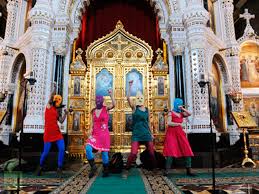
Pussy Riot inside the church in Moscow

A member of punk rock band Pussy Riot, Nadezhda Tolokonnikova, who was kept at the Krasnoyarsk prison hospital, was set free, her husband Pyotr Verzilov tweeted.

Tolokonnikova, like another member of the group, Maria Alyokhina, who was also released on December 23rd, was pardoned in connection with the 20th anniversary of the Russian Constitution. The State Duma decided to release those convicted of hooliganism.

Pyotr Verzilov wrote on his Twitter that Tolokonnikova intended to facilitate the dismissal of the Chief of the Federal Penitentiary Service in the Republic of Mordovia, General Simchenkov. Tolokonnikova served a part of her sentenced at Correctional Colony No. 14 in Mordovia, where she went on a hunger strike, claiming that the administration of the colony threatened to kill her. She claimed that her human rights were violated and complained of intolerable conditions for prisoners. Tolokonnikova described her claims in an open letter.

Maria Alyokhina, Ekaterina Samutsevich and Nadezhda Tolokonnikova were detained in March 2012. On August 17, 2012, the activists were sentenced to two years in prison for their “punk prayer” at the Cathedral of Christ the Savior. The women were convicted of hooliganism motivated by religious hatred. The activists said they did not intend to offend believers, but wanted to draw people’s attention to close ties between the state and the church. On October 10, 2012, Ekaterina Samutsevich’s sentenced was changed to conditional one. – pravda.ru

Defeated by the Taliban, Washington decides to take on Russia,China

pcrby Paul Craig Roberts

The several days of organized protests in Ukraine are notable for the relative lack of police violence. Unlike in the US, Canada, Thailand, Greece, and Spain, peaceful protesters have not been beaten, tear gassed, water cannoned, and tasered by Ukrainian police. Unlike in Egypt, Palestine, and Bahrain, Ukrainian protesters have not been fired upon with live ammunition. The restraint of the Ukrainian government and police in the face of provocations has been remarkable. Apparently, Ukrainian police have not been militarized by US Homeland Security.

What are the Ukrainian protests about? On the surface, the protests don’t make sense. The Ukrainian government made the correct decision to stay out of the EU. Ukraine’s economic interests lie with Russia, not with the EU. This is completely obvious.

The EU wants Ukraine to join so that Ukraine can be looted, like Latvia, Greece, Spain, Italy, Ireland, and Portugal. The situation is so bad in Greece, for example, that the World Health Organization reports that some Greeks are infecting themselves with HIV in order to receive the 700 euro monthly benefit for the HIV-infected.

The US wants Ukraine to join so it can become a location for more of Washington’s missile bases against Russia.

Why would Ukrainians want to be looted?

Why would Ukrainians want to become targets for Russia’s Iskander Missiles as a host country for Washington’s aggression against Russia?

Why would Ukrainians having gained their sovereignty from Russia want to lose it to the EU?

Obviously, an intelligent, aware, Ukrainian population would not accept these costs of joining the EU.

So, why the protests?

Part of the answer is Ukrainian nationalists’ hatred of Russia. With the Soviet collapse, Ukraine became a country independent of Russia. When empires break up, other interests can seize power. Various secessions occurred producing a collection of small states such as Georgia, Azerbaijan, the former central Asian Soviet Republics, Ukraine, the Baltics, and the pieces into which Czechoslovakia and Yugoslavia were broken by “nationalism.” The governments of these weak states were easy for Washington to purchase. The governments of these powerless states are more responsive to Washington than to their own people. Much of the former Soviet Empire is now part of Washington’s Empire. Georgia, the birthplace of Joseph Stalin, now sends its sons to die for Washington in Afghanistan, just as Georgia did for the Soviet Union,

These former constituent elements of the Russian/Soviet Empire are being incorporated into Washington’s Empire. The gullible nationalists, naifs really, in these American colonies might think that they are free, but they simply have exchanged one master for another.

They are blind to their subservience, because they remember their subservience to Russia/Soviet Union and have not yet realized their subservience to Washington, which they see as a liberator with a checkbook. When these weak and powerless new countries, which have no protector, realize that their fate is not in their own hands, but in Washington’s hands, it will be too late for them.

With the collapse of the Soviet Union, Washington quickly stepped into the place of Russia. The new countries were all broke, as was Russia at the time and, thus, helpless. Washington used NGOs funded by Washington and its EU puppets to create anti-Russian, pro-American, pro-EU movements in the former constituent parts of Soviet Russia. The gullible peoples were so happy to have escaped the Soviet thumb that they did not realize that they now had new masters.

It is a good bet that the Ukrainian protests are a CIA organized event, using the Washington and EU funded NGOs and manipulating the hatred of Ukrainian nationalists for Russia. The protests are directed against Russia. If Ukraine can be realigned and brought into the fold of Washington’s Empire, Russia is further diminished as a world power.

To this effect NATO conducted war games against Russia last month in operation Steadfast Jazz 2013. http://www.strategic-culture.org/news/2013/10/17/nato-steadfast-jazz-exercise-chill-of-cold-war.html Finland, Ukraine, Georgia, and neutral Sweden have offered their military participation in the next iteration of NATO war games close to Russia’s borders despite the fact that they are not NATO members.

The diminishment of Russia as a powerful state is critical to Washington’s agenda for world hegemony. If Russia can be rendered impotent, Washington’s only concern is China.

The Obama regime’s “Pivot to Asia” announced Washington’s plan to surround China with naval and air bases and to interject Washington into every dispute that China has with Asian neighbors. China has responded to Washington’s provocation by expanding its air space, an action that Washington calls destabilizing when in fact it is Washington that is destabilizing the region.

China is unlikely to be intimidated, but could undermine itself if its economic reform opens China’s economy to western manipulation. Once China frees its currency and embraces “free markets,” Washington can manipulate China’s currency and drive China’s currency into volatility that discourages its use as a rival to the dollar. China is disadvantaged by having so many university graduates from US universities, where they have been indoctrinated with Washington’s view of the world. When these American-programmed graduates return to China, some tend to become a fifth column whose influence will ally with Washington’s war on China.

So where does this leave us? Washington will prevail until the US dollar collapses.

Many support mechanisms are in place for the dollar. The Federal Reserve and its dependent bullion banks have driven down the price of gold and silver by short-selling in the paper futures market, allowing bullion to flow into Asia at bargain prices, but removing the pressure of a rising gold price on the exchange value of the US dollar.

Washington has prevailed on Japan and, apparently, the European Central Bank, to print money in order to prevent the rise of the yen and euro to the dollar.

The Trans-Pacific and Trans-Atlantic Partnerships are designed to keep countries in the US dollar payments system, thus supporting the dollar’s value in currency markets.

Eastern European members of the EU that still have their own currencies have been told that they must print their own currencies in order to prevent a rise in their currency’s value relative to the US dollar that would curtail their exports.

The financial world is under Washington’s thumb. And Washington is printing money for the sake of 4 or 5 mega-banks.

That should tell the protestors in Ukraine all they need to know.

Paul Craig Roberts was Assistant Secretary of the Treasury for Economic Policy and associate editor of the Wall Street Journal. He was columnist for Business Week, Scripps Howard News Service, and Creators Syndicate. He has had many university appointments. His internet columns have attracted a worldwide following. His latest book, The Failure of Laissez Faire Capitalism and Economic Dissolution of the West is now available.

The unity of European culture – a response to Alain de Benoist

roodt_dan_wiki

by Dan Roodt

Last month a very interesting interview appeared with French thinker Alain de Benoist in American Renaissance. One of its main ideas is that we are living in an increasingly fragmented world. As Benoist puts it:

To see solutions we must conceive of globalization as a dialectic. The more the world is homogenized, the more there is rebellion. Thus, the impulse that homogenizes the planet creates new kinds of fragmentation, new kinds of divisions. Sometimes this resistance can be excessive—it can take the form of terrorism, for example.

Benoist’s solution to this is “localism”, that we should think and work locally to create “liberated spaces”. He is also skeptical of politics as such, especially the party-political system and what he calls the “new class” of politicians, financiers and media. The Swiss system of direct democracy exercised at a local level is the best example of localism at work.

In essence, one has to agree with Benoist’s ideas and that peoples all over the world could benefit from a cantonal system whereby power is devolved down to the lowest level where each town or suburb, arondissement and so on, looks after its own education, health, security and economy. Of course, the globalist and centralist powers will resist such change. As we know so well here in South Africa, globalism and centralism are both forms of parasitism extracting wealth and power from citizens.

Donate or subscribe to praag!

Recently I read about an American initiative in Baton Rouge, Louisiana, where a group of people wish to secede and form a new municipality called St. George. Within multicultural societies where people chafe under disparate, conflicting norms and standards, everyone wants to secede from something. Apparently underlying the desire of mostly suburban St. George to become independent from inner-city Baton Rouge, are squabbles over the schooling system, educational standards and the power relations between different racial/ethnic groups.

According to the black mayor of Baton Rouge, “Kip” Holden, the movement for the secession of St. George will fail. He is a member of the “new class” that Benoist speaks of, the global nomenklatura that is to be found in all countries and that sees us all as “the same”, to be mixed together so that ultimately there will only be one global consumer left, consuming the same global brands and having one universal, syncretic religion that will go under different names.

The question is: how do we advance the interests of locals against the powerful centralist bureaucrats, financiers and media moguls? For this struggle is not taking place in a vacuum, but amid the reality of geopolitical and financial power relations.

I daresay Benoist takes a somewhat acerbic view of the USA, referring to naive and contradictory statements by Ronald Reagan and Nelson Rockefeller. Similarly, he is justifiably critical of the absurdities of American feminism, exemplified by Judy Butler. He also questions another myth of American academe, that race and sex “don’t exist because they are social constructs; they are only what your mind says they are”.

Of course, South Africa has been so thoroughly Americanized when it comes to race and what is called “gender” that we know all about the absurd slogan: “Race and sex do not exist, but we must fight racism and sexism”. Even that modish, albeit tragic document known as the new South African constitution, expectorates these clichés in its eleven official languages.

However, if our struggle is to succeed, I believe that we must rise above our mutual gripes with one another. I do not know which is worse: America seen from France or France seen from America. An even worse case of mutual stereotyping and historical hostility is that between the USA and Russia, maintained by the continued existence of enough ICBMs to destroy the planet and most of the population in the northern hemisphere.

I feel so much in agreement with Benoist’s thinking – including his exaltation of smaller identities, tribes, etc. – that I can hardly be critical. But if I do have a critique of sorts it is that there is something very French – “hexagonal” as they say in France – about his view of America. This is no mere chauvinism, but like the rest of us, he is a prisoner of history. I get the sense that the relics of the cold war still influence our view of the world, this very new world with its “multicultural” populations and dependence upon technology and the internet.

In summary, both the internet and the end of the cold war have changed us radically and we should try and look at our problems in a new way, unlike George Soros and the American generals who are still fighting Russia.

Whence the title of this piece: “The unity of European culture.” I specifically omitted any reference to “Western” culture. When I grew up, we were taught at school that South Africa was part of the West, just like Britain, France, the USA or West Germany. Toynbee wrote about that West in his little book The world and the West, but we can safely say that that West is dead now. Increasingly, Europe and America are at loggerheads as the USA, being the sole remaining superpower, feels no need for Western European allies anymore. Instead of an alliance, NATO has become more of a colonial army with local recruits, lording it over Europeans and even extending its reach further and further eastwards, threatening to overwhelm Russia.

I really love America. Its culture of resilience, gun ownership and vestiges of race realism are very attractive, as attractive as European refinement and intellectualism. Benoist too, commends Americans for their honesty in at least keeping racial statistics, saying:

You can go to the government and find race statistics on everything, including crime and social patterns. The collection of these kinds of statistics is forbidden in Europe — certainly in France.

Benoist criticises us for not listening to each other’s music or watching each other’s films. Instead, the whole world just consumes American cultural products, in English or some translated form. But last night I watched a horrible French film that had come out earlier this year, a comedy called Les profs (The teachers).

Fortunately I fell asleep halfway as it was French in name only. It contained the same images of multicultural utopia encountered in Hollywood films, dished up with insipid humour.

The point is valid that, as a friend once put it: “I do not have to visit the USA, because I already have it in my living room.” However, that is not our main problem; being a vociferous critic of anglicisation in South Africa I will be forgiven for saying this.

Our main problem is that the global nomenklatura, the people that Alex Jones from Texas calls “the New World Order”, are applying a policy of “divide and rule” against us. If they have a project, it is one of world domination, a one-world government that will impose multiculturalism and sameness on all of us, whether we like it or not. They will probably have some kind of Spanish Inquisition or Guantanamo Bay torture squad hunting down people who do not accept that race is “social construct” or who cling to local identities and languages, if they do not have that already.

The one thing that I like about American movies is that there is usually one man (or woman, as feminism obliges) fighting the whole of the CIA, US government and system. Naturally, this is entirely unrealistic and fantastical, but at least US individualism still keeps open the possibility of resistance to the anonymous leviathan.

Perhaps the CIA and George Soros’s Open Society Foundation are using Toynbee’s views on Russia to steer their assault on that country. According to Toynbee, despite being Christian, Russia has never been part of the West. Interestingly, Toynbee saw communism in that country as “a Western weapon for waging an anti-Western spiritual warfare”. Despite the vast political changes since, most establishment American observers, both liberal and conservative, will agree with Toynbee’s statement from 60 years ago:

The Russian attitude of resignation towards an autocratic régime that has become traditional in Russia is, of course, one of the main difficulties, as we Westerners see it, in the relations between Russia and the West today. (The World and the West, p. 6)

On the other hand, if ever the CIA and American liberal NGOs had to engineer an orange revolution in Moscow and appoint some or other puppet pro-American leader there as they have done in so many East European countries, it will probably be the final nail in the coffin for all of us. Like no other so-called “Western”leader on the world stage, Vladimir Putin has come out in favour of nationality and sovereignty. So his demise will be a major triumph for the globalists and one-world people.

Over the next decade or three, the population of the African continent will double again while that of Europe will decline, and we may even include in that decline the 200 million white Americans. Already, Europeans make up less than ten percent of the world population, with five percent looming on the horizon.

The challenge for us is to overcome the ideological, military, cultural and linguistic divisions of the past in attempting to conceive of a unified European culture and worldview. Linguists are aware of just how close our languages are to one another. Notwithstanding all the universalist ideology of the European enlightenment, each one of us speaks a Germanic or Latin dialect, sometimes (as in the case of English) a mixture of the two.

I am always struck by the way in which philoligists such as Georges Dumézil, for example, could see European and even Indo-European civilisation as a coherent religious, mythological and cultural whole, stretching far back into history. In this respect, I do not agree with Benoist’s characterisation of America as being somehow “non-European”. And if Calvinism played a role in the USA, did it not influence Switzerland too, the country cited by Benoist as a model for us to look up to?

The juxtaposition between “old Europe” and “new America” does not hold either. Europeans went to the USA, not bereft of a tradition, but very much driven and sustained by one. The republicanism of America’s founding fathers was invented in Europe, notably in France, as we know. Much of American modernism consisted of the application of European avant-garde ideas over there, especially in architecture. For Mies van der Rohe and many others, America was simply a playground for experimenting with European modernity. Unfortunately, many decadent, postmodern ideas first dreamed up in Europe, such as cultural relativism, have also made their way to the USA, where they have informed US-style political correctness. Simone de Beauvoir is probably cited even more than Judy Butler or Andrea Dworkin when it comes to the notion that “patriarchy” must be abolished.

Regarding information technology, we have to recognise the sea change that has taken place and which has contributed to the current “deterritorialization”, to use another French term from Gilles Deleuze which has become globally fashionable. It would be a mistake to think of “Europe” simply as a continent. It is more of a civilisation, a Kultur, an idea, which has unfortunately been bureaucratized and given a bad name by Brussels.

To my mind, it has become high time to conceive of a non-territorial Europe which would include Russia, Serbia, Greece and the rest of the Orthodox world rejected by Toynbee and the classical “Western” theorists. It should include those non-mestizo Spanish-speaking nations of Latin America, as well as Australia and the pockets of European settlement in South Africa and elsewhere.

After all, Pan-Africanism includes everyone of African descent, whether they reside in the USA, the Caribbean, the UK, France or Africa itself. Whereas the anarchic competition between nation states has been a threat to many smaller European cultures, not to mention the cause of many catastrophic wars, Pan-Europeanism might be that ultimate “empire” that would ensure our survival and prosperity, being compatible with localism as Benoist astutely observes.

The tripartite rivalry between America, Europe and Russia is not conducive to European survival in the face of the demographic cataclysm already in motion.

We should support any form of a Eurocentric canton, be it in: Baton Rouge, Louisiana; Pretoria, South Africa; or Marseilles, France.

Donate or subscribe to praag!

Rosatom due to sign SA nuclear agreement in 2014

rosatomRosatom, or the Russian Atomic Energy Agency is prepared to build nuclear power plants in South Africa and set up research centres to train personnel.

South Africa’s NPP project is estimated at 40 billion dollars to 50 billion dollars. Eight power generating units with more than one GW of power capacity each are due to be built under the project. Rosatom has offered assurances that in South Africa it will use its latest, – “post-Fukushima” – nuclear reactor safety systems.

“Rosatom boasts the latest nuclear power plant building technologies, just as several US and European corporations,” the Energy Development Fund Director Sergei Pikin said.

Russia and South Arica have already reached agreement to that end. Now the agreement should be declared legally valid. The contract is due to be signed on February 15th next year. Rosatom says it is prepared to co-fund the project. Also, Russia has the required resources to supply fuel for nuclear power plants to be built, says an analyst with the Veles Capital investment company Ayrat Khalikov.

“Traditionally, the organization that builds an NPP is due to supply nuclear fuel rods for it. In other words, if Russia builds a nuclear power plant somewhere, Russian uranium mines, as well as facilities that enrich uranium to turn it into fuel will also become involved,” Khalikov said.

Speaking of prospects for Rosatom’s cooperation with South Africa, and African countries in general, experts point out that Rosatom will have to withstand some pretty tough competition.

But Russia’s offer is more attractive, since Moscow is prepared to provide the full cycle of services, from drawing up a project plan to rendering the maintenance service of the plant. Also, the quality-price ratio is no small importance. Voice of Russia

‘Free Ukraine, not me,’ Tymoshenko urges EU leaders

Yulia Tymoshenko
Yulia Tymoshenko

Jailed opposition leader Yulia Tymoshenko called on EU leaders to drop all demands and sign a historic pact with Ukraine without any preconditions at a summit that opens Thursday.

The EU demanded that Ukraine boost the rule of law and free the jailed former prime minister before the two could sign a landmark political and free trade deal.

But last week President Viktor Yanukovych’s government stunned the West by halting all negotiations on the deal that would have set it on a path to EU membership, saying it wanted better terms.

Yanukovych said he would still travel to the two-day summit in Vilnius to continue negotiations but his government’s shock decision sparked the biggest rallies since the pro-democracy Orange Revolution in 2004.

“If Yanukovych takes a positive decision, I passionately ask you to sign the agreement on Friday without any hesitation and conditions including those that are related to my release,” Tymoshenko, 53, said in a message read out by her daughter Yevgenia late Wednesday.

“I thank you for steadfastly defending democracy in Ukraine. But today it’s necessary to release not just separate political prisoners,” said Tymoshenko who on Monday launched a hunger strike in solidarity with pro-European protesters.

“It’s necessary to free Ukraine. That means it’s necessary to sign the agreement if Yanukovych agrees to it.”

“By signing the agreement with him, you would help an entire nation to overcome a civilisational abyss created by erroneous ideologies and agressive empires, you would make another important step towards re-uniting the entire Europe.”

The Ukrainian government’s decision to scrap the EU pact has brought tens of thousands onto the streets since Sunday.

Setting up camp in central Kiev and led by opposition leaders including world boxing champion Vitali Klitschko, protesters has staged mass rallies since Sunday.

Yanukovych has called for calm after the protests turned violent, with riot police firing tear gas and protesters hurling traffic cones and rocks at the security forces.

Yanukovych stressed he would wait for better EU terms including financial aid before considering signing the deal. He said the bloc offered insufficient compensation for the damages Ukraine would suffer by rupturing ties with historic master Russia.

The EU said it was still ready to talk about the deal but the ball was in Ukraine’s court.

“Our offer stays on the table,” said the EU’s Enlargement Commissioner Stefan Fuele.

The debate over Ukraine’s future has turned into a heated diplomatic tussle between the EU and the Kremlin.

Russia wants its smaller neighbour to join a Moscow-led Customs Union which already includes the ex-Soviet states of Belarus and Kazakhstan. Moscow has repeatedly threatened Ukraine, which heavily depends on Russian natural gas, with economic retaliation if it signed the EU pact.

Top EU officials have said they “strongly disapprove” of Russian pressure on Kiev.

Russian President Vladimir Putin has responded by advising “our friends in Brussels, my personal good friends in the European Commission, to hold back on the sharp words”.

Kiev’s move to scrap the deal with the EU came after parliament failed to adopt legislation that would have freed Tymoshenko.

Shortly after she lost to Yanukovych in a 2010 presidential election, she was sentenced to seven years on abuse of power charges that the West sees as politically motivated.

Ukrainian opposition leaders Klitschko, Arseniy Yatsenyuk and Oleg Tyagnybok are also expected at the Vilnius summit. – AFP

Netanyahu Moscow visit falls flat: Israeli media

Israeli Prime Minister Benjamin Netanyahu’s visit to Moscow to push Russia into taking a harder line on Iranian nuclear negotiations has fallen flat, Israel’s media said on Thursday.

Premier Netanyahu and President Putin

Netanyahu flew to Moscow Wednesday in what was seen as a last-minute bid to influence an emerging nuclear deal with Iran strongly opposed by the Jewish state and being discussed by world powers and Iranian diplomats in Geneva.

Right-leaning Maariv newspaper said Russian President Vladimir Putin’s comments after meeting Netanyahu at best gave little away, and suggested the Israeli premier’s visit had left no lasting impression.

“When the two men gave their joint press conference (Wednesday), it appeared Putin’s statement had been given to journalists in advance, and he only changed certain passages afterwards to make them more palatable to Netanyahu,” it said.

Speaking as the talks got under way in Geneva between Iran and world powers, Putin only said he hoped that “in the nearest future a mutually acceptable solution is found” to end the crisis.

Top-selling Yediot Aharonot said Netanyahu’s visit to Moscow was an unnecessary “put-down” to the United States after tension with Israel over a possible Iran deal.

“Every reader knows Putin supports and will continue to support the ayatollahs’ regime in Iran,” Yediot said.

“If there’s the slightest chance of persuading world powers to take a harsher line on Iran, Israel should engage in discreet dialogue (with the US), instead of bickering publicly with Washington,” it said.

And left-leaning daily Haaretz suggested Netanyahu’s visit was futile, pointing out Russia was traditionally much more closely aligned with the Islamic republic than with other world powers.

“Russia, which built Iran’s first nuclear power plant and remains on better terms with Tehran than Western powers, has expressed less suspicion than them about Iran’s nuclear work,” it said.

Netanyahu insisted on the need for a “real” solution to the Iranian nuclear crisis, after his talks with Putin.

“We would all like a diplomatic solution, but it needs to be a real solution,” said Netanyahu, adding that this would involve Iran halting nuclear work in the same way that Syria was allowing its chemical weapons arsenal to be destroyed.

Iran would have to halt uranium enrichment, stop work on centrifuges, have enriched uranium material taken out from Iran and dismantle the Arak heavy water reactor, he said.

“We think it is possible to get a better agreement but that requires determination,” Netanyahu warned.

Israel, the region’s sole if undeclared nuclear-armed state, has not ruled out the use of force against the Iranian atomic drive.

Tehran says its nuclear programme is purely for peaceful purposes. – AFP

Russian activists pelt Dutch royals with tomatoes

Royal couple meet Putin

Two activists from the unregistered Other Russia party were arrested Saturday for yelling insults and throwing a tomato at the Dutch royal couple before a concert in Moscow.

The incident took place when Dutch King Willem-Alexander and Queen Maxima came out of their limousine and walked on a red carpet toward the entrance of the Moscow Conservatory building to attend the ceremonial closure of a year dedicated to celebrating Dutch-Russian ties.

Two young people from the crowd of onlookers reportedly started shouting “You have Dolmatov’s blood on your hands!” and threw a tomato at the royal couple. The tomato missed the intended target and the couple proceeded to the entrance without responding to the insults.

Police arrested the hooligans and escorted them to a patrol van parked nearby.

Spokesman for the Other Russia party, Alexander Averin, told RIA Novosti after the incident that the party activists staged a protest against the negligence of the Dutch government that led to the death of their fellow party member, Alexander Dolmatov, in a Dutch prison earlier this year.

Dolmatov, whom the Russian authorities wanted to question in connection with a violent opposition rally in Moscow in May 2012, killed himself in a Rotterdam deportation center on January 17 after being refused political asylum in the Netherlands.

The Dutch Justice Ministry has later acknowledged that agencies dealing with immigration issues “acted carelessly” in the treatment of Dolmatov.

The Other Russia was founded by Eduard Limonov in 2010 after his radical National Bolshevik party was banned in 2007. Limonov’s new party was denied registration by the Federal Registration Service in 2011 because “it did not have enough popular support among the Russian people.” – RIA Novosti

Russian students humiliate black paedophile

russia-black-shaving-head
‘David Smith’ gets a haircut

A 20-year-old black student from Johannesburg studying at the Shukhov State Technological University, in Belgorod was made fun of by a group of Russian students because he requested sex with a minor.

In an initiation-style video posted online was mostly in Russian and minimal broken English.

The student, called David Smith, although he later says his name is Bonga, is made a fool by four anti-LGBT activists, who had lured him by pretending to be a 15-year-old boy available for sex.

The legal age of consent in Russia is 16.

The Russian group calls themselves “Occupy Pedophilia,” and basically lure young gay men into meeting a member of their group, ostensibly by pretending to be gay themselves.  They then kidnap their victim and make fun of them, including “forcing them to drink urine” on film, according to a gay website.

The film is then published on Russian social media sites.

In Bongo’s case, they barge in, forcing him to do a fake tribal dance, then shaving his head and force feeding him a watermelon. . “Black, white, black white”, says one of the anti-LGBT activists, as he compared the colour of his palm against the colour of the back of his hand.

President Vladimir Putin’s new law where police can detain suspected homosexuals for up to two weeks is not popular with paedophiles. It has been reported that Russian MPs will discuss a bill early next week that could see homosexual couples lose custody of their children.

The soccer governing body has been battered by international gay lobbies for picking Russia and Qatar as hosts for the 2018 and 2022 tournaments. Both countries are known for their anti-gay laws.

Russian Unity Day: 8 000 Russian nationalists protest against migrants

Russians on the march for Unity Day

Several thousand Russian nationalists rallied Monday in Moscow, venting against the migrants they accuse of pushing up the crime rate and taking their jobs.

The protest took place on the national holiday of Unity Day, established in 2005 to replace commemorations of the Bolshevik Revolution.

Many demonstrators carried Russian imperial flags. One group displayed a banner reading “Young People Against Tolerance.” The protesters in a southern neighborhood of the Russian capital ranged from tough-looking youths to older people.

Animosity is strong among nationalists against migrants both from the former Soviet Central Asian republics and non-Slavs from the largely Muslim Russian Caucasus region.

Monday’s rally came three weeks after rioters targeted a vegetable warehouse where they believed the killer of an ethnic Russian man was working. Police later rounded up more than 1,000 migrants working at the warehouse.

Some demonstrators praised the riot and suggested it was backed by the state.

“People received a signal that if they engage in such pogroms, there will be progress,” said Yevgeny Morgunov, a 36-year-old researcher at the Russian National Academy of Sciences.

He said he didn’t support the radical exclusionary sentiment reflected in the nationalist slogan “Russia for Russians,” but said “if Russians feel good, the other people of Russia will feel it too.”

There were no immediate reports of trouble at the Moscow rally, but the Interfax news agency said police detained 12 participants in a similar rally in the Siberian city of Krasnoyarsk. Nationalist demonstrations were also reported in the cities of Irkutsk and Kazan.

A U.N. report in September said Russia has about 11 million migrants. The state news agency RIA-Novosti, however, cited the Federal Migration Service as saying only about 718,000 of them have residency permits. – AP

Putin topples Obama in Forbes power ranking

Top of the heap
Top of the heap

Having outfoxed him on Syria, Russian President Vladimir Putin has pipped Barack Obama to the title of the world’s most powerful leader as ranked by Forbes on Wednesday.

It was the first time in three years that the US president has dropped to second place on the magazine’s list and came as US-Russia relations slid to a new low.

Putin, who has enjoyed 13 years of dominant rule over Russia, was again elected president in March 2012.

Obama, on the other hand, has just emerged scathed from an embarrassing 16-day US government shutdown caused by a budget and debt crisis in Washington.

“Putin has solidified his control over Russia, while Obama’s lame duck period has seemingly set in earlier than usual for a two-term president — latest example: the government shutdown mess,” wrote Forbes.

In August, Russia granted asylum to former National Security Agency contractor Edward Snowden, wanted in the United States over a mammoth intelligence leak.

A month later, Putin played the trump card again by averting Obama’s threatened missile strikes on Syria with a plan for Damascus to hand over chemical weapons.

“Anyone watching this year?s chess match over Syria and NSA leaks has a clear idea of the shifting individual power dynamics,” Forbes wrote.

The 2013 list of 72 powerbrokers was chosen to reflect one for every 100 million lesser mortals on Earth.

Third prize went to Chinese President Xi Jinping, who is expected to rule for a decade in which China is set to eclipse the US as the world’s largest economy.

Pope Francis made his debut at number four and German Chancellor Angela Merkel rounded out the top five.

Among 13 newcomers were Samsung Chairman Lee Kun-Hee at number 41 and Nigerian billionaire Aliko Dangote, the richest man in Africa, in at number 64.

There were 17 heads of state who run nations with a combined GDP of $48 trillion and 27 CEOs and chairs who control over $3 trillion in annual revenues.

Only nine women made the cut despite representing half the world’s population. – breitbart.com

The warmongers: not looking out for us

mercer_ilanaby Ilana Mercer

[followbutton username=’IlanaMercer’ count=’true’ lang=’en’ theme=’light’]

Like Ilana Mercer’s Facebook page

To listen to U.S. government officials there is only an upside to the punitive sanctions imposed on Iran by the United States and a reluctant European Union. Consequently, the emphasis is forever on how to toughen the punishment; never on whether to lift economic sanctions on the long-suffering people of Iran.

But what about the effects of trade boycotts on American businesses?

Chris Harmer of The Institute for the Study of War estimates that the Boeing Company alone forfeits a minimum of $25 billion in business every year because of U.S.-imposed sanctions on Iran, a niche market that is filled by the Russians. Overall, Harmer puts the value to U.S. business of trade lost due to the economic embargo on Iran at approximately $50 billion per annum.

For example, Iran imports $1.5 billion worth of cars a year, the beneficiaries of which are companies like Nissan, Toyota and Peugeot (when they might have been General Motors and Chrysler). Peugeot does an added half a billion dollars’ worth of commerce with Iran just in car parts.

The Iranian economy, moreover, has diversified and is adapting to life without the U.S. The rest of the world—pockets in Europe and most of Asia—has not isolated Iran, with the result that the country has many trading partners other than the U.S. And while Iran has lost petroleum revenue due to sanctions, the trend will not endure. China, Japan and South Korea are hungry for the country’s crude.

Not to be overlooked are the costs to Americans of sanction enforcement, avers Harmer. In addition to the opportunity costs—the missed business aforementioned—there are “direct costs.” The Office of Foreign Asset Control in the U.S. Treasury Department squanders around $1 billion a year in developing lists of “financial institutions that are subject to sanctions,” and then infringing on the rights of individuals and companies to freely exchange privately owned property.

“Indirect costs” are incurred in the course of cultivating a massive U.S. intelligent infrastructure—a veritable alphabet soup of agencies—upon which the Treasury draws in enforcing a regimen of sanctions.

Into the Cannibal's Pot

So, too, are the “deterrent costs” borne by the American taxpayer who pays for patrolling the Persian Gulf, the Northern Arabian Sea and the Strait of Hormuz.

Ultimately, trade, not democracy, is the best antidote to war with Iran. The more economically intertwined countries become, the less likely they are to go to war. More than boycotts, barter with Iran is bound to promote goodwill and reduce belligerence on both sides.

As a general rule, state-enforced boycotts harm honest, hard-working Americans who use the economic means to earn their keep. They benefit servants of Uncle Sam—the political class and its media and think-tank hangers-on. For they deploy the political means to advance their ends and grow their sphere of influence. As libertarian economist Murray Rothbard once observed, these “are two mutually exclusive ways of acquiring wealth”—the economic means is honest and productive, the political means is dishonest and predatory.

As always, it’s us against them: the state versus the people who labor outside it and in spite of it.

For now, Obama’s eager response to Iranian overtures has sidelined Syria. Before Syria recedes in memory—to be replaced by demands for action against Iran—it’s worth considering one constant quantity: the media guttersnipes and their motivation.

The bobbingheads of TV have been complaining in the most unctuous terms that Russia and Syria have pulled one over us. The U.S., they lament, has been weakened, evidently, because someone halted the momentum of war.

You see, the chattering and political classes cannot conceive of greatness outside the state because they are part of the state apparatus and depend on it for status and income.

Conversely, individual Americans—who have nothing to gain and only losses to sustain from war—should never conflate their interests with those of the government and its emissaries, who have everything to gain from the great theatre that is war.

More than anyone, who benefits when America goes to war? Those who “function within the nimbus of great power” in D.C. and around it—the media-military-congressional-industrial complex.

Thus did Charles Krauthammer ridiculously equate the failure to go to war against Syria with “Russia supplanting America as regional hegemon.”

Krauthammer was joined by others, not least of them Bill O’Reilly and his sidekick Dennis the Menace. How diminished will the bluster of both media mouths be if the U.S. is no longer dictating the terms of war (lots of it) and peace (too little of it) in the world? Their immense egos will suffer. Maybe even their incomes, eventually.

But not you, the everyday American.

Putin stopped a war in Syria. This is not the same as “supplanting” American power. Rather, the Russians replaced bully power with a balance of power, and this is good for ordinary Americans.

He who saves you from war is better than he who sends you to war. The proof is in the Putin.

[followbutton username=’IlanaMercer’ count=’true’ lang=’en’ theme=’light’]

Like Ilana Mercer’s Facebook page

©2013 By ILANA MERCER

For syndication rights to http://BarelyABlog.com or http://IlanaMercer.com, contact ilana@ilanamercer.com. Read more.

The two missiles that ended a confrontation in Syria

TridentA well informed diplomatic source told a Lebanese newspaper that “the US war on Syria had started and ended the moment those two ballistic missiles were fired, leaving inconsistent information, as Israel denied and Russia confirmed, until an Israeli statement was issued indicating they were fired in the context of an Israeli-US joint drill and fell in the sea, and that they were not related to the Syrian crisis.”

The source further told the Lebanese daily As-Safir that “the US forces fired these two rockets from a NATO base in Spain, and were instantly detected by the Russian radars and confronted by the Russian defense systems, so one of them exploded in the airspace and the second one diverted towards the sea.”

In this context, the source pointed out that “the statement issued by the Russian Defense Ministry, which stated the detection of two ballistic missiles fired towards the Middle East, intended to neglect two points: the first was the location from which the two rockets were fired, and the second was their downing. Why? Because the moment the full military operation was launched, Head of the Russian Intelligence Service contacted the US intelligence and informed it that “hitting Damascus means hitting Moscow, and we have removed the term “downed the two missiles” from the statement to preserve the bilateral relations and to avoid escalation. Therefore, you must immediately reconsider your policies, approaches and intentions on the Syrian crisis, as you must be certain that you cannot eliminate our presence in the Mediterranean.”

“This unannounced direct confrontation between Moscow and Washington increased the Obama Administration’s confusion and certainty that the Russian side was ready to move until the end with the Syrian cause, and that the US did not have a way out of its impasse except through a Russian initiative which would save America’s face…” he added.

From this point, the diplomatic source clarified that “in order to avoid further US confusion, and after Israel denied knowing anything about the rocket firing in its first statement, which is the truth, Washington demanded Tel Aviv to adopt the rocket firing to save its face in front of the International Community, especially since these two rockets were the beginning of the US aggression on Syria and the announcement of the beginning of military operations, after which US President Barack Obama was supposed to go to the G20 Summit in Russia to negotiate the destiny of Syrian President Bashr Al-Assad. However, he went to find a way out of the impasse he’s in.”

The source further indicated that “after the US-Russia rocket confrontation, Moscow intended to increase its number of military experts in Russia, and added to its military units and destroyers to enhance its military presence in the Mediterranean. It also set a time for announcing about its initiative on stopping the aggression on Syria after the G20 Summit, after drawing a side scene on the sidelines of the summit which was followed by two successive visits for Iranian Foreign Minister, Hussein Amir Abdul Lahyan, and Syrian Foreign Minister, Walid Al-Moallem, in which a way out was agreed on with the Russian side, and it included a Syrian announcement on approving the Russian initiative regarding putting Syrian chemical weapons under international supervision and preparing Syria for joining the non-proliferation treaty.

Finally, the source pointed out that “One of the first results of the US-Russian military confrontation was the British House of Commons’ rejection to participate in a war on Syria. This was followed by European stances, most significantly, the German stance announced by Chancellor Angela Merkel.” – almanar.com

Russia considers ban om GMO’s

mielieAs one of the few nations in the world with a GMO-free platform, Russia does not allow any cultivation of GMOs for commercial purposes. Their regulatory agencies recently suspended the import and use of an American GM corn following a study suggesting a link to breast cancer and organ damage. The Russian Prime Minister has now ordered the same agencies to consider a possible ban on all GMO imports into Russia.

The Russian Federal Environmental Assessment Commission has not adopted any commercialized GM varieties for agricultural use.

The recent decision by the Russians to suspend authorisation for American GM corn threatens to trigger a transatlantic commercial and diplomatic row.

A growing body of scientific research – done mostly in Europe, Russia, and other countries – showing that diets containing engineered corn or soya cause serious health problems in laboratory mice and rats.

Experts at the University of Caen conducted an experiment running for the full lives of rats – two years.

The findings, which were peer reviewed by independent experts before being published in a respected scientific journal, found raised levels of breast cancer, liver and kidney damage.

Russia’s consumer rights watchdog and Health Ministry, Rospotrebnadzor, announced one year ago that it had suspended the import and use of the Monsanto GM corn.

Now, the Russian Prime Minister Dmitry Medvedev has ordered the relevant agencies to consider a possible ban of all imports into Russia of products containing genetically modified organisms (GMOs) by October 15.

The order is addressed to Rospotrebnadzor, the Agriculture Ministry, and the Trade and Economic Development Ministry. They have been ordered to “submit proposals on amendments to the Russian legislation aimed at tightening control over the turnover of products containing components obtained from GMOs together with the relevant federal executive bodies.”

The aforementioned agencies are also ordered to submit proposals “on the possibility of banning the import of such products into the Russian Federation.”

A list of the prime minister’s orders was drawn up to fulfill the presidential orders issued after the meeting on the socio-economic development of the Rostov region held on September 18. Medvedev’s orders have been posted on the government website, Interfax news agency reported last September 25.

Russia is currently taking a hard line on GMOs — in August the first independent project for identifying whether Russian farmers are growing illegal GM crops started in the Belgorod region.

NAGS (The National Association for Genetic Safety) conducted the first checks of agricultural crops for the presence of GMOs. No GMO plants were found in any Belgorod fields.

According to the current law, 19 GM lines are allowed in foodstuffs, but the cultivation of GMOs is not allowed.

After joining the World Trade Organisation (WTO), Russia is being pressured simplify the procedure for registration of genetically modified products, seed and feed, to stop their safety checks, and to stop controls over their distribution.

Glyphosate is the world’s top selling herbicide, and Monsanto’s formulations Roundup is used with more than 80 percent of all genetically modified (GM) crops grown globally. But evidence of its extreme toxicity has been emerging within the past decade. Glyphosate was found to kill human placental cells at concentrations below that recommended for agricultural use and approved by our regulators, while Roundup was lethal at even lower concentrations.

The toxic effects of Roundup (R400) begin at 5 ppm, and the first endocrine disrupting action is already evident at 0.5 ppm, 800 times lower than the level of 400 ppm authorized by the US Environment Protection Agency in food or feed.

Denmark has imposed widespread bans on the spraying of glyphosate in response to research showing that the sprays have been contaminating the countrys groundwater.

The chemical has, against all expectations sieving down through the soil and polluting the ground water at a rate of five times more than the allowed level for drinking water, according to tests done by the Denmark and Greenland Geological Research Institution (DGGRI).

A decade ago, the Danish environment minister Hans Christian Schmidt announced unprecedented restrictions on glyphosate, the country’s and Europe’s most widely used herbicide. – wakingtimes.com

Obama talks to Rouhani

Pres. Rouhani
Pres. Rouhani

President Obama announced today that he talked on the phone with Iranian president Rouhani: “Just now I spoke on the phone with President Rouhani of the Islamic Republic of Iran,” he said. “The two of us discussed our ongoing efforts to reach an agreement over Iran’s nuclear program.”

This is the first time leaders from America and Iran have spoken since 1979.

“I reiterated to President Rouhani what I said in New York. While there will surely be important obstacles to moving forward and success is by no means guaranteed, I believe we can reach a comprehensive solution.

“I’ve directed Secretary Kerry to continue pursuing this diplomatic effort with the Iranian government. We had constructive discussions yesterday in New York with our partners, the European Union, the United Kingdom, France, Germany, Russia, and China, together with the Iranian foreign minister, and going forward, President Rouhani and I have directed our teams to continue working expeditiously in corporation with the P-5 plus one to pursue an agreement. And throughout this process we will stay in close touch with our friends and allies in the region, including Israel.

“Now we are mindful of all the challenges ahead. The very fact that this was the first communication between an American and Iranian president since 1979 underscores the deep mistrust between our countries.”

Obama said that “Iran’s supreme leader has issued a fatwa against the development of nuclear weapons, President Rouhani has indicated that Iran will never develop nuclear weapons.”

“I have made clear that we respect the right of the Iranian people to access peaceful nuclear energy in the context of Iran meeting its obligations. So the test will be meaningful, transparent, and verifiable actions,” said Obama, which could lead to a relaxation of sanctions.

Obama talked of a new relationship between the U.S. and Iran, if his diplomatic efforts succeed. – TWS