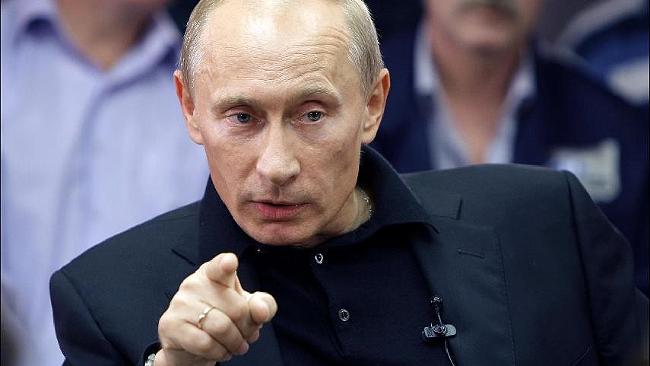
Propaganda rules the news: Russia never invaded Ukraine

pcrGerald Celente calls the Western media “presstitutes,” an ingenuous term that I often use. Presstitutes sell themselves to Washington for access and government sources and to keep their jobs. Ever since the corrupt Clinton regime permitted the concentration of the US media, there has been no journalistic independence in the United States except for some Internet sites.

Glenn Greenwald points out the independence that RT, a Russian media organization, permits Abby Martin who denounced Russia’s alleged invasion of Ukraine, compared to the fates of Phil Donahue (MSNBC) and Peter Arnett (NBC), both of whom were fired for expressing opposition to the Bush regime’s illegal attack on Iraq. The fact that Donahue had NBC’s highest rated program did not give him journalistic independence. Anyone who speaks the truth in the American print or TV media or on NPR is immediately fired.

Russia’s RT seems actually to believe and observe the values that Americans profess but do not honor.

I agree with Greenwald. Greenwald is entirely admirable. He has intelligence, integrity, and courage. He is one of the brave to whom my just published book, How America Was Lost, is dedicated. As for RT’s Abby Martin, I admire her and have been a guest on her program a number of times.

My criticism of Greenwald and Martin has nothing to do with their integrity or their character. I doubt the claims that Abby Martin grandstanded on “Russia’s invasion of Ukraine” in order to boost her chances of moving into the more lucrative “mainstream media.” My point is quite different. Even Abby Martin and Greenwald, both of whom bring us much light, cannot fully escape Western propaganda.

For example, Martin’s denunciation of Russia for “invading” Ukraine is based on Western propaganda that Russia sent 16,000 troops to occupy Crimea. The fact of the matter is that those 16,000 Russian troops have been in Crimea since the 1990s. Under the Russian-Ukrainian agreement, Russia has the right to base 25,000 troops in Crimea.

Apparently, neither Abby Martin nor Glenn Greenwald, two intelligent and aware people, knew this fact. Washington’s propaganda is so pervasive that two of our best reporters were victimized by it.

As I have written several times in my columns, Washington organized the coup in Ukraine in order to promote its world hegemony by capturing Ukraine for NATO and putting US missile bases on Russia’s border in order to degrade Russia’s nuclear deterrent and force Russia to accept Washington’s hegemony.

Russia has done nothing but respond in a very low-key way to a major strategic threat orchestrated by Washington.

It is not only Martin and Greenwald who have fallen under Washington’s propaganda. They are joined by Patrick J. Buchanan. Pat’s column calling on readers to “resist the war party on Crimea” opens with Washington’s propagandistic claim: “With Vladimir Putin’s dispatch of Russian Troops into Crimea”.

No such dispatch has occurred. Putin has been granted authority by the Russian Duma to send troops to Ukraine, but Putin has stated publicly that sending troops would be a last resort to protect Crimean Russians from invasions by the ultra-nationalist neo-nazis who stole Washington’s coup and established themselves as the power in Kiev and western Ukraine.

So, here we have three of the smartest and most independent journalists of our time, and all three are under the impression created by Western propaganda that Russia has invaded Ukraine.

It appears that the power of Washington’s propaganda is so great that not even the best and most independent journalists can escape its influence.

What chance does truth have when Abby Martin gets kudos from Glenn Greenwald for denouncing Russia for an alleged “invasion” that has not taken place, and when independent Pat Buchanan opens his column dissenting from the blame-Russia-crowd by accepting that an invasion has taken place?

The entire story that the presstitutes have told about the Ukraine is a propaganda production. The presstitutes told us that the deposed president, Viktor Yanukovych, ordered snipers to shoot protesters. On the basis of these false reports, Washington’s stooges, who comprise the existing non-government in Kiev, have issued arrest orders for Yanukovych and intend for him to be tried in an international court. In an intercepted telephone call between EU foreign affairs minister Catherine Ashton and Estonian foreign affairs minister Urmas Paet who had just returned from Kiev, Paet reports: “There is now stronger and stronger understanding that behind the snipers, it was not Yanukovych, but it was somebody from the new coalition.” Paet goes on to report that “all the evidence shows that the people who were killed by snipers from both sides, among policemen and then people from the streets, that they were the same snipers killing people from both sides . . . and it’s really disturbing that now the new coalition, that they don’t want to investigate what exactly happened.” Ashton, absorbed with EU plans to guide reforms in Ukraine and to prepare the way for the IMF to gain control over economic policy, was not particularly pleased to hear Paet’s report that the killings were an orchestrated provocation.

What has happened in Ukraine is that Washington plotted against and overthrew an elected legitimate government and then lost control to neo-nazis who are threatening the large Russian population in southern and eastern Ukraine, provinces that formerly were part of Russia. These threatened Russians have appealed for Russia’s help, and just like the Russians in South Ossetia, they will receive Russia’s help.

The Obama regime and its presstitutes will continue to lie about everything.

Paul Craig Roberts was Assistant Secretary of the Treasury for Economic Policy and associate editor of the Wall Street Journal. He was columnist for Business Week, Scripps Howard News Service, and Creators Syndicate. He has had many university appointments. His internet columns have attracted a worldwide following. His latest books are, The Failure of Laissez Faire Capitalism and How America Was Lost. 

Putin, Merkel want Ukraine’s territorial integrity respected

ukraine3Vladimir Putin spoke with Angela Merkel by telephone on Sunday about the situation in Ukraine. According to a statement on the chancellor’s website, both leaders agreed that Ukraine’s “territorial integrity must be respected.”

President Viktor F. Yanukovych has fled the Ukrainian capital. He was removed from power by a unanimous vote in Parliament, lawmakers moved swiftly on Sunday to dismantle his government by firing top cabinet members, including the foreign minister.

The defense minister, Pavlo Lebedev told Ukraine’s Channel 24 that he intended to remain in his post.

Parliament voted to grant Oleksandr Turchynov, the Speaker, authority to carry out the duties of the president of Ukraine.

Speculation about a major role for the freed former prime minister, Yulia V. Tymoshenko, was squashed on Saturday afternoon when she issued a statement asking not to be considered for the post again.

EU officials recall her period as prime minister after Ukraine’s 2004/5 pro-democracy Orange Revolution as hardly less corrupt than Yanukovich’s tenure. Ukraine is 144th on watchdog Transparency International’s index of perceived corruption.

“Political uncertainty has arguably increased – including around the outcome of the presidential election set for 25 May – bringing with it a potential increase in the probability of a sovereign default,” Nomura political analyst Alastair Newton said.

France and Germany’s Merkel are both quite cool on the EU enlargement. Polish Prime Minister Donald Tusk, whose country played a central role in the negotiations, is not.

The EU has found it politically difficult enough to bail out its own members during the bloc’s debt crisis. Spending on an outsider will be more fraught still.

US media’s knee-jerk response to Putin leads to Berlin-Moscow axis

mercer_ilanaby Ilana Mercer

[followbutton username=’IlanaMercer’ count=’true’ lang=’en’ theme=’light’]

Like Ilana Mercer’s Facebook page

When it comes to President Vladimir Putin, who enjoys an approval rate of 65 percent among Russians, the motto of the menagerie of morons that is the American media is ignorance über alles.

The energetic and reflexive demonization of a Russian leader – unparalleled during communism – against the backdrop of the Sochi Olympic Games and the conflagration in the Ukraine, is the handiwork of a conga-line of cretins, stateside, whose bombast comports with the boorishness of their pronouncements.

The “Shangri-La of Socratic disinterest,” one wag’s delicious description of broadcaster Bill O’Reilly, is not delimited by ideology. Instead, “wanton Putin bashing,” as scholar of Russian history Stephen Cohen attests, is the order of the day at the New York Times, Washington Post, Wall Street Journal, The New Republic, CNN, Fox News, MSNBC, on and on.

As to “traditional journalistic standards”: In the service of their anti-Putin monomania, the U.S. Pussy Riot press and its approved phalanx of “experts” routinely omit “facts and context,” conflate “reporting with analysis,” and court conformity and unanimity at the cost of veracity and impartiality.

(Revered in the U.S., Pussy Riot is a punk rock Russian band of feminists, whose forté is breast-baring, defiling places of worship, punching the air while shrieking, “F–k you Putin,” and participating in public-orgy protests and other criminal acts.)

The “Shangri-La of Socratic disinterest,” fortunately, is not a feature of the nuanced and informed analysis available on the John Batchelor Show, where the scholarly host and his guest, professor Cohen, delve deeply into the region’s geopolitical dynamics.

Cohen, who tackled O’Reilly’s out-and-proud ignorance with aplomb, was slightly more flummoxed by that of MSNBC’s Andrea Mitchell. She blamed Putin for Ukraine having “spun into politician chaos.” To wit, Europe had offered Ukraine $800 million in aid. The Kremlin “outbid the West” to the tune of billions, but held back on the last installment because it wanted to see to which government Russian funds would ultimately be going. Although Putin has since released the remaining funds to Ukraine, Mitchell surmised that Putin had orchestrated recent events so as to compel Kiev to sell-out to the Kremlin.

Nonsense on stilts. If anything, Putin’s impetus would be to avert trouble in Ukraine during the Sochi Olympics. Add Putin to the list of people who do not control what unfolds in Kiev, belabors Cohen.

Into the Cannibal's Pot

Contrary to America’s Democracy Alinskyites – media, academia, members of the Stupid and Evil Parties, State Department floozy Victoria Nuland (taped plotting to “midwife a new, anti-Russian Ukrainian government”), John McMussolini – the Ukrainian People, not unlike the “American People,” are not one people. The country is riven – divided into Western and Eastern regions, respectively. The West has been seduced by EU membership; the East is culturally and historically enmeshed in Russia.

What we’re witnessing is a tale of two Ukraines.

As it stands, explains Cohen, Kiev has lost control over Western Ukraine. Moderate voices are being silenced. Armed provocateurs are inciting matters and undermining moderate leadership. Revolution is being fomented.

Ukraine is not a dictatorship, it is an anarchy.

As to the demands issued by Vice President Joe Biden that the democratically elected Ukrainian President Viktor Yanukovych withdraw forces from the Maidan, the site of the protests: “preposterous,” avers Cohen. The “occupation of government buildings in Kiev and in Western Ukraine, the hurling of firebombs at police and other violent assaults on law enforcement officers … all documented and even televised”: these would not be tolerated in any Western democracy.

Equally outrageous is the Obama administration’s improvised and impromptu demands that the same democratically elected president step down before elections are held next year. The rational solution to the chaos in Ukraine is to allow the parties to “chill out” and resolve to wait until the February elections, next year, whereupon a referendum question can be tagged to the ballot to help decide whether Ukraine should sign up with Europe or Russia. (Cohen advocates an either/or “democratic” decision; I say secession.)

Should cool heads fail to prevail in the negotiation of a political solution, the division of Ukraine is impending, with part of the country cleaving to Europe, the other to Russia.

The “struggle for Ukraine” is a chapter in a series of U.S.-orchestrated provocations, which began with the expansion of NATO (North Atlantic Treaty Organization) eastward to abut Russia’s borders – an expansion pursued by Clinton, Bush and Obama alike. It gathered momentum with the U.S.-backed attempts to incorporate Georgia and Ukraine into the North Atlantic alliance.

The next stage in goading the Russian Bear consisted in American-funded NGO political-action groups – many of them backed by George Soros – flooding Russia proper. (“Purple” in Iraq, Blue in Kuwait, Cotton in Uzbekistan, Grape in Moldova, “Orange” in the Ukraine, “Rose” in Georgia, “Tulip” in Kyrgizstan, “Cedar” in Lebanon, Jasmine in Tunisia, Green in Iran, still un-christened in Russia and Syria: Dig around and you’ll find American activists à la Alinsky behind these “color-coded,” plant-based revolutions, blessed and backed by Foggy Bottom.)

“A U.S.-NATO military outpost in Georgia and missile-defense installations near Russia” completed the provocation. “Whether this longstanding Washington-Brussels policy is wise or reckless, it – not Putin’s December financial offer to save Ukraine’s collapsing economy – is deceitful,” inveighs Cohen.

Also upon us is a second Cold War between the U.S. and Russia, which will see a close, bilateral collaboration between Berlin and Moscow – Putin and Angela Merkel enjoy a cozy and copacetic relationship and will likely work together to dominate Eurasia.

Having flouted America’s national interests and squandered Russian goodwill – the ignoramuses of the Beltway will have no place in this grand geopolitical realignment.

© 2014 by Ilana Mercer

[followbutton username=’IlanaMercer’ count=’true’ lang=’en’ theme=’light’]

Like Ilana Mercer’s Facebook page

Kerry talks tough in Syria meeting with Russia

John Kerry
John Kerry

by Matthew Lee and Nancy Benac

Striking a tough tone, U.S. Secretary of State John Kerry opened swiftly convened talks with Russia on Syria’s chemical weapons Thursday by bluntly rejecting a Syrian pledge to begin a “standard process” by turning over information rather than weapons – and nothing immediately.

That won’t do, Kerry declared at an opening news conference, a stone-faced Russian Foreign Minister Sergey Lavrov at his side. “The words of the Syrian regime in our judgment are simply not enough.”

“This is not a game,” Kerry said of the latest developments in a series that has rapidly gone from deadly chemical attacks to threats of retaliatory U.S. air strikes to Syrian agreement with a Russian plan to turn over the weapons and, finally, to the crucial matter of working out the difficult details.

“We believe there is nothing standard about this process at this moment because of the way the regime has behaved,” Kerry declared. And he kept alive the threat of U.S. military action, saying the turnover of weapons must be complete, verifiable and timely – “and finally, there ought to consequences if it doesn’t take place.”

Adding to the drama, Russian President Vladimir Putin weighed in from afar, raising eyebrows with an opinion piece in The New York Times that chided Americans for seeing themselves as “exceptional.” That was an apparent reference to a comment President Barack Obama made in his Syria speech Tuesday night, explaining why he felt the U.S. needed to take action. Congress has shown little inclination to authorize military action, and a vote on that has been put off.

Putin also warned that a U.S. strike against Syria because of chemical weapons use could unleash new terrorist attacks. And he still maintained there is “every reason to believe” the weapons were used by rebels and not by Assad’s military. In Washington, Obama’s spokesman said Russia was “isolated and alone” in that view.

Obama, for his part, said simply that he was hoping for “a concrete result” from the talks.

The back-and-forth was a stark indication of the challenging work ahead as Kerry, Lavrov and their teams of chemical weapons experts plunge into talks aimed at finding agreement on how to dismantle the chemical weapons amid the confusion and danger of Syria’s civil war.

Lavrov seemed to contradict Kerry’s negative view of Syrian President Bashar Assad’s offer to provide details on his country’s chemical arsenal beginning 30 days after it signs an international convention banning such weapons. Syria’s ambassador to the United Nations said that as of Thursday his country had become a full member of the treaty, which requires destruction of all chemical weapons. However, the United Nations said it will take at least another 30 days.

The Russian said the initiative must proceed “in strict compliance with the rules that are established by the Organization for the Prohibition of Chemical Weapons.” That suggests Russia does not agree with the U.S. that this is an exceptional case and that Syria should face tougher standards than other countries.

“We proceed from the fact that the solution to this problem will make unnecessary any strike on the Syrian Arab Republic, and I am convinced that our American colleagues, as President Obama stated, are firmly convinced that we should follow a peaceful way of resolution to the conflict in Syria.” Lavrov said.

The distrust in U.S.-Russia relations was on display even in an off-hand parting exchange at the news conference.

Just before it ended, Kerry asked the Russian translator to repeat part of Lavrov’s concluding remarks.

When it was clear that Kerry wasn’t going to get an immediate re-translation, Lavrov apparently tried to assure him that he hadn’t said anything controversial. “It was OK, John, don’t worry,” he said.

“You want me to take your word for it?” Kerry asked Lavrov. “It’s a little early for that.”

They were smiling at that point.

Shortly after making their opening statements, the two went into a private dinner. Talks were to resume Friday.

The meetings in Geneva got underway as Assad, in an interview with Russia’s Rossiya-24 TV, said his government would start submitting data on its chemical weapons stockpile a month after signing the convention. He also said the Russian proposal for securing the weapons could work only if the U.S. halted threats of military action.

But Kerry, who met earlier Thursday with Lakhdar Brahimi, the U.N.-Arab League envoy for Syria, made clear the threat remains.

“President Obama has been clear that should diplomacy fail, force might be necessary to deter and degrade Assad’s capacity to deliver these weapons,” he said. “It won’t get rid of them, but it could change his willingness to use them.”

Even as diplomacy took center stage, word surfaced that the CIA has been delivering light machine guns and other small arms to Syrian rebels for several weeks, following Obama’s statement in June that he would provide lethal aid to the rebels.

The U.S. is hoping that an acceptable agreement with the Russians can be part of a binding new U.N. Security Council resolution being negotiated that demands that Syria’s chemical weapons be put under international control and dismantled and condemns the Aug. 21 attack that led to the current crisis. Russia has long opposed U.N. action on Syria, has vetoed three earlier resolutions and has not indicated it is willing to go along with one now.

As for arming the Syrian rebels, White House National Security Council spokeswoman Bernadette Meehan said the administration could not “detail every single type of support that we are providing to the opposition or discuss timelines for delivery, but it’s important to note that both the political and the military opposition are and will be receiving this assistance.”

Current and former U.S. intelligence officials said the CIA has arranged for the Syrian opposition to receive anti-tank weaponry such as rocket-propelled grenades through a third party, presumably one of the Gulf countries that have been arming the rebels. They spoke on condition of anonymity because they were not authorized to discuss the classified program publicly.

Loay al-Mikdad, a spokesman for the Free Syrian Army, told The Associated Press that his group expected to receive weapons in the near future.

“We are cooperating with the American administration and have been receiving some logistical and technical assistance and there are commitments by the administration to arm us but until now we have not received any weapons,” al-Mikdad said by telephone.

The U.S. officials said the aid has been arriving for more than a month.

The U.S. team with Kerry in Geneva includes officials who worked on inspection and removal of unconventional weapons from Libya after 2003 and in Iraq after the first Gulf War. Officials with Kerry said the teams that eventually go into Syria would have to be an international mix.

The meetings are taking place in the same hotel where former Secretary of State Hillary Clinton in 2009 gave Lavrov a symbolic “reset button” as a goodwill gesture and a reminder of the Obama administration’s efforts to improve U.S.-Russian relations. – AP

Did Mandela’s friend supply chemical weapons to Syrian rebels?

Prince Bandar bin Sultan and Nelson Mandela

by Terry Crawford-Browne

REPORTS from Syria by Jordanian journalists allege that it was Prince Bandar bin Sultan of Saudi Arabia who distributed those chemical weapons to the Syrian rebels.( Here he is shown with that other unrepentant terrorist)

If true, it indicates the chemical attack in Damascus to have been a false-flag operation by the American war business.

This would be entirely in keeping with Prince Bandar’s history of organising the Afghan mujahideen in the 1980s, the Iran-Contra weapons exchanges, Libya in 2011, the suppression of the Shia uprising in Bahrain, Saudi support for the coup d’etat in Egypt and support for Syrian rebels.

Other reports confirm that Prince Bandar also went to see Russian President Vladimir Putin last month and offered to buy $15bn worth of Russian weapons provided Mr Putin abandoned Syrian President Bashar al-Assad. Mr Putin gave him short shrift.

Prince Bandar was not only the Saudi ambassador in Washington for 22 years and friends of Ronald Reagan and the Bush family, but he also negotiated the 1985 £43bn Al-Yamamah weapons deal with Margaret Thatcher, which Tony Blair renewed in 2007 with the Al-Salaam weapons deal.

When the British Serious Fraud Office investigated the bribes which BAE Systems paid him, Prince Bandar allegedly threatened blood in the streets of London.

Mr Blair squelched the investigation citing “national security.” The Guardian newspaper revealed a couple of months later how BAE with collusion of the British government had laundered bribes to Prince Bandar of over £1bn through Riggs Bank in Washington DC and other US banks.

Most importantly, Prince Bandar and Ms Thatcher negotiated the Al-Yamamah deal under the British Official Secrets Act, meaning that it cannot be investigated in Britain.

Saudi Arabia ships thousands of barrels per day of oil consigned to the Bank of England, which is then distributed to Shell and BP.

Over the years a surplus has developed, which is guesstimated to be worth over $150bn. Its purpose is a) to guarantee British and US support for the Saudi royal family against domestic insurrection and b) to fund covert destabilisation of resource-rich countries in Asia and Africa under the guise of the war on terror.

Having targeted Afghanistan, Iran, Iraq, Yemen, Somalia, Libya and other countries over the years, Syria and Egypt are Prince Bandar’s current targets. When will SA be targeted by the American and British “war business” given our country’s mineral wealth?

Saudi Arabia made lavish donations to the African National Congress. Prince Bandar was also the only foreigner present at Nelson Mandela’s secret wedding to Graca Machel, and was a frequent visitor to SA when the arms deal was being negotiated.

World powers fail to heal Syria rift at G20 dinner

The G20 dinner in St. Petersburg

World powers on Thursday discussed the Syria crisis over dinner at the G20 summit but failed to bridge their deeply entrenched divisions over a US push for military action against President Bashar al-Assad’s regime.

As tensions over the Syrian conflict threatened to torpedo the working schedule of the G20 summit outside Saint Petersburg, host Vladimir Putin made a last-minute announcement for participants to air their views over dinner.

But rather than seeking a genuine breakthrough, the leaders took turns over three hours to reiterate their own positions on the issue in 10-minute speeches, a diplomatic source close to the talks told AFP.

“The G20 has just now finished the dinner session at which the divisions about Syria were confirmed,” Italian Prime Minister Enrico Letta, who attended the dinner, said in a comment on his official Twitter feed.

Russia has led the opposition to US-led military action against the Syrian President Bashar al-Assad over a chemical attack on August 21 outside Damascus, which Washington says was perpetrated by the regime.

In New York, the US envoy to the United Nations accused Russia of holding the UN Security Council hostage, while British Prime Minister David Cameron said London had fresh evidence of chemical weapons use.

In a new bid for a peaceful solution for Syria, the UN announced that its special envoy Lakhdar Brahimi would attend meetings at the two-day summit to push for peace talks.

“Providing more arms to either side is not the answer. There is no military solution,” the UN quoted Ban as telling the G20 leaders at the dinner hosted by Putin.

Russia meanwhile said Syria’s Foreign Minister Walid Muallem would travel to Moscow on Monday as Obama seeks to convince US lawmakers to approve military action.

A French diplomatic source said the closed-door dinner, hosted by Putin at the luxurious imperial palace of Peterhof outside Saint Petersburg, was not meant to secure a deal.

“The objective was an exchange between the top world leaders and not to come to an agreement” on the crisis, said the source.

Following the dinner, which ended at around 1:00 am (2100 GMT), the leaders of the world’s top emerging and developed nations were treated to a rendition of a abridged version of the opera “La Traviata”.

Putin and Obama put on a show of smiles for the cameras as they shook hands just before the summit got under way on the shores of the Gulf of Finland.

— ‘War cannot solve the problem’ —

Syria’s allies remained unmoved by Obama’s push.

Iran’s supreme leader Ayatollah Ali Khamenei called allegations of an August 21 chemical weapons attack by the regime a “pretext” to launch strikes against the country, and pledged to support Damascus “until the end”.

According to US intelligence, more than 1,400 people living in rebel-held suburbs of Damascus were killed in the strike, which involved the use of sarin nerve gas.

“We have just been looking at some samples taken from Damascus in the Porton Down laboratory in Britain which further shows the use of chemical weapons in that Damascus suburb,” Cameron told BBC TV from the G20 summit.

A British source told AFP that a soil and cloth sample taken from the site of the alleged chemical attack in the Syrian capital “has tested positive for sarin”.

Beyond convincing Russia, Obama has a tough sell ahead elsewhere. China — another veto-wielding Security Council member — has already expressed its “grave concerns” over unilateral military strikes.

A political solution is the only way to end the Syria crisis, a senior Chinese official said on Thursday, warning world powers to be “highly prudent” over the issue.

“War cannot solve the problem in Syria,” Chinese delegation spokesman Qin Gang told reporters at the G20.

Pope Francis added his voice to the calls for a peaceful solution to the Syria crisis, warning against the “futile pursuit of a military solution”.

German Chancellor Angela Merkel has repeatedly ruled out her country’s participation in any US-led military strike against Assad’s regime, while the British parliament has also rejected the idea.

EU president Herman van Rompuy said while the Damascus chemical attack was “a crime against humanity” there was “no military solution to the Syrian conflict”.

While no formal bilateral sit-down meeting is planned between Obama and Putin, a White House official suggested there would likely be some kind of more informal conversation.

With Russia expected to use its UN Security Council veto to block any military action, US ambassador to the United Nations Samantha Power on Thursday accused Russia of holding the UN Security Council “hostage” over the Syria crisis.

Western military action against Syria had looked imminent last week, but Obama deferred the move and is seeking backing from Congress when it resumes sitting next week.

Since British lawmakers voted down a bid for strikes against the regime, Washington has found a firm partner in France.

Now in its third year, the popular uprising against the Assad regime has cost more than 100,000 lives. – AFP

Why Putin is winning the War of Images

Abby Martin, a familiar face on RT

Russian President Vladimir Putin has created an anti-CNN for Western audiences with the international satellite news network Russia Today. With its recipe of smart propaganda, sex appeal and unlimited cash, it is outperforming its peers worldwide.

Russia Today uses the source material America supplies to its rivals untiringly and with relish. Even Washington’s relatively minor peccadilloes don’t escape notice. For instance, the show also includes a story about Gabonese dictator Ali Bongo Ondimba, whom US President Barack Obama supports.

Many in the West are also interested in seeing critical coverage of the self-proclaimed top world power. Russia Today is already more successful than all other foreign broadcast stations available in major US cities, such as San Francisco, Chicago and New York. In Washington, 13 times as many people watch the Russian program as those that tune into Deutsche Welle, Germany’s public international broadcaster.

Two million Britons watch the Kremlin channel regularly. Its online presence is also more successful than those of all its competitors. What’s more, in June, Russia Today broke a YouTube record by being the first TV station to get a billion views of its videos.

The station was even more triumphant when it signed Larry King, a legend of American radio and TV journalism who began working for Russia Today this summer. “America’s best known TV interviewer is defecting to the Russians,” wrote the London-based Times in May.

King and his new colleagues have a simple assignment: They are to “break the monopoly of the Anglo-Saxon mass media,” President Vladimir Putin said during a studio visit a few weeks ago. The Russians’ recipe for success has three ingredients: sex appeal, which has been atypical for most news channel; a rigidly anti-American stance; and a never-ending flow of money from the Kremlin.

The Ministry of Media Defense

Since 2005, the Russian government has increased the channel’s annual budget more than tenfold, from $30 million (€22.6 million) to over $300 million. Russia Today’s budget covers the salaries of 2,500 employees and contractors worldwide, 100 in Washington alone. And the channel has no budget cuts to fear now that Putin has issued a decree forbidding his finance minister from taking any such steps.

The Moscow leadership views the funds going to the channel as money “well invested,” says Natalya Timakova, the press attaché to Prime Minister Dmitry Medvedev. “In addition, Russia Today is — and I hope the Germans will forgive me for this remark — significantly more modern than Deutsche Welle, for example, and it also has more money.”

The government has also spent a lot of money on the new broadcasting center in northeast Moscow, which Russia Today moved into in May. The station, citing confidentiality requirements, isn’t willing to quote an exact price tag. On the grounds of a former Soviet tea factory, the broadcaster is now creating programming in Arabic, English and Spanish. In 2009, it rebranded its English- and Spanish speaking divisions as simply “RT.” The evening news is currently focused on the euro crisis, social protests in Portugal and the NSA surveillance scandal.

Margarita Simonyan
Margarita Simonyan

Margarita Simonyan is the woman who shaped Russia Today into Russia’s most effective weapon in the battle for influencing the opinions of the global public. In her office on the eighth floor of its headquarters in Moscow, the editor-in-chief has Orthodox icons on her desk and a dozen flickering screens around it. Putin made Simonyan the head of the new station in 2005. At the time, she was only 25 and derided as an unknown reporter from the crowd of journalists that accompany the president at meetings.

Simonyan’s mission is to prevent Russia from ever losing a war of images.

CNN showed images of destroyed buildings, allegedly taken after a Russian bomb strike on the Georgian provincial city of Gori. According to Russia Today, however, they were actually shots of the South Ossetian capital of Tskhinvali after a Georgian attack. “There is no objectivity,” Simonyan says today, “only approximations of the truth by as many different voices as possible.”

Mistrust of the domestic media is also greater than ever in the United States. CNN, for example, is struggling to cope with a massive loss of viewers. – Der Spiegel

Obama cancels meeting with Putin over Snowden

Putin, Obama
Putin, Obama

US President Barack Obama has canceled a meeting with President Vladimir Putin in Moscow which was scheduled for September. The move comes after Russia’s recent decision to grant temporary asylum to NSA leaker Edward Snowden.

The US decision is seemingly a diplomatic snub to Russia amid heightened tensions between the two countries over recent issues listed by the White House as “missile defense and arms control, trade and commercial relations, global security issues, and human rights and civil society in the last 12 months.”

“Russia’s disappointing decision to grant Edward Snowden temporary asylum was also a factor that we considered in assessing the current state of our bilateral relationship,” Washington said in a statement.

Citing lack of progress on this and other agenda items, the White House said the president deemed it more “constructive” to postpone the summit.

Instead of visiting Putin in Moscow, Obama will add a stop in Sweden to his early September travel itinerary.

Moreover, the US president will not be meeting alone his Russian counterpart while he stops over in St. Petersburg for the G20 summit, diplomats said.

Russia responded by saying it is “disappointed” by the move, with Putin’s aide Yury Ushakov adding that the situation showed the US “is still not ready to build relations with Russia on an equal footing.” It is “clear” that the decision is related to Snowden, he said, reminding that the US for its part has repeatedly refused Russia’s past extradition requests.

The cancelation comes just after President Obama expressed his “disappointment” on Snowden’s asylum – and talked of Moscow slipping into “Cold War” mode despite his calls for negotiations.

“There have been times where they slip back into Cold-War thinking and a Cold-War mentality,” Obama told to Tonight Show host Jay Leno Tuesday night. “And what I consistently say to them, and what I say to President Putin, is that’s the past and we’ve got to think about the future, and there’s no reason why we shouldn’t be able to cooperate.”

Edward Snowden, whose US passport has been revoked, was granted one year’s temporary asylum in Russia last Thursday, finally leaving the confines of the Moscow airport where he had been holed up since June 23. His new residence permit allows the former CIA employee to work and freely travel all across Russia.

The former CIA employee is wanted in the US on espionage charges after revealing secret NSA surveillance programs to the public.

Among other issues, Russia and the US have considerable differences over the situation in Syria, with the US government determined to see President Bashar Assad ousted from his position. The House and Senate Intelligence Committees gave a green light to arm Syrian rebels at the end of July.

Obama has also voiced antipathy towards Russian legislation against gay rights activism, saying on the Tonight Show that he has “no patience for countries that try to treat gays and lesbians and transgendered persons in ways that intimidate them or are harmful to them.”

The last time the two leaders met was in June at the G8 Summit in Ireland.

The G20 summit will be held on September 5-6, with the US deeming it sensible to still attend, as the annual gathering brings together the world’s largest economies. Obama said that it makes sense for the US to have high-level representation at the event. – RT

Russia allows Snowden ‘to leave airport’

Police outside Sheremetyevo international airport in Moscow

US intelligence leaker Edward Snowden was set Wednesday to leave the Moscow airport transit zone where he has been holed up for the last month after being provided with a document allowing him to officially enter Russia, reports said.

The state RIA Novosti news agency said the document confirms that his application for asylum in Russia is being considered and allows him to cross into Russia proper so long as border guards do not object, it said.

The news agency added that the document was initially given to the lawyer helping him, Anatoly Kucherena, who was now at Sheremetyevo airport and meeting Snowden in a secure zone.

A large crowd of media was already outside a door marked “staff only” on the lower floor of Terminal E at Sheremetyevo, with police and security guards keeping tight control, an AFP correspondent at the scene said.

The Interfax news agency said Snowden, who is wanted by the US on espionage charges for revealing a vast spying programme, could leave the airport in the “next hours”.

“The American is currently getting ready to leave. He is being provided with new clothes. The document will be given to him by Kucherena,” Interfax said.

RIA Novosti cited a source within the Russian border guards service as saying he would be allowed to leave the airport as soon as he presents the document.

He would not cross the border with regular passengers but through a special channel, the Interfax news agency reported.

The migration service declined to comment and there was no official confirmation that he was preparing to cross into Russian territory.

Snowden earlier this month applied for asylum in Russia, a process that could take up to three months.

Kucherena has said Snowden may even apply for Russian citizenship and is interested in looking for work in Russia.

Hosting Snowden risks further straining relations between Russia and the United States. But Russia has refused to hand Snowden over, saying it has no extradition treaty with Washington.

Snowden arrived in Moscow from Hong Kong on June 23.

The former contractor for the National Security Agency was checked-in to fly on to Cuba the next day but he never boarded the plane to Havana.

He ended up marooned at the Moscow airport after the United States revoked his passport.

With the help of Sarah Harrison, an employee of anti-secrecy group WikiLeaks, the 30-year-old applied for asylum in 27 countries but most of the nations denied him a safe haven under pressure from Washington.

Three countries in Latin America known for their anti-US stance –Nicaragua, Bolivia and Venezuela — have said they would be willing to give refuge to Snowden.

But there are doubts about whether the American will be able to travel on to Latin American after Bolivian President Evo Morales’s plane flying from Moscow earlier this month was forced to land in Vienna and searched amid suspicions Snowden was on board.

Breaking his silence for the first time since arriving from Hong Kong, Snowden on July 12 summoned several rights activists and Kremlin-friendly lawyers for a dramatic, closed-door meeting at Sheremetyevo airport.

He told them he would apply for asylum in Russia and asked them to petition President Vladimir Putin on his behalf.

On July 16, Snowden applied for temporary asylum with the help of Kucherena, a pro-Kremlin lawyer who participated in the airport meeting.

The Kremlin has sought to keep Snowden’s case at arm’s length but observers said the activists’ meeting at the state-controlled airport would have never been possible without government involvement. – AFP

Putin: Egypt going the same way as Syria

Putin sees another Syria in the making

Russia’s President Vladimir Putin has said that Egypt risks slipping into civil war following the military overthrow of president Mohamed Morsi.

Dozens of people have been killed and more than 1 000 wounded in clashes between Morsi’s supporters, opponents and the military since the president’s exit.

“Syria is already in the grips of the civil war … and Egypt is moving in the same direction,” Putin told Russian state news agency RIA Novosti on Sunday during a visit to Kazakhstan’s capital Astana.

Meanwhile, Egypt’s transition has stumbled after the choice of Mohamed ElBaradei as interim prime minister was thrown into doubt by Islamist objections.

ElBaradei’s nomination had been confirmed by several sources and state media on Saturday, but just before midnight a presidential spokesperson told reporters that the prime minister had not in fact been chosen.

The abrupt U-turn came amid opposition to the appointment by the Nour Party, Egypt’s second Islamist force after Morsi’s Muslim Brotherhood movement, highlighting the challenge the military faces in finding consensus among liberals and conservatives on who should run the country.

Clashes between tens of thousands of pro- and anti-Morsi protesters swept the Arab world’s most populous nation on Friday and at least 35 people were killed and more than 1 000 wounded.

The violence, which saw rival factions fighting street battles in central Cairo and many others cities and towns, underlined the pressing need for a swift political solution seen as inclusive to all.

“We extend our hand to everyone, everyone is a part of this nation,” the spokesperson told reporters. “The Muslim Brotherhood has plenty of opportunities to run for all elections including the coming presidential elections or the ones to follow.”

Minutes after he spoke, state media reported that the public prosecutor ordered that four top Brotherhood leaders held this week be detained for a further 15 days on accusations that they incited violence against protesters.

The four included Saad el-Katatni, head of the group’s political wing, and Khairat El-Shater, its political strategist.

The Brotherhood has said it wants nothing to do with the military’s plans for a new interim government. It believes Morsi should be reinstated, and has pledged to keep protesting until he is.

The Nour Party, however, had agreed to the army-backed transition plan leading to new elections. Its withdrawal from the process would strip that plan of vital Islamist support.

And following the Nour rejection, the interim administration headed by Adli Mansour delayed naming the new prime minister.

On Sunday, people were still reeling from one of the bloodiest days in over two years of tumultuous upheaval since autocrat Hosni Mubarak, who ruled for 30 years, was toppled in a popular uprising that was part of the 2011 “Arab Spring”.

The Brotherhood called for another day of protest on Sunday.

Huge protests were staged on June 30 to pressure Morsi into resigning amid growing anger at economic stagnation and the perception among many that the Brotherhood was seeking to take control of every part of the state – a charge it fiercely denies.

Millions took to the streets to cheer his ouster on Wednesday, but for many Islamists it was a bitter reversal that raised fears of a return to the suppression they endured for decades under autocratic rulers.

The military said it had not carried out a coup, but merely enforced the will of the people. – Reuters

Putin: Snowden never crossed Russian border, so no extradition

Putin slams US demands

Former NSA contractor Snowden remains in the transit zone of a Moscow airport. President Putin said that Snowden never crossed the Russian border and doesn’t fall under any extradition treaty. He called accusations against Russia “nonsense and rubbish.”

“It is true that Snowden has arrived to Moscow, and it really came as a surprise for us. He arrived as a transit passenger, and didn’t need a [Russian] visa, or any other documents. As a transit passenger he is entitled to buy a ticket and fly to wherever he wants,” Vladimir Putin said as he spoke to journalists in Finland.

Edward Snowden is still at the transit area of Moscow’s Sheremetyevo Airport, Putin stressed. He said that any accusations against Russia are “nonsense and rubbish,” as the former NSA contractor “has not crossed” the Russian border.

The President also pointed out that there is no extradition treaty between Russia and the US, which makes it impossible to extradite people like Snowden.

“We can only extradite any foreign citizens to such countries with which we have signed the appropriate international agreements on criminal extradition,” he explained.

Snowden “has not committed any crime” on Russian soil, Putin added. Russian security agencies “have never worked with and are not working with” the former CIA employee, he also stressed.

“Snowden is a free person. The sooner he chooses his final destination, the better it is for him and Russia,” Putin said.

He also expressed hope that the Snowden saga would not have any negative impact on Russian-American relations and that the US “will understand this.”

Putin also commented on the situation with WikiLeaks founder Julian Assange, who has been holed up in the Ecuadorian embassy in London to avoid extradition to Sweden, fearing that he would then be extradited to the US.

“Just like Snowden, he considers himself a rights advocate and fights for sharing information. Ask yourself: should or should not people like these be extradited to be later put to jail?” the President asked.

“In any case, I would like not to deal with such issues because it is like shearing a pig: there’s lots of squealing and little fleece,” he said.

Washington again requested that Moscow expel Snowden on Tuesday, urging Russia to build upon its bilateral law enforcement cooperation with the US.

Russia has “clear legal basis” to expel the NSA leaker, National Security Council spokeswoman Caitlin Hayden said in a statement. She added that Snowden would face espionage charges in the US, even without an extradition treaty.

The White House, along with Putin, doesn’t want the issue to negatively impact the nations’ bilateral relations, Hayden said. – RT

Gerard Depardieu is granted Russian citizenship by Putin decree

Gerard DepardieuPresident Vladimir Putin has signed a decree granting Russian citizenship to French film star and tax exile Gerard Depardieu, who is renouncing his French citizenship to search for an easier tax climate outside of his native country.

­The Academy Award-nominated Depardieu is a regular in Moscow. The actor made headlines across the world when he announced in late December that “Putin has already sent me a passport!” The statement was a joke, but it soon became reality.

The day after the announcement, Putin told a press conference that the French bon vivant was a welcome guest in Russia: “If Gerard Depardieu really wants to have Russian residence permit or a Russian passport, we can consider the issue resolved positively.”

Putin also said that he has long had “kind, friendly, personal relations” with the leading light of French cinema.

On the morning of January 3, the Kremlin released a statement announcing that “Vladimir Putin has signed a decree granting Russian citizenship to France’s Gerard Depardieu.”

The 64-year-old actor said he was renouncing his French citizenship over the “insulting” accusations of tax evasion he faced after announcing plans to move to Belgium. “I don’t ask for approval, but I could at least be respected!” Depardieu wrote in an open letter to Prime Minister Jean-Marc Ayrault.

“All those who have left France have not been insulted as I have been,” Depardieu said, referring to French Prime Minster Jean Marc Ayrault’s comment that the actor was “pathetic”for deciding to leave his native country.

Last week, Depardieu confirmed he would stay in Belgium despite the fact that a French court struck down the proposed 75 percent income tax rate for the country’s wealthiest. The French government agreed to axe the notorious measure after it “failed to recognize equality before public burdens.”

Depardieu earlier mentioned three countries ready to offer him residence: Belgium, where he recently bought a house; Montenegro, where he has friends and some businesses; and Russia, which has a flat 13 percent income tax rate and could become a tax haven for the actor. – RT

Putin ‘has exhausted his potential’

Mikhail Gorbachev said Thursday that Prime Minister Vladimir Putin has “exhausted” his potential as Russia’s leader and his inability to change the Kremlin’s political system might prompt more massive anti-government protests.

Putin – who became prime minister after serving as Russia’s president in 2000-2008 – is almost certain to become president again during the March election, despite recent opposition rallies that have been the largest protests Russia has seen since the Soviet collapse.

Gorbachev, a former Soviet leader, said of Putin: “He won’t carry that weight. By now he has exhausted himself. Looks like that.”

Gorbachev recently urged Putin to give up power and annul the results of December’s fraud-tainted parliamentary vote, which triggered the rallies. The thousands of protesters also have joined Kremlin critics in accusing Putin’s government of cracking down on dissent, limiting press freedoms and breeding widespread corruption in Russia.

“If he does not overcome himself, change the way things are – and I think it will be difficult for him to do that – then everything will end up on city squares,” Gorbachev said at a news conference.

“We can’t let it happen. We’ve already seen what happens on city squares,” Gorbachev said, referring to the Arab Spring rallies in northern Africa and the Mideast.

Gorbachev led the Soviet Union from 1985 until its collapse in 1991. He remains admired abroad, but he is regarded as insignificant at home and his comments are not likely to affect public opinion or threaten Putin’s grip on power.