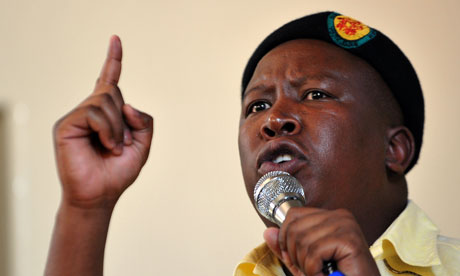
Army will seek legal advice on Julius Malema

The SA National Defence Force will seek legal advice on expelled ANC Youth League president Julius Malema’s address to soldiers, the SANDF said on Thursday.

“We want to understand the legality of it and the implication. The meeting between Mr Malema and SANDF members… we need to find the legal basis of that,” said Brig-Gen Xolani Mabanga.

“We cannot think that any member of the public can just go and talk to members of the SANDF.”

Mabanga said it was also unacceptable for SANDF members to invite a person to address them outside defence structures.

“Anybody outside the established military structure and the South African government, that would be out of order. Even if they invited a pastor, or a priest or a bishop or a sangoma or whatever,” Mabanga said.

He said SANDF members who had grievances should use existing structures to voice them and not air them with private individuals such as Malema.

Mabanga said legal advice would not be sought by the SANDF itself, but through its civilian leadership in the department of defence.

On Wednesday, Malema addressed about 60 soldiers in civilian dress at the Lenasia Recreation Centre.

There he criticised the political leadership of the country and accused them of ignoring the needs of SANDF members, including not re-instating the 1100 soldiers put on special leave for protesting at the Union Buildings in 2009.

Mabanga said some of the 60 soldiers at Malema’s speech were among the 1100 members put on special leave and they could face disciplinary action for their attendance.

“They still fall under the military disciplinary code. They’re still members of the SANDF,” Mabanga said.

He said they had been ordered to return to their home units and would now be charged with failing to obey that order.

Some of the other SANDF members had already been dismissed and the military had no jurisdiction over them. – Sapa

ANC tries to reassure ‘panicking’ international community about South Africa

ANC secretary general Gwede Mantashe has denied there was wide-spread panic over recent violent protests countrywide.

“I’m not sure what’s the difference between panic and caution. If they take cautionary measures to avoid the damage and deaths of people that have occurred now, I don’t think that can be called panic, it would be called cautionary,” Mantashe told SAfm on Thursday morning.

Asked for reaction to investors and the international community “panicking” about the situation, Mantashe said there were two “distinct problems” that needed to be dealt with.

“When there is lawlessness, the state must be capable to deal with that. When there is agitation and incitement, the state must be able to deal with that,” said Mantashe.

If the state becomes “flat-footed”, “everything can break loose”.

“I think that is where I am more worried than the panic you are talking about.”

He also expressed concern about threats to bring the mining industry to a standstill. Mantashe said it would be regrettable if bargaining councils no longer functioned properly.

A month ago, 34 people were shot dead by police at Lonmin platinum mine in Marikana, Rustenburg in the North West. Protests — apparently sparked by rivalry between two unions — had left 10 people dead the week before the shooting by police.

Another body was found at the mine this week, where talks to deal with a R12,500 monthly salary demand were yet to yield any results.

The mine has not been able operate for weeks, and protests by mineworkers seem to have spilled over to more mines — Anglo American Platinum in Rustenburg, and Goldfields’ KDC West mine in Carletonville.

Expelled African National Congress Youth League leader Julius Malema has addressed striking miners, urging them to go on work stoppages every month until their demands were met.

He also addressed disgruntled soldiers on Wednesday, causing the defence minister to accuse him of being counter-revolutionary and trying to incite members of the SA National Defence Force against the state.

Mantashe said the ANC national executive committee would meet to discuss “all these matters that are in the public domain”.

“It’s not an emergency [meeting], it’s a normal NEC meeting. It’s scheduled,” he said. – Sapa

‘ANC faction causing unrest at Lonmin’ – Cosatu

The ongoing labour dispute at Lonmin and spreading throughout the mining sector is being organised by an ANC faction with expelled ANCYL president Julius Malema acting as their front man, Cosatu president Sdumo Dlamini said in a report on Thursday.

The Congress of SA Trade Unions leader told Business Day the unrest was the result of a “systematic, orchestrated, long-time plan” by this faction within the African National Congress.

This faction was hoping to force the ANC into “chaos” ahead of their elective conference this December in Mangaung to compel the party to remove Jacob Zuma from his position as African National Congress president.

“We also understand that there have been certain individuals behind him [Malema] who are funding this for their own political ambitions,” he told the paper.

“Julius Malema may be the point person running at the front but we know that there are big guns behind him.”

Malema has made himself a fixture amongst protesting miners throughout the sector since 34 Lonmin miners were shot a month ago.

He has been offering them support for their wage demands and calling on them to demand the resignation of political figures and the leadership of the National Union of Mineworkers, a Cosatu affiliate. – Sapa

If Africa is more like Singapore, why are we getting so many refugees?

by Dan Roodt

Living in South Africa, one gets used to being called a moron by every visiting foreigner, especially ones of the liberal to left-wing persuasion. After all, they seem to reason, we do not know anything about our own history. We do not understand our own country or our own continent. Nor do we have any grasp of Africa or African culture, despite many of our people speaking African languages and compiling dictionaries in those languages.

The same goes for what is called the mass media. The bigger and more influential they are, the more you will find the view that the average Afrikaner or white commentator in this country is a barely literate buffoon. Many a time I have come across the phrase about this country: “Apartheid destroyed South Africa.”

If you had flown in an aeroplane over South Africa in 1994, shortly after Nelson Mandela became president, you would have seen just how “destroyed” South Africa was. We had more roads and railways than Great Britain. Having a far bigger surface area also helps, I suppose. At one time we were one of the few countries exporting more food than we imported, notwithstanding being a semi-arid country.

The criteria for measuring progress in Africa seem to differ from other places. Economic growth, income per capita,  life expectancy, quality of life, infant mortality, the level of education, all those ordinary measures of a country’s success or progress are suspended in favour of focussing on, well, some racial element.

The racial element could be the mystique of Africa, its smiling, simple people happily singing to some merry tune like the coffee plantation workers on Karen Blixen’s farm  in the Hollywood movie “Out of Africa”. Or it could be the successful eradication of Western influence, the confiscation of land owned by white farmers, the imposition of racial job quotas to prevent whites from working in South Africa, and so on.

Organising a successful pogrom against whites in Africa is always cause for celebration. Whichever dictator or strongman is involved in such an operation, may be assured of vast amounts of Scandinavian aid money before, during and after the operation.

A few weeks ago, the correspondent for the New York Times in Johannesburg, Lydia Polgreen, wrote a more or less glowing account of the Zimbabwean tobacco industry. Since nationalising the farms of white farmers and replacing them with “small-scale” black farmers, the country has taken a great leap forward, it appears.

Enthused Polgreen: “The success of these small-scale farmers has led some experts to reassess the legacy of Zimbabwe’s forced land redistribution, even as they condemn its violence and destruction.” Read the whole article: In Zimbabwe Land Takeover, a Golden Lining.

One week after the publication of this article, the UN’s World Food Programme announced that Zimbabwe was in dire need of food aid for 1,6 million people. This is the result of Zimbabwean “land reform” and “restoring the dignity of the African who no longer toils for a white boss”. Of course, up to half the Zimbabwean population has already fled to South Africa in search of food and jobs where they continue to toil for white bosses in restaurants, on farms and as cleaners and gardeners in suburban houses.

Zimbabweans have voted for Robert Mugabe for years. He has rewarded them with the kind of policies that they preferred: crypto-Marxism, confiscation of white assets, robber capitalism, cronyism, a small elite lording it over an impoverished majority enduring increasing hardship, environmental degradation, collapse of infrastructure, hyperinflation and economic crisis.

However, in South Africa these Zimbabwean voters who have democratically chosen to saunter down the road to national disaster, are considered “refugees”. Not only that, but according to a recent article on The Daily Maverick website, South Africa is the country in the world receiving the most refugees. Last year we took in a whopping 219 368 of them. By contrast, the USA only got 40 000 refugees. In many West-European countries, refugees are considered a major problem when about 20 000 announce themselves at the border posts in any given year. Yet we are supposed to endure the flow of hundreds of thousands of refugees across our borders, together with many more illegal aliens, as part of our fate.

But the biggest paradox of all is the following: Why would any African want to leave his democratic, prosperous, economically booming home country for the not so bright lights of Johannesburg, Pretoria, Durban or Cape Town? After all, according to the world’s mass media, we are “the destroyed country”, the least successful on the African continent.

Perhaps the New York Times correspondent in Johannesburg, Lydia Polgreen, could solve that conundrum. This is all the more remarkable in the light of recent pronouncements by American academics that the image of poor sub-Saharan Africans holding out a begging bowl for help or Bono to organise an aid concert is very passé. Malthus was wrong. Unbridled population growth is the road to riches and Africa’s “youth bulge” represents a “demographic dividend”.

This may sound like satire or sarcasm, but it is not. On the CNN website, I came across a piece asking the rhetorical question: Is Africa the new Asia? Written by Professor Richard Aidoo from the Department of Politics and Geography, Coastal Carolina University, the article asserts that Ghana has had a 13,5% growth rate recently, portending an “African miracle”. On the demographic issue, Professor Aidoo writes:

“Africa has another potential advantage – a youthful population with a hunger for change. Many of the uprisings in support of democracy across the continent have been championed by disaffected young people bitten by the technology bug and anxious for opportunities. For these young and driven Africans, change isn’t a distant hope, but something achievable. The memories of colonial exploitation are receding further into the rearview mirror as young Africans look forward.”

Aidoo cites the British Economist in support of his views. Howard W. French, a New York-based African expert who teaches at Columbia University Graduate School of Journalism and is a former senior writer and foreign correspondent for the New York Times, concurs that the continent is already way up the economic scale. He writes in The Atlantic:

“Africa, with a population expected to roughly double by mid-century, has become recognized as the world’s fastest growing continent. But the less-told story is of Africa’s economic rise. In the last decade Africa’s overall growth rates have quietly approached those of Asia, and according to projections by the IMF, on average Africa will have the world’s fastest growing economy of any continent over the next five years.

Seven of the world’s 10 fastest-growing economies are African. The continent is famously resource rich, which has surely helped, but some recent studies suggest that the biggest drivers are far less customary for Africa, and far more encouraging for its future: wholesale and retail commerce, transportation, telecommunications, and manufacturing.”

After 18 years of ANC rule, South Africa’s formerly first-world infrastructure is crumbling. Raw sewage is flowing into our rivers. The roads are full of holes. Our previously superb health care system is in a shambles with patients left to die in state hospitals. Despite record spending, the education department cannot deliver school books to some of its schools. South Africa has two million mostly white and corporate taxpayers who supply a welfare state for 50 million people. We are definitely not an Asian tiger economy, but by traditional measures SA is still the biggest economy on the continent.

But those are traditional measures. Clearly, people in the know and pundits associated with The New York Times, have decided otherwise.

If someone could just explain to me why so many Africans are still flocking to this country which suffered so much damage in the past and has still “not quite recovered from apartheid”, I would be really glad. After all, why would you leave one of the fastest growing economies in the world seething with bright young technology entrepreneurs, to settle in our country still blighted by white, Western influence?

Afrikaners are a lost cause, Dan Roodt

By English-speaking Patriot

Dear Dan Roodt, congratulations on your letter about apartheid in Business Day and here on praag.org. And did you see the knee jerk reaction from the liberals, the Afrikaans jingoes and the “others” in Business Day? Always guaranteed to defend the shambles, as you put it. I’ll never understand these people. They go against nature!

As far as Woolworths is concerned, I have boycotted them entirely. But others haven’t. The wording of their advertised “explanation” was ambiguous, so their actual racist advertisements need to be circulated so that everyone can see just what they are doing.

 MultiChoice did the same thing – gave shares only to blacks. Yet most of MultiChoice customers are white. Nobody said a word.

 I can tell you that all universities, all government departments, all municipalities and most private job advertising refer to “Employment Equity” and the other euphemisms they use to discriminate. People whine about this to the newspapers, but that’s as far as it goes. There will always be whites who will do the catering for these morons when they gorge themselves at their “conferences”, there will always be whites who will set up the sound system for their ridiculous rallies, there will always be whites who will provide the flowers for their funerals, and there will always be whites who, as you say, keep the whole show on the road. And look at the farmers! Do you think they will ever stand together and hold back the food for just one week? Not on your life!

 It is difficult to get the whites to do anything. Especially Afrikaners, they simply sit back and suffer so very politely. They don’t want to be  omstrede. They will die from ordentlikheid! They watch the department stores remove Afrikaans signs from within their stores, and they do nothing. Frankly, my feeling is they deserve what they get. Fancy buying the Beeld every day, the biggest piece of twisted and traitorous journalism I’ve ever seen in my life! And they’ve been doing this for as long as I can remember.  They are giving soup to squatters and illegals, and their churches have made them so “lam” that it is a world phenomenon!

 These third-world cretins are laughing all the way to the bank. There is no unity  within Afrikanerdom, and if there are three together, one is a traitor. You’ve only got to look at the Boeremag trial. Without the Afrikaans informers, there would never have been a Boeremag. Yet these traitors walk around without a care in the world, getting their traitorous salaries from the ANC who are destroying their own Afrikaans people!

 In Ireland they would have had their knees capped. And what do the Palestinians do with their traitors?

 No Dan Roodt, they are a lost cause. There is no spirit, no sense of an eye for an eye, and they are awash with “it’s God’s will” and other such nonsense. They are living martyrs, no different from those who were thrust into the Colosseum in ancient Rome, ready to die for their “faith” and ending up as bones in the catacombs.

 It makes me sick to my stomach!

Vast crowds in Catalonia demand independence from Spain

Showing support for Catalonian autonomy from Spain

(Reuters) – Hundreds of thousands of Catalans took to the streets of Barcelona on Tuesday in an unprecedented show of mass support for autonomy from Madrid, blaming Spain’s economic crisis for dragging their wealthy region down.

Surging unemployment and financial disarray have stoked a fever of separatism in Catalonia, a comparatively prosperous part of Spain whose leaders say their wealth is being sucked dry by the central government.

Crowds waved red and yellow striped Catalan flags – one of the oldest still in use in Europe – and sang the Catalan anthem on a national day marking the conquest of Catalonia by Spain’s King Philip V in 1714 after a 13 month siege of Barcelona.

The central government said the crowd was 600,000 strong. Catalan police gave figures as high as 1.5 million.

Marchers said the sheer size of the crowd – swollen with people from around the region who descended on its capital in bright sunshine – would at last make Madrid hear their message.

“This is a blow for the government. People like me came from everywhere. I don’t think they were expecting something as big,” said 53-years-old Teresa Cabanes, who came from Santa Coloma de Gramanet, in the outskirts of Barcelona, to march.

“We feel that the central government is fooling with us. We Catalans are giving away a lot of money to Spain.”

They held up banners and signs saying “No to the Fourth Reich”, “No to Europe”, “Independence Now!” and “Catalonia: the New European State”.

The huge volume of people overwhelmed the mobile phone network, which shut down for hours under the strain. Marchers who had attended Catalan national day rallies for decades, including others that attracted hundreds of thousands, said this was the biggest they could recall.

The march ended after nightfall without any incident and no people were arrested, police said.

The show of anger and ethnic pride will play into the hands of regional authorities who are trying to force the central government to yield control over taxes raised in Catalonia.

Catalans speak a language similar to, but distinct from, the Castillian Spanish spoken in the rest of Spain. The region accounts for 15 percent of Spain’s population but 20 percent of its economy.

With Spain’s economy in freefall from the euro zone debt crisis, Catalans complain of paying billions of euros more in taxes than they receive back from Madrid, even as their regional government has been forced to fire workers and cut services.

The region’s president, Artur Mas, has suggested he could seek independence if he is not given more control over tax raised from Catalonia.

“If we cannot reach a financial agreement, the road to freedom for Catalonia is open,” he repeated on Tuesday. Mas did not attend the march but said he backed it in spirit.

URGENT BATTLE

The annual Diada holiday is typically commemorated with a fiesta in the Catalan capital with song, dance and a floral offering to Rafael Casanova, a hero of the siege.

But the outpouring on Tuesday was a sign that the economic crisis has transformed issues of cultural identity into a mainstream political movement bent on autonomy. A poll by the regional government in July showed for the first time that more than half of Catalonia’s population favors independence.

For Mas and his nationalist Convergence and Union party (CiU), that translates into demands for control over tax.

When Spain returned to democracy in the mid-1970s, regions such as Catalonia and the Basque Country saw a vibrant resurgence of their culture and languages that had been crushed during the dictatorship of Francisco Franco.

Catalonia has long sought more autonomy, though without a violent separatist movement like the Basque Country’s ETA.

Economists calculate Catalans pay at least 12 billion euros more in taxes per year to Madrid than they receive back for services like schools and hospitals. Many Catalans say the figure – difficult to calculate because of a complex system of transfers – is even higher, up to 16 billion.

“A lot of people who were not into independence are more and more into it now,” said Elvira Farre, a retired secretary from Barcelona. “They are being driven into it by their feelings but also by their wallets.”

Government worker Jauma Turra said: “It’s like a marriage you can’t put up with any more.”

The Madrid government took a dim view of what leaders there saw as Mas’s stirring up Catalans ahead of the march.

“Catalonia has serious deficit and employment problems and this is not the moment for messing around or disputes or controversy,” Prime Minister Mariano Rajoy of the conservative People’s Party said on Monday.

SUSPICION

Many Catalans are suspicious of what they see as the centralizing aims of the People’s Party.

Although Catalonia’s unemployment is somewhat lower than Spain’s as a whole – 22 percent instead of more than 24 percent – the region has suffered badly due to the Spanish debt crisis.

There are 700,000 jobless in Catalonia. The government cannot borrow from financial markets to pay bills because, like other Spanish regions, it saw its debt downgraded to junk.

Catalonia was among the first of Spain’s 17 autonomous regions to start making budget cuts to its public services in 2010 and cuts have grown deeper, with civil servant pay cuts causing a public backlash in recent months.

Despite his austerity drive, Mas has managed to deflect fury over his region’s economic problems onto the central government, saying if the tax system were set up differently Catalonia would not be in its quagmire.

He has proposed a “fiscal pact” that would give Catalonia its own tax authority. He is scheduled to meet Rajoy on Sept 20 to discuss it, but Rajoy is expected to reject it.

“It’s part of a political game that has been going on for years. The only difference is that the crisis has changed the stakes,” said Antonio Barroso, political analyst with Eurasia Group consulting firm.

Catalans were particularly galled when the central government raised the value-added tax across Spain from Sept 1, but said it would not pass the extra revenue to the regions.

Catalonia has already had to tap billions of euros in emergency central government funds this year to catch up on months of back payments to service providers.

Mas says he now needs another 5.7 billion euros to pay maturing debt, but the possibility that the central government would demand more say in local finances in exchange for the aid is adding to anger in the province.

If he meets the expected resistance from Rajoy on the fiscal pact, Mas is expected to call early elections to try to win an absolute majority in the regional parliament, where he currently governs through alliances with other parties. He could use such wider backing to press Madrid for more autonomy.

South African army placed on high alert over Malema

Julius Malema

South African military bases were placed on high alert last night.

The status – the first of its kind since the ANC’s takeover of the country in 1994 – comes as axed ANC Youth League president Julius Malema is expected to meet soldiers near a military base in Lenasia, south of Johannesburg, today.

Defence Minister Nosiviwe Mapisa-Nqakula issued a strongly worded statement which said, in part, that ill-discipline in the military was a direct threat to the country’s security.

Today’s meeting comes after sources told The Times, a Johannesburg newspaper, that top security intelligence briefings, involving several government ministers, were held last night.

In a statement issued late yesterday by Friends of the ANC Youth League, Malema said he would address soldiers after listening to their “cries and demands”.

The meeting comes after Malema met disgruntled mineworkers from various companies around Gauteng over the past two weeks.

Malema’s planned address has been slammed by the Ministry of Defence and Military Veterans slammed as incitement. He yesterday called for mineworkers to go on a five-day nationwide strike every month until mine bosses had listened to their demand for better wages and for National Union of Mineworkers leaders to step down.

Malema has called on the miners not to give up on their struggle for a R12500 a month salary.

It is a move economists say will shut down mines and affect pension savings.

Malema’s spokesman, Floyd Shivambu, said: “The meeting is as a result of the pleas and requests the armed forces – soldiers of the SANDF – sent to Malema to come listen to and voice the military and soldiers’ cries and demands.

“For a considerable amount of time now, South Africa’s important component of its defence force has been marginalised and threatened with dismissal whenever they raised concerns about conditions of work.”

Defence Ministry spokesman Siphiwe Dlamini said all bases had been placed on “high alert”.

“The situation is being monitored. We cannot elaborate. Directives have been issued to base commanders and certain steps are being taken,” he said.

Dlamini said it was the first time that something like this had happened in the military.

“The military is a non-partisan organisation … this is being viewed as incitement … which is a criminal offence … it will be treated as such,” Dlamini said.

Mapisa-Nqakula said Malema’s intentions had been noted.

“It has been the expressed intention of Malema that his activities in the mining sector are aimed at rendering the sector ‘ungovernable’, thereby undermining the economy. The country cannot afford for similar instability in the military. The SANDF is the last line of defence of the sovereignty of the country. We cannot allow anyone to play political football with this institution,” she said.

Mapisa-Nqakula said any attempt to destabilise the military would be regarded as anti-South African and counter-revolutionary at the highest level.

“It is not going to be tolerated. It must be stated in no unclear terms that the military operates within an environment of command and control wherein discipline forms an integral part.

“Any actions outside this realm will be dealt with decisively by the chief of the SANDF.

“The minister calls on all members of the SANDF and the public to distance themselves from these actions of Malema.

“No permission has been granted by the SANDF’s command structures for any soldiers to participate in the proposed gathering.

“Any member who does without proper permission will be subjected to the disciplinary code of the SANDF. The compromise of discipline within the SANDF is a threat to the security of our country and all our people.”

Military analyst Helmoed Heitman said it was clear the military was the next target.

“Malema turned his sights on the mines and unions, but did not succeed. Now he is targeting the military in an attempt to continue with his campaign.

“If you are intending to plot sedition, the military is a good place to start. If you want to destabilise the state you demoralise the military.”

Heitman said a dim view should be taken of pseudo-politicians who addressing the military, which is meant to be “apolitical”.

“It is definitely something to keep an eye on. Despite there being numerous systems such as the military ombudsman, the Defence Review Commission and service commission being in place to address soldiers’ concerns, some troops will fall for Malema’s rhetoric,” he said.

SA National Defence Union spokesman Pikkie Greeff said the meeting was not union-driven.

“We have nothing to do with this. The information we have is that among the matters to be discussed are concerns over the deployment of ANC cadres to the top structures of the defence force, poor salaries and grievances around dismissals and disciplinary matters.”

NUM spokesman Lesiba Seshoka said heeding the firebrand’s calls would lead to massive job losses.

“To call on workers to embark on illegal strikes is totally irresponsible and childish.

“NUM condemns his attack on its leadership and the desperate behaviour of taking advantage of vulnerable people and trampling on rights of families of the deceased in Marikana in an attempt to score cheap political points.

“The National Union of Mineworkers appeals to all its loyal members to reject Malema’s hogwash and to return to work.

“Cosatu called on mineworkers not to allow themselves to be used as a “political football”.

“[Malema] is playing a dangerous game, exploiting the emotions of angry workers. This can only inflame tensions within the mining industry, flames which he is quite incapable of quenching.

“It is revealing that his main target is not the capitalist employers, who are responsible for the mineworkers’ low wages and terrible conditions, but their union, the National Union of Mineworkers.”

Peter Major, a mining consultant at Cadiz Corporate Solutions, said companies would lose $192-million a day should the national strike take place, a move that would lead to massive retrenchments.

“Eventually everyone would sell their shares. They would rather put their money in the banks, property and bonds.

“All these pension funds – the government pension funds, the mineworkers’ pension funds and foreign pension funds – they will obviously sell all their South African mining shares,” he said.

Australia to deal with its boatpeople this week

Australian Immigration Minister Chris Bowen on Monday said he hoped to begin sending asylum-seekers who arrive by boat to the tiny Pacific nation of Nauru later this week.

With Australia facing a record influx of asylum-seekers arriving by sea, Canberra last month announced plans to send them to Nauru and Papua New Guinea’s Manus Island in a policy aimed at stemming the flow.

Bowen tabled a document in parliament Monday designating Nauru as a regional processing country under the Migration Act so boatpeople can be sent to the small state to await their visa decision.

“Subject to both houses (of parliament) passing a resolution approving the designation, the designation will allow for the transfer of irregular maritime arrivals who arrived after 13 August to Nauru,” Bowen said.

Canberra announced its intention to transfer asylum-seekers to Nauru and Papua New Guinea in mid-August as part of a tough new policy to deter them from paying people-smugglers to attempt the dangerous sea voyage.

Since then 2,087 asylum-seekers have arrived by boat — close to capacity for the camps on Manus and Nauru, which will accommodate a total of 2,100 once completed.

Bowen would not comment on who would be part of the first transfer to Nauru or whether children would be sent but said that he hoped the first group would be transferred within days.

“Construction work on the temporary facility is nearing completion and the government expects to be able to begin transferring people to Nauru later this week,” Bowen said in a statement.

More than 9,796 asylum-seekers have arrived in Australia on boats in 2012, many of them Afghans, Iraqis and Iranians who have paid people-smugglers to ferry them from Indonesia to Australia.

Offshore processing is a sensitive issue in Australia, with Prime Minister Julia Gillard adopting the policy after months of bitter political debate and after several boats capsized en route, drowning scores of people.

The policy signals a return to the practice of the previous conservative government, which sent asylum-seekers to Nauru and Manus, that centre-left Labor rolled back soon after taking office in late 2007.

The opposition supports offshore processing but said the government’s promise that asylum-seekers won’t be resettled quicker just because they are processed on Nauru or PNG will see them stranded in the Pacific for years.

“The policy that (they) have adopted means people could expect to wait on Nauru for five years,” opposition spokesman Scott Morrison said. – AFP

Afrikaans becomes a campaign issue in Dutch election

Geert Wilders

Shutting the Netherlands down on Sundays, protecting Afrikaans and living a work-free life are some of the more offbeat policies being put forward by Dutch parties ahead of Wednesday’s vote.

A whopping 21 parties are contesting parliament’s 150 seats in the election, the second in just over two years after government collapsed in April over a disagreement on European Union austerity measures.

Should they get their say, the conservative Reformed Political Party (SGP), which currently has two seats in the Lower House, wants to close all shops on Sundays in order for citizens “to go to church”.

The party, which bases itself on strict Christian principles and has never had a woman in parliament since its founding in 1918, advocates a “no work” Sunday, unless the work is an act of charity or an essential service.

In an ideal world the SGP would also like to see an end to Sunday matches that are watched religiously at stadiums and in sitting rooms around the football-mad country because they mean police officers “have to work”, a party official told AFP.

The Sovereign Independent Pioneers Netherlands (SOPN), also known as the “UFO party” after its founder UFOlogist Anton Teuben, wants to give every citizen a “living wage” and do away with the necessity of having a job.

The SOPN also advocates the ban of future land ownership with the total “land area of the Dutch State being seen as the property of Mother Earth. Current owners can use the land provided they look after it,” the SOPN said in its election manifesto.

A “movement” rather than a party, the SOPN predicted winning this election with a “majority of 76 seats or more” but has not managed a single seat since it started in 2003.

In its campaign manifesto, the Party for Freedom (PVV), run by eurosceptic anti-Islam politician Geert Wilders said it wanted to push for the preservation of the Afrikaans language in South Africa and Namibia.

Spoken by white and mixed-race South Africans, Afrikaans has its roots in 17th-century Dutch spoken by early colonial farmers and slaves, with words borrowed from Indonesian and indigenous languages.

“We are defending our Dutch language. Afrikaans is closely related to Dutch… but the language is further being marginalised,” the PVV said.

The Party for Animals (PvdD), currently with two MPs, wants recreational angling banned, demanding also that “fishing lessons” in schools be scrapped.

The party also wants a complete ban on pigeon racing as a sport, saying many of the birds die of exhaustion.

The Dutch Electoral Commission struck down 26 other parties who said they wanted to take part in the polls, but failed to hand in valid candidacy lists.

Of these, the Party for Humans and Other Earth Dwellers said they had no problem with people taking drugs “but in moderation.”

They also advocate free food and drink in supermarkets, financed by income tax gained from citizens.

The Club of Non-voters argued that at least a third of all Dutch citizens were disillusioned with politics and would support their movement.

“Should the movement decide to become a political party and take part in the elections, there would be a big chance that the prime minister would come from our ranks.”

“But in the current political system you have to take part. We won’t.” – AFP

Towson White Student Union to host Jared Taylor

Jared Taylor

Towson University, Maryland — The new student-run organization, the Towson White Student Union, has arranged for Jared Taylor to speak on campus on October 2, 2012 at 8pm in the Chesapeake 3 room of the University Union.  At the public and free event, attendees will hear Mr. Taylor discuss the political and cultural interests of Whites in the contemporary West, which is quickly becoming balkanized through multiculturalism. His topic will be: “What is White Identity?”

 Mr. Taylor is an American journalist who founded and currently serves as editor of American Renaissance.  Mr. Taylor is the president of the New Century Foundation and is a former director of the National Policy Institute, which is a Georgia-based think tank.  He is also a former member of the advisory board of The Occidental Quarterly.
Born to missionary parents in Japan, Mr. Taylor has written or edited the following published books: White Identity, Paved With Good Intentions: The Failure of Race Relations in Contemporary America, The Color of Crime, and A Race Against Time: Racial Heresies for the 21st Century.
Matthew Heimbach, the founder and president of the White Student Union, said, “It is an honor to host Jared Taylor.  I could not think of a better way to begin the academic school year than by hosting a speech by him.  The students of Towson will finally be afforded the opportunity to learn something other than the cultural Marxism that is espoused by their professors.”

Brics brings new dynamic to world system – South African minister

The Brics bloc has introduced a new dynamic to the world’s political and economic systems, International Relations Minister Maite Nkoana-Mashabane said on Monday.

“We [Brics] also envision and work to realise a more equitable global political and economic system,” she said at a business breakfast in Johannesburg hosted by The New Age newspaper.

Brics refers to the Brazil, Russia, India, China and South Africa group of large emerging market economies.

South Africa joined Brics to advance the country’s national interests, and promote regional integration and continental development.

Nkoana-Mashabane said Brics allowed South Africa to partner with key global players to advance international governance and reforms.

Brics, with 43 percent of the global population, contributed 20 to 25 percent of global GDP, and 11 percent of annual foreign direct investment in 2012.

Regarding petrol tariffs, the minister said South Africa was not insulated from the changes in the global oil price, controls and speculation that occurred in the market.

The government had taken steps since 1994 to diversify South Africa’s imported oil supply, importing from African countries such as Nigeria and Angola. Other African oil suppliers were also being considered as future import options.

The minister said South Africa’s national interests were intricately linked to the interests of the African continent.

“It’s important that we continue to think globally and act locally.”

South Africa had supported United Nations resolution 1973, allowing for the implementation of a no-fly zone over Libya, because the resolution was about protecting the human rights of Libya’s citizens.

Nkoana-Mashabane said the path to resolving the current conflict in Syria lay in a political solution, and not a military one.

For a political solution to be possible, hostilities within the country must be suspended, she said.

She agreed with the assessment, with disagreements over Syria being an example, that the United Nations Security Council needed to be reformed. – Sapa

South African Deputy Foreign Minister to visit Cuba, Panama

Marius Fransman
Marius Fransman

International Relations and Cooperation Deputy Minister Marius Fransman is scheduled to arrive in the Republic of Panama today, 09 September 2012, ahead of his two-nation visit to Panama and Cuba.

Deputy Minister Fransman visits Panama at the invitation of his Panamanian counterpart, Deputy Foreign Minister Francisco Alvarez de Soto.

Deputy Minister Alvarez de Soto visited South Africa in April 2012, the first high-level bilateral visit from Panama to South Africa since full diplomatic relations were established on in January 1995.

The Government of Panama opened an Embassy in Pretoria in August 2000. South Africa is non-residentially represented in Panama from Mexico City, Mexico, with an Honorary Consulate in Panama.

The visit by Deputy Minister Fransman will provide an opportunity to continue bilateral discussions between the two Deputy Ministers, with a focus on strengthening economic relations.

It is expected that Deputy Minister Fransman will also meet with Panama’s Deputy Minister of Commerce and Industry, the Deputy Minister of Finance and Economics and the Chamber of Commerce, Agriculture and Industry.

Deputy Minister Fransman is also expected to meet with the CEO and Board of Directors of Panama’s COPA Airlines to discuss cooperation with SAA through code sharing, to create direct links for passengers between the two countries. Panama is a hub for air traffic in Latin America.

The Deputy Minister will visit the Panama Canal and the Colon Duty Free Zone to witness and be informed first-hand of the opportunities and advantages for shipping access to the Pacific and trade in general offered.

The visit will also include a tour of the City of Knowledge, an institution providing facilities and support to programmes in education, research, technological development and innovation, while promoting integration of institutions and business, as well as being self-sustainable.

The visit promises to provide impetus to South Africa’s already solid bilateral and multilateral relations with Panama, a prominent maritime country and a hub for trade with a strong economic growth.

Following his visit to Panama, Deputy Minister Fransman will visit Havana, Cuba, on 12-14 September 2012, where it is expected that he will meet with Deputy Minister Rogelio Serra, responsible for Africa, the Middle East and Asia in the Cuban Foreign Ministry. The two Deputy Ministers will hold bilateral discussions on issues of mutual interest.

Deputy Minister Fransman is expected to deliver a lecture at the Superior Institute of International Relations (ISRI) in Havana on the upcoming International Solidarity Conference in South Africa and on the commemoration of the ANC centenary, amongst other issues.

Relations between South Africa and Cuba remain excellent. The Governments of both countries share similar interests in relation to addressing the socio-economic needs and aspirations of the peoples of South Africa and Cuba.

Cuba is an established key partner of South Africa in Latin America and the Caribbean.

South Africa is a beneficiary of Cuba’s ongoing assistance in the form of scholarships for our youth. There are currently 408 South African students studying medicine in Cuban universities. A total of 323 South African graduates from the Cuba programme work as medical doctors in various South African hospitals. In addition, 74 South African students are currently doing a one-year internship in South Africa after finishing their studies in Cuba this year, 2012.

From October 2012, South Africa will begin to train 1 000 students in medical science at Cuban universities.

On the economic front, authorities of both countries have in the past few years increased efforts to enhance bilateral trade and commercial relations.

Bobby Godsell says Marikana violence ‘outrageous’

Bobby Godsell, former CEO of Anglogold Ashanti and chairman of Business Unity

The violence at Marikana was “outrageous” and the killers needed to be held accountable, Business Unity SA chairman Bobby Godsell said on Monday.

“In an apartheid South Africa with no (democratic) constitution you can say that violence was regrettable and understandable,” he said during a discussion at the Gordon Institute of Business Science in Johannesburg.

“In a constitutional democracy, (violence) is not understandable. It is completely outrageous.

“People must be held accountable for those murders.”

For South Africa to fix what happened at the Lonmin platinum mine in Marikana, North West, wage negotiation processes had to change.

“We have to make wage negotiation work. It has to be inclusive. We have to include people in the negotiation process.

“It has to deliver outcomes that people find broadly acceptable.”

A panel consisting of business leaders, economists and political commentators discussed what led to the deaths of 44 people, most of them striking Lonmin employees, in August.

Executive head of joint venture operations at Anglo American Platinum, Vishnu Pillay, said South Africa needed successful communities to prevent the Marikana tragedy.

Pillay said it was clear there was a link between the social problems faced by Lonmin workers and what the workers wanted from management.

The tragedy, he added, taught the mining community that it needed to conduct its business differently.

Pillay said both the mining company and unions had “in some way” failed the mineworkers in Marikana.

On August 16, police fired on a group of protesters near Lonmin’s Marikana mine, killing 34 and wounding 78. Another 10 people were killed in the preceding week, including policemen and two security guards.

SA Chamber of Mines CEO Bheki Sibiya echoed some of Pillay’s views.

“Mining is a microcosm of what happens in South Africa. Because it is a microcosm we find that a lot of problems which are happening around [the country] are happening in the mining industry as well.”

The fact that most of the 260 people who were arrested on August 16 did not work at Lonmin showed the Marikana tragedy was underpinned by social issues.

Sibiya urged all parties involved in Marikana to stop blaming one another.

“Let’s hang our heads in shame and fix the problem.”

Most of the panellists also criticised he inefficiency of the National Economic Development and Labour Council (Nedlac), a forum where government, labour, business, and community organisations negotiate.

“I don’t go to Nedlac because it’s a waste of time. I don’t go there because the government officials who were supposed to be making it successful decided not to attend,” Sibiya said.

Chief executive of Pan-African Capital Holdings, Iraj Abedian, pinned the blame on the nation’s failure to practice what it preached.

Abedian said everyone knew the mining sector had not complied with its social responsibility targets, and nothing had been done about it.

The government and society had done little about structural risks in the mining sector.

“In economics if you do not manage the structural risk and you hope that it will go away… it bounces back,” he said. – Sapa