Cécile Kyenge with the Belgian Deputy Prime Minister, Joelle Milquet, to her right
Ministers from 17 EU member states on Monday (23 September) gathered in Rome to condemn the racism directed towards Italy’s integration minister Cecile Kyenge.
Ministers from 17 member states gathered in Rome to condemn racism.
The ministers called for a new pact to stamp out racism across Europe, which they see as on the rise.
“What has happened to the Italian minister is unacceptable but we’re talking about a widespread phenomenon,” Belgium’s deputy prime minster, Joelle Milquet, told reporters in Rome.
They signed a “Declaration of Rome,” which calls upon the EU to put together a plan for 2014-2020 on diversity and the fight against racism.
“Intolerance and discrimination, in whatever form, is reprehensible. We cannot ignore it and we cannot do nothing about it,” states the declaration.
The ministers want the European Commission to draft a report on racism before the European Parliament elections next May.
It notes that all member states should finalise the transposition of anti-discrimination legislation and put in place “judicial instruments” to help weed out attacks.
The declaration also condemns political movements with racist and xenophobic positions and notes that the economic crisis has reinforced populism and racism.
Speaking to reporters after the declaration, Kyenge thanked her counterparts for their support.
Kyenge, an eye doctor born in the Congo, has faced racial slurs and jeers in her first five months office from far right Italian politicians and others. She has also faced death threats.
Right-wing Northern League senator Roberto Calderoli compared her features to that of orangutan. Italian Northern League MEP Mario Borghezio, who is a member of the civil liberties committee, described the Italian government as a ‘bongo bongo’ administration because of Kyenge.
In early September, members of the far-right Forza Nuova movement smeared blood on mannequins, which they placed outside municipal buildings in Rome. The act was in protest of Kyenge’s proposal to extend citizenship to Italian-born children of immigrants.
“I have never said Italy is racist, every country needs to start building awareness of immigration and Italy has simply arrived very late,” Kyenge said following the mannequin incident.
In August, a member of separatist group Veneto State, threatened to kill Kyenge on his Facebook page.
In another incident over the summer, Italian Councillor Dolores Valandro, was given a 13-month suspended sentence, a €13,000 fine, and a three-year ban from holding public office after she suggested Kyenge should be raped. – euobserver.com
Hundreds of migrants from Morocco were trying to cross the southern EU border at Melilla, a Spanish exclave, on Monday before dawn.
Having torn down a part of a triple six-meter high fence, about 100 made it through, Spanish government officials in the territory said in a statement.
They were the latest of thousands of migrants who try to reach Spain from Africa across the fence or by sea, forced to leave by unrest in Northern Africa, most of them from Algeria, Morocco and Tunisia. – RT
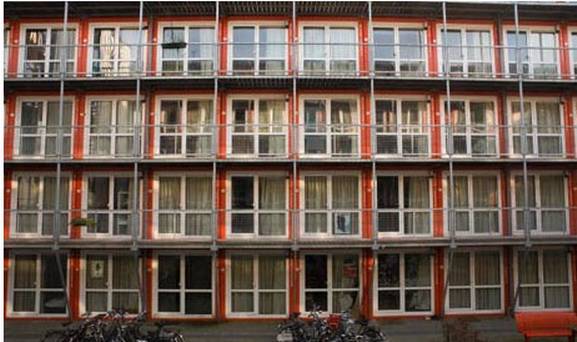
The Dimitrovs are the first nuisance neighbours to be moved forcibly to police-supervised accommodation as crowded Amsterdam steps up measures against anti-social behaviour.
Eberhard van der Laan, Amsterdam’s mayor, admitted that the removal of the family was a draconian measure but insisted that bullying and violent behaviour had left him with no choice.
“The family has been causing problems for years and has a history of vandalism, noise nuisance and threatening behaviour,” he said.
The eight members of the gypsy family have compared their container homes, numbers 48a and 48b, to a concentration camp and accused Amsterdam council of “pure racism”.
Francois Lonis, an ex-boyfriend of one of the Dimitrov daughters who still lives with the family, criticised Mr van der Laan for commemorating the Holocaust while “discriminating” against Roma. “The mayor talks about Auschwitz but sends us to this place,” he said.
“Where is my mother-in-law supposed to do the shopping. Our television does not fit inside.”
The housing camps have been nicknamed “scum villages” because their establishment follows a 2011 proposal from Geert Wilders, the leader of a populist Dutch right-wing party, for special units to deal with persistent troublemakers.
“Repeat offenders should be forcibly removed from their neighbourhood and sent to a village for scum,” he argued at the time. – Daily Telegraph
From spats over halal meat in Danish schools to asylum seekers in Sweden, anger about immigration has fuelled the march of populist parties across Nordic countries, leading one such group to the brink of government in prosperous Norway.
The anti-tax and anti-immigration Progress Party, which once had among its members mass killer Anders Behring Breivik, won 16 percent of votes on Monday and could be kingmaker in a new center-right coalition after eight years of center-left rule.
Its strength reflects both worries about an influx into the Nordics of asylum seekers from countries like Syria and economic migrants from Spain, as well as disenchantment with mainstream parties that have dominated the political landscape for decades.
“We’ll ensure a solid footprint in a new government,” Progress leader Siv Jensen said. “We have reason to celebrate.”
Even without entering government, right-wing populists have managed to toughen public policies ranging from immigration to euro zone bailouts, drag political debate to the right and become a permanent feature of the parliamentary landscape.
The backlash has surfaced even though Nordic economies have outperformed languishing southern European countries. Their success has attracted thousands of “euro refugees”, vying for scarce jobs as their home states endure grinding austerity.
Economic conditions may be different, but many voters around Europe share the same perception that the established parties are out of touch with ordinary people and their concerns.
From Greece to France and the Netherlands, unemployment and economic grievances have combined with suspicion of European integration, Islam and multiculturalism, to propel both the far right and far left.
In Italy, the grassroots 5-Star Movement, born of disgust at the entire political establishment, surged to prominence in a general election in February. Britain’s UK Independence Party has gained ground and spooked mainstream politicians by harnessing an anti-EU platform with hostility to immigration.
BACK FROM THE SIDELINES
Breivik’s killing of 77 people in Norway in 2011 initially set back hard right parties in the Nordics.
But the Danish People’s Party now has the support of nearly one in six voters. The anti-immigrant Sweden Democrats have almost doubled their support since the last general election to touch 10 percent, and Finland’s opposition Finns party stands second in opinion polls with 19 percent support.
Populist groups are nowhere near winning an election and the majority of Nordic voters still express tolerance to immigrants. But any of these parties could secure the balance of power and hold a coalition government hostage on issues like immigration.
Consensus around the post-war Nordic model of high taxes and generous welfare was long sustained by a homogenous society. But immigration, global competition and fear for jobs have put that ideal of equality based on civic trust under strain.
“There exist groups that don’t feel this trust,” said Swedish Prime Minister Fredrik Reinfeldt. “These people as voters are more easily seduced by populist forces seeking short-sighted answers and which often are more or less hostile to immigrants.”
Rising immigration has been coupled with economic troubles that have seen iconic Nordic companies such as Ericsson and Nokia shed jobs. Worries about the affordability of welfare have put the once taboo subject of immigration high on the agenda.
The nightmare for mainstream Nordic parties would be the experience of Denmark’s last government, when an anti-immigrant party held the balance of power and pushed for tighter border controls that fuelled tension with European neighbors.
Under Denmark’s current center-left government, immigration had faded as an issue until controversy surfaced when it was discovered that halal meat, slaughtered under Muslim dietary laws, was being served routinely at schools and hospitals – raising protests by anti-Islam groups.
Danish Prime Minister Helle Thorning-Schmidt waded into the debate – earning the nickname “meatball Helle’ after calling for voluntary labeling of halal meat but also urging that traditional Danish food including pork dishes be served.
The construction of a mosque in Copenhagen sparked accusations from the Danish People’s Party that it was being used for radical Islamist groups.
In Sweden, immigration has become part of the mainstream debate in a country where 15 percent of people are foreign-born, the highest rate in the Nordics. Riots in poor immigrant suburbs of Stockholm in May led to further debate about how Sweden was integrating its immigrants.
“Immigration is questioned by pretty considerable portions of the populace,” said Folke Johansson, a professor of political science at Sweden’s Gothenburg University. “It’s largely been taboo to discuss these issues, and therefore other mainstream parties haven’t been able to discuss it. It was really an open goal once they (anti-immigration parties) arrived on the scene.”
In Finland, the Finns party, whose anti-euro rhetoric struck a chord with voters in 2011, when they finished a close third in parliamentary elections, aims to join the next government.
Formerly known as True Finns, The Finns leapt to prominence during the euro zone debt crisis by opposing bailouts for troubled countries. They effectively forced the government to demand collateral in exchange for helping Greece and Spain.
Calling themselves a “nationalistic and center-left working class party”, the Finns would curb immigration by trimming immigrant social benefits and adjusting refugee quotas to Finland’s financial situation.
These parties have benefited from media-savvy leaders. The Sweden Democrats’ Jimmie Akesson, whose aim is to reduce immigration by 90 percent, wears a suit and as a lawmaker has changed the party’s former image of street ruffians.
Populists are expected to poll strongly in many countries in European Parliament elections next May, surfing a wave of Euroscepticism due to the financial and economic crisis.
But analysts say these Nordic parties may have hit a ceiling in national elections and are facing greater pushback even as they complicate coalition politics around the region.
Hundreds of Swedish women posted photographs of themselves with headscarves across social media this year to protest an attack on a Muslim woman in Stockholm who was wearing a veil.
Community leaders worry about aggressive rhetoric against migrants, and there have been other attacks. But violent incidents in Nordic countries have been isolated compared with, for example, far right attacks on migrants in Greece.
Reinfeldt’s government recently made headlines by giving Syrians an automatic right of residence.
Support for Norway’s Progress is actually down from 22 percent at the last election four years ago, although the parliamentary arithmetic gives it more leverage.
“The way Progress communicates is somewhat old fashioned and a bit cheesy,” said Daniel Gaim, 37, a teacher. “But when it comes to real policy, they don’t differ much from other parties. I’m not very concerned about giving them a bigger influence.” – yahoo.com
Zimbabwean police are looking for two journalists from the British newspaper, The Times over a story about a secret uranium export deal between Zimbabwe and Iran, a state newspaper reported Sunday.
The two Times journalists, Jan Raath and Jerome Starkey, are wanted for “spreading falsehoods” after the uranium deal story was published in the London paper on Saturday, Zimbabwe’s Sunday Mail reported.
TheTimes quoting outgoing deputy minister of mines, Gift Chimanikire, wrote that Zimbabwe signed a deal with Iran to supply the Islamic republic with the raw materials needed to develop a nuclear weapon.
The United States and the European Union have imposed crippling sanctions on Iran over its nuclear programme, which Tehran insists is for peaceful energy uses but which the Western powers fear is intended to build an atomic bomb.
Zimbabwe is also subject to international sanctions over its human rights record and alleged election fraud.
President Robert Mugabe, who won another five-year term in disputed polls last month, has publicly backed Iran’s nuclear drive.
During a visit to Harare in 2010 by then Iranian president Mahmoud Ahmadinejad, Mugabe said his guest should be assured of “Zimbabwe’s continuous support of Iran’s just cause on the nuclear issue”.
Chimanikire could not be reached for comment but The Sunday Mail quoted him denying the story as “silly, speculative and dangerous”.
“No licence has been issued. I never said such a silly thing,” the paper quoted Chimanikire as saying.
When contacted by AFP, The Times newspaper said it was not aware of the story in the Zimbabwean press and would prepare a response.
However, one of the two reporters, Starkey, tweeted about the report of the “manhunt” by Zimbabwean police. When asked if he planned to add the event to his CV, he tweeted: “Let’s wait and see that it ends ok.”
National police spokesperson Charity Charamba said she was not aware of a search for the journalists.
“I have not heard about it. I only got a call from someone else who was inquiring,” she told AFP, saying she would have to look into it. – SABC
Seventeen lawmakers from the European Parliament have called on President Barack Obama to put an end to the persecution of US soldier Bradley Manning accused of aiding the enemy after he handed over a bunch of sensitive military documents to the WikiLeaks website.
In an open letter to President Obama and Defense Secretary Chuck Hagel, the group of seventeen praised Manning for shedding light on “evidence of human rights abuses and apparent war crimes in Iraq and Afghanistan.”
“We hereby urge you to end the persecution of Bradley Manning, a young gay man who has been imprisoned for over three years, including ten months in solitary confinement, under conditions that the UN Special Rapporteur on Torture Juan Mendez deemed ‘cruel and abusive.’ Bradley Manning has already suffered too much, and he should be freed as soon as humanly possible,” MEPs from Spain, France, Sweden, Germany, Portugal, Ireland, and Ukraine wrote.
The lawmakers specifically stressed that the “aiding the enemy” offense thrown at him by the US court martial would set a terrible precedent.
“To consider releasing information about war crimes to the public to be ‘aiding the enemy’ would be a terrible setback for the defense of Human Rights and International Humanitarian Law worldwide,” they underscored.
“Army prosecutors closed their arguments in the case without having provided any real evidence that Bradley Manning aided the enemy, or that he intended to do so,” they said.
Army Pfc. Bradley Manning faces a potential life sentence for passing hundreds of thousands of classified military and diplomatic cables to the transparency website WikiLeaks, which exposed America’s crimes in its wars in Iraq and Afghanistan and further abuses around the world.
The military judge in Manning’s trial is expected to deliver a final verdict today, July 30. The sentencing stage of the trial is expected to run for several weeks in August.
Manning faces life imprisonment if found guilty
The sentence a US court will pass upon Wikileaks informant Private Bradley Manning will show what fugitive former US intelligence contractor Edward Snowden would get should he return to his country, a senior Russian lawmaker Alexei Pushkov said.
“When the sentence is passed upon Manning for handing files to the Wikileaks website, it would be clear what would await Snowden if he returned to the United States,” Alexei Pushkov, the head of the Russian lower house’s international committee, said on Twitter on Monday.
Snowden, who is wanted by the United States for leaking classified data about the US National Security Agency’s surveillance programs, formally requested temporary asylum in Russia on July 16. Washington has repeatedly called on Moscow to reject Snowden’s request for asylum and send him back to the United States to stand trial on charges of espionage and theft. – Voice of Russia, RIA, RT, Express Tribune, TASS, Scoop
European Union foreign policy chief Catherine Ashton said on Tuesday she found that deposed Egyptian President Mohamed Morsi was well and had access to television and newspapers when she visited him.
Sources told AFP that Ashton had left Cairo in a military helicopter heading to the undisclosed location where Morsi is being held.
Ashton was speaking to journalists after meeting Morsi on Monday night. “I’ve tried to make sure that his family know he is well,” said Ashton.
Ashton, who is trying to mediate a resolution to Egypt’s political crisis, added: “I said I wouldn’t come unless I could see him (Morsi).” Asked about a media report that she had offered Morsi a “safe exit”, she replied: “I did nothing of the kind.”
Spokeswoman Maja Kocijancic said on her Twitter feed that Ashton and Morsi had an “in-depth discussion” lasting two hours.
Morsi is in army detention at an undisclosed location, facing charges of conspiring with Islamist group Hamas to carry out “hostile acts.”
Ashton was on her second visit to Egypt since widespread political unrest gripped the country following Morsi’s ouster on July 3. – Voice of Russia/dpa
Germany is preparing to bring charges against US and British intelligence amid fresh allegations that the services spied far more extensively than thought on German phone and internet traffic and bugged European Union offices in America.
A report alleging a major and continuous US National Security Agency spying operation in Germany was published by Der Spiegel magazine yesterday, prompting outrage from Berlin MPs still reeling from reports about extensive British surveillance in their country.
The German Justice Minister, Sabine Leutheusser-Schnarrenburger, demanded an immediate explanation and said the behaviour of the intelligence services was “reminiscent of the actions against enemies during the Cold War”. “It defies belief that our friends in the US see the Europeans as their enemies,” she said.
The leak, which Der Spiegel said came from fugitive ex-CIA analyst Edward Snowden, claimed that the NSA tapped into half a billion German phone calls, emails and SMS messages each month. Reports last week revealed extensive tapping of German phone and internet traffic by British intelligence under its so-called Tempora programme. The information was said to be shared with the NSA.
A spokesman for the Federal Prosecutor said the office was preparing to bring charges against “persons unknown” in relation to the reports.
There was also widespread and mounting anger at official European Union level yesterday following disclosures that the NSA had spied on EU computer networks at its offices in New York and Washington and that it had also bugged the premises. Martin Schulz, head of the European Parliament, demanded “full clarification” from the US and said that if the disclosures proved true they would have a severe impact on US-EU ties.
It also emerged that the UK Government had invited German MPs and justice officials to attend a video conference at British Embassy in Berlin today during which the issue of spying would be addressed.
Der Spiegel said the NSA’s German phone and internet surveillance operation was the biggest in the EU. On 7 January 2013 it tapped into some 60 million German phone calls in a single day.
The magazine said that Canada, Australia, Britain and New Zealand were exempt from NSA surveillance but Germany was regarded as a country open for “spy attacks”. – Belfast Telegraph
Roughly 80 percent of all the packaged foods sold within the United States contain chemicals outlawed in other parts of the world, Britain’s Daily Mail reports.
Six common food additives found in an estimated 8-out-of-10 products sold in American stores are banned outside of the US, the Mail claims, putting millions of Americans at risk of consuming chemicals considered too dangerous for humans in other countries.
Grocery shop items including best-selling soft-drinks and cereal sold in the US contain additives such as brominated vegetable oil, olestra and others that have been banned in the European Union and elsewhere.
The Daily Mail cites ‘Rich Food, Poor Food,’ a recently published book by Jayson Calton and Mira Calton, as the source for their claim that the majority of American groceries contain the additives.
Among the common items containing the chemicals are Mountain Dew, Chex Mix and Hungry Man frozen dinners, which are made with additives outlawed overseas due to health risks. The Caltons say these products are filled with some of the six “Banned Bad Boys” that are used in America but absent in supermarkets overseas.
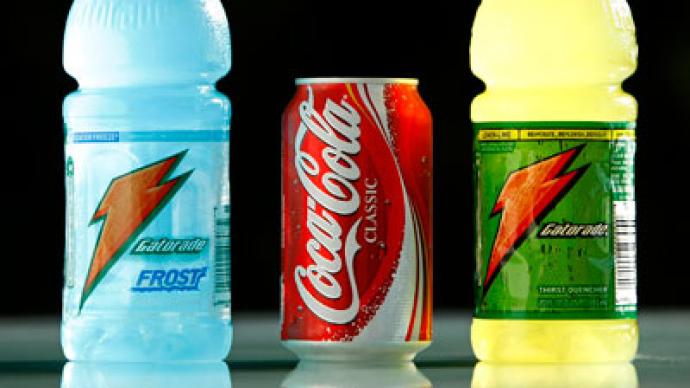
“One of the most common ‘Bad Boys’ is different variations of food coloring, which actually is made from petroleum and is found in everyday items like soda, sports drinks, mac and cheese, cake, candy and several other common, American products,” reports the Daily Mail. One of the chemicals in that food coloring, they add, has been proven to cause various different cancers. Those artificial dyes have been outlawed in Norway, Finland, Austria, France and the United Kingdom
Another additive, brominated vegetable oil, has been banned in over 100 countries because it’s been linked to causing major organ damage, birth defects and hearing loss, among other side effects. Brominated vegetable oil, or BVO, is used in Mountain Dew, Gatorade, Powerade and Squirt — and around 10 percent of all drinks sold in the US.
A petition started earlier this year to get BVOs out of beverages sold in the US received over 206,000 signatures on the website Change.org.
“BVO is banned other places in the world, so these companies already have a replacement for it,” the petition’s author, Sarah Kavanagh, told The New York Times. “I don’t see why they don’t just make the switch.”
Another additive, potassium bromate, is used in American bakeries to speed up the process of preparing wraps, rolls and other bread products. It’s derived from the same chemical as BVO, though, and has been tied to causing kidney damage and cancer. That’s why it’s been outlawed in Europe, Canada and China, but not in the US.
Also on the Calton’s list is azodicarbonamide, a chemical the Daily Mail notes is used to make things like bleach and rubber yoga mats.
Azodicarbonamide is “approved to be a bleaching agent in cereal flour” and is “permitted for direct addition to food for human consumption,” according to the Food and Drug Administration. Along with waxy preservatives called butylated hydroxyanisole (BHA) and butylated hydroxytoluene (BHT) used in bubble gums, though, the additive has been banned in parts of Europe for potential health risks.
Rounding out the authors’ ‘Bad Boys’ list are Synthetic growth hormones rBGH and rBST and the chemical arsenic. They’ve both been banned in the EU for a variety of reasons, and perhaps for good reason: the arsenic put in American poultry can kill a human being if consumed in a high enough dosage.- RT
The European Union wants to stop some imports from South Africa, like citrus fruit, SA Ambassador to Belgium Mxolisi Nkosi said on Sunday.
“There is a trend of rising protectionism that the EU is using to threaten to block some of our exports, including citrus exports,” he said, during an unofficial meeting with South African diplomats at his home in Belgium’s capital, Brussels.
“We are concerned about this. We will speak of this at the meeting and see how we can find a solution.”
The South African delegation from the international relations department arrived in Brussels on Saturday ahead of bilateral talks and political engagement.
They are accompanying Minister Maite Nkoane-Mashabane, who is due to meet with several top European officials this week. The accompanying officials met with the ambassador on Sunday.
Nkosi said the citrus sector contributed around R6 billion to South Africa’s gross domestic product (GDP). The rise in citrus production was mainly due to the increase in cultivation areas, packaging and transport improvements, and preferences for healthier food options.
But citrus harvesting and production in most of Europe continues to decline, particularly at this time of the year due to climate conditions. About 40% of South Africa’s citrus exports go to the EU, making it one of the country’s most important markets. South Africa is the world’s biggest exporter of whole oranges and the largest shipper of grapefruit.
“This is a big business,” said Nkosi.
Citrus imports were halted after some shipments were found to have the citrus black spot (CBS) disease.
The spot is a fungal disease which affects the external appearance of the fruit.
In 1993, the EU declared CBS a phyto-sanitary measure, meaning it was placed on a trade watch-list at EU borders. If spotty fruit were found, the consignment would be impounded.
This reduced the proportion of citrus exports to the EU. Farmers are now spending substantial amounts to get rid of the spots. The Citrus Growers’ Association of Southern Africa listed nine additional direct and indirect costs associated with the EU measure. These include more spraying, replanting earlier than necessary, added inspection costs, and storage costs for impounded fruit at European ports.
Export earnings account for about 80 to 90% of citrus growers’ revenue. The industry wants the phyto-sanitary measure withdrawn pending further research into black spot. Farmers believe the threat of citrus fruit being blacklisted could have disastrous effects on the sector.
The first case of CBS was recorded in 1929, and until recently the EU has not been too concerned about excluding spotty fruit.
Nkosi said the EU remained one of South Africa’s biggest trading partners, accounting for 24% of global exports.
He said the Eurozone financial crisis had significantly reduced demand for South African exports.
Despite its problems, Nkosi said the EU remained the second-largest economy in the world, accounting for 17% of the world’s GDP.
“Our relations with the EU go a long way,” he said.
“South Africa is the only African country with a partnership with the EU.” However, Nkosi was concerned that EU development aid to South Africa would be significantly cut in the coming years.
“We need to be alive [to this], and the reality is the EU can no longer help us the way they used to,” he said.
Despite this, he said the EU would remain a strategic partner. – SAPA
The Netherlands has asked its retail chains to label Israeli products made in areas beyond the 1949 ceasefire line, including Judea, Samaria, eastern Jerusalem and the Golan Heights.
The Netherlands is the second European country, after the UK, to introduce this kind of labeling system.
However, there will be no punitive measures for those retailers who choose not to comply. Also, it will not be illegal to import products from these areas and only labeling of fresh fruit, vegetables, wine, honey, olive oil, fish, meat, chicken, eggs and cosmetics will be affected.
The decision comes following the EU recommendation for its member states to implement an economic boycott of Jewish communities in those areas.
Flemish nationalists made sweeping gains across northern Belgium in local elections on Sunday, a success that will bolster separatists’ hopes for a break-up of the country.
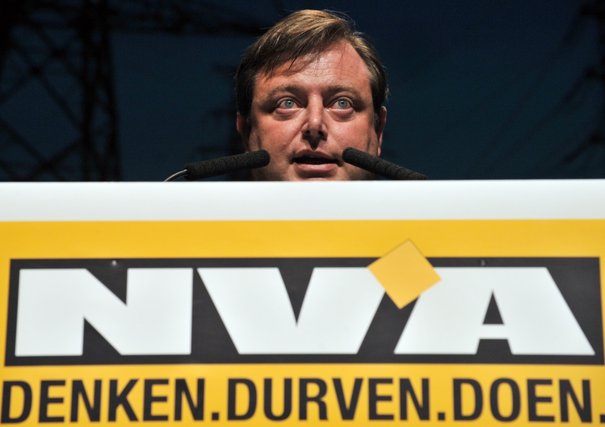
Bart de Wever, leader of the New Flemish Alliance (NVA), is set to become mayor of the northern city of Antwerp, Belgium’s economic heartland, after his party emerged as the largest one ending about 90 years of socialist rule.
Soon after the ballot results emerged, Mr De Wever, who had turned the tough mayoral race into a referendum on Flander’s independence for Belgium, demanded that the country’s prime minister give greater independence to the Dutch-speaking north.
“De Wever sent a strong signal to Brussels and he has put his party on course to send an even clearer one in 2014 … they will try to go for an even bigger win in the federal elections,” said a veteran political analyst for the Gazet Van Antwerpen.
“We want to give Flemish people the government they want at all levels. That is why I call on Elio Di Rupo and the francophone politicians. Take up your responsibility,” said De Wever.
The strong result recorded by the Flemish nationalists is likely to have an impact across Europe, where the sovereign debt crisis, which has seen rich countries bail out poor ones, has revived separatist sentiment throughout the continent.
Flanders, which is the most economically prosperous region of Belgium, has long resented financing the ailing economy of French-speaking Wallonia, and Sunday’s victory will strengthen their demand for self-rule.
Lieven De Winter, a political scientist at Université Catholique de Louvain, said that Mr De Wever’s victory was a clear step forward for separatist who had long been campaigning for secession from the southern part of the country. However, he warned that the process towards accomplishing a break-up would be wrath of problems.
“There is no doubt that tonight De Wever made a small step towards completing his dream of a break-up but there are many obstacles ahead … at the end of the day you need two to tango,” Mr De Winter said.
NVA won about 38 per cent of votes in Antwerp against about 28 per cent secured by the Socialists, according to provisional Flanders government data. Meanwhile, in the rest of the northern region the Flemish nationalists won more than 30 per cent of support.
NVA is expected to seek the support of the Socialists to run Antwerp – in Belgium it is common for opposing parties to form a coalition after elections as no one party enjoys an outright majority throughout the country.
Belgium consists of Dutch-speaking Flanders, francophone Wallonia and Brussels, its bilingual capital. The Socialists have tried to keep Brussels French through Arab immigration. Political powers have already been devolved to regional governments, Flanders, in more populous with about 6m people compared with 3.5m in Wallonia.
NVA’s victory in Antwerp and strong result across the north of Belgium will give good momentum to the separatists in the run-up to the key federal elections in 2014, said analysts. – FT
The European Union has been announced the winner of the Nobel Peace Prize 2012. Amidst Europe’s as-yet-unsolved crippling economic backdrop, a heated debate emerged over the validity of the prize.
The unanimous decision was reportedly made by a five-person panel chaired by Council of Europe Secretary-General Thorbjoern Jagland, a strong advocate of the 27-nation block.
The news came 60 years after the creation of the EU’s predecessor organization, the European Coal and Steel Community, which helped rebuild a continent decimated by two World Wars.
“The European Union is in the middle of one of its worst crises, but perhaps it is precisely now the peace and stabilization project deserves a hand from the ‘no’ country Norway?” Norwegian public broadcaster NRK said.
Norway, the Nobel Peace Prize’s host nation, refused membership in the EU in 1972 and again in 1994.
One past winner introduced indefinite detention and expanded the deadly global drone war. Another was the architect of the deliberate mass killing of civilian populations in Indochina. Ghandi never got one.
With the winner of the 2012 Nobel Prize set to be announced in Oslo, Norway on Friday, the shadow of Barack Obama still looms large. In 2009, the committee awarded the current US president “for his extraordinary efforts to strengthen international diplomacy and cooperation between peoples.” Nominations for the award are due by February 1, meaning Obama had served as America’s executive for less than two weeks when the Norwegian Nobel Committee selected him. Perhaps it was wishful thinking.
Since then, Obama signed the National Defense Authorization Act into law, making it legal to indefinitely detain US citizens. There are also the deadly drone wars in Yemen and Pakistan, the war waged in Libya, the Afghan surge and a secret “kill list” revealed this year by The New York Times, which grants a select few American officials the option to mark perceived national security threats – foreign citizens or otherwise – for assassination. Ironic, yes, but they never could have known.
Even attempts for the committee to play it more conservatively have backfired. Last year, the committee decided to recognize three women for their role in a non-violent struggle for the safety of women and for women’s rights to full participation in peace-building work. The three women included a Yemeni activist, Liberian President Johnson Sirleaf and her fellow citizen and civil society activist Leymah Gbowee.
On Wednesday, Gbowee publically lambasted Sirleaf for failing to fight corruption and nepotism in Liberia.
Liberia’s Truth and Reconciliation Commission even put Sirleaf on a list of 52 people who should be sanctioned for committing war crimes for supporting former Liberian warlord and President Charles Taylor in the late 1980s.
Taylor, who infamously campaigned on the slogan “He killed my ma, he killed my pa, but I will vote for him” during the 1997 general election that followed a war that killed over 200,000 people, fortunately did not win a Nobel Prize.
The post-Obama rehabilitation of the prize might not have gone as smoothly as hoped, but the prize’s history is replete with examples of questionable choices, to say the least.
Chief among them was the 1973 prize awarded to North Vietnamese leader Le Duc Tho and Henry Kissinger. Tho rejected the prize, telling Kissinger that peace had not been restored in South Vietnam. Kissinger for his part accepted the prize “with humility.”
Before, during and after his acceptance of the prize, Kissinger would be implicated in assassination, war crimes and the slaughter of civilians in a large swath of countries: East Timor, Pakistan, Greece, Cyprus, Chile, Argentina, Cambodia, Laos and Vietnam.
This year’s winner was drawn from 231 different nominations, 188 of whom are individuals, while the rest are organizations.
Also on the list was Myanmar’s President Thein Sein, who might be recognized for his role in moderating Myanmar’s notoriously repressive military regime. But even Sein has been implicated in confiscating land from paddy farmers which was later sold to an officer from the effectively paramilitary United Wa State Arm, who then used the land for the production of amphetamines.
This certainly wouldn’t have been the biggest shock in the prize’s hundred-plus years.
Fuel is usually found in unattractive places. Geologists discovered the biggest oil and natural gas reserves in the deserts of the Middle East and beneath the permafrost of Siberia. Countries in temperate Central Europe, on the other hand, have only modest reserves. One of them lies some 5,000 meters (16,000 feet) beneath the surface in Rotenburg/Wümme, an administrative district in the northwestern German state of Lower Saxony.
Using a method known as “fracking,” Germany could exploit domestic sources to meet its natural gas needs for 20 years. But safety worries have prompted government authorities to refrain from granting the permits that companies need to use the controversial technique.
ExxonMobil, which operates a well called “Bötersen Z11” uses “induced hydraulic fracturing,” or “fracking” for short.
ExxonMobil plans to inject about 350,000 liters (92,500 gallons) of water, mixed with a cocktail of chemicals, into the well under high pressure. The liquid is supposed to penetrate into the rock at the bottom of the pipe and trigger a long-term loosening effect. Hair-line fractures will create a network of tiny channels from which natural gas can escape for at least 15 years, according to ExxonMobil estimates.
But what ExxonMobil still lacks is official permission to do this. The state mining agency has been sitting on the company’s application for the last year, hesitant to move forward with its approval.
“Unfortunately, fracking has become a scary word,” says Dieter Sieber, a mining engineer and fracking expert at ExxonMobil. A cart decorated with pamphlets from a local citizens’ initiative is parked at the entrance to the drilling site. The group aims to “protect God’s creation,” and one of its signs proclaims: “Stop Fracking!”
The public reservations and protests are coming at a surprisingly late point. As a method to increase the yields of hydrocarbon deposits, fracking has been in use for almost 50 years. In Germany, it has been instrumental in preventing domestic natural gas production from drying up altogether. Very few Germans are aware that, until the 1980s, almost a quarter of the natural gas being burned in Germany came from domestic sources. Although it’s still about 12 percent today, that number is declining by about 1 percent a year.
The deposits that have already been discovered are almost exhausted. About 300 wells have been fracked in Germany since the 1960s. Without imports, more than three-quarters of which come from Russia, Norway and the Netherlands, Germany would soon find itself without natural gas — if there weren’t another alternative, that is.
In May, Germany’s Federal Institute for Geosciences and Natural Resources (BGR) published a study concluding that there are up to 2.3 trillion cubic meters (81 trillion cubic feet) of technically recoverable natural gas under German soil, primarily in the northern state of Lower Saxony and the western state of North Rhine-Westphalia. This would amount to more than 20 times Germany’s annual consumption of natural gas.
The reserves are in deposits that are described as “unconventional,” consisting of shale and coal formations, which are the primary “source rocks” of hydrocarbons. They were long considered unexploitable because they are substantially denser than “conventional” deposits found in more porous sandstone. The coveted fuel simply doesn’t flow out of shale formations — which is where fracking comes in.
Fracking is now proving to be a key technology for extracting oil and gas from shale formations. In Germany, the natural gas reserves that could be exploited in this manner would have “the potential to make up for declines in production in recent years,” explains geophysicist Dieter Franke, a geophysicist who heads the BGR’s oil and gas geology department. In light of the sheer magnitude of proven reserves, this could be seen as a conservative estimate.
Since the mid-1990s, Americans have been far more aggressive and active when it comes to fracking. Geologists estimate that — after China and, presumably, Russia — the United States has the third-largest shale natural gas reserves on Earth, or about 20 times as much as Germany. The United States is exploiting these reserves on a large scale and even hopes to use fracking to end its dependence on gas imports.
Now the United States is also taking a similar approach with shale oil. Thanks to fracking, the Midwestern state of North Dakota already produces more than half a million barrels of oil from the Bakken shale formation. As a result, this year, the state surpassed Alaska in oil production for the first time. According to a forecast by the Organization of Petroleum Exporting Countries (OPEC), oil-tanker traffic to North America could very well be eliminated by 2035.
In contrast to the United States, which once met its own oil requirements and is now enthusiastic about returning to this status, government agencies in Europe are tentative. France, which is assumed to have the largest unconventional gas reserves in Western Europe, has yet to issue a single fracking permit. German authorities have only permitted isolated test fracking. The last fracking operation in German bedrock was conducted in late July 2011 — also by ExxonMobil — at the “Buchhorst T12” site, a conventional gas deposit in Bundsandstein, a type of colored sandstone that lies below large parts of Western and Central Europe.
Horror stories from the United States, an El Dorado for companies engaged in fracking, have discredited the technology. A documentary film about the practice showed a fireball emerging from a faucet, a result of the presence of methane in drinking water. People are starting to realize that pumping 13 million liters of chemical-laced water into a hole can have unpleasant consequences.
This website uses cookies to improve your experience. We'll assume you're ok with this, but you can opt-out if you wish. Cookie settingsACCEPT
Privacy & Cookies Policy
Privacy Overview
This website uses cookies to improve your experience while you navigate through the website. Out of these cookies, the cookies that are categorized as necessary are stored on your browser as they are essential for the working of basic functionalities of the website. We also use third-party cookies that help us analyze and understand how you use this website. These cookies will be stored in your browser only with your consent. You also have the option to opt-out of these cookies. But opting out of some of these cookies may have an effect on your browsing experience.
Necessary cookies are absolutely essential for the website to function properly. This category only includes cookies that ensures basic functionalities and security features of the website. These cookies do not store any personal information.
Any cookies that may not be particularly necessary for the website to function and is used specifically to collect user personal data via analytics, ads, other embedded contents are termed as non-necessary cookies. It is mandatory to procure user consent prior to running these cookies on your website.