Bolivian leader’s plane ‘skyjacked’ on Snowden fear

Evo Morales
Evo Morales

The plane carrying Bolivian President Evo Morales was forced to land in Austria after various European countries refused to let it cross their airspace because of suspicions that NSA leaker Edward Snowden was on board, Bolivian officials said Tuesday.

Officials in both Austria and Bolivia said that Snowden was not on the plane, which was taking Morales home from a summit in Russia, where he had suggested that his government would be willing to consider granting asylum to the American.

A furious Bolivian Foreign Minister David Choquehuanca said France and Portugal would have to explain why they canceled authorization for the plane, claiming that the decision had put the president’s life at risk.

“We don’t know who invented this lie” that Snowden was traveling with Morales, Choquehuanca said in La Paz. “We want to denounce to the international community this injustice with the plane of President Evo Morales.”

In a midnight press conference, Bolivian Vice President Alvaro Garcia said that not only France and Portugal, but also Italy and Spain were denying the plane permission to fly through their airspace.

He described Morales as being “kidnapped by imperialism” in Europe.

“The ambassador for Spain in Austria has just informed us that there is no authorization to fly over Spanish territory and that at 9 a.m. Wednesday they would be in contact with us again,” said Defense Minister Ruben Saavedra, adding that the Spanish government had put as a condition for passage the “revision of the presidential plane.”

Earlier, Choquehuanca said that Spain’s government allowed Morales’ plane to refuel in its territory before flying on to Vienna.

French government officials reached overnight said they could not confirm whether Morales’ plane was denied permission to fly over France. Officials at Portugal’s Foreign Ministry and National Civil Aviation Authority could not be reached to comment.

Austrian Foreign Ministry spokesman Alexander Schallenberg told The Associated Press that Snowden was not with Morales.

Leaks by Snowden, a former NSA systems analyst, have revealed the NSA’s sweeping data collection of U.S. phone records and some Internet traffic, though U.S. intelligence officials have said the programs are aimed at targeting foreigners and terrorist suspects mostly overseas.

He is believed to be in a Moscow airport transit area, seeking asylum from one of more than a dozen countries.

While Bolivia’s foreign minister had earlier said officials did not know who was behind the “lie” that Snowden was on Morales’ plane, the country’s defense minister later expressed no doubt.

“We want to declare very firmly that it was an American story that Edward Snowden was on this flight,” said Saavedra at the VIP terminal of Vienna’s airport. “This is a plot by the U.S. government to destroy president Morales’ image. We say this simply is a lie. And we will confirm this.”

Morales himself was present during the improvised press conference but chose not to speak to reporters. Morales will remain at the airport until his plane has been cleared for takeoff.

In Washington, the State Department would not comment directly when asked to speak to the matter and referred the AP to statements on Snowden made at the department’s daily briefing. Earlier Tuesday, department spokesman Patrick Ventrell would not discuss how the Obama administration might respond if Snowden left the Moscow airport. “We’re not there yet,” he said.

Snowden has applied for asylum in Venezuela, Bolivia and 18 other countries, according to WikiLeaks, a secret spilling website that has been advising him. Many European countries on the list — including Austria, Finland, Ireland, the Netherlands, Norway, Spain and Switzerland — said he would have to make his request on their soil.

One of Snowden’s best chances of finding refuge outside the United States may hinge on Venezuelan President Nicolas Maduro, who was also in Russia on Tuesday.

Maduro told Russian reporters that his country has not received an application for asylum from Snowden and dodged the question of whether he would take him with him when he left.

But Maduro also defended the former National Security Agency systems analyst.

“Who must protect Snowden? This is the question. This young man of 29 was brave enough to say that we need to protect the world from the American imperial elite, so who should protect him?” Maduro said in response to a question from journalists covering a ceremony to rename a Moscow street after Chavez. “All of mankind, people all over the world must protect him.”

Maduro was scheduled to spend Wednesday in neighboring Belarus before returning to Venezuela.

In Venezuela, Foreign Minister Elias Jaua said that changing the flight’s route without checking on how much fuel it had endangered Morales’ life.

“All the countries that have denied permission for the flight of our brother president, Evo Morales, must be held responsible for his life and his dignity as president.”

Another possible landing spot for Snowden is Ecuador, where Wikileaks founder and publisher Julian Assange has been seeking asylum.

“We are willing to analyze Mr. Snowden’s request for asylum and this position has not changed,” said Ecuadorean Foreign Minister Ricardo Patino on Tuesday. “What we have said is that we will be able to analyze the request when Mr. Snowden is in Ecuadorean territory or in an Ecuadorean mission.”

Patino added that two weeks ago a hidden microphone was found in Ecuador’s embassy in London, where Assange is holed up. “We want to find out with precision what the origin of the apparatus is.”

Snowden, who recently turned 30, withdrew a bid for asylum in Russia when he learned the terms Moscow had set out, according to Putin’s spokesman Dmitry Peskov. Putin said on Monday that Russia was ready to shelter Snowden as long as he stopped leaking U.S. secrets.

At the same time, Putin said he had no plans to turn over Snowden to the United States.

Rebuffed by Russia’s president, the Obama administration has recently toned down demands Snowden be expelled from the Moscow airport in a sign that the U.S. believes he is not worth scuttling diplomatic relations between the former Cold War enemies.

On Monday, WikiLeaks posted a statement attributed to Snowden on its website, in which he slams Obama for “using citizenship as a weapon.”

“Although I am convicted of nothing, (the United States) has unilaterally revoked my passport, leaving me a stateless person,” Snowden says in the statement. “Without any judicial order, the administration now seeks to stop me exercising a basic right. A right that belongs to everybody. The right to seek asylum.

“Their purpose is to frighten, not me, but those who would come after me.” – AP

Snowden asking 15 countries for asylum

edwardsnowden2Edward Snowden, the former National Security Agency contractor who leaked U.S. security secrets and is now a fugitive, met Monday morning with Russian diplomatic officials and handed them an appeal to 15 countries for political asylum, a Russian Foreign Ministry official told The Times.

“It was a desperate measure on his part after Ecuador disavowed his political protection credentials,” said the official, speaking on condition of anonymity. ”In the document Snowden reiterated once again that he is not a traitor and explained his actions only by a desire to open the world’s eyes on the flagrant violations by U.S. special services not only of American citizens but also citizens of European Union including their NATO allies.”

The official didn’t disclose the countries that were on the list. The meeting took place at Moscow’s Sheremetyevo International Airport, where Snowden has apparently holed up in a transit lounge since fleeing from Hong Kong while seeking a route to Ecuador or somewhere else that might grant him asylum.

Kirill Kabanov, a member of the Presidential Council on Human Rights, a Kremlin advisory body, said he believes that Russia is on the list.

“In the given circumstances, Russia has two workable options: Firstly is to provide Snowden with some refugee-status papers so that he could buy a ticket and leave for some other country, or secondly to grant him political asylum,” Kabanov said in an interview with The Times.

“Snowden’s actions were motivated by a desire to protect human rights and freedoms and now many rights activists in Russia are talking about him as a human rights advocate who deserves to be granted asylum, although this measure is fraught with some political inconveniences for Russia,”  he said. – latimes.com

SA ready for nuclear

Alexander Bychkov
Alexander Bychkov

SOUTH Africa is “ready” to develop nuclear energy, an International Atomic Energy Agency (IAEA) forum held being held in St Petersburg, Russia, heard on Wednesday.

IAEA deputy director-general for nuclear energy Alexander Bychkov said he believed South Africa was “fully capable” of implementing a nuclear programme.

“There are no capacity problems in South Africa. It is a fast-growing economy. It is up to the government to decide how to implement nuclear energy. It appears interested in using the energy source to develop its people.”

Luc Oursel, CEO of French nuclear energy multinational Avera, said his company and many others in the industry globally would be interested in working with South Africa.

“South Africa is seen as a country (which) nuclear energy companies can develop long-term relationships with. Areva is awaiting a plan from South Africa. We want to know how we can play a role in the programme they develop. We want to help them to procure the necessary materials.”

Energy officials in South Africa’s government have expressed a commitment to developing nuclear energy, amid scepticism about the cost of the venture.

In April, Department of Energy director-general Nelisiwe Magubane told Parliament that South Africa’s nuclear plans were non-negotiable and were backed by the National Development Plan, which some commentators have disputed.

“The only thing(s) that we are waiting for are the procurement processes and how (they are) going to be funded,” Ms Magubane said.

In March, Deputy President Kgalema Motlanthe said a nuclear industry needed to be established in South Africa.

Ms Magubane said South Africa had to build three nuclear stations to generate a total of 9,600MW, with the first units to come on line in 2025.

Nuclear costs are rising. Given advanced, safer technologies, input costs sit at $7,000/kW compared with $5,000/kW back in 2010.

Nuclear energy stations can be expensive to build and maintain but South Africa is struggling to meet energy demand and remains heavily reliant on coal as its energy source, a National Planning Commission report found earlier this year.

If liquefied natural gas became an energy source of choice, nuclear energy could be delayed for years, while funds were diverted to developing infrastructure to mine the gas.

In addition, the proposed fracking of shale gas in the Karoo has been met with outrage over fears it would damage the environment and require lots of water. South Africa already suffers water scarcity. – bdaylive.co.za

• Anderson was invited to the IAEA international forum and Atomexpo held in St Petersburg, Russia, by Russian state nuclear energy firm Rosatom.

Rice leaves UN with final blast over Syrian ‘disgrace’

Susan Rice
Susan Rice

US ambassador Susan Rice left the United Nations on Tuesday slamming the Security Council’s failure to act over the worsening Syria conflict as a “moral and strategic disgrace.”

But while Rice criticized Russia and China for their veto of resolutions on the Syria war, she said it was not inevitable that relations with Russia would continue to sour.

Rice, who moves to become President Barack Obama’s national security advisor, said: “The repeated failure of the Security Council to unify on the crucial issue of Syria I think is a stain on this body and something that I will forever regret.”

“The council’s inaction on Syria is a moral and strategic disgrace that history will judge harshly,” Rice told reporters after making her farewells to other UN envoys after four and a half years as US ambassador.

Russia and China have three times used their vetoes as permanent members of the Security Council to block western-proposed resolutions that would have increased pressure on President Bashar al-Assad.

Rice stressed that there were no sanctions or threats of force in the proposed resolutions which she called “very mild.”

“Yet we have been paralyzed, and I don’t know how in any circumstance one could ascribe that to a failure of US policy or US leadership, when the vast majority of the council was ready and willing to move ahead.”

Russia and China accused the United States, France and Britain of only seeking regime change in Syria, where the United Nations says more than 93,000 people have been killed in the past 27 months.

Rice said tougher sanctions against Iran and North Korea had been a Security Council success and showed it was possible to work with Russia, which could become a key dossier in her new White House job.

At Rice’s final closed consultations, Russia’s UN ambassador Vitaly Churkin read out a mock council statement which “expressed relief” at Rice’s departure, according to diplomats at the meeting.

Russia is a “complex” relationship, Rice acknowledged to reporters after the good natured farewell from her rival envoy.

“While there are certainly important points of divergence, and there have been points of friction and there undoubtedly will be in the future, I am not prepared to predict that that is inevitable,” she said.

“On issues as important as Iran and North Korea, and many others, we have been able to find common ground and effect outcomes that have been beneficial,” Rice said.

Samantha Power, a White House advisor, has been named as the new UN ambassador and is awaiting Congress confirmation. – AFP

Putin: Snowden never crossed Russian border, so no extradition

Putin slams US demands

Former NSA contractor Snowden remains in the transit zone of a Moscow airport. President Putin said that Snowden never crossed the Russian border and doesn’t fall under any extradition treaty. He called accusations against Russia “nonsense and rubbish.”

“It is true that Snowden has arrived to Moscow, and it really came as a surprise for us. He arrived as a transit passenger, and didn’t need a [Russian] visa, or any other documents. As a transit passenger he is entitled to buy a ticket and fly to wherever he wants,” Vladimir Putin said as he spoke to journalists in Finland.

Edward Snowden is still at the transit area of Moscow’s Sheremetyevo Airport, Putin stressed. He said that any accusations against Russia are “nonsense and rubbish,” as the former NSA contractor “has not crossed” the Russian border.

The President also pointed out that there is no extradition treaty between Russia and the US, which makes it impossible to extradite people like Snowden.

“We can only extradite any foreign citizens to such countries with which we have signed the appropriate international agreements on criminal extradition,” he explained.

Snowden “has not committed any crime” on Russian soil, Putin added. Russian security agencies “have never worked with and are not working with” the former CIA employee, he also stressed.

“Snowden is a free person. The sooner he chooses his final destination, the better it is for him and Russia,” Putin said.

He also expressed hope that the Snowden saga would not have any negative impact on Russian-American relations and that the US “will understand this.”

Putin also commented on the situation with WikiLeaks founder Julian Assange, who has been holed up in the Ecuadorian embassy in London to avoid extradition to Sweden, fearing that he would then be extradited to the US.

“Just like Snowden, he considers himself a rights advocate and fights for sharing information. Ask yourself: should or should not people like these be extradited to be later put to jail?” the President asked.

“In any case, I would like not to deal with such issues because it is like shearing a pig: there’s lots of squealing and little fleece,” he said.

Washington again requested that Moscow expel Snowden on Tuesday, urging Russia to build upon its bilateral law enforcement cooperation with the US.

Russia has “clear legal basis” to expel the NSA leaker, National Security Council spokeswoman Caitlin Hayden said in a statement. She added that Snowden would face espionage charges in the US, even without an extradition treaty.

The White House, along with Putin, doesn’t want the issue to negatively impact the nations’ bilateral relations, Hayden said. – RT

The US and Britain’s proxy war in Syria threatens planetary civilisation

roodt_fbfotoby Dan Roodt

[followbutton username=’danroodt’ count=’true’ lang=’en’ theme=’light’]

Like Dan Roodt’s Facebook page

The news that the UK, US and allies will provide ‘urgent military support to Syrian rebels’ has signalled the prolongation and possible escalation of the Syrian civil war. Not surprisingly, it was followed by news that Russia (is) to supply advanced weapons to Syria.

The so-called “Friends of Syria” group comprises Britain, France, the US, Germany, Italy, Jordan, Qatar, Saudi Arabia, Turkey, Egypt and the United Arab Emirates. We can safely say that America and Britain are the driving forces behind the initiative and that the other countries have merely been roped in to lend some international legitimacy to what is turning into a proxy war between the US-UK and Russia.

The Syrian conflict represents a threat to world peace. In fact, it could lead to the end of civilisation as we know it!

That may sound like an outrageous statement, but let me explain.

The civil war in Syria is not only a proxy war between the Atlantic powers (or Atlanticists) and Russia, but once Syria falls, the next target will be Iran and after that Russia itself.

Putin understands this. He is also correct when he accuses the American and British governments of disregarding the sovereignty of other states and nations. Especially Democratic and Labour governments have in recent decades embraced the doctrine of “regime change” whereby the two Anglo-Saxon powers see fit to start wars and uprisings in other countries to serve their own interests. However, a lot of the time they are not even serving their own interests but are acting to promote the new Soviet ideology of multiculturalism. Racial equality, or “equality of outcomes” is to the Atlanticists what class equality was to the former totalitarian states of Eastern Europe.

Elsewhere on this website, Felicity Arbuthnot quotes Sbigniew Brzesinski as saying that the United States is courting “large-scale disaster” in Syria:

“Having covertly provided arms and equipment to insurgents from numerous different countries for over two years, they have now moved to the overt stage, a move over which even arch hawks such as former National Security Advisor Zbigniew Brzezinski, and former Republican Senator Richard Luger, six term leader of the Senate Foreign Relations Committee urged caution.

“Luger said such action would boost extremists, with Brzezinski dismissing Obama’s talk of ‘red lines’ as thoughtless and risking “a large-scale disaster for the United States.”

Carl Schmitt
Carl Schmitt

The geostrategic scenario predicted by Russian writer and commentator Aleksandr Dugin, is being realised. I posted his essay The Great War of Continents on my personal blog some time ago. Dugin was influenced by the great German legal philosopher, Carl Schmitt, who was skeptical of democracy. In fact, we can see how democracy plays hardly any role in the decisions taken by the Atlanticists as the populations of both the US and the UK are vehemently opposed to further wars. A recent poll conducted by the Pew Research Center shows that Americans (are) overwhelmingly against arming Syrian rebels. Schmitt also wrote a book on Land and sea in which he theorised about the conflict between the Atlantic “sea powers” and the Eurasian “land powers”.

However, I think the Syrian conflict, together with the so-called “Arab Spring”, colour revolutions, as well as the South African revolution of 1994 portend a major movement with the ultimate objective of abolishing the nation state as we know it. Almost all of these revolutions were fomented from the outside by Atlanticists who discerned weaknesses in the ethnic, religious and multinational compositions of the states being attacked. The use of media and the arming or financing of “rebels” and terrorists were features of all these revolutions or “regime changes”.

Apart from the thalassocratic elements identified by Schmitt and Dugin – the USA and the UK being maritime powers – there is another, archaic driver behind Atlanticist overreach and that is the resurrection of a kind of Zombie British Empire (ZBE). America, being a republic, has always been ill at ease with its role as the New Rome. Americans are not well-versed in foreign languages, customs and geography. The average intern or staffer in Washington would not be able to find Syria on a map, let alone appreciate the ethnic, religious and political complexities of that society.

But in its economic and geostrategic decline, Britain has become the tail wagging the dog. It is clearly seeking to influence and direct the United States in re-establishing its nineteenth-century dominance as a global imperium. Earlier this year, an Historic strategy meeting between the USA and the UK was announced. More recently, it was revealed by Edward Snowden that the British are worse than US in spying. Just yesterday, it appeared that the UK (was) tapping the EU’s data flows and the “German Justice Minister… called the British spy agency’s massive eavesdropping of international fiber-optic cables ‘a catastrophe’.”

There is a long-standing hostility towards the nation state in Britain, which has become deeply rooted in academia, the media, the ubiquitous left-wing NGOs and especially in the Labour Party. European nationalism or the historical desire of European peoples to exercise their right to self-determination is routinely equated with Hitlerism. But even in the United States where Woodrow Wilson is remembered as a champion of self-determination and the nation state, there is another school of thought expressed by Wilson’s secretary of state, Robert Lansing, in the aftermath of World War I:

“The more I think about the President’s declaration as to ‘self-determination’, the more convinced I am of the dangers of putting such ideas into the minds of certain races. It is bound to be the basis of impossible demands on the Peace Congress, and create trouble in many lands. What effect will it have on the Irish, the Indians, the Egyptians, and the nationalists among the Boers? Will it not breed discontent, disorder and rebellion?”

The successful suppression of Afrikaner self-determination or “Boer nationalism” over more than a century, as well as the so-called “peaceful regime change” in South Africa in 1994, has emboldened neo-imperialists in the UK and the US to engineer many more regime changes, starting in Iraq, but also the Maghreb and Egypt, with the focus now on Syria.

This is what opponents of the Obama administration in the United States are starting to call the “New World Order”. The adherents of the NWO envisage such a radical change in global government, coupled with Big Brother spying techniques and sci-fi mind control, that we are indeed seeing the end, not only of Wilsonian self-determination, but even of the European order that arose at the end of the Thirty Years War in 1648. The so-called “Peace of Westphalia” in 1648 established national sovereignty and religious freedom as the two inviolable principles of European statecraft.

Under its current government, there is religious freedom in Syria, unlike in other Muslim states. On the other hand, we have seen Christian churches being attacked by the so-called rebels. The question has already been asked on this website: Who will the US really arm in Syria? Quoting from that RT report, we can only conclude that it must be radical Islamists opposed to the current modern-Arab regime of Bashar al-Assad:

“The US decision to arm the Syrian rebels fighting government troops has sparked feuds among various rebel factions dominated by radical Islamist fighters. As internal schisms among the rebels deepen, fighters from the Al-Qaeda-linked Al-Nusra Front have reportedly assassinated a large number of officers of the Free Syrian Army.”

The love-hate relationship that the USA is entertaining with Al-Qaeda may be conceptually difficult to grasp. But not if one takes a step back to look at the big picture, both present and past. On the one hand and especially after 9/11, Al-Qaeda was Enemy No. 1, the target for Bush’s “war on terror”. On the other hand, Al-Qaeda, the Muslim Brotherhood and similar fundamentalist groups are being funded, supported and armed by the United States to take over Arab countries and establish a form of theocracy, including shariah. Are the US and the UK being run by idiots who simply do not understand what they are doing?

The answer is no. The ostensible paradox of modern, so-called Western states with same-sex marriage laws, equality of the sexes, religious and political pluralism, aiding and abetting mediaeval, theocratic groups is no paradox at all.

Some years ago I realised with a shock that globalist capitalism would succeed where communism had failed, in establishing a denationalised, internationalist empire. Two Marxists, one American and one Italian – a former member of the Red Brigades – wrote a book looking forward to this global imperium  being created by the United States, appropriately entitled Empire. We all know that Lenin was apparently funded by a New York banker called Jacob Schiff.

Like globalism, fundamentalist Islam is also a doctrine that does not recognise secular government within a nation state, of the form established in Europe and America after 1648. Arabic Islamic culture is already transnational, as opposed to the Nasserist nationalist regimes of a Saddam Hussein or a Bashar al-Assad that must be destroyed at all costs. What the proponents of the New World Order, or the Atlanticists, are telling us is that Muslims and Arabs have no need of nation states. Neither do Europeans, Asians or Africans, for that matter. Within the globalist, new-world-order logic, only transnational entities such as the UN, the EU or the African Union matter. The nation state must be razed to the ground.

It follows that a failed state is always preferable to a functional one. Iraq was attacked and in its wake there is now a failed state, more or less bordering on chaos. Africa is littered with failed states, including Zimbabwe, the creation of British foreign policy. Many of these states cannot even supply potable water to their citizens, yet they are praised to high heaven as examples of “postcolonial democracy”. The New York Times recently declared Zimbabwe’s disastrous “land reform” a “success”, during which the property of private white land owners was confiscated. South Africa too, is on its way to becoming a failed state with rampant, crime, corruption and marauding bandits attacking houses and farms, often torturing white farmers to death.  But South Africa is the darling of the Anglo-American world, as a transnational state with more or less open borders – that which is envisaged for the whole planet as peoples, races and cultures mingle and we all sit at McDonald’s having a Coke. However, some of us will be wearing the burka and others will be sacrificing a goat outside to appease the forefathers.

Apart from the ideological imperative to destroy national identities and nation states wherever they are to be found, the globalist powers also have an economic imperative. As we all know, the United States has to a large extent transferred its manufacturing to China and the Far East. Both American and Britain have financial and service economies that depend on capital flows and trade. Up to a quarter of British GDP is generated in the City of London, by bankers, brokers, traders, consultants, accountants and other economic parasites that produce absolutely nothing. They are so-called “intermediaries”.

The British bank HSBC, one of the world’s largest, has been described as a criminal enterprise, for its role in money laundering.

The two bellicose countries are also bankrupt, amassing mountains of government and private debt. Successive bailouts of the banking industry have left them with amounts of debt that normal handheld calculators cannot even process unless one leaves out substantial numbers of zeroes. It is an old adage that war is the only way out of a prolonged economic downturn and financial melt-down. After the failure of quantative easing to kickstart the US economy, war is all that America has left.

The war economy is, by definition, a subsidised economy. The American taxpayer is funding the military-industrial complex, which can almost charge what it likes, having a captive market for its goods. Free weapons for Syrian rebels may therefore be seen as the latest round of quantitative easing and “stimulus”.

America will not attack China because, as some commentator put it the other day on a blog, that country represents “our T-bill sugar daddy”. China is the biggest buyer and holder of US debt, so for the moment no Chinese rebels will be armed.

Not so Russia, which competes with the USA in fhe only field where it has real industrial capacity left: armaments. With its military parades, patriotism and sense of tradition, Russia is the exact antithesis of globalist transnationalism. It also celebrates its own language, music and literature. In the USA and Britain, what passes these days for “literature” is mostly guilt-ridden, anti-white tracts attacking any sense of identity, tradition, genius or cultural standards. Nietzsche called it “nihilism”. Risking opprobium, one may even resuscitate a German term from the 1930s, Entartete Kunst or “degenerate art”. Let’s stick to “nihilism”.

The Nasserist, nationalist Arab regimes have fallen like the proverbial dominoes, pushed by American money and CIA tricks. Syria is proving a harder nut to crack. After Syria, Iran will be next, that citadel of Shiite power. Not only is Iran a country with a large population, but it also has a unique sense of self, with its religion and traditions.

However, the ultimate target is Russia. Whatever one may think of Russia and its role in the twentieth century, it is obvious that it has become a “guarantor of sovereignty” of sorts. Many Afrikaners muse today that we would have been better off if Vorster had surrendered to the Soviet Union in the 1970s than De Klerk’s capitulation to the Nordic and British-backed “rebels” of the ANC in 1994. Soviet nationalities policy was an enlightened way of allowing regional and national identities to flourish. Even as communists, Russians had respect for culture, including the culture of others.

Looking at pictures of Syrian churches being vandalised and sacked by the US-backed rebels, it saddens one to think that such acts are being condoned by some of the fresh-faced, all-American and probably Christian boys and girls that one still encounters in Washington offices, although they will probably soon be replaced by multicultural imports.

The modern civilisation whose fruits we are enjoying today came about during the European Renaissance and after the Peace of Wesphalia during 1648. French Socialist President François Mitterand was wrong when he stated: Le nationalisme, c’est la guerre. (“Nationalism means war.”) More often than not, nation states have created institutions, schools, universities, academies, opera houses, and theatres; such states have allowed peoples to determine their own destiny. As Woodrow Wilson put it to Congress a month after his famous Fourteen Points Speech, sometimes referred to as his “Four Point Speech” on 11 February 1918:

“National aspirations must be respected; people may now be dominated and governed only by their own consent. ‘Self-determination’ is not a mere phrase; it is an imperative principle of action…”

In Syria and elsewhere, Obama and Cameron, like Bush and Blair before them, are pitting themselves against this principle and that of sovereignty. If the Atlanticists succeed, a global disaster might ensue which could take us back to a high-tech version of the Middle Ages. We will be subjected to and even forcibly converted to various faiths, of which fundamentalist Islam is one and multicultural leftism is another. Heretics will again be persecuted, stoned to death or simply executed by various uniformed militiamen, either belonging to rebel movements or government forces.

Perhaps some of the global corporations and oil companies, employing their own private armies for protection, will do quite well in such a postnational world. But the rest of us will be terrorised by gangs, mobs and armed “rebels”, as is happening in many parts of Africa already.

Of course, South Africa is the guinea pig country, the first open-border, transnational state with hardly any sovereignty where any government official may be bought. Organised crime and multinational corporations share the spoils. Private property is open to interpretation and any Marxist historian’s vague theories about exploitation could jeopardise your title deed.

Is this the kind of world we want?

If Germany and France want to follow the arming of rebels and the destabilisation of whole countries, we should start boycotting their cars and buy Korean or Japanese. Russia should also do its best to wake Europe up to the dangers of the New World Order unfolding before our very eyes. Patriotic Americans and Britons who oppose the inteventionist role of their countries in wrecking the states and societies of other peoples, should also make their voices heard. Many are already doing so, via radio staions and the internet, but if we are to stop the powerful insiders taking control of the globe, much more action and information are needed.

[followbutton username=’danroodt’ count=’true’ lang=’en’ theme=’light’]

Like Dan Roodt’s Facebook page

White House wants Snowden extradited from Russia to America

Edward Snowden
Edward Snowden

The U.S. assumes National Security Agency leaker Edward Snowden remains in Russia, and officials are working with Moscow in hopes he will be expelled and returned to America to face criminal charges, President Barack Obama’s spokesman said Monday. He declared that a decision by Hong Kong not to detain Snowden has “unquestionably” hurt relations between the United States and China.

Snowden left Hong Kong, where he has been in hiding, and flew to Moscow but then apparently did not board a plane bound for Cuba as had been expected. His whereabouts were a mystery. The founder of the WikiLeaks secret-spilling organization, Julian Assange, said he wouldn’t go into details about where Snowden was but said he was safe.

Snowden has applied for asylum in Ecuador, Iceland and possibly other countries, Assange said.

At the White House, spokesman Jay Carney said the U.S. was expecting the Russians “to look at the options available to them to expel Mr. Snowden back to the United States to face justice for the crimes with which he is charged.”

“The Chinese have emphasized the importance of building mutual trust,” he added. “And we think that they have dealt that effort a serious setback. If we cannot count on them to honor their legal extradition obligations, then there is a problem. And that is a point we are making to them very directly.”

Snowden has given highly classified documents to The Guardian and The Washington Post newspapers disclosing U.S. surveillance programs that collect vast amounts of phone records and online data in the name of foreign intelligence, often sweeping up information on American citizens. He also told the South China Morning Post that “the NSA does all kinds of things like hack Chinese cellphone companies to steal all of your SMS data.”

Snowden still has perhaps more than 200 sensitive documents, Sen. Dianne Feinstein, chairwoman of the Senate Intelligence Committee, said over the weekend.

He had been in hiding in Hong Kong, a former British colony with a degree of autonomy from mainland China. The United States formally sought Snowden’s extradition but was rebuffed by Hong Kong officials who said the U.S. request did not fully comply with their laws. The Justice Department rejected that claim, saying its request met all of the requirements of the extradition treaty between the U.S. and Hong Kong.

Said Carney: “We are just not buying that this was a technical decision by a Hong Kong immigration official. This was a deliberate choice by the government to release a fugitive despite a valid arrest warrant, and that decision unquestionably has a negative impact on the U.S.-China relationship.”

The dual lines of diplomacy — harsh with China, hopeful with the Russians — came just days after Obama met separately with leaders of both countries in an effort to close gaps on some of the major disputes facing them.

Snowden arrived in Moscow on Sunday, but his whereabouts were thrown into question Monday when a plane took off from Moscow for Cuba with an empty seat booked in his name. The U.S. has revoked his passport.

In Washington, U.S. Secretary of State John Kerry said it would be “deeply troubling” if Russia or Hong Kong had adequate notice about Snowden’s plans to flee to a country that would grant him asylum and still allowed him leave.

“We don’t know, specifically, where he may head, or what his intended destination may be,” Kerry said, responding to a question during a news conference in New Delhi where he was discussing bilateral issues between the U.S. and India.

U.S. officials pointed to improved cooperation with the Russians in the aftermath of the Boston Marathon bombing and to assistance the U.S. has given Russia on law enforcement cases.

“We continue to hope that the Russians will do the right thing,” Kerry told NBC News. “We think it’s very important in terms of our relationship. We think it’s very important in terms of rule of law. These are important standards. We have returned seven criminals that they requested for extradition from the United States over the last two years. So we really hope that the right choice will be made here.”

“We don’t know, specifically, where he may head, or what his intended destination may be,” Kerry said during a news conference in New Delhi.

Carney said the U.S. was in touch through diplomatic and law enforcement channels with countries through which Snowden might travel or where he might end up.

“The U.S. is advising these governments that Mr. Snowden is wanted on felony charges and as such should not be allowed to proceed in any further international travel, other than is necessary to return him here to the United States,” Carney said.

An Aeroflot representative who wouldn’t give her name told The Associated Press that Snowden wasn’t on flight SU150 to Havana, which was filled with journalists trying to track him down.

In Moscow, security around the aircraft was heavy prior to boarding and guards tried to prevent the scrum of photographers and cameramen from taking pictures of the plane, heightening the speculation that Snowden might have been secretly escorted on board.

After spending a night in Moscow’s Sheremetyevo Airport, Snowden had been expected to fly to Cuba and Venezuela en route to possible asylum in Ecuador.

Some analysts said it was likely that the Russians were questioning Snowden, interested in what he knew about U.S. electronic espionage against Moscow.

“If Russian special services hadn’t shown interest in Snowden, they would have been utterly unprofessional,” Igor Korotchenko, a former colonel in Russia’s top military command turned security analyst, said on state Rossiya 24 television.

The White House’s tough response to Hong Kong’s decision to let Snowden leave came just two weeks after Obama met with Chinese President Xi Jinping for two days of personal diplomacy in a desert retreat in California.

Carney said that after the U.S. sought Snowden’s extradition from Hong Kong, authorities there requested additional information from the U.S.

“The U.S. had been in communication with Hong Kong about these inquiries and we were in the process of responding to the request when we learned that Hong Kong authorities had allowed the fugitive to leave Hong Kong,” Carney said.

Ecuador’s foreign minister, Ricardo Patino, said his government had received an asylum request, adding Monday that the decision “has to do with freedom of expression and with the security of citizens around the world.”

Ecuador has rejected some previous U.S. efforts at cooperation and has been helping Assange avoid prosecution by allowing him to stay at its embassy in London.

But Assange’s comments that Snowden had applied in multiple places opened other possibilities of where he might try to go.

WikiLeaks has said it is providing legal help to Snowden at his request and that he was being escorted by diplomats and legal advisers from the group.

Icelandic officials have confirmed receiving an informal request for asylum conveyed by WikiLeaks, which has strong links to the tiny North Atlantic nation. But authorities there have insisted that Snowden must be on Icelandic soil before making a formal request. – AP

US warns countries against Snowden travel

snowdenagentFugitive former U.S. spy agency contractor Edward Snowden was seeking asylum in Ecuador on Sunday after Hong Kong allowed his departure for Russia in a slap to Washington’s efforts to extradite him on espionage charges.

In a major embarrassment for President Barack Obama, an aircraft thought to have carried Snowden landed in Moscow on Sunday, and the anti-secrecy group WikiLeaks said he was “bound for the Republic of Ecuador via a safe route for the purposes of asylum.”

Earlier, Ecuadorean Foreign Minister Ricardo Patino, visiting Vietnam, tweeted: “The Government of Ecuador has received an asylum request from Edward J. #Snowden.”

It was a blow to Obama’s foreign policy goals of resetting ties with Russia and building a partnership with China. The leaders of both countries were willing to snub the American president in a month when each had held talks with Obama.

The United States continued efforts to prevent Snowden from gaining asylum. It warned Western Hemisphere nations that Snowden “should not be allowed to proceed in any further international travel, other than is necessary to return him to the United States,” a State Department official said.

U.S. Senator Charles Schumer charged that Russian President Vladimir Putin likely knew and approved of Snowden’s flight to Russia and predicted “serious consequences” for a U.S.-Russian relationship already strained over Syria and human rights.

“Putin always seems almost eager to stick a finger in the eye of the United States – whether it is Syria, Iran and now of course with Snowden,” Schumer, a New York Democrat, told CNN’s “State of the Union” program. He also saw “the hand of Beijing” in Hong Kong’s decision to let Snowden leave the Chinese territory despite the U.S. extradition request.

Ecuador, which has been sheltering WikiLeaks‘ founder Julian Assange at its London embassy for the past year, once again took center stage in an international diplomatic saga over U.S. data secrecy.

Ecuador’s ambassador to Russia, Patricio Alberto Chavez Zavala, told reporters at a Moscow airport hotel he would hold talks with Snowden and Sarah Harrison, a WikiLeaks representative.

Hours later, shortly after midnight (2000 GMT Sunday), the ambassador emerged from a business-class lounge near the hotel and refused to say whether he had met Snowden or make any other comment. Shortly before he appeared, a cart with three plates of salmon and a Starbucks bag were rolled into the lounge.

Snowden, who had worked at a U.S. National Security Agency facility in Hawaii, had been hiding in Hong Kong, the former British colony that returned to China in 1997, since leaking details about secret U.S. surveillance programs to news media.

U.S. authorities had said on Saturday they were optimistic Hong Kong would cooperate over Snowden.

U.S. authorities have charged Snowden with theft of federal government property, unauthorized communication of national defense information and wilful communication of classified communications intelligence to an unauthorized person, with the latter two charges falling under the U.S. Espionage Act.

A source at Russian airline Aeroflot said on Sunday that Snowden was booked on a flight scheduled to depart for Havana on Monday at 2:05 p.m. (1005 GMT) from the same Moscow airport where the flight from Hong Kong arrived, Sheremetyevo.

The chief of Cuba’s International Press Center, Gustavo Machin, said he had no such information though pro-government bloggers heaped praise on Snowden and condemned U.S. spying activity.

Venezuela, Cuba and Ecuador are all members of the ALBA bloc, an alliance of leftist governments in Latin America that pride themselves on their “anti-imperialist” credentials.

In their statement announcing Snowden’s departure, the Hong Kong authorities said they were seeking clarification from Washington about reports of U.S. spying on government computers in the territory.

The Obama administration has previously painted the United States as a victim of Chinese government computer hacking.

At a summit this month, Obama called on his Chinese counterpart Xi Jinping to acknowledge the threat posed by “cyber-enabled espionage” against the United States and to investigate the problem. Obama also met Putin in Northern Ireland last week.

A spokesman for the Hong Kong government said it had allowed the departure of Snowden – considered a whistleblower by his supporters and a criminal or even a traitor by his critics – as the U.S. request for his arrest did not comply with the law.

However, a U.S. Justice Department official said at no point in discussions through Friday did Hong Kong raise issues about the sufficiency of the U.S. arrest request.

“In light of this, we find their decision to be particularly troubling,” the official said.

U.S. sources familiar with the issue said Washington had revoked Snowden’s U.S. passport. State Department spokeswoman Jen Psaki said revoking the passport of someone under a felony arrest warrant was routine and does not affect citizenship status.

“It’s a shocker,” Simon Young, a law professor with Hong Kong University said. “I thought he was going to stay and fight it out. The U.S. government will be irate.”

The issue has been a major problem for Obama, who has found his domestic and international policy agenda sidelined as he has scrambled to deflect accusations that U.S. surveillance practices violate privacy protections and civil rights. The president has maintained that the measures have been necessary to thwart attacks on the United States.

The White House had no comment on Sunday’s developments. – Reuters

British spying claims outrage Russia, Turkey and South Africa

Russian Prime Minister Dmitry Medvedev, also spied upon

Russia, Turkey and South Africa expressed outrage on Monday over revelations that Britain and the United States spied on foreign delegates at G20 meetings in London in 2009.

The Turkish government summoned Britain’s charge d’affaires to explain a newspaper report that London put Finance Minister Mehmet Simsek under surveillance during the talks.

Moscow meanwhile expressed concern that US spies had intercepted communications made by then president Dmitry Medvedev while he was in Britain, and some Russian lawmakers warned it could harm US-Russian ties.

British Prime Minister David Cameron said he would not comment on intelligence matters, but the revelations were likely to be embarrassing as he hosts G8 leaders at a summit in Northern Ireland.

The claims are based on documents leaked by former US spy Edward Snowden, who has already invoked the ire of Washington by lifting the lid last week on a massive US Internet surveillance system.

According to The Guardian newspaper, Britain’s GCHQ electronic eavesdropping agency used “ground-breaking intelligence capabilities” to monitor communications at two G20 meetings in April and September 2009.

Delegates were allegedly tricked into using specially prepared Internet cafes which allowed British spies to intercept and monitor email messages and phone calls through BlackBerry devices.

GCHQ was also able to track when delegates were contacting each other and the agency targeted certain officials, including the finance minister of NATO ally Turkey.

Ankara responded with outrage, contacting the British ambassador and summoning the deputy head of mission to demand an explanation, a foreign ministry diplomat said.

Earlier, the ministry said that if the report was true, “such an action by an ally country is unacceptable”.

“This will constitute a scandal in terms of relations between the two countries if any truth is found in the allegations,” it said.

The British Foreign Office confirmed that its deputy head of mission had met Turkey’s director general for intelligence and security at the foreign ministry in Ankara, but gave no details.

Officials travelling to Northern Ireland with Russian President Vladimir Putin meanwhile expressed concern over claims that US agents spied on his predecessor while he was in London.

“As a country which takes steps to protect its own information, we are worried,” said Russia’s G8 negotiator Alexei Kvasov.

The reaction in Moscow was less diplomatic.

“It’s a scandal!” fumed Alexei Pushkov, the head of the lower house of parliament’s foreign affairs committee, on Twitter.

Senator Igor Morozov, a member of the international affairs committee of the upper house of parliament, said it risked hurting ties with Washington.

“In this situation how can we trust the current announcements of US President Barack Obama, who is talking about a new ‘reset’ (of relations)?” he told the RIA Novosti news agency.

Cameron earlier told Sky News television: “We never comment on security or intelligence issues, and I am not about to start now.”

The Guardian said that South African computers were also singled out for special attention, prompting Pretoria to warn against the abuse of privacy and “basic human rights”.

“We have solid, strong and cordial relations with the United Kingdom and would call on their government to investigate this matter fully with a view to take strong and visible action against any perpetrators,” the foreign ministry said.

The leaked documents suggest that orders to gather intelligence on G20 delegates came from a senior level within the government of Britain’s then prime minister Gordon Brown.

A briefing paper prepared for GCHQ director Iain Lobban, dated January 9, 2009, said the agency’s remit was “to ensure that intelligence relevant to Her Majesty’s government’s desired outcomes for its presidency of the G20 reaches customers at the right time and in a form which allows them to make full use of it”.

Snowden, currently in hiding in Hong Kong, has vowed to fight any attempt by the United States to extradite him, as it pursues a criminal investigation into the Internet surveillance leaks.

In a live question-and-answer session on The Guardian’s website on Monday, he said there were more revelations to come about the US National Security Agency’s access to Internet data. – AFP

Russia to vote on bill that bans informing children that gay people exist

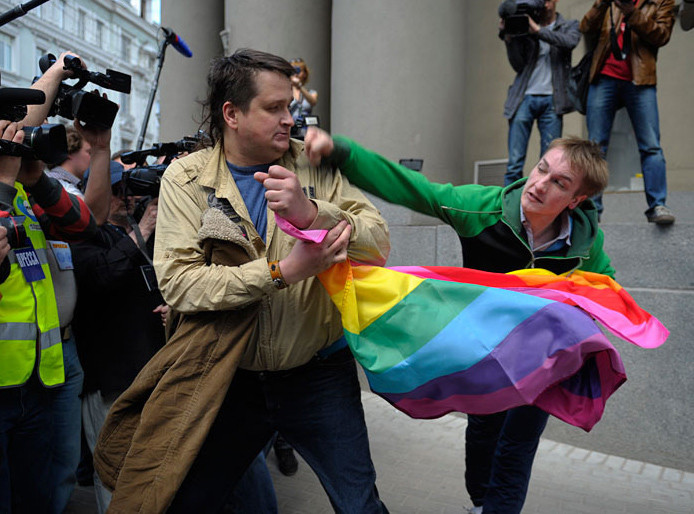
More than two dozen activists were detained in Moscow on Tuesday as they were protesting a bill that stigmatizes the gay community and bans the giving of information about homosexuality to children.

The protesters attempted to rally outside the Russian State Duma before what is expected to be a final vote on the bill banning “propaganda of nontraditional sexual relations.”

Police moved in after supporters of the bill started showering the protesters with eggs and water. Some of the protesters who were not detained were viciously attacked by masked men on a central street a mile away.

The Kremlin-backed legislation imposes hefty fines for providing information about the lesbian, gay, bisexual and transgender community to minors or holding gay pride rallies.

Russia is also considering banning citizens of countries that allow same-sex marriage from adopting Russian children.

Lawmakers changed the wording of “homosexual propaganda” to “propaganda of nontraditional sexual relations,” which backers of the bill define as “relations which are not conducive to procreation.”

Breaching the law carries a fine of up to 5,000 rubles ($156) for an individual and up to 1 million rubles ($31,000) for media.

Earlier Tuesday a dozen anti-gay activists picketed the Duma. One of them held a poster that read: “Lawmakers, protect the people from perverts!”

The bill has been seen as Putin’s attempt to consolidate his support base which includes many conservative Russian Orthodox voters.

Russian and foreign rights activists have decried the bill as violating basic rights. Human Rights Watch on Monday said the bill would “infringe Russian citizens’ freedom of expression and information, and discriminate against Russia’s LGBT community.”

Russian officials have rejected criticism. Foreign Minister Sergey Lavrov defended the bill in February, saying that Russia does not have any international or European commitment to “allow propaganda of homosexuality.”

Russia decriminalized homosexuality in 1993 but anti-gay sentiment is still high. – AP

Russia sends advanced anti-ship missiles to Syrian government

Yakhont missile

Russia has sent advanced antiship cruise missiles to Syria, a move that illustrates the depth of its support for the Syrian government led by President Bashar al-Assad, American officials said Thursday.

Russia has previously provided a version of the missiles, called Yakhonts, to Syria. But those delivered recently are outfitted with an advanced radar that makes them more effective, according to American officials who are familiar with classified intelligence reports and would only discuss the shipment on the basis of anonymity.

Unlike Scud and other longer-range surface-to-surface missiles that the Assad government has used against opposition forces, the Yakhont antiship missile system provides the Syrian military a formidable weapon to counter any effort by international forces to reinforce Syrian opposition fighters by imposing a naval embargo, establishing a no-fly zone or carrying out limited airstrikes.

“It enables the regime to deter foreign forces looking to supply the opposition from the sea, or from undertaking a more active role if a no-fly zone or shipping embargo were to be declared at some point,” said Nick Brown, editor in chief of IHS Jane’s International Defense Review. “It’s a real ship killer.”

Jeffrey White, a fellow at the Washington Institute for Near East Policy and a former senior American intelligence official, said Syria’s strengthened arsenal would “tend to push Western or allied naval activity further off the coast” and was also “a signal of the Russian commitment to the Syrian government.”

The disclosure of the delivery comes as Russia and the United States are planning to convene an international conference that is aimed at ending the brutal conflict in Syria, which has killed more than 70,000. That conference is expected to be held in early June and to include representatives of the Assad government and the Syrian opposition.

Secretary of State John Kerry has repeatedly said that it is the United States’ hope to change Mr. Assad’s “calculations” about his ability to hold on to power so that he will allow negotiations for a political solution to the conflict. Mr. Kerry indicated that he had raised the issue of Russian arms deliveries to Syria during his recent visit to Moscow, but declined to provide details.

“I think we’ve made it crystal clear we would prefer that Russia was not supplying assistance,” he said. “That hasn’t changed.”

American officials have been concerned that the flow of Russian and Iranian arms to Syria will buttress Mr. Assad’s apparent belief that he can prevail militarily.

“This weapons transfer is obviously disappointing and will set back efforts to promote the political transition that is in the best interests of the Syrian people and the region,” Senator Bob Corker of Tennessee, the senior Republican on the Foreign Relations Committee, said in a statement on Thursday night. “There is now greater urgency for the U.S. to step up assistance to the moderate opposition forces who can lead Syria after Assad.”

Senator Robert Menendez, Democrat of New Jersey and the committee chairman, added in a statement, “Russia is offering cover to a despotic ruler and defending a bankrupt regime.”

Syria ordered the coastal defense version of the Yakhont system from Russia in 2007 and received the first batteries in early 2011, according to Jane’s. The initial order covered 72 missiles, 36 launcher vehicles, and support equipment, and the systems have been displayed in the country.

The batteries are mobile, which makes them more difficult to attack. Each consists of missiles, a three-missile launcher and a command-and-control vehicle.

The missiles are about 22 feet long, carry either a high-explosive or armor-piercing warhead, and have a range of about 180 miles, according to Jane’s.

They can be steered to a target’s general location by longer-range radars, but each missile has its own radar to help evade a ship’s defenses and home in as it approaches its target.

Two senior American officials said that the most recent shipment contained missiles with a more advanced guidance system than earlier shipments.

Russia has longstanding interests in Syria, including a naval base at the Mediterranean port of Tartus.

As the Syria crisis has escalated, Russia has gradually augmented its naval presence in the region. In January, more than two dozen Russian warships sailed to the Black and Mediterranean Seas to take part in what the Defense Ministry said was to be the country’s largest naval exercise in decades, testing the ships’ ability to deploy outside Russian waters.

A month later, after the Black Sea exercises ended, the Russian Defense Ministry news agency said that four large landing vessels were on their way to operations off the coast of Syria.

“Based on the results of the navy exercises in the Black and Mediterranean seas,” the ministry said at the time, “the ministry leadership has taken a decision to continue combat duty by Russian warships in the Mediterranean.”

– New York Times full story

Russia seals energy, military cooperation with South Africa

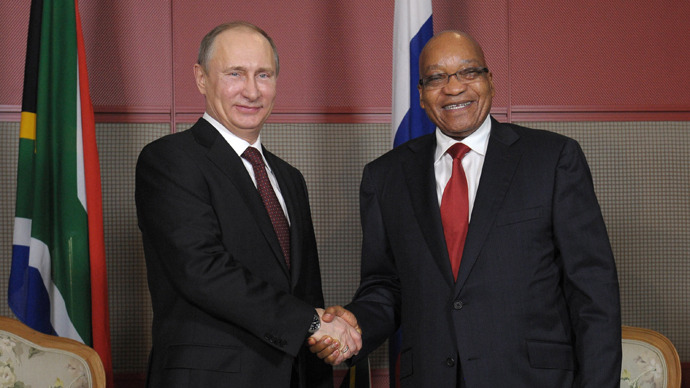
The Russian-South African talks on the sidelines of the BRICS summit produced a wide range of agreements, including a joint declaration on strategic partnership, cooperation in communications and joint construction of nuclear power plants.

Russia is ready to provide credit support for South Africa to build nuclear power plants using Russian specialists. Development of cooperation with South Africa in the energy sector has a huge potential, according to the Russian leader.

“Russia is offering South Africa not only to help with construction of nuclear power reactors, but also with the creation of an advanced nuclear power industry, including the extraction of raw materials, construction of NPPs and research reactors, design and domestic production of nuclear power equipment with Russian credit support,”  RIA Novosti has quoted Putin as saying.

Besides the nuclear sphere, Putin and his counterpart Jacob Zuma also agreed on cooperation in the field of communication. In particular, South Africa will help Russia maintain the Global Navigation Satellite System (GLONASS).

“A quantum-optical system will be established in South Africa to increase the accuracy of GLONASS signal reception in the Southern Hemisphere,” Putin told journalists at the press-conference.

The Russian leader also added that the Space center in South Africa will be used to retrieve data from Russian satellites according to the “Radioastron” Project. The sides signed the essential document on Tuesday after the high-level talks.

Putin set a target to increase the trade turnover between the two states.

“Our countries have a good basis for increasing cooperation. In 2012, the turnover grew by a record 66.3 per cent, almost reaching $ 1 billion, which is almost twice more than in 2011. In the medium term we plan to increase the volume of bilateral trade by several times,” Putin said, adding that Russian companies “raised more than $ 1 billion in mutually beneficial projects in South Africa, invested this money in its economy.”

Russian President Vladimir Putin and President of South Africa Jacob Zuma (from right, background) during the signing of joint documents at a meeting in Durban. Foreground left – Russian Foreign Minister Sergei Lavrov on March 26, 2013. (RIA Novosti / Alexsey Druginyn)

Russia and South Africa have agreed to coordinate their actions for key global problems, including the current situation in Syria.

“Russia and South Africa share common approaches to key global issues. We cooperate in the UN, the BRICS and other international organizations. We agreed to further coordinate our actions, including for peaceful solutions to the Syrian crisis,” said Putin.

The Russian President also promised to think about the possibility of Russia’s support for a UN Security Council resolution on the cross-border provision of humanitarian assistance to Syria.

Russia and South Africa signed a declaration on a strategic partnership.

In particular, the document states the need to “enhance military cooperation, including military and military-technical cooperation on a long term basis and other forms of interaction between the armed forces of the two countries.”

The sides also agreed to cooperate in the fight against international terrorism, separatism, organized crime and drug trafficking. – RT

Shale gas boom visible from space

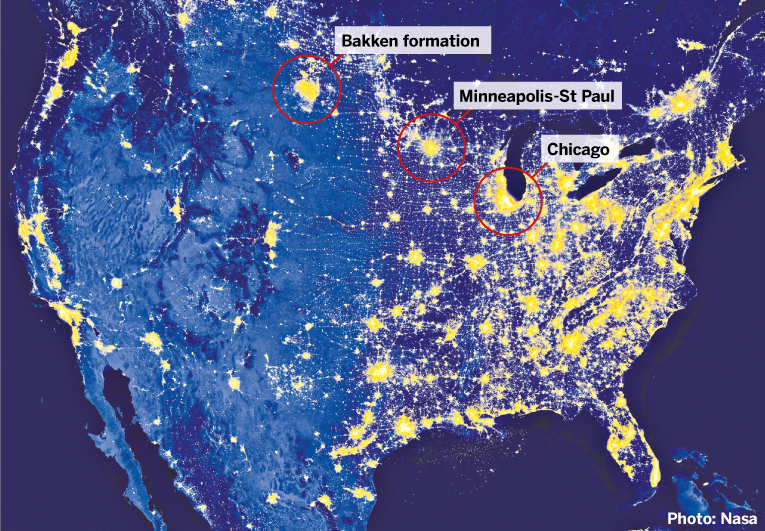
Oil companies at the heart of the US shale oil boom are burning off enough gas to power all the homes in Chicago and Washington combined in a practice causing growing concern about the waste of resources and damage to the environment.

The volume of unwanted gas being flared off in North Dakota, the state leading the shale revolution transforming the outlook for US energy, rose about 50 per cent last year. The surge at the state’s Bakken formation is being replicated in other shale regions with the Texas state regulator issuing 1,963 permits to flare in 2012, more than six times the number of 306 in 2010.

The rapid increase has made the US one of the world’s worst countries for gas flaring. The volume of gas flared in the US has tripled in just five years, according to World Bank estimates and is now fifth highest in the world, behind Russia, Nigeria, Iran and Iraq.

The flaring is a result, in large part, of the low price of natural gas in North America, which can make it uneconomic to build pipelines and tanks to handle the gas released by oil production. Flaring is often the safest way to dispose of it.

The lights of the flares burning in the Bakken and Texas’ Eagle Ford shale fields can clearly be seen in night-time satellite photography.

Flaring has been attracting attention from investors and environmental campaigners because of the waste of gas and its consequences for greenhouse gas emissions, local air pollution and disturbance to nearby communities.

Flaring in North Dakota increases by about 20 per cent the greenhouse gas emissions resulting from the state’s oil production, refining and transport, compared with the US average, according to Financial Times analysis of official data.

Investors managing a total of $500bn last year wrote to oil companies including ExxonMobil, Chevron, Statoiland US independents urging them to do more to cut their flaring. They warned that “excessive flaring, because of its impact on air quality and climate change, poses significant risks for the companies involved.”

Since then, flaring in the US and concerns over it have only increased.

The North Dakota legislature is considering a bill to encourage flaring reduction through tax breaks. The state is also pushing producers to use gas to power drilling rigs.

Russia, China wrestle US on Internet governance, freedom

A Russia-led proposal calling for sweeping new governmental powers to regulate cyberspace could enable countries to block some Web locations and wrest control of allotting Internet addresses from a U.S.-based body.

The proposal, co-signed by Russia, China, Saudi Arabia, Algeria, Sudan and the United Arab Emirates, added to fears in some Western countries of a stalemate midway through a 12-day conference in Dubai to rewrite a longstanding treaty on international communications.

Russia and its supporters, which include many African and Arab states, seek to formally extend the remit of the International Telecommunication Union (ITU) to govern many aspects of the Internet.

The United States, Europe and other allies including Australia and Japan insist the treaty should continue to apply only to traditional telecommunications such as international wireline and wireless calls.

Countries can opt out of parts of the revised treaty when it emerges or refuse to sign it altogether.

“If we have no agreement it will create political tension around the Internet,” said Markus Kummer, vice president for public policy at industry think tank The Internet Society.

A leaked draft of the Russia-led proposals would give countries “equal rights to manage the Internet including in regard to the allotment, assignment and reclamation of Internet numbering.”

This could allow governments to render websites within their borders inaccessible, even via proxy servers or other countries. It also could allow for multinational pacts in which countries could terminate access to websites at each others’ request.

Such moves would undermine ICANN, a self-governing nonprofit organization under contract to the U.S. Department of Commerce, which is ultimately responsible for making sure that people trying to reach a given website actually get there.

“Much of the Internet was developed from U.S. research funding, and the U.S. has kept a residual role, so many other governments say it’s not right that one government ‘controls’ the Internet,” said Kummer.

“The irony is the U.S. has a very laid-back role and protects the Internet from political interference, but the fact it’s the U.S. makes it highly political.”

Beyond web locations and addresses, the Russia-led coalition document says ITU member states should be able to control other elements of the Internet’s infrastructure within their borders, as Russia has sought for months.

The revision would give nations the explicit right to “implement policy” on net governance and “regulate the national Internet segment,” the draft says.

“If you throw in addressing and naming, that puts the entire ecosystem in play, which is what the U.S. and E.U. said they would never agree to,” said a Western participant.

“You’re almost guaranteeing lock-up in certain areas that might prevent the other areas from easily going forward,” he said.

Another clause states any country should have the right to know the route of telecom traffic “where technically feasible,” which differs from an earlier submission and appears to acknowledge tracing Internet traffic is impractical.

“Internet networks don’t follow national borders and a lot of governments are not happy with that notion, that they don’t have control over their territory,” said Kummer. “Some governments feel threatened, which they see as undermining their national sovereignty.”

The ITU usually agrees decisions by consensus, but the intransigence of both sides means it could come down to a vote, which may leave the United States and its allies in the minority.

“The U.S. is not considering walking out of the conference and is still participating as normal,” a U.S. spokesman said in an emailed statement, denying an earlier report that the United States could quit the summit, which ends on Friday. – Reuters