Antwerp mayor receives death threats from Jihadists

Islamic extremists in Belgium have publicly threatened to kill the mayor of the Belgian city of Antwerp, Bart De Wever, if he does not convert to Islam, local media reported Monday.

A sign written in French stating threats against de Wever, who is also the head of the nationalist political party the New Flemish Alliance, was placed on one of the main squares of Antwerp. Experts are currently assessing the seriousness of the action and the message.

“I always warned that we will not get rid of the threat from Islamic extremists in the near future. This was ignored for years. This wound became apparent now with [the current developments in] Syria and will fester for a long time before we will get rid of it,” de Wever said.

Throughout his political career, De Wever has repeatedly received threats. The Belgian government has provided him with security guards at state expense.

In the light of advance of the Islamic State (ISIL) terrorist group in the Middle East and a number of ISIL-inspired terrorist attacks in Europe, the European Union has currently seeing a surge in anti-Islamization sentiment.

According to September 2014 statistics from Belgium’s Ministry of Interior, between 300 and 350 Belgians have gone to fight alongside the ISIL in Iraq and Syria since 2012.

Source: Sputniksnews

Over 80% of Russians Against Same-Sex ‘Marriages’

The percentage of Russians who are positive about the law banning the propaganda of homosexuality is increasing and is now 77% against 67% in 2013, Levada Center told Interfax.

Fifteen percent of the respondents do not support this law and 7% said they are not interested, a poll surveying 800 people conducted in 46 regions of Russia shows.

Over half of the respondents said they see this law aims to protect morals (67% against 60% in 2013), while 14% believe it aims to distract public attention from other problems and 7% believe it is aimed at fanning feud.

Seven percent of the respondents said they support the idea to allow same-sex “marriage” in Russia and 84% said they are negative towards it.

Twenty-nine percent of the respondents believe homosexuals are subjected to physical violence in Russia, while 32% believe they are discriminated against (psychological pressure, encroachments on rights, etc.). Thirty-seven percent of the respondents and 33% of the respondents respectively, have the opposite opinion.

A little more than one-third of the respondents (37%) believe homosexuality is a disease that needs to be treated (against 34% in 2013). One-fourth of the respondents (26% against 17% in 2013) see homosexuality as a result of bad upbringing, promiscuity and a bad habit.

The percentage of respondents who see homosexuality as a result of seduction has decreased from 23% to 13% in the past two years. One out of every ten respondents believe homosexuality is innate (11% against 16% in 2013).

Two-thirds of Russians said their feelings about homosexuals are manly negative: fear and loathing (24%), irritation (22%), and tension (19%). One out of every four respondents (26%) reacts to homosexuals and lesbians “calmly, without any special emotion.” Only 3% are friendly to homosexuals or interested in them.

Source: Interfax

Oz misled by fake evidence about MH-17?

Pointing the finger of blame at Russian President Putin for the Malaysia Airlines shoot-down last July, an Australian news show claims to have found the spot where the Russian BUK missile battery made its getaway, but the images don’t match, raising questions of journalistic fakery, writes Robert Parry.

An Australian television show claims to have solved the Malaysia Airlines Flight 17 shoot-down mystery – the Russians did it! – but the program appears to have faked a key piece of evidence and there remain many of the same doubts as before, along with the dog-not-barking question of why the U.S. government has withheld its intelligence data.

The basic point of the Australian “60 Minutes” program was that photographs on social media show what some believe to be a BUK anti-aircraft launcher aboard a truck traveling eastward on July 17, 2014, the day of the shoot-down, into what was generally considered rebel-controlled territory of eastern Ukraine, south and east of Donetsk, the capital of one of the ethnic Russian rebellious provinces.

Citing one image, the program’s narrator says the “launcher is heading east further into rebel territory,” south and east of Donetsk.

However, in mid-July, the ethnic Russian rebels were reeling under a Ukrainian military offensive to the north of Donetsk. Despite shifting their forces into the battle zone, they had lost Sloviansk, Druzhkivka, Kostyantynivka and Kramatorsk. In other words, the lines of control were fluid and chaotic in mid-July 2014 with the possibility that an unmarked Ukrainian government truck, maybe carrying a concealed anti-aircraft battery, could have moved into the titular rebel zone, especially in the lightly defended south.

Another problem with the Australian TV account is that the video and photographic images show the truck heading eastward toward Russia, but there are no earlier images of the truck moving westward from Russia into eastern Ukraine. If the mysterious truck was supposedly so obvious on the day of the shoot-down, why wasn’t it obvious earlier?

For the Australian TV account to be true – blaming the Russians – the launcher would have to have crossed from Russia into Ukraine, traveled somewhere west of Donetsk, before turning around and heading eastward back toward Russia, yet the trail seems to begin only with photos on July 17 showing the truck headed east.

Indeed, I was told shortly after the MH-17 crash, which killed 298 people including Australians, that one of the problems that U.S. intelligence analysts were having in pinning the blame on the Russians was that they could not find evidence that the Russians had delivered a BUK missile system to the rebels who – until then – were known only to have short-range Manpads incapable of reaching MH-17 flying at around 33,000 feet.

Another part of the Australian TV narrative stretched credulity. If the Russians had somehow snuck a BUK missile system into eastern Ukraine without U.S. intelligence knowing and were moving it back toward Russia, why would the crew stop en route to shoot down a civilian airliner before continuing on the way? There was no military value in destroying a civilian airliner and it was obvious – in the Western media hysteria then surrounding Ukraine – that Russia and its president, Vladimir Putin, would be blamed.

What I was told by a source briefed by U.S. intelligence analysts was that at least some of them – after reviewing electronic intercepts, overhead satellite images and other intelligence – had reached the conclusion that the shoot-down was a provocation, or a false-flag operation, carried out by a rogue element of the Ukrainian military operating under one of the hard-line oligarchs.

However, it was not clear to me whether that was the opinion of just a few U.S. analysts or whether that had become the consensus. When I sought an updated briefing from the Office of the Director of National Intelligence in March, I was told that the U.S. intelligence community had not updated or refined its analysis of the shoot-down since five days after the event, a claim that was not credible given the significance of the MH-17 case to tensions between nuclear powers, United States and Russia.

In reality, Western intelligence services have been hard at work trying to determine who was responsible for the shoot-down. Last October, Der Spiegel reported that the German intelligence service, the BND, had concluded that Russia was not the source of the missile battery – that it had been captured from a Ukrainian military base – but the BND still blamed the rebels for firing it. The BND also concluded that photos supplied by the Ukrainian government about the MH-17 tragedy “have been manipulated,” Der Spiegel reported.

And, the BND disputed Russian government claims that a Ukrainian fighter jet had been flying close to MH-17, the magazine said, reporting on the BND’s briefing to a parliamentary committee on Oct. 8, 2014. But none of the BND’s evidence was made public — and I was subsequently told by a European official that the evidence was not as conclusive as the magazine article depicted. [See Consortiumnews.com’s “Germans Clear Russia in MH-17 Case.”]

Possible TV Fakery

There also appears to have been some fakery involved in the Australian documentary. In several instances, as the film crew traveled to eastern Ukraine to seek out scenes from July 17 video showing the truck possibly carrying BUK missiles, images of those sites – then and now – were overlaid to show how closely the scenes matched.

However, for one crucial scene – the image of an alleged “getaway” BUK launcher lacking one missile and supposedly heading back to Russia after the shoot-down – the documentary broke with that pattern. The program showed the earlier video of the truck moving past a billboard and then claiming – based on information from blogger Eliot Higgins – that the TV crew had located the same billboard in Luhansk, a rebel-held city near the Russian border.

This was the documentary’s slam-dunk moment, the final proof that the Russians and particular Vladimir Putin were guilty in the deaths of 298 innocent people. However, in this case, there was no overlay of the two scenes, just Australian correspondent Michael Usher pointing to a billboard and saying it was the same one as in the video.

But the scenes look nothing at all alike if you put them side by side. While Usher is standing in an open field, the earlier video shows an overgrown area. Indeed, almost nothing looks the same, which might explain why the film crew didn’t try to do an overlay this time.

A screen shot of the roadway where the suspected BUK missile battery passes after the shoot-down of Malaysia Airlines Flight 17 on July 17, 2014. (Image from Australian “60 Minutes” program)

A screen shot of the roadway where the suspected BUK missile battery passes after the shoot-down of Malaysia Airlines Flight 17 on July 17, 2014. (Image from Australian “60 Minutes” program)

Correspondent Michael Unger of Australia’s “60 Minutes” claims to have found the billboard visible in a video of a BUK missile launcher after the shoot-down of Malaysia Airlines Flight 17 on July 17, 2014. (Screen shot from Australia’s “60 Minutes”)

Correspondent Michael Usher of Australia’s “60 Minutes” claims to have found the billboard visible in a video of a BUK missile launcher after the shoot-down of Malaysia Airlines Flight 17 on July 17, 2014. (Screen shot from Australia’s “60 Minutes”)

This discrepancy is important because the Russian government placed the scene of the “getaway” BUK launcher in the town of Krasnoarmiis’k, northwest of Donetsk and then under Ukrainian government control. Usher dismissed that Russian claim as a lie before asserting that his team had located the scene with the billboard in Luhansk.

The significance of the Australian news show’s sleight of hand is that if the BUK launcher was making its “getaway” through government-controlled territory, not through Luhansk on its way back to Russia, much of the Russia-did-it scenario collapses. It also means the Australian audience was grossly misled.

Source: Consortium News

Events in Macedonia orchestrated from outside

Moscow believes the events in Macedonia are being orchestrated from outside, Russian Foreign Minister Sergei Lavrov said Wednesday.

Lavrov said that outside pressure is being put on current Macedonian Prime Minister Nikola Gruevski for not agreeing to follow Western-backed sanctions against Russia and is being blamed for incompetency.

Moscow is concerned over the situation in Macedonia, Lavrov said during a speech before the Russian upper house of parliament.

Late in April, a group of some 40 Albanian-speaking gunmen briefly seized a police station in the northern Macedonian village of Gosince calling for the establishment of an Albanian state.

Less than three weeks after the incident, on May 9, Macedonia witnessed deadly clashes between police and an armed group of Albanians in Kumanovo, a city bordering Serbia and Kosovo.

Following the deadly clashes, the country was hit by a wave of protests staged by the Social Democratic Union of Macedonia (SDSM) that accuses the country’s government of corruption and demands its resignation.

Gruevski said that the opposition is trying to exploit the tragedy in Kumanovo to gain power.

Source: Sputnik News

The Killer language takes Cannes

This year’s Cannes Film Festival was greeted with consternation when a commonality was noticed across many of the festival’s in-competition selections: the Killer language, English.

Though there are only two American filmmakers in competition for Cannes’ Palme d’Or and no British directors, this year’s festival is littered with Europe’s elite filmmakers working in a language not their own. On a continent that has warily watched English become a kind of de facto common language, fears flared that contemporary European cinema was being lost in translation.

The Guardian said that an “Anglophone virus” was rampaging.

Italy’s Paolo Sorrentino will on Wednesday premiere his second English language film, “Youth,” with Michael Cain and Harvey Keitel. Four other notable names in international film – Norway’s Joachim Trier, Italy’s Matteo Garrone, Greece’s Yorgos Lanthimos and Mexico’s Michel Franco – are all making their English language debuts. And Quebecois filmmaker Denis Villenueve, an Oscar-nominee for his French language “Incendies,” premiered his English language drug war thriller “Sicario” on Tuesday.

As the festival has unspooled, many directors have defended their decision to switch languages

Directors are eyeing the American market and big money, say some:

“If you want to go to the American market maybe you need to have a film in English, but I still think all the great directors make films in their own languages,” said festival director Thierry Fremaux, who said English functions like “the new Esperanto.” ”I’m not sure if it’s a trend. We’ll see.”

Marine le Pen: We must resist corporations

Leader of France’s National Front party, Marine Le Pen, has launched a month-long blitz against the Transatlantic Trade and Investment Partnership (TTIP) – a proposed EU-US treaty, which has been criticized for secretiveness and lack of accountability.

“It is vital that the French people know about TTIP’s content and its motivations in order to be able to fight it. Because our fellow countrymen must have the choice of their future, because they should impose a model for society that suits them, and not forced by multinational companies eager for profits, Brussels technocrats sold to the lobbies, politicians from the UMP [party of former president Nicolas Sarkozy], who are subservient to these technocrats,” Le Pen said during a press conference in Paris.

Since 2013, open-ended negotiations between Washington and Brussels have drawn up the framework for the agreement, intended to standardize legislation and bring down trade barriers between them.

As per US practice, the contents of all economic treaties are classified. The EU has recently set up reading rooms throughout Europe for officials with clearance – but only a few thousand people have had access to the working documents.

Le Pen hit out at the secrecy of the negotiations, which have featured mostly bureaucrats from the European Commission, the EU’s executive body, and nebulous “stakeholders” from businesses and public organizations. As a member of the European parliament, she forwarded a motion for greater transparency in negotiations last year. Le Pen’s motion was defeated.

She is now hoping for grassroots support.

“I am convinced that we can push back the TTIP if the peoples are informed of its content, and if they decide themselves to join us in order to express their disagreement concerning this treaty,” Le Pen told journalists.

Both of France’s leading parties have endorsed the treaty, but Le Pen is relying on strong the anti-European sentiment that propelled her party to first place in last year’s elections for the European parliament.

While TTIP’s authors promise that the treaty will bring an extra 0.5 percent GDP to Europe and the US, figures across the political spectrum have expressed concern.

US President Barack Obama, who is also negotiating a similar treaty with Asia, was defeated by his own party in the Senate last week when he asked for fast-track approval to handle negotiations. Additional votes will be required if the proposed legislation is not to be bogged down in the US chambers of Congress.

Meanwhile, European legislators have raised a host of issues, in particular concerning the investor-state dispute settlement (ISDS) mechanism outlined in the treaty. The controversy centers on the proposed special economic tribunal, which would operate outside the traditional legal system and allow corporations to challenge governments.

In April, thousands took to the streets of Brussels, Madrid, Berlin and Helsinki to protest against the secretive deal.

German cop probed for ‘immigrant abuse’

German prosecutors are investigating a police officer who allegedly abused two immigrants, strangling an Afghan man and forcing a Moroccan to eat pork off the floor.

The police officer has been accused of bragging about the brutal assaults in text messages and photos he sent via instant messaging service WhatsApp to his colleagues in the western city of Hanover.

Human rights group Pro Asyl condemned the alleged incidents, first reported by public broadcaster NDR, for their “appalling level of racism and inhumanity” and demanded a probe into how many “accomplices in police uniform” knew of the violence.

Prosecutors are investigating the officer, who has been suspended, on charges of physical assault and illegal weapons possession and have searched his home and work place.

In the first alleged case, in March last year, the officer had bragged in a text message about beating, strangling and sticking his fingers up the nose of a 29-year-old Afghan man whose feet were cuffed after he was detained for not carrying ID papers.

“It was funny … squealed like a pig,” the officer allegedly wrote on WhatsApp. “It was a present from Allah.”

In the second case, months later, the officer allegedly targeted a 19-year-old Moroccan man, who had been detained for travelling on a train without a ticket, carrying a small amount of marijuana.

NDR reported that the policeman bragged about how he assaulted and then humiliated the young man by forcing him to eat minced pork off the floor.

A photo allegedly sent by the officer shows a handcuffed man lying on the floor, wincing in pain, and apparently restrained by at least two officers.

Germany has become Europe’s top destination for people fleeing war and poverty. Last year, asylum requests rose 60 percent to more than 200,000, and the government expects that number to more than double this year.

Source: AFP

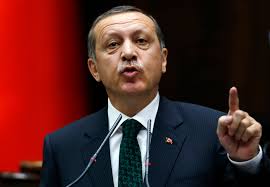
Turkish president wants focus on Jerusalem

Nothing in the western media covered what the Turkish Anadulu Agency released, when Turkish President Recep Tayyip Erdogan gave a speech this Friday.

Erdogan called on all Turks to refocus on the Ottoman goal to re-conquer Jerusalem for Islam:

“Unfortunately we the Muslims lost our aim to head towards Jerusalem. The water of our eyes froze making us blind, and our hearts that was destined to beat for Jerusalem is now instead conditioned for rivalry being in a state of war with each other.”

Erdogan’s desire to end strife and unite Sunnis and Shiites to aim towards Jerusalem was made in the state of Erzincan, central Turkey.

Turkish president called on citizens to “raise their hands in supplication for this blessed night towards Allah to restore the Al-Aqsa Mosque [Jerusalem] to be re-owned by Muslims, and to remove the mist from their eyes, to see Jerusalem in their hands at every moment and at every opportunity”.

Erdogan added: “When you mention the word ascension; the first thing that comes to mind is Jerusalem and Al-Aqsa Mosque,” while he expressed deep regret for the condition of Muslim heedlessness for Al-Aqsa Mosque and Jerusalem.

Such reflections were also made by Turkish Prime Minister Ahmed Davutoglu recently, that “Jerusalem belongs to the Muslims, not to the Jews,” while criticizing the leader of the co-party Peoples Democratic opposition, Salahuddin Dmirattash, in which he said in opposition to the Islamist rhetoric of Davutoglu.

Erdogan also said that he wanted Spain. Tariq Bin Ziad, the conqueror of Spain, the tyrant Alp Arslan, and Saladin are the Muslim leaders who fought Christendom and Saladin was the one who conquered Jerusalem.

Case that sparked 3 weeks of rioting heard in France

A French court delivers its verdict in the case of two police officers accused of not helping two youths electrocuted in 2005, whose deaths sparked three weeks of rioting.

The deaths of Bouna Traore, 15, and Zyed Benna, 17, following a chase by police ignited three weeks of arson and running clashes with security forces in downtrodden French city suburbs.

The two officers, Sebastien Gaillemin and Stephanie Klein, stand accused of “non-assistance to individuals in danger” by failing to raise the alarm after the two youths scarpered into an electricity substation.

They risk a five-year prison sentence and a fine of up to 75,000 euros ($86,000) if found guilty, but both prosecution and defence have called for them to be let off.

Gaillemin told the court during the trial that he had checked twice to see whether the youngsters were still in the substation and, satisfied that they were clear, left the scene.

“As he was not aware of the danger, he cannot be blamed for not acting to deal with it,” said prosecutor Delphine Dewailly.

“You don’t ease the pain of one drama by adding another injustice,” she told the court at the emotional trial, during which both officers broke down in tears.

Daniel Merchant, a lawyer for the officers, said: “There will only be closure if they are let off. The case will then be closed… Ten years, that’s enough now.”

Merchant added that in the case of a conviction, he would appeal on behalf of his client.

However, relatives of the two dead youths — as well as a third youth who escaped with burns — have launched a civil case, seeking a total of 1.6 million euros in compensation and damages.

A lawyer for the families said he was certain the officers were guilty of not coming to the boys’ aid. “Lets call the crime what it is,” said Jean-Pierre Mignard.

Much of the trial turned on one phrase uttered by Gaillemin during the chase.

According to transcripts from the police radio, he was heard to say: “They are climbing over to get to the EDF (electric company) site. If they enter the EDF site, I don’t give them much of a chance.”

During the trial, Gaillemin said he was only aware the boys were running “towards the site” and was not sure they had actually entered it.

Nevertheless, the trial has again brought to the fore the alienation felt by many in France’s ghetto-like suburbs, which Prime Minister Manuel Valls said earlier this year still represent a form of “territorial, social and ethnic apartheid”.

Source: AFP

New Russian tank’s steering tested by millions of gamers

It is one of Russia’s newest military vehicles, designed to take soldiers into battle, while having the firepower of a tank.

Yet for many in Russia’s military, controlling the Kurganets-25 will be easy.

Rather than a traditional steering wheel, it uses a controller based on Sony’s Playstation gamepad.

Scroll down for video The Kurganets-25 is an infantry fighting vehicle, which is a category of machine halfway between an armored truck and a full-size battle tank.

The vehicle is controlled using a gamepad.

On May 9th, the Kurganets-25 made its public debut as part of a parade commemorating the 70th anniversary of Russia’s victory in World War II.

The new Russian armoured vehicle platform uses a device similar to a Playstation controller, the manufacturer’s vice-president told Russian media.

The new Kurganets-25 infantry fighting vehicle uses a ‘console similar to a Sony Playstation gamepad,’ Tractor Plants vice-president Albert Bakov told state owned outlet Sputnik.

‘I spent two years on convincing the designers to make the console similar to a Sony Playstation gamepad, to make it easier for a young soldier to familiarize himself with it,’ Bakov said.

Source: Daily Mail

Autonomy proposed for Russians in Ukraine

The self-proclaimed Donetsk People’s Republic and Luhansk People’s Republic have proposed amendments to the Ukrainian constitution to vest individual districts in eastern Ukraine with vast autonomy, including authority to regulate cross-border cooperation and the use of the Russian language.

What are termed as districts with “a special status” would also be authorized to control law courts and prosecution services on their territory, those the district prosecution services would be parts of the Ukrainian national prosecution service.

The consent of the government bodies of “special status” districts would be necessary for the appointment and dismissal of the districts’ chief prosecutors, but other regulations on their prosecution services would be established by Ukrainian law.

The DPR and LPR also proposed a formal non-bloc status for Ukraine by “making an amendment to the Constitution of Ukraine, for instance supplementing Article17 or 18 with the following words: ‘Ukraine shall not be a member of any military bloc or alliance, maintain neutrality and refrain from participation in hostilities outside its territory,’ and/or bringing out a law of Ukraine to enshrine the non-bloc, neutral status for Ukraine.”

Such districts would be authorized to call local referendums and elections, draft and adopt their own budgets, and participate in drafting the Ukrainian budget in order to make sure that their interests are taken into account and to “guarantee their financial independence.”

“Special status” districts would be empowered to permit the use of Russian and other languages on their territory and to sign economic agreements with foreign states or individual regions of foreign states.

They would be authorized to set rates for local taxes and fees for local administrative services.

The DPR and LPR also proposed a constitutional amendment to prescribe that the Ukrainian government sign economic or cultural agreements with “special status” districts or associations of such districts and to help them step up cross-border cooperation.

Source: Interfax

‘EU could lift Russian sanctions by end of 2015’

The EU sanctions against Russia could be lifted by the end of the year, Czech President Milos Zeman said.

“I will also add that it may be possible to lift the sanctions fully, maybe even before the end of this year. The

European Council will discuss this in June, I think,” Zeman said in an interview with the Kommersant newspaper published Tuesday.

According to the Czech president, economic sanctions are “completely pointless”, while the political restrictions were introduced to prevent Russia from invading eastern Ukraine.

“I believe that all official moves by the Russian politicians prove that there will be no intervention in eastern Ukraine,” Zeman said, adding that he believed that the internal conflict in the region was dying down.

Russia’s relationship with the European Union deteriorated greatly amid the Ukrainian crisis, with the bloc introducing several rounds of sanctions against Moscow, accusing it of meddling in Ukraine’s internal affairs.

Source: Sputniknews

Tories’ repeal of Human Rights Act could spark constitutional crisis

Newly appointed Justice Secretary Michael Gove will push ahead with Conservative plans to repeal the Human Rights Act – a move experts warn could spark a constitutional crisis and blight Britain’s reputation on human rights worldwide.

Conservative Party sources, fresh from last week’s general election victory, told the Guardian the human rights reforms are imminent.

Civil liberty advocates warn the soon-to-be implemented measures would erode the right to life, the right to privacy, the right to a fair trial, the right to protest and the right to freedom from torture and discrimination.

Although the Tories were keen to push ahead with the legal changes during their last term in government, the move was blocked by the party’s ex-coalition partner the Liberal Democrats. But as a majority government, the Conservatives are now poised to push ahead with the reforms.

Central to the Tories’ election manifesto was a pledge to repeal the Human Rights Act (HRA) and significantly curb the power of the European Court of Human Rights (ECHR) in Britain. The legal reforms are expected to surface in PM David Cameron’s plans for his first 100 days, which will be outlined in the Queen’s Speech on May 27.

Under these changes, the Conservatives would replace the HRA with a Tory-styled British Bill of Rights. Britain’s Supreme Court would no longer be answerable to the ECHR, with the Strasbourg-based court losing the power to order changes to UK law.

The plans were drawn up in 2014 by then-Secretary of State for Justice Chris Grayling. At the time, Grayling proposed Britain withdraw from the ECHR if the Council of Europe rejects the Conservatives’ British Bill of Rights.

Constitutional crisis

Considerable doubt exists among experts that the Council of Europe, a human rights watchdog responsible for ensuring the Convention is upheld, will accept the Tories’ proposals. As a result, it is widely believed Britain will disengage from the European Convention on Human Rights and undermine Europe’s’ civil liberties framework in the process.

Britain’s withdrawal from the ECHR has been strongly opposed by former Secretary of State for Justice Kenneth Clarke and the UK’s ex-Attorney General Dominic Grieve. Grieve has long condemned the proposal, warning its consequences would be devastating.

In December, he said the government’s threat to potentially abandon the Strasbourg court undermines international law and could fray the constitutional fabric that holds the United Kingdom together. Echoing grieve, analysts warn such a withdrawal would spark a constitutional crisis in the UK.

They suggest the move would be flatly rejected by Nicola Sturgeon’s Scottish Nationalist Party (SNP) and would mean the Conservative government has violated Northern Ireland’s 1998 Good Friday Agreement.

EU wants military intervention to curb migration

The European Union’s (EU) Chief Diplomat, Frederica Mogherini briefed the United Nations Security Council on migrants.

The EU is considering a draft resolution that would authorise EU military intervention to curb the illicit trafficking of persons that has already cost almost 2000 lives lost at sea this year alone.

The EU indicated its first priority was to prevent further loss of lives as sea.

As the Security Council mulls the parameters of military intervention off the coast of Libya in the Mediterranean, concerns about what will happen to migrants found in illegal boats.

Chaos in Libya, which has two opposing governments and various armed militias in the country, has allowed organised networks a foothold to traffic persons off its coast.

The country’s internationally recognised government has objected to the EU proposals which include ‘the use of all necessary means to seize and dispose’ of vessels used in trafficking.

Russia has also said such proposals might go too far as the shape the military action might take remains unclear.