‘Idiot’ Afrikaners and clever Jews

by Johan de Wet

I’ve got the brains, you’ve got the looks
Let’s make lots of money
You’ve got the brawn, I’ve got the brains
Let’s make lots of money – The Petshop Boys

Afrikaans columnist Manfred Delport has just alerted me to the latest Boerehaat shriek by one Richard Poplak from the Daily Maverick which he calls a “linkse haatblad” (leftist hate site). No, Manfred, said Daily Maverick is not so much leftist, as Jewish. OK, so usually the two go together. Outside Israel, one can almost count the number of right-wing Jews on one hand.

I know I am sticking my neck out in daring to point to the ethnic composition of the Daily Maverick’s set of Boerehaat screamers. Voltaire said that if you want to know who your oppressors are, you should think about the people you are not allowed to criticise. Until this latest spate of child-killing by the Israelis, the J-word was about as taboo in South Africa as the K-word. But in an astonishing twist of fate, the word “apartheid” which so many Jews in South Africa, in Britain and in the USA worked so hard to turn into a stigma attached to South Africa and to Afrikaners has now come back to haunt them, with “Apartheid Israel” being flavour of the month.

Even Chomsky has said that apartheid as practised in Israel is actually worse than apartheid in South Africa. He recently repeated this statement in a phone interview with PressTV:

“Hospitals have been attacked repeatedly. Each one is a war crime. In fact, for Israel to fire one bullet across the border is also a crime. Trials for war crimes only apply to the defeated. Within the occupied territories, Israel’s policies are much worse than apartheid, if you mean by apartheid South African-style apartheid. And it is a kind of gift to Israel to compare it to South Africa.”


Although Johannesburg Jews pretend otherwise, the Afrikaner government actually built Baragwanath hospital in Soweto, they never once bombed it! Imagine, after one of Joe Slovo and Umkhonto we Sizwe’s terrorist attacks in the 1980’s, we had to send the Mirages over Soweto to bomb black civilians there in retribution, like Israel is doing at present. This is the stuff of fantasy, Jewish fantasy. Read Nadine Gordimer’s trashy little novella, July’s People, where she foresees the shooting down of civilian aeroplanes, Malaysian Airlines-style, full of screaming white people in South Africa’s glorious anti-white revolution sometime in the future.

The Daily Maverick is the latest in a long line of leftist Jewish publications, starting with Ruth First’s Guardian and the Rand Daily Mail in its more extremist moments, which was partially resurrected in the form of the Weekly Mail founded by two Jews, Irwin Manoim and Anton Harber. These days its successor, the Mail & Guardian, is slightly more of a mainstream newspaper, hence the need for the Daily Maverick where “Jewish genii” may vent their hatred for everything South African and especially Afrikaans.

Afrikaners in their naivete still remember the days when Israel was an ally of previous Afrikaner governments and are completely unaware of the sustained Jewish onslaught on them. Richard Poplak is a self-proclaimed Jewish genius whose mommy has been telling him since his Bar Mitzvah that he would one day receive the Nobel prize for literature, just like Nadine Gordimer.

If there are two things I understand about Jewish identity in Johannesburg and probably Cape Town, they are: (1) Every Jew is also an American. (2) Every Jew abhors Afrikaans, Afrikaners, boeremusiek, volkspele, boerewors, biltong, rugby, Steve Hofmeyr, the architecture of Gerard Moerdijk, Bloemfontein and Pretoria, the paintings of Pierneef and just about everything else you can think of. In fact, academic Jews give each other PhDs for denouncing the Afrikaans language and culture as racist, backward, fascist and so on.

In Blade Nzimande’s quest for “more South African PhDs”, he should just hand all 80 000 Jews in the country a title; after all, they already congratulate each other on their utter brilliance all the time. It might also save us from the embarassing episodes when we discover that black politicians, praised almost as lavishly by Jews as those of their own ilk, such as Pallo Jordan, turn out to have fake PhDs.

And, of course, within the “chosen people” ideology of Jews, Afrikaners are congenitally stupid. Hence Richard Poplak’s rant about the two female students in which he makes two main points: He, Richard Poplak, is a genius. After all, he has heard of something called “conceptual art”. Put that in your pipe and smoke it! And, secondly, Afrikaans students are in need of re-education. As he puts it:

I propose an art gallery of South African stupidity, a building devoted to the enactment of racial stereotypes that remind us of our foetal id, of the miasma we swim in every day in our tentative and botched way of becoming a different, properly reconciled country.

“South African stupidity” is code for Afrikaans culture and the incomplete re-education of Afrikaners, all of whom have not yet accepted vicarious Jewish domination through Malema-like “Marxist-Leninist” radicalism and fervent white guilt. The father of Jewish-South African radicalism, Joe Slovo, envisaged a world in which a committee of Jews within the South African Communist Party would rule the country while their Zulu and Xhosa impis cheer their “liberators”. Like the NAACP in the USA, for most of its existence the ANC has been a Jewish front organisation controlled by the more kosher Communist Party. Mandela’s “autobiography” was written by an American Jew, Richard Stengel. An interesting article is currently doing the rounds, The role of Jews in South Africa since 1948. Nothing much of this is new: Jews openly brag about their role in the downfall of Afrikaner power in South Africa in various books and articles.

Apparently there is something like a Black-Jewish Entrepreneurs Network which proudly proclaims that Jews and blacks will “develop the country together”. The rest of us are not needed. In fact, if one reads between the lines, white South Africans and especially Afrikaners, have no future in the land of braaivleis and sunny skies.

Blacks have the numbers, Jews have the money. It is a beautiful synergy in South Africa, where every black leader or politician is for sale. Hence the motto above from the Petshop Boys:

I’ve got the brains, you’ve got the looks
Let’s make lots of money
You’ve got the brawn, I’ve got the brains
Let’s make lots of money

After Brian Joffe’s takeover of Adcock Ingram and Clencore’s acquisition of Xstrata’s coal empire, there are few areas of the South African economy left that are not in some way controlled by Jews, including Gill Marcus at the helm of our central bank and Rob Davies as minister of trade and industry. It is almost comical how the South African Reserve Bank has now become a purveyor of Mandela coins, to be on-sold by Jewish coin merchants. According to Niall Ferguson’s book on the Rothschild family, Mayer Amschel Rothschild set off on conquering Europe’s banking capitals by trading in collector’s coins. Old habits die hard.

The Russian Pravda recently carried a surprising comment in its delectably Russified English:

The victim of the humanitarian imperialism could be a Boer (a Palestinian in our times) or any people convinced of a barbarian conduct (see the pamphlets of the NYT against ‘homophobe’ Uganda these last weeks).

Jews were first welcomed into the Zuid-Afrikaansche Republiek (ZAR) in the 1890s as refugees from Lithuania. In an amazing turn of the tables, Johannesburg’s powerful Jewish elite is now dictating what “South African” identity should be (and even whom may still be tolerated in the country).

Hence Pravda’s comparison between Boers and Palestinians, harking back to nineteenth-century imperialism – itself partly driven by London Jewish banking interests such as those of the Rothschilds – has a flavour of history repeating itself. The 20th-century tragedy of the Russian nation who lost tens of millions of people in Stalin’s purges, may be traced back to Jewish migration from the Pale of Settlement to St. Petersburg and Moscow where radical Jews were in the forefront of the Bolshevik revolution.

There is something like a Jewish “echo chamber”, nicely revealed by the recent comment by an American Jew, Yochanan Gordon, that if it takes Palestinian genocide to ensure “a sustainable quiet for the citizens of Israel”, then so be it. Jews must fantasize among themselves about simply exterminating the 1,8 million Palestinians in the Gaza strip, thereby claiming another chunk of the Holy Land for themselves. Arguably, South African Jews are already seeing a post-Afrikaner South Africa where our people will be simply gone, either driven out or worse.

The most positive future that Jews foresee for us is “becoming Coloureds”: “White and black must make Coloured,” as Nadine Gordimer put it in an interview with the BBC. Presumably we will then all live in a kind of Gaza strip on the Cape Flats, addicted to alcohol supplied by Jewish liquor stores and drugs supplied by Jewish druglords. Rumour has it that the drug trade in DA-run Cape Town is already controlled by Jews. A Muslim politician from Cape Town once said, privately: “We are ruled by Zionists in Cape Town.” According to journalist Garth van Onselen, the liberal DA has a large number of Jewish donors who were once alarmed by an anti-Israel position taken by the party, which was promptly “corrected”.

It is an enduring source of amazement to many that a group as endogamous as Jews should always advocate multiculturalism and race-mixing for others, from Afrikaners to Swedes. As Barbara Lerner Spectre of the European Institute for Jewish Studies in Sweden famously put it:

I think there’s a resurgence of antisemitism because at this point in time Europe has not yet learned how to be multicultural, and I think we’re gonna be part of the throes of that transformation, which must take place. Europe has not yet learned how to be multicultural. Europe is not going to be the monolithic societies that they once were in the last century. Jews are going to be at the center of that. It’s a huge transformation for Europe to make. They are now going into a multicultural mode, and Jews will be resented because of our leading role. But without that leading role, and without that transformation, Europe will not survive.

From their confident tone, you may surmise that everyone writing in the Daily Maverick is a “natural born leader”, spearheading the “huge transformaton” that we all “have to make”. While the Daily Maverick, Africa Check, Section 27 and other Jewish-dominated groups and NGOs regularly vituperate Afrikaner public figures, remaining pockets of Afrikaans at universities, as well as our politically incorrect behaviour, there is a deathly silence about South Africa’s so-called white genocide, the atrocities committed against farmers, elderly Afrikaners and children. Where Jews take cognisance of such ethnic violence at all, it is to exonerate the perpetrators thereof, minimise the statistical relevance of such murders or blame the victims by suggesting that they are mere “racists” deserving of their fate.

However, in Europe there is now a counter-current. The left-wing intellectuals who used to be enthralled with Jewish ideas, praying at the altar of Frankfurt School cultural Marxism, have become very critical of Israel. Reacting to Israel’s attacks on Palestinian civilians, the Italian philosopher Gianni Vattimo said: “Israeli Zionist bastards have nothing to do with the Jews [bastardi israeliani sionisti che non hanno niente a che fare con gli ebrei].”

In France, ex-Marxist thinker Alain Soral is now spearheading the critique of globalism and internationalist, multicultural Jewish ideas. He collaborates with comedian Dieudonné whose shows have on occasion been banned by the French government due to pressure from organised French Jewry.

Many French people are now openly mocking Jews, a bit like Jews in South Africa have for a long time mocked Afrikaners as “boorish, boerewors-eating, brandy-drinking, rugby-watching” idiots, to quote a phrase from a controversy some years ago. A self-confessed Jewish radical, Glen Moss, recently described rugby as “boorish, the preserve of Afrikaans-speaking apartheid-supporting racists with both spectators and players prone to violent behaviour”.

As far as I am aware, there has never been a riot by rugby spectators in South Africa or behaviour akin to “soccer hooliganism”, unlike in many other countries and unlike among South African blacks who riot all the time, including sometimes at soccer matches. According to South African History Online,

13 January 1991: At least forty soccer spectators of a friendly match between Orlando Pirates and Kaizer Chiefs died and 100 were injured as they fled fighting between rival team supporters at the Oppenheimer stadium near Orkney, Western Transvaal (now North West Province).

Jews’ sense of their own genius and talent has been known for a long time. I came upon the following amazing quote by French author Céline via The New York Review of Books where Céline satirizes in a conversation between himself and another character the Jewish control of the media and the mindless promotion of Jewish artists, thinkers and politicians. Admittedly Céline was a hard-core anti-Semite whose wife has forbidden the republication of his pamphlets from the 1930s but, given the Zeitgeist of Boerehaat emanating from Daily Maverick and others, it is perhaps time, as The New York Review of Books puts it in its headline, “to uncover Céline”:

“Ferdinand, you have become quite the fanatic, thus you are always chattering on, but I’m warning you and I’m putting you on your guard, that the Jews are very intelligent…they are the ones in France who read the books, who gather information, who man the information pipeline, they are armed with knowledge , and occupy all of the high positions, all of the rackets are in their hands, they know how to make themselves popular, in addition they do good, to the little people, the forty hour week, that’s their security…and then there’s the vacations… You are going to get yourself put into prison… You are going to wind up getting cut to pieces, beyond doubt…”

“Intelligent, how?…” I retaliated. “They are racist, they have all the money, they have seized all the levers of control, they have latched unto all the positions of command… Is that how they’re intelligent?… There’s nothing of brilliance to that!… They do stay on track admirably, as they eliminate, dissuade, pursue, and hound down, all of those who might rival them, or cause them the least little bit of umbrage… It’s their crusade against us, a crusade unto the death… That’s the stuff of their intelligence!… All of the interesting jobs, they’ve put into their pockets…monopolizing, they expel outright or with little ado anyone who is not properly Jewish…filthy Jewish… Judaized… pro-Jewbie…ass-reamed Jewish… This is the great technique of the cuckoo… To put it bluntly, in order to cast a better light on things, if Einstein weren’t Jewish, if Bergson weren’t circumcised, if Proust had been only a Breton, if Freud didn’t bear the mark, people wouldn’t be saying very much about any one of them…these are not at all amongst those geniuses who will have brought enlightenment unto the world!… I can bloody well guarantee that… The least little fart by a Jew is called a boom! one of the admirable discoveries of our age my friend, instantaneously! through the automatic effect of the world Jewish apparatus…millions of little bells go off… That pathetic fart is raised up like some sort of miracle! and at top speed!… It is due to that that the painting of Cézanne, Modi, Picasso and all the others…the films of Monsieur Benhur, the music of Tartinowsky all suddenly become a big deal…An enormous favorable pre-judgment, world-wide, precedes and forms the prelude for every Jewish intention… The Jews, all of the critics in the universe, all of the artistic circles…all of the news media!… All of the world’s Jewish agencies set about spitting forth claps of Thunder, to the very least murmur, the very least quiver of Hymie creativity…and the Jewish supremacist publicity in the spoken media provides an admirable echo… Every trumpet sounds from one end of every continent to the other, heralding, intoning, resounding, buzzing with the marvelous Hosanna! to the sublime messenger from Heaven! Yet another incomparable Jew at the palette! on the screen! at the violin! in politics! infinitely more brilliant! without contest more renovating, than all of the geniuses of the past (and all Aryans of course). The grotesque goyim are quickly caught-up into a whirlwind of epilepsy, they rejoice as a choir of cuckolds, they violently join into the chorus, with all the force of their stupidity, and they have themselves completely consumed within! …it’s the triumph of a new Jewish idol!… In order to pack them in, it is enough to offer them a little more Jewish shit in which to wallow… They are no longer particular…They have lost all of their instinct… They don’t know the difference between the living and the dead…the ‘organic’ and the diffuse, a cardboard box and the pure juice, the bladder rather than the lantern, the false and the authentic… They no longer know at all… They have sucked up far too much garbage over too many centuries and epochs, to wind up with anything of authenticity… They would rather treat themselves to falsifications… They mistake bleach for spring water…and they find it most preferable! infinitely superior. They are geared towards the counterfeit. By consequence, of course, misfortune, shit! for the indigenous person who through some sort of original gift, some little bit of music all his own…one little whispers attempt! he immediately becomes hateful, suspect, perfectly shameful to his racial brethren. It’s the law in a conquered country that nothing must ever be allowed to disturb the torpor of the enslaved masses… Everyone must fall back down as soon as possible…into the ruminations of drunkards… It is they, the racial brethren, who are most strictly charged methodically to obstruct, to denigrate, and to stifle. No sooner does one of the indigenous people arouse himself…than the others of the same race rise up against him, with lynching being not far off… In penal colonies, the dirtiest deeds are performed by the convicts themselves…amongst themselves, a thousand times as cruel as the most atrocious slave galley…

The New York Times Book Review provides a link in a footnote to Trifles for a massacre by Céline where I got this quotation from.

Among the many delights of Afrikaans culture is the fact that it is truly indigenous and free of political correctness. For a long time we have enjoyed a truly astonishing degree of freedom of speech in Afrikaans. That is, until recently, when Adriaan Basson took control of the Beeld newspaper in Johannesburg. Is it any coincidence that there are apparently now “lecturing sessions” to the Beeld journalists by Anton Harber, founder of the Weekly Mail? Basson is on a crusade against “Nazism” and “anti-Semitism” at the rural University of Potchefstroom which in more than a century has never known such a campaign.

Besides a small number of so-called Boerejode, Jews in South Africa have never taken an interest in Afrikaans and considered the language beneath them. The reference for most Jews is America, beaming out to them from across the Atlantic. When Jews talk about “history”, they automatically refer to American history, especially over the last century since they have been so intimately connected with that country. The “sixties” means “sixties America” and have nothing to do with us. Their authors are mostly American (Jewish) authors, feminists, anti-racists, and the like.

Reviewing Poplak’s outobiography, another Johannesburg Jew, David Dyzenhaus, writes:

Like Poplak, I am a former South African and a Jew from Johannesburg. However, I was born in 1957 and grew up with a rather heightened awareness of the politics of apartheid. My mother was what would be called today a human rights activist. My father, who had survived the Warsaw ghetto and the destruction of Warsaw, had no tolerance for nationalism of any kind, whether that of the Afrikaners or of the black liberation movements.

Both Poplak and Dyzenhaus now live in Canada, not being able to stomach life out here in our “transformed” utopia. Why on earth does Poplak take an interest in what happens in a women’s residence at the University of Pretoria? Except that in some sense he knows that those students represent the “target population”?

Apart from the times when they may “trash” or vilify us, Afrikaners do not really exist for Johannesburg’s all-conquering Jews. We are more or less part of the local fauna, like Impala grazing in the Kruger National Park and that you gaze at from afar through a pair of binoculars.

The upshot of Jewish disdain has been that Afrikaans has been largely and blissfully free of Jewish influence, “authentic” and not false, as Céline would say. However, suddenly over the last few months, more and more Jewish “commentators” are now being published in the Afrikaans newspapers in translation. We are now being told what to think, how to behave if we have any desire to “fit into” the South Africa busily being socially engineered by Jews according to their American model. What Richard Poplak is saying is essentially the same as the “huge transformation” Barbara Lerner Spectre has in mind for Swedes and Europeans. We have to become “a properly reconciled country”, which I suppose means that we have to accept the dominance of Jews and their coterie of quasi-communist, radicalized, politically correct blacks reciting Karl Marx (or Andrea Dworkin) to us. Every Zulu chief in South Africa has now become a feminist to boot, soon to be spotted at the Cape Town Gay Pride.

Those two Afrikaans girls at Tukkies have now been expelled from their residence. The Jews and their lackeys have been lenient this time. Soon we might be treated to more Soviet punishments for our lack of ideological purity. But now those two hapless students will have to find other accommodation, in regularly burgled flats in Hatfield, near the university. I live in Pretoria and speak to students, so I know. They will also suffer the sexual taunts of the indolent black youths who lurk around the university campus and make it a point of reminding all young white girls that they have now been “liberated” into sexual relations with whites, sometimes of the forced kind called rape. This is what the Jewish genii of the Daily Maverick call “our non-racial, non-sexist South Africa”.

All of that is “common cause” as they say in the law courts. What concerns me is the future. Whatever we may think of Palestinians or Muslims generally – although South African Muslims have always behaved in an exemplary way – the lack of respect for non-Jewish life displayed by Israel, readily acclaimed by Johannesburg Jews, does not portend well for us here. Come to the think of it, Jewish terrorists like Joe Slovo or Ronnie Kasrils displayed a similar contempt for the lives of our civilians – black and white – when they were using car bombs in our streets or bombs in supermarkets or restaurants to “persuade” us of the well-foundedness of their Marxist doctrine.

Pravda’s analogy between Boers and Palestinians may still prove to be prophetic.

Johan de Wet is a businessman from Pretoria

PRAAG to oppose ‘Ebola-like outbreak of Boerehaat in South Africa’

PRAAG, the Pro-Afrikaans Action Group, is meeting this week to consider the options in what it described as the “Ebola-like outbreak of Boerehaat in South Africa”.

“We’ve had it,” said Dr. Dan Roodt, leader of PRAAG. “In the latest incident a modelling agency down in Cape Town, Elite Models, told an Afrikaans girl of 16 that she was a ‘Nazi’ and should be ashamed of putting Afrikaans as a language on her CV. Hatred of Afrikaans and Afrikaners, tradionally known as ‘Boerehaat’, has reached boiling point.”

PRAAG is instructing its lawyers to sue both Iris Minier who made the remark to Anna Modler, 16, and Elite Models in the Equality Court. “This is like Germany in the 1930s,” Roodt continued. “Not only are we being massacred on the farms and being discriminated against by this sadistic English state, but there are now people who actually call us ‘Nazi’s’ when they are the real perpetrators of a crime against humanity by ethnically cleansing us from the country for which we trekked, fought and died.”

Reacting to reports that the Department of Higher Education under its communist minister was going to anglicise the NWU’s Potchefstroom campus, PRAAG declared: “According to an interview with Minister Blade Nzimande published today, he is the son of a foreigner, a Mozambican who also happened to be a criminal. We demand to know when Nzimande became a South African citizen, when and where his birth was registered and by what right he may impose his language, English, on our beautiful students on their pristine rural campus which was founded by our own people and which has existed in Potchefstroom since 1905.”

PRAAG called on Nzimande “to put a stop to his irrational hatred of Afrikaans and Afrikaners, even though he comes from Natal where the Union Jack once flew” and honour the commitment given by the ANC in 2000 that “at least two universities should retain their Afrikaans language and character”.

“However, we have become used to the very English duplicity of this government. Just like Tony Blair, that war criminal, lied about weapons of mass destruction in Iraq, only to kill a million Iraqis, this equally hideous English government is reneging on its promises to at least accord a modicum of language rights to the indigenous Afrikaner people,” said Roodt.

The leader of PRAAG also expressed his fear that both the ANC and “the motley collection of Boerehaat fanatics thronging in Johannesburg and in Cape Town, especially in the British-oriented media, would start treating us like Palestinians and kill even more of our children than their sadistic freedom fighters are already doing on the farms and in the suburbs”.

“We reject your fake English state, with your fake PhDs, your fake British identity, your bad taste, your horrible SABMiller culture, your bad food, your ugly buildings, your corruption, your sewage in our rivers, your lies, your fake Marxist history, your fake everything. Just deliver us from this English-Kampuchean ‘democratic’ nightmare in which, to quote Mr. Steve Hofmeyr, our people are dying like flies,” the leader of PRAAG concluded.

He previously tweeted: “‘Democratic Kampuchea’ under Pol Pot lasted 4 years. ‘Democratic South Africa’ another tragic mistake. Scrap it now & give us cantons!”

Note: Roodt’s reference to “fake PhDs” comes after the recent revelation that Pallo Jordan, who had successively held three ministerial posts in South Africa, had lied for 30 years about having a doctoral degree when in fact he had not even graduated for a Bachelor’s degree. The head of the SABC (South African Broadcasting Corporation), Hlaudi Motsoeneng, was equally embroiled in a scandal for lying about having a matric, or school-leaving certificate, which was exposed some weeks before Pallo Jordan’s fake qualifications.

Regarding “sewage in the rivers”, as a result of municipal corruption and profligacy, up to 47 megalitres of raw sewage per day are being released into the Vaal River, the main source of water for the country’s biggest urban concentration around Johannesburg and Pretoria. Municipal officials and petty local politicians are also stealing and spending funds by buying luxury cars and houses while not paying the national electricity utility, Eskom, leading to whole towns being cut off from the electricity grid.

South Africa is the rape capital of the world with more than a million women being raped annually. On average 45 people are also murdered every day, with Afrikaner farmers and suburban children often tortured to death for hours. 4000 farmers have already been killed in ethnic murders by marauding killers, some of whom have received military training in Robert Mugabe’s Zimbabwe.

PRAAG supports EFF call to scrap Die Stem

PRAAG, the Pro-Afrikaans Action Group, has come out in favour of the EFF plan to scrap the bits of Die Stem still sung as part of the South African national anthem.

“Although, like all Afrikaners, we love Die Stem,” said Dan Roodt, leader of PRAAG, “we have to face the fact that it represents a kind of patriotism and national identity that do not fit in with South Africa’s open-border, internationalist, pan-African policies.”

According to PRAAG, there is vast popular and institutional support for doing away with Die Stem, which is being astutely exploited by the Economic Freedom Fighters. “Just like the Business Day, the country’s main business newspaper, supports the confiscation of Afrikaner-owned farms, the English universities, media, and even religious bodies like the South African Council of Churches or the Jewish Board of Deputies would also support doing away with any Afrikaans or Afrikaner snippets still included in the national anthem. There is a rising tide of Boerehaat in South Africa, which it would be unwise to further exacerbate by insisting on any retention of Afrikaner elements within South Africa’s post-1994 British and pan-African identity.”

At the same time PRAAG supports the singing of Die Stem at Afrikaans art festivals, such as Innibos in Nelspruit where singer Steve Hofmeyr recently got 45 000 people to sing the 1928 anthem written by poet CJ Langenhoven, as well as other Afrikaner patriotic songs. “Steve did the right thing,” said Roodt. “We have to face the fact that mainstream South Africa has rejected our language, culture, literature and traditions and as a non-colonial people we would never force it upon others, unlike the British, French and other colonial powers. Let us sing Die Stem henceforth among ourselves, as a souvenir of our lost sovereignty and a song of hope for the future when sometime we will again be free of cultural, linguistic, political and military domination.”

Roodt also rejected neo-marxist criticism of Hofmeyr’s act in Nelspruit, with left-wing radicals characterising it as “fascist” and “authoritarian”. “These days in our country, everything is ‘fascist’,” Roodt said. “The family, heterosexuality, spelling correctly, giving marks for a maths test, rugby, aesthetic standards, stopping immigrants at the border, are all derided as manifestations of right-wing extremism. The EFF does not wear red overalls for nothing. In fact, Julius Malema is the spiritual and intellectual leader of the South African revolution and we predict that the universities will soon fall over themselves to award him honorary doctorates in political science, economics and philosophy.”

“Let us not stand in the way of transformation and revolution,” Roodt concluded. “But at the same time, let us uphold our quaint habits, such as good Afrikaans spelling, giving marks for maths tests in our schools and singing Die Stem.”

SABC denies ‘marginalising Afrikaans’

According to the South African Press Assocation (SAPA), the SABC on Thursday denied claims it is preparing to “dump” almost all its Afrikaans language shows on SABC2 and move the language’s programming to SABC3.

Kaizer Kganyago, spokesman for the SABC, said the public broadcaster had not marginalised any language and would not do so in future. The SABC subscribed to the Broadcasting Act to ensure all languages were treated equally.

Kganyago said the broadcaster had revealed on 29 May how programming would be affected due to the Soccer World Cup.

“The Xitsonga, SiSwati, IsiNdebele, and Venda news have also been moved from SABC2.We strongly believe that all South Africans are equally important,” Kganyago said.

“This week, the most watched current affairs programme on SABC2, Leihlo la Sechaba, will not be playing. One of our flagship programmes, Generations, has been moved to SABC2 from SABC1,” Kganyago said.

He was puzzled as to why programming was an issue only when the Afrikaans shows were affected.

Mandela: myths vs. facts

landman_christoby Christo Landman

The ceremonies and media propaganda around the death of Nelson Mandela, cost millions of rands.  Those rands were to a large extent paid by taxpayers of whom the large majority are white.  By means of social grants, they also have to financially support 17 million people, the vast majority of whom are black.

The propaganda wave surrounding the life and death of the then President Mandela is a blend of myth and fact. Khehla Shubane of the Centre for Policy Studies verbalized the Mandela mythology on CNN, which hasnow  become the official Mandela mythology.

But Shimon Peres, a former Prime Minister of Israel, once said of the Israeli and Palestinian disputes: “Personally, I have very little patience for history. I believe that to imagine is more important than to remember.”  Myths are figments of the imagination, but to remember is the recollection of facts.

Imagination is the fertile ground in which myths flourish. Imagine what Mandela was thinking as he looked through the bars of his prison window overlooking Table Mountain.  The myth developed that he had had a Damascene experience and converted from a man who planned violence as the only way to achieve his political objectives, to a man who rejects all forms of violence and instead embraces reconciliation, forgiveness, tolerance and accommodating interpersonal and group differences.

Imagination became perception, which grew into mythical proportions to be finally presented as historical fact.  It is true that he was a skillful politician and a worthy opponent, who never allowed side issues to influence the core issues on the table. It was a fact that during his five-year tenure as the country’s first black president, he achieved more for peace and harmony in a deeply divided South Africa than Mbeki and Zuma, who succeeded him during the fifteen years thereafter. The success of his policy of accommodating differences between cultural groups during his reign supported the growing myth of the saintly Madiba.

But the historical facts that emerged since his retirement do not support the notion of Mandela’s fundamental sense of righteousness and moral values. During the fifteen years since his retirement he never ever pronounced his displeasure at the way the ANC had converted from a liberation movement to a plundering national mafia.  Did he condone what his successors were doing?  Did he condone their immoral return to outdated tribal customs in the face of the need for a unified South Africa, where one race group is not superior to another? Or did he merely lack the courage to defend his moral convictions such as Archbishop Tutu so often does?

That failure on his part drew a line through the Mandela myth and has exposed him as a shrewd political strategist and not the moralist he is made out to be. The world conveniently has conveniently forgotten about the last fifteen years of Mandela’s life on earth before catapulting him as a saint into future mythology.

It is therefore fitting to review the actual historical facts of South Africa in order to gain a perspective to evaluate the pre- and post-Mandela era.

It seems that mythmaking is a fact of life in the history of countries and peoples.  South Africa is no exception.

  • Among Afrikaners the myth is accepted as fact that the Dutch came to RSA with the godly purpose to Christianize blacks. In fact, they came to the Cape of Good Hope to open a trade mission between Europe and India.
  • On the other hand, blacks believe sincerely that they were indigenous to RSA and that their land was stolen by whites. The fact is that the black tribes originated in the central parts of Africa and moved to the south in three great streams. In Southern Africa different language groups occupied different geographical areas. This is still so! The constitution of SA 1996 lists the following black language communities:  Sepedi, Sesotho, Setswana, siSwazi, Tshivenga, Xitsonga, isiNdebele, isiXhoas and isiZulu. In the 1993/4 financial year the government spent R650 mill on 4 554 tribal leaders, which included 18 kings and queens.

The further fact is that the Dutch occupied land at the Cape which was deemed to be “no-man’s-land”. Here and there nomadic Khoi and San tribes were found but what was absent was a government over an identifiable territory with fixed borders and with its own administration.

Another severe problem is that the original history of the black peoples of Southern Africa is not a written one, but a verbal one — so that mythmaking is obviously at the order of the day. The history of the whites is a written one, of which the facts are verifiable. Some of these facts include the following:

  • Dutch temporary occupation was a business transaction and when the Free Burger farmers emerged and moved to the interior, the occupation of the Cape in international law obtained a permanent character.
  •  The numbers of the Dutch were strengthened by the French Huguenots and by some Germans and later, after the first and second British occupation of the Cape, by some English and Scots.
  • White civilization over a period of 2 700 years grew through the following phases: organized agriculture, education, mining, technological innovations, industrialization and an electronic revolution. Differently said: through a pre-modern society to modernism and rationalism to post-modernism!
  • On the other hand, when the first contacts of the whites with blacks other than the Khoi and San “first peoples” took place in 1675, their agricultural tradition was not organized at all and land ownership was the collective property of the tribal king … as is still the case in many of the tribal communities today.
  •  As a matter of fact, the land ownership at Qunu, where Nelson Mandela is buried, is owned by the Tembu King who is the trustee of land ownership. This is the case in many a Southern African country, such as Zimbabwe, Mozambique, Swaziland and others. In RSA there are strong forces at work to abolish private ownership of land.

Ideologically speaking, the divide between white and black is just as strong. British colonialism made a huge impact on Afrikaners and the black peoples. In the case of the Afrikaners British colonialism tried to impose the British way of life on them. Those Afrikaners and black elite groups who adopted the English life-style were in a limited way integrated. Hence, the British influence in RSA actually laid the foundation for a class system; which system is now, after the demise of a policy of ethnic diversity, dominant.

The Afrikaners, on the other hand, advocated the Republican system of government.  British liberalism based on the advancement of individual rights, as manifested in Chapter 2 of the Constitution of SA 1996, had a great impact on Afrikaner political thinking. As a matter of fact, a dominant group of Afrikaners now vote for the Democratic Alliance, which Alliance adopts liberal democracy as the only viable alternative to ANC collectivism and the workings of social democracy.

Black political thinking in the leadership of the so-called liberation movements was heavily influenced and supported by the philosophy of Marxism and Soviet Communism whose ideological thinking was closer to the collectivism of the traditional social organization of the various black ethnic groups.

The political development of SA since 1652 developed in various phases:

  • Since 1652 the Dutch forefathers of the Afrikaners established themselves in the Cape as a permanent settlement.
  • This was followed by two occupations by the United Kingdom, which led to the advancement of the Voortrekkers to the interior.
  • It was during their move to the interior that the Vootrekkers encountered the AmaXhosa.
  • The British introduced segregation of the races to supplement the segregation of a social class system.
  • The Voortrekkers established themselves in two main Republics: of the Transvaal and the Orange Free State.
  • The gold rush to the Witwatersrand in the Transvaal Republic inspired British colonialism to occupy the Transvaal Republic as well as of the Orange Free State.
  •  The British were defeated in the First War of Liberation.
  • During the second War of Liberation, British colonialism became famous for its concentration camp policy whereby 27 000 Afrikaner women and children (one third of all children in the Boer Republics) died of starvation and diseases.

In 1910 the Union of SA came into being which resulted in the amalgamation of four provinces and a large number of traditional tribal authorities. However, Lesotho, Swaziland and Botswana, although politically part of British SA and geographically part of Southern Africa, were given the option to remain outside the Union, which they did. In so doing they created three ethnic sovereign states.  The other language communities found themselves in subordinate positions as part of the Union. In 1913 their territorial bases were acknowledged by law.

The underdeveloped status of the tribal authorities and the gold rush led to an unprecedented influx of blacks to the four (European-style) provinces. To such an extent that the European-style governments in the provinces introduced extraordinary measures to protect Western standards in policies which became known as “petty apartheid”.

In 1948, when the Afrikaners took over the power of government, they tried to unscramble the egg, made by British colonialism and imperialism.  “Petty apartheid” then became only the object of a broader policy of territorially based nation states. In 1960 SA became a Republic outside the British Commonwealth.  The so-called TBVC states (Transkei, Botswana, Venda and Ciskei) opted for independence, but lacked recognition by the international community. The role of the Marxist-inspired liberation movements, such as the African National Congress, as a tool of communist expansionism in the cold war, cannot be emphasized enough.

Eventually apartheid and Zionism were declared racist ideologies by the UN. The propaganda onslaught against the policy of separate but equal development became notorious. In the meantime SA was plagued by terrorist acts, such as the Rivonia case, in which outcome Nelson Mandela and others were given life sentences. The fact remains that the then government of SA was never defeated by acts of violence. In his later years the Mandela groups could have been released much earlier, if only they were prepared to renounce violence.

In the end both the ruling National Party of SA and the liberation groups had to negotiate a peaceful settlement. The settlement comprised the following:

  • 34 constitutional principles for state formation, of which principle 12 read that collective self-determination be acknowledged.
  • An interim Constitution of 1993.
  • A final Constitution of 1996.

The 1993 Constitution provided for the Afrikaners a Volkstaat Council to investigate forms or models of self-determination. It also included a non-diminution clause for the protection of the Afrikaans language.

The 1996 Constitution included the following clauses to enhance the right of self-determination of (language) communities:

  • Internal autonomy for organs of civil society [s.31(1)(b)].
  • Constitutional councils for the protection and promotion of the collective rights of (language, religious, cultural and other) communities (s.185)
  • Territorial self-determination for blacks on their collectively owned tribal lands (s.211 and 212)
  • Territorial self-determination for communities other than communities based on customary law (s.235)
  • A (constitutional) Commission for the Promotion and the Protection of the Rights of Language, Religious, Cultural and other Communities (s.185)

In other words, to a large extent, the ANC is party to a constitution which recognizes many of the principles now post facto discredited as apartheid measures. However, the constitution says one thing, but in practice the ANC-government governs SA as if a negotiated settlement never occurred.

Economically speaking, the development of the so-called homelands is still stunted, due to the non-cooperation of the tribes with the economic system of border industries and industries in the tribal lands on an agency basis.  It is also a best-kept secret that white South Africans simply had no rights within the tribal lands, but a lot of propaganda is being made regarding “petty apartheid” measures in the then four provinces.

In conclusion: because of the resistance of the liberation movements to adopting the policies of separate but equal development, the tribal lands are still underdeveloped and their people pre-modern in their outlook. What we see in SA after the failure of so-called apartheid is new colonialism of a special kind: namely the imposition of African collectivism on inter alia the white population with their European heritage. It is an invasion of masses of Africans, and the creation of innumerable so-called informal settlements in conditions of poverty around the cities. It is estimated that about 8 million illegal immigrants from other African countries invaded the liberated South African society. At the same time what we observe is a class of super-rich Blacks with their limos and then 17 million Blacks on social welfare. The real catastrophe facing SA is when the declining economy of the country becomes incapable of paying social grants; a condition which will start a fire that will burn down SA as well as all the myths on which the present de facto government is based.

The Mandela myth would then have failed to liberate the country, as it ignored the hard realities of a developing state with the need for an economy based on sound principles of modernity, competitiveness and hard work.

Dr. Christo Landman is a former South African diplomat and currently active in Afrikaner cultural organisations. His columns in Afrikaans may be read here.

Advocate objects to Afrikaans testimony at Marikana hearing

afrikaans_grafikaSome families of deceased Marikana mineworkers were prejudiced at the Farlam Commission of Inquiry as they did not understand Afrikaans, a lawyer said on Friday.

Dumisa Ntsebeza SC, for the families, brought the complaint shortly after the inquiry resumed its public hearings on Friday.

It was prompted by the fact that police Brigadier Adriaan Calitz testified exclusively in Afrikaans.

“I did not have a problem with translation… I have been approached by the families from Lesotho, who are saying ‘because the Brigadier is insisting on speaking in Afrikaans, which apparently is his Constitutional right, Sesotho has been eliminated completely,” Ntsebeza said.

“There are three channels [of translation used at the commission] and the Brigadier is speaking in Afrikaans, then there is a translation to English and another translation from English to IsiXhosa.”

Some of the families had been prejudiced, contended Ntsebeza, saying five families had raised the complaint.

Commission chairman, retired judge Ian Farlam, then translated Calitz’s brief testimony.

“He was telling us about the experience he has had, which he referred to yesterday about a riotous incident. He particularly told us about an incident in May last year when there was a strike and there was disorder,” Farlam said.

“Police ran out of bullets in the incident.”

Farlam said perhaps arrangements would be made to cater for the Sotho-speaking families next week.

“We will see what we can do, if it’s possible to do something. [We may] provide for a third translation service just for those five people, I am not sure whether we can do that,” he said.

“We may have to resort to translating the transcript to them when it becomes available.”

Head of the evidence leaders, Geoff Budlender, said translators at the commission had complained that Calitz, apart from answering quickly to the questions, also spoke too quickly.

On Friday, some people in the auditorium were dressed in Julius Malema’s Economic Freedom Fighters party regalia.

In May, the commission heard that Calitz gave the order for police to “engage” the striking Marikana miners in August last year.

A video clip taken from a helicopter that Calitz was in during the police’s dispersal operation at Marikana was played for the commission.

“Get out there and engage,” Calitz is heard saying on the clip.

Calitz was one of the commanders assigned to the Marikana operation.

Another police officer, Maj-Gen Charl Annandale, who was under cross-examination at the time, confirmed Calitz’s voice was audible in the clip.

“That was Papa one, Brigadier Calitz,” said Annandale.

Annandale headed the police tactical response team during the wage-related unrest at Lonmin’s platinum mining operations at Marikana, near Rustenburg in North West last year. He said he was at the joint operations centre listening to the police radio when the instruction was given.

The three-member commission is holding public hearings in Centurion. The other commissioners are senior advocates Bantubonke Tokota and Pingla Hemraj.

Thirty-four people, mostly striking miners, were shot dead on August 16, 2012 and 78 were wounded when police fired on them while trying to disperse and disarm a group which had gathered on a hill near the mine.

In the preceding week, 10 people, including two policeman and two security guards, were hacked to death near the mine.

President Jacob Zuma appointed the commission in August last year. – Sapa

Black mob threatens school over its Afrikaans language medium

Heidelberg_ANCA mob chanting that they will burn the headmaster of an old and prestigious high school east of Johannesburg yesterday marched on the school, led by local politicians from the South African Communist Party and the ANC.

One of the ANC-Communist apparatchiks who participated in yesterday’s march in Heidelberg, Recato Eberwein, had previously written on a blog:

I personally hope genocide happens. Then we get rid of amabhunu’s that life (sic) in cuckoo land. Kill a Boer, Kill a Farmer. Until Jesus comes we the ANC will rule

The ANC-Communist Party provincial government in Gauteng is currently on an offensive to stamp out Afrikaans in schools under its radical MEC, Ms. Barbara Creecy, a self-confessed Marxist revolutionary.

After an incident during which a black pupil at Volkskool Heidelberg had tried to kill a white classmate, the school suspended the pupil concerned, pending a disciplinary hearing. Due to the race of the suspended pupil, it was immediately denounced as racism by local ANC-Communist Party officials.

After a previous protest had been prohibited by court order, a march was held yesterday to protest against the suspension of the murderous pupil, as well as 10 others who had been investigated for drug possession and abuse. This too, was denounced as “racism”.

Mr. Johan Bester, the school governing body’s representative for safety and security, said the suspended pupils were suspected of taking drugs.

“We have a drug monitoring system and we regularly test pupils for drugs,” said Bester.

“If they test positive they are suspended and we put them on a programme to help them.”

Anglo-black genocide pact

A retired historian in Nigel, a nearby town, told praag.org: “What we are seeing are old rancours coming to the fore. During the Anglo-Boer War the British military in these parts had encouraged armed Bantu men to kill and rape the Boer women. Boer civilians were also put into concentration camps where they were starved to death or left without water.

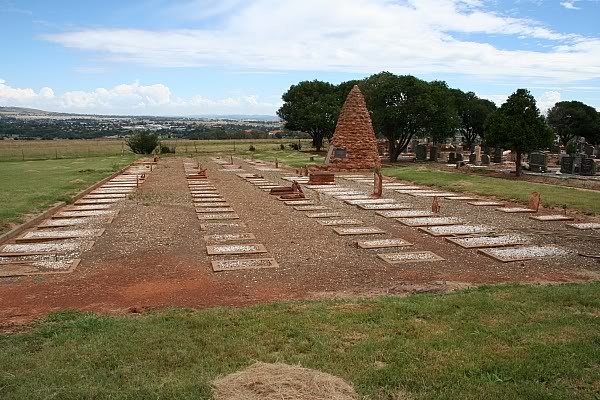
Children's graves at the British concentration camp site in Heidelberg
Children’s graves at the British concentration camp site in Heidelberg Photo: Boerevryheid

“This particular high school was founded just after the war, in a desperate attempt to save the Afrikaans language from being extirpated by the British administration. The fact that the school is today highly successful, displined and one of the top-performing schools in the province, is just too much to bear for Mrs. Creecy and pro-British genocidaires who are still nursing the Afrikaner hatred from hundred years ago.”

The mob was demanding that the century-old patriotic name of the school be changed to that of a local communist, Robert Nkosi. Another member of the South African Communist Party, Archie Mokonane of the South African Communist Party (SACP) told the crowd that the school was racist because it taught in Afrikaans.

“English is the language of proletarian internationalism, therefore all other languages are racist. Those people in Europe who teach in Dutch or German or French are racists too!”

Sipho Nhlengethwa, a local ANC councillor, said they would campaign for the school to be named after Obed Nkosi, a terrorist from Ratanda, the black township in the area. “This is our public school now, we have conquered the Boers,” said Nhlengethwa.

Regional leaders from the ANC, SA Communist Party, Cosatu and the Young Communist League handed over a memorandum of demands.

They want the school’s civilian governing body to be dissolved and replaced with a revolutionary communist council of “education workers”.

‘We will necklace them, we will burn them’

Young Red Guards chanting “we will necklace them, we will burn them”, referring to the Afrikaner pupils at Heidelberg Volkskool, disrupted and brought to a halt all education in the black township of Ratanda. School children were forced to participate in the protest, with both primary and high schools being deserted for the rest of the day. Bystanders put the number of marchers at 8 000. Teachers had told children that there would be no classes on Monday as “everybody had to march against the Afrikaner cockroaches”.

Volkskool was also accused of being racist because there were white players in the rugby team, with some members of the mob claiming that governmental race quotas for rugby only allowed one or two white players per team. “We want no whites in the team, it hurts our eyes to see whites,” said one.

A spokesman for the school blamed the inflamed racial tensions in the town on the provincial government’s failure to build an extra English-language high school, as promised in 1998. Cornelius Human, a member of the school’s governing body responsible for its legal affairs, said:

“What we found ourselves in was just a situation with wild allegations, with no substance – and we’re expected to act on them. It’s exactly the same situation that we have now.”

In hundred years, not much has changed in Heidelberg. The British concentration camp has gone, leaving a children’s graveyard like so many others in South Africa, but the hatred of Afrikaner children has stayed.

Jonathan Jansen backtracks on anti-Afrikaans statement

Jonathan Jansen
Jonathan Jansen

A careful argument on language in education has been distorted to create a media hype, Free State University rector Jonathan Jansen said on Wednesday.

“It still amazes me how a careful argument about language inclusivity can be seriously distorted for maximum media hype,” Jansen said on his twitter account in reply to a report about a speech in September.

Afrikaans newspapers Beeld and the Die Volksblad published front page articles on Jansen’s opinion that exclusive white Afrikaans schools and universities held a danger for race relations in South Africa.

Jansen’s comments were made while delivering the Percy Baneshik Memorial Lecture of the English Academy of South Africa on September 18.

In his speech, Jansen said English and not Afrikaans could be the “taal van versoening” — language of reconciliation — for South Africa.

He said English could also be the one major solution for the crisis in education.

“Instruct every teacher and every child in English from the first day of school rather than add the burden of poor instruction in the mother-tongue in the foundation years to the trauma of transition to English later on.”

Jansen said for many parents English was already the language of choice in schools.

The reason for this was that indigenous languages were poorly taught.

He said learning in a mother tongue was no guarantee of improved learning gains in school.

The Kovsie rector said English could be the foundation for a common language. He said he understood that the symbolism of supporting indigenous languages had a political value beyond his pragmatic reasoning.

Language differences were of themselves not contentious, but the mobilisation of languages for political purposes constituted the problem.

For this reason Afrikaans-dominant white schools and universities represented a serious threat to race relations in South Africa, he said.

“You simply cannot prepare young people for dealing with the scars of our violent past without creating optimal opportunities in the educational environment for living and learning together.”

Jansen said English had levelled the playing fields in the historically Afrikaans universities for common engagement between students.

The Kovsie rector confirmed his opinion on English as a reconciliation language in a tweet on Wednesday.

“I also believe that there is no way in which young people across divisions can heal past rifts without a common language; that is English,” Jansen’s tweet read. – Sapa

Anti-racists are the new racists

roodt_dan_wiki

by Dan Roodt

[followbutton username=’danroodt’ count=’true’ lang=’en’ theme=’light’]

Like Dan Roodt’s Facebook page

South Africa’s multiracial and multicultural society is exploding into a never-ending Kulturkampf or American-style culture war. Anti-racists are the new racists, spreading intolerance and even violence ahead of them with a megaphone, figuratively speaking. During the court appearance of a wine farmer, Mr Johnny Burger, the crowd in the Cape had been swept up into a lynch mob threatening to kill him on the spot. Police had to use pepper spray and a stun grenade to disperse them. Shades of the Ku Klux Klan? Except here the Klansmen are anti-racists.

Anti-racist intolerance is growing in leaps and bounds. In another recent incident, it led to the unfortunate resignation from Pretoria University of one of our praag columnists after Dr Piet Croucamp from the University of Johannesburg had accused her of hate speech. As I have commented elsewhere in an Afrikaans column:

“The media group Naspers and a small group of academics acting in bad faith and attacking others in the name of race, mostly for personal reasons, represent a danger to freedom of speech in South Africa.”

This afternoon I got an email from a friend saying that Mr Burger’s case reminded him of the notorius “Black Circuit” of the early nineteenth century. At the time a 1000 Cape farmers had to appear before a roving court to answer to trumped-up charges of murder, rape and assault. In the end, no-one was convicted and it was found that colonial English missionaries had colluded with local Khoi-San tribesmen to falsely accuse farmers of heinous crimes.

Contrary to our law, Mr Burger, accused of assaulting a Coloured child, was presumed guilty until his innocence could be proven. Two days ago, the Cape Times newspaper wrote about the case of Flippie Engelbrecht, the child concerned: “Those who brought the case to court charged that after the assault Engelbrecht had lost his sight, had epileptic fits, and because of this had rolled into a fire and suffered terrible burns, losing his hands.” In yesterday’s Cape Times, headlined Questions surround Flippie’s assault, “new evidence” came to light in the form of medical records showing that Flippie Engelbrecht had reported a “swelling on the side of his face”, which may have been a tumour, causing his epileptic fits and other medical problems. The same medical records contradict some of the dates advanced by the victim. However, in the meantime the wine farmer had committed suicide after his life and his business had been ruined by hysterical anti-racists pursuing him in the media, both traditional and social, led by the radical, Afrikaner-hating ex-lawyer (who was struck off the record as an attorney after dubious business deals and bankruptcy), Carina Papenfus.

So here we have two incidences of whites being subjected to histrionic public campaigns by so-called “liberal” anti-racists whose objectives have more in common with the Spanish Inquisition than with advancing the precepts of liberalism. Freedom of speech and even academic freedom in South Africa have been casualties of these campaigns, not to mention the two white victims, one committing suicide and another resigning her post and leaving the country, presumably for fear of being further persecuted.

Our universities are no longer places of learning but over-politicised shrines to political correctness and obtuse hatreds that are seemingly ignited by throwing a switch.

Volumes have been written on the cultural, linguistic, racial, anthropological, ethnic, ideological and religious divisions of South African society and I do not wish to dwell on the obvious. What concerns me more, is the apparent descent of people with nominal university qualifications into this kind of racial street fighting. They wield race and the word “racist” like a Cape Flats gangster brandishes his knife. Not so long ago, twelve schools had to be closed in that area as a result of gang activity and Mrs Helen Zille, the premier of the Western Cape, was calling for the army to be brought in to stabilise Manenberg.

Yet, ostensibly, we have more to fear from the pseudo-intellectual gangsters than from the drug-dealing, turf-warring criminals of the Cape Flats. Their influence on public discourse is far more insidious and destructive of the last vestiges of civilisation that remain in South Africa. They are intolerant zealots such as are to be found throughout history, wherever religious wars or ethnic conflicts have ignited and blazed.

Except for the Sunday paper Rapport, no-one seems to take Papenfus seriously. She waged a slanderous email and Twitter campaign against the hapless winemaker, apparently threatening and cajoling his customers into ceasing to order from him, with the intention of ruining his business and his life. Ms. Papenfus is a kind of cyber thug that replicates the intimidation tactics of petty gangsters in the public sphere. After all, as any mafioso or racketeer knows, a small business may be ruined by hitting one or two of its weak spots. Although she must have studied at one time for a degree or diploma, she has no intellectual pretensions. Her creed is simple: harass the whites. And being white and Afrikaans herself, but an ANC member, it is a case of être plus royaliste que le roi.

Papenfus is dangerous, but easily understood. The other two zealots who pounced upon the soft-spoken Pretoria woman philosopher, occupy positions of institutional power. Croucamp is a lecturer at the University of Johannesburg in political science and frequently appears on talk shows, both on radio and on television, wearing his trademark blue bandana. Schutte writes a column in the Mail & Guardian newspaper which is also avidly read by the “tenured radicals” at South Africa’s more than twenty universities.

Schutte was due to debate Croucamp’s victim on the topic: “‘Do white people have an obligation to withdraw from the public sphere?’ But as she stated in a subsequent column: “I am obviously not going to validate Louise Mabille’s hate speech by actually debating with her. Rather I will end by saying that she has presented a shining example of how whites should not participate in the public arena.  It is a good thing that Louise Mabille has handed in her resignation and that the University of Pretoria has accepted it.”

From Rhodes University, we have already had an opinion by Dr Samantha Vice that all whites, i.e. everyone of European descent, should take some form of vow to remain silent in public. So white guilt leads to the ultimate form of self-censorship, public silence.

Elsewhere, Ms Gillian Schutte describes herself, somewhat pretentiously, as a “feminist-neopagan-post-structuralist-deconstructionist-socialist” and she apparently has a Master’s degree in creative writing from the University of the Witwatersrand.

The one thing we can already deduce is that the mob outside the Cape courtroom who wanted to lynch Mr Burger at least believed in some form of dialogue. They were screaming, hurling abuse and gesticulating. With police intervention and protection, one could still call it communication.

Croucamp and Schutte want to reduce us to silence, however. Theirs is the monologue of totalitarianism, of censorship, of “There is only one truth and it is mine”. They pontificate in the name of power, the corrupt power that is ruling, nay, pillaging, South Africa.

It is therefore ironic that Schutte should describe herself as a “post-structuralist-deconstructionist”. Does she even know what she is referring to? The very basis of any “deconstruction” is the existence of more than one meaning, even the uncertainty, indetermination and radical plurality of meanings. Just over ten years ago a small group of us Afrikaner thinkers had a private seminar with Jacques Derrida, the father of deconstruction, at the École des hautes études en sciences sociales on the boulevard de Raspail in Paris. I remember Derrida as a modest, soft-spoken, amiable figure who reminisced about his single visit to South Africa. He liked Potchefstroom and even told me that “Heidegger would have felt at home there”. Derrida was full of gentle irony, self-doubt and respect for others, even the Other, as he so often termed it in his more political writings.

Schutte, by contrast, is a third-world ideologue, possessed by a terrible certainty. She has more in common with Robert Mugabe or Idi Amin than Jacques Derrida. Like so many others strutting about our campuses today, she has no real culture but the fad of the moment. The more politically correct such fads are, the better. Her meretricious pseudo-intellectualism has all the charm of Winnie Mandela’s expensive sunglasses and jewellery, being the brash expression of a corrupt and power-hungry soul. Ideas are but slogans, brands, to market yourself to another kind of mob to the one that wanted to lynch the Cape winemaker.

I have often thought that South Africa today has much in common with Nero’s Rome. Our country has become murderous, corrupt and decadent. Innocence has died. Approximately a thousand children are raped every day, including babies, and nobody says a word. Or if they broach the subject, they are immediately reduced to silence, given the ritual knife for disembowelling themselves. Schutte’s smug satisfaction (“It is a good thing that Louise Mabille has handed in her resignation and that the University of Pretoria has accepted it”) may be deconstructed to reveal two things: Schadenfreude and a paradoxical expectation of honour in others.

There is no English word for Schadenfreude, hence the German loanword that is universally used. However, the Afrikaans (and Dutch) term leedvermaak expresses the same thing, with a few more connotations (“signifieds” for post-structuralists) thrown in. The other day I tweeted in Afrikaans, something to the effect that leedvermaak is the apotheosis of journalism in South Africa. Vermaak also means entertainment, hence the misery of others, their travails amid hysterical accusations, calumny and vilification provide entertainment. Anti-racist Blitzkrieg, either on the vineyards of the Cape or on the campus of Pretoria University, therefore feeds the sensationalist mainstream media machine, sated on the blood of murder victims.

Celebrity "businessman" Kenny Kunene
Celebrity “businessman” Kenny Kunene

Due to the surfeit of murders in South Africa, people are becoming bored with news of another killing, no matter how ruthless and macabre. Celebrity murder, such as the Oscar Pistorius case, is still news, but not even serial killings elicit much attention. In a society as utterly cruel and corrupt as ours, we are in desperate need of frivolity, such as the camp antics of that incorrigible clown in drag, Pieter-Dirk Uys, or Kenny Kunene’s parties where guests eat sushi off the bodies of bikini-clad ladies.

South Africa is profoundly amoral. It lacks a moral or ethical code to define right and wrong. Someone like Baudrillard would say that this “lack”, in a psychoanalytical sense, creates a need for a kind of pseudo-ethics, a moral simulacrum.

This is where anti-racism comes in. Anti-racism is the simulacrum of our lost moral code. It is no coincidence that the objectionable sentence in Louise Mabille’s column contained references to both Calvinism and baby rape, the former marking the overtly Christian morality of the old South Africa and the latter epitomising the radical “freedom from all scruples” that characterises the new South Africa.

In this respect, Gillian Schutte, despite her evidently defective grasp of some basic philosophical and literary concepts, understands the “new amorality” well. In one of her “feminist” videos, a rape victim explains that the “cure” for the shame attached to having been raped, is to join the so-called “slutwalk”, ardently recommended by Ms. Schutte. By self-identifying as a slut, a woman is freed from the fear of rape and “forced sex” as it is euphemistically called. Miracle cures are to be found everywhere in South Africa, peddled by immigrant Nigerian pastors and indigenous witchdoctors alike. Not to forget the infamous “virgin cleansing myth” by which one may be cured of HIV-Aids by raping a virgin, including an infant, and which Louise Mabille alluded to in her column.

Gillian Schutte is also a champion of the word “cunt” which, according to her, should become part of our everyday discourse. As she puts it,

“When women finally reclaim and speak this word, its full potential will be released and women will repossess their collective cunt-power and rise up against misogyny and patriarchy with the absolute intent of ending it.”

Amid the universal amorality and Neronic decadence of South Africa, Schutte is clutching at ethical straws, more precisely: pubic hairs. Instead of simply affirming and enjoying the slutwalk, she opts for the simulacrum of the good, which has now turned out to be the “collective cunt-power” of women.

But there is no “good” anymore. South Africa is really living according to the famous maxim from Dostoyevsky’s Brothers Karamazov: “If there is no God, then everything is permitted.” As I intimated the other day, SA really stands for “Sadists’ Apocalypse”. Eighteenth-century French literature, specifically the writings of the Marquis de Sade, is all that we have to remotely begin to understand our baby rapists and farm murderers.

Apart from Gillian Schutte’s “cunt-power”, the other pseudo-morality that people desperately cling to is anti-racism. In our sadistic universe where nothing is wrong, some people imagine that racism is the one remaining sin. You may kill, rape, bribe, lie and steal, more or less with impunity, but uttering the word “Bantu” will earn you the opprobrium of polite society, that society which is now reappropriating the magical power of four-letter words.

The simulacrum of sin is transgression of anti-racist etiquette. That alone awakens some form of long-lost moral response which is delivered with predictable ecclesiastical ritual: denunciation, excommunication, prohibition, censorship. From the TV studio did Schutte, the high priestess of atavistic cunt-power and pagan ritual, deliver her sermon against what Orwell called thoughtcrime: “racist” thoughts and suspicions, including the mere mention of “baby rape”, which is a proven and documented phenomenon in this country.

Did Johnny Burger, the Cape winemaker, commit suicide to save his honour? In a country where “trial by media” and populist passions have come to influence courts and the judicial system, Burger probably correctly surmised that he would not receive a fair trial. His suicide reminds me of the death of the patrician Latin author Petronius who, having got wind of Nero’s henchmen being sent to kill him, preferred taking his own life while drinking wine and having musicians perform for him.

Thanks to Carina Papenfus’s hate campaign, no-one will ever drink Burger’s wine again.

Similarly to Burger, Louise Mabille fell upon her own sword and resigned. Understandably, there is despair and pessimism among the remaining class of thinking people in South Africa. We are outnumbered and outscreamed by those who are playing for the gallery.

However, notwithstanding samurai customs, there are other ways of saving one’s honour. On these shores, we have the example of the bittereinder, of someone fighting to the very, bitter end, against all odds.

Are we ready for that thankless struggle, knowing full well that we shall face calumny all the way? If reason be dead, can thought or the mind still withstand the mob, baying for our blood?

[followbutton username=’danroodt’ count=’true’ lang=’en’ theme=’light’]

Like Dan Roodt’s Facebook page

‘Too few Afrikaans-speakers in dept. of trade and industry’

Rob Davies
Rob Davies

The under-representation of Afrikaans-speaking personnel in the department of trade and industry is unacceptable and the Freedom Front Plus will be asking the minister of trade and Industry, Mr. Rob Davies, to rectify the imbalance, Adv. Anton Alberts, the FF Plus’ parliamentary spokesperson on trade and industry said.

It appears from a reply to a question of Adv. Alberts addressed to the minister in which he asked for an analysis of the languages spoken by all the personnel in his department and other institutions which report to the department of trade and industry.

According to Adv. Alberts, in certain sections in his department, such as the Companies Tribunal and the National Consumer Commission, there aren’t any Afrikaans speaking personnel.

“It is unacceptable and worrying and serves as proof that the interests of minorities such as Afrikaans speakers are being ignored by the ANC government, especially when it is taken into consideration that a lot of correspondence and many complaints are submitted in Afrikaans,” Adv. Alberts said.

From the minister’s reply, it appears that of the 1 541 personnel in the department, only 123 are Afrikaans speakers, while Afrikaans is the third most spoken language in the country.

Apart from the Companies Tribunal and the National Consumer Commission, where there aren’t any Afrikaans speakers, percentage wise, there are only 4,4% at the Export Credit Insurance Corporation and 1,2% at the National Empowerment Fund.

The National Metrology Institute of South Africa is the most representative with 37,5% of personnel being Afrikaans speakers.

Blacks impose English on coloured children of N. Cape

languageMr. Zolile Prusente is the curriculum specialist with the regional education department in Upington. Recently, he sent a complaint to the South African Human Rights Commission regarding a problematic shift in language policy in the past year.

He alleges that the school principal and the school management team implemented a language policy that designated English as the first language of instruction for all subjects against the advice of the law or parental preference. Afrikaans, isiXhosa and Setswana were set aside and offered as alternative languages. The decision was an abrupt change from the former policy which provided for instruction in the students’ first languages rather than English.

For Prusente, the shift in policy is most harmful for the students. “[This situation] clearly shows that the SGB [school governing board] is not in control of language policy and that language policy is dictated by educators to suit their needs,” he wrote in his statement to the Human Rights Commision. Prusente believes that the students’ constitutional rights are violated by the “one-way” decision to teach primarily in English. Those responsible, he said, acted “without… taking cognisance of the additive bilingual approach promoted by the language-in-education policy.” In his statement, he refers to the Northern Cape Education Department circular 37 which also highlights “the importance of mother tongue instruction in the Foundation phase.” In their response, the principal, Ms. AB Silwana, and the chairperson of the SGB, Mr. Themba Smith, denied Prusente’s claims and said that the “overwhelming majority of parents” voted for their children to be taught in English.

While most teachers have agreed to the change, there are some who doubt the validity of the vote and who have consequently received “warning letters” from Silwana. Mrs. Thembisa Magodi, who is an SGB member and one of the two grade two teachers who refused to implement the English-only medium, said she and her colleague were not aware of any parents meeting or voting. They have refused to acknowledge Silwana’s warnings and stated that any policy “that [asks] us to teach in a foreign language [English] is not reasonable [and] unlawful because the Law encourages mother tongue teaching.”

Magodi and her colleague point to the 2007 whole school evaluation report that “has shown that learners do not understand English” as further proof that the new policy is not beneficial to students. Both teachers have announced that, ignoring the new policy, they “will continue in the third quarter to teach in the home language of learners and English only as an additional language.”

Silwana and Smith contend that the South African schools act No. 84 of 1996 gives the SGB the power to determine the language policy. They state that, since 2009, the SGB has engaged in thoughtful deliberations regarding “the complexity of formulating a language policy” for a “multi-cultural and multi-lingual learner population.” Furthermore, they maintain that the adoption of English-only policy is based on a “research/survey” taken during the 2011-2012 year that demonstrated that “parents preferred English as the language of learning and teaching.”

Prusente believes that the policy change is rooted in the SGB’s biased aversion to multi-lingual education. He claims that the boards sees “many languages spoken by learners as a problem instead of a resource.” This leads them to favor English instruction, he explained, and makes them “guilty of killing [the home] languages of the learners and community.” He challenges the SGB to provide evidence of the minutes and attendance register where the language policy was decided upon.

Mrs. Miriam Gatyeni (54) is the grandmother of a grade two and grade three learner. She remembers the survey looking into language preferences, but denies that English was the overwhelming favorite. She, for one, chose Afrikaans. “Another parent chose isiXhosa and another man preferred English,” Gatyeni recalled.

The new language policy has forced her to consider different options for her grandchildren’s schooling. If the mother tongue of her grandchildren is not used to teach them, she will be forced to take them to an Afrikaans school in Blikkies, known as Progress, which is “far” from her home. “Home language is the best. It is [the] language [in which] I talk to them at home, just like it was with my mother,” said Gatyeni.

When asked for a copy of the language policy, Silvana referred this writer to Smith who said that while the policy “is not closed or classified information”, it has to be handled “carefully”. He also said that only the documents guiding the policy formulation process can be availed.

The site steward at Vela-Langa, Mr. Daniel Mokopi, said they reported the language policy chaos to the South African Democratic Teachers Union and decided that they “don’t want to interfere in individual school matters.”

The South African Human Rights Commission will hold a meeting regarding the matter today. – groundup.org.za

Two Afrikaners on trial for bestiality in Pretoria

A labrador, such as allegedly used by Smit

The Pretoria News reports that the case of a Pretoria East woman who allegedly had sex with two dogs is finally ready to go to trial next week, having been transferred to a court with an Afrikaans-speaking magistrate.

Smartly dressed in a black suit and red blouse, Jana Smit, 31, and her co-accused and former lover, Morne Fourie, 38, stood in the dock as State prosecutor Heinrich Scholtz told the court the case had been transferred from another court because of language issues.

Scholtz indicated that the accused and defence in the matter were all Afrikaans-speaking and it would make it easier if the magistrate could speak Afrikaans too.

Smit and Fourie face five charges of bestiality, possession of child pornography and sexual enticement.

Scholtz also indicated that he was waiting for feedback from the senior public prosecutor after “discussing certain matters with her regarding the case”.

Smit was arrested in August last year after a complaint from an animal protection organisation. It is alleged that the organisation and the NSPCA had received home-made video footage and photographs of Smit having sex with a Staffordshire bull terrier and a Labrador.

The footage was immediately taken to the Moot police station. Smit was arrested hours later. It is believed that the Staffie belonged to Smit’s neighbours. At the time of her arrest, the Labrador was taken to the NSPCA where it was put up for adoption.

Fourie, an IT specialist from Garsfontein, was arrested three days later. It is alleged that he helped to produce some of the pornographic images.

Both were released on bail of R1 000 each following their first court appearance.

At the time the court ordered Smit to undergo a mental assessment at the Moot police station. The outcome of the assessment will be disclosed during her trial.

Earlier, the court heard that investigators trawled through 31 000 e-mails on Smit’s laptop as part of the investigation.

Prosecutor releases robbers because ‘she did not understand Afrikaans’

crime+robberyTwo men accused of being part of a gang of robbers were mistakenly released after a miscommunication in the National Prosecuting Authority’s (NPA) office, The Saturday Star reported.

The newspaper reported that a prosecutor misunderstood an instruction from a control prosecutor that led her to withdraw charges against Solly Mahlahlo and Morekgomo Stanley Phaahla.

The case was scheduled to be heard in the Pretoria North Regional Court.

Police spokesman Captain Jan Sepato told the paper they would have to issue Mahlahlo and Phaahla with summons to appear in court as they did not escape from custody, but were released by officials.

The three witnesses in the case, Fanie Venter, Tiaan Strydom and Jeandre Visagie told the newspaper they feared for their lives as the men, who they positively identified in May 2011 could be after them.

NPA spokesman Medupe Simasuku told the Saturday Star that the error was an honest mistake that did not warrant disciplinary action.

“The instruction was given to the prosecutor in Afrikaans which is not her home language,” Simasuku was quoted.

The two were allegedly part of a gang that attacked the witnesses and robbed them in Montana, Pretoria in 2011. – Sapa

Soweto to welcome Obama, a ‘fellow African’

Scene in Soweto
Scene in Soweto

Barack Obama was barely 15 years old when riots erupted in the South African township of Soweto over a circular concerning the use of Afrikaans and other African languages in black schools. Decades later, its residents are preparing to welcome the US president as a “fellow African”.

Obama, now 51, will host a town hall meeting at a university campus as part of his visit to a crucible of the fight against apartheid, which saw protests break out in 1976 that spread across the country.

Although the white nationalist regime was not defeated, the 1976 riots spawned a new generation of black liberation leaders who continued the struggle while senior figures like Nelson Mandela and others languished in prisons.

While hundreds of anti-Obama protesters marched on the US Embassy in the capital Pretoria, 80 kilometres (50 miles) to the north on Friday, many Sowetans were keenly anticipating the visit by the first black US president.

“I want it to be a message of hope. I hope he talks about important things like education and the importance of going to school,” Christopher Mutangwa, a 20-year-old accounting student, said outside the University of Johannesburg’s (UJ) satellite Soweto campus.

“But I also hope that he can learn something about us and what happened here in Soweto during the struggle,” Mutangwa told AFP.

“He should, because I think he is an African.”

While there were few signs of preparation ahead of the highly anticipated visit at the UJ campus, many residents said they planned to line the streets, or watch the event on television.

“I was planning to visit my grandmother … but now I think I would rather go see Obama,” said Sibongiseni Kekana, 22, who makes a living as a struggling artist.

“Maybe I’ll even sell something to him,” Kekana laughed as he showed AFP around his tin shack, which also doubles as his art studio.

“In any case, I hope for inspiration from him,” Kekana said.

But even with Obama visiting Soweto, the continuing illness of South Africa’s own first black president, Nelson Mandela, never strays far from the conversation.

Mandela, 94, spent a third week in the intensive care section of a Pretoria hospital where he is being treated for a recurring lung infection.

After taking a turn for the worse last weekend, Madiba, as he is popularly known by his clan name, has been showing tentative signs of recovery.

— Two generations of black leaders —

With a possible visit by Obama to the ailing statesman on the cards over the weekend, inevitable comparisons are being drawn in many conversations.

“To me, Madiba represents an older and perhaps more traditional generation of black leaders, while Obama represents the new generation,” Tshepo Mofokeng, 43, told AFP.

“I’m sure he will be welcomed here as an African,” said Mofokeng, as he took some pictures on his mobile phone of his children at the Hector Pieterson Museum, which covers the 1976 uprising.

“I just think he (Obama) is sexy,” his wife Nomsa, 36, added with a laugh.

Even though many people will flock to welcome the US head-of-state, not all Sowetans were happy with his presence and demonstrations were planned for Saturday.

“I don’t think it’s a good thing that he’s coming here,” said Freddy Mhaule, 25.

“Especially with him spying on the world,” he added, referring to the recent revelations about PRISM, the US Internet surveillance programme.

“Obama’s visit will have zero impact on us,” said an art vendor, who only wanted to be identified as “Lebo”, at the Hector Pieterson Museum, which commemorates the death of the youth activist, shot dead in 1976 by apartheid police at the age of 12.

“To me he’s just another politician,” Lebo added, as he tried to sell tourists a wooden model of the Soweto home where Mandela once lived, which today serves as a museum. – AFP