Where’s America’s right to referendum, secession?

mercer_ilanaby Ilana Mercer

[followbutton username=’IlanaMercer’ count=’true’ lang=’en’ theme=’light’]

Like Ilana Mercer’s Facebook page

From a node in the neoconservative network, a Fox News studio, Charles Krauthammer has complained about the eviction of the Ukrainian Navy from the city of Sevastopol, where it was headquartered. Not a word did the commentator say about the city’s location: Sevastopol is on the Crimean Peninsula. It would appear that the city now falls within Crimean jurisdiction – starting March 16, the day the people of Crimea voted to secede from Ukraine.

By most estimates, between 97 and 93 percent of Crimean voters said yes to a reunion with Russia. High too was voter turnout. McClatchy pegs it at 83 percent of registered voters in Crimea. BBC News was agreed, also reporting a ballot of “more than 80 percent.” Zerohedge.com counted a “paltry” 73 percent turnout, still “higher than every U.S. presidential election since 1900.”

As rocker Ted Nugent might say, the Russians and Crimeans are blood brothers. Nugent got into trouble for using this perfectly proper appellation to describe his affinity for a politician, of all people: Texas Republican gubernatorial hopeful Greg Abbott. Notwithstanding that in the land of the terminally stupid, linguistic flourish can land one in hot water – blood brother is a good, if colorful, turn of phrase that denotes fealty between like-minded people. Steeped in state-enforced multiculturalism, America’s deracinated, self-anointed cognoscenti have a hard time grasping the blood-brother connections between the people of Russia and Crimea.

For no apparent reason other than that it is pro-Russian, Americans have reflexively aligned themselves against the swell for secession in southern Ukraine. Separatist referenda in Kosovo, Catalonia, South Sudan and Scotland have been accepted without demur by a political and media establishment unprepared to countenance a similar referendum in Crimea.

Guided by the pack animals of politics and punditry who seldom fail to shed darkness on whatever topic they tackle, a nation that struggles to locate the disputed territories on the map has been convinced of the menace posed by Russia. According to a CNN poll, 69 percent of Americans say they see Russia as a threat. A Rasmussen Report poll indicated that “52 percent support U.S. diplomatic action against Russia over Crimea.”

Helping to drive American Russophobia is the implacable logic exemplified by Bill O’Reilly of “The Factor,” yet another node in the network mentioned. At the suggestion that there are similarities between Russian and American military bellicosity, the TV host foams at the mouth. Fulmination is followed not by argument, but by a form of ad hominem or psychologizing.

Into the Cannibal's Pot

It is absolutely verboten on this popular and powerful show to compare Russia’s “excursion” into Ukraine to America’s naturally illicit and illegal occupations of Iraq, Afghanistan and Libya. In defense of their reflexive rejection of the reasonable, if inaccurate, comparison – for decades the U.S. has been far more aggressive than Russia in its forays abroad – Bill and his gang “argued” (on March 3) as follows:

President Vladimir Putin is a thug. That’s why his actions can’t be contrasted with the actions of “a good country” like the U.S. By “logical” extension, George Bush and Barack Obama are never to be fingered as thugs.

Why, Billy, some of you will inquire? Is it because these thugs are American? Precisely.

Next, Bill O’Reilly’s mind-reading gifts were galvanized to negate the juxtaposition of the actions on the ground of the Russian and American governments. Putin, it would appear, seeks the recrudescence of the Russian empire. On the other hand, the U.S., with a military presence in 148 countries and 900 bases worldwide, has neither sought nor achieved empire status.

Why, Billy, some of you will ask? Is it because the U.S. is a good country? You got it!

Be it in Belgium, Germany, Italy, Spain, Turkey, the United Kingdom, Japan, Bahrain, Djibouti, South Korea, Iraq, Kyrgyzstan, Afghanistan and Kuwait – even Aruba, Iceland, Indonesia, Kenya, Norway and Peru – wherever it plants its military boot, a “good country” is never an empire, only a force for good.

Me, O’Reilly would dismiss as “anti-American.” But what of former secretary of state Henry Kissinger? While Kissinger has condemned Russia’s annexation of Crimea, he excoriated “the demonization of Vladimir Putin.” This antipathy “is not a policy; it is an alibi for the absence of one.” “The United States needs to avoid treating Russia as an aberrant to be patiently taught rules of conduct established by Washington,” wrote the statesman in the Washington Post.

Is Henry Kissinger anti-American or simply smarter than some Americans?

At least Secretary of State John Kerry hung on to his sense of humor. “Unless you are the United States of America, you just don’t invade another country on phony pretext in order to assert your interests,” Kerry lectured the congenitally incurious David Gregory, of “Meet the Press.”

I ad-libbed. Except for the first eight words in quotation marks, Secretary Kerry did indeed say the foregoing. Given America’s military record, the missing words are implied.

The O’Reilly school of “thought” could – and does – counteract that Crimea’s vote to join Russia was tainted by fraud. This is certainly possible. Nevertheless, it is none of our business. Americans have their own tyrants to dethrone.

We’re supposed to be the freest people in the world, aren’t we? Is this claim not the moral basis for America’s we-know-best global meddling? But if we Americans are the freest people in the world, where’s our right to a referendum on, say, that “little” legislative “blip” called Obamacare? And if we’re so bleeding free, where’s our right to secede from D.C.?

© 2014 by Ilana Mercer

[followbutton username=’IlanaMercer’ count=’true’ lang=’en’ theme=’light’]

Like Ilana Mercer’s Facebook page

Associated Press no longer recognizes Crimea as part of Ukraine

apUS news agency Associated Press is no longer marking news items coming from Crimea as Ukrainian. In a blog statement, the American news major explained that the Ukrainian regime had lost control over the peninsula, and stressed its marking practice was based on the actual state of things.

Where it once used this dateline: “SEVASTOPOL, Ukraine (AP),” it will now use this one: “SEVASTOPOL, Crimea (AP).”

The reason is that Crimea is geographically distinct from Russia; they have no land border.

“For instance, we just say “Sicily” and “Sardinia” in datelines – “Palermo, Sicily” – even though they are part of Italy, and “Guadeloupe” in datelines even though that island is part of France,” Associated Press’ Stylebook announced

The change will effectively recognize Crimea as an independent state following a referendum on Sunday where the vast majority of Crimeans voted to become independent and join Russia.

Rather than champion the cause of independence and self-determination for colonized peoples around the world, the United States has become a center for defending inequitable status quos.

When, in 2008, the Assembly of Kosovo declared the region independent of Serbia, it was immediately recognized by the major corporatist powers because NATO troops were present to ensure that Serbia did not try to reassert its control over the region. NATO and the European Union also warned the majority Serbs in northern Kosovo not to declare independence and unify with Serbia.

Apparently, independence for ethnic groups is only permitted by NATO and the European Union as long as it is not Russians, Serbs, Afrikaners asking for the independence or the right of self-determination.

In the Crimean referendum, registered voter turnout was 83.10 percent. Only 2.09 percent of those voting opted to restore the 1992 constitution and remain a part of Ukraine. A clear majority of 96.7 percent favored joining the Russian Federation.

If the same rules that are presently applied by the corporatist powers to Crimea were extended to independence referenda held in other countries, there today would be no independent Norway, Iceland, Cambodia, Guinea, Samoa, Algeria, Malta, Djibouti, Slovenia, Estonia, Latvia, Lithuania, Bosnia-Herzegovina, Moldova, Eritrea, East Timor, Montenegro, South Sudan, or, in fact, Ukraine.

All declared independence after referenda, some of which were more openly in favor than that held by Crimea (Norway, 99.9 percent; Iceland, 99.5 percent; Cambodia, 100 percent; Guinea, 95.2 percent; Samoa, 85.4 percent; Algeria, 99.7 percent; Malta, 54.5 percent; French Territory of Afars and Issas (Djibouti), 99.8 percent; Slovenia, 88.5 percent; Estonia, 78.4 percent; Latvia, 74.9 percent; Lithuania, 93.2 percent; Bosnia-Herzegovina, 99.7 percent; Moldova, 97.9 percent; East Timor, 78.5 percent; Montenegro, 55.5 percent; South Sudan, 98.3 percent; and Ukraine, 92.3 percent.)

The corporatist powers have, like Ukraine, denied their regions independence after clear majorities voted in favor of secession. In 1933, the British Parliament rejected a 70.7 percent vote in favor of secession by Western Australia. In 1946, the Danish King rejected a 50.4 percent vote in favor of independence held in the Faroe Islands. The declaration of independence by the islands was rejected by Denmark. In 1977, after the people of Aruba voted 95.1 percent for independence, the Netherlands instead offered the island a bogus self-determination status.

Great Britain still recognises the independence of two Bantustans in Southern Africa today, but refused to recognise the independence of other ethnic states because they had no control over them. Instead Britain called the independence of South African provinces “apartheid” and launched a worldwide attack on separate development.

Should Britain give the Falklands back?

cristinakirchnerArgentine leader Cristina Fernandez de Kirchner recalled that the UN Charter stipulates the right of people to self-determination, which means that this rule should be applied to all countries without any exception.

Kirchner compared the situation in Crimea with another event in modern history. The Falkland Islands also held a referendum a year ago. It was a disputed territory, claimed by both Argentina and the United Kingdom. In 1982, differences resulted in an open military conflict.

Britain then defended the Falklands by force of arms, and last March almost all the residents voted to stay a part of the UK in a plebiscite. The UN did not question the legality of the vote at that time, Kirchner said.

“Many of the major powers, which have secured the Falklands’ people right to self-determination, do not want to do the same in relation to the Crimea now. How can you call yourselves guarantors of world stability, if you do not apply the same standards for everyone? It looks like the Crimeans cannot express their will, but the residents of the Falklands can. There is zero logic in that,” she said.

The EU countries and the US government refused to recognize the results of the referendum in the Crimea, with region’s residents voting almost unanimously for joining Russia.

The EU imposed second-tier sanctions against Russia on Monday, as a retaliation measure to the holding of a referendum in Crimea. Financial assets freezing and a visa ban on entry into the EU countries were applied to those Russian officials, who the West calls responsible for the annexation of the Crimea.

The US sanctions have affected an even higher tier – Barack Obama signed a decree that prohibits entry into the United States and seizes US assets of seven Russian officials and deputies: the Federation Council Speaker Valentina Matviyenko, Deputy Prime Minister Dmitry Rogozin, Presidential Adviser Sergei Glazyev, Assistant to President Vladislav Surkov, State Duma deputies Elena Mizulina and Leonid Slutskiy, Senator Andrey Klishas.

Rejecting contacts with Russia, the West harms himself, not us, the Vzglyad newspaper states. As a response to the US and European sanctions the State Duma issued a document named “On the US and EU sanctions,” suggesting that Western leaders should extend restrictions on all Russian deputies.

Putin: Crimeans expressed their will in full accordance with intl law, UN Charter

A woman with her face painted in the colours of the Russian national flag waits for the announcement of preliminary results of today's referendum on Lenin Square in the Crimean capital of Simferopol March 16, 2014
A woman with her face painted in the colours of the Russian national flag waits for the announcement of preliminary results of today’s referendum on Lenin Square in the Crimean capital of Simferopol March 16, 2014

The referendum in Crimea was fully consistent with international law and UN Charter, Russian President Vladimir Putin told Barack Obama, after the overwhelming majority of Crimeans expressed their willingness to join Russia.

The citizens of the peninsula have been given an opportunity to freely express their will and exercise their right to self-determination, the Russian president said in a phone conversation with his US counterpart, according to Kremlin’s press service.

With a record-breaking turnout of over 80 percent, according to preliminary results, over 95 percent of the Crimean population said ‘yes’ to the reunion of the republic with Russia. International observers have not reported any violations or anything resembling any kind of pressure during the vote.

However, Obama said the Unites States and the “international community” will “never recognize” the results of the referendum “administered under threats of violence and intimidation,” according to White House spokesman.

Obama “emphasized that Russia’s actions were in violation of Ukraine’s sovereignty and territorial integrity” and that the US in coordination with its European partners is “prepared to impose additional costs on Russia,” the White House added.

Despite the existing differences in the assessment of the situation in Ukraine, the leaders of Russia and US have agreed that they must jointly seek to help stabilize the situation in the country, the Kremlin said.

“Putin drew attention to the inability and unwillingness of the current Kiev authorities to curb rampant ultra-nationalist and radical groups, destabilizing and terrorizing civilians, including Russian-speaking population, and our fellow citizens,” Kremlin statement reads.

In this context, the possibility of sending an OSCE monitoring mission to Ukraine was discussed, the press office reported. The Russian President believes such a mission should be extended to all Ukrainian regions. – RT.COM

Language discrimination fuels Ukrainian conflict

Language map of Ukraine

The deepening crisis in Ukraine involves not only issues of political sovereignty, European integration and Russian hegemony, but also language and its relationship to nationalism and ethnic identity. Immediately after the removal of President Viktor Yanukovych from power on Feb. 22, the Ukrainian Parliament repealed a controversial law passed in 2012 that allowed the use of “regional languages” – including Russian, Hungarian, Romanian and Tatar — in courts and certain government functions in areas of the country where such speakers constituted at least 10 percent of the population. (In 1991, in the wake of the collapse of the Soviet Union, the newly independent state of Ukraine established Ukrainian as its sole official language.)

Interim President Oleksandr Turchynov has since vetoed that repeal, but the episode has alarmed many of Ukraine’s Russian speakers and others. “Just as the law itself was meant to validate the continued use of Russian in Ukraine for a wide range of activities, the move to cancel that law was perceived as taking away rights enjoyed by the Russian-speaking population, and potentially a sign that there might be growing discrimination against them,” explained Olga Oliker, a security and defense analyst at the RAND Corp.

Indeed, after the 2012 law was passed, 13 of Ukraine’s 27 regions, mostly in the industrial eastern parts of the country, quickly adopted Russian as a second official language. (But even then, the passage of the law triggered demonstrations in the streets and even fistfights in Parliament.) Dr. Vitaly Chernetsky, associate professor in the department of Slavic languages and literatures at the University of Kansas, commented that the 2012 language law was poorly written and roundly criticized by many experts at the time. “Additionally, no budgetary allocations were made at the time, so passing this law was, in effect, a purely symbolic measure intended to divert the attention of the Ukrainian electorate from corruption and economic problems,” Chernetsky said in an interview.

According to the CIA/World Factbook, the Russian language is spoken by about one-fourth (24 percent) of the Ukrainian population, while about one-sixth (17.3 percent) of the Ukrainian population are ethnic Russians. RT, a Russian television network, claims that 40 percent of Ukrainians speak Russian, (presumably including non-Russians). Russian speakers are concentrated in the southern and eastern parts of Ukraine – while in the southern autonomous region of Crimea (where the Russians have had a naval base on the Black Sea for more than 200 years), an estimated 60 percent of the population are ethnic Russians.

Related

Oleksandr Turchynov: The Baptist Currently Running Ukraine
Ukraine Girls Really Knock Me Out: Women Playing Crucial Roles In Euro-Maidan Protests
The Ukraine Parliament reportedly will consider yet another language law in the coming weeks or months – it is unclear if it will again allow a multi-language framework for the country’s social and political life.

Svitlana Melnyk, a lecturer in Slavic languages and literatures at Indiana University-Bloomington, argued that the establishment of monolingualism formed a key part of solidifying Ukraine’s national identity. “For post-Soviet independent countries and Ukraine in particular, the state language has symbolic meaning and a great symbolic value in the process of nation-building,” she said. “This is a national symbol along with the flag and anthem. The language issue is highly politicized in Ukraine, and its future management heavily depends on the evolving political situation.”

Melnyk added that she thinks that Ukrainian should be “the only state language” in the country. “At the same time, the [new language] law should consider the current socio-linguistic situation and protect the languages of national and ethnic minorities in the country,” she said.

But the temporary repeal of the 2012 law sparked outrage from Ukraine to Moscow and even in the European Union. Russian Prime Minister Dmitry Medvedev condemned the law’s abolition. “We do not understand what is going on there. There is a real threat to our [Russian] interests and to the lives and health of our citizens,” he said at a press conference, adding that the new interim government in Kiev lacks legitimacy. Similarly, Konstantin Dolgov, the Russian Foreign Ministry’s commissioner for human rights, characterized the law’s repeal as an “attack on the Russian language in Ukraine” and a “brutal violation of ethnic minority rights.”

Outside of Russia, the European Parliament even passed a resolution calling on the new Ukraine regime to respect the rights (and languages) of its minority population. “The Parliament of Ukraine has made what I believe to be a mistake… canceling a law on regional languages,” Poland’s Foreign Minister Radoslaw Sikorski told CNN. “The new Ukrainian government should signal very eloquently to the ethnic minorities in Ukraine that they are welcome in Ukraine; that they are going to be part of the new Ukraine. And also Ukraine is a member of the Council of Europe, [with] its laws on protecting minorities.”

Separately, in response to the gathering storm in Ukraine, some nationalist lawmakers in Moscow, led by the far-right Liberal Democratic Party of Russia, have called for the fast-tracking of Russian citizenship to ethnic Russians in Ukraine. LPDR MP Ilya Drozdov has already tabled a bill that would grant Russian citizenship to Ukrainian-Russians within six months of proving their ethnicity. “The adoption of this amendment would allow [us] to lawfully use the migration potential of Ukrainian citizens of Russian ethnicity who desire to get Russian citizenship,” Drozdov explained. RT reported that more than 2 million residents of the former Soviet republics have received fast-tracked Russian citizenship since the fall of the Soviet Union – even including people not of ethnic Russian origin, like the South Ossetians of Georgia, who speak an Iranian-related language.

Meanwhile Ukrainian nationalists, particularly members of the ultra-right Svoboda (Freedom) party led by Oleg Tyahnibok, have even threatened to ban the Russian language completely and even strip the Ukrainian citizenship of the nation’s Russian speakers. Jean Asselborn, the foreign minister of Luxembourg, in a meeting with his Russian counterpart Sergei Lavrov in Moscow, expressed their grave concerns about another Svoboda-proposed bill that would essentially ban all Russian language media in Ukraine (which Svoboda has defended by citing that Russian reports of the turmoil in Ukraine have been tarred with bias). That bill would prohibit from Ukraine any media from nations that have not ratified the European Convention on Transfrontier Television — Russia has signed the convention, but has not ratified it yet.

“Russia is not a party to the convention, but it does not prevent us from broadcasting all across Europe. No EU member makes any problems for our broadcasts. If such a decision is taken in Ukraine, it would be a serious violation of the freedom of speech,” Lavrov said at a media conference.

With respect to the prevalence of Russian language, Chernetsky also noted if one looks at an average Ukrainian newsstand, one will find that about 90 percent of the publications are in Russian, even in the areas where the majority of the population speaks Ukrainian. “The Russian language also dominates the radio,” he said. “The only segment of the media where the Ukrainian language predominates is the national-level television channels.”

Oliker noted that while Ukraine has some strident far-right groups, including Svoboda and Pravyi Sektor (Right Sector), there are also more measured voices that recognize that Ukraine is a multi-ethnic country and which have absolutely no interest in denying anyone their citizenship on ethnic grounds. “Emotions are of course running very high right now, but I think most Ukrainian leaders, including the leadership of Svoboda, know they stand to lose far more than they stand to gain by taking action against the ethnic Russian minority,” she noted. “That said, the situation bears watching, because people are very angry and frightened, because one cannot ignore the ethnic undertones to the anger or the fear, and because elements of Svoboda, and certainly Pravyi Sektor, do hold ultra-nationalist views.”

Russian and Ukrainian are closely related Slavic tongues, but they are also distinct languages with separate ethnic and national identities. The Christian Science Monitor reports that Russian-language activists in Ukraine have long wanted to make Russian a second official state language, citing such scenarios in multi-lingual countries like Canada and India. “There is this pervasive suggestion that if you speak Russian, you’re not a loyal or true Ukrainian. This makes Russian-speakers feel like second-class citizens,” Ruslan Bortnik, vice chairman of Russian-Speaking Ukraine, an advocacy group, told the Monitor.

Of course, Ukrainian nationalists fear the further encroachment of Russian into its national fabric. “If Russian were an official language, the main fear is that it would be a wide-open door for Russian influence in Ukraine,” said Oleksiy Kolomiyets, president of the Center for European and Transatlantic Studies in Kiev. – International Business Times

Russia and Ukraine agree on truce over Crimea until 21 March

crimea-mapThe defense ministries of Ukraine and Russia have agreed on a truce in Crimea until March 21, Ukraine’s acting defense minister said on Sunday.

“An agreement has been reached with (Russia’s) Black Sea Fleet and the Russian Defense Ministry on a truce in Crimea until March 21,” Ihor Tenyukh told journalists on the sidelines of a cabinet meeting.

“No measures will be taken against our military facilities in Crimea during that time. Our military sites are therefore proceeding with a replenishment of reserves.” – Reuters

International observer in Crimea receives death threats

Johan Bäckman
Johan Bäckman

An international observer from Finland, who sees the referendum on the status of Crimea as absolutely legitimate, has received death threats.

A referendum is due to be held in Crimea on the status of the peninsula tomorrow, on Sunday, March 16, so on Saturday, any campaigning is banned there. An ad-hoc commission is due to see to it that this is strictly observed.

Meanwhile, an international monitor from Finland, Johan Bäckman, has complained at Simferopol airport of pressure that has been brought to bear on him and his colleagues, and also said he’d received death threats, because he supports the referendum.

“It’s all threats and slander. I received a letter with death threats earlier today”, Bäckman said. “The letter is anonymous. The Western media are full of aggression against Russia. I can’t really make out the position of the West that the referendum is allegedly in breach of international law”.

He said the residents of Crimea have every right to determine their future. The US and the European Union are bending every effort to have the referendum cancelled, and are threatening with sanctions. That the EU is considering sanctions is absolutely absurd.

Bäckman said the attempts of western politicians to stop or cancel the referendum are prompted by their desire to downgrade Russia’s authority.

The All-Crimea plebiscite is due on Sunday from 8 a.m. to 8 p.m. local time. The minimum voter turnout to consider the referendum valid is 50%. International observers keep arriving in Crimea to monitor the plebiscite.The international observer stressed that he sees the referendum on the status of Crimea as absolutely legitimate.

The situation in Crimea is calm, Deputy of the Belgian parliament Frank Creelman, who arrived to monitor the referendum to be held on March 16, said on Saturday. Everything is very calm and normal, absolutely not the way it is being pictures abroad, he said.

There are many pro-Russian people among residents and many law enforcement officers are at streets, Creelman said.

Creelman said he intended to monitor the referendum on the status of Crimea not just in Simferopol but in relatively small Crimean settlements as well.

The former Republican congressman and three-time presidential candidate Ron Paul has launched a scathing attack on what he calls a US-backed coup in Ukraine, insisting the Crimean people have the right to align their territory with Moscow and characterising sanctions against Russia as “an act of war”.

“The evidence is pretty clear that the NGOs [non-governmental organisations] financed by our government have been agitating with billions of dollars, trying to get that government changed,” he said. “Our [American] hands are not clean.”

Voice of Russia, Interfax, Life News, The Guardian

Second US drone intercepted over Crimea

mq5b_g2mAn American scout-attack drone was intercepted in the Crimean sky, the Rostec state corporation reports. “Judging by side marking, the MQ-5B drone was part of the 66th US brigade of military intelligence with the main location in Bavaria,” the report on the website of the corporation reads.

According to the report, at the beginning of March, the American brigade was relocated to the Ukrainian Kirovohrad, from where drones commit reconnaissance raids in the direction of Crimea and Russian border areas.

Earlier, they reportedly appeared in the Kherson region, in the area of the Crimean roadblock Chongar.

The 66th Military Intelligence Brigade is a United States Army brigade, subordinate to United States Army Intelligence and Security Command and based at Wiesbaden Army Airfield, Wiesbaden, Germany. After years of history as a counter intelligence/intelligence group with headquarters in Munich and geographically dispersed detachments, it became a brigade on 16 October 1986, but was inactivated in July 1995. Reformed again as an intelligence group in 2002, it became a brigade again in 2008.

The unit’s mission is to provide intelligence support to U.S. Army Europe and U.S. Army Africa.

Part of the 66th Military Intelligence Brigade supports near real-time missions for deployed soldiers such as operations in Afghanistan and also Iraq.

“According to some data, the American reconnaissance brigade had 18 MQ-5B drones in its arsenal. This is the second time the American UAV is intercepted over Crimea,” the report says.

“The drone was at the height of about 4 thousand meters and was practically invisible from the earth. It was possible to break the drone’s link with its American operators with the help of the EW (electronic warfare) complex Avtobaza. As a result, the device made an emergency landing and passed into the possession of the self-defense forces almost unbroken,” the report says.

Ten years ago a German drone nearly collided with a passenger plane over Afghanistan. The classified drone camera footage drew public attention after the German defense ministry scrapped a drone program for its lack of anti-collision technology.

Footage taken by an EMT Luna X-2000 reconnaissance drone as it passed mere meters under the left wing of an Airbus A300 passenger plane surfaced on YouTube several years ago. After the encounter, the drone was caught in the plane’s wake turbulence, lost control, and crashed over the Afghan capital Kabul, Der Spiegel reported.

The Ariana Afghan Airlines plane was carrying about 100 people on board, the magazine said. The manufacturer of the 40kg drone has claimed that the near-collision occurred after the passenger jet veered off-course without informing ground control.

The video was leaked a week after German Defense Minister Thomas de Maizière decided to scrap the $652 million EuroHawk program meant to be a replacement for existing reconnaissance aircraft. EuroHawk is part of the NATO Global Hawk project.

Local German communities have expressed apprehension about US drones being in German airspace. Germans are concerned about potential violation of their freedoms after the drones come into operation. The recent scandal surrounding NSA spying activities in Germany and the protests that followed, has heightened public skepticism.

“It’s a big issue here in general, and it’s a very German topic,” Constanze Schulze, a reporter for ARD Bavaria stated. “There are many discussions going on about unmanned units, and of course there is some concern. I think that’s why you see so many reporters here. Everyone is talking about it.”

Politicians have also expressed concerns. Reinhold Strobl of the Social Democratic Party of Germany (SDP) said that the public was informed “too late” and that there was “inadequate” information provided by the German authorities and US military ahead of the deployment. If it was not for test flights conducted in July, the politician says, Germans would have been left completely in the dark.

Richard Reisinger from the Christian Social Union Party (CSU) also said that the way the public was informed about the issue lacked transparency. “What happens to the collected data?” he asks, expressing concern of potential risk of information misuse.

Source: Voice of Russia/BBC/RT

‘Kosovo gives Crimea right to self-determination’

Gregor Gysi
Gregor Gysi

The recognition of Kosovo independence set a precedent that gives Crimeans, as well as Basques and Catalans, a right for self-determination, German opposition leader said, lashing out against Angela Merkel’s support of sanctions against Russia.

Gregor Gysi, a parliamentary head of the largest lower-house opposition party in Germany has spoken out on Thursday against German Chancellor’s unquestioning support of the coup-appointed Ukrainian government.

“They formed a new government….. Immediately recognized by president Obama by the EU and German government as well. Miss Merkel! The vice-prime minister, the defense minister, minister of agriculture, environment minister, the attorney general.. They are fascists!” he stated.

Gysi said that NATO opened Pandora’s Box by recognising the unilaterally proclaimed independence of Kosovo and that Crimea’s secession from Ukraine applies the same pattern of international law.

“With Kosovo, they opened Pandora’s box. What’s allowed for Kosovo, you should also allow for others. I told you this but you haven’t listened to me. Winning the Cold War has eclipsed everything for you, you forgot about everything else,” Gysi said.

“The Basques are asking why can’t they make their choice, whether they want to stay within Spain or not? Catalonians are asking, why can’t they decide whether they want to belong to Spain or not. Of course people living in Crimea are asking the same thing.”

“I think that Crimea breaking away from Ukraine is just the same as Kosovo. I knew Putin would use this argument, and he did,” the politician said. “It must be found, such status for the Crimea, which will be acceptable for Ukraine, Russia, and us.”

Gysi also commented on NATO’s expansion to the east and called on the German government and the West to acknowledge the “legitimate security interests of Russia.”

“When we restored Germany’s unity, the US, German and other foreign ministers proclaimed there will be no NATO expansion to the east. But this promise has been broken. There was an expansion of NATO in Russia’s direction,” said Gregor Gysi in an outburst directed at Merkel.

“Security in Europe, there are neither without nor against Russia, but with Russia. When the crisis is over one day, an advantage could be that international law is finally respected again from all sides,” Gysi concluded.

Right before Gysi’s emphatic statement Chancellor Angela Merkel addressed German MPs, expressing her support of imposing sanctions and warning Russia that it risks “massive political and economic consequences” if it sticks to its position on Ukraine.

Russia has repeatedly said it considers the actions of Crimean authorities reasonable and legal, and will respect the results of the referendum.

Source: RT

National sovereignty inconsistent with US dollar system

pcrFrom the moment that Washington launched its orchestrated coup in Kiev, Washington has been accusing Russia of “intervening in Ukraine.” This propaganda ploy succeeded. The Western presstitute media reported (nonexistent) Russian intervention to the exclusion of coverage of Washington’s obvious intervention.

Having falsely accused Russia of invading Crimea, the Obama regime now demands that Russia interfere in Crimea and prevent the referendum set for next Sunday. Unless Russia uses force to prevent the people of Crimea from exercising their right of self-determination, John Kerry declared that the Obama regime will not discuss the Ukrainian situation with Russia.

So, Kerry has given Russia the green light to send in troops to prevent Crimean self-determination.

The presstitute Western media has not noticed that out of one corner of his mouth Kerry denounces Russia for intervening and out of the other corner of his mouth Kerry demands that Russia intervene in behalf of Washington’s interest and suppress Crimean self-determination.

What is the point of such an absurd demand on Russia?

The Obama regime claims that the Crimean vote is not legal, because all of Ukraine is not voting on Crimea’s future. When Washington stole Kosovo from Serbia, Washington did not allow Serbia to vote on Kosovo secession. In the upcoming Scottish vote on whether to secede from the UK, only the Scottish are voting, not the British population. But these normal processes established in international law cannot be permitted to Crimeans, because the vote will not support Washington’s agenda.

Clearly, an Obama regime this shameless has no shame.

The neoconservative warmongers who control the Obama regime are boasting that unless Russia prevents Crimean self-determination, Washington will use sanctions to “badly damage the Russian economy.”

Sanctions are likely to backfire. Sanctions would damage economies of Washington’s NATO puppet states, making them think again about providing cover for Washington’s aggressive words and deeds. It is Europe that will pay for Washington’s aggressive actions.

Sanctions are likely to speed up the implementation of the BRICS negotiations to leave the dollar system and settle their international accounts in their own currencies. All countries with financial and economic links to the West can be intimidated, punished, and destabilized by Washington. National sovereignty is inconsistent with being part of the US dollar system.

From Washington’s standpoint, the importance of sanctions is not any economic effects.

The importance is the propaganda advantage of portraying Russia as an offending party who is punished by Washington. Not only does this propaganda put Russia in the wrong, it also portrays Russia as subservient to Washington.

The Crimean government is actually elected, whereas the Washington-installed government in Kiev is not. Here is a report on Global Research about the “democrats” who comprise the unelected government in Kiev:

During the Clinton, George W. Bush, and Obama regimes, Washington has established that whatever serves Washington’s agenda is legal. Laws inconsistent with Washington’s agenda are simply not applicable. They are dead letter laws. Therefore, it comes as no surprise that in violation of US law that prohibits giving financial assistance to governments whose leaders come to power via coup or other illegal means, Washington is offering its stooges in Kiev $1 billion to help the coup government get up and running.

Paul Craig Roberts was Assistant Secretary of the Treasury for Economic Policy and associate editor of the Wall Street Journal. He was columnist for Business Week, Scripps Howard News Service, and Creators Syndicate. He has had many university appointments. His internet columns have attracted a worldwide following. His latest books are, The Failure of Laissez Faire Capitalism and How America Was Lost. 

US threatens war ‘if treaty obligations triggered’

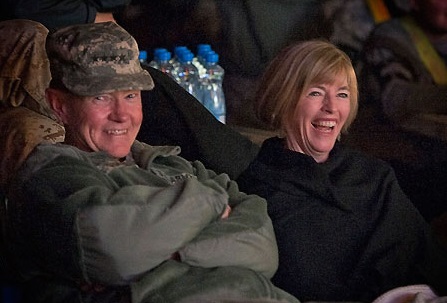
The Dempseys enjoying war

The US has escalated hostilities in Europe further, citing the Chairman of the Joint Chiefs of Staff, General Martin Dempsey, who said the US Army is ready to back up Ukraine and its allies in Europe with military action.

According to the Web site of the Atlantic Council, Dempsey said that “he’s sending a clear message to Ukraine and members of NATO that the US military will respond militarily if necessary.”

“We do have treaty obligations with our NATO allies. And I have assured them that if that treaty obligation is triggered [in Europe], we would respond,” Dempsey said.

According to the General, an independent Crimea creates risk for all the countries of Europe and NATO allies.

“If Russia is allowed to do this, which is to say move into a sovereign country under the guise of protecting ethnic Russians in Ukraine, it exposes Eastern Europe to some significant risk, because there are ethnic enclaves all over Eastern Europe and the Balkans.”

Obama’s war fever, his patent disregard for the sovereignty of nations, his expansion of the Afghanistan war, his illicit use of drones and continued operation of Guantanamo – all deemed “war crimes” of the Bush administration – are now hailed by Democrats and Hawks alike as “democracy”.

As conservative pundit Ann Coulter laments: “I’m sorry, but who cares about military spending as long as Obama is president? At the rate he’s going, Obama might use our military to attack England.”

In response, Russia’s Defense Ministry has given permission for a surveillance flight by Ukraine over Russian territory near the border between the countries. Kiev had claimed Moscow was building up its military presence there.

“The Ukrainians have asked for an unscheduled observation flight over our territory,” Deputy Defense Minister Anatoly Antonov told reporters in Moscow.

Russia and Ukraine are entitled to surveillance flights over each other’s territories following the Open Skies treaty signed in 1992, but Antonov said that Kiev had never asked for one before.

“We have decided to allow such a flight. We hope that our neighbors are assured that there is no military activity that threatens them on the border.”

Antonov vehemently denied a statement Tuesday by Igor Tenyukh, defense minister for the Kiev coup-appointed government, that Russia had amassed more than 220,000 troops, 1,800 tanks and over 400 helicopters in regions adjacent to eastern Ukraine.

“Ukrainian military officials know full well that the entire [Russian] Southern and Western Military Districts put together don’t have that much equipment. The only way you could arrive at that number of soldiers would be if you counted their families,” Antonov said.

“I would dissuade Mr Tenyukh from adding fuel to the fire of the crisis, which is what he appears to be doing. He openly outlined the reasons for this himself, when he asked the Ukrainian parliament to issue him with more funding,” continued the Russian official.

Antonov added that continuing mass training exercises in eastern Ukraine, which Kiev began this week, could plunge Ukraine into even deeper turmoil.

“Staging exercises in an area that is gripped by mass protests against the new regime which came to power as a result of a coup is a risky endeavor, which could further destabilize the political situation in Ukraine,” Antonov insisted.

Oleksandr Turchynov’s, Ukraine’s acting president, said earlier his country could not use its army alone to stop Crimea’s independence, thereby enhancing the possibility of US intervention.

Ukrainian putschists can’t send army to Crimea

Willy Wimmer
Willy Wimmer

Ukraine’s acting president said the country could not use its army alone to stop Crimea from seceding, the latest sign that Crimean independence may be imminent.

Oleksandr Turchynov’s comments came after the Crimean parliament voted for independence ahead of a Sunday referendum on joining Russia, while Washington and Moscow engaged in one of the fiercest clashes since the Cold War.

The interim leader of Ukraine’s putschists said intervening in the Black Sea peninsula, where Crimeans have seized de facto control, would leave Ukraine exposed on its eastern border, close to Russia.

“We cannot launch a military operation in Crimea, as we would expose the eastern border and Ukraine would not be protected,” Turchynov told AFP.

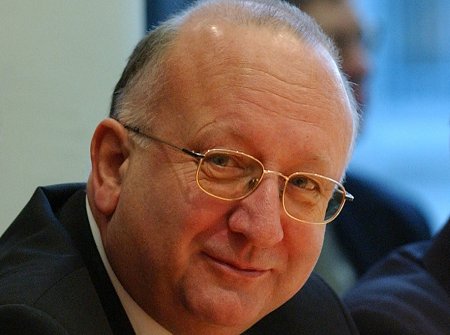
Willy Wimmer, former vice president of the Organization for Security and Co-operation in Europe (OSCE) and state secretary at the German Defense Ministry, said the Black Sea territory might end up under US domination.

The veteran German politician warned more than a decade ago that NATO’s bombing of Yugoslavia was actually part of a US expansion plan.

Until the mid-90s however, all major powers agreed in international law, and in cooperation. But in the middle of the 90s, the US changed tack. They clearly no longer feel bound by international law.

The war in Yugoslavia was only the beginning, and since then, Afghanistan, Iraq, Syria, Libya, have shown that the US would rather rely on military power.

Wimmer said the current government in the Ukraine is not legitimate. “I think it was a putsch, a coup d’état, what happened in Kiev. And what we heard in the news before, the OSCE and other international bodies are doing what they can to create a legal framework for a government which is not legal at all.”

Wimmer said the US puppets in Ukraine are co-operating with Nazi groups, a punishable offence in Germany and other European countries. Many ban all elements associated with Nazism, including Nazi symbols. The coup in Ukraine have left many Europeans fearful of what the US might plan next.

At a political rally in Bavaria this week the main speaker addressed the audience with an appeal not to forget the friendship with the Russian people.

Obama comes out against self-determination

pcrBy Paul Craig Roberts.

The White House Fool has repeatedly declared erroneously and foolishly that it is “against international law” for Crimea to exercise self-determination. Self-determination, as used by Washington, is a propaganda term that serves Washington’s empire but is not permissible for real people to exercise.

On March 6 Obama telephoned Putin to tell the Russian President again that only Washington has the right to interfere in Ukraine and to insist against all logic that only the “government” in Kiev installed by the Washington-organized coup is “legitimate” and “democratic.”

In other words, the elected government in Crimea pushed by the people in Crimea to give them a vote on their future is “undemocratic” and “illegitimate,” but a non-elected government in Kiev imposed by Washington is the voice of self-determination and legitimacy.

Washington is so arrogant that it never occurs to the hubris-infected fools what the world thinks of Washington’s blatant hypocrisy.

Since the Clinton regime, Washington has done nothing but violate international law–Serbia, Kosovo, Afghanistan, Iraq, Libya, Syria, Iran, Pakistan, Yemen, Somalia, Honduras, Venezuela, Ecuador, Bolivia.

Does Russia have an Africa Command? No, but Washington does.

Is Russia surrounding the US with military bases? No, but Washington has used the NATO organization, whose purpose disappeared 23 years ago, to organize western, eastern, and southern Europe into an empire army with forward bases on Russia’s borders. Washington is determined to extend the boundaries of a North Atlantic Treaty Organization to Georgia in central Asia and to Ukraine on the Black Sea. Both Georgia and Ukraine are former constituent parts of both Russia and the Soviet Union.

Washington is doing the same thing to China and Iran. Washington is working to establish new air and naval bases in Philippines, South Korea, Vietnam, Thailand, Australia, with which to block the flow of oil and other resources into China. Iran is surrounded by some 40 US military bases and has US fleets standing off its coastline.

In Washington’s propaganda, this rank militarism is presented as “defending democracy.”

The Russian government continues to act as though Washington’s thrusts at Russia’s independence and strategic interests can be defused with good sense and good will. But Washington has neither.

Since the Clinton regime, Washington has been in the hands of a collection of ideologues who are convinced that the US is “the exceptional indispensable country” with the right to world hegemony. Everything that Washington has done in the 21st century is in pursuit of this goal.

Washington intends to break up the Russian Federation itself. Washington funnels huge sums of money into NGOs inside Russia that serve as Washington Fifth Columns and work hand-in-hand with Washington to discredit Russian free elections, to demonize Putin and the Russian government, to spread anti-Russian propaganda and agitation. It is amazing how many Russians actually believe the Western propaganda.

Washington is also working to isolate China with the Trans-Pacific-Partnership, but at this time is primarily focused on destabilizing and isolating Russia. Washington is desperate to break up the BRICS, the emerging organization of Brazil, Russia, India, China, and South Africa. With the largest countries and half of the world’s population, the BRICS organization is emerging as a political and economic power, especially with the organization’s plan to cease using the US dollar as reserve currency. Ringing Russia with US missile bases on Russia’s borders impairs Russian sovereignty and independence and, thus, weakens the BRICS as a countervailing power to Washington.

Many have been deceived by Washington’s propaganda. The world is slowly waking up, but is it in time?

The US media and much of Europe’s speak with one voice parroting Washington’s propaganda, demonizing Washington’s targets, and preparing insouciant Western populations for more war. The Western media, like Western governments, is devoid of integrity. Liars and whores rule.

Paul Craig Roberts is an economist and a nationally syndicated columnist for Creators Syndicate. He served as an Assistant Secretary of the Treasury in the Reagan Administration earning fame as the “Father of Reaganomics”. He is a former editor and columnist for the Wall Street Journal, among others. He has recently published How the Economy Was Lost: The War of the Worlds and is coauthor with Lawrence Stratton of The New Color Line and The Tyranny of Good Intentions.

German economist warns sanctions against Russia could harm EU

Economic sanctions against Russia would cause serious damage to Germany’s switch to alternative energy sources, the head of the German Economic Research Institute, Hans-Werner Sinn, said in an interview published in Germany’s Passauer Neue Presse on Friday.

Germany cannot afford such a policy of sanctions, as it considerably depends on Russian gas supply in the process of switching to alternative energy sources, the economist notes. According to him, EU sanctions will only harm the European countries.

Any attempt to bring such countries as Ukraine out of Russia’s influence and link with the West is naive, he believes.

Russia, along with Norway, is an important supplier of gas to Germany, the publication notes.

Source: Voice of Russia, Interfax