Liberalism is the real cause of witchcraft murders in South Africa

roodt_fbfotoby Dan Roodt

[followbutton username=’danroodt’ count=’true’ lang=’en’ theme=’light’]

Like Dan Roodt’s Facebook page

Apparently Barack Obama has signed an executive order authorising $10 million to be spent on stopping the poaching of wildlife in Africa, including rhinoceri that are being decimated at an alarming rate.

But, as the bumper sticker forlornly states: “Forget the rhino, save the white ou (guy).” Obama or any of his liberal entourage in America would never donate funds to stop the horrific farm murders taking place in South Africa. Because, as we know, the life of a white person is worth far less to a liberal than that of an animal. Especially a wild animal.

The liberal media in South Africa – the MSM as they are called – hardly ever record farm murders or other killings of whites. However, the Afrikaans dailies Beeld and Volksblad have some court reporters that normally expose us to the truly blood-curdling horrors of our liberal utopia. Just last week Beeld reported on a Witchdoctor who cooked farmer’s testicles declared a mental patient.

Normally South African liberals do not read much Afrikaans. In fact they have utter contempt for Afrikaans as a “parochial and tribal white language”. But this story was relayed via the newswire Sapa and so appeared on the radar screen of BDLive’s columnist, Gareth van Onselen. He relates the details of this muti (medicine) murder and then launches into a plea for balancing the constitutiion with “the more horrendous aspects of cultural belief”. After which he comes to the thunderous conclusion:

“In many respects, that is the fundamental challenge facing South Africa.”

Within the clichés of liberal discourse, there is always “one more challenge facing South Africa” before we taste the sweet fruits of paradise. In many small towns it is a challenge just to keep municipal services going and to supply potable water to the inhabitants, something which the previous, so-called “apartheid system” managed with surprising ease. But then in those days the services of town planners and engineers were not considered superfluous instances of racist employment practices. It was also before municipal government managed to evolve into permanent conferences and planning sessions held in luxury hotels where the hapless local taxpayer’s money gets spent by VIPs transported in luxury automobiles, living it up with an enviable air of insouciance.

I judged Van Onselen by his cover, or rather his Twitter profile where he describes himself as a “liberal” and a “humanist”. He sounded like the hordes of sub-intelligent sheeple churned out by the ANC’s universities where conforming to a mixture of petty hatred and PC dogma is usually enough to earn a postgraduate qualification in the social sciences. Or journalism, for that matter.

Van Onselen has really been elevated a few millimetres in my esteem. For there exists a tremendous taboo on just mentioning the race or ethnic background of any murderer in South Africa, let alone tying it to “cultural belief”. He has transgressed that taboo and cited some statistics from parliament to prove that muti murders are on the rise in South Africa. From 1994 to 2004 such murder cases increased by almost 6 000 percent!

However, before we rush to applaud a self-confessed liberal like Gareth van Onselen for showing an insight that most of us had already acquired on our tenth birthday, it would not be amiss to ask why these murders are indeed in the ascendant.

It is easy to blame “cultural belief”, more precisely tradtional African culture, as Van Onselen does. If I were a hypocritical, imbecilic liberal, I would immediately have let loose the pack dogs of the Inquisition myself and accused him of “racism”. All contemporary liberal thinking – as opposed to the forgotten nineteenth-century creed of tolerance going by that name – is predicated upon “racism”. Being a liberal is tantamount to having an obsessive disorder of which the most recognisable symptom is frequent shrieks of “racist!” of “burn him at the stake, pronto!”

In fact, formally, there is absolutely no difference between an African-style “witch-hunt”, which Van Onselen seems to be opposed to, and liberalism. Astonishingly, Van Onselen cites a piece of “apartheid legislation”, seemingly approvingly:

“…we do have longstanding witchcraft legislation in the country. The Witchcraft Suppression Act of 1957 makes it illegal for anyone to identify another person as a witch (as this inevitably leads to death or torture) or to instigate what is a called a ‘witch-sniffing ceremony’ (in which someone is called into a community to identify a witch).”

I myself was subjected to a liberal witch-hunt in 2005 upon being invited to be interviewed on my Afrikaans novel Moltrein at the arts festival known as the Woordfees in Stellenbosch. At least 15 professors and lecturers of Stellenbosch University, including the head of the English department (a left-liberal feminist) and journalist Max du Preez, subequently threatened me with banishment and even violence as they were going to get gangsters from surrounding black and Coloured areas to come and attack me. My crime was that I had precisely done what I am doing here, inquiring into the causes of South Africa’s sadistic violence, of which we see examples every day. I was declared a dissident, or a witch, which to anyone with even a smattering of anthropological knowlede, amounts to the same thing. Therefore I was hunted by sundry academics, journalists and self-styled guardians of good morals, foaming at the mouth, pointing shivering fingers at me as a “danger to society”.

As we can see from the statistics cited in parliament, witchcraft was under control under the previous government. I do not want to enter into another controversy on so-called apartheid, but the Afrikaner governments of the past practised sound epistemological principles in keeping the paradigms separate. Western science was one thing, or one set of beliefs, and traditional healing or witchcraft, invoking the ancestors and related practices, were another.

Along came liberalism and decreed, not only that “we are all the same”, but also: “all beliefs are the same”. South African liberalism is fundamentally irrational in not recognising differences between conceptual systems such as Western science and various tribal forms of witchcraft.

Liberalism is also anti-science. It fears science or any form of neutral, objective enquiry. Its obsessive principle, “racism”, is a kind of law of the universe against which everything must be measured. It follows that any attempt to regulate witchcraft or temper its more odious and murderous aspects, could equally be construed as “racism”.

Prior to the reign of liberalism, African culture never posed a problem to us in South Africa. I daresay we used to celebrate it as the healthy expression of the identity and age-old customs of the various peoples that inhabit this land. The study of African languages, as well as traditional dancing and so on, were encouraged. However, in 1970 the liberal English Academy of South Africa started agitating against African languages, in favour of English and an anglicisation policy.  As we know all too well, in 1976 blacks rioted against, not only Afrikaans, but also against being taught in their own languages!

Without going into all the complexities of tribal culture in South Africa and without denying that this kind of murderous, sadistic witchcraft exist traditionally, the real cause of the explosion of muti murders, farm murders and general mayhem must be laid at the door of liberalism. In their quest for hegemony and domination, South African liberals have literally awakened all the demons. In vilifying Afrikaner, Western and white culture as “fascist, oppressive and racist”, and by putting “traditional healing” and Western medical science on the same footing, they have given the so-called sangomas immense power and prestige.

The anti-white propaganda and hatred sown by the liberals have also bolstered the dark side of black culture. Hence the macabre, occult murder rituals and cannibalism that are so much in resurgence at present.

While people in Europe complain about Islamic fundamentalism that represents a threat to them, including terrorist incidents, we must remember that South African liberals have always condoned and even encouraged terrorism against us. The liberal understands the “powers of horror” as well as the muti murderer. Engaging in witch-hunts is also second nature to him.

The combination of a fundamentalist political ideology, liberalism, and a set of occult beliefs espoused by the more radical sangomas, is a dangerous cocktail that is not just a “challenge” to South Africa. It threatens to further erode the very foundations of civilised society in our country.

[followbutton username=’danroodt’ count=’true’ lang=’en’ theme=’light’]

Like Dan Roodt’s Facebook page

Obama warns Africa’s ‘tyrant’ leaders

Barack Obama at the University of Cape Town

US President Barack Obama warned Sunday that Africa could only fulfill its rising potential with leaders who serve their people, not tyrants who enrich themselves.

In a strident call for democratic change and good governance, Obama used the political legacy of ailing Nelson Mandela and South Africa’s emergence from years of Afrikaner rule as proof that freedom will ultimately prevail.

“In too many countries, the actions of thugs and warlords and human traffickers hold back the promise of Africa,” Obama said at a speech at Cape Town University.

“America cannot put a stop to these tragedies alone, and you don’t expect us to. That is a job for Africans. But we can help you and we will help you,” he said, announcing major new US programs to boost electricity and health care.

“History shows us that progress is only possible where governments exist to serve their people and not the other way around,” said Obama, in a line that drew loud and prolonged cheers from his audience of more than 1,000 people.

The speech was delivered from the same spot where American political icon Robert Kennedy delivered his famous “ripple of hope” speech in 1966, which called on students to decry the “racial inequality of apartheid”.

Obama’s goal was to inspire a new generation of Africans with the belief that they could ignite political change and the potential of their continent.

He slammed leaders who “steal or kill or disenfranchise voters,” saying that the ultimate lesson of South Africa was that such brutal tactics will not work.

“So long as parts of Africa continue to be ravaged by war and mayhem, opportunity and democracy cannot take root,” said Obama.

“Across the continent, there are places where still, fear often prevails,” Obama said, warning of “senseless terrorism” from Mali to Mogadishu.

“From Congo to Sudan, conflicts fester,” Obama said, hitting out at those who argue that American calls for democracy and freedom are “intrusive” or “meddling”.

He also condemned the rule of Robert Mugabe in neighbouring Zimbabwe, where he said the “promise of liberation gave way to the corruption of power and the collapse of the economy”.

Like the rest of Obama’s trip to South Africa, the speech was rich in emotion when he mentioned his hero Mandela, who lies critically ill in a Pretoria hospital.

“You have shown us how a prisoner can become president,” Obama said. – AFP

Soweto to welcome Obama, a ‘fellow African’

Scene in Soweto
Scene in Soweto

Barack Obama was barely 15 years old when riots erupted in the South African township of Soweto over a circular concerning the use of Afrikaans and other African languages in black schools. Decades later, its residents are preparing to welcome the US president as a “fellow African”.

Obama, now 51, will host a town hall meeting at a university campus as part of his visit to a crucible of the fight against apartheid, which saw protests break out in 1976 that spread across the country.

Although the white nationalist regime was not defeated, the 1976 riots spawned a new generation of black liberation leaders who continued the struggle while senior figures like Nelson Mandela and others languished in prisons.

While hundreds of anti-Obama protesters marched on the US Embassy in the capital Pretoria, 80 kilometres (50 miles) to the north on Friday, many Sowetans were keenly anticipating the visit by the first black US president.

“I want it to be a message of hope. I hope he talks about important things like education and the importance of going to school,” Christopher Mutangwa, a 20-year-old accounting student, said outside the University of Johannesburg’s (UJ) satellite Soweto campus.

“But I also hope that he can learn something about us and what happened here in Soweto during the struggle,” Mutangwa told AFP.

“He should, because I think he is an African.”

While there were few signs of preparation ahead of the highly anticipated visit at the UJ campus, many residents said they planned to line the streets, or watch the event on television.

“I was planning to visit my grandmother … but now I think I would rather go see Obama,” said Sibongiseni Kekana, 22, who makes a living as a struggling artist.

“Maybe I’ll even sell something to him,” Kekana laughed as he showed AFP around his tin shack, which also doubles as his art studio.

“In any case, I hope for inspiration from him,” Kekana said.

But even with Obama visiting Soweto, the continuing illness of South Africa’s own first black president, Nelson Mandela, never strays far from the conversation.

Mandela, 94, spent a third week in the intensive care section of a Pretoria hospital where he is being treated for a recurring lung infection.

After taking a turn for the worse last weekend, Madiba, as he is popularly known by his clan name, has been showing tentative signs of recovery.

— Two generations of black leaders —

With a possible visit by Obama to the ailing statesman on the cards over the weekend, inevitable comparisons are being drawn in many conversations.

“To me, Madiba represents an older and perhaps more traditional generation of black leaders, while Obama represents the new generation,” Tshepo Mofokeng, 43, told AFP.

“I’m sure he will be welcomed here as an African,” said Mofokeng, as he took some pictures on his mobile phone of his children at the Hector Pieterson Museum, which covers the 1976 uprising.

“I just think he (Obama) is sexy,” his wife Nomsa, 36, added with a laugh.

Even though many people will flock to welcome the US head-of-state, not all Sowetans were happy with his presence and demonstrations were planned for Saturday.

“I don’t think it’s a good thing that he’s coming here,” said Freddy Mhaule, 25.

“Especially with him spying on the world,” he added, referring to the recent revelations about PRISM, the US Internet surveillance programme.

“Obama’s visit will have zero impact on us,” said an art vendor, who only wanted to be identified as “Lebo”, at the Hector Pieterson Museum, which commemorates the death of the youth activist, shot dead in 1976 by apartheid police at the age of 12.

“To me he’s just another politician,” Lebo added, as he tried to sell tourists a wooden model of the Soweto home where Mandela once lived, which today serves as a museum. – AFP

Namibian PM wants to close down ‘racist outposts’ after interracial brawl

Dr. Hage Geingob, prime minister of Namibia (ex-South West Africa)

Windhoek — The days are numbered for Buffalo’s bar in Gobabis, the latest flashpoint in an alleged racist attack, warned Prime Minister Dr Hage Geingob.

He said “undesirable establishments like Buffalo’s bar and similar places which are scattered all over the country,” should be closed down for being racist outposts. Geingob made the remarks on Tuesday in the National Assembly when he launched a strong denunciation of the alleged act of racism in which Levi Katire was allegedly assaulted by Nico Kotze and Frederick ‘Boeta’ du Plessis who now face charges of assault and racial discrimination.

“The heinous actions of a group of racist criminals in the town of Gobabis took the entire nation back to a dark past from which we have all so dearly wanted to emerge. It seems there are some people living within our borders who are intent on continuing the sinister legacy of racial discrimination and brutal violence of the past,” said the Prime Minister who joined the growing chorus of voices condemning the barbaric attack.

Geingob went on to say the two suspects are amongst a large number of “so-called Namibian citizens” who look upon the country’s policy of national reconciliation as a “policy of weakness”. The policy of national reconciliation was adopted to heal a nation, which was emerging from a dark history of racial discrimination, and to mitigate acts of revenge following the attainment of independence, Geingob said.

He condemned in the strongest terms the attack on Katire and promised that no stone would be left unturned until “we uproot and expose each and every one of these racist elements, who participated in this act of barbarism.” According to Geingob there are people who still think they can establish “pseudo republics and homelands” on the territory of an independent Namibia that courageously fought and triumphed over a discriminatory system.

He said it is high time that the government awakens racially intolerant individuals from “their absurd dreams and remind them that the apartheid republic is now nothing but a relic of psychosis”. He further warned that Namibia is a free and sovereign state and any individual who cannot comprehend that after 23 years should do him or herself a favour to “pack and go”.

“If you cannot pack yourself fast enough we will assist you. Make no mistake. The days are numbered for undesirable establishments like Buffalo’s bar and similar places which are scattered all over the country.”

He said so-called private establishments should be outlawed in public areas and implored the Attorney-General to find ways of closing down such places and to conduct a thorough investigation into the Gobabis incident.

“We need to identify the nationality of these perpetrators and if they are not Namibians, they should be shipped off immediately. I am aware that there is a criminal investigation which is ongoing, but we must ensure that a place such as Buffalo’s bar is permanently shut down,” he urged the Attorney-General.

The two men were denied bail on Friday in the Gobabis Magistrate’s Court and their quest to secure bail resumed on Wednesday and continues today. – New Era

Sexwale wants to destroy white-majority suburbs voting for opposition

Tokyo Sexwale

The biggest problem facing the human settlements department is reversing the social engineering of the apartheid era, Human Settlements Minister Tokyo Sexwale said on Friday.

“The most important job as a strategic approach for human settlements is to deracialise this country,” Sexwale told The New Age breakfast.

“That is a tough one. We meet at places of work but we go back to different places.

“That apartheid engineering of society negatively resulted in divided communities. My single largest job… as minister, is to close that divide.”

Sexwale said building houses for people restored their human dignity and gave them opportunities to enter the capital and financial markets.

“When you have a house you play in the capital markets. When you leave this planet you can leave that to your children or whoever your successor is. You can use that fixed asset to exchange it for a loan.” Sexwale said people needed to live where they could work, study, worship, and play. – Sapa

Queers Against Israeli Apartheid ‘do not violate hate laws in Toronto’

The Toronto city council has no legal grounds to deny grant money to Pride over the gay festival’s refusal to ban the group Queers Against Israeli Apartheid, Toronto’s chief lawyer has told Mayor Rob Ford’s executive committee.

In a confidential and frank April report obtained by the Star, city solicitor Anna Kinastowski says she “cannot recommend” that council require Pride to ban the phrase “Israeli apartheid” as a condition of receiving taxpayer funds.

Kinastowski writes: “The term ‘Israeli Apartheid’ does not violate the city’s human rights policy, does not appear to violate the Ontario Human Rights Code, and does not appear to constitute ‘hate’ as the (Supreme) Court has interpreted it and would therefore appear to fall within the realm of potentially ‘offensive’ yet protected speech.”

The committee will again discuss Queers Against Israeli Apartheid (QuAIA) on Tuesday during a debate on the city’s anti-discrimination policy for grant recipients. Pride’s annual grant — about $124,000 last year — will be debated by council in June, only 10 days before the festival begins.

Pro-Israel councillors have repeatedly and unsuccessfully sought to find a way to tweak city rules in a way that might prevent the activist group from marching in the annual Pride parade. Councillor James Pasternak, who does not sit on the executive, has even floated the idea of offering Pride a “diversity bonus” for excluding QuAIA.

Citing a February Supreme Court decision, Kinastowski also warns against a 2012 suggestion from the executive to change the anti-discrimination policy to prohibit “anything which shows a lack of respect for all persons.”

Kinastowski, cautioning against imposing “an overbroad standard for ‘discrimination,’ ” says such a policy would be “unlikely to withstand a court challenge” on freedom-of-speech grounds.

“That’s what we know. I mean, it’s not a secret. Every single report that comes out says we don’t violate any hate laws or anything like that,” said QuAIA member Tony Souza. “We’re not breaking any laws, and we certainly don’t ‘hate’ anybody. We just want justice in Palestine.”

“I don’t think the question is a legal question — I think the question is one of morality and divisiveness,” said Avi Benlolo, chief executive of the pro-Israel Friends of Simon Wiesenthal Center for Holocaust Studies. “And if we want to live in a pluralistic society where we demonstrate respect for one another, then there’s just morality. . . . We’re just saying to the city we don’t think this is socially acceptable.” – Toronto Star

Do South African whites really ‘have it so good’?

by Dan Roodt

In today’s City Press newspaper, Frans Cronjé of the South African Institute of Race Relations claim that whites live in some kind of paradise.

He cites statistics claiming the following:

“Between 1994 and 2012, the rate of unemployment among white people increased from 3% to 5.7%…

The white unemployment rate was low, even when compared to a host of international benchmarks. In the US, for example, the rate in 2012 was 7.6%, in Britain 7.9% and in Canada 7.2%.”

Apparently praising South African white entrepreneurship, he goes on to say that “while a black university graduate is more likely than a white graduate to find a job within 12 months of graduation (due to strict affirmative-action laws-DR), white graduates are four times more likely to start and operate businesses”.

I would treat these statistics about low white unemployment with a great deal of caution. Many whites are not on the unemployment statistics as they do not claim benefits from the government. Driving around many white areas, you notice their old, decrepit cars, lack of maintenance to their properties and other signs of economic distress.

Go to any five-star hotel now and you will find blacks sitting around in designer clothes. The only whites there are foreign tourists. Most cars costing R1 million (about $100 000) and more that I see every day in Johannesburg are owned by blacks, not whites. Blacks get all the lucrative corporate directorships and make easy money as “tenderpreneurs” to the state and municipalities.

I know of thousands of whites who literally had to leave the country to find jobs, in the Middle and Far East where they do dismal work as part-time English teachers or pack groceries in Australian supermarkets.

Many small businesses started by whites have failed, not least because of the racial laws and regulations imposed by government and the corporate sector. The corporate sector – banks and large companies – are now arguably more anti-white than government. They do not trade with white-owned businesses and generally sue or harass small businesses at the drop of a hat. Many whites have lost their homes which the banks require them to pledge as collateral for a simple overdraft for their small businesses.

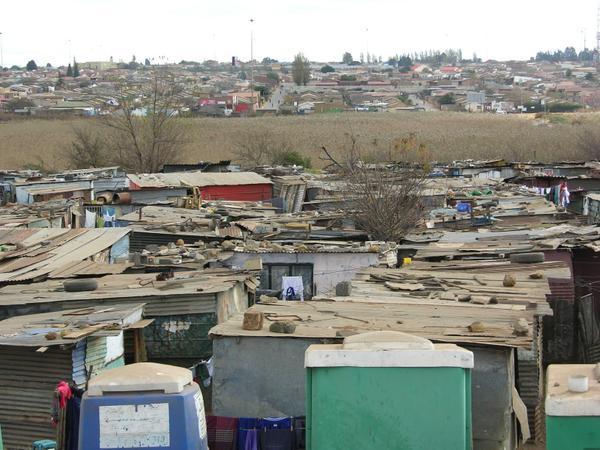
More whites now live in so-called “informal housing” than at any time since the Great Depression. Solidarity estimates that up to 800 000 whites – educated, literate and previously taxpayers – now live in squatter camps and other “informal areas” such as this one:

Poor South African whites living in cabins normally used as garden sheds

We are witnessing the greatest social-engineering programme whereby one race is economically subjugated to another that this country and perhaps the world has ever seen.

The very notion that whites could be “liberated” by such an unfair and racist system is so fundamentally cynical that it has an Orwellian ring to it. But that is why the mainstream media no longer has any credibility among middle-class whites.

The South African media are loyal to foreign and corporate interests who see South African whites as an unwanted presence in the country, preventing them from bribing their way into looting most of the remaining assets in South Africa. That is why the SA mass media are constantly attacking whites, accusing them of racism, “apartheid privilege”, and the like. White males even get blamed for the intense crime and lawlessness in the country! Every white person knows that 99% of the violence is committed by other races, yet we are blamed for everything. If all else fails, there is always ever-increasing “the legacy of apartheid” to blame.

What I find amazing is that Frans Cronjé published two contradictory articles today, one in Rapport and this one in City Press. The one in Rapport, written in Afrikaans and therefore intended for a mainly white audience, shows how 500 000 middle-class taxpayers essentially contribute 50% of all personal taxes in South Africa. White readers of that article would be understandably outraged that, while still contributing a large share of the country’s taxes, they are treated as second-class citizens.

English in South Africa is increasingly the language of blacks and the internationalist whites who are hostile to Afrikaners and the white middle class, for reasons explained in the paragraph above, namely that their ownership of land and role in the judiciary and the accounting profession prevents the wholesale looting of our country. Even though looting is already taking place, there is still some semblance of legality left. Clearly, this has to go.

This article in English about whites is therefore intended for a black and foreign audience, to convince them that South African whites “have never had it so good”. Understandably the very real hostility felt for those dastardly Nazis and perpetrators of a “crime against humanity” will only rise upon reading this article. It will undermine any inchoate sympathy whites enjoy with their less brainwashed brethren in the West and Europe.

The most absurd sentence of all is the following: “(Whites) were liberated, first, from the guilt and pariah status that had been attached to their support and enforcement of apartheid.”

On the contrary, South African whites are now more hated and stigmatised than ever! Over the past twenty years the SABC and the mainstream media have played their quasi-communist propaganda about white evil and viciousness over and over in South Africa. Most of the time this propaganda is literally the work of unreconstructed communists who occupy powerful positions in South Africa, being the “white face” of the ANC government, the SABC and other state agencies. The British media, including the BBC, see us whites as free game now that we are utterly without any political power and lack any form of state support. More
unfair and one-sided news stories have been published and broadcast about us since 1994 than ever before, barring perhaps the 1890s when the Uitlander press and the London newspapers were publishing war propaganda about the Boer republics.

As for white guilt, there is a whole industry meant to inculcate it into us, almost from birth. At school our children are exposed to compulsory subjects such as “Life Orientation” containing political propaganda of the worst kind, meant to persuade them that their parents were all war criminals killing thousands, if not millions, of blacks. In reality, of course, only 500 blacks died at the hands of the SA police from 1948 to 1994, fewer than die every year as a result of police brutality under black rule! However, the foreign whites and media do not write about police brutality anymore because it is now committed by blacks and therefore of no interest.

More than 80 000 whites have been murdered since 1994 and up to a million white women have been raped. Four thousand farmers, their wives and children have been killed, many of them spending their last hours under dehumanising torture.

While all this is going on in the ghoulish present, not a week goes by without newspapers and radio programmes calling for whites to “repent about apartheid”, surrender the meagre assets that they still control or simply leave the country as they “have outstayed their welcome”. People are constantly telling me to “go back to Europe” or “get lost”, even though my forebears came here in the early 1700s.

Apart from racial quotas in education that prevent whites from obtaining a tertiary education, especially in medicine and other fields, an aging white population now endures a third-world system of medical care. Prior to 1994, whites had one of the best healthcare systems in the world, with both a private and a well-managed public hospital system.

Corruption and mismanagement have reduced the public system to a shambles while the costs of private healthcare have gone through the roof. Only the corporate elite can now afford private healthcare. Whites are almost banned from studying medicine by the universities so that their parents and grandparents may just die from neglect in the state hospital system.

Despite being well-educated and hard-working, affirmative action and so-called BEE (black-economic empowerment) have reduced most South African whites to poverty. Their mean income per capita is far less than the minimum wage in many European countries.The following table shows annual per capita income growth from 2001 to 2011 for all racial groups in South Africa:

Source: Moneyweb/SA census

If the R365 134 earned by the average SA white is translated into dollar terms at $40 970, this is way below minimum wage levels in most European countries. However, this very modest white income gets taxed at 40% to fund the megalomaniac dreams of this make-believe government whose only interest is in seeking international prestige while it cannot even mend our roads, nor deliver school books on time. In a real sense, white poverty is caused by government, either through its high taxes or its racially interventionist policies.

This is Frans Cronjé’s “white paradise”!

The downside of diversity

It seems increasingly popular to speak of racial and ethnic diversity as a civic strength. From multicultural festivals to pronouncements from political leaders, the message is the same: our differences make us stronger.

But a massive new study, based on detailed interviews of nearly 30,000 people across America, has concluded just the opposite. Harvard political scientist Robert Putnam — famous for “Bowling Alone,” his 2000 book on declining civic engagement — has found that the greater the diversity in a community, the fewer people vote and the less they volunteer, the less they give to charity and work on community projects. In the most diverse communities, neighbors trust one another about half as much as they do in the most homogenous settings. The study, the largest ever on civic engagement in America, found that virtually all measures of civic health are lower in more diverse settings.

“The extent of the effect is shocking,” says Scott Page, a University of Michigan political scientist.

The study comes at a time when the future of the American melting pot is the focus of intense political debate, from immigration to race-based admissions to schools, and it poses challenges to advocates on all sides of the issues. The study is already being cited by some conservatives as proof of the harm large-scale immigration causes to the nation’s social fabric. But with demographic trends already pushing the nation inexorably toward greater diversity, the real question may yet lie ahead: how to handle the unsettling social changes that Putnam’s research predicts.

“We can’t ignore the findings,” says Ali Noorani, executive director of the Massachusetts Immigrant and Refugee Advocacy Coalition. “The big question we have to ask ourselves is, what do we do about it; what are the next steps?”

The study is part of a fascinating new portrait of diversity emerging from recent scholarship. Diversity, it shows, makes us uncomfortable — but discomfort, it turns out, isn’t always a bad thing. Unease with differences helps explain why teams of engineers from different cultures may be ideally suited to solve a vexing problem. Culture clashes can produce a dynamic give-and-take, generating a solution that may have eluded a group of people with more similar backgrounds and approaches. At the same time, though, Putnam’s work adds to a growing body of research indicating that more diverse populations seem to extend themselves less on behalf of collective needs and goals.

His findings on the downsides of diversity have also posed a challenge for Putnam, a liberal academic whose own values put him squarely in the pro-diversity camp. Suddenly finding himself the bearer of bad news, Putnam has struggled with how to present his work. He gathered the initial raw data in 2000 and issued a press release the following year outlining the results. He then spent several years testing other possible explanations.

When he finally published a detailed scholarly analysis in June in the journal Scandinavian Political Studies, he faced criticism for straying from data into advocacy. His paper argues strongly that the negative effects of diversity can be remedied, and says history suggests that ethnic diversity may eventually fade as a sharp line of social demarcation.

“Having aligned himself with the central planners intent on sustaining such social engineering, Putnam concludes the facts with a stern pep talk,” wrote conservative commentator Ilana Mercer, in a recent Orange County Register op-ed titled “Greater diversity equals more misery.”

Putnam has long staked out ground as both a researcher and a civic player, someone willing to describe social problems and then have a hand in addressing them. He says social science should be “simultaneously rigorous and relevant,” meeting high research standards while also “speaking to concerns of our fellow citizens.” But on a topic as charged as ethnicity and race, Putnam worries that many people hear only what they want to.

“It would be unfortunate if a politically correct progressivism were to deny the reality of the challenge to social solidarity posed by diversity,” he writes in the new report. “It would be equally unfortunate if an ahistorical and ethnocentric conservatism were to deny that addressing that challenge is both feasible and desirable.”

. . .

Putnam is the nation’s premier guru of civic engagement. After studying civic life in Italy in the 1970s and 1980s, Putnam turned his attention to the US, publishing an influential journal article on civic engagement in 1995 that he expanded five years later into the best-selling “Bowling Alone.” The book sounded a national wake-up call on what Putnam called a sharp drop in civic connections among Americans. It won him audiences with presidents Bill Clinton and George W. Bush, and made him one of the country’s best known social scientists.

Putnam claims the US has experienced a pronounced decline in “social capital,” a term he helped popularize. Social capital refers to the social networks — whether friendships or religious congregations or neighborhood associations — that he says are key indicators of civic well-being. When social capital is high, says Putnam, communities are better places to live. Neighborhoods are safer; people are healthier; and more citizens vote.

The results of his new study come from a survey Putnam directed among residents in 41 US communities, including Boston. Residents were sorted into the four principal categories used by the US Census: black, white, Hispanic, and Asian. They were asked how much they trusted their neighbors and those of each racial category, and questioned about a long list of civic attitudes and practices, including their views on local government, their involvement in community projects, and their friendships. What emerged in more diverse communities was a bleak picture of civic desolation, affecting everything from political engagement to the state of social ties.

Putnam knew he had provocative findings on his hands. He worried about coming under some of the same liberal attacks that greeted Daniel Patrick Moynihan’s landmark 1965 report on the social costs associated with the breakdown of the black family. There is always the risk of being pilloried as the bearer of “an inconvenient truth,” says Putnam.

After releasing the initial results in 2001, Putnam says he spent time “kicking the tires really hard” to be sure the study had it right. Putnam realized, for instance, that more diverse communities tended to be larger, have greater income ranges, higher crime rates, and more mobility among their residents — all factors that could depress social capital independent of any impact ethnic diversity might have.

“People would say, ‘I bet you forgot about X,'” Putnam says of the string of suggestions from colleagues. “There were 20 or 30 X’s.”

But even after statistically taking them all into account, the connection remained strong: Higher diversity meant lower social capital. In his findings, Putnam writes that those in more diverse communities tend to “distrust their neighbors, regardless of the color of their skin, to withdraw even from close friends, to expect the worst from their community and its leaders, to volunteer less, give less to charity and work on community projects less often, to register to vote less, to agitate for social reform more but have less faith that they can actually make a difference, and to huddle unhappily in front of the television.”

“People living in ethnically diverse settings appear to ‘hunker down’ — that is, to pull in like a turtle,” Putnam writes.

In documenting that hunkering down, Putnam challenged the two dominant schools of thought on ethnic and racial diversity, the “contact” theory and the “conflict” theory. Under the contact theory, more time spent with those of other backgrounds leads to greater understanding and harmony between groups. Under the conflict theory, that proximity produces tension and discord.

Putnam’s findings reject both theories. In more diverse communities, he says, there were neither great bonds formed across group lines nor heightened ethnic tensions, but a general civic malaise. And in perhaps the most surprising result of all, levels of trust were not only lower between groups in more diverse settings, but even among members of the same group.

“Diversity, at least in the short run,” he writes, “seems to bring out the turtle in all of us.”

The overall findings may be jarring during a time when it’s become commonplace to sing the praises of diverse communities, but researchers in the field say they shouldn’t be.

“It’s an important addition to a growing body of evidence on the challenges created by diversity,” says Harvard economist Edward Glaeser.

In a recent study, Glaeser and colleague Alberto Alesina demonstrated that roughly half the difference in social welfare spending between the US and Europe — Europe spends far more — can be attributed to the greater ethnic diversity of the US population. Glaeser says lower national social welfare spending in the US is a “macro” version of the decreased civic engagement Putnam found in more diverse communities within the country.

Economists Matthew Kahn of UCLA and Dora Costa of MIT reviewed 15 recent studies in a 2003 paper, all of which linked diversity with lower levels of social capital. Greater ethnic diversity was linked, for example, to lower school funding, census response rates, and trust in others. Kahn and Costa’s own research documented higher desertion rates in the Civil War among Union Army soldiers serving in companies whose soldiers varied more by age, occupation, and birthplace.

Birds of different feathers may sometimes flock together, but they are also less likely to look out for one another. “Everyone is a little self-conscious that this is not politically correct stuff,” says Kahn.

. . .

So how to explain New York, London, Rio de Janiero, Los Angeles — the great melting-pot cities that drive the world’s creative and financial economies?

The image of civic lassitude dragging down more diverse communities is at odds with the vigor often associated with urban centers, where ethnic diversity is greatest. It turns out there is a flip side to the discomfort diversity can cause. If ethnic diversity, at least in the short run, is a liability for social connectedness, a parallel line of emerging research suggests it can be a big asset when it comes to driving productivity and innovation. In high-skill workplace settings, says Scott Page, the University of Michigan political scientist, the different ways of thinking among people from different cultures can be a boon.

“Because they see the world and think about the world differently than you, that’s challenging,” says Page, author of “The Difference: How the Power of Diversity Creates Better Groups, Firms, Schools, and Societies.” “But by hanging out with people different than you, you’re likely to get more insights. Diverse teams tend to be more productive.”

In other words, those in more diverse communities may do more bowling alone, but the creative tensions unleashed by those differences in the workplace may vault those same places to the cutting edge of the economy and of creative culture.

Page calls it the “diversity paradox.” He thinks the contrasting positive and negative effects of diversity can coexist in communities, but “there’s got to be a limit.” If civic engagement falls off too far, he says, it’s easy to imagine the positive effects of diversity beginning to wane as well. “That’s what’s unsettling about his findings,” Page says of Putnam’s new work.

Meanwhile, by drawing a portrait of civic engagement in which more homogeneous communities seem much healthier, some of Putnam’s worst fears about how his results could be used have been realized. A stream of conservative commentary has begun — from places like the Manhattan Institute and “The American Conservative” — highlighting the harm the study suggests will come from large-scale immigration. But Putnam says he’s also received hundreds of complimentary emails laced with bigoted language. “It certainly is not pleasant when David Duke’s website hails me as the guy who found out racism is good,” he says.

In the final quarter of his paper, Putnam puts the diversity challenge in a broader context by describing how social identity can change over time. Experience shows that social divisions can eventually give way to “more encompassing identities” that create a “new, more capacious sense of ‘we,'” he writes.

Growing up in the 1950s in a small Midwestern town, Putnam knew the religion of virtually every member of his high school graduating class because, he says, such information was crucial to the question of “who was a possible mate or date.” The importance of marrying within one’s faith, he says, has largely faded since then, at least among many mainline Protestants, Catholics, and Jews.

While acknowledging that racial and ethnic divisions may prove more stubborn, Putnam argues that such examples bode well for the long-term prospects for social capital in a multiethnic America.

In his paper, Putnam cites the work done by Page and others, and uses it to help frame his conclusion that increasing diversity in America is not only inevitable, but ultimately valuable and enriching. As for smoothing over the divisions that hinder civic engagement, Putnam argues that Americans can help that process along through targeted efforts. He suggests expanding support for English-language instruction and investing in community centers and other places that allow for “meaningful interaction across ethnic lines.”

Some critics have found his prescriptions underwhelming. And in offering ideas for mitigating his findings, Putnam has drawn scorn for stepping out of the role of dispassionate researcher. “You’re just supposed to tell your peers what you found,” says John Leo, senior fellow at the Manhattan Institute, a conservative think tank. “I don’t expect academics to fret about these matters.”

But fretting about the state of American civic health is exactly what Putnam has spent more than a decade doing. While continuing to research questions involving social capital, he has directed the Saguaro Seminar, a project he started at Harvard’s Kennedy School of Government that promotes efforts throughout the country to increase civic connections in communities.

“Social scientists are both scientists and citizens,” says Alan Wolfe, director of the Boisi Center for Religion and American Public Life at Boston College, who sees nothing wrong in Putnam’s efforts to affect some of the phenomena he studies.

Wolfe says what is unusual is that Putnam has published findings as a social scientist that are not the ones he would have wished for as a civic leader. There are plenty of social scientists, says Wolfe, who never produce research results at odds with their own worldview.

“The problem too often,” says Wolfe, “is people are never uncomfortable about their findings.”

Michael Jonas is acting editor of CommonWealth magazine, published by MassINC, a nonpartisan public-policy think tank in Boston.

© Copyright 2007 Globe Newspaper Company.

‘Apartheid’ as metonym for Afrikaners

In a multiethnic society like South Africa, groups will always blame each other for their lack of wealth, education, political power, and so on. In this respect, SA is no different to Malaysia, Sri Lanka, Northern Ireland, Belgium or anywhere else.

Apartheid is a national obessession. To some extent it has imparted some sort of inverse identity to the so-called New South Africa where people wonder whether we are really the 51st state of the USA, the southern province of Zimbabwe or part of the British Empire. Of course, one of the first steps after 27 April 1994 was to rejoin the Commonwealth so in a sense that made many people feel “whole” again.

Apartheid is, however, also a metonym. Being an Afrikaans word, sometimes the only Afrikaans word that many people know, it stands for “Afrikaners”. A statement like “apartheid destroyed black wealth” decodes as “Afrikaners destroyed black wealth”. The massive participation of Afrikaners in education between 1948 and 1994, mainly because the angelic English owned all the mines and industries, may therefore be seen as “de-educating South Africa”. At one point 50% of teachers in English-language white schools were also Afrikaners. Soon these “deprived” Engelse will be blaming Afrikaners for not having won more Nobel prizes for science, not having founded Google or Microsoft or not inventing the Ipod. Instead, they were “forced” to read Somer by CM van den Heever or some Afrikaans poetry in their second-language class, which “dehumanised” them.

Of course, Afrikaner teachers also taught millions of people science and mathematics, but as some minister once said: “Verwoerd made it too difficult, because he was a racist.” Fortunately Kader Asmal introduced “mathematical literacy” which is is the non-racist version.

As Paul Berkowitz so eloquently argues in How do you solve a problem like Apartheid?: “In the end, perception usually trumps truth.” Someone will have to be blamed for the fact that the average black South African does not enjoy the same standard of living as the average citizen of Luxembourg or Norway. Nor does the average white, of course, but that is besides the point.

Apartheid, like Satan, still lurks within dark corners of South Africa, usually on farms or in Afrikaans schools or within the homes of poorer Afrikaners living on smallholdings such as in Muldersdrift or Kameeldrif.

Within the metonymic logic of South African ethnic discourse, eliminating apartheid is easy: you have just have to eliminate Afrikaners. This can be done in three ways: putting them all on a boat to Australia, assimilating them completely, or by killing them en masse. Or maybe one by one, family by family.

In Muldersdrift, Kameeldrif, on farms and even in the cities, the clarion call to “eliminate the last vestiges of apartheid” is being responded to with vicious enthusiasm. Remember that Lord Milner or one of his contemporaries also used those terms on the eve of the Anglo-Boer War: “eliminating the last vestiges of Afrikanerism from South Africa”. Afterwards 500 000 British soldiers and 100 000 armed blacks put the Boer women and children in concentration camps and burned everything to the ground, homes, barns, even churches. In fact, the British were the only Western people to have burnt churches in the modern era.

According to historians, it took Germany 120 years to recover from the Thirty Years War (1618-1648) when a similar “scorched earth policy” had been followed on its soil. However, no-one – least of all the omniscient apartheid theorists of today – has ever argued that the Anglo-Boer had any economic effect whatsoever. On the contrary, the economic effect is generally seen as positive, in having put control of the economy firmly in English hands. Confiscated Boer livestock and grain were sold to the British army by English companies whose names have changed since, some of which are today listed on the JSE. “Apartheid capital” therefore metamorphosed into “English entrepreneurial flair”. This was the first form of BEE, or British Economic Empowerment. Arguably, the current form of BEE still benefits bankers and stockbrokers more than it does blacks, because these rake in huge fees for enriching a few high-profile blacks.

After the war, irate letter writers from Natal castigated Milner and others for not having killed all the Boers and “cleansing the country for England”. That would have been one way of nipping apartheid in the bud, as it were.

But it is never too late and we can all agree that apartheid is being eliminated every day, whether metaphorically by erasing Afrikaans names of towns or streets, or physically by terminating the bearers of the disease. There is an uncanny resemblance between the gentlemanly style of the British in 1900-1902 and the methods of the current crop of freedom fighters, who appreciate that children, especially girl children, represent the next generation and it therefore makes sense to eliminate them first. The names of Alyssa Botha and Danielle Esterhuizen come to mind, but there are many others too.

Fear that DA ‘will bring apartheid back’

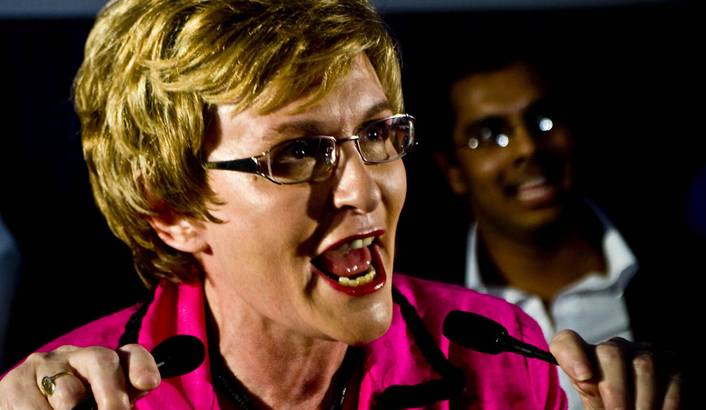
Helen Zille

Some South Africans fear that apartheid would return if the Democratic Alliance (DA) led the country, the party’s leader Helen Zille said on Saturday.

“When I travel around South Africa, it truly shocks me to hear that many

people think the DA would bring back apartheid if we won an election,” said Zille at a Democratic Alliance campaign in Alexandra, Johannesburg.

“There are a significant number of people who think the DA was responsible for apartheid, and that Helen Suzman (an apartheid activist who died in 2009) was a member of the ANC.”

Zille said DA members had to change the false perception people had about her party.

The campaign’s objective was to educate people about the history of the opposition party.

Zille gave a detailed background of how the party was formed and what its priorities were.

She said some DA members were also part of the struggle during apartheid, adding that the party had grown considerably in the last few years.

“The DA has grown so fast, because we have been able to convince people from many different backgrounds that racial nationalism is a dead-end, and that South Africa can only thrive as an open, opportunity society for all.” – SAPA

President Zuma’s comments regarding the impact of apartheid on South Africa’s present problems

FW de KlerkIn comments that he made to mark the 20th anniversary of Chris Hani’s assassination, President Zuma alluded to the recent debate regarding the impact of apartheid on the current problems confronting South Africa.

He said that “to suggest we cannot blame apartheid for what is happening in our country now, I think is a mistake, to say the least. We don’t need to indicate what it is apartheid did. The fact that the country is two in one – you go to any city, there is a beautiful part and squatters on the other side – this is not the making of democracy and we can’t stop blaming those who caused it.”

“While wanting to see change happening fast in every corner of the country, we are under no illusion that South Africa will automatically and comprehensively change in only 20 years. That is impossible. The legacy of apartheid runs too deep and too far back for the democratic administration to reverse it in so short a period.”

President Zuma’s remarks were a repetition of what has become a central refrain in ANC communication: that the legacy of the past – i.e. apartheid or “colonialism of a special kind” – is responsible for the triple crisis of inequality, unemployment and poverty. The remarks are usually accompanied by simplistic comparisons between whites who live in the “beautiful part” and blacks who live “on the other side.”

We are all the products of our past – and there can be no doubt that apartheid created serious distortions in the normal development process that black South Africans would otherwise have experienced. However, the roots of inequality and poverty are far more complex than that. They include, in particular, lack of access to decent education, employment and effective government services – all factors that have been within the sphere of government policy since 1994.

The inequality that characterised our society in 1994 may certainly be ascribed to the complex legacies of the past. However, the fact that, 19 years later, we are an even more unequal society is the consequence of the failure of government policy. Unacceptable levels of inequality have their roots – among other things – in:

  • the dismal performance of our education system caused overwhelmingly by government mismanagement and the depredations of SADTU;
  • the fact that almost 40% of black South Africans are unemployed – primarily as a result of rigid labour policies; policies and attitudes that discourage foreign and domestic investment and the refusal of COSATU to countenance competition in freer labour markets;
  • the inability of government to deliver decent services – which is attested to by service delivery protests throughout the country almost on a daily basis; and
  • the implementation of inappropriate policies to promote equality – which have greatly benefited the top 10% of the black population – but which have done nothing for the bottom 60%.

Attempts to blame these failures on “apartheid” will simply divert government and public attention from the urgent need to implement the kind of realistic solutions called for in the National Development Plan. They also serve intentionally or unintentionally to stir up racial animosities that we simply cannot afford. When President Zuma says that “we cannot  stop blaming those who caused it”, he is playing the very dangerous game of making whites the racial scapegoats for the manifest failures of his own government.

The reality is that many of the beautiful parts to which President Zuma refers are now increasingly inhabited by the emerging black elite and middle class. In 1995 whites accounted for 69% of those in the top earnings decile. By 2007 their share had diminished to 43%. By now it will be even smaller. The nature of the squatter camps is also changing: several are now inhabited by impoverished whites. The country may be “two in one” as President Zuma observes but they can no longer be simplistically characterised as ‘rich white’ and ‘poor black’.

Clearly we South Africans need to engage one another in frank discussions about the legacy of the past, the challenges of the present and  our vision for the future.

ISSUED BY THE FW DE KLERK FOUNDATION

CAPE TOWN, 12 APRIL 2013

Zuma, Manuel – ‘no quarrel over apartheid’

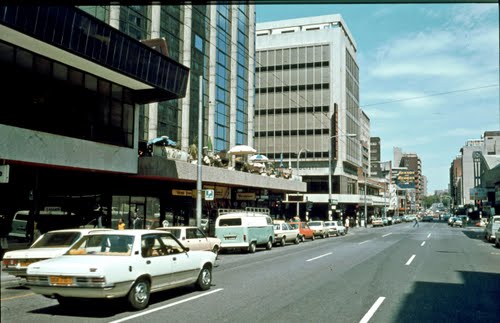
Legacy of apartheid... Johannesburg in the 1980s.

There is no contradiction between what President Jacob Zuma and Minister in the Presidency Trevor Manuel have said about the legacy of apartheid, the presidency said on Thursday.

“Stating that the apartheid legacy and impact still exists and will linger on for a long time does not mean that the president is saying that public servants should use it to excuse laziness and incompetence,” spokesman Mac Maharaj said in a statement.

“The point President Zuma made is that it is impossible to reverse the legacy of apartheid in only 20 years.”

During a wreath-laying ceremony to commemorate the 20 years since SA Communist Party leader Chris Hani was killed, Zuma commented on the statement that the government should stop blaming apartheid for its faults.

“To suggest we cannot blame apartheid for what is happening in our country now, I think is a mistake, to say the least,” he said, in an apparent reference to the comments made by Manuel.

“We don’t need to indicate what it is apartheid did. The fact that the country is two in one — you go to any city, there is a beautiful part and squatters on the other side — this is not the making of democracy and we can’t stop blaming those who caused it,” said Zuma.

Speaking to reporters on the sideline of a government leadership summit last week, Manuel said the government should take responsibility for its actions when it came to service delivery.

“We [the government] should no longer say it’s apartheid’s fault.

“We should get up every morning and recognise we have responsibility. There is no longer the Botha regime looking over our shoulder. We are responsible ourselves.”

Addressing public servants at the summit earlier, Manuel said the government had run out of excuses and had failed the people of South Africa repeatedly in terms of service delivery.

“We cannot continue to blame apartheid for our failings as a state,” he said in speech prepared for delivery.

“We cannot plead ignorance or inexperience. For almost two decades, the public has been patient in the face of mediocre services. The time for change, for ruthless focus on implementation has come.”

SACP deputy general secretary Jeremy Cronin reportedly said on Thursday that Manuel’s comments were taken out of context.

Cronin said Manuel’s remarks were intended to encourage civil servants to be proactive in delivering services.

During the wreath-laying, Zuma said: “While wanting to see change happening fast in every corner of the country, we are under no illusion that South Africa will automatically and comprehensively change in only 20 years. That is impossible.”

However, Zuma said as leaders of public servants, the government had to work harder, faster and more efficiently to ensure true freedom reached the poor and working class in a shorter time.

Maharaj said Manuel had also emphasised this.

“The impact of 300 years of apartheid and colonialism will be felt for many years to come, and since 1994 government has been working to reverse it. However, stating this fact, does not excuse laziness and inefficiency,” Maharaj said.

Opposition parties seemed to agree with Manuel’s comments that the government needed to take responsibility.

The Democratic Alliance said even though the material legacy of apartheid lived on, the slow rate of delivery could not be blamed on apartheid but on the government.

“The truth is that government has not delivered on these objectives fast enough,” DA national spokesman Mmusi Maimane said in a statement.

“Too many people still suffer from apartheid’s material legacy.”

He said Zuma should take responsibility for this and focus on improving service delivery so that the country could combat the evil legacy of apartheid.

United Democratic Movement leader Bantu Holomisa said although apartheid would be an important reminder of what not to do, the time was over for the ANC-led government to blame its failures on apartheid.

“Government has to take full responsibility for its failures and scandals such as the dysfunctional education system, the crumbling infrastructure, Sarafina II, the arms deal, the oilgate and Nkandlagate scandals, the [Andries] Tatane and Marikana incidents as well as the Central African Republic fiasco, among others,” he said. – Sapa

Thatcher’s death divides

Former British Prime Minister Margaret Thatcher was an “attractive” woman, who did more to help South Africa to “get rid of apartheid” than any other leader in her time, former foreign affairs minister Pik Botha said yesterday.

Thatcher died yesterday following a stroke. She was 87.

Botha, who served as the last foreign minister of the apartheid government, said while Thatcher was a staunch opponent of apartheid, she “listened”, and “understood” the issues that South Africa faced in abolishing it.

“She and [US President] Ronald Reagan did more to move South Africa to get rid of apartheid and towards a new constitution than any other leader outside the country,” said Botha, who served in the first post-apartheid government from 1994 to 1996 under President Nelson Mandela. He joined the ANC in 2000, but later criticised some of its policies.

The ANC’s tribute to Thatcher differed sharply from Botha’s in its assessment of her role in the dismantling of apartheid.

Though acknowledging that she was a major leader on the world stage, the ruling party said: “The ANC was on the receiving end of her policy in terms of refusing to recognise the ANC as the representatives of South Africans and her failure to isolate apartheid after it had been described as a crime against humanity.”

Botha met Thatcher in the early 1970s when he and other officials were invited to the UK. He later had several run-ins with her, when the two countries clashed on issues such as the Falklands war and the deportation of the “Coventry Four”, a group of South Africans arrested in London while attempting to smuggle arms to South Africa.

But, said Botha, “she helped me in so many ways to keep South Africa going internationally”.

He remembers a “historically critical moment”, on April 1 1989 – the day UN Resolution 435 was to have been implemented in then South West Africa (Namibia). The resolution was a UN-adopted proposal for a ceasefire between the South African Defence Force and the People’s Liberation Army of Namibia, and a UN-supervised election in the country.

“[Thatcher and I] met at Windhoek Airport and we heard that Swapo had come over the [Namibia/Angola] border in their thousands, heavily armed,” said Botha.

“Our troops were contained in their barracks, and she said [that] under no circumstances were we allowed to release them to fight the incursion. But she then helped me persuade UN Secretary-General Pérez de Cuéllar to allow the SADF troops to fight the incursion. If our troops weren’t freed to repel them then South West Africa would not have gone to elections peacefully,” said Botha. “Her death saddens me tremendously,” he added.

ANC spokesman Jackson Mthembu said: “Her tenure as prime minister redefined British politics and public administration and these impacted greatly on European politics and governance. Long after her passing on, her impact will still be felt and her views [will be] a subject of discussion.”

Former president FW de Klerk said Thatcher was a steadfast critic of apartheid. But, he added: “She consistently, and correctly, believed that much more could be achieved through constructive engagement with the South African government than through draconian sanctions and isolation.”

Social media was overflowing with people writing “Ding Dong!” in reference to the Wizard of Oz song, and posting pictures of themselves drinking in celebration of “Margaret Thatcher Death Day”.

Hundreds of people took to the streets in Brixton, an area of south London in Britain which suffered serious rioting in the 1980s, to celebrate Lady Thatcher’s death. Holding notices saying ‘‘Rejoice – Thatcher is dead’’, about 200 people gathered in the neighbourhood, a hotspot of alternative culture, and toasted her passing by drinking and dancing to hip-hop and reggae songs blaring from sound systems.

‘‘I’m very, very pleased. She did so much damage to this country,’’ said one man brandishing an original newspaper billboard from 1990 announcing Thatcher’s resignation. Others scrawled ‘‘Good Riddance’’ on the pavement.

‘‘We’ve got the bunting out at home,’’ said Clare Truscott, a woman in her 50s wearing a sparkly beret and holding a homemade sign reading ‘‘Ding dong, the witch is dead’’.

‘‘I’m from the north, where there were no jobs, where the industry was rapidly disappearing, and her policies ensured it went more quickly.’’

Brixton was the scene of fierce riots in 1981, two years after Lady Thatcher became prime minister. Carole Roper, a full-time carer in her 50s from north London, said: ‘‘We’re here to celebrate her death.’’

Sipping from a can of beer, she insisted: ‘‘I don’t think it’s vindictive. It’s not so much about the death of Thatcher but what she has done, the policies she introduced to this country.‘‘

Compare the coverage to that when Chavez died – she’s being eulogised. It’s been wall to wall coverage on the BBC, but she did nothing to help the poor people of this country.’’

In the Scottish city of Glasgow more than 300 people gathered to hold their own impromptu ‘‘party’’. Anti-capitalist campaigners shouted, ‘‘Maggie, Maggie, Maggie’’ while the crowd replied ‘‘dead, dead, dead’’.

Among her old foes many – at least temporarily – laid aside old grudges and paid public tribute to her achievements as Britain’s first female prime minister.

But others did not hesitate to express their continuing disgust and anger at Lady Thatcher’s policies and her (in their words) disastrous, divisive impact on Britain’s industry and people.

George Galloway, the Respect member of parliament for Bradford West and former Labour firebrand, led the charge with a simple Tweet: “Tramp the dirt down”.

It was a reference to a 1988 Elvis Costello song of the same name, a virulent attack on the then prime minister that contains the lines “when they finally put you in the ground / I’ll stand on your grave and tramp the dirt down.”

Mr Galloway added on Twitter: “Thatcher described Nelson Mandela as a ‘terrorist’. I was there. I saw her lips move. May she burn in the hellfires.”

His Twitter feed quickly became an echo chamber for criticism of Thatcherite policies, which one commenter said were “selling off public utilities, encouraging personal greed and befriending murderous dictators”.

On Facebook, a campaign was launched to take the Wizard of Oz song ‘Ding Dong! The Witch is Dead‘ to No. 1. – AFP, additional reporting by Sapa

IN HER OWN WORDS

“I don’t think there will be a woman prime minister in my lifetime.” – as Education Secretary in 1973. She became Britain’s first woman prime minister in 1979.

Where there is discord, may we bring harmony. Where there is error, may we bring truth. Where there is doubt, may we bring faith. And where there is despair, may we bring hope.” – Quoting St Francis of Assisi, on her 1979 election victory.

“I am not a consensus politician. I’m a conviction politician.” – 1979

“I don’t mind how much my ministers talk, as long as they do what I say.” – 1980

“We had to fight the enemy without in the Falklands. We always have to be aware of the enemy within, which is much more difficult to fight and more dangerous to liberty.” – On the 1984-85 miners’ strike, which provoked some of the fiercest union opposition to her policies.

“To those waiting with bated breath for that favourite media catch phrase, the U-turn, I have only one thing to say: You turn if you want to. The lady’s not for turning.” – At the 1980 Conservative Party conference to colleagues urging her to soften her economic policies which were raising unemployment.

“This is a day I was not meant to see.” – To reporters the day after surviving a deadly 1984 Irish Republican Army bomb attack on the Conservative Party conference.

“We have become a grandmother.” – On the birth of her first grandchild, 1989.

“No! No! No!” At the House of Commons in 1990, the climax of an anti-European outburst that moved Geoffrey Howe to quit as deputy prime minister and deliver a resignation speech which called for her to be challenged for her job.

“I fight on, I fight to win.” – In November 1990, after failing to win enough votes to avoid a second round in the Conservative leadership contest. She resigned the next day.

“It’s a funny old world.” – On her decision to quit in 1990. – Reuters

India’s evil Apartheid

Why are South African Indians concerned about equal rights in this country, but seem to care little about an evil system back home?

In a uniquely Indian version of Romeo and Juliette, a teenage girl and boy were publicly lynched earlier this month in rural Uttar Pradesh. The girl’s parents and hundreds of villagers watched and applauded.

The crime? The girl was a Brahmin, Hinduism’s highest caste; the boy, a Jat, a somewhat lower, though still respectable, farming caste. The girl’s family had been ‘defiled’ by their daughter crossing the ‘pollution barrier’ to consort with a lower caste boy. The appropriate punishment was death.

At the end of August, India, a self-professed champion of human rights, will attend the UN’s conference on racism in Durban, South Africa. While the US is frantically trying to shield its protégé, Israel, from charges of racism at Durban, India is just as frantically trying to prevent its caste system, which is often called ‘hidden apartheid,’ from being put onto the conference’s agenda.

For decades, India loudly denounced discrimination against blacks in the US and South Africa. But hidden from the world’s gaze, India, according to many human rights groups, continues to practice and condone the world’s largest, most pernicious system of institutionalized racism and discrimination, the caste system.

Of India’s 1 billion people, 160 million are untouchables, or ‘Dalits’(meaning: ‘broken people’). Untouchables are at the bottom of the Hindu caste system of segregation; light-skinned Brahmins at the top. In between are a myriad of castes and sub-castes. Untouchables, India’s poorest people, are forced to perform society’s most menial, degrading tasks.

Untouchables are barred from sections of villages inhabited by higher caste Hindus. A Dalit’s ‘unclean’ shadow must never fall upon that of a Brahmin, lest he be defiled. Dalits may not draw water from higher caste wells, nor touch food implements of their betters. They may not enter higher caste temples, nor own land. Their children sit in the back of classrooms, or are simply denied schooling.

The ancient Hindu caste system dates back to 1500 BC when fair-skinned Aryan tribes invaded northern India. The newcomers conquered India’s dark-skinned indigenous Dravidian inhabitants. Though occupation and rank originally determined caste, over centuries caste came to be associated with skin color. Even in overseas Indian communities, including Canada, caste still reigns. Marriage solicitations routinely request ‘light-skinned’ boys or girls.

Fair-skinned Brahmins, 3.5% of the population, are India’s ruling elite, holding 78% of judicial positions and half parliament’s seats. In recent tests, Indian scientists discovered that high-caste Hindus, particularly Brahmins, are genetically closer to Europeans than they are to dark-skinned, Dravidian Indians. Caste became a rigid system whereby India’s fair-skinned ruling class kept lower and swarthier orders in their places – as laborers, landless peasants, and servants – exploiting them in the name of religion.

The Sikh religion and Islam both reject the Hindu caste system. Millions of low caste Indians found refuge from racial oppression as Sikhs, Muslims, and, more recently, Christians. All three religions have been and remain subject to varying forms of persecution by India’s Hindu majority.

Dalits are forced to clean public toilettes and remove human feces, usually with their hands. They sweep up after Indians defecate in the streets and move dead animals. According to an extensive report on caste by the respected Human Rights Watch, large numbers of Dalit women are routinely raped and forced to become sex slaves for Hindu priests and land owners. Of India’s estimated 40 million indentured laborers – a modern form of slavery – most are Dalit children, often sold into lifelong servitude by starving parents.

When Dalits try to defend themselves from abuse and exploitation, they are attacked by higher-caste gangs and local police. Their shanties are burned and their women gang raped. Dalits, like Muslim Kashmiris, are frequently subjected to beatings, rape, torture and arson by India’s brutal police, says Human Rights Watch.

The recent case of India’s famed Bandit Queen, a Dalit woman who killed a score of higher caste men who had raped her, is but one dramatic example of the suffering inflicted by India’s cruel caste system, which makes South Africa’s former apartheid look benign by comparison.

Modern India’s father, the great Mohandas Gandhi, struggled against caste and called for liberation of Dalits. India outlawed discrimination against untouchables in the 1950′s, and has enacted affirmative action programs for Dalits in education, voting, and government jobs. Nepal just followed suit this summer. India’s president, a ceremonial post, is a Dalit, though most of its leaders, like PM Vajypee and Home Minster L.K. Advani, are high-caste, fair-skinned Hindus.

“The Indian government has been very successful at manufacturing an image as the world’s largest democracy,” says Smita Narula, author of the Human Rights Watch report,…”but none of its (anti-discrimination) laws are implemented and the Constitution is not enforced.”

Delhi simply winks at the widescale oppression of Dalits across India, remembering them only at election time. India appears unlikely to make a major national effort to root out the deeply ingrained caste system until worldwide outrage shames India’s elite into taking drastic action. Durban would be a good start. India won’t achieve the international respect and great power status it so craves until the evil of caste is ended for good. – Eric Margolis wrote this article before the start of the World Conference against Racism, Racial Discrimination, Xenophobia and Related Intolerance in August 2001. This conference was held under the auspices of the United Nations. Nothing much has changed since then.