Except for Afrikaners, South Africans prefer their children to be taught in English

Steven Gordon, Human Sciences Research Council and Jaqueline Harvey, Human Sciences Research Council

English is only one of 11 official languages spoken in South Africa. It’s currently the preferred language of education and is used in many of the nation’s schools. But most children entering the education system are not native English speakers and many are still in the process of learning English by the time they arrive at school.

The main language of instruction in education influences academic and career progress. Oral language proficiency is a foundational skill that’s required to develop the ability to read which in turn is required, together with writing, for all types of learning.

Language use in schools has been a focus in both national and international research. It is largely agreed that learners should be taught in their home language. However, many countries continue to promote English instruction including Kenya, India, and South Africa. The conflict between what is being implemented in schools and what is recommended by the available research remains unresolved.

There is a strong body of work that shows that learning problems can develop if the language in which a child has oral proficiency is not the same as the language of instruction. As a result, policymakers in most countries now recommend home language instruction for the first years of education after which a gradual transition to another language can be made.

But the policy won’t succeed unless there is buy-in from the general public. In designing and implementing education language policy, it’s therefore necessary to understand peoples’ preferences.

We set out to find out what these are in South Africa. We examined public attitudes towards main language of instruction at different levels in the South African education system. Preferences for language of instruction at different stages of education was examined for the period 2003–2016 and this allowed us to map any changes in attitude.

We found that a majority of the population favoured English as the language of instruction at all levels of education. It is clear that people are unaware of the benefits of home language instruction and may resist efforts to promote the teaching of African languages in South African schools.

The research

We used data from the South African Social Attitudes Survey for this study. The survey series is nationally representative and is used to track public attitudes on important social and political issues. The series is administered by the Human Sciences Research Council and has been conducted annually since 2003.

In each round of the survey, people were asked: “What do you think should be the main language of instruction in: (1) grade 1–3; (2) grade 4–9; (3) grade 10–12; and (4) higher education?”

In 2003 about half (55%) of the population preferred English as the language of instruction against about two-fifths (41%) selected home language at the foundation phase (grades 1-3).

Thirteen years later popular support for English as the language of instruction during the foundational phase had gone up to 65% – the highest level since polling began. The most recent survey, the results of which have not yet been published, found little change in 2018.

The preference for English extended into later years of education too. In fact, we found that the number of people supporting English rose the higher up the education ladder went. In other words, the more advanced the phase of education the smaller the share of the public supporting options other than English.

There was remarkably little variation in attitudes for the last decade indicating the durability of these preferences. And over the ten years attitudes among South Africa’s population groups remained very similar.

The best way forward

A preference for English over home language may be motivated by economic concerns. Research has shown that English proficiency in South Africa is linked to socio-economic advancement.

Another reason for the popularity of English as a language of instruction could be the general lack of school resources and training required for educators to teach in many of the country’s African languages. When compared to other languages, greater resources are devoted to helping teachers educate learners in English.

The disparity in resources could, in turn, reinforce the view that English is superior to African languages.

What next

We believe that post-colonial education policies should nurture multilingualism and promote all languages. This will require a well-resourced programme to overcome common misconceptions about the alleged inferiority of African languages. The development of compelling teaching materials for African languages is required as well as educating teachers on how to use such materials. Although there may be opposition from some, learners will ultimately benefit from such a programme.

The government is moving in this direction. The Department of Basic Education recently launched the Incremental Implementation of African Languages programme which aims to strengthen the teaching of African languages in South African schools.

The goal is to reach 3,558 public schools across all grades by 2029.

But, as our research shows, South African policymakers must convince the public to support home languages as the main language of instruction if the programme is going to succeed.The Conversation

Steven Gordon, Senior research specialist, Human Sciences Research Council and Jaqueline Harvey, Researcher, Human Sciences Research Council

This article is republished from The Conversation under a Creative Commons license. Read the original article.

Sex in history, by Gordan Rattray Taylor

Gordan Rattray Taylor

SEX IN HISTORY

First published in 1954

Harmful effects of electromagnetic field in a person

Do you use your cell phone as an alarm clock, sleeping with it close to your head? Do you type on your laptop all day, with the device laid out directly on your, well, lap? Many people nowadays walk around with any number of devices glued to their hand, and doctors are increasingly sounding the alarm on the significant health risks posed by these electronics. While the significant technological advances we have witnessed in the past decade alone is wondrous to behold, they also pose serious threats to our bodily integrity, especially when it comes to electromagnetic fields.

An electromagnetic field is a type of energy created by differences in voltage; the higher the voltage, the stronger the field. The radiation that emanates from man-made electromagnetic fields poses health threats in any one of the following ways:

1. Cataracts

Eye irritation and cataracts have been reported in individuals exposed to high levels of radio frequency from different devices, particularly in things like the microwave. So, definitely squash that impulse to babysit your reheating lunch by waiting for it and staring directly into  the microwave.

2. Depression

Depression was a disease that was often written off in the past, but with the passage of time, psychologist verified it as a very real and prominent issue plaguing many humans around the world. According to recent findings, one of the risks of EMF radiation in some individuals has been a level of previously undetected “hypersensitivity.” This can happen in the form of aches, pains, or frequent headaches. An attendant form of depression can also occur, as many have reported feelings of lethargy, sleeping disorders, and other emotional or behavioral problems associated with frequent exposure to radiation. While scientists are still trying to confirm these findings, the results of studies conducted thus far have been disconcerting.

3. Cancer

If you haven’t previously heard much about the disastrous effects of electromagnetic radiation, you most assuredly have at least come across the claim that they have a direct effect on increasing the likelihood of cancer. While this remains a controversial prognosis, the bodily harm caused by increasing levels of radiation cannot be underestimated.

For example, communities that reside near nuclear plants have been shown to have a much higher predisposition towards cancer and other harmful, terminal illnesses. So, while the science is perhaps hesitant to render the linkage set in stone, the correlation between cancer and electromagnetic radiation can’t exactly be swept under the rug.

4. Pregnancy

This is another common association with electromagnetic radiation: pregnant women exposed to high levels of EMF run the risk of malformations, low birth weight, congenital diseases, and even spontaneous abortions. Unlike the correlation with cancer, this health risk is well acknowledged by the medical and scientific establishments.

5. General Health

Besides the major health risks mentioned above, EMF has been blamed for everything from an increase in anxiety disorders, regular headaches, a loss of libido, to constant fatigue. While perhaps these are harder to quantify than a full-blown illness, it’s safe to assume that the presumed health consequences of EMF far outweigh the positives.

Finally, while perhaps the scientific evidence of the effects of high levels of EMF radiation on humans remains somewhat inconclusive, there are enough warning signs to vouch for its dangers. So, next time you decide that you absolutely cannot part with your phone or iPad, think again…

Here’s how tech giants profit from invading our privacy, and how we can start taking it back

Katharine Kemp, UNSW

Australia’s consumer watchdog has recommended major changes to our consumer protection and privacy laws. If these reforms are adopted, consumers will have much more say about how we deal with Google, Facebook, and other businesses.

The proposals include a right to request erasure of our information; choices about whether we are tracked online and offline; potential penalties of A$10 million or more for companies that misuse our information or impose unfair privacy terms; and default settings that favour privacy.


Read more:
Consumer watchdog calls for new measures to combat Facebook and Google’s digital dominance


The report from the Australian Competition and Consumer Commission (ACCC) says consumers have growing concerns about the often invisible ways companies track us and disclose our information to third parties. At the same time, many consumers find privacy policies almost impossible to understand and feel they have no choice but to accept.

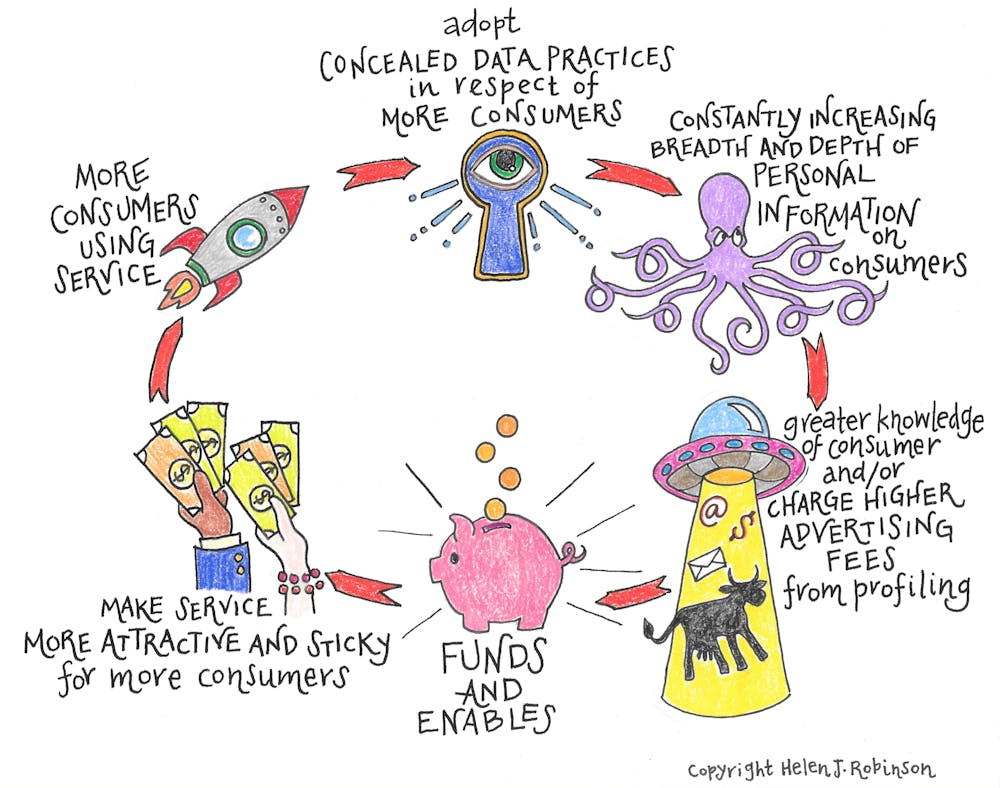
My latest research paper details how companies that trade in our personal data have incentives to conceal their true practices, so they can use vast quantities of data about us for profit without pushback from consumers. This can preserve companies’ market power, cause harm to consumers, and make it harder for other companies to compete on improved privacy.

The vicious cycle of privacy abuse.
Helen J. Robinson, Author provided

Privacy policies are broken

The ACCC report points out that privacy policies tend to be long, complex, hard to navigate, and often create obstacles to opting out of intrusive practices. Many of them are not informing consumers about what actually happens to their information or providing real choices.

Many consumers are unaware, for example, that Facebook can track their activity online when they are logged out, or even if they are not a Facebook user.


Read more:
Shadow profiles – Facebook knows about you, even if you’re not on Facebook


Some privacy policies are outright misleading. Last month, the US Federal Trade Commission settled with Facebook on a US$5 billion fine as a penalty for repeatedly misleading users about the fact that personal information could be accessed by third-party apps without the user’s consent, if a user’s Facebook “friend” gave consent.

If this fine sounds large, bear in mind that Facebook’s share price went up after the FTC approved the settlement.

The ACCC is now investigating privacy representations by Google and Facebook under the Australian Consumer Law, and has taken action against the medical appointment booking app Health Engine for allegedly misleading patients while it was selling their information to insurance brokers.

Nothing to hide…?

Consumers generally have very little idea about what information about them is actually collected online or disclosed to other companies, and how that can work to their disadvantage.

A recent report by the Consumer Policy Research Centre explained how companies most of us have never heard of – data aggregators, data brokers, data analysts, and so on – are trading in our personal information. These companies often collect thousands of data points on individuals from various companies we deal with, and use them to provide information about us to companies and political parties.

Data companies have sorted consumers into lists on the basis of sensitive details about their lifestyles, personal politics and even medical conditions, as revealed by reports by the ACCC and the US Federal Trade Commission. Say you’re a keen jogger, worried about your cholesterol, with broadly progressive political views and a particular interest in climate change – data companies know all this about you and much more besides.

So what, you might ask. If you’ve nothing to hide, you’ve nothing to lose, right? Not so. The more our personal information is collected, stored and disclosed to new parties, the more our risk of harm increases.

Potential harms include fraud and identity theft (suffered by 1 in 10 Australians); being charged higher retail prices, insurance premiums or interest rates on the basis of our online behaviour; and having our information combined with information from other sources to reveal intimate details about our health, financial status, relationships, political views, and even sexual activity.


Read more:
Why you might be paying more for your airfare than the person seated next to you


In written testimony to the US House of Representatives, legal scholar Frank Pasquale explained that data brokers have created lists of sexual assault victims, people with sexually transmitted diseases, Alzheimer’s, dementia, AIDS, sexual impotence or depression. There are also lists of “impulse buyers”, and lists of people who are known to be susceptible to particular types of advertising.

Major upgrades to Australian privacy laws

According to the ACCC, Australia’s privacy law is not protecting us from these harms, and falls well behind privacy protections consumers enjoy in comparable countries in the European Union, for example. This is bad for business too, because weak privacy protection undermines consumer trust.

Importantly, the ACCC’s proposed changes wouldn’t just apply to Google and Facebook, but to all companies governed by the Privacy Act, including retail and airline loyalty rewards schemes, media companies, and online marketplaces such as Amazon and eBay.

Australia’s privacy legislation (and most privacy policies) only protect our “personal information”. The ACCC says the definition of “personal information” needs to be clarified to include technical data like our IP addresses and device identifiers, which can be far more accurate in identifying us than our names or contact details.


Read more:
Explainer: what is surveillance capitalism and how does it shape our economy?


Whereas some companies currently keep our information for long periods, the ACCC says we should have a right to request erasure to limit the risks of harm, including from major data breaches and reidentification of anonymised data.

Companies should stop pre-ticking boxes in favour of intrusive practices such as location tracking and profiling. Default settings should favour privacy.

Currently, there is no law against “serious invasions of privacy” in Australia, and the Privacy Act gives individuals no direct right of action. According to the ACCC, this should change. It also supports plans to increase maximum corporate penalties under the Privacy Act from A$2.1 million to A$10 million (or 10% of turnover or three times the benefit, whichever is larger).

Increased deterrence from consumer protection laws

Our unfair contract terms law could be used to attack unfair terms imposed by privacy policies. The problem is, currently, this only means we can draw a line through unfair terms. The law should be amended to make unfair terms illegal and impose potential fines of A$10 million or more.

The ACCC also recommends Australia adopt a new law against “unfair trading practices”, similar to those used in other countries to tackle corporate wrongdoing including inadequate data security and exploitative terms of use.

So far, the government has acknowledged that reforms are needed but has not committed to making the recommended changes. The government’s 12-week consultation period on the recommendations ends on October 24, with submissions due by September 12.The Conversation

Katharine Kemp, Senior Lecturer, Faculty of Law, UNSW, and Co-Leader, ‘Data as a Source of Market Power’ Research Stream of The Allens Hub for Technology, Law and Innovation, UNSW

This article is republished from The Conversation under a Creative Commons license. Read the original article.

Archive documents reveal the US and UK’s role in getting the ANC into power

Sue Onslow, School of Advanced Study and Martin Plaut, School of Advanced Study

It is a quarter of a century since the end of apartheid in South Africa. But it’s easy to forget how complex, difficult and violent the birth of full democracy really was. This was particularly true in KwaZulu-Natal, where battles between the African National Congress (ANC) and the mainly Zulu Inkatha Freedom Party (IFP) claimed the lives of as many as 20,000 in the decade between 1984 and 1994.

In the three months before the first elections in April 1994 an estimated 1 000 people were killed. The British and Americans were becoming increasingly concerned. The conflict between Inkatha and the ANC was just one crisis: another was developing with far right white extremists, who were threatening to resort to violence.

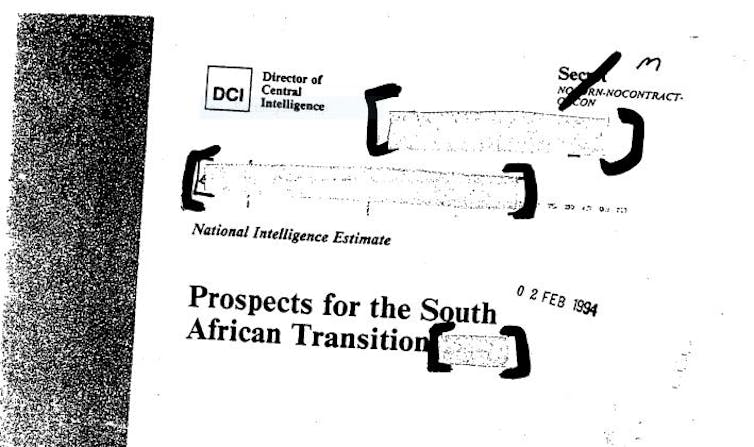
The US Central Intelligence Agency (CIA) reported that there was an:

eight in 10 chance that violence will surge immediately before and during the election, when emotions are at their highest.

The agency also warned of the threat of a right wing coup, although it considered this “unlikely”. (This CIA report is available in hard copy only.)

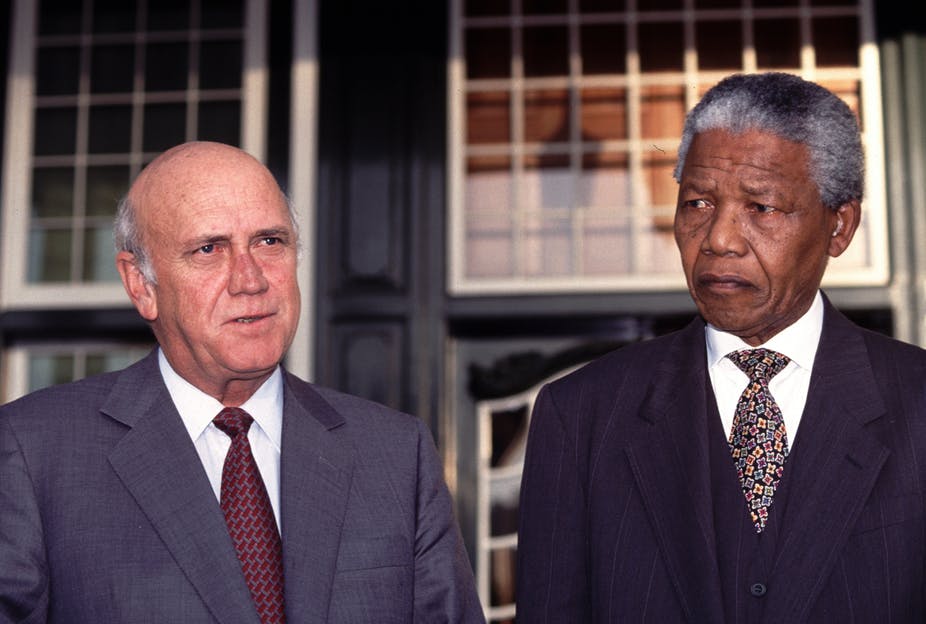
As the situation grew increasingly tense, Britain’s Prime Minister John Major and the US’s President Bill Clinton became personally involved. Their interventions are shown in documents just released by the UK National Archives.

The cover page of the CIA document.
Author provided

The documents reveal just what a close-run thing the first truly democratic election was, and how much time and effort Britain and the USA spent ensuring that the voting went ahead.

Desperate times

Prime Minister Major took a phone call from Nelson Mandela on 22 February, in which the ANC leader described the situation as “very difficult.” Major briefed Mandela on a meeting between the British ambassador and the Inkatha leader, Mangosuthu Buthelezi. He gave Mandela a full account of the conversation, which he warmly welcomed.

On 24 February there is the first indication of a joint Anglo-American mediation effort to resolve the crisis. This arose during planning for a visit to Washington by Major three days later.

Our starting point is that the situation has now deteriorated to the point where it seems very unlikely that left to themselves the South Africans will reach an agreement that will enable to participate in the elections. The consequences are likely to be very serious.

The British suggested that Major and Clinton might “offer their joint help to the transition process”.

The following day – having held discussions with Mandela, Buthelezi and President Frederik de Klerk – the British ambassador in Pretoria, Sir Anthony Reeve, was able to report that all three were prepared to go along with the Anglo-American initiative, although with some reservations. The ambassador concluded:

These responses do, I think, give us the green light to consult the Americans in detail on our thinking.

The proposal was discussed between Mandela and Buthelezi at a meeting on March 1 and both leaders agreed to “explore” the possibility of international mediation. Lord Carrington, who had negotiated the end of Rhodesia and its transition to Zimbabwe in 1980, was on a lecture tour of South Africa. He was approached by the ANC’s Thabo Mbeki who asked whether he might act as one of a panel of mediators.

Others suggested were US Secretary of State Henry Kissinger and former Tanzanian head of state Julius Nyerere.

There followed intensive discussions between London and Washington, over how such mediation might work; indeed, Carrington and Kissinger travelled to South Africa. In the end a failure to agree on the terms of reference for the mediators, and South African government fears that the elections might be delayed, put paid to the plan.

It has been claimed the crisis – the most immediate was that Buthelezi was threatening to boycott the poll – was resolved by surprising last minute mediation by Kenyan Professor, Washington Okumu. Other Commonwealth envoys who had excellent contacts with both the ANC leadership and Buthelezi, including the late Ghanaian diplomat Moses Anafu, doubt this, arguing that forces that led Buthelezi into the election were much bigger.

Indeed, Buthelezi’s brinkmanship had ensured key constitutional concessions. Okumu’s intervention seems then a face-saving device for the IFP leader. A joint statement was agreed between Mandela, Buthelezi and de Klerk on 19 April, which allowed the election to take place just a week later (April 26-28).

Close-run thing

It had been a close-run thing and South Africa’s first truly democratic election almost came to grief. But there were two more potential obstacles.

In the tense run-up to polling day, a report on the role of the apartheid state in stoking internal tension and violence was published. The Commission of Inquiry Regarding the Prevention of Public Violence and Intimidation, led by Justice Richard Goldstone had been established in 1991: its report was published on 21 April 1994. Judge Goldstone’s investigations revealed that sections of the South African Police had armed Inkatha, and pointed to attempts by senior police officers to subvert the work of his enquiry.

The charges were explosive and for a while the judge and his family were clearly at risk from white extremists. With de Klerk’s support and the knowledge of Mandela, Goldstone, his wife and a “key witness” (a former South African police officer) asked whether they might come to Britain. John Major agreed, and they were given temporary asylum and a safe house.

The second obstacle was the South African government’s clandestine chemical and biological weapons programme, known as “Project Coast.” The British Foreign Secretary, Douglas Hurd, contacted Washington about the possibility of issuing a formal public protest unless President de Klerk publicly admitted his government’s involvement in the use of these weapons against ANC and Namibian prisoners.

The British had apparently intervened to prevent the proliferation of these weapons to other rogue states or terrorist groups. On April 11 the US and British ambassadors delivered their protest to President de Klerk – which apparently did the trick. There was an agreement that all the chemical and biological systems would be destroyed and one of the key South African experts, Wouter Basson, who had travelled to Libya on several occasions, was subsequently prosecuted.

Political triumph

The April 1994 election proved to be a watershed for South Africa. In technical terms, the election was a fiasco, but it was a political triumph, according to the Commonwealth’s leading election official, Carl Dundass. Inkatha’s surprising victory in Natal-KwaZulu strongly suggest Natal “horsetrading” involved overturning an actual ANC victory to manage anticipated post-election violence.

Despite all the violence, tension and drama the election ended apartheid and allowed Major to phone Mandela with his congratulations – a highly satisfactory conclusion to an intense period of international diplomacy.The Conversation

Sue Onslow, Reader, Institute of Commonwealth Studies, School of Advanced Study and Martin Plaut, Senior Research Fellow, Horn of Africa and Southern Africa, Institute of Commonwealth Studies, School of Advanced Study

This article is republished from The Conversation under a Creative Commons license. Read the original article.

Africa’s fast-growing cities are failing

Over the next 16 years, all of the world’s 10 fastest growing cities are going to be in Africa. If this growth is a process of people voting with their feet, as last year’s winner of the Nobel Prize in Economics Paul Romer once put it, these cities are winning.

Yet urbanisation in many developing countries, particularly in sub-Saharan Africa, is not delivering the benefits of people and firms clustering together. Historically, cities have been the drivers of productivity and engines of economic growth. One key factor preventing this potential from being unlocked is how cities are governed. It matters who makes the decisions and how they do it. It also matters how the decisions are subsequently implemented.

Cross-city experiences, which we detail in our newest policy paper, have shown that tangible policy options which target underlying institutions can lead to better governance outcomes.

We highlight three elements of the institutions of urban governance: allocation of responsibility, capacity, and legitimacy.

Deciding who decides

First, the most effectively run cities have institutions with clearly defined mandates. Take Cairo. The city has 18 government entities and four parastatal agencies, leading to overlapping and missed mandates. This fragmentation has affected the overall efficiency and operation of Cairo’s transportation system, which relies heavily on private cars and taxis. The result has been widespread congestion. Many trips take more than double the time they would if the traffic flowed freely.

Clearly defined responsibilities and mandates can be achieved through several approaches. The most powerful way of dealing with fragmentation is by creating a single agency responsible for a service or policy decision. To overcome fragmentation, the government of Lagos in Nigeria created an agency to coordinate the work of all transport-related entities. The Lagos Metropolitan Area Transport Authority also awards concessions and levies transport user fees. And it manages major arterial roads throughout the metropolitan region.

This institutional change has improved the clarity of functions in Lagos, paving the way for tangible improvements the city’s transportation. For example, the transport authority has worked with the World Bank to improve the city’s bus service. This included the implementation of a pilot bus franchise scheme along the Iyana-Ipaja-Ikotun corridor, which carries more than 100 000 people every day.

However, the creation of a single entity may not always be feasible or desirable. Softer governance arrangements, such as coordination committees, may sometimes be required. These committees can be temporary, formed and run only when required and subsequently disbanded. Or they can be more permanent. Medellin in Colombia has a committee responsible for integrated housing planning. It brings together the heads of the city’s planning, housing, environmental and public works departments to streamline policy on housing.

Building capacity

Second, municipal governments need the capacity to implement decisions. Again, larger institutional reforms can support this. Revenue reform in Kampala, the Ugandan capital, is a good example.

The Kampala Capital City Authority established a directorate to collect revenue. It was set up separately from the Directorate of Finance. Through this, the city authority was able to dedicate sufficient human and financial resources to revenue collection. As a result, it increased its own-source revenue by nearly 200% in four years.

Other options that may be easier to implement than full institutional reform include establishing strong internal coordination mechanisms to manage programmes and projects. For example, in 2013 Baghdad’s Deputy Mayor created a steering committee to improve the city’s sewerage system. The committee brought together various senior city staff and helped improve the timeliness and overall streamlining of decision making. This contributed towards significant improvements to the city’s sewerage network, including a new competitive bidding system and higher citizen satisfaction.

Adequate legitimacy

Thirdly, effectively making and implementing decisions requires sufficient legitimacy. Legitimacy can be derived from predetermined procedures, like elections. But elections can be difficult to organise and can be very costly.

There are other ways of building legitimacy. These include participatory budgeting. This has been used extensively by municipalities in Brazil. After a series of consultation processes with citizens, the final municipal budget is determined based on priority rankings of projects, considering their technical and financial feasibility. The city isn’t legally bound to invest in the projects selected. Nevertheless the mechanism creates an established channel for identifying priority projects for people. And evidence shows that participatory budgeting does affect municipal spending patterns.

Simply improving public communication can also be a useful and potentially more cost-effective option for building local legitimacy. It can generate public buy-in as well as acting as a mechanism for the municipal government to receive feedback. It can also be a powerful way to increase compliance. For example, Lagos increased tax compliance on business-related taxes by working on its direct relationships and improved communication with the city’s key private sector associations. This led to an increase in business-related taxes. These rose from an estimated 30-40% in 2005 to over 80% by 2015 among large companies.

Urbanisation provides a important opportunity for unlocking economic growth. The challenge for urban leaders is how to effectively govern rapidly growing cities. This requires that critical decisions are made and implemented in a timely manner, and are supported by the majority of citizens.

Shahrukh Wani (@ShahrukhWani) contributed to this article. He is an economist in IGC’s Cities that Work team, based at the Blavatnik School of Government.The Conversation

Astrid R.N. Haas, Senior Country Economist (Cities) and Manager of Cities that Work, International Growth Centre, with assistance from Shahrukh Wani, who is an economist in IGC’s Cities that Work team, based at the Blavatnik School of Government.The Conversation

This article is republished from The Conversation under a Creative Commons license. Read the original article.

Bitcoin Smashes the legendary $ 15 000 mark. Now what?

Bitcoin has smashed the legendary $ 15 000 mark just after noon (SAST) today, the 7th of December. With every YouTube video and website advertising a wide variety of Bitcoin and other cryptocurrency-related services, the average, normal individual is left to wonder what to make of this exciting and strange phenomenon in our modern tech-society.

Nordea Bank AB, the largest financial group in Northern Europe, had their chief executive calling it a “joke”. Many more finance professionals and long-time players have raised their eyebrows in severe skepticism, and given the nature of the entity, investors have plenty of reasons to be concerned.

Crypto fever has caught on in South Africa as well. As Bitcoin is a currency, it has many different prices connected to various currencies. The Rand-Bitcoin (BTCZAR) price of a single Bitcoin broke through the R 200 000 barrier on the morning of December 7, although volatility remains high with violent fluctuations in every market. On a granular level, the BTCZAR singular price has pushed as far as R 230 000 in individual markets such as Luno, a South African-based Bitcoin exchange.

South African citizens are embracing the plethora of opportunities that Bitcoin presents. Citizens can even pay their traffic fines using Bitcoin through certain companies. A specific company, Fines4U, is not adopting Bitcoin in the more traditional sense which has been seen in other countries such as Japan however, where direct payments are allowed. Rather, this is a creative attempt to accumulate Bitcoin without direct investment. This approach represents a new wave of individual adoption where individuals are thinking out of the box in order to participate in the cryptocurrency mania, with some South African I.T. employers offering their staff bonuses and even salaries in Bitcoin.

Nona Creative, a digital consultancy and product development firm in Cape Town, with the slogan “Web Apps for Humans”, recently purchased a significant chunk of shares in what it claims to possibly be the first Bitcoin equity transaction in the country ever. CEO, Mike Scott, said: “We firmly believe in Bitcoin and wanted to show just how effortless it is to conduct normal business transactions using cryptocurrency.” Clearly, Bitcoin is becoming more and more integrated into our mainstream financial society and shows no signs of becoming irrelevant.

Cryptocurrencies have been carefully crafted to avoid fitting into any conventionally-defined security categories. It cannot be a commodity; it has no physical and tangible form. It isn’t a derivative either; again, it simply sits in cyberspace. Regulators are struggling to even begin regulating cryptocurrencies as they have no geographical source. Korea, for example, has banned the exchange of Bitcoin but is finding it incredibly difficult to enforce the ban and it hasn’t realised a significant decrease in the crazy growth in the relevant local market at all. At the time of writing this, Korea’s local market was valuing a single Bitcoin at $ 19 000.

Bitcoin and other cryptos are here to stay it would seem. They are also near impossible to regulate right now. How can an individual and society as a whole benefit from this new technology?

Firstly, what makes Bitcoin so great? There is clearly a general consensus that cryptocurrencies are simply pockets of hot air. Bitcoin’s price has no grounding in anything besides sentiment. It has no influence on interest rates, inflation trends or any other macro-economic indicators. The true innovation, as propagated by numerous financial and tech experts, is not Bitcoin itself. It lies in the mechanism upon which Bitcoin is built, the blockchain. Not going into the technical details, blockchain technology allows any cryptocurrency to function as a gigantic, collective and completely transparent public ledger. Nobody can lie about their Bitcoin transactions. Every time a crypto is sold or bought, every single holder of all the other Bitcoins in the world has their “ledgers” updated. The future financial applications are fantastic, indisputably so.

Secondly, there is a clear upward trend in the price of Bitcoin, despite the wild volatility levels – rapid up and down price movements are intrinsic to an entity that has no other driving force besides investor sentiment – and more and more people are investing in cryptocurrencies as Bitcoin’s market capitalisation has surpassed Warren Buffett’s total value and the entire New Zealand GDP. There is opportunity in investing here, but around every corner scams and shady businesses have sprung up around the craze. If a website has long, complicated user agreements and makes it easy for a new user to swipe their credit card, it is best to be avoided. Etoro and IQ Option spring to mind as gambling service sites masquerading as legitimate financial institutions, whilst Bitcoin pyramid schemes such as BitClub Network openly admit to being pyramid schemes. Even simply buying and holding Bitcoin is risky, although the clear upwards trend has the world in awe.

Bitcoin has grown close to 1 800% in 2017 alone. Since its inception, it has grown from $ 0.01 in 2009 to $ 15 000 today (2017/12/07), totalling 29 000 000 %. That is 29 million percent. Most of the growth has occurred in 2017. It is the greatest modern investment bubble of our time, because it has no intrinsic value. It is bits of code in cyberspace, at its core. Bubbles can burst, and the brutal price movements make speculation very risky.

The verdict? Avoid the scams and the pyramid schemes. Buying and holding Bitcoin can be good this year end. It has repeatedly defied expectations. But bubbles are always profitable until they are not, and this is a bubble through and through. Caution must be exercised when investing in Bitcoin, and no sane-minded investor should invest a significant proportion of their capital in an entity such as this. Moreover, it would be inadvisable to park cash in the cryptocloud for too long. As for the innovation behind the cryptocurrency mania, it is here to stay and we should welcome it. A worldwide, completely transparent, constantly updated public ledger seems to be a very refreshing concept.

Please note that this article is NOT intended to be used as financial advice and the author cannot be held responsible for any financial or any other losses as a result of Bitcoin-related interactions. Stay safe, don’t gamble.


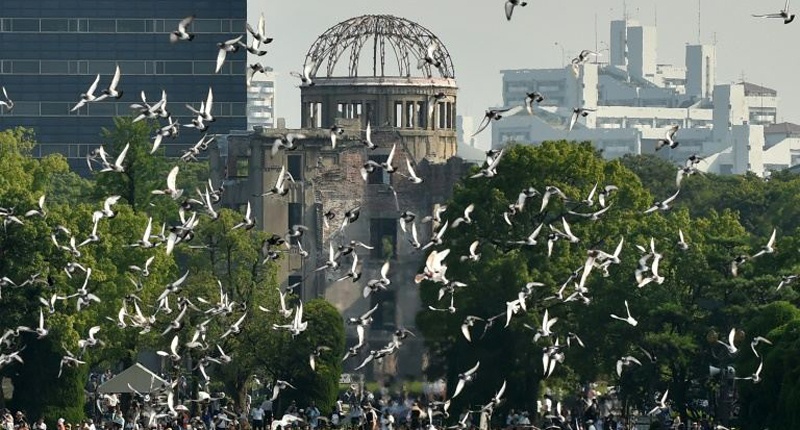
Hiroshima: Killing on an industrial scale

It has been 70 years since the United States became the only nation in history that deployed two nuclear weapons against civilian populations.

On August 6, 1945, a B-29 known as the Enola Gay took off from Tinian island, north of Guam. After flying six hours to the main Japanese island of Honshu, pilot Paul Tibbets flew his aircraft over the city of Hiroshima released «Little Boy», an atomic bomb with the explosive power of 16 kilotons of TNT.

Together two bombs eventually killed an estimated 200,000 Japanese civilians.

Little already remained of Tokyo long before the attacks on Hiroshima and Nagasaki. Hiroshima was one of the largest military centers provisioning the Japanese army and navy.

Originally the chosen targets for the attack were Niigata (a military base and industrial center), Yokohama (an industrial center), Kokura (which held the largest arsenal and warehouse), and Kyoto (also an industrial center).

Nagasaki was a haphazard target. The plane originally flew to Kokura, but because of cloud cover it was unable to release its payload and it turned toward Nagasaki instead.

Within a week of each nuclear attack, thousands who had escaped death began to experience inexplicable combinations of symptoms: high fever, dizziness, nausea, headaches, diarrhea, bloody stools, nosebleeds and whole-body weakness. Their hair fell out in large clumps, their wounds secreted extreme amounts of pus, and their gums swelled and bled.

Purple spots appeared on their bodies, signs of hemorrhaging beneath the skin. Infections ravaged their internal organs. Within a few days of the onset of symptoms, many people lost consciousness, mumbled deliriously and died in extreme pain; others languished for weeks before either dying or slowly recovering.

Even those who had suffered no external injuries fell sick and died. In the ruins of his small tuberculosis hospital in Nagasaki, Dr. Tatsuichiro Akizuki likened the situation to the Black Death pandemic that ravaged Europe in the 1300s.

A second wave of radiation illnesses and deaths swept through Nagasaki in late August through early October. From Akizuki’s perspective on top of Motohara Hill, the illness carved a clear geographical path: From the bottom of the hill upward, people died in order of their distance from the bomb’s hypocenter. Akizuki called this phenomenon the “concentric circles of death.”

By February 1945, Russia and Japan were on the same page and proposed a Far East peace conference that would include Russia, China, Great Britain, the United States, France, and Japan. Japan wrongly believed that Russia would not enter the Pacific war on the side of the Allies.

The USSR’s entry into the war against Japan on Aug. 9, 1945 had a decisive impact on Japan’s decision to capitulate. When the fate of the Kwantung command was almost a foregone conclusion, Emperor Hirohito decided to surrender after panicked reports from his military commanders in Manchuria.

Immediately after the bombings, high-level U.S. officials publicly — and adamantly — rebuffed news reports about the bombs’ horrific aftereffects. Gen. Leslie Groves, director of the Manhattan Project, which developed the atomic bombs, dismissed these reports as propaganda.

Later that year, Groves testified before the U.S. Senate that death from high-dose radiation exposure is “without undue suffering” and “a very pleasant way to die.”

Killing had become possible on an industrial scale by WWII with rifles and machine guns mass-produced in factories, as well as a wide range of products needed to support multimillion-man armies.

Destroying cities was thus the key to winning wars and an integral part of Allied strategy against Germany and in Japan. For Japan the aftermath of bombing Hiroshima and Nagasaki was as calamitous as the fate of Dresden and Hamburg.

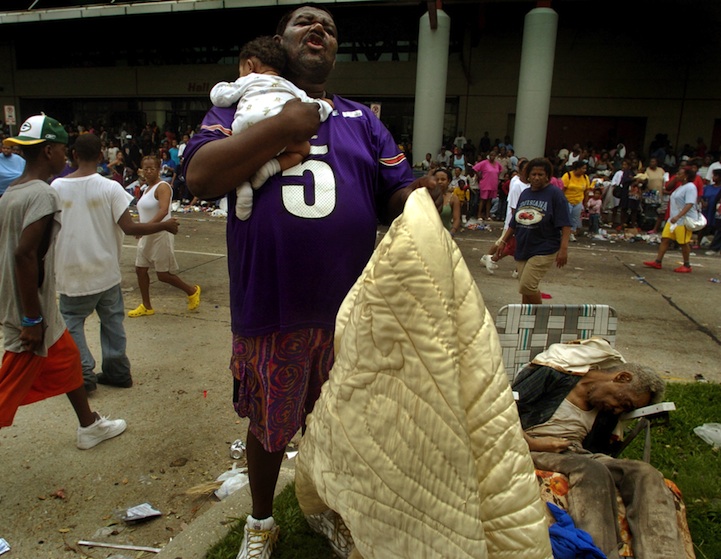
Fewer blacks move back to New Orleans after Katrina devastation

A decade after Hurricane Katrina, New Orleans seems to have found its rhythm again: the French Quarter is choked with tourists, construction cranes tower over the skyline, and hipsters bike to cafes in gentrifying neighbourhoods.

But recovery has been uneven in the city, which took the brunt of the 2005 storm that killed more than 1,800 people and was the costliest in U.S. history.

Many properties still bear physical scars from the hurricane, particularly in poorer African-American neighbourhoods. Social, demographic and political changes still ripple through the city.

In the mostly black Lower Ninth Ward, devastated by the flooding, Charles Brown is still attending services in his pastor’s nearly empty living room, waiting for the day when Mount Nebo Bible Baptist Church is rebuilt.

The black population of the city, long a hub of African-American culture, has plummeted since Aug. 29, 2005, the day Katrina swept in from the Gulf of Mexico and overwhelmed the levees meant to prevent flooding in the low-lying city.

Income gaps between blacks and whites have widened. Many African-American neighbourhoods and the businesses supporting them have not fully recovered.

Brown’s family and neighbours were among more than 1 million evacuated from the region after Katrina, which exposed deep poverty in the city, and displaced more people than any other event since the Dust Bowl drought and dust storms of the 1930s.

Brown, an emergency responder, stayed behind to search for the missing.

“We should have made so much more progress,” said the 55-year-old Brown in an interview before a series of events the city is planning this month to mark the storm’s 10th anniversary. “I don’t see anything to celebrate.”

The population of New Orleans is now about 385,000, according to U.S. Census figures from 2014, representing about 80 percent of its pre-Katrina population.

The number of African-Americans has plunged by nearly 100,000 since the storm, while there are now about 10,000 fewer white residents, according to Census figures and the Data Centre, a local nonprofit tracking demographic and economic trends.

Before the hurricane, African-Americans comprised 67 percent of the population. By 2014, that dwindled to 60 percent, the Census reported.

Orleans Parish, which has the same boundaries as the city of New Orleans, is the only county or parish in the United States with at least 4,500 African-Americans that experienced such a steep decline between 2000 and 2010, a Reuters analysis found, based on the Census counts before and after Katrina.

Some of the black population moved out to the suburbs, the Data Centre notes, and some gradually are moving back. Every year since 2010, the city’s African-American population has increased, adding on average several thousand residents.

Yet some who came back say they live in a different New Orleans. Tracie L. Washington, director of the nonprofit Louisiana Justice Institute, returned to New Orleans after evacuating. Today she says something feels off in the city.

She compares it to a missed beat in the brass band parades, called second lines, that weave through its traditionally African-American neighbourhoods on many Sundays.

“I’m just one of the survivors,” she said. “There shouldn’t be so few.”

INCOME GAP WIDENS

Yet the income gap between black and white residents has widened, according to the local Urban League. In 2013, the median income for African-American households in New Orleans was $25,102, compared to $60,553 for white households. The disparity has increased by 37 percent since 2005, according to figures from the Urban League.

“The folks who are benefiting from the most positive trends are the white community, whereas the African-American community by and large has not benefited in the same way,” said Allison Plyer, chief demographer at the Data Centre.

Among those who left and still want to go home is Philoraine Skipper, who was rescued from a second-story window when flood waters engulfed her house.

She was evacuated to the Superdome arena, where she was reunited with her two daughters, and eventually went with family to Oklahoma, where she still lives.

“We will be coming back,” said the 69-year-old, choking back tears as she described her long and unplanned departure, and her excitement visiting New Orleans this week to continue her house repairs. “This is home.” – Reuters

NATO is the root cause of EU migrant crisis

The scale of the migrant crisis Europe is facing today cannot be understated. It is truly unprecedented. What is habitually understated, however — and in fact almost completely ignored by mainstream media — are the real roots of the crisis, says Danielle Ryan.

The debate around migration into the EU is happening nearly entirely without reference to the causes of the recent influx of migrants from North Africa and the Middle East. The elephant in the room is NATO and nobody really wants to talk about it.

Hundreds of articles, laden down with numbers and proposals and predictions fail to make any direct link between cause and effect. News anchors sit seemingly baffled, mouths agape, at the apocalyptic-like pictures they are seeing land on their desks, and yet few are willing to draw the appropriate conclusions. But it is such a basic and logical connection that it’s hard to believe it is not being made very loudly and very persistently.

Maybe it’s just that these journalists are so conditioned to framing U.S. and NATO policy in a positive light that the links don’t even really occur to them. Or maybe they’re simply embarrassed and trying to shift focus from their long-recorded support for various military interventions in these countries.

Either way, the result is that the story is framed in such a way that it makes the timing of the crisis sound almost random. We’re witnessing a conversation about how to ‘deal’ with boats full of Libyans making their way across the Mediterranean — as if Libya was a country that had just self-imploded yesterday, and for no discernible reason.

A fierce debate is raging over ‘what to do’ about these migrants — and in a way that’s understandable because that is the more immediate problem — but the debate we really need to be having is about the policies, NATO’s policies, which were the catalyst.

Even if Europe unites in formulating a ‘solution’ to the problem, it will be nothing more than a bandaid fix because it will only deal with symptom. After all, what’s the point in covering your open wound with a bandaid when the guy who cut you is still wielding a knife in the same room? It doesn’t take a genius to work out how that story ends.

Whenever the cause is grudgingly mentioned by the media, it is mentioned briefly and abstractly where the author or anchor might refer to “conflict” or make mention of how violence has “reignited” in these countries in recent years and months.

The editors at the New York Times in particular, are big fans of loading all the blame squarely onto Europe’s shoulders. Here a Times piece argues that the migrant crisis “puts Europe’s policy missteps into focus”. Another piece, from the editorial board, lectures Europe on how to handle the situation.

In April, NATO head Jens Stoltenberg called for a “comprehensive response” to the crisis and promised that NATO would help to stabilize the situation. The alliance’s role in “stabilizing” Afghanistan was part of its broader approach to the refugee crisis in the Mediterranean, he said.

That is rich coming from the head of a ‘security’ and ‘defensive’ alliance which for years has pursued a policy of offensive destabilization in the very regions which people are fleeing from in their hundreds of thousands. But Stoltenberg’s comments and NATO’s actions are easily decoded by the employment of some basic common sense.

The NATO modus operandi is clear. The pattern, repeated over and over, involves the complete destabilization of a region, to be swiftly followed up with another NATO-led ‘solution’ to the problem. When you couple that with the use of spokespeople who are unashamed to feign ignorance and lie blatantly (Jen Psaki, Marie Harf etc.), and a compliant media that will regurgitate the line without question, this is what you get.

The 2011 NATO intervention in Libya was authorized by the United Nations on “humanitarian” grounds and resulted in the deaths of between 50,000 and 100,000 people and the displacement of 2 million. Very humanitarian.

Similarly, after the U.S.-led campaign to destabilize Syria in an effort to topple Bashar al-Assad, facilitating (and even supporting) the rise of ISIS in the region, a staggering 10 million have been displaced (according to Amnesty International) and European countries are left to help pick up the pieces. Germany, for example, has pledged to resettle 30,000 Syrian refugees. Sweden, a non-NATO nation, has taken in similar numbers.

It should be made clear however, that the numbers European countries have taken or pledged to take pale in comparison to the numbers being hosted in other Middle Eastern countries. Lebanon, for example, is hosting 1.1 million Syrian refugees. Jordan is hosting more than 600,000. Iraq hosts nearly a quarter of a million. Turkey hosts 1.6 million.

There is one country that’s getting off scot-free in all of this — at least on the Syrian front. That country is the United States. The U.S. has taken in less than 900 Syrian refugees after four years of war. American officials have cited “national security” in their explanations for not yet taking more, although they have said they would like to see the number increase.

Maybe this has something to do with it?
Debate not allowed

There is a second media crime flying under the radar here and it is this: In European countries where the massive influx of migrants from the Middle East and North Africa have caused serious societal divisions, where migrants have failed to assimilate (for a variety of reasons, including both government policies and often radical religious beliefs), Western media will allow no one to talk about it honestly — and woe betide the person who tries.

Take Sweden, where the disease of political correctness is at an even more advanced stage than it is in the rest of Europe. There, any attempt to debate the coherence of a ‘doors wide open’ immigration policy is branded as “racist”. A further irony in the Swedish context, is that the country is facing a housing crisis and has nowhere to put most of the people they are pledging to resettle. There’s some real forward-thinking, common sense policy for you.

This is a dangerous combination for Europe: An unsustainable influx of migrants, foreign policy which ensures its continuation, a docile media, and an epidemic of political correctness which has infected the entire continent.

Media 101 on the migrant crisis: Talk a lot about migrants, don’t mention why they fled and then call anyone who has a problem with it a “racist” — success! Oh, and you get an added bonus if you can somehow link it all to ‘Russian aggression’, Vladimir Putin and NATO as a ‘defensive’ alliance.

Some European countries are taking a more hardline approach and are getting slammed for it. Hungary, for example, is looking at building a barrier wall along its border with Serbia, similar to barriers along the Greek-Turkish and Bulgarian-Turkish borders. Again, this has sparked accusations of xenophobia and racism from media and political quarters.

But that’s part of the game, isn’t it? If NATO’s war supporters can focus the debate around the idea that anyone who wants to address or critically assess immigration policy is “racist” then we won’t have to talk about why the migrants are here in the first place or why they are facing such dire circumstances at home.

Russia Today’s Oksana Boyko tried recently, to broach this topic with Peter Sutherland, the UN’s special representative on international migration and development, but she got nowhere. She argued that the debate around migration into the EU can’t really be had without addressing the essence and heart of the problem, but found that NATO policy is apparently a topic not up for discussion.

Debating Europe’s migrant crisis without acknowledging the context in which it has been created it useless. It would be like asking Americans to debate police brutality without talking about race. The two are inescapably interlinked and any ‘solutions’ that come from an incomplete debate will ultimately fail.

For now though, it seems Europe will continue to debate this humanitarian crisis in terms of ‘what to do’ without addressing the ‘how to stop’ and we’ll keep running around in a vicious circle.

An easier solution, of course, would be for NATO to put an end to its campaign of destabilization in the Middle East and North Africa, but that would require the acceptance and acknowledgement of some very hard truths.

Danielle is an Irish journalist and blogger. She has a degree in Business and German from Trinity College Dublin and studied political reporting at the Washington Center for Politics and Journalism in Washington, DC. Special interests: American politics and foreign policy, US-Russia relations and media bias. Her blog can be found at journalitico.com.

Baragwanath Hospital Chaos

By: Nathan Geffen and Ben Stanwix/Ground Up

A doctor at South Africa’s largest hospital, Chris Hani Baragwanath Academic Hospital (CHBAH) in Soweto, has described chaotic planning and management that is putting patient care at risk.

The doctor spoke on condition of anonymity. Employees at the hospital are scared to speak out. One doctor told GroundUp that “colleagues who work at Bara” are not “willing to get involved due to their previous experiences with clamp downs and retaliation from senior management.”

GroundUp has made extensive attempts to get responses from officials at the Gauteng Department of Health. These are described at the end of the article. In the end, only one official responded and he wrote, “I am not officially able to consent but can add some clarity”. We have included his responses below each allegation.

Breakdown of referral system

CHBAH is a tertiary hospital. Patients who attend the hospital are supposed to be referred there from other health facilities, which do not have the technology or expertise to deal with a particular patient issue. The referral system, says the doctor, has effectively broken down.

“Clinics that feed Bara have such basic equipment that they end up sending people up the referral system for most basic stuff, including blood tests and ECGs. So if you come into a small clinic with chest pain, the health worker has to refer you up, because even though he or she might be pretty sure you have nothing serious, he or she can’t take the chance, and there’s no ECG in the clinic, or it has broken down or no one knows that they’re there. This breakdown of the referral system causes congestion right up the system all the way into Bara.”

“Jabulani is a district hospital that has just opened with the idea of relieving Bara. It’s a first step in right direction. But it is still not enough. There are millions of people living in Soweto. There needs to be more.”

“For the patient this means they’ve sat for hours at the clinic waiting. They don’t get the care they should have. Often, they need to arrange their own transport to Jabulani or Bara. And then they sit for several more hours. They might get shouted at, ‘Why do you come to Jabulani just for an ECG?’ And sometimes the patients will even be chased away.”

The official who responded unofficially told GroundUp that “procurement of equipment is a challenge in the clinics and this does sometime lead to referrals to Bara not being appropriate but this is more of an exception than the rule.” He also said, “ECG machines are a challenge because the leads are at the moment difficult to procure but this should improve over the next few months.”

According to the doctor, the referral problems have worsened in April because of poor planning. Gauteng Health Department has been paying for 500 beds at a private facility called Clinix Selby Park Hospital to manage its overflow. The doctor says, “Gauteng Health’s management has now realised they don’t want to pay for these 500 beds because it’s too expensive and they would rather spend the money on state resources. So they ended this in April with a limited backup plan: 20 more beds in Jabulani Hospital from April, and then the intention of about hundred or so beds at Lenasia South, which will be converted into a district hospital. But clearly there’s a massive shortfall from April. And Bara is going to become even more clogged.”

The Health Department official responded, “The Selby 500 beds were shared between Bara, Charlotte-Maxeke, Helen Joseph and other Hospitals. The department has made arrangements for all hospitals to add additional beds to cater for these patients. This includes Carletonville, Yusuf Dadoo, Leratong Hospitals etcetera.”

Planless renovations

The doctor explained that for hundreds of patients, the first port of call at Bara is Medical Casualty. Here patients are referred either to another unit at Bara, Selby or Jabulani hospitals. Bara’s administration are planning on renovating Medical Casualty. Doctors and nurses at Casualty have been moved 20 minutes drive away to Jabulani while the renovations are ongoing. “How will patients know this? The lab at Jabulani is not yet functional. They send their stuff to Bara lab, so there’s a labyrinth of complex connections between the two hospitals which could potentially break down,” said the doctor.

The health department official responded, “I believe this renovation will be managed by Bara and it is necessary as the floor has become unsafe.”

A day at Bara

The doctor described the complexity of managing patients at Bara. “The enormity of Bara puts patients at risk because of the distances that have to be covered when moving critically ill patients. So to take someone from the maternity area to ICU, you have to take them across a road. There is hospital transport that transfers people around. They sometimes provide an ambulance, but sometimes patients simply cross the road.”

“Just understanding how the Bara system works is a daunting task for new health workers at the hospital. One of the systems you have to learn how to use is that there are ten medical wards with approximately 60 beds in a ward. When you are on call in the medical admissions award, you admit 20 or 30 patients on an intake shift. So you come in the next day and have to find them. And there are 600 options,” explained the doctor.

“There’s no electronic database so this is the system you have to use. You start off on your home ward and you look at the written patient list for the patient you want. There’s a book for patients at other wards but whether your patient’s location is recorded depends on a nurse having recorded it. If you can’t find the patient and you still have time before your rounds, you have to phone around. Sometimes you start ward rounds not knowing where all your patients are. Sometimes you don’t find the patient. A few days later you might get a call, ‘Doctor, you haven’t seen this patient for a few days.’ If they need urgent care, what can you do? If you phone all the wards and they don’t know where your patient is, how can you?

“And then how much more difficult must it be for friends and family who want to locate their loved ones?”

GroundUp’s attempts to get an official response

On 31 March we emailed Gauteng Department of Health to request a response to the doctor’s allegations. We used two email addresses listed on the department website: General Enquiries and Complaints about Services. We received no response.

On 2 April, the department responded. We were promised that contact would be made with regard to the initial queries. Emails we subsequently received indicated that on 7 April our queries were passed to Mr Chris Maxon, the department spokesperson, and Ms Merylin Deoraj, PA to the CEO of Bara.

On 9 April, we received an email from the hospital’s communications and public relations officer, Nkosiyethu Mazibuko, requesting more information and assuring us that “the department views these allegations in a serious note”.

We then emailed detailed notes on the allegations. Receipt of our email was acknowledged on 10 April and we were promised a response by 13 April.

Dr Sandile Mfenyana, Bara’s CEO, Goodhope Maseko, deputy-CEO, Monde Ntebe, Bara’s communications head, and Lesemang Matuka, the Gauteng health department’s director of of communications, were all brought in on the email correspondence at one point or another.

We were also in contact with Mr Mazibuko, the hospital’s public relations officer by cell phone. We received constant reassurance that a response was imminent, as the following images show:

Correspondence-on-14-and-15-April-203x360

Correspondence-on-15-and-16-April

More-correspondence-on-16-April.

Correspondence-on-17-April.

GroundUp then contacted Mr Monde Ntebe, who heads hospital communications in the health department, as well as Mr Prince Hamnca, the MEC’s spokesperon on 17 April. Neither responded to emails. After calling Mr Ntebe on his cellphone he apologised for the “totally unacceptable” delay and promised to attend to the allegations. GroundUp received a message from Mr Ntebe on 21 April saying he needed to confer with the CEO and spokesperson of the hospital before commenting. This is the latest response we have received from Bara’s head of communications, and the last communication we received (23 April):

The-official-who-sent-the-unofficial-response-that-we-quoted-from-in-the-article-also-did-so-on-23-April.

This article was first published on Ground Up.

Scientists train people in their sleep against ‘racism’ and ‘sexism’

Levels of unconscious racist and sexist bias have been reduced by manipulating the way the brain learns during sleep.

A team at Northwestern University, Chicago, played sounds while people slept to trigger and enforce memories of an exercise earlier in the day.

The trial on 40 people, published in the journal Science, showed the changes lasted at least a week.

Experts said the findings had potential in many situations, but also raised ethical questions.

Sexual and racial prejudice are common but may often be unintentional, says the Northwestern team.

They cite studies in computer games when people chose to shoot black characters more often than white ones or men being favoured over women despite having identical job applications.

Breaking bias?

People’s prejudices were assessed with a series of publicly available tests at the start of the study.

They were then given “counter-bias training”. During the session, pictures of faces were paired with words that were the opposite of widely-held stereotypes.

So female faces were paired with words like “maths” or black faces with positive words like “sunshine”.

Distinctive sounds were played during the counter-bias training and were played again at low volume during a 90-minute afternoon nap.

The result was a reduction in sexual and racial bias scores, which persisted for at least a week.

So could this really make someone less sexist or racist?

Prof Ken Paller, the director of the cognitive neuroscience programme at Northwestern University, told the BBC News website: “We didn’t have people interact with or make decisions about other people, so that sort of experiment is needed to know the full effects of the methods we used.

“But we suggest that modifying unconscious social bias is likely to influence the extent to which decisions are influenced by racist or sexist attitudes.”

In a commentary, Gordon Feld and Jan Born from the University of Tubingen praised the study saying: “This is the first to demonstrate that this method can be used to break long-lived, highly pervasive response habits deeply rooted in memory.”

But they cautioned that sleep was a vulnerable state in which people did not have “wilful consciousness”.

They added: “However, Aldous Huxley’s description of a dystopian ‘brave new world’ where young children are conditioned to certain values during sleep reminds us that this research also needs to be guided by ethical considerations.”

Prof Paller said there were similarities to subliminal advertising and that there was an ethical discussion to be had.

However, he continued: “More importantly, perhaps, is the question of whether people in positions of authority in society, such as judges and police officers, and perhaps people who make hiring decisions, should have their unconscious bias evaluated and perhaps trained to some standard.” – BBC.COM


87% of British blacks vote Labour and other ethnic facts

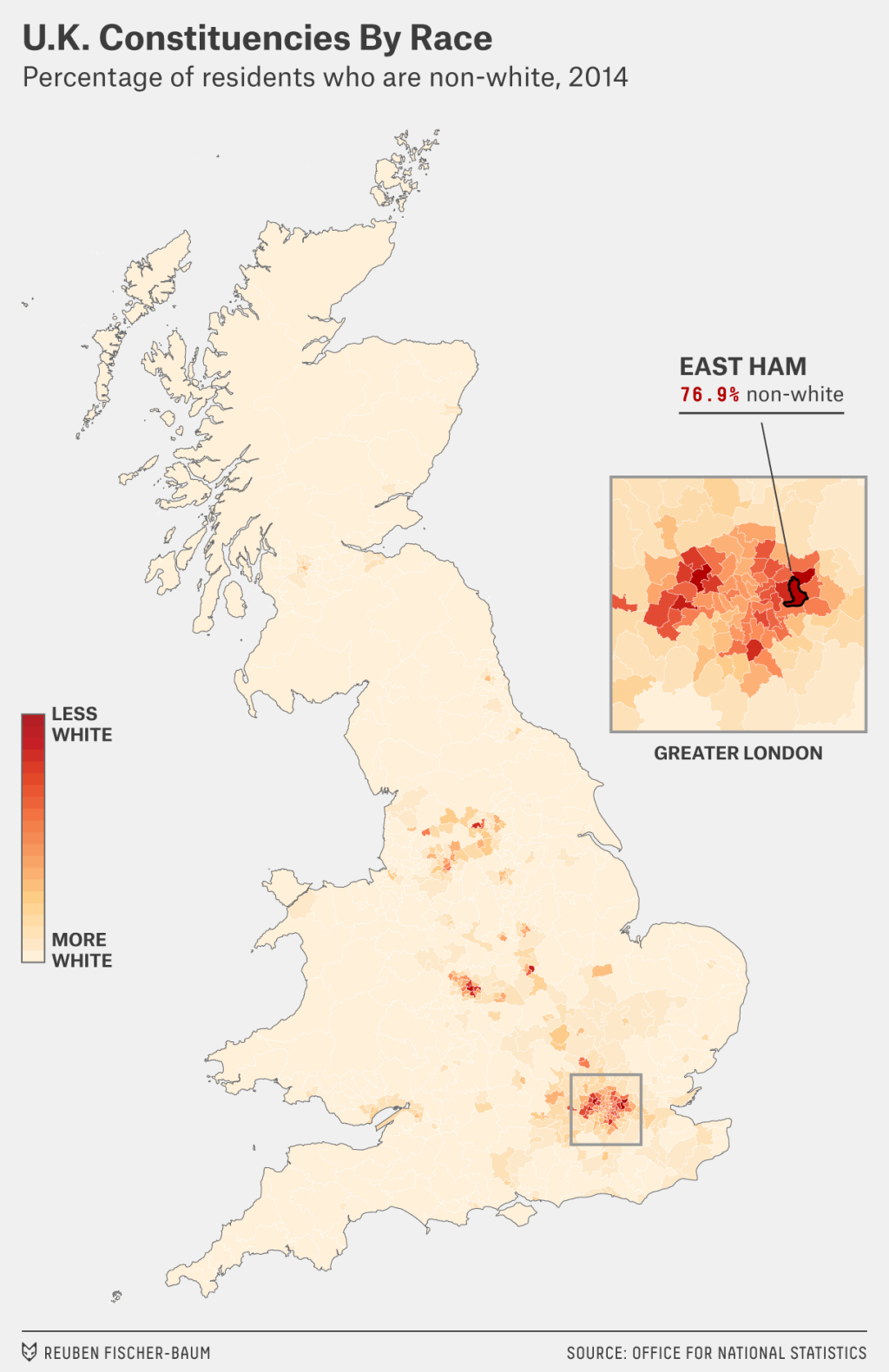
One of the safest Labour seats in Britain is its most non-white one, East Ham. It has been in Labour hands since it was formed in 1997 and will vote Labour again tomorrow in Britain’s general election. Its MP, Stephen Timms, was once stabbed by one of his constituents, Roshonara Choudhry, a 21-year-old student, who “was inspired by an al-Qaida cleric and wanted to punish Timms for voting in favor of the Iraq War”. The Labour MP downplays the incident and simply wants to represent his “diverse” ward.

Mona Chalabi writes:

There are two mosques on Church Road. I arrive at one of them just after prayers have finished one afternoon in early April, and as I peer my head around the entrance, I see a man hopping on one leg dressed in a black parking inspector’s uniform. He slips his foot into a black regulation shoe that he left on the grid of shelves that line the lobby when he went in to pray.

“Do you have time to talk to me about the election?”

“Nah, sorry,” he replies. “I’m still on my shift.”

I step back outside so that I’m not in the way of the men silently filing out of the mosque. One tall man with a round stomach slowly passes me in a beige salwar kameez, his sandals flapping behind him as he talks quietly into a cell phone. I don’t recognize the language, but I’m hardly surprised — I am, after all, in East Ham. Only 58.6 percent of people in Newham, the local authority where East Ham is found, reported English as their main language in the 2011 census, the lowest share of anywhere in England and Wales.

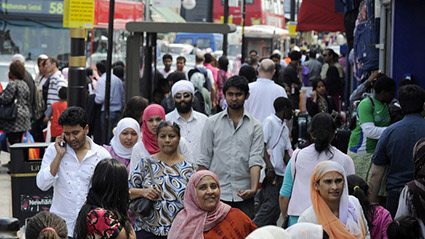
I’m here because the residents of this East London constituency make this place an outlier in a number of ways. This is the U.K.’s most ethnically diverse constituency and one of its most religious areas. It has the highest number of residents who were born abroad — 83,223, according to the 2011 census. And, according to the Office for National Statistics (ONS), 77 percent of the population here is non-white, the highest share of anywhere in the country. The median across the U.K.’s 650 constituencies is just 5.2 percent non-white.

In other words, this place sticks out statistically.

east-ham-uk-diversity3

Understanding those numbers is important in explaining why this is one of the safest Labour seats in the country. East Ham has been represented by a Labour member of Parliament (MP) since the seat was formed in 1997. In the 2010 general election, Labour won 70 percent of the vote here and is projected to win 69 percent on May 7.

But while residents here are a key part of this political continuity, they’re also in some ways the focus of calls for political change. Race and religion are rarely explicit talking points in U.K. politics, but they’re often implicit when the topic of immigration comes up — as it now so often does.

That evening, the first of two debates is aired on national television. Leaders of the seven largest political parties take to podiums to present their visions for the country, debate them and take a handful of questions from members of the audience. Race doesn’t come up once, but immigration features heavily. The politicians exchange insults about inaction and make promises about immigration policies. If those policies were different — and most of the party leaders say they should be — maybe East Ham wouldn’t look the way it does now.

In 1999, my mum started working in East Ham as a general practitioner in a National Health Service medical practice that was made up of two small terraced houses with one wall between the two knocked down. Each summer, after a few weeks of holidays had passed and the boredom had become unbearable, my best friend and I would go to the surgery to help out. We would prepare new files for new patients in a waiting area that had once been a living room. There were always new files to make because there were always new patients. Six years ago, the surgery moved to a much larger multi-story, multi-practice building half a mile away to cope with increasing demand.

Between the 1991 and 2011 censuses, the population of Newham grew 42 percent. That growth has been almost exclusively non-white, as the Centre on Dynamics of Ethnicity at the University of Manchester shows below.

eastham-chart

Newham’s largest non-white groups reported in the 2011 census were Indian (13.8 percent of people), African (12.3 percent) and Bangladeshi (12.1 percent) — but it’s a long list.3

There’s no data on race and voting patterns at the constituency level, but it’s safe to say that the high share of ethnic minorities here has driven Labour’s success in East Ham. Between May and August 2010, the Ethnic Minority British Election Study asked almost 4,000 voters nationally who they had chosen in the general election that May. Of Brits who were ethnic minorities, 68 percent supported Labour; that compares with 31 percent of whites.

RACE LABOUR CONSERVATIVE LIBERAL DEMOCRAT
African 87% 6% 6%
Caribbean 78 9 12
Bangladeshi 72 18 9
Indian 61 24 13
Pakistani 60 13 25
White 31 37 22

And religiosity in the area has probably played a role, too. Newham is the least irreligious place in the country: Only 9.5 percent of residents say they have no religion, compared with 24.7 percent in England. That’s partly because the share of the population that is Hindu is six times larger in Newham than it is at the national level — the same is true of the Muslim population.

Between February and March of last year, the British Election Study conducted a national survey on the attitudes of religious groups. Among those who said their religion was Islam, 73 percent said they would vote Labour. It’s a strikingly high figure — only 40 percent of those with no religion and 32 percent of Anglicans said they would vote Labour (the largest and second-largest groups of respondents, respectively).

FAITH LABOUR CONSERVATIVE LIBERAL DEMOCRAT UKIP
Islam 73% 15% 7% 1%
Sikhism 64 15 6 6
Hinduism 58 31 3 6
Roman Catholic 45 30 5 13
None 40 27 11 12
Buddhism 38 25 7 14
Baptist 37 32 10 16
Presbyterian 35 25 5 8
Methodist 35 41 11 10
Anglican 32 39 8 18
Judaism 30 46 5 12

Stephen Timms, who has represented East Ham in Parliament since 1994,4 is well aware that he represents an incredibly diverse constituency. He’s also probably well aware that the racial and religious makeup of his constituency has helped secure his seat as a Labour MP. But it’s not just political demographics — Timms is also well-liked by his constituents. Several people I spoke to gave examples of how he had helped them personally. He votes strongly in favor of raising welfare benefits and against reducing housing benefits, issues that are especially important in this area where 42 percent of children live in poverty.

After a string of high-profile roles, most recently as shadow employment minister, Timms, 59, is now the Labour party’s “Faith Envoy” (he took up Christianity in his teens).

But this long political career, one built on a very solid electoral majority, has not been without incident.

Just a week after re-winning his seat in the last election, Timms was stabbed twice in the stomach by a constituent at an advice surgery — a regular session for MPs to hear the concerns of the people they represent. His attacker, Roshonara Choudhry, a 21-year-old student, said she was inspired by an al-Qaida cleric and wanted to punish Timms for voting in favor of the Iraq War. Aside from giving a few interviews about it, Timms finished his most recent political term without emphasizing the attempted murder.

When I call him, hours before the first leaders debate is due to air, I ask Timms, who is seeking re-election, about race in East Ham. Timms, who is white, speaks about it comfortably.

“You’d think that a very diverse place like this was kind of, by definition, a pretty fragmented community — I actually don’t think that’s the case,” he said. “I think this is actually a quite cohesive community, and I think the reason for that is the great majority of people in this area belong to something. They belong to a church or a mosque or a temple or a gurdwara.”

A thriving religious community and a high vote share for Labour don’t mean there isn’t political debate in East Ham. The U.K. Independence Party (UKIP) has a candidate standing in East Ham who is expected to get 5 percent of the vote in this election (nowhere near enough to unseat Timms, and lower than the 11 percent median vote share that UKIP is projected to get across the U.K.). Britain’s newest political force, UKIP has the strongest stance of any party on immigration — it wants the country to get out of the EU because it believes immigration is unsustainably high.

In 2010, UKIP was politically irrelevant. But the party came in first in the 2014 European Parliament elections, which was followed by two wins in U.K. by-elections. Now, UKIP is shaping the debate on immigration — and by extension, the stakes of this election. Nationally, 27 percent of voters say immigration is the most important issue facing Britain, more than any other single issue. I told Timms that even some of the immigrants I’d spoken to in East Ham were worried that immigration was too high.

“I’m not surprised you came across that,” he said. “It is sometimes a little bit surprising to listen to someone who is clearly an immigrant complaining about immigration, but people do feel quite strongly about that. … Quite a lot of Labour supporters think this is an important issue, and they need to feel that the system is properly managed and fairly.”

The Church in East Ham is now a community centre where they play disco music, unlike in the mosques in the area that are very much used for religious purposes

From the outside, Trinity Community Centre looks like a church so typical that it could be part of a toy train set, made of plastic and placed next to the pretend railway station. I’m greeted in the hallway by a suited Sikh man in a turban holding a clipboard. I tell him that I’m looking for the advice surgery. Only the staff is here today — with the election just five weeks away, Timms is busy with “other commitments.”

Someone somewhere is playing the 1994 disco hit “U Sure Do” by Strike very, very loudly. Over the man’s shoulder, I can see through a glass window — streamers hang from the ceiling, and balloons float between adults and children. I ask if it’s a birthday party, and he tells me that it’s a therapy group for children with disabilities.

A lot of community support groups meet here. If I had arrived at another time or on another day, I might have bumped into Dost, a service for refugee, asylum-seeking, trafficked, undocumented or new migrants between the ages of 11 and 25. Or I might have seen one of the adult education classes or stumbled across Bayaan, a support group that encourages young Asian girls to get into higher education.

The man with the clipboard points above his head: “The advice surgery is upstairs.”

About a dozen constituents sit on pews, waiting to speak to a member of Timms’s staff. I’m keen to hear what they think about UKIP. People here don’t all agree about UKIP; some say the party is racist, some say the party has a point on immigration, but most of these constituents tell me they will vote Labour.

There’s no data on support for UKIP by race either nationally or at the constituency level, but there is evidence that many voters are concerned about the party’s racial politics. In a survey last May, 41 percent of people said they believed UKIP was a racist party and 46 percent said they believed UKIP was “deliberately trying to attract support from racist voters.” The Guardian recently reported that “Are UKIP racist?” was the most common Google search about the party in March.

UKIP’s public policies don’t use xenophobic language, but the party’s general position on immigration and a string of racist incidents involving UKIP members can leave British voters straining for subtext.

Given all that, it seems unlikely that UKIP will be able to win over ethnic minorities in East Ham or elsewhere in Britain. But that doesn’t mean Labour can be complacent about these voters. Britain’s political landscape has changed quite rapidly — established parties now have a smaller share of the vote, and new parties like UKIP are no longer irrelevant players.

If another party emerges that can successfully disentangle race and immigration, presenting itself as neither xenophobic nor lax on border control, Labour could be in real trouble. In 2010, the party won 79 seats with a margin of victory of less than 5 percentage points. In 19 of those seats, over a quarter of the population was non-white.5 Those seats matter; they could make the difference between being in government and being out of it. Parties that want power would do well to not neglect the voters who live in places like East Ham. – Mona Chalabi for fivethirtyeight.com

How America became an Oligarchy

American democracy no longer exists

According to a new study from Princeton University, American democracy no longer exists. Using data from over 1,800 policy initiatives from 1981 to 2002, researchers Martin Gilens and Benjamin Page concluded that rich, well-connected individuals on the political scene now steer the direction of the country, regardless of – or even against – the will of the majority of voters. America’s political system has transformed from a democracy into an oligarchy, where power is wielded by wealthy elites.

“Making the world safe for democracy” was President Woodrow Wilson’s rationale for World War I, and it has been used to justify American military intervention ever since. Can we justify sending troops into other countries to spread a political system we cannot maintain at home?

The Magna Carta, considered the first Bill of Rights in the Western world, established the rights of nobles as against the king. But the doctrine that “all men are created equal” – that all people have “certain inalienable rights,” including “life, liberty and the pursuit of happiness” – is an American original. And those rights, supposedly insured by the Bill of Rights, have the right to vote at their core. We have the right to vote but the voters’ collective will no longer prevails.

In Greece, the left-wing populist Syriza Party came out of nowhere to take the presidential election by storm; and in Spain, the populist Podemos Party appears poised to do the same. But for over a century, no third-party candidate has had any chance of winning a US presidential election. We have a two-party winner-take-all system, in which our choice is between two candidates, both of whom necessarily cater to big money. It takes big money just to put on the mass media campaigns required to win an election involving 240 million people of voting age.

In state and local elections, third party candidates have sometimes won. In a modest-sized city, candidates can actually influence the vote by going door to door, passing out flyers and bumper stickers, giving local presentations, and getting on local radio and TV. But in a national election, those efforts are easily trumped by the mass media. And local governments too are beholden to big money.

When governments of any size need to borrow money, the megabanks in a position to supply it can generally dictate the terms. Even in Greece, where the populist Syriza Party managed to prevail in January, the anti-austerity platform of the new government is being throttled by the moneylenders who have the government in a chokehold.

How did we lose our democracy? Were the Founding Fathers remiss in leaving something out of the Constitution? Or have we simply gotten too big to be governed by majority vote?

Democracy’s Rise and Fall

The stages of the capture of democracy by big money are traced in a paper called “The Collapse of Democratic Nation States” by theologian and environmentalist Dr. John Cobb. Going back several centuries, he points to the rise of private banking, which usurped the power to create money from governments:

The influence of money was greatly enhanced by the emergence of private banking. The banks are able to create money and so to lend amounts far in excess of their actual wealth. This control of money-creation . . . has given banks overwhelming control over human affairs. In the United States, Wall Street makes most of the truly important decisions that are directly attributed to Washington.

Today the vast majority of the money supply in Western countries is created by private bankers. That tradition goes back to the 17th century, when the privately-owned Bank of England, the mother of all central banks, negotiated the right to print England’s money after Parliament stripped that power from the Crown. When King William needed money to fight a war, he had to borrow. The government as borrower then became servant of the lender.

In America, however, the colonists defied the Bank of England and issued their own paper scrip; and they thrived. When King George forbade that practice, the colonists rebelled.

They won the Revolution but lost the power to create their own money supply, when they opted for gold rather than paper money as their official means of exchange. Gold was in limited supply and was controlled by the bankers, who surreptitiously expanded the money supply by issuing multiple banknotes against a limited supply of gold.

This was the system euphemistically called “fractional reserve” banking, meaning only a fraction of the gold necessary to back the banks’ privately-issued notes was actually held in their vaults. These notes were lent at interest, putting citizens and the government in debt to bankers who created the notes with a printing press. It was something the government could have done itself debt-free, and the American colonies had done with great success until England went to war to stop them.

President Abraham Lincoln revived the colonists’ paper money system when he issued the Treasury notes called “Greenbacks” that helped the Union win the Civil War. But Lincoln was assassinated, and the Greenback issues were discontinued.

In every presidential election between 1872 and 1896, there was a third national party running on a platform of financial reform. Typically organized under the auspices of labor or farmer organizations, these were parties of the people rather than the banks. They included the Populist Party, the Greenback and Greenback Labor Parties, the Labor Reform Party, the Antimonopolist Party, and the Union Labor Party. They advocated expanding the national currency to meet the needs of trade, reform of the banking system, and democratic control of the financial system.

The Populist movement of the 1890s represented the last serious challenge to the bankers’ monopoly over the right to create the nation’s money. According to monetary historian Murray Rothbard, politics after the turn of the century became a struggle between two competing banking giants, the Morgans and the Rockefellers. The parties sometimes changed hands, but the puppeteers pulling the strings were always one of these two big-money players.

In All the Presidents’ Bankers, Nomi Prins names six banking giants and associated banking families that have dominated politics for over a century. No popular third party candidates have a real chance of prevailing, because they have to compete with two entrenched parties funded by these massively powerful Wall Street banks.

Democracy Succumbs to Globalization

In an earlier era, notes Dr. Cobb, wealthy landowners were able to control democracies by restricting government participation to the propertied class. When those restrictions were removed, big money controlled elections by other means:

First, running for office became expensive, so that those who seek office require wealthy sponsors to whom they are then beholden. Second, the great majority of voters have little independent knowledge of those for whom they vote or of the issues to be dealt with. Their judgments are, accordingly, dependent on what they learn from the mass media. These media, in turn, are controlled by moneyed interests.

Control of the media and financial leverage over elected officials then enabled those other curbs on democracy we know today, including high barriers to ballot placement for third parties and their elimination from presidential debates, vote suppression, registration restrictions, identification laws, voter roll purges, gerrymandering, computer voting, and secrecy in government.

The final blow to democracy, says Dr. Cobb, was “globalization” – an expanding global market that overrides national interests:

[T]oday’s global economy is fully transnational. The money power is not much interested in boundaries between states and generally works to reduce their influence on markets and investments. . . . Thus transnational corporations inherently work to undermine nation states, whether they are democratic or not.

The most glaring example today is the secret twelve-country trade agreement called the Trans-Pacific Partnership. If it goes through, the TPP will dramatically expand the power of multinational corporations to use closed-door tribunals to challenge and supersede domestic laws, including environmental, labor, health and other protections.

Looking at Alternatives

Some critics ask whether our system of making decisions by a mass popular vote easily manipulated by the paid-for media is the most effective way of governing on behalf of the people. In an interesting Ted Talk, political scientist Eric Li makes a compelling case for the system of “meritocracy” that has been quite successful in China.

In America Beyond Capitalism, Prof. Gar Alperovitz argues that the US is simply too big to operate as a democracy at the national level. Excluding Canada and Australia, which have large empty landmasses, the United States is larger geographically than all the other advanced industrial countries of the OECD (Organization for Economic Cooperation and Development) combined. He proposes what he calls “The Pluralist Commonwealth”: a system anchored in the reconstruction of communities and the democratization of wealth. It involves plural forms of cooperative and common ownership beginning with decentralization and moving to higher levels of regional and national coordination when necessary. He is co-chair along with James Gustav Speth of an initiative called The Next System Project, which seeks to help open a far-ranging discussion of how to move beyond the failing traditional political-economic systems of both left and Right..

Dr. Alperovitz quotes Prof. Donald Livingston, who asked in 2002:

What value is there in continuing to prop up a union of this monstrous size? . . . [T]here are ample resources in the American federal tradition to justify states’ and local communities’ recalling, out of their own sovereignty, powers they have allowed the central government to usurp.

Taking Back Our Power

If governments are recalling their sovereign powers, they might start with the power to create money, which was usurped by private interests while the people were asleep at the wheel. State and local governments are not allowed to print their own currencies; but they can own banks, and all depository banks create money when they make loans, as the Bank of England recently acknowledged.

The federal government could take back the power to create the national money supply by issuing its own Treasury notes as Abraham Lincoln did. Alternatively, it could issue some very large denomination coins as authorized in the Constitution; or it could nationalize the central bank and use quantitative easing to fund infrastructure, education, job creation, and social services, responding to the needs of the people rather than the banks.

The freedom to vote carries little weight without economic freedom – the freedom to work and to have food, shelter, education, medical care and a decent retirement. President Franklin Roosevelt maintained that we need an Economic Bill of Rights. If our elected representatives were not beholden to the moneylenders, they might be able both to pass such a bill and to come up with the money to fund it.

Ellen Brown is an attorney, founder of the Public Banking Institute, and author of twelve books including the best-selling Web of Debt. Her latest book, The Public Bank Solution, explores successful public banking models historically and globally.