Farm murders, white genocide and RedOctober

Kevin_Kingby Kevin King

[followbutton username=’djkevking’ count=’true’ lang=’en’ theme=’light’]

“Every action has an equal but opposite reaction” – Sir Isaac Newton

In life, actions (physical or otherwise) also have reactions.  Somehow, an unknown number of actions, reactions and re-reactions got us to where we are today, causing this RedOctober march, the allegations of white genocide and outrage over farm murders.  A large section of social media describes these activists and supporters as racists, without questioning how we got to this point.  I’ll attempt to apply Stephen Covey’s 5th Habit of Highly Successful People, “Seek first to understand, then to be understood”, so doing some research before shouting insults and proclaiming these people to be racists.

Crime

I’ve written numerous articles about crime on this country, so I’ve done a lot of research.  Hopefully all the readers will know that we are the crime capital of the world.  If you need reminding, here’s our wall of shame, 1994 to 2012:

  • 376,627 reported murders (57 per day)

  • 597,900 reported homicides (91 per day)

  • 443,551 reported attempted murders (67 per day)

  • 4,175,178 reported serious assaults (635 per day)

  • 1,111,425 reported rapes (169 per day)

  • 22,228,500 estimated rapes (3,383 per day)

Our crime is at crisis levels, no doubt, and with these high levels it’s impossible that every region, race, sex, group, religion etc is not affected.

Hate crime vs normal crime

It seems that a large number of RedOctober detractors are using the “crime affects all” reasoning for shooting down RedOctober.  With the extreme levels of crime in our country it would be easy for hate crime to be hidden in the enormous sea of crime that taking place.  Taking this “crime affects us all” approach would mean denying the existence of hate crime, which is absurd.  Besides the fact that hate crime is difficult to identify, quantify and prove there is an obvious difference between hate crime and normal crime.  The latter lacks the element of hatred by the perpetrator(s) towards the victim(s) and the level of violence is often exaggerated.  I never really thought about how the psychological effects would vary, so I did some research.   According to research, hate crimes have more serious psychological effects than other crime.  Also, survivors of hate crime show more signs of psychological distress than survivors of non-biased crime and this distress was found to last longer in hate crime survivors due to the fact that the crime leaves lasting feelings of personal danger and vulnerability associated with their identity.  A high level of outrage would thus make sense, as members of the victim’s group would feel this same personal danger and vulnerability that the victim felt.

So we’ve seen outrage by Afrikaner groups over social media, we’ve seen the RedOctober march taking place, all against farm murders in particular.  While these Afrikaners may speak a different language to us, be a different colour to the majority of the country, have different interests and cultures, they are not immune to the same feelings of vulnerability and persecution that all other groups affected by hate crimes feel.  In other words, they are also human.  The next big question would then be:  Are these feelings of vulnerability and persecution, which is causing their reaction of outrage, justified or merely perceived?

These activists present a long list (thousands) of victims murdered on their farms in interracial murders, and they claim that the murder rate on farms is far higher than the national average.  Now without going into the actual numbers, because I feel they are irrelevant for purposes of this discussion, I’d like to make a few points:

  • A number like this can create a perception

  • The aggravating circumstances surrounding these attacks strengthens the perception

  • However, proving hate crime on an individual basis is near impossible, as will be further discussed in the next paragraph, which can strengthen critics’ claims that the perception is false

Proving and prosecuting hate crime

South Africa is set to bring into law the Hate Crimes Bill in 2014.  Long overdue to say the least, the Bill is set to address how hate crime is tried and prosecuted.  What may be a first for our country is old news for many first world countries like the USA, which has several hate crimes statutes.  But even with all their legislation, they have serious challenges in proving that a crime is hate crime, especially proving racial motives.  The (US) Journal of Criminal Law and Criminology contains a discussion as to why this difficulty exists, and these same reasons are relevant in our context.

  • “The fact that an individual’s motive lies peculiarly within his or her knowledge undermines the ability of prosecutors and plaintiffs to prove racist motives in hate crimes cases”

So without the accused’s own admission, it is virtually impossible to prove hate crime.  Prosecutors will have to rely on circumstantial evidence.  Other difficulties in proving motive are:

  • “Inferences about motive which are drawn from circumstantial evidence may be highly inaccurate given the inherent ambiguity of motive itself” – The defendant may have acted out of paranoia rather than racism

  • “Multiple motives may impel an individual to act” – The defendant may claim that he or she acted out of some other motivation

To sum up the document:  “Prosecutors often find it impossible to demonstrate by proof beyond a reasonable doubt that the accused acted out of racist motives”.  These are the exact same problems that RedOctober activists like Steve Hofmeyr face when pushing their cause, and the exact same problem our courts will face when the Hate Crimes Bill comes into force.

There are cases that pop up which are undoubtedly hate crime such as the Rawstorne family murder by William Kekana, who testified that he brutally wiped out the family “because they were white”, or the Lotter women murders where the perpetrators left behind their motive, “Kill the Boer” daubed in the victims’ blood.  These cases further strengthen the perception that many other farm murders have a racial motive behind them but these cases are generally ignored by critics.  Activists thus have an uphill battle to prove hate crime when motive is so difficult to prove for the vast majority of cases.  But although the motives behind hate crime are almost impossible to prove in court, it is very successfully proven outside of court.

The media and social media commentators (SMC’s)

In most cases of interracial violence and cases involving violence against minorities, the media and SMC’s are quick to attach a motive to the crime, classifying the crime as a hate crime.  These accusations are deemed to be true by consumers as if the motive was actually proven in a court of law.  Also, the media and SMC’s tend to be very inconsistent when classifying crimes as hate crimes, creating the impression amongst some that they are biased or trying to censor.  To give an example:

  • A recent case of a horrific rape and murder of a lesbian.  The media and SMC’s immediately classified the crime as a corrective rape hate crime, although no anti-gay motive was obtained from the perpetrator.  The motive was assumed because the victim was lesbian and due to the aggravating circumstances.

  • A recent case of a brutal torture and murder of an elderly farm couple.  Although this was an interracial crime and aggravating circumstances existed, the media and SMC’s declined to attach a racial motive to the crime.

When the latter is called a “racist farm murder” or “white genocide”, critics are quick to claim “crime affects all”, “we have a high murder rate so obviously these farmers will be murdered” and “farmers are more vulnerable because they are isolated” etc.  Then why is it that when a lesbian is raped it’s called “corrective rape”?  Doesn’t “crime affect us all”?  When we have over 3000 rapes per day isn’t it obvious that lesbians will also be victims of rape?  Are lesbians not vulnerable because men are usually more powerful and often hunt their victims in packs?  Yet both cases are not treated the same.

Pure double standards in my book and most probably one of the reasons why the likes of Steve Hofmeyr go to extreme lengths to protest and create awareness regarding farm murders and white genocide.

White genocide

Just to touch on the main misconceptions about genocide:

  • Numbers don’t matter.  According to the definition of genocide, “an individual criminal may be guilty of genocide even if he kills only one person, so long as he knew he was participating in a larger plan to destroy the group [or part of a group]”.

It only takes ONE individual to kill ONE person, if that individual knew he was participating in a larger plan to destroy the people.  That means that if only ONE individual interprets a statement like “Shoot the Boer” by his commander and chief for instance, to be an order to commit genocide and acts on it, that individual will be guilty of committing genocide, plain and simple.

There are indicators that genocide could be happening on a larger scale, for example, widespread rape, torture and executions of Afrikaners on their farms, with perpetrators stealing few or no valuables.  However the existence of an organised plan to commit genocide is unknown and will be extremely difficult to prove.  Regardless, individuals can be perpetrators of genocide by definition.  In the two cases I mentioned before, the Rawstorne family and the Lotters, it can easily be debated that these are cases of genocide.  After a healthy debate, you will at best prove that these cases are racist hate crimes, which I’m afraid is not much worse than genocide.

Conclusion

There are a high number of Afrikaners being murdered on their farms.  Often there is rape and torture involved and in many cases nothing is stolen.  There are numerous death threats posted on Facebook, Twitter and even at political rallies, mostly directed at this group.  On top of this, there are cases where the racist motive cannot be denied.  Although few of these cases exist, they further strengthen the perception that farm murders in general are racially motivated and that white genocide may exist.  There is clear evidence for the Afrikaner minority group to feel vulnerable and threatened and it appears that their fears and outrage of unjustly treated by the media, social media commentators and even the government.  Besides the compelling evidence in their favour, even their human nature is criticised and they are persecuted for this.

 [followbutton username=’djkevking’ count=’true’ lang=’en’ theme=’light’]

Boeremag show trial exposes South African legitimation crisis

roodt_dan_wiki

by Dan Roodt

[followbutton username=’danroodt’ count=’true’ lang=’en’ theme=’light’]

Like Dan Roodt’s Facebook page

The exceedingly harsh sentences handed down by Judge Eben Jordaan in the Boeremag trial have had a mixed reception in South Africa. On the one hand, members of the black elite and the white neo-Marxist Left have reacted with unbridled Schadenfreude. On the other, patriotic Afrikaners – while not agreeing with the Boeremag’s reasoning or methods – have nonetheless evinced instinctive sympathy with them and their long-suffering families.

Jordaan has taken a very formalistic approach to the South African constitution and the country’s recent history, refusing to see the many mitigating factors that would have elicited more humane sentences.

First of all, only one person died as a result of the Boeremag explosions, some distance away from the scene. This was rightly seen by the court as a case of culpable homicide. As first offenders, in a country where even the most sadistic child murderers get released after ten years, it should not have carried a heavy penalty.

The many outlandish elements of the trial were no doubt included by the state in its evidence for the maximum propaganda effect. How could fewer than two dozen white men ever hope to displace thousands of South African blacks, let alone the whole population of forty million?

However, the most important factor that detracts from the guilt of the Boeremag trialists was the intimate involvement of state agents who did not attempt to dissuade them from pursuing their attempts at sabotage but in fact encouraged them. Not so long ago there was a similar “sting” operation in Germany during which the secret service or Verfasssungsschutz had infiltrated both the NDP, a political party and a group known as Sturm 34 which was at one point led by a government agent. German courts rejected governmental attempts to ban the NDP due to its heavy infiltration by state agents, finding that responsibility between the state and illegal political activity had actually blurred. In the USA too, courts take a dim view of overzealous state agents who “persuade” citizens to break the law.

Many people claim or suspect that the state organised the Boeremag “rebellion” in order to “mop up” right-wing dissidents. The detailed and incriminating “Document 12” was apparently supplied to the Boeremag members by the state who, through its agents, was intimately involved in so-called “strategic planning”.

The extreme, dehumanising violence associated with South African farm murders acted as a trigger for the Boeremag’s activities. One could argue that under conditions of lawlessness and violence, men are more easily persuaded to answer violence with violence. Certainly that is the line taken by Nelson Mandela and his fellow accused at the Rivonia trial who saw their sabotage campaign as justified by the police shooting at Sharpeville.

This leads to another problem of post-1994 South Africa to which Judge Eben Jordaan has not been attentive: violence is often seen as a legitimate vehicle for political objectives. With the exception of Clive Derby-Lewis and Eugene de Kock, among others, those who had committed acts of terror prior to 1994 were all amnestied by the Truth and Reconciliation Commission. Even the cold-blooded murderers of Amy Biehl were exonerated by the TRC because they supposedly killed her for “political reasons”.

So-called “democracy” has not led to a pacification of the South African population. There are more riots by South Africa’s black population now than ever under so-called “apartheid”. Together with farm attacks and house robberies, the general instability produces a climate of fear and insecurity that engender radical ideas like secession, rebellion or insurrection. In this respect, South Africa is a victim of the notion that it is “just another decolonising African country” that must be “liberated” through the kind of cleansing violence described by a theorist such as Franz Fanon.

During sentencing, Judge Eben Jordaan described South Africa as a constitutional democracy. But does that stand up to scrutiny? During the negotiations in the early 1990s, one of the objectives of the Slovo-Mandela camp was to disenfranchise ethnic Afrikaners. Both provinces and towns were demarcated in such a way that not a single area of the country is ruled by Afrikaners who have been here for 360 years. The largest concentration of Afrikaners in the country, Pretoria and environs where about 500 000 of them live, does not even control a local government and are made to undergo unpopular decisions, including humiliating name changes.

While not condoning sabotage and terrorism, at least the disenfranchisement of the Afrikaner national minority should have been taken into account in judging the actions of the Boeremag accused.

There is a further paradox in South Africa: Violence and terror are eulogised by the media, politicians and historians, as long as such violence was committed against whites or against Afrikaners. Both Communist Party leader  Joe Slovo and Nelson Mandela, who had ordered the Church Street bomb and other horrific attacks on civilians, are presented as “good men” who had selflessly fought for freedom. In Amanzimtoti, terrorist  Andrew Zondo who had placed a bomb in a shopping centre full of Christmas shoppers on 23 December 1985, has had the main street of the town named after him, in the very place where victims and relatives still nourish the wounds of their nightmare experience.

We see then that the South African state is increasingly suffering a legitimation crisis caused by:

  • the effective disenfrenchisement of the Afrikaner minority;
  • corruption and profligacy at all levels of government;
  • a plethora of racial laws limiting the employment and educational opportunities of Afrikaners, in the name of “affirmative action” for the majority;
  • physical insecurity which is only mitigated to some extent by private security companies, neighbourhood watches and so on;
  • anti-white and anti-Afrikaner rhetoric by leading ANC political figures;
  • the deterioration of infrastructure such as roads, electricity and water supply, as well as state hospitals where many whites are simply left to die without proper care;
  • systemic cultural and language discrimination, with Afrikaans schools and universities under attack by government bureaucrats and ANC politicians;
  • the impending radical land reform which could plunge the country into Zimbabwe-style famine and chaos;
  • the general perpetuation of communist/Marxist ideas in South Africa that have lost their legitimacy or attraction elsewhere in the world.

If the Boeremag trial had lasted six months and the accused had been sentenced in 2003 or 2004, shortly after their arrest, probably the Afrikaans public would have seen them simply as extremists out of touch with the new reality of ANC rule. However, given the protracted length of the trrial and the changing perceptions of our much-lauded “democracy”, public sympathies for the accused have definitely been in the asendance, even among those law-abiding middle-class Afrikaners who accept the fait accompli of National Party capitulation and a concomitant loss of Afrikaner sovereignty.

Afrikaner history is replete with martyrs after unsuccessful rebellions who received harsh treatment from a hostile government. There was the infamous death by firing squad suffered by Jopie Fourie on 20 December 1914, but also the Slagtersnek hangings of 1816 that gave rise to the Great Trek inland from the Cape.

Judge Eben Jordaan may just have given Afrikaners another Slagtersnek, apart from adding to the legitimation crisis of the current South African regime.

[followbutton username=’danroodt’ count=’true’ lang=’en’ theme=’light’]

Like Dan Roodt’s Facebook page

Red October march calls for end to black violence

Sunette Bridges
Sunette Bridges

Almost 600 Afrikaners marched on the Union Buildings on Thursday to protest white genocide. The Red October group released hundreds of red balloons to mark the day while calling for tolerance and warned against hate speech and racism.

The mostly white Afrikaner group, organised by Afrikaans singer Sunette Bridges, delivered a memorandum calling for an end to black-on-white violence and what it termed reverse racial discrimination in education and employment.

“We are not denying that they are being murdered, but they are not being murdered by white people,” said Bridges, when asked why the focus was on white, and especially farm, murders. “And if they were murdered by white people, the international community would have an absolute freak-out.”

The group and its organisers had come under fire from other Afrikaans constituencies for appropriating a traditionally communist slogan for its name on what in previous years had been celebrated as Kruger Day, the birthday of Boer resistance leader Paul Kruger.

Organisers said they were fighting for the rights of minorities, and not protesting black rule.

“Everyone is welcome here,” said popular Afrikaans singer Steve Hofmyer, who acted as a celebrity draw card for the event. “We march to prove that there are South Africans left who won’t acclimatise to the sub-standard.”

Despite arguments that the event was intended to advance minority rights in general, the focus was very much on the rape and murder of white people by black people, something organisers did not shy away from characterising as genocide.

Hofmyer said white people faced an exaggerated threat.

“Immaterial of the statistics, we are not used to this mortality rate, we are not used to being raped in these numbers,” he said.

Crime affects everyone in South Africa, he told the crowd, but Afrikaners had the right to count their own dead. “If we say all deaths should be counted, why do we count the rhinos and not count all dead animals?”

Dr Dan Roodt from Praag said Afrikaners had been disenfranchised and were not allowed to have their own municipalities even in towns and cities where they were the majority population.

“As someone said, even in the reserves, American Indians are permitted to run their own affairs,” he stated. “Yet we are universally denied any say in the running of the country our forefathers built.”

Dr Roodt
Dr Dan Roodt


RO5
Her placard says it all…


Red balloons against the Union Buildings, seat of South Africa's government
Red balloons against the Union Buildings, seat of South Africa’s government


During the march, the crowd sang Afrikaans folk songs such as 'Sarie Marais', 'Die lied van jong Suid-Afrika', 'Oukraalliedjie', 'Bobbejaan klim die berg' and many others.
During the march, the crowd sang Afrikaans folk songs such as ‘Sarie Marais’, ‘Die lied van jong Suid-Afrika’, ‘Oukraalliedjie’, ‘Bobbejaan klim die berg’ and many others.


Famous Afrikaans singer Steve Hofmeyr being interviewed by the media


This protestor simulated some wounds
redOctober3
Most liberal pundts denounced the protest as ‘racist’ for being white, but the march in Cape Town contained a few people of colour


Rising red balloons signified the end of the protest in Pretoria


On the prejudices of ‘progressives’

roodt_dan_wiki

by Dan Roodt

[followbutton username=’danroodt’ count=’true’ lang=’en’ theme=’light’]

Like Dan Roodt’s Facebook page

My first question upon reading this sorry little ego trip from a Daily Maverick columnist who obviously thinks she deserves the Nobel prize for literature in a few days, is: Why don’t you go back to the UK where you spent 14 halcyon years? Why return to this backward country where English is mostly a second language to everyone – even to people like you who are hardly on the English peerage list – and therefore in various states of creolisation, pidginisation, etc.?

Many sub-editors and journalists at English-language newspapers in this country are actually Afrikaners. Maybe you should go on a campaign and get them fired and replaced by born-and-bred Englishmen?

Recently the Coloured champion of English and anglicisation in South Africa, Jonathan Jansen, claimed that “English will unite us”, where Afrikaans divided us, or some such lunatic fallacy. The truth is that English, like any language, unites as well as divides. In the UK, the British class system has created almost two worlds, an upper class gossiped about in the tabloid press and an anomic, drug-ridden white underclass whose children pass out in public places as reported here.

In the USA, which until recently used to be an English-speaking country, there is the Mason-Dixon line which no longer exists politically, but which still defines two cultures. The New York Times regards Southern identity with the same suspicion as a Soviet commissar would look upon stirrings of nationalism in any satellite state. We Afrikaners have a lot in common with Southern Americans, having lost an important war in the nineteenth century but also being puritans and Calvinists. The other day I read a comment by the Austrian intellectual Erik von Kuehnelt-Leddihn describing American folk music, especially country, as Calvinist and I must admit, he is right! The contemptuous American-liberal view of “red-state fascism” corresponds very much to the Johannesburg leftist’s supercilious “interest in the oddities of post-Apartheid whiteness”, as Nicky Falkof puts it.

To me English is also a foreign language, like French. But I really love reading books in French and even sometimes, more rarely, in English. When a black taxi knocked me over on my bicycle in DF Malan Drive a few years ago, I lost a lot of what Falkof would call my white skin, and spent a week immobile on my side. To ease the pain and discomfort, I read three Jean Echenoz novels and I think his quirky, ironic prose anaesthetised me a little and took my mind away from my immediate inability to even get up and go to the toilet without help.

I have never come across a Frenchman or -woman who held me in contempt because I was not a mother-tongue writer of French. Yet, Nicky Falkof, this is what you seem to be doing: you despise people who do not happen to be “to the manner born”, to quote J.P. Donleavy. I gather you were raised in some deep corner of Houghton where anglophilia was part of your noble upbringing.

By implication you are also saying that Afrikaners like Sunette Bridges and others are foreigners because they do not speak or write British English properly. The theme of alienation, becoming-foreign in the land of one’s birth – my forebears only came here in 1701 so I have not been properly naturalised as a “South African” – is one that really interests me. We named most of the country’s towns and cities, yet we are now seen as strangers. Farm murders are also an expression of xenophobia because, at least since the revolution, Afrikaners are considered foreigners or settlers, as Thabo Mbeki, Ruth First and many others have assured us.

That said, and being a foreigner/stranger, an “étranger” – if you know the famous novella by Albert Camus bearing that title, you will understand the existential alienation concomitant with being “not of this place”, the RSA, which is now oh so English – I cannot say that I know too much about your exalted language.

Yet the one thing I do know about South African English is that it is really horrible, lacking in aesthetic sense and coherence. Even mother-tongue speakers – although that might be a contradiction in terms – make lots of mistakes all the time and of course spelling and grammar have fallen by the wayside since the revolution and Kader Asmal importing something called “outcomes-based education”. Have you heard how blacks speak English? Have you seen how some of them write it, even ones with university degrees? Because it is not their own language, but also because since 1994 they have had sub-Bantu education. Maybe you should apply some of your heart-felt linguistic snobbery there?

Or is it not politically correct to put blacks down on account of their English style, but in relation to those local whites who object to being killed, tortured and raped, it is almost de rigueur?

Your other concern, that these hapless non-English are not amenable to being manhandled and executed by Foucauldian freedom fighters, and are actually usurping the register of genteel leftist diction, might be more problematic than you think. You describe it as “a ham-fisted attempt at adopting progressive discourse”.

First of all, I regard as ham-fisted the attempts by English people such as yourself to adopt some kind of local identity. Why does Woolworths sell boerewors and koeksisters? Why are you not proud to say that you are English, hoist the Union Jack or preferably the St. George’s Cross, and leave us in our benighted enjoyment of sosaties and pap, dubious Afrikaans poetry and popular songs, including Steve Hofmeyr, much like British peers on a visit to Africa would gaze from a distance at the dancing natives in colonial times?

At its simplest level: why do you want to correct our grammar? Lately, you or your underlings have even taken to correcting Afrikaans grammar, something about which you know absolutely nothing.

At a more theoretical level – and this might be another primitive display of non-English mores, as we are straying from “common sense” now – what you call “progressive discourse” probably means some variation of Marxism. To the extent that Karl Marx used Hegel and German indealism to construct his little dogma of the class struggle, we “naive people of the veld” could level exactly the same accusation at you “progressives”: Why did you pollute Hegel with your quasi-religious social eschatology? Progressivism in itself stands revealed as a perverted – more precisely perverse, even in a sexual sense – form of idealism.

By the way, the expression “naive people of the veld” is derived from a statement made by Gillian Slovo, the daughter of South African Communist Party leader Joe Slovo who characterised all of Afrikaans culture, everything from Eugène Marais to Mimi Coertse or Arnold van Wyk, I suppose, as “the naive culture of the veld”. Gillian Slovo is English enough to remain in London and I sometimes wonder when all you “progressives” will follow her example.

Being “naive people of the veld”, we find some things difficult to understand. The cognitive limitations of the proverbial “dumb Dutchman”… One is the depths of sadism that the freedom fighters stoop to in their orgies of killing in rural areas, but sometimes in the cities too. The mutilation of the victim’s body is supposed to be a sign of clinical sadism, so we are not being semantically naive in referring to it as sadism.

The second conundrum is the depths of “progressive” contempt for our “naive culture of the veld”, our language, music, architecture, cuisine, art, literature, place names, and so on. How do we explain that contempt, even apart from the “progressive” penchant for everything British and colonial?

Is there some innate or structural connection between the sadism of the “natural born killers” stalking the countryside and the “progressive” need for humiliating, putting down and ultimately affirming a cultural and perhaps even racial superiority on the part of the cultural-Marxist nobility that rules the roost in South Africa, particularly in the media and the universities?

A phenomenon of which, needless to say, Nicky Falkof has just given us an exemplary demonstration.

[followbutton username=’danroodt’ count=’true’ lang=’en’ theme=’light’]

Like Dan Roodt’s Facebook page

Bantu imperialism

roodt_dan_wiki

by Dan Roodt

[followbutton username=’danroodt’ count=’true’ lang=’en’ theme=’light’]

Like Dan Roodt’s Facebook page

I was still pondering the implications of “black colonialism” as set out in a previous column when it struck me that some of South Africa’s ethnic categories are completely wrong.

Afrikaners were the first group in the country to refer to themselves as “Africans”, as long ago as 1707 when Hendrik Biebouw said: “Ik ben een Afrikaander.” However, today Afrikaners have been defined as an out-group by South African legislation that simply classes them as “whites”.

Most of our affirmative-action legislation has been imported from the USA and BEE is just an adapted form of what is called “minority procurement” over there. So there is nothing “African” about the current race-classification system!

In German, “Afrikaner” means simply “African”, yet the current laws define Afrikaners as Europeans. The ultimate irony is that ANC and especially SACP ideology has been constructed by recent immigrants from Lithuania (like Joe Slovo) and, of course, Britain.

Imposing racial quotas on everything from the medical schools at Afrikaans universities to the Blue Bulls rugby team is bad enough. But stripping us of our age-old Africanness by legislative fiat represents the ultimate insult, making us interlopers in our own country.

Searching for answers, I reread Thabo Mbeki’s “I am an African” speech, but it is simply a fanciful restatement of American multiculturalism, with echoes of (Swedish) Gunnar Myrdal’s “melting pot” idea. So nothing “African” there, either.

We urgently need to bring back the term “Bantu” and I have begun to recommend its use on social media and everywhere else. There seems to be a certain squeamishness about using this word, meaning “people”, which is unfathomable. Even the famous Xhosa definition of “ubuntu” contains it: “Ubuntu ungamntu ngabanye abantu.”

Anthropologists, linguists and other people in need of proper definitions have never stopped referring to the “Bantu peoples”, “Bantu languages”, etc. Even Bantu education has been rehabilitated by such leading authorities as Dr. Mamphela Ramphele and a lecturer at Wits Business School, Mr. Rabelani Dagada, both of whom consider it better than the current schooling system.

The first ANC-supporting newspaper in the 1920s was called Abanthu-Batho and today there is a clothing brand which is thus advertised: “Abantu is a ladies wear brand which creates timeless pieces which speak to the South African audience.”

The Bantu peoples inhabit East and Southern Africa. For them or their Lithuanian theorists to arrogate unto themselves the sole right to being called “Africans” is not only intellectually unsound, but also unfair. After all, there are 200 million North Africans, including Egyptians, Arabs, Berbers, Copts and so on, who are Africans, by definition. West Africa too, is given the cold shoulder by Bantu imperialism.

In the nineteen-twenties some leading German and French anthropologists claimed, upon the basis of very ancient mining activity in these parts, that whites may have inhabited both South Africa and Zimbabwe as long ago as 3500 B.C. They must have been the first Afrikaners and we should venerate them as our true founding fathers, together with the Khoi and San.

Either we must qualify for affirmative action like other “Africans” – and even the Chinese! – or the Bantu must clearly announce their pretensions to being a kind of continental nobility with special privileges.

[followbutton username=’danroodt’ count=’true’ lang=’en’ theme=’light’]

Like Dan Roodt’s Facebook page

This column also appeared as a letter in Business Day.

Anti-racists are the new racists

roodt_dan_wiki

by Dan Roodt

[followbutton username=’danroodt’ count=’true’ lang=’en’ theme=’light’]

Like Dan Roodt’s Facebook page

South Africa’s multiracial and multicultural society is exploding into a never-ending Kulturkampf or American-style culture war. Anti-racists are the new racists, spreading intolerance and even violence ahead of them with a megaphone, figuratively speaking. During the court appearance of a wine farmer, Mr Johnny Burger, the crowd in the Cape had been swept up into a lynch mob threatening to kill him on the spot. Police had to use pepper spray and a stun grenade to disperse them. Shades of the Ku Klux Klan? Except here the Klansmen are anti-racists.

Anti-racist intolerance is growing in leaps and bounds. In another recent incident, it led to the unfortunate resignation from Pretoria University of one of our praag columnists after Dr Piet Croucamp from the University of Johannesburg had accused her of hate speech. As I have commented elsewhere in an Afrikaans column:

“The media group Naspers and a small group of academics acting in bad faith and attacking others in the name of race, mostly for personal reasons, represent a danger to freedom of speech in South Africa.”

This afternoon I got an email from a friend saying that Mr Burger’s case reminded him of the notorius “Black Circuit” of the early nineteenth century. At the time a 1000 Cape farmers had to appear before a roving court to answer to trumped-up charges of murder, rape and assault. In the end, no-one was convicted and it was found that colonial English missionaries had colluded with local Khoi-San tribesmen to falsely accuse farmers of heinous crimes.

Contrary to our law, Mr Burger, accused of assaulting a Coloured child, was presumed guilty until his innocence could be proven. Two days ago, the Cape Times newspaper wrote about the case of Flippie Engelbrecht, the child concerned: “Those who brought the case to court charged that after the assault Engelbrecht had lost his sight, had epileptic fits, and because of this had rolled into a fire and suffered terrible burns, losing his hands.” In yesterday’s Cape Times, headlined Questions surround Flippie’s assault, “new evidence” came to light in the form of medical records showing that Flippie Engelbrecht had reported a “swelling on the side of his face”, which may have been a tumour, causing his epileptic fits and other medical problems. The same medical records contradict some of the dates advanced by the victim. However, in the meantime the wine farmer had committed suicide after his life and his business had been ruined by hysterical anti-racists pursuing him in the media, both traditional and social, led by the radical, Afrikaner-hating ex-lawyer (who was struck off the record as an attorney after dubious business deals and bankruptcy), Carina Papenfus.

So here we have two incidences of whites being subjected to histrionic public campaigns by so-called “liberal” anti-racists whose objectives have more in common with the Spanish Inquisition than with advancing the precepts of liberalism. Freedom of speech and even academic freedom in South Africa have been casualties of these campaigns, not to mention the two white victims, one committing suicide and another resigning her post and leaving the country, presumably for fear of being further persecuted.

Our universities are no longer places of learning but over-politicised shrines to political correctness and obtuse hatreds that are seemingly ignited by throwing a switch.

Volumes have been written on the cultural, linguistic, racial, anthropological, ethnic, ideological and religious divisions of South African society and I do not wish to dwell on the obvious. What concerns me more, is the apparent descent of people with nominal university qualifications into this kind of racial street fighting. They wield race and the word “racist” like a Cape Flats gangster brandishes his knife. Not so long ago, twelve schools had to be closed in that area as a result of gang activity and Mrs Helen Zille, the premier of the Western Cape, was calling for the army to be brought in to stabilise Manenberg.

Yet, ostensibly, we have more to fear from the pseudo-intellectual gangsters than from the drug-dealing, turf-warring criminals of the Cape Flats. Their influence on public discourse is far more insidious and destructive of the last vestiges of civilisation that remain in South Africa. They are intolerant zealots such as are to be found throughout history, wherever religious wars or ethnic conflicts have ignited and blazed.

Except for the Sunday paper Rapport, no-one seems to take Papenfus seriously. She waged a slanderous email and Twitter campaign against the hapless winemaker, apparently threatening and cajoling his customers into ceasing to order from him, with the intention of ruining his business and his life. Ms. Papenfus is a kind of cyber thug that replicates the intimidation tactics of petty gangsters in the public sphere. After all, as any mafioso or racketeer knows, a small business may be ruined by hitting one or two of its weak spots. Although she must have studied at one time for a degree or diploma, she has no intellectual pretensions. Her creed is simple: harass the whites. And being white and Afrikaans herself, but an ANC member, it is a case of être plus royaliste que le roi.

Papenfus is dangerous, but easily understood. The other two zealots who pounced upon the soft-spoken Pretoria woman philosopher, occupy positions of institutional power. Croucamp is a lecturer at the University of Johannesburg in political science and frequently appears on talk shows, both on radio and on television, wearing his trademark blue bandana. Schutte writes a column in the Mail & Guardian newspaper which is also avidly read by the “tenured radicals” at South Africa’s more than twenty universities.

Schutte was due to debate Croucamp’s victim on the topic: “‘Do white people have an obligation to withdraw from the public sphere?’ But as she stated in a subsequent column: “I am obviously not going to validate Louise Mabille’s hate speech by actually debating with her. Rather I will end by saying that she has presented a shining example of how whites should not participate in the public arena.  It is a good thing that Louise Mabille has handed in her resignation and that the University of Pretoria has accepted it.”

From Rhodes University, we have already had an opinion by Dr Samantha Vice that all whites, i.e. everyone of European descent, should take some form of vow to remain silent in public. So white guilt leads to the ultimate form of self-censorship, public silence.

Elsewhere, Ms Gillian Schutte describes herself, somewhat pretentiously, as a “feminist-neopagan-post-structuralist-deconstructionist-socialist” and she apparently has a Master’s degree in creative writing from the University of the Witwatersrand.

The one thing we can already deduce is that the mob outside the Cape courtroom who wanted to lynch Mr Burger at least believed in some form of dialogue. They were screaming, hurling abuse and gesticulating. With police intervention and protection, one could still call it communication.

Croucamp and Schutte want to reduce us to silence, however. Theirs is the monologue of totalitarianism, of censorship, of “There is only one truth and it is mine”. They pontificate in the name of power, the corrupt power that is ruling, nay, pillaging, South Africa.

It is therefore ironic that Schutte should describe herself as a “post-structuralist-deconstructionist”. Does she even know what she is referring to? The very basis of any “deconstruction” is the existence of more than one meaning, even the uncertainty, indetermination and radical plurality of meanings. Just over ten years ago a small group of us Afrikaner thinkers had a private seminar with Jacques Derrida, the father of deconstruction, at the École des hautes études en sciences sociales on the boulevard de Raspail in Paris. I remember Derrida as a modest, soft-spoken, amiable figure who reminisced about his single visit to South Africa. He liked Potchefstroom and even told me that “Heidegger would have felt at home there”. Derrida was full of gentle irony, self-doubt and respect for others, even the Other, as he so often termed it in his more political writings.

Schutte, by contrast, is a third-world ideologue, possessed by a terrible certainty. She has more in common with Robert Mugabe or Idi Amin than Jacques Derrida. Like so many others strutting about our campuses today, she has no real culture but the fad of the moment. The more politically correct such fads are, the better. Her meretricious pseudo-intellectualism has all the charm of Winnie Mandela’s expensive sunglasses and jewellery, being the brash expression of a corrupt and power-hungry soul. Ideas are but slogans, brands, to market yourself to another kind of mob to the one that wanted to lynch the Cape winemaker.

I have often thought that South Africa today has much in common with Nero’s Rome. Our country has become murderous, corrupt and decadent. Innocence has died. Approximately a thousand children are raped every day, including babies, and nobody says a word. Or if they broach the subject, they are immediately reduced to silence, given the ritual knife for disembowelling themselves. Schutte’s smug satisfaction (“It is a good thing that Louise Mabille has handed in her resignation and that the University of Pretoria has accepted it”) may be deconstructed to reveal two things: Schadenfreude and a paradoxical expectation of honour in others.

There is no English word for Schadenfreude, hence the German loanword that is universally used. However, the Afrikaans (and Dutch) term leedvermaak expresses the same thing, with a few more connotations (“signifieds” for post-structuralists) thrown in. The other day I tweeted in Afrikaans, something to the effect that leedvermaak is the apotheosis of journalism in South Africa. Vermaak also means entertainment, hence the misery of others, their travails amid hysterical accusations, calumny and vilification provide entertainment. Anti-racist Blitzkrieg, either on the vineyards of the Cape or on the campus of Pretoria University, therefore feeds the sensationalist mainstream media machine, sated on the blood of murder victims.

Celebrity "businessman" Kenny Kunene
Celebrity “businessman” Kenny Kunene

Due to the surfeit of murders in South Africa, people are becoming bored with news of another killing, no matter how ruthless and macabre. Celebrity murder, such as the Oscar Pistorius case, is still news, but not even serial killings elicit much attention. In a society as utterly cruel and corrupt as ours, we are in desperate need of frivolity, such as the camp antics of that incorrigible clown in drag, Pieter-Dirk Uys, or Kenny Kunene’s parties where guests eat sushi off the bodies of bikini-clad ladies.

South Africa is profoundly amoral. It lacks a moral or ethical code to define right and wrong. Someone like Baudrillard would say that this “lack”, in a psychoanalytical sense, creates a need for a kind of pseudo-ethics, a moral simulacrum.

This is where anti-racism comes in. Anti-racism is the simulacrum of our lost moral code. It is no coincidence that the objectionable sentence in Louise Mabille’s column contained references to both Calvinism and baby rape, the former marking the overtly Christian morality of the old South Africa and the latter epitomising the radical “freedom from all scruples” that characterises the new South Africa.

In this respect, Gillian Schutte, despite her evidently defective grasp of some basic philosophical and literary concepts, understands the “new amorality” well. In one of her “feminist” videos, a rape victim explains that the “cure” for the shame attached to having been raped, is to join the so-called “slutwalk”, ardently recommended by Ms. Schutte. By self-identifying as a slut, a woman is freed from the fear of rape and “forced sex” as it is euphemistically called. Miracle cures are to be found everywhere in South Africa, peddled by immigrant Nigerian pastors and indigenous witchdoctors alike. Not to forget the infamous “virgin cleansing myth” by which one may be cured of HIV-Aids by raping a virgin, including an infant, and which Louise Mabille alluded to in her column.

Gillian Schutte is also a champion of the word “cunt” which, according to her, should become part of our everyday discourse. As she puts it,

“When women finally reclaim and speak this word, its full potential will be released and women will repossess their collective cunt-power and rise up against misogyny and patriarchy with the absolute intent of ending it.”

Amid the universal amorality and Neronic decadence of South Africa, Schutte is clutching at ethical straws, more precisely: pubic hairs. Instead of simply affirming and enjoying the slutwalk, she opts for the simulacrum of the good, which has now turned out to be the “collective cunt-power” of women.

But there is no “good” anymore. South Africa is really living according to the famous maxim from Dostoyevsky’s Brothers Karamazov: “If there is no God, then everything is permitted.” As I intimated the other day, SA really stands for “Sadists’ Apocalypse”. Eighteenth-century French literature, specifically the writings of the Marquis de Sade, is all that we have to remotely begin to understand our baby rapists and farm murderers.

Apart from Gillian Schutte’s “cunt-power”, the other pseudo-morality that people desperately cling to is anti-racism. In our sadistic universe where nothing is wrong, some people imagine that racism is the one remaining sin. You may kill, rape, bribe, lie and steal, more or less with impunity, but uttering the word “Bantu” will earn you the opprobrium of polite society, that society which is now reappropriating the magical power of four-letter words.

The simulacrum of sin is transgression of anti-racist etiquette. That alone awakens some form of long-lost moral response which is delivered with predictable ecclesiastical ritual: denunciation, excommunication, prohibition, censorship. From the TV studio did Schutte, the high priestess of atavistic cunt-power and pagan ritual, deliver her sermon against what Orwell called thoughtcrime: “racist” thoughts and suspicions, including the mere mention of “baby rape”, which is a proven and documented phenomenon in this country.

Did Johnny Burger, the Cape winemaker, commit suicide to save his honour? In a country where “trial by media” and populist passions have come to influence courts and the judicial system, Burger probably correctly surmised that he would not receive a fair trial. His suicide reminds me of the death of the patrician Latin author Petronius who, having got wind of Nero’s henchmen being sent to kill him, preferred taking his own life while drinking wine and having musicians perform for him.

Thanks to Carina Papenfus’s hate campaign, no-one will ever drink Burger’s wine again.

Similarly to Burger, Louise Mabille fell upon her own sword and resigned. Understandably, there is despair and pessimism among the remaining class of thinking people in South Africa. We are outnumbered and outscreamed by those who are playing for the gallery.

However, notwithstanding samurai customs, there are other ways of saving one’s honour. On these shores, we have the example of the bittereinder, of someone fighting to the very, bitter end, against all odds.

Are we ready for that thankless struggle, knowing full well that we shall face calumny all the way? If reason be dead, can thought or the mind still withstand the mob, baying for our blood?

[followbutton username=’danroodt’ count=’true’ lang=’en’ theme=’light’]

Like Dan Roodt’s Facebook page

Apartheid wasn’t conceived in a vacuum

Apartheid homelands
Apartheid homelands

Expose entrenched racism as it manifests in contemporary South Africa but don’t assume your authority to equate (“all but small dissident groups of alternative”) Afrikaners with white supremacy. It was the British that united all of South Africa as the political entity we know today, just over 100 years ago, after they showed zero white solidarity towards the Afrikaners and just before they passed the Natives Land Act of 1913. It only needed a name when the NP came to power: Apartheid wasn’t conceived in a vacuum.

Furthermore, dressing the experience of whiteness in a costume of irrational racial hatred that sprang from thin air might impress your Elizabethan audiences in the enchanted forest (for whom Englishness may have been the only conceivable “default”) but it will do nothing towards our understanding of how things came to be the way they are, which is crucial for reconciliation in this country and all over the world.

Playing the brutish white off against the helpless black conjures up images of a 19th-century representation of “Bongo bongo land” and your call on “us whites” to unite in our collective white guilt is just outright supremacist. Welcome to the African renaissance. It isn’t up to “us whites” anymore. – Guest on Mail & Guardian

Boeremag trial: ‘I am not a racist,’ says Dr Lets Pretorius

Dr Lets Pretorius
Dr Lets Pretorius

Boeremag member Dr Lets Pretorius told the High Court in Pretoria on Monday he was not a racist and had never been in favour of using violence to achieve change.

Testifying in mitigation of sentence, he said he had not raised his sons to be racist or to be fanatical extremists.

“We were a happy, loving, God fearing and close family. I raised my sons as patriotic Afrikaners,” he said.

Pretorius, his three sons and 16 other Boeremag members were convicted last year on a charge of high treason.

This arose from a rightwing coup plot to overthrow the African National Congress government.

His sons, and Herman van Rooyen and Rudi Gouws, were also found guilty on charges of attempting to murder former president Nelson Mandela with a homemade bomb.

They were furthermore convicted of murdering Soweto mother Claudia Mokone with a bomb placed on a railway line in October 2002.

Pretorius said that as a medical doctor he worked with black patients at a missionary hospital for three years.

He ran several rural clinics in the former Lebowa for 16 years and treated both black and white patients at his private clinic.

His sons often accompanied him and did not have any problems with black people, he said.

“The day before my arrest, I received a command from the Holy Spirit to level the road for the Boer nation in the desert, and to raise a banner for the new nation that would be formed.

“There was no element of violence anywhere in this command.

“I’ve kept myself busy with this since my release on bail. I know the State has watched every word and step I take, and I am sure that if there was even a hint of illegality anywhere my bail would have been cancelled.

“I am still involved in the website Boerevryheid that is used as a debate forum to build the Boer nation as an entity.”

He denied playing a leading role in the Boeremag.

He said his role would have been to provide medical support services when a large scale black-on-white attack (the so-called Night of Terror) predicted by Boer prophet Siener van Rensburg came to pass.

He claimed the coup plot was exclusively the brainchild of fellow accused Tom Vorster and that he had not been privy to all of Vorster’s plans.

“Vorster assured me we were busy with plans that would come into effect after the Night of Terror.

“I never had the impression that we were busy with an offensive action. I was very effectively bluffed.

“I am prepared to admit attending meetings and to admit my lack of insight.

“I was always on the sidelines and never helped to make plans, except to ensure there was medical equipment available.

“I can say in all honesty that I was never at any stage busy planning a coup.

“If people had enough trust in me to link my name without my knowledge to ranks and posts, I should not be punished for it.

“I never had the impression that my sons were going to plant bombs.

“I knew absolutely nothing about the planting of bombs. If I had not been arrested, I would have done everything within my power to ensure than no bomb ever went off.

“I confronted my sons in jail about the bombs and was told Tom Vorster and Hanekom had convinced them they would be in a situation of war and would be protected by the Geneva Convention.

“I’ve never been in favour of violence to achieve change.

“I had always treated the victims of violence, but the first time I personally came into contact with violence was when a gun was pushed against my head and I was shoved around during my arrest.

“I’ve had a good relationship with black people all of my life. My record [as a medical doctor] speaks for itself,” he said.

Pretorius testified that he and his son Johan, also a medical doctor, had according to his calculations each lost about R20 million as a result of the case.

They had to close down their private hospital and Pretorius also had to sell off his farms and livestock.

The trial continues. – Sapa

Freedom is neither Right, nor Left

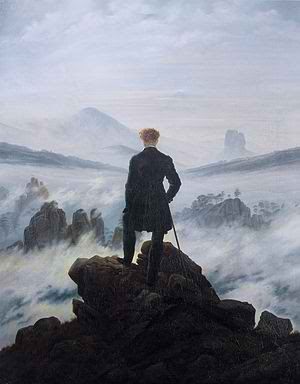
Caspar_David_Friedrich_032_(The_wanderer_above_the_sea_of_fog)

by Albert Brenner

What happens to exist is the cause of its use. (Lucretius)

Equal-outcome egalitarianism (henceforth, EOE) is the scourge of our time.  It is the doksa of our Zeitgeist – the fons et origo of the Prismon of Equality.

To, for example, believe that race and gender are “social constructs”, gay and heterosexual marriage (are) commensurate and culture(s) “relative” – in order to make all (appear) equal in outcome – is unreason at its purest. For all actions aimed at its fulfillment are fated to fail because its telos is extrinsic in finality… meaning that if that external thing – in this case a-historical and universal equality in outcome – had never  existed, all action undertaken to bring it to fruition will, inexorably, fail.

Fortunately this anthropic attribution underpinning the “divine” purpose of secular-humanism is petrifying.  Its “truth” – its “mobile army of metaphors, metonyms, and anthropomorphisms …” (Nietzsche) is becoming increasingly immobile … in the face of Reason.

Freedom-loving people in the West are becoming increasingly aware of EOE’s inherent, and inevitable, totalitarian aspirations. They are getting sick and tired of, for example, words being banned, wanton social-engineering (e.g. AA, BEE, bussing and “gender-free” toilets for kids), state-sponsored punishment via forced “rehabilitation” courses like sensitivity and cultural-awareness training – as if (the) Soviet gulags weren’t bad enough already, etc.

Be that as it may; the rise of libertarianism as embodied by, for example, the Tea Party in America and UKIP in England, is the clearest sign that the overtly coercive policies of (yet another) state-driven ideology have reached their sell-by date.

And this disaffection has nothing to do with being “left” or “right” on the political spectrum… because the aforementioned positions are but dichotomous expressions of allegiance to, or contra, (a) specific ideology.

For example, anti-communists like Lech Walesa and Alexander Solzhenitsyn were actually “left-wing” because they fought against those who wanted to conserve Communism. Yet (the) support of Communism is (usually) regarded as being “leftist”. Ergo, to conserve (as in “right-wing”) or to explore/demand liberty (as in “left-wing”) is completely relative – purely a factor of allegiance as expressed dichotomously.

Meaning that the growing dissatisfaction with (yet another prismon) – this time, EOE – transcends all traditional notions of conservatism and liberalism. Hence, new political constellations are arising in the West… under the guiding light of libertarianism. For libertarianism seems to be the only viable solution left to guarantee the freedom of Whites in the future.

And this is especially true for the Afrikaner in South Africa. The road to the “right” (e.g. the AWB) and the road to the “left” (e.g. the DA) have brought them nowhere. Even worse; it has made enemies of potential friends.

There are many non-Christian Afrikaners (especially the youth) and there are many white English-speaking South Africans who are fiercely loyal to the Afrikaner’s quest for freedom.  Yet they and “traditional” Afrikaners are always at each other’s throats… simply because they are still caught within the “left-wing versus right-wing” political constellation… now discredited!

Maybe the path to Afrikaner Freedom is via libertarianism… the antithesis of (the) authoritarianism shackling him to ANC/DA-driven equal-outcome egalitarianism. Because it, libertarianism, – as defined by the philosopher Roderick Long – furthers “any political position that advocates a radical redistribution of power from the coercive state to voluntary associations of free individuals”.

Maybe (a) federalism fed by libertarianism will, one day, be the only political guarantee of voluntary associations (of whites in South Africa) within a clearly defined geographical (and ideological) locale, like Orania. But alas, only time will tell.

What is a given though is the fact that libertarianism will be the Alamo of the Pale Male once its own artillery, democracy, has finally turned against him… on the eternal battlefield where demography is fate (August Comte).

Malema: I’m persecuted by Indians and Afrikaners

Julius Malema
Julius Malema

Julius Malema has alleged that the tax case against him is a politically motivated conspiracy run by a group of Indians ‘in bed’ with Afrikaners.The Economic Freedom Fighters leader alleged this in a report by the Sunday Times.

“I’m subjected to political persecution by political leadership led by [Finance Minister] Pravin [Gordhan], with his group of Indians,” Malema was quoted as telling the newspaper.

“It’s a small clique of Indians who are in bed with a group of Afrikaners in [the SA Revenue Service (Sars)], and Afrikaners in the law fraternity.”

He reportedly claimed the “small group of Indians” had a “political programme” against him.

“The Afrikaner are [sic] pursuing a racial hatred against Julius and what he advocates for,” he was quoted as saying.

On Tuesday, Malema’s Polokwane house was auctioned.

Sars attached the property to recoup Malema’s R16-million tax debt.

In May, Malema’s incomplete mansion in Sandton, Johannesburg, was sold at auction for R5.9-million. His farm in Limpopo fetched R2.5-milolion at auction in June. Several of his household goods were also auctioned earlier in the year.

Malema also faces corruption charges in the Polokwane Magistrate’s Court. He is accused of making nearly R4 million from corrupt activities, and is out on bail of R10 000. – Sapa

Apartheid and Black Consciousness: An unexplored angle

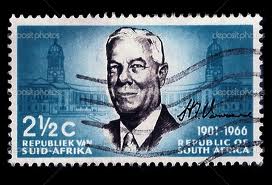
verwoerdseël

by Joseph Secrève

The late 50’s and 60’s were interesting times worldwide. Dramatic shifts took place and people of various nations and convictions were busy experimenting with new identities and freedoms. An important milestone was the progressive decolonisation of Africa, and Africans themselves, some gleefully and others dauntingly, waited to see what would happen next.

Many sub-Saharan nations unfortunately fell into disarray shortly afterwards, marked by tribal war, mistrust, and virtual anarchy that followed after the abandonment of colonial rule. African tribesmen scrambled to lay their hands on industries left behind by their former colonial masters, and in no small measure were rival tribes killed off by the new black rulers, while often being hailed in the West as great liberators. Robert Mugabe’s killing spree of tens of thousands of Ndebeles serves as a case in point, albeit in the 1980’s.

Due to the unique history of the Afrikaners, South Africa did not follow the same route. Especially under National Party rule when Verwoerd became Prime Minister in 1958, the country took a turn for the better, becoming the second fastest growing economy in the world. This obviously did not go unnoticed and British journalist Lord William Deedes enviously remarked how Africa became poorer while South Africa – against all expectations – worked its way up the ladder to rank amongst formidable world powers.

Yet, regardless of all these developments, South Africa was not free from underlying skirmishes. Black liberation elsewhere inspired many black youths in South Africa to challenge white authority, and a foremost activist and founder of the black Consciousness Movement Stephen Bantu Biko was to become its martyr thanks to Helen Zille’s efforts.

A closer look at the works of Biko and especially his spiritual father, the Antillean psychiatrist Frantz Fanon, reveals a surprising peculiarity though. Fanon’s prime objective was to help blacks rediscover their true identity, which was alienated from them when they were caught up under colonial rule. To Fanon it was important that contact with whites should be avoided, as white influence had psychologically “emptied blacks out” and filled the void with white stereotypes of them; either the “good negro”, always obedient and smiling, or the “bad negro” being unpredictable and dangerous. Regardless of whether whites acted racist or altruistically towards blacks, both actions stem from a sense of white superiority, filling Africans with feelings of inferiority and apathy, reinforcing the notion that they are in a constant state of servitude with no authentic identity. This analysis by Fanon later led to Biko’s well-known slogan that the most potent weapon of the oppressor is the mind of the oppressed. This explains why Biko openly scoffed white liberals in his collected essays I Write What I Like, claiming their insincere love of Africans originates from enmity of their own fellow whites and not from a true understanding of the African. Liberals, Biko claimed, cared for Africans only if their own (white) interests weren’t at stake.

In his essay Black Skin White Masks, Fanon more fully expounded his weariness of interracial contact between blacks and whites, claiming that a woman of colour seen with a white man shows contempt for her own race, while a man of colour seen with a white woman longs to be white and seen as their equal. Either way, a healthy development of the African identity is compromised.

As one probably has surmised, there is not much difference between the thoughts expressed by the founders of Black Consciousness and those expressed by the New World Order’s public enemy number one, Hendrik Verwoerd.

Verwoerd’s speech which arguably had the most damning effect on him was his claim that there was no place for the Bantu in the European Community above the level of certain forms of labour. A quote that has been taken completely out of context. In his next sentence, he continued that within their own communities however, all doors were open. Verwoerd argued that a European education for the African would show him the green pastures of Europe but prohibit him from grazing there.

The “green pastures” part is often misunderstood, but could be explained by means of an analogue: Imagine, after years of dismal failure in a certain fictitious country’s educational system, a conscientious educator returns from a foreign nation with impeccable standards in education. Let’s say this latter country is Japan. Enthused by what he saw, he now eagerly wants to copy the Japanese model and educate his nation in the same way. This entails that pupils are to be taught in Japanese, their writing, language, literature and mathematical system. As one would expect, this would lead to a high dropout rate due to the completely alien education that has no bearing on the daily lives and surroundings of the pupils involved. Not to mention the fact that the parents are incapable of lending their necessary guidance. On the other hand, let’s further assume that there are a scant few learners who did manage to do exceptionally well. In fact, they performed so well that the Japanese government offers them a stipend to study and work in Japan. Once they set foot over there, they will notice that the Japanese on the streets, the business culture, street culture, youth culture, university culture etc. are, regardless of their learned knowledge of local customs, foreign to them. They are confronted with a whole barrage of unspoken rules and codes which have traditions dating from long ago. Where they prefer to kick a football around in their spare time, the Japanese would rather play handball and computer games. Where they would laugh at certain acts of foolishness, the Japanese would be grossly offended. Where they would be offended by being pushed into crowded trains by station masters, the Japanese would consider it polite to allow more passengers on board. Throughout their stay, they’ll notice how the slight differences in customs could be a source of major frustration in their daily routine. Because of this, their performance, albeit well-meant, would simply not measure up to Japanese standards. Their whole understanding of Japanese language and customs would amount to no more than acting, since their real life cultivation lies elsewhere. Their authentic self-expression is not appreciated as they are accustomed to, causing them to become jaded, apathetic and at a loss, lowering their involvement with society even further. At the end of the day this whole ambitious plan to educate in Japanese has not borne much fruit, both for the dropouts as well as the excellent. It has taught them the ways of the Japanese, but by the very nature of cultures themselves, prohibited them from becoming full participants. From here onward, complaints of discrimination would become the norm, including various psychological illnesses. In a real life example, the suicide rate amongst black South Africans has trebled since the demise of apartheid. For those unfortunate souls, the struggle to fully imbibe Western norms and customs came at too costly a price.

Says Fanon: “Overnight the Negro has been given two frames of reference within which he has had to place himself. His metaphysics, or, less pretentiously his customs and the sources on which they were based, were wiped out because they were in conflict with a civilisation that he did not know and that imposed itself on him.”

Instead of permanent servitude, Verwoerd gave them the opportunity they were eagerly waiting for, i.e. a place of their own that they could fill in and develop according to their own cultural guidelines while slowly modernising them in ways that they could absorb. By limiting the African in white areas, he intended to heighten the attractiveness of the homelands where Africans were freer to hone their skills in accordance with their culture.

Afrikaner anthropologist Werner Eiselen, who served as educational advisor to Verwoerd, compiled a report as to the best route to take to educate the African within his own culture, and one recommendation was to educate Africans in their mother tongue, at least throughout their primary school years. These findings were strikingly similar to Fanon’s opinion wherein he stated that he “…should like nothing more nor less than the establishment of children’s magazines especially for Negroes, the creation of songs for Negro children, and, ultimately, the publication of history texts especially for them, at least through the grammar-school grades. For, until there is evidence to the contrary, I believe that if there is a traumatism it occurs during those years.”

This helps explain why only in exceptional cases were Africans allowed to study at white institutions. The intention was to take their education back to their own people to help them further along. In 1955, during National Party rule, the first black doctor graduated at the University of the Witwatersrand. The general argument that apartheid outright deprived Africans of privileges, especially under Verwoerd, does not hold water. A fuller understanding of the ideal that they wanted to achieve would undoubtedly have helped to ease racial tensions.

Another rationale for segregated education was demonstrated in 1986 when a small group of white students enrolled at the Medical University of South Africa, located in the former homeland of Bophuthatswana to study medicine. This did not go down well with the African students. Even though the whites were outnumbered by far, their fellow African students refused point blank to share lectures with white students, openly protesting their presence on campus.

For many years the notion has been held that the ideals behind apartheid were completely at variance with the ideals behind African liberation. These abovementioned quotes and occurrences however demonstrate that the ideals pursued by Verwoerd and many Afrikaner nationalists were much more in step than is generally assumed. After all, Afrikaners, who have no other country to turn to, certainly have no interest in stirring animosity amongst a majority of the country’s people. The formation of the homelands was South Africa’s response to decolonised Africans elsewhere who had started claiming a piece of land for themselves as a protective measure against future invasion. Not to mention the creation of homogeneous groups for Africans where they could live their own culture and develop stable identities.

In short, South Africa had a choice between either the formation of stable and homogeneous units, or to abandon this project wholesale and flood the cities with large numbers of low skilled African labourers, creating a Brazilian style ghetto where crime, disease and xenophobia run rampant. Due to demographic factors, pressure from within and outside, and the gravitational pull of the cities, the grand apartheid plan had finally caved in, along with years of vicious propaganda stating that Afrikaners are the chief cause of this mayhem. In reality, all their efforts were designed to prevent the current level of national decline.

Ultimately, the abolition of apartheid had little to do with the liberation of blacks. Destroying the Afrikaner power base was the primary concern for the Afrikaner’s traditional enemies, i.e. the British elite and international banking cartel. Where Africans had homelands to escape to, Afrikaners today have no choice but to flee abroad or to accept second class citizenship in the country of their birth. As Verwoerd stated fifty years ago, ethnic integration has no added value and only leads to situations where various groups become locked in constant competition for political power. This is where a major difference between Verwoerd and Biko came to the fore: Where Biko argued that a complete ethnic integration was possible and minorities would become non-existent, Verwoerd went the other way, claiming that ethnic tensions would never be abolished entirely, and whites were the ones who really needed protection.

If one considers how affirmative action, black economic empowerment and various attempts to bar whites from the job market are still the norm today almost twenty years into ANC rule, one could only conclude that Verwoerd’s prediction was more accurate. In fact, not only whites are targeted, but other non-white groups are next in line to be overwhelmed, judging by the way Africans are bussed into the Western Cape to swamp the local coloured population, who form one of the last ramparts against total ANC domination.

In the end, post-apartheid South Africa has never lead to non-racialism, but only served to escalate racial tensions further.  With an approximate 80 thousand Afrikaners murdered since political takeover – much more than the 1,5 to two thousand blacks killed by the erstwhile security forces, the situation has indeed become atrocious for them, yet, to no-one’s surprise, hardly a whisper from the leftist press is ever heard about this.

Little doubt exists as to the ANC’s sanctimonious embodiment of black consciousness. They have in fact not only betrayed the whites, but the true believers amongst the blacks as well; the irony being that Verwoerd supported their legacy more than Zuma and his ilk ever did.

To quote Verwoerd’s son Wilhelm, the keeper of his father’s legacy: “There were discriminatory aspects but they were also intended for the benefit of the black people. He [Verwoerd] had a lot of support among the blacks. It’s only these ANC types who are now in power who were trying not only to take a piece of the cake but the whole cake. They of course didn’t support him, but the more traditional people who attached value to their chiefs and customs – they found him to be the best minister that they’d ever had.”

And this constitutes the legacy of a true nation builder.

Joseph Secreve lives in Amsterdam, and is a regular columnist for PRAAG.

Police bungle another farm attack case

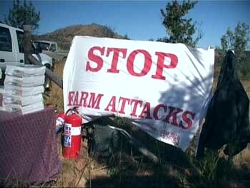
stopfarmattacksAfriForum is considering legal action against a police investigator after a case was thrown out of court and a farm attacker was freed due to gross negligence by the police.

The victims of the attack, Mr Noël McSeveney, and his wife, Alta, were attacked by two men in June 2013 on their farm just outside of Malelane, Mpumalanga. Mr McSeveney was wounded in the attack, and in his efforts to protect himself and his wife, he killed one attacker and wounded the other.

According to Nantes Kelder, Head of the Investigative Unit at AfriForum, the case against the accused took place in absentia. The investigating officer allegedly failed to present a medical report to the court to confirm that the accused was still in hospital, receiving treatment. As a result, the case was thrown out.

The Investigative Unit of AfriForum also made a report available earlier this year on mistakes made by the police during their investigations of farm attacks. “The blatant negligence of the police means that an attacker is now free and the victims have to live in fear. The investigator should be held responsible,” said Kelder.

AfriForum will take on the case on behalf of Mr McSeveney. Kelder added that the incidence of farm attacks and violent crimes is unacceptably high. One would think that such cases would be handled with great care, in order to ensure that justice is served.

A warrant for the arrest of the accused has been issued, but AfriForum has heard that he could not be traced.

How should we respond to calls for white genocide?

roodt_fbfoto

by Dan Roodt

[followbutton username=’danroodt’ count=’true’ lang=’en’ theme=’light’]

Like Dan Roodt’s Facebook page

This week on Twitter a former UKZN student representative council member, Sfiso “Mabhiza” Mbatha, tweeted: “We gonna kill every white cockcroach that breath(es) SA’s air”, while adding, “Would rape every 13yr old white girl after Mandela finally kick that bucket. Just for control.”

These tweets caused a lot of reaction, but no official complaints were laid. If any such statement were made about blacks, it would have provoked a far larger furore. The tweeter would have been charged with hate speech at the SA Human Rights Commission and MSM journalists would have “shamed” him with negative publicity about his “racism”.

As Mbatha explained afterwards, he thought it was something of a joke: “It was just a joke at the end of the day. But now I realise that they were uncalled for, they went overboard and pushed the limit. I did say that I was joking, but people responded by insulting me, so I insulted them back.”

A large number of whites did not react at all. This is typical of so-called “advanced groups” all over the world who almost expect to be resented and even hated by the less successful groups. The well-known ethnic expert and author of the book, Ethnic goups in conflict, David Horowitz, distinguishes between “advanced groups” and “backward groups”. I think it would be fair to say that South African whites fit the definition of an “advanced group” and therefore typically react like one. Advanced groups are more educated, entrepreneurial and occupy the higher social classes in an ethnically divided society. As Horowitz explains:

“Where backward groups seek proportionality in government employment, advanced groups seek only assurances of nondiscrimination. Where backward groups attempt to keep ethnic strangers from government service in their region, advanced groups affirm the principle of unrestricted mobility.”

Advanced groups are reluctant to secede if they find themselves living in diaspora in a “backward territory”. Significantly, Horowitz notes that advanced groups are “disproportionately victims of ethnic violence”. South Africa’s brutal farm murders are a case in point, targeting a specific language and racial group that is perceived to be in a better socio-economic position than the surrounding “backward” population.

If we are honest, we should admit that some form of white genocide or anti-white violence has always been at the core of the ANC’s “liberation strategy”. The ANC is essentially composed of elites identifying with the less successful ethnic groups in South Africa. It is therefore normal that, according to the laws of ethnic conflict, it should heap opprobium onto whites which it perceives as “the enemy” and responsible for the relative deprivation of South African blacks. It is also telling that the principle of proportional employment has been implemented, not only in the public sector, but also in the private sector in a clear attempt to curtail white social and economic prowess.

However, it would be too simplistic to transpose Horowitz’s theory of ethnic conflict onto South Africa as one might onto Nigeria, Sri Lanka or Malaysia. In addition to the ethnic dynamic at work in the South African conflict, there is also the ideological dimension in the form of political correctness, Western decadence and generalised anti-white attitudes to be found in the global mainstream media.

Against this backdrop, calls for a white genocide in South Africa seem almost normal or normalised. Foreign correspondents in Johannesburg from the BBC, the New York Times and the London Guardian who have been casting whites in the role of evil racists for years, are likely to report on anti-white animus among blacks with “understanding”. In the light of the aforegoing narrative, these correspondents might suggest: who can blame them?

White South African liberals and leftists who are loyal to Britain and share left-wing Anglo-American perspectives on their own countrymen, take an equally sanguine view of such manifestations of anti-white “racism”. Liberal Britons are indifferent to the killing of whites in South Africa, if not supportive of any would-be black genocidaires. I once spoke to an official from a London NGO who explained to me that we should not complain about being killed by blacks as “they were only getting their own back”, as if white leaders in the past had proceeded to similar public appeals to “exterminate the kaffirs”!

As we saw during the court case around Julius Malema’s “hate speech” against Afrikaner farmers, there was little media sympathy for white victims of ethnic and racial violence. Even though Malema was prohibited from singing the song, “Kill a Boer, kill a farmer”, the song kept on being sung all over the country. In fact, the governing ANC opposed the legal prohibition of the song, with its advocate Gilbert Marcus, brother of Reserve Bank governor Gill Marcus, arguing for the party’s “freedom of speech”. Singing such songs were part of “black culture”.

It may be, therefore, that calls for white genocide in South Africa are examples of the “free speech” that Marcus and many other leftists and liberals would argue are “harmless” and “not to be taken literally”. In the words of the young black tweeter from Natal, Sfiso “Mabhiza” Mbatha, it is “just a joke at the end of the day”.

It is also true that black Africans often joke about killing. “I’m going to kill you,” is quite an everyday saying. Also, killing is invoked many a time as a universal method of meting out justice for all sorts of crimes and misdemeanours.

However, as the saying goes, “many a true word is spoken in jest”. Robert Mugabe is one of the most admired black leaders in South Africa and there is no doubt that his “final solution to the white problem” by simply confiscating their assets and expelling most of the white population, would also be wildly popular in this country. There not being another country south of South Africa towards which whites could flee, a broad desire “to get rid of whites once and for all” could lead to widespread killing, massacres or even systemic genocide of the kind hinted at in “jocular” black tweets.

How then should we answer my initial question in the title above: “How should we respond to calls for white genocide?” I think there would be at least two approaches. The one would be a kind of laissez faire approach in line with leftist white responses of “not taking it literally”. That would also constitute the most typical reaction of Horowitz’s “advanced group” that sees its salvation not in mass mobilisation and ethnic agitation, but in avoiding conflict – or at worst, moving away from it. The most common reaction of whites after escaping from an armed robbery, farm attack or other form of black-on-white violence is not to join the local chapter of the AWB’s Ystergarde (Iron Guard), but to call an Australian immigration consultant.

I have just had a visit from a friend who had recently emigrated to Australia. He misses South Africa, family and friends, especially the warmth and hospitality of Afrikaners. But he does not contemplate ever returning to South Africa, because, as he put it: “I feel safe in Australia. I would be scared to live in South Africa again.”

Many whites simply ignore ethnic slogans directed at them. I once listened to a talk show on the Afrikaans radio RSG where many of the callers stated quite frankly that they had adopted a kind of ostrich-like, head-in-the-sand approach. They would simply avoid reading newspapers and websites or even listening to the news on radio because it upsets them. They choose not to know. The average white professional woman or housewife shopping at Woolworths does not care either that the chain has an anti-white employment policy. She buys the fantasy of eating well, dressing well and decorating her home in the latest mix of white and earthy, African colours.

Ever since my Afrikaans high school days, I have often heard the typical injunction from teachers and many others: “Don’t be so negative!” Within the Afrikaner mind, every problem has a solution and “being negative” is a cardinal sin. In that sense, what can be more “negative” than imputing genocidal urges to South Africa’s black majority? Or even responding to a call for white genocide that is made every so often by some tweeter or black politician?

Among my many criticisms of the Afrikaans schooling system, although one of the best in the world for churning out straight-A students in maths and science, or good writers, artists, actors and so on, is that it does not teach one the art of critical thinking. Disagreeing with someone, especially publicly, is often seen as “bad manners” or even worse, as displaying that nefarious “negative” attitude. Often I have sat in meetings with especially elderly Afrikaners who used to occupy positions of authority in the old system and, upon voicing my disagreement on some point, they would simply ignore me as if they had not heard me!

Similarly, many Afrikaners out there, including the editors of newspapers, radio stations and pay-TV channels, are “simply not hearing” any call for white genocide. Call it denial or what you will, but just as their culture predisposes blacks to easily talking about killing, local white culture tends to make them hard of hearing.

We have been educated and programmed to be decent, cooperative, “positive” in Afrikaans parlance, so behave like a typical “advanced” ethnic group, eschewing ethnic solidarity in the face of danger.

However, there is one “advanced” group, probably due to past experience, that does not take calls for genocide lying down. Here I am referring, of course, to Jews. South African Jews enjoy arguably the highest standard of living of any ethnic group in the world and a perusal of the weekly South African Jewish Report will tell you about their huge socio-economic success, as well as media and political influence.

Unlike such dreadful appeals directed against Afrikaners and Boers, no-one in South Africa has ever called for the extermination of Jews. In fact, South Africa’s much-maligned National Party government was probably responsible for the good relations not only between Jews and the rest of the white population, but also between Jews and South African Muslims.

To my surprise, I recently discovered the construction site of Johannesburg’s Holocaust Centre, with another one having been in existence in Cape Town for some years already. These centres, apart from educating the public about the history of Jewish persecution, tend to preach tolerance towards Jews and between ethnic groups generally.

There is also the international Anti-Defamation League which, according to one of its own documents, “fights anti-Semitism and all forms of bigotry, defends democratic ideals and protects civil rights for all,” doing so through “information, education, legislation, and advocacy”.

I can only imagine the international outcry, notably from Germany, that would ensue if any South African black leader had to start singing “freedom songs” about “Kill a Jew, kill a plutocrat”. Charges of hate speech would immediately be laid against the offender and he would become persona non grata in many quarters. I doubt very much whether anyone at the Johannesburg Bar, least of all Gilbert Marcus SC, would defend his “freedom of speech” and colourful metaphors.

The so-called South African Human Rights Commission is a suspect body, in itself prone to anti-white sentiment. It was created to harass whites, not to uphold their rights. As far as I know, it has never responded to complaints about anti-white hate speech, apart from acknowledging the receipt of such a complaint. For that reason, many Afrikaner groups do not even comtemplate complaining to the SAHRC about calls for white genocide.

But if we are looking for models to deal with the growing chorus calling for a white genocide in South Africa, we could do worse than to imitate the Jewish community. Either one lets these comments and invocations to kill whites slide, like the ostriches that we are, or one should draw a line and respond to each and every one of them. Even if the SA Human Rights Commission will do nothing to stop hate speech against whites, the mere fact of documenting such complaints might come in handy at some later point when our struggle for survival gets even more intense than it already is.

The current mayor of Chicago, Rahm Emanuel, made a bizarre statement in 1992 when he said: “Gays are the next Jews of fundraising.” Many people have recently quoted this.phrase to point out the vast support for Obama’s Democrats among US gays.

But in a more fundamental sense, I think we could say that Afrikaners – and by extension white South Africans – are “the next Jews”. We are already subject to vicious propaganda campaigns, vilification, hostile media reports, legal and official discrimination, stereotyping and random ethnic attacks, even pogroms.

Our famous Afrikaner poet, N.P. van Wyk Louw, once wrote: “If the Afrikaner had to lose political power in South Africa, he would be as helpless as the Jew in Nazi Germany.”

Recent history has vindicated Louw. It is high time that, while we are being treated like Jews in Czarist Russia, we should respond like modern Jews who not only react vehemently against any suggestion of genocide, but also preempt it through, in the words of the Anti-Defamation League: “information, education, legislation, and advocacy”.

[followbutton username=’danroodt’ count=’true’ lang=’en’ theme=’light’]

Like Dan Roodt’s Facebook page

The Left wouldn’t mind seeing South Africa destroyed

roodt_fbfotoby Dan Roodt

[followbutton username=’danroodt’ count=’true’ lang=’en’ theme=’light’]

Like Dan Roodt’s Facebook page

In my last column, I went to the trouble of explaining what happened on 16 June 1976 and that none of the six rioting Soweto high schools had actually been forced to learn anything in Afrikaans, whereas a seventh studied only the subject of history by medium of Afrikaans.

However, the motley collection of so-called English-liberal whites do not like to be “bored with the facts”. Just today I read on the website of the leftist Mail & Guardian: “The issue of language has been a sensitive one since June 16 1976, when Soweto pupils rose up against Afrikaans as a primary language in schools.” No, the issue of language has been moot since 1806 when the British permanently set foot in South Africa and embarked on a drawn-out attempt to stamp out, first Dutch, and then its inveterate spoken variety, Afrikaans, a policy that continues to this day under the ANC regime.

There always seems to be one newspaper in Johannesburg that is vehemently anti-Afrikaans. A century ago it was The Star. When the first Afrikaans high school opened in the city in 1921 (my old school called Helpmekaar), The Star opined: “There is something rotten in the state of Denmark.” In the 1960s and early 1970s it was the Rand Daily Mail where Helen Zille cut her teeth. The late journalist Chris Louw once overheard the editor of that paper, Alistair Sparks, during an aeroplane flight raging against the “sub-human” Afrikaners and how South Africa would have been better off if Britian had “finished the job in 1902 and killed them all”. The Rand Daily Mail ultimately closed down, with its business section continuing as the current Business Day. The present Mail & Guardian was in fact started as a replacement Rand Daily Mail. It regularly vilifies Afrikaners and tells us how ugly our language is, how reactionary we are, how we should disappear forever and just how backward our music, literature and art are. For good measure it keeps a few renegade Afrikaners – mainly because they are prepared to work for lower salaries – who now and again write about their identity crises and how they felt much better when they managed to forget their Afrikaans, including their horrible conservative upbringings.

However, some of the Mail & Guardian journalists have absconded to set up an online rag or electronic wet wipe known as The Daily Maverick. This is a complete misnomer as it should have been called The Daily Conformist. After all, the term “maverick” denotes, especially in American usage, exactly the opposite of a conformist. I could copy and paste a definition from any number of online dictionaries, but let me climb onto my little wooden step ladder and fetch the Shorter Oxford Dictionary off the top shelf.

According to the dictionary, the term may be traced to one Samuel A. Maverick, a “Texas engineer who owned but did not brand cattle”. Hence its two meanings: “1. An unbranded calf or yearling. 2. An unorthodox or independent-minded person, an individualist, US, a politician who will not affiliate with a regular political party.”

Obviously, there is nothing maverick about The Daily Maverick. It keeps us corralled or herded within the enclosures of South Africa’s tedious, second-hand and stupid leftist tradition. Every academic in South Africa, as well as many a journalist, especially the kind that writes for The Daily Maverick, dreams of becoming a British Marxist and being able to kiss Terry Eagleton or E.P. Thompson’s boots. Well, E.P. Thompson is dead now, but any old pommie commie would do.

The thing to understand about English-South African leftists, is that they are something like T.S. Eliot’s “hollow men”, a notion which may be traced back, appropriately, to the character Mister Kurz in Joseph Conrad’s great novella about Africa, Heart of Darkness. You probably recall the first lines of Eliot’s poem:

We are the hollow men
We are the stuffed men
Leaning together
Headpiece filled with straw. Alas!

Since 1994, with all the cultural Marxists in control of the media and the universities in South Africa, there is almost no debate possible. Just repeat all the tired clichés and propaganda after us.

However, as Oscar Wilde would say, there is one thing worse than a left-wing snot who fancies himself a journalist and that is a snot who writes about cricket. South Africa is a bit like Nero’s Rome: the worse it gets, the more fanatical people become about games, nonchalantly stepping over all the casualties that we learn about daily. Not sports casualties and not in The Daily Conformist a.ka. Maverick either. Just the men and women dying by the thousands every month, the human sacrifices to the god of political correctness.

Kenneth Borland is a cricket correspondent for a provincial paper, The Natal Witness, who also writes for The Daily Maverick, it appears. They are not keeping him properly corralled, for he seems to stray off the pitch sometimes, but then he keeps his comments firmly within the quasi-Soviet style of labelling any dissident or heretic on the misty horizon as a “Nazi, fascist, racist” or other imaginative terms. Oh, I left out “homophobe” and “white supremacist”.

Just yesterday Mr. Borland called me a “white supremacist” in the following passage from The Daily Maverick‘s comment section:

“As opposed to your evil, divisive, hate-filled propaganda Dan?

“As a member of the white middle-class I can safely say I am not under attack by the state, however appalled I am by Zuma, the corrupt political elite and the worrying signs of a return of oppression through state security apparatus.

“You and your shameful ilk are the biggest cause of ethnic conflict in this country. Your statement elsewhere that white South Africans are the nicest people in the world is laughable. I, for one, am extremely grateful that the majority in this country, oppressed for so long, have been able to show such magnanimous ubuntu that I do still believe there is hope for South Africa.

“You are nothing short of a white supremacist and you should be living somewhere like Nazi Germany rather than a country that is still striving for reconciliation and meaningful democracy.”

I do not intend entering into a literary analysis of this passage, which is hardly on a par with T.S. Eliot or Joseph Conrad. Nevertheless, I find it quite telling that the author admits that South Africa “is still striving for reconciliation and meaningful democracy” as no-one in his right mind would describe the current one-party state with non-existent boundaries between party and state as a “democracy” in the Western sense.

He also acknowledges that there is some kind of “ethnic conflict” going on in the country. When our “good democrats” are not assaulting or killing foreign Africans (a little “xenophobia” here and there), they are elsewhere engaged in farm murders, house robberies, hold-ups, rapes and other mayhem. Sometimes the police force join in too, in full uniform! Recently there was a case in Naboomspruit where two black policemen committed a robbery in full uniform, using their service pistols. They are out on bail but have not been suspended. Their weapons having been retained as court evidence, they have simply been issued with other pistols and are back at the station.

This is South Africa, the leftist utopia. Anything goes. From gay unions to policemen moonlighting as armed robbers.

But according to Borland – and he probably speaks for the entire pack of hounds yapping away every day at The Daily Conformist, in their pompous imitations of British-Marxist cool – “me and my shameful ilk” are somehow responsible for all the violence and lawlessness in the country, apart from relegating me to “Nazi Germany”.

I have news for these mauve Brits or would-be Brits, merrily uploading their daily wet wipe which wouldn’t even clean my screen without leaving an opaque layer of obfuscation. I don’t need to time-travel back to Germany in the thirties. This is Nazi Germany already! Except that we Afrikaners are being treated like Jews. If we are not being attacked by your daily Einsatzgruppen, torturing, killing or raping us, we are vilified, smeared, labelled and blamed as scapegoats for the mess known as the “New South Africa”, or Mbeki’s “youngest black republic”. This is a failed state and its failure was planned so that it would either drive us out of here or we would simply be eliminated during a protracted uhuru, realising Alistair Sparks’s dream of a final solution for us.

Afrikaners, as educators, engineers, administrators, farmers and founders of industries such as Sasol over which the Rand Daily Mail and “its ilk” once guffawed as “sheltered employment for stupid Afrikaners”, have always tried to bring development and stability to South Africa. Not so the destructive, know-it-all uitlander opportunist and pompous purveyor of revolution, “transformation” and other radical concepts.

The present Zimbabwe is entirely the result of Briitsh foreign policy that saw Ian Smith as just another intractable white patriot to be eliminated. Regime change was needed. Ten years later a reforming South Africa was seen as a threat to the Marxist-revolutionary ambitions of the ANC and the South African Communist Party. So we got regime change too. After us it was Iraq, Afghanistan, Libya, Egypt and other countries of the so-called Arab Spring where the fundamentalist Muslim Brotherhood was deemed preferable to the more secular, modernist but autocratic Arab regimes. We now have civil war in Syria, another country destroyed by Anglo-American foreign policy and support for Al Kaida-type “rebels”. Among other things, the British-supported “rebels” are destroying churches, portending an end to religious freedom in Syria.

South African leftism, of which The Daily Maverick is but one of the many mouthpieces that have mushroomed and grown like weeds since the South African revolution, is also a form of fundamentalism. Its creed, like every strain of communism during the twentieth century, is “equality at all costs”. Except the very people who propagate this utterly totalitarian idea do not themselves believe that they are equal to anyone else. In Orwell’s famous phrase: “Some animals are more equal than others.”

It follows that even a low-life cricket commentator like Kenneth Borland believes himself to be far above the average middle-class Afrikaner, concerned about his children’s education and the safety of his family while revolution rages about him. Borland and his coreligionists are part of a British-Marxist nomenklatura egging their ANC storm troopers on. Go kill some Boers, go take their land! Go rape their daughters and teach them not to be “racist” in their choice of a sexual partner. After all, in Soweto “forced sex” is not considered wrong, according to opinion polls among the enlightened youth of that conurbation, so why should we conservative, Calvinist, “Nazi” Afrikaners object? “Corrective rape” already exists for lesbians in South Africa, so why not introduce it for “white-supremacist women and girls” too?

I could expatiate on the peculiar, almost racial (Nazi?!) sense of superiority that one encounters in Natal with its virulent anti-Afrikaans chauvinism. Despite Natal, or KZN as it is now known, being one of the poorest provinces in the country, its inhabitants believe that somehow the British Empire is not dead. As long as Britain can still bomb a few Iraqi children or supply weapons to Syrian Islamists, I suppose there is life in it yet. Small wonder then, that the ANC and the SA Communist Party have recruited some of their most pliable white “cadres” from that most English of South African provinces, who will serve the Bantu Empire with a zeal once reserved for the British one.

The Natal Witness cricket commentator, Kenneth Borland, hails from Pietermaritzburg, the smaller of the two KZN cities. Need one say more? Hence the pregnant “you and your shameful ilk”, implying that to be descended from the Dutch, French Huguenots, Germans and Scots as we are, is somehow beyond the pale.

Reading an e-wipe like The Daily Maverick, I sometimes get the impression that this whole tragic, violent revolution slowly consuming our country, is based not on Karl Marx – although he is in there somewhere – but on some imitation or simulacrum of English snobbery. I imagine that Baron David Owen or Lord Carrington condemned Rhodesia to death over gin and tonic while boasting about his new Jaguar. Likewise, South Africa’s demise was concocted as some act of upper-class insouciance. People were just tired of PW Botha’s hat that he wore sometimes at a time when it was no longer fashionable, whereas now it would have been perfectly à la mode.

I think author Nadine Gordimer – she got her anti-Afrikaans attitude from Lithuania, not from Natal – summed it up when she said in an interview: ““We were naive, because we focused on removing the apartheid government and never thought deeply enough about what would follow.”

Gordimer makes it sound as if she cares. However, none of the South African leftists care about this country. If it had to descend into a Zimbabwean abyss of hyperinflation and famine tomorrow, they would simply pack up and leave, with a shrug.

Besides smugness, they are also motivated by Schadenfreude. The notion that they are powerful enough to destroy and dilapidate all that Afrikaners managed to create in 360 years, gives them a tremendous sense of satisfaction.

[followbutton username=’danroodt’ count=’true’ lang=’en’ theme=’light’]

Like Dan Roodt’s Facebook page