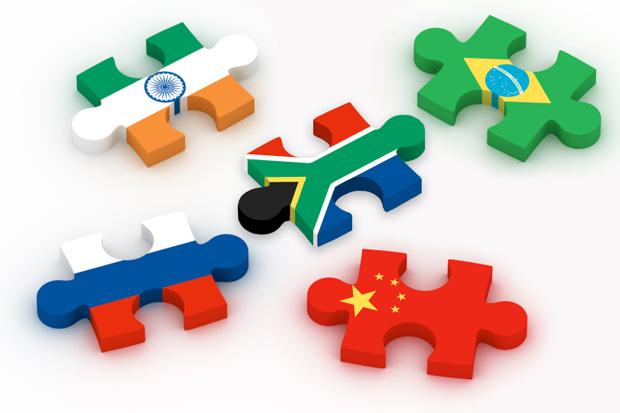
Russia asks Greece to join BRICS bank

Russian Deputy Finance Minister Sergei Storchak spoke with Greek PM Alexis Tsipras today, proposed that Greece become 6th member of New Development Bank set up by Brazil, Russia, India, China, South Africa, a Greek govt official says in e-mail to reporters.

Meanwhile the $100 billion BRICS development bank will be based in Shanghai, according to its founding agreement, and will be headed by an Indian for the first five years, followed by a Brazilian and then a Russian.

Kundapur Vaman Kamath, a 67-year-old, is the non-executive chairman of India’s second largest bank by asset size, ICICI Bank, and India’s third largest IT firm, Infosys.

Now, Kamath will have another position to tend to: The first head of the BRICS bank.

The bank’s $100 billion capital—with an initial subscribed capital of $50 billion that will be equally shared by all BRICS members—will be used for infrastructure financing and sustainable development project funding within the BRICS nations. Other low- and middle-income countries will be able to access loans.

In February this year, India’s cabinet, headed by prime minister Narendra Modi, approved the establishment of the bank, after founding members sorted out several contentious issues. “The New Development Bank will mobilise resources for infrastructure and sustainable development projects in BRICS and other emerging economies and developing countries, to supplement existing efforts of multilateral and regional financial institutions for global growth and development,” the Indian government said in a statement.

The bank, according to the Russian finance ministry, is expected to be fully functional by the end of 2015.

EU paymaster Germany suggested on Monday that Greece might need a referendum to approve painful economic reforms on which its creditors are insisting, but Athens said it had no such plan for now and others warned a vote could delay vital aid.

Greece calmed immediate fears of a default by making a crucial 750 million euro payment to the International Monetary Fund a day early. But Finance Minister Yanis Varoufakis said the liquidity situation was “terribly urgent” and a deal to release further funds was needed in the next couple of weeks.

Euro zone finance ministers welcomed some progress in slow-moving talks on a cash-for-reform deal between Athens and the IMF, the European Commission and the European Central Bank but said more work was needed to each a deal.

“We acknowledged that more time and effort are needed to bridge the gaps on the remaining open issues,” they said in a short statement after spending barely an hour on a progress review on the negotiations behind held among senior officials.

Source: Bloomberg/Reuters

Germany puts pressure on Kiev

The Financial Times has disclosed the first attempt by Germany to put pressure on Kiev to implement the Minsk 2.0 peace agreement for East Ukraine.

Germany, in a bid to remain neutral amid rising trans-Atlantic tensions, may have warned the Ukrainians that unless they fulfill the Minsk Memorandum, something the Ukrainians have no intention of doing, there may be renewed aggression.

Kiev has welcomed military training missions from Canada and the US to Ukraine adding to what might become a US -Russian proxy war.

Atlanticist neocons entertain maximalist ambitions and have shown but intransigence to the bloodshed.

It seems as though Germany will exert some pressure on Kiev to back down from further escalating the conflict that have cost thousands of lives and seen the rise of modern Nazis.

From the Financial Times:

Germany and key European partners are pressing Ukraine to speed up implementing the Minsk ceasefire agreement — for fear of giving Russia excuses for renewed aggression.

The warnings from Berlin, Paris and London come as EU officials led by Jean-Claude Juncker, European Commission president, are due on Monday to start their first EU-Ukraine summit in Kiev since the Ukraine crisis broke out a year ago.

They coincide with renewed tensions between Russia and the US over Ukraine, with Washington and Moscow trading allegations of increased military involvement in conflict zones.

The latest European comments highlight EU desires to ease tensions with Russia’s President Vladimir Putin, even at the cost of irritating Kiev.

EU diplomats readily admit the separatists violate the Minsk ceasefire far more often than Kiev. But they urge president Petro Poroshenko to stick to the accord and implement its political clauses.

The word among German diplomats is that Kiev needs to be “more co-operative”. Stefan Meister, of Berlin’s DGAP foreign policy think-tank, said: “German officials are talking to both sides, but especially to the Ukrainians because if they don’t do what’s necessary, the Russians will always have the possibility of renewing the conflict.”

In France, President François Hollande said during a visit by Mr Poroshenko last week: “The only line of conduct is the full implementation of the Minsk accord.”

In the UK, which has followed the US in taking a tougher line against Moscow, an official said Ukraine should fulfil its side of the Minsk deal and “not give Russia the space to criticise them”.

The latest Minsk accord, agreed in February under pressure from Germany and France, has reduced fighting and led to the withdrawal of some heavy weapons from front lines, though soldiers and civilians still die almost daily.

But Berlin is worried that Kiev is dragging its feet over other parts of the fragile deal, notably in trying to postpone political decentralisation until after local elections are staged in separatist-held territory.

For Ukraine this is critical because it does not want to hand over power to separatist leaders in the Donbas region, who are not recognised by the international community. EU diplomats say, however, that while local elections are indeed envisaged under Minsk, the accord does not insist that they take place before decentralisation.

Dmytro Kuleba, a senior Ukrainian foreign ministry official, dismissed charges of delaying tactics as “perfect hypocrisy”, saying Russia was encouraging this perception while continuing its aggression.

Kiev has, however, acted on another EU concern. Last week, lawmakers softened recent legislation banning Soviet and Nazi symbols. The planned law had raised fears in Russia of a campaign to remove monuments and rename streets dating from the Soviet era. Now such decisions are planned to be devolved to regional authorities.

But Russia is maintaining the pressure. The foreign ministry on Friday accused Kiev of having “no political will” to implement the Minsk agreement.

Meanwhile, Berlin is also pressing EU officials to be conciliatory with Moscow. Foreign minister Frank-Walter Steinmeier wrote this month to Mr Juncker urging the EU to ease “Russian concerns” over a deep free-trade agreement with Ukraine.

The planned deal helped trigger the initial crisis when it fuelled Russian fears of losing influence in Kiev. Implementation was postponed last year in the face of Russian resistance, with the hope of discussing the matter at trilateral talks between Moscow, Kiev and Brussels.

But Kiev is loath to involve Russia in what it sees as a bilateral accord — and Moscow has warned Ukraine against unilateral implementation. Mr Steinmeier has urged a start to the three-way talks, asking Mr Juncker to “use the considerable flexibility that the agreement offers”.

Merkel to throw more money at immigrants

On May 8, German leaders will hold their own talks in Berlin to channel money and assistance to mayors in carrying out the federal mandate for each of Germany’s 16 states to take their share of migrants, and figure out how to make room for them.

“Wealthy Germany can afford to help,” said Volker Herzog, the mayor of Vorra. The local pastor, the Rev. Björn Schukat, said that instead, there was a tendency among the authorities higher up the chain to simply announce that, for example, a dozen refugees are arriving — “and now you get on with it.”

Behind the worries is a government policy that calls on the 82 million people of Europe’s biggest economy to be generous. The federal and state authorities apportion the quotas and, increasingly, pay to renovate or rent apartments before sending the people to localities.

Some maintain that Germany’s current wealth and Nazi past impose an obligation to accommodate immigrants. But the costs are being felt as social workers grapple with overcrowded reception centers and officials scramble to house asylum seekers.

In the region, known as central Franconia, there are three social workers for a current allocation of 1,000 migrants. It could use 10, said Pastor Schukat in Vorra.

It was only last December that the federal authorities allocated an extra billion euros to the states and smaller communities to care for refugees this year and next. Just three weeks ago, Berlin was rebuffing calls for more. Now, more money is expected to flow from federal coffers after Ms. Merkel gathers with officials and politicians on May 8.

In 2014, some 627,000 people applied for asylum in a European Union country, including 203,000 in Germany. That was more than anywhere else in the bloc, but proportionally, Germany ranked No. 8, with 2.5 asylum applicants per 1,000 inhabitants, compared with 8.4 per thousand in Sweden.

In a recent German poll, more than half the respondents said they thought there was strong hostility to foreigners in the country.

The concern that Germany is inhospitable was also expressed this winter in pro-immigration demonstrations held nationwide to counter swelling anti-immigration marches, above all in Dresden.

With the federal authorities expecting a flood of newcomers — an estimated 300,000 will apply for asylum in Germany this year, after 200,000 in 2014 — places like Vorra, population 1,000, are struggling to make room.

The mayor of Tröglitz, Markus Nierth, quit after marchers opposed to the housing of migrants demonstrated outside his house. At least half a dozen politicians, from big city districts to tiny towns, subsequently told the German news media of harassment and even death threats.

In a telephone interview on Wednesday, Mr. Nierth said he was glad the federal authorities now seemed willing to do more, particularly financially. “It is really hard to make clear to some people that there is no money for a kindergarten or a swimming pool, but there is money to put up refugees,” he said. If the state or federal government absorbed the cost, hostility to refugees would diminish, he said.

Source: NYT

Gunter Grass warned of ‘sleepwalking’ into world war in final interview

Germany’s Nobel-winning author Gunter Grass, translated into Afrikaans by PRAAG, said he feared humanity was “sleepwalking” into a world war, in the last interview he gave before his death on Monday.

“We have on the one side Ukraine, whose situation is not improving; in Israel and Palestine things are getting worse; the disaster the Americans left in Iraq, the atrocities of Islamic state and the problem of Syria,” he told the Spanish newspaper El Pais in the interview published Tuesday.

“There is war everywhere; we run the risk of committing the same mistakes as before; so without realising it we can get into a world war as if we were sleepwalking,” he added.

Spain’s top-selling newspaper said the interview, carried out at the author’s home in Luebeck in northern Germany on March 21, was his last before his death aged 87.

Grass, who achieved worldwide fame with his debut and best-known novel “The Tin Drum” in 1959 opposed the installation of nuclear missiles on German soil.

In his lengthy interview with El Pais, he also expressed concern over climate change and overpopulation.

“As the years went by I realised that we have the possibility to autodestruct, something that did not exist before: it was said that Nature caused famine, droughts, the responsibility lay elsewhere,” he said.

“For the first time we are responsible, we have the possibility and the capacity to auto-destroy ourselves and we don’t do anything to eliminate this danger.

“All of this together makes me realise that things are finite, that we don’t have an indefinite amount of time.

“If we take into account the existence of our planet, we have to recognise that we are guests that spend a short and very determined period in this world and all we leave behind is nuclear waste,” he added.

– ‘Need to understand Russia’ –

His Danzig Trilogy is set in the ethnically-mixed region of his childhood. Danzig was handed to Poland after the war, when its ethnic German population fled or were expelled.

Grass, who was wounded and taken prisoner by the Allies during World War II, said his strong work ethic stemmed from several near-death experiences he had as a youth.

“During the space of three or four weeks, during the war, I had five or six possibilities to die like many others of my age. I am still conscious of that,” he told El Pais.

“The fact that I work as much as possible serves to prove to myself that I have survived, that I exist, that I am still living, that I am alive.”

Grass also discussed the rise of tensions between the West and Russia, saying Russia’s long history of occupations needed to be taken into account.

“There are Russian traumas, since Napoleon, since World War II, with 27 million dead when the Germans arrived… and now the fear of being surrounded by the enemy has returned to it,” he said.

“We need to understand it and that is what we have to do, understand Russia,” he added.

Source: AFP

Wilders rallies thousands of PEGIDA followers

Dutch lawmaker Geert Wilders rallied thousands of PEGIDA followers in eastern Germany Monday to counter society’s “Islamisation”.

The “Patriotic Europeans Against the Islamisation of the Occident”, founded half a year ago in the city of Dresden, had aimed to top their previous record from January of 25,000 people joining a rally.

Many were waving Germany’s red-black-gold national flag and yelling their standard chant of “we are the people”.

“Dresden is showing how it’s done,” said the flamboyant Dutch politician with the trademark peroxide blond hair, who has called Islam a fascist religion and compared the Koran to Hitler’s “Mein Kampf”.

“We have had enough of the Islamisation of society,” he said, speaking in German to loud cheers from the crowd.

“Immigrants have to adopt our values, not the other way around.”

He also insisted that “we don’t hate Muslims, but they have to integrate” and demanded the reintroduction of border controls within the European Union.

More than 2,000 anti-fascist counter-demonstrators had rallied in the afternoon, away from the PEGIDA protest site which was blocked off by police.

PEGIDA marches, which have also targeted “criminal asylum seekers”, mainstream political parties and the media — began with several hundred supporters last October and peaked in January, just after the deadly Islamist attacks in Paris.

Wilders, 51, who heads the Party for Freedom, was again accused of inciting racial hatred after pledging last year to ensure there will be “fewer Moroccans” in the Netherlands.

The German integration commissioner, Aydan Ozoguz, had warned citizens against attending the PEGIDA event, saying that by inviting Wilders the group had shown its true extremist colours.

“Anyone who still marches behind their flag is joining an openly far-right movement,” Ozoguz told the Welt daily.

Saxony state Interior Minister Markus Ulbig said: “This is not a good day for Saxony. With Geert Wilders they have invited a person who has hate inside him, who is divisive”.

Dresden police declined to provide a crowd estimate for the PEGIDA event.

Source: AFP

Will Kiev take down statue of Soviet general?

Rumors are swirling the man who liberated Kiev from the Germans may not be allowed to rest there any longer

There have been rumors in the Russian press about Ukraine’s alleged plans to dismantle the monument to Vatutin in central Kyiv, a stone’s throw from parliament.

According to the reports, Ukrainian authorities intend to cremate Vatutin’s remains, buried under the monument, unless his relatives collect them.

Kyiv, however, firmly denies the claims.

A Just Russia, a Russian political party seen as loyal to the Kremlin, ratcheted up tensions this week by stating that Vatutin’s daughter had requested that her father’s body be repatriated to Russia after authorities in Kyiv personally informed her of their plans.

Party leader Sergei Andrei Mironov was quick to throw his weight behind the reburial initiative.

“Our duty is to shield the grave and the monument from the danger they face today,” in the April 8 press release. “Reburying the general and transferring the monument to his homeland would be a correct and timely act.”

With relations between Russia and Ukraine at their lowest since the demise of the Soviet regime, Vatutin has become a polarizing figure.

The Russian general commanded Red Army operations in Ukraine during World War II.

Despite liberating Kyiv from Nazi German forces, he was attacked by the Ukrainian Insurgent Army (UPA), a partisan unit that fought both Nazi troops and the Red Army, and died of his wounds in April 1944.

The UPA was organized by supporters of controversial Ukrainian nationalist leader Stepan Bandera, branded a neo-Nazi by Russian state media.

Since Ukraine’s pro-Russian President Viktor Yanukovych was ousted following mass protests in Kyiv, Russia has repeatedly accused the new Western-leaning government in Kyiv of being followers of Bandera, or “Banderovtsy.”

A Just Russia is no exception.

“General Vatutin died after being attacked by nationalists, Banderovtsy from the so-called Ukrainian Insurgent Army,” Mironov wrote in the press release. “Today, their heirs and successors are in power in Ukraine. And they don’t hide their hatred for heroes of the Great Patriotic War such as Nikolai Vatutin.”

Vatutin’s daughter, too, has only harsh words for the Ukrainian leadership.

Yelena Vatunina, who lives in Prague, confirms writing to Russian President Vladimir Putin last month to petition for her father’s reburial in Moscow.

She has yet to receive an answer.

“My father’s grave is located where they stirred all this trouble, near the Verkhovna Rada,” she told RFE/RL. “And who are they? They are all Banderovtsy. My father also died because of Banderovtsy.”

But she says her request was inspired solely by her distaste for Ukraine’s new government and denies being contacted by Ukrainian authorities about plans to dismantle the memorial.

“We don’t know anything yet,” she says.

Vatunina is also unlikely to back proposals to transfer the entire monument, which she describes as an architectural “monster,” to Russia.

Meanwhile, Ukraine insists the monument will remain in place, together with Vatutin’s ashes.

Lawmaker Oleksandr Brygynets, the former head of the Kyiv City Council’s commission on culture, admits that feelings are mixed in Ukraine about Vatutin’s legacy.

But he says the general’s final resting place should still be in Ukraine, not Russia.

“I’m not in favor of people who symbolize Soviet rule being actively represented in the streets of Kyiv,” he says. “On the other hand, I strongly believe we need to preserve monuments to people who are part of Kyiv’s history, and Vatutin is unquestionably one of them.

Source: Radio Free Europe

Germany sells fifth nuclear submarine to Israel

Germany’s Federal Security Council has approved the export of a fifth submarine to Israel.

It’s the penultimate submarine promised to Israel by German Chancellor Angela Merkel and will be handed over by the company Thyssen Krupp.

Süddeutsche Zeitung newspaper revealed the approval, citing the Federal Security Council’s report to the parliamentary Economics Committee.

Germany’s Howaldtswerke-Deutsche Werft (HDW) builds the new Air Independent Propulsion Dolphins and the decision to sell them has been criticized for two reasons. One, in that German taxpayers are shouldering a third of the cost.

Secondly, the vessels are reportedly capable of being equipped with nuclear weapons.

Peter Roberts is an expert in sea power and naval weapons systems at the Royal United Services Institute in London and told Sputnik News that Israel will want to produce and develop nuclear capability on the new submarines.

“That’s the long term aspiration”, says Roberts. “But does it have it right now? No.

“These are new batch of submarines that Israel is receiving which have a markedly increased capability on what they’d had previously in terms of range, covertness and ability to reach different parts of the world then they had previously been able to do.”

Roberts adds that the submarines have the capability to become nuclear armed, “but probably not right now.”

“Several hurdles have to be overcome before it can be armed with a nuclear warhead.”

He explains that the key to being able to arm the submarines with nuclear weapons is down to the delivery mechanism.

“The Israelis rely on the fact they could fire the Popeye submarine missile — a system that the Americans successfully launched in 2002. But traditionally the Israelis only keep the Harpoon anti-ship missile.”

“These are the first submarines that will be able to fire this missile, the size of the torpedo tubes allow it to be fired, they have a bigger tubes for bigger missiles.

“The submarines would have the ability to launch them [missiles] — it’s the weapon itself that is the critical part and developing that weapon and navigation system for the guidance from within a submerged submarine is a further challenge.”

Peter Roberts says it’s difficult to say whether the submarines are distinctly designed for nuclear weapons.

“The Israelis will want to add this to their golf bag of capability which will give them huge resilience in their nuclear forces — but they’re not there yet.”

According to an article written by Anthony Bellchambers for Global Research, the Dolphin Class nuclear powered submarines “that have already been converted by the Israeli navy to being armed with ICB nuclear missiles…has given the Israeli state ‘deep sea dominance’ that is now virtually irreversible.”

Adding that German Chancellor Merkel agreed to supply Israel with the vessels “without any prior consultation with the EU.”

More than 140 believed dead in latest air disaster

A passenger plane flying from Barcelona to Düsseldorf has crashed in a remote and mountainous area of southern France, officials have confirmed.

The French prime minister, Manuel Valls, said he fears between 142 and 150 people have been killed.

The Airbus A320 making the flight for Lufthansa’s lowcost arm, Germanwings, crashed near the small mountain village of Barcelonette in the southern Alps.

A distress call was made by the aircraft at 10.47am, while the plane was “in an abnormal situation”, the French transport ministry said. The crash happened shortly afterwards, it added.

The aircraft disappeared off the radar at around 11.20am, Le Figaro reported. The plane dropped from 38,000 feet to 6,925 feet in nine minutes between 10.31 and 10.40, air radar services said.

At least 142 passengers and six crew-members on board. Spain’s deputy prime minister said 45 passengers were believed to be Spanish nationals. A spokesman for France’s interior ministry said the passenger manifest was being verified.

The plane crashed at 2,000 metres altitude in the Alps, in the commune of Méolans-Revel, an isolated area of small villages and hamlets that are difficult to reach.

The French weather station says the meteorogical conditions were calm at the time of the accident and that the sky was “completely clear”, with almost non-existent wind.

Gilles Gravier, president of Tourism in the Val d’Allos ski resort area, said nothing of the crash had been heard from the pistes in his village. He said 400 gendarmes, firefighters and emergency search and rescue personnel had been mobilised but the zone was “extremely difficult” to get to.

Florent Plazy, director of the local ski school ESF, confirmed the area was hard to access even for mountain walkers.

Eric Ciotti, the head of the regional council, said search-and-rescue teams were headed to the crash site but Pierre-Henry Brandet, the interior ministry spokesman, told BFM television that he expected “an extremely long and extremely difficult” operation because of the area’s remoteness.

“The aircraft debris has been localised, and we can only fear a heavy death toll. The first information from rescuers suggests that the number of survivors, if there are any, will be low, but until we have reached the site by land, we cannot say with any certitude. The rescuers are being taken in by helicopter.”

The French president, François Hollande, said it was likely there were no survivors.

He said the crash happened in “an area that was very difficult to access” and did not know yet whether any homes had been affected on the ground. “Solidarity is our first sentiment at this moment,” he said.

Spain’s airport operator, Aena, has confirmed that the plane left Barcelona at 8.55am, a slight delay from its expected departure of 8.35am but did not know the reason for the delay. It said it had designated a special room in Terminals 1 and 2 of Barcelona’s El Prat airport for family members and media.

Airbus said it was aware of reports about the crash.

“We are aware of the media reports,” Airbus said on Twitter. “All efforts are now going towards assessing the situation. We will provide further information as soon as available.”

The crashed A320 is 24 years old and has been with the parent Lufthansa group since 1991, according to online database airfleets.net.

Source: The Guardian

China producing arms at a faster clip than West

China has surpassed Germany to become the world’s third largest arms exporter, a Stockholm-based think tank said in a report on Monday.

China’s military spending has seen double-digit growth for decades, and Beijing has poured funds into modernizing its armed forces as it takes a more assertive stance on territorial disputes in the region.

Exports of major arms from the world’s second largest economy grew 143 percent over the years 2010 to 2014, versus the previous five-year period, when China had ranked ninth globally, the Stockholm International Peace Research Institute (SIPRI) said in a report.

“Asian countries continue to expand their military capabilities, with an emphasis on maritime assets,” Siemon Wezeman, senior researcher with the SIPRI Arms and Military Expenditure Programme, said in a news release.

More than 68 percent of Chinese exports went to Pakistan, Bangladesh and Myanmar. Beijing also sold major arms to 18 African states.

The volume of US exports of major weapons rose by 23 per cent between 2005–2009 and 2010–14. The USA’s share of the volume of international arms exports was 31 per cent in 2010–14, compared with 27 per cent for Russia. Russian exports of major weapons increased by 37 per cent between 2005–2009 and 2010–14. During the same period, Chinese exports of major arms increased by 143 per cent, making it the third largest supplier in 2010–14, however still significantly behind the USA and Russia.

‘The USA has long seen arms exports as a major foreign policy and security tool, but in recent years exports are increasingly needed to help the US arms industry maintain production levels at a time of decreasing US military expenditure’, said Dr Aude Fleurant, Director of the SIPRI Arms and Military Expenditure Programme.

Analysts say Chinese-made equipment has found eager buyers among countries at odds with the United States and its allies.

Source: Reuters

German company denies bribes

A German company that allegedly bribed middlemen to get contracts to supply the South African government with warships denied the claims on Monday, the SABC reported.

Klaus Wiercimok, senior house attorney at ThyssenKrupp maritime systems, told the Seriti Commission of Inquiry in Pretoria it was untrue that the price of the frigates was inflated to pay commissions to the middlemen.

He told the commission probing the 1999 arms deal, that a German probe had cleared all those implicated, including South African politicians, of wrongdoing.

“These allegations have been the subject or object of the state prosecutors’ office in Germany starting in 2006. This obviously was supported by a lot of interest here in this country. I can only say that no evidence supporting the allegations, that any sort of corruptive practices have taken place in SA, was ever found,” he said.

The SABC reported that Wiercimok addressed allegations that former chief of acquisition for the defence department, Chippy Shaik received millions of dollars from the company.

“I can tell you this is not true. The GFC [German Frigate Consortium] never authorized such payments. This, at the end, was also a subject of the investigation by the state prosecutors’ office in Germany. And we also looked into ourselves. No such payments were also authorized.”

Two other companies were expected to appear before the commission on Friday, the SABC reported.

Source: Sapa

‘Israel should nuke Germany and Iran’

An Israeli newspaper, Israel National News, published an opinion piece on Tuesday in which it called for Israel to attack Germany and Iran with nuclear bombs. The article claims that only through the nuclear annihilation of Germany and Iran, with 20 or 30 nuclear bombs, can Israelis prevent destruction of the state.

„If Israel does not follow the way of the Torah, it will be almost completely destroyed by a severe punishment and only a few will survive“ writes Chen Ben-Eliyahu, the author of the piece, in Hebrew.

Israel must respond in kind in order to prevent this. “We must answer an existential threat with an existential threat”; he writes, “not with speeches to the US-Congress. We must make it clear to the Iranians that Israel will wipe out their nuclear program and Teheran and Isfahan as well.

“If an enemy sets out to destroy you, then you must destroy him first. Twenty or thirty nuclear bombs will get the job done”, he explains.

He reminds the Israelis of their near destruction at the hands of the Nazis and calls for revenge on Germany, although the German government is now, next to the US, Israel’s biggest supporter.

Ben-Eliyahu demands a turnaround of the „Final Solution“ and writes „twenty to thirty nuclear bombs on Berlin, Munich, Nuremberg, Cologne, Frankfurt, Stuttgart, Dresden, Dortmund and so on will ensure obliteration.” And in allusion to the “Thousand Year Reich” he continues, “afterwards the country will be quiet for a thousand years“.

The editors of the newspaper „Israel National News“ refused to react to queries about why this opinion had been published in the first place. For it is a racist’s expression of pure hate and it incites genocide.

His reasons are anyway based on the lie that Iran has a nuclear weapons program. Such a person should be accused, convicted and imprisoned for sedition and sanctioning nuclear war.

What Chen Ben-Eliyahu admits with his demand for an attack on Iran and Germany with „twenty or thirty nuclear bombs“ is that Israel possesses a nuclear arsenal, a fact which Israeli government has hitherto vehemently denied.

Translated from German

Source: Alles Schall und Rauch

NATO tries to torpedo Berlin with fake numbers and no intel

Top NATO commander General Philip Breedlove has raised hackles in Germany with his public statements about the Ukraine crisis.

Hawks in Washington seem determined to torpedo Berlin’s approach of finding a diplomatic solution to the Ukraine crisis, and bellicose statements from NATO’s top commander in Europe has been helping.

It was quiet in eastern Ukraine last Wednesday. Indeed, it was another quiet day in an extended stretch of relative calm. The battles between the Ukrainian army and the pro-Russian separatists had largely stopped and heavy weaponry was being withdrawn. The Minsk cease-fire wasn’t holding perfectly, but it was holding.

On that same day, General Philip Breedlove, the top NATO commander in Europe, stepped before the press in Washington. Putin, the 59-year-old said, had once again “upped the ante” in eastern Ukraine — with “well over a thousand combat vehicles, Russian combat forces, some of their most sophisticated air defense, battalions of artillery” having been sent to the Donbass. “What is clear,” Breedlove said, “is that right now, it is not getting better. It is getting worse every day.”

German leaders in Berlin were stunned. They didn’t understand what Breedlove was talking about. And it wasn’t the first time. Once again, the German government, supported by intelligence gathered by the Bundesnachrichtendienst (BND), Germany’s foreign intelligence agency, did not share the view of NATO’s Supreme Allied Commander Europe (SACEUR).

The pattern has become a familiar one. For months, Breedlove has been commenting on Russian activities in eastern Ukraine, speaking of troop advances on the border, the amassing of munitions and alleged columns of Russian tanks. Over and over again, Breedlove’s numbers have been fake, playing into the hands of the hardliners in the US Congress and in NATO.

The German government is alarmed. Are the Americans trying to thwart European efforts at mediation led by Chancellor Angela Merkel? Sources in the Chancellery have referred to Breedlove’s comments as “dangerous propaganda.” Foreign Minister Frank-Walter Steinmeier even found it necessary recently to bring up Breedlove’s comments with NATO General Secretary Jens Stoltenberg.

But Breedlove hasn’t been the only source of friction. Europeans have also begun to see others as hindrances in their search for a diplomatic solution to the Ukraine conflict. First and foremost among them is Victoria Nuland, head of European affairs at the US State Department. She and others would like to see Washington deliver arms to Ukraine and are supported by Congressional Republicans as well as many powerful Democrats.

Breedlove’s announcements are making Berlin very uneasy. False claims and exaggerated accounts, warned a top German official during a recent meeting on Ukraine, have put NATO — and by extension, the entire West — in danger of losing its credibility.

The fact that NATO has no intelligence agency of its own plays into Breedlove’s hands. The alliance relies on intelligence gathered by agents from the US and Britain.

“I stand by all the public statements I have made during the Ukraine crisis,” he wrote to SPIEGEL in response to a request for a statement accompanied by a list of his controversial claims. He wrote that it was to be expected that assessments of NATO’s intelligence center, which receives information from all 33 alliance members in addition to partner states, doesn’t always match assessments made by individual nations.

Berlin has the impression that important power brokers in Washington are working against the Europeans. Berlin officials have noticed that, following the visit of American politicians or military leaders in Kiev, Ukrainian officials are much more bellicose and optimistic about the Ukrainian military’s ability to win the conflict on the battlefield. “We then have to laboriously bring the Ukrainians back onto the course of negotiations,” said one Berlin official.

Nuland, who is seen as a possible secretary of state should the Republicans win back the White House in next year’s presidential election, is unfortunately an important voice in US policy.

A massive troop training range is located in Yavoriv in western Ukraine near the Polish border. According to the Pentagon’s plans, American officers are going to train troops on how to use American artillery-locating radar devices.

The US Army in Europe commander Lt. Gen. Hodges announced in January that the training would start at the beginning of March, but on Tuesday, Hodges said during an appearance in Berlin that he expects the training will still begin at some point this month.

Source: Der Spiegel

‘Mein Kampf’ returning to German bookshops

“This book is too dangerous for the general public,” library historian Florian Sepp warned as he carefully laid a first edition of “Mein Kampf” — Adolf Hitler’s autobiographical manifesto of hate — on a table in a restricted reading room of the Bavarian State Library.

Nevertheless, the book that once served as a kind of Nazi bible, banned from domestic reprints since the end of World War II, will soon be returning to German bookstores from the Alps to the Baltic Sea.

The prohibition on reissue for years was upheld by the state of Bavaria, which owns the German copyright and legally blocked attempts to duplicate it. But those rights expire in December, and the first new print run here since Hitler’s death is due out early next year. The new edition is a heavily annotated volume in its original German that is stirring an impassioned debate over history, anti-Semitism and the latent power of the written word.

The book’s reissue, to the chagrin of critics, is effectively being financed by German taxpayers, who fund the historical society that is producing and publishing the new edition. Rather than a how-to guidebook for the aspiring fascist, the new reprint, the group said this month, will instead be a vital academic tool, a 2,000-page volume packed with more criticisms and analysis than the original text.

Still, opponents are aghast, in part because the book is coming out at a time of rising anti-Semitism in Europe and as the English and other foreign-language versions of “Mein Kampf” — unhindered by the German copyrights — are in the midst of a global renaissance.

Although authorities here struck deals with online sellers such as Amazon.com to prohibit sales in Germany, new copies of “Mein Kampf” have become widely available via the Internet around the globe. In retail stores in India, it is enjoying strong popularity as a self-help book for Hindu nationalists. A comic-book edition was issued in Japan. A new generation of aficionados is also rising among the surging ranks of the right in Europe. The Golden Dawn party in Greece, for instance, has stocked “Mein Kampf” at its bookstore in Athens.

Regardless of the academic context provided by the new volume, critics say the new German edition will ultimately allow Hitler’s voice to rise from beyond the grave.

“I am absolutely against the publication of ‘Mein Kampf,’ even with annotations. Can you annotate the Devil? Can you annotate a person like Hitler?” said Levi Salomon, spokesman for the Berlin-based Jewish Forum for Democracy and Against Anti-Semitism. “This book is outside of human logic.”

Charlotte Knobloch, head of the Jewish community in Munich, said she had not vigorously opposed it when the project first surfaced. But her position, she said, hardened after hearing from outraged Holocaust survivors.

“This book is most evil; it is the worst anti-Semitic pamphlet and a guidebook for the Holocaust,” she said. “It is a Pandora’s box that, once opened again, cannot be closed.”

Source: Washington Post

Dull leftists attack Pegida with snobbery

The views of the Stammtisch [pub regulars] are a growing force in Germany.

The new popular movement in Dresden — Pegida, or ‘Patriotic Europeans against the Islamisation of the West’ has highlighted intra-German divisions: not only those between immigrants and ethnic Germans but also those between most German voters and the country’s small, vainglorious politically correct establishment.

Lutz Bachmann, founder of anti-Islam movement Pegida, said on Monday that the group was ready to choose a candidate to run for Dresden city hall in June.

As thousands once again flocked to the rally in the city, the fifteenth since the movement began last October, Bachmann said that there were three possible candidates, and the person selected would be introduced soon.

Bachmann himself is out of the running, as he has a criminal record and was forced to step down from leading the group after “evidence of racist comments” he had made against immigrants emerged online.

At the meeting, Bachmann also reported on a conference he had held with Pegida offshoots from different cities and put forward ten political demands under the title “Dresden Theses”.

One of the key points in the list is the immediate deportation of people whose asylum applications are rejected.

Other cities saw smaller demonstrations by Pegida copycats on Monday, including Leipzig, Chemnitz, Magdeburg and – for the first time.

In snobby and gay Berlin adherents are called Sachsenschweine — Saxon pigs. It seems that dull leftists everywhere – including South Africa – believe insults, snobbery and vanity are actually arguments.

As The Spectator from January 31, 2015 reported:

The French-Russian philosopher Alexandre Kojève was right to predict that, in a post-modern globalised world devoid of traditional values, the only remaining factor structuring society would be snobbery. When Kathrin Oertel, the de facto leader of Pegida, appeared on a chat show on 18 January, she was asked by the anchorman, ‘Who are Pegida’s supporters?’ ‘Ordinary people like you and me,’ she replied. Quick as a flash, the presenter retorted, ‘Like you, maybe. Like me, maybe not.’ Seldom has a member of the media super-class spoken so lucidly.

Snobbery was also the prime mover behind the great anti-Pegida concert organised by the Dresden city authorities on Monday night. One after another, ageing luvvies came on stage to express their contempt for the movement. ‘Pegida is an uprising of stupid ignoramuses,’ a 60-year-old rocker told the crowd to applause. The propaganda was grotesque: one Muslim woman claimed that immigrants now do not feel safe on the streets of the city — what tosh! — while a Spanish student at the university said that Pegida should learn to accept people from different backgrounds.

Angela Merkel put on her glummest rainy-afternoon-in-Chemnitz face to give Pegida supporters a sound telling-off during her New Year’s broadcast to the nation earlier this month. ‘I say to those who go to these marches, don’t follow these people! They have prejudices, coldness, even hatred in their hearts!’ This is the same woman who, in 2010, wowed a room full of CDU young bloods with a full-frontal attack on uncontrolled immigration and multiculturalism.

.