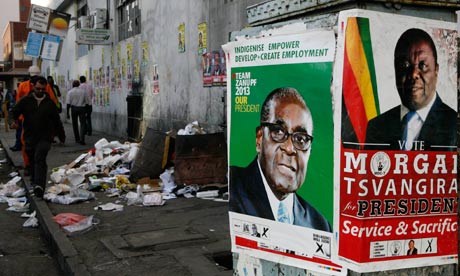
International unease mounted Sunday over the re-election of Africa’s oldest leader Robert Mugabe in polls denounced by Zimbabwe’s opposition as “stolen”.
Mugabe, 89, in power since 1980, trounced his long-standing rival Morgan Tsvangirai in Wednesday’s polls with 61 percent of the presidential vote while his party swept to a crushing parliamentary majority.
But 61-year-old Tsvangirai, leader of the Movement for Democratic Change (MDC) who has unsuccessfully tried to unseat Mugabe three times, condemned the vote as “fraudulent and stolen” and has vowed to challenge it.
Western powers, barred from sending full observer teams, voiced serious doubts about the polls following concerns over irregularities.
On Sunday, Germany said the election “casts a big shadow on the political and economic future of Zimbabwe”, while Australia called for new polls.
“Given our doubts about the results, Australia calls for a re-run of the elections based on a verified and agreed voters roll,” Foreign Minister Bob Carr said in a statement.
US Secretary of State John Kerry had Saturday described the election as “deeply flawed” and said Washington “does not believe that the results …today represent a credible expression of the will of the Zimbabwean people.”
British Foreign Secretary William Hague added his own “grave concerns” over the conduct of the vote in the former colony.
African and local observers raised concerns over the voters roll, the printing of extra ballot papers, and the turning away of voters at polling stations.
But with gentler assessments from the continent despite noting the flaws, President Jacob Zuma of powerful neighbour South Africa offered his “profound congratulations” to Mugabe on Sunday.
“President Zuma urges all political parties in Zimbabwe to accept the outcome of the elections as election observers reported it to be an expression of the will of the people,” a foreign ministry statement said.
The reaction in Zimbabwe’s Sunday press was starkly divided, with state-controlled newspaper The Herald proclaiming “President Mugabe romps to victory”, while the independent Daily News headlined, “It’s a Crisis”.
The vote marks the end of Mugabe and Tsvangirai’s tense compromise government, forced by bloodstained 2008 polls, that helped steer the isolated nation out of a protracted crisis.
In Harare’s oldest township Mbare on Sunday, several hundred Mugabe supporters carried a white coffin draped in an MDC flag, with a red knotted scarf placed on top with the inscription “RIP Morgan”.
“People are elated,” said one of the marchers, Tatenda Savanhu, 26, an economist.
“It’s really a moment of joy that the GNU (coalition government) is now gone that we are going into an era of ZANU-PF”.
— Finding a smoking gun may prove difficult —
Tsvangirai vowed to challenge the result in court and said the MDC would boycott government institutions.
“The fraudulent and stolen election has plunged Zimbabwe into a constitutional, political and economic crisis.”
Tsvangirai defended his 2008 decision to enter the uneasy pact with Mugabe, who has had him arrested, beaten and charged with treason, saying it had “rescued” Zimbabwe after years of meltdown.
But Mugabe’s ZANU-PF party says there is no need for the MDC in the new government.
“We have received over 60 percent of the vote, we have two-thirds majority, why would we want to bring someone else on board?” State Security Minister Sydney Sekeramayi told AFP.
The MDC now has until Saturday to present evidence of fraud to the constitutional court, but finding a smoking gun may prove difficult. The inauguration is expected within 48 hours of the court’s decision.
Tsvangirai said he would submit a dossier of “all irregularities and all the illegalities” to the influential 15-member Southern African Development Community (SADC) and called for an urgent summit.
The European Union, which had been moving toward easing long-standing sanctions, has also expressed concern.
But Emmerson Mnangagwa, defence minister and a key Mugabe lieutenant, argued that the result was a game-changer.
“The West will now have to climb down, they must find a ladder and climb down… A democratic election has taken place in Zimbabwe,” he told AFP.
The SADC, which engineered the power-sharing government, said the vote was “free and peaceful”.
But top SADC election observer Bernard Membe noted: “We did not say it was fair … we didn’t want to jump to a conclusion.”
The poll’s credibility was further tarnished by the resignation of one of the nine official electoral commissioners over “the manner” in which the polls “were proclaimed and conducted”.
But Harare based political analyst Blessing Vava said Western concerns meant little with African guarantors having given the polls the nod.
“The issue of Zimbabwe is over and done with,” Vava said.
The criticism will also be of little concern to Mugabe, he said.
“He will not care much with what the West will say, this is the reason why they were not invited to observe elections in the first place.” – AFP
Russia’s awarding of asylum to US leaker Edward Snowden dealt a new blow to already bruised relations between Moscow and Washington but it remains in their interest to prevent the row from erupting into a Cold-War style crisis, analysts said.
Washington immediately rebuked Moscow for granting one year asylum to a man the United States wants to put on trial for leaking details of a vast US intelligence programme.
The White House said it was “extremely disappointed” and, perhaps more significantly, said the decision had called into question the need for a planned bilateral summit between Vladimir Putin and Barack Obama in September.
The dispute could barely come at a worse time in Russia-US relations with Washington deeply critical of rights violations under Putin’s rule and the two sides at odds over the conflict in Syria.
Yet in over two decades since the collapse of the Soviet Union, Russia and the United States already have a chequered history of cyclical ups and downs in relations and the blow of the Snowden row may not be terminal, analysts said.
“A cancellation of the meeting between Obama and Putin would be evidence of a serious complication in relations,” said Maria Lipman of the Carnegie Centre in Moscow.
“But it would be wrong to say that relations are collapsing,” she added, noting that one of Obama’s priorities remained agreeing more arms cuts with Russia.
“There is a risk that Obama could lose interest in relations with Russia but even in this case it is not fatal,” she told AFP.
Putin has tried to distance himself from the entire Snowden affair, declaring on July 17 that “relations between states are much more important than squabbles surrounding the work of security services.”
Minutes after the asylum decision was made public on Thursday, Putin’s foreign policy advisor Yury Ushakov rushed to describe the Snowden issue as “rather insignificant” and arguing it should not affect relations.
The Kremlin had repeatedly argued that it did not invite Snowden to come to Russia and his arrival on June 23 at Moscow’s Sheremetyevo airport from Hong Kong was completely unexpected.
“Russia did not need the Snowden problem but it happened,” said Valery Garbuzov of the US-Canada Institute in Moscow.
“The Russian leadership had to react — it would have been inhumane to hand him over but giving asylum also complicates relations,” he said.
In a strong sign that contacts have not been ruptured, US ambassador to Moscow Michael McFaul met Ushakov Friday for talks on issues including the “new status” of Snowden as well as Syria and missile defence, the American embassy said.
Obama is due to visit Russia in any case in early September to attend the G20 summit in Saint Petersburg.
But he had been expected to come to Moscow for a separate one-on-one meeting with Putin which would be the first bilateral summit between the two men since the Russian strongman returned to the Kremlin for a third term in May 2012.
Until now, they have only held brief meetings on the sidelines of international summits.
Fyodor Lukyanov, editor of the journal Russia in Global Affairs, said it was still possible that Obama could undertake the Moscow visit although he would risk domestic criticism.
“Putin has tried to distance himself from the Snowden affair and has always emphasised that Russia is a victim of circumstances,” he said.
He said that any “retaliation from the United States will only have symbolic character”.
Republican US Senator John McCain had said after the granting of asylum to Snowden that it was time to “fundamentally rethink our relationship” and take tough action against Moscow.
But Lipman said that Putin’s statements on the Snowden affair had shown that the Kremlin chief still had an interest in preserving relations with Russia.
“Other solutions were sought, including sending him to another country. Putin did not strive for Snowden to come to Russia,” she added. – AFP
A good number of people in Britain and beyond have had the honour of being stripped of their knighthoods and awards by the honours forfeiture committee since 1995.
Last year a former Manchester headteacher, Jean Else, became the first woman to have her damehood annulled.
The forfeiture committee was established to guard the system of knighthoods, peerages and other awards.
The committee’s recommendations are submitted to the Queen through the prime minister. Any decisions on forfeiture are formally published in the London Gazette.
It is composed of senior civil servants. Meeting at least once a year, the committee examines individual cases brought to its attention and reviews general policy about how the system should operate.
The Commonwealth award is removed by a different forfeiture committee.
Robert Mugabe, knighted in 1994, to cheers of African liberation and Mandela worshipping, had the honour withdrawn in 2008 following the international furore over violent, disputed elections. Bob had become slightly too black for his boots.
The Romanian dictator Nicolae Ceausescu, honoured by the British government in an attempt to improve relations within Europe during the cold war had his knighthood revoked just in time. He fell from grace the day before his execution by a revolutionary firing squad.
Anthony Blunt, the keeper of the Queen’s pictures, was knighted for his services to art only to have his status revoked in 1979 shortly after the prime minister, Margaret Thatcher, had exposed his double life as a Soviet spy in parliament.
Another victim of the hasty re-writing of history is the Italian dictator Benito Mussolini.
Mussolini had been the first Italian to receive the honour. He was given the Knight Grand Cross of the Order of the Bath in 1923 from King George V, no less.
Il Duce lost his knighthood when Italy joined Nazi Germany in 1940 in declaring war on the UK.
The case of Roger Casement remains one of the most controversial forfeitures. A distinguished diplomat and human rights campaigner, he was eventually hanged for treason. He had attempted to deliver weapons to Irish republicans before the Easter Rising in 1916.
Even before this week’s vote in Zimbabwe, it seems clear that President Robert Mugabe will remain in power. Voter lists have been manipulated, critics are being intimidated and the opposition is divided.
Even after a week’s search, there are no 100-year-olds to be found in Harare, the Zimbabwean capital. There isn’t even anyone who knows a centenarian. Still, there ought to be plenty of very old people in Zimbabwe, because exactly 116,195 of its 13 million citizens have supposedly reached this biblical age. If that were the case, Zimbabwe would be home to nine times as many centenarians as Germany.
“It’s easy to explain,” McDonald Lewanika says wryly: “These people don’t exist. They are phantom voters.” Lewanika is the director of the Crisis in Zimbabwe Coalition, an alliance of regime critics. “The voter list is bogus. I’m afraid the result is already clear: The old man will win again.”
The “old man” is Robert Mugabe, 89, president of Zimbabwe for the last 33 years, since Lewanika was born. During this time, his regime has practically ruined the country, and yet he has been repeatedly re-elected, with completely implausible election outcomes. Through a series of manipulations, Mugabe’s power machine has also made sure that this week’s presidential and parliamentary elections are decided in advance.
Voter List Irregularities
The large number of 100-year-olds is just one of many oddities. According to the voter lists, 63 districts have more voters than residents. And in the rural strongholds of Mugabe’s party, the Zimbabwe African National Union-Patriotic Front (Zanu-PF), there was a miraculous increase in eligible voters, while their numbers were corrected downward in urban areas where, coincidentally, many supporters of the main opposition party Movement for Democratic Change (MDC) live. More than a million people on the voter lists are either dead or have moved away. And 1.9 million citizens under 30 were not even included on the rolls, according to experts with the Research and Advocacy Unit, which analyzed the voter lists. Only those whose names appear on the lists are allowed to vote.
The remaining possible supporters of the opposition are intimidated to ensure that they vote for Zanu-PF. The regime has reportedly distributed 50,000 members of party militias across the country. Dissidents are systematically persecuted, locked up and tortured. In June, a former Zanu-PF cabinet minister who had exposed senior politicians’ involvement in diamond deals was killed in a mysterious traffic accident.
Glen View on the outskirts of Harare is a densely populated, dilapidated neighborhood, with potholed dirt roads, mountains of garbage and wrecked cars by the roadside. The majority of Glen View’s impoverished residents sympathize with the opposition.
A woman waits by the side of the road. She wears a broad-rimmed straw hat to avoid being recognized. It’s dangerous to be seen with white foreigners. She calls herself an activist fighting for democracy, but for security reasons she wants to remain anonymous. “In the 2008 election campaign, Mugabe’s gangs of thugs set houses on fire and beat up people wearing red clothing, the color of the MDC,” the woman says. “We haven’t forgotten that.” Today the Big Man, as he is called here, doesn’t need to resort to brute violence. It’s enough, she says, for his people to go from door to door and hold up matches. “Glen View is practically paralyzed. People are afraid.”
The live broadcast of a campaign event is on the TV screen in a beer pub in Glen View. Mugabe talks and talks, speaking for an entire two hours. He clings to the podium, mumbles, becomes muddled and gets the African Union confused with the European Union. He faces a sea of yellowish-green caps and T-shirts, either real supporters or people who were bussed in to cheer the president, the “God-chosen leader for Zimbabwe,” as Mugabe’s wife Grace calls him.
The geriatric dictator seems exhausted and fragile. He has advanced-stage prostate cancer and has reportedly had two or three mild strokes recently. But his will to stay in power keeps him going. He wants to bring in the harvest of fear and show the world, once again, that he can win.
‘The Kiss of Death’
Mugabe is at his best when he announces his rescue plan for the ailing country. He wants to “indigenize” — that is, expropriate — 1,138 foreign companies and turn them over to the majority control of local businesspeople, cleaning up the government’s budget in the process. “That would be the next pilferage after the catastrophic land reform,” says a market expert who prefers to remain anonymous. “It would be the kiss of death for Zimbabwe.”
The country’s rapid decline began with the land grab 13 years ago, when 4,000 white farmers were expropriated and driven out. Since then Zimbabwe, once a breadbasket, has had to import corn. In addition, some 1.5 million Zimbabweans would starve without the food provided by international aid organizations. Three million have emigrated to South Africa, in the search for bread and work.
After the so-called agrarian revolution, the economy has declined by as much as 40 percent a year, with unemployment topping 90 percent. In 2009, the currency collapsed and was replaced with the US dollar, after inflation had reached the unimaginable figure of 60 billion percent.
Mugabe liberated his country in its struggle against British colonial rule — and then he turned it into a poorhouse. But in his eyes, others are always to blame for Zimbabwe’s troubles: the British, neo-imperialists, whites, the West with its sanctions.
Ironically, the man charged with “indigenizing” the economy is named Saviour Kasukuwere, a giant of a man, as heavy as a prize fighter. His supporters call him “Tyson.” Kasukuwere, 42, the youngest minister in Zanu-PF, has his office on the 20th floor of a high-rise building in downtown Harare. It’s a large office with flashy leather sofas and a view of the city.
Is it possible that party leaders are trying to line their pockets with the help of expropriations? That’s complete nonsense, Kasukuwere grumbles. “It’s about fighting poverty. We are liberating ourselves from economic apartheid.” He sounds like Mugabe, which is probably one reason he is mentioned as a possible successor. There are rumors that the president told a politician friend from Zambia that he intends to step down shortly after winning the next election.
Western Hopes for Peaceful Election
“The preparation for these elections was much too short, and the requirements under the new constitution were not met,” says a Western diplomat. “We just hope that the election is peaceful. And that the military doesn’t stage a coup if the wrong outcome is achieved.” Representatives of the United States and the European Union have already announced their intention to lift the remaining sanctions against the regime if the election remains peaceful.
But that is by no means certain. The majority of the people no longer believe Mugabe’s bluster. In the last presidential election, in 2008, he lost the first round against MDC leader Morgan Tsvangirai, 61. To secure a Mugabe victory in the runoff election, the police, military and party militias terrorized the population, and more than 200 people were killed.
Neutral election observers are not allowed. Only the envoys of friendly nations are permitted to monitor the vote. “Once again, the elections are neither free nor fair. And, once again, Mugabe will steal victory,” predicts Blessing Vava, 30, one of the many bloggers who, for lack of an independent press, are gaining more and more supporters.
The best known of them is “Baba Jukwa,” who discovers new machinations on the part of Zanu-PF every day and has 286,000 supporters on Facebook. Baba Jukwa is a pseudonym, and no one knows who is behind the site. But the whistleblower’s revelations are often correct. So correct, in fact, that Mugabe has promised a reward of $300,000 (€226,000) for his exposure.
“Many young people mistrust the political class and won’t vote for the MDC, either,” says Vava. “They are disappointed in Tsvangirai. Some even accuse him of being in bed with Mugabe.”
Since 2009, MDC leader Tsvangirai has been prime minister in a government brokered by South Africa. But Mugabe still controls the police, military, intelligence services, judiciary and the media. Tsvangirai, the pro-forma premier and opposition leader in one, tends to make headlines because of his womanizing activities. Some of his fellow party members have become just as corrupt as the Zanu-PF fat cats, driving flashy official cars and living in attractive villas. The opposition is deeply divided and has failed to come up with a shared candidate.
In the Book Café in Harare, where artists, intellectuals and students meet, no one takes the politicians seriously anymore. Most of the patrons are under 30, part of a new, skeptical generation that gets its information from the Internet and sees no future in its country.
Three performers are doing a parody of the news broadcast by ZBC, the propagandist government broadcaster, on the stage at the café. One actor is playing a journalist, who is reporting from a village and holds up a sealed ballot box, already stuffed with 50,000 ballots before the election day. “Respect our ancestors!” says the host, and the people in the audience laugh. They know all about the many dead people on the voter lists. – spiegel.de
Whatever the result of Zimbabwe’s election Wednesday one thing is for sure: four years of uneasy power-sharing between President Robert Mugabe and Prime Minister Morgan Tsvangirai will end.
As Zimbabweans streamed to the polls, the unity government partners sighed with relief at the close of their “painful”, “disappointing” union.
The forced marriage was arranged by the international community to avoid further violence in the wake of suspect and blood-soaked 2008 elections.
Tsvangirai won the first round, but was forced to drop out of the second round amid the killing of 200 of his supporters.
He then became prime minister as a reluctant partner in the unity government alongside Mugabe, the former guerrilla who has ruled since independence from Britain.
While the power-sharing deal which took effect in 2009 prevented full-scale conflict, critics today deplore its failure to achieve much-needed democratic reforms and kickstart the economy.
“It has been a major disappointment,” Rugare Gumbo, spokesman for Mugabe’s ZANU-PF party, told AFP.
But communications minister Nelson Chamisa, spokesman for Tzvangirai’s Movement for Democratic Change (MDC), said the government had achieved some victories.
“It has been difficult, difficult, painful but useful for the people of Zimbabwe. People’s lives have improved,” he said. “We are excited that we are coming out of the blast furnace.”
The arrangement was aimed at creating a “genuine, viable, permanent, sustainable” solution to the crisis.
But in its early days, Mugabe could not hide his discomfort.
“I feel awkward in a thing like that, absolutely awkward,” he told mediator President Jacob Zuma of South Africa at the time.
Ex-finance minister Simba Makoni, who was not part of the unity deal, branded the Mugabe-Tsvangirai government “pathetic” and “dismal”.
And analysts said the deal had failed to set a democratic framework for fresh elections.
Days before Wednesday vote, the country was “still grappling with issues of reforms, the timing of elections, issues of sporadic violence and intimidation,” said Trevor Maisiri, a researcher with the International Crisis Group.
“It has not fully served its primary purpose because the idea was to create a transitional mechanism that would lead to a credible election,” he said.
Initially the unity government was to last just two years but it had to be extended as delays plagued the formulation of a new constitution that would lay the basis for credible polls this time around.
The MDC “regrets, definitely that quite a number of reforms did not move as we had wanted,” said Chamisa, highlighting a lack of revisions of the media and security sector.
Civic rights coalition Sokwanele, which kept an eye on the government’s performance, traced 22,482 violations of the agreement — 90 percent by ZANU-PF.
The rivals still strongly disagree on the economy, and bitterly blame each other for Zimbabwe’s slow recovery.
Unemployment still hovers on the wrong side of 50 percent while millions of people are still economic refugees in neighbouring countries.
Once a net food exporter known as Africa’s breadbasket, Zimbabwe’s reformed agricultural sector is yet to produce enough to feed the country.
“There were many programmes that we were going to carry out, but our colleagues acted like they were an opposition party instead of carrying themselves as part of the government,” the ZANU-PF’s Gumbo claimed.
The MDC said it opposed “ill-conceived” black economic empowerment schemes that forced foreign companies to cede a majority of their shares, saying it drove away investors.
But some say the power-sharing agreement was not all bad.
The government rescued the moribund economy by abandoning the Zimbabwean dollar, ending rampant inflation that peaked at 231 million percent.
Politicians who previously had not seen eye-to-eye suddenly were forced to run the country together, which may explain the peaceful run-up to Wednesday’s polls.
Just being able to talk to each other in parliament or in cabinet “has really been helpful,” said Gumbo.
The coalition “brought about some sanity, peace and stability. We are not fighting as we used to. Even campaigning is being done in a peaceful, orderly manner,” he said.
Chamisa also said the unity government was a healthy exercise.
“The past four years showed that another Zimbabwe is possible. A Zimbabwe where we can realise, appreciate and celebrate the cross-pollination of ideas,” he said.
By Richard Haass. Whenever something bad happens – Iran moving closer to acquiring nuclear weapons, North Korea firing another missile, civilian deaths reaching another grim milestone in Syria’s civil war, satellites revealing an alarming rate of polar-ice melt – some official or observer will call upon the international community to act. There is only one problem: there is no “international community.”
Part of the reason stems from the absence of any mechanism for “the world” to come together. The United Nations General Assembly comes closest, but little can be expected from an organization that equates the United States or China with, say, Fiji or Guinea-Bissau.
To be fair, those who founded the UN after World War II created the Security Council as the venue in which major powers would meet to determine the world’s fate. But even that has not worked out as planned, partly because the world of 2013 bears little resemblance to that of 1945. How else could one explain that Britain and France, but not Germany, Japan, or India, are permanent, veto-wielding members?
Alas, there is no agreement on how to update the Security Council. Efforts like the G-20 are welcome, but they lack authority and capacity, in addition to suffering from excessive size. The result is “multilateralism’s dilemma”: the inclusion of more actors increases an organization’s legitimacy at the expense of its utility.
No amount of UN reform could make things fundamentally different. Today’s major powers do not agree on the rules that ought to govern the world, much less on the penalties for breaking them. Even where there is accord in principle, there is little agreement in practice. The result is a world that is messier and more dangerous than it should be.
Consider climate change. Burning fossil fuels is having a measurable impact on the earth’s temperature. But reducing carbon emissions has proved impossible, because such a commitment could constrain GDP growth (anathema to developed countries mired in economic malaise) and impede access to energy and electricity for billions of people in developing countries, which is unacceptable to China and India.
Stopping the spread of nuclear weapons would seem a more promising issue for global collaboration. The Nuclear Non-Proliferation Treaty (NPT) limits the right to possess nuclear weapons to the Security Council’s five permanent members, and then only temporarily.
But agreement is thinner than it appears. The NPT allows countries the right to develop nuclear energy for purposes such as electricity generation, a loophole that allows governments to build most of what is necessary to produce the fuel for a nuclear weapon.
The inspection regime created in 1957 under the International Atomic Energy Agency (IAEA) is a gentlemen’s agreement; inspectors can inspect only those facilities that are made known to them by the government in question. Governments (such as Iran’s) can and do carry out illegal nuclear activities in secret sites that international inspectors either do not know about or cannot enter. At least as important, there is no agreement on what to do when a country violates the NPT, as Iran and North Korea (which withdrew from the treaty in 2003) have done.
More international cooperation exists in the economic realm. There has been real progress toward reducing tariff barriers; the World Trade Organization has also established a dispute-resolution mechanism for its 159 members. But progress on expanding free trade at the global level has stalled, as many countries disagree on the treatment of agricultural goods, the elimination of subsidies, and trade in services.
Meanwhile, cooperation in the realm of cyberspace is just getting started – with difficulty. The US is most concerned about cyber security and the protection of intellectual property and infrastructure. Authoritarian governments are more concerned about information security – the ability to control what is available on the Internet in order to maintain political and social stability. There is no agreement on what, if anything, constitutes an appropriate target for espionage. The prevalence of non-state actors is further complicating efforts.
Another area where there is less international community than meets the eye is human suffering. Governments that attack their own people on a large scale, or allow such attacks to be carried out, expose themselves to the threat of outside intervention. This “Responsibility to Protect,” or R2P, was enshrined by the UN in 2005.
But many governments are concerned that R2P raises expectations that they will act, which could prove costly in terms of lives, military expenditure, and commercial priorities. Some governments are also worried that R2P could be turned on them. Russian and Chinese reticence about pressuring governments that deserve censure and sanction stems partly from such concerns; the absence of consensus on Syria is just one result.
In short, those looking to the international community to deal with the world’s problems will be disappointed. This is not reason for despair or grounds for acting unilaterally. But so long as “international community” is more hope than reality, multilateralism will have to become more varied.
In the trade area, this implies regional and bilateral accords. On climate change, it makes sense to seek “mini-agreements” that set minimum common standards for fuel efficiency, slow deforestation, or limit the largest economies’ carbon output.
In these and other areas, governments will need to rally around regional undertakings, form coalitions of the relevant or willing, or simply seek understandings among countries to do their best to adopt common policies. Such approaches may lack the reach and legitimacy of formal global undertakings, but they do have the advantage of getting something done.
Richard N. Haass is President of the Council on Foreign Relations
Four out of 5 U.S. adults struggle with joblessness, near-poverty or reliance on welfare for at least parts of their lives, a sign of deteriorating economic security and an elusive American dream.
Survey data exclusive to The Associated Press points to an increasingly globalized U.S. economy, the widening gap between rich and poor, and the loss of good-paying manufacturing jobs as reasons for the trend.
The findings come as President Barack Obama tries to renew his administration’s emphasis on the economy, saying in recent speeches that his highest priority is to “rebuild ladders of opportunity” and reverse income inequality.
As nonwhites approach a numerical majority in the U.S., one question is how public programs to lift the disadvantaged should be best focused – on the affirmative action that historically has tried to eliminate the racial barriers seen as the major impediment to economic equality, or simply on improving socioeconomic status for all, regardless of race.
Hardship is particularly growing among whites, based on several measures. Pessimism among that racial group about their families’ economic futures has climbed to the highest point since at least 1987. In the most recent AP-GfK poll, 63 percent of whites called the economy “poor.”
“I think it’s going to get worse,” said Irene Salyers, 52, of Buchanan County, Va., a declining coal region in Appalachia. Married and divorced three times, Salyers now helps run a fruit and vegetable stand with her boyfriend but it doesn’t generate much income. They live mostly off government disability checks.
“If you do try to go apply for a job, they’re not hiring people, and they’re not paying that much to even go to work,” she said. Children, she said, have “nothing better to do than to get on drugs.”
While racial and ethnic minorities are more likely to live in poverty, race disparities in the poverty rate have narrowed substantially since the 1970s, census data show. Economic insecurity among whites also is more pervasive than is shown in the government’s poverty data, engulfing more than 76 percent of white adults by the time they turn 60, according to a new economic gauge being published next year by the Oxford University Press.
The gauge defines “economic insecurity” as experiencing unemployment at some point in their working lives, or a year or more of reliance on government aid such as food stamps or income below 150 percent of the poverty line. Measured across all races, the risk of economic insecurity rises to 79 percent.
Marriage rates are in decline across all races, and the number of white mother-headed households living in poverty has risen to the level of black ones.
“It’s time that America comes to understand that many of the nation’s biggest disparities, from education and life expectancy to poverty, are increasingly due to economic class position,” said William Julius Wilson, a Harvard professor who specializes in race and poverty. He noted that despite continuing economic difficulties, minorities have more optimism about the future after Obama’s election, while struggling whites do not.
“There is the real possibility that white alienation will increase if steps are not taken to highlight and address inequality on a broad front,” Wilson said.
Nationwide, the count of America’s poor remains stuck at a record number: 46.2 million, or 15 percent of the population, due in part to lingering high unemployment following the recession. While poverty rates for blacks and Hispanics are nearly three times higher, by absolute numbers the predominant face of the poor is white.
More than 19 million whites fall below the poverty line of $23,021 for a family of four, accounting for more than 41 percent of the nation’s destitute, nearly double the number of poor blacks.
Sometimes termed “the invisible poor” by demographers, lower-income whites generally are dispersed in suburbs as well as small rural towns, where more than 60 percent of the poor are white. Concentrated in Appalachia in the East, they are numerous in the industrial Midwest and spread across America’s heartland, from Missouri, Arkansas and Oklahoma up through the Great Plains.
Buchanan County, in southwest Virginia, is among the nation’s most destitute based on median income, with poverty hovering at 24 percent. The county is mostly white, as are 99 percent of its poor.
More than 90 percent of Buchanan County’s inhabitants are working-class whites who lack a college degree. Higher education long has been seen there as nonessential to land a job because well-paying mining and related jobs were once in plentiful supply. These days many residents get by on odd jobs and government checks.
Salyers’ daughter, Renee Adams, 28, who grew up in the region, has two children. A jobless single mother, she relies on her live-in boyfriend’s disability checks to get by. Salyers says it was tough raising her own children as it is for her daughter now, and doesn’t even try to speculate what awaits her grandchildren, ages 4 and 5.
Smoking a cigarette in front of the produce stand, Adams later expresses a wish that employers will look past her conviction a few years ago for distributing prescription painkillers, so she can get a job and have money to “buy the kids everything they need.”
“It’s pretty hard,” she said. “Once the bills are paid, we might have $10 to our name.”
Census figures provide an official measure of poverty, but they’re only a temporary snapshot that doesn’t capture the makeup of those who cycle in and out of poverty at different points in their lives. They may be suburbanites, for example, or the working poor or the laid off.
In 2011 that snapshot showed 12.6 percent of adults in their prime working-age years of 25-60 lived in poverty. But measured in terms of a person’s lifetime risk, a much higher number – 4 in 10 adults – falls into poverty for at least a year of their lives.
The risks of poverty also have been increasing in recent decades, particularly among people ages 35-55, coinciding with widening income inequality. For instance, people ages 35-45 had a 17 percent risk of encountering poverty during the 1969-1989 time period; that risk increased to 23 percent during the 1989-2009 period. For those ages 45-55, the risk of poverty jumped from 11.8 percent to 17.7 percent.
Higher recent rates of unemployment mean the lifetime risk of experiencing economic insecurity now runs even higher: 79 percent, or 4 in 5 adults, by the time they turn 60.
By race, nonwhites still have a higher risk of being economically insecure, at 90 percent. But compared with the official poverty rate, some of the biggest jumps under the newer measure are among whites, with more than 76 percent enduring periods of joblessness, life on welfare or near-poverty.
By 2030, based on the current trend of widening income inequality, close to 85 percent of all working-age adults in the U.S. will experience bouts of economic insecurity.
“Poverty is no longer an issue of `them’, it’s an issue of `us’,” says Mark Rank, a professor at Washington University in St. Louis who calculated the numbers. “Only when poverty is thought of as a mainstream event, rather than a fringe experience that just affects blacks and Hispanics, can we really begin to build broader support for programs that lift people in need.”
The numbers come from Rank’s analysis being published by the Oxford University Press. They are supplemented with interviews and figures provided to the AP by Tom Hirschl, a professor at Cornell University; John Iceland, a sociology professor at Penn State University; the University of New Hampshire’s Carsey Institute; the Census Bureau; and the Population Reference Bureau.
Among the findings:
-For the first time since 1975, the number of white single-mother households living in poverty with children surpassed or equaled black ones in the past decade, spurred by job losses and faster rates of out-of-wedlock births among whites. White single-mother families in poverty stood at nearly 1.5 million in 2011, comparable to the number for blacks. Hispanic single-mother families in poverty trailed at 1.2 million.
-Since 2000, the poverty rate among working-class whites has grown faster than among working-class nonwhites, rising 3 percentage points to 11 percent as the recession took a bigger toll among lower-wage workers. Still, poverty among working-class nonwhites remains higher, at 23 percent.
-The share of children living in high-poverty neighborhoods – those with poverty rates of 30 percent or more – has increased to 1 in 10, putting them at higher risk of teenage pregnancy or dropping out of school. Non-Hispanic whites accounted for 17 percent of the child population in such neighborhoods, compared with 13 percent in 2000, even though the overall proportion of white children in the U.S. has been declining.
The share of black children in high-poverty neighborhoods dropped from 43 percent to 37 percent, while the share of Latino children went from 38 percent to 39 percent.
-Race disparities in health and education have narrowed generally since the 1960s. While residential segregation remains high, a typical black person now lives in a nonmajority black neighborhood for the first time. Previous studies have shown that wealth is a greater predictor of standardized test scores than race; the test-score gap between rich and low-income students is now nearly double the gap between blacks and whites.
—
Going back to the 1980s, never have whites been so pessimistic about their futures, according to the General Social Survey, a biannual survey conducted by NORC at the University of Chicago. Just 45 percent say their family will have a good chance of improving their economic position based on the way things are in America.
The divide is especially evident among those whites who self-identify as working class. Forty-nine percent say they think their children will do better than them, compared with 67 percent of nonwhites who consider themselves working class, even though the economic plight of minorities tends to be worse.
Although they are a shrinking group, working-class whites – defined as those lacking a college degree – remain the biggest demographic bloc of the working-age population. In 2012, Election Day exit polls conducted for the AP and the television networks showed working-class whites made up 36 percent of the electorate, even with a notable drop in white voter turnout.
Last November, Obama won the votes of just 36 percent of those noncollege whites, the worst performance of any Democratic nominee among that group since Republican Ronald Reagan’s 1984 landslide victory over Walter Mondale.
Some Democratic analysts have urged renewed efforts to bring working-class whites into the political fold, calling them a potential “decisive swing voter group” if minority and youth turnout level off in future elections. “In 2016 GOP messaging will be far more focused on expressing concern for `the middle class’ and `average Americans,'” Andrew Levison and Ruy Teixeira wrote recently in The New Republic.
“They don’t trust big government, but it doesn’t mean they want no government,” says Republican pollster Ed Goeas, who agrees that working-class whites will remain an important electoral group. His research found that many of them would support anti-poverty programs if focused broadly on job training and infrastructure investment. This past week, Obama pledged anew to help manufacturers bring jobs back to America and to create jobs in the energy sectors of wind, solar and natural gas.
“They feel that politicians are giving attention to other people and not them,” Goeas said. – AP
Justice Piitso says the question of the ownership of the economy is the nerve centre of the struggles of the people
A revolution will remain incomplete without the resolution of the fundamental question of land ownership.
Next week the people of Zimbabwe will have an opportunity to exercise their democratic right to elect the government of their choice when they will be going to the polls.
This will be the most historic elections paving way for the end of the power sharing unity government between the ZANU -PF under President Robert Mugabe and the MDC under Prime Minister Morgan Tsvangirai.
This complex transitional arrangement is unfolding under the auspices of the watchful eye of the international community. The recent past elections were marred by allegations of state sponsored violence and intimidation of voters that made it difficult for a conducive environment of a free and fair elections.
It will therefore be in the best interest of the people of Zimbabwe that the forthcoming elections take place within the enabling framework of a free and fair environment. The people of Zimbabwe, Southern African region, the continent and the world need peace and stability.
The elections are taking place against the background of protracted forms of struggles between the government of Zimbabwe and the former colonial power Britain, over the historic land ownership question.
The political tensions escalated when the government under the leadership of ZANU-PF, embarked on a programme of seizure of land from the hands of the few white into the hands of the vast majority of the black people of Zimbabwe.
The state led radical programme for seizure of land from the white Zimbabwean community, sparked a fierce reaction that prompted the international community to impose sanctions against the government under the leadership of President Mugabe.
The imposition of the economic sanctions by the international community was a confirmation that colonial societies are ordered by imperialism. The reason why we say the Zimbabwean revolution fiddled with the nervous system of the forces of imperialism and colonialism.
It is from this context that revolutionaries openly debate on the important question of the complexities of the post colonial transitional periods, and how they affect the struggles of our people in the former colonies and semi colonies.
Equally we need to appreciate this as a metamorphosis of how the post colonial contradictions manifest themselves in the arena of the struggles of our people, against imperialism and neo colonial domination.
In the year 1980 Zimbabwe was declared an independent state after decades of protracted forms of struggles for national liberation against British colonial domination and the racist South African apartheid regime.
The declaration of the independence of the former colonial state of Rhodesia, was a historic breakthrough in the struggles of our people for the liberation of the Southern African region.
The declaration of the independence of the former colonial state of Rhodesia was a product of a negotiated transitional political arrangement. The transitional negotiations culminated into the former colonial master Britain and the liberation movement of Zimbabwe signing the historic Lancaster Agreement.
At the heart of the watershed agreement was the unwavering commitment by the British colonial government to assist in ensuring equitable transfer of land back to the overwhelming majority of the people of Zimbabwe. It was agreed that the process should be completed within the first decade of the transitional period.
Historical records prove that the British colonial government rescinded by not expediting the process of the transfer of land as agreed at the Lancaster house. This is the fundamental problem that has aggravated the present socio economic crisis.
The Zimbabwean land ownership question is a living testimony of how complex post colonial transitional period can be in the context of the history of the struggles of our people in the former colonies and semi colonies. It also relates to the nature and the character of the struggles, between the oppressor and the oppressed nations, post colonial transitional period.
At the core of these struggles is the fundamental question of how do we involve the oppressed people in the former colonies and semi colonies into the mainstreams of our economy. The primary issue remains to be how do we resolve the fundamental question of the ownership of the economy.
The scientific historical realities have proven that the question of the ownership of the economy is the nerve centre of the struggles of our people. The basic reason why it has become the most contentious issue after every war of the independence of our people.
The pertinent question is how do we understand the interrelationship between the primary and secondary contradictions. The mistakes we must avoid is to elevate secondary contradictions at the expense of primary contradictions.
Imperialism is trying to confuse our people by elevating the superficial issues of human rights at the expense of the fundamental question of the ownership patterns of the economy.
We must therefore refuse the attempts by imperialism to reduce the role of the people in the former colonies and semi colonies into being praise singers of national anthems and hoisting of National flags.
The most fundamental question is how do we take forward the common struggles of our people to create a new world social order. Our immediate task is to implore our collective responsibility to resolve the contradictions of poverty, disease and underdevelopment inflicting the poor people of the world.
We therefore have to ask ourselves the most important question as to what are the lessons and experiences we have learned out of the contradictions of the Zimbabwean post colonial transition.
We have to ask ourselves the most important question as what is the role and influence of the phenomenon of imperialism and colonialism during the transitional period of the post colonial nation states.
The essence of any revolutionary phase is about generations of mankind making sacrifices. The people of Zimbabwe have made sacrifices during the struggles for liberation against British colonial rule, and they are still making sacrifices today as they continue with the struggles for the socio economic transformation of their country.
The struggles of the people of Zimbabwe are still consistence with the values, culture and traditions of the progressive movement of the world. Its posture is still anti colonial in form and content.
The only task confronting the collective leadership of the ZANU-PF is how to polish their understanding of the scientific revolutionary concept of the role of an individual in the making of history.
The collective leadership of the ZANU-PF will go into the annals of history, having been the first generations of the people of the former colonies and semi colonies to have fiddled with the nervous system of the forces of imperialism and colonialism.
Phatse Justice Piitso is the former Ambassador to the republic of Cuba and the former provincial secretary of the SACP.
Did you notice during the George Zimmerman trial how the media kept repeating the salacious question “What if Trayvon Martin had been white?” They acted as if this question was the perfect response to Zimmerman defenders. They pretended that this was a question without a “safe” answer, but in reality, the question had already been answered.
In April of 2009 Mr. Roderick Scott awoke at 3am to the sounds of three young men breaking into cars on his street. He called the police and went down to the street to make sure the young men did not flee before the police arrived. He shouted at the three to “freeze” and told them that the police were coming soon. The three boys stood before the big man obviously considering what they should do.
That’s when Christopher Cervini (17) rushed at Mr. Scott uttering “I’ll get you” or “I’ll get him.” Roderick Scott fired twice, killing the teenager. The trial that followed was again a case of prosecutorial overreach, as they tried to charge Mr. Scott with manslaughter. Fortunately for Mr. Scott, a jury of his peers agreed with him that he did only what was needed to protect himself.
Afterwards the prosecutor opined, “I just hope it’s not a message to this community… that you have the right to shoot an unarmed 17-year-old kid for breaking into a car.” The problem is that Mr. Scott did not shoot young Christopher Cervini for breaking into his car, but for attacking him. While the Cervini family may now be in much pain over the loss of their son, he brought himself to his tragic end through a series of terrible choices. Roderick Scott had every right to protect himself; he did what he should have… and a jury of his peers agreed.
Oh, and Roderick Scott was a 42 year old black man about the size of an NFL linebacker. Christopher Cervini was a skinny, 17 year old white kid with a little bit of marijuana in his system. Scott was justified in the killing of the younger man not because of the crime that Cervini had committed, but because Scott rightfully feared for his own safety.
There was no “white uproar” over the shooting of a young white man at the hands of a black man with a “hero-complex.” The NAACP didn’t show up to argue that the shooter should be jailed, or that the Justice Department should pursue charges of civil rights violations against the man for killing Cervini. Jesse Jackson, Al Shartpon, and all of the other race hate baiters stayed home for the trial. The trial was treated as a tragic situation that a young man brought on himself by turning to violence.
Which is exactly how the George Zimmerman case should have been treated. The next time someone tells you, “What if…?” You can tell them it already happened, and the outcome was zero racial tension. laresistance.com
A bid to reconcile hardened enemies in Ivory Coast has all but broken down, according to participants and observers, and time is running out for a commission set up to heal the wounds of bitter strife.
More than two years after a political and military crisis that claimed at least 3,000 lives in the west African country in the wake of disputed elections, statements by rival sides reveal their deep differences.
Yet the word “reconciliation” is still on many lips in political circles. Supporters of President Alassane Ouattara make it an article of faith. So do members of the opposition Ivorian Popular Front (FPI) of former president Laurent Gbagbo, who triggered the crisis by refusing to accept defeat at the polls in November 2010.
In an early July tour of the cocoa-rich north, his electoral stronghold, Ouattara urged the FPI to “ask pardon of the victims” of the bloodshed, which lasted from December 2010 to April 2011 in a country already weakened by civil war and partition.
The FPI this week curtly rejected the call to “repent”. Many in the party still consider Gbagbo their champion, though he is detained by the International Criminal Court in The Hague facing charges of crimes against humanity. His supporters argue that Ouattara’s side was to blame for the post-electoral violence.
Created by Ouattara in September 2011, a national Dialogue, Truth and Reconciliation Commission (CDVR) with a two-year mandate has endeavoured to resolve differences and has joined in the debate.
“In what happened to Ivory Coast, the wrongs are shared,” said the commission chairman, former prime minister Charles Konan Banny, closing a forum last week on the “profound causes” of a decade of hostilities.
“It’s up to all those who committed violations of human rights to acknowledge them and make an act of repentance,” he added, but the commission has less than three months to complete an enormous task.
Banny has indicated that he might ask for an extension of the commission’s mandate. “A time limit (is) not the best” of solutions, he told AFP, suggesting that two years are not enough for the work to be done.
Asked whether he would take up his post again if the mandate is prolonged, Banny evades the question. In political circles, many are speculating that the ex-premier might want to take up another challenge: the presidential election of 2015.
According to these observers, Banny may try to take control of his political party, the once all-powerful Democratic Party of Ivory Coast (PDCI), which has now become the main ally of Ouattara’s Rally of Republicans (RDR). The PDCI’s leading bodies are due for renewal in October.
‘A great national catharsis’
Now that the reconciliation commission is nearing the end of its mandate, politicians, diplomats, observers and non-governmental organisations are taking stock of its record, often with great severity.
“The CDVR is at a dead end,” says Rene Legre Hokou, the chairman of the Ivorian League of Human Rights, (LIDHO), arguing that the panel has kept a low profile and shown few concrete results.
The commission has for months promised public hearings across the country in which the “executioners” would directly confront their “victims”, but they have yet to begin. Many Ivorians eagerly await what Banny has termed a “great national catharsis”.
Under fire from its critics, some members of the panel complain of a lack of sufficient financial resources and also argue that their task is being complicated by political and legal interference.
In the most recent episode they cite, 84 people who were part of Gbagbo’s regime or close to it, including former first lady Simone Gbagbo, have been summoned before an assize court to answer for their suspected roles in the crisis of 2010-2011. However, the date for the hearing has not yet been set.
While for Ouattara, there can be no reconciliation without justice, Gbagbo supporters see the latest move by the judiciary as a new illustration of “conqueror’s justice”. Ivorian prosecutors have so far taken no steps to deal with serious crimes blamed on pro-Ouattara forces during the crisis.
Scant grounds exist for a resumption of talks between the government and the opposition FPI, which have been stalled for months. Yet such dialogue is essential to pave the way for the presidential election in two years’ time, with Ouattara already a candidate.
CDVR member Simeon Ahouana, the bishop of the central town of Bouake -long the stronghold of rebels involved in a 2002 coup bid against Gbagbo – has annnounced that he has “concerns” about the forthcoming poll.
LIDHO’s chairman Hokou is more blunt. In his eyes, if there is no progress in reconciliation by 2015, “we must fear that we’ll fall back into even worse violence”. – AFP
Pope Francis waving to supporters in the streets of Rio
Pope Francis wants to ignite the passion of Roman Catholics for their faith while on his first international trip, and the boisterous, sometimes frenzied welcome he got on his first day in Rio seemed to fill those hopes.
Returning to his home continent for the first time since becoming pontiff, Francis smiled broadly as thousands of people rushed his car Monday after it became stuck behind buses and taxis when his driver made a wrong turn on a main avenue in Rio’s center.
It was a nightmarish scene for security officials, but clearly a delight and another opportunity to connect for this pope, who was scheduled to take a day off Tuesday for rest and private meetings.
The ecstatic throngs forced his motorcade to repeatedly come to a standstill, weeks after violent protests against the government paralyzed parts of Brazil. Francis’ driver turned into the wrong side of a boulevard at one point, missing lanes that had been cleared. Other parts of the pope’s route to the city center weren’t lined with fencing, giving the throngs more chances to get close, with uniformed police nowhere in sight to act as crowd control.
The three dozen visible Vatican and Brazilian plainclothes security officials struggled to keep the crowds at bay. Francis not only looked calm but got even closer to the people. He rolled down his back-seat window, waved to the crowd and touched those who reached inside. He kissed a baby a woman handed to him.
“His secretary was afraid, but the pope was happy,” said the papal spokesman, the Rev. Federico Lombardi.
The pope is here on a seven-day visit meant to fan the fervor of the faithful around the globe. That task has grown more challenging as Catholics stray, even in strongholds of the religion such as Brazil, yet it seemed to come easily to Francis even on the drive from the airport to an official opening ceremony.
After finally making it past crowds and blocked traffic, Francis switched to an open-air vehicle for a cruise along main streets past crowds of people who screamed wildly as he waved and smiled. He left his popemobile – the bulletproof one – in the Vatican garage so he could better connect with people during the church’s World Youth Day.
Vatican officials insisted they had no concern for the pope’s safety as his vehicles eased through the masses, but Lombardi acknowledged there might have been some “errors” that need correcting.
“This is something new, maybe also a lesson for the coming days,” Lombardi said.
Many in the crowd looked stunned to see the pope, with some standing still and others sobbing loudly.
“I can’t travel to Rome, but he came here to make my country better … and to deepen our faith,” Idaclea Rangel, a 73-year-old Catholic, said, choking through her tears after the pope passed by.
As many as 1 million young people from around the world are expected in Rio for the Catholic youth fest, a seemingly tailor-made event for the Argentine-born pope, who has proven enormously popular in his four months on the job. But the fervor of the crowds that regularly greet Francis in St. Peter’s Square was nothing compared with the raucous welcome in Rio.
Popes generally get a warm welcome in Latin America; even the more aloof Pope Benedict XVI received a hero’s welcome when he visited Mexico and Cuba in 2012. John Paul II frequently received rock star treatment, and during one 1996 visit to Venezuela, his motorcade was similarly mobbed when he stopped to greet well-wishers.
Outside Rio’s Guanabara government palace where the pope was officially welcomed, Alicia Velazquez, a 55-year-old arts teacher from Buenos Aires, waited to catch a glimpse of the man she knew well when he was archbishop of her hometown.
“It was so amazing when he was selected, we just couldn’t believe it. We cried and hugged one another,” Velazquez said. “I personally want to see if he’s still the same man as simple and humble whom we all knew. I have faith that he’s remained the same.”
Francis displayed that humility in greeting President Dilma Rousseff, saying he understood that to really know Brazilians, one must pass through their heart.
“So let me knock gently at this door,” Francis said in Portuguese at the official welcoming ceremony. “I have neither silver nor gold, but I bring with me the most precious thing given to me: Jesus Christ.”
On the plane trip to Rio, Francis had lamented that an entire generation of young people risked not knowing what it’s like to work thanks to an economic crisis that has seen youth unemployment skyrocket in many European countries while leaving the poor of the developing world behind.
“People get their dignity from work, they earn their bread,” he told reporters aboard the plane. “Young people in this moment are in crisis.”
Francis arrived at a tense time for Brazil, as the country reels from sometimes violent demonstrations that began last month as a protest against public transport price hikes and mushroomed into a wave of protests against government corruption, inefficiency and spending for the 2014 World Cup and 2016 Olympics.
Those protests continued after Francis’ arrival. Police and anti-government protesters clashed outside the government palace.
The government has spent about $52 million for Francis’ visit, but he does not appear to be a focus of protesters’ rage.
“We’ve got nothing against the pope. Nobody here is against him,” said Christopher Creindel, a 22-year-old art student and Rio native protesting outside the government palace. “This protest is against our politicians.”
Lombardi confirmed that a homemade explosive device was found Sunday by Brazilian authorities in a public toilet near the basilica at Aparecida, a Marian shrine that Francis is to visit Wednesday. Vatican security was informed of the device but didn’t think it was aimed at the pope, Lombardi said.
“There are no concerns for security. The concerns are that the enthusiasm is so great that it’s difficult to respond to so much enthusiasm for the pope. But there is no fear and no concern,” he told reporters.
Francis’ weeklong schedule underscores his commitment to make his pontificate focus on the poor. He will walk through one of Rio’s shantytowns, or favelas, and meet with juvenile offenders, an extension of his call for a more missionary church that goes to the peripheries to preach.
He will also pray at Aparecida, an indication of his strong Marian devotion that is shared in much of Latin America. And, in a rather incongruous matchup, he will preside over a procession re-enacting Christ’s crucifixion on the beach at Copacabana, ground zero of Rio’s Sin City.
Alex Augusto, a 22-year-old seminarian dressed in the bright green official T-shirt for pilgrims, said Monday that he and five friends made the journey from Brazil’s Sao Paulo state to “show that contrary to popular belief, the church isn’t only made up of older people, it’s full of young people. We want to show the real image of the church.” – AP
On Jan. 4 of last year, a local narcotics strike force conducted a raid on the Ogden, Utah, home of Matthew David Stewart at 8:40 p.m. The 12 officers were acting on a tip from Mr. Stewart’s former girlfriend, who said that he was growing marijuana in his basement. Mr. Stewart awoke, naked, to the sound of a battering ram taking down his door. Thinking that he was being invaded by criminals, as he later claimed, he grabbed his 9-millimeter Beretta pistol.
The police say that they knocked and identified themselves, though Mr. Stewart and his neighbors said they heard no such announcement. Mr. Stewart fired 31 rounds, the police more than 250. Six of the officers were wounded, and Officer Jared Francom was killed. Mr. Stewart himself was shot twice before he was arrested. He was charged with several crimes, including the murder of Officer Francom.
The police found 16 small marijuana plants in Mr. Stewart’s basement. There was no evidence that Mr. Stewart, a U.S. military veteran with no prior criminal record, was selling marijuana. Mr. Stewart’s father said that his son suffered from post-traumatic stress disorder and may have smoked the marijuana to self-medicate.
Early this year, the Ogden city council heard complaints from dozens of citizens about the way drug warrants are served in the city. As for Mr. Stewart, his trial was scheduled for next April, and prosecutors were seeking the death penalty. But after losing a hearing last May on the legality of the search warrant, Mr. Stewart hanged himself in his jail cell.
The police tactics at issue in the Stewart case are no anomaly. Since the 1960s, in response to a range of perceived threats, law-enforcement agencies across the U.S., at every level of government, have been blurring the line between police officer and soldier. Driven by martial rhetoric and the availability of military-style equipment—from bayonets and M-16 rifles to armored personnel carriers—American police forces have often adopted a mind-set previously reserved for the battlefield. The war on drugs and, more recently, post-9/11 antiterrorism efforts have created a new figure on the U.S. scene: the warrior cop—armed to the teeth, ready to deal harshly with targeted wrongdoers, and a growing threat to familiar American liberties.
The acronym SWAT stands for Special Weapons and Tactics. Their usual aim is to “clear” a building—that is, to remove any threats and distractions (including pets) and to subdue the occupants as quickly as possible.
The number of raids conducted by SWAT-like police units has grown accordingly. In the 1970s, there were just a few hundred a year; by the early 1980s, there were some 3,000 a year. In 2005 there were approximately 50,000 raids.
A number of federal agencies also now have their own SWAT teams, including the Fish & Wildlife Service, NASA and the Department of the Interior. In 2011, the Department of Education’s SWAT team bungled a raid on a woman who was initially reported to be under investigation for not paying her student loans, though the agency later said she was suspected of defrauding the federal student loan program.
The details of the case aside, the story generated headlines because of the revelation that the Department of Education had such a unit.
Americans have long been wary of using the military for domestic policing. Concerns about potential abuse date back to the creation of the Constitution, when the founders worried about standing armies and the intimidation of the people at large by an overzealous executive, who might choose to follow the unhappy precedents set by Europe’s emperors and monarchs. – WSJ
Black footballer Balotelli on the cover of the Italian VanityFair
by Michele Leridon, Davide Lerner
From monkey chants in football stadiums to threats against the first black minister, racial outbursts in Italy reflect the profound social change taking place in a country relatively new to immigration.
Shocking episodes of racism have multiplied over the past few months, from hooligans taunting star striker Mario Balotelli with inflatable bananas to crude and vicious insults against the country’s Immigration Minister Cecile Kyenge, an Italian citizen born in the Democratic Republic of Congo.
Kyenge, who refuses to write Italy off as racist, has taken the brunt of the abuse since her election in April, shrugging off derogatory nicknames or photograph montages online in which her head is superimposed onto the bodies of indigenous African women.
“Why does no one rape her, so she can understand what the victims of atrocious crime feel?” a party official with Italy’s anti-immigrant Northern League party wrote of her last month in a Facebook post, while last week the vice-president of the Senate compared her to an orangutan.
The former was given a 13-month suspended sentence and was banned from public office for three years, while senator Roberto Calderoli is being investigated for inciting racial hatred — though he refuses to resign, insisting he has done enough by apologising to Kyenge with a bunch of flowers.
Bizarrely, the probe against him was only opened after a consumers association, Condacons, launched a complaint. And despite a petition signed by 200,000 people calling for Calderoli’s removal, the League member has so far managed to hold on to his prestigious Senate post.
“Italy is no more racist than other European countries, but sensitivity to the issue is not as developed here,” Italian historian Marco Fossati told AFP.
Michela Marzano, a philosopher and deputy from the centre-left Democratic Party (PD), said: “there is an extreme tolerance towards intolerance.”
“Italy has not had many opportunities to enter into contact with ‘the Other’, because it has always been a country of emigration rather than immigration,” she said.
While millions of Italian fleeing poverty emigrated to the United States, Latin America and other parts of Europe throughout the Twentieth century, the Mediterranean country has only had to absorb large numbers of immigrants over the past 20 years or so.
“We have remained very provincial, and the Calderoli affair has sparked a lot of indignation but no concrete action,” said Fossati, adding: “anyone who reacts with indignance is seen as a moralist, someone who is infected with the ‘politically correct’ virus.”
Luigi Manconi, head of the civil rights commission in the Senate, dates the ‘legitimisation’ of racial abuse back to an episode in 2007, when an Italian woman was raped by a Romanian man ahead of municipal elections, kicking off a fear-based campaign equating Romanians to rapists.
From that point, Manconi says, the Northern League — and Calderoli in particular — have felt increasingly free to be racist and “have played a fundamental role in the legitimation of xenophobia.”
Adriano Prosperi, modern history professor at Pisa University, compares Italians’ apathy in the face of racism today with the introduction of racial laws in 1938 which were “passively absorbed by Italian society” under dictator Benito Mussolini’s Fascist regime.
Centre-right former premier Silvio Berlusconi, renowned for off-colour comments, sparked a backlash in January when he stated during the inauguration of a Holocaust museum that the regime “in many ways did good things” for Italy — before retracting his comment.
Despite such incidents, Prosperi said he does not think Italy is “profoundly racist at heart”. While the League may generate shock headlines — its former leader Umberto Bossi once said immigrants arriving by boat should be shot at with cannons — it won just four percent in the last elections.
The real reason Calderoli has not been forced out, Prosperi says, is that the current government “has sacrificed values for the sake of realpolitik.” – AFP
A house in Detroit, mirroring the black city’s decay
by Tom Krishner and Dee-Ann Durbin
The city of Detroit, which for years paid its bills with borrowed money, is the largest city in U.S. history to file for bankruptcy protection. Here’s a look at how the city spiraled into financial ruin and why it’s in so much trouble:
What happened?
For decades, Detroit paid its bills by borrowing money while struggling to provide the most basic of services for its residents. The city, which was about to default on a good chunk of its $14 billion-plus debt, now will get a second chance in a federal bankruptcy court-led restructuring. Detroit’s budget deficit this year alone is estimated at $380 million, and Kevin Orr, its state-appointed emergency manager, chose bankruptcy over diverting money from police, fire and other services to make debt payments. The move conserves cash so the city can operate, but it will hurt Detroit’s image for years. It also leaves creditors with pennies on the dollar and places in jeopardy the pension benefits of thousands of city retirees.
Mayor Kwame Kilpatrick, after his federal indictment on corruption charges
Why did it happen?
It took decades of decay to bring down the once-mighty industrial giant that put the world on wheels. The city grew to 1.8 million people in the 1950s, luring them with plentiful jobs that paid good wages to stamp out automobiles for sale across the globe. But like many American cities, Detroit’s fall began late that decade as developers starting building suburbs. Then came the 1967 race riots that accelerated the number of white residents who moved to the cities north of Eight Mile Road, considered the region’s racial dividing line. At the same time, auto companies began opening plants in other cities, and the rise of autos imported from Japan started to cut the size of the U.S. auto industry. Detroit’s property values fell, tax revenue dropped, police couldn’t control a growing murder rate, and many middle-class blacks fled the city for safer suburbs with better schools. By 2009, the auto industry collapsed along with the economy as a whole, eventually pulling the city down with it. Government corruption under former black Mayor Kwame Kilpatrick only made things worse. In the 2000 census, Detroit’s population fell under 1 million in as the exodus continued. Today it’s barely above 700,000.
Did the auto industry’s fall drag down Detroit?
It’s a big factor. The city is littered with abandoned factories built in the postwar boom years, most of which have multiple stories. As the Japanese auto invasion began cutting into Detroit’s sales, General Motors, Chrysler, Ford and hundreds of auto parts companies looked outside the city to build one-story plants that could handle modern assembly lines. With every downturn, more companies abandoned the city, leaving the hulking buildings to squatters. Detroit’s tax base continued to erode. By the time the auto industry melted down in 2009, only a few factories from GM and Chrysler were left. GM is the only one with headquarters in Detroit, though it has huge research and testing centers with thousands of jobs outside the city.
Where else has this happened?
Before Detroit, the largest local government bankruptcy filing was in Jefferson County, Ala., in November 2011. The county cited more than $4 billion in debt, mostly from corrupt deals involving sewer financing that fell apart when the home mortgage crisis hit in 2008. The county is still trying to clean up the mess. Last month, commissioners sought a compromise that calls for paying creditors a little over half the money they’re due and raising sewer rates. They hope to exit bankruptcy by December. Jefferson County has nearly 700,000 people, which is similar in size to Detroit, and includes the city of Birmingham. The economic crisis also caused bankruptcies of smaller cities. The California cities of Stockton, San Bernardino, and Mammoth Lakes all filed for bankruptcy last year. Stockton and San Bernardino were hit by plummeting home values during the recession, which cut property and sales taxes, while Mammoth Lakes was overwhelmed by a $43 million breach-of-contract judgment brought against it by a developer.
General Motors rebounded after bankruptcy: can Detroit follow?
Maybe. In GM’s 2009 government-funded bankruptcy, the company was split in two, with money-making assets staying at GM and decrepit plants and billions in debt going to a separate company. GM reduced its debt from $46 billion to $8 billion and used the bankruptcy to close factories, shed brands and get more concessions from union workers. The new, leaner company has since racked up $17.2 billion in profits and added jobs in Detroit. For the city, the comeback will be much harder. Its decaying neighborhoods can’t be sent elsewhere. But creditors whom Detroit owes more than $14 billion will have to take pennies on the dollar. Thousands of retired city workers could lose at least part of their pension benefits. Concessions could be forced upon dozens of city unions, including pay and benefit cuts. Free of these financial burdens, Detroit will be able to concentrate its limited dollars on services such as basic police and fire protection. Better services could bring more people and lure more business investment. Already the downtown and an area to the north called Midtown are seeing business and residential growth — signs that Detroit has a future. – AP
This website uses cookies to improve your experience. We'll assume you're ok with this, but you can opt-out if you wish. Cookie settingsACCEPT
Privacy & Cookies Policy
Privacy Overview
This website uses cookies to improve your experience while you navigate through the website. Out of these cookies, the cookies that are categorized as necessary are stored on your browser as they are essential for the working of basic functionalities of the website. We also use third-party cookies that help us analyze and understand how you use this website. These cookies will be stored in your browser only with your consent. You also have the option to opt-out of these cookies. But opting out of some of these cookies may have an effect on your browsing experience.
Necessary cookies are absolutely essential for the website to function properly. This category only includes cookies that ensures basic functionalities and security features of the website. These cookies do not store any personal information.
Any cookies that may not be particularly necessary for the website to function and is used specifically to collect user personal data via analytics, ads, other embedded contents are termed as non-necessary cookies. It is mandatory to procure user consent prior to running these cookies on your website.