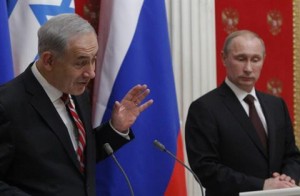
Israeli Prime Minister Benjamin Netanyahu’s visit to Moscow to push Russia into taking a harder line on Iranian nuclear negotiations has fallen flat, Israel’s media said on Thursday.
Premier Netanyahu and President Putin
Netanyahu flew to Moscow Wednesday in what was seen as a last-minute bid to influence an emerging nuclear deal with Iran strongly opposed by the Jewish state and being discussed by world powers and Iranian diplomats in Geneva.
Right-leaning Maariv newspaper said Russian President Vladimir Putin’s comments after meeting Netanyahu at best gave little away, and suggested the Israeli premier’s visit had left no lasting impression.
“When the two men gave their joint press conference (Wednesday), it appeared Putin’s statement had been given to journalists in advance, and he only changed certain passages afterwards to make them more palatable to Netanyahu,” it said.
Speaking as the talks got under way in Geneva between Iran and world powers, Putin only said he hoped that “in the nearest future a mutually acceptable solution is found” to end the crisis.
Top-selling Yediot Aharonot said Netanyahu’s visit to Moscow was an unnecessary “put-down” to the United States after tension with Israel over a possible Iran deal.
“Every reader knows Putin supports and will continue to support the ayatollahs’ regime in Iran,” Yediot said.
“If there’s the slightest chance of persuading world powers to take a harsher line on Iran, Israel should engage in discreet dialogue (with the US), instead of bickering publicly with Washington,” it said.
And left-leaning daily Haaretz suggested Netanyahu’s visit was futile, pointing out Russia was traditionally much more closely aligned with the Islamic republic than with other world powers.
“Russia, which built Iran’s first nuclear power plant and remains on better terms with Tehran than Western powers, has expressed less suspicion than them about Iran’s nuclear work,” it said.
Netanyahu insisted on the need for a “real” solution to the Iranian nuclear crisis, after his talks with Putin.
“We would all like a diplomatic solution, but it needs to be a real solution,” said Netanyahu, adding that this would involve Iran halting nuclear work in the same way that Syria was allowing its chemical weapons arsenal to be destroyed.
Iran would have to halt uranium enrichment, stop work on centrifuges, have enriched uranium material taken out from Iran and dismantle the Arak heavy water reactor, he said.
“We think it is possible to get a better agreement but that requires determination,” Netanyahu warned.
Israel, the region’s sole if undeclared nuclear-armed state, has not ruled out the use of force against the Iranian atomic drive.
Tehran says its nuclear programme is purely for peaceful purposes. – AFP
To listen to U.S. government officials there is only an upside to the punitive sanctions imposed on Iran by the United States and a reluctant European Union. Consequently, the emphasis is forever on how to toughen the punishment; never on whether to lift economic sanctions on the long-suffering people of Iran.
But what about the effects of trade boycotts on American businesses?
Chris Harmer of The Institute for the Study of War estimates that the Boeing Company alone forfeits a minimum of $25 billion in business every year because of U.S.-imposed sanctions on Iran, a niche market that is filled by the Russians. Overall, Harmer puts the value to U.S. business of trade lost due to the economic embargo on Iran at approximately $50 billion per annum.
For example, Iran imports $1.5 billion worth of cars a year, the beneficiaries of which are companies like Nissan, Toyota and Peugeot (when they might have been General Motors and Chrysler). Peugeot does an added half a billion dollars’ worth of commerce with Iran just in car parts.
The Iranian economy, moreover, has diversified and is adapting to life without the U.S. The rest of the world—pockets in Europe and most of Asia—has not isolated Iran, with the result that the country has many trading partners other than the U.S. And while Iran has lost petroleum revenue due to sanctions, the trend will not endure. China, Japan and South Korea are hungry for the country’s crude.
Not to be overlooked are the costs to Americans of sanction enforcement, avers Harmer. In addition to the opportunity costs—the missed business aforementioned—there are “direct costs.” The Office of Foreign Asset Control in the U.S. Treasury Department squanders around $1 billion a year in developing lists of “financial institutions that are subject to sanctions,” and then infringing on the rights of individuals and companies to freely exchange privately owned property.
“Indirect costs” are incurred in the course of cultivating a massive U.S. intelligent infrastructure—a veritable alphabet soup of agencies—upon which the Treasury draws in enforcing a regimen of sanctions.
So, too, are the “deterrent costs” borne by the American taxpayer who pays for patrolling the Persian Gulf, the Northern Arabian Sea and the Strait of Hormuz.
Ultimately, trade, not democracy, is the best antidote to war with Iran. The more economically intertwined countries become, the less likely they are to go to war. More than boycotts, barter with Iran is bound to promote goodwill and reduce belligerence on both sides.
As a general rule, state-enforced boycotts harm honest, hard-working Americans who use the economic means to earn their keep. They benefit servants of Uncle Sam—the political class and its media and think-tank hangers-on. For they deploy the political means to advance their ends and grow their sphere of influence. As libertarian economist Murray Rothbard once observed, these “are two mutually exclusive ways of acquiring wealth”—the economic means is honest and productive, the political means is dishonest and predatory.
As always, it’s us against them: the state versus the people who labor outside it and in spite of it.
For now, Obama’s eager response to Iranian overtures has sidelined Syria. Before Syria recedes in memory—to be replaced by demands for action against Iran—it’s worth considering one constant quantity: the media guttersnipes and their motivation.
The bobbingheads of TV have been complaining in the most unctuous terms that Russia and Syria have pulled one over us. The U.S., they lament, has been weakened, evidently, because someone halted the momentum of war.
You see, the chattering and political classes cannot conceive of greatness outside the state because they are part of the state apparatus and depend on it for status and income.
Conversely, individual Americans—who have nothing to gain and only losses to sustain from war—should never conflate their interests with those of the government and its emissaries, who have everything to gain from the great theatre that is war.
More than anyone, who benefits when America goes to war? Those who “function within the nimbus of great power” in D.C. and around it—the media-military-congressional-industrial complex.
Thus did Charles Krauthammer ridiculously equate the failure to go to war against Syria with “Russia supplanting America as regional hegemon.”
Krauthammer was joined by others, not least of them Bill O’Reilly and his sidekick Dennis the Menace. How diminished will the bluster of both media mouths be if the U.S. is no longer dictating the terms of war (lots of it) and peace (too little of it) in the world? Their immense egos will suffer. Maybe even their incomes, eventually.
But not you, the everyday American.
Putin stopped a war in Syria. This is not the same as “supplanting” American power. Rather, the Russians replaced bully power with a balance of power, and this is good for ordinary Americans.
He who saves you from war is better than he who sends you to war. The proof is in the Putin.
REPORTS from Syria by Jordanian journalists allege that it was Prince Bandar bin Sultan of Saudi Arabia who distributed those chemical weapons to the Syrian rebels.( Here he is shown with that other unrepentant terrorist)
If true, it indicates the chemical attack in Damascus to have been a false-flag operation by the American war business.
This would be entirely in keeping with Prince Bandar’s history of organising the Afghan mujahideen in the 1980s, the Iran-Contra weapons exchanges, Libya in 2011, the suppression of the Shia uprising in Bahrain, Saudi support for the coup d’etat in Egypt and support for Syrian rebels.
Other reports confirm that Prince Bandar also went to see Russian President Vladimir Putin last month and offered to buy $15bn worth of Russian weapons provided Mr Putin abandoned Syrian President Bashar al-Assad. Mr Putin gave him short shrift.
Prince Bandar was not only the Saudi ambassador in Washington for 22 years and friends of Ronald Reagan and the Bush family, but he also negotiated the 1985 £43bn Al-Yamamah weapons deal with Margaret Thatcher, which Tony Blair renewed in 2007 with the Al-Salaam weapons deal.
When the British Serious Fraud Office investigated the bribes which BAE Systems paid him, Prince Bandar allegedly threatened blood in the streets of London.
Mr Blair squelched the investigation citing “national security.” The Guardian newspaper revealed a couple of months later how BAE with collusion of the British government had laundered bribes to Prince Bandar of over £1bn through Riggs Bank in Washington DC and other US banks.
Most importantly, Prince Bandar and Ms Thatcher negotiated the Al-Yamamah deal under the British Official Secrets Act, meaning that it cannot be investigated in Britain.
Saudi Arabia ships thousands of barrels per day of oil consigned to the Bank of England, which is then distributed to Shell and BP.
Over the years a surplus has developed, which is guesstimated to be worth over $150bn. Its purpose is a) to guarantee British and US support for the Saudi royal family against domestic insurrection and b) to fund covert destabilisation of resource-rich countries in Asia and Africa under the guise of the war on terror.
Having targeted Afghanistan, Iran, Iraq, Yemen, Somalia, Libya and other countries over the years, Syria and Egypt are Prince Bandar’s current targets. When will SA be targeted by the American and British “war business” given our country’s mineral wealth?
Saudi Arabia made lavish donations to the African National Congress. Prince Bandar was also the only foreigner present at Nelson Mandela’s secret wedding to Graca Machel, and was a frequent visitor to SA when the arms deal was being negotiated.
Zimbabwean police are looking for two journalists from the British newspaper, The Times over a story about a secret uranium export deal between Zimbabwe and Iran, a state newspaper reported Sunday.
The two Times journalists, Jan Raath and Jerome Starkey, are wanted for “spreading falsehoods” after the uranium deal story was published in the London paper on Saturday, Zimbabwe’s Sunday Mail reported.
TheTimes quoting outgoing deputy minister of mines, Gift Chimanikire, wrote that Zimbabwe signed a deal with Iran to supply the Islamic republic with the raw materials needed to develop a nuclear weapon.
The United States and the European Union have imposed crippling sanctions on Iran over its nuclear programme, which Tehran insists is for peaceful energy uses but which the Western powers fear is intended to build an atomic bomb.
Zimbabwe is also subject to international sanctions over its human rights record and alleged election fraud.
President Robert Mugabe, who won another five-year term in disputed polls last month, has publicly backed Iran’s nuclear drive.
During a visit to Harare in 2010 by then Iranian president Mahmoud Ahmadinejad, Mugabe said his guest should be assured of “Zimbabwe’s continuous support of Iran’s just cause on the nuclear issue”.
Chimanikire could not be reached for comment but The Sunday Mail quoted him denying the story as “silly, speculative and dangerous”.
“No licence has been issued. I never said such a silly thing,” the paper quoted Chimanikire as saying.
When contacted by AFP, The Times newspaper said it was not aware of the story in the Zimbabwean press and would prepare a response.
However, one of the two reporters, Starkey, tweeted about the report of the “manhunt” by Zimbabwean police. When asked if he planned to add the event to his CV, he tweeted: “Let’s wait and see that it ends ok.”
National police spokesperson Charity Charamba said she was not aware of a search for the journalists.
“I have not heard about it. I only got a call from someone else who was inquiring,” she told AFP, saying she would have to look into it. – SABC
Zimbabwe has breached international sanctions with an agreement to supply Iran with uranium to fuel its nuclear programme.
Zimbabwean Deputy Mining Minister Gift Chimanikire said: “I have seen [a memorandum of understanding] to export uranium to the Iranians.”
The agreement, which was reportedly signed in 2012, is likely to cause alarm in western capitals.
The United States and the European Union have imposed crippling sanctions on Iran over its declared nuclear programme.
Zimbabwe is also subject to international sanctions over its human rights record and conduct of elections.
A report compiled by the United Nations’ nuclear watchdog more than two years ago detailed a visit from Iran’s then Foreign and Co-operative Ministers to Zimbabwe to strike a deal, with the Iranians also sending engineers to assess uranium deposits
President Robert Mugabe, who won another five-year term in disputed polls in July, has publicly backed Iran’s nuclear drive.
During a visit by Iran’s then president, Mahmoud Ahmadinejad, to Harare in April 2010, Mugabe said his guest should be assured of “Zimbabwe’s continuous support of Iran’s just cause on the nuclear issue”.
He said the uranium deal had been made without his knowledge, and was only known to a handful of people at the top of the government.
A Chinese company has been surveying yellow-cake deposits in the far northeast of the country and the Zimbabwe government has been actively looking for buyers, according to Chimanikire, who, as a member of Zimbabwe’s opposition is likely to be replaced now that the election has brought an end to the shaky coalition government.
Uranium ore, or yellow cake, can be converted to a uranium gas which is then processed into nuclear fuel or enriched to make nuclear weapons.
Iran has long maintained that it needs the uranium for peaceful nuclear aspirations, as a source of domestic energy.
Mugabe has begun his seventh term as Zimbabwe president following an election once again stained by accusations of widespread vote rigging
Despite the agreement, analysts have said it was likely to be a long time before Zimbabwe’s uranium reserves were ready for export. – Sapa
Cosatu secretary general Zwelinzima Vavi fears for his life and has increased security to protect himself, he has told Eyewitness News.
The Cosatu secretary general said during the interview: “I am scared. This matter came to the public sphere three years ago, and it seems people who issued the threats then are still on a mission to attain that.”
Vavi told the radio station he started receiving death threats in 2010, when he received information that he would “go down” the same way as the former deputy minister of health, Dr Molefi Sefularo.
Sefularo died in a car accident in Pretoria in 2010.
Vavi reportedly said the accident was presumed to have been “engineered”.
The threat was reported to the police ministry, but nothing had come of it so far, he said.
Last year, immediately after the Cosatu held its elective congress, intelligence officials told him there was a plot by Iranians to poison him, he said.
“I was told that the plot originated from Iranian intelligence, and that someone from the non-government organisations that we, as Cosatu, work with has been hired by Iranians to poison me.”
When asked why the Iranians would want him killed, Vavi said he did not know because Cosatu and the country had good relations with Iranians.
“Months have gone by and intelligence officials have not come back to me regarding this,” he told Eyewitness News.
Vavi is facing an ongoing internal investigation into alleged corruption regarding the sale of Cosatu’s headquarters, in which he was implicated. – SAPA
The so-called “Friends of Syria” group comprises Britain, France, the US, Germany, Italy, Jordan, Qatar, Saudi Arabia, Turkey, Egypt and the United Arab Emirates. We can safely say that America and Britain are the driving forces behind the initiative and that the other countries have merely been roped in to lend some international legitimacy to what is turning into a proxy war between the US-UK and Russia.
The Syrian conflict represents a threat to world peace. In fact, it could lead to the end of civilisation as we know it!
That may sound like an outrageous statement, but let me explain.
The civil war in Syria is not only a proxy war between the Atlantic powers (or Atlanticists) and Russia, but once Syria falls, the next target will be Iran and after that Russia itself.
Putin understands this. He is also correct when he accuses the American and British governments of disregarding the sovereignty of other states and nations. Especially Democratic and Labour governments have in recent decades embraced the doctrine of “regime change” whereby the two Anglo-Saxon powers see fit to start wars and uprisings in other countries to serve their own interests. However, a lot of the time they are not even serving their own interests but are acting to promote the new Soviet ideology of multiculturalism. Racial equality, or “equality of outcomes” is to the Atlanticists what class equality was to the former totalitarian states of Eastern Europe.
Elsewhere on this website, Felicity Arbuthnot quotes Sbigniew Brzesinski as saying that the United States is courting “large-scale disaster” in Syria:
“Having covertly provided arms and equipment to insurgents from numerous different countries for over two years, they have now moved to the overt stage, a move over which even arch hawks such as former National Security Advisor Zbigniew Brzezinski, and former Republican Senator Richard Luger, six term leader of the Senate Foreign Relations Committee urged caution.
“Luger said such action would boost extremists, with Brzezinski dismissing Obama’s talk of ‘red lines’ as thoughtless and risking “a large-scale disaster for the United States.”
Carl Schmitt
The geostrategic scenario predicted by Russian writer and commentator Aleksandr Dugin, is being realised. I posted his essay The Great War of Continents on my personal blog some time ago. Dugin was influenced by the great German legal philosopher, Carl Schmitt, who was skeptical of democracy. In fact, we can see how democracy plays hardly any role in the decisions taken by the Atlanticists as the populations of both the US and the UK are vehemently opposed to further wars. A recent poll conducted by the Pew Research Center shows that Americans (are) overwhelmingly against arming Syrian rebels. Schmitt also wrote a book on Land and sea in which he theorised about the conflict between the Atlantic “sea powers” and the Eurasian “land powers”.
However, I think the Syrian conflict, together with the so-called “Arab Spring”, colour revolutions, as well as the South African revolution of 1994 portend a major movement with the ultimate objective of abolishing the nation state as we know it. Almost all of these revolutions were fomented from the outside by Atlanticists who discerned weaknesses in the ethnic, religious and multinational compositions of the states being attacked. The use of media and the arming or financing of “rebels” and terrorists were features of all these revolutions or “regime changes”.
Apart from the thalassocratic elements identified by Schmitt and Dugin – the USA and the UK being maritime powers – there is another, archaic driver behind Atlanticist overreach and that is the resurrection of a kind of Zombie British Empire (ZBE). America, being a republic, has always been ill at ease with its role as the New Rome. Americans are not well-versed in foreign languages, customs and geography. The average intern or staffer in Washington would not be able to find Syria on a map, let alone appreciate the ethnic, religious and political complexities of that society.
But in its economic and geostrategic decline, Britain has become the tail wagging the dog. It is clearly seeking to influence and direct the United States in re-establishing its nineteenth-century dominance as a global imperium. Earlier this year, an Historic strategy meeting between the USA and the UK was announced. More recently, it was revealed by Edward Snowden that the British are worse than US in spying. Just yesterday, it appeared that the UK (was) tapping the EU’s data flows and the “German Justice Minister… called the British spy agency’s massive eavesdropping of international fiber-optic cables ‘a catastrophe’.”
There is a long-standing hostility towards the nation state in Britain, which has become deeply rooted in academia, the media, the ubiquitous left-wing NGOs and especially in the Labour Party. European nationalism or the historical desire of European peoples to exercise their right to self-determination is routinely equated with Hitlerism. But even in the United States where Woodrow Wilson is remembered as a champion of self-determination and the nation state, there is another school of thought expressed by Wilson’s secretary of state, Robert Lansing, in the aftermath of World War I:
“The more I think about the President’s declaration as to ‘self-determination’, the more convinced I am of the dangers of putting such ideas into the minds of certain races. It is bound to be the basis of impossible demands on the Peace Congress, and create trouble in many lands. What effect will it have on the Irish, the Indians, the Egyptians, and the nationalists among the Boers? Will it not breed discontent, disorder and rebellion?”
The successful suppression of Afrikaner self-determination or “Boer nationalism” over more than a century, as well as the so-called “peaceful regime change” in South Africa in 1994, has emboldened neo-imperialists in the UK and the US to engineer many more regime changes, starting in Iraq, but also the Maghreb and Egypt, with the focus now on Syria.
This is what opponents of the Obama administration in the United States are starting to call the “New World Order”. The adherents of the NWO envisage such a radical change in global government, coupled with Big Brother spying techniques and sci-fi mind control, that we are indeed seeing the end, not only of Wilsonian self-determination, but even of the European order that arose at the end of the Thirty Years War in 1648. The so-called “Peace of Westphalia” in 1648 established national sovereignty and religious freedom as the two inviolable principles of European statecraft.
Under its current government, there is religious freedom in Syria, unlike in other Muslim states. On the other hand, we have seen Christian churches being attacked by the so-called rebels. The question has already been asked on this website: Who will the US really arm in Syria? Quoting from that RT report, we can only conclude that it must be radical Islamists opposed to the current modern-Arab regime of Bashar al-Assad:
“The US decision to arm the Syrian rebels fighting government troops has sparked feuds among various rebel factions dominated by radical Islamist fighters. As internal schisms among the rebels deepen, fighters from the Al-Qaeda-linked Al-Nusra Front have reportedly assassinated a large number of officers of the Free Syrian Army.”
The love-hate relationship that the USA is entertaining with Al-Qaeda may be conceptually difficult to grasp. But not if one takes a step back to look at the big picture, both present and past. On the one hand and especially after 9/11, Al-Qaeda was Enemy No. 1, the target for Bush’s “war on terror”. On the other hand, Al-Qaeda, the Muslim Brotherhood and similar fundamentalist groups are being funded, supported and armed by the United States to take over Arab countries and establish a form of theocracy, including shariah. Are the US and the UK being run by idiots who simply do not understand what they are doing?
The answer is no. The ostensible paradox of modern, so-called Western states with same-sex marriage laws, equality of the sexes, religious and political pluralism, aiding and abetting mediaeval, theocratic groups is no paradox at all.
Some years ago I realised with a shock that globalist capitalism would succeed where communism had failed, in establishing a denationalised, internationalist empire. Two Marxists, one American and one Italian – a former member of the Red Brigades – wrote a book looking forward to this global imperium being created by the United States, appropriately entitled Empire. We all know that Lenin was apparently funded by a New York banker called Jacob Schiff.
Like globalism, fundamentalist Islam is also a doctrine that does not recognise secular government within a nation state, of the form established in Europe and America after 1648. Arabic Islamic culture is already transnational, as opposed to the Nasserist nationalist regimes of a Saddam Hussein or a Bashar al-Assad that must be destroyed at all costs. What the proponents of the New World Order, or the Atlanticists, are telling us is that Muslims and Arabs have no need of nation states. Neither do Europeans, Asians or Africans, for that matter. Within the globalist, new-world-order logic, only transnational entities such as the UN, the EU or the African Union matter. The nation state must be razed to the ground.
It follows that a failed state is always preferable to a functional one. Iraq was attacked and in its wake there is now a failed state, more or less bordering on chaos. Africa is littered with failed states, including Zimbabwe, the creation of British foreign policy. Many of these states cannot even supply potable water to their citizens, yet they are praised to high heaven as examples of “postcolonial democracy”. The New York Times recently declared Zimbabwe’s disastrous “land reform” a “success”, during which the property of private white land owners was confiscated. South Africa too, is on its way to becoming a failed state with rampant, crime, corruption and marauding bandits attacking houses and farms, often torturing white farmers to death. But South Africa is the darling of the Anglo-American world, as a transnational state with more or less open borders – that which is envisaged for the whole planet as peoples, races and cultures mingle and we all sit at McDonald’s having a Coke. However, some of us will be wearing the burka and others will be sacrificing a goat outside to appease the forefathers.
Apart from the ideological imperative to destroy national identities and nation states wherever they are to be found, the globalist powers also have an economic imperative. As we all know, the United States has to a large extent transferred its manufacturing to China and the Far East. Both American and Britain have financial and service economies that depend on capital flows and trade. Up to a quarter of British GDP is generated in the City of London, by bankers, brokers, traders, consultants, accountants and other economic parasites that produce absolutely nothing. They are so-called “intermediaries”.
The British bank HSBC, one of the world’s largest, has been described as a criminal enterprise, for its role in money laundering.
The two bellicose countries are also bankrupt, amassing mountains of government and private debt. Successive bailouts of the banking industry have left them with amounts of debt that normal handheld calculators cannot even process unless one leaves out substantial numbers of zeroes. It is an old adage that war is the only way out of a prolonged economic downturn and financial melt-down. After the failure of quantative easing to kickstart the US economy, war is all that America has left.
The war economy is, by definition, a subsidised economy. The American taxpayer is funding the military-industrial complex, which can almost charge what it likes, having a captive market for its goods. Free weapons for Syrian rebels may therefore be seen as the latest round of quantitative easing and “stimulus”.
America will not attack China because, as some commentator put it the other day on a blog, that country represents “our T-bill sugar daddy”. China is the biggest buyer and holder of US debt, so for the moment no Chinese rebels will be armed.
Not so Russia, which competes with the USA in fhe only field where it has real industrial capacity left: armaments. With its military parades, patriotism and sense of tradition, Russia is the exact antithesis of globalist transnationalism. It also celebrates its own language, music and literature. In the USA and Britain, what passes these days for “literature” is mostly guilt-ridden, anti-white tracts attacking any sense of identity, tradition, genius or cultural standards. Nietzsche called it “nihilism”. Risking opprobium, one may even resuscitate a German term from the 1930s, Entartete Kunst or “degenerate art”. Let’s stick to “nihilism”.
The Nasserist, nationalist Arab regimes have fallen like the proverbial dominoes, pushed by American money and CIA tricks. Syria is proving a harder nut to crack. After Syria, Iran will be next, that citadel of Shiite power. Not only is Iran a country with a large population, but it also has a unique sense of self, with its religion and traditions.
However, the ultimate target is Russia. Whatever one may think of Russia and its role in the twentieth century, it is obvious that it has become a “guarantor of sovereignty” of sorts. Many Afrikaners muse today that we would have been better off if Vorster had surrendered to the Soviet Union in the 1970s than De Klerk’s capitulation to the Nordic and British-backed “rebels” of the ANC in 1994. Soviet nationalities policy was an enlightened way of allowing regional and national identities to flourish. Even as communists, Russians had respect for culture, including the culture of others.
Looking at pictures of Syrian churches being vandalised and sacked by the US-backed rebels, it saddens one to think that such acts are being condoned by some of the fresh-faced, all-American and probably Christian boys and girls that one still encounters in Washington offices, although they will probably soon be replaced by multicultural imports.
The modern civilisation whose fruits we are enjoying today came about during the European Renaissance and after the Peace of Wesphalia during 1648. French Socialist President François Mitterand was wrong when he stated: Le nationalisme, c’est la guerre. (“Nationalism means war.”) More often than not, nation states have created institutions, schools, universities, academies, opera houses, and theatres; such states have allowed peoples to determine their own destiny. As Woodrow Wilson put it to Congress a month after his famous Fourteen Points Speech, sometimes referred to as his “Four Point Speech” on 11 February 1918:
“National aspirations must be respected; people may now be dominated and governed only by their own consent. ‘Self-determination’ is not a mere phrase; it is an imperative principle of action…”
In Syria and elsewhere, Obama and Cameron, like Bush and Blair before them, are pitting themselves against this principle and that of sovereignty. If the Atlanticists succeed, a global disaster might ensue which could take us back to a high-tech version of the Middle Ages. We will be subjected to and even forcibly converted to various faiths, of which fundamentalist Islam is one and multicultural leftism is another. Heretics will again be persecuted, stoned to death or simply executed by various uniformed militiamen, either belonging to rebel movements or government forces.
Perhaps some of the global corporations and oil companies, employing their own private armies for protection, will do quite well in such a postnational world. But the rest of us will be terrorised by gangs, mobs and armed “rebels”, as is happening in many parts of Africa already.
Of course, South Africa is the guinea pig country, the first open-border, transnational state with hardly any sovereignty where any government official may be bought. Organised crime and multinational corporations share the spoils. Private property is open to interpretation and any Marxist historian’s vague theories about exploitation could jeopardise your title deed.
Is this the kind of world we want?
If Germany and France want to follow the arming of rebels and the destabilisation of whole countries, we should start boycotting their cars and buy Korean or Japanese. Russia should also do its best to wake Europe up to the dangers of the New World Order unfolding before our very eyes. Patriotic Americans and Britons who oppose the inteventionist role of their countries in wrecking the states and societies of other peoples, should also make their voices heard. Many are already doing so, via radio staions and the internet, but if we are to stop the powerful insiders taking control of the globe, much more action and information are needed.
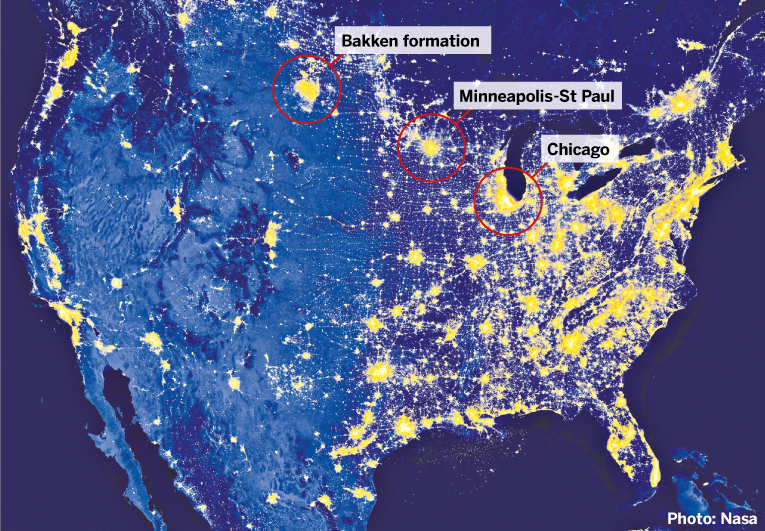
Oil companies at the heart of the US shale oil boom are burning off enough gas to power all the homes in Chicago and Washington combined in a practice causing growing concern about the waste of resources and damage to the environment.
The volume of unwanted gas being flared off in North Dakota, the state leading the shale revolution transforming the outlook for US energy, rose about 50 per cent last year. The surge at the state’s Bakken formation is being replicated in other shale regions with the Texas state regulator issuing 1,963 permits to flare in 2012, more than six times the number of 306 in 2010.
The rapid increase has made the US one of the world’s worst countries for gas flaring. The volume of gas flared in the US has tripled in just five years, according to World Bank estimates and is now fifth highest in the world, behind Russia, Nigeria, Iran and Iraq.
The flaring is a result, in large part, of the low price of natural gas in North America, which can make it uneconomic to build pipelines and tanks to handle the gas released by oil production. Flaring is often the safest way to dispose of it.
The lights of the flares burning in the Bakken and Texas’ Eagle Ford shale fields can clearly be seen in night-time satellite photography.
Flaring has been attracting attention from investors and environmental campaigners because of the waste of gas and its consequences for greenhouse gas emissions, local air pollution and disturbance to nearby communities.
Flaring in North Dakota increases by about 20 per cent the greenhouse gas emissions resulting from the state’s oil production, refining and transport, compared with the US average, according to Financial Times analysis of official data.
Investors managing a total of $500bn last year wrote to oil companies including ExxonMobil, Chevron, Statoiland US independents urging them to do more to cut their flaring. They warned that “excessive flaring, because of its impact on air quality and climate change, poses significant risks for the companies involved.”
Since then, flaring in the US and concerns over it have only increased.
The North Dakota legislature is considering a bill to encourage flaring reduction through tax breaks. The state is also pushing producers to use gas to power drilling rigs.
Painting a picture of internal political dysfunction in a dangerous world, former Defense Secretary Robert Gates warned Wednesday night that a U.S. or Israeli attack on Iran would have disastrous consequences.
Neither the United States nor Israel is capable of wiping out Iran’s nuclear capability, he said, and “such an attack would make a nuclear-armed Iran inevitable. They would just bury the program deeper and make it more covert.”
Iran could respond by disrupting world oil traffic and launching a wave of terrorism across the region, Gates said.
“The results of an American or Israeli military strike on Iran could, in my view, prove catastrophic, haunting us for generations in that part of the world.”
First in this season’s Norfolk Forum speaker series, Gates spoke to an audience of nearly 2,000 in Chrysler Hall.
United Nations sanctions aimed at discouraging Iran’s nuclear ambitions are starting to have an impact on the Iranian economy, he said, and “that’s our best chance going forward, to ratchet up the economic pressure and diplomatic isolation to the point where the Iranian leadership concludes that it actually hurts Iranian security and, above all, the security of the regime itself, to continue to pursue nuclear weapons.”
And while Israeli anxiety over Iran’s intentions is understandable, he added, America should make it clear to Israel’s leaders that “they do not have a blank check to take action that could do grave harm to American vital interests.”
Meanwhile, Gates warned, the United States is paralyzed by partisan gridlock that threatens the nation with financial insolvency.
The combination of across-the-board spending cuts and tax increases set to take effect in January, put in motion by Congress’ inability to agree on how to reduce the ballooning national debt, would do grave damage to the military and virtually every other essential government operation and could throw the country into a new recession, he said.
The central problem, Gates said, is that both major parties have been captured by their ideological extremes.
“The moderate center, the foundation of our political system, is not holding.
“Too many of our politicians seem more concerned with winning elections and scoring ideological points than saving the country.”
Gates ran the Pentagon from 2006 to 2011 under Presidents George W. Bush and Barack Obama. He was the first defense secretary to serve under presidents of both parties.
He was also the only career CIA officer in history to rise from entry-level employee to director of the agency. He was director from 1991 to 1993.
The Kansas native now holds the honorary post of chancellor at the College of William and Mary. A 1965 graduate of the college, he is the first alumnus in the modern era to become chancellor.
Israeli Prime Minister Benjamin Netanyahu demanded Thursday that the international community impose a red line on Iran to prevent it from enriching enough uranium for a nuclear bomb.
“The hour is late, very late,” Netanyahu said, alleging Iran was already 70% of the way through the process of enriching enough uranium to fuel a bomb, and must be prevented from reaching the 90% level.
The Israeli leader even used the world stage at the UN to present a cardboard diagram of a bomb with different levels on it, drawing a thick red line across it with a marker pen for dramatic effect.
“Faced with a clear red line Iran will back down,” he said, insisting in a address to the United Nations General Assembly that imposing an ultimatum on Tehran would not provoke war but help prevent it.
Israel has warned that it could launch military action against Iran in order to prevent it reaching a certain nuclear threshold, and has urged the international community to force Tehran to abandon its atomic quest.
Iran denies it is building a nuclear weapon and has dismissed the Israeli threat.
US President Barack Obama vowed in his address to the United Nations on Tuesday that he would prevent Iran from getting the bomb but his administration has repeatedly rejected imposing a red line on Tehran.
With relations between Netanyahu and Obama already viewed as frosty, US Defence Secretary Leon Panetta earlier this month highlighted the policy split further when he rejected Israel’s “red lines” outright.
“The fact is, look, presidents of the United States, prime ministers of Israel or any other country – leaders of these countries don’t have, you know, a bunch of little red lines that determine their decisions,” Panetta said.
“What they have are facts that are presented to them about what a country is up to, and then they weigh what kind of action is needed to be taken in order to deal with that situation,” he told Foreign Policy magazine.
“I mean, that’s the real world. Red lines are kind of political arguments that are used to try to put people in a corner.”
The Iranian government, reacting to Israeli Prime Minister Benjamin Netanyahu at the United Nations, demanded that Jerusalem open its own nuclear installations to inspection before telling Tehran do so.
Using the U.N.’s “right of reply,” Iran’s deputy U.N. ambassador, Eshagh al Habib, told the General Assembly the Israeli prime minister “has admitted to the possession of nuclear weapons which has been repeatedly stated by the 120 members of the Non-Aligned Movement ‘poses a serious and continuing threat to the security of states in the region.
“Instead of making baseless allegations,” he said, “this regime has ignored repeated calls by the international community to accede promptly and without any conditions to the Non-Proliferation Treaty as a non-nuclear weapons party and place all its nuclear-related facilities under the International Atomic Energy Agency verification system. … The international community should continue to exert the utmost pressure on this regime.”
The Iranians have long claimed to be sponsoring a movement to free the Middle East of any atomic weapons.
Israel, its conventional forces vastly outnumbered by neighboring Arabs, has long seen its nuclear stockpile as an equalizer should a new war erupt in the region.
Published reports claim Jerusalem has manufactured more than 200 low-yield nuclear warheads that have been stockpiled in a desert facility in the Negev.
The nuclear facility, near the hamlet of Dimona, has had sporadic visits by U.N. inspectors, but nothing unusual has ever been uncovered.
Late Iraqi President Saddam Hussein tried unsuccessfully to rocket bomb the Dimona facility in the 1991 Gulf War.
Today, the Dimona base is protected by the Israeli Iron Dome anti-missile system.
A group of Israeli diplomats sat stone-faced throughout the Iranian rebuttal, deciding not to challenge it.
The U.S.-U.N. mission did not attend the late-night General Assembly session. – AFP/WND
I AM SO SAD – and it is not because a justifiably angry crowd of Libyans in Benghazi stormed an embassy that represents the brute force that destabilized their lives for decades to come.
I feel for my countrymen who perished in that embassy, but the truth remains that they acquiesced in leveling Libya. And by so doing, they invited into that country the very lynch mob that took their lives. The Americans targeted had become an irritant to the long-suffering Libyans, who will use any U.S. provocation, real or imagined, to expel the people who “came, saw and conquered.”
To those who imagine the death of our diplomats in Libya turns on American free-speech, I say this: You have no right to deliver your disquisition in my living room. You have only the right to request permission to so do from this (armed) private-property owner.
By extension, you have no universal right to “free speech” on another man’s land. More so than to America’s diplomats – Libya, Yemen, Egypt and Iran belong to the people of Libya, Yemen, Egypt and Iran.
I AM SO SAD – and it is not because Israeli Prime Minister Benjamin Netanyahu has chosen a most inopportune time to insert himself into the middle of a rancorous American election season and by so doing make Mitt Romney’s foreign-policy bellicosity look good to a war-weary people that can ill-afford it.
Now is not a good time, Bibi. Israel is a wedge issue in the coming election. If Israelis love Americans as Americans love Israel, they need to understand that, “The Titan is Tired”:
“We Americans have our own tyrants to tackle. We no longer want to defend to the death borders not our own – be they in Iraq, Afghanistan, Pakistan, Libya, wherever. And we don’t need our friends looking to us to do so.”
I AM SO SAD – and it is not because another 9/11 has come and gone. The polls indicate that Americans want to move on; have moved on. Perhaps Americans have realized that it behooves our “overlords who art in D.C.” to keep them stuck in grief. By stunning us like cattle to the slaughter, the statists have been able to perpetrate in our name crimes way worse than 9/11.
I AM SO SAD because my sweet, kind friend, Thomas Szasz, has passed away. Tributes merely touch on professor Szasz’ unmatched genius and attendant achievements (professor of psychiatry emeritus, SUNY Upstate Medical University, Syracuse, N.Y., and author of the seminal work, “The Myth of Mental Illness”).
I attempted to word what Thomas Szasz did over decades, in the advance praise he requested for one of his many magisterial masterpieces, “Coercion as Cure: A Critical History of Psychiatry”:
“Bit by barbarous and bizarre bit, Thomas Szasz dismantles psychiatry’s rickety scaffolding, exposing over two centuries of physical torture and tortured logic. Professor Szasz takes the necessary analytical and empirical solvents to this state-empowered fraternity of sorceresses. He also supplies the only salve for the psychiatric violence he correctly dubs ‘psychiatric slavery’: abolition: Now, ‘Let the sunshine in.’”
“This will be hard to beat,” Tom quipped. (“Tom” was how he’d sign off.)
Allow me, then, to speak but briefly to the tender friendship professor Szasz and I developed over the years. Briefly, for the breezy ease with which my countrymen share their feelings with strangers is alien to me. Abreacting à la Oprah in public bespeaks a shallowness that was foreign to Tom too. Whenever we communicated, it was in succinct, intense and precise language. We spoke a similar language. Dare I say that it was our shared ancestry as European Jews that accounted for these cultural commonalities?
For example, we came together – yet stood apart from libertarian mainstream – on the all-time moral litmus test: the state-sanctioned, slow execution of Theresa Marie Schindler Schiavo.
Even eerier was the way we both drew on the allegoric power of William Faulkner to capture the late Ms. Schiavo’s plight, before knowing one another. “A Rose for Emily” was Tom’s source of inspiration, in June of 2006; mine was “As She Lay Dying,” in March of 2005.
“Kindred souls” was Tom’s reaction.
Late in 2009, we decided to meet near Huntington Beach, where, Dr. Szasz, nearing 90, was to address a conference. Alas, he was detained on the East Coast by bad weather, and my husband and I went on to visit in the vicinity. “Maybe I’ll mobilize myself and visit you next summer in Seattle,” he promised.
I last heard from Dr. Szasz on July 27, this year. Characteristically, it was in response to a column I had written, “‘You didn’t build that’: Obama’s political epitaph.” As he would so often do, the great man excerpted his favorite lines. “BRAVO, AGAIN!,” he added in capitals.
I replied:
Thank you, my dear. It seems so futile.
But I like hearing from you.
How have you been?
Tom wrote back laconically but poignantly:
Yes. Disheartening. “Virtue is its own reward.” – I am OK.
Would that everyone rationed speech thus; the entire mainstream punditocracy would cease to exist.
Earlier this year – it was in May – I made my way to Manhattan, where it was my distinction to address Victor Niederhoffer’s New York City Junto gathering as featured speaker. I inquired whether Tom would be gallivanting around, as was his wont.
Ever sweet and affectionate, there was a finality to his reply:
Many thanks, dear Ilana. Sadly no. I am OK but progressively weakening and everything is too much of a schlep. I enjoy and agree with all that you send me.
Love (without a first sight), Tom.
“Promise me,” I wrote back, “that this will not be unrequited love.”
AP,l Tehran – U.N. nuclear inspectors stia two-day visit to Tehran on Monday sought to meet Iranian nuclear scientists and visit a key military facility as they try to gauge allegations that Iran is pushing toward making an atomic weapon.
The trip is the second in less than a month by the International Atomic Energy Agency team, reflecting growing concerns over alleged weapons experiments – something Iran has so far both denied and refused to discuss.
Herman Nackaerts, a senior U.N. nuclear official, said in Vienna before the team departed on Sunday that he hoped for progress in the talks but his careful choice of words suggested little expectation the meeting will be successful.
The West suspects Iran’s nuclear program is geared toward making weapons, a charge Iran denies, insisting it’s for peaceful purposes only, such as power generation.
Iran’s state radio said Monday the inspectors hope to meet Iranian nuclear scientists and visit the Parchin military complexThe report said the IAEA had requested to visit Parchin, an Iranian military base and conventional weapons development facility outside of Tehran. The site has also been suspected of housing a secret underground facility used for Iran’s nuclear program, a claim denied by Iranian authorities.
IAEA inspectors visited the site in 2005, but only one of four areas of potential interest within the grounds. At the time, the nuclear watchdog did not report any unusual activities but the Parchin site was prominently mentioned in the agency’s report last year.
The report asserted that Iran constructed “a large explosives containment vessel” in which to conduct experiments on triggering a nuclear explosion, apparently 11 years ago, adding that it had satellite images “consistent with this information.”
“Whatever the reasoning of the agency is, it proves the IAEA is not loyal to its previous commitments,” the Iranian radio said. The tone of the commentary suggested the visit to the military complex would likely be denied.
The IAEA visit comes as Iran last week announced what it described as key advancements in its nuclear program, inserting the first domestically made fuel rod into a research reactor in Tehran and installing a new generation of Iranian-made centrifuges at the country’s main uranium enrichment facility in the central town of Natanz.
Beyond concerns about the purported weapons work, Washington and its allies want Iran to halt uranium enrichment, which they believe could eventually lead to weapons-grade material and the production of nuclear weapons. Iran has been enriching uranium up to 20 percent, while uranium enriched to more than 90 percent can be used for a nuclear warhead.
The IAEA team wants to talk to key Iranian scientists suspected of working on an alleged weapons program. They also hope to break down opposition to their plans to inspect documents related to nuclear work and secure commitments from Iranian authorities to allow future visits.
The IAEA summarized its information last November in a 13-page document drawing on 1,000 pages of intelligence. It stated then for the first time that some of the alleged experiments can have no other purpose than developing nuclear weapons.
Iran has denied alleged weapons experiments for nearly four years, saying they are based on “fabricated documents” provided by a “few arrogant countries” – a phrase authorities in Iran often use to refer to the U.S. and its allies.
This website uses cookies to improve your experience. We'll assume you're ok with this, but you can opt-out if you wish. Cookie settingsACCEPT
Privacy & Cookies Policy
Privacy Overview
This website uses cookies to improve your experience while you navigate through the website. Out of these cookies, the cookies that are categorized as necessary are stored on your browser as they are essential for the working of basic functionalities of the website. We also use third-party cookies that help us analyze and understand how you use this website. These cookies will be stored in your browser only with your consent. You also have the option to opt-out of these cookies. But opting out of some of these cookies may have an effect on your browsing experience.
Necessary cookies are absolutely essential for the website to function properly. This category only includes cookies that ensures basic functionalities and security features of the website. These cookies do not store any personal information.
Any cookies that may not be particularly necessary for the website to function and is used specifically to collect user personal data via analytics, ads, other embedded contents are termed as non-necessary cookies. It is mandatory to procure user consent prior to running these cookies on your website.