Beware the Black Borg!

Borg Art  Pic

by Albert Brenner

[followbutton username=’albertbrenner1′ count=’true’ lang=’en’ theme=’light’]

The greatest bogeyman ever conjured up in order to keep rebellious white South Africans in line, comes in the form of an amorphous, same-thinking, same-feeling, black entity. This all-dominant Jungian (archetypal) mass of collective agency was reinvigorated by the half-wit CEO of the South African Institute of Race Relations (SAIRR), Fransie Cronjé, in a Rapport (read Naspers Pravda) column last weekend.

According to Fransie, whites in Mandelatopia must stop rebelling against their de facto enslavement forthwith, lest blacks destroy them utterly in a “second revolution”. In short – in line with the finest Stockholm Syndrome diagnosis – Fransie is screaming; “Keep quiet, otherwise they will kill us!”.

Now the thing is just whether the little bald pseudo-intellectual shyster is actually dim-witted or just plain ignorant. For he neither knows or represents white South Africans, nor does he know or represent black South Africans. Yet he presumes to do both, in public!

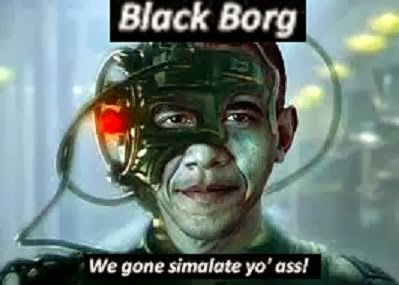
The simple fact is that this amorphous collective black entity that he so dreads, simply does not exist. It is simply another bogeyman created by the MSM and Hollywood – an entity akin to the Borg in the science-fiction series Star Trek. The former fictional being – written in the singular because they all share the same consciousness, and conscience – is famous for their (dreaded) command; “This is the Borg. We`ll assimilate you now. Resistance is futile”!

All fiction, all guano… in the real world. Never in recorded history has there been absolute hegemony among Africans – and, especially not in South Africa. The various black groupings – mostly tribal, in nature – were at each others throat before Apartheid, during Apartheid, and even now… after Apartheid.

To even think that all blacks share the exact same thoughts, feelings, moral sentiments, et cetera, – just because they share the same skin colour – is not only incredibly naive, it is also downright patronising and racist. In short; there is no absolute hegemony among the other races; so why should blacks be different in this regard?!

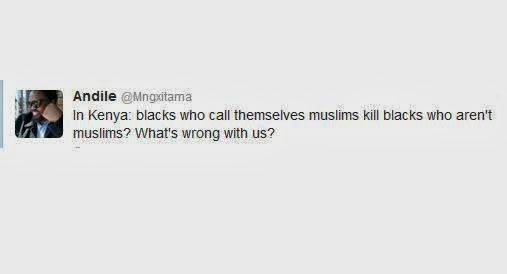
It therefore beggars belief when even (self-appointed) black intellectuals, like the awfully trite Hegel-emulating “Bikoist”, Andile Mngxitama, throw tantrums when blacks – wherever they may find themselves in space and time – do not act as “one” (see picture below).

andilem

Be that as it may; the “Black Borg” myth is only topped by its inverse, the myth of the Noble Savage. The latter, a neo-Romantic Rousseauian-regurgitating MSM/Hollywood creation, sees all blacks as inherently cherubic beings who only want the best for humanity, the universe… and the environment, of course. All little Mandela`s in heart, soul and suffering… all “one” in their eternal victimhood at the hands of the White Devil.

It is, frankly, beyond belief that even blacks themselves ascribe to this sickening denigration of their very being. I mean honestly, how can they acquiesce to a perception that only allows them collective agency, and not individual agency? But then, hey; they have been baby-sat for so long by bleeding-heart White Guilt-driven liberals that they, blacks, have left it up to others, like little lentil Fransie, to speak on their behalf.

Whatever the moral weather on that one; it is a fact that blacks have never, and will never, act as “one”. And the threat by the SAIRR vegetable, Fransie, that disillusioned (`”bitter”) whites will cause the Black Borg to suddenly appear from the Delta-quadrant wormhole just because they, the whites, are justifiably recalcitrant, is equally preposterous. Nothing, in the context of Mandelatopia, illustrates this more succinctly than the transition period to black rule in the early 90s.

During this time, the blacks did not rise up as “one” to take revenge on their Tutu-myth Holocaust oppressors, the whites. On the contrary; once the blacks realised that FW (fuck-wit) De Klerk was just going to hand over the whole caboodle, they went straight for each other’s throats…to get at the loot first.

Near-civil war circumstances prevailed as the Zulus of Buthulezi’s IFP fought the (mostly Xhosa) ANC of Mandela. More than 16 000 blacks died during that period. Hardly any whites were harmed, except for the cowardly APLA attacks on the St George’s Pub and the Roseview Church.

In her brilliant bookThe People’s War, Anthea Jeffery painstakingly researched the true facts behind the so-called “liberation struggle”. Her findings illustrate, beyond any doubt, how blacks used fellow blacks as a mere means to an end. It is an indisputable fact that the vast majority of blacks in South Africa were coerced, by threat of physical violence, to partake in Joe Slovo’s callous revolution.

  • `”the ANC had little compunction about attacking black civilians, including its own supporters, for the formula for people’s war draws no distinction between combatants and others and regards all civilians (irrespective of their political affiliation) as expendable in conflict;
  • the ANC had a motive to unleash violence, for it wanted to create enough mayhem and unrest either to spark an insurrection or to weaken its opponents to the point where it could triumph in negotiations;
  • the ANC had the means to unleash violence, for the peace process allowed it to bring back into South Africa some 13 000 armed and trained combatants whom it then refused to disarm or disband; and
  • the ANC was the only organisation to draw benefit from the 15 000 political killings that took place in the early 1990s (after all major apartheid laws had been repealed), for it used these to;
  1. stigmatise De Klerk and the IFP,
  2. stampede negotiators into giving it what Joe Slovo called ‘a famous victory’ in negotiations, and
  3. put great pressure on the first all-race election, while making it unthinkable for anyone to demand a re-run of the deeply flawed April 1994 poll in which it was accorded (no accurate count being possible) some 63% of the vote.” (source)

The above-quoted just illustrates, once more, that Fransie is as dumb as mud… especially given the fact that Dr Jeffery is his chief researcher at the SAIRR!

Hell, one does not even need to read a single book to understand that blacks are not “one”. Just look at the dismal moral state of all post-colonial sub-Saharan countries. The chief “liberator” and his inner circle have always enriched themselves shamelessly, at the expense of their own people.

In Mandelatopia, Mandela, like his cronies Sexwale, Zuma, Ramaphosa, et cetera, are drowning in money, while the vast majority of their fellow blacks are suffering under extreme poverty. It suffices to say that they, the former, couldn’t`t give a continental damn. There is no “oneness”, no ubuntu, no Noble Savage and no Black Borg. Period!

That a “second revolution” will take place in Mandelatopia is a fact. But it will not be because whites are standing up for their rights. It will be because blacks will revolt against their own leaders because of the broken promises of the past 20 years of typically-African mis-governing. That whites will bear the brunt of the coming (inevitable) revolution is obvious, because they (still) have those things that the black leaders promised their black sheeple, but failed to deliver… as always.

It is thus abundantly clear that the motive behind Fransie`s reinvigoration of the Black Borg myth is everything but noble, in the sense of heroically”saving” the enslaved backsides of whites in Mandelatopia.

For you see, for Fransie – as one of the main Afrikaner H-G men in Mandelatopia – it is all about keeping his ill-earned privileges and prestige. Had the playing-field with his white peers been level, half-wits like Fransie, Piet Croucamp, JP Landman, Tim du Plessis, Pierre de Vos, etc. would never have reached the level they have attained now.

But then; Fransie`s DNA is coward-based. His survival instincts and skills were honed in his dad’s nutsack… where he used to cower in the most remote corner because he was the lesser of 60 million. Now he is still cowering, in front of 60 million blacks. But that is his saving grace, his claim to fame. For unlike the one million whites who were forced to emigrate in order to seek employment, Fransie is in league with the new Master of South Africa. He is a made-man!

So the next time Fransie screams at you, as a white South African, to shut the fcuk up and continue paying unquestioningly for the `”sins of your forefathers”, just think of the picture below.

frans

FW’s Folly, a cautionary tale

Cartoon_ZAPIRO_FW_De_Klerk_speaks_with_a_forked_Tongueby Gustav Venter

[followbutton username=’GustavSVenter’ count=’false’ lang=’en’ theme=’light’]

FW de Klerk, pink peeling face bloated as if by cortisone, funereal smile stretched under dull eyes, his political ideas as obsolete as a typewriter, his opinion blighted by the ridicule of opponents – and his opponents are everywhere and everybody – his memory distorted by his misapprehensions and his reputation finally tarnished by extra-marital dalliance, will have what he has desired above all else: he will leave a legacy. “Legacy” in the mind of the career politician means “place in history.” And a place in history FW de Klerk will have and it will be that of a rare enough political bird, and though he represents a well-developed example of a certain category, he certainly is not without company in his corner of history. There future historians will find him with a coterie of some of history’s most flamboyant figures. Montezuma, the Aztec king, will be there, as will Rehoboam the grandson of ancient Israel’s great king David, as will France’s “Sun King” Louis XIV and Phillip II of Spain, a lineage of Renaissance popes and England’s “Farmer” George the Third.

What distinguishes these men; why are they in that particular corral of history? They were leaders sure, as were thousands of others, but they are remarkable for having devastated their countries and their people, not by one massive miscalculation, but in persisting in a course of action that was so foolish that historians are at a loss to explain the slow meltdown of mental processes.

Popular historian Barbara Tuchman (popular historians are the same as regular or “academic” historians except that they write readable prose) considers the effect in her pondering (as opposed to ponderous) work, The March of Folly. She beautifully describes the nature and mechanisms of folly, but concedes that she does not understand why the leaders in our list persisted in it. And persist in it, that they did.

Farmer George lost America forever for England, Louis expelled the Huguenots and thus impoverished his country and then vaingloriously waged unnecessary wars which bankrupted France and shoved the country over the precipice towards revolution, popes Sixtus IV to Clement VII through their perversions and arrogance triggered the Reformation which split the church and eventually led to it forever losing its pre-eminent position in the world, but only two of the leaders in the list – Montezuma and FW de Klerk – rushed from heights of enormous power to prostrate themselves – and their people – at the feet of a ruthless but weak and outmanoeuvred foe.

Montezuma was the mighty leader of the Aztecs, a people so ruthless they habitually sacrificed people in an effort to cajole some goodwill from their imaginary gods. They were safely ensconced in the natural fortresses of the high mountains and were a prosperous lot. There was no reason to even contemplate a radical change in position or fortune. They had every reason to feel safe behind the aggressive bulk of a standing army exceeding six hundred thousand men. Then, at the height of their power, one Hernán Cortés came calling. He’d sailed from the Old to the New World, not with an armada, but with a few dainty wooden ships containing 600 men, seventeen horses and 17 small cannons in all.

Cortés was a conquistador, a Spanish invader and fortune seeker. He was utterly ruthless, decisive and fearless. And outmanned. His enemy had the decisive advantage of 1,000 men under arms for every one of Cortés’s adventurers. Montezuma could have summoned his cooks to do his fighting and still overwhelmed Cortés and his avaricious band. This he did not do. What he in fact did was to meekly submit to the conquistador, thereby cracking the door to his country for the thin edge of the wedge. Soon he was deposed and his people subjugated under the unsympathetic heel of Catholic Spain.

This stunning capitulation still renders historians nonplussed. Tuchman has a tentative stab at an answer, but if she is not convincing it is because she is not convinced. She timidly ascribes Montezuma’s meltdown to the superstition of the Aztecs. “Their ‘gray’ faces, their ‘stone’ garments, their arrival at the coast in waterborne houses with white wings, their magic fire that burst from tubes to kill at a distance, their strange beasts that carried the leaders on their backs…” apparently was too much evidence for the idol-worshipping Montezuma who forthwith caved in. But who can tell?

If Tuchman cannot explain Montezuma’s brain freeze, she is in her own mind sure what constitutes folly. In her “inquiry” she defines it as “policy contrary to self-interest” and lists three requirements for a policy to receive full recognition as folly. She writes that “it must have been perceived as counter-productive in its own time, not merely by hindsight.” “Secondly a feasible alternative course of action must have been available.” The third requirement is that “the policy in question should be that of a group, not an individual ruler, and should persist beyond any one political lifetime.”

Montezuma’s actions were decidedly contrary to his self-interest and that of his followers. He was ignominiously stoned to death and the Aztecs subjected under the iron heel of the avaricious conquistadors and eventually removed as a culture and distinct people from the face of the earth.

It can be argued that the demise of Montezuma and his people was inevitable. They were in the way of the ambitions of a restless and ruthless force. If Cortés did not wipe them out, some other trigger-happy European conqueror would have been all too happy – and capable – to perform the deed. Western expansion was an unstoppable force and the primitive Aztec hardly an unmoveable object.

Myth, superstition, obsolete defence equipment, political naiveté and the appearance of an unknown foe will all make good strands to weave a case in mitigation of Montezuma’s disastrous handling of his ultimate political crisis. But what to make of a leader who was not hobbled by any of these debilitations and yet unexpectedly, cravenly and completely caved in to a defeated enemy? And, since history is not merely a repository of interesting snippets, what can one learn from it and what should its influence be on our planning for the future? Tuchman’s examination of folly ends with the Vietnam war but one can only imagine the glee with which she would have picked through the debris of National Party policy to explain the unnecessary, completely self-defeating and irrevocable surrender of FW de Klerk to that comical “liberation movement,” the ANC.

While there are clear similarities between the way in which Montezuma and De Klerk pursued “policies contrary to” their “self-interest,” there are also obvious differences. The Aztec had to deal with an unknown foe. De Klerk cannot possibly make use of this defence. His people, the Afrikaners, had been living among the Bantu for three and a half centuries. Nothing about the nature, history, customs and capabilities – and  lack thereof – of black Africans was unknown to the National Party. Even the modern cant of the ANC, its Marxist and Afro-nationalist roots were well-known to the Nationalists. FW very well knew that the black people of South Africa were incurably envious of the very capable and successful whites, especially the Afrikaner.

Before the arrival of Cortés Montezuma had no data of the capabilities of a Western force and he could never be certain how an armed clash between Aztec and conquistador would turn out. De Klerk, by contrast, was well aware of the power of the armed forces under his control. The South African Defence Force had dispersed its foes during the Border War. It had severed SWAPO’s supply chain in Angola and devastated its bases and forced the terrorist organization to scurry to the negotiation table, leading to a tame Namibian independence. The “Boers” had seen off the communist threat, culminating in the severe mauling it handed the Cuban forces at Cuito Cuanavale before staring down Castro’s last charge to the border of Namibia. The South African security forces in the early nineties were a lean, tough, hell-for-leather outfit.

There is also the quality of opposition to bear in mind when comparing Motezuma’s folly with that of FW de Klerk. The Aztec king had every right to be taken aback by the sheer daring of Cortés and his merry men. A man who brazenly sails to the shores of a hostile and unknown country and then burns his ships to prevent a premature withdrawal, might very well know something the king does not. This valiant approach is not something to be found in the ANC playbook.

The ANC were the Keystone Kops of the revolutionary world. They bungled so many operations that they killed more of their own than of the enemy. Their leadership was corrupt and mostly in the pocket of the state. It is indicative that their most revered induna failed miserably under arms and was, by the mercy of the Afrikaner government, reshaping rocks on an island prison.

The South African government had to confront the two-faced sanctions of the world, yet the economy proved surprisingly robust, so much so that the very sanctions designed to smother it was forcing it to bloom in surprising areas. The South African armaments industry, for instance, was thriving. The ANC’s loss of its communist sponsor after the unravelling of the Iron Curtain also meant that new markets were opening up to South African products, while the country’s stranglehold on certain strategic minerals could be used to lever trade with other countries.

FW’s South Africa, then, was militarily strong, its people resourceful and hardworking, its economy stable, its foes vanquished and its agriculture so productive it could feed the region. For goodness sake, South Africa had six self-developed nuclear devices which represented the ultimate bargaining chip.

FW de Klerk had nothing to gain by a transition of government and everything to lose. The Afrikaner possessed the strength to retain everything and the ANC was too weak to force the president’s hand. And yet, in a mad rush, within a few months, in the face of furious warnings, FW de Klerk and his National Party completely surrendered as if they’d been whipped by an overwhelming foe.

It remains a modern political mystery. De Klerk is certainly not unintelligent. He was a deft political operator and by stealth, decisiveness and sometimes calumny disarmed the right-wing threat to his plans. He was a good communicator and a skilled debater. In an SABC TV debate, for instance, he easily outclassed a glum, muttering, somewhat confused Nelson Mandela. Why then the abrupt change of course, from an untouchable position to utter defeat? Barbara Tuchman’s “inquiry” only stretched to Vietnam, but with what glee would she have poked through the debris of the National Party’s ruinous folly!

Tuchman has a dim view of politicians. Right in the beginning of her book she ruminates about the nature of people in government. “Mankind,” she writes, “makes a poorer performance of government than of almost any other human activity… Why do holders of high office so often act contrary to the way reason points and enlightened self-interest suggests?”

When Tuchman refers to “self-interest” she clearly sees the interest of the ruler and the interests of his people as the same. Yes, on the face of it De Klerk served his own interests very well, thank you. He was for a heady period touted by tout le monde – and still by some die-hard liberal ex-Nats – as the enlightened vanquisher of evil. He pocketed half a Nobel Prize, was financially sumptuously greased and even waltzed out of his marriage with the glamorous wife of a Greek friend on his arm.  All in all FW was personally well served by his political folly. The lot of his people is an entirely different issue. They were stripped of their power and rendered at the mercy of a merciless people. They are subjected to discrimination and have to stare in horror from the sidelines as the fine country they built is ransacked and ruined by the cupidity and stupidity of inept rulers.

This hardly resonates with De Klerk. Having ingested too much of his own political snake oil, he still stubbornly believes that he did not only do the right but a noble and admired thing. That is why he still feels called upon to chide other African countries on their treatment of minorities – this from the man who stripped the powers of the most envied and therefore feared and hated minority in the world.

He may try and duck behind the ruse that his people are all the races in the country, but it will ultimately not serve him well. Only a small collection of people benefited from his folly. The rest – the overwhelming majority – of South Africans will reap misery from his actions. The economy is wrecked and the hoof beats of the grey horseman, famine, are already thudding through the dry crust of abandoned farms.

De Klerk, then, has fooled so many people, worst of all himself. And it is just too tempting to avoid answering the most intriguing question of all: Why?

The few people who can definitively answer the question aren’t talking, so we are free to conjecture. While his precise motives are murky leaves on the bottom of the tea cup, we can be more certain of when he took the fateful and fatal decision to betray his people and surrender himself to the currents of folly. The FW de Klerk of October 1989 does not resemble the determined fool of February 1990. During that particular October he primly scolded his elder brother, Willem, for hobnobbing with the enemy, the ANC, during the infamous “Dakar Safari.” Not even four months later he released the brakes on the wagon of surrender by unbanning the ANC and setting their terrorist-in-chief, Nelson Mandela, free.

The elder De Klerk brother, in a biography he wrote on his kid brother, puzzles over this abrupt change of tack. He calls it an astonishing political conversion.

Who got hold of FW and what was said? Maybe one day all will be revealed. In the meantime it seems clear that the carrot jiggled in front of his nose is the one so very few party-political animals can resist – the possibility of a legacy.

For the modern party politician a legacy is a big deal.

Winston Churchill (in words quoted by FW de Klerk in his lecture to African leaders) damned democracy with faint praise. “Democracy,” he said, “is the worst form of government in the world – apart from all the others.”

This is somewhat bombastic for somebody who has not experienced a single day of pure democracy. The warped version of democracy so beloved by him and touted as the panacea for all political ills by the West is in fact little more than a popularity contest run by unscrupulous, self-serving people.

Ever since the invention of the political party the fortunes of the country has been embedded with the self-serving interests of a collection of vainglorious shysters. Cynics, yoked with the modern press, have gradually made the manipulation of voters and election results a finely tuned science.

This system inevitably produces a warped hierarchy of interests. For the modern-day politician the party comes first, followed by whichever partners helped it to beat the ballot box. The country and its people come a very distant third.

The very nature of political office in the party system necessarily produces a peculiar political animal. What kind of person exactly does it take to be enamoured by the prospect of rising through the ranks to gain political favour? A very determined individual, yes, one that is so focused on the success of campaign and career that he will sacrifice anything to attain it. In this strident selection process morality and integrity are drawbacks. Even when couched in terms of ends justifying means, the politician of necessity must first of all do what is best, not for his constituents, but his political career. This demands an intense focus on himself. Therefore the successful party politician is almost invariably self-obsessed. And narcissism is hardly the right stuff for a righteous ruler.

Running a country is heady stuff. The political self is so well served by the office.  People come when he calls and go forth when he commands. The only shame, to the very few who obtain the position, is that it cannot last forever. Political leaders will gladly strike a deal with any devil to prolong the situation. The manful struggle to obtain political power does not compare in desperation with the fight to retain it. And that is why the “legacy” is of such all-consuming importance. It is often the only way to let the effect linger. To leave a proper legacy, however, the leader has to perform deeds of such heroism, courage and flamboyance that other people will find it necessary to preserve his memory.

Between October 1987 and 2 February 1990 FW de Klerk came to believe he had found the one thing, in his mind of such courage and dash, which would leave him touted for the ages to come. And so he delivered his people into the hands of their enemies.

Folly, remember, is an act contrary to self-interest and ultimately FW’s treachery undermined himself and his ultimate goal of leaving a treasured legacy. The only people who truly celebrate him as the national saviour he imagines himself to be are a few NP dinosaurs, his immediate family, FW himself and Dave Steward who runs the ex-president’s feeble attempt to manufacture the scaffolding of his own legacy, the FW de Klerk Foundation. The press consigned him to the status of an oddity. His main competitor, that old terrorist, Nelson Mandela, was swept away on tides of adulation. He usurped all the praise De Klerk expected to garner.

So he will leave a legacy. His tale will be part of the anthology that includes the history of Montezuma, the Renaissance popes, Louis XIV, Farmer George III and other incompetents. If ever a future leader carefully but with great determination follows a program of self-destruction – where the “self” is not just the ruler but his people – observers will grin knowingly and say: “Just like FW de Klerk.” His legacy then is having been a fool.

Oh, they will be talking about FW de Klerk for a while longer. There are lessons to be drawn from his career and actions. But not in the way he hoped for. FW de Klerk’s life has become a cautionary tale.

He was not the first leader to devastate his country through his own folly. And, more importantly, he will not be the last.

The current South African regime, that foul political party, the ANC, would do well to consider the tale of FW and his folly. They are marching to their own demise, deaf to the entreaties of caution. They know that history will cold-shoulder FW de Klerk but they are so cock-sure that it will treat them well. However, there is a rule of history: From those to whom much has been given, much will be expected. Nowhere in history has so much been given as to the undeserving ANC. And when future historians peer through the smoke above the debris of a once magnificent country, their judgment of the ANC, starting with the failed terrorist and statesman Nelson Mandela, will be harsh.

And yet they will also see pockets of prosperity among the ruins. A betrayed people will be at work, rebuilding the country as their forefathers once did.

And that will be the legacy of the Afrikaner.

[followbutton username=’GustavSVenter’ count=’false’ lang=’en’ theme=’light’]

Beware the Stockholm syndrome

Cyril and Roelf, laughing

by TAU Bulletin

“Adjusting” to the ANC and the consequences thereof.

Stockholm Syndrome: This syndrome refers to a group of psychological symptoms that occur in some persons or groups in a captive or hostage situation. It is sometimes referred to as a Survival  Identification Syndrome.

In early June of this year, a meeting was held between Afrikaner groups and the ANC. A former National Party minister Mr. Roelf Meyer facilitated the meeting which was attended, inter alia, by some commercial farmers and was designed to discuss the government’s land reform policy. In press pictures, Mr. Meyer was seen laughing and joking with ANC bigwigs including Mr. Gwede Mantashe, secretary general of the ANC, but it was the ANC which was laughing all the way to the bank. TAU SA’s public statement at the time explained why it would not attend – numerous TAU SA requests to see the country’s president, the Minister of Water Affairs and the Ministers of Transport and the Police were systematically ignored. All efforts to get appointments were fruitless.

So what was to be discussed under the sponsorship of Mr. Meyer? If the government is not prepared to meet representatives of organized agriculture, it can only be assumed the Meyer meeting was a public relations exercise for the ANC, with the hapless attendees along for the ride.

There is a growing trend in South Africa, particularly within the Afrikaans press and other organizations, that reconciliation (from one side only of course), a healthy guilt complex  and “live and let live” with the government is the way forward. Attitudes within the English language press seem to have hardened, although there are still sycophants who urge us not to be pessimistic:  that “false alarmism” is wrong.

But the University of Pretoria’s politics lecturer  Mzukisi Qobo says we must “face the truth”. (Business Day  29.6.2012).  He says “peddlers of good news” are trying to convince us that things are not so bad. “Anyone who dares point to the reality of a creaking public service or worsening leadership is likely to be reminded that there are many good stories happening elsewhere in the country”. They point to Zimbabwe, Nigeria and Iraq as being worse than South Africa.

“There is nothing as dangerous as unguarded optimism” says Qobo. “It is a convenient refuge for those who find reality too discomfiting and want to be left alone to wallow in their apathy. They think that to be discontented is a bad thing when in fact it is the absence of meaning and too much comfort in the face of crisis that gives succor to bad leadership. What our optimists don’t realize is that they are fostering idle indifference.  Action is a progeny of discontent.  It is when we are deeply dissatisfied with a political framework which lowers the benchmark for success and excellence that we are most likely to take action and insist on meaningful change.”

Mr. Qobo’s words should cause those who are succumbing to a group version of the Stockholm Syndrome to take stock of themselves. Now that we are enslaved by the ANC, let’s make the best of it. Let’s sit down and chat and try and get them to be “reasonable”.  After all, it’s all we’ve got left. They run the country, they have the power and if we’re nice to them, maybe they’ll leave us alone! For the sake of peace and quiet, we can overlook the ANC’s bad governance, its corruption, its venal theft and plunder of the country’s assets, its corrosive indifference to the needs of the people, its dismissive contempt of criticism and its wholesale destruction of a country that took 350 years of hard work to build. Let’s all be friends, even if the ANC treats us with disdain. They are our captors, but so what? We can’t do anything about it so let’s just get on with it and stop complaining!

Mr. Qobo quotes US admiral Jim Stockdale who survived torture in captivity during the Vietnam war.  He didn’t try and escape from reality by invoking a false sense of optimism. This “cripples human agency by leaving everything to fate”. Stockdale’s counsel is that “you must never confuse faith that you will prevail in the end… with the discipline to confront the most brutal facts of your current reality”. How many times have we heard that “it has to get worse before it will get better!”  Who says it will get better?

At the same time

At the Meyer group’s convivial get-together, the ANC’s Gwede Mantashe assured the meeting that land reform without compensation wasn’t the policy of the ANC. Soon after, at the ANC Midrand policy conference, delegates passed a motion where the “willing seller, willing buyer” principle regarding agricultural property ownership, was rejected.  In mid April, TAU SA’s legal representatives told the Equality Court in Johannesburg that it is more dangerous being a farmer in South Africa than being a member of the police. This evidence was proffered in the case against the ANC and its Youth League’s Julius Malema on the hate speech issue. The song “Shoot the Farmer” has been widely sung at ANC rallies, with no comment from the ANC’s hierarchy and no strong objections from others in civil society who should have been shouting from the rooftops about this exhortation to kill!

During the ANC’s centenary celebrations in KwaZulu/Natal in April and May of this year, President Jacob Zuma sang (in Zulu)  – “We will kill them with a canon (gun); They will flee, shoot them;  You are a Boer, we will kill you;  You will be killed, you will flee”.

(During this period, blacks occupied a farm in Komatipoort and ordered the farmer to leave. The levels of aggression displayed by the crowd were similar to the same type of behavior exhibited by land invaders in Zimbabwe.)

It was AFTER the President’s outburst that Mr. Meyer organized the meeting with the ANC. Did Mr. Meyer complain to the ANC about these obvious crimes, urging people to kill the farmers? Or is this to be cast aside in order to” get along” with the ANC and the President?

The government’s Green Paper on land reform and its Draft Land Tenure Security Bill have caused shockwaves not only within the farming community but throughout the country. Why bother talking to the ANC when they are at the same time undermining commercial agriculture? (Has Mr. Meyer read through these destructive Bills?)   At virtually the same time as Mr. Meyer’s affable June 6 meeting with the ANC, TAU SA declared in a press release that ANC Youth League threats to occupy farms and put farmers’ safety in jeopardy was being taken very seriously. “Is it meaningful to stay involved with government forums?” asked TAU SA. “We are being deceived and cajoled in official circles while being threatened and intimidated outside these circles.”

State president

The State President continues with his obfuscation about land ownership (the old 13% black/87% white  ownership fiction), and it’s time those who care should take action to counter this propaganda. South Africans who do not want to see their country descend into yet another African abyss should do all in their power to disseminate throughout the world the appalling failures of ANC rule. There are not enough “successes” to counteract the decline.

Are citizens really content to “go along” with the third world “values” of the ruling party? Where our hospitals are death traps, where doctors are raped and where a cake and a bottle of Coke will get the nurse out of her chair to attend to you? Where our municipalities don’t function, yet salary increases and bonuses are lavishly awarded? Where the civil service’s inertia, incompetence and corruption degrades us; where you can buy a passport on the street, forge your matriculation certificate and indeed your Ph.D. documentation;  where the government  cannot keep the country clean, where it pollutes the water and trashes school books? The ANC has turned South Africa into the world’s laughing stock, so why the obsequiousness towards them?

If there is no public discontent  and rebellion against certain media and groups who continue to urge us to reconcile with criminals, incompetents and thieves, then we deserve everything we get.

When farm murders figures cease to shock us so that we consider it “normal” that those who supply South Africa’s food are wiped out;  when we say Thank Heaven we were not killed when thugs rob and assault us, then it’s time to take stock. There was a time when the police WERE dependable, when the hospitals WERE the best in the world, when our fences WEREN’T bedecked with barbed wire, when our transport ran on time, our cities were clean, our civil service functioned efficiently, and our borders repelled transients, criminals and illegal entrants to what used to be a sovereign country.

It’s time to remind the ANC that if they don’t ship up, then they must ship out! It’s our constitutional right to do so.

The silent co-conspirators in military mass shootings

mercer_ilanaby Ilana Mercer

[followbutton username=’IlanaMercer’ count=’true’ lang=’en’ theme=’light’]

Like Ilana Mercer’s Facebook page

At Dummies.com you can learn how to “refresh a computer system.” It is hardly a super-specialized IT job.

“Refreshing computer systems” for the Navy Marine Corps’ Intranet network was the job description of the Washington Navy Yard killer, Aaron Alexis. Alexis, who gunned down 12 military contractors in the capital, on Sept. 16, was not an irreplaceable cog in the US military-industrial complex. Given his checkered record, Alexis ought to have been a liability to any organization.

Nevertheless, the former Navy reservist would have been coveted by military contractors for his prized possession: the secret military security clearance and common-access card (CAC), courtesy of the U.S. government.

Access is invaluable. If you’re cleared to work on military installations, you’re gold to contractors – who are themselves cogs in the corrupt military juggernaut.

A government grant of privilege, not his skills, turned a mass murderer in the making into an asset to The Experts Inc., for which Alexis worked.

Unburdened by brains, liberals are demanding to know “why was Alexis able to buy guns?” Again, ask the government. Gun sellers must use the FBI-run National Instant Criminal Background Check System for background checks on customers. Sharpshooters Small Arms Range, from which Alexis bought the Remington 870 shotgun used in the crime, was in compliance. The shop checked Alexis out with the feds. The government gave them the go-ahead.

Equally compromised, Republican Sen. Susan Collins was prompted to “question the kind of vetting contractors do.” Ask the government you serve, Susan, for it, not the contractors, conducts background checks.

“The government maintains the final approval authority,” Rear Adm. John Kirby told CNN’s Wolf Blitzer.

And for government officials, no infraction committed by Alexis was too egregious to ignore.

Even stranger is the discrepancy between the killer’s performance during his Navy service and the glowing evaluations and awards he received from his superiors. If anything, top brass’s outsized ambition for Alexis incriminates them, not him.

“A valuable asset to the command” and to “any civilian organization.” In possession of “unlimited potential.” In the category of “must promote”: These are just some of the superlatives Alexis’ superiors deployed in plotting what was supposed to be his meteoric rise through the ranks.

Into the Cannibal's Pot

All despite the fact that Alexis “had eight instances of misconduct in the Navy.” As reported by CNN’s Brian Todd, “Police records say he had three arrests between 2004 and 2010,” two for “gun-related offenses.” “A private firm does background checks on civilian contractors with the government’s Office of Personnel Management. OPM checks the information and then passes it on to the Department of Defense. There is one office in DOD that determines whether someone gets the kind of security clearance Alexis had.”

Aside from this office, Alexis would have been scrutinized by layers of military security; among these the Department of the Navy’s Central Adjudication Facility (DONCAF) and the Naval Criminal Investigative Service (NCIS).

Not only is it preposterous to float the idea that the point people at OPM, DOD, DONCAF or NCIS “dropped the ball” (as media are framing it) – the truth is almost entirely the opposite.

Intuitively, we all know why Alexis was being groomed for great things, despite grave lapses in judgment; why, he was praised in exuberant language and honorably discharged, in 2011, for dishonorable conduct. How elastic are military morals? No less an authority than the aforementioned rear admiral characterized Alexis’ indiscretions as “fairly mild,” while conceding that this was “no stellar sailor.”

The same military honor system worked wonders for Maj. Nidal Malik Hasan, the jihadi who committed fratricide at Fort Hood.

The military minded not a bit that Hasan breezed about the base in his jihadi jumpsuit. If anything, his superiors encouraged his “areas of interest” – proselytizing for Islam. Hasan’s devotional zeal Army psychiatrists dismissed as merely “different.” The same great military put a positive spin on the psychiatrist’s substandard professional performance and felt no qualms about unleashing him on vulnerable veterans. (A mother whose son was left to the mercies of the major attested that he was scary, inappropriate and without empathy.)

Like Aaron Alexis – who was allowed to retain a secret security clearance issued in 2007 and valid until 2017 – no amount of trouble Hasan got into undermined his own gold-embossed security clearance, employment status, rank and six-figure salary.

In both cases, the wise monkeys of the military chose to see no evil, hear no evil and most certainly speak no evil of the two archetypal holy men: a Muslim and a black man. The Navy Affirmative Action Plan (NAAP), matched by the Department of the Army Affirmative Action Plan, demands it.

None of this should come as a surprise. The military is government. The military works like government; is financed like government and sports the same inherent malignancies and perverse incentives of government, down to the racial-spoils system.

Military top dogs and their loyal political lieutenants should have been tried with Nidal Malik Hasan, and they should stand in the dock for Aaron Alexis.

[followbutton username=’IlanaMercer’ count=’true’ lang=’en’ theme=’light’]

Like Ilana Mercer’s Facebook page

©2013 By ILANA MERCER

For syndication rights to http://BarelyABlog.com or http://IlanaMercer.com, contact ilana@ilanamercer.com. Read more.

18 years of crime – counting the dead

Kevin_Kingby Kevin King

[followbutton username=’djkevking’ count=’true’ lang=’en’ theme=’light’]

With the release of the latest crime stats imminent, I’d like to recap what’s happened in the last 18 years in South Africa.

Homicide

Firstly, it’s interesting to note that the SAPS and the media only report the murder rate but ignore the actual number of victims killed in homicides, the act of killing another human being illegally.  There is a very thin line between murder and culpable homicide but fact is that death is the result.

In the 1994/1995 year, 38,525 homicides were reported by the SAPS.  25,965 murders and 12,560 culpable homicides.  105.55 killed per day.

In total, for the last 18 years including the 2011/2012 year, 597,500 were killed in homicides at a rate of 91 per day.

In the last reported statistics, the SAPS reported 27,397 homicides in the 2011/2012 year, a slight decrease from the previous year and a 29% decrease from the4 1994/1995 year.

The most unexpected discovery I made when analysing the stats was regarding the ratio of culpable homicides to total homicides.  There is a clear, undeniabletrend in the last 18 years.  From 33% in 1994/1995, the ratio increases consistently each year until 2011/2012 where it ends on 43%.  There are three possible reasons for this:

  1. There has been a steady change in the courts/law, every year, for the last 18 years, that has seen a greater percentage of homicides being classified as culpable homicide instead of murder, thus the law is being more lenient.
  2. Criminals themselves have been changing their behaviour, every year, for the last 18 years, in a manner that has seen them committing more unintentional homicides.
  3. Homicides are being incorrectly classified as culpable homicides in order to make the murder rate look rosier, because as mentioned, the murder rate is the main indicator of the crime situation in South Africa and the only figure that is reported, so there is motive to manipulate this figure.

Serious contact crimes

5,216,629 reported victims of serious contact crimes in the 18 years from 1994/1995 to 2011/2012.  That comprises:

  1. 597,900 victims of homicide who are now dead
  2. 443,551 victims of attempted murder
  3. 4,175,178 victims of assault with intent to do grievous bodily harm

There is a thin line between category 2 and 3 but fact remains, there were 794 cases per day where someone’s life was in serious danger.

Sexual assault

Always a horrific stat, 1,111,425 reported cases of sexual offences took place in the 18 years from 1994/1995 to 2011/2012.  As mentioned in my previous articles, cases of sexual assault are severely under-reported in South Africa.  So here is a look at estimates of actual sexual assaults in the last 18 years based on the reported cases by the SAPS:

  1. Conservative estimate (1 in 5 reported) – 5,557,125 (846 per day)
  2. Moderate estimate (1 in 10 reported) – 11,114,250 (1,692 per day)
  3. Aggressive estimate (1 in 20 reported) – 22,228,500 (3,383 per day)

Most surveys and experts indicate that between 1 in 10 and 1 in 20 cases of sexual assault are reported.

Arrests made, where do the criminals go?

According to NathiMthethwa, over 800,000 arrests were made in the 2012/2013 year for “serious crimes” and 352,513 of these were convicted, I’m however surprised that Nathi never expected anyone to do the maths…

Earlier this year our prison population stood at 156,000 and that was at 130% over capacity.  So Nathi, where do these serious criminals go?  352,513 arrested and convicted in only ONE year but our prisons were over capacity before these convictions?  Assuming all these serious criminals stay behind bars for 2 years, where will next year’s 350,000 serious criminals go?  Because I promise you now, at the end of the 2013/2014 year there will not be more than 160,000 prisoners in jail, so how can there be 352,513 arrested, convicted and jailed for serious crimes, unless most of these never see a day behind bars?  Taking your stats Nathi, there should be over 2 million criminals in jail for serious offences…

[followbutton username=’djkevking’ count=’true’ lang=’en’ theme=’light’]

Master and slave

mandeladeklerk

by Albert Brenner

It is always so amusing to witness the blatant hypocrisy on display when (the) Slave becomes Master. The Enlightenment philosopher Friedrich Hegel`s masterful little piece, the Master-Slave dialectic, has been the fons et origo of all the various discourses by the Other to claim/gain power.

From Simone de Beauvoir`s First Wave Feminism, Frantz Fanon’s Black Consciousness Movement to the modern Gay and Lesbian Movement, all call on Hegel. It was even the inspiration behind Francis Fukuyama’s rather dull neo-liberal utopianism in his international best-seller The End of History and the Last Man. It is rather trite, but it needs elucidation… especially if one wants to understand the pseudo-intellectual madness underpinning Mandelatopia.

According to Hegel, the Slave first becomes just like the (hated) Master s/he has overthrown. I.e. the former institutes the exact same regime that supported the latter. In subsequent stages, the consciousness of these two antagonists are suppose to fuse – bringing about a “higher plane of Reality” through the synthesis of the thesis (i.e. The Master) and the antithesis (i.e. The Slave).

It suffices to say that this synthesis has never happened. Hegel was a typical German idealist… always dreaming of Utopia. Yet, his dialectic, in itself, exists – and is evident in many spheres of reality, e.g. Anthony Giddens’s Third Way (socialism), as a synthesis between capitalism and communism. As to Hegel’s overt utopianism; Sir Karl Popper dealt it the death-blow with his fantastic book The Poverty of Historicism.

Be that as it may; we can clearly see that the new Master of South Africa, the ANC/SACP/COSATU alliance, has instituted the exact same discriminatory regime as the old NP Apartheid government. Affirmative action, Black Economic Empowerment, race quotas in sport teams, race quotas at universities, et cetera, are the hallmarks of the new Master’s claim to the moral high ground. Like Master, like Slave.

In order to legitimise his/her overt discriminatory regime – the exact same overt discriminatory regime the (hitherto Slave) fought against – s/he must couch it in terms and concepts that deny his/her blatant inherent hypocrisy.

Sigmund Freud sees the above need as a form of guilt assuagement; in terms of the Oedipus recriminations experienced by the Brother Clan once they have killed the Great Patriarch (nudge nudge, Groot Krokodil PW Botha). I mean seriously, one ought to feel guilty, especially as an academic, when one (morally) justifies a regime that is exactly the same as the one that was overthrown… in the name of freeing the oppressed from the oppressor!

The above guilt assuagement in Mandelatopia comes in three forms. Firstly; “re-dressing the wrongs of the past”. The silliness of such an endeavour is obvious. How can one, for example, accurately weigh what needs to be “re-dressed” when the scales were not even to start off with. Blacks in South Africa do have a “default burden”, to borrow a term from artist and activist Steve Hofmeyer. It is a fact that they were pretty much pre-Neolithic in culture till recently. Add to this a (black) population that doubles in size every 30 years then it is physically impossible to “re-dress” anything, even in a remotely fair and just manner.

The second form of guilt assuagement is “healing the wounds of the past”. This nonsense even outshines Scientology… for one can only heal something that was healed in the first place. Never in the history of South Africa has there ever been a “healed” body (politic). The Boers fought the Brits, the Brits fought the Zulus, the Zulus the Shangaans, the Brits the Zulus, et cetera, et cetera. Meaning that endeavouring to “heal” something that was not “whole/healed” in the first place is physically impossible and intellectually dishonest, to say the least.

The third form of guilt assuagement is (the) propagation of, and adherence to, “Whiteness Studies” theory. This has become the intellectual instrument of choice of anti-Afrikaner Afrikaner academics like Piet Croucamp, Anton van Niekerk, Christi van der Westhuizen, Amanda Gouws, et cetera.

It suffices to say that this pseudo-intellectual guano is just a feel-good academic disguise for stripping the (heterosexual) Pale Male of his power… as called for by the father of this nonsense, Noel Ignatiev. His call to “abolish the white race” is nothing but a call for the Master (the heterosexual Pale Male) to be killed by the Slave (the Other), globally.

Okay, enough theory; let us examine how Hegel and Freud’s theories work in practice. Enter the half-wit, Dr Piet Croucamp. Peester Piet (henceforth, PP) first rose to prominence when he threw his lot in with the (hitherto) Slave during a speech by Mandela at the University of Stellenbosch in 1991. According to an article (see picture, click to enlarge) in the Vrye Weekblad of Max du Preez (a useful idiot of George Soros), PP had brawled with some “right-wing” students because they were being “intolerant”.

piet1_vryeweekbl

Find below a translation of the most important parts of this article, titled “I cannot tolerate intolerance”:
  1. “But I get seriously pissed off when people are intolerant…when people don`t want to listen and just pay attention to their own boring rhetoric.”
  2. “I do not have specific political views and beliefs. It is just that I cannot tolerate intolerance. Here it concerns the nice old classic Socratic idea of (an) open-ended debate.”
  3. “I would have hit lefties as well if they had screamed down speakers and displayed such intolerance. It is, at the end of the day, (the) participation that counts – whether somebody is a fascist, a racist or a liberal, is irrelevant.”

Now, what tolerance, in terms of his much-professed “open-ended Socratic style of debate”, did PP display towards Dr Louise Mabille when she published her article, Die vreemde veraad van feministe teenoor die Weste, on Praag? What “participation” did he allow her… given the fact that he said even “racists” must be allowed to “say their say” without hindrance? Why did he not hit himself, seeing that he had said he would hit “lefties” as well if they displayed such intolerance?

The answer to all these questions can be summed up in one sentence. PP is the Master now… and the Master, by his/her very nature, is always intolerant! Like, for example, the previous regime’s use of state coercion to silence Steve Biko, so PP used the power of state instruments (in this case, the UP senate and SAHRC) to silence Dr Mabille… even before she had the opportunity to “say her say”!

That PP, is too dumb to understand that he has become that hated Master he so loathed as (champion of the) Slave way back then, must be due to the fact that he did his doctorate in minbus-taxi berths, or something equally academically frivolous.

piet 2And not only is PP intellectually under-endowed, he is also a lying sack of guano. He lied in public when he said that Dr Mabille wrote that blacks had a genetic “inclination” to commit baby rape. She said no such thing! She said it was a cultural phenomenon among black ethnic groups. This is an empirical fact confirmed by leading medical professionals, top ANC leaders, black social workers, et cetera.

Now why didn’t PP lodge a complaint against the above-mentioned persons and institutions as well? And why hasn’t the SAHRC laid “hate speech” charges against all the above-mentioned international news agencies and their reporters? Well, they, like PP, are all (still) part and parcel of the same thuggish being, the Master.

But one day, soon, some Slave, like my recalcitrant self, will rise up and hit Master PP full in the face, for it is foreordained by Hegel’s Master-Slave dialectic. How exciting, how boring…

PS. Hey Peester Piet, jammer, Meester Piet… wat het van jou Simsonhare geword?!

Anti-racists are the new racists

roodt_dan_wiki

by Dan Roodt

[followbutton username=’danroodt’ count=’true’ lang=’en’ theme=’light’]

Like Dan Roodt’s Facebook page

South Africa’s multiracial and multicultural society is exploding into a never-ending Kulturkampf or American-style culture war. Anti-racists are the new racists, spreading intolerance and even violence ahead of them with a megaphone, figuratively speaking. During the court appearance of a wine farmer, Mr Johnny Burger, the crowd in the Cape had been swept up into a lynch mob threatening to kill him on the spot. Police had to use pepper spray and a stun grenade to disperse them. Shades of the Ku Klux Klan? Except here the Klansmen are anti-racists.

Anti-racist intolerance is growing in leaps and bounds. In another recent incident, it led to the unfortunate resignation from Pretoria University of one of our praag columnists after Dr Piet Croucamp from the University of Johannesburg had accused her of hate speech. As I have commented elsewhere in an Afrikaans column:

“The media group Naspers and a small group of academics acting in bad faith and attacking others in the name of race, mostly for personal reasons, represent a danger to freedom of speech in South Africa.”

This afternoon I got an email from a friend saying that Mr Burger’s case reminded him of the notorius “Black Circuit” of the early nineteenth century. At the time a 1000 Cape farmers had to appear before a roving court to answer to trumped-up charges of murder, rape and assault. In the end, no-one was convicted and it was found that colonial English missionaries had colluded with local Khoi-San tribesmen to falsely accuse farmers of heinous crimes.

Contrary to our law, Mr Burger, accused of assaulting a Coloured child, was presumed guilty until his innocence could be proven. Two days ago, the Cape Times newspaper wrote about the case of Flippie Engelbrecht, the child concerned: “Those who brought the case to court charged that after the assault Engelbrecht had lost his sight, had epileptic fits, and because of this had rolled into a fire and suffered terrible burns, losing his hands.” In yesterday’s Cape Times, headlined Questions surround Flippie’s assault, “new evidence” came to light in the form of medical records showing that Flippie Engelbrecht had reported a “swelling on the side of his face”, which may have been a tumour, causing his epileptic fits and other medical problems. The same medical records contradict some of the dates advanced by the victim. However, in the meantime the wine farmer had committed suicide after his life and his business had been ruined by hysterical anti-racists pursuing him in the media, both traditional and social, led by the radical, Afrikaner-hating ex-lawyer (who was struck off the record as an attorney after dubious business deals and bankruptcy), Carina Papenfus.

So here we have two incidences of whites being subjected to histrionic public campaigns by so-called “liberal” anti-racists whose objectives have more in common with the Spanish Inquisition than with advancing the precepts of liberalism. Freedom of speech and even academic freedom in South Africa have been casualties of these campaigns, not to mention the two white victims, one committing suicide and another resigning her post and leaving the country, presumably for fear of being further persecuted.

Our universities are no longer places of learning but over-politicised shrines to political correctness and obtuse hatreds that are seemingly ignited by throwing a switch.

Volumes have been written on the cultural, linguistic, racial, anthropological, ethnic, ideological and religious divisions of South African society and I do not wish to dwell on the obvious. What concerns me more, is the apparent descent of people with nominal university qualifications into this kind of racial street fighting. They wield race and the word “racist” like a Cape Flats gangster brandishes his knife. Not so long ago, twelve schools had to be closed in that area as a result of gang activity and Mrs Helen Zille, the premier of the Western Cape, was calling for the army to be brought in to stabilise Manenberg.

Yet, ostensibly, we have more to fear from the pseudo-intellectual gangsters than from the drug-dealing, turf-warring criminals of the Cape Flats. Their influence on public discourse is far more insidious and destructive of the last vestiges of civilisation that remain in South Africa. They are intolerant zealots such as are to be found throughout history, wherever religious wars or ethnic conflicts have ignited and blazed.

Except for the Sunday paper Rapport, no-one seems to take Papenfus seriously. She waged a slanderous email and Twitter campaign against the hapless winemaker, apparently threatening and cajoling his customers into ceasing to order from him, with the intention of ruining his business and his life. Ms. Papenfus is a kind of cyber thug that replicates the intimidation tactics of petty gangsters in the public sphere. After all, as any mafioso or racketeer knows, a small business may be ruined by hitting one or two of its weak spots. Although she must have studied at one time for a degree or diploma, she has no intellectual pretensions. Her creed is simple: harass the whites. And being white and Afrikaans herself, but an ANC member, it is a case of être plus royaliste que le roi.

Papenfus is dangerous, but easily understood. The other two zealots who pounced upon the soft-spoken Pretoria woman philosopher, occupy positions of institutional power. Croucamp is a lecturer at the University of Johannesburg in political science and frequently appears on talk shows, both on radio and on television, wearing his trademark blue bandana. Schutte writes a column in the Mail & Guardian newspaper which is also avidly read by the “tenured radicals” at South Africa’s more than twenty universities.

Schutte was due to debate Croucamp’s victim on the topic: “‘Do white people have an obligation to withdraw from the public sphere?’ But as she stated in a subsequent column: “I am obviously not going to validate Louise Mabille’s hate speech by actually debating with her. Rather I will end by saying that she has presented a shining example of how whites should not participate in the public arena.  It is a good thing that Louise Mabille has handed in her resignation and that the University of Pretoria has accepted it.”

From Rhodes University, we have already had an opinion by Dr Samantha Vice that all whites, i.e. everyone of European descent, should take some form of vow to remain silent in public. So white guilt leads to the ultimate form of self-censorship, public silence.

Elsewhere, Ms Gillian Schutte describes herself, somewhat pretentiously, as a “feminist-neopagan-post-structuralist-deconstructionist-socialist” and she apparently has a Master’s degree in creative writing from the University of the Witwatersrand.

The one thing we can already deduce is that the mob outside the Cape courtroom who wanted to lynch Mr Burger at least believed in some form of dialogue. They were screaming, hurling abuse and gesticulating. With police intervention and protection, one could still call it communication.

Croucamp and Schutte want to reduce us to silence, however. Theirs is the monologue of totalitarianism, of censorship, of “There is only one truth and it is mine”. They pontificate in the name of power, the corrupt power that is ruling, nay, pillaging, South Africa.

It is therefore ironic that Schutte should describe herself as a “post-structuralist-deconstructionist”. Does she even know what she is referring to? The very basis of any “deconstruction” is the existence of more than one meaning, even the uncertainty, indetermination and radical plurality of meanings. Just over ten years ago a small group of us Afrikaner thinkers had a private seminar with Jacques Derrida, the father of deconstruction, at the École des hautes études en sciences sociales on the boulevard de Raspail in Paris. I remember Derrida as a modest, soft-spoken, amiable figure who reminisced about his single visit to South Africa. He liked Potchefstroom and even told me that “Heidegger would have felt at home there”. Derrida was full of gentle irony, self-doubt and respect for others, even the Other, as he so often termed it in his more political writings.

Schutte, by contrast, is a third-world ideologue, possessed by a terrible certainty. She has more in common with Robert Mugabe or Idi Amin than Jacques Derrida. Like so many others strutting about our campuses today, she has no real culture but the fad of the moment. The more politically correct such fads are, the better. Her meretricious pseudo-intellectualism has all the charm of Winnie Mandela’s expensive sunglasses and jewellery, being the brash expression of a corrupt and power-hungry soul. Ideas are but slogans, brands, to market yourself to another kind of mob to the one that wanted to lynch the Cape winemaker.

I have often thought that South Africa today has much in common with Nero’s Rome. Our country has become murderous, corrupt and decadent. Innocence has died. Approximately a thousand children are raped every day, including babies, and nobody says a word. Or if they broach the subject, they are immediately reduced to silence, given the ritual knife for disembowelling themselves. Schutte’s smug satisfaction (“It is a good thing that Louise Mabille has handed in her resignation and that the University of Pretoria has accepted it”) may be deconstructed to reveal two things: Schadenfreude and a paradoxical expectation of honour in others.

There is no English word for Schadenfreude, hence the German loanword that is universally used. However, the Afrikaans (and Dutch) term leedvermaak expresses the same thing, with a few more connotations (“signifieds” for post-structuralists) thrown in. The other day I tweeted in Afrikaans, something to the effect that leedvermaak is the apotheosis of journalism in South Africa. Vermaak also means entertainment, hence the misery of others, their travails amid hysterical accusations, calumny and vilification provide entertainment. Anti-racist Blitzkrieg, either on the vineyards of the Cape or on the campus of Pretoria University, therefore feeds the sensationalist mainstream media machine, sated on the blood of murder victims.

Celebrity "businessman" Kenny Kunene
Celebrity “businessman” Kenny Kunene

Due to the surfeit of murders in South Africa, people are becoming bored with news of another killing, no matter how ruthless and macabre. Celebrity murder, such as the Oscar Pistorius case, is still news, but not even serial killings elicit much attention. In a society as utterly cruel and corrupt as ours, we are in desperate need of frivolity, such as the camp antics of that incorrigible clown in drag, Pieter-Dirk Uys, or Kenny Kunene’s parties where guests eat sushi off the bodies of bikini-clad ladies.

South Africa is profoundly amoral. It lacks a moral or ethical code to define right and wrong. Someone like Baudrillard would say that this “lack”, in a psychoanalytical sense, creates a need for a kind of pseudo-ethics, a moral simulacrum.

This is where anti-racism comes in. Anti-racism is the simulacrum of our lost moral code. It is no coincidence that the objectionable sentence in Louise Mabille’s column contained references to both Calvinism and baby rape, the former marking the overtly Christian morality of the old South Africa and the latter epitomising the radical “freedom from all scruples” that characterises the new South Africa.

In this respect, Gillian Schutte, despite her evidently defective grasp of some basic philosophical and literary concepts, understands the “new amorality” well. In one of her “feminist” videos, a rape victim explains that the “cure” for the shame attached to having been raped, is to join the so-called “slutwalk”, ardently recommended by Ms. Schutte. By self-identifying as a slut, a woman is freed from the fear of rape and “forced sex” as it is euphemistically called. Miracle cures are to be found everywhere in South Africa, peddled by immigrant Nigerian pastors and indigenous witchdoctors alike. Not to forget the infamous “virgin cleansing myth” by which one may be cured of HIV-Aids by raping a virgin, including an infant, and which Louise Mabille alluded to in her column.

Gillian Schutte is also a champion of the word “cunt” which, according to her, should become part of our everyday discourse. As she puts it,

“When women finally reclaim and speak this word, its full potential will be released and women will repossess their collective cunt-power and rise up against misogyny and patriarchy with the absolute intent of ending it.”

Amid the universal amorality and Neronic decadence of South Africa, Schutte is clutching at ethical straws, more precisely: pubic hairs. Instead of simply affirming and enjoying the slutwalk, she opts for the simulacrum of the good, which has now turned out to be the “collective cunt-power” of women.

But there is no “good” anymore. South Africa is really living according to the famous maxim from Dostoyevsky’s Brothers Karamazov: “If there is no God, then everything is permitted.” As I intimated the other day, SA really stands for “Sadists’ Apocalypse”. Eighteenth-century French literature, specifically the writings of the Marquis de Sade, is all that we have to remotely begin to understand our baby rapists and farm murderers.

Apart from Gillian Schutte’s “cunt-power”, the other pseudo-morality that people desperately cling to is anti-racism. In our sadistic universe where nothing is wrong, some people imagine that racism is the one remaining sin. You may kill, rape, bribe, lie and steal, more or less with impunity, but uttering the word “Bantu” will earn you the opprobrium of polite society, that society which is now reappropriating the magical power of four-letter words.

The simulacrum of sin is transgression of anti-racist etiquette. That alone awakens some form of long-lost moral response which is delivered with predictable ecclesiastical ritual: denunciation, excommunication, prohibition, censorship. From the TV studio did Schutte, the high priestess of atavistic cunt-power and pagan ritual, deliver her sermon against what Orwell called thoughtcrime: “racist” thoughts and suspicions, including the mere mention of “baby rape”, which is a proven and documented phenomenon in this country.

Did Johnny Burger, the Cape winemaker, commit suicide to save his honour? In a country where “trial by media” and populist passions have come to influence courts and the judicial system, Burger probably correctly surmised that he would not receive a fair trial. His suicide reminds me of the death of the patrician Latin author Petronius who, having got wind of Nero’s henchmen being sent to kill him, preferred taking his own life while drinking wine and having musicians perform for him.

Thanks to Carina Papenfus’s hate campaign, no-one will ever drink Burger’s wine again.

Similarly to Burger, Louise Mabille fell upon her own sword and resigned. Understandably, there is despair and pessimism among the remaining class of thinking people in South Africa. We are outnumbered and outscreamed by those who are playing for the gallery.

However, notwithstanding samurai customs, there are other ways of saving one’s honour. On these shores, we have the example of the bittereinder, of someone fighting to the very, bitter end, against all odds.

Are we ready for that thankless struggle, knowing full well that we shall face calumny all the way? If reason be dead, can thought or the mind still withstand the mob, baying for our blood?

[followbutton username=’danroodt’ count=’true’ lang=’en’ theme=’light’]

Like Dan Roodt’s Facebook page

In Syria (and all else), it’s ‘Us’ against ‘Them’

mercer_ilanaby Ilana Mercer

[followbutton username=’IlanaMercer’ count=’true’ lang=’en’ theme=’light’]

Like Ilana Mercer’s Facebook page

The “Us” of this column’s title needs no explaining. The “Them,” however, does. We the American people are up against an entity far more sinister than the traditional, inchoate enemy – terrorism – around which we are instructed to unite in purpose.

The debate over whether to strafe Syria or to stay out of that country pits us against the military-congressional-industrial complex, whose interests run counter to ours.

According to a Washington Post-ABC News poll, “Nearly six in 10 [of ‘us’] oppose missile strikes in light of the U.S. government’s determination that Syria used chemical weapons against its own people. Democrats and Republicans alike oppose strikes by double digit margins, and there is deep opposition among every political and demographic group in the survey. Political independents are among the most clearly opposed, with 66 percent saying they are against military action.”

Yet at the behest of Mr. Obama, who had drawn that red line in the sand – ran his mouth off and needed to save presidential face – Secretary of State John Kerry, Secretary of Defense Chuck Hagel and Joint Chiefs of Staff Chairman Gen. Martin Dempsey convened on Capitol Hill to argue against the wishes of Americans and for a “strategic” strike on Syria, a country that poses no imminent danger to “us.”

Offering near-meaningless opposition to the power of the president were our representatives in both Houses – Houses that, to paraphrase Edmund Burke, were “designed as a control for the people,” but have become a control “upon the people.” The latter failed to speak on behalf of the Great Unwashed – which is how they look upon us – delivering self-aggrandizing disquisitions instead.

How seriously do these dangerous war-gamers take “us”?

Sen. Ron Johnson, the Republican from Wisconsin, who, so far, has done the right thing in voting against the lobbing of Tomahawk cruise missiles at Syria, in the Senate Foreign Relations Committee, nevertheless told Fox News’ Greta Van Susteren that if his constituents came out against the strike, he would vote his conscience and merely consider their wishes.

How considerate of him! You elect a representative believing he’s aligned with certain principles, only to discover that so vast are the powers he’s been granted, that you cannot hope to sway him once he arrives on Mount Olympus. Johnson’s attitude also encapsulates the theatre of the absurd alluded to by Sen. Rand Paul, whereby, after the puppets in the Houses get to say their piece, the presidential veto puts paid to all delusions of a democratic decision-making process.

Into the Cannibal's Pot

Prominent among a new breed of military man turned lawmaker to stalk the people’s House is Illinois Republican Rep. Adam Kinzinger. A “veteran of the military” who still serves as a military pilot in the National Guard is how Kinzinger bills himself. War weary though he purports to be, Kinzinger is not. The verbally flatulent representative from Illinois loved it when his ilk flew sorties over the Old Stable Iraq and seeks a repeat performance over Syria. He appears to see no limits to the role the U.S. should play in rolling back evil around the world, out of “the goodness of our heart.” Yes, the constitutional principle Rep. Kinzinger invokes to justify war against the wishes and interests of the American people is “The Goodness of Our Heart” Clause.

But then, a “Global Force for Good” is how the Navy promises to fulfill “The Goodness of Our Heart” Clause of the U.S. Constitution, on its frightful, promotional website. You see, members of the U.S. military do not regard themselves as defenders of the realm – unless by “realm” one means empire. They’ve been brainwashed to be foot soldiers for the federal government, whenever, wherever.

Imagine what America’s Founding Fathers would think of a military that straddles the planet, having assumed the unauthorized role of a “global force for good.” Those sages opposed the idea of a standing army. They understood that “a standing military force, with an overgrown Executive will not long be safe companions to liberty.”

The magnificent Robert E. Lee, on the other hand, had it right. To this American hero, local was beautiful. Gen. Lee saw himself as a Virginian first. Rep. Kinzinger is a Syrian first.

Baseless too is the idea that someone who’s seen war will be especially judicious in sending others to war. John McCain had suffered in war and has not stopped advocating for it ever since. John Kerry voted to go into Iraq. Ditto Chuck Hagel. Both are veterans. Both are itching to “send a message” to Syria, despite Kerry’s earlier admission, in his “remarks on the alleged Syria chemical attack,” that Ban Ki-moon and assorted sources were clueless as to who was doing what in Syria.

“There is no clear indication that there is an imminent threat to the United States from Syria,” stressed Republican Rep. Jeff Duncan, pointing out that no other signatory to the convention against the use of chemical weapons has joined the U.S. in banging the tom-tom for war.

Indeed, a refrain repeated during this week’s hearing was that Assad’s alleged chemical-weapon use posed a threat to our troops. Only if they continue globetrotting!

What Duncan said next is especially poignant. Unlike Sen. Johnson, Duncan had consulted his constituents in South Carolina. Of the hundreds of emails his office had received, not one was in support of Uncle Sam killing more Syrians just because the factions in that country are killing one another. To a letter, Duncan’s South Carolinian bosses, down to the eighth-graders among them, told Duncan, “No! Don’t get involved in the civil war in Syria.”

Three minutes into his address to the House Foreign Affairs Committee’s hearing on Syria, Rep. Duncan made another pivotal point: An administration so eager to mire the U.S. in Syria had refused to galvanize the same resources to rescue four brave Americans who fought for their lives in Benghazi.

And here’s the rub. Here’s what American patriots must understand. The “estimable” men arguing for war in both Houses and before them are not on the people’s side. Never will be. For they do not accept that a just government’s duty is to its own citizens first.

Assuming for the sake of argument that lobbing long-range, air-to-surface missiles at Syria will enhance Syrian liberties – the Deciders stateside do not accept that distinguish we must between the right of the people the world over to be free and our obligation to free them.

We have a solemn [negative] duty not to violate the rights of foreigners everywhere to life, liberty and property. But we have no duty to uphold their rights. Why? Because the ostensible upholding of the negative rights of the world’s citizens involves compromising the negative liberties of Americans – our lives, our liberties and our livelihoods.

By this imperative, Kerry, Hagel, Dempsey, Kinzinger, the senior Republican flake from Arizona, the junior Jeff Flake from the same state, will never abide. This is why it is “us” against “them” on Syria and all else.

[followbutton username=’IlanaMercer’ count=’true’ lang=’en’ theme=’light’]

Like Ilana Mercer’s Facebook page

©2013 By ILANA MERCER

For syndication rights to http://BarelyABlog.com or http://IlanaMercer.com, contact ilana@ilanamercer.com. Read more.

Afrikaner H-G men

Kurt Vonnegut`s seminal science-fiction short story Harrison Bergeron paints a bleak dystopian future in which equal-outcome egalitarianism reigns supreme.

In this story everybody has been forced, by the government, to be equal in every respect. Those, like 14-year old Harrison (an exceptionally gifted student and athlete) and his father, George (a physically big and highly intelligent man), have to wear artificial “handicaps/hindrances” on their bodies in order to make them “equal” to their lessers.

In addition to being weighed down by 300 pounds of scrap metal, Harrison must also wear spectacles with thick wavy lenses “intended to make him not only half blind, but to give him whanging headaches besides”. And, like his father, he is required by law to wear a mental handicap radio in his ear that is tuned to a government transmitter. “Every twenty seconds or so, the transmitter would send out some sharp noise to keep people like George from taking unfair advantage of their brains”.

This was their fate… their existence in The Prismon of Equality. A world in which “nobody was smarter than anybody else. Nobody was better looking than anybody else. Nobody was stronger or quicker than anybody else”. A world of absolute equality, as enforced by the Handicapper General and her henchmen, the H-G men.

And this is the story of 21st-century South Africa. A dystopian reality where the Pale Male has, by acts of law, been burdened with so many hindrances/handicaps that he has become all but a slave in name.

Harrison is the clever young white South African man who will not be admitted to university, even if he has the highest academic marks. He is the ambitious young man who will not find employment in a government department, even if he is the best man for the job. He is the top sportsman who will not be allowed into the team because of race quotas.

George is the big intelligent Boer (and the hard-working white English-speaking professional) who has to carry the responsibility (the burden) of producing healthy and affordable food to feed 60 million people, and pay for the 17 million blacks living off government welfare grants. He is the one that pays the salaries of the most bloated government on the planet, the heart of the black middle-class. He is the one diligently paying his taxes… only to have to see how his own sons and daughters suffer the same fate as Harrison.

And then there are the H-G men and their boss, the Handicapper General. In Afrikaner circles, Piet Croucamp is the latter – always trying his utmost to ensure that Afrikaners never assert their unique identity. Always morally criminalizing them when they dare speak out against their debilitating bondage.

And people like Anton van Niekerk, Tim du Plessis, Max du Preez, Koos Kombuis, Willie Esterhuyse, Christi van der Westhuizen, Pierre de Vos, Sampie Terreblanche, FW de Klerk, Pik Botha, Leopold Scholtz, et cetera, are the H-G men.

They are responsible for ensuring that the Afrikaner stays “equal” in all aspects of their existence. Every time when George starts to rebel against his “equalizing” burdens, the mental handicap in his ear starts to screech hysterically.

It is the voice of Naspers … incessantly screaming; RACIST! HATER! APARTHEID! RACIST! HATER! APARTHEID! RACIST! HATER! APARTHEID!

And just like in Vonnegut`s story, the Handicapper General and his H-G men are not burdened by any hindrances/handicaps whatsoever. On the contrary; they are free to do as they please, for they are the enforcers, the rule-makers… the inquisitors of our Zeitgeist.

They, the Afrikaner H-G men, all studied during Apartheid. They all started fantastic careers during Apartheid. I.e. they benefitted tremendously from Apartheid. Yet they have no moral qualms whatsoever to police the burdening of their own people – their own children, family and friends… like the H-G men in Vonnegut’s story.

It is a sickening hypocrisy and selfishness unequaled. For not even an animal will deliberately disfigure the very being and future of its offspring in order to benefit itself.

Be that as it may; Vonnegut`s story has become reality… right here in Mandelatopia. Its prescience was uncanny. Yet, there are two chapters that Vonnegut did not write. They are the most important chapters, namely; how did it get to that point where unique people like Harrison, George and the Afrikaner accepted being burdened – being enslaved by equal-outcome egalitarianism – in the first place?

And how did they finally manage to free themselves…?

These are the chapters we are writing now, here on Praag.

Watch Harrison Bergeron the movie on YouTube.

John Maynard Keynes: Where’s The Genius?! (Part 2)

mercer_ilanaby Ilana Mercer

[followbutton username=’IlanaMercer’ count=’true’ lang=’en’ theme=’light’]

Like Ilana Mercer’s Facebook page

The following is the conclusion of my conversation with Benn Steil. (Read part 1.) Dr. Steil is senior fellow and director of international economics at the Council on Foreign Relations. His latest book is “The Battle of Bretton Woods: John Maynard Keynes, Harry Dexter White, and the Making of a New World Order.”

ILANA MERCER: After reading a negative review of your book in The Times Literary Supplement,I decided to go cold turkey on what had been a guilty pleasure for over a decade. I did not renew my TLS subscription. The TLS had stupidly assigned the review to one Eric Rauchway, a left-coast history teacher. Rauchway would not let an argument favorable to the gold standard—yours—stand. Your case against the Bretton Woods system of “managed currencies” he turned on its head. Rauchway credited Harry Dexter White, one of Bretton Woods’ architects, with helping to lift the “cross of gold” from the shoulders of the world’s working classes. Since White was also a Soviet spy, Rauchway quickly concluded that the Soviets saved capitalism (an “unknown ideal” for a very long time). Sound money is suspect, but a Soviet spy is capitalism’s savior. How do you unpack that!?

BENN STEIL: You can’t get blood from a stone, and you can’t get logic from Rauchway’s review, just gobs of nonsense and libel (as I documented onon my blog). The review’s title, “How the Soviets saved capitalism,” is so inane that the only explanation for it is that Rauchway, or his TLS editors, fell in love with the sheer childish cheekiness of it. It certainly bears no relation to Rauchway’s account of Bretton Woods, nor that of anyone who can actually claim to know anything about it. Rauchway would no doubt mock the economist who wrote the following of the 19th century classical gold standard: “[t]he various currencies, which were all maintained on a stable basis in relation to gold and to one another, facilitated the easy flow of capital and of trade to an extent the full value of which we only realize now, when we are deprived of its advantages.”Unless, that is, Rauchway knew who it was – none other than J. M. Keynes.

MERCER: We can both agree that John Maynard Keynes’ opposition to WWI and his “bitterness over the terms of the peace” were admirable. Priceless too was Keynes’ description of President Woodrow Wilson as “slowminded and bewildered”; a “blind and deaf Don Quixote.” (pages 70-71) On the other hand, also quite admirable was the following unflattering description of Keynes’ “General Theory of Employment, Interest and Money.” It comes courtesy of our author: “It is only slightly outlandish to liken the book to the Bible: powerful in its message, full of memorable, mellifluous passages; at times obscure, tedious, tendentious, and contradictory; a work of passion driven by intuition, with tenuous logic and observation offered as placeholders until disciples could be summoned to supply the proofs.” (page 88) Have Keynes’ disciples really delivered? It would appear that the Keynesian faithful have foisted on free-market capitalists an unfalsifiable theory. Evidence that contradicts it, Keynesian kooks enlist as evidence for the correctness of their theory.

STEIL: Yes, if the economy sinks, then Paul Krugman was right about the need for massive stimulus; if it recovers in the face of plunging deficits, from spending cuts and tax increases, then Krugman was right that deficits were not a problem. Heads he wins, tails you lose.

Into the Cannibal's Pot

MERCER: Keynes assessed Karl Marx’s “economic value” as “nil… apart from occasional flashes of insight.” (page 87) I would venture that in the United States, Marxism has been far less destructive to free-market capitalism than Keynesianism. Marxists honestly wish for capitalism’s demise and say as much. We can fight such an enemy. Conversely, Keynesians have redefined capitalism and banished our definition therefrom. The Keynesians then proceeded to cripple capitalism so as to ostensibly save it. Positively Orwellian.

STEIL: Keynes said that “if economists could manage to get themselves thought of as humble, competent people on a level with dentists, that would be splendid.” Yet Keynes’s “General Theory of Employment, Interest and Money” had the effect of elevating economists to the status of technocratic wizards, even saviors. At Bretton Woods, Keynes also quite literally created the persona of the celebrity economist. Today, we are used to economists like Paul Krugman and Nouriel Roubini jetting around the world with eager journalists waiting on their every pronouncement. They owe it all to Keynes.

MERCER: A busybody. A planner. A Keynesian before his time. That is the impression I got of Harry Dexter White from your penetrating study. Not even from the unpublished handwritten essay you unearthed did I get the impression that White, who spied for the USSR, was a communist ideologue. Something occurred to me as I listened to the founder of PayPal—a patriotic, productive American who professes libertarianism—tout the merits of income distribution and progressive taxation to broadcaster Charlie Rose. Mr. PayPal sounded far more socialist than White, who, to go by your nuanced portrayal, was a “tinkerer, an engineer.” (page 20) Indeed, in his statement before the House Un-American Activities Committee, White better expressed the American Creed than most Republicans could today. All this was most revealing. It told me that even those who profess a love of freedom nowadays are less familiar intellectually with the American Creed than were freedom’s enemies during Bretton Woods.

STEIL: In terms of the economics White advocated for, he was boringly Keynesian. Yet, as that essay you mention illustrates, he believed passionately that the bold Soviet experiment with socialist economics was a success, and that the world would be moving in the direction of greater state control of industry and trade after WWII. He was also – which was not unusual in FDR’s Treasury – dangerously naïve about Soviet geopolitical ambitions and intentions towards the United States.

MERCER: How the mighty have fallen. The US, post WWII, was a creditor country that ran trade surpluses and rejected the demands of the Keynes camp that surplus countries be forced to reduce their surplus positions. (page 338) Libertarians generally dismiss the gap between U.S. exports and imports as an insignificant economic indicator. To me that sounds … Keynesian. Yes, I run a trade deficit with Costco, my hair stylist, or my GTI dealer. But I pay for my purchases. The data demonstrate that, in general, Americans circa 2013 don’t. What’s your verdict about America’s aggregate, negative balance of trade?

STEIL: I explain in the book’s epilogue why persistent American current account deficits were an inevitable feature of a U.S.-dollar based international monetary system, and why those deficits had, ultimately, to spell the demise for Harry White’s system – as it did in 1971, when President Nixon closed the gold window. Ending the dollar’s convertibility into gold should have, according to White’s thinking, which I explain at length in the book, ended the dollar’s global monetary role and precipitated economic chaos. Yet the globe limps on, on its fiat-dollar crutch, periodic financial crises notwithstanding.

MERCER: The US, a world superpower, is not the only country that has fallen from grace since Bretton Woods. South Africa, the superpower of Africa, is mentioned in “The Battle” as “the preeminent gold-mining nation.” (page 165) Prime Minister Jan Smuts was something of a power player on the international stage. Other than in Africa and in Hollywood, the South Africa of Mandela, Mbeki and Zuma—exposed in “Into the Cannibal’s Pot: Lessons for America from Post-Apartheid South Africa”—doesn’t count economically ever since the Anglo-American axis “delivered” that country from the likes of Smuts. Your book is replete with accounts of US hypocrisy. Any thoughts about my former homeland, South Africa?

STEIL: You’re taking me out of my depths, as I’ve only been to South Africa once in my life. But I would say this: one reason why I believe New York City has become so much more livable, even civil, since the Giuliani-Bloomberg era began is that tribal politics has died down immeasurably. I pray that the next mayor will be wise enough not to take us back to the bad old days of playing one group off against another for political gain. New Yorkers should be New Yorkers. Period.

MERCER: The American press’s commentary throughout the battle of Bretton Woods is quite a shock to the system for what it reveals about the same press’s prevailing intellectual bankruptcy, in 2013. Back then, the New York Times was scathing about “the British financial expert’s” advocacy of “deficit financing and cheap money.” Other major media had mocked the worthless “product of the printing press.” The same sources lambasted “currency devaluation and credit expansion,” and warned against helping a debtor nation (Britain) at the expense of US solvency? (page 166) Have at it.

STEIL: The famed Henry Hazlitt, a 19th-century style classical liberal, was from 1934 to 1946 the New York Times’ principal editorial writer on economics; he wrote a weekly column along with many of the unsigned economics editorials. This almost certainly explains the Times’ hostile position on Bretton Woods. It also seems fair to say that a Hazlitt could never reprise such a role at the Times today.
[followbutton username=’IlanaMercer’ count=’true’ lang=’en’ theme=’light’]
[followbutton username=’IlanaMercer’ count=’true’ lang=’en’ theme=’light’]

Like Ilana Mercer’s Facebook page

©2013 By ILANA MERCER

For syndication rights to http://BarelyABlog.com or http://IlanaMercer.com, contact ilana@ilanamercer.com. Read more.

Liberals and their IQ cake

gollum

by Albert Brenner

Everybody knows it is not very intelligent to want your cake and eat it. Yet, this is exactly what many liberals do when it concerns discourses surrounding the validity and applicability of IQ tests/scores. That the aforementioned is still a very sensitive issue needs no further elaboration.

Unfortunately ill fortune still awaits any serious writer when s/he addresses the IQ question in a frank manner, except when it comes to criminalizing the conservative (heterosexual) Pale Male, of course.

In a recent article in the science section of the left-wing Huffington Post newspaper, “evidence” was provided to prove that “racists” have low IQ scores.

According to the study`s lead author, Dr. Gordon Hodson, a professor of psychology at Brock University in Ontario, “People of low intelligence gravitate toward socially conservative ideologies, which stress resistance to change and, in turn, prejudice…”

His sentiments were echoed by Dr. Brian Nosek, a University of Virginia psychologist, “ Reality is complicated and messy… Ideologies get rid of the messiness and impose a simpler solution. So, it may not be surprising that people with less cognitive capacity will be attracted to simplifying ideologies.”

Now, seeing that one of the gods of the left, Karl Marx, imposed a “simpler solution” called dialectical-materialism on (the) “complicated and messy” Reality – by, basically, reducing everything to the monopoly of the means of production – it surely must cut both ways.

Meaning that both conservatives and liberals are, ultimately, equally prone to simpler solutions, ergo, being equal in the capacity to be people of low intelligence. Nosek readily admits to this logic; stating that less intelligent types might be attracted to liberal “simplifying ideologies“ as well as conservative ones.

It therefore suffices to say that this research only proved that the opposite of its hypothesis is also true. Rather “scientific”, wouldn’t you say? But that, obviously, did not dissuade the Huffington Post to boldly title this article Intelligence Study Links Low I.Q. To Prejudice, Racism, Conservatism.

Their prejudice (low IQ?) is even more evident in the opening paragraph of said article, “Are racists dumb? Do conservatives tend to be less intelligent than liberals? A provocative new study from Brock University in Ontario suggests the answer to both questions may be a qualified yes”.

Another example; in a recent article titled IQ tests: women score higher than men, in the left-wing British newspaper The Telegraph, it was boldly stated that women are more intelligent than men.The article quoted a certain Helena Jamieson… who said: “I think women probably always knew deep down that they were the more intelligent ones – but as the gentler sex we were quiet about it and let men continue to believe they ruled the world.”

Now just imagine if a man had said, “I think men probably knew deep down that they were the more intelligent ones…“ Can you just imagine the furious outcry that would have caused, especially on the part of feminists?

As is glaringly evident in the above examples, liberals have absolutely no qualms in recognizing the scientific legitimacy/validity of IQ tests when it comes to nailing conservative Pale Males. Yet, when it comes to acknowledging the very same instrument as a scientifically legitimate tool to, for example, measure the difference in average IQ scores between blacks and whites, all hell breaks loose!

Be that as it may; the left certainly has a Gollum-like approach to IQ. A warped approach akin to acknowledging that a thermometer can measure warm temperatures, but when it gets cold, it suddenly does not “function” anymore.

The above irrationality is perfectly illustrated by the liberal columnist John Wiener of The Nation magazine. He wrote an article in lieu of the dismissal of Dr Jason Richwine from the Heritage Foundation. Wiener basically accused Richwine of “racism”. In his article, Why Did Harvard Give a PhD for a Discredited Approach to Race and IQ?, Wiener wrote: “Both ‘race’ and ‘intelligence’ are culturally constructed notions, not biological or genetic facts. None of this is hard to understand.”

Yet in his conclusion, he wrote the following: “The last word in this story goes to a study published in 2012 in the journal Psychological Science. ‘In an analysis of two large-scale, nationally representative United Kingdom data sets (N = 15,874),’ the researchers wrote, ‘we found that lower general intelligence (g) in childhood predicts greater racism in adulthood.'”

It really does seem that liberals want their IQ cake and eat it. It is a pity they do not allow conservative (heterosexual) Pale Males the same Gollum-like leeway. On the contrary; if the latter just mentions the words “race” and “IQ” then they will most certainly be crucified … like Dr Thilo Sarrazin, Prof James Watson, Dr Jason Richwine, et cetera.

The fact that any scientific inquiry into the differences between the races is a political landmine field guarded by the left, has its origins in a deliberate lie told by one of its doyens, Margaret Mead.

As the conservative columnist Christopher F. Chabris notes; “Before World War II, for example, the anthropologist Margaret Mead, presumably basing herself on her observations of non-Western cultures, wrote: ‘We are forced to conclude that human nature is almost unbelievably malleable, responding accurately and contrastingly to contrasting cultural conditions.’ Later, Mead admitted that what forced this conclusion was not the data she had collected but the political goals she espoused: ‘We knew how politically loaded discussions of inborn differences could become. . . . (I]t seemed clear to us that [their] further study . . . would have to wait upon less troubled times.'”

Well, these “troubled times” are still upon us. Difference has not disappeared. On the contrary, it has got progressively worse.

But then, what else could be expected from those who want their cake and eat it?

John Maynard Keynes: Where’s The Genius?! (Part 1)

mercer_ilanaby Ilana Mercer

[followbutton username=’IlanaMercer’ count=’true’ lang=’en’ theme=’light’]

Like Ilana Mercer’s Facebook page

The following is the first part of my conversation with Benn Steil. Dr. Steil is senior fellow and director of international economics at the Council on Foreign Relations. His latest book is“The Battle of Bretton Woods: John Maynard Keynes, Harry Dexter White, and the Making of a New World Order.”

ILANA MERCER: Congratulations on a beautifully written book, so carefully researched, with both archival and secondary material. Followers of the Austrian School of economics, as I believe we both are, havea reflexive disdain for John Maynard Keynes.Nevertheless, the portrait you drew of him was powerful and persuasive. For example, it is easy to sympathize with Keynes’ frustration with the American mind—so prosaic and anti-intellectual—during the critical Bretton-Woods negotiations. There is much to admire too about Keynes’ “unrelenting nationalism.” I had never before thought of Keynes as an English patriot, first. You, a Hayekian thinker, managed to humanize J. M. Keynes. How did that happen?

BENN STEIL: Thanks Ilana. I’m a great admirer of Hayek’s writing, as you know, but I’ve never been one to wear the Austrian (or any other) label. More importantly, “The Battle of Bretton Woods” is in large measure a parallel biography of Keynes and Harry Dexter White, and no biographer succeeds in engaging readers of any stripe without empathy towards his subjects. In the case of Keynes, I may not sympathize with his economics in the way that his greatest biographer, Robert Skidelsky, does, but I found it not in the least bit difficult to admire him as a gifted public intellectual and to warm to him as a human being, with all his obvious flaws and foibles. One aspect of Keynes that I tried to bring out is how fundamental his English upbringing and nationalism were to shaping both his economic and political thinking. He was a defective diplomat, no doubt, but he took to the role with ease and enthusiasm.2)

MERCER: My mistake. You were awarded the 2010 Hayek Book Prize, so I presumed you favored Austrian economics. But back to Keynes. As you reveal, he “never bothered with a [doctorate]; he hadn’t even a degree in economics,” and “he formally studied economics for a brief period” only. (page 61) His election to “a life fellowship at Kings College, Cambridge, at twenty-six” seemed to rely on familial membership in Britain’s intellectual peerage. Yet, as you contend, he amalgamated the qualities of “mathematician, historian, statesman, philosopher” “with a genius that no economist has ever matched.” (page 62) Guide the perplexed, please.

STEIL: It’s important to understand that in Keynes’s day, and particularly in the “Oxbridge” environment in which he was schooled, it was not abnormal to become an economics “don” without a PhD. Also, there was and still is a powerful element of “nature over nurture” in Oxbridge thinking about a person’s capacity, and the combination of Keynes’s natural polymorphic intelligence and lineage (his father was a Cambridge economist) no doubt influenced his tutor and patron, the great economist Alfred Marshall. Hayek was critical of what he felt was Keynes’s lack of knowledge of important elements of classical economics, which was – in Hayek’s view – partly due to the fact that Keynes did not read German, which was still an important language for economics theorizing in the late 19th century.

Into the Cannibal's Pot

MERCER: By extension, I didn’t see in “The Battle of Bretton Woods” evidence for Keynes’ asserted brilliance. Clearly, John Maynard Keynes possessed an “effortless facility with words.” There were, moreover, a few wonderfully enjoyable quips that showed Keynes to be likeably bourgeoisie. Those of us on the Old Right can identify with what you call Keynes’ “Burkean conservatism.” Namely, his view that “society should never be forced to bend itself to abstract economic principles.” But public works, economic protectionism, cheap money, “deficit-financed government spending,” and“the animal spirits of the spendthriftin the service of boosting “consumption demand”: Where’s the genius in these? Doesn’t Keynesianism simply appeal to the worst in human nature?

STEIL: Keynes, I should emphasize, was not a redistributionist. He wrote, for example, that “the immense accumulations of fixed capital which, to the great benefits of mankind, were built up during the half century before the [first world] war, could never have come about in a Society where wealth was divided equally.” Keynes’s aim was to save capitalism, which we must understand was under great intellectual assault after WWI and the Russian revolution, and particularly during the Great Depression.

MERCER: Twice do you compare Keynes to Albert Einstein, writing that Keynes had “assaulted the intellectual orthodoxy of the economics profession the way Einstein had done with physics two decades earlier.” (pages 3, 89) However, for good or ill, Einstein unearthed laws of nature. Keynes’ theories perverted the natural laws of economics, did they not?

STEIL: I argue in the book that Keynes was transparently mimicking Einstein, whom he greatly admired, in titling his opus magnum “The General Theory” (of Employment, Interest and Money) – as in “The General Theory” of Relativity. Here’s the crux of the problem you touch on (somewhat brutally, in your second batch of questions) – Einstein’s induced laws of physics were falsifiable, whereas Keynes’s laws of economics were not. This is why economists can argue with such passion about the same phenomena decade after decade without the matters ever getting “settled.” I explain in my book economist Jacques Rueff’s critique of Keynes’s critical concept of “liquidity preference,” which underlies the whole intellectual structure of “The General Theory” as a universal theory. It matters who is right – if Keynes is right, then a depression can literally go on forever unless government steps in to substitute for fallen aggregate demand, whereas if Rueff is right, and depressions are manifestations of remediable policy failures (say, inappropriate monetary policy) or institutional blockages, then massive Keynesian fiscal interventions will cause new problems.

MERCER: You omitted another option derived deductively: the Austrian Business Cycle theory of Mises and Hayek, which is most assuredly correct. In any event, let us return to the character of Keynes. In your book you remark that, “What is striking is that Keynes did not support his position with economic theory. It was purely a matter of political viability.” (page 83) In 1917, British Prime Minister David Lloyd George captured the essence of Maynard’s “mercurial” mind, referring to him as an impulsive man who “dashed at conclusions with acrobatic ease,” and “rushed into opposite conclusions with the same agility.” (page 70) Again: Where’s the genius?

STEIL: Well, regarding the first quote you do cut out the middle of the sentence, which said “at this point in time.” The context was 1931, when, as I explain, Keynes’s stimulus ideas were a political nonstarter. So he publicly backed import tariffs as, what he considered, a second-best policy alternative to revive the British economy in the face of internationally uncompetitive but sticky wages. Keynes, as a scholar, pundit, and government adviser, did dash back and forth during his career between positions he believed were fundamentally right and those he believed were better than the most likely alternative policy stance. As for Lloyd George’s comments, they are spot on. Despite fundamental shifts and reversals through time in Keynes’s thinking on matters such as the virtues of free trade and price and currency stability, his writing sustained one supreme constant: biting disdain toward those who remained wedded to either old heresies, as he saw them, or old orthodoxies. If consistency were a mark of genius, then Keynes was surely not one. But he was right about much in his career – important stuff, like deriving the grave economic and political consequences of British war debts, or of the Versailles treaty – and, when he was wrong, he was typically wrong with sparkling flair.

[followbutton username=’IlanaMercer’ count=’true’ lang=’en’ theme=’light’]

Like Ilana Mercer’s Facebook page

©2013 By ILANA MERCER

For syndication rights to http://BarelyABlog.com or http://IlanaMercer.com, contact ilana@ilanamercer.com. Read more.

Rugby and the Afrikaner

pienaar+mandelaby Albert Brenner

You`ll find him sauntering through the streets of many a city in the West – especially in Commonwealth capitals like London, Dublin and Sydney.

And in the cities and towns of South Africa he is a common sight… the lone big Afrikaner man wearing the Springbok jersey with rightful pride. It is as if wearing the jersey of the national rugby team makes him the real Springbok player, that winner – if only for a moment.

And who can blame him? The Springboks – those gloriously sculptured athletes of a physical game perfectly suited for the rough-and-tumble Afrikaner man – are legends. They have always been one of the top two teams on the planet. It is a tremendous source of pride… for winners they are!

By wearing the Springbok jersey in public, Afrikaner men are finally receiving that positive recognition, that international ego-boost, which they have been denied ever since being blamed – by their peers in the West – for all the woes besetting blacks in South Africa.

It is, in fact, the only source of pride the Afrikaner is allowed to nurture… the sole recognition s/he may claim. For they find themselves in a socio-cultural and politico-economic environment that still regard them, their whole being, only in terms of Apartheid. Not unlike post-WWII Germans, the Afrikaner has, literally, been stripped of all his achievements – his very historical being – before Apartheid.

His unique language, Afrikaans – the third youngest Germanic language on the planet – is still being criminalized and marginalized as the “language of the oppressor” … and derided as the uncool “dumb Dutchman” language by arrogant native English-speakers in South Africa.

His legendary military prowess – as, once again, displayed in the Angolan War – has also been criminalized. Those brave young Afrikaner men – many of them 18-years old at the time – who helped win the Cold War for the West have been vilified as nothing but cruel Apartheid “killers” by the black-run ANC government… which actually rooted for the other side.

His remarkable performance and achievement in having built South Africa into the richest, most powerful and most developed country in Africa have been all but wiped from History by the black government and white liberals in the West – simply because they assume that South Africa`s blacks would have done so any case, had it not been for the “evil” Afrikaner’s Apartheid “intervention”.

Not even to speak of the Afrikaner’s incredible guts and determination for having literally pulled himself, without any help, from the ashes left by Lord Milner’s cowardly scorched-earth “warfare” during the Anglo-Boer War. A war in which the Afrikaner was outnumbered 10/1, a war that left 33 000 of his women and children dead in British concentration camps – and reduced the Afrikaner to the poorest white nation on the planet at the time.

In short; the Afrikaner’s whole historical being has suffered the same fate as his farms during Milner’s attempted genocide a century ago… except this time round it is his mind that has been scorched!

But this doesn`t bother the international community in the least. And most disturbing of all; it does not seem to bother the majority of the modern Afrikaner. Why? I mean, how come a unique people with an incredible history simply forget, as if nothing has happened?

Well, this is where rugby comes in. The recognition the (majority of the) Afrikaner gets through rugby seemingly suffices to keep him happy… even amid all the barbaric chaos in Mandelatopia.

The search for recognition (thymos) is one of the most powerful drives in the human psyche. So powerful that it has even been postulated as the motor of history, by Francis Fukuyama. His (rather trite) book, The End of History and the Last Man, had many a Western leader in hysterical glee, because it provided a utopian underpinning/validation for neo-liberalism, after the Cold War against Communism had been won.

Be that as it may; all of us crave recognition – some more (and on a larger scale) than others. The puberty-wing on the boot of a Ford Escort may be that thing which strokes your ego the most, or a beach house in Hermanus, or a Dr. title before your name, or a multi-national company that gets you invites to Davos (like Kdoos Bekker of Naspers). Whatever the size and shape of your ego, you will go through hell and high water to have it stroked. And when it finally gets stroked, you are that winner… you have craved to be for so long.

And that is exactly why Afrikaners are willing to live with a scorched mind in a lost kingdom run by “noble” savages. For winning in rugby is all the recognition he (thinks he) needs, because just like the Springboks he has never really lost. He is still the “Baas of the Plaas” in his mind.

The dastardly Old Empire Brits won the Anglo-Boer War, but they never succeeded in breaking the Afrikaner’s spirit. The Afrikaner won the Angolan War outright, even though they lost the peace, thanks to the treachery of their half-wit leaders. The Afrikaner never lost their “kingdom” to god-Mandela; they simply gave it to him – like the Springbok jersey they gave him at the closing ceremony of the 1995 RWC.

All in all, Afrikaners, as individuals, are still (on average) winners in Mandelatopia, and globally as expats – especially financially – just like their Springbok heroes and role-models.

The only problem is that rugby is a team sport, like a nation… like a civilization. Even the mighty Springboks can only remain winners, provided they play as a team. That is why fewer and fewer lone big Afrikaner men wearing Springbok jerseys will saunter pridefully through the streets of the cities of the West in the future.

Read Albert’s blog.

Lees dié rubriek in Afrikaans.

Freedom is neither Right, nor Left

Caspar_David_Friedrich_032_(The_wanderer_above_the_sea_of_fog)

by Albert Brenner

What happens to exist is the cause of its use. (Lucretius)

Equal-outcome egalitarianism (henceforth, EOE) is the scourge of our time.  It is the doksa of our Zeitgeist – the fons et origo of the Prismon of Equality.

To, for example, believe that race and gender are “social constructs”, gay and heterosexual marriage (are) commensurate and culture(s) “relative” – in order to make all (appear) equal in outcome – is unreason at its purest. For all actions aimed at its fulfillment are fated to fail because its telos is extrinsic in finality… meaning that if that external thing – in this case a-historical and universal equality in outcome – had never  existed, all action undertaken to bring it to fruition will, inexorably, fail.

Fortunately this anthropic attribution underpinning the “divine” purpose of secular-humanism is petrifying.  Its “truth” – its “mobile army of metaphors, metonyms, and anthropomorphisms …” (Nietzsche) is becoming increasingly immobile … in the face of Reason.

Freedom-loving people in the West are becoming increasingly aware of EOE’s inherent, and inevitable, totalitarian aspirations. They are getting sick and tired of, for example, words being banned, wanton social-engineering (e.g. AA, BEE, bussing and “gender-free” toilets for kids), state-sponsored punishment via forced “rehabilitation” courses like sensitivity and cultural-awareness training – as if (the) Soviet gulags weren’t bad enough already, etc.

Be that as it may; the rise of libertarianism as embodied by, for example, the Tea Party in America and UKIP in England, is the clearest sign that the overtly coercive policies of (yet another) state-driven ideology have reached their sell-by date.

And this disaffection has nothing to do with being “left” or “right” on the political spectrum… because the aforementioned positions are but dichotomous expressions of allegiance to, or contra, (a) specific ideology.

For example, anti-communists like Lech Walesa and Alexander Solzhenitsyn were actually “left-wing” because they fought against those who wanted to conserve Communism. Yet (the) support of Communism is (usually) regarded as being “leftist”. Ergo, to conserve (as in “right-wing”) or to explore/demand liberty (as in “left-wing”) is completely relative – purely a factor of allegiance as expressed dichotomously.

Meaning that the growing dissatisfaction with (yet another prismon) – this time, EOE – transcends all traditional notions of conservatism and liberalism. Hence, new political constellations are arising in the West… under the guiding light of libertarianism. For libertarianism seems to be the only viable solution left to guarantee the freedom of Whites in the future.

And this is especially true for the Afrikaner in South Africa. The road to the “right” (e.g. the AWB) and the road to the “left” (e.g. the DA) have brought them nowhere. Even worse; it has made enemies of potential friends.

There are many non-Christian Afrikaners (especially the youth) and there are many white English-speaking South Africans who are fiercely loyal to the Afrikaner’s quest for freedom.  Yet they and “traditional” Afrikaners are always at each other’s throats… simply because they are still caught within the “left-wing versus right-wing” political constellation… now discredited!

Maybe the path to Afrikaner Freedom is via libertarianism… the antithesis of (the) authoritarianism shackling him to ANC/DA-driven equal-outcome egalitarianism. Because it, libertarianism, – as defined by the philosopher Roderick Long – furthers “any political position that advocates a radical redistribution of power from the coercive state to voluntary associations of free individuals”.

Maybe (a) federalism fed by libertarianism will, one day, be the only political guarantee of voluntary associations (of whites in South Africa) within a clearly defined geographical (and ideological) locale, like Orania. But alas, only time will tell.

What is a given though is the fact that libertarianism will be the Alamo of the Pale Male once its own artillery, democracy, has finally turned against him… on the eternal battlefield where demography is fate (August Comte).