Austrian far-right leader blames US, NATO for migrant crisis

The leader of Austria’s far-right Freedom Party (FPO) has blamed the United States and the NATO Western military alliance for triggering the refugee crisis that has overwhelmed Europe.

“The USA and NATO have destroyed Iraq and Libya with their military intervention, bombs and missiles; provided financial, logistical and military support to the opposition against President Assad in Syria, and thus made possible the destruction, chaos, suffering and radical Islamism (IS) in the region,” Heinz-Christian Strache said on his Facebook page.

Strache’s opposition FPO party, which leads opinion polls ahead of the centrist Social Democrats and People’s Party coalition partners, typically espouses anti-Muslim and isolationist approaches to dealing with foreign policy.

Source: Jerusalem Post

Social media storm after German minister says ‘negro’

A German state minister sparked a social media storm on Tuesday after calling a beloved German pop singer a “wonderful Negro” during a TV debate on Europe’s migrant crisis.

The Twitter hashtag #Neger (Negro) topped trending topics in Germany the morning after Bavarian Interior Minister Joachim Herrmann used the term for Roberto Blanco, who is of Afro-Cuban origin.

“Roberto Blanco was always a wonderful Negro, who most Germans thought was wonderful,” Herrmann had said in a TV talk show Monday evening on public broadcaster ZDF.

Continuing on the topic of immigrant “success stories” in Germany, he added that football powerhouse Bayern Munich also has many star players “with black skin”.

The debate centred on Blanco — a household name whose career as a singer peaked in the late 1960s and early 70s — comes as Europe faces its biggest migrant influx since World War II, with Germany the top destination.

On social media, people poured outrage and scorn on the comment from the minister of the conservative southern state of Bavaria.

Twitter user @Herzistvoll wrote: “A ‘Negro’ is only wonderful when he amuses white people with singing, dancing and football”.

User @TheGoodOldGamer commented that Herrmann “also has nothing against #Negroes who do the housework and work in the fields”.

Another Twitter user wrote that “whether Joachim Herrmann also finds #Obama wonderful remains unclear”.

An online comment from Berlin daily Tagesspiegel sneered that “little Joachim would like to be picked up from the 1950s”.

Herrmann on Monday morning was back on the airwaves to justify his comment, saying he had replied to a caller who had first used the term by saying he “did not want to have Negroes at all”.

The minister said this comment was “completely unacceptable”, adding that “I usually don’t use the word Negro at all”.

Source: AFP

Merkel booed at refugee centre

Angela Merkel has vowed “no tolerance” for violent anti-migrant protests that have gripped Germany in recent weeks.

The German chancellor called on her countrymen to make a stand against the “shameful and disgusting” protests on Wednesday, as she visited a migrant shelter that has been the scene of some of the worst violence.

“There is no tolerance for those people who question the dignity of others, there is no tolerance for those who are not willing to help where legal and human help is required,” Mrs Merkel said.

“The more people who make this clear, the stronger we shall be.”

But Mrs Merkel was booed and denounced as a “traitor” by rightwing protesters as she visited the government migrant shelter in the small town of Heidenau, outside Dresden.

More than 30 police officers were injured in three nights of running battles with protesters trying to stop asylum-seekers from entering the shelter over the weekend.

“Germany will help where help is needed. This will require still more strength,” Mrs Merkel said.

“We cannot operate as if we were in a normal situation. We shall succeed only if we break new ground together.”

Germany takes in by far the most asylum-seekers of any EU state, and expects to host 800,000 this year.

The country recently stopped deporting Syrian refugees under EU rules that require them to claim asylum in the first country they reach, and started accepting their claims itself.

But the record numbers have seen an outbreak of violent protests from the far-Right, and Mrs Merkel has been under increasing pressure to take a stand on the issue.

Meanwhile British premier David Cameron has called migrants “swarms of people” linked to organised crime in an interview with ITV.

Source: The Telegraph/ITV

Migrant flood breaks new record in June

A record 107,500 migrants crossed the European Union’s borders last month, according to new figures, showing they are arriving in dramatically increasing numbers and creating a humanitarian crisis for the 28-nation bloc.

EU border agency Frontex reported that its latest figures far outstripped the previous monthly record in June of 70,000.

During the first seven months of the year, there were nearly 340,000 migrants, up from 123,500 during the same period last year, Frontex said.

“This is an emergency situation for Europe that requires all EU member states to step in to support the national authorities who are taking on a massive number of migrants at its borders,” Frontex director Fabrice Leggeri said in a statement.

Germany alone expects as many as 750,000 refugees to seek asylum there this year, according to media reports.

The UN refugee agency said in the last week alone, 20,843 migrants — virtually all of them fleeing war and persecution in Syria, Afghanistan and Iraq — arrived in Greece, which has seen around 160,000 migrants land on its shores since January, according to the UN refugee agency.

Germany, as Europe’s economic powerhouse, has become the refugees’ top destination, with one in three who arrived in the EU last year seeking asylum there.

According to a report in the Handelsblatt newspaper, Berlin expects up to three-quarters of a million to apply for asylum in 2015.

UN refugee chief Antonio Guterres called Tuesday for more solidarity among European countries in taking in asylum seekers, insisting it was “unsustainable” for Germany, along with Sweden, to take in the majority of refugees.

France and Britain meanwhile were preparing to sign a deal this week to try to alleviate the migrant crisis in the northern French port of Calais, where thousands of people desperate to get to Britain through the Channel tunnel have gathered.

There is no sign the flood of migrants into Europe will subside.

Some 250,000 migrants have already crossed the Mediterranean this year to Italy and Greece, and the International Organization for Migration said Tuesday it expected that number to pass 300,000 by the end of the year.

The ones who make it to shore are the lucky ones, with 2,440 people having died trying so far this year, according to the UNHCR.

The vast majority of migrants will travel on towards northern Europe.

German journalist wades into mass immigration debate

A German journalist suggested that prosecuting “Facebook rabble-rousers” – that is people who do not agree with mass immigration – while a step in the right direction, was not enough.

Reschke delivered her message just hours after Hans-Georg Maassen, head of the intelligence service, branded a right wing group “dangerous rabble-rousers”.

“These haters have to understand that society will not tolerate this,” she said. “So, if you are not of the opinion that all refugees are freeloaders who should be hunted down, burned or gassed, then you should make it very clearly known. Speak up against it.”

Anja Reschke ended by calling for a public demonstration in favor of “decency,” and told viewers that she was looking forward to “your comments on this commentary.”

She was not disappointed, as more than five million people watched a video of her remarks posted on Facebook in the first 48 hours after the broadcast, generating thousands of comments, both for and against, and more than 130,000 likes.

On Twitter, as The Guardian’s Berlin correspondent, Kate Connolly, reported, the replies to Ms. Reschke included outrage from a German-speaker who claimed to be living in England and wrote that it was “Better to be a Nazi in the street than a foreign social parasite.”

The same blogger later complained that Germany granted freedom of speech only to those who agreed with the mainstream consensus, branding dissidents as Nazis.

Most German journalists however backed Reschke.

Source: NYT/The Independent

More Nazi’s in the Royal woodwork

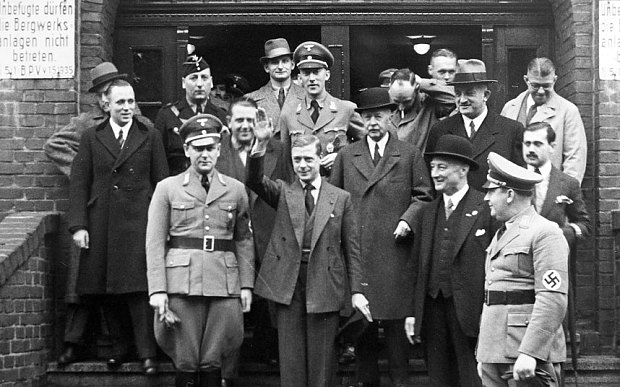
Photographs of the Queen’s uncle Edward VIII giving Nazi salutes on a visit to Germany two years before the outbreak of war have emerged after being put up for auction.

The then Duke of Windsor, who had abdicated the previous year, is pictured making the distinctive “Heil Hitler” gesture on an unofficial visit to Germany in 1937.

He is surrounded by senior Nazis in uniform, some wearing swastika armbands, on a visit to the Friedrich Heinrich colliery in the Lower Rhine area.

His guide during the visit was Robert Ley, the Nazi head of the German Labour Front, who later committed suicide while awaiting trial at Nuremberg for war crimes.

Among the other senior Nazis who accompanied him were Joachim von Ribbentrop, the German foreign minister; Fritz Wiedemann, Hitler’s personal adjutant; Arthur Goerlitzer, the deputy political leader of Berlin and Walter Hewel, Hitler’s liaison to Ribbentrop.

The British government representative was James Harrison, third secretary at the British Embassy.

Although Edward VIII’s admiration for Hitler has always been well known – he once met the Fuhrer with his wife Wallis Simpson – the timing of the photographs’ release could not have been worse for the Royal family.

The portfolio has been held by a private collector for the last 30 years.

Edward’s visit to Germany in October 1937 had ostensibly been to learn about factories and working conditions, but he attended a political rally flanked by SS guards and met Hitler at his Alpine retreat at Berchtesgaden.

An account of the conversation between the Fuhrer and Edward was captured by the Allies, but it has never been released by the National Archives.

Edward spoke in German to his hosts, and gave a speech declaring the Nazi economic model to be “a miracle”, adding: “One can only begin to understand it when one realises that behind it all is one man and one will.”

Source: The Telegraph

Buckingham braces for more Nazi-exposure

Buckingham Palace was last night braced for new embarrassment as turmoil continued over leaked footage showing the Queen performing a Nazi salute as a child.

An explosive Channel 4 documentary is set to reveal details of how Prince Philip’s sister met and admired Adolf Hitler, whom she described as a ‘charming and seemingly modest man’.

Three of his sisters were married to senior Nazi officers – one a colonel in the SS – and when Philip attended a family funeral in Germany in 1937 he was confronted by crowds giving the Heil Hitler salute. The documentary includes previously unseen extracts from a private memoir in which one sister talks of her early admiration for Hitler.

Meanwhile the footage showing the Queen performing a Nazi salute as a child could have been accidentally leaked by Buckingham Palace, it has been reported.

The Palace will not welcome a fresh focus on links to the Third Reich while controversy continues over the footage of the Queen.

The grainy film was shot in 1933, months after Hitler came to power and six years before the start of the Second World War. It shows the then seven-year-old Princess Elizabeth playing with a dog on the lawn at Balmoral with her sister Margaret, before raising her arm in a Nazi salute.

Her mother, the future Queen Mother, and her uncle Edward – later Edward VIII – are also shown in the pose. Her uncle appears to be showing them how to perform the Nazi salute, which even then was recognised internationally as a sign of obedience to Hitler.

Royal aides are investigating how the 17-second black and white film clip came to be published by The Sun, and Buckingham Palace has not ruled out legal action.

The footage was sold to a tabloid newspaper for a four-figure sum, the Mail has learnt.

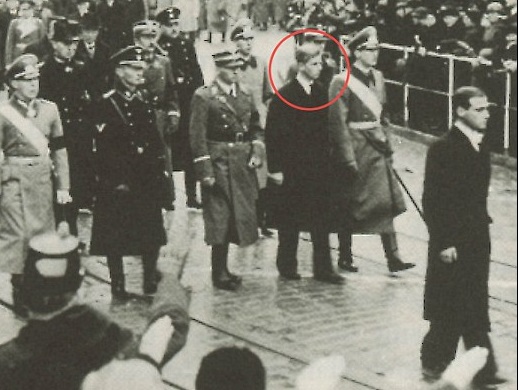
Another remarkable photograph from 1937 shows Prince Philip, then just 16, in a funeral procession for his older sister Cecile, who was killed in an air crash.

The young prince is flanked by grieving relatives, all wearing distinctive Nazi uniforms. One is clad in the uniform of the Brownshirts; another wears full SS regalia.

The street in Darmstadt, near Frankfurt, is lined with crowds – many giving the ‘Heil Hitler’ salute.

On his marriage to Princess Elizabeth, he assumed his mother’s maternal surname – Mountbatten, which is an Anglicised version of the German ‘Battenberg’.

The Queen’s real surname is also is German – Saxe-Coburg-Gotha. That was the surname of Prince Albert, Queen Victoria’s husband, who was born near Coburg in Germany.

The Royal Family’s surname was changed to Windsor in 1917, during the First World War, when Saxe-Coburg-Gotha was considered too German a name – not least because the planes coming over to bomb Britain were called Gotha bombers.

Source: Daily Mail

Germany backs down on Greece

Germany is at last bowing to pressure as a chorus of countries and key institutions demand debt relief for Greece, a shift that could break the five-month stalemate and avert a potentially disastrous rupture of monetary union at this Sunday’s last-ditch summit.

In a highly significant move, the European Council has called on both sides to make major concessions, insisting that the creditor powers must do their part as the radical Syriza government puts forward a new raft of proposals on economic reforms before a deadline expires tonight.

“The realistic proposal from Greece will have to be matched by an equally realistic proposal on debt sustainability from the creditors,” said Donald Tusk, the European Council president.

This is the first time Europe’s institutions have acknowledged clearly that Greece’s public debt – 180pc of GDP – can never be repaid and that no lasting solution can be found until the boil is lanced.

Any such deal would give Greek premier Alexis Tspiras a prize to take back to the Greek people after they voted by 61pc to 39pc to reject austerity demands in a landslide referendum last weekend.

While he would still have to deliver on tough reforms and breach key red lines, a debt restructuring of sufficient scale would probably be enough to clinch a deal, and allow him to return to Athens as a conquering hero.

The Greek parliament is due to vote to ratify the measures on Friday.

Source: The Telegraph

German missiles taken over by hackers

German-owned Patriot missiles stationed in Turkey were briefly taken over by hackers, according to media reports on Tuesday.

The attack took place on anti-aircraft ‘Patriot’ missiles on the Syrian border. The American-made weapons had been stationed there by the Bundeswehr (German army) to protect Nato ally Turkey.

According to the civil service magazine, the missile system carried out “unexplained” orders. It was not immediately clear when these orders were carried out and what they were.

The magazine speculates about two weak spots in the missile system which could be exploited by hackers.

One such weakness is the Sensor-Shooter-Interoperability (SSI) which exchanges real time information between the missile launcher and its control system.

The second exposed point is a computer chip which controls the guidance of the weapon.

Attackers might have gained access in two different ways, one that takes over the operating of the missile system and one that steals data from it.

The patriot missile has been in service in the US army since 1984 and was first used in operation in the first Gulf war in 1991.

In 2012 Turkey asked that its Nato partners support it by stationing Patriot missile systems there, after the civil war in Syria drew closer to its southern border.

In June 2015 Germany announced that it would replace its Patriot missiles with MEADS, an air defence system designed in cooperation with the USA and Italy.

Source: thelocal.de

‘US drawing Europe into crusade against Russia, against our interests’

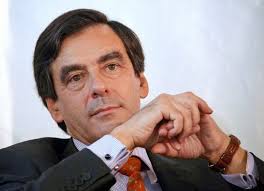
The US is drawing European states into a “crusade” against Russia, which goes against Europe’s interests, former French Prime Minister Francois Fillon has said. Speaking to French media, he stressed that Europe now is dependent on Washington.

“Today, Europe is not independent… The US is drawing us [the EU] into a crusade against Russia, which contradicts the interests of Europe,” Fillon told the BFMTV channel.

The ex-French prime minister, who served in Nicolas Sarkozy’s government from 2007 till 2012, lashed out at Washington and its policies.

Washington, Fillon said, pursues “extremely dangerous” policies in the Middle East that the EU and European states have to agree with.

He accused German intelligence of spying on France “not in the interests of Germany but in the interests of the United States.”

Fillon pointed out that Washington is pressurizing Germany to concede to Greece and find a compromise.

He noted the “American justice system” often interferes with the work of “European justice systems.”

“Europe is not independent,” the ex-PM said, calling for “a broad debate on how Europe can regain its independence.”

This, however, would not be possible if Europe goes ahead and signs the Transatlantic Trade and Investment Partnership (TTIP), a proposed EU-US treaty, which has drawn much criticism for its secretiveness and lack of accountability.

“I am definitely against signing this agreement [TTIP] in the form in which it is now,” he added.

The TTIP agreement seeks to formalize the economic relationship between the EU and US economies across the board. The two partners trade nearly €1 billion (US$1.1 billion) worth of goods and services annually.

Its supporters promise €100 billion in GDP growth for the EU and almost $90-billion growth for the US, as well as the creation of over 700,000 extra jobs in the US. However, TTIP critics warn the deal would create environmental problems, a loss of economic sovereignty, bring in torrents of genetically modified food and cause unemployment.

French media call G7 ‘idiots’

Nicolas Bonnal of Boulevard Voltaire believes Russia is lucky that it wasn’t invited to the G7 summit this year, comparing the group to the company of hypocritical “idiots.”

As the West is reaching new heights of absurdity, Russia should be happy that it didn’t end up in the company of “idiots,” Nicolas Bonnal said in Boulevard Voltaire.

Russia certainly shouldn’t be ashamed of not being invited to the G7 summit this year. The group of the richest Western nations gathered in Germany, without Russia and China, but with “Italy and its crowds of Libyan refugees,” Bonnal said, comparing the summit akin to being in a luxurious hotel up in mountains, but with non-alcoholic beer.

Even Ethiopia was invited to attend the summit, but not Russia. Russia was punished for not dancing to Washington’s tune.

Moscow was put in a corner for the alleged aggression against Ukraine and the lack of respect for human rights, the author said.

Meanwhile, the United States has 2.2 million prisoners, Guantanamo Bay and the Patriot Act, 1,200 victims of police brutality and over a million people killed because of drug-related gang wars.

American neoconservatives started a series of atrocious wars in Libya, Iraq, and Syria in their “irrational and even frightening desire to harm,” Bonnal said.

The contemporary G7, which was originally seen as the collection of the world’s largest economies, lacks not only Russia, but also China, India and Brazil. Currently, the group consists of the United States, Germany, Britain, France, Japan, Canada and Italy. And almost no economic growth.

Source: Sputnik News

Yuan inclusion in SDR basket inevitable

An integrated Eurasian block will dominate the world. The Chinese are acting upon that insight.

The IMF is due to re-examine the composition of its currency basket for Special Drawing Rights, a foreign-exchange reserve asset for fund members, later this year says Zhao Yongsheng.

“Our assessment now is that the substantial real effective appreciation [of the yuan] over the past year has brought the exchange rate to a level that is no longer undervalued,” the IMF said last week after it concluded its 2015 Article IV Consultation Mission to China.

Does this mean that the yuan is about to be included in the SDR currency basket? We can consider a “signal” sent by IMF Managing Director Christine Lagarde during a speech at Fudan University in Shanghai in March: “It’s not a question of if, it’s a question of when.”

Her speech, and the IMF’s announcement, indicate that the yuan is quite likely to be included in the SDR basket when it is reviewed this year.

But merely joining the SDR basket is not the only important step for the yuan, even if it is already a significant development in the currency’s internationalization.

Actually, the inclusion of the yuan in the SDR basket is not just a question of “if” or “when,” but a question of “how much.”

Let’s look first at the composition of the SDR basket, which now includes the four strongest currencies in the world: the dollar, euro, yen and British pound.

When the SDR was launched in 1981, the shares for the five currencies in the basket were 42 percent, 19 percent, 13 percent, 13 percent and 13 percent for the dollar, Deutsche mark, French franc, yen and pound, respectively. The basket is adjusted every five years.

Looking at this original composition, we can divide the basket’s basic structure into two blocks: the “Deutsche mark-French franc block” (or the “euro block” after the adoption of the European single currency in 2001) and the “dollar-pound-yen block.”

This division is based on differences in culture, historical links and even military relationships.

It is true that Germany and France are not the same, as one is a Germanic culture and the other is a French or half-Latin culture.

Nevertheless, these countries had no choice but to work together to establish and expand the European Union. Especially since the birth of the euro, monetary and financial relations between Germany and France have become closer. They are both countries of Europe’s continental culture.

For their part, the UK and US share an “Anglo-Saxon” culture, and their relationship is that of siblings. With regard to Japan, it has close links to the US due to its post-WWII occupation and rebuilding by the US. That’s why we put these three countries and their currencies together.

Originally, the combined share of the mark and franc was 32 percent.

Even if we assume this European continental culture block increased to 37.4 percent for 2011-15, it would still lag far behind the dollar-pound-yen block, which stands at 62.6 percent for the same period.

How can we maintain balance in the SDR basket?

Balance is essential for any game with multiple players, and that is also true of currency baskets.

In the case of the above division, obviously the gap of 25.2 percentage points between two blocks is too huge to be good for stability.

If we assume a share of 10 percent for the yuan in the SDR basket, the euro plus the yuan will make up 47.4 percent of the basket, against a new share for the dollar-pound-yen block of 52.6 percent. Now, the gap is not so large.

Why do we put the euro and yuan together? This implies the necessity for Europe to find another force to implicitly provide balance against the “American hegemony.”

The increasing closeness of Europe and China will be gradually reinforced with the adoption of China’s “One Belt, One Road” initiative and the operation of the China-initiated Asian Infrastructure Investment Bank.

This solution can also be a moderate and acceptable reform for the current players in the SDR basket, whatever their position, because even with the new composition, the dollar-pound-yen block will retain a dominant position with 5.2 percentage points more than the euro-yuan block.

Finally, in China’s pursuit of inclusion, France will play a major role – and not only because the IMF’s president is usually a French national.

It is also because France needs China, probably much more than do other countries, to recover from the lingering effects of the financial crisis and keep its economy growing.

Source:Global Times

The author is a Paris-based economist and vice-president of the Paris-based China-France Association of Lawyers and Economists. bizopinion@globaltimes.com.cn

Solar panels can power the world says MIT study

An MIT report has found that regular solar panels like the ones used today could supply much of the world with power. They believe terawatts of energy could be produced by 2050 and say that investment, not technology, could be the biggest hurdle.

The world’s population currently consumes 15 terawatts of power from various energy sources, according to the Economist. Despite making up less than 5 percent of the world’s population, Americans use 26 percent of the world’s power.

The publication, by the Massachusetts Institute of Technology, shows that no revolution in solar energy needs to take place, as scientists already have everything they need to harness the energy of the sun and turn it into electricity, though minor tweaks may help to improve efficiency.

The US, for example, generates less than 1 percent of its energy from solar power. This is something the researchers are looking to change.

“Our objective has been to assess solar energy’s current and potential competitive position and to identify changes in US government policies that could more efficiently and effectively support its massive deployment over the long-term, which we view as necessary,” Robert Armstrong, the director of MIT Energy Initiative, said in a statement.

The Topaz solar farm in California went online at the end of 2014. It generates 500 megawatts of energy, which is enough energy to power at least 160,000 homes. A terawatt is 1 million megawatts of energy.

The company behind the project, First Solar, uses 9 million solar panels to generate electricity. Crucially, it also eliminates over 350,000 tons of CO2 every year, Techspot reports.

“Solar electricity generation is one of very few low-carbon energy technologies with the potential to grow to very large scale. As a consequence, massive expansion of global solar generating capacity to multi-terawatt scale is very likely an essential component of a work-able strategy to mitigate climate change risk,” the MIT report said.

The study has emphasized the need for more research at a federal level, as well as more development support to help to advance low cost and large scale electricity storage technologies.

Battery technology is expected to be a crucial part of the future development of solar power energy, as the batteries can be used to store electricity during peak production and then dispense it at times when there is no sunshine.

The CEO of Tesla industries, Elon Musk, has been a big advocate of trying to develop better batteries that could help to store electricity.

“Our goal here is to fundamentally change the way the world uses energy,” Musk said on April 30, Bloomberg reported. “We’re talking at the terawatt scale. The goal is the complete transformation of the entire energy infrastructure of the world.”

The ability to get funding is out there. For example, the International Monetary Fund has calculated that the fossil fuel industries are receiving $5.3 trillion a year in subsidies, which is the equivalent to $10 million every minute. This is a figure that those looking to promote solar power can only dream of.

The authors of the MIT publication believe that the production of solar power will only increase if carbon dioxide emissions become costly. They admit this is unlikely to happen without a drastic rethink in US government policy.

“The main goal of US solar policy should be to build the foundation for a massive scale-up of solar generation over the next few decades,” the report said.

The researchers point to the example of Germany as a standout in pursuing green energy. In 1991, Berlin adopted a Feed-in Tariff scheme which was a rebate scheme to encourage the production of low carbon source energy.

The scheme was so successful that by 2013 Germany was producing 45 percent of solar energy in the EU, and 27 percent of solar energy around the globe, despite the fact that the country is not renowned for having a year-round sunny climate.

German cop probed for ‘immigrant abuse’

German prosecutors are investigating a police officer who allegedly abused two immigrants, strangling an Afghan man and forcing a Moroccan to eat pork off the floor.

The police officer has been accused of bragging about the brutal assaults in text messages and photos he sent via instant messaging service WhatsApp to his colleagues in the western city of Hanover.

Human rights group Pro Asyl condemned the alleged incidents, first reported by public broadcaster NDR, for their “appalling level of racism and inhumanity” and demanded a probe into how many “accomplices in police uniform” knew of the violence.

Prosecutors are investigating the officer, who has been suspended, on charges of physical assault and illegal weapons possession and have searched his home and work place.

In the first alleged case, in March last year, the officer had bragged in a text message about beating, strangling and sticking his fingers up the nose of a 29-year-old Afghan man whose feet were cuffed after he was detained for not carrying ID papers.

“It was funny … squealed like a pig,” the officer allegedly wrote on WhatsApp. “It was a present from Allah.”

In the second case, months later, the officer allegedly targeted a 19-year-old Moroccan man, who had been detained for travelling on a train without a ticket, carrying a small amount of marijuana.

NDR reported that the policeman bragged about how he assaulted and then humiliated the young man by forcing him to eat minced pork off the floor.

A photo allegedly sent by the officer shows a handcuffed man lying on the floor, wincing in pain, and apparently restrained by at least two officers.

Germany has become Europe’s top destination for people fleeing war and poverty. Last year, asylum requests rose 60 percent to more than 200,000, and the government expects that number to more than double this year.

Source: AFP