Can South Africa properly be called a ‘democracy’?

roodt_dan_wikiby Dan Roodt dan[at]praag.org

I find it interesting that professor Anthony Butler of UCT should point out potential tribal schisms within the ANC in Business Day. According to Stephen Ellis in his book External Mission: the ANC in exile 1960-1990 there had been a gun fight between Xhosa and Zulu members of MK in the Tanzanian camp, but this got buried under the avalanche of details concerning the heroic life of Nelson Mandela.

Many South African and British academics seriously analysed South African ethnicity using the Soviet term “the national question”. For years we were made to believe that, unlike the rest of Africa, this country had no real tribes, only artificial ethnic “divisions” imposed by the Nazi-like “apartheid regime”, at gunpoint as it were.

Likewise, the rise of the South African identity was more or less coterminous with the Book of Genesis, and everything else was just an “imagined community” or a “social construct” like race which would dissipate as people turned into global, brand-conscious consumers.

The uncomfortable truth is that South Africa is no different to any other multiethnic or multinational state where the most numerous group will capture the state through the ballot box and then use clientelism to retain power.

The current system was designed not to ensure efficient or accountable government, but to disenfranchise minorities, especially Afrikaners who do not even rule the tiniest rural municipality anymore.

Machiavelli’s dictum that the prince should be particularly generous in distributing largesse paid for by others will ensure that Afrikaner assets will be plundered to the last cent. Eventually the remaining family-owned farms of Afrikaners will have to go and South Africa will experience a Zimbabwean-style rural melt-down although it might not lead to hyperinflation as long as the mines keep earning foreign exchange. No-one in the City of London will even wince when it happens.

Xhosas and Zulus do not like each other, but they are locked into a kind of prisoner’s dilemma. Given current demographics, neither Kwazulu-Natal nor the Eastern Cape may rule the rest of the country without some degree of cooperation from its sister province on the East Coast.

Together, these two Nguni “dominant tribes” constitute 40% of SA’s population but their respective regions produce just over 20% of our GDP. So the benefits of power are obvious, especially to politicians from impoverished rural areas whose access to the state could turn them and their families into billionaires almost overnight.

Buy Dan Roodt's book through Amazon.com
Buy Dan Roodt’s book through Amazon.com

Many people scoffed at the term used by Dr. Piet Koornhof in the 1970s when he referred to the homeland system as a “plural democracy”. I suppose those same cynics are cackling today when they hear that South Africa is no longer a plural, but a “model democracy”.

Given the demographics of the current South Africa there is no way in which even an alliance of minority ethnic groups could ever outvote the ANC. Those opposition politicians, such as the DA, who are pretending otherwise, are not only deluding their supporters but also themselves. Even in the unlikely event that ANC support had to slip among ethnic Zulus and Xhosas, it would be inconceivable for South Africa to ge be governed by a coalition exluding the ANC.

First of all, the outbreak of violence and riots by ANC supporters would far surpass those which occurred in the aftermath of the Kenyan elections of December 2007. ANC potentates who have been treating the state as their private preserve would be very reluctant to leave office. The ruling party would not have to stage a coup because it has already erased any separation of party and state. In the unlikely event that it should ever lose power through the ballot box, it has maintained its militia known as Umkhonto we Sizwe which could be equipped from government military stockpiles. On the other hand, its militia commanders are already in control of the South African National Defense Force, so there would be no need for that.

In fact, the opposition coalition having triumphed at the ballot box would have to stage a coup just to assume office, or summon outside militarry intervention. Given the example of Zimbabwe where ZANU PF has held onto power through a spell of electoral weakness, the outcome seems predictable.

For all intents and purposes, South Africa is a one-party state or one-party dominant state ruled by the East Coast tribes. Event at the University of Cape Town with its British and quasi-British professors who have long denied the existence of ethnicity in South Africa, that reality is finally sinking in.

A shorter version of this column appeared as a letter in Business Day.

Education is about values… not a commodity

Top ten academic performers at Hoërskool Wagpos, an Afrikaans government school in South Africa

by TAU Bulletin

And a school matriculation certificate is not a ticket to the corner office, the VIP lift and the executive washroom.

Education is holistic: it is not a voucher for a comfortable life, nor a ticket to the turnstile of good fortune. The dictionary defines education as “the systematic development and cultivation of the mind and other natural powers. It begins in the nursery, continues through school and also through life. The impartation of knowledge by others is but a part of education.” The dictionary’s synonyms for education include “breeding, cultivation, culture, development, discipline, information, instruction, knowledge, learning, nurture, reading, schooling, study, teaching, training and tuition”.

Education is an intrinsic ingredient of a culture: it is the living embodiment of the passing from generation to generation the means by which the people of that culture conduct their lives.

The exuberance displayed by South Africa’s Minister of Basic Education Ms. Angie Motshekga when she recently announced the matriculation pass rate for South African pupils had jumped to 76.5% (from 60,6% in 2009) was met with scepticism and even derision. According to AfriForum, the actual pass rate was less than 38%, this because only half of the students who enrolled at the beginning of their school careers finished to write Grade 12, the matric year.

Mr. Tinyiko Maluleke, deputy vice chancellor of student affairs at the University of Johannesburg asked in a hard-hitting article (Independent 5.1.14) whether the matric certificate could be trusted. He said the certificate was in danger of “meaninglessness, worthlessness and irrelevance. The country’s entire education system is at issue, and 20 years of democracy have not taught teachers and principals (of mainly black schools) to stop striking during school hours.”

Professor Jonathan Jansen, rector and vice-chancellor of the University of the Free State weighed in, saying SA’s education system is a “fraud”. He concurred with other critics that the results proffered by the Minister were “grossly misleading”. “We know that the top 5% of Grade 6 pupils know more mathematics than the bottom 20% of the maths teachers in the same grade. We know that South Africa was dead last, just above Yemen, at the bottom end of international rankings on science and mathematics.” Mediocrity has been institutionalized, he declared, while “government officials hope we are all ignorant enough to accept the ‘official lies’” because of the way the so-called pass figures were manipulated. Pass rates were “pulled up by white kids” said Graeme Bloch of Wits University. “Sorry to be racial, but if you are born on the right side of the tracks, you have a 100% chance of getting matric”.

(We must pause here to comment on this “if you are born” comment. Who you are when you are born is the result of your genetic background, a consequence of your family’s ancestral lineage. And if that history is replete with achievement, initiative, hard work, the ability to overcome obstacles and a skill and desire to move forward and improve yourself, then comparing those “born on the right side of the tracks” with those ”born into” poverty is fallacious. This delusion infers that there is some sort of pantry in the sky which dishes out ways of life to some, and other less salubrious ways of life to others.

Everyone in South Africa is a genetic descendant of his ancestors. Blaming poor education results on the “privilege” of some is disingenuous. Cultural backgrounds have played a huge role in education result disparities – Africans had no written word, while South Africa’s first-world educational system was brought to this country by European settlers who then superimposed it on Africans. Similar occurrences took place during the colonial times in other new-world lands.

As well, using the term “previously disadvantaged” (liberally utilized to neutralize white academic achievements) is to refute history. Indeed, Africans were actually advantaged by European settlement. From where did they receive everything they have now – their ability to communicate in a world language, their education, health, legal and legislative system, and the country’s first-world infrastructure?)

The laughing stock

Setting a matriculation pass mark of 30% makes South Africa the world’s laughing stock. Average grade three literacy achievements only reached 35%, with numeracy at 28%. In grade six, the language average is 28% and mathematics is 30%. These figures are a reflection of how the government has managed an education system not generic to Africa. Cultural and language problems have been swept under the carpet in the government’s rush to “prove” that education is improving, when the opposite is in fact true.

Education is not just learning – it is how you interpret, utilize and develop that which is taught. In a country where mediocrity is the norm, it is not surprising that many waving their certificates cannot get work. Dumbing down the worth of this certificate has caused heartache to millions. They were led to believe that their 30% pass would get them a job. The government has sacrificed young people as scapegoats to foster the illusion that the state’s education system is delivering.

Quality is the name of the game. Said Anne Oberholzer, Independent Examinations Board’s (IEB) CEO: “If I’m prepared to spend my salary on my child’s education … rather than buying clothes or a fancy car, you can’t stop me from doing that”. The excellent IEB pass rate was the result of “extra hard work” rather than necessarily school resources. “Success at matric starts way back – matric is a combination of all the years of school exposure”, she said.

It is a simple case of values and norms. If black teachers go on strike during class teaching times, if pupils burn down schools, if ministers don’t get school books to pupils in time, and if the government shows by example that one really doesn’t need a good education to get rich as a party hack with a cushy government job (where capacity doesn’t even come into it), why bother to learn? Why have unbelievably bad results in black schools earned the ire of government when at the same time they show by their actions you don’t have to get good marks to join the government jobs gravy train?

And why try to achieve through hard work and sacrifice when government will legally provide you with a goodly share of someone else’s company just because you are black? In both the public and private sector, there are ample opportunities to feed at the trough, so why struggle at school and university? This same hypocrisy extends to government complaining about the quality of teachers, while universities across the board give preference to blacks for academic posts. A University of Johannesburg advertisement for the Deputy Vice Chancellor: Strategic Services (24.1.14) says it is “committed to taking persons with disabilities and the potential of historically disadvantaged individuals into account in making this appointment”. So if merit is not a criteria for university posts, how will government produce good teachers, and how can this in the end provide competent students and graduates for the country’s future?

Entrepreneurship

Entrepreneurship can’t be taught, yet it is the well-spring of all economies. It emanates from within and it is difficult, fraught with risk and sometimes very disappointing. It is easier to leaching on someone else’s success, a path made easier by government policies. While informal entrepreneurship is well entrenched in South Africa – small traders in townships and city streets sell goods someone else has produced – this doesn’t grow the economy.

Where is black entrepreneurial contribution to the formal economy? A weekly Pretoria is enthusiastically supported by locals and the diplomatic community. Selling mostly food, more than seventy stalls are manned by whites, Portuguese, Indians, a Moroccan family, Greeks, some Chinese. There is not one black South African stall. What is the point of an education that cannot extend to doing something for yourself?

Farming

Paging through any SA farm magazine shows the extent to which farmers have themselves developed and streamlined their profession. They haven’t just studied agriculture, they have applied it, improved on it, created new processes, adapted international methods to South African conditions and perfected agriculture to such an extent that 35 000 of them can feed 53 million people. Education was just the beginning. Without application, initiative, resilience, the ability to overcome hardship and plain hard work, where would South Africa be in terms of food security?

Most government officials and politicians see themselves as an intrinsic part of first world South Africa. They wear the clothes and drive the cars, but many do not exhibit the values generic to this first world. Education in this context should mean:

  • solving the problem yourself, not hiring a consultant;
  • making sure the traffic lights work and if they don’t, ensuring that a point officer keeps the traffic flowing until the robot is fixed;
  • making sure our cities are not littered and polluted until they look like Nairobi or Lagos;
  • answering the phone, replying to the e-mail and delivering the service to the people who pay your salaries;
  • owning up, with an apology, to the fact that many in government are incompetent and are unable to run South Africa as it should be run;
  • accepting criticism without retaliation in the form of racism accusations;
  • deciding that police asleep on duty, taking bribes and generally running amok with weapons is not worthy of a law-enforcement body;
  • immediately sacking all persons with criminal records employed in government;
  • not contemptuously ignoring court judgments;
  • ridding yourself of a completely unjustified entitlement syndrome because you didn’t create what you are now enjoying;
  • not wasting taxpayer’s money with impunity, and being contemptuous when confronted with this fact;
  • not handing over productive farms to incompetents and admitting this policy is a failure;
  • trying to emulate those who achieve instead of denigrating them and accusing them of being ”privileged”.

A point to ponder about education: Zimbabwe president Robert Mugabe has three university degrees, but he remains a savage tyrant, contemptuous of his people’s quality of life, of democracy and of what others think of him. Education without values is truly just a piece of paper!

Conned about marriage, constitution and ‘states’ rights’

mercer_ilanaby Ilana Mercer

[followbutton username=’IlanaMercer’ count=’true’ lang=’en’ theme=’light’]

Like Ilana Mercer’s Facebook page

The ban on the ban is unconstitutional.

This was the gist of broadcaster Mark Levin’s angry tirade against the humdrum, and certainly predicable, decision of a federal judge to strike down “Oklahoma’s voter-approved ban” on gay marriage.

At the center of conservative contretemps are similar decisions in California, New Mexico and Utah, following on which U.S. District Judge Terence Kern had “determined that Oklahoma’s constitutional amendment” violated the 14th Amendment’s Equal Protection Clause. It stipulates that “No state shall make or enforce any law which shall abridge the privileges or immunities of citizens of the United States; nor shall any state deprive any person of life, liberty, or property, without due process of law; nor deny to any person within its jurisdiction the equal protection of the laws.”

Broadly speaking, WND’s Alan Keyes concurred with Levin, alluding to the Constitution’s 10th and Ninth Amendments by which “the judges and justices of the federal judiciary are forbidden to … deny the antecedent rights retained by the people.”

Indeed, “the prevailing view in 1791,” observed The Honorable Robert T. Donnelly, former chief justice of the Supreme Court of the state of Missouri, “was that the national government had only delegated powers and that reserved to the people was an undefined sphere of non-government within which people may not be interfered with by government.”

But that was then.

In voiding “voter-approved law,” Justice Kern has resorted to perfectly proper 14th Amendment judicial activism. Deploying the Equal Protection Clause of the 14th Amendment, Kern nullified the 10th. It specifies that, “The powers not delegated to the United States by the Constitution, nor prohibited by it to the States, are reserved to the States respectively, or to the people.”

As expressed in the once-impregnable 10th Amendment, the Constitution’s federal scheme has long since been obliterated by the 14th Amendment and the attendant Incorporation Doctrine.

What does this mean?

If the Bill of Rights was intended to place strict limits on federal power and protect individual and locality from the national government—the 14th Amendment effectively defeated that purpose by placing the power to enforce the Bill of Rights in federal hands, where it was never intended to be.

Into the Cannibal's Pot

In their love of Lincoln and the 14th, conservative constitutional originalists will disagree. They’ll say the 14th was meant to limit the power of the states and enlarge the power of Congress, not the Courts. “Congress, not the Court,” was to “implement the provisions of the 14th Amendment,” subject to judicial review.

And that’s somehow a good thing?

They “say tomato, I say tomahto.” As I see it, the 14th Amendment was a gargantuan grant of power to the federal government. That the judiciary has done what was left undone by Congress does nothing to alter the dismal outcome for liberty. The 14th spelt the demise of our Constitution’s decentralized dispensation.

Either way, the freedoms afforded by federalism are no longer because American federalism is no longer.

“The natural progress of things [being] for liberty to yield, and government to gain ground,” this inevitable momentum, in the form of the invented legal doctrine of “selective incorporation,” soon progressed—regressed is the right word—to complete incorporation.

A précis of Incorporation-Doctrine jurisprudence in the legal dictionary admits that “most provisions of the Bill of Rights were eventually incorporated to apply to the states.”

Put differently, matters previously subject to state jurisdiction have been pulled into the orbit of the judiciary.

Among other legal decisions to have been implicated by Justice Donnelly in expunging federalism from the Constitution is Cooper v. Aaron. In 1958, “the United States Supreme Court asserted for the first time in its history and in the history of the nation that its interpretations of the written Constitution in a particular case in one State constitute the ‘supreme law of the land’ under Article VI of the Constitution and are of binding effect in all of the States.”

“It is emphatically the province and duty of the judicial department to say what the law is,” declared the Court. (See Cooper v. Aaron, 358 U.S. 1, 1958.)

So much for Alexander Hamilton’s promise, in Federalist No. 78 (May 28, 1788), that the Judiciary would be the weakest of the three branches of his proposed government.

“Instead of protecting the legitimate interests of the states,” surmised Justice Donnelly (in “The Demise of Federalism: With Consent of the Governed?”), “the Supreme Court competes with Congress to dictate to the states their ‘legitimate’ interests.”

Commensurate with the power they’ve amassed, nine unaccountable, unelected, Supreme-Court judges now sit as “a Council of Revision over the states.”

Just as the interpretation of the 14th Amendment in Brown v. Board of Education became the supreme law of the land, so, too, will the states likely lose their (petty) marriage-licensing jurisdiction, once that coven of casuists, the Supreme Court, embroils itself in setting social policy for all the states.

Conservatives as astute as Mr. Levin, Esq., ought to quit misleading their readers and listeners about the restoration of a constitutional structure that has suffered death by a thousand cuts, long before the dreadful cur Obama appeared on the scene.

[followbutton username=’IlanaMercer’ count=’true’ lang=’en’ theme=’light’]

Like Ilana Mercer’s Facebook page

Mandela for Dummies

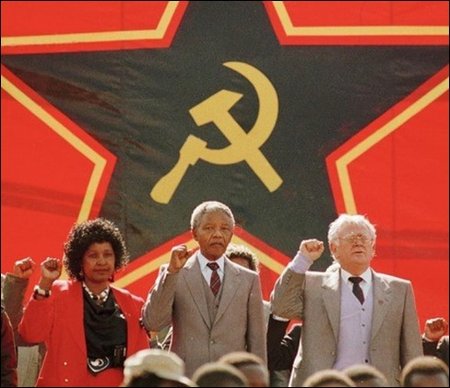
Winnie and Nelson Mandela, as well as Joe Slovo of the SACP, singing "Kill the whites"
Winnie and Nelson Mandela, as well as Joe Slovo of the SACP, singing “Kill the whites”

by Albert Brenner

[followbutton username=’albertbrenner1′ count=’true’ lang=’en’ theme=’light’]

It simply boggles the mind having to witness people still prostrating themselves in the dust whenever the name Mandela is spoken. Elevated to a modern-day god, Mandela is believed to be three, a `Holy Trinity`… yet he is only one – the one ultimately responsible for having turned South Africa into a failed-state-in-the-making.

Mandela No 1 is the latest poster boy of the secularization process which dictated the morality of the West after WWII. It is, basically, the moral world in which the 10 Commandments were replaced by Human Rights. A world in which the biblical “love God and love thy neighbor like thyself” has been replaced by “love thy neighbor like thyself because /she is thyself, (both) God”.

This is the moral universe of George Soros’ Open Society Foundation – which turned the Afrikaners Beyers Naude, Van Zyl Slabbert, Max du Preez, etc. into Walter Lippman`s useful-idiots of Mandela No 2`s world. And it is the world that grounded Pax Americana…

“We hold these truths to be self-evident, that all men are created, that they are endowed by their Creator with certain unalienable Rights, that among these are Life, Liberty and the pursuit of Happiness.”

Funny; if this “Creator” is no more – i.e. the moral rationale driving secular-humanism – how can we still state with such hubristic certainty that we are still “endowed” with them? Rather silly, but then; no wonder it has become the Inquisition.

Mandela No 2 is the world of End Game. A world which saw the dumbest Afrikaner philosopher ever, Willie Esterhuyse, formally hand South Africa’s future over to the cold Queen of England… at the behest of Her Holocaust card-playing Randlords. The world which saw Mandela and his inner-circle “struggle” buddies become some of the richest men in Africa… simply because Mandela No 3 did everything KGB colonel Joe Slovo taught him.

Mandela No 3, the real Mandela, is the great “democrat” who wrote; “If force will advance [the struggle], then it must be used whether or not the majority agrees with us.” And that is precisely what he, and his murderous “necklacing” wife, Winnie Mandela, did… killing 15 000 fellow blacks in the process!

This is the true world painstakingly depicted in the fantastic book The People’s War, by Dr Anthea Jeffery of the SAIRR…

  • “the ANC had little compunction about attacking black civilians, including its own supporters, for the formula for people’s war draws no distinction between combatants and others and regards all civilians (irrespective of their political affiliation) as expendable in conflict;
  • the ANC had a motive to unleash violence, for it wanted to create enough mayhem and unrest either to spark an insurrection or to weaken its opponents to the point where it could triumph in negotiations;
  • the ANC had the means to unleash violence, for the peace process allowed it to bring back into South Africa some 13 000 armed and trained combatants whom it then refused to disarm or disband; and
  • the ANC was the only organisation to draw benefit from the 15 000 political killings that took place in the early 1990s (after all major apartheid laws had been repealed), for it used these to;
  1. stigmatise De Klerk and the IFP,
  2. stampede negotiators into giving it what Joe Slovo called ‘a famous victory’ in negotiations, and
  3. put great pressure on the first all-race election, while making it unthinkable for anyone to demand a re-run of the deeply flawed April 1994 poll in which it was accorded (no accurate count being possible) some 63% of the vote” (source).

Well, there you have it. Mandela is not three. He is only one, No 3 – although No 1 and No 2 gave him – and his murderous, greedy and woefully incompetent ANC thugs – the Noble Prize for Peace… for having turned South Africa into a failed-state-in-the-making.

But then; only dummies won`t believe it.

[followbutton username=’albertbrenner1′ count=’true’ lang=’en’ theme=’light’]

A soldier in the style of ‘Stonewall’ Jackson

mercer_ilanaby Ilana Mercer

[followbutton username=’IlanaMercer’ count=’true’ lang=’en’ theme=’light’]

Like Ilana Mercer’s Facebook page

Barack Hussein Obama at war and George W. Bush at war: How does the 44th president of the United States differ from the 43rd?

If nothing else, former Defense Secretary Robert M. Gates has settled that question. Bush sent troops to fight futile battles without flinching; Obama did the same with some reservation.

Hardly a peacemaker, Obama questioned the mission in Afghanistan and was skeptical of the military brass’s motivation in securing for itself—to the detriment of the grunts on the ground—a long-term commitment to the theatre of war in that country.

Like Obama, 82 percent of Americans oppose the war the president is being panned for having embraced publicly, but agonized over privately. On Afghanistan, Obama is more aligned with the American people—and the truth—than the former defense secretary and his Republican champions.

This I say with reluctance. I awarded Barack Obama brownie points thrice in his tenure: for doing not a thing about the 2011–2012 protests in Iran, for ceasing the criminalization of cancer and AIDS patients for their medicinal use of illegal substances, and for breaking with Bush and his neocons in refusing to step on the Russian Bear’s claws. Obama scrapped the missile-defense shield in Russia’s backyard.

Yet this revelation in Gates’ “Duty,” a book that hangs on one hook, has Republicans gurgling with pleasure. Limitless is the GOP’s zest and zeal for ignoring the negative right of the American people to be free of the Sisyphean (and Jacobean) struggle to save the world.

If anything, it sounds as though Gates might have had misgivings of his own about the missions in which his “soldiers, sailors, airmen and Marines” were dying for nothing.

A bereft Gates tells of “evening sessions” during which he’d write condolence letters “to the families of service members killed in action.” There “probably wasn’t a single evening in nearly 4 1/2 years when I didn’t — when I didn’t weep,” he confessed. Gates relates how focused he became “on the strain on our troops and on their families.” After all, “they’d been at war for 10 years.” “My highest priority,” he averred in an interview with NPR, was “trying to avoid new conflict … in terms of recommending against intervention in Libya,” and expressing “concerns about going to war in Syria, much less in Iran.”

It just seemed to me that some of the areas where we were looking at potential conflict were more in the category of wars of choice. And it was those that I was trying to protect the troops from.

Having fought for the survival of his people—and never to democratize or “save” another—Ariel Sharon was far less of a study in contradictions than poor Mr. Gates. The former Israeli prime minister died on Jan. 11, after languishing in a vegetative state for 8 years.

Into the Cannibal's Pot

Seared in my mind as a child growing up in Israel is a 1973 image of the late Ariel Sharon. He is on the western bank of the Suez Canal in Egypt, head bandaged because of an injury sustained in combat. What is he doing? Winning. Sharon was beating back an enemy that came close to vanquishing Israel.

Ariel Sharon led his men into battle and won the 1973 Yom Kippur War in which the Israeli government and the intelligence failed miserably. He himself had said that “his greatest military success came during that war, during which he surrounded Egypt’s Third Army and, defying orders, led 200 tanks and 5,000 men over the Suez Canal, a turning point.”

Had Sharon himself not performed military miracles, who knows if Israelis, myself included, would have survived? How many Americans can point to a leader who had actually saved their lives, rather than send other men to die in foreign lands, and then propagandize his countrymen about having fought for their freedoms?

As a Special-Forces commander, Sharon was on the front—and in front of his men—performing daring assaults that saved Israel in both the 1967 and 1973 wars.

Pugnacious and tenacious, “Arik” Sharon was nothing if not controversial. Hated though he was abroad, Sharon was, nevertheless, a soldier in the style of “Stonewall” Jackson, not Dubya the Deserter, to whom he and the Likudniks were often compared.

Agree or disagree with the methods and politics of this titanic personality—it is unarguable that Sharon’s overriding concern was with the survival and security of the Jewish state: he saw himself as bearing a “historic responsibility” for “the fate of the Jewish people.” By contrast, Bush’s Wilsonian, global missionary movement to rid the world of “evildoers” related not even tangentially to the future and safety of the American people.

Unlike George Bush the internationalist, “Arik” Sharon was a fierce nationalist, who put his country and its people first.

As with so many of our military men—cast adrift by the policies of Rome-on-the-Potomac—Mr. Gates would be less of a mess had he, too, been able to lead his men into wars of necessity, instead of charging headlong into unjust “wars of choice.”

[followbutton username=’IlanaMercer’ count=’true’ lang=’en’ theme=’light’]

Like Ilana Mercer’s Facebook page

650 000 homicides in South Africa in 20 years!

Kevin_Kingby Kevin King

[followbutton username=’djkevking’ count=’true’ lang=’en’ theme=’light’]

The SAPS stats confirm that towards the end of 2014, we will have had 650,000 homicides since 1994.

Here are the facts:

  • SAPS reports show 392,886 (56.65 per day) murders in last the 19 years. During the 2012/2013 year they reported 16,259 (44.54 per day).
  • SAPS reports show 221,273 (31.91 per day) cases of culpable homicide in the 18 years up to 2011/2012. During the 2011/2012 year they reported 11,788 (32.26 per day).
  • Our homicide rate per capita is 11.5 times higher than the gun crazy USA, and we are ranked top 5 in the world under the most homicidal countries.
  • In the SAPS crime report for 2012/2103, there was NO mention of culpable homicide (the killing of another human being) under “serious crimes”, “contact crimes” or anywhere in the entire report.
  • Taking an estimate of the 2012/2013 cases of culpable homicide (12,300) and a forecast for the combined murders and culpable homicides in 2013/2014 (28,000), we will pass 650,000 homicides by late this year, 90 per day since 1994.

Culpable homicide

  • Why remove 12,300 unlawful deaths from the crime statistics, surely this is a serious crime and should be reported directly below murder? (Previously culpable homicide was reported in the bottom half of the report under “negligent and ill treatment of children”)
  • Why is our murder rate reported excluding culpable homicide and compared to international homicide rates that include culpable homicide?
  • In our country you can be executed in your home during a robbery (eg Father Louis Blondel) and it will be recorded as culpable homicide which means your death will not even make it only the crime stats. If this was America it would be recorded as “non-negligent homicide” which together with “murder” is the reported murder rate over there. Apples with apples?

The matric pass rate is reported excluding all the students who drop out. Similarly, South Africans being murdered are excluded from the crime stats and the murder rate. It’s not difficult to draw conclusions from this…

 [followbutton username=’djkevking’ count=’true’ lang=’en’ theme=’light’]

‘Left’ and ‘Right’ bamboozling you on Benghazi

mercer_ilanaby Ilana Mercer

[followbutton username=’IlanaMercer’ count=’true’ lang=’en’ theme=’light’]

Like Ilana Mercer’s Facebook page

“Us against al-Qaida”: This has been—still is—the narrowly conceived narrative among neoconservatives. As the politically provincial neoconservative foreign-policy paradigm has it, those were the forces that played out in the Benghazi affair, in which the American mission was left undefended, resulting in the slaughter of Ambassador Christopher Stevens and three other Americans (who, given the pecking order in the Empire, generally go unnamed).

Hillary Clinton, the woman who cracked the whip at Foggy Bottom at the time, had clearly resolved to run the U.S. embassy in Benghazi, Libya, as one would an open community center. This was meant to signal that her war on Libya had been a success, when in fact Hillary’s adventure there had as much “host-nation support” as George Bush’s faith-based forays into Iraq and Afghanistan.

Indeed, “a central figure in the attack,” reports David D. Kirkpatrick of the New York Times, “was an eccentric, malcontent militia leader, Ahmed Abu Khattala.” Once persecuted and imprisoned by Gadhafi, Abu Khattala is a Libyan Islamist from the el-Leithi region, who considers “the United States not far behind Col. Gadhafi on his list of infidel enemies.”

Understandably, Fox-News neocons have been fuming over “A Deadly Mix in Benghazi,” Kirkpatrick’s exposé in the Times. In their focused blindness, Republicans believe religiously that, to quote Kirkpatrick, “Mr. Stevens died in a carefully planned assault by al-Qaida to mark the anniversary of its strike on the United States 11 years before.” Accordingly, the Obama administration has been “covering up evidence of al-Qaida’s role to avoid undermining the president’s claim that the group has been decimated, in part because of the raid that killed Osama bin Laden.”

Uncovered by The Times’ investigation, however, was a very different reality in Benghazi—”murkier than either of those story lines suggests. Benghazi,” contends Kirkpatrick, “was not infiltrated by Al Qaeda, but nonetheless contained grave local threats to American interests. The attack does not appear to have been meticulously planned, but neither was it spontaneous or without warning signs.”

In particular are neoconservatives fulminating over the findings that “turned up no evidence that al-Qaida or other international terrorist groups had any role in the assault,” and that “the attack was led, instead, by fighters who had benefited directly from NATO’s extensive air power and logistics support during the uprising against Col. Gadhafi.”

How can that be? Easily: The history of Libya is festooned with similar ransacking and burning of consulates by angry local mobs. Alas, in the ignorance it cultivates about the past, America is Cicero’s perpetual child. By the definition of the great Roman statesman, “Not to know what happened before one was born is to be always a child.”

Into the Cannibal's Pot

Based on the annals of U.S. intervention in the region, it is fair to say that, to the extent the American-made video lampooning Islam triggered the hatred harbored by the invaded Libyans for the invading Americans—to that extent it is true that the YouTube clip, more so than the mythical al Qaida, was a catalyst for the attack on our embassy in Benghazi.

Still, the NYT has hardly been unsparingly honest. Rather, the Gray Eminence is as dishonest and politically provincial as the opposing faction.

Discounted in the Kirkpatrick essay is that al Qaida has devolved into many decentralized operations that mirror the aspirations of the indigenous population to be free of meddling Westerners—unless of course said militia and tribesmen (the Ansar al-Shariah, for example) can get us to bankroll their Baksheesh economy.

Predictably, the double-crossing neoconservative and neoliberal entities cross-pollinate each other.

So wrong was the Times on Iraq that the reporter who piped lies straight from the Bush White House to her Times readers was recruited to Fox News: She is Judith “Chalabi” Miller. (Ahmed Chalabi was the Iraqi exile who agitated for American intervention in Iraq. In the ramp-up to war, Chalabi fed Ms. Miller, the New York Times’ birdbrain now perched at Fox News, with the pro-invasion “intelligence” she then presented to the public.)

The facts in the Benghazi affair have likewise been unwoven and retied into two contradictory narratives to suit the respective sides.

Think of lab rats racing through a maze, as you watch the sub-intelligent, dual-panel “dialogue” conducted on the teli. Hosts Stephanie Cutter (left-wing, social-democratic rat) and S. E. Cupp (right-wing, social-democratic rat): Each rat runs with a designated, neatly bifurcated (Republican or Democratic) political orthodoxy. Each is a “maze-bright” rat, and not the possessor and giver of any truth.

“Left” and “right” are bamboozling you on Benghazi.

Queen Georgina and the Holocaust card

Georgina Guedes enjoying the Colonial Life

by Albert Brenner

[followbutton username=’albertbrenner1′ count=’true’ lang=’en’ theme=’light’]

I must admit that I did not expect Georgina Guedes to do it. But then, maybe I underestimated the impact my column had on her. For her subsequent reaction speaks volumes about her desperate attempt to silence me… and all other Red October supporters once and for all.

Unfortunately it is, even in our day and age, still very easy to silence someone. All you have to do is pull the Holocaust card. This card still trumps all others. It is the Royal Flush of the moral poker of our Zeitgeist. Whoever pulls this card is guaranteed to win the game… solely by way of implicitly accusing his/her opponent of complicity (by association) in the horrors of Auschwitz.

And this is exactly what Georgina did in her critique of my column. Her play was narrative crudity at its best. She simply focused in on the Jewish genes of Nadine Gordimer. Something which I never even mentioned, simply because it was neither relevant in/to the context of my argument, nor does her, Gordimer`s, ethnicity/race interest me in the least. I specifically stated that Gordimer represents the interests of the British upper-class in Mandelatopia. Yet it provided Georgina with the golden opportunity to use the Holocaust card.

Why? Well, the Holocaust card still has the ability to blind all and sundry to the horrors that occurred before and after Auschwitz. It is the ultimate card played by Anglo-Saxon liberals when the Hillbilly-card and the race card have zero effect anymore. It is their way of telling the rest of humanity to simply shut up, for only they know best… what is best, for all.

And it is the moral weapon of choice of the British upper-class when it comes to deflecting all criticism from its unsavory role in history during the oh so glorious days of the British Empire — an epoch which saw the Brits invade nine out of every ten countries on the planet.

It suffices to say that the conquered did not appreciate their de facto enslavement by the Crown. Yet many Brits still yearn for those “glorious” days of old… when they, according to their moral rationale, “civilized” the world. Now obviously there were some positive aspects to British colonization, but woe beholds all non-Brits who use the exact same moral rationale to point to positive aspects of other forms of domination, like Apartheid, for example. For if you do so, the Brits automatically pull the Holocaust card.

Even more hypocritical is the fact that Cecil John Rhodes, one of the champions of the British Empire, was even more morally depraved than Hitler himself. According to Rhodes;

“I contend that we British are the finest race in the world and that the more of the world we inhabit the better it is for the human race. Just fancy those parts that are at present inhabited by the most despicable specimens of human beings what an alteration there would be if they were brought under Anglo-Saxon influence.”

“… despicable specimens of human beings… ?” Did he mean Africans, or the French, or the Chinese, or the Boers? Whatever his depravity; one thing is for sure, Hitler, as we know, at least liked white people. Rhodes on the other hand, hated all those who were not British… including all other whites on the planet. Yet his name and fame live on as if he were a benign being at heart, a hero. We have a Rhodes University in Mandelatopia, and innumerable statues and street names honouring him. A Rhodes scholarship is one of the most prestigious in the country.

Now just imagine a Hitler University, or a Hitler Scholarship. Just imagine if, for example, the half-wit pseudo-intellectual hobby gay-porn writer Eusebius McKaiser had instead received a Hitler Scholarship to study philosophy at Oxford. Maybe then the British visa/customs authorities would have taken a closer look at McKaiser`s past, especially given that little girl’s skeleton in his closet. But then, the victor writes morality, and little lackeys like McKaiser tag along merrily.

Be that as it may; Guedes’s attempt to silence me and, by association, all Red October supporters, back-fired beautifully. For not only has support for this peaceful movement grown exponentially, but the true face of anti-Semitism in Mandelatopia has revealed itself at one of the very tertiary institutions founded by the ever-so-innocent British upper-class, Wits University.

During a recent performance by an Israeli artist at Wits University, members of the Boycott, Divestment and Sanctions movement (BDS) sang the Dubula iJuda (Shoot the Jew) song. Ha-ha… it used to be Shoot the Boer but now the wheel has turned — thanks to the ever-patronizing attitude of the British elite towards the locals of South Africa — the blacks, Coloureds and the Boer.

I wonder why Guedes did not pull the Holocaust card on these people, for they richly deserve it. But no; only the Boers are all aspiring Auschwitz camp guards, eternally. Little does the little MSM half-wit know that the Boers were the first to provide military assistance to the Jews fighting to ground their Heimat after their millennia-long Diaspora… which included their 350-year long expulsion from Britain.

But then; who cares that the Boer never harmed the Jew in South Africa? Who cares that the Boer was the best friend of the state of Israel? Who cares that the Jew became the richest group in South Africa during Apartheid? Who cares that the former Israeli Foreign Minister recently advised all Jews in Mandelatopia to flee to Israel? Who cares that England was the first European nation to require Jews to wear a marking badge? And who cares that the British upper-class physically banned Jews from Britain for a period seven times longer than the entire duration of Apartheid?

Nobody cares. Just blame the Boer. Just blame Dr Dan Roodt, Steve Hofmeyer, Sunette Bridges and all the Red October supporters. Just use the full might of Her Majesty’s MSM newspapers in Mandelatopia to hound them like an oh so sporting fox-hunt back on the sacred soil of the country upon which “God`s sun would never set”. Just keep on slaughtering those elderly Boer farmers like animals… they are all Hitler’s spawn anyway, period!

Who cares about the truth? Nobody in the Mandelatopian MSM, it would seem. Especially not those black journalists now working for Her Majesty.

All is just fine and dandy in the Queen’s backyard. Mandela`s inner-circle blacks have all been co-opted — as has the Afrikaner elite. The “dumb Dutchman” farmer Boers are still feeding the Great Unwashed… who have to slave away in Her Majesty`s gold, diamond and platinum mines in order to eke out a living in a world which Her money-mongers forced them into with Her hut and dog tax, in those glorious old days of the oh so benign British Empire.

Thank goodness the Natives are still not too restless, after even more than a century of bondage. No annus horribilis like in Zimbabwe… goodness me, have some more tea. Simply use MSM minions to silence the likes of Boer Albert Brenner and Bikoist Zolisa Socrates Soji. It’s all too easy…

Who cares that South Africa is a failed state in the making? The Queen’s cup still runneth over. Nothing to see here; just move along, as if nothing is awry — whilst blaming those “Jew-hating” Red October supporters. Just keep that stiff MSM moral upper lip. It is all so easy to keep the foot of the Queen on the neck of these people — Boer and Black. What military metal did a century ago, Anglo-Saxon morality is doing now. And if Her subjects dare rebel against their bondage, just say they are in league with Lucifer/Hitler.

For as long as the Holocaust card still trumps all others, all Good & Evil — past, present and future — remains the sole moral property of the Monarch of England.

[followbutton username=’albertbrenner1′ count=’true’ lang=’en’ theme=’light’]

Quacking Over Ducksters As Freedoms Go POOF

mercer_ilanaby Ilana Mercer

[followbutton username=’IlanaMercer’ count=’true’ lang=’en’ theme=’light’]

Like Ilana Mercer’s Facebook page

While the nation fretted over the ouster of one Duckster from the parallel reality of a TV reality show, more of the protections enshrined in the Fourth Amendment of the U.S. Constitution evaporated.

Just after Christmas, district-court Judge William Pauley ruled that the privacy protections afforded by the Constitution were relative freedoms, not absolute ones. As such, Fourth-Amendment rights had to be calibrated against a government’s need to maintain a database of records that would (putatively) prevent future terrorist attacks.

Paraphrased by The Guardian, “Pauley argued that al-Qaida’s ‘bold jujitsu’ strategy to marry seventh century ideology with 21st century technology made it imperative that government authorities be allowed to push privacy boundaries.”

You’d think that the purview of the justice elite is to “marry” American law with Islamist ideology, rather than uphold a timeless principle that states: “The right of the people to be secure in their persons, houses, papers, and effects, against unreasonable searches and seizures, shall not be violated, and no warrants shall issue, but upon probable cause, supported by oath or affirmation, and particularly describing the place to be searched, and the persons or things to be seized.”

“The judgment,” continued The Guardian, “directly contradicts the result of a similar challenge in a Washington court [a week earlier] which ruled the NSA’s bulk collection program was likely to prove unconstitutional and was ‘almost Orwellian’ in scale.”

Friday’s ruling, surmised the vigilant British paper, “makes it more likely that the issue will be settled by the U.S. Supreme Court, although it may be overtaken by the decision of Barack Obama on whether to accept the recommendations of a White House review panel to ban the NSA from directly collecting such data.”

Indeed, in August, media-enabled megalomaniac Obama told a rapt press corps that, in his magnanimity, he’d be prepared to “jiggle” his surveillance apparatus here and there to better allay unnecessary fears (“provide greater assurances,” as the president put it).

In his remarks, Big Daddy said—in defiance of the evidence—that he was comfortable “the NSA program [was] not being abused,” going on to promise that he’d outsource the matter to a new hire: A civil liberties officer. (CNN’s Jessica Yellin was in estrus.)

This is the inglorious history of American freedom and federalism. In the rare event that the Supreme Court refuses to play along (as nicely as plaything Justice John G. Roberts did for ObamaCare)—there is always a perfectly legal, extra-constitutional, quasi-legislative, quasi-executive, quasi-judicial, “independent” regulatory commission or executive agency to kill off or override constitutional protections.

A “civil liberties officer,” for example.

The nice men in periwigs who came up with the Fourth Amendment were recklessly naive to imagine that branches of a government, each of whose power is enhanced when the power of the other branches grows, would serve to check one another. The idea of a judiciary that would police the executive as an arm of a self-correcting tripartite government was worse than naive.

Ditto the Duck detritus: they are the new wholesome in America.

Into the Cannibal's Pot

As “luck” would have it, legislation that flouts the Fourth Amendment was previously in place to provide Pauley with all the positive-law backing the judge needed to justify an anti-constitutional ruling. To wit, the grounds upon which the New York jurist dismissed this ACLU (American Civil Liberties Union) case against the NSA were, primarily, “that bulk collection was [already] authorized under existing laws allowing ‘relevant’ data collection to be authorized by secret US courts.”

Here you have the essence of modern-day, Managerial-State America. Natural law, common-law and Constitution have been nullified; buried under the rubble of legislation, statute, precedent, ad infinitum, rights having long-since been outsourced to the “better” judgment of bureaucrats and hired “experts.”

In this case, to Eric Holder’s Department of Justice.

Not only has Obama “the sinner” trusted Holder his “sin eater” with the expansion of surveillance-state USA; he has, it would appear, charged him with dealing a one-two Knockout punch to white America.

Eric Holder’s first arrest in the string of Knockout attacks across the country is a first in more than one way.

The arrest is unique in that it is of a white offender. Knockout attacks have been, almost exclusively, black-on-white hate crimes.

Were it not so disquieting for what it portends, this single arrest would be as comical as the specter of global-warming scientists marooned in Antarctic ice so densely packed that no man-made machinery can affect it.

Heeding Holder, the U.S. attorney for the southern district of Texas has remanded Conrad Alvin Barrett (27 years old) to prison for breaking the jaw of a man (79 years old), while “laughing and saying; ‘Knockout’” as he beat it.

The question is not whether this is a good arrest. If he’s guilty, let Barrett rot. The question is, why have there been no arrests for the multiple killings and maiming of innocents by feral black thugs across the country?

Befitting a banana republic, Holder, who carries water for President Camacho, is likely attempting to deploy the law to frame the Knock-Out phenomenon as an equal-opportunity crime. This is the administration’s ultimate racial reprisal against white victims of hate crimes: “know thy place, Honky!”

MSNBC host Melissa Harris-Perry will no doubt deem the “banana” usage here to be racist, “conceived by a group of wealthy white men who needed to . . . render [a black man] inferior and unequal and diminish his accomplishments.” This is what our unsharpened pencil thinks of the word “Obamacare.”

But Obama and his fans “can’t have their banana and eat it.” It is an incontrovertible fact that under Strong Man Obama, America’s banana-republic- and surveillance-state credentials are that much stronger.

[followbutton username=’IlanaMercer’ count=’true’ lang=’en’ theme=’light’]

Like Ilana Mercer’s Facebook page

South Africa’s war of perspectives and the whites’ dwindling fortunes

roodt_dan_wiki

by Dan Roodt dan[at]praag.org

Ever since Britain started getting seriously interested in South Africa after the discovery of diamonds at Kimberley in 1866, there have been at least two conflicting views of the country. Throughout the twentieth century too, South Africa has borne the brunt of the Western ideological revolutions, all the way from colonialism and so-called “white supremacy” to contemporary political correctness. In fact, in the aftermath of the Mandela funeral, one could almost speak of the West’s religious devotion to black Africans who are being endowed with all the capricious amoral innocence of Greek gods.

More precisely, South Africa has been the theatre of an “epistemic war” if I could be excused such a French-sounding term. Apart from the very palpable shifts in demographic, political, economic and military power towards South African blacks, locals are also acutely aware of how the Western world view is no longer the dominant one in South Africa.

A few years ago I spoke to a liberal, anglophone, Jewish woman who lived in Johannesburg but who had some connection to the huge Baragwanath hospital in Soweto, one of the proud achievements of the former Afrikaner-led government. Within the Afrikaner mind, blacks had wanted not real political power but hospitals, schools, universities and jobs which is why they put so much effort into constructing such public institutions. Those institutions are currently being derided as having been entirely useless and a sop, or an insult to blacks, especically to the divine black leaders such as Mandela.

The point is, however, that since the black takeover in the country “they have changed the frame of reference” as my liberal Jewish friend put it. But she wasn’t really speaking in general terms, referring to the broad sweep of history and politics. First and foremost, she was speaking in medical terms. What she was saying, was that with the new order had come a new way of looking at healthcare, at patients and the function of a hospital. In short, the age-old belief systems of Africans have been reasserting themselves and “success” is no longer measured in white or European terms. That is why, when whites decry the deterioration of the state hospital system, as well as standards of professionalism and hygiene there, blacks are quick to retort with the ubiquitous cry of “racism”. After all, blacks are now in charge and they make the rules and set the standards against which a hospital, a school, a university or even a government will be measured.

It is really hard to understand the hullabaloo over President Zuma’s expenditure on what amounts to a private Zulu homestead or kraal at Nkandla. Compared to the billions being frittered away in corruption and unauthorised expenditure, the R240 million (about $20 million) involved seems almost paltry.

It is a truism of historians and philosophers alike, that one’s assessment of a situation – any situation – depends on one’s perspective. Not so long ago I read a paragraph by French political philosopher Alain de Benoist wherein he said:

… I am not fighting for the white race. I am not fighting for France. I am fighting for a world view. I am a philosopher, a theoretician, and I fight to explain my world view. And in this world view, Europe, race, culture, and identity all have roles. They are not excluded. But mainly I am working in defense of a world view. Of course, I am very interested in the future and destiny of my own nation, race, and culture, but I am also interested in the future of every other group.

That all sounds very interesting, but somewhat abstract. To the Afrikaner farmer who is being attacked in his or her home by a group of blacks who had imbibed some form of “medicine” or muti to make them invincible, the quesion is one, not of philosophy but of survival.

At a more mundane or political level, the clash is one of perspectives, even a traditional fight between the left and the right. In South Africa, any statement expressing concern over the future of whites or their well-being is almost always characterised as “right-wing”. Blacks are simply too good-natured and inherently moral ever to commit evil on a significant scale against whites.

This is also the foreign perspective. A Marxist theologian in Germany or a pro-white militant in America would concur that whites “have no place in South Africa, at the southern tip of a black continent”. On the other hand, the Afrikaner perspective is quite the opposite. They feel deeply rooted in South Africa and reject the “black supremacism” of both the foreign whites and the anglicised, superficially Westernised blacks who see them as being “not indigenous” to the country or the continent.

For most of the twentieth century, there has been a perspectival war around the notion of whether Afrikaners or whites really “belong” in South Africa or not. Once, I was shocked to see the former leader of the opposition, Tony Leon, being bluntly told by a BBC announcer on the programme Hard Talk that he was a “white politician” and that South Africa had always been “their country” – meaning that of the blacks – even in former centuries when their numbers were limited to about a million, nomadically drifting through parts of a mostly unpopulated territory twice the size of France.

Buy Dan Roodt's book through Amazon.com
Buy Dan Roodt’s book through Amazon.com

History, as the ruling ANC politicians usually put it in their quasi-communist way, is “a terrain of ideological struggle”. Needless to say, whites have lost that ideological struggle – or the perspectival war over the past – hands down. It is now better to kiss the feet of Mandela’s bronze colosssus than to voice your own opinions or interpretation of history.

Faulkner, that strange author from the American South who uses the “N word” in his novels but depicts his own Southern whites with relentless cynicism, once wrote: “The past is never dead. It’s not even past.” So there will always be a feud over history, everyone’s history.

But looking at the future of South Africa, or even our present safety in a physical sense, it also depends on one’s perspective. To foreigners and overseas correspondents in South Africa, this is Mandelatopia, a liberal democracy with same-sex marriages and universal suffrage – although cannabis is not yet quite legal. According to this view, which is based on a very superficial “multicultural” reading, “South Africa belongs to all who live in it, united in our diversity”, as it is stated in our incongruous constitution, replete with rancour and affirmative-action clauses.

Many whites, especially women, have a sense of impending doom. The crime, corruption and general sense of lawlessness portend worse to come. Usually, they are not arguing against the dominant ideology with its illusions of democratic bliss. Rather, they intuit some kind of typically African implosion or civil war during which whites will be punished for all the evil they have wrought in their zeal to “uplift” and “civlise” blacks, admittedly ridiculous notions within the present context.

To the pessimist or the more intuitive analyst, South Africa’s future represents the “chronicle of a death foretold”, or many deaths, if you will pardon my paraphrasing the fetching title of Gabriel Márquez’s little novel. It will be Zimbabwe on a much vaster scale, and much bloodier. It is already much bloodier, and ultimately the country will be ethnically cleansed of its Caucasian undesirables, probably to universal acclaim.

Depending on one’s point of view, South Africa is either a “problem that has been happily solved” or a disaster in the making. Looking at the past, especially the nineteenth century when indigenous whites were as weak as they are now and were regularly massacred by blacks, as well as the history of postcolonial Africa, I am not macho enough to cast all caution to the winds and believe in the foreign male fantasy of a South Africa that is some kind of Switzerland or Singapore, clean, tolerant and law-abiding.

There being no common ground in this war of perspectives, no rational debate will take place either. I am inclined to trust those “womanly” truths that are as unspeakable as they are likely to come to pass.

Donate or subscribe to praag!

‘Duck Dynasty’: A Decoy For Dummies

mercer_ilanaby Ilana Mercer

[followbutton username=’IlanaMercer’ count=’true’ lang=’en’ theme=’light’]

Like Ilana Mercer’s Facebook page

I managed to watch 10 torturous minutes of “Duck Dynasty” so as to catch up on the controversy.

In the tradition of American pop-theology—light on doctrine; heavy on hellfire and damnation—the ostensibly devout and “educated” Dynastic patriarch, Phil Robertson, phrased his abhorrence of homosexuality thus:

‘It seems like, to me, a vagina—as a man—would be more desirable than a man’s anus. ‘That’s just me. I’m just thinking: There’s more there! She’s got more to offer. I mean, come on, dudes! You know what I’m saying?

How profound. How refined.

The rest of this reality show’s stars are unsharpened pencils too – dull, not particularly witty and plenty vulgar. Yet 12 million Americans draw spiritual sustenance from watching hours packed with dumb, Duck-Dynasty vignettes.

Easily the phoniest, most contrived of characters is Si Robertson. During the brief penance I served in front of the teli, Uncle Si voiced a Vietnam-era fondness for booster injections—Vitamin B he called this military mainlining. Si then proceeded to fondle and fall atop a mannequin in a clothing store. The lewd old man is, of course, a preacher too. Lovely.

Then again, this column was assailed when, in 2008, it judged Miley Cyrus to be a precocious, brassy, none-too-bright exhibitionist, singularly propelled by fame. Miley was “wholesome,” I was told — even as she nestled in the arms of father Billy Ray Cyrus in various states of undress.

Ditto the Duck detritus: they are the new wholesome in America.

Into the Cannibal's Pot

Give them a few months, and the Ducksters’ downmarket flourishes will include “Dancing With the Stars” and a teen pregnancy. The dynasty has already been conferred with the Barbara-Walters Mark of Cain. That dumbo added “Duck Dynasty” to her annual lineup of cretin, otherwise known as America’s most fascinating personalities.

“Duck Dynasty” represents “the best of America,” came the angry retort from readers on Facebook. Oy vey!

Somehow, I think H.L. Mencken would disagree. Southerners, to paraphrase that great American, had been drained of their best blood by the War of Northern Aggression.

Although vestiges of good breeding, charm and civility remain in many a Southern man, the uncouth Duck hunters from down South are not it.

What would the Duck-Dynasty debate be without “lite-libertarian reductionism”? The Ducksters are capitalists, they scolded. As a capitalist yourself, a critique of this cultural product ought to be beyond the pale.

Indeed, there is nothing wrong with making a good living catering to the base, voyeuristic demand created by many millions of Americans, as do the Ducksters. But are capitalists compelled to like their product because it makes money? No. It is perfectly productive, if far from lucrative, for me to criticize all aspects of the puerile Duck production.

The Ducksters are part of a debased culture—the right-wing answer to Kim Kardashian, whose deformed figure and ass elephantiasis you can ogle online and on late-night Leno (1.21 minutes in).

Then there is the matter of Duck-Dynasty religiosity.

“I think you’re missing an important point, Ilana,” said one perceptive Facebook Friend. “The [Ducksters] were selected for the show because they are how you describe them. Duck Dynasty was meant to be a redneck minstrel show. They were supposed to be objects of ridicule for cosmopolitan America. They are what blue-state America imagines religiosity to be.”

Arguably, this is precisely what being devout looks like in the USA.

Delve more deeply, and you’ll discover that Christianity in our country is a lot like what the Ducksters profess. No longer doctrinaire or demanding, the mishmash of pop-religion practiced in churches across America is an extension of the therapeutic culture: festooned with feelings, mostly misdirected. Untempered by intelligent interpretation of scripture.

As for the Ducksters’ occupation. I’ll leave you with Proverbs 12:10:

Whoever is righteous has regard for the life of his beast, but the mercy of the wicked is cruel.

[followbutton username=’IlanaMercer’ count=’true’ lang=’en’ theme=’light’]

Like Ilana Mercer’s Facebook page

Apartheid South Africa: Reality vs. libertarian fantasy

mercer_ilanaby Ilana Mercer

[followbutton username=’IlanaMercer’ count=’true’ lang=’en’ theme=’light’]

Like Ilana Mercer’s Facebook page

One needn’t propagate lies about the state-enforced segregation that was Apartheid in order to condemn it.

Yet in defiance of fact, one prominent libertarian economist has gone so far as to assert that apartheid was “a version of Castroite socialism.”

How can one credibly say that about a country that in its heyday had a gold-backed currency, enjoyed the confidence of investors the world over, sported low to no government debt and similar rates of inflation, the most opulent and spectacular shopping malls, the freest, finest medicine I’ve experience in life on three continents, near-unfettered legal access to handguns (for whites) and relatively secure property rights for the same minority? You can’t. Not if you wish to retain intellectual credibility.

Racial segregation, inequality under the law, injustice: yes, yes, and yes. But “Castroite socialism”?

Not quite as embarrassing, another wag asserted the following: “Apartheid was a system of government control and regulation to artificially keep South African blacks from competing against whites in the marketplace.”

This is only partly true. The problem with half-truths is that the conclusions that flow from their premises will likewise be deficient.

Dogma without data

Distorting the facts about Apartheid’s raison d’être does nothing to promote the truth.

“Hermann Giliomee – whose grand historical synthesis and primary source exegesis (“The Afrikaners: Biography of a People”) is referenced extensively in “Into the Cannibal’s Pot: Lessons For America From Post-Apartheid South Africa” – has concluded that Afrikaner anxieties were overwhelmingly existential, rather than racial. Leading thinkers at Stellenbosch University devised a system for the National Party to ensure “the security of the Afrikaners as a dominant minority.” (More about Apartheid as “A Strategy for Survival,” in “Into the Cannibal’s Pot,” pp. 67-70.)

As noted in the same book:

Anybody who lived … among Afrikaners during the apartheid era can testify that crime and communism were foremost on their minds. To rationalize the cruel, Kafkaesque laws of Apartheid, Afrikaners spoke of the Swart Gevaar (which meant the “Black Threat”), and of the Rooi Gevaar (the “Red Threat”). My Afrikaner neighbor would regularly admonish me for my incipient liberalism: “You want black rule so badly, look around you at the rest of Africa! Anglos like you simply don’t understand what’s at stake.” (P. 70)

The sweeping non sequitur that follows from the partial truth aforementioned has it that “black poverty” and misery stemmed solely from Apartheid’s “suppression of free market forces.” This is economic reductionism, typical of the impoverished analysis of South Africa, offered so authoritatively by libertarian economists stateside.

Apartheid is a necessary explanatory variable in the “black poverty” equation, but never a sufficient one.

As expounded in “Into the Cannibal’s Pot,” “the maze of racial laws that formed the edifice of Apartheid” had been dismantled by the offending National Party almost a decade before the transition to democracy; by 1986, the party had already brought down Apartheid’s pillars, the “pernicious influx control laws,” for example.

In all, South Africa has now been racially desegregated for almost 28 years.

Documented in the same book are these immutable facts: “Twelve years into the Nationalist government’s rule, the rate of literacy among the Bantu of South Africa was already higher than that of any other state in Africa, or that of India. From the 8.6 million recorded in the 1946 census, the black population rose to 17.4 million in 1974 and 28.3 million by 1991. [In-migration from the north was just about non-existent.] From the 1940s to the 1990s, life expectancy for blacks soared from thirty-eight to sixty-one years!” (P. 178.)

“Since the dawn of democracy in 1994, life expectancy has plummeted by nine years. Crime has reached crippling levels … and is certainly much higher than in the Old South Africa. … unemployment had jumped from 19 percent in 1994 (before ‘freedom’) to 31 percent in 2003 (after ‘freedom’), steadily rising until, in 2005, it stood at 38.8 percent. The trend is consistent and persistent.” (P. 178)

These stubborn facts collapse the politically pleasing but reductive theory, promulgated by libertarian know-nothings, that holds Apartheid to be the sole cause of black South Africa’s dysfunction, economic and other.

As the pesky facts attest, black dysfunction in racially desegregated South Africa is way worse than it was during state-enforced segregation. In fact, it now resembles that of the rest of Africa.

Apartheid was reprehensible. But dogma denuded of data does nothing to bolster this uncontested, incontrovertible position.

Lite libertarianism vs. the right kind

Herein lies the difference between the paleolibertarian analysis and what this column has termed the lite libertarian one, philosopher Hans-Hermann Hoppe being the finest example of the former. The rest fall into the latter, lite category.

A crucial difference between lite libertarians and the right kind is that to the former, the idea of liberty is propositional – a deracinated principle, unmoored from the realities of history, hierarchy, biology, tradition, culture, values.

Conversely, the paleolibertarian grasps that ordered liberty has a civilizational dimension, stripped of which the libertarian non-aggression axiom, by which we all must live, cannot endure. “The pursuit of the … paleolibertarian ideal,” explained Catholic philosopher Jack Kerwick, Ph.D., “is the pursuit of an ideal of liberty brought down from the clouds to the nit and the grit of the history and culture from which it emerged.”
Into the Cannibal's Pot

‘The color of money’

Indeed, the truth about the Old South Africa is far more nuanced. As this writer tried mightily to explain during an RT broadcast (embedded), “The color of money” did speak loud and clear to enlightened self-interest in Apartheid South Africa.

“‘The market is color-blind,’ said Milton Friedman. ‘No one who goes to the market to buy bread knows or cares whether the wheat was grown by a Jew, Catholic, Protestant, Muslim or atheist; by whites or blacks.’ As Thomas Sowell put it so well, ‘prejudice is free, but discrimination has costs.’ Added South African academic, Steven Farron: ‘[P]eople demand that their governments restrict the economic and occupational success of specific ethnic or racial groups. However, when the same people act as individuals or business owners, they actively resist and/or circumvent these restrictions.’” (P. 127)

All people do this. Apartheid South Africa was no different.

During Apartheid, white industrialists – miners especially – “put continual pressure on the South African government to allow them to use more black labor.” Afrikaner farmers also chose overwhelmingly to ignore racial job quotas, despite their own racist predilections, and also despite high unemployment among rural Afrikaners. Well before the official dismantling of Apartheid laws (carried out, as mentioned, by the white minority government), the agricultural sector, skilled and managerial jobs included, came to be dominated by blacks. As was the semi-skilled labor market – clothing, furniture, millinery, sheet metal, construction, mining, baking. Clearly, whites, acting as individuals, chose to subordinate ethnic advancement to optimize their livelihood. (P. 126)

Those half-truths again

“Free market economists (the only kind worth consulting) have long since insisted that the rational, self-interest of individuals in private enterprise is always not to discriminate. Arguably, however, the good economists, while certainly not wholesale liars as are their Keynesian counterparts, are still offering up a half-truth. Rational self-interest does indeed propel people, however prejudiced, to set aside bias and put their scarce resources to the best use. But to state simply that ‘discrimination is bad for business’ is to present an incomplete picture of reality. This solecism stems from the taint the word ‘discriminate’ has acquired. The market, by which we mean the trillions of capitalist acts between consenting adults, is discriminating as in discerning – it is biased toward productivity. Hiring people on the basis of criteria other than productivity hurts the proprietor’s pocket.” (P. 127)

Thus, we can be fairly certain that, absent racist affirmative-action laws, the market would reflect a bias toward productivity. In other words, what the good economists are loath to let on is that a free market is a market in which groups and individuals are differently represented. Parity in prosperity and performance between differently able individuals and groups can be achieved only by playing socialist leveler.” (P. 128.)

Freedom vs. egalitarianism

Contra the economic reductionism of the lite libertarian, free-market capitalism is a necessary but insufficient condition to sustain freedom in a country of South Africa’s complexion.

The truth absent from the phantasmagorical formulations critiqued is this: Economic freedom does not necessarily reduce so-called wealth inequality. Inegalitarainism is a feature of a free economy. If history is anything to go by, certain minorities will achieve prosperity from poverty, no matter how gravely the state and society impede them. Jews did it in Europe. Levantines and Indians in Africa and the Middle East. Chinese in southeast Asia and everywhere else they go. Europeans in South Africa.

Moreover, “While all people want safety and sustenance for themselves, not everyone is prepared to allow those whom they dislike and envy to peacefully pursue the same.” (P. 4) Free-market capitalism is not enough to safeguard ordered liberty in racially riven societies like South Africa, where the majority will always covet the possessions of immensely wealthier minorities and associate these riches with racial privilege.

Ultimately, the rights to life, liberty and private property will forever be imperiled in a country whose constitution has a clause devoted to “Limitation of Rights,” and where redistributive “justice” is a constitutional article of faith. (P. 101)

This, paleolibertarians (all three of us) know too well.

In “The Cannibal” chapter entitled “Saving South Africans S.O.S.,” secession is explored as one solution, it being a species of the private-law society delineated by Hans-Hermann Hoppe. Hoppe, of course, has never been afraid to speak to the “unequal civilizing potential” (in James Burnham’s coinage) of different people and peoples.

Against dog-ate-my-homework argumentation

For the sins of man, hard leftists blame society, and the lite libertarian saddles the state.

In its social determinism, the lite libertarian’s “the-state-made-me-do-it” argumentation apes that of the left’s “society-made-me-do-it” argumentation. Both philosophical factions implicate forces outside the individual for individual and aggregate group dysfunction.

In the New South Africa, the left’s “argument” has been taken to a new level of abstraction: “The legacy of Apartheid” is said to explain the unparalleled depravity of Nelson Mandela’s dominant-party mobocracy.

While the state is a worthier culprit than society, both are analytical equals in as much as they absolve the individual of responsibility for his actions. For the philosophy of freedom is predicated on individual responsibility.

“Societies are only as good as the individuals of whom they are comprised; individuals only as good as their actions.” (P. 4) If the sanctity of life is the highest value in a civilized society – then Mandela’s South Africa is uncivilized in every way possible.

The unvarnished truth about democratic South Africa is that it is “now preponderantly overrun by elements, both within and without government, which make a safe and thriving civil society impossible to sustain.” (P. 4)

Although absolutely essential, free-market capitalism is insufficient to the task of tackling this tide of sinecured criminals.

[followbutton username=’IlanaMercer’ count=’true’ lang=’en’ theme=’light’]

Like Ilana Mercer’s Facebook page

Mandela: myths vs. facts

landman_christoby Christo Landman

The ceremonies and media propaganda around the death of Nelson Mandela, cost millions of rands.  Those rands were to a large extent paid by taxpayers of whom the large majority are white.  By means of social grants, they also have to financially support 17 million people, the vast majority of whom are black.

The propaganda wave surrounding the life and death of the then President Mandela is a blend of myth and fact. Khehla Shubane of the Centre for Policy Studies verbalized the Mandela mythology on CNN, which hasnow  become the official Mandela mythology.

But Shimon Peres, a former Prime Minister of Israel, once said of the Israeli and Palestinian disputes: “Personally, I have very little patience for history. I believe that to imagine is more important than to remember.”  Myths are figments of the imagination, but to remember is the recollection of facts.

Imagination is the fertile ground in which myths flourish. Imagine what Mandela was thinking as he looked through the bars of his prison window overlooking Table Mountain.  The myth developed that he had had a Damascene experience and converted from a man who planned violence as the only way to achieve his political objectives, to a man who rejects all forms of violence and instead embraces reconciliation, forgiveness, tolerance and accommodating interpersonal and group differences.

Imagination became perception, which grew into mythical proportions to be finally presented as historical fact.  It is true that he was a skillful politician and a worthy opponent, who never allowed side issues to influence the core issues on the table. It was a fact that during his five-year tenure as the country’s first black president, he achieved more for peace and harmony in a deeply divided South Africa than Mbeki and Zuma, who succeeded him during the fifteen years thereafter. The success of his policy of accommodating differences between cultural groups during his reign supported the growing myth of the saintly Madiba.

But the historical facts that emerged since his retirement do not support the notion of Mandela’s fundamental sense of righteousness and moral values. During the fifteen years since his retirement he never ever pronounced his displeasure at the way the ANC had converted from a liberation movement to a plundering national mafia.  Did he condone what his successors were doing?  Did he condone their immoral return to outdated tribal customs in the face of the need for a unified South Africa, where one race group is not superior to another? Or did he merely lack the courage to defend his moral convictions such as Archbishop Tutu so often does?

That failure on his part drew a line through the Mandela myth and has exposed him as a shrewd political strategist and not the moralist he is made out to be. The world conveniently has conveniently forgotten about the last fifteen years of Mandela’s life on earth before catapulting him as a saint into future mythology.

It is therefore fitting to review the actual historical facts of South Africa in order to gain a perspective to evaluate the pre- and post-Mandela era.

It seems that mythmaking is a fact of life in the history of countries and peoples.  South Africa is no exception.

  • Among Afrikaners the myth is accepted as fact that the Dutch came to RSA with the godly purpose to Christianize blacks. In fact, they came to the Cape of Good Hope to open a trade mission between Europe and India.
  • On the other hand, blacks believe sincerely that they were indigenous to RSA and that their land was stolen by whites. The fact is that the black tribes originated in the central parts of Africa and moved to the south in three great streams. In Southern Africa different language groups occupied different geographical areas. This is still so! The constitution of SA 1996 lists the following black language communities:  Sepedi, Sesotho, Setswana, siSwazi, Tshivenga, Xitsonga, isiNdebele, isiXhoas and isiZulu. In the 1993/4 financial year the government spent R650 mill on 4 554 tribal leaders, which included 18 kings and queens.

The further fact is that the Dutch occupied land at the Cape which was deemed to be “no-man’s-land”. Here and there nomadic Khoi and San tribes were found but what was absent was a government over an identifiable territory with fixed borders and with its own administration.

Another severe problem is that the original history of the black peoples of Southern Africa is not a written one, but a verbal one — so that mythmaking is obviously at the order of the day. The history of the whites is a written one, of which the facts are verifiable. Some of these facts include the following:

  • Dutch temporary occupation was a business transaction and when the Free Burger farmers emerged and moved to the interior, the occupation of the Cape in international law obtained a permanent character.
  •  The numbers of the Dutch were strengthened by the French Huguenots and by some Germans and later, after the first and second British occupation of the Cape, by some English and Scots.
  • White civilization over a period of 2 700 years grew through the following phases: organized agriculture, education, mining, technological innovations, industrialization and an electronic revolution. Differently said: through a pre-modern society to modernism and rationalism to post-modernism!
  • On the other hand, when the first contacts of the whites with blacks other than the Khoi and San “first peoples” took place in 1675, their agricultural tradition was not organized at all and land ownership was the collective property of the tribal king … as is still the case in many of the tribal communities today.
  •  As a matter of fact, the land ownership at Qunu, where Nelson Mandela is buried, is owned by the Tembu King who is the trustee of land ownership. This is the case in many a Southern African country, such as Zimbabwe, Mozambique, Swaziland and others. In RSA there are strong forces at work to abolish private ownership of land.

Ideologically speaking, the divide between white and black is just as strong. British colonialism made a huge impact on Afrikaners and the black peoples. In the case of the Afrikaners British colonialism tried to impose the British way of life on them. Those Afrikaners and black elite groups who adopted the English life-style were in a limited way integrated. Hence, the British influence in RSA actually laid the foundation for a class system; which system is now, after the demise of a policy of ethnic diversity, dominant.

The Afrikaners, on the other hand, advocated the Republican system of government.  British liberalism based on the advancement of individual rights, as manifested in Chapter 2 of the Constitution of SA 1996, had a great impact on Afrikaner political thinking. As a matter of fact, a dominant group of Afrikaners now vote for the Democratic Alliance, which Alliance adopts liberal democracy as the only viable alternative to ANC collectivism and the workings of social democracy.

Black political thinking in the leadership of the so-called liberation movements was heavily influenced and supported by the philosophy of Marxism and Soviet Communism whose ideological thinking was closer to the collectivism of the traditional social organization of the various black ethnic groups.

The political development of SA since 1652 developed in various phases:

  • Since 1652 the Dutch forefathers of the Afrikaners established themselves in the Cape as a permanent settlement.
  • This was followed by two occupations by the United Kingdom, which led to the advancement of the Voortrekkers to the interior.
  • It was during their move to the interior that the Vootrekkers encountered the AmaXhosa.
  • The British introduced segregation of the races to supplement the segregation of a social class system.
  • The Voortrekkers established themselves in two main Republics: of the Transvaal and the Orange Free State.
  • The gold rush to the Witwatersrand in the Transvaal Republic inspired British colonialism to occupy the Transvaal Republic as well as of the Orange Free State.
  •  The British were defeated in the First War of Liberation.
  • During the second War of Liberation, British colonialism became famous for its concentration camp policy whereby 27 000 Afrikaner women and children (one third of all children in the Boer Republics) died of starvation and diseases.

In 1910 the Union of SA came into being which resulted in the amalgamation of four provinces and a large number of traditional tribal authorities. However, Lesotho, Swaziland and Botswana, although politically part of British SA and geographically part of Southern Africa, were given the option to remain outside the Union, which they did. In so doing they created three ethnic sovereign states.  The other language communities found themselves in subordinate positions as part of the Union. In 1913 their territorial bases were acknowledged by law.

The underdeveloped status of the tribal authorities and the gold rush led to an unprecedented influx of blacks to the four (European-style) provinces. To such an extent that the European-style governments in the provinces introduced extraordinary measures to protect Western standards in policies which became known as “petty apartheid”.

In 1948, when the Afrikaners took over the power of government, they tried to unscramble the egg, made by British colonialism and imperialism.  “Petty apartheid” then became only the object of a broader policy of territorially based nation states. In 1960 SA became a Republic outside the British Commonwealth.  The so-called TBVC states (Transkei, Botswana, Venda and Ciskei) opted for independence, but lacked recognition by the international community. The role of the Marxist-inspired liberation movements, such as the African National Congress, as a tool of communist expansionism in the cold war, cannot be emphasized enough.

Eventually apartheid and Zionism were declared racist ideologies by the UN. The propaganda onslaught against the policy of separate but equal development became notorious. In the meantime SA was plagued by terrorist acts, such as the Rivonia case, in which outcome Nelson Mandela and others were given life sentences. The fact remains that the then government of SA was never defeated by acts of violence. In his later years the Mandela groups could have been released much earlier, if only they were prepared to renounce violence.

In the end both the ruling National Party of SA and the liberation groups had to negotiate a peaceful settlement. The settlement comprised the following:

  • 34 constitutional principles for state formation, of which principle 12 read that collective self-determination be acknowledged.
  • An interim Constitution of 1993.
  • A final Constitution of 1996.

The 1993 Constitution provided for the Afrikaners a Volkstaat Council to investigate forms or models of self-determination. It also included a non-diminution clause for the protection of the Afrikaans language.

The 1996 Constitution included the following clauses to enhance the right of self-determination of (language) communities:

  • Internal autonomy for organs of civil society [s.31(1)(b)].
  • Constitutional councils for the protection and promotion of the collective rights of (language, religious, cultural and other) communities (s.185)
  • Territorial self-determination for blacks on their collectively owned tribal lands (s.211 and 212)
  • Territorial self-determination for communities other than communities based on customary law (s.235)
  • A (constitutional) Commission for the Promotion and the Protection of the Rights of Language, Religious, Cultural and other Communities (s.185)

In other words, to a large extent, the ANC is party to a constitution which recognizes many of the principles now post facto discredited as apartheid measures. However, the constitution says one thing, but in practice the ANC-government governs SA as if a negotiated settlement never occurred.

Economically speaking, the development of the so-called homelands is still stunted, due to the non-cooperation of the tribes with the economic system of border industries and industries in the tribal lands on an agency basis.  It is also a best-kept secret that white South Africans simply had no rights within the tribal lands, but a lot of propaganda is being made regarding “petty apartheid” measures in the then four provinces.

In conclusion: because of the resistance of the liberation movements to adopting the policies of separate but equal development, the tribal lands are still underdeveloped and their people pre-modern in their outlook. What we see in SA after the failure of so-called apartheid is new colonialism of a special kind: namely the imposition of African collectivism on inter alia the white population with their European heritage. It is an invasion of masses of Africans, and the creation of innumerable so-called informal settlements in conditions of poverty around the cities. It is estimated that about 8 million illegal immigrants from other African countries invaded the liberated South African society. At the same time what we observe is a class of super-rich Blacks with their limos and then 17 million Blacks on social welfare. The real catastrophe facing SA is when the declining economy of the country becomes incapable of paying social grants; a condition which will start a fire that will burn down SA as well as all the myths on which the present de facto government is based.

The Mandela myth would then have failed to liberate the country, as it ignored the hard realities of a developing state with the need for an economy based on sound principles of modernity, competitiveness and hard work.

Dr. Christo Landman is a former South African diplomat and currently active in Afrikaner cultural organisations. His columns in Afrikaans may be read here.

Letter from Zimbabwe: Generations yet to be born

Cathy Buckle

by Cathy Buckle

Christmas has arrived with a bombshell to Zimbabwe this year. A seven page photocopied form has flooded what’s left of privately owned, legally operating businesses. It’s called the ‘Notification of Extent of Indigenisation and Indigenisation Implementation Plan.’ All ‘foreign’ owned businesses have been instructed to outline their plans to hand over 51% of their companies to ‘indigenous’ Zimbabweans.

At first glance you assume that ‘foreign’ refers to non Zimbabweans but that assumption isn’t the case. According to the Form, an ‘indigenous’ Zimbabwean is defined as “any person who, before the 18th April 1980 was disadvantaged by unfair discrimination on the grounds of his or her race, and any descendant of such person and includes any company, association, syndicate or partnership of which indigenous Zimbabweans form the majority of the members or hold the controlling interest.”

This phrase, and those that follow, leave you with more questions than answers, no matter how many times you read them. It seems that by including the word ‘descendants’, the term ‘indigenous’ also refers to generations yet to be born, conceived or even dreamed of. Then there’s the question about just exactly who is indigenous. If you are a Zimbabwean born Indian, or mixed race or white Zimbabwean, can you be called indigenous? If you are a black Zimbabwean whose parents, grandparents or great grandparents were not born in Zimbabwe – are you indigenous? If your skin is not black but you have a Zimbabwean ID card, a residence permit or a work permit can you be called indigenous? If you were born after 1980, regardless of your skin colour , are you therefore not regarded as indigenous? Or have we all been condemned because of the colour of our skins, regardless of our beliefs, values and actions both before and after 1980?

The most worrying question of all is: Are non-black Zimbabweans, born and resident here, working, employing and paying taxes, to be punished for eternity for something that other non-black people did?

All companies have been told they must submit the Indigenisation Form by the 1st of January 2014. A list of over 50 categories of businesses are itemized on the Form and with each line your heart sinks. All the things that everyone has been doing to survive since farms were seized and the economy went into freefall, are on the indigenisation schedule.

The Indigenisation Form stipulates that every business must ‘cede a controlling interest of not less than 51%’ of its shareholdings to ‘indigenous’ Zimbabweans with effect from the 1st of March 2010 or within five years from the commencement of business. According to the Permanent Secretary for Indigenisation, non compliance with the Indigenisation law will lead to arrest. Lawyers say they are waiting for people to come forward and challenge the legislation but they aren’t offering pro bono services and for companies struggling to stay open, lawyer’s fees aren’t in the budget, nor is the ability to swallow the outrage that you must give away a 51% controlling interest of your company because of the colour of your skin.

While this ugly plan is unfolding in Zimbabwe, we tried to follow the events in South Africa but it wasn’t easy. ZBC gave almost no coverage to the death of Nelson Mandela or the week of international memorials and tributes. ZBC TV waited until the day after the Johannesburg memorial service and then screened just a few minutes of the service, not providing the audio of any of the speeches of world leaders. They didn’t give Zimbabweans the chance to hear US President Obama say words that we so wish were also true for Zimbabwe. President Obama said that because Nelson Mandela was not only a leader of a movement but also a skilled politician, South Africa now had a Constitution that was: “true to his vision of laws that protect minority as well as majority rights, and the precious freedoms of every South African.”

This is my last letter of 2013 and I wish all Zimbabweans, and people who follow our trials and turmoil, a happy, peaceful and safe Christmas. Thank you for reading this letter and supporting my books for so long, without you I wouldn’t have had to courage to keep going. Until next time, love Cathy.

Read Cathy Buckle’s blog where she posts regular letters from Zimbabwe.